

Crypto World
BitPay wins Dutch MiCA approval for EU wide crypto services



BitPay has secured authorization under the European Union’s Markets in Crypto-Assets (MiCA) framework, allowing the crypto payments company to offer regulated digital asset services across the bloc through its Dutch subsidiary.
Summary
- BitPay has secured MiCA authorization from the Dutch financial regulator to offer regulated crypto services across the European Union.
- The approval allows the company to expand crypto payments, stablecoin transactions, and cross border payment services throughout the bloc.
- BitPay joins Coinbase and Ripple among crypto firms that have obtained EU wide operating rights under MiCA.
According to a press release shared with crypto.news, BitPay B.V. has received authorization as a crypto-asset service provider (CASP) from the Dutch Authority for the Financial Markets (AFM), enabling the company to operate across European Union member states under MiCA’s passporting rules.
The approval allows BitPay to expand regulated crypto payment services across the region, including cryptocurrency payment acceptance, stablecoin-based transactions, and cross-border payment solutions for businesses. Consumers will also gain access to tools for spending and managing digital assets, while partner platforms can support buying, selling, and swapping cryptocurrencies.
Thom de Jong, BitPay’s Chief Compliance Officer Europe, said the authorization strengthens the company’s ability to serve businesses and consumers throughout the EU while reinforcing its compliance-focused approach. He added that MiCA provides a common regulatory framework for responsible digital asset innovation across Europe.
MiCA licensing race reshapes the European market
BitPay joins a growing list of crypto companies that have secured MiCA authorization following the European Union’s July 1 deadline requiring crypto-asset service providers to operate under the new regulatory framework.
Earlier this month, Ripple received full CASP authorization from Luxembourg’s financial regulator after first obtaining preliminary approval in June. Coinbase also selected Luxembourg as its European regulatory base, giving it passporting rights across all 27 EU member states as well as Iceland, Liechtenstein, and Norway.
Not every company completed the licensing process before the deadline. Earlier reports showed Binance withdrew its Greek license application and began limiting services in several European markets after the transition period ended.
Industry observers have also noted that customer migration toward licensed platforms has created new compliance challenges. Bruna Szego, chair of the EU Authority for Anti-Money Laundering and Countering the Financing of Terrorism (AMLA), previously warned that firms onboarding large numbers of new customers must maintain effective anti-money laundering controls while handling increased demand.
BitPay plans further expansion in Europe
From its European base in Amsterdam, BitPay said it intends to support merchants, partners, and consumers as demand for regulated digital asset payments continues to grow.
“Europe is one of the most important regions for the future of payments,” said Jonathan Arler, Head of Europe at BitPay.
“From Amsterdam, BitPay is now positioned to support merchants, partners, and consumers as demand grows for practical ways to accept, move, manage, and spend digital assets.”
The company said the authorization also expands its global regulatory footprint, which already includes money transmitter licenses and other approvals in multiple jurisdictions.
According to BitPay, the additional regulatory coverage will support businesses and consumers as cryptocurrency payments, stablecoin transactions, consumer finance applications, and cross-border settlement become more widely used.
Founded in 2011, BitPay said the MiCA authorization represents the next stage of its European operations. The company also plans to invest further in regional infrastructure and strategic partnerships to expand regulated cryptocurrency payment services across the European Union.

Trading competitions reward more than raw luck. They reward traders who understand exactly how a leaderboard formula works and who build their execution around it. Zoomex has run a series of high-profile competitions in 2026, from the 2026 Zero-Cost Trading Competition with its combined $600,000 USDT prize pool, to the World Cup-themed Footballmania campaign built around a 300,000 USDT pool, to smaller contract-launch events like the New Contract Trading Competition. Each has its own scoring logic, and understanding that logic is the actual edge.
This deep dive breaks down the mechanics behind Zoomex’s competition formats and the concrete steps traders can take to rank higher, without increasing risk beyond what they can control.
Understand the Scoring Formula Before You Place a Single Trade
Zoomex’s Individual Competition track does not rank participants purely on profit. The ranking formula blends two components: <cite index=”2-1,3-1″>total return weighted at 30% and trading volume weighted at 70%</cite>. That weighting is the single most important number in the entire competition, and most participants never check it before they start trading.
A 70/30 split toward volume means that a trader who runs a modest but consistent strategy across many trades will often outrank a trader who scores one lucky high-return position but trades infrequently. Practically, this changes the optimal playbook:
- Frequency compounds. If volume carries 70% of the weight, executing more qualifying trades across the event window matters more than swinging for a single large win.
- Return still matters at the margin. The 30% return component means reckless overleveraging to chase volume without any regard for drawdown will still cost you rank against traders who balance both metrics.
- Read the fine print for every event. Not every Zoomex competition uses the same formula. The contract-launch style events (like the New Contract Trading Competition) rank purely on cumulative trading volume in designated pairs, with tiered USDT bonuses at fixed volume thresholds rather than a blended score. Always check the specific promotion page before committing a strategy.
Trade Only the Designated Pairs and Account Type
This sounds obvious, but it is the single most common way traders lose eligible volume. Competition volume typically only counts on the trading pairs the promotion designates, and only after the account meets specific setup requirements.
For Zoomex’s World Cup Carnival campaign, for example, eligibility required traders to <cite index=”5-1″>register, upgrade to a Unified Trading Account, and trade USDT and Bitcoin futures within the campaign window</cite>. Volume generated on spot markets, non-designated pairs, or a legacy account type does not count toward the leaderboard even if the trade itself is profitable.

Source: Zoomex
Before entering any Zoomex competition:
- Confirm your account is upgraded to a Unified Trading Account, which consolidates margin and enables you to trade the full range of eligible contracts from a single balance.
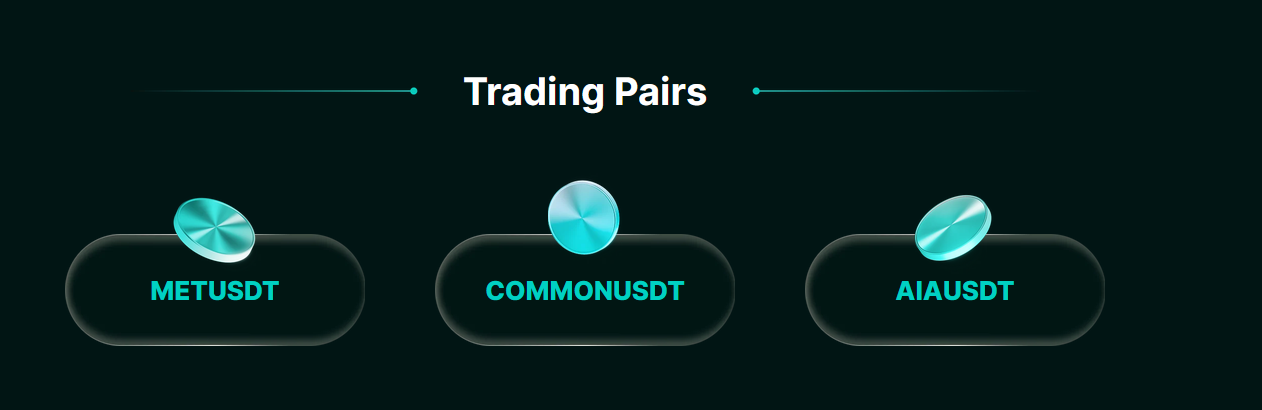
- Cross-check the designated pairs list on the competition’s official page. In recent Zoomex events this list has included newer contract listings such as METUSDT, COMMONUSDT, and AIAUSDT, alongside majors like BTC and ETH futures.
- Maintain the minimum net asset balance required to remain reward-eligible. Zoomex’s contract competitions have required participants to <cite index=”10-1″>maintain a net asset balance of over $50</cite> to receive payouts, and unverified accounts forfeit rewards entirely.

Source: Zoomex
Use Volume Thresholds as Checkpoints, Not Just a Finish Line
Zoomex structures its tiered competitions around clear volume checkpoints rather than a single continuous curve. In the New Contract Trading Competition, for instance, ranking bonuses stepped from a $1,000,000 volume threshold up through $3,000,000 for the top spot, with a separate flat $10 bonus unlocked at just $20,000 in cumulative volume. That structure rewards traders who plan their trading in stages:
Stage 1: Hit the minimum unlock threshold early. Getting past the base volume requirement in the first days of the event secures your baseline reward and removes pressure later.
Stage 2: Reassess your position on the leaderboard. Because Zoomex has published daily leaderboard updates through its official community channels in past events, checking your standing lets you decide whether pushing for the next tier is worth the additional exposure.
Stage 3: Push for the top tier only if your risk-adjusted return supports it. Climbing from a mid-tier bonus to a top-tier one usually requires a nonlinear jump in volume. Do the math on whether the marginal reward actually compensates for the marginal risk before increasing size.
Treat Bonus Funds as Free Variance, Not Free Capital
Zero-cost competitions like the 2026 Zero-Cost Trading Competition are structurally different from deposit-based ones. Zoomex gave <cite index=”2-2″>newly registered users $100 to $200 in bonus trading funds</cite> so they could enter the Individual Competition or Entertainment Zone without depositing. This is genuinely useful for testing a competition strategy with zero personal capital at risk, but it should be treated as exactly that: a testing budget, not a scaling budget.
A disciplined approach is to use bonus funds to validate your entry and exit logic under real competition conditions (volume tracking, order execution speed, how quickly your fills reflect on the leaderboard) before deploying your own capital, if you choose to at all. This also matters for compliance: some Zoomex events explicitly restrict participation to non-affiliate accounts and flag multiple-account or arbitrage abuse for disqualification, so keep your strategy to a single verified account.
Factor In Execution Quality, Not Just Position Sizing
A high-performance matching engine matters more in a volume-weighted competition than in ordinary trading, because slippage and fill latency directly reduce your effective, reportable volume per trade. Zoomex has positioned its infrastructure around this exact point, emphasizing <cite index=”2-4″>a high-performance matching engine and transparent asset and order displays that ensure consistent trade execution and fully traceable results</cite>. In practice, that means:
Favor limit orders during high-volatility windows only if you have confirmed fill rates are acceptable; a missed fill is lost volume that can’t be recovered later in the event.
Monitor spread and depth on the designated pairs specifically, since thinner contracts like recent altcoin listings can behave very differently from BTC or ETH futures under competition-driven volume spikes.
Use leverage deliberately. Zoomex supports leverage up to 1:150, which can accelerate volume accumulation, but every increment of leverage also increases the return-side variance that factors into the 30% return component of the Individual Competition score.
Build a Simple Pre-Competition Checklist
Before the next Zoomex competition window opens, run through this sequence:
- Read the specific promotion page in full and identify the exact scoring formula (blended return/volume vs. pure volume tiers).
- Upgrade to a Unified Trading Account if you haven’t already, and confirm KYC is complete so rewards aren’t forfeited later.
- Identify the designated trading pairs and check current liquidity conditions on each.
- Decide your volume checkpoints in advance, tied to the specific bonus tiers published for that event.
- Join Zoomex’s official community channels for daily leaderboard visibility during the event.
- If bonus funds are offered, use them to test execution before scaling with personal capital.
Competitions like these are ultimately a controlled environment for sharpening real trading discipline: reading the rules precisely, respecting position sizing, and executing with intent rather than emotion. The traders who consistently place well are rarely the ones who trade the most impulsively. They’re the ones who understood the scoring formula on day one.
About Zoomex
Founded in 2021, Zoomex is a global cryptocurrency trading platform focused on derivatives trading. The platform serves over 3 million users across 35+ countries and regions, offering access to 590+ trading pairs. Built around easy to use, transparency, fairness, and speed, Zoomex provides a clear and efficient trading experience for users worldwide.
Through its high-performance matching engine, clear asset and order displays, and transparent fee and rule mechanisms, Zoomex helps users better understand their account status, order execution, trading costs, and results. Zoomex maintains registrations, licenses, and regulatory statuses across multiple jurisdictions, including the U.S. MSB, Canada MSB, U.S. NFA, and Australia AUSTRAC, and has completed security audits conducted by blockchain security firm Hacken. The platform also continues to strengthen its trust framework through Proof of Reserves, Security & Transparency, Compliance Information, and Fees / Rules Transparency initiatives.
Beyond trading, Zoomex builds a refined brand experience through elite sports partnerships, including the TGR Haas F1 Team, World Cup-winning goalkeeper Emiliano Martínez, and world-class tennis events such as Wimbledon. The values of speed, precision, discipline, fair play, and rule-based execution are closely aligned with Zoomex’s approach to derivatives trading.
At Zoomex: Easy to Use. Transparent balance. Fair access to your earnings.
The post How to Maximize Your Edge in Zoomex Trading Competitions appeared first on BeInCrypto.


Former Ethereum Foundation researcher Francesco D’Amato has joined independent protocol research group Ethlabs, extending the movement of core Ethereum developers into organizations operating outside the Foundation.
Summary
- Former Ethereum Foundation researcher Francesco D’Amato has joined Ethlabs after five years to continue Ethereum protocol research.
- D’Amato said he will keep working on faster Ethereum finality while helping Ethlabs expand its protocol research team.
- The move adds to a growing number of independent Ethereum organizations formed by former Foundation researchers following the Foundation’s restructuring.
According to a statement shared by Ethereum Foundation researcher Francesco D’Amato on X, he has left the Ethereum Foundation after five years to join Ethlabs, a nonprofit protocol research organization established by former Foundation researchers to continue Ethereum core development.
During his time at EF Research, D’Amato said he worked across several protocol research areas, including maximal extractable value (MEV), consensus mechanisms, data availability sampling, and execution layer pricing. He described the decision to leave as difficult but said the current period of change made it the right moment for “a new beginning.”
“Leaving that behind is hard, but after 5 years this time of great change seems right for a new beginning,” D’Amato wrote.
He added that, for the first time since beginning Ethereum protocol research, he believes there is “a credible shot” for core research to advance outside the Ethereum Foundation.
At Ethlabs, he said he will work alongside former EF colleagues to expand the organization’s protocol research efforts, bring new researchers into the ecosystem, and continue contributing to Ethereum’s long-term technical roadmap.
Among his priorities, D’Amato said he intends to keep working on reducing Ethereum’s transaction finality time, stating that he plans to focus much of his effort on helping Ethereum “finalize much faster, as soon as possible.”
Ethlabs expands its research team
Ethlabs launched in June as an independent nonprofit research organization founded by former Ethereum Foundation researchers Ansgar Dietrichs, Barnabé Monnot, Caspar Schwarz Schilling, Josh Rudolf, and Julian Ma. The organization said its research spans settlement speed, network capacity, native asset issuance, cross-chain interoperability, and Ethereum’s monetary design.
Backed by Ethereum co-founder Joe Lubin, Bitmine, SharpLink, Anchorage, Octant, SNZ, and other Ethereum ecosystem participants, Ethlabs has said its research priorities are tied to growing institutional use of Ethereum for stablecoins, tokenized assets, investment products, and AI-driven commerce.
The group has also stated that research decisions remain independent despite corporate funding, with contributions managed through an external grants administrator.
When the organization launched, executive director Ansgar Dietrichs said Ethlabs was created to advance Ethereum’s core technology while providing a long-term home for protocol researchers outside the Ethereum Foundation. Lubin described the organization as another stewardship body working alongside the Foundation and other independent contributors to Ethereum’s development.
Ethereum development spreads beyond the Foundation
D’Amato’s move comes as the Ethereum Foundation continues reshaping its internal structure and as more protocol work shifts to independent organizations.
Last month, the Foundation reduced its workforce by 54 positions, or about 20%, following a review of its staffing and long-term responsibilities. It later dissolved its Protocol Support team while reorganizing its remaining work into dedicated divisions covering protocol development, users, community, access, and institutional activity.
The restructuring has also led to the creation of new Ethereum-focused organizations. Earlier this month, former Foundation employees Mo Jalil, Oskar Thorén, and Aaryamann Challani launched EthSystems, a for-profit company building confidential infrastructure for regulated financial institutions on Ethereum with backing from Bitmine, SharpLink, and Lubin.
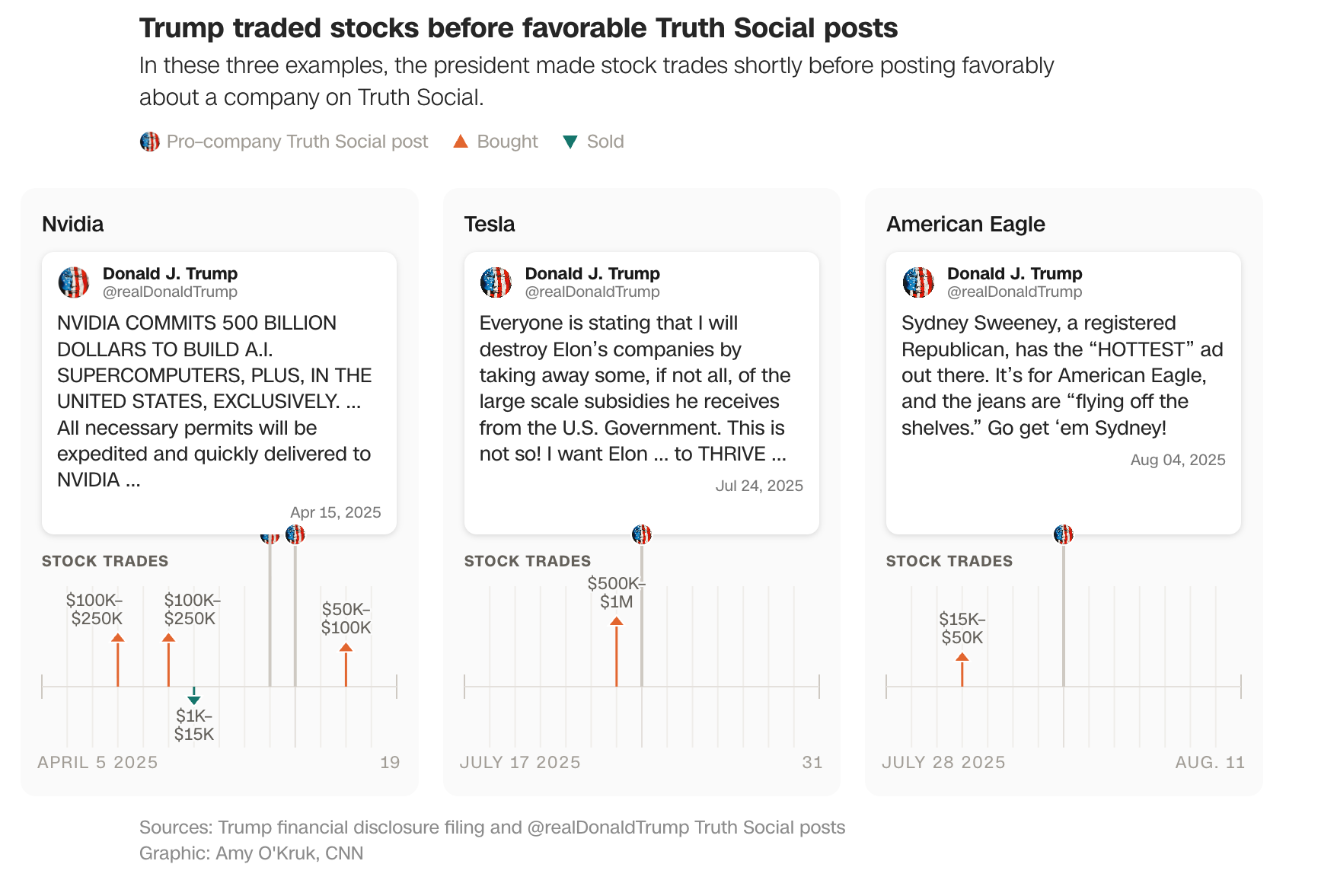
President Donald Trump bought stock in 21 companies within a week before posting favorable Truth Social messages about them, a CNN investigation found. He made at least 44 purchases.
The findings sharpen questions about whether the president holds a conflict of interest through his trading.
44 Trades, 21 Companies, A Key Pattern in Trump’s Truth Social Posts
Trump’s 2025 financial disclosure listed more than 21,000 transactions. The Office of Government Ethics released it last month. Most were stock purchases and sales, reported in broad dollar ranges.
In one example, Trump bought between $200,000 and $500,000 in Nvidia stock in April. Days later, he promoted the chipmaker’s plans to build artificial intelligence supercomputers in the United States.
In the April 15 post, he also vowed to expedite all necessary permits for Nvidia and similar firms.
“Trump is both a frequent poster and stock trader, sending more than 6,000 Truth Social posts last year and often sharing his opinions about major corporations, while his managers made more than 20,000 stock purchases or sales in that same time frame,” the report read.

Not every post was positive. Trump made 17 purchases of eight companies before criticizing them, including Comcast and Microsoft.
Moreover, CNN found no evidence that Trump used the posts to lift his own holdings. Most of his trades drew no matching Truth Social activity.
Follow us on X to get the latest news as it happens
White House Rejects Conflict Claims
The White House repeatedly denied that Trump has ever used his office for personal gain. It said his assets sit in fully discretionary accounts managed by independent institutions.
“President Trump only acts in the best interests of the American public … There are no conflicts of interest,” White House spokesperson Anna Kelly said.
Trump also broke with recent presidents on one point. Every stock-owning president for the past 5 decades has used a blind trust. Trump instead uses a trust with his son, Donald Trump Jr., as trustee.
That setup lets him know his holdings, even if he cannot direct trades. Previously, timing concerns surfaced when a BBC probe flagged suspicious trades before Trump’s market-moving statements.
The scrutiny lands as Trump Media prepares to sell Wall Street faster access to Truth Social posts. Its Truth API launches August 1, delivering top accounts’ posts at a significantly faster pace.
That product would let paying firms react to the posts faster than the public. This, in turn, would let Trump Media, where his family is the largest shareholder, benefit from his posts. It also deepens the same conflict that his trading already raises.
Subscribe to our YouTube channel to watch leaders and journalists provide expert insights
The post Trump Praised Over 20 Companies on Truth Social After Buying Their Stock, CNN Finds appeared first on BeInCrypto.
On 3 July, Japan’s Finance Minister, Satsuki Katayama, stated that the Ministry of Finance remains in close contact with US authorities regarding developments in USD/JPY as the yen traded near its weakest level in almost 40 years. Similar verbal warnings have become increasingly common whenever the pair approaches the 162.00 area, although no direct intervention has been announced so far.
At the same time, weaker-than-expected US inflation data added pressure to the dollar. On 14 July, June’s Consumer Price Index came in below forecasts, significantly reducing expectations of a Federal Reserve rate hike at the July meeting and pushing US Treasury yields lower. The combination of increasingly cautious rhetoric from Japanese officials and softer US inflation expectations may keep USD/JPY range-bound, preventing buyers from establishing a sustained break above its multi-decade highs.
Technical Picture
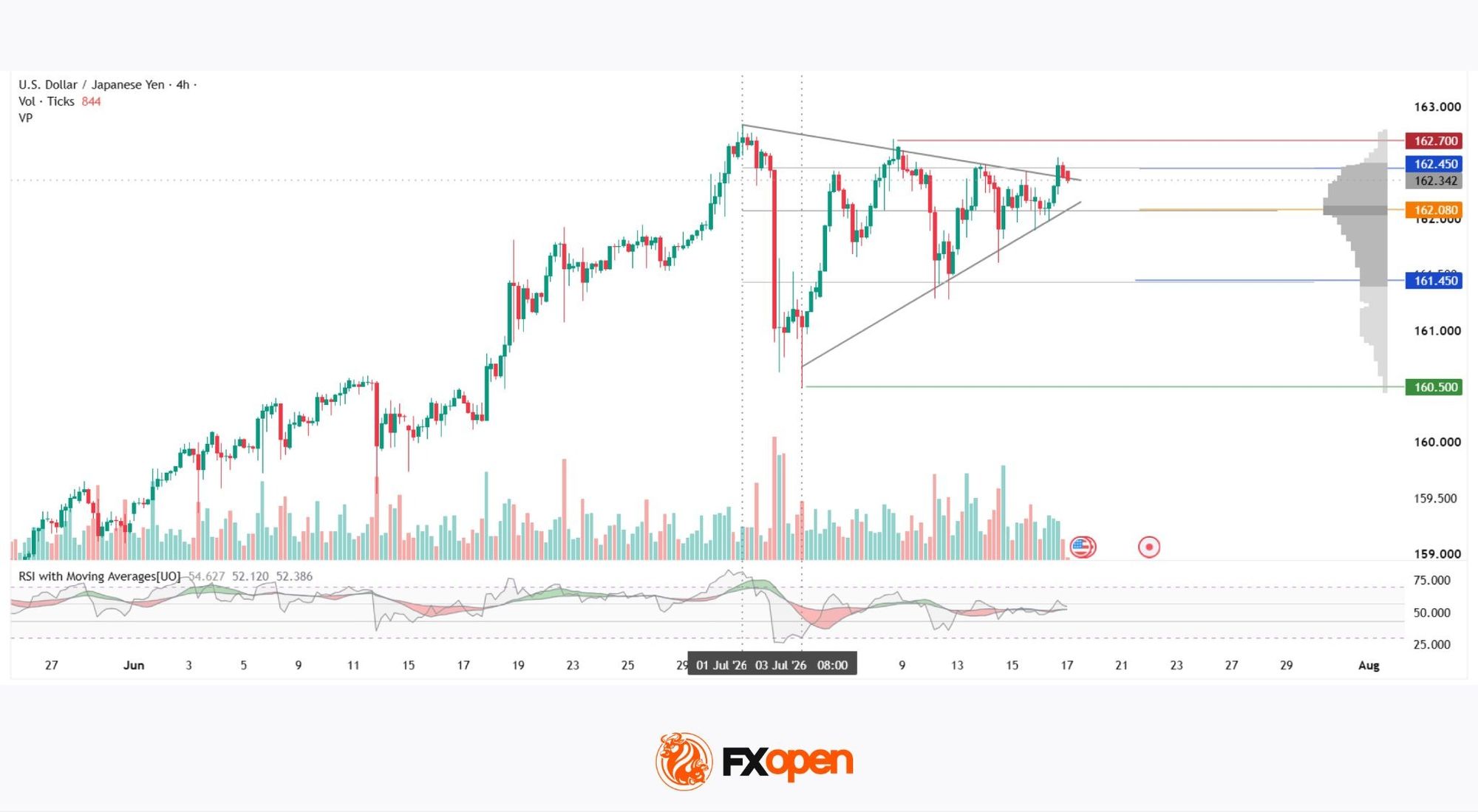
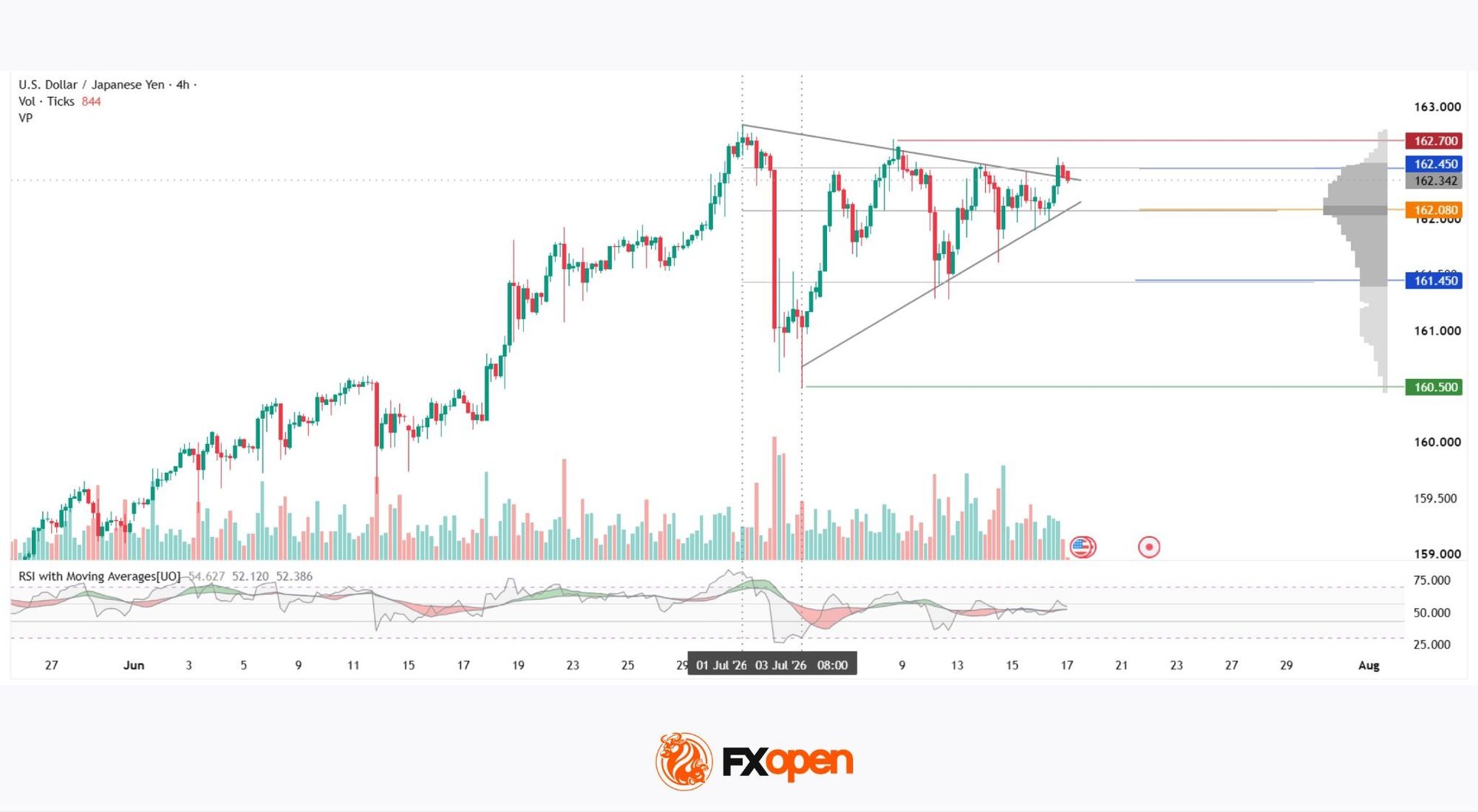
On the four-hour chart, USD/JPY advanced steadily throughout June, reaching a peak near 162.80 on 1 July. A sharp reversal followed, with the pair dropping rapidly to the 160.50 area, where the green support zone is currently located. The decline coincided with market speculation about a possible currency intervention by the Japanese authorities.
After rebounding from the 3 July low, the pair began forming a triangle pattern. Price is now testing the upper boundary of the formation, although the attempted upside breakout is currently being capped by the upper edge of the current volume profile at 162.45. Just above this level lies the red resistance zone at 162.70.
The Point of Control (POC) is located around 162.08 and could become a key magnet if the pair moves back towards the lower part of the range, where two additional important technical levels are visible: the lower boundary of the volume profile at 161.45 and the green support zone at 160.50.
Volume behaviour also deserves attention. The break above the triangle’s upper boundary was not supported by strong bullish volume, indicating limited buying conviction and increasing the risk that the breakout could soon reverse. Meanwhile, the RSI + MAs oscillator stands at 54, 52 and 52 respectively, with all three readings remaining firmly in neutral territory, reinforcing the current lack of directional conviction.
Key Takeaways
USD/JPY is testing the upper boundary of its current market structure while momentum indicators remain neutral. The lack of bullish volume at the breakout adds uncertainty, while the Point of Control around 162.08 could be the key reference level if price begins to move lower.
Trade over 50 forex markets 24 hours a day with FXOpen. Take advantage of low commissions, deep liquidity, and spreads from 0.0 pips (additional fees may apply). Open your FXOpen account now or learn more about trading forex with FXOpen.
This article represents the opinion of the Companies operating under the FXOpen brand only. It is not to be construed as an offer, solicitation, or recommendation with respect to products and services provided by the Companies operating under the FXOpen brand, nor is it to be considered financial advice.


US spot Bitcoin ETFs attracted $79.2 million on Thursday, lifting their three-day inflow total to about $368 million as Bitcoin attempted a price recovery.
Crypto World
Zoomex Predict World: Turning Crypto Markets, Sports, and Global Events Into Live, Tradable Predictions
Football and crypto have been circling each other for years through sponsorships, fan tokens, and NFT collectibles. Zoomex has taken a more direct route by connecting the two markets together, letting users trade on match outcomes with the same tools they already use to trade crypto. The result is Zoomex Predict World, a prediction market built for the 2026 World Cup and designed to feel less like a betting slip and more like a live order book.

Source: Zoomex
What Predict World Actually Is
Zoomex Predict World is the flagship sports application of Zoomex’s new Prediction Market product, an event-based trading system that lets users take a position on an outcome, whether that’s a football result, a crypto price level, or another real-world event, and trade that position as conditions change. Inside the World Cup zone specifically, users pick match events, review the available outcomes alongside their current market prices or implied probabilities, and enter a position using crypto through their Zoomex account.
The part that separates this from a traditional prediction pool is what happens after the position is opened. A correct call at kickoff doesn’t need to be held blindly until the final whistle. As the match develops, goals go in, cards get shown, injuries happen, substitutions shift momentum, users can sell their existing shares, add to a position, trim it, or flip to the opposite outcome entirely. Prediction shares are priced continuously, so match events translate into price movement the same way news moves a crypto pair. That turns a pre-match guess into something closer to an in-play trading session, run through the same interface Zoomex traders already know.
The World Cup Campaign
Zoomex paired the product launch with a dedicated World Cup Football Carnival campaign, running as a prediction market from June 11 through July 19, 2026 (UTC), with qualifying points valid through July 26 and rewards distributed between July 26 and July 31, 2026. Entry is free, and participants can forecast match outcomes, finalists, and the eventual champion directly from the Zoomex app.

Source: Zoomex
On top of the predictions themselves, Zoomex layered in a task-based rewards system. Users unlock Lucky Spin chances by:
- Reaching cumulative valid prediction amount thresholds
- Completing a set number of valid predictions each day
- Racking up correct predictions over time
- Inviting friends to join the World Cup predictions
Those spins feed into a prize pool that includes World Cup final and semi-final live match tickets, World Cup-themed gift boxes, airdrop rewards, margin deduction coupons, copy trading insurance funds, and futures trial funds, all on top of a reported $1,000,000 total prize pool for the campaign. Full mechanics, timelines, and eligibility details are published on the Zoomex campaign page and official channels, so it’s worth checking there before jumping in.
Beyond Sports: Politics, Macro, and Global Events
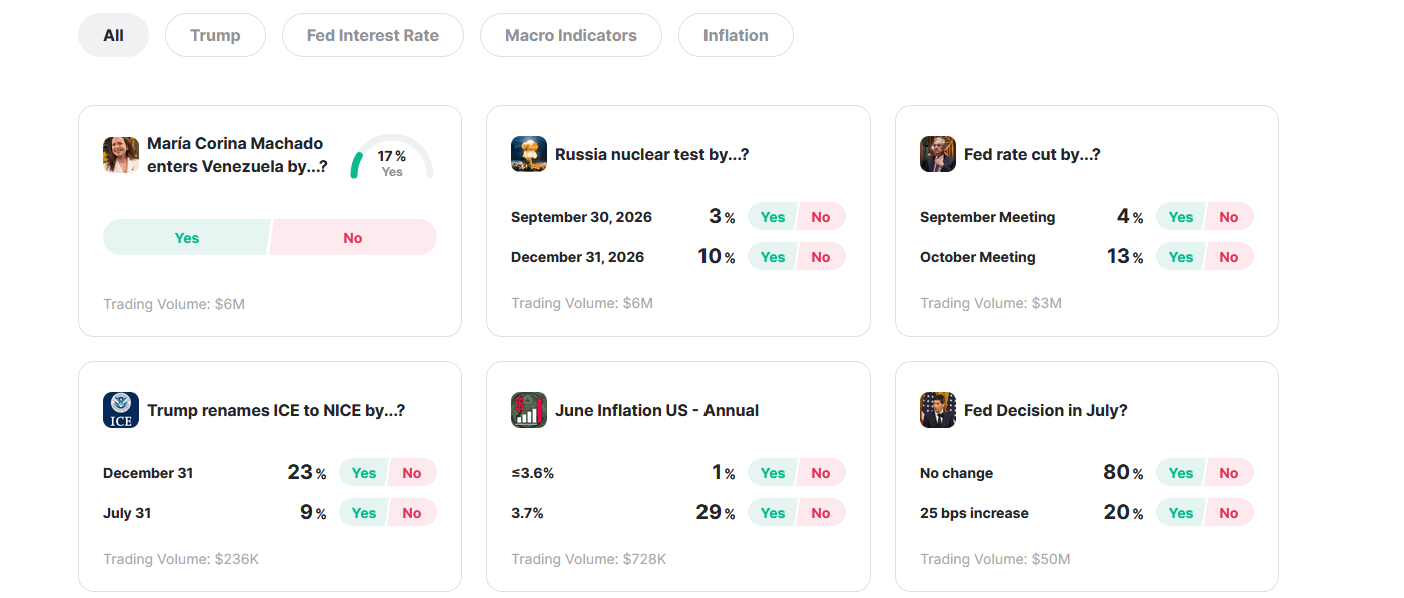
The World Cup zone is just one filter inside Predict World. Browse the full markets view and the category tabs make the range clear: alongside sports, there’s Trump, Fed Interest Rate, Macro Indicators, and Inflation, each holding a live board of yes/no markets with real-time pricing and trading volume attached.

The mix on any given day can span geopolitics and monetary policy in the same scroll: a market on whether María Corina Machado enters Venezuela by a set date, another tracking the odds of a Russia nuclear test by specific 2026 deadlines, and a running board on Fed rate cuts broken out by meeting date, each priced individually with its own Yes/No spread. Macro releases get the same treatment, with a market on the June US annual inflation print offering separate outcome bands (such as at or below 3.6% versus exactly 3.7%) that traders can position on ahead of the data. Even political process questions show up, like a market on whether Trump renames ICE to NICE by year-end, split into short-term and longer-dated windows. Some of these single markets carry trading volumes in the tens of millions, on par with what a mid-sized crypto pair might see in a day.
That range is the point. A trader who has a read on Fed policy doesn’t need to leave Zoomex to act on it, and someone tracking inflation data or a geopolitical headline can turn that view into a position with the same mechanics used for the World Cup markets described above: enter early, adjust as new information lands, exit whenever the price no longer matches their view.
Why It’s Built for Crypto Traders Specifically
Most prediction markets ask users to think like sports bettors. Zoomex Predict World asks them to think like traders, because that’s exactly the audience it’s built for. Match outcomes become event-based assets. Market prices reflect the crowd’s live expectations, not a fixed pre-match line. Someone who already understands how to manage a position on Zoomex, when to add exposure, when to cut it, when the market has clearly turned, can apply the same instincts to a football match as they would to a volatile altcoin.
That’s the real pitch behind Predict World: it doesn’t ask crypto users to learn a new mental model. It hands them a World Cup-shaped version of the one they already use every day on Zoomex.
Getting Started
Joining the campaign takes a few steps:
- Open or log into your Zoomex account
- Head to the Predict World zone
- Browse upcoming match events and review current outcome pricing
- Enter a position with crypto, then manage it as the match plays out
- Complete daily and cumulative tasks to earn Lucky Spin chances toward the reward pool
With the World Cup entering its most unpredictable stretch, the window to build up valid predictions and Lucky Spin entries is narrowing. Fans who want to combine tournament excitement with an actual trading edge can head to Zoomex Predict World now and put their read on the tournament to the test.
About Zoomex
Founded in 2021, Zoomex is a global cryptocurrency trading platform focused on derivatives trading. The platform serves over 3 million users across 35+ countries and regions, offering access to 590+ trading pairs. Built around easy to use, transparency, fairness, and speed, Zoomex provides a clear and efficient trading experience for users worldwide.
Through its high-performance matching engine, clear asset and order displays, and transparent fee and rule mechanisms, Zoomex helps users better understand their account status, order execution, trading costs, and results. Zoomex maintains registrations, licenses, and regulatory statuses across multiple jurisdictions, including the U.S. MSB, Canada MSB, U.S. NFA, and Australia AUSTRAC, and has completed security audits conducted by blockchain security firm Hacken. The platform also continues to strengthen its trust framework through Proof of Reserves, Security & Transparency, Compliance Information, and Fees / Rules Transparency initiatives.
Beyond trading, Zoomex builds a refined brand experience through elite sports partnerships, including the TGR Haas F1 Team, World Cup-winning goalkeeper Emiliano Martínez, and world-class tennis events such as Wimbledon. The values of speed, precision, discipline, fair play, and rule-based execution are closely aligned with Zoomex’s approach to derivatives trading.
At Zoomex: Easy to Use. Transparent balance. Fair access to your earnings.
The post Zoomex Predict World: Turning Crypto Markets, Sports, and Global Events Into Live, Tradable Predictions appeared first on BeInCrypto.


It shows that major participants are not just “long-only” or “short-only” speculators; they are increasingly treating volatility as a separate asset class and using complex options Greeks, specifically vega (sensitivity to volatility) and gamma (sensitivity to price acceleration), to extract profit from market turbulence.
Inside the $28 million straddle
Notional value represents the total market value of the underlying asset controlled by the trade, rather than the cash paid to enter it.
The straddle involved the purchase of 15,000 contracts, with each contract representing 1 ETH. The notional value, therefore, is calculated by multiplying 15,000 by the market price of ETH on the day of execution. That amount comes to roughly $28 million.
According to Laevitas, the trader paid a premium of $852,000 to establish this $28 million notional straddle. That premium represents the maximum amount at risk if ether remains range-bound or quiet through the July 24 expiry, leading to a “time-decay” in option value.
Now, turning to the maximum possible gain: it is theoretically unlimited. This stems from the fact that volatility itself has no upper bound, as asset prices can, in principle, move dramatically in either direction.
Caveat
While the prospect of profiting from a move in either direction is enticing, the high cost of entry and the relentless decay of time value serve as a stark warning.
Amid all the controversial feedback and token price moves as of late, Pi Network’s Core Team continues with outlining new initiatives aimed at improving the overall user experience.
The latest focused on the Pi mining app and the app profile page, and here’s what users have to know about the new changes.
Redesign Updates
The blog post published by the team stated that the changes reflect the first step of a broader mining app design refresh, as they make “important Pioneer info and ecosystem features easier to find, understand, and navigate.” Users, also referred to as Pioneers within the broader Pi Network ecosystem, can click on the hamburger icon on the top left to review them.
The new side menu presents key information and ecosystem components in a clearer, more organized format, including better UI style and visual hierarchy throughout. Users can easily view features like the Mainnet Checklist, mining information, featured Pi Apps, and “other important parts of the Pi experience in one place.” The app also contains a dark mode now.
The post further explained that the refresh comes after an intense feedback process from all users. Pioneers have reportedly shared that the mining app has been operating well, but it was time for a new look and improved experience. The team promised that this redesign is just the first step of a more profound Pi Network response.
Because the mining app is used by over 60 million ‘engaged’ Pioneers, “changes to its design and user experience must be introduced thoughtfully and iteratively, not all at once.”
“The goal is to improve clarity, style, and usability while maintaining the core functionalities that have been working and continuing to learn from Pioneers’ feedback.”
PI Price Update
No matter what sorts of features or new updates the team behind the project announces, the native token continues to underperform. It recently lost the key $0.10 support level, and the bears drove it south hard, plummeting to a new all-time low of just over $0.07 (on CoinGecko).
PI rebounded swiftly and challenged $0.085, but that was another dead-cat bounce. It was rejected yesterday and plunged to $0.073 once again. Nevertheless, it has found some support there and now trades at $0.078 after a minor daily increase.
PiScan data continues to show a rather worrying trend as almost 130 million coins are scheduled to be unlocked in the next month, which could, at least in theory, increase the immediate selling pressure from investors who have been waiting for their tokens for a while.

The post Pi Network Team Surprises Pioneers With Major Redesign: Here’s What’s New appeared first on CryptoPotato.

A prominent Bitcoin Ordinals advocate, Leonidas, has proposed building an alternative open-source Bitcoin client aimed at easing protocol-level limits that currently affect Ordinals inscriptions and Runes-style token transfers. The proposal, discussed in a Friday post on X, is framed as a way to reduce what Leonidas calls unnecessary “permission” requirements enforced by widely used node software.
Leonidas’ plan—described as “Bitcoin $DOG Mode”—would, if implemented, increase the maximum individual transaction size and reduce the network’s dust threshold. Supporters argue these changes would make it more practical to package larger token and inscription activity into fewer transactions, while critics have long accused Ordinals and Runes of contributing to “spam” on Bitcoin’s base layer.
Key takeaways
- “Bitcoin $DOG Mode” proposes a new open-source client to relax limits that Leonidas says hinder Ordinals inscriptions and Runes transactions.
- It targets a much higher max transaction size—3.9 million weight units versus Bitcoin Core’s 400,000 WU.
- It would lower the dust limit to 1 satoshi from the current range of 294–546 sats, reducing output padding requirements.
- The approach is positioned as competitive: the client would be an alternative to Bitcoin Core and Bitcoin Knots, with the goal of pressuring broader adoption to loosen restrictions.
What Leonidas says would change
In his announcement on X, Leonidas set out two specific operational tweaks. First, the proposal would lift the maximum allowed size for an individual transaction to 3.9 million weight units, compared with 400,000 WU under Bitcoin Core. Second, it would reduce the dust limit—the minimum UTXO amount considered economically spendable—to 1 satoshi, down from a 294–546 satoshi range.
Leonidas’ stated reasoning is that Bitcoin’s rules and culture are broader than what popular client implementations currently permit. He argues that Bitcoin Core and Bitcoin Knots have spent years applying policies that go beyond what he believes the protocol requires, particularly in ways that complicate how Ordinals and Runes activity is formatted and relayed across nodes.
“Bitcoin Core and Bitcoin Knots have spent years enforcing rules that Bitcoin itself does not have,” Leonidas said in a statement, describing the initiative as a response to what he calls excessive restrictions.
Why transaction limits matter for Ordinals and Runes
Both Ordinals and Runes are often discussed as Bitcoin’s answer to categories of assets usually associated with token standards outside Bitcoin—inscriptions for non-fungible representations and Runes for fungible token-like transfers. Even though they’re controversial, they share a practical challenge: getting complex data and structured token transfers into transactions that fit within standard limits.
Leonidas emphasized that increasing the transaction size ceiling would make it easier for Ordinals users to fit much larger files or collections into a single transaction. Under the proposed settings, he said it could be possible to create transactions that consume a large share of block space—transactions approaching nearly an entire block—without being blocked by client-imposed maximums.
The dust-limit change would also target day-to-day friction. Dust rules determine the smallest outputs that are economical to handle. If dust is too high, users may need to create extra output padding to ensure their transactions get relayed and processed smoothly by default Bitcoin Core nodes. Leonidas’ proposal would reduce that requirement by lowering the economically “uneconomical” floor to 1 satoshi.
From an end-user perspective, those adjustments translate into fewer constraints when forming inscription-heavy or token-heavy transactions—potentially enabling more efficient packaging and less waste in output structure.
Alternative client strategy—and what it would take to move the market
Leonidas positioned $DOG Mode not as a patch to Bitcoin Core, but as an alternative open-source client. In his description, the new client is meant to compete with two of the most widely used Bitcoin node implementations: Bitcoin Core and Bitcoin Knots.
The broader bet is that if enough users run the new client, Bitcoin Core may eventually be forced to reconsider its own policy restrictions in practice. Leonidas said the objective is to build enough adoption that Bitcoin Core would “eventually” have to loosen its stance.
That strategy reflects a key tension in Bitcoin’s ecosystem: software defaults strongly influence what is considered “normal” network behavior. Even when community debate centers on whether certain limitations are truly required by Bitcoin’s fundamentals, the reality for users is that mainstream clients shape what transactors can practically submit and propagate without running into relay or policy friction.
Whether a competing client can achieve the kind of uptake Leonidas is targeting remains unclear. Adoption depends on more than technical changes—it requires trust in the client’s security, compatibility, and network behavior. The proposal’s effectiveness would also hinge on how other nodes in the ecosystem handle and standardize the transactions produced by $DOG Mode.
An ongoing debate over “spam” and Bitcoin’s direction
The move lands in the middle of a continuing community argument. Leonidas’ remarks explicitly tap into a familiar criticism: that Ordinals and Runes can increase on-chain activity by embedding additional data and structures into transactions. Detractors have repeatedly argued that this kind of usage is “spam” that burdens the network and obscures Bitcoin’s purpose.
Supporters generally counter that Bitcoin’s permissionless nature allows diverse usage, and that clients should not restrict how data and token-like activity can be expressed on-chain when the underlying protocol can accommodate it.
Leonidas’ client proposal is essentially a technological expression of that philosophical dispute. By altering parameters around transaction size and dust thresholds, $DOG Mode would aim to make controversial activity easier to execute and easier to propagate—without relying on permission from the dominant clients.
Earlier coverage from Cointelegraph has discussed the conservative node client landscape as part of this broader context, underscoring how different implementations can influence what users can do on Bitcoin without friction.
Earlier Cointelegraph reporting has also highlighted how conservative approaches can restrict certain inscription activity, reinforcing why Leonidas’ focus on client-enforced rules is central to this proposal.
What readers should watch next is whether Leonidas and supporters produce a working open-source implementation of “Bitcoin $DOG Mode,” and—if they do—how quickly it gains traction among users and node operators. Equally important will be whether the proposed parameter changes trigger more explicit policy adjustments from Bitcoin Core or other major clients, or whether the ecosystem continues to split into competing operational norms.


PayPal’s board has determined that a $53 billion takeover proposal from Stripe and Advent International undervalues the company while raising financing and regulatory concerns, even as discussions continue.
Summary
- PayPal’s board said the $53 billion offer from Stripe and Advent undervalues the company and carries regulatory and financing risks.
- Stripe and Advent have secured about $50 billion in financing while continuing talks to acquire PayPal through a joint ownership structure.
- Investors are now watching PayPal’s upcoming earnings as the company weighs the takeover proposal against its turnaround plan.
Reuters reported that PayPal’s board believes the consortium’s $60.50-per-share offer does not fully capture the value the company could generate if its turnaround plan succeeds, according to a person familiar with the matter. The proposal values PayPal at about $53 billion and represents a premium over the company’s recent trading price.
While the board has not formally responded to the offer, Reuters reported that directors are reviewing both the bid and the possibility of competing proposals before deciding on the company’s next steps.
Alongside the purchase price, the board is weighing the certainty of financing, possible regulatory obstacles, and the time needed to complete such a transaction, the report said.
Shares of PayPal rose about 2% on Thursday to $56.73.
Earlier this month, Stripe and private equity firm Advent International submitted the joint proposal after first approaching PayPal with Block in April. Reuters previously reported that Block later exited the consortium before the latest offer was presented.
Financing package and deal structure
According to Reuters, JPMorgan and Morgan Stanley have assembled a financing package of roughly $50 billion to back the acquisition, while Stripe and Advent would contribute about $17 billion in equity. Under the proposal, the two companies would jointly own PayPal with equal stakes instead of splitting the business into separate entities.
People familiar with the discussions told Reuters the consortium has also explored possible remedies should antitrust regulators raise concerns. One option under consideration would be to separate PayPal’s Braintree business or certain other assets and transfer them to Advent, where they could be combined with the firm’s existing payments investments, including Nuvei.
Although PayPal has reservations about the current terms, Reuters reported that Stripe and Advent remain interested in reaching an agreement and continue to be viewed as the most serious bidders. The sources added that negotiations are expected to continue and may take time before any outcome becomes clear.
Turnaround plan and crypto business remain in focus
Investors are now looking ahead to PayPal’s July 28 earnings report for evidence that its core checkout business is recovering after the company issued weaker-than-expected guidance earlier this year and warned of slowing momentum in the segment, Reuters reported.
PayPal has been restructuring its operations under CEO Enrique Lores, who took over in March. In April, the company reorganized its business into three divisions covering checkout, Venmo consumer financial services, and payments and crypto. First-quarter revenue rose 7% year over year to $8.35 billion, while payment volume increased 8% on a currency-neutral basis to about $464 billion.
The company’s crypto operations include PayPal USD (PYUSD), a dollar-backed stablecoin issued by Paxos and backed by U.S. dollar deposits, Treasuries and similar cash equivalents. PYUSD recently expanded natively to Polygon through the network’s Open Money Stack, giving businesses access to stablecoin payments, settlement, fiat conversion and compliance services.
The proposed acquisition would also unite PayPal’s crypto payment products with Stripe’s expanding stablecoin infrastructure. Stripe strengthened its blockchain payments business through its roughly $1.1 billion acquisition of stablecoin platform Bridge and has since expanded stablecoin payment services across multiple technology platforms and blockchain networks.
According to Reuters, Advent joined the bid because funding the entire equity portion would be difficult for privately held Stripe alone. The private equity firm’s long history of investments in payment companies, including Worldpay, Vantiv, and Nuvei, could also provide additional flexibility if regulators require changes to the transaction structure.
Reuters noted that the size of the proposed acquisition and potential antitrust scrutiny could complicate any path to a completed deal.

Taylor Frankie Paul’s Team Reacts to Parenting Concerns

Raid 2: Money Money 8K Video Song | Yo Yo Honey Singh, Ajay Devgn, Jacqueline F, Riteish D

Subtle warning signs of deadly pneumonia everyone MUST know: Yet another celebrity is killed by suffocating disease that can go unnoticed for months – and people of all ages are at risk


-

 Fashion6 days ago
Weekend Open Thread: Nutriplenish Leave-In Conditioner
-
 NewsBeat17 hours ago
London Mayor Sadiq Khan handed a peerage by Keir Starmer alongside 15 other Labour figures… just days before the PM leaves No10
-

 Crypto World1 day ago
CFTC blocks Kalshi from unwinding Michigan trades after court order
-

 Business1 day ago
Nvidia Stock Slips After Big Tuesday Rally as Huang Confirms Vera Rubin Chip Is Now in Production Today
-

 Politics2 days ago
Young campaigners urge incoming PM to act on outdoor junk food ads
-

 News Videos3 days ago
XRP BOMBSHELL… XRP OMBOARDED FOR TRANSACTIONS!!!
-

 Tech3 days ago
Get Your ESP32 Sunny Side Up With This Solar Dev Board
-
 Entertainment2 days ago
Disney’s Most Ambitious Failed Star Wars Attraction Is Coming to SDCC
-

 Tech2 days ago
Dark Secrets Emerge When Jailbreaking LLMs
-

 Crypto World11 hours ago
Injective Submits SEC Transfer-Agent Registration to Onchain Ownership Records
-
 Sports1 day ago
New Cornerback Enters Vikings Trade Rumor Mill
-

 News Videos1 hour ago
Money | Class 12 Economics | CBSE Board Exam 2026-27
-

 Business7 hours ago
Banco Bilbao Vizcaya Argentaria, S.A. (BBVA) Discusses Global Macro Environment and Economic Outlook for Core Markets Transcript
-
 Tech4 days ago
Cloudflare Precursor Watches Your Mouse and Keyboard To Decide If You Are Human
-

 News Videos4 days ago
how to make coin bank box with cardboard #scienceproject #money #diy #shorts
-
 Entertainment2 days ago
Vicki Gunvalson Defends Discussing Heather Dubrow’s Money
-
Crypto World3 days ago
Ripple, Coinbase, Circle Join Linux x402 Foundation to Help Shape AI Payments
-

 Business1 day ago
Palantir Shares Rise After Expanded Nvidia Partnership and Fresh Analyst Upgrades Ahead of Earnings Day
-
Business8 hours ago
Nephros, Inc. (NEPH) Discusses Evolving Water Safety Strategies and Expansion Beyond Filtration Transcript
-
 Crypto World10 hours ago
Claude Fable 5 Slips to Second in AI Coding Leaderboard
You must be logged in to post a comment Login