

Crypto World
Bittensor Subnet 68 Screens 11 Million Molecules in Decentralized Drug Discovery Race


TLDR:
- Bittensor Subnet 68 has already screened over 11 million molecules across nine disease targets.
- Three live competitions cover molecule screening, nanobody design, and search optimization.
- Yuma Consensus rewards high-quality research outputs through stake-weighted validator agreement.
- Metanova Labs uses decentralized miners to accelerate drug discovery at lower operational cost.
Bittensor is currently running a live drug discovery operation through Subnet 68. Metanova Labs built the subnet to reduce the high cost of early drug development. So far, 11 million small molecules have been screened across nine active disease targets.
Miners compete to find the best candidates, while validators judge quality through Yuma Consensus. The OpenTensor Foundation has publicly pointed to SN68 as proof of the network’s broader purpose.
Three Simultaneous Competitions Running on Subnet 68
Three separate competitions are running at the same time on Subnet 68. Each targets a different layer of the drug discovery process.
This structure lets the network tackle screening, design, and search strategy all at once. Together, they form a coordinated decentralized research effort with real financial stakes.
The first competition involves small molecule screening across nine active disease targets. Miners work to identify the strongest candidates from among millions of options. The best contributors earn TAO emissions, while low-quality submissions receive no reward.
The second competition centers on nanobody design, targeting PD-L1, a critical marker in cancer immunotherapy. Around 4,200 nanobody structures are under evaluation by competing researchers.
Crypto analyst @2xnmore noted on X that no centralized lab could match this volume of candidate output. The post described Subnet 68 as evidence that decentralized competition can outpace traditional research pipelines.
The third competition focuses on improving the methods used to search chemical space. Sixty-three unique algorithms are competing to explore that space more efficiently than rival approaches. The goal is not only to find good molecules but to build better tools for finding them.
Yuma Consensus Powers Bittensor’s Incentive Framework Across Any Problem Type
Yuma Consensus is the mechanism Bittensor uses to judge output quality across all its subnets. It operates through stake-weighted agreement and does not depend on the type of problem. This design allows it to evaluate drug discovery outputs just as it processes AI language model results.
The pharmaceutical industry spends billions of dollars before a single molecule reaches clinical trials. The chemical search space is too vast for any single organization to cover efficiently. A decentralized network of competing miners can screen millions of candidates at lower cost and higher speed.
This is where Bittensor’s competitive structure becomes relevant to real-world research. Anonymous miners contribute without institutional barriers, driven entirely by TAO emissions. The network removes bottlenecks that typically slow traditional pharmaceutical development pipelines.
Jacob Steeves hosted a full episode with the Metanova Labs team, which the OpenTensor Foundation shared publicly. This places Subnet 68 within the core team’s own stated vision for the network.
Drug discovery, more than any other live application on Bittensor, shows what incentive-driven decentralization can produce. It applies that model to a problem with measurable outcomes and real consequences for human health.


Strategy CEO Phong Le said the company’s success rests on more than the Bitcoin held on its balance sheet.
Summary
- Strategy said Q1 revenue rose 11.9% year over year to $124.3 million.
- Phong Le said cloud revenue grew 59% during the company’s strongest software quarter in years.
- Strategy’s Bitcoin model faces scrutiny as debt and losses mount.
In a post on X, he argued that Strategy’s enterprise software business remains a core part of the company’s long-term model.
Le said the software unit gives Strategy engineers, cloud teams, enterprise customers, compliance systems, and global operations that most digital asset firms do not have. “Strategy’s success is rooted in more than Bitcoin” is the key claim, but it depends on whether the software business can keep growing while Bitcoin drives most investor attention.
Q1 software growth supports Bitcoin costs
Strategy reported $124.3 million in total Q1 2026 revenue, up 11.9% from $111.1 million a year earlier. The company also posted gross profit of $83.4 million, with a 67.1% gross margin.
Le said Q1 was the strongest software quarter in a decade, helped by 12% revenue growth and 59% cloud revenue growth. He added that controllable margin rose 27%, helping fund Bitcoin operating expenses.
The update comes as Strategy’s Bitcoin strategy remains under scrutiny. The company reported a $12.54 billion Q1 net loss, compared with a $4.22 billion loss in the same period last year.
As Crypto.news reported, Strategy had raised $25.3 billion in 2025 to expand its Bitcoin treasury strategy. That report also noted Phong Le’s focus on expanding STRC to support growth in Bitcoin per share.
Strategy turns to AI and enterprise data
Le said Strategy has built an AI data foundation called Mosaic. The platform links large language models, hyperscalers, and data warehouses into a secure enterprise data layer.
He also said the company is rebuilding internal systems with AI and expects more workflows to become automated.
For Strategy, the message is clear: the software arm is no longer just a legacy business. It is part of the company’s case for why its Bitcoin treasury model can operate at institutional scale.


Global markets are entering a major week filled with inflation reports, geopolitical developments, and central macroeconomic data.
Summary
- Iran responded to a US proposal while rejecting claims of surrender during ongoing diplomatic discussions.
- Markets now focus on CPI, PPI, retail sales, and industrial production data this week.
- Bitcoin traders are watching macro volatility as BTC remains near major psychological levels recently.
Traders are closely watching new comments from Iran alongside upcoming U.S. economic releases.
The Kobeissi Letter reported that Iran sent a response to a U.S. proposal through Pakistani mediators. Shortly afterward, Iranian President Masoud Pezeshkian stated that negotiations would not represent surrender.
Iran comments add to market uncertainty
According to statements shared by The Kobeissi Letter, Pezeshkian said Iran would “never bow” to external pressure while defending national interests during talks.
“Dialogue does not mean surrender or retreat” remains the central quote drawing market attention as traders monitor whether diplomatic discussions reduce or increase geopolitical pressure in coming days.
Geopolitical developments have remained an important factor for risk assets this year. Bitcoin and equities have repeatedly reacted to Middle East headlines, especially during periods of uncertainty tied to energy markets and global trade.
CPI and inflation reports now in focus
Markets are also preparing for several major U.S. data releases this week. April CPI inflation data is scheduled for Tuesday, followed by PPI inflation figures on Wednesday.
Retail sales data and industrial production numbers will follow later in the week. Traders are expected to monitor whether inflation continues slowing or shows renewed pressure after recent volatility in commodities and energy prices.
The Kobeissi Letter also pointed to the OPEC monthly report as another event that could influence oil markets and inflation expectations.
Bitcoin traders watch volatility signals
Bitcoin (BTC) traded near the $80,000 region ahead of the macro-heavy week. Crypto.news price data showed BTC holding above major short-term support despite recent market swings.
Crypto traders continue watching whether inflation data and geopolitical developments push investors toward risk assets or trigger another defensive move across financial markets.
Some analysts believe lower inflation could support Bitcoin and equities if expectations for easier monetary policy return. Others remain cautious as global tensions and economic uncertainty continue affecting investor sentiment across crypto and traditional markets.
Bitcoin continues to trade within a broader recovery structure following the strong rebound from the $60K region. However, despite the recent bullish momentum, the market has been struggling to reclaim a decisive resistance zone at the $80K region, where the next major directional move is likely to emerge.
Bitcoin Price Analysis: The Daily Chart
On the daily timeframe, BTC has been recently experiencing choppy price action near the crucial $80K resistance region, while lacking sufficient bullish momentum for a confirmed breakout. This area carries substantial technical importance as it aligns with the 100-day moving average, strengthening seller presence around current levels.
Recent candles reflect increasing hesitation and fading momentum as the market struggles to establish acceptance above this threshold. Based on the current structure and the repeated rejection attempts around the $80K-$82K range, the probability of a bearish reversal appears slightly higher in the short term.
Nevertheless, if buyers unexpectedly manage to push the price above both the 100-day MA and the upper boundary of the price channel, a fresh short-squeeze scenario could unfold, potentially driving BTC toward the major $90K resistance region.

BTC/USDT 4-Hour Chart
On the 4-hour chart, Bitcoin remains trapped within a tight consolidation range bounded by the ascending dynamic trendline from below and the static $80K-$83K resistance zone overhead. This structure reflects a temporary equilibrium between buyers and sellers following the recent impulsive rally.
As long as the price remains confined within this range, further sideways consolidation is likely. However, the ascending trendline near the $78K level currently acts as the key short-term support for buyers. A bearish rejection and breakdown below this trendline could trigger a corrective decline toward the lower order block regions around the $75K-$76K and potentially the $70K-$71K support area.

Onchain Analysis
From an on-chain perspective, the realized price of long-term holder cohorts continues to act as one of the market’s most important macro support and resistance indicators. These realized price levels are crucial because they determine whether specific holder cohorts remain in overall profit or loss, significantly influencing their market behavior.
Currently, Bitcoin is trading between the realized price bands of the 12-month to 2-year cohorts, positioned approximately between $62K and $92K. Historically, remaining above these realized price levels reflects stronger holder confidence and reduced sell-side pressure, while losing them often leads to broader market weakness. As a result, this range remains highly significant for determining Bitcoin’s next macro trend direction.

The post Bitcoin Price Prediction: Where Is BTC Headed Next Week? Key Levels to Watch appeared first on CryptoPotato.


Cardano’s Web3 wallet Lace has received fresh updates as the network prepares for the Van Rossem hard fork.
Summary
- Lace 2.0.3 fixed migration, DApp connection, loading, and legacy wallet issues.
- Lace 2.0.4 added view mode options, auto-lock settings, and language fixes.
- Cardano’s Van Rossem hard fork targets Protocol Version 11 in late June.
The wallet’s recent 2.0 releases focus on smoother migration, better DApp access, and easier wallet use.
Lace 2.0 brings Cardano, Midnight, and Bitcoin into one wallet interface. The update aims to reduce the need for users to move between separate wallets when managing assets across ecosystems.
Lace 2.0.3 and 2.0.4 improve user access
Lace 2.0.3 fixed a white screen issue that stopped some users from completing migration or connecting to DApps. It also fixed a problem affecting some older wallets imported from Nami.
Lace 2.0.4 added a default view mode, letting users switch between Side Panel and Tab. It also introduced an auto-lock timer and fixed missing Spanish and Japanese translations.
Moreover, Cardano is preparing the Van Rossem hard fork, an intra-era upgrade to Protocol Version 11. The upgrade is expected to improve Plutus performance, ledger consistency, and node-level security.
Cardano Node 11.0.1 Pre-Release is required to safely cross the hard fork. Stake pool operators and developers on preview have been asked to upgrade before the mainnet step.
Network upgrade avoids major disruption
The Van Rossem upgrade does not move Cardano into a new era. That matters because transaction formats remain unchanged, reducing work for wallets, DApps, and exchanges.
“Late June 2026” remains the date to watch, but the rollout still depends on readiness and governance steps.
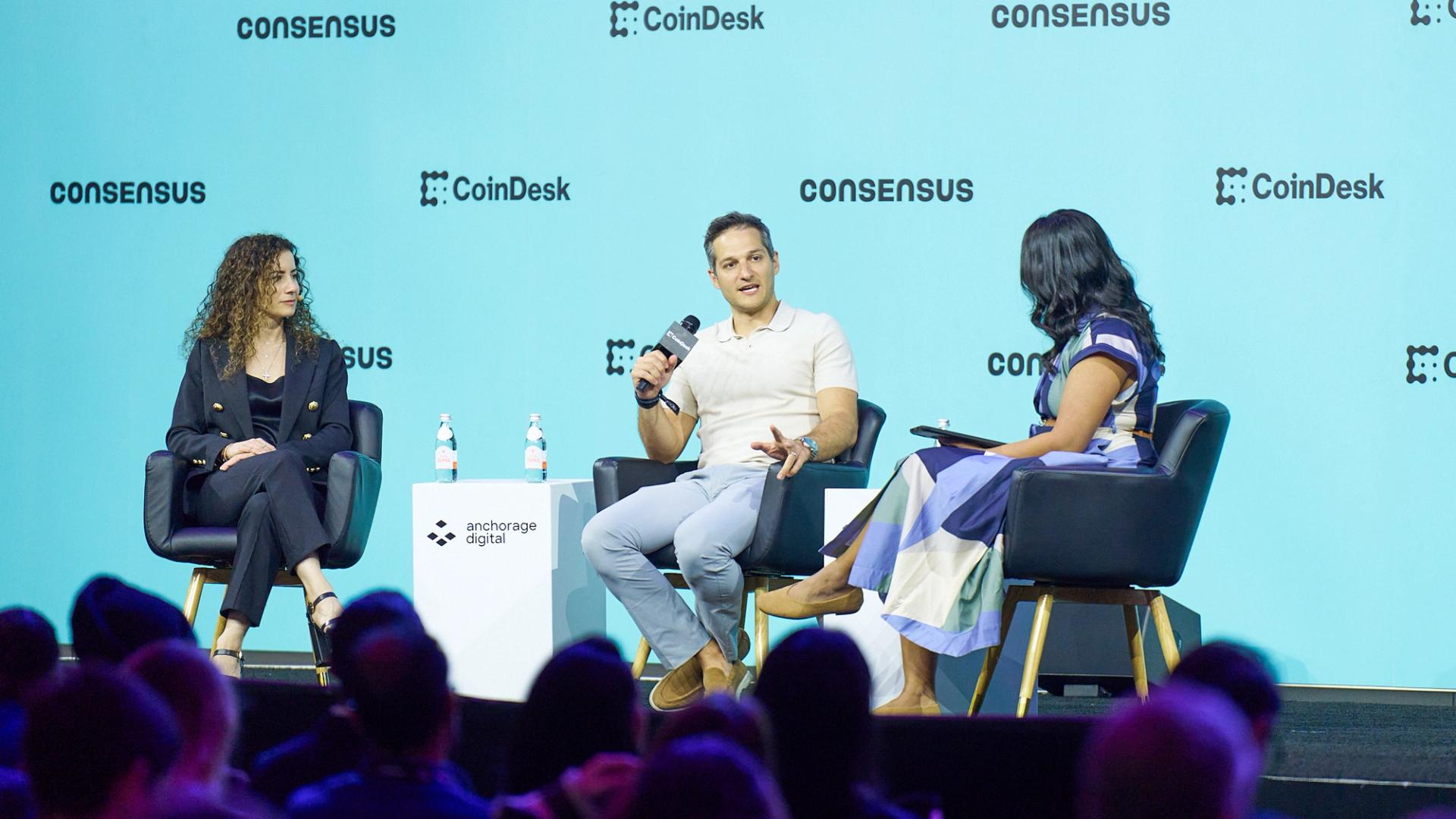
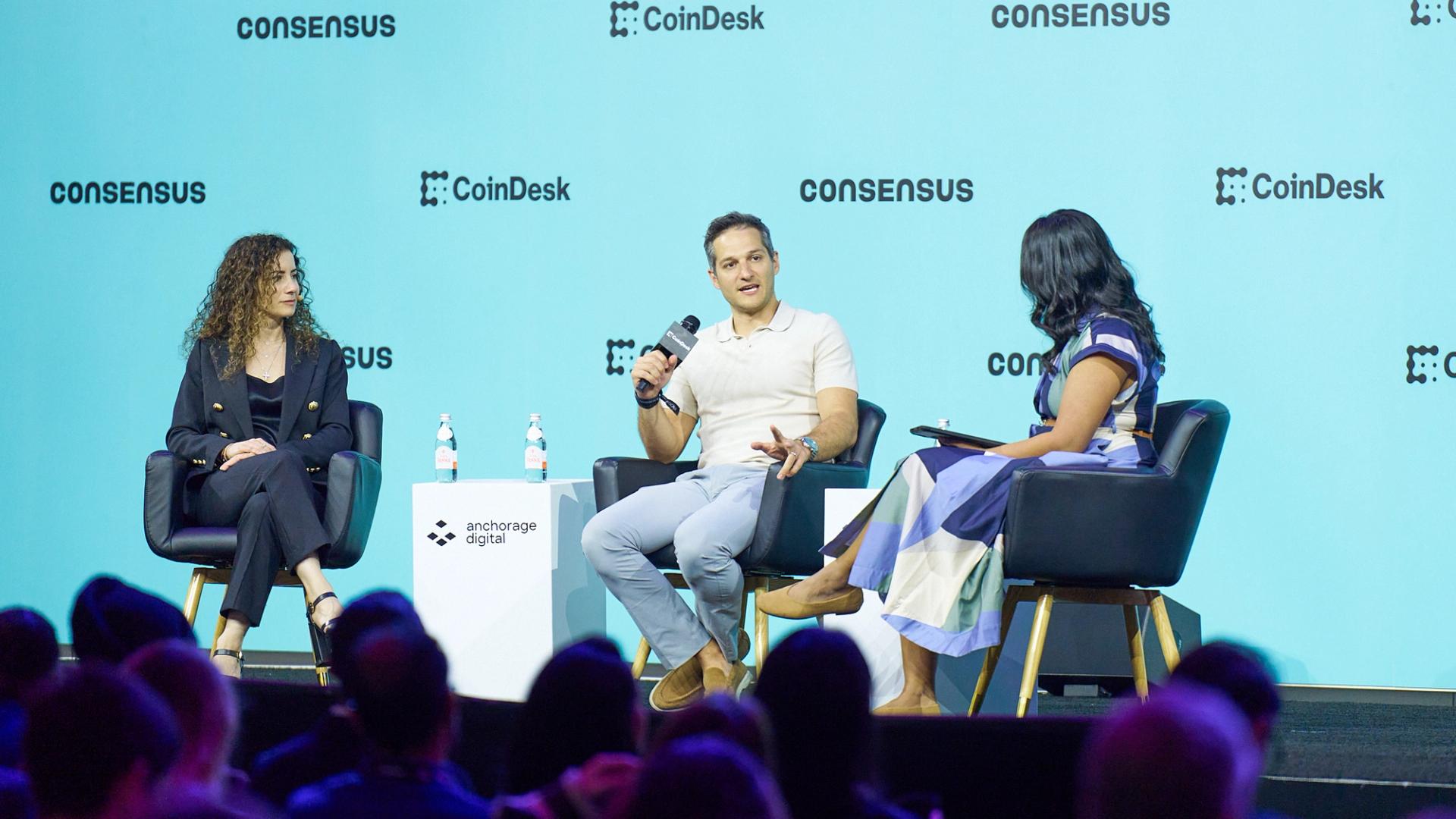
MIAMI BEACH, Fla. — Senior figures from Google Cloud and PayPal told CoinDesk’s Consensus Miami conference on Thursday that the next wave of internet commerce will run on crypto rails because AI agents structurally cannot use traditional financial accounts.
Richard Widmann, global head of Web3 strategy at Google Cloud, said the existing internet user experience does not extend to autonomous agents.
“An agent cannot get a bank account. It’s not hard, it just is impossible,” he said, citing technological and regulatory barriers. Crypto, by contrast, is “a fantastic machine readable interface for payments,” Widmann said.
To address the gap, Google has launched the Agentic Payments Protocol (AP2), an open protocol that has been donated to the FIDO Foundation and has more than 120 partners including PayPal, Widmann said. He compared the move to the x402 internet-native payment standard given to the Linux Foundation.
“Open dialogues and open standards are really the foundation you need to build on,” Widmann said.
May Zabaneh, senior vice president and general manager of crypto at PayPal, said the company is treating agents as the next channel after PayPal’s evolution from offline to online to mobile commerce. PYUSD, the company’s stablecoin, is “a very natural programmable layer for payments,” she said, particularly as commerce trends toward globalization, AI-native experiences and tokenized assets.
Zabaneh cited a recent PayPal survey which found that 95% of merchants now see AI agent traffic on their sites, but only 20% have machine-readable catalogs. “Merchants need to be ready for this next era,” she said. The shift, she added, mirrors the move from offline to online stores; merchants need to expose their products in agent-readable formats.
On liability, Zabaneh said the question of who’s responsible if an agent makes a bad purchase is “definitely something that we have to think through as an industry.” Widmann said multi-party custody is becoming central to agent design. Google has extended its Cloud KMS platform to cryptocurrency custody, and Widmann argued that an agent should hold only one of two or three key shards rather than the full private key. “It cannot simply unilaterally move funds or take action,” he said.
Asked what keeps them up at night, Widmann said the open question is “how do you onboard agents into all of the existing capital markets and infrastructure plumbing that powers payments and trading today.” Zabaneh said trust keeps her up professionally, though personally she “can’t wait for agentic to help make my life easier.”
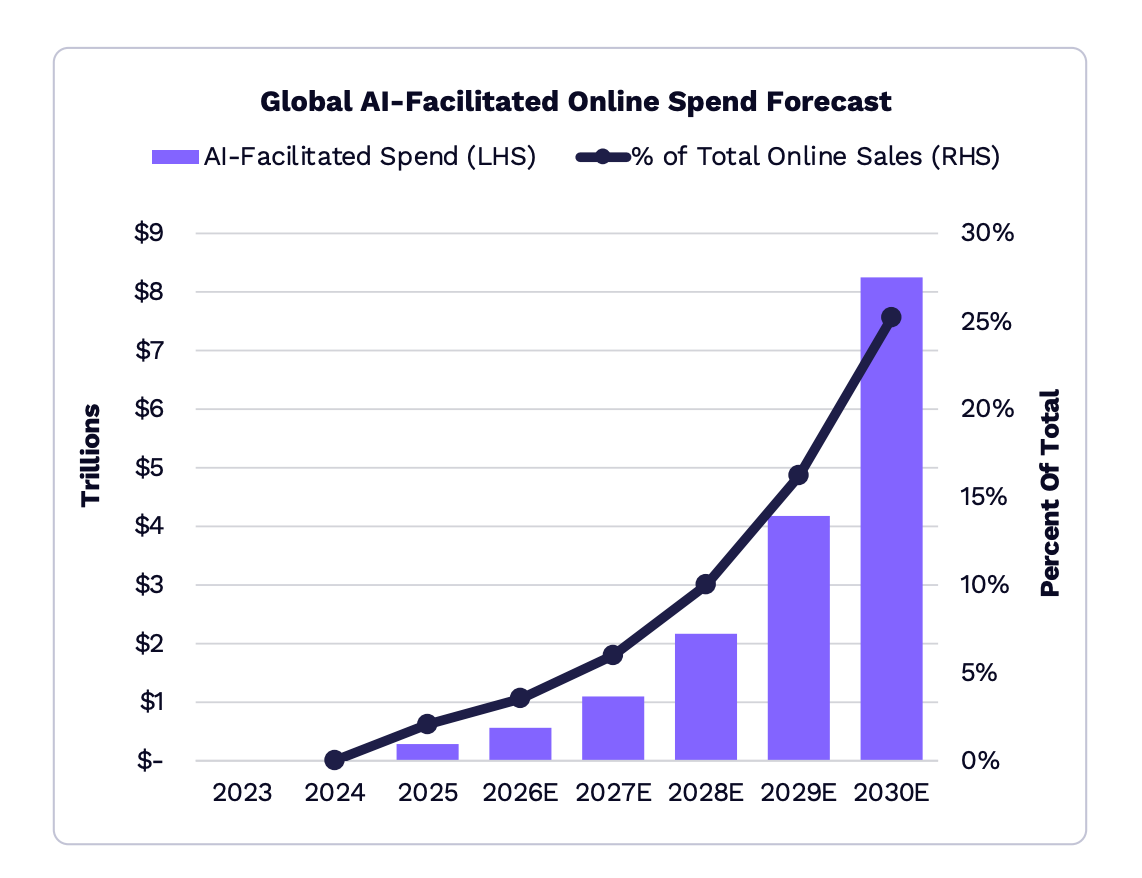
ARK Invest projects that artificial intelligence (AI) agents could facilitate $8 trillion in online consumer spending by 2030.
The projection highlights the growing opportunity in AI-driven commerce as major firms compete to build the infrastructure powering autonomous digital transactions.
ARK Sees AI Agents Driving Commerce and Reshaping Online Search
In its latest Big Ideas 2026 report, ARK Invest forecasts that AI agents could account for a growing portion of online transactions. The share could rise from 2% of digital spending in 2025 to nearly 25% by 2030 as consumers increasingly rely on intelligent systems to make purchasing decisions.

Follow us on X to get the latest news as it happens
The report also projected strong growth across other AI-driven segments. According to ARK Invest, AI-powered search could grow from 10% of global search traffic in 2025 to 65% by 2030.
“AI-related search advertising increases ~50% at an annual rate. AI ads are likely to take share from traditional search advertising, with monetization likely to follow with a two-year lag,” the report read.
The report further estimated that AI-mediated consumer revenue could surge from around $20 billion today to nearly $900 billion by 2030. This represents a compound annual growth rate of 105%.
Firms Race to Power Agent Payments
As interest in AI-driven commerce accelerates, companies are increasingly rolling out infrastructure designed to support autonomous digital payments.
On May 7, Amazon Web Services introduced its AgentCore Payments service. The service allows AI agents to instantly access and pay for services such as APIs, web content, MCP servers, and other AI agents.
“There will soon be more AI agents transacting than humans, and they need money that’s built for the internet – programmable, always on, and global. By bringing Coinbase’s stablecoin infrastructure and x402 into AWS AgentCore, we’re giving developers the full stack to build agents that move money at software speed, with the trust and compliance enterprises expect,” Brian Foster, Head of Infrastructure Growth and Strategy, Coinbase said.
Solana Foundation and Google Cloud introduced Pay.sh. It is a marketplace designed to enable AI agents to complete stablecoin payments on the Solana network. Anchorage Digital also launched Agentic Banking.
The developments suggest that crypto-based payment rails and stablecoins could play a major role in powering the next wave of AI-led digital commerce.
Subscribe to our YouTube channel to watch leaders and journalists provide expert insights
The post AI Agents Are Coming for Online Shopping: ARK Says $8 Trillion by 2030 appeared first on BeInCrypto.
TLDR:
- CZ says Bitcoin climbed from $0.05 to $80,000 while facing 15 years of active government resistance worldwide.
- Binance founder CZ served prison time for a single Banking Secrecy Act violation, the only case of its kind in US history.
- CZ believes blockchain will power billions of AI-to-AI microtransactions, creating an exponentially larger global economy.
- Beyond $100 million, CZ argues additional wealth brings diminishing returns, with $10 million enough for true financial freedom.
Changpeng Zhao, the founder of Binance, recently sat down for a wide-ranging interview. He discussed his memoir, Freedom of Money, his prison experience, and his outlook on cryptocurrency’s future.
CZ reflected on Bitcoin’s growth from $0.05 to $80,000, achieved largely without government support. He noted that real institutional backing has only existed for about 18 months.
His views span blockchain’s role in AI, personal finance, and global economic transformation.
CZ Reflects on Prison, Pardon, and Personal Priorities
CZ wrote Freedom of Money during his 76-day prison sentence using limited computer access. He described the process as a “brain dump,” working through mental anxiety and stress daily.
He noted being targeted for extortion while incarcerated, adding to the psychological toll. A brief, unsettling return to a detention center made the ordeal even harder to endure.
He is the only person in US history to be imprisoned for a single Banking Secrecy Act violation. His lawyers had assured him no jail sentence would follow his guilty plea.
Yet he served time, paid a $150 million personal fine, and Binance paid $4.3 billion. The experience reshaped his perspective on what truly matters in life.
What he missed most during imprisonment was not material comfort or status. He missed his family and the people closest to him, above everything else.
That realization brought him mental clarity and a stronger sense of personal values. He now prioritizes quality family time over fame, legacy, or wealth accumulation.
On the question of legacy, CZ was direct. He stated, “I never aimed to be ‘the best’ at anything; I just aimed to do ‘my best’ in what I believed mattered.”
His pardon later removed his felon status and eased global financial restrictions. Today, he focuses on four areas: education through Igloo Academy, investments via Easy Labs, BNB Chain, and government consulting.
He now calls the UAE home, having accepted citizenship there, with Binance headquartered in Abu Dhabi under a supportive regulatory environment.
Blockchain, Bitcoin, and the Coming AI Economy
CZ views blockchain as one of three transformative technologies of his adult life, alongside the internet and AI. He remains firm in his belief that Bitcoin will continue to dominate as a global store of value.
While he acknowledges room for future advancement, he sees no credible challenger to Bitcoin’s position yet. For CZ, crypto remains the most undervalued asset class available to investors today.
His most forward-looking argument centers on AI’s need for blockchain infrastructure. He foresees billions of microtransactions happening between AI agents on behalf of humans.
That shift, he argues, would create an exponentially larger global economy than what exists now. Blockchain, in his view, is the only system capable of handling that scale of trustless, automated exchange.
Putting Bitcoin’s journey into context, CZ noted, “Bitcoin went from $0.05 to $80,000 while fighting governments the entire way.” He added that only 18 months of real government support have existed across crypto’s entire 15-year history.
That growth, he emphasized, happened entirely against the tide of institutional resistance. It is a point he returns to as proof of the asset class’s fundamental resilience.
On personal wealth, CZ holds a pragmatic view. He believes around $10 million is enough for genuine financial freedom.
Beyond $100 million, he argued, additional wealth delivers diminishing returns on happiness. His focus now is deploying capital into AI and biotech for positive global impact, rather than personal accumulation.
He also addressed past business regrets, stating he wished he had separated Binance US from Binance Global from the outset.
That single structural decision led to avoidable regulatory complications. Legal compliance, he stressed, is a lesson learned the hard way. Moving forward, he applies that lesson to every new venture he touches.
The XRP Ledger ecosystem is preparing two major upgrades aimed at expanding XRPL beyond payments and settlement.
Summary
- XRPL plans native lending pools and fixed-term crypto loans directly on-chain for institutional users.
- Smart Escrows aim to bring programmable transaction logic without slowing XRPL transaction speeds or efficiency.
- XRPL Foundation says compliance layers and permissioned tools are already active across ecosystem infrastructure.
XRPL Foundation Community Director Hussain Zangana, known online as Vet, shared details about the planned additions through recent posts on X.
According to Zangana, the roadmap includes a native decentralized lending protocol and a programmable escrow system designed to support advanced financial activity directly on XRPL. The updates are expected to build a broader on-chain credit infrastructure while keeping XRPL’s low-cost transaction model intact.
Native lending system targets on-chain credit markets
The planned lending protocol would allow liquidity pools and fixed-term crypto loans to operate directly on XRPL without intermediaries. The system is expected to support both retail and institutional use cases.
Zangana said the goal is to expand XRPL into a decentralized credit hub while using XRP as a cross-chain liquidity bridge. “This turns XRPL into a decentralized credit ecosystem” remains a forward-looking claim because the features have not yet launched publicly.
The proposed framework follows growing interest in tokenized finance and on-chain lending systems across major blockchain networks. XRPL’s approach focuses on adding these features at the protocol level instead of relying fully on external smart contract platforms.
Smart Escrows aim to expand programmability
The second planned upgrade involves Advanced Programmability, also referred to as Smart Escrows. The feature is designed to automate transaction conditions and locked fund management while preserving XRPL’s transaction speed.
The system would introduce smart contract-like functions without converting XRPL into a fully generalized smart contract chain. Developers may use the feature to create automated payment flows, lending conditions, and programmable fund releases.
According to Zangana, XRPL already has several core pieces required for these upgrades. Those include the Multi-Purpose Tokens standard, native AMM functionality, permissioned exchange tools, and compliance frameworks tied to Credentials and Permissioned Domains.
XRPL ecosystem expands beyond Ripple
The XRP Ledger Foundation also confirmed changes to its organizational structure this week. The updated framework places more focus on independent validators and open-source ecosystem development.
Zangana said Ripple is now concentrating more on long-term research areas such as privacy, quantum protection, and broader programmability tools. Meanwhile, XRPL Commons is focusing on user-facing infrastructure like secure storage systems and lending products.
Recent crypto.news coverage has also noted growing institutional attention on XRPL infrastructure, including tokenization, permissioned finance tools, and cross-border settlement systems tied to XRP liquidity.
Crypto World
Nebius (NBIS) Stock Surges Near 52-Week Peak Following Major Tech Partnerships and $643M Acquisition

Key Takeaways
- Nebius Group has finalized a $643 million deal to acquire Eigen AI, integrating advanced inference and optimization capabilities into its technology stack.
- A $2 billion equity commitment from Nvidia supports Nebius’s strategic transformation into a Platform as a Service provider.
- The company has locked in multi-billion dollar, extended-term agreements with Meta and Microsoft for AI infrastructure services.
- Institutional investors have increased their holdings to 21.9%, with Mitsubishi UFJ Asset Management expanding its position by 230.6%.
- NBIS shares opened Friday at $177.08, approaching the 52-week peak of $197.89, while analyst consensus shows a “Moderate Buy” rating with a $154.75 average price target.
Nebius Group is executing an ambitious strategy to climb higher in the artificial intelligence technology stack.
The company has completed a $643 million buyout of Eigen AI, a specialist in inference optimization and efficiency technology. This transaction introduces sophisticated software capabilities to Nebius’s infrastructure foundation and represents a fundamental pivot toward becoming a full-fledged Platform as a Service operator.
NBIS shares began Friday’s session at $177.08, marking a 4.18% decline for the day, yet remaining close to the stock’s 52-week peak of $197.89.
The Eigen AI acquisition will integrate directly into Nebius’s Token Factory solution, transforming what was primarily a computational infrastructure service into a software-centric platform with recurring revenue potential.
This strategic repositioning is significant because it positions Nebius within the higher-margin segments of the AI technology landscape, territory currently dominated by major cloud service providers.
Major Tech Players Commit Resources
Nvidia is supporting this transformation with a substantial $2 billion equity infusion into Nebius. This investment strengthens their existing partnership and integrates Nebius more deeply into GPU distribution networks as the company scales its data center infrastructure, including a 310-megawatt facility under development in Finland.
Both Meta and Microsoft have committed to multi-billion dollar, long-duration contracts for Nebius’s AI infrastructure and platform offerings. These agreements provide the company with predictable revenue streams spanning multiple years instead of dependence on volatile short-term capacity demands.
Collectively, these three strategic relationships provide Nebius with vendor and client backing that remains uncommon among emerging AI infrastructure competitors.
Growing Institutional Interest
Mitsubishi UFJ Asset Management expanded its NBIS holdings by 230.6% during the fourth quarter, purchasing an additional 165,278 shares to reach a total position of 236,949 shares, representing approximately $21.3 million in value.
Additional institutional investors followed suit. Sumitomo Mitsui Trust Group established a fresh position valued at roughly $24.8 million. Zurcher Kantonalbank increased its stake by more than 34,000%, while Mirae Asset Global Investments boosted its holdings by 52%.
Institutional investors now control 21.9% of outstanding shares.
Regarding analyst coverage, DA Davidson elevated its price target from $150 to $200 while maintaining a “buy” recommendation. Bank of America, Compass Point, and Citigroup have all launched coverage with “buy” ratings. Cantor Fitzgerald assigned an “overweight” rating with a $129 price objective. The consensus among 15 covering analysts stands at “Moderate Buy” with an average price target of $154.75.
This consensus target trails Friday’s opening price, indicating the stock has already exceeded much of the Street’s projected appreciation.
Nebius faces notable challenges. The company’s latest quarterly results missed expectations — posting a loss of $0.69 per share compared to the anticipated $0.42 loss, while revenue of $227.7 million fell short of the $246 million forecast.
Insider activity has also tilted toward selling. CEO Arkadiy Volozh divested 33,358 shares on April 1st at an average price of $103.73. Director Elena Bunina sold 10,819 shares on May 6th at $184.86 per share through a pre-established 10b5-1 trading plan. Total insider dispositions over the previous 90 days reached 146,441 shares valued at approximately $17.7 million.
Nebius is scheduled to release earnings on May 13th.

Key Highlights
- Penguin Solutions (PENG) experienced a ~13.47% spike following the unveiling of a collaborative venture with AMD and Shell targeting AI data center optimization.
- Management elevated fiscal 2026 revenue growth projections from 6% to 12%, propelled by robust memory division performance.
- Second quarter FY2026 revenues reached $343M, marginally exceeding analyst expectations of $340.2M.
- Technical indicators including a “golden cross” pattern combined with elevated trading volumes amplified the upward momentum.
- Senior Vice President Clark Joseph Gates divested $173,750 in shares on May 5 through a predetermined 10b5-1 trading arrangement.
Shares of Penguin Solutions (PENG) climbed 13.47% on May 10, closing at $44.23, following the disclosure of a tripartite collaboration with AMD and Shell designed to enhance AI-powered data center capabilities. After-hours activity pushed the stock to $46.50.
The surge followed a respectable Q2 FY2026 financial performance. Quarterly revenues totaled $343.0 million, edging past analyst projections of $340.2 million.
Despite a 6% year-over-year revenue decline, market participants remained optimistic. The primary catalyst was management’s decision to double their annual revenue growth forecast from 6% to an ambitious 12%.
This outlook enhancement stems primarily from momentum in PENG’s memory operations. Leadership emphasized the company’s strategic positioning within what they’re terming “AI factory” infrastructure and inference-optimized artificial intelligence platforms.
Stifel reaffirmed its Buy recommendation post-earnings, though analysts reduced their price objective to $24 from $27, citing supply chain limitations as a temporary obstacle.
Citizens retained its Market Outperform stance while elevating its price target to $35 after executive discussions with Penguin’s CEO and CFO. The firm believes the organization’s transition toward enterprise AI offerings will fuel sustained expansion.
However, sentiment wasn’t universally positive. Barclays shifted its rating to Equalweight from Overweight — despite increasing its price target to $27 from $23. Analysts expressed concern about delayed progress in the Advanced Computing division, linked to shifting AI expenditure patterns from enterprise to cloud environments.
Chart Patterns Attract Momentum Traders
Beyond fundamental developments, technical signals played a significant role. PENG formed a “golden cross” — a bullish indicator where the 50-day moving average surpasses the 200-day — typically attracting momentum-driven investors.
Trading volume spiked considerably, indicating substantial institutional interest beyond normal fluctuations. The equity has surged 126% year-to-date and approached its 52-week peak of $39.66 before today’s advance.
Valuation metrics provide additional context. Prior to the jump, shares traded at a P/E multiple of 55, with InvestingPro identifying the stock as overvalued against its Fair Value calculation.
Executive Transaction Precedes Stock Rally
On May 5 — several days before the stock’s breakout — SVP Clark Joseph Gates liquidated 5,000 shares at $34.75 each, generating proceeds of $173,750. The transaction was documented through an SEC Form 4 filing.
This divestiture occurred under a Rule 10b5-1 trading arrangement initiated in November 2025, indicating the sale was predetermined rather than reactive to corporate developments.
Following this transaction, Gates maintains ownership of 81,776 shares directly.
The equity has appreciated approximately 122% over the trailing twelve months. Citizens’ upgraded price target of $35 now sits below PENG’s current trading level after today’s rally.

Barangay Ginebra edges TNT to clinch second seed

The hottest place for startups to strike a deal? The F1 paddock

How Grassington became Darrowby for All Creatures Great and Small

Manchester United reach agreement with Casemiro over contract clause amid transfer speculation

US brings back mandatory military draft registration

Steven Gerrard disagrees with Gary Neville over ‘shock’ Chelsea and Arsenal claim | Football


-
 Crypto World2 days ago
HarrisX Poll Found 52% of Registered Voters Support the CLARITY Act
-

 NewsBeat7 days ago
Channel 5 – All Creatures Great and Small series 7 new post
-

 Crypto World3 days ago
Upbit adds B3 Korean won pair as Base token gains Korea access
-

 Fashion2 days ago
Weekend Open Thread: Marianne Dress
-

 Tech6 days ago
Image AI models now drive app growth, beating chatbot upgrades
-
 NewsBeat3 days ago
NCP car park operator enters administration putting 340 UK sites at risk of closure
-
 Business1 day ago
Ignore market noise, India’s long-term story intact, say D-Street bulls Ramesh Damani and Sunil Singhania
-

 Politics1 day ago
Politics Home Article | Starmer Enters The Danger Zone
-
 Crypto World7 days ago
BlackRock Buys $284M In Bitcoin On May 1 As The Best Crypto To Invest In For 2026 Sits Below A Pending Binance Listing
-

 Entertainment6 days ago
Olivia Wilde Reacts To Viral ‘Corpse’ Comparison
-

 Sports6 days ago
Inter Milan Win Serie A Title After Victory Over Parma
-

 Sports7 days ago
Kofi Kingston and Xavier Woods reportedly released by WWE along with others
-

 Business7 days ago
Can LeBron James Lead LA Past OKC Without Injured Luka Doncic?
-

 Crypto World5 days ago
UAE Free Zone Deploys Blockchain IDs to Verify Registered Firms
-

 Entertainment7 days ago
Other Bennet Sister Love Triangle Cast: Ella Bruccoleri, Donal Finn
-
 Sports6 days ago
Every word of Arne Slot’s heated rant after Manchester United win vs Liverpool
-

 Sports7 days ago
Joel Embiid urges Sixers fans not to sell playoff tickets to Knicks fans
-

 Sports7 days ago
La Liga: Vinicius Jr scores twice as Real Madrid win to keep Barcelona waiting for title
-
Entertainment7 days ago
Jennifer Lawrence’s Mary Jane Sneakers Are Spring’s It-Girl Shoe
-
 Entertainment7 days ago
7 Most Universally Beloved Jason Statham Movies of All Time, Ranked
You must be logged in to post a comment Login