

Crypto World
BlackRock Launches BITA, a Covered-Call Bitcoin ETF Designed to Generate Monthly Income



BlackRock this week listed the iShares Bitcoin Premium Income ETF (BITA) on Nasdaq, extending its spot-bitcoin franchise into structured-income territory by overlaying a covered-call strategy on top of its flagship IBIT fund. The fund began trading on June 9, with bitcoin priced at $61,825.37 per… Read the full story at The Defiant



Stablecoin issuer Circle (CRCL) has acquired nearly 1,000 issued blockchain-anchored patents from IBM, a deal the firm said makes it the largest holder of blockchain patents in the United States.
The portfolio spans more than 680 patent families covering blockchain technology, banking, financial services, insurance, enterprise infrastructure, supply-chain verification and cloud security, according to a press release.
The deal’s financial terms weren’t disclosed.
IBM was already among the largest U.S. blockchain patent holders before the sale. A December 2025 analysis by patent analytics firm PatSnap credited it with 790 patents, alongside Advanced New Technologies and Bank of America.
Circle said the portfolio would support USDC, Circle Payments Network, its Arc blockchain and financial tools designed for AI agents. Circle and IBM also plan to explore further commercial opportunities, the document adds.
“Intellectual property is critical to advancing our mission and expanding adoption of onchain infrastructure,” said Sarah Wilson, Circle’s general counsel and corporate secretary.
Circle received its first patent, covering parallel blockchain data processing, in December 2023. It had earlier joined the LOT Network to protect its products from patent-assertion firms.

Dogecoin is trading at a few cents under $0.073, up about 1% this week. However, the real question is not today’s price. The question is whether the $0.07 level can hold as support or turn into resistance again. Bulls staged a weekend rebound, briefly lifting DOGE above $0.073 before momentum cooled.
Polymarket currently gives DOGE only a slim chance of making a meaningful breakout before July ends. Just weeks ago, those odds were much higher. That sharp shift in sentiment shows how quickly traders have turned cautious despite the recent bounce.
The weekend rally was partly fueled by easing geopolitical tensions, which sparked a crypto risk-on move. Analyst Ali Martinez also flagged a buy signal with a $0.16 upside target. Meanwhile, TradingView’s MACD indicator flipped to a buy signal on the DOGE/USD pair.
Even so, 24-hour trading volume remains around $670 million to $950 million, and activity has improved, but it still falls short of the surges that usually precede sustained breakouts.
Whether DOGE is building a base for another leg higher or forming a local top will depend largely on sentiment across the altcoin market. For now, traders are watching whether support near $0.07 can survive another round of selling.
Discover: The Best Crypto to Diversify Your Portfolio
Can Dogecoin Price Hit $0.10 Before August Ends?
Current price sits in contested territory. Multiple analyses frame $0.072 as the key support for bulls. Lose that level, and the short-term structure weakens. Resistance near $0.075 has repeatedly capped recent rallies, with DOGE pulling back after testing that area. Its market cap stands near $11.3 billion, keeping Dogecoin among the largest cryptocurrencies by market value.
An analyst, Peter Zhang, describes the setup as a coiled spring between support and resistance. He notes neutral RSI and weak near-term momentum but still targets $0.16 if buyers regain control. Meanwhile, TradingView’s MACD buy signal adds a constructive data point. Even so, a technical signal without stronger volume remains a warning rather than confirmation.

The bullish case is straightforward. DOGE must defend support around $0.072 and reclaim $0.075 with convincing volume. If that happens, momentum could strengthen and keep the path toward Martinez’s $0.16 target alive.
The base case is continued consolidation around current levels until a fresh macro or social catalyst emerges. On the downside, a break below $0.072 with rising volume would shift the structure bearish. Analysts also caution that even a breakout needs sustained buying pressure to avoid another failed rally.
Polymarket still tells a cautious story. The crowd remains unconvinced that a major breakout is imminent. Technical buy signals are present, but traders will likely want stronger volume before treating them as anything more than an early indication. DOGE has a habit of generating signals that fade without the social and retail momentum that defined its 2021 runs.
Trade Dogecoin on Bybit and Get a Chance to Win Our $1,000 USDT Airdrop
LiquidChain Targets Early Mover Upside as DOGE Tests Key Levels
For traders watching DOGE consolidate at a ceiling that may or may not break, the asymmetry calculus shifts. A $0.10 DOGE at roughly $19 billion market cap offers a different risk/reward profile than an early-stage infrastructure play still in presale, and that’s precisely where LiquidChain ($LIQUID) enters the frame.
LiquidChain is a Layer 3 infrastructure project built around a single core thesis: the fragmentation problem across Bitcoin, Ethereum, and Solana ecosystems isn’t a UX inconvenience. It’s a structural inefficiency that bleeds value.
The view is different from the third layer. — LiquidChain (@getliquidchain) July 27, 2026

You’ll understand soon. pic.twitter.com/P2WOELSTjI
Its Unified Liquidity Layer also fuses BTC, ETH, and SOL liquidity into a single execution environment, with Single-Step Execution, Verifiable Settlement, and a Deploy-Once Architecture that lets developers access all three ecosystems without redeployment overhead.
As of today, the presale has raised $920K at a current price of $0.01484 per $LIQUID. That’s not a rounding-friendly number, it’s exact by design, and the rise trajectory is building. For traders sizing up where early-stage infrastructure sits relative to a memecoin grinding at a resistance ceiling, the entry math is worth running.
Discover: The Best Token Presales
The post Dogecoin Bulls Are Betting on a $0.10 Breakout appeared first on Cryptonews.
Crypto World
Axis Robotics Raised $12M Funding to Build the Compounding Data Engine Accelerating Physical AI

Axis Robotics, the compounding data engine accelerating Physical AI, announces that it has raised $12 million in a seed round led by Hack VC, with participation from Nomad Capital, Pi Network Ventures, 10K Ventures, and various angel investors.
The funding will accelerate Axis’s mission to build a massively parallel, human-in-the-loop global data engine, solving physical AI’s biggest pain point: the scalable generation of structured, highly diverse robotic training data.
Solving the Data Bottleneck in Physical AI
While Large Language Models scale on trillions of tokens of pre-existing internet data, Physical AI faces three important barriers: severe data scarcity, generalization gap, and embodiment fragmentation across different robot hardware.
“Physical AI demands billions of human-physical interaction motion trajectories,” said Chris, Founder of Axis Robotics. “For years the industry lacked an efficient, infinitely scalable hybrid data production system which can help models iterate effortlessly – and that’s exactly what we built with Axis, a compounding data engine.”
How does Axis Empower General Robotics Intelligence
Axis’s proprietary Compounding Data Engine delivers an end-to-end workflow integrating task generation, data capture, continuous model training, and optimization:
Task Gen Engine: Generates exponentially diverse atomic robotic tasks via randomization across objects, spatial layouts, visuals, robot embodiments and semantics, embedding diversity into every single data trajectory;
Browser-Based Sim Teleoperation Platform: The world’s first web-based interface that empowers anyone to generate high-quality robotic motion trajectories remotely. Axis delivers 10x higher throughput than lab-based collection and seamlessly integrates human-gated DAgger (Dataset Aggregation) intervention loops to continuously refine and correct robot policies;

Ego Data Mobile Capture App: Shifts real-world data capture from expensive, hardware-heavy setups to a zero-barrier mobile application. By pairing state-of-the-art (SOTA) real-time hand pose tracking with global workforce, Axis translates human vision and dexterity into robotic motion at global scale;
Data Processing Pipeline: Automates trajectory cleaning, domain randomization and dense language annotation, outputting model-ready multimodal datasets with over 10x improved data quality.
The unified architecture creates a self-reinforcing flywheel: failed robot trajectories from real/sim deployment trigger human corrective intervention, which feeds back into training to expand edge-case coverage, creating compounding intelligence as data volume grows.

Axis’s Structural Moats: A Vertically Integrated Diversity Engine & Global Contributor Network
Axis’s core edge is its unified platform that spans the entire lifecycle of Physical AI. Unlike traditional fragmented approaches, Axis has built a vertically integrated engine that unites large-scale distributed pre-training data collection and real-time human-gated Dataset Aggregation post-training.
Native-built for data diversity, Axis’s proprietary Task Generation Engine randomizes object layouts, lighting, camera poses, physical properties and robot morphologies, creating endless unique scenes and manipulation tasks, outputting generalization-ready training data.
To deliver foundation-model scale diversified data, Axis has established a global robotic data infrastructure with over 100,000 active contributors who submit an average of 3 to 4 times daily, which maximizes both production efficiency and diversity coverage. Today, Axis can generate over 1,200 hours of simulation data and 20,000+ hours of real-world ego-centric data across diverse scenarios every month.
Axis recently launched Sim Dataset V1, with benchmark results showing that engineered diversity delivers measurable performance gains. On LIBERO-Plus, pretraining π0.5 on Axis’s fully diversified dataset improved overall success by 4.9 points, outperforming a volume-matched RoboCasa365 baseline by 31.3 points, with gains in layout generalization, sensor-noise resilience, and robot-pose robustness. This gap demonstrates that Axis’s edge comes from its proprietary diversity pipeline—not simply larger data scale.

Commercialization and Strategic Partnerships
Axis Robotics is rapidly commercializing its high-quality training data for real-world deployment. The company delivers customized “Task Packages” tailored to the specific needs of robotics hardware manufacturers, physical AI model companies, and industrial automation leaders.
Initial commercial partnerships have already been established with companies including Booster Robotics, Manycore Tech, Feagine Robotics, Dexmal, Lotus Car, Geely Auto, SomaStacks and more. These collaborations highlight the immediate market demand for scalable, high-fidelity robotic training data.
Redefine General Physical Intelligence
“The future of Physical AI hinges on deep symbiosis between models and data,” said Chris. “Static datasets cannot power general robotic intelligence. The winning solution is a compounding data engine: a vertically integrated system linking a global contributor network with constant model iteration. Every diverse trajectory and human correction fuels faster model improvement, forming a self-reinforcing intelligence flywheel.”
The company is driven by a world-class team combining top AI and robotics researchers from elite institutions such as UC Berkeley, Carnegie Mellon University, Georgia Tech, NTU and SJTU, alongside growth hackers who have previously scaled consumer products to over 30 million global users.
With this $12 million funding round led by Hack VC, Axis Robotics will further expand its procedural generation capabilities, scale its distributed network of contributors, and solidify its position as the critical data engine powering the future of Physical AI.
Linktree | Twitter | Doc | Product
The post Axis Robotics Raised $12M Funding to Build the Compounding Data Engine Accelerating Physical AI appeared first on BeInCrypto.

It has been roughly a month since the world’s largest corporate holder of bitcoin halted its cryptocurrency purchases, as it has seemingly listened to some experts’ advice to focus on rebuilding its greenback reserve.
The latest example was just announced by Strategy’s co-founder and former CEO, Michael Saylor. In a tweet on X, the prominent BTC bull noted that the firm has raised its USD stash by another $525 million. Consequently, it now has the power to cover 2.1 years of dividend payments.
Strategy sold 5.4 million shares through its ATM program in the past week, which allowed it to raise the aforementioned millions of dollars.
Strategy has increased its USD Reserve by $525 million, achieving 2.1 years of dividend coverage. As of 7/26/2026, we hodl ₿843,775 in our BTC Reserve and $3.75 billion in our USD Reserve. $MSTR $STRC https://t.co/Diy0008VE5
— Michael Saylor (@saylor) July 27, 2026
The reason for this pivot came in late Q2 when STRC, the company’s stretch stock used to raise funds to buy BTC, dumped far away from its par price of $100. Its low came a month ago at under $75, which prompted Strategy to rethink its focus. It has since recovered to $87, but it’s still below the needed $100.
While it has not announced a new bitcoin buy since June 22, the company sold 3,588 units a week later and has remained determined to raise its cash pile. It also launched the Digital Credit Capital Framework to enhance its available liquidity to cover monthly dividend payments and increase its long-term cryptocurrency exposure.
For now, Strategy’s bitcoin stash remains unchanged at 843,775 BTC, currently valued at just over $56 billion given the asset’s price of $65,000.
The post Saylor’s Strategy Keeps Rebuilding Its Cash Pile, Putting Bitcoin Buys on Hold appeared first on CryptoPotato.
Crypto World
EMCD launches Miner Support Program with up to $30M for Miners Amid Industry’s Steepest Profitability Squeeze


EMCD, a global crypto-fintech platform and one of the world’s largest Bitcoin mining pools, announced the launch of its Miner Support Program, providing eligible miners with access to up to $30 millions* in financing, fee relief and partner benefits.
The program launches against a challenging backdrop. Bitcoin’s hashprice — the key measure of mining revenue per unit of compute — has declined to approximately $28/PH/day, a 50% drop from its October 2025 peak and an all-time post-halving low, per CoinShares Q1 2026 data. An estimated 252 EH/s has been taken offline (According to Hashrate Index data, cited in CoinCentral, April 2026) as operators running older-generation hardware found margins no longer viable. Three consecutive negative difficulty adjustments, the first such streak since July 2022, signal broad capitulation across the sector. EMCD, which has operated its mining pool since 2017 and processed over 4,550 BTC mined by its users in 2025, sees the current period as both a stress test and a structural opportunity for operators who remain active.
Program Structure
As margins compress across the industry, EMCD has put together a concrete response: restructured fees, negotiated hardware and infrastructure deals, and opened access to its liquidity and yield products — a toolkit built around how mining businesses actually work, available to operators in any region.
Miners facing cash flow pressure can access EMCD’s secured liquidity facilities at 3.9% APR — to cover operational costs without selling assets into a down market. Unlike generic crypto-backed credit lines, EMCD products are built around mining-specific cash flow cycles and are bundled with the rest of the program, so the effective cost of capital comes down further when combined with fee relief and hardware savings rather than being judged on rate alone.
Those looking to protect margins on every block can apply for zero pool commission for 60 days, reducing overhead while hashprice remains depressed. Miners running older or underperforming hardware can unlock preferential pricing on Vnish firmware — the market’s leading third-party ASIC optimization software. Those looking to expand or relocate capacity get access to special terms on equipment and data center services through EMCD’s partner network.
Partner Participation
EMCD is inviting hardware manufacturers, data centers, and hosting providers to join the program by offering exclusive terms to eligible miners. Partner applications can be submitted at the website: https://support-miners.emcd.io/.
“We’ve been through every cycle in this industry since 2017 — the rallies, the winters, the halvings. What we’ve learned is that the operators who survive aren’t the ones who wait out the downturns. They’re the ones who use them. This program is our commitment to making sure our miners have the tools to do exactly that.” — Michael Jerlis, Founder & CEO, EMCD.
*The stated amount reflects the maximum aggregate value of support (including financing, fee reductions and partner offers) that may be made available under the program and does not constitute a reserved fund.
About EMCD
EMCD is the global cryptocurrency mining pool and infrastructure provider. Founded in 2017 as an early industrial BTC mining operation in Europe, EMCD now serves users and businesses across 120+ markets. With over 30 EH/s of hashrate and a place in the global top ten, EMCD committed to security, reliability and transparency. EMCD’s mission is to make it simpler for individuals and businesses to build, earn and transact with digital assets. EMCD was recognised as Best Mining Pool by Coingape in 2026 and Finance Feeds in 2025.
The post EMCD launches Miner Support Program with up to $30M for Miners Amid Industry’s Steepest Profitability Squeeze appeared first on BeInCrypto.
XRP price is closing its strongest month of the year, yet the funds that buy it have gone quiet. ETF desks recorded no flows at all on 10 of July’s 17 trading days.
XRP trades near $1.10 after a month locked inside a tight range. It now enters August, the one month on its record with no clear direction, and three signals say demand is thinning.
XRP’s Best Month Hands Over to Its Flattest One
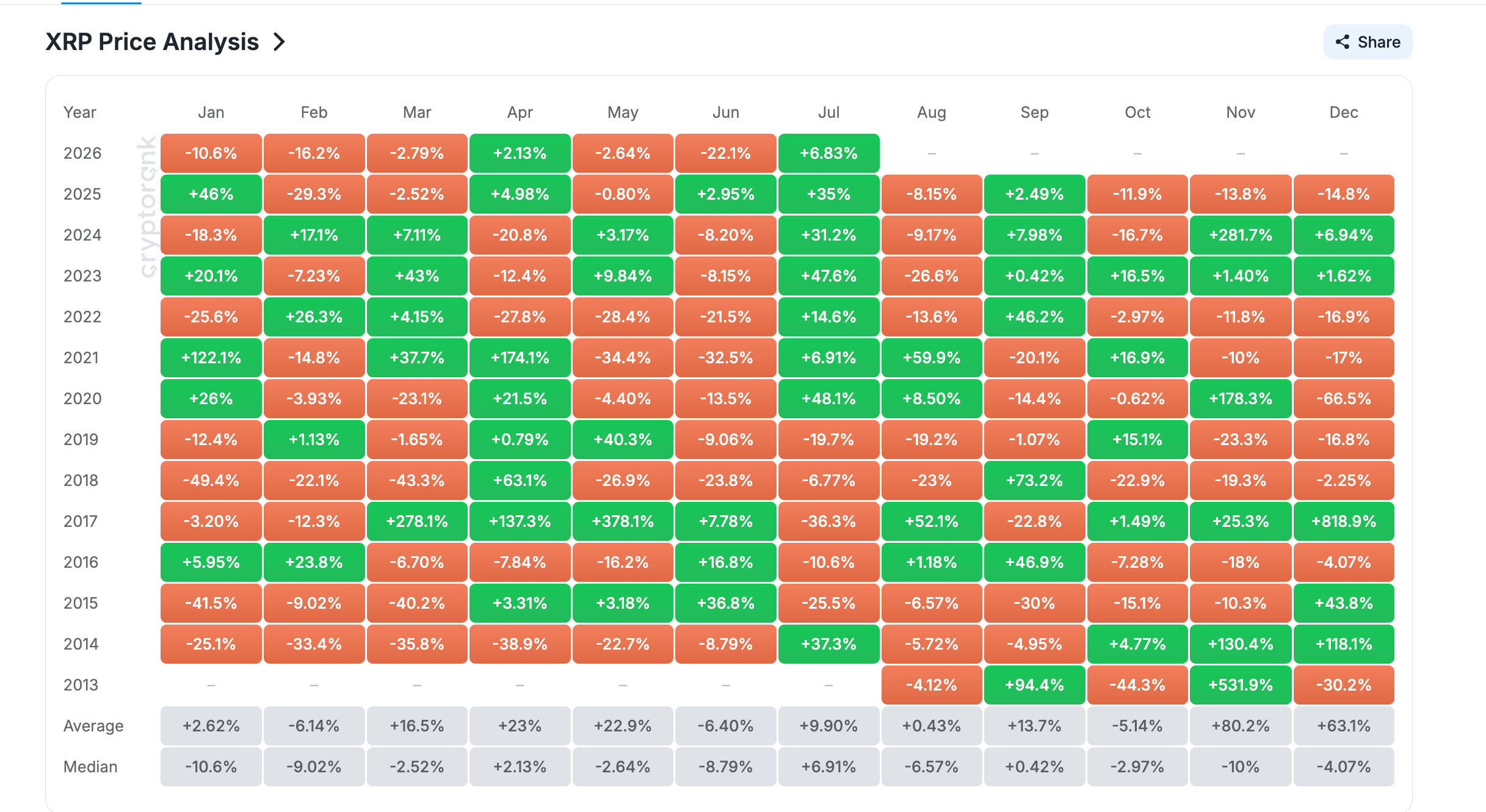
History sets the stage. XRP has closed July green every year since 2020. That is six completed years, with 2026 currently up 6.83% and tracking a seventh.
Want more token insights like this? Sign up for Editor Harsh Notariya’s Daily Crypto Newsletter here.
No month on XRP’s record holds a longer winning run. July also carries a +6.91% median, the strongest of any month. Median matters more than average here, because it strips out the outlier years that distort XRP’s history.

August breaks the rhythm. Its +0.43% average is the flattest reading on the table, while every other month leans clearly positive or negative. August has also closed red four years running, the longest losing run any month currently carries, and Bitcoin walks into a similar August setup.
Fund flows already match that apathy. XRP ETF flows registered exactly $0.00 on 10 of the 17 trading days in July, including two separate three-day blackouts.
The latest blackout ran from July 22 to July 24, straight into month end. Net July demand across those 17 sessions reached roughly $12.4 million against a fund complex holding about $997 million, so US spot XRP ETF demand has barely moved the needle.
Turnover is thinning too. Daily value traded fell from $14.05 million on July 1 to $8.80 million on July 24, a drop of about 37%.

Fund desks stepping back is one signal. Whether spot buyers are doing the same is the next question.
Exchange Outflows Collapse as Buyers Step Aside
On-chain data answers it. The XRP exchange net position change, a metric tracking how many tokens move in and out of exchanges, sat at -205.1 million XRP on July 3.
By July 26 it had shrunk to -70.2 million XRP, a 66% drop. Coins are still leaving exchanges, but at roughly a third of the earlier pace.
Sustained outflows usually point to accumulation. A collapse this steep suggests buyers may be stepping aside rather than turning into sellers. Another sign of fading interest.

That fits the ETF picture. Neither institutions nor spot participants are dumping XRP, yet neither group is adding with conviction ahead of a month that historically goes nowhere.
The price chart shows exactly what drained the interest.
XRP Price Prediction Hinges on a 20-Cent Range
The levels here come from an unusual fit. Anchoring a Fibonacci tool across the March 17 and May 13 swings produces a grid that price now respects almost exactly.
Two lines define everything. The 1.618 extension at $1.01 has held since late June, close to a month of defense. Another key level at $1.22 has capped every attempt since XRP lost it at the end of May.
That $1.01 to $1.22 band is the whole story. XRP has spent a month trapped inside it, which explains why ETF desks and spot buyers alike have drifted away.

Volume backs the fatigue. Buying volume has fallen steadily since June 30, so an upside break looks unlikely without fresh demand.
For the XRP price prediction to turn bullish, buyers need a three-day close above $1.22. That 10.42% move would likely pull ETF inflows back. Losing $1.01, a 7.95% drop, would instead open the door to renewed outflows. Regardless of the direction, something will finally happen.
It is worth noting that selling pressure is not building either. If sell volume stays this thin, August’s flat history argues for more range rather than a breakdown. For now, $1.01 separates another dull month inside the band from the drop that finally forces institutions to react.
The post XRP Price Prediction for August 2026: Empty ETF Desks Price In a Month of Nothing appeared first on BeInCrypto.

European regulators have expanded the public register of crypto-asset service providers (CASPs) operating under the EU’s Markets in Crypto-Assets (MiCA) framework, adding 15 new firms in the latest ESMA update released after the July 1 transitional deadline.
According to the European Securities and Markets Authority (ESMA), the interim MiCA register now lists 309 licensed CASPs. The newest entries include several banks, as well as digital asset platforms such as BitPay, Coinify and Bleap.
Key takeaways
- ESMA’s latest MiCA register update adds 15 CASPs, bringing the interim total to 309 licensed providers.
- Banking groups are among the largest new entrants, including BNY SA/NV and multiple German banks.
- Germany and Denmark contributed the most new registrations, with three additions each.
- ESMA reported no changes in other MiCA registers in this update for issuers of ARTs and EMTs, or for crypto asset categories and non-compliant entities.
- Industry concerns persist that compliance costs could pressure smaller firms to exit the market.
ESMA adds 15 CASPs as MiCA roster keeps growing
ESMA’s update, published on Friday, continues the step-by-step buildout of the MiCA licensing pipeline since the July 1 deadline for firms to transition into the regime. MiCA is designed to create the EU’s first unified framework for crypto services, replacing a patchwork of national rules with standardized oversight.
In this third post-deadline register update, ESMA’s interim list for regulated providers increased from prior levels by 15 new CASPs. Among the additions are four banking institutions, including BNY SA/NV—identified in ESMA’s update as the Belgian subsidiary of BNY Mellon.
Where the new registrations came from
The geographic distribution of the new CASPs underscores how MiCA licensing is spreading across member states. ESMA reports that Germany and Denmark led the latest additions, with three newly listed CASPs in each country. Bulgaria and Latvia followed with two new providers each.
Belgium, Cyprus, Liechtenstein, and the Netherlands each recorded one addition in this round, indicating a broader but uneven rollout pattern across Europe.
The German entries include cooperative institutions and a regional bank: Spar-und Kreditbank Rheinstetten, VR-Bank Augsburg-Ostallgäu, and Raiffeisenbank Falkenstein-Wörth. Denmark’s new registrations include SafeLynx Technologies and Januar, described as a digital asset infrastructure company.
Other newly listed providers named in ESMA’s update include Bulgaria’s Altcoins BG and Digital Assist, and Latvia-registered firms Bleap and Nodu Digital. In addition to these regional entities, digital asset platforms also appear among the new CASPs, including BitPay, Coinify and Bleap.
MiCA expansion continues after the July 1 transitional deadline
This update follows ESMA’s second post-deadline register changes, when the regulator added 14 CASPs after July 1. Earlier coverage from Cointelegraph noted that some major industry participants were among those earlier additions, including Ripple Payments Europe.
While the CASP list grew again this time, ESMA said its latest update did not affect other MiCA-related registers. Those include authorized issuers of asset-referenced tokens (ARTs) and e-money tokens (EMTs), as well as registers covering crypto assets and non-compliant entities. For market participants, this distinction matters: the CASP register reflects entities providing regulated services, while token issuer categories are tracked separately.
That separation also helps explain why the MiCA rollout can appear uneven across the ecosystem. Even when service providers reach licensing milestones, the authorization process for token issuers and specific issuer categories may follow different timelines and require different documentation.
Why the growing CASP list matters—and what to watch next
For investors and users, a larger number of MiCA-licensed CASPs can translate into clearer regulatory expectations around custody, exchange services, and other crypto-asset activities—assuming firms comply with ongoing MiCA obligations. For builders and fintech operators, the register’s expansion provides a real-time signal that licensing is progressing beyond announcement stages and into operational authorization.
At the same time, ESMA’s continued additions also highlight that MiCA implementation remains an evolving process. Even after the July 1 transitional deadline, ESMA’s register continues to change as companies complete licensing procedures across different European markets.
Beyond the register itself, the sustainability of compliance requirements remains a live issue. Earlier reporting from Cointelegraph cited Gate Europe CEO Giovanni Cunti warning that the cost of maintaining a MiCA license could weigh on smaller firms, potentially making it harder for them to keep up with compliance resources over the long term.
As ESMA publishes further updates, market participants should monitor not only how quickly the CASP roster expands, but also whether changes begin to appear in the token issuer registers—ARTs, EMTs, and other crypto asset categories. That shift would indicate MiCA’s next phase is moving beyond service providers into a broader portion of the crypto value chain.

Senator Cynthia Lummis has put national security at the center of her push for the Digital Asset Market Clarity Act, arguing the bill’s three core illicit-finance provisions are the most direct mechanism available to cut off North Korea’s Lazarus Group from crypto markets.
The argument lands as the bill’s Senate floor vote slips toward the August recess, and Polymarket traders price 2026 passage at just 33–37%, down from above 80% in February.

Discover: The Best Crypto to Diversify Your Portfolio
Clarity ACT: Three Provisions, One Target
Lummis has pointed to three specific sections of H.R. 3633 to make her case. Section 201 extends the Bank Secrecy Act and AML crypto compliance obligations to crypto firms, exchanges, DeFi front ends, and crypto ATMs, including. Section 303 adds a new Treasury crypto sanctions authority aimed at Iran.
Section 305 creates a safe harbor that allows exchanges to voluntarily freeze funds tied to suspicious activity before obtaining a court order, provided they cooperate with law enforcement.
That last provision is the operational crux of Lummis’s argument. Lazarus moves stolen funds quickly across chains and through mixers, and the current legal framework gives exchanges little incentive to act unilaterally. Section 305 closes that window by removing liability for platforms that freeze fast-moving suspicious transactions.
On July 26, Lummis posted that North Korea’s Lazarus Group and other bad actors thrive on gaps in financial rules, and that the CLARITY Act gives Treasury new sanctions authority alongside a safe harbor for companies to freeze suspicious transactions before the money moves, a paraphrase of her public statement on X.
Discover: The Best Token Presales
Lazarus’s Track Record Makes the Case
The scale of the problem is not abstract. Lazarus Group stole roughly $625 million from the Ronin Bridge in 2022, the infrastructure underpinning Axie Infinity.
In February 2025, it executed the largest single crypto heist on record, taking $1.5 billion from Bybit. Treasury estimates the group has taken at least $3.4 billion in crypto since 2007, with proceeds routed toward North Korea’s weapons programs.
The Axie Infinity main menu screen features a player’s team of three Axies.
The group has also deployed operatives posing as remote IT workers to directly infiltrate crypto firms, a vector that AML and KYC controls at the corporate level are specifically designed to catch. Lummis frames Section 201’s extension of BSA obligations as a direct response to exactly this kind of insider-access attack surface.

Senator Elizabeth Warren has pushed back hard, calling the Digital Asset Market Clarity Act a sanctions loophole rather than a sanctions tool. A former NSC Iran director. Those are not frivolous objections. Republicans have already absorbed additional ethics language into a merged draft released July 22.
Don’t Miss Out on Our $1,000 USDT Airdrop on ByBit
The post CLARITY Act Is Secret to Killing North Korean Lazarus Hacker Group, Says Lummis appeared first on Cryptonews.
Bitcoin price climbed back above $65,000 on July 27 as the pause in US-Iran strikes drove oil lower and restored demand for risk assets.
Summary
- Bitcoin traded at $65,386, recovering from a daily low of $64,892.
- 4-hour RSI reached 58.64, while a bullish MACD crossover supported the rebound.
- $67,181 remains the key resistance, with major downside liquidity concentrated near $63,000-$63,500.
Bitcoin price rises as US-Iran strikes pause
Bitcoin was trading at $65,386 at the time of the July 27 chart, nearly unchanged for the day after moving between $64,892 and $65,744. The latest advance extended its recovery from the July 25 low near $63,700.
The immediate catalyst came from the Middle East, where the United States and Iran refrained from attacking each other for a third consecutive day. Regional mediators reported progress toward an interim ceasefire, although Washington and Tehran had not resumed direct negotiations. AP reported that Iran and Oman were also discussing how to manage shipping through the Strait of Hormuz.
Oil prices fell sharply as the pause reduced fears of a prolonged supply disruption. Brent crude dropped 6.5% to $90.45, while the weaker oil outlook supported stocks, cryptocurrencies and other risk-sensitive markets. Bitcoin rose to about $65,155 during the session.
Lower energy prices can reduce near-term inflation pressure, a factor that matters for US crypto investors ahead of the Federal Reserve’s July 28-29 policy meeting. However, futures markets still assigned a 33% probability to a rate increase, up from 16% a week earlier, Reuters reported.
The geopolitical risk has also not disappeared. Iran’s foreign ministry said Tehran had not requested renewed talks with Washington and reported no change in the status of the Strait of Hormuz, according to a separate Reuters report.
Bitcoin indicators favor another test of $67,181
Bitcoin remains inside an ascending parallel channel on the 4-hour chart. The lower boundary now passes through approximately $64,000, while the upper trendline approaches the $67,800-$68,000 region.
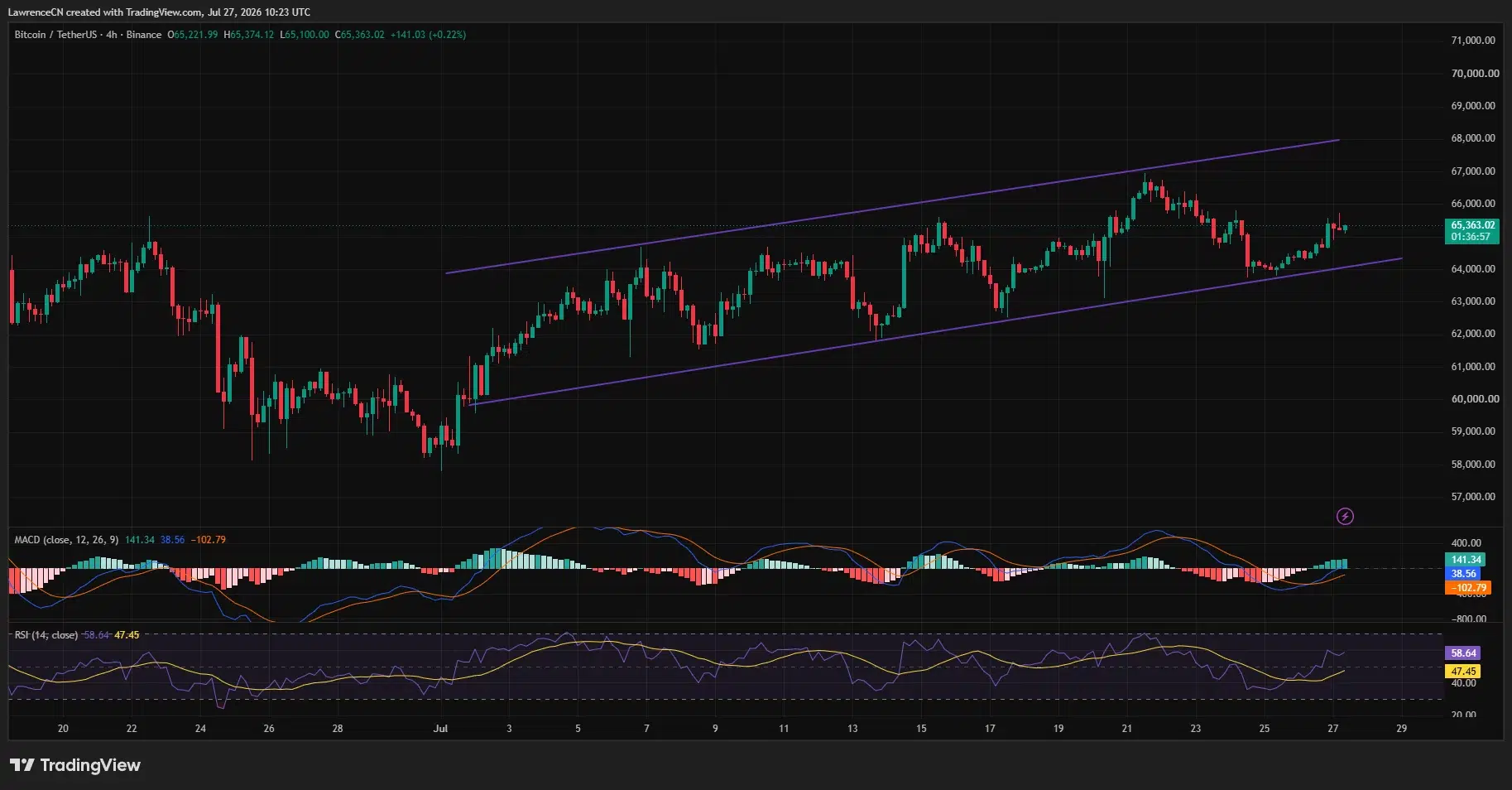
BTC rebounded from the lower trendline on July 25 and moved back above $65,000, preserving the pattern of higher lows established at the beginning of July. The channel therefore remains valid unless sellers force a 4-hour close below the rising support.
Momentum indicators have also improved. The 4-hour relative strength index rose to 58.64 from below 40, placing it above its moving average of 47.45 without entering overbought territory.
The moving average convergence divergence indicator completed a bullish crossover. Its histogram increased to 141.34, showing that positive momentum was rebuilding after the July 21-25 pullback.
Daily indicators are less decisive but still lean constructive. The Aroon Up reading stood at 57.14%, while Aroon Down fell to zero, showing that recent highs carried more weight than recent lows. Chaikin Money Flow remained positive at 0.04, indicating modest net buying pressure rather than aggressive capital inflows.
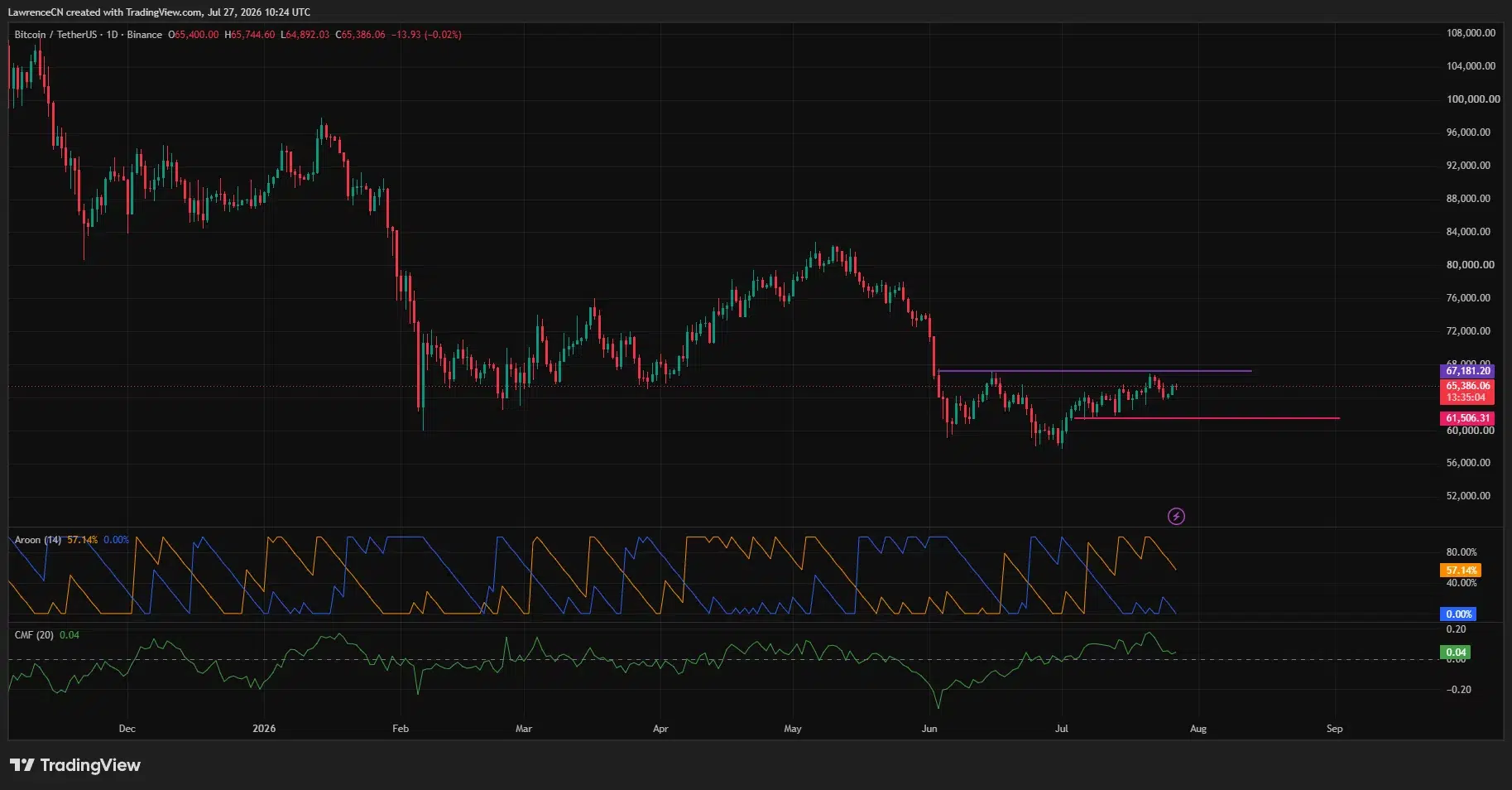
Bitcoin must now close above the daily resistance at $67,181 to leave its current consolidation range. That level rejected the July 21 advance and sits close to the upper boundary of the 4-hour channel.
Liquidation heatmap puts $68,000 within reach
The three-day CoinGlass liquidation heatmap shows that Bitcoin cleared several leveraged clusters between $64,500 and $65,300 during its rebound. The move likely forced some short positions to close, adding buy orders to the rally.
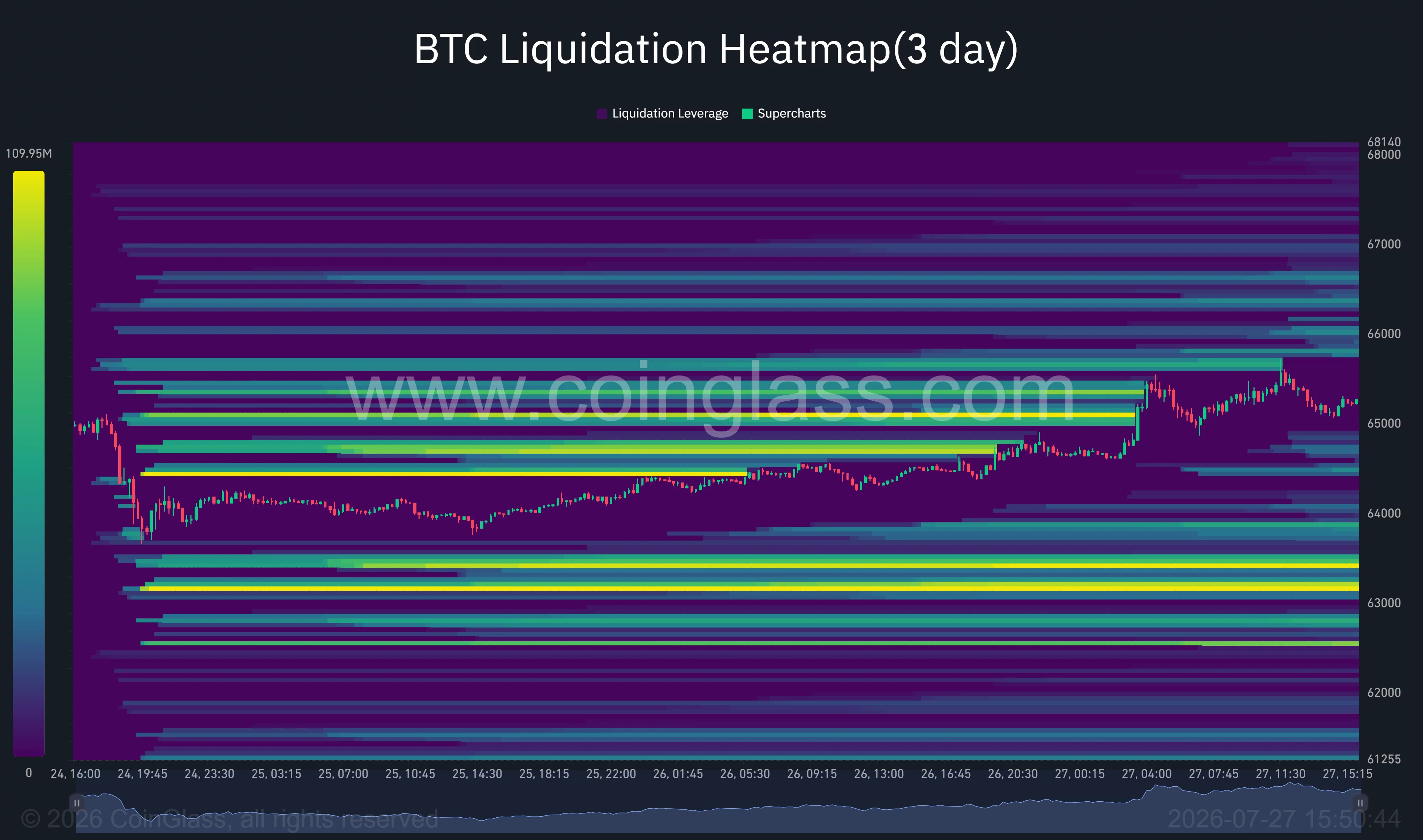
Further liquidation bands appear between $65,800 and $66,600. A sustained move above the latest intraday high of $65,744 could draw price toward these positions before BTC challenges $67,181.
Crypto analyst Ted Pillows also identified $68,000 as a possible target if US lawmakers make progress on the CLARITY Act.
“Any chance of it moving forward could send Bitcoin to $68,000 soon,” Pillows wrote.
That target broadly matches the upper boundary of the ascending channel. However, the policy catalyst remains uncertain. Polymarket traders placed the probability of the CLARITY Act becoming law in 2026 at about 38% as of July 27, with $2.8 million wagered on the market.
US spot Bitcoin ETF demand also remains uneven. The funds recorded $33 million in net inflows after three weeks of weaker activity, but SoSoValue data showed a $240.08 million net outflow on July 24. The mixed flows suggest institutional demand has improved without confirming a sustained reversal.
BTC risks a return to $63,000 if support fails
The bullish setup would weaken if Bitcoin loses the channel floor near $64,000. The daily chart places the broader range support at $61,506, leaving room for a deeper decline if the current higher-low structure breaks.
The liquidation heatmap identifies the strongest downside clusters between $63,000 and $63,500. These bright bands could attract price if weekend gains unwind or tensions between the US and Iran return.
According to crypto analyst Lennaert Snyder, weekend Bitcoin rallies are often retraced. He is watching for a possible short setup after a sweep of recent highs, with $63,700 as the initial downside target. Snyder identified the $60,000 region as his first preferred area for a potential long position if the correction deepens.
For the bullish case, Bitcoin needs to defend $64,000 and break $67,181. That would expose $68,000, where the channel ceiling and analyst target converge. A rejection followed by a move below $64,000 would instead put $63,500, $61,506, and eventually $60,000 back in focus.
Disclosure: This article does not represent investment advice. The content and materials featured on this page are for educational purposes only.


The FXStreet platform helps traders compare drawdowns, profit targets, restrictions and platform compatibility according to their experience and risk profile.
Barcelona, July 21, 2026: FXStreet has launched Propinder, a free prop firm comparison tool designed to help traders identify prop trading challenges that align with their experience, risk tolerance, platform preferences and country of residence. The platform presents key challenge conditions in a structured format before traders commit any money.
Profile-based prop firm comparison
Propinder begins with a profiling questionnaire that takes less than two minutes to complete. Traders provide information about their level of experience, preferred trading platform, approach to risk and country of residence.
The platform combines these inputs with aggregated and anonymized information from traders with similar profiles. It then presents a shortlist of prop trading challenges that users can explore and compare.
Propinder does not predict whether a trader will pass a challenge or recommend that the trader purchase a particular product.
Challenge rules displayed before payment
Prop trading challenges can have similar account sizes and profit targets while applying substantially different operating conditions.
These differences may include:
- The type and calculation of drawdown.
- Daily and maximum loss limits.
- Time limits.
- Instrument restrictions.
- Rules affecting trading around news events.
- Trading platform compatibility.
- Requirements for achieving profit targets.
Propinder presents these conditions in a comparable format so traders can evaluate how each challenge works before paying an entry fee.
The platform covers different prop trading models, including instant funding firms, evaluation-based challenges and firms offering futures programs.
Commercial agreements do not determine rankings
Propinder is not owned by a prop trading firm.
FXStreet states that prop firms cannot pay to obtain a higher position in the results and that challenges associated with affiliate partners do not receive preferential treatment.
Listings are created using publicly available challenge information and the results generated by Propinder’s profiling methodology.
“We are here to make sure that when a trader reads the conditions, they understand them before it costs them anything,” said Javier Hertfelder, CEO of Propinder.
Built by FXStreet in partnership with Swiset
Propinder is a product of FXStreet, the financial media company that has provided market and trading information for more than 25 years.
The platform was developed in partnership with Swiset, a trading technology provider serving brokers, prop firms and trading communities.
Swiset provides technology supporting trader profiling, performance analysis and challenge data management. FXStreet is responsible for the Propinder product and its approach to information, comparison and transparency.
Free access for traders
The Propinder profiling questionnaire, challenge comparison results and displayed rule information are available without charge.
The platform does not have a paid subscription or premium access tier.
Traders can access Propinder at propinder.com, review the suggested challenges and explore individual prop firm pages.
The final decision remains with the user. Information provided by Propinder should not be interpreted as trading, investment or financial advice.
About Propinder
Propinder is a free prop firm comparison tool that helps traders explore prop trading challenges according to their experience, risk tolerance, platform preferences and country of residence. The platform presents information about drawdowns, profit targets, time limits, restrictions and platform compatibility in a comparable format. Propinder uses aggregated and anonymized profile information and does not provide trading advice or predict challenge outcomes. Propinder is a product of FXStreet developed in partnership with Swiset. More information is available at propinder.com.
The post Propinder Launches Free Prop Firm Comparison Tool For Trading Challenges appeared first on BeInCrypto.

Dressed in Gemstone Shades – Julia Berolzheimer

Rebecca Hackett in court over Harry Heslop Stockton murder

How wildfires in France and Spain may affect your travel plans


-

 Fashion3 days ago
Weekend Open Thread: Brooks Brothers
-

 Crypto World6 days ago
Grayscale Files For Worldcoin ETF, WLD Registers Sharp Rise
-

 NewsBeat6 days ago
How a former Blue Peter presenter stunned America’s Got Talent judges
-

 Tech12 hours ago
Intel is reversing course and bringing hyper-threading back to its server chips
-

 Tech7 days ago
Sail Virtually Aboard The “Itanic” With IA-64 Emulator
-
 Tech6 days ago
Turtle Beach Command Series KB7 review: a nifty screen-equipped gaming keyboard
-
 Business5 days ago
New Jersey voter registration controversy explained: How 6,600 noncitizens got on the rolls, and what happens next
-
 Entertainment6 days ago
Johnny Depp’s R-Rated Gothic Cult Classic Gets New Release Ahead of Sydney Sweeney Remake
-

 Crypto World5 days ago
Ethics, other provisions in crypto Clarity Act to be further discussed
-

 Tech7 days ago
Watch Flock Safety CEO Garrett Langley discuss the future of surveillance at TechCrunch Disrupt 2026
-
 NewsBeat6 days ago
Shanghai science forum photos show China’s AI and robotics advances in rivalry with US
-
 Sports16 hours ago
Commonwealth Games boxing: Jadumani Singh seals dominant 5-0 win over Pakistan’s Sumama Rehman to enter quarter-finals | Commonwealth Games News
-

 News Videos4 days ago
The Peugeot Family: How 200 Years of an “Old Money” Dynasty Died in A Boardroom
-

 Sports3 days ago
2026 3M Open leaderboard: Scottie Scheffler finds putter in Round 1, sits three back
-

 Politics24 hours ago
Spain sweeps the board at 2026 World Cup with individual awards
-

 Fashion3 days ago
16 Dresses for the High Summer Event
-

 Politics2 hours ago
Luke Littler dismantles Gerwyn Price to retain title in Blackpool
-

 Crypto World6 days ago
Andrew Cuomo joins OKX board as crypto exchange expands in U.S.
-
 Entertainment3 days ago
A New Post-Apocalyptic Gundam Anime Series Blasts Into SDCC
-

 News Videos16 hours ago
BITCOIN JUST ENTERED THIS CRITICAL ZONE…
You must be logged in to post a comment Login