

Crypto World
BlackRock Launches Staked Ethereum ETF



The TradFi giant’s iShares Staked Ethereum Trust ETF is its first yield-bearing exchange-traded product.
BlackRock today debuted the iShares Staked Ethereum Trust ETF (Nasdaq: ETHB) — the firm’s first crypto exchange-traded fund to incorporate staking and its third spot crypto ETF overall.
In a press release from BlackRock today, March 12, the world’s largest asset manager, with $14 trillion in AUM, said that ETHB will stake “a portion of its ether holdings.” Per the asset manager’s dedicated webpage for the fund, Coinbase Prime will provide ETH custody — and presumably staking services.
The Defiant first reported when BlackRock registered its staked Ethereum ETF last November, which came about four months after the U.S. Securities and Exchange Commission (SEC) acknowledged BlackRock’s filing to permit staking in its Ethereum ETFs.
ETHB is BlackRock’s first yield-bearing ETF, though it’s not first to market among staked ETH funds in the U.S. REX-Osprey launched ESK — the first U.S. staked ETH ETF, under the 1940 Act — in September 2025, and Grayscale enabled staking on its ETH and SOL products in October, as The Defiant reported.
The broader push dates back to March of last year, when Cboe proposed adding staking to existing Ethereum ETFs.
BlackRock is the dominant crypto ETF issuer by net assets across both its spot ETH and BTC ETFs. The firm’s spot Ethereum ETF, ETHA, holds just under $6.6 billion in net assets as of March 11, per data from SoSoValue. That represents more than 50% of the U.S. Ethereum ETF market, which currently stands at $11.85 billion.
Among spot Bitcoin ETFs, BlackRock’s IBIT commands over $55 billion — also well over half of the $90.89 billion in total net assets across all spot BTC ETFs trading in the U.S., per SoSoValue.
After a multi-day net outflow streak, Ethereum ETFs saw net inflows over the past two trading days, recording over $57 million in inflows yesterday, March 11.
Meanwhile, today, spot ETH is trading just over $2,060 at publishing time, per data from The Defiant’s price tracker.
Despite ETH stagnating in a tight range in recent months, the amount of ETH staked on the network continues to break new highs, reaching over 37.6 million ETH as of March 11.
This article was written with the assistance of AI workflows. All our stories are curated, edited and fact-checked by a human.



Security researchers at Ledger have discovered a major flaw in some Android smartphone chips that lets an attacker siphon encrypted user data like passwords and private keys in a matter of seconds using just a USB connection.
Summary
- Ledger’s Donjon security team discovered a vulnerability in MediaTek and Trustonic TEE chips that could allow attackers to extract encrypted data from Android phones in under 45 seconds.
- The exploit bypasses the secure boot chain before Android loads, allowing attackers to recover the device PIN, decrypt storage and extract seed phrases from popular wallets.
The vulnerability was first spotted in January by Ledger’s internal security research team, Donjon, Ledger Chief Technology Officer Charles Guillemet wrote in a recent X post.
According to Guillemet, the vulnerability affected smartphones powered by MediaTek and Trustonic’s TEE processors.
MediaTek has since issued a security patch to fix the issue; users who have not installed the latest security updates on their devices may still remain at risk.
White hat hackers were able to penetrate a smartphone from manufacturer Nothing, notably the company’s CMF 1 phone, in under 45 seconds using a laptop.
“Without ever even booting into Android, the exploit automatically recovered the phone’s PIN, decrypted its storage, and extracted the seed phrases from the most popular software wallets,” Guillemet said.
This puts software wallets like Trust Wallet, Base, Kraken Wallet, Rabby, Tangem’s mobile wallet, and Phantom at risk, as the seed phrases and other sensitive credentials are stored locally on the device.
In their report, researchers noted that the vulnerability allowed attackers with physical access to bypass the phone’s security protections through the secure boot chain, which is a core startup process that runs at the highest privilege level before the operating system loads. Subsequently, the attacker can recover the device’s PIN, decrypt its storage, and extract the information.
“This has the potential to affect millions of Android smartphones,” Guillemet added.
Estimates suggest nearly 36 million people manage digital assets on their smartphones, which means that if attackers manage to exploit a vulnerability, it could put a large number of wallets at risk.
Guillemet advised using devices with dedicated secure elements that are built for key protection and can safeguard sensitive data even under physical attack.
The Ledger team also detailed a separate attack it tested on MediaTek Dimensity 7300 processors (MT6878) in December, where the team used electromagnetic fault injection to disrupt the chip’s boot process. It allowed them to bypass security checks and ultimately gain full control over the smartphone at the highest privilege level.
As covered by crypto.news on several occasions, crypto users have been targeted across multiple platforms, including iOS, macOS, and Windows.
While Android devices are often easier to compromise due to Google’s more open ecosystem and flexible app distribution model, Apple’s iOS devices have also developed unique attack vectors that target users through malicious frameworks embedded inside otherwise legitimate apps.
For instance, last year, security researchers discovered a malicious app that infiltrated both iOS and Android devices by requesting file access and subsequently scanning device storage to extract wallet data. Although not as technically severe in nature as hardware-level exploits, the scheme still managed to steal more than $1.8 million in cryptocurrency.
Around the same time, Kaspersky flagged a malware campaign that spread through malicious software development kits embedded in seemingly harmless apps.
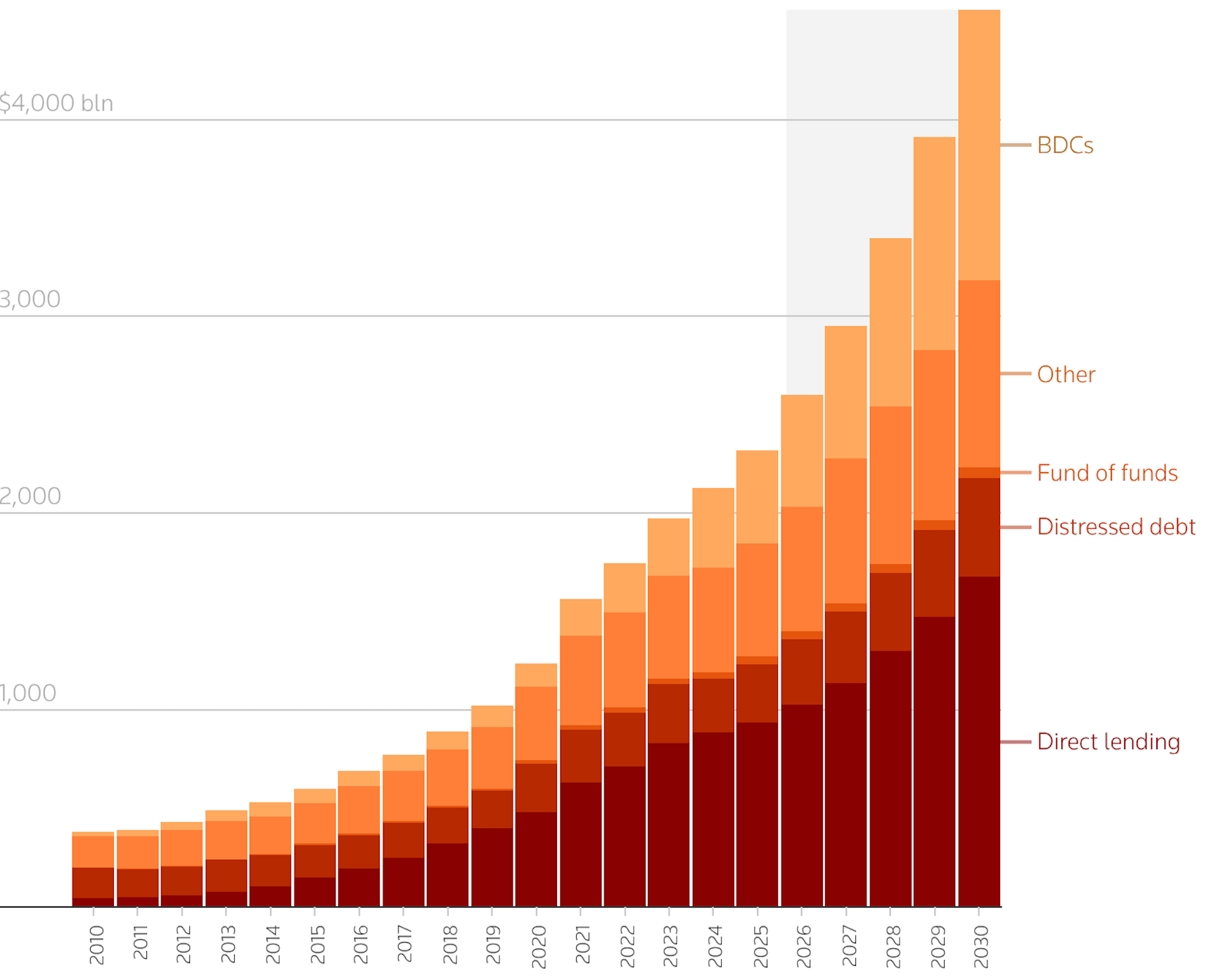
There is a growing risk that a looming crisis in the private credit market, fueled by rising redemptions and defaults, could spill over into Bitcoin (BTC) and crypto markets, according to analysts.
Key takeaways:
-
The $2 trillion private credit sector faces a crisis from defaults, redemptions, and limited oversight.
-
A liquidity crunch may force investors to sell readily accessible assets, like Bitcoin, first.
-
Historical crises show Fed interventions often lead to strong Bitcoin price rallies as a hedge against money supply expansion.
The private credit ticking time bomb?
The private credit sector, the non-bank lending sector that has grown to over $2 trillion from $500 billion in the past five years, is flashing warning signs of an impending crisis.
Fueled by low rates and investor hunger for high yields, it now rivals traditional banks but lacks the same oversight.
Related: Will Bitcoin crash if oil prices hit $100 per barrel?
In 2024, the International Monetary Fund (IMF) warned that the private credit sector “warranted closer watch,” adding:
“Rapid growth of this opaque and highly interconnected segment of the financial system could heighten financial vulnerabilities given its limited oversight.”

Now, the private credit market shows cracks that threaten triggering a financial crisis.
BlackRock, the world’s largest asset manager, with over $10 trillion under management, limited withdrawals from its $26 billion flagship credit funds, reported Bloomberg.
Blue Owl Capital halted redemptions amid software sector woes from AI disruptions, while UBS warns of default rates hitting 15% in worst-case scenarios.
On Wednesday, Reuters reported that JPMorgan restricted lending to its private credit funds while Morgan Stanley and Cliffwater Private Credit Fund joined the growing list of asset managers under distress.

”Bond King” Jeffrey Gundlach, founder at Double Line said that the private credit fund of funds in 2026 closely mirrors CDO-squared in early 2007, before the 2008 global financial crisis.
“Financial repression is incoming,” market analyst MartyParty said in an X post on Thursday, attributing the problems to the sector’s rapid growth in the face of ‘increasing scrutiny’ over liquidity during periods of investor outflows.
“Either the Fed injects liquidity, or we go into crisis.”
Global conflict and macroeconomic uncertainties exacerbate this, potentially delaying Fed easing while putting pressure on equities and the Bitcoin price.
As Cointelegraph reported, futures markets are pricing less than a 1% chance of Fed rate cuts at the March 18 FOMC meeting.
Liquidity crunch could crash Bitcoin price, at first
While the withdrawal limitations directly affect the private credit market, the implications extend far beyond traditional finance.
Withdrawal limits are a “big deal for crypto,” crypto investor Paul Barron said in a recent post on X, adding:
“When giants like Blackrock lock the gates on private funds, it signals a ‘liquidity crunch.’ Investors stuck in private credit might sell their ‘liquid’ assets (Bitcoin/ETH) to raise cash elsewhere.”
This means that if investors cannot access funds from illiquid private credit portfolios, they may turn to assets that can be sold instantly in public markets.
Bitcoin, which trades 24/7, often serves as the first pressure valve. Its price dropped sharply by 50% in March 2020 as the market priced in the COVID-19 crisis.
But this usually forces government interventions: emergency liquidity injections and rate cuts, aimed at averting systemic collapse.
In 2020, Fed actions post-crash fueled Bitcoin’s surge to its previous all-time high of $69,000 by year-end from $4,400, a 1,400% rally.

Similarly, during the March 2023 banking turmoil, Bitcoin initially sold off on contagion fears, then rallied more than 200% as markets priced in a Fed pause on rate hikes.
This suggests that a private credit breakdown might ultimately result in the further expansion of the money supply, sending BTC price to new highs.
As Cointelegraph reported, BitMEX co-founder Arthur Hayes will wait untill until the Fed loosens its monetary policy before buying any more Bitcoin. BTC price will then rise to $250,000, he predicted.
This article does not contain investment advice or recommendations. Every investment and trading move involves risk, and readers should conduct their own research when making a decision. While we strive to provide accurate and timely information, Cointelegraph does not guarantee the accuracy, completeness, or reliability of any information in this article. This article may contain forward-looking statements that are subject to risks and uncertainties. Cointelegraph will not be liable for any loss or damage arising from your reliance on this information.

Looking for the best altcoins to buy amid the ongoing Iran-US war volatility? This article highlights some of the top coins to buy for big gains as the war goes on and as many tokens become bargains.
Summary
- Hyperliquid is a top altcoin to buy because of its strong fundamentals.
- Pi Network will be listed on Kraken this Friday.
- Chainlink is the biggest oracle network in the crypto industry.
Hyperliquid
Hyperliquid (HYPE) has become one of the top beneficiaries of the ongoing war in Iran because of its perpetual oil futures product. This product has made it possible for people to trade crude oil during the weekend when most of the developments are happening.
Data shows that the volume in Hyperliquid has jumped this month. According to DeFi Llama, the network has processed perpetual futures contracts worth over $178 billion in the last 30 days. That amount is higher than that of Aster, Lighter, and TradeXYZ, combined.
The benefit of all this is that Hyperliquid’s fees have continued rising, which, in turn, has led to more token burns and buybacks.
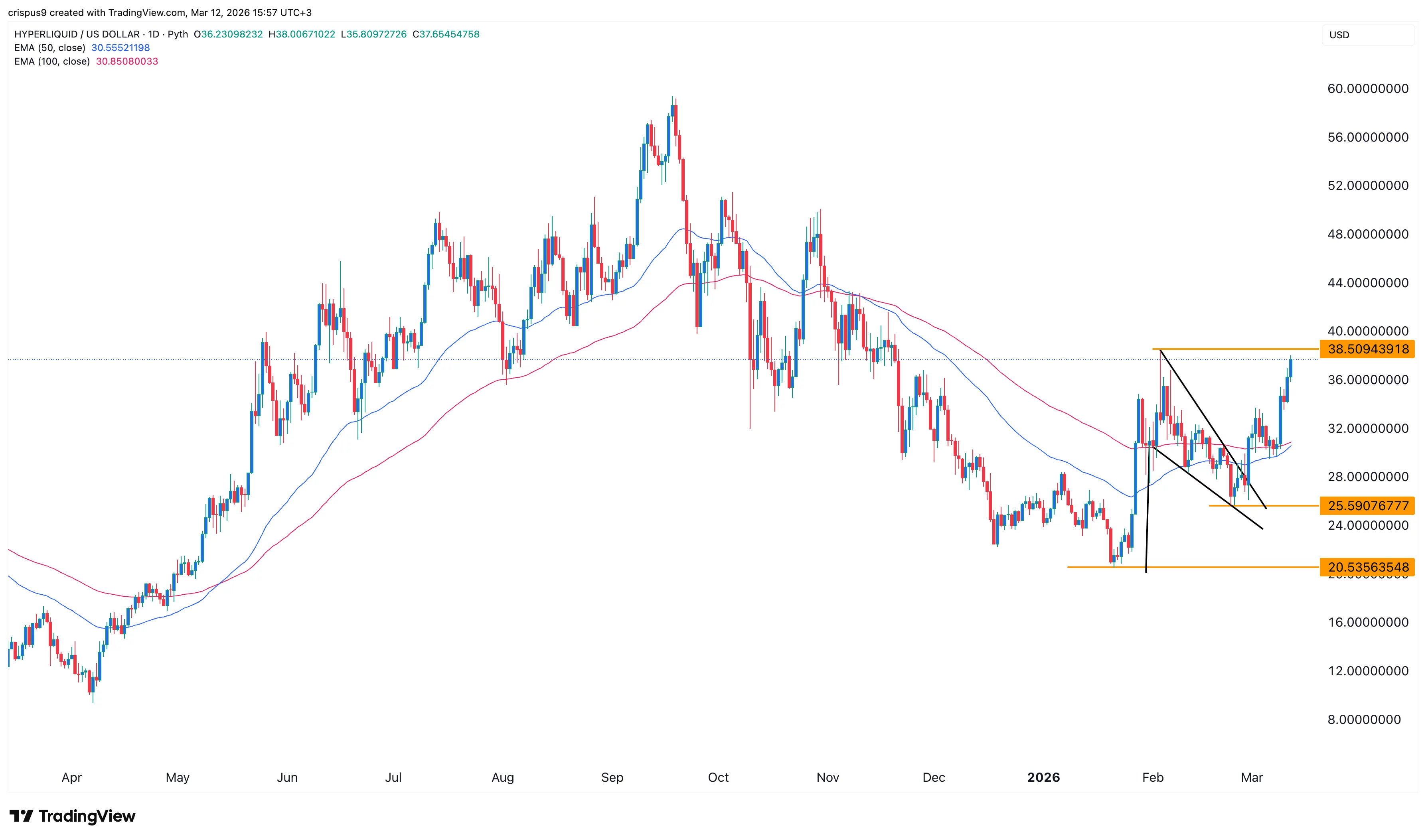
Technicals suggest that the HYPE price has more upside to go. It has already moved above the upper side of the falling wedge pattern. It also jumped above the 50-day and 100-day moving averages, pointing to more gains.
Pi Network
Pi Network (PI) is another top crypto to buy today. It has already jumped by over 80% from its lowest point this year and has numerous catalysts that may drive it higher in the coming weeks.
Kraken has already confirmed that it will list it on Friday. This listing is important as it will make it available in the United States for the first time. More exchanges may also decide to list it as it has become a top 50 coin.
The coin may continue rising because of the upcoming Pi Day event on Saturday and the ongoing network upgrades. Also, the developers are working on launching a KYC-as-a-Service solution. It is also becoming a top player in the artificial intelligence industry through its partnership with OpenMind.
Chainlink
Chainlink (LINK) is a top altcoin to buy for long-term gains because of it substantial market share in the oracle industry. It has a total value secured of over $50 billion, much higher than other oracles like RedStone and Pyth.
Chainlink is also a major player in the fast-growing real-world asset tokenization industry. It has large partnerships with companies like JPMorgan, Swift, ANZ Bank, and DTCC.
The Grayscale and Bitwise Chainlink ETFs have also accumulated $93 milion in inflows despite the ongoing crypto bear market.
There are other quality altcoins worth buying that will do well once a bull market starts. Some of the other notable ones are Ethereum, Solana, XRP, and Internet Computer.
PUMP price edged higher on Thursday as traders speculated about the project’s potential expansion beyond its current ecosystem.
Summary
- PUMP price rose as speculation around Pump.fun’s potential multi-chain expansion grew.
- Trading activity increased while the token held support near $0.002.
- Technical indicators show a volatility squeeze, suggesting a breakout could be approaching.
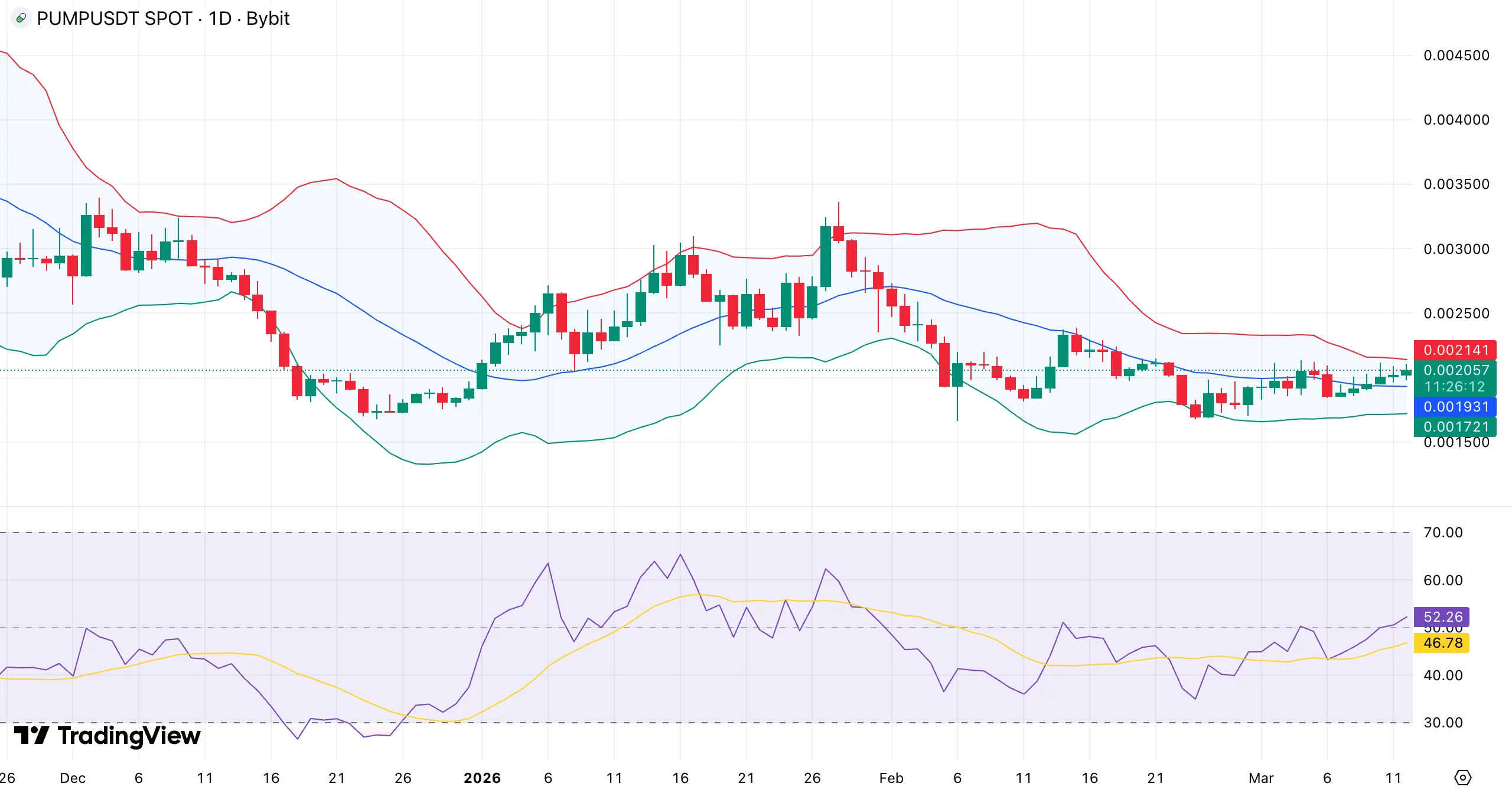
At press time, Pump.fun (PUMP) was trading at $0.00206, up about 4% in the past 24 hours. Over the past week, the token has traded between $0.001848 and $0.002108, keeping it near the top of its recent range.
The token has gained around 9% over the past month as buyers attempt a recovery. Even so, PUMP remains roughly 78% below its September 2025 all-time high.
Market activity has picked up alongside the price move. 24-hour trading volume reached about $111.1 million, a 32.4% increase from the previous day.
According to CoinGlass data, derivatives activity has also climbed, with futures volume rising 29% to $242 million while open interest increased 3.52% to $177 million. When both metrics rise together, it usually shows that traders are opening new positions rather than closing existing ones.
Multi-chain expansion rumors drive interest
Signs that Pump.fun may be getting ready to expand outside of Solana are largely responsible for the project’s recent surge in interest.
The platform recently registered a number of new subdomains linked to other networks, such as Ethereum, BNB Chain, Base, and Monad, according to observers. The move is often seen as early infrastructure work before launching services on additional chains.
At the same time, the project’s official social media profile removed its “Solana” location tag, adding to speculation that a broader rollout could be coming.
🚨JUST IN: https://t.co/VS31GZ3dMY has registered subdomains for Base, BSC, Monad and Ethereum, suggesting a possible move beyond Solana, while also removing Solana as its location from its X profile, adding to speculation of a crosschain expansion. pic.twitter.com/kpScjK7xDz
— SolanaFloor (@SolanaFloor) March 11, 2026
A new development has also emerged through a recent partnership with MoonPay, which allows users to fund Pump.fun accounts with assets held on different blockchains. Deposits from networks like Bitcoin, Polygon, and Arbitrum are possible with this integration.
The process is handled in the background by MoonPay, which automatically converts the assets and routes them to the platform.
Pump.fun itself continues to operate on the Solana network, and the team has not officially announced a full multi-chain expansion. Even so, the integration has sparked speculation that meme coin creation and trading on the platform could eventually extend beyond the Solana ecosystem.
If that direction is taken, the platform could gain access to larger liquidity pools from other networks. A rise in user activity and trading volume would likely increase the platform’s revenue.
In the past, those funds have been used for PUMP buybacks, token burns, and investments aimed at developing the ecosystem. However, some critics warn that multi-chain expansion could fragment liquidity. Memecoins listed on the platform may experience more volatility as a result.
PUMP price technical analysis
PUMP appears to be entering a volatility squeeze, which often precedes a large price movement. Following the recent period of consolidation, the Bollinger Bands have begun to contract, indicating a decrease in volatility.
When the bands narrow in this way, markets often react with a sharp move once price breaks out of the range. Several recent candles have formed near the $0.002 support area, where the token is currently trading. Buyers have stepped in around that level during the latest pullbacks.
Momentum also shows some improvement. The relative strength index has climbed back toward the 50 midpoint, indicating that selling pressure has started to ease after the earlier decline.
On shorter timeframes, the price structure is beginning to form higher lows. This pattern sometimes appears when a market starts to stabilize after a period of weakness.
For now, the next level traders are watching sits around $0.0022–$0.0023, which aligns with the upper Bollinger Band. A move above that area could confirm a volatility breakout.
If the breakout holds, the market may enter a new expansion phase. However, if resistance holds, the token could continue to move sideways around the $0.002 level while traders wait for clearer direction.

A crypto user has lost millions during a crypto swap on the decentralized finance protocol Aave, with a Maximal Extractable Value, or MEV, bot also front-running the transaction to make almost $10 million.
A recently funded wallet from Binance containing $50.4 million USDt (USDT) executed a swap via decentralized exchange aggregator CoW Protocol and the SushiSwap DEX on Thursday, aiming to convert the full amount into the Aave (AAVE) token.
However, the wallet only received 327 AAVE tokens valued at approximately $36,000, according to Etherscan.
The result was an almost total loss as the user paid around $154,000 per AAVE, compared to its market price of around $114.
Adding to the loss was a MEV bot that did a “sandwich attack” on the user. MEV bots scan pending blockchain transactions, and in this case, targeted the large incoming AAVE order to inflate the price of the token ahead of the order to profit.
The bot front-ran the transaction by flash-borrowing $29 million wrapped Ether (ETH) tokens from Morpho to drive up the price of AAVE ahead of the user’s transaction with a purchase on Bancor. It then sold the inflated tokens on SushiSwap for a $9.9 million profit.

User ignored slippage warnings: Aave
Automated market makers, such as SushiSwap, use an automated pricing formula that adjusts slippage, the intended and actual price of a trade, depending on the size of the trading pool and impending trades.
Aave founder Stani Kulechov posted to X that the protocol interface warned the user about the “extraordinary slippage” due to the “unusually large size of the single order.”
“The user confirmed the warning on their mobile device and proceeded with the swap, accepting the high slippage, which ultimately resulted in receiving only 324 AAVE in return,” he said.
Related: Vitalik Buterin proposes solutions for Ethereum’s MEV problem
CoW DAO said on X that “despite clear warnings that showed the user they would lose nearly all of the value of their transaction, and despite needing to explicitly opt into the trade after seeing the warning, the user chose to proceed with their swap.”
“No DEX, DEX aggregator, public liquidity pool, or private liquidity pool (or combination thereof) would have been able to fill this trade at anywhere near a reasonable price.”
CoW DAO said that trades like this “show that DeFi UX still isn’t where it needs to be to protect all users,” adding that it would refund any protocol fees associated with the transaction.
Aave’s Kulechov said it sympathized with the user and would attempt to contact them to return $600,000 in fees it collected from the transaction.
“The key takeaway is that while DeFi should remain open and permissionless, allowing users to perform transactions freely, there are additional guardrails the industry can build to better protect users.”
Magazine: All 21 million Bitcoin is at risk from quantum computers


Disclosure: This article does not represent investment advice. The content and materials featured on this page are for educational purposes only.
Bitcoin, Ethereum, and XRP are drawing renewed investor attention, while platforms like NOW DeFi highlight the growing shift toward passive income strategies.
Summary
- The synchronized recovery of major cryptocurrencies such as Bitcoin, Ethereum, and XRP is driving higher trading volumes and renewed investor discussions across the market.
- Investors are increasingly exploring alternatives to active trading, including staking, DeFi yield protocols, and cloud mining as ways to generate automated crypto income.
- NOW DeFi is attracting attention with features such as free hash power rewards, AI-powered mining optimization, and daily automated earnings settlement.
As sentiment in the cryptocurrency market begins to improve, major digital assets such as BTC, ETH, and XRP have recently rebounded together, once again becoming the focus of investor attention. Trading volumes are rising, and market discussions are increasing, with many analysts suggesting that the crypto market could be entering a new phase of activity.
However, after experiencing multiple cycles of volatility, investor priorities are also evolving. Rather than relying solely on price appreciation, more users are now exploring more stable and automated ways to generate crypto income.
With BTC, ETH, and XRP returning to the spotlight, a new trend is emerging: passive income is becoming a key theme in crypto investing.
As the market rebounds, investors are seeking new ways to earn
In the past, many crypto investors relied heavily on trading strategies to generate returns. But as market volatility increases and cycles move faster, more users are realizing that price speculation alone is not the only path to profit.
Today, investors are increasingly searching for opportunities that offer:
- Income models that do not require frequent trading
- Platform-based services with lower technical barriers
- Digital asset tools capable of generating automated returns
As market activity returns, these income models are attracting growing interest among investors.
Three Passive Income Strategies Gaining Popularity Among Crypto Investors
As the crypto ecosystem matures, several new earning models are gaining traction. The following three strategies are currently among the most widely discussed options.
1. Digital Asset Staking
Staking is one of the most common passive income strategies in the crypto space. By locking certain digital assets, users can receive rewards distributed by blockchain protocols or platforms.
This approach has a relatively low barrier to entry, although returns are often closely tied to market conditions.
2. DeFi Yield Protocols
DeFi protocols allow users to earn returns through liquidity provision, lending, or yield aggregation. While flexible, these methods often require a stronger understanding of risk management.
3. Cloud Mining Platforms
Among the various passive income options available, cloud mining is once again attracting market attention.
Unlike traditional mining, cloud mining does not require users to purchase expensive hardware or manage electricity and maintenance costs. Instead, users can rent computing power through a platform and participate in the mining rewards of cryptocurrencies such as Bitcoin.
This model is particularly appealing to investors who want a lower technical barrier while benefiting from automated income generation.
Why NOW DeFi is attracting growing interest from investors
Within the cloud mining sector, NOW DeFi is gradually gaining attention among crypto users.
For investors who are already trading BTC, ETH, or XRP but are looking for a “second income stream,” NOW DeFi offers a simplified entry point. The platform combines cloud mining infrastructure with DeFi-based earning mechanisms, enabling users to participate in digital asset income opportunities through automated processes.
Key features of NOW DeFi
Free Hash Power Rewards
New users receive a free mining reward upon registration.
Daily Earnings Settlement
The platform supports automated daily reward distribution.
AI Hash Power Optimization System
Dynamic resource allocation helps improve mining efficiency.
Green Energy Mining Farms
The platform’s mining infrastructure is located in regions rich in renewable energy.
According to the platform, its mining network is primarily distributed across:
- Norway
- Canada
- Iceland
- Sweden
- Paraguay
- Uruguay
These regions offer relatively low energy costs and stable renewable energy supplies, supporting efficient mining operations.
How to start earning with NOW DeFi in 3 simple steps
For users interested in trying cloud mining, the process is relatively straightforward:
Step 1: Register an Account and Claim Free Hash Power
Visit the official nowdefi.com website or download the mobile application to register and receive the platform’s free hash power reward.
Step 2: Choose a Mining Plan
Select a mining plan that fits your investment preferences.
Step 3: Earn Daily Rewards Automatically
The system calculates and distributes rewards automatically, allowing users to monitor their earnings through their account dashboard.
Example Mining Plans
Plan
Investment
Contract Duration
Estimated Daily Earnings
Entry Plan
$100
2 Days
~$4
Mid-Tier Plan
$10,000
Varies by plan
~$165
Advanced Plan
$50,000
Varies by plan
~$955
Please note that actual returns may vary depending on market conditions, network difficulty changes, and platform policies.
Passive income is becoming a major trend in the crypto market
As the cryptocurrency market matures, investors are increasingly adopting diversified strategies rather than relying solely on price speculation.
Many users are combining multiple approaches, including:
- Holding major digital assets
- Participating in DeFi yield protocols
- Using cloud mining platforms
This diversified approach can help investors maintain more stable income streams during periods of market volatility.
Conclusion
The synchronized rebound of BTC, ETH, and XRP has once again sparked excitement across the crypto market. But for many investors, the real attraction is not just price appreciation, but the ability to generate value consistently across market cycles.
From DeFi to cloud mining, passive income strategies are becoming an important focus for crypto investors. For those seeking opportunities beyond simply trading major cryptocurrencies, NOW DeFi offers a relatively simple way to participate.
Users can register by visiting the official NOW DeFi website or downloading the mobile application. After completing registration, new users can claim the platform’s free hash power reward and begin participating in cloud mining without purchasing mining hardware.
Disclosure: This content is provided by a third party. Neither crypto.news nor the author of this article endorses any product mentioned on this page. Users should conduct their own research before taking any action related to the company.
AVAX price hovered near a key level on Thursday as the market reacted to the launch of a new exchange-traded fund tied to the token.
Summary
- AVAX traded near the top of its weekly range as Grayscale’s Avalanche ETF started trading.
- The new product gives traditional investors exposure to Avalanche and its staking rewards.
- Traders are watching the $10 level, which has acted as a strong resistance zone.
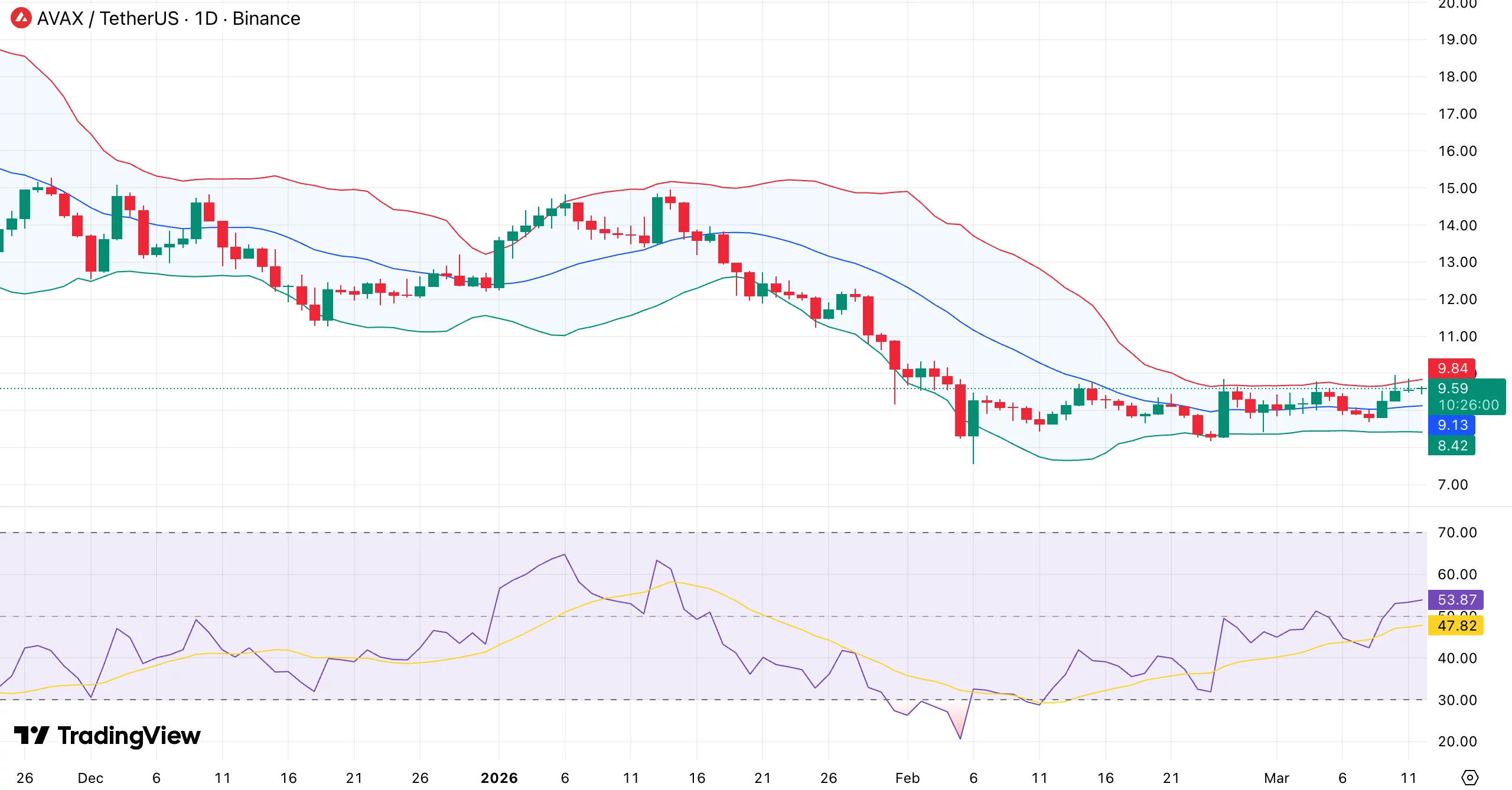
At press time, Avalanche (AVAX) traded at $9.58, down about 0.8% over the past 24 hours. The token has moved between $8.82 and $9.87 over the past week and is now close to the top of that range.
AVAX has gained around 8.8% in the past month as buyers try to push the price higher again. Even so, the token is still about 47% lower than it was a year ago, after the long slide that hit much of the crypto market.
Activity in the derivatives market cooled a bit during the last day. CoinGlass data shows futures volume dropping 26% to $489 million, while open interest slipped 4.41% to $432 million.
When both numbers fall at the same time, it often means some traders are closing positions while others wait for the next move.
Grayscale Avalanche ETF begins trading
The market is reacting to a new product from Grayscale Investments. The firm’s Grayscale Avalanche Staking ETF, trading under the ticker GAVA, began trading on March 12 on Nasdaq.
The fund first appeared as the Grayscale Avalanche Trust in August 2024. At that time it was only available through private placement for accredited investors. After a filing with U.S. regulators in 2025, the product was converted into a publicly traded exchange-traded product.
The ETF started trading with a net asset value of $23.33 per share and about $5.55 million in assets under management. It tracks the price of AVAX and also factors in staking rewards earned from the network. Staking on Avalanche returned roughly 7% on average in 2025, which is now reflected in the structure of the fund.
Products like this often bring new attention to a token because they allow investors to gain exposure through traditional markets. Whether the ETF attracts large inflows will likely determine how much impact it has on AVAX price.
AVAX price technical analysis
On the chart, AVAX is slowly moving toward the $10 mark, which has acted as a strong barrier during previous rallies. The price is now close to the upper Bollinger Band near $9.8–$10, and traders are watching to see if it can push above that area.
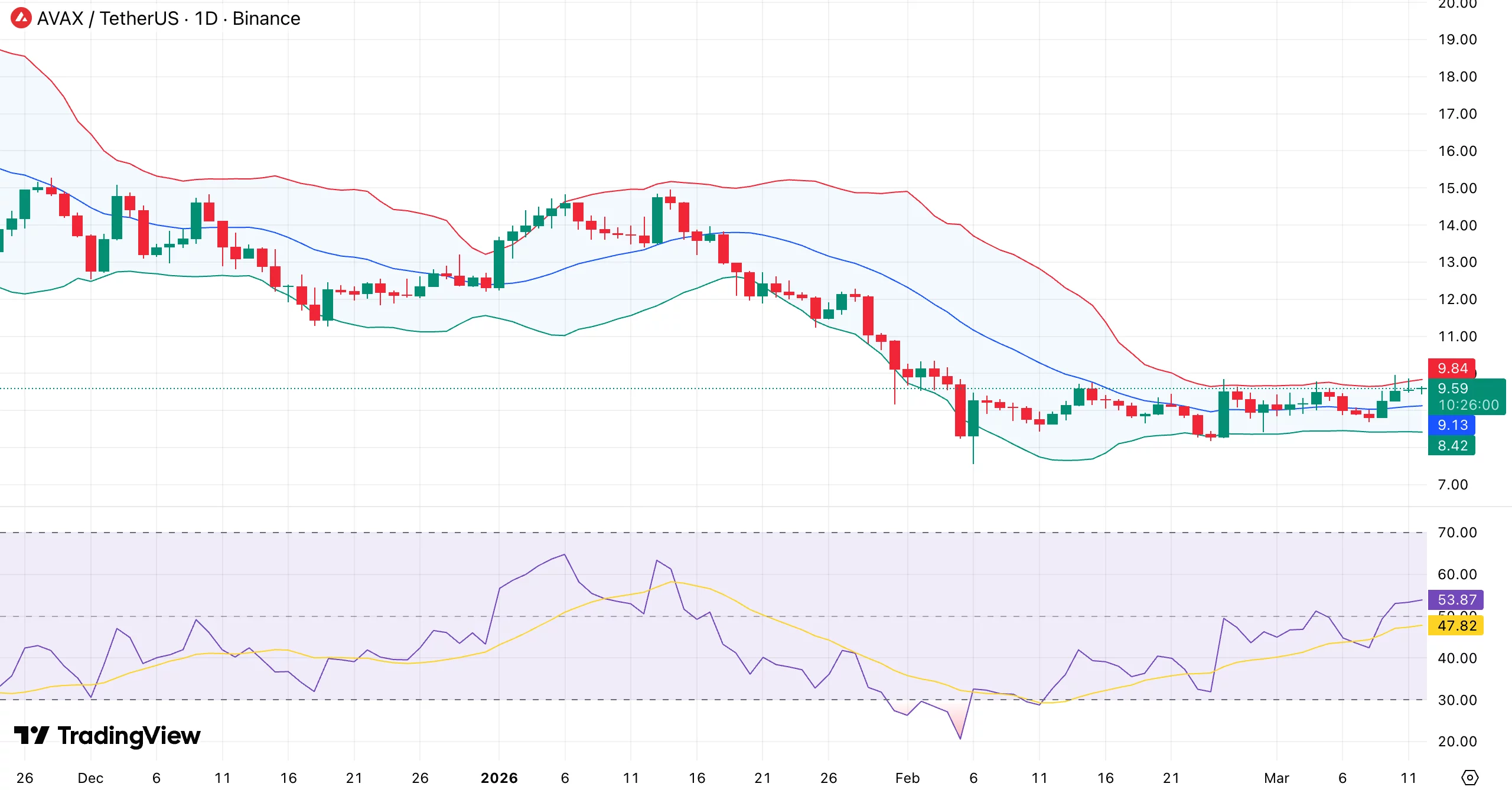
Volatility has been shrinking over the past several days as the Bollinger Bands move closer together. This type of setup often appears before a bigger move once price finally breaks out of the range.
AVAX has also moved back above its 20-day moving average near $9.1–$9.2. That level held during recent pullbacks and buyers stepped in each time the price approached it.
Momentum has improved as well. Slightly above the neutral zone, the relative strength index is currently at 53. Since the indicator is not yet in overbought territory, price movement is still possible if buying pressure persists.
Beginning early February, the chart has also started to show higher lows, a pattern that often appears when buyers slowly build positions.
Support is near $9.10–$9.20, while a deeper pullback could test the $8.40–$8.50 area. For now, the main level traders are focused on remains $10. A clear daily close above that line would be the first strong sign that AVAX may be turning upward after months of decline.

Donald Trump is billed as the keynote speaker at an event in Florida for his top memecoin holders, which comes as the token hits an all-time low.
US President Donald Trump’s memecoin saw a slight bump up from its all-time low after the team behind the token said its top holders will be given access to the president at another exclusive event.
The Official Trump (TRUMP) token team posted to X on Thursday that a luncheon with Trump at his Mar-a-Lago residence in Florida on April 25 is up for grabs for the top 297 holders of the token.
The memecoin’s website bills Trump as the keynote speaker of the event; however, a White House official told Politico that the event isn’t locked in on Trump’s schedule, and is taking place the same day that Trump said he would attend the White House Correspondents’ Dinner.
Eligibility to attend the event is limited to the top 297 holders based on time-weighted holdings between Mar. 12 and April 10. Attendees will also need to pass a background check. The top 29 holders will also qualify for a private reception with Trump.

It is the second event for holders of the TRUMP token, with the first taking place at a Trump golf club in May, which attracted concern from critics who accused Trump of using his position as president for personal financial gain.
TRUMP climbs out of low on gala offer
The TRUMP token hit a high of $3.06 on Thursday amid news of the gala, climbing from an all-time low of $2.73 hours earlier, according to CoinGecko.
TRUMP is up 2.4% in the past 24-hours to $2.94, but is down 96% from its all-time high in January 2025 of $73.43.
At the first event for TRUMP token holders last year, Tron founder Justin Sun was the largest tokenholder in attendance, which was reportedly enough to earn him a watch presented during a ceremony.
Related: US Senate votes to include CBDC ban in bipartisan housing bill
Infinex founder Kain Warwick also attended the event after stocking up on enough TRUMP to break the top 25 investors on the leaderboard.
US senators and former staffers protested outside the event, with Bloomberg reporting at the time that protestors shouted “Shame!” and “I hope you choke on your dinner!” at attendees.
Magazine: All 21 million Bitcoin is at risk from quantum computers
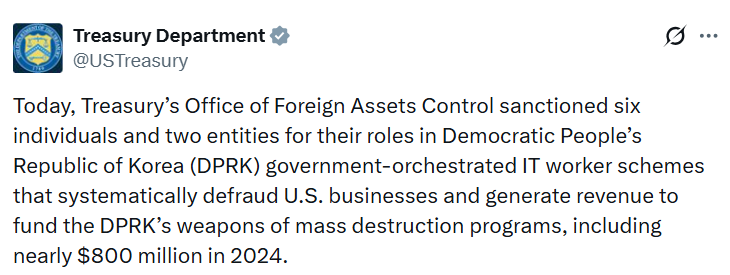
The US Treasury has sanctioned six people and two entities for their alleged roles in an IT worker fraud scheme orchestrated by North Korea, which frequently targets the crypto industry.
The Office of Foreign Assets Control (OFAC) said on Thursday that it sanctioned alleged facilitators of the IT worker fraud networks operating in North Korea, Vietnam, Laos and Spain, which generate revenue to fund North Korea’s weapons program.
OFAC sanctioned Amnokgang Technology Development Company, a DPRK firm accused of managing overseas IT workers, and Nguyen Quang Viet, CEO of Quangvietdnbg International Services Company Limited, a Vietnam-based company accused of laundering $2.5 million through cryptocurrency for the network.
Do Phi Khanh, Hoang Van Nguyen, Yun Song Guk, Hoang Minh Quang and York Louis Celestino Herrera were also sanctioned for their alleged roles in the DPRK IT worker networks.

The sanctions mean all US assets connected to those named are frozen and they can’t conduct any financial transactions or engage in business dealings with the US under threat of civil and criminal penalties.
Fraudulent tech workers with ties to North Korea have been highly active, targeting a range of industries, including blockchain companies. An April 2025 report by Google found that the schemes’ infrastructure has spread worldwide.
Worker fraud rings a growing threat: Chainalysis
OFAC’s sanctions included 21 cryptocurrency addresses across Ethereum and Tron. Chainalysis said on Thursday that the “designation of addresses across multiple blockchain networks reflects [North Korea’s] increasingly multi-chain approach to moving funds.”
Related: Someone counter-hacked a North Korean IT worker: Here’s what they found
Chainalysis added that North Korean IT worker schemes “represent a sophisticated and growing threat,” relying on stolen identities and fabricated personas to obtain employment with legitimate companies globally.
“Beyond generating revenue through fraudulent employment, these workers have also been known to covertly introduce malware into company networks to extract proprietary and sensitive information,” the firm said.
“Cryptocurrency businesses should screen all counterparties against updated OFAC sanctions lists, be alert to patterns consistent with IT worker fraud, and monitor for unusual payment patterns.”
Magazine: All 21 million Bitcoin is at risk from quantum computers

Presidential memecoin TRUMP drew a brief bid higher after the project team announced a high-stakes access event for its most loyal holders. The Official Trump token will grant the largest holders—based on time-weighted holdings from March 12 through April 10—a luncheon with Donald Trump at Mar-a-Lago on April 25. The invitation also reserves a private reception for the top 29 holders. While the marketing message centers on Trump as the keynote speaker, a White House official told Politico that the date isn’t firmly locked and could shift, potentially aligning with Trump’s schedule for the White House Correspondents’ Dinner. The plan marks the second such gathering for TRUMP holders, continuing a pattern of celebrity-driven promotions that keep meme coins in the headlines even as fundamentals remain fragile.
Key takeaways
- The event is limited to the top 297 holders by time-weighted balance between March 12 and April 10, with the top 29 receiving a private reception with Trump.
- A White House official indicated to Politico that the date may not be locked, potentially creating scheduling uncertainty around the dinner and the gala.
- The announcement followed a lift in price, with TRUMP reaching a high of $3.06 after the news, up from an intraday low of $2.73.
- Despite the bounce, the token remains vastly suppressed versus its peak in January 2025, when it traded near $73.43.
- Past events at Trump properties have drawn scrutiny from critics who view celebrity-backed memecoins as leveraging political influence for financial gain.
- The event underscores ongoing dynamics in meme-coins, where access, exclusivity, and public spectacle can drive short-term volatility even as regulatory and investor skepticism persists.
Tickers mentioned: $TRUMP
Sentiment: Neutral
Price impact: Positive. A promotional event for top holders helped lift the token’s price from a prior trough, though the overall levels remain far from earlier highs.
Trading idea (Not Financial Advice): Hold. The event-driven move suggests short-term volatility, but the long-run prospects for a meme-based token tied to a political figure remain highly uncertain.
Market context: Meme coins continue to react to promotional events and celebrity associations, often swaying on short-lived headlines while liquidity and regulatory scrutiny shape broader risk sentiment in crypto markets.
Why it matters
The TRUMP event illustrates how meme-based assets persist in attracting retail attention through staged gatherings, exclusivity, and social-media momentum. For holders, a luncheon with a high-profile political figure offers perceived social capital and a potential price catalyst, even as the fundamental underpinnings of the token remain speculative. The broader crypto ecosystem has grown accustomed to celebrity-linked campaigns, but these moves come with increased regulatory sensitivity and investor risk. Critics argue that leveraging presidential associations for token sales can blur lines between marketing and potential conflicts of interest, prompting ongoing debates about disclosure and accountability in crypto promotions.
From a market mechanics perspective, the event highlights how time-weighted metrics and holder concentration can translate into real-world access rewards, creating incentives for larger wallets to accumulate and maintain positions. Yet, the same dynamics can amplify volatility if the distribution criteria change or if regulatory signals curb promotional activity. As with prior memecoin episodes, the reaction is likely to be transient, with price swings centering on the perceived value of access and the credibility of the event’s organizers.
For investors and builders, the episode reinforces the importance of differentiating between hype-driven moves and substantive product developments. It also underscores the risk that politically connected promotions may face heightened scrutiny, affecting liquidity and moderation from exchanges and wallets. The juxtaposition of a presidential figure with a speculative digital asset continues to shape the narrative around meme-coins, even as mainstream financial and policy considerations evolve around crypto advertising and investor protection.
What to watch next
- Confirmation or rescheduling of the Apr 25 Mar-a-Lago luncheon, as officials’ schedules and public appearances could shift.
- Updates on the time-weighted holdings window (Mar 12–Apr 10) and the final list of eligible holders, including the top 29 for the private reception.
- Any regulatory or legislative developments that address celebrity-driven crypto promotions or disclosures in memecoin campaigns.
- Subsequent price movements in TRUMP following the event announcement and after any public statements from organizers or attendees.
Sources & verification
- Official Trump token event post detailing the top holder eligibility and reception tiers
- Announcement discussions on X (GetTrumpMemes/status/2032178840663929116)
- Conference page for the TRUMP token (gettrumpmemes.com/conference)
- Politico reporting on the White House schedule and event timing
- CoinGecko price data for Official Trump (TRUMP)
TRUMP token gala lifts sentiment among top holders
The Official Trump token (CRYPTO: TRUMP) has moved briefly higher after its developers disclosed a high-profile access opportunity for major holders. The arrangement centers on a luncheon with Donald Trump at Mar-a-Lago on April 25, open to the 297 largest holders by time-weighted holdings recorded between March 12 and April 10. The 29 largest holders are set to attend a private reception, a detail echoed on the project’s official website and promoted across social channels. While the description emphasizes Trump as the keynote, a White House official told Politico that the schedule remains fluid, with potential overlap with the White House Correspondents’ Dinner on the same day.
Access rules are explicit: attendees must pass a background check, and eligibility is determined by holdings within the defined window. The event marks the second such gathering for TRUMP token holders, following a prior gala at a Trump golf club in May, which drew controversy from critics who argued that presidential influence was being leveraged for private gain. Notably, Justin Sun, founder of Tron, attended the first event and was reported to have received a timepiece as a token of attendance, underscoring how celebrity ties can elevate the profile of meme coins despite lackluster fundamentals.
Beyond the headline, price action reflected a brief rally. The TRUMP token rose to a high of $3.06 on Thursday after the gala was announced, rebounding from an intraday low of $2.73. By the end of the session, data from CoinGecko showed the token trading around $2.94, a 2.4% gain over 24 hours. The bounce comes with a caveat: the token has plunged about 96% from its January 2025 all-time high of $73.43, illustrating the steep, meme-driven volatility that characterizes these assets. Historical context includes past attendance by notable figures such as Infinex founder Kain Warwick, who participated after accumulating significant TRUMP holdings, highlighting how insider-flavored events can attract attention from niche crypto communities.
As the narrative unfolds, the episode sits at the intersection of political spectacle and crypto promotion, a space that has attracted scrutiny from lawmakers and market observers. Critics have argued that such events risk conflating political optics with financial incentives, potentially prompting calls for greater transparency in token distributions and marketing practices. Proponents, meanwhile, view these events as a legitimate form of community-building within a volatile ecosystem where audience engagement often drives short-term liquidity and sentiment. The balance between entertainment value and investor protection remains the key tension shaping TRUMP’s trajectory in the coming weeks.
Attorney Seeks To Move Battery Case To Diversion

How to end awkward multilingual calls

MediaTek chip flaw exposed crypto wallets and passwords without booting Android


-
Business7 days ago
Form 8K Entergy Mississippi LLC For: 6 March
-

 News Videos4 days ago
10th Algebra | Financial Planning | Question Bank Solution | Board Exam 2026
-

 Fashion6 days ago
Weekend Open Thread: Ann Taylor
-

 Crypto World4 days ago
Paradigm, a16z, Winklevoss Capital, Balaji Srinivasan among investors in ZODL
-
 Tech2 days ago
A 1,300-Pound NASA Spacecraft To Re-Enter Earth’s Atmosphere
-

 Tech2 days ago
ChatGPT will now generate interactive visuals to help you with math and science concepts
-

 Politics7 days ago
Top Mamdani aide takes progressive project to the UK
-

 Business3 days ago
ExxonMobil seeks to move corporate registration from New Jersey to Texas
-

 Sports5 days ago
Three share 2-shot lead entering final round in Hong Kong
-

 Sports5 days ago
Braveheart Lakshya downs Lai in epic battle to enter All England Open final | Other Sports News
-

 NewsBeat1 day ago
Residents reaction as Shildon murder probe enters second day
-

 Entertainment6 days ago
Hailey Bieber Poses For Sexy Selfies In New Luscious Lip Thirst Traps
-

 Business4 days ago
Search for Nancy Guthrie Enters 37th Day as FBI Probes Wi-Fi Jammer Theory
-

 Business2 days ago
Search Enters Sixth Week With New Leads in Tucson Abduction Case
-
 NewsBeat3 days ago
Pagazzi Lighting enters administration as 70 jobs lost and 11 stores close across Scotland
-

 Tech4 days ago
Despite challenges, Ireland sixth in EU for board gender diversity
-

 Business3 days ago
Search Enters 39th Day with FBI Tip Line Developments and No Major Breakthroughs
-

 NewsBeat2 days ago
I Entered The Manosphere. Nothing Could Prepare Me For What I Found.
-

 Business6 days ago
Iran war enters second week as Trump demands ’unconditional surrender’
-

 Sports4 days ago
Skateboarding World Championships: Britain’s Sky Brown wins park gold