

Crypto World
BlackRock scores major SEC win as IBIT options cap quadruples



BlackRock’s iShares Bitcoin Trust has secured a major regulatory win after the U.S. Securities and Exchange Commission approved a fourfold increase in the ETF’s options position limit from 250,000 to 1 million contracts.
Summary
- SEC has approved raising IBIT options limits from 250,000 to 1 million contracts.
- NYSE Arca says the higher cap matches strong trading demand and improves liquidity.
- The approval comes after BlackRock reported 31% year-over-year revenue growth in Q2.
According to a notice published by the U.S. Securities and Exchange Commission, a rule change submitted by NYSE Arca has become effective immediately, allowing the exchange to raise the position and exercise limits for options linked to the iShares Bitcoin Trust ETF.
The regulator said the filing was made under Section 19(b)(1) of the Securities Exchange Act and Rule 19b-4 while continuing to seek public comments on the proposal.
The approval gives traders access to significantly larger options positions tied to the world’s largest spot Bitcoin ETF by assets. It also arrives as institutional interest in U.S. spot Bitcoin ETFs continues to grow, with IBIT remaining one of the strongest-performing funds in the category over recent months.
NYSE Arca says trading growth justified the increase
NYSE Arca stated in its filing that the previous 250,000-contract limit no longer matched trading activity in IBIT options. The exchange argued that increasing the cap to 1 million contracts would better accommodate current market demand while allowing market makers to manage inventory and hedge positions more effectively.
The exchange also noted that the revised limit is consistent with similar changes already recognized for competing options venues, including Nasdaq ISE, Nasdaq PHLX, and BOX Exchange. By aligning the limits across exchanges, NYSE Arca said participants would be able to trade under a more consistent regulatory framework.
Although the SEC allowed the proposal to take effect immediately, the agency said it will continue accepting public feedback before reaching a final conclusion on the filing.
For institutional investors, the higher ceiling removes a practical restriction that could limit large hedging or trading strategies. According to NYSE Arca’s filing, expanding the available contract limit should support smoother options trading without forcing large participants to divide positions because of exchange-imposed caps.
BlackRock earnings add to positive momentum
The regulatory decision has arrived shortly after BlackRock released its fiscal second-quarter 2026 earnings. The asset manager reported a 31% year-over-year increase in revenue and announced plans to raise its quarterly share repurchase target to $550 million, adding another positive development for the firm’s investment business.
At the same time, IBIT has remained in focus after recording strong investor inflows over the past week, reinforcing its position as one of the largest spot Bitcoin exchange-traded funds in the U.S. market.
BlackRock has also expanded its presence beyond crypto ETFs. Earlier this week, the firm joined the Depository Trust & Clearing Corporation tokenization pilot alongside JPMorgan Chase and Goldman Sachs to explore blockchain-based settlement for stocks and U.S. Treasuries.
While traditional exchanges continue expanding Bitcoin ETF derivatives, tokenized equity trading is also gaining traction on blockchain-based platforms, giving crypto investors additional ways to access equity exposure.
The SEC’s latest approval applies specifically to regulated options listed on NYSE Arca and does not affect trading rules for tokenized securities.



Actor and cryptocurrency critic Ben McKenzie has taken his campaign against the Digital Asset Market Clarity Act to Capitol Hill as the legislation approaches a possible Senate vote.
Summary
- Ben McKenzie lobbied senators against the CLARITY Act as lawmakers prepare for possible floor action.
- His campaign joins Democratic calls for stronger ethics rules covering President Trump’s growing cryptocurrency interests.
- The bill needs sixty Senate votes, making bipartisan support essential before lawmakers leave for recess.
McKenzie spent Tuesday meeting with lawmakers and joined Democratic senators at a Capitol Hill press conference opposing the CLARITY Act. The former The O.C. actor argued against legislation that he and other critics say lacks adequate consumer protections and government ethics rules.
McKenzie joins senators opposing CLARITY Act
McKenzie appeared alongside Senators Chris Murphy, Jeff Merkley and Chris Van Hollen, as well as representatives from Americans for Financial Reform and Indivisible. The group called on senators to reject the current bill unless lawmakers address their concerns.
The opposition centers partly on President Donald Trump’s financial ties to digital assets. Critics have called for restrictions preventing senior government officials and their families from benefiting financially from industries they oversee. The White House has rejected allegations of improper conflicts and has argued that ethics rules should apply equally to officials rather than target the president specifically.As previously reported, the ethics dispute has become one of the main barriers to securing the Democratic votes needed for passage.
Actor has become a prominent crypto critic
McKenzie is best known for playing Ryan Atwood in The O.C. and later appearing in Southland and Gotham. In recent years, he has become an outspoken critic of cryptocurrency markets, celebrity token promotions and claims that blockchain technology can remove the need to trust financial intermediaries.
His work has included interviews with investors, industry critics and former FTX CEO Sam Bankman-Fried. McKenzie has argued that software cannot fully remove human control from financial systems, pointing to failures at centralized crypto companies as examples of why management and oversight still matter.
His latest lobbying effort moves that campaign directly into the legislative debate. A social media post documenting his Capitol Hill activity showed McKenzie participating in the campaign against the market structure bill.
CLARITY Act faces a narrowing Senate window
The CLARITY Act would create a federal market structure for digital assets and establish clearer regulatory roles for the Securities and Exchange Commission and Commodity Futures Trading Commission. It would also introduce rules covering exchanges, token issuers and other crypto businesses.
The measure passed the Senate Banking Committee in May by a 15-9 vote after receiving support from two Democrats. It has since reached the Senate legislative calendar, making it eligible for floor consideration, but Senate leaders had not publicly scheduled a final vote as of July 15.
Recent crypto.news coverage noted that the legislation still faces a narrowing path before the Senate’s August break. A July 17 House hearing will also examine the bill, although that hearing cannot move the Senate legislation itself.
Ethics fight could determine whether the bill passes
The CLARITY Act needs enough support to clear the Senate’s 60-vote procedural threshold, making Democratic backing necessary. Ethics provisions have therefore become central to negotiations as lawmakers from both parties work on a final version.
As previously reported, lawmakers are also negotiating rules for decentralized finance and stablecoin rewards. Those disagreements add further pressure to an already limited legislative calendar.
Supporters argue that the bill would replace years of regulatory uncertainty with clearer federal rules. Opponents, including McKenzie and the senators who joined Tuesday’s event, say Congress should not approve the framework without stronger ethics and consumer safeguards.
McKenzie’s involvement does not give him a formal role in the legislative process, but his Capitol Hill campaign adds another public voice to the opposition. The outcome will depend on whether senators can settle the remaining disputes and build the bipartisan support required for a floor vote.


BitMine Immersion Technologies generated $45.7 million from Ethereum staking and validation during the three months ended May 31, making staking its main source of revenue.
Summary
- Ethereum staking generated $45.7 million, accounting for 98% of BitMine’s total quarterly revenue in May.
- BitMine now stakes 4.9 million ETH, equal to roughly 85% of its Ethereum treasury holdings.
- Tom Lee projects $284 million in annual rewards once BitMine fully stakes its ETH treasury.
The figure represented 98% of the company’s $46.5 million in total quarterly revenue, according to its latest 10-Q filing with the SEC.
A year earlier, BitMine reported total quarterly revenue of just $2.05 million. Machine leasing contributed $1.08 million, while Bitcoin self-mining generated $813,000. The latest results show how sharply the company’s business has shifted toward Ethereum after building one of the world’s largest corporate ETH treasuries.
Ethereum staking becomes BitMine’s core revenue source
BitMine began native Ethereum staking in November 2025 and later launched the Made in America Validator Network, or MAVAN, in March 2026. The institutional platform provides validator and staking infrastructure and is designed to expand beyond BitMine’s own treasury to serve custodians and other institutional clients.
The company also acquired Australian staking infrastructure provider Pier Two in March. The business contributed $3.53 million of quarterly staking revenue and now operates under the MAVAN brand. BitMine said staking and validation generated $56.9 million during the nine months ended May 31, or 95% of its total revenue for the period.
BitMine now has 4.9 million ETH staked
BitMine has continued expanding its Ethereum position since the quarter ended. As of July 12, the company held 5.77 million ETH and had 4,917,189 ETH staked through its operations and staking partners, equal to about 85% of its total holdings.
Notably, BitMine has steadily increased both its ETH treasury and the share placed into staking. Its long-term strategy targets ownership of 5% of Ethereum’s total supply, a goal Chairman Tom Lee calls the “Alchemy of 5%.”
Tom Lee projects $284M in annual staking rewards
Lee said BitMine could generate about $284 million in annualized ETH staking rewards once its entire Ethereum balance is staked through MAVAN and partner platforms. The estimate uses a recent seven-day annualized yield of 2.70%. The figure remains a projection and could change as Ethereum staking yields, ETH prices and validator conditions move.
The company itself identified that dependence as a business risk. Its SEC filing said staking and validation revenue is highly concentrated in MAVAN-related operations. Lower staking yields, validator disruption, Ethereum protocol changes or regulatory developments could therefore have a direct effect on future revenue.
BitMine shifts away from its Bitcoin mining roots
The quarter also showed how small BitMine’s older business lines have become. Bitcoin self-mining generated $624,000, while consulting brought in $168,000. Machine leasing and mining equipment sales produced no revenue after the company ended those operations.
Despite the revenue increase, BitMine reported a quarterly net loss of $83.6 million, driven partly by derivative losses and other expenses. The results show that staking has become the company’s dominant operating revenue engine, but its overall financial performance remains exposed to Ethereum prices, staking economics and its wider treasury strategy.
Recent crypto.news coverage showed BitMine’s ETH holdings reaching 5.77 million tokens as it moved closer to its 5% supply target. With about 4.9 million ETH already staked, future earnings will increasingly depend on whether MAVAN can maintain its validator performance and expand into institutional staking services.
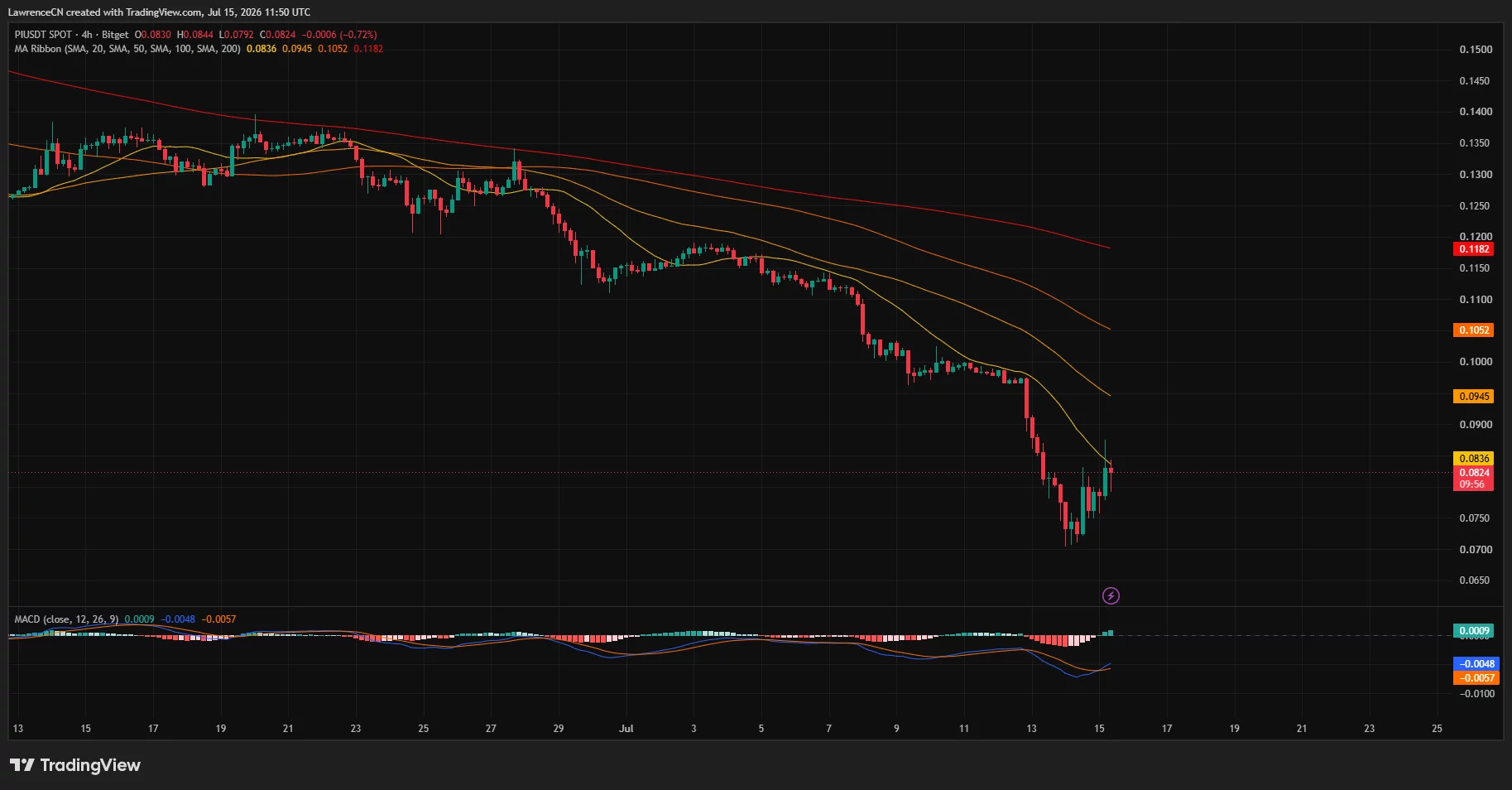
Pi Network price has climbed nearly 20% to around $0.086 on July 15 after an oversold rebound, with improving U.S. inflation data and renewed buying interest combined to lift the token from fresh record lows.
Summary
- Pi Network price surged nearly 20% after an oversold rebound and softer U.S. inflation data boosted crypto sentiment.
- A bullish MACD crossover and higher trading volume supported the recovery, though PI remains below key moving averages.
- Heavy July token unlocks continue to pressure the market despite new Pi2Day products and ecosystem upgrades.
According to data from crypto.news, Pi Network (PI) rebounded from the $0.070-$0.072 area before reaching an intraday high near $0.086, while the latest U.S. inflation figures helped fuel a relief rally across the cryptocurrency market.
The move followed several weeks of relentless selling that had erased roughly 40% of the token’s value and pushed momentum indicators into deeply oversold territory, encouraging bargain hunters and short-term traders to step back into the market.
Oversold conditions and macro relief have supported the rebound
The recovery gained traction after Pi’s daily Relative Strength Index dropped to around 15, a level that typically signals exhausted selling pressure.
At the same time, softer-than-expected U.S. consumer price data improved sentiment across digital assets, drawing fresh liquidity into high-risk cryptocurrencies that had suffered some of the steepest declines during the recent market correction.
Trading activity also accelerated during the rally, with daily volume climbing above $27 million as speculative buyers returned. On the 4-hour chart, Pi has also produced a bullish MACD crossover, while the histogram has turned positive for the first time in days, suggesting bearish momentum has weakened in the short term.
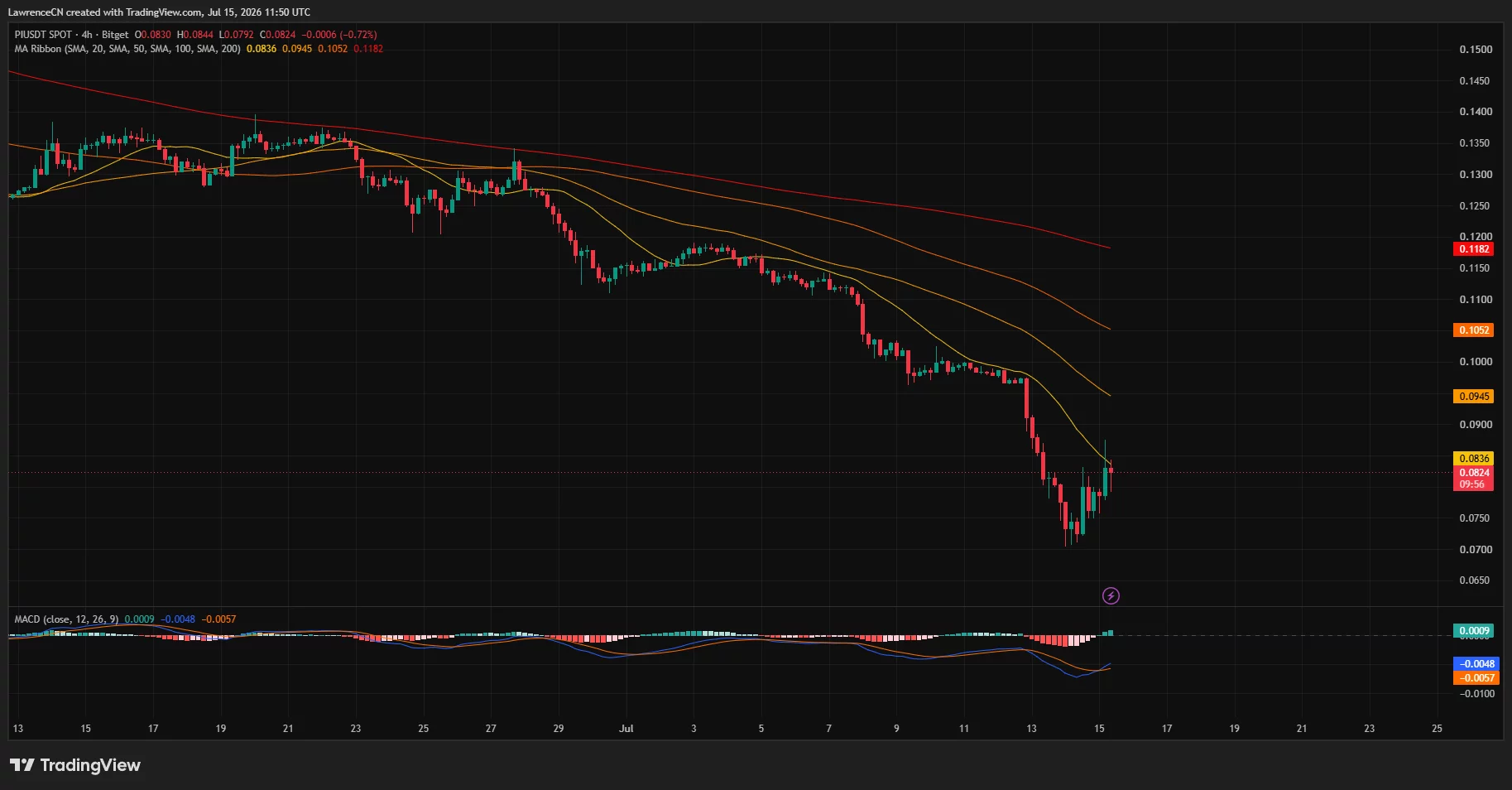
Even so, the technical picture has yet to fully recover. TradingView data shows PI remains below all of its key moving averages, including the 50-period, 100-period, and 200-period simple moving averages, leaving the prevailing downtrend intact despite the latest bounce.
The token briefly reclaimed its 20-period moving average near $0.084 before encountering resistance, indicating buyers still face selling pressure as price attempts to recover.
From a price structure perspective, the recent rebound has helped establish the $0.070 area as an important short-term support zone. However, stronger resistance now sits near the 50-period moving average around $0.094, followed by approximately $0.105 and $0.118, levels that would need to be reclaimed before the market could begin reversing the broader bearish trend.
Heavy token unlocks continue to weigh on sentiment
While macro conditions helped spark today’s rally, the factors behind Pi’s prolonged decline remain largely unchanged. Throughout July, the network has been absorbing substantial scheduled token unlocks, with roughly 103.7 million to 127 million PI entering circulation. The steady increase in available supply has repeatedly outpaced organic demand, contributing to sharp breaks below the $0.12 and $0.10 support levels.
At the same time, capital has continued flowing toward artificial intelligence-related equities in the United States and East Asia, reducing investor appetite for smaller, thinly traded crypto assets such as Pi. The combination of expanding token supply and weaker speculative demand has kept sustained buying pressure limited despite occasional relief rallies.
Developers have nevertheless continued introducing new products intended to strengthen long-term utility within the ecosystem. Recent Pi2Day releases added decentralized application hosting, developer software development kits, and an automated Know Your Customer verification service that requires payments in PI.
Alongside those launches, ongoing core upgrades based on newer versions of the Stellar protocol and continued community speculation surrounding potential listings on major exchanges such as Kraken remain among the key narratives that supporters believe could improve demand over time, although no such exchange listing has been officially confirmed.


SBI Global Asset Management has launched the world’s first tokenized Japanese equity fund on the Solana blockchain through a partnership with DigiFT, bringing a high-dividend equity strategy on-chain for institutional and accredited investors.
Summary
- SBI and DigiFT have launched the world’s first tokenized Japanese equity fund on Solana.
- The JX token offers accredited and institutional investors on-chain access to a high-dividend Japan equity strategy.
- SBI is expanding its blockchain business alongside Ripple partnerships and its upcoming 3% JPYSC stablecoin lending product.
According to an announcement shared by SBI Global Asset Management on July 15, the company has introduced the SBI Japan High Dividend Equity Strategy Token (JX token) in collaboration with DigiFT, a regulated real-world asset exchange.
The token gives accredited and institutional investors blockchain-based access to a Japanese high-dividend equity strategy managed by SBI Asset Management Co. The launch is also DigiFT’s first on-chain tokenization of a Japanese equity fund.
Solana powers SBI’s latest tokenized investment product
Built on the Solana blockchain through DigiFT’s tokenization infrastructure, the JX token expands SBI’s digital asset offerings beyond stablecoins and payments.
According to DigiFT, the product combines traditional Japanese equities with blockchain-based ownership while allowing investors to access institutional-grade assets on-chain.
Commenting on the launch, DigiFT founder Henry Zhang said the company has focused on bringing institutional assets onto blockchain infrastructure that investors and asset managers can trust.
“Our mission at DigiFT has always been to bring real, institutional-grade assets on-chain through infrastructure that investors and asset managers can actually trust. JX extends that mission to Japan for the first time.”
The platform also supports settlements in USDC, while DigiFT said integration with a Japanese yen stablecoin is planned for a later stage. According to the company, token holders will also be able to use the asset in decentralized finance applications, including lending and asset management protocols such as Morpho.
The rollout comes as interest in tokenized real-world assets continues to grow across financial markets, with asset managers increasingly exploring blockchain-based distribution for traditional investment products.
Ripple partnership continues alongside multi-chain expansion
Although SBI Holdings has worked closely with Ripple since 2016 through initiatives including SBI Ripple Asia and more recent collaborations around the RLUSD stablecoin, the new equity fund has been launched on Solana because DigiFT’s tokenization platform is built on that network.
The move adds another blockchain to SBI’s digital asset strategy rather than replacing its existing relationship with Ripple. SBI and Ripple continue to work together on expanding XRP and XRP Ledger adoption across Japan.
Most recently, the companies partnered with Doppler to encourage institutional use of XRP in the country. Earlier, SBI also selected Ripple to support RLUSD stablecoin distribution in Japan as part of its multi-stablecoin strategy.
SBI has simultaneously been expanding its yen-backed stablecoin business. As previously reported by crypto.news, the financial group is preparing to introduce a lending product offering a fixed 3% annual yield on its JPYSC stablecoin through SBI VC Trade. The service, which could launch as early as this month, is expected to require users to lock their JPYSC holdings for three months.
The planned lending product follows the release of JPYSC, Japan’s first trust bank-backed yen stablecoin issued by SBI Shinsei Trust Bank. SBI previously said the stablecoin was designed to reduce transaction costs, support large-value transfers, and serve both retail and institutional users, complementing the company’s growing portfolio of blockchain-based financial products.
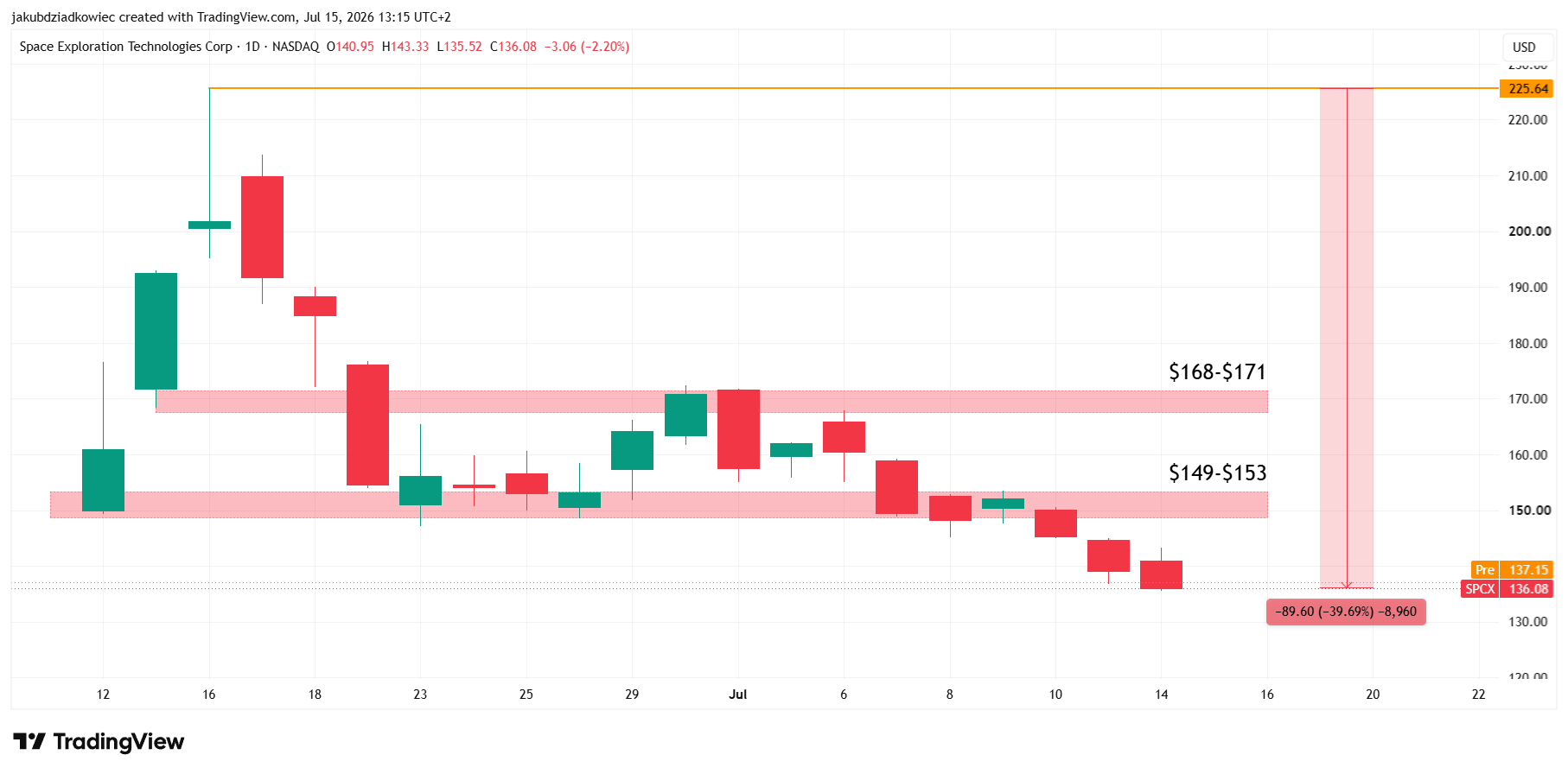
SpaceX stock traded near $137 in Wednesday’s premarket, just above the $135 IPO price and Tuesday’s record low of $135.52. Still, a falling wedge on the hourly chart suggests a rebound to $158 may be forming.
Space Exploration Technologies Corp. (SPCX) has fallen almost 40% since its June 16 peak of $225.64. Thursday’s Starship Flight 13 launch could decide whether the pattern plays out.
SpaceX Stock Loses Two Key Support Zones in Four-Week Slide
The daily chart shows three consecutive red sessions, with SPCX closing at $136.08 on Tuesday, down 2.20%. The decline from the June 16 peak now measures $89.60, or 39.69%.
Sellers broke the $168 to $171 support zone in mid-June. A rejection near that area on July 1 confirmed it as resistance. The $149 to $153 zone followed, giving way on July 8 and capping a brief retest days later.

Meanwhile, fundamental pressure keeps building. The first lock-up tranche of 20% releases around Q2 earnings in late July. A bonus 10% tranche required closes above $175.50, a condition the slide has made nearly impossible.
SpaceX also priced a $25 billion inaugural bond issuance in June, with coupons between 5.35% and 6.65%. The added supply deepened a correction that has already cut over $500 billion from Elon Musk’s fortune.
Falling Wedge and RSI Divergence Offer Bulls a Lifeline
The hourly chart complicates the bearish picture. Since the July 1 rejection near $176, SPCX has compressed inside a falling wedge, a pattern that often resolves upward.
The measured target sits at $157.89, roughly 15% above the current price. However, the projection only activates if buyers reclaim the $149 to $153 zone, which now acts as resistance.
Momentum adds weight to the setup. The Relative Strength Index (RSI) printed a higher low on July 14 while the price set a lower low. This marks the first bullish divergence since the correction began.

Analysts see value near these levels, too. Evercore ISI initiated coverage on Tuesday with an Outperform rating and a $230 target, close to the $236 broker consensus.
“We don’t think there’s a debate that this is an extraordinary company on a real path to reshaping the future of humanity.”
SPCX Price Prediction Depends on Starship Flight 13
Thursday’s Starship Flight 13 stands as the first major test of the rebound case. The rocket will carry 20 functional Starlink V3 satellites for the first time. That batch adds 60 terabits per second of capacity, over 20 times a single Falcon 9 load, according to SpaceNews.
A clean mission could trigger the wedge breakout and support Musk’s long-term valuation claims. In contrast, a failure risks a close below the $135 IPO price, which would push SPCX into price discovery with no chart support below.
Retail demand for SPCX exposure also remains visible on-chain. Tokenized SpaceX products on Solana (SOL), led by Backpack’s token with over 10,000 holders, fed the $5.77 billion in tokenized stock volume the network processed in Q2.
For now, SPCX sits between a bullish pattern pointing to $158 and an IPO floor the bulls cannot afford to lose.
The post SpaceX Stock Nears All-Time Low, but This Pattern Points to $158 appeared first on BeInCrypto.
Cathie Wood’s ARK Invest is doubling down on its bet on USDC issuer Circle even as the company’s stock remains under pressure.
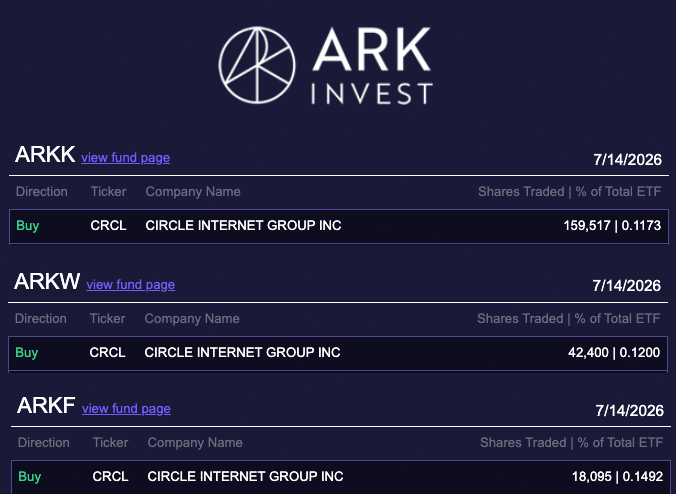
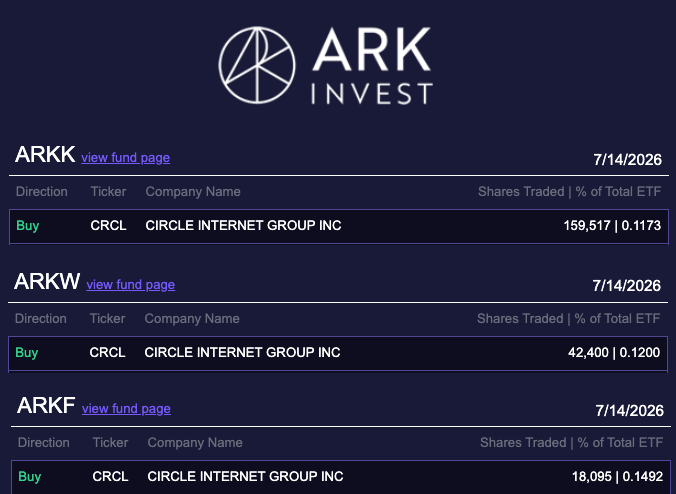
ARK bought another 220,000 shares of Circle Internet Group (CRCL) across three of its actively managed exchange-traded funds on Tuesday, according to the company’s daily trade disclosure reviewed by Cointelegraph.
Based on Circle’s Tuesday closing price of $63.22 on the New York Stock Exchange, ARK’s latest purchase was worth about $13.9 million.
Circle shares were down about 22% year-to-date and roughly 76% below their post-initial public offering (IPO) peak.
ARK discloses 725,000 Circle shares in July purchases
ARK’s latest buy brought its disclosed July acquisitions of Circle shares to 725,517, following previous buys of 287,609 shares on July 1 and 217,896 shares on July 9.
The latest trade disclosures show ARK has consistently added to its Circle position across its flagship funds despite the stock’s prolonged decline, underscoring the investment manager’s conviction in the USDC issuer.
Source: ARK Invest
As of Wednesday, Circle accounted for 4.37% of the ARK Fintech Innovation ETF (ARKF), making it the fund’s seventh-largest holding. ARKF’s Circle position was valued at about $33 million, according to its latest holdings data.
Related: USDC issuer Circle wins final approval for US national trust bank charter
Circle also represented 3.35% of the flagship ARK Innovation ETF (ARKK), where it ranked as the fund’s ninth-largest holding, worth about $218 million.
Analysts see growing risks for Circle
ARK’s latest purchase came as analysts reassessed Circle’s outlook following a sharp decline in the company’s stock price.
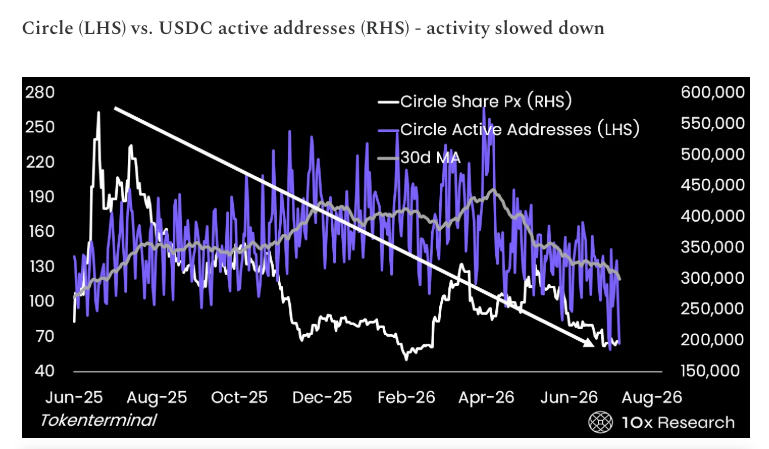
Digital asset research platform 10x Research said it no longer considers Circle a buy after the stock fell back below $80. In a report published Tuesday, the company said it previously viewed CRCL as attractive below that level but now says Circle’s fundamentals have “meaningfully deteriorated.”
Source: 10x Research
The research report also pointed to slower USDC activity, including a decline in active addresses, as a concern for Circle.
Related: USDT wins payments, USDC wins DeFi as stablecoins diverge: Dune
USDC’s market capitalization has declined roughly 3% year-to-date to $73 billion at the time of publication, according to CoinGecko. Despite the recent decline, the stablecoin’s market capitalization remains about 17% higher than a year ago.
Still, 10x Research said a bullish case for Circle remains, adding the stock’s recent decline could either present a long-term buying opportunity or mark the start of a more prolonged downturn.
Magazine: Strategy became a symbol of the dot-com crash: Could history repeat?
SpaceX stock has steadied above its IPO price after Needham raised its price target to $250 despite growing warnings that an AI stock bubble could threaten financial markets.
Summary
- Needham raised its SpaceX price target to $250 and maintained a buy rating despite growing AI bubble concerns.
- Bank of England Governor David Bailey warned an AI stock crash could spill into the economy and affect monetary policy.
- SpaceX stock is holding above $135 support, with technical indicators showing fading bearish momentum inside a descending channel.
According to Needham, the investment bank lifted its target on SpaceX shares from $200 to $250 while maintaining a buy rating, arguing that recent AI developments and upcoming launch milestones could support the company’s valuation.
The upgrade comes even as SpaceX stock remains under pressure after a sharp pullback from its post-listing highs.
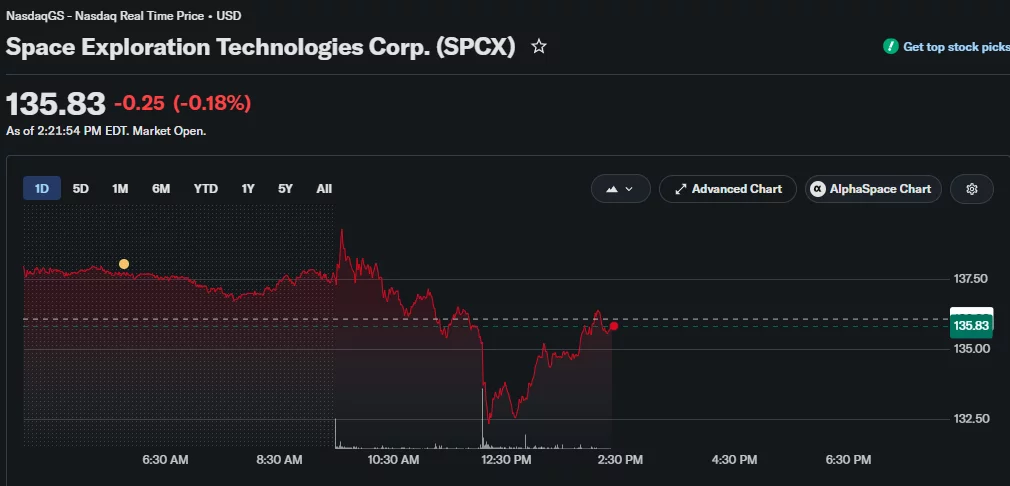
Shares traded around $136 at the time of writing on July 15, down 0.18% on the day after briefly falling to the IPO price of $135 earlier this week. The stock had slipped below its Nasdaq debut price of $150 on July 7 as investors continued taking profits following its strong listing rally.
Needham sees AI and Starship as upside catalysts
Needham attributed its higher valuation to two near-term developments linked to Elon Musk’s AI strategy and SpaceX’s launch schedule. The bank said the release of Grok 4.5 on July 8 fits with Musk’s efforts to rebuild the company’s AI program, a development it believes could strengthen investor confidence.
The investment bank also pointed to the planned Starship Flight 13 launch on July 16. According to Needham, a successful mission could expand SpaceX’s commercial opportunities and act as another catalyst for the stock.
The bullish call stands in contrast to growing concerns about AI-related valuations. On July 8, former White House economic advisers Jared Bernstein and Ryan Cummings warned that the AI bubble continues to inflate as technology companies keep increasing spending on artificial intelligence.
Those concerns gained fresh attention after Bank of England Governor David Bailey cautioned that a sharp correction in AI stocks could spill over into the broader economy. Bailey said such a downturn could eventually require central banks to respond with measures such as interest-rate cuts to limit economic damage.
Even with those warnings, investor appetite for AI companies has remained firm. Reports that DeepSeek is preparing an initial public offering at a valuation of roughly $75 billion have added to expectations for another major AI listing. The planned flotation follows reports that OpenAI and Anthropic are also preparing to go public.
Technical picture points to a key breakout level
The hourly chart shows SpaceX shares trading inside a descending channel that has guided price action lower since early July. Although the broader short-term trend remains bearish, the stock has bounced from support near $135, where the lower boundary of the channel and the psychological support level converge.
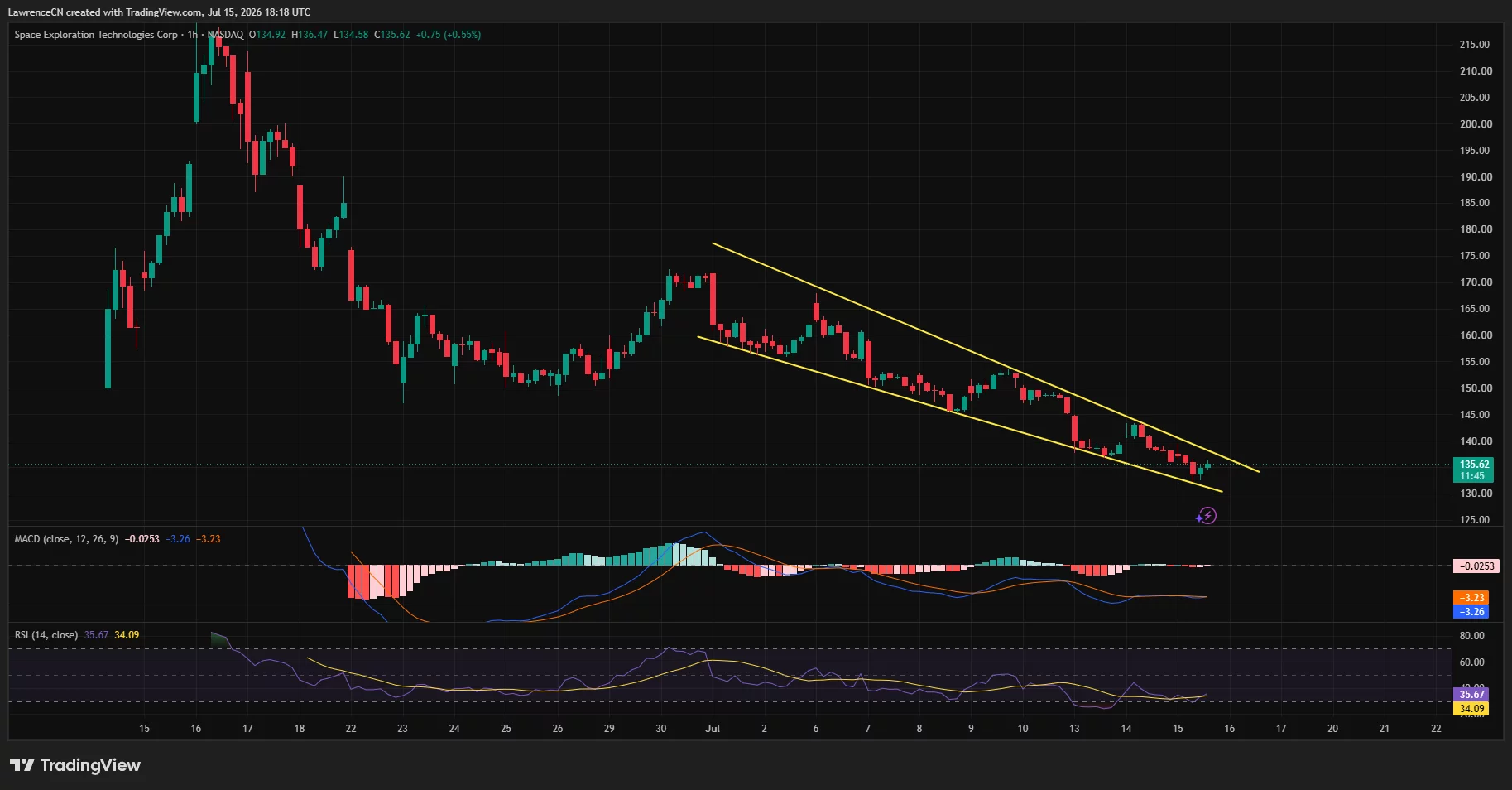
Momentum indicators suggest selling pressure may be easing. The Relative Strength Index has recovered to around 36, keeping the stock close to oversold territory without yet confirming a reversal. At the same time, the MACD remains below zero, but its histogram has flattened considerably, indicating bearish momentum is weakening.
For buyers, the first technical hurdle sits near the channel’s upper boundary around $137 to $138. A move above that area could clear the path toward $140, while a sustained breakout may allow the stock to retest its Nasdaq debut price of $150. Conversely, if the $135 support fails, the descending channel suggests the current downtrend could continue.
Institutional investors have continued adding exposure despite the recent decline. ARK Invest purchased approximately $21.3 million worth of SpaceX shares on July 13, extending a position that began with a $528 million purchase when the company debuted on Nasdaq on June 12 under Cathie Wood’s leadership.
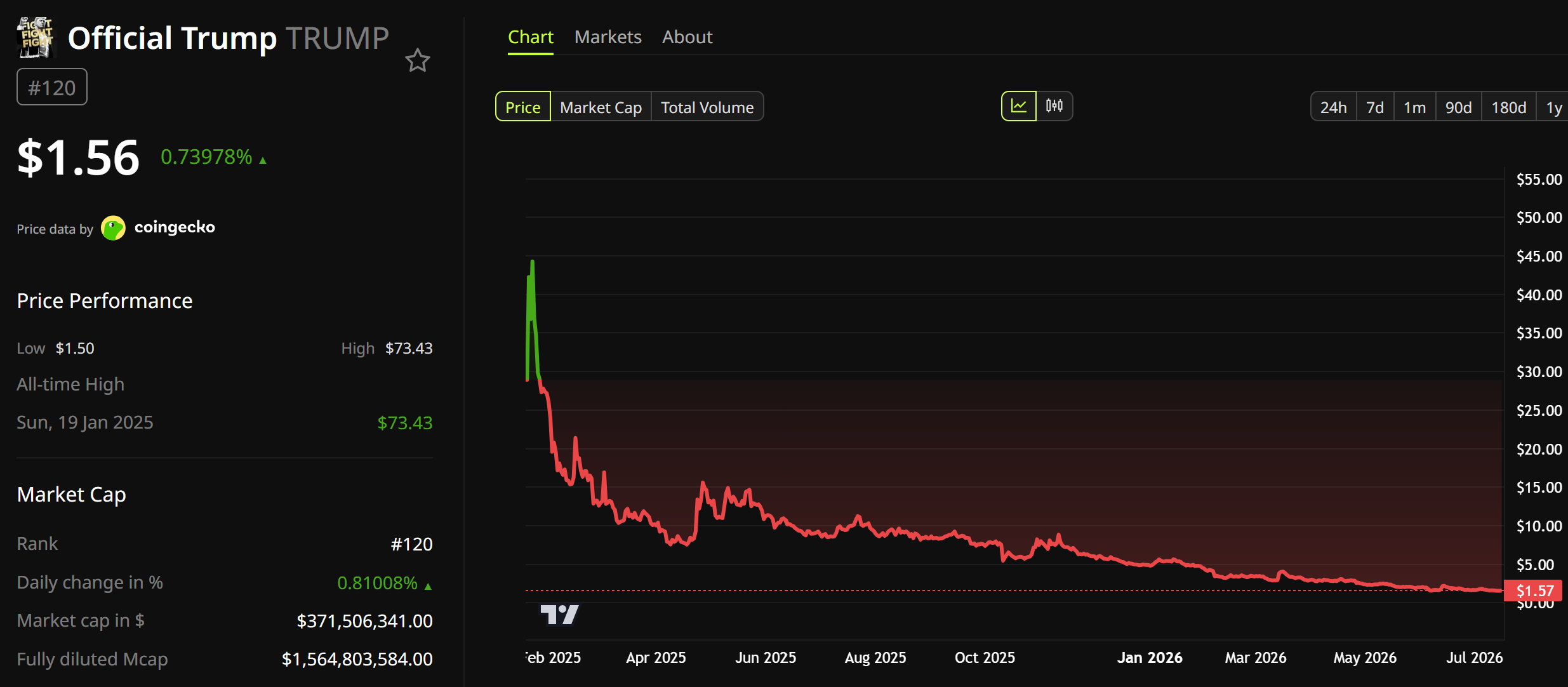
The Official Trump (TRUMP) meme coin team may deploy up to 9.6% of total supply, roughly 96 million tokens worth about $150 million at current prices, over the coming months. TRUMP trades 98% below its January 2025 peak of $73.43.
That potential deployment equals about 40% of the token’s 237 million circulating supply and nearly three days of its $55 million daily trading volume. The scale of the plan frames the recovery question.

Trump Meme Coin Supply Math Weighs on Recovery
The team said in its latest update that about 67% of the 1 billion maximum supply has unlocked under a public daily schedule. Since February, roughly 5% of previously unlocked tokens were sold, deployed, or otherwise monetized.
Ownership structure gives those numbers weight. Per the project’s own disclosures, CIC Digital LLC, a Trump Organization affiliate, and Fight Fight Fight LLC own 80% of supply under a three-year unlock. Both entities also earn revenue from trading activity.
With 670 million tokens unlocked and only 237 million circulating, most unlocked supply appears to sit off the market. Planned dispositions would move part of it into partnerships, acquisitions, the TRUMP Coin Club, and the mobile game.
“These actions continue to reflect a balanced, long-term approach to ecosystem development, prudent management of inventory from the original mint, and continued engagement with the $TRUMP community.”
Follow us on X to get the latest news as it happens
However, history explains holder anxiety. Nansen data showed nearly 1 million buyers sitting on $3.81 billion in combined losses since launch.
Liquidity Programs Look Small Against Potential Sales
The team paired the plan with liquidity spending. A Kamino campaign distributed about 114,000 TRUMP, worth near $180,000 today, growing the TRUMP-SOL pool from $2,000 in March to a $1.66 million May peak. New pools followed on Orca and Raydium.
Yet that peak depth covers barely 1% of the potential $150 million in dispositions. Demand-side spending is similarly modest, with $1 million in entrepreneur grants and another $1 million distributed through the mobile game waitlist.
Meanwhile, the market offers no cushion. TRUMP trades near $1.57, down 83% in a year and 22% in 30 days. The token set an all-time low of $1.50 on June 6, with its $372 million market cap ranked 120th.

Critics see access selling rather than ecosystem building. The token drew sharp criticism from Peter Schiff, while one senator demanded a meme coin ban after the project’s reported $636 million windfall.
The update promises discipline, but the arithmetic stays lopsided. Unless ecosystem demand absorbs a 96 million token pipeline, price relief may prove elusive, especially with meme coin dominance at a two-year low.
The post Trump Meme Coin Reveals Liquidity Update: Will It Change Price Misery? appeared first on BeInCrypto.
President Donald Trump will meet senators at the White House on Thursday to review progress on the CLARITY Act. Ripple executives, meanwhile, warned that rejecting the bill would leave crypto consumers exposed to bad actors.
The bill has cleared every hurdle except the Senate floor, where it needs 60 votes. Leaders want it passed before the August recess.
Why Trump Is Stepping Into CLARITY Act Talks
Sen. Bernie Moreno told Politico that senators will update the president on Thursday afternoon. Sen. Cynthia Lummis, a lead architect, said a revised draft could circulate soon, with ethics language possibly bracketed for later.
The ethics provision remains the biggest obstacle. Trump’s annual disclosure listed $635 million in meme coin royalties and roughly $515 million from World Liberty Financial token sales. Democrats want limits on officials holding crypto business interests before they supply the missing votes.
The arithmetic explains the urgency. The House passed the bill 294-134 in July 2025, and the Senate Banking Committee advanced it 15-9 in May. Only two Democrats, Ruben Gallego and Angela Alsobrooks, backed it in committee.
Senate Majority Leader John Thune wants a floor vote before the work period ends on August 7. However, Trump has already pushed the CLARITY Act publicly, even as a shrinking Senate window raises the stakes.
“I’m hoping that we can come up with some agreement by the end of this week. I think it’s critical if we’re going to try and get this across the floor before August recess,” Politico reported, citing Sen. Thom Tillis, who signaled negotiators are close.
Follow us on X to get the latest news as it happens
Ripple Frames a No Vote as Anti-Consumer
Ripple’s stake in the outcome is personal. The company fought the SEC for four years over XRP’s legal status. Chief Legal Officer Stuart Alderoty argued the same uncertainty now threatens consumers.
“A vote against the Clarity Act is a vote to leave the same unregulated conditions in place to be exploited by bad actors. We’ve seen this movie. Let’s not watch the sequel,”
In the same tone, Lauren Belive, Ripple’s global public policy co-head, argued that with the delay, the regulatory gaps behind FTX’s collapse remain open.
The bill would hand the SEC and CFTC shared jurisdiction and require oversight before tokens reach the market.
Opposition persists, however. Sens. Elizabeth Warren and Chris Van Hollen say the draft weakens consumer protections rather than adding them.
Separately, 78 banking groups pushed to rewrite the stablecoin yield rules. In contrast, law enforcement opposition eased on Section 604 developer liability.
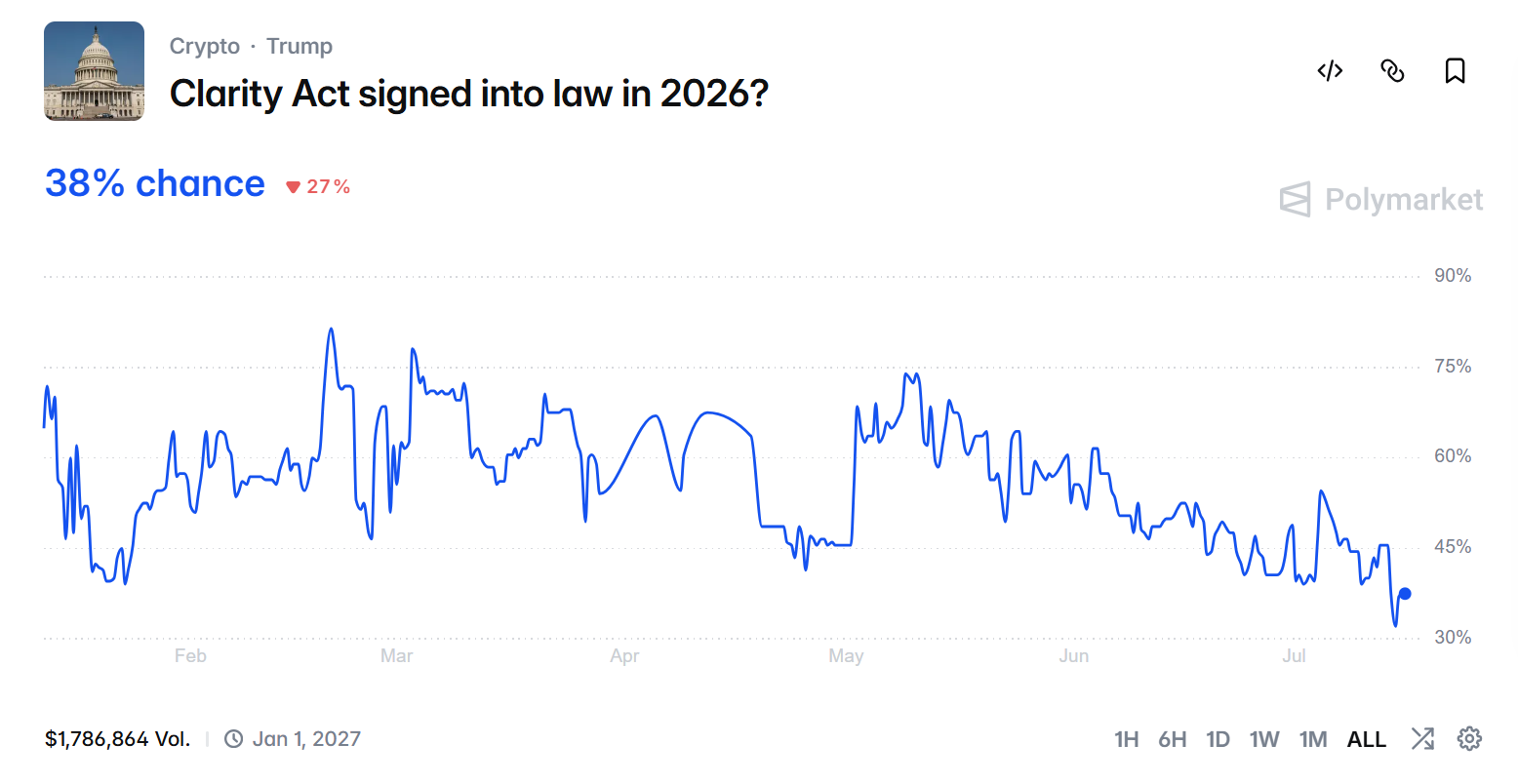
Polymarket traders price passage at only 38% in 2026, suggesting waning confidence as the countdown continues.

Thursday’s meeting will show whether an ethics deal revives those odds before the clock runs out.
The post Trump Steps Into CLARITY Act Talks: Can the Senate Deliver Before Recess? appeared first on BeInCrypto.

Coinbase CEO Brian Armstrong sparked debate over Bitcoin’s direction on July 14 after asking X users whether the OG cryptocurrency has already reached its market bottom.
The poll quickly drew thousands of votes and a wave of comments, with the community split almost evenly between the yays and the nays.
Poll Splits Crypto X Down the Middle
It all started with a simple question Armstrong posited on X earlier today: “Is the bottom in?” The Coinbase chief also clarified in a follow-up post that the survey was specifically about Bitcoin.
“Perpetual futures trading, stablecoin payments, prediction markets, and tokenized real world assets have just been growing,” he said.
At the time of writing, nearly 31,000 people had cast their vote, and more than 648,000 X users had viewed the post, with 55.6% of those who voted answering “No,” while 44.4% believed BTC had already bottomed.
The replies were also split along the same lines as the vote, with one user, AI developer Ilan Rakhmanov, in total agreement, tweeting, “Opinion: the bottom is in.”
Meanwhile, ChainLeak founder Joshuwa Roomsberg argued that the poll had become a “market map” and that Armstrong’s comments pointed to a sector where crypto adoption is expanding beyond BTC itself.
Some of those who didn’t agree that the bottom was in included market watcher Our Crypto Talk, who said there was a “very high chance” BTC would go back to the $50,000 to $55,000 range one more time before any real recovery happens.
Others, like crypto educator Rob Art, focused squarely on percentages, saying that in past bottoms, the price of BTC dropped by 93%, 84%, and 77%, while right now it is just over 50% below its October 2025 all-time high and would need to be at roughly 65% to follow the pattern that he pointed out has been in effect since 2014.
On-Chain Data Paints a More Balanced Picture
While opinions remained divided, recent on-chain analysis points to a market that looks very different from the overheated conditions seen during the 2025 bull run.
A July 14 report from XWIN Japan highlighted four widely followed CryptoQuant indicators: the MVRV Ratio, Net Unrealized Profit/Loss (NUPL), Realized Price, and the Puell Multiple.
According to the update, these metrics suggest Bitcoin is no longer in a euphoric phase, with valuations cooling and investor optimism fading without reaching outright capitulation. It also showed that market activity appears more consistent with consolidation and accumulation.
That assessment broadly matches Bitcoin’s recent price behavior. Despite selling pressure linked to renewed conflict involving Iran and the United States and earlier concerns over Strategy’s Bitcoin sales, the cryptocurrency has fought its way back close to $63,000, having found itself near $61,000 on Monday.
Whether those rebounds mark the start of a durable recovery or simply another pause within the wider bear market is still an open question, but for now, Armstrong’s poll shows that there’s little consensus, even among crypto’s most engaged participants.
The post Brian Armstrong Asks if Bitcoin Bottom Is In, Crypto Community Can’t Agree appeared first on CryptoPotato.

2026 Open Championship odds: Picks, predictions by model that’s nailed 17 majors

AWS EC2 leadership change: Dave Treadwell replaces Brown

Things that are worth the money as a single girl that lives alone #single #singlegirl #singlelife

No Jackpot Winner as $257 Million Prize Rolls Over to $269 Million Monday Draw

Renter of Home in Anne Heche Crash Denies Settlement With Son

Weekend Open Thread: Staud – Corporette.com
Things that are worth the money as a single girl that lives alone #single #singlegirl #singlelife

Mike Rowe’s WILD Financial Ride! #finance #money #shorts

Financial journey start karne ka sahi tareeqa Personal finance start kahan se karein? #finance
-

 Fashion7 days ago
Loro Piana Fall 2026 Enters Houston’s Art Scene
-

 Fashion5 days ago
Weekend Open Thread: Nutriplenish Leave-In Conditioner
-
 Sports6 days ago
2026 Genesis Scottish Open Thursday TV coverage: Round 1
-

 Sports6 days ago
Super Eagles star Moses Simon opens up on Liverpool transfer regret
-

 Tech6 days ago
Character.AI enters the microdrama arena with its own productions, but there’s a twist
-

 Politics12 hours ago
Young campaigners urge incoming PM to act on outdoor junk food ads
-

 News Videos1 day ago
XRP BOMBSHELL… XRP OMBOARDED FOR TRANSACTIONS!!!
-

 Tech2 days ago
Get Your ESP32 Sunny Side Up With This Solar Dev Board
-

 Tech1 day ago
Dark Secrets Emerge When Jailbreaking LLMs
-
 Sports2 hours ago
New Cornerback Enters Vikings Trade Rumor Mill
-

 Tech7 days ago
Level Infinite Launches Gangstar Mirage City in India with Pre-Registrations
-
 NewsBeat7 days ago
Major update after Huntingdon train attack as man enters plea
-
 Entertainment7 hours ago
Disney’s Most Ambitious Failed Star Wars Attraction Is Coming to SDCC
-

 News Videos2 days ago
how to make coin bank box with cardboard #scienceproject #money #diy #shorts
-
 Tech2 days ago
Cloudflare Precursor Watches Your Mouse and Keyboard To Decide If You Are Human
-

 Tech7 days ago
Entra passkey enrollment vishing targets Microsoft 365 users
-
 Entertainment5 hours ago
Vicki Gunvalson Defends Discussing Heather Dubrow’s Money
-
 Crypto World7 days ago
DeFi Dashboard Zapper to Shut Down After 7 Years
-
Crypto World1 day ago
Ripple, Coinbase, Circle Join Linux x402 Foundation to Help Shape AI Payments
-

 NewsBeat2 hours ago
Watch: Is Donald Trump facing a popular backlash on immigration?
You must be logged in to post a comment Login