

Crypto World
Blackstone and Apollo line up $36 billion chip debt deal for Anthropic



Anthropic is set to tap a $36 billion private credit deal led by Blackstone and Apollo to finance Google AI chips backed by Broadcom, in one of history’s largest debt financings.
Summary
- Apollo and Blackstone are syndicating about $36 billion in debt to finance Google TPUs for Anthropic
- Broadcom will backstop payments as Anthropic leases the custom chips to fuel its Claude AI models
- The deal comes as Anthropic’s valuation jumps to $965 billion and its AI revenue run rate accelerates
Private equity giants Apollo Global Management and Blackstone are working to syndicate roughly $36 billion in debt financing that will fund Anthropic’s next wave of AI infrastructure, in what could become one of the largest private credit transactions ever executed. Reuters reported that the debt will be used to buy custom tensor processing unit chips from Google, which Anthropic will then lease as it races to scale compute for its Claude chatbot and related models.
The structure is straightforward but aggressive: Apollo and Blackstone are inviting additional investors into the $36 billion deal while planning to retain “significant portions” of the debt on their own books, according to additional report by Bloomberg, said that Broadcom, which co designs Google’s TPUs, is backstopping payments on the largest tranches, effectively using its balance sheet and its existing role in Google’s chip stack to de risk the financing. Investors have been asked to submit orders this week, with the transaction expected to close as early as next week, though terms could still shift as books are finalized.
Massive private credit bet on AI compute
For Anthropic, the deal deepens an already sprawling web of capital commitments around AI infrastructure, stacking financial leverage on top of earlier equity deals and long term capacity contracts with hyperscalers. In April, Anthropic secured access to around 3.5 gigawatts of TPU compute through an expanded partnership with Google and Broadcom, with deployments slated to begin scaling from 2027 as part of a broader $50 billion push into domestic US compute capacity. The company simultaneously announced it had raised $6.5 billion in new funding at a $965 billion post money valuation, overtaking OpenAI on paper as demand for its Claude models accelerates.
Anthropic’s revenue run rate recently blew past $30 billion annually, more than tripling from roughly $9 billion at the end of 2025 as its share of the enterprise API market climbed from 12 percent in 2023 to 32 percent by mid 2025, our reporting has showed. That growth has been fueled in part by large financial and industrial clients integrating Claude into production workflows, even as regulators and officials scrutinize emerging risks: in April, US Treasury officials convened major bank CEOs over cyber risks linked to Anthropic’s forthcoming Claude Mythos model after internal tests and a code leak highlighted its ability to uncover “unprecedented” volumes of software vulnerabilities.
Broadcom’s role and the chip supply squeeze
Broadcom’s decision to guarantee payments on large slices of the Anthropic chip financing underscores how AI hardware suppliers are starting to act more like structured finance counterparties than mere vendors. The semiconductor firm already sits at the core of Google’s TPU roadmap and is expected to support future iterations of the chips that Anthropic will be leasing, including next generation designs Google is exploring with partners such as Marvell to improve memory bandwidth and model efficiency.
The Blackstone Apollo transaction is only the latest sign that private equity has no intention of staying on the sidelines of AI infrastructure. Earlier this month Anthropic and a group including Blackstone, Goldman Sachs, Apollo and Hellman & Friedman launched a $1.5 billion venture aimed at pushing Claude into portfolio companies across sectors from healthcare to manufacturing, according to CNBC. For crypto markets, the move reinforces a familiar pattern: capital is clustering around a tiny number of AI platforms that already absorb an outsize share of cloud, chip and power budgets, even as tokenized AI projects scramble for scraps on chain.

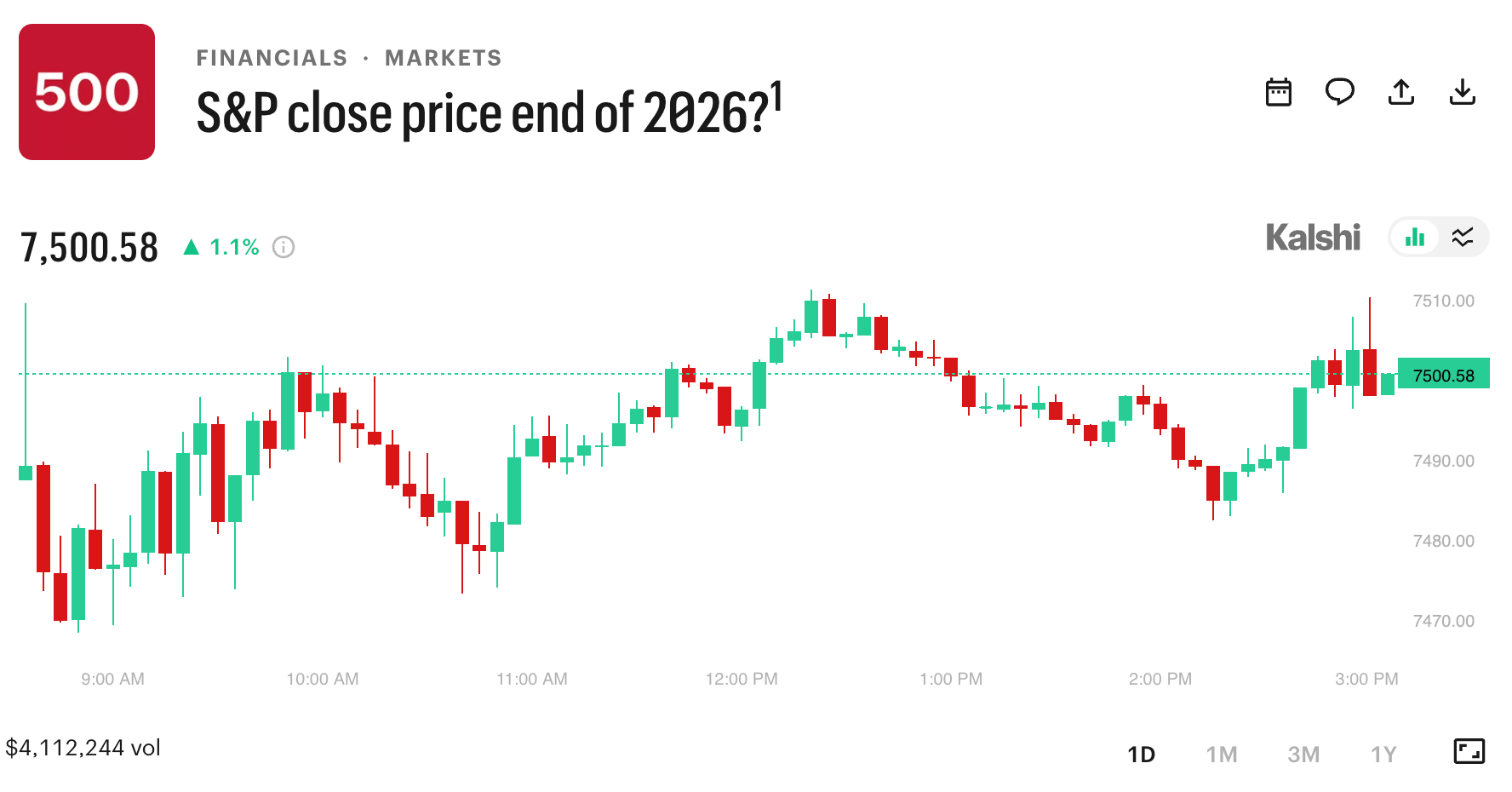
Financial services giant Charles Schwab will reportedly enter the prediction markets business by offering customers wagers on the S&P 500.
According to a Friday Wall Street Journal report, Charles Schwab is planning to launch options contracts allowing users to place yes-or-no wagers on the performance of the S&P 500 stock market index. The move, expected to roll out in a matter of months as part of a partnership with Cboe Global Market, could mark the company’s first into prediction markets.
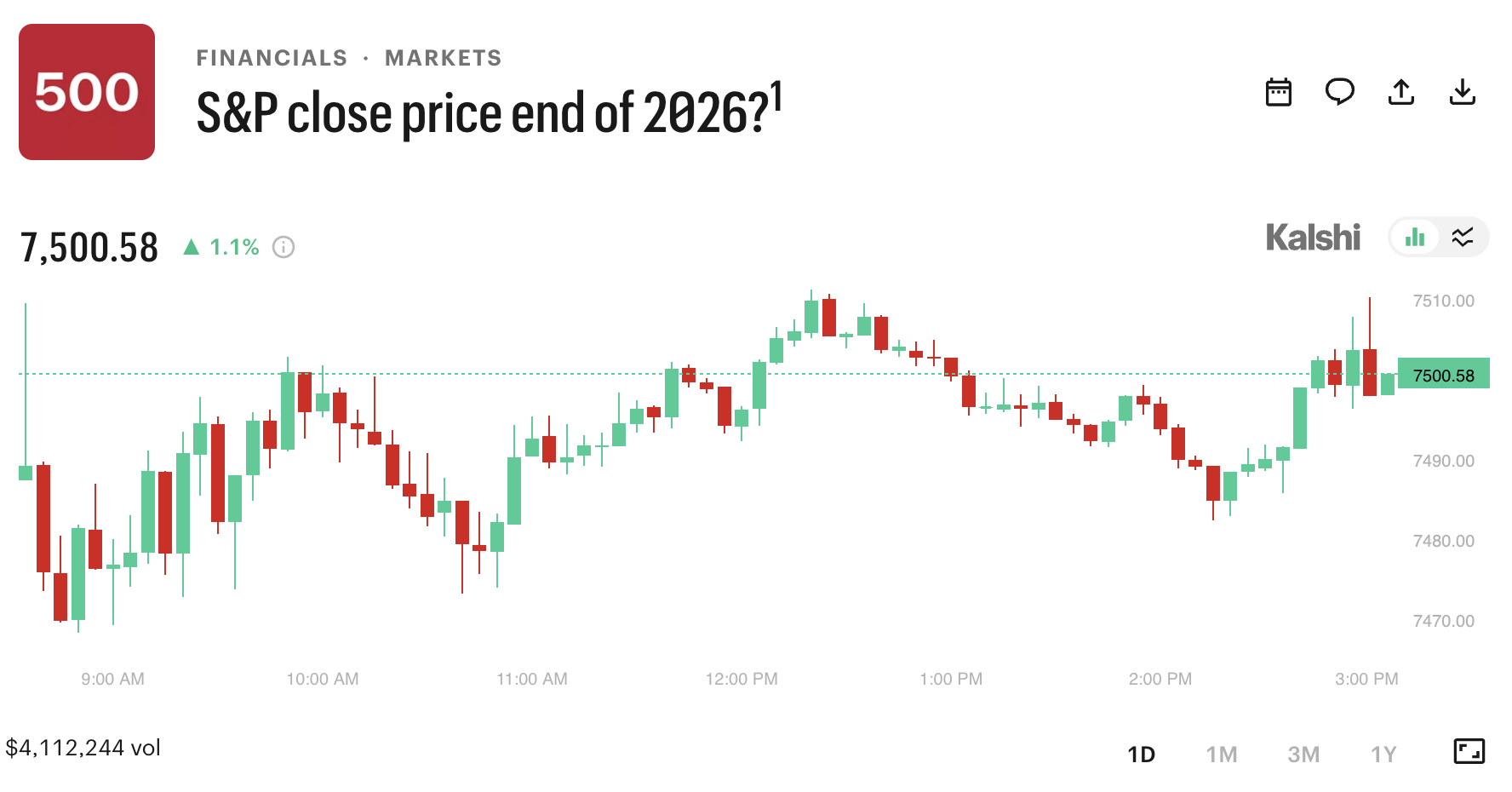
Source: Kalshi
While prediction market platforms like Kalshi and Polymarket offer a variety of event contracts based on the outcome of events, including those tied to politics, sports, weather and companies, the Charles Schwab product will reportedly only include yes-or-no bets on whether the S&P 500 closes above or below a target price. Cryptocurrency exchanges like Coinbase have also moved closer to prediction offerings with many projecting the market will reach $1 trillion in annual volume by 2030.
In May, Charles Schwab announced the launch of spot Bitcoin and Ether trading for retail clients, marking the company’s move deeper into digital asset services. The company reported a net income of $2.5 billion for the first quarter of 2026.
Both Polymarket and Kalshi already offer similar event contracts related to predictions on the S&P 500.
Prediction markets are still under scrutiny by lawmakers
Although the market continues to grow, many state-level authorities and members of US Congress are calling for oversight of platforms like Kalshi and Polymarket. In addition to the potential for elected officials to profit from using nonpublic information on the platforms, many state gaming authorities have challenged their ability to offer event contracts related to sports.
The US Commodity Futures Trading Commission (CFTC) under Chair Michael Selig has taken the position that event contracts on prediction markets qualify as “swaps” and the agency has exclusive jurisdiction for regulation and enforcement. Many of the cases connected to Kalshi, Polymarket, the CFTC, and state authorities continue to be litigated.
Magazine: Should users be allowed to bet on war and death in prediction markets?
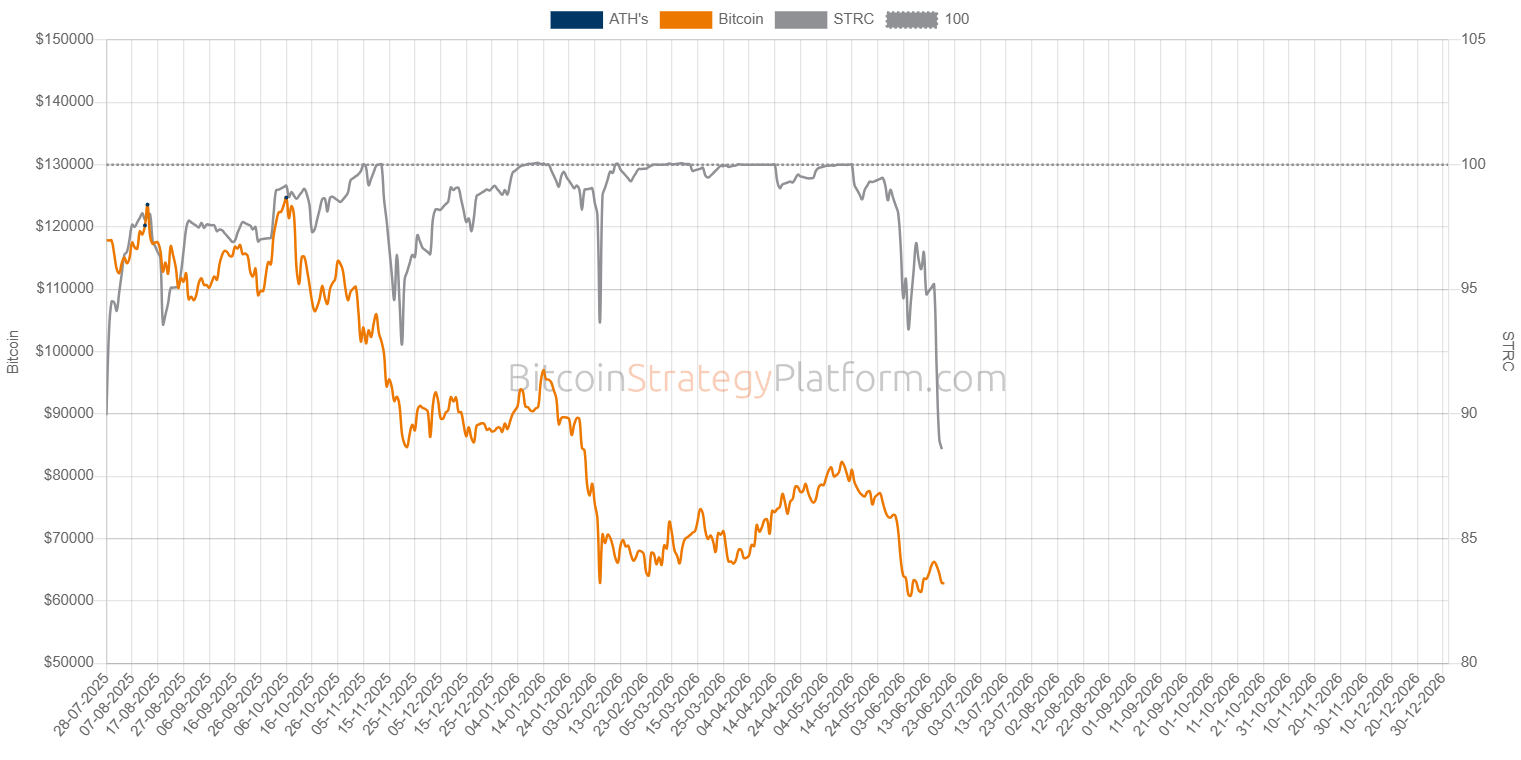
Digital credit faced its first real stress test this week, as MicroStrategy’s STRC preferred stock crashed, prompting critics to declare the Bitcoin-backed asset class dead.
Bitcoin (BTC) itself has weathered the same obituaries many times before. On-chain data now tells a different story, with network activity climbing to multi-year highs even as the price slides.
What Digital Credit Actually Means
Digital credit is a young class of income-generating securities backed by Bitcoin. Companies holding large Bitcoin reserves issue structured products such as preferred equity and convertible notes.
They use the proceeds to buy more Bitcoin. The aim is straightforward. Long-term BTC appreciation should outpace the dividends and interest those products owe.
Strategy, formerly MicroStrategy, built the clearest example with its STRC preferred stock. STRC has a $100 par value and pays a high, variable yield near 12% per year.
When the shares trade at or above par, Strategy issues more shares and routes the cash into Bitcoin. That mechanism turns STRC demand into BTC on the balance sheet.
Strategy frames the whole stack in plain terms. It calls bitcoin digital capital, STRC digital credit, and its common stock digital equity. The pitch attracted income-focused investors seeking Bitcoin exposure without holding the coin.
They earn a steady yield while Strategy carries the price risk.
Convertible notes and other preferreds follow the same logic. Each one borrows against future Bitcoin gains to buy more BTC today.
From 2025 through 2026, these vehicles became a major source of fresh Bitcoin demand. STRC-linked buying funded far more bitcoin than spot ETFs over the same stretch.
The First Real Stress Test
Critics declared digital credit dead this week, and some of the criticism landed. STRC was marketed as a lower-volatility way to hold Bitcoin exposure.
Instead, it broke par. The preferred shares fell to an intraday low near $82, roughly 18% below $100.

Several pressures hit at once. The asset class is less than a year old, and leveraged STRC positions are unwinding while Bitcoin forms a bottom. Capital is also competing with AI listings and a crowded IPO pipeline.
The wider market mirrors that strain. Total value locked across Decentralized Finance (DeFi) fell from about $170 billion in October 2025 to near $72 billion now.

That marks a drop of more than 55% and signals a broad flight from risk. The selling pressure on STRC did not happen in isolation. The structure also fed on itself. Because STRC trades under par, Strategy has paused new share sales through its market program.
That limits its ability to keep buying Bitcoin, the very engine behind the model. A higher variable dividend, meant to defend par, now reads as a distress signal rather than a reward.
Rival treasury preferreds with higher yields have also pulled capital away. Together these forces explain why critics reached for the word dead. Still, the death call looks premature. Analyst @therationalroot argues that a failure here is very unlikely.
Strategy holds enough cash to cover dividends for at least seven months. Its Bitcoin reserve could fund those same payments for decades.
The market still flinched at one move. In late May, Strategy sold a small batch of bitcoin to fund STRC distributions for the first time. The sale was tiny against its overall holdings. Yet it fed the fear that the model would bend when Bitcoin fell hard.
This remains the first true downturn for an asset class barely a year old. Bitcoin has carried that same dead label through every deep bear market and returned each time.
Bitcoin’s Network Tells the Opposite Story
While digital credit takes its punches, the Bitcoin network looks anything but dead. CryptoQuant’s Network Activity Index broke above its trend for the first time since mid-2024.
It has climbed since January 2026 and has held above trend since late March. That creates a clear divergence, with activity rising while the price falls.
The index measures how heavily the chain gets used, from transaction volume to address activity. A reading above trend points to real expansion rather than a quiet network.
Daily transaction counts and average transactions per block both sit near record highs. The catch sits in the detail.

Transactions below 0.01 BTC now make up about 80% of daily activity, up from under 50% in 2023. Much of the surge comes from OP_RETURN usage tied to Runes and Ordinals inscriptions.
OP_RETURN lets users attach small data to a transaction, which token and inscription projects rely on heavily. These generate large volumes of low-value transactions rather than big economic transfers.
That distinction matters for how the surge gets read. A busy chain is not the same as a chain moving more value.
The mempool has swelled to its highest transaction count since late February 2025. Congestion sits mostly in the low-fee cohorts.
Sustained non-financial activity could raise fees for economic transactions over time. Even so, the core signal stands, and the chain is busier than it has been in years. Michael Saylor has made similar arguments about resilient demand.
A Pulse, Not a Eulogy
Bitcoin trades near $62,400, down about 3% on the day and far from its highs. Both digital credit and the Bitcoin network have been written off before.
The timing tells its own story. Doubts about digital credit grew louder exactly as Strategy’s preferred shares slid below par.
The on-chain numbers cut against that gloom. A network this active rarely fits the picture of a dying asset. That gap between price and usage is the core tension to watch. Falling prices and rising activity rarely sit together for long.
The data suggests both still have a pulse. Whether STRC reclaims par and network activity keeps climbing will decide if this moment marks a bottom or a warning.
The post Is Bitcoin-Backed Digital Credit Dead After MicroStrategy’s STRC Crash? appeared first on BeInCrypto.
Crypto World
Sonic Labs Founders Including Andre Cronje Quit Board as New CEO Pledges to Get '1% Better' Daily


Sonic Labs said its three founding board members — Andre Cronje, Michael Kong and David Richardson — are resigning from the board, and named Matt Visser as chief executive officer and Kosta Kourkoumelis as chief operating officer, in a leadership overhaul at the blockchain network whose token and… Read the full story at The Defiant


GoMining has launched a Bitcoin payment infrastructure stack that settles transactions directly on the Bitcoin network while charging merchants a 0.2% processing fee, a rate the company says is significantly lower than traditional card payment costs.
Summary
- GoMining has launched GoBTC Pay SDK and API to help merchants accept Bitcoin directly.
- The platform settles payments directly on the Bitcoin network without fiat conversion and charges a 0.2% fee.
- GoMining says its model could compete with both crypto gateways and card networks.
According to GoMining, the newly released GoBTC Pay Gen1 SDK and API are designed to help merchants, wallet providers, and ecosystem partners add Bitcoin payments to their products and services without relying on fiat conversion or custodial intermediaries. The company said it will initially onboard up to 10 merchants and partners as part of the rollout.
Built for businesses looking to accept Bitcoin payments, the package includes merchant onboarding tools, payment management functions, online checkout integrations, developer documentation, an open API, and a web dashboard for transaction monitoring and settlement management.
In comments accompanying the launch, GoMining CEO Mark Zalan said Bitcoin was originally created to transfer value between users rather than remain inactive in wallets. Zalan stated that the new infrastructure is intended to make Bitcoin payments easier for merchants and wallet providers to support in everyday commercial transactions.
Direct Bitcoin settlement removes fiat conversion
Unlike many crypto payment services that convert digital assets into fiat currency before settlement, GoMining said GoBTC Pay processes payments directly on Bitcoin while allowing users to retain control of their assets throughout the transaction flow.
The company said the platform runs on its private 15 EH/s mempool infrastructure and uses Stratum V2 technology to prioritize transactions. Based on GoMining’s estimates, settlements are expected to be completed in roughly 12 hours on average.
A separate incentive structure accompanies the launch. According to the company, merchants pay a 0.2% transaction fee, which is divided equally between wallet providers and miners involved in processing settlements. GoMining said the model is designed to reward infrastructure participants while encouraging payment adoption across the Bitcoin ecosystem.
Last month, GoMining positioned the same 0.2% fee structure against traditional card processing costs. Company statements cited industry data from Premier Payments, Forbes, and Visa litigation settlement documents indicating that merchants typically pay between 1.5% and 3.5% per transaction once interchange, assessment, and processor fees are combined.
Miners become payment infrastructure providers
According to GoMining’s earlier explanation, the low-fee structure leaves less room for intermediaries and requires the company to absorb fraud, volatility, and operational costs through its own infrastructure and block-production economics.
The company has argued that Bitcoin miners are well placed to operate payment protocols directly on the Bitcoin mainnet because they already earn block rewards and can generate additional revenue from transaction processing and related services.
Under that model, a payment network charging 0.2% could compete with crypto payment gateways that typically charge between 0.5% and 1%, while also challenging parts of the economics behind traditional card-processing networks, according to GoMining’s assessment.
Founded in 2021, GoMining operates a Bitcoin mining platform that allows users to earn BTC through NFT-linked hashrate rather than purchasing mining hardware. The company manages mining operations across multiple global data centers.
GoMining says it is backed by Bitscale Capital, operates on Bitmain infrastructure, and uses BitGo for institutional custody. Its advisory board includes Tal Cohen and Victor Orlovski.
Cohen, who previously served as CEO of Kraken US and held leadership roles at McKinsey and Google, joined the board in June 2025.
Andrew Tate, founder of the Real World, a company that sells online education courses on trading, lost nearly $100,000 while betting on Bitcoin (BTC) between Wednesday and Thursday.
Key takeaways:
- Tate’s wallet balance drops to $14,000 from $100,000 in a day.
- The social media influencer has lost around $804,000 on Hyperliquid.
Tate’s wallet balance drops to just $14,000
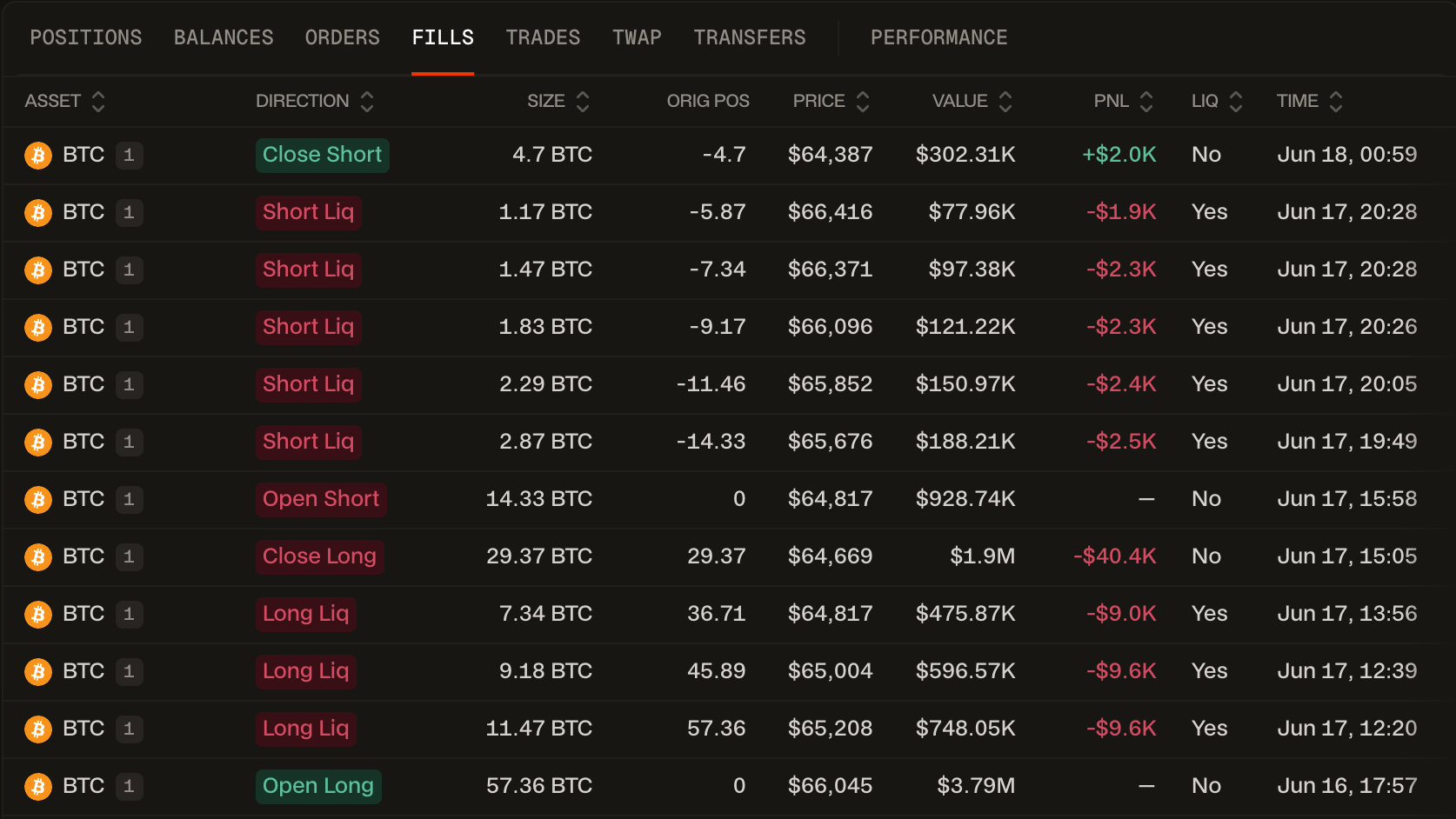
A Hyperliquid wallet reportedly linked to Andrew Tate opened a 57.36 BTC long position on Wednesday, with an entry price near $66,000, according to data resource HyperDash.
The trade was worth about $3.79 million, backed by roughly $100,000 in USDC, implying leverage of around 40x.
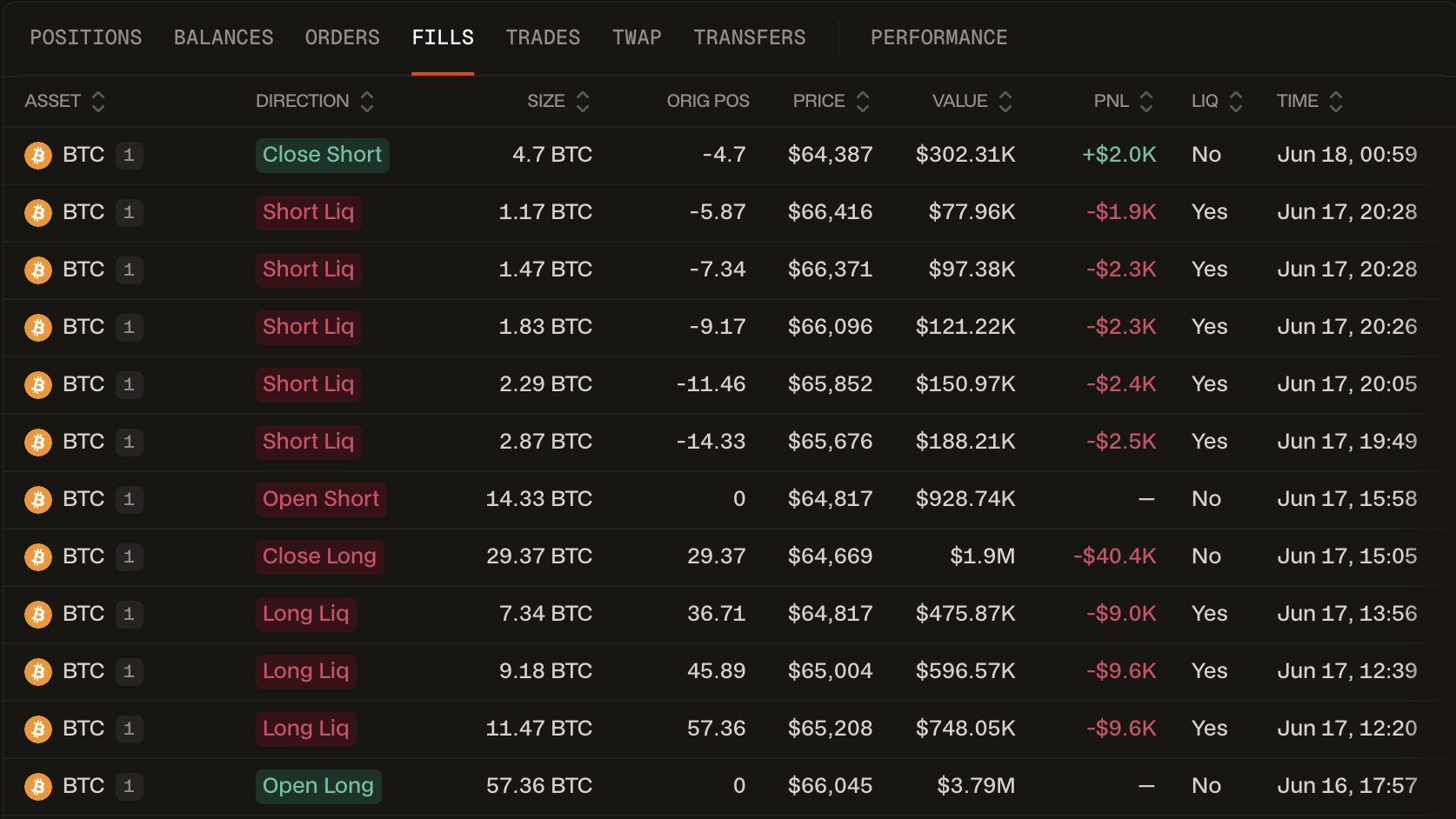
Andrew Tate’s filled order history. Source: HyperDash
The position began unwinding on Thursday as Bitcoin fell toward the mid-$64,000 area. Ultimately, the long trade recorded about $68,600 in cumulative realized losses.
The wallet then switched direction, opening a 14.33 BTC short position worth about $1 million at $64,817. That trade was also hit as Bitcoin rebounded, with five short liquidation fills.
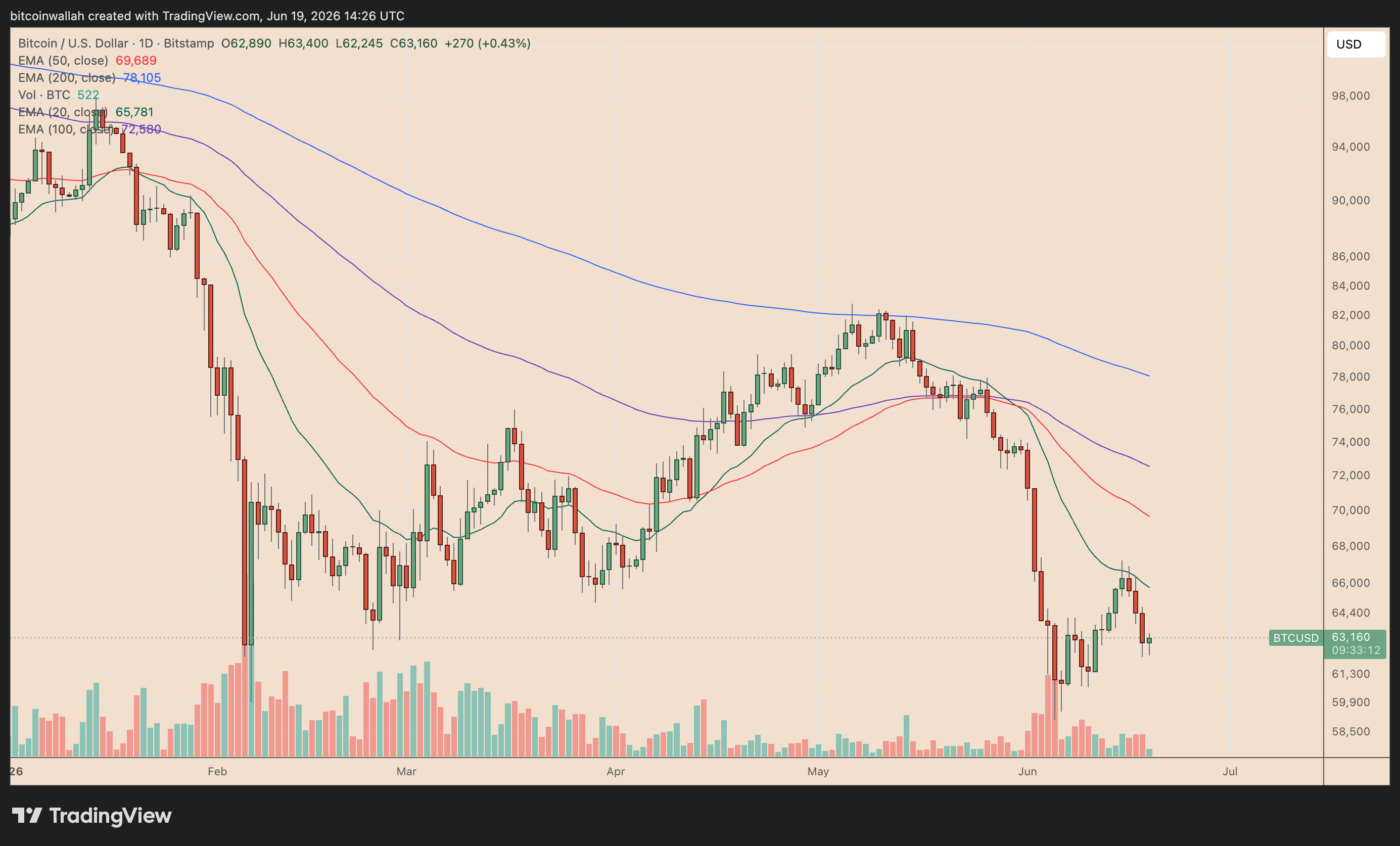
BTC/USD daily chart. Source: TradingView
By June 18, the account balance had fallen to around $14,000, thus losing almost the entire deposit.
Tate’s Hyperliquid portfolio is down nearly $804,000
Andrew Tate’s crypto trading issues on Hyperliquid began well before 2026.
For instance, in November 2025, his 40x BTC long position was liquidated for $235,000 on Nov. 14. By Nov. 18, multiple longs near $90,000–$95,000 were wiped out, leaving the account near zero.
Related: Bitcoin to $145K by October? Why this ‘crazy accurate’ 4chan prediction is sketchy
In another instance, Tate lost around $67,500 on World Liberty Financial (WLFI) positions ahead of a token unlock that triggered a sharp drop in September 2025. He re-entered the same trade almost immediately and lost again.
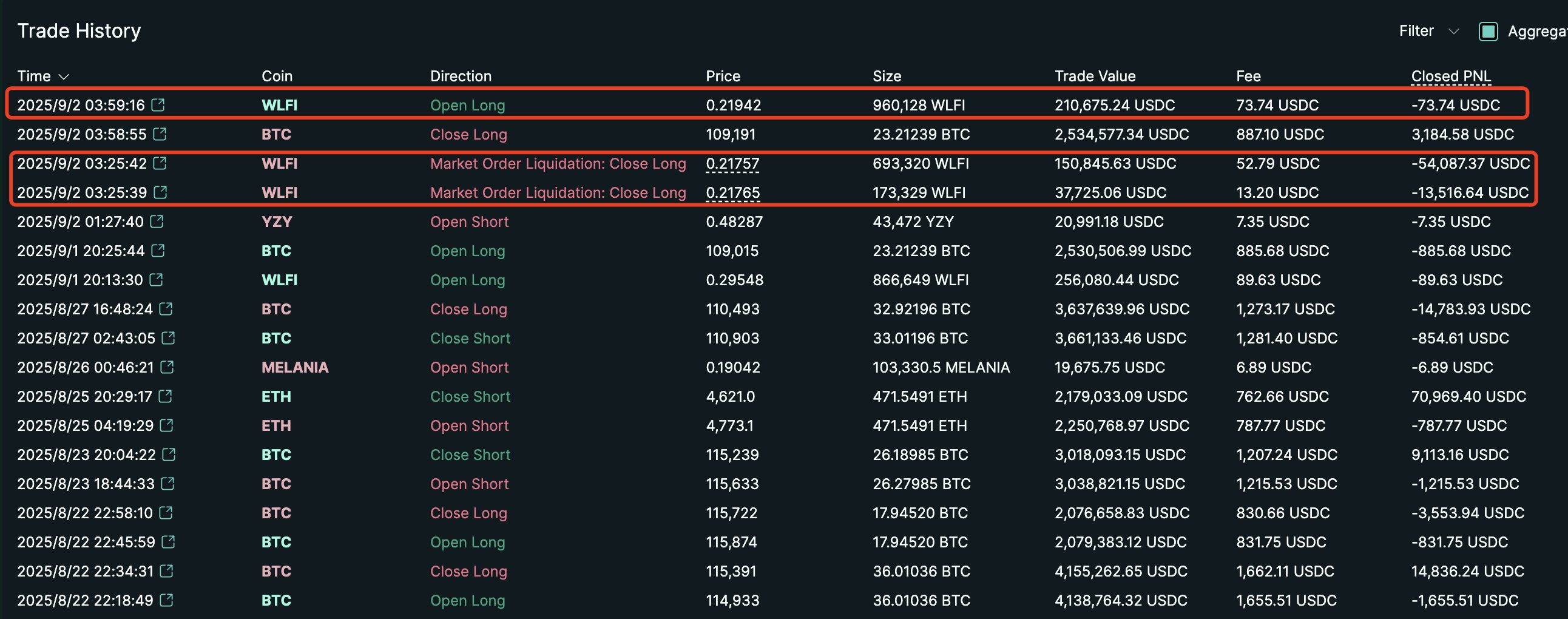
Screenshot of Tate’s WLFI positions from 2025. Source: HyperDash/Lookonchain
As of Friday, Tate’s all-time performance tab showed perpetual futures losses of $803,800, extending a drawdown that began in early 2025 and deepened again after the latest June liquidation streak.
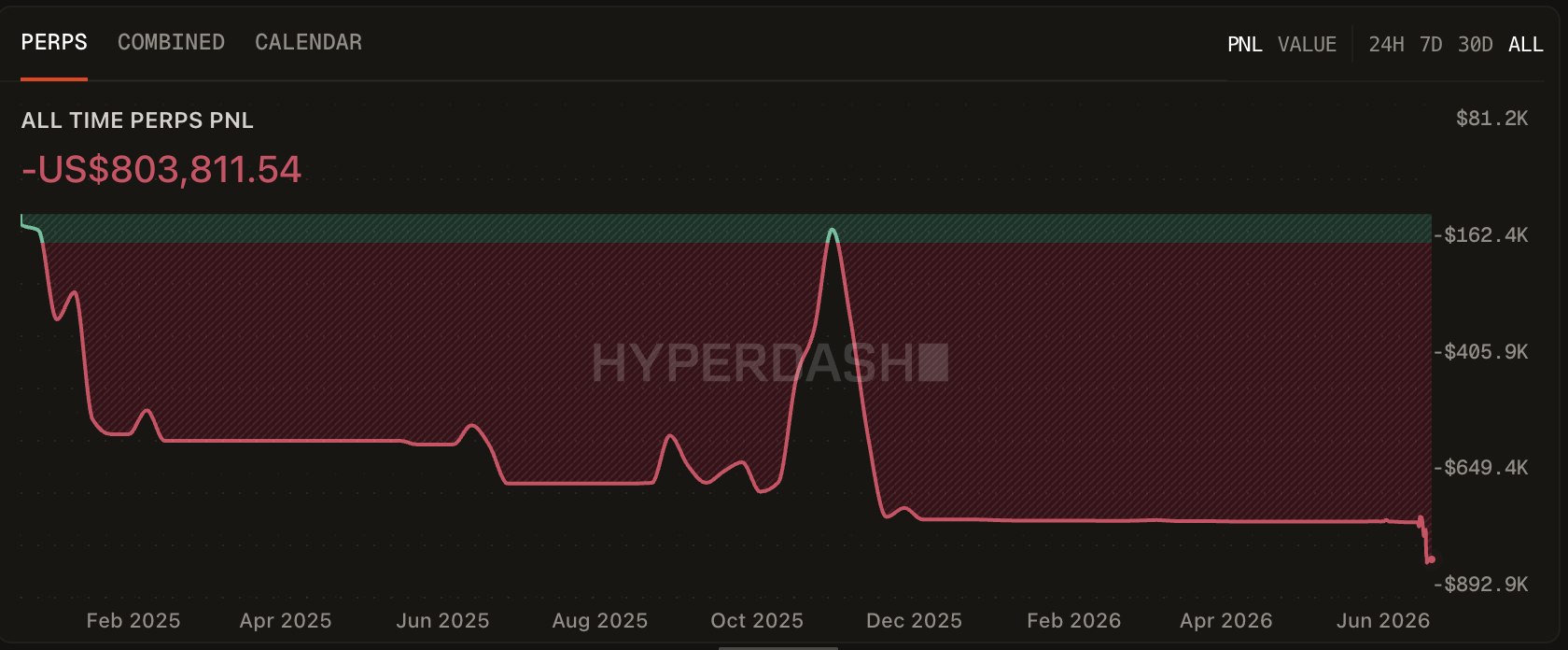
Tate’s profit-and-loss from all perp trades. Source: HyperDash
The trades show how quickly a leveraged account can lose capital in volatile market conditions, even when the underlying asset moves only a few percentage points.

Celsius founder and former CEO Alexander Mashinsky has been permanently banned from trading in markets overseen by the US Commodity Futures Trading Commission (CFTC) after a federal court approved a consent order resolving the regulator’s 2023 enforcement case against him.
The order, entered by the US District Court for the Southern District of New York, also permanently prohibits Mashinsky from violating certain anti-fraud provisions of the Commodity Exchange Act and CFTC regulations and bars him from registering with the agency in the future.
Celsius Collapse Fallout
The CFTC sued Mashinsky and Celsius Network in July 2023. It had alleged that the company operated a digital asset platform where customers deposited cryptocurrencies that were pooled together and used to generate revenue. Customers were told they would receive weekly interest payments or rewards from those activities.
According to the complaint, Mashinsky and Celsius misled hundreds of thousands of customers between 2018 and at least June 2022 by making false or misleading statements about the platform’s safety, profitability, and regulatory standing.
The regulator alleged that Mashinsky repeatedly promoted Celsius through public videos, livestreams, blog posts, social media content, and the company’s website. In those communications, he reportedly portrayed Celsius as a safe place to store digital assets and compared it to a traditional banking alternative while also advertising high-yield returns for customers.
However, the CFTC claimed that Celsius took on increasingly risky investment strategies to generate the returns it had promised. These strategies allegedly included making millions of dollars in uncollateralized loans and participating in risky decentralized finance agreements that were not subject to regulation. While customers continued to be told that their assets were secure and generating rewards, the company was allegedly suffering major losses.
According to the complaint, customer funds were not as secure as Celsius had previously claimed, and the company ultimately filed for bankruptcy. The regulator said Celsius received approximately $20 billion worth of customer funds during its operations. In July 2023, the court entered a separate consent order imposing a permanent injunction against Celsius itself, which left Mashinsky as the sole remaining defendant in the CFTC’s civil case.
Mashinsky’s Sentencing
The CFTC case was separate from but related to a criminal case filed by federal prosecutors in New York on July 11, 2023, involving the same alleged actions by Mashinsky. The founder later pleaded guilty on December 3, 2024, to one count of commodities fraud and one count of securities fraud.
He was sentenced on May 8, 2025, to 12 years in prison and was ordered to pay a $50,000 fine. The court also required him to forfeit $48.39 million for his role in the commodities and securities fraud committed at Celsius.
The post Celsius Founder Alex Mashinsky Permanently Banned From CFTC-Regulated Markets appeared first on CryptoPotato.
Tom Lee, chairman of BitMine Immersion Technologies, the largest corporate holder of Ether, dismissed a warning from a former Ethereum Foundation contributor that the network's core development faces a funding crisis, saying there is "zero chance" of a shortfall. "In my opinion, zero chance of this… Read the full story at The Defiant


Axelar has disabled its Secret Network bridge connections after a security incident resulted in the loss of roughly $4.7 million worth of bridged assets.
Summary
- Axelar disabled Secret Network bridge routes after a $4.7 million exploit tied to a Secret-side ICS-20 contract.
- The company said the incident appears limited to Axelar-bridged assets on Secret Network, with no impact on its core protocol.
- Binance Research previously estimated DeFi exploits triggered $13 billion in TVL outflows and pushed leverage ratios to 2021 highs.
According to Axelar, the exploit affected assets transferred from the Axelar chain to Secret Network through the Cosmos Inter-Blockchain Communication framework.
Early findings from the investigation indicate the issue is linked to the Secret-side ICS-20 smart contract used in the IBC connection between the two networks rather than Axelar’s core infrastructure.
As part of its immediate response, Axelar said its emergency committee shut down the Secret and Secret-SNIP connections to prevent further losses. The interoperability protocol also stated that it had contacted relevant exchanges and law enforcement agencies while its investigation remains ongoing.
Secret Network operates as a privacy-focused blockchain that encrypts transaction data while allowing smart contract code to remain verifiable on-chain.
Through its integration with Axelar, developers have been able to support private cross-chain applications, including confidential decentralized finance activity, private NFT transactions, and anonymous governance functions.
Exploit appears limited to a single bridge connection
Details shared by Axelar indicate that the incident is confined to assets on the Secret Network that were bridged from Axelar. The company said no evidence currently suggests that other IBC connections, Secret-native assets, or additional Axelar integrations were affected.
At the same time, Axelar emphasized that its core protocol remained operational throughout the incident. The team said the suspected vulnerability was isolated to the Secret-side contract involved in processing transfers from Axelar into the Secret ecosystem.
A full post-mortem is expected once the investigation is completed. Until then, the affected bridge routes will remain disabled as engineers continue reviewing the attack path and assessing the extent of the losses.
The incident adds to a growing list of security breaches that have disrupted crypto infrastructure projects in recent weeks. Earlier this month, Humanity Protocol disclosed recovery measures after a June 8 exploit that forced the project to retire its original H token across Ethereum, BNB Chain, and Humanity Mainnet.
According to Humanity Protocol, affected users will receive replacement H tokens through an airdrop tied to a newly deployed audited ERC-20 contract on Ethereum. The project stated that the breach resulted from stolen credentials rather than vulnerabilities in its token contracts, bridge infrastructure, or Safe setup.
Recent exploits continue to pressure crypto projects
Security incidents have also had consequences beyond immediate token losses. Earlier this week, crypto payments platform Pyra announced plans to wind down operations after determining it could not recover from the financial and user impact of the Drift exploit.
Against that backdrop, Axelar’s response has focused on containing the Secret Network incident while investigators determine how the exploit occurred. The company said it will provide additional details once its review is complete and has maintained that no other parts of the Axelar network appear to be affected based on current findings.
As crypto.news reported earlier, Binance Research estimated that DeFi exploits in April alone contributed to roughly $13 billion in total value locked outflows across decentralized finance protocols, reducing available liquidity throughout the sector. The research arm also found that the on-chain leverage ratio climbed to around 38%, a level last seen in 2021, as TVL declined faster than borrowing activity.

U.S. Representative Bryan Steil, chair of the House subcommittee on digital assets, has introduced legislation aimed at preventing members of Congress—and certain family members—from profiting through prediction markets tied to public-policy decisions and “political outcomes.” The proposal, described in a Thursday notice from Steil’s office, would create a narrowly tailored restriction focused on event contracts that reference government action rather than all forms of political or market participation.
The bill reflects ongoing legislative efforts to address concerns that prediction markets could be used to translate privileged information into financial gain. It also adds a new compliance layer for platforms operating in the United States, particularly those marketing policy-relevant event contracts to U.S. users and institutions.
Key takeaways
- Steil’s proposed “Stop Lawmakers from Predicting Act” would bar members of Congress, along with spouses and dependent children, from placing bets on policy-aligned event contracts.
- The restriction targets wagers tied to specific government policies, government actions, and “political outcomes,” with no blanket ban on all prediction-market activity.
- Violations would trigger a financial penalty of either a $2,000 fee or 10% of the prohibited bet’s value, depending on the bill’s enforcement mechanism.
- The legislation would not explicitly extend to White House officials; the proposal instead focuses on elected members of Congress.
- The move comes amid an active regulatory jurisdiction dispute in which the CFTC has sought federal control over prediction market oversight.
What the Stop Lawmakers from Predicting Act would change
According to Steil’s announcement, the Stop Lawmakers from Predicting Act is designed to prevent public officials from “wagering on public policy issues and political outcomes.” The bill’s stated focus is not on whether lawmakers may use prediction markets as participants broadly, but on whether they may place event-contract bets that map directly onto governmental policies, specific actions by the government, and political developments.
The proposal specifically contemplates restrictions for “members of Congress, their spouses, and dependent children.” It would prohibit those individuals from using prediction market platforms—such as Kalshi and Polymarket—for contracts that are aligned with government policy or political results.
Steil’s office outlined a penalty framework for violations. Under the bill, prohibited participants would be subject to either a $2,000 fee or a penalty equal to 10% of the value of the affected bets, depending on the application of the statute. If Congress passes the act and the president signs it, the proposal would reportedly take effect 180 days after enactment.
Why it matters for compliance and institutional oversight
In practice, the bill would require prediction market operators to consider how to identify and restrict access by covered persons. Unlike broad trading prohibitions that target entire classes of market activity, this proposal aims at a defined subset: contracts tied to government actions and policy outcomes.
For compliance teams, that distinction matters. Platforms would need to define contract categories with sufficient specificity to determine which events are “policy-aligned” or concern “political outcomes,” and then implement controls that can flag when a covered person attempts to place a wager. The requirement also creates a compliance question for affiliates, payment processors, and customer due diligence processes: who must be screened, what documentation is necessary, and how sanctions and penalties would be monitored.
For institutional observers, the bill also functions as a legislative attempt to address reputational and governance concerns around the fairness of markets whose payoffs depend on political events. Even when a prediction market is structurally legal, policymakers and regulators frequently assess the risk of insider access, information asymmetry, and conflicts of interest—issues that are closely connected to broader AML/KYC and ethics compliance frameworks.
Limited scope: Congress-focused, not White House officials
Steil’s draft does not specifically establish a blanket prohibition on U.S. lawmakers using prediction market platforms, and it likewise does not broadly outlaw wagers on sporting events. Instead, it targets contracts tied to government policies, government actions, and political outcomes—categories that would likely require platform-specific classification and careful legal interpretation.
The proposed restriction is also notable for who is not included. The legislation does not explicitly bar White House officials, including the president and vice president. Coverage of the issue has also pointed to the involvement of Donald Trump Jr., who has been described as a strategic adviser to Kalshi, and to Polymarket, which has been referenced as having a sponsorship connection to a White House event.
Cointelegraph reported that Steil’s office was contacted for comment but did not receive an immediate response. That incomplete public record underscores an unresolved compliance gap: while Congress-focused restrictions could be implemented relatively directly, questions about broader conflicts of interest and political influence may persist if other officials remain outside the bill’s defined scope.
The broader fight over prediction market jurisdiction
Steil’s proposal arrives during an active federal regulatory dispute over prediction markets. Under the Trump administration, the Commodity Futures Trading Commission (CFTC) and its chair, Michael Selig, have argued that the agency has “exclusive jurisdiction” over regulation and enforcement for prediction market activity.
Cointelegraph has previously reported that the CFTC filed multiple lawsuits against state-level authorities that sought to restrict or ban prediction market platforms. The CFTC’s argument rests on the view that certain event contracts can be regulated as “swaps” under the Commodity Exchange Act—rather than ordinary bets—placing them within federal oversight.
Some legal experts have suggested that the ongoing jurisdiction battle could escalate further, potentially reaching the U.S. Supreme Court. If courts determine that the CFTC’s characterization is controlling, it could reshape the compliance landscape for platforms by centralizing federal enforcement rather than leaving states to impose varying restrictions.
That jurisdictional context is important to the new bill because it highlights a split between two overlapping regulatory aims: (1) enforcing insider-conflict and ethics concerns through legislation aimed at specific public officials, and (2) establishing which regulator has authority over the underlying trading instrument and platform activity. A bill that restricts participation by covered individuals does not automatically resolve instrument classification disputes; similarly, federal jurisdiction rulings do not determine how conflict-of-interest rules apply to lawmakers.
As enforcement frameworks develop, prediction market operators may face multi-layer compliance expectations: platform-level controls for participant eligibility and event-type categorization, alongside ongoing monitoring for activities that regulators might characterize as covered derivatives under federal law.
Closing perspective
While the Stop Lawmakers from Predicting Act targets a specific conflict-of-interest risk tied to policy and political event contracts, its prospects depend on congressional action and how it is operationalized by exchanges and market operators. The parallel CFTC jurisdiction litigation will likely remain a key driver of regulatory certainty, and the legal outcome may influence how quickly platforms can standardize compliance across states and federal enforcement positions.

Bitcoin mining is increasingly becoming less about pure exposure to BTC price moves and more about building a business around electricity, compute supply chains, and AI-related infrastructure. The change is being reinforced by signals from outside crypto, including a report that Nvidia is seeking to raise $20 billion through a bond sale to fund additional AI expansion.
At the same time, other parts of the industry are showing resilience or momentum. Tokenized real-world assets continue to grow even as the broader crypto market struggles, while Ripple is expanding its payments footprint in Africa through an investment in Flutterwave. Separately, former FTX CEO Sam Bankman-Fried’s attempt to overturn his fraud conviction has failed, according to an appeals panel in Manhattan.
Key takeaways
- A reported $20 billion Nvidia bond offering underscores the scale and durability of the AI investment cycle that some Bitcoin miners are positioning to support.
- Bitcoin mining firms are increasingly targeting AI hosting and high-performance computing opportunities as mining margins tighten.
- Tokenized real-world assets have surpassed $43 billion in total value of onchain financial assets, with Token Terminal citing a 37% increase over six months.
- Ripple’s investment in Flutterwave is another step in expanding stablecoin and payments infrastructure across Africa, where cross-border payments demand is rising.
- Sam Bankman-Fried’s appeal to overturn his fraud conviction was denied by a Manhattan appeals panel.
Nvidia’s bond plan highlights why miners are looking beyond hash rate
According to Bloomberg, Nvidia is pursuing a multi-part bond offering totaling $20 billion to finance future AI-related investments and refinance existing debt. The report also notes that the longest-dated bonds are expected to carry meaningfully higher yields than comparable U.S. Treasury securities, reflecting investor pricing for longer-duration risk and returns.
The relevance for crypto comes from how the economics of mining have been shifting. For years, many miners effectively operated as leveraged vehicles for BTC: mining profitability tended to track Bitcoin’s price and difficulty dynamics, leaving little room for a broader corporate identity. But with mining economics under pressure and power costs remaining a constant constraint, miners have been exploring a new angle—using their energy access and data center capabilities for AI compute workloads.
As Cointelegraph previously reported, the AI and data center trend has created practical opportunities for miners, since many of their facilities already support high-density computing. Companies such as HIVE Digital, Hut 8, CleanSpark, and TeraWulf have been positioning themselves as AI infrastructure providers, effectively treating energy and hosting as primary assets rather than secondary byproducts of mining.
While Nvidia’s funding plan is not a direct endorsement of Bitcoin mining, it is a reminder that major AI infrastructure buildouts tend to be multi-year investments. That duration matters: investors and operators typically need a longer runway when converting electrical and facilities capability into new revenue streams. The key watchpoint is whether AI hosting demand continues to absorb capacity fast enough to offset ongoing mining margin compression.
Tokenized RWAs keep expanding even as crypto sentiment softens
The tokenized real-world asset market continues to grow despite weakness across wider crypto markets. Token Terminal reports that the total value of onchain financial assets has surpassed $43 billion—an increase of 37% over the past six months—suggesting ongoing institutional and product-level experimentation rather than a purely speculative boom.
Tokenized funds dominate the category, accounting for nearly 80% of all onchain financial assets, though other forms are gaining attention. Commodities and tokenized stocks are gradually strengthening their presence, indicating that issuers are exploring more than one blueprint for bringing traditional asset exposure onchain.
The momentum is also being reinforced by longer-term projections from major banks. Standard Chartered expects tokenization to help drive decentralized finance toward a $2.7 trillion market capitalization by 2030, while Citigroup projects tokenized RWAs could reach $5.5 trillion over the same period. Even if exact outcomes differ, these forecasts point to a consistent theme: large financial institutions see tokenization as a structural opportunity that could eventually scale beyond pilots.
For market participants, the practical implication is that the RWA sector may behave differently from mainstream crypto narratives. Growth appears tied to product distribution and balance-sheet-backed use cases, which can be less correlated with day-to-day volatility than trading-heavy segments.
Ripple doubles down on African payments with Flutterwave investment
Ripple has invested an undisclosed amount in Flutterwave, one of Africa’s fastest-growing remittance and payments firms, in a deal valuing the fintech at $3.3 billion. The investment is expected to connect Ripple’s RLUSD stablecoin, Ripple Payments platform, and XRP Ledger infrastructure with Flutterwave’s payments reach.
Flutterwave operates across 35 countries, and this partnership aims to strengthen Ripple’s stablecoin-based rails for cross-border transfers. The pitch aligns with the broader industry demand for faster settlements and lower-cost remittances, especially in regions where traditional correspondent banking can be slow or expensive.
This development also fits Ripple’s continuing strategy to deepen its presence in Africa. In October, Ripple partnered with South Africa’s Absa Bank to provide institutional digital asset custody solutions—another area where regulatory frameworks and institutional adoption tend to matter as much as technology. Taken together, the Flutterwave investment suggests Ripple is seeking both market access and the operational capacity to serve institutional and consumer payment flows.
Manhattan appeals panel rejects Sam Bankman-Fried bid to overturn conviction
Former FTX CEO Sam Bankman-Fried failed to overturn his fraud conviction after a three-judge appeals panel in Manhattan upheld the verdict, finding that he received a fair trial. The denial comes after an appeal that challenged the conviction stemming from FTX’s collapse.
In an opinion attributed to Circuit Judge Barrington Parker, the court highlighted a central contradiction in Bankman-Fried’s conduct during the period leading to FTX’s failure: while he was publicly reassuring customers, investors, and regulators that customer funds were safe, the judge wrote that he was simultaneously using FTX funds for personal purposes, including spending on real estate, political contributions, and investments.
Bankman-Fried was convicted on fraud and conspiracy charges tied to the collapse of FTX and sentenced to 25 years in prison in 2024, according to earlier reporting. In addition, Cointelegraph reported that he formally applied for a presidential pardon from U.S. President Donald Trump, with the request appearing on the Pardon Attorney website in early June.
For observers, the outcome means the legal fight does not reset the underlying conviction. While additional post-conviction steps may still be possible in the future, this appeals decision closes a key chapter and keeps attention on the enforcement trajectory following one of crypto’s most consequential corporate failures.
Looking ahead, the most important signal to track is whether the AI infrastructure shift can convert into durable, measurable revenue for mining operators—especially as power and equipment costs remain the real battlefield. Meanwhile, tokenized RWAs will likely remain a key barometer for whether onchain finance can sustain growth through traditional finance’s adoption cycles, even when broader crypto markets cool off.
This article was originally published as AI’s Role in Reshaping Miner Strategy: Is It the Way Out? on Crypto Breaking News – your trusted source for crypto news, Bitcoin news, and blockchain updates.

LEGO Builds a Life-Size Koenigsegg Sadair’s Spear Megacar That Hits 69 MPH
![J MONEY - NA NHA NOME [VIDEO OFICIAL]](https://wordupnews.com/wp-content/uploads/2026/05/1777799968_maxresdefault-80x80.jpg)
J MONEY – NA NHA NOME [VIDEO OFICIAL]

Marcus Rashford hands England major World Cup injury scare after Man United star’s complaint


-

 Business5 days ago
No Jackpot Winner as $257 Million Prize Rolls Over to $269 Million Monday Draw
-
 Crypto World5 days ago
Zimbabwe Requires Crypto Businesses to Register Annually Under New FIU Regulations
-

 Crypto World7 days ago
Bitget enters Argentina’s regulated crypto market through PSAV registration
-

 Tech7 days ago
NanoClaw integrates JFrog registries to secure AI agent downloads
-
 Entertainment5 days ago
Matt Damon’s Viral Sci-Fi Thriller Has Taken Over HBO Max
-

 Business5 days ago
Anthropic staff to meet White House officials next week, Axios reports
-

 Tech5 days ago
As AI companies race to go public, who else is along for the ride?
-
 Crypto World5 days ago
Bitcoin could crash to $48,000, if this historical pattern is triggered
-

 Politics5 days ago
“Israel’s” ban on ICRC visits ruled illegal, but Knesset moves to stop them permanently
-
 NewsBeat5 days ago
Warning of disruption as Cardiff Crossrail works to start
-

 News Videos5 days ago
Financial Accounting | Last Day Revision Strategy and Booster | CMA Inter – June 2026
-
 NewsBeat5 days ago
what doctors are seeing in ebike crashes
-
 NewsBeat5 days ago
Tributes to former deputy head teacher at Cambridge school among death and funeral notices
-

 Entertainment6 days ago
Deion Sanders Shares Powerful Post After Viral Advice To Deiondra
-
 Entertainment5 days ago
Kate Middleton Glare Goes Viral After Kids Booed At Royal Event
-

 Crypto World5 days ago
XRP ETFs Outperform As Bitcoin And Ethereum Funds Extend Outflow Trend
-
 Crypto World5 days ago
Market Preview: SpaceX (SPCX) IPO Record, Federal Reserve Meeting, and Iran Nuclear Agreement
-

 Tech5 days ago
Over 400 Arch Linux packages compromised to push rootkit, infostealer
-

 Business5 days ago
Invesco Quality Income Fund Q1 2026 Commentary
-
 Entertainment7 days ago
44 Years Later, This Is the Greatest Star Trek Quote in Sci-Fi History
You must be logged in to post a comment Login