

Crypto World
Blockchain.com Moves Toward Public Listing in US

Crypto services company Blockchain.com confidentially filed for a US initial public offering (IPO), becoming the latest digital asset player to pursue a public listing as crypto firms return to equity markets.
The company said it submitted a draft S-1 registration statement to the US Securities and Exchange Commission (SEC) related to a proposed offering of Class A ordinary shares. Pricing and the number of shares have not yet been determined.
According to Thursday’s announcement, the proposed IPO remains subject to market conditions and SEC review. Confidential S-1 filings allow companies to begin the IPO process and receive regulatory feedback before publicly disclosing financial and offering details.
Founded in 2011, Blockchain.com said it has more than 95 million wallets, over 43 million verified users and has processed more than $1.1 trillion in crypto transactions. The company offers consumer trading and wallet services alongside institutional products.
The filing follows several expansion efforts this year, including a deeper push into African markets and the launch of perpetual futures trading through its self-custodial wallet via the Hyperliquid protocol.
Related: SpaceX reveals larger-than-expected Bitcoin holdings in IPO filing
Crypto IPO plans shift with market conditions
Several major crypto companies have explored public listings over the past year, though some plans have shifted alongside changing market conditions.
Crypto trading platform Backpack Exchange said in February that it plans to move toward a potential US IPO, with its forthcoming Backpack token structured to unlock in stages ahead of a public listing. The company said some token holders may eventually be able to exchange staked tokens for company equity.
In January, digital asset custodian Copper was reported to be weighing a potential IPO. However, reports this week suggest the company is now be exploring a sale instead of pursuing a listing.
Kraken, one of the largest private crypto exchanges and a long-rumored IPO candidate, saw its public listing plans fluctuate over the past year. Parent company Payward confidentially filed for a US IPO in November 2025 before reports in March suggested the company had paused its plans amid weaker crypto market conditions.
Kraken co-CEO Arjun Sethi later said in April that the company was still pursuing a public listing, though it was reported in May that the debut could be delayed until 2027 following a round of layoffs at the company.
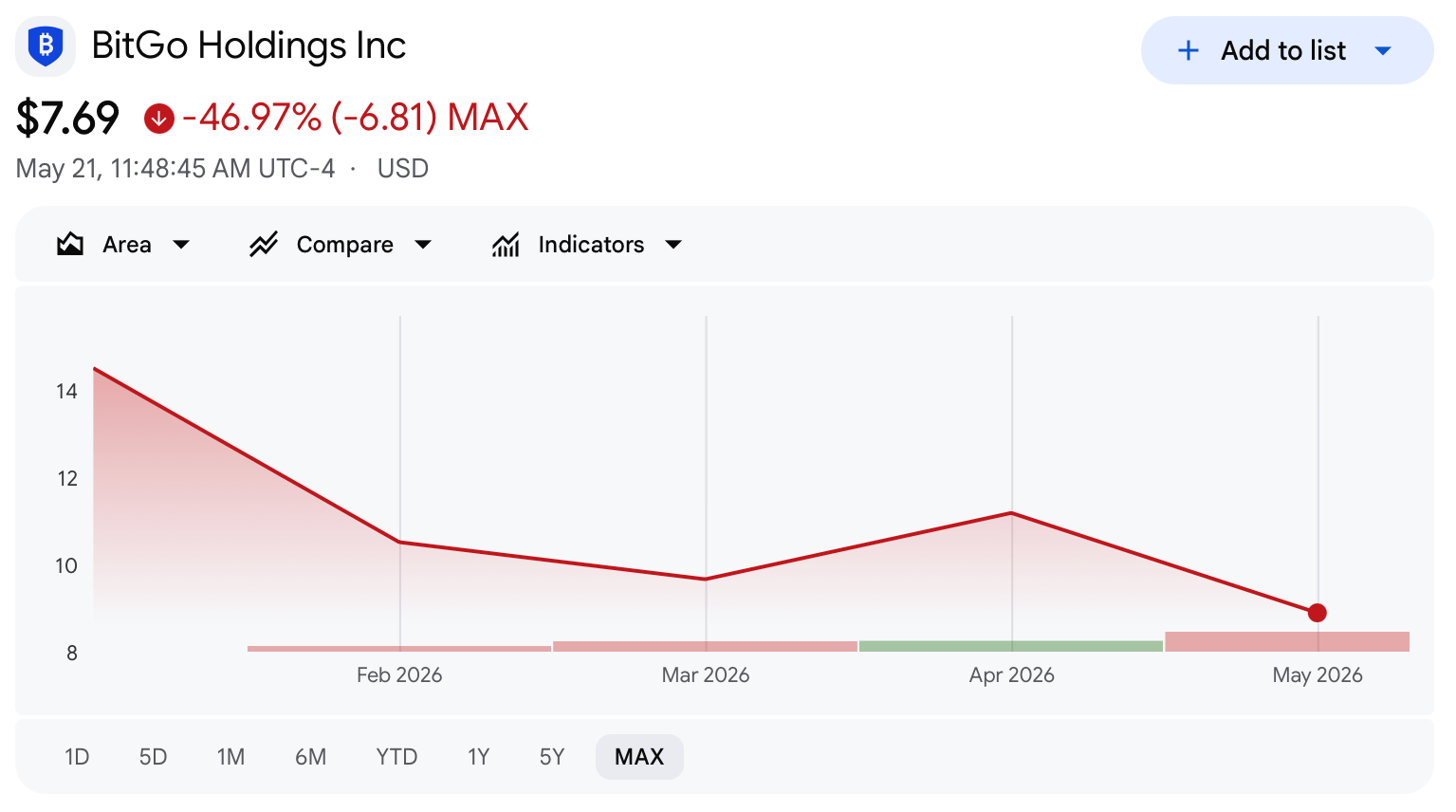
While crypto companies continue to weigh, delay or cancel public listings, BitGo completed one of the largest crypto IPOs of 2026 in January, pricing shares at $18 and raising about $213 million in its NYSE debut at a valuation exceeding $2 billion.
Since launch, the stock has fallen about 57% to around $7.66 per share amid the broader downturn in crypto markets, according to Google Finance data.
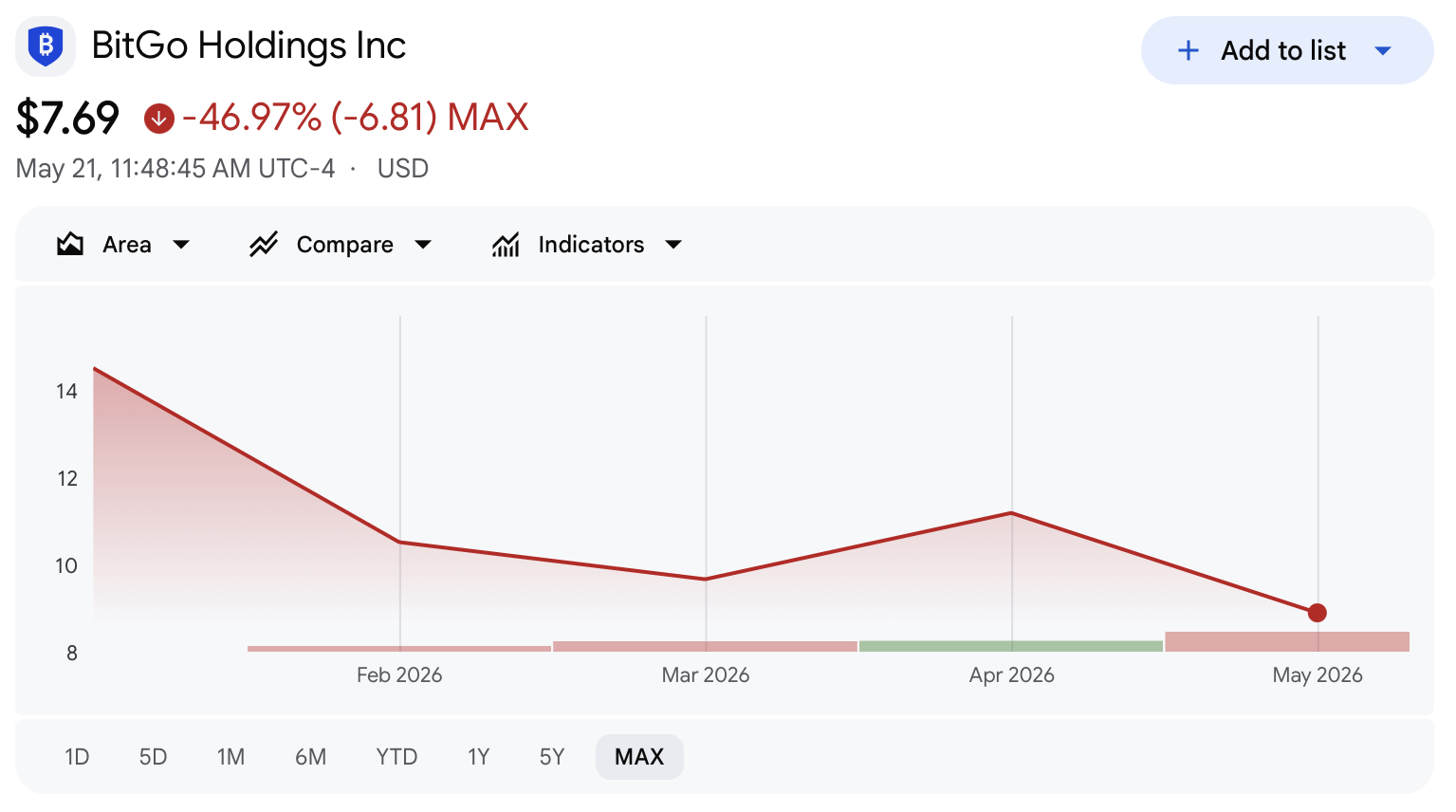
Source: Google Finance
Magazine: 5 tech predictions the mainstream media got horribly wrong

Canadian Bitcoin miner HIVE Digital Technologies said its AI subsidiary BUZZ HPC has signed a three-year GPU cloud contract worth approximately $220 million with Bell AI Fabric for AI startup Cohere, expanding the company’s push into high-performance computing (HPC) and AI infrastructure.
The agreement calls for BUZZ HPC to deploy 2,304 NVIDIA Grace Blackwell GPUs at a Bell Canada data center in British Columbia, where the infrastructure will support Cohere’s artificial intelligence models and services for enterprise and government customers.
After the deployment enters service, HIVE expects the project to contribute about $70 million in contracted annual recurring revenue, increasing its contracted HPC revenue target to more than $100 million, according to the company.
HIVE said it will fund the purchase of the AI infrastructure using a portion of the proceeds from the $115 million convertible note financing it completed in April.
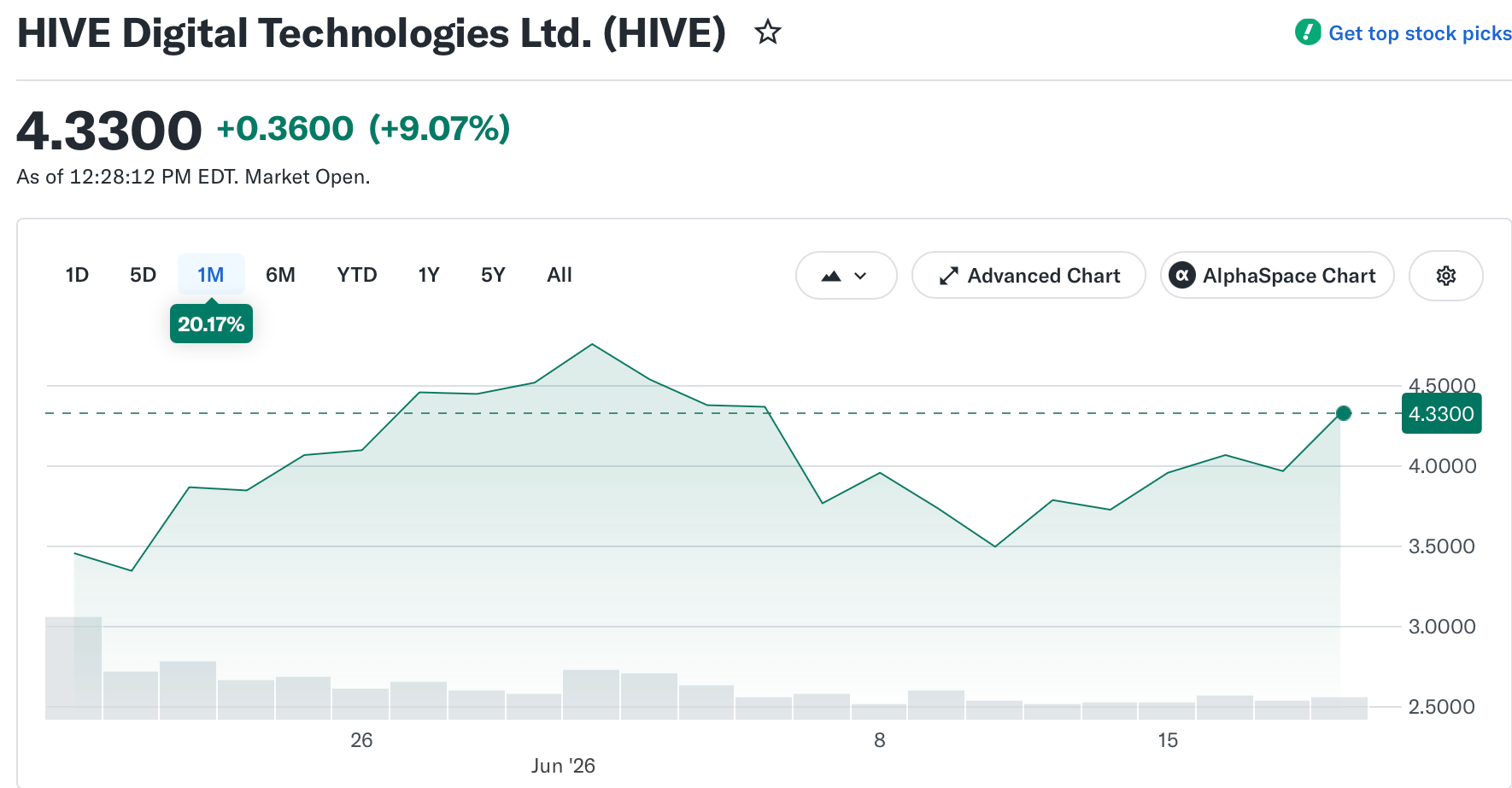
The company’s stock price was up around 9% at the time of writing and almost 24% in the past month, according to Yahoo Finance data. Sector tracking exchange-traded fund CoinShares Bitcoin Mining ETF (WGMI) was up 5.4% on the day, and up more than 30% in the past month. HIVE stock is the fund’s eighth-biggest holding.
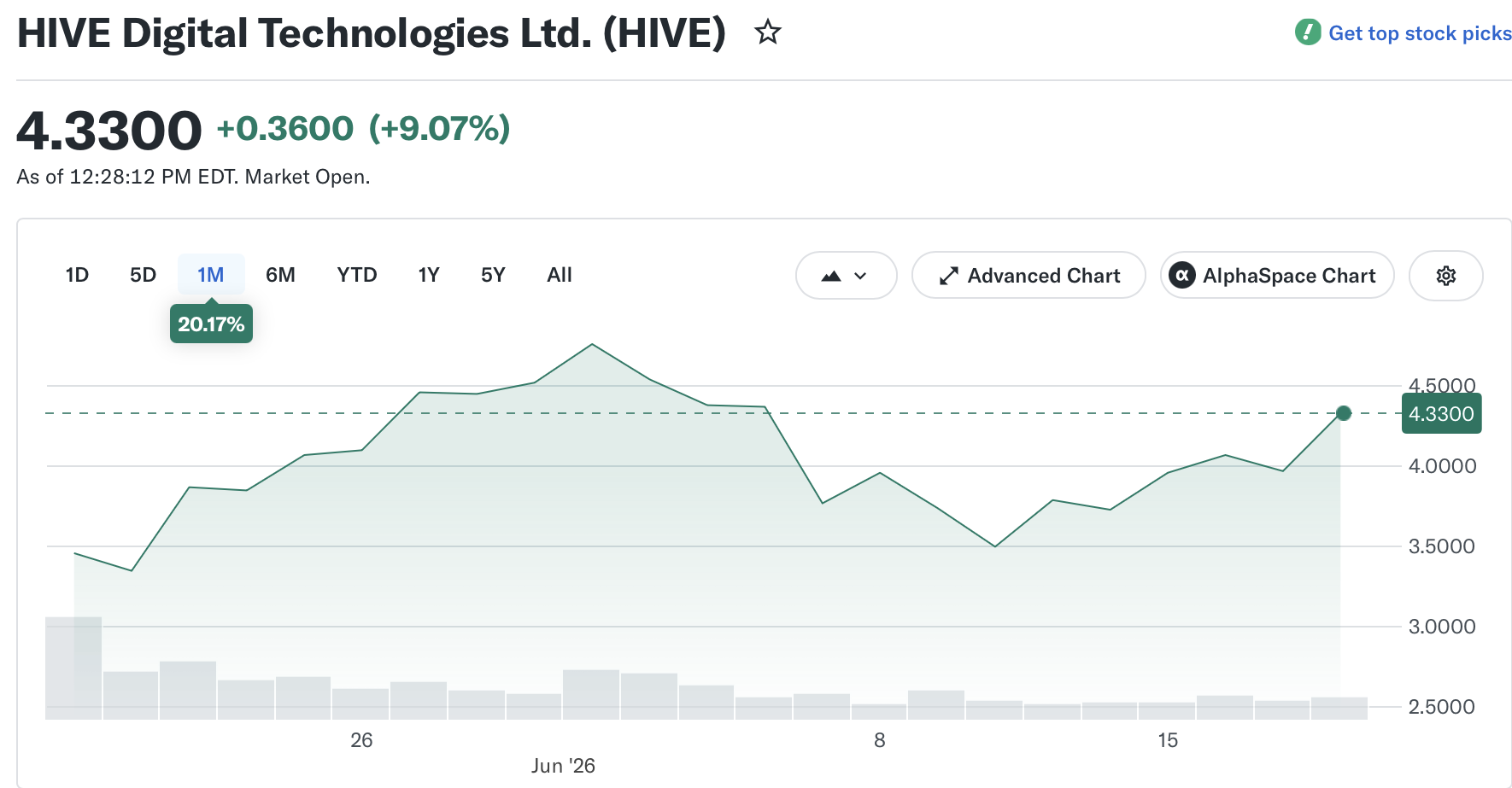
Source: Yahoo Finance
Related: Georgia targets illegal crypto mining in Mestia crackdown: Report
HIVE grows AI business as Bitcoin holdings decline
The deal is the latest move in HIVE’s broader expansion into AI infrastructure. In May, the company said its BUZZ HPC subsidiary planned a 320-megawatt AI data center campus near Toronto, capable of supporting more than 100,000 GPUs.
Earlier this month, HIVE reported that revenue from its HPC division increased to $19.5 million in fiscal 2026, nearly doubling from a year earlier. The company also said contracted annual recurring revenue from the business reached $35 million, supported by deployments of Nvidia-powered GPU clusters and new enterprise contracts.
HIVE also reported a decline in its Bitcoin (BTC) treasury holdings, which fell to 150 BTC from 481 BTC a quarter earlier.
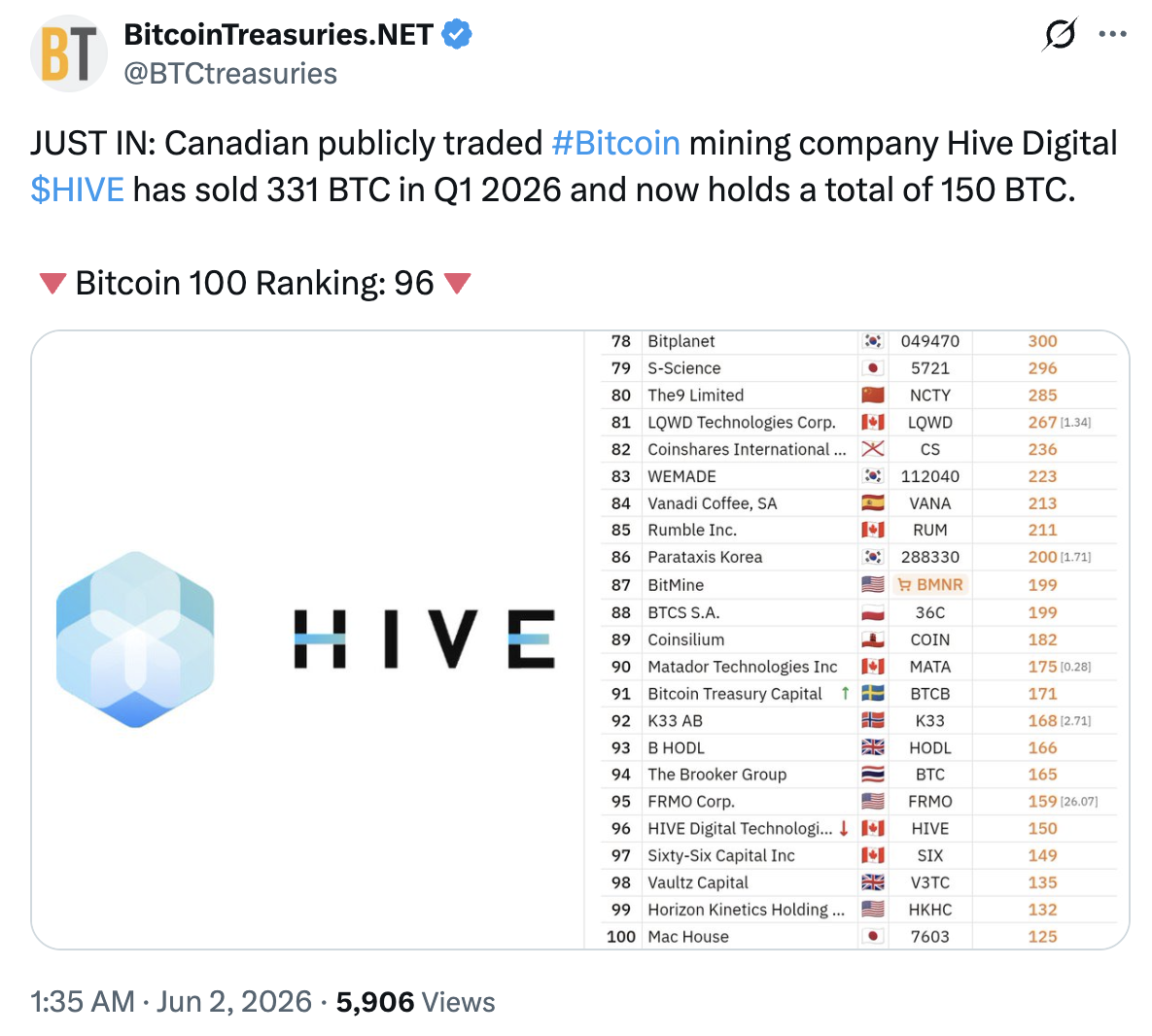
Source: BitcoinTreasuries.NET
Related: Nvidia’s $20 billion debt boom reinforces Bitcoin miners’ AI pivot
Hashrate declines as AI investments grow
On Thursday, The Energy Mag (formerly The Miner Mag) noted that Bitcoin mining difficulty, a measure of how hard it is for miners to produce new blocks, fell 10.09% on June 14, one of the largest downward adjustments in the network’s history.
The publication attributed the decline to weaker mining economics, Bitcoin’s price decline, seasonal power curtailment in Texas and broader power-market dynamics. It also argued that miners dedicating power to AI and HPC projects could alter future hashrate growth by reducing the amount of capacity available for Bitcoin mining.
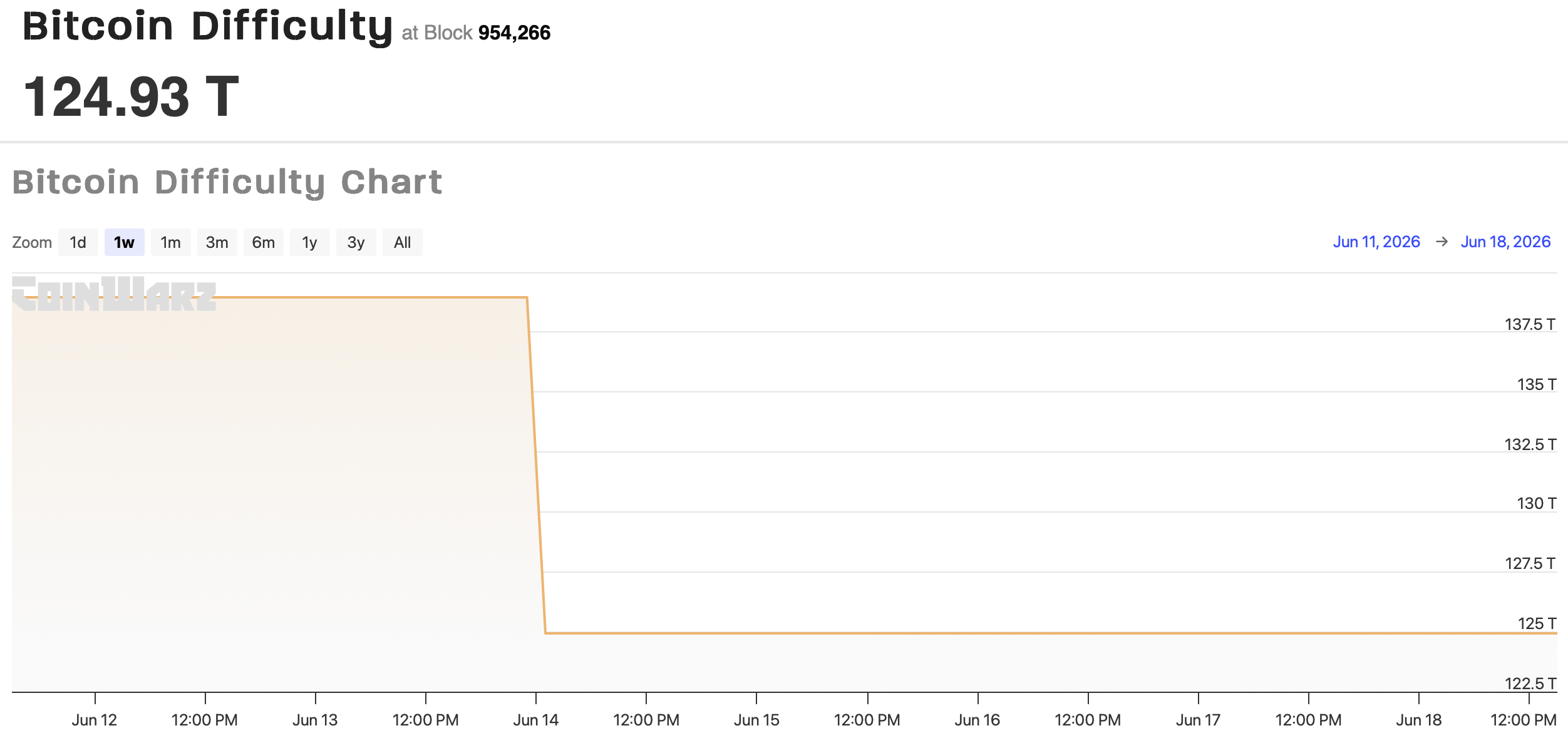
Bitcoin mining difficulty. Source: Coinwarz.com
The decline came days after Cointelegraph reported that Bitcoin mining profitability had fallen to record lows, making it harder for some operators to remain profitable.
Meanwhile, miners continue expanding into AI and high-performance computing. On Tuesday, IREN completed its acquisition of Spanish data center developer Nostrum Group, while TeraWulf recently added a Kentucky development site that it said could eventually support more than 1 gigawatt of AI and HPC capacity.
Magazine: Does ‘Paper Bitcoin’ mean there’s an unlimited supply of BTC?
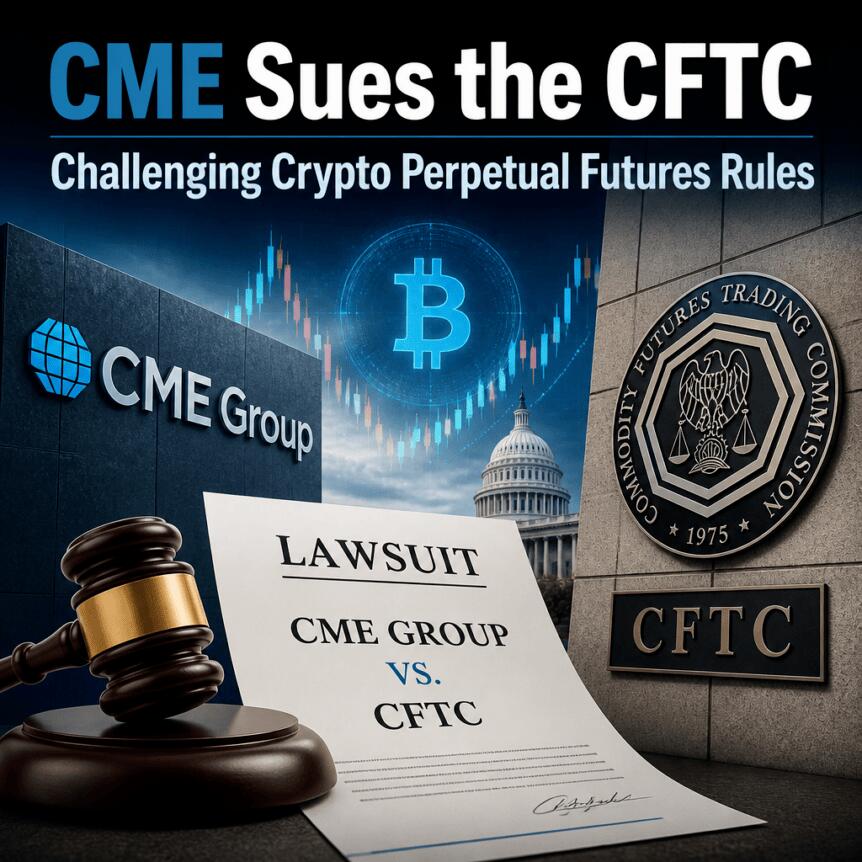
The Chicago Mercantile Exchange (CME) Group has filed a lawsuit in federal court challenging the U.S. Commodity Futures Trading Commission (CFTC) over its approvals of cryptocurrency-linked perpetual futures. The complaint, submitted to the U.S. District Court for the District of Columbia, targets the CFTC, its chair Michael Selig, and asks the court to vacate the agency’s actions.
The case highlights an expanding regulatory dispute over how U.S. derivatives rules apply to crypto products that do not fit neatly into traditional futures structures. For crypto exchanges, broker-dealers, market operators, and institutional investors, the outcome could affect product design, compliance expectations, and supervisory oversight of crypto derivatives—particularly where regulatory interpretations hinge on whether a contract is treated as a “futures” product or as a “swap” under the Commodity Exchange Act (CEA).
Key takeaways
- CME filed a D.C. federal lawsuit against the CFTC and chair Michael Selig relating to the agency’s approval of crypto perpetual futures tied to Bitcoin spot prices.
- The complaint centers on a CFTC notice dated May 29 involving Kalshi prediction market products and a no-action position for similar products involving Coinbase.
- CME alleges the CFTC improperly applied the CEA by effectively treating “futures” as “swaps” with expiration dates, and argues Selig acted without a full five-commissioner panel.
- The CFTC, through a spokesperson, rejected the claims as “frivolous” and characterized CME’s litigation approach as “lawfare.”
CME’s lawsuit challenges CFTC approvals for crypto perpetual futures
In its Thursday filing, CME sought judicial review of CFTC actions approving certain perpetual futures contracts linked to Bitcoin’s spot price. The dispute traces back to a May 29 CFTC notice that (1) approved perpetual futures contracts tied to Bitcoin for Kalshi, a platform operating prediction markets, and (2) issued a “no-action” position for similar perpetual products referenced in connection with Coinbase.
CME’s complaint argues that the CFTC’s approach conflicts with directives from Congress, particularly by treating “futures” as “swaps” for purposes of regulatory classification. Under CME’s theory, the classification matters because it determines which statutory and regulatory requirements apply to the relevant derivatives framework.
Beyond the substantive challenge, CME also raised procedural concerns. The exchange contends that Selig acted unilaterally rather than through a full panel of five CFTC commissioners, implying that the agency’s internal governance or decision-making process was not properly followed for the actions at issue.
“With one stroke of his pen, [Selig] overrode Congress’s definition of the term ‘swap’ and circumvented the regulatory regime Congress required for that form of derivative.”
CME further asserted that the CFTC’s handling of these approvals could harm competition and destabilize derivatives markets, arguing the agency failed to apply the CEA consistently and evenly.
Congress, contract classification, and why the dispute matters
At the core of CME’s legal argument is the classification of perpetual futures contracts—contracts that, in typical market practice, can be designed to trade without a fixed expiration date, while still resembling derivative instruments whose regulatory treatment depends on statutory definitions.
From a compliance standpoint, how a product is categorized can determine whether market participants must register, seek approvals, adopt particular operational controls, and comply with specific surveillance or reporting expectations under U.S. derivatives oversight. The lawsuit therefore sits at the intersection of contract engineering and statutory interpretation: market operators and intermediaries may need clarity on whether certain crypto-linked “perpetual” structures fit within futures frameworks or instead trigger swap-like regulatory pathways.
The broader institutional issue is that perpetual crypto derivatives have increasingly blurred lines between legacy derivative categories. That raises practical uncertainty for exchanges and clearing entities, and it can create compliance friction for financial institutions that must meet regulatory expectations for eligible contract types and risk controls. In that context, CME’s challenge is not merely a technical disagreement: it is aimed at shaping the legal boundaries that govern future approvals and market access.
Selig’s position and the CFTC’s response
The dispute escalated publicly shortly before CME’s filing. One day earlier, CME CEO Terrence Duffy said the exchange operator would take legal action against the CFTC. In a subsequent interview, Selig maintained that perpetual futures contracts “trade very similarly” to other derivatives and argued that the CEA does not define the term “futures contract.”
The CFTC rejected CME’s complaint. A CFTC spokesperson told Cointelegraph that CME had engaged in “lawfare” against the agency and the administration’s broader crypto policy approach, characterizing the lawsuit as “frivolous.” The exchange’s response, in turn, underscores a high-stakes policy conflict: if courts accept CME’s reading, it could compel the agency to revisit approvals tied to its prior interpretive stance and potentially adjust how it evaluates similar applications or regulatory notices.
CFTC leadership structure and timing: a procedural and policy flashpoint
CFTC chair Michael Selig was confirmed by the U.S. Senate in December 2025 and, as of the time of CME’s filing, remains the chair and sole commissioner in a leadership panel intended to include five commissioners. The lawsuit comes amid uncertainty about whether the CFTC’s full bipartisan composition will be restored in time for complex contested decisions—an issue that CME highlights through its allegation that Selig acted without a complete panel.
Political context also matters for the regulatory process. As of Thursday, President Donald Trump had not announced nominations to fill the CFTC seats, despite calls from members of Congress to do so. That governance vacuum can become consequential when markets depend on consistent, multi-member commission decision-making for contested interpretations of the CEA.
The dispute also arrives as crypto perpetual derivatives are proliferating across U.S. venues and regulated infrastructure. For example, Kraken announced it would offer perpetual futures to U.S. users through a CFTC-regulated platform, Bitnomial. While that development is separate from CME’s lawsuit, it reflects the practical stakes of regulatory clarity: product expansion continues, but the legal foundations supporting classification and approval pathways are actively contested.
What to watch next
Courts will determine whether CME’s claims succeed on statutory interpretation and whether the challenged approvals can stand procedurally under the CFTC’s decision-making requirements. For market participants, the most immediate watchpoints are how the court frames the futures-versus-swaps classification issue and whether the CFTC revises its approach to approvals of crypto perpetual derivatives pending the litigation’s outcome.
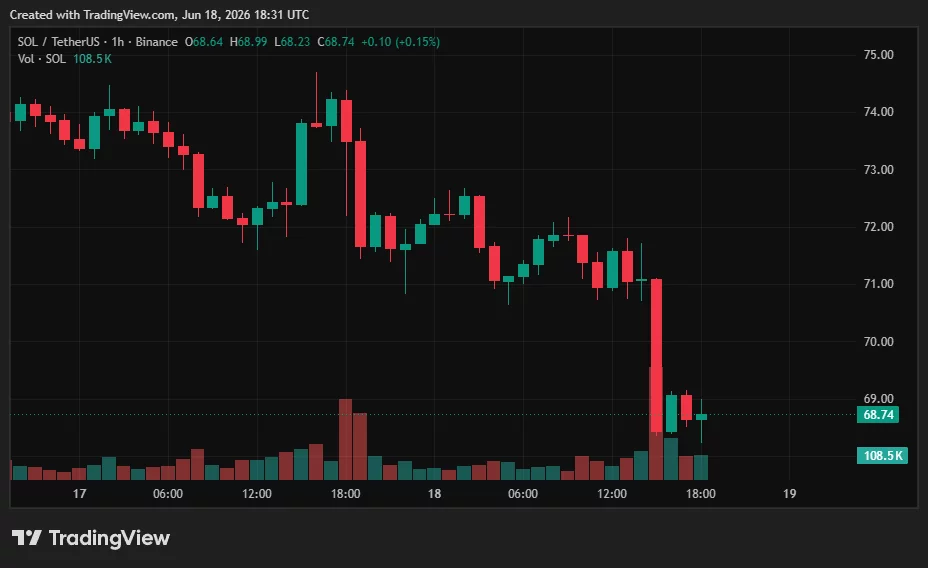
Kraken has expanded access to more than 2,500 Solana-based tokens through on-chain trading while SOL has fallen nearly 8% amid a wider crypto market selloff.
Summary
- Kraken has launched on-chain trading for more than 2,500 Solana-based tokens across 100+ countries.
- The feature gives users access to many unlisted Solana tokens using USD or USDC.
- SOL fell nearly 8% as a broader crypto market selloff outweighed the positive platform update.
According to Kraken, customers in the United States and more than 100 countries can now trade thousands of Solana ecosystem tokens directly through the exchange’s platform, including assets that have not yet been listed on centralized exchanges.
The rollout allows users to buy and sell eligible Solana tokens using USD or USDC without relying on separate self-custody wallets or external decentralized finance tools.
Kraken said the feature removes several steps that have traditionally required users to manage seed phrases, bridge assets between platforms, or interact with multiple applications.
Speaking on the launch, Kraken Chief Data Officer Kamo Asatryan said the company wants to simplify access to blockchain-based assets by reducing the complexity associated with activities such as paying gas fees and moving funds across networks.
Kraken expands beyond traditional exchange listings
Rather than focusing only on tokens that pass through the centralized exchange listing process, Kraken is opening access to a much larger segment of the Solana ecosystem. According to the company, many of the newly available assets are not listed on conventional trading platforms.
“Our customers in the US and more than 100 countries can now trade 2,500+ Solana-based tokens directly from the Kraken app they already use, including many not yet listed on any centralized exchange.”
The launch adds another product line to Kraken’s recent expansion efforts. As crypto.news reported on June 15, the exchange introduced perpetual futures for eligible U.S. customers through a Commodity Futures Trading Commission-regulated venue.
Following the rollout, eligible users can trade perpetual futures on Kraken Pro alongside spot, margin, and traditional futures products within a single account. The offering was enabled by Kraken parent company Payward’s acquisition of Bitnomial, a CFTC-licensed derivatives platform acquired earlier this year.
Kraken noted that support for additional blockchain networks is expected in the future, which would allow users to trade assets from ecosystems beyond Solana through the same interface.
Market weakness keeps pressure on SOL
Despite the exchange’s latest Solana-focused product launch, the token has remained under pressure as risk appetite continues to weaken across digital asset markets.
At the time of writing, Solana (SOL) was trading at $68.45, down nearly 7% over the previous 24 hours. The decline has unfolded alongside a broader market downturn that pushed the total cryptocurrency market capitalization down roughly 4% to $2.24 trillion.
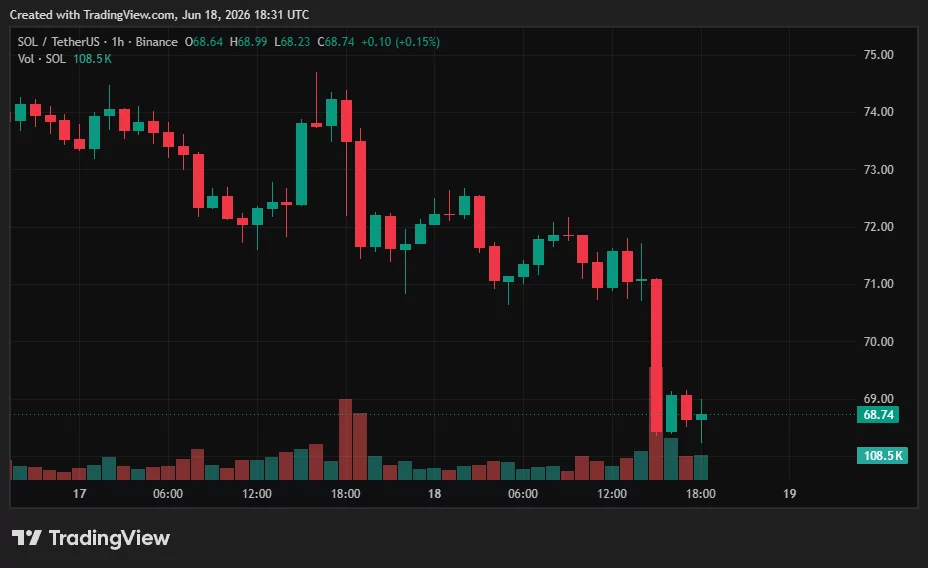
According to a previous crypto.news analysis, a break below the key $70 support level could shift attention back to the June low around $62 and increase the likelihood of a move toward the $60 region.
Elsewhere in the market, Bitcoin traded near $62,620 after falling more than 4%, adding to pressure across major altcoins and speculative digital assets.
Recent activity suggests Kraken continues to increase its presence across multiple parts of the crypto market.
In May, the exchange launched regulated margin trading services, while earlier this month it joined several industry organizations in urging the U.S. Senate to advance the CLARITY Act, legislation designed to establish a clearer regulatory framework for digital assets.


- Legacy Aztec Network contracts were drained of over $4M in three days.
- Attacks exploited flaws in zero-knowledge proof verification logic.
- The core Aztec network and AZTEC token were not affected by the exploits.
Aztec’s legacy infrastructure has come under a coordinated wave of attacks, leading to losses that crossed $4 million within just three days.
The exploits targeted deprecated smart contracts that had already been shut down years earlier but still held on-chain liquidity.
Despite being labelled as inactive and immutable, the contracts remained accessible to attackers who exploited weaknesses in zero-knowledge proof verification logic.
While the attacks did not affect the current Aztec network or its AZTEC token, they exposed long-standing risks tied to retired DeFi systems that continue to exist on Ethereum without active maintenance or upgrade paths.
First breach: Aztec Connect drained of $2.1 million
The first incident occurred on June 14, when attackers exploited the Aztec Connect protocol, a deprecated privacy-focused bridge that had been officially shut down after its retirement phase.
The contract was already considered inactive, yet it still contained residual funds.
The attacker managed to drain approximately $2.1 million in digital assets, including around 909 ETH, 270,000 DAI, and 167 wstETH, alongside other smaller holdings.
The exploit was linked to flaws in the way rollup proof verification was handled, allowing invalid or manipulated proofs to be accepted as legitimate.
What made the situation more critical was the nature of the contract itself.
Aztec Connect was described as immutable, meaning it could not be paused or patched once deployed.
Even though users had previously been encouraged to withdraw funds before shutdown, the remaining balance became an easy target for exploitation years later.
Security teams reviewing the incident pointed to a breakdown in the relationship between zero-knowledge proof validation and on-chain settlement logic.
In simple terms, the system accepted proofs that did not correctly match the underlying transaction state, allowing the attacker to trigger unauthorised withdrawals.
Second attack: Private Rollup Bridge exploited for $2.15 million
Just three days later, a second exploit hit another legacy system known as the Private Rollup Bridge.
This contract was also part of Aztec’s older infrastructure and had been deprecated following the transition away from earlier rollup designs.
In this case, attackers drained roughly 1,158 ETH, valued at close to $2.15 million at the time of the incident.
The method used was different in execution but similar in technical root cause.
Instead of directly manipulating withdrawals through basic proof mismatch, the attacker leveraged a vulnerable “escape hatch” mechanism embedded in the bridge design.
By submitting a specially crafted zero-knowledge proof, the attacker was able to trigger the contract’s exit logic.
The system incorrectly validated the proof and released funds without proper verification of the underlying state transitions.
This allowed the attacker to extract liquidity in a single coordinated sequence.
Like the earlier exploit, this breach did not involve private key compromise or reentrancy vulnerabilities.
Instead, it highlighted deeper issues in how proof validation was structured in legacy rollup systems, particularly when contracts remain permanently active on-chain after being officially sunset.
Response from Aztec and security firms
Following both incidents, Aztec Labs and the Aztec Foundation confirmed that the affected systems were deprecated products with no connection to the current Aztec network or AZTEC token ecosystem.
The Aztec Foundation was made aware of a potential exploit targeting a deprecated product which occurred on June 17, 2026. There are no links between this product and any smart contracts related to the current network or the AZTEC ERC20 token.
The product was deprecated 4 years… https://t.co/kANaIuw8HF
— Aztec Foundation (@aztecFND) June 18, 2026
They emphasised that neither contract could be upgraded, paused, or controlled, as both were designed to be immutable at deployment.
Security firm CertiK Alert also flagged the Private Rollup Bridge exploit, identifying the attacker’s address and confirming the movement of funds tied to a specific Ethereum transaction.
Their analysis aligned with other reviews, suggesting that the vulnerability stemmed from flaws in zero-knowledge proof verification rather than conventional smart contract bugs.
Aztec representatives also clarified that the Private Rollup Bridge and Aztec Connect incidents were separate events, even though they occurred within a short timeframe and shared similar technical weaknesses.
Crypto World
Bitcoin’s (BTC) nemesis, the Dollar Index (DXY), is on the verge of a major breakout: Daybook: Crypto Daily


Bitcoin and the Dollar Index (DXY) are moving in opposite directions, with the latter on the verge of a major move that may embolden crypto bears.
The largest cryptocurrency is under pressure for a third straight day, trading near $63,900 and down nearly 1% since midnight UTC. The broader market is mostly showing similar losses, with the exception of a few tokens such as HASH, XLM and ENA, which gained 7% or more.
The Dollar Index, which tracks the U.S. currency’s value against major fiat currencies, has gained 0.26% to 100.66, extending Wednesday’s 0.8% rise. What’s notable is that the index is now on the verge of firmly breaking out of a 13-month-long trading range.
This type of setup usually leads to more momentum chasing by traders, resulting in further gains. Strength in the greenback typically weighs on dollar-denominated assets such as bitcoin.
BTC has historically tended to move in the opposite direction to the dollar. Its 90-day correlation coefficient with the DXY was recently minus 0.82.
Crypto World
Mounting AI costs and weaker performance are driving investors toward AI infrastructure


The biggest winners from the rotation have been memory and semiconductor stocks. Memory-chip maker Sandisk (SNDK) has surged roughly 800% this year and the Global X Artificial Intelligence & Technology ETF, which focuses on memory-related companies (DRAM), is up about 140%. In microprocessors, Micron Technology (MU) has gained about 230% this year, and the VanEck Semiconductor ETF (SMH) 67%.
The investments highlight a growing preference for the companies supplying the infrastructure behind the AI boom rather than the hyperscalers funding it.
In addition, capital has been attracted SpaceX (SPCX), Elon Musk’s space exploration company that is also expanding into AI. Last week, the company raised $75 billion in the largest IPO in history.
While AI has become the market’s dominant investment theme, the cash required to feed the growth is rising even faster. Google parent Alphabet (GOOGL), Amazon, Microsoft and Meta are expected to spend a combined $725 billion on capital expenditures this year, a 77% increase from last year’s record level.
Free cash flow is no longer fully funding these ambitions. Alphabet, Amazon and Meta, collectively borrowed some $93 billion last year, accounting for roughly 6% of total corporate bond issuance.
Another source of support is also fading. Share repurchases have fallen 33% to $132 billion in 2025, reducing a key pillar of demand for these stocks.

After showing signs of recovery, Bitcoin (BTC) lost momentum and dipped below $64,000 earlier today before finding support there.
While short-term sentiment weakened, the largest BTC holders appeared unfazed, using the decline as a buying opportunity.
Whale Accumulation Returns
Bitcoin whales holding at least 1,000 BTC have increased their combined holdings to 7.17 million BTC, according to Santiment’s latest findings. This is the highest level recorded since March 14. These large holders now control 35.82% of Bitcoin’s available supply, while the number of wallets holding at least 1,000 BTC stands at 2,044.
Additionally, crypto analyst Darkfost revealed that addresses holding more than 1 BTC have increased their combined holdings to a new all-time high of over 16.8 million BTC. The total supply held by this group continues to rise.
Darkfost explained that this trend could be linked to Bitcoin’s gradual institutionalization, although he stressed that such a development should be viewed from a long-term perspective.
Retail investors are also showing signs of renewed accumulation, but at a slower pace. This group is currently estimated to hold around 1.7 million BTC, which remains below the peak recorded in December 2023. The analyst went on to add that some retail participants may have taken profits during previous rallies, while others could have shifted their exposure to Bitcoin exchange-traded funds, which are easier to manage.
Despite these differences, both large holders and retail investors appear to be increasingly viewing the current market environment as an opportunity to accumulate Bitcoin.
Fed Takes Center Stage
Markets reacted strongly after the latest FOMC meeting. Bitcoin dropped below its “liquidity defense line.” Bitunix analyst Dean Chen said these moves suggest that investors are adjusting portfolios for a longer period of high interest rates rather than expecting an economic slowdown or easier monetary conditions. In a statement to CryptoPotato, Chen said that Federal Reserve policy is becoming a bigger driver of crypto markets than Middle East developments.
The analyst also warned that tighter liquidity, a stronger dollar, and rising Treasury yields could increase pressure on risk assets in the months ahead.
“Now, Warsh has explicitly anchored policy priorities to inflation control and rebuilding Fed credibility, meaning liquidity expectations could continue to tighten in the coming months. If the dollar remains strong and Treasury yields continue to climb, capital will increasingly favor the greenback and fixed-income assets, leaving risk assets to face higher valuation pressures.”
The post Bitcoin Dips Below $64K Again: Here’s How Whales Reacted appeared first on CryptoPotato.
The OG meme coin has fared poorly over the past several months, dropping out of the elite top 10 crypto club.
While some market observers remain optimistic that a recovery could be on the way, recent whale behavior suggests that a deeper collapse is also plausible.
DOGE Whales ‘Paying Rent’
The popular analyst Ali Martinez revealed that 420 million coins have been distributed by such large investors over the past seven days. As of current rates, the USD equivalent of this stash is around $35 million, while whales now collectively own nearly 35 billion DOGE, 22.7% of the token’s circulating supply.
The development doesn’t guarantee that the meme coin’s price is headed for further decline, but it signals that these investors are preparing for such a scenario.
Some believe these market participants are experienced players who may have access to inside information, enabling them to position themselves effectively ahead of major moves. In any case, their actions are closely monitored by retail investors, who could follow suit, thereby intensifying the sell-off.
Others took a more humorous approach to explaining the recent behavior. X user Lynor, for instance, said that DOGE whales cashed out so they can “pay rent this week.”
Time to Rally?
Martinez has been quite vocal on DOGE lately, and his previous comments were quite optimistic. Earlier in June, he disclosed that the Tom DeMark Sequential indicator flashed a buy signal on the asset, suggesting a rebound could be on the way. It’s worth mentioning that this technical tool accurately predicted the meme coin’s pullback in early May, when the valuation dropped from $0.113 to $0.078.
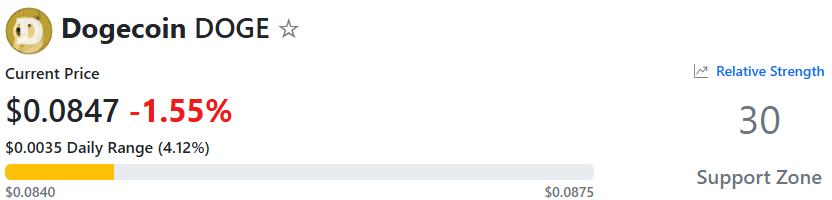
Later on, the analyst paid special attention to $0.081, classifying it as “the lower mid-range boundary” of a five-year parallel channel dating back to 2021. He argued that holding above that level could open the door for another “parabolic move.”
DOGE’s Relative Strength Index (RSI) supports the bullish scenario. The ratio has fallen to 30, meaning that the asset has entered oversold territory and could be due for a resurgence. The technical analysis tool ranges from 0 to 100, with anything above 70 considered a warning of a possible correction.
Last but not least, we will take a look at DOGE’s exchange netflow. Over the past several weeks, outflows have surpassed inflows, reflecting a growing investor preference for self-custody – a trend that naturally reduces immediate selling pressure.

The post 420,000,000 Dogecoin (DOGE) in 7 Days: Crash Signal or False Alarms? appeared first on CryptoPotato.


Blockchain infrastructure firm Alchemy said AI agents with its AgentCard now have access to the Visa (V) network with complete identity and payment capabilities, enabling them to make online purchases on behalf of consumers.
The integration allows AgentCard, a virtual ID and spending card for AI agents, to access Visa Intelligent Commerce to book a vacation, order groceries or renew a subscription, for example, without the consumer ever touching a checkout screen.
Agent-native payment protocols are in early adoption with firms like Stripe, Visa and Mastercard (MA) driving hard into this new area, known as agentic commerce. AgentCard works with agents built on models from any provider, including OpenAI or Anthropic.
“Every major computing shift has produced a new kind of economic actor,” Nikil Viswanathan, co-founder and CEO of Alchemy, said in a statement. “The internet created online businesses. Mobile created the app economy. AI agents are next, and they need to be able to access the global economy, and AgentCard is how that starts.”
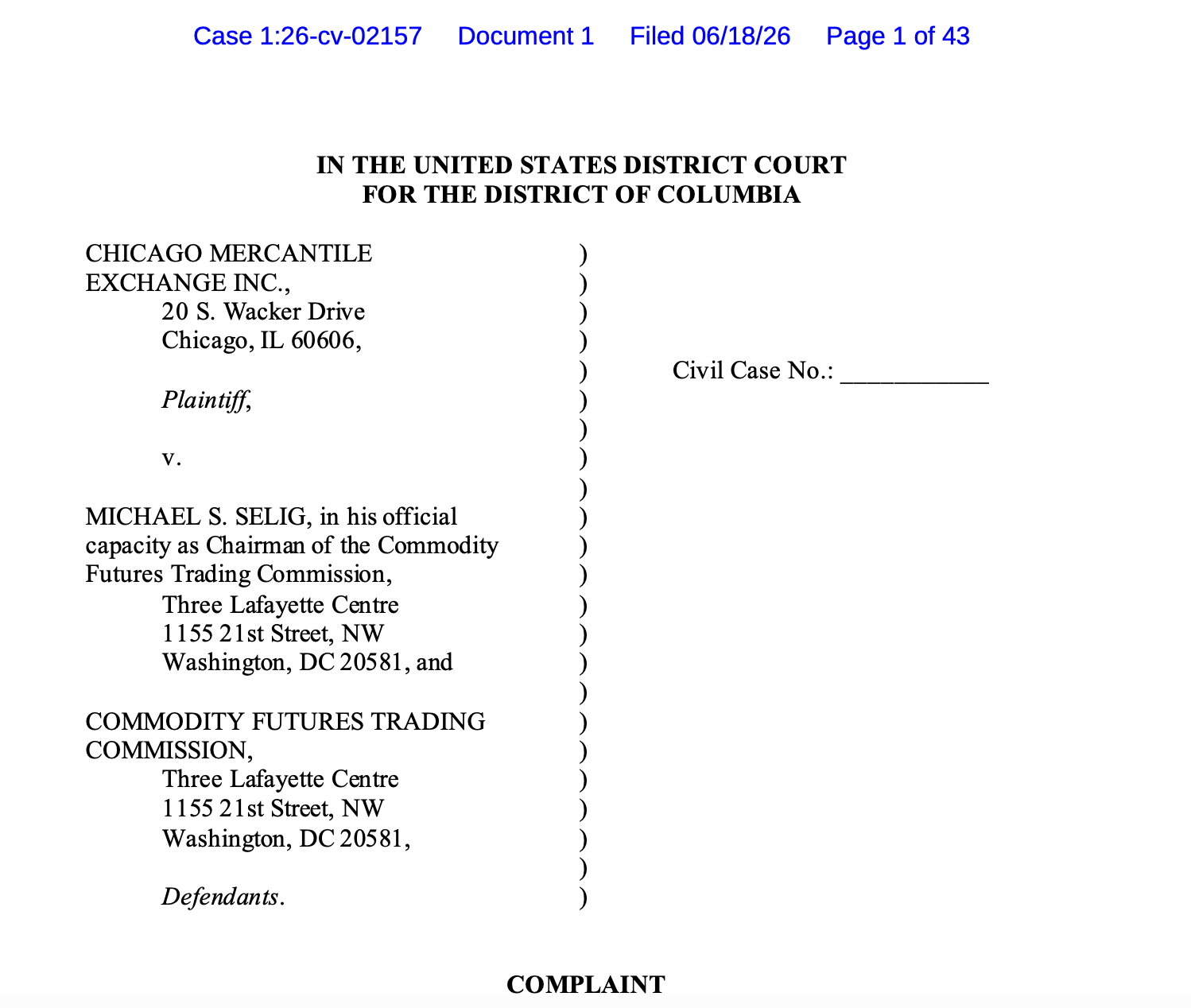
The Chicago Mercantile Exchange (CME) Group said it was taking legal action against the US Commodity Futures Trading Commission (CFTC) over cryptocurrency perpetual futures.
In a Thursday filing in the US District Court for the District of Columbia, CME filed a complaint against the CFTC and its chair Michael Selig over the agency’s regular approvals of perpetual futures tied to crypto. The lawsuit stemmed from a May 29 notice from the CFTC approving perpetual futures contracts tied to the spot price of Bitcoin (BTC) for prediction markets platform Kalshi and issuing a no-action position for similar products on cryptocurrency exchange Coinbase.
According to CME’s filing, the CFTC’s approval of such products went against directives from the US Congress by treating “futures” as “swaps” with expiration dates. The company alleged that the agency was in violation of the Commodity Exchange Act and a court should vacate its actions over perpetual futures, noting that Selig had unilaterally acted without a full panel of five CFTC commissioners.
“With one stroke of his pen, [Selig] overrode Congress’s definition of the term ‘swap’ and circumvented the regulatory regime Congress required for that form of derivative,” said the complaint, adding:
“The CFTC’s failure to evenhandedly, consistently, and correctly apply the CEA risks harming competition and destabilizing derivatives markets.”
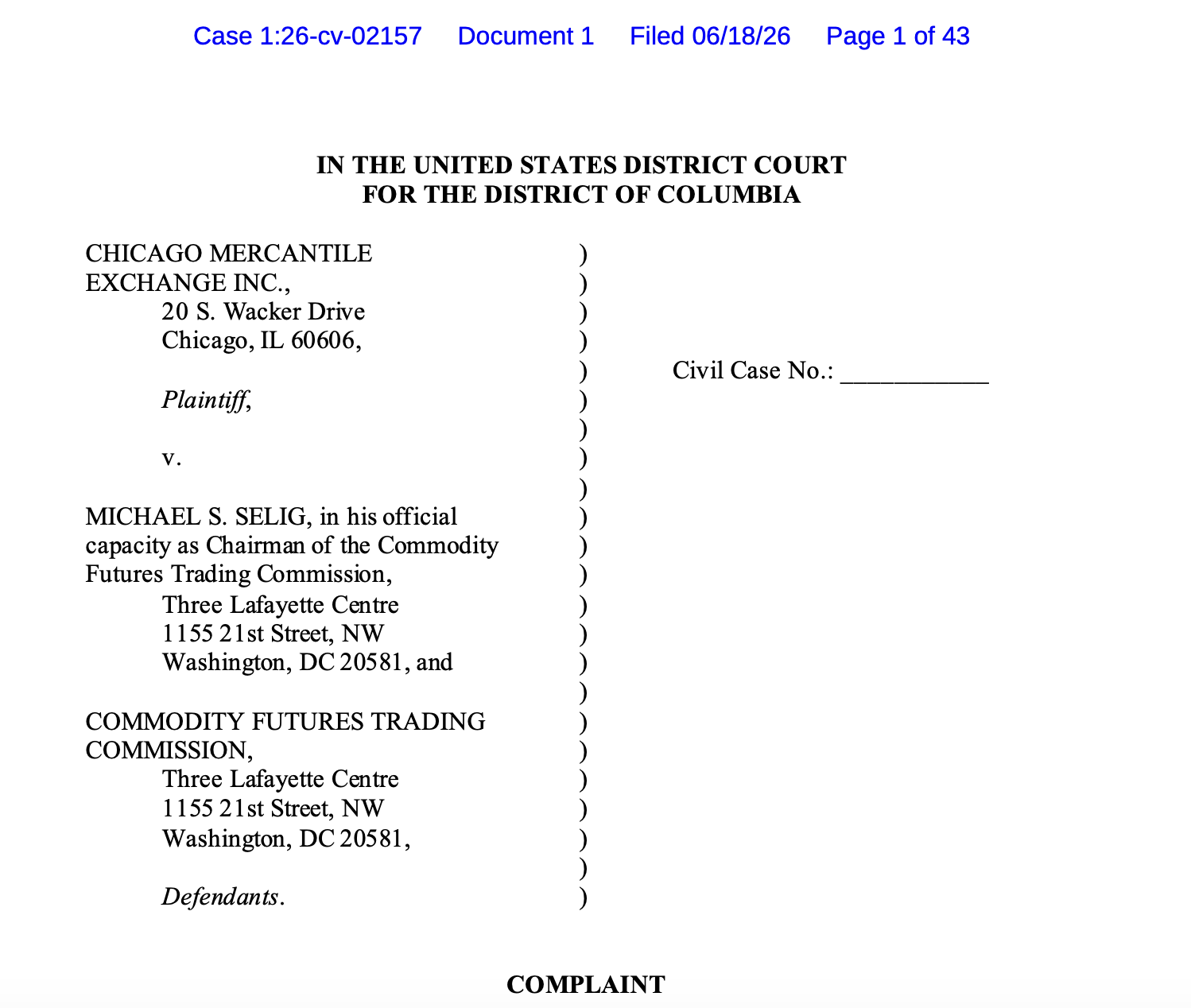
Source: PACER
The lawsuit came just one day after CME CEO Terrence Duffy said that the company would be taking legal action against the CFTC. In a Monday CNBC interview, Selig said that perpetual futures contracts “trade very similarly” to others, describing the CFTC’s position as “good for investors” and claiming that the Commodity Exchange Act “does not define the term ‘futures contract.’”
A CFTC spokesperson told Cointelegraph that CME had engaged in “lawfare” against the agency and the administration’s crypto policies, calling the complaint “frivolous.”
Related: ICE, CME press US regulators to ‘rein in’ Hyperliquid energy trading: Report
Kraken also announced the launch of perpetual futures trading for US users through CFTC-regulated platform Bitnomial.
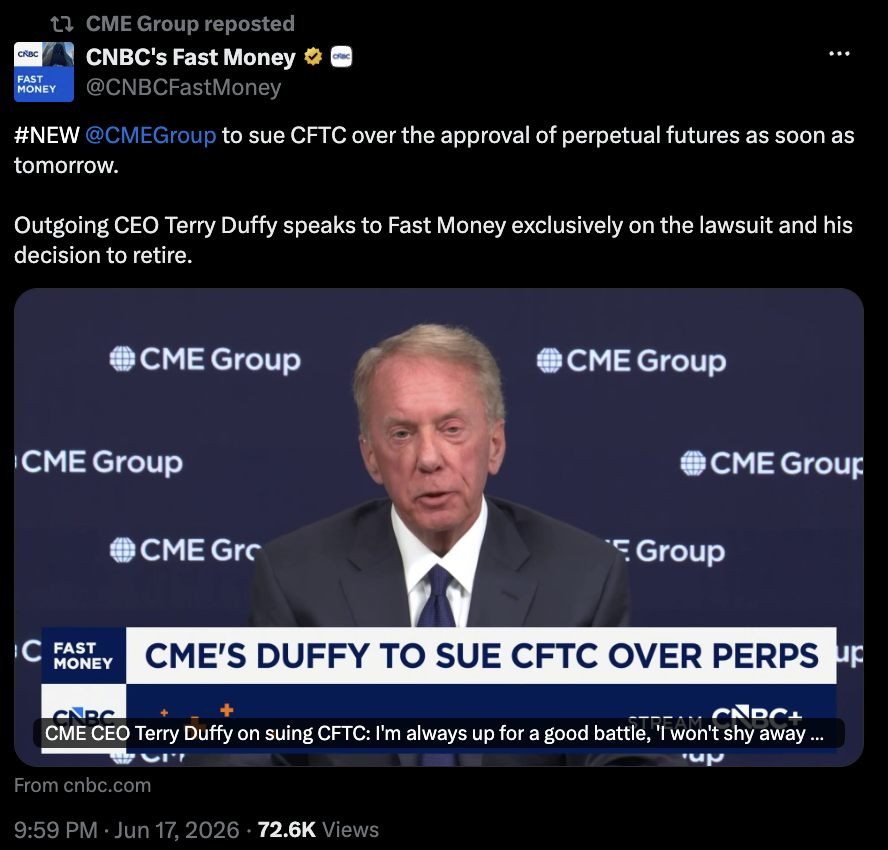
CME CEO Terry Duffy. Source: CNBC Fast Money
Selig acts alone on prediction markets, perpetual futures, CFTC agenda
Confirmed by the US Senate in December 2025, Selig remains the chair and sole commissioner at the CFTC in a leadership panel intended to consist of a bipartisan group of five people. As of Thursday, US President Donald Trump had not announced any nominations to fill the seats, despite urging from many members of Congress to do so.
Magazine: OpenAI files for IPO, SEC scraps 611 rule and Hungary overhauls crypto: Hodlers Digest June 7-13

Brooklyn Beckham’s World Cup Ad ‘Stuns’ Family

Errol Spence rates Floyd Mayweather’s chances of beating Pacquiao in rematch at 49 years old

Inside SURBL, the email blacklist that checks your links, not your IP


-

 Business4 days ago
No Jackpot Winner as $257 Million Prize Rolls Over to $269 Million Monday Draw
-

 Fashion6 days ago
Weekend Open Thread: Tuckernuck – Corporette.com
-
 Crypto World4 days ago
Zimbabwe Requires Crypto Businesses to Register Annually Under New FIU Regulations
-

 Crypto World6 days ago
Bitget enters Argentina’s regulated crypto market through PSAV registration
-

 Tech6 days ago
NanoClaw integrates JFrog registries to secure AI agent downloads
-

 Tech6 days ago
This Week In Security: Microsoft On Microsoft, Register Your Domains, Linux On ARM, And FreeBSD Joins The File Cache Club
-

 NewsBeat7 days ago
El Nino has formed in the Pacific and could set records, forecasters say
-

 NewsBeat6 days ago
FBI searches office of Ohio voter registration group
-
 Tech7 days ago
Anthropic is spending $150M to embed 1,000 AI fellows inside nonprofits. No degree required.
-
 Entertainment7 days ago
‘The Pitt’s Fan-Favorite Doctor Confirms Noah Wyle Gave His Blessing to Return [Exclusive]
-

 Tech7 days ago
Former AWS CEO Adam Selipsky to lead new $10B AI data center venture
-
 Crypto World7 days ago
Ripple and Bitso Bring MXNB Stablecoin to XRP Ledger
-
 Entertainment4 days ago
Matt Damon’s Viral Sci-Fi Thriller Has Taken Over HBO Max
-

 Business4 days ago
Anthropic staff to meet White House officials next week, Axios reports
-

 Tech4 days ago
As AI companies race to go public, who else is along for the ride?
-

 Business7 days ago
Justin Bieber Prepares for 2026 Tour Return with New Music and Promoter Talks
-
 Crypto World4 days ago
Bitcoin could crash to $48,000, if this historical pattern is triggered
-

 Politics4 days ago
“Israel’s” ban on ICRC visits ruled illegal, but Knesset moves to stop them permanently
-
 Tech7 days ago
Euro-Office 1.0 Arrives To Open-Source Infighting: ‘Compatibility Is Not Sovereignty’
-
Entertainment7 days ago
Ana Navarro unleashes explosive tirade on ex-Trump aide, Disney Channel star in epic on-air fight: 'Have you no shame?'
You must be logged in to post a comment Login