
Crypto World
BNB Price Prediction Steady at $634 After Osaka Hard Fork Sets April 28 Deadline. Where Does Pepeto Fit?

The BNB price prediction gained fresh momentum on April 22 after Yahoo Finance reported BNB Chain’s sector adding 3.8% to its market cap in a single week, with BNB climbing 4.2% to $634. Node operators must upgrade before the Osaka and Mendel hard fork on April 28, a move that positions BNB Chain as the fastest EVM-compatible network in 2026.
An $86 billion cap keeps the math clear. BNB at $634 needs $1,375 to reclaim its October 2025 all-time high, a 114% run. Wallets tracking the BNB price prediction are also watching Pepeto cross $9.45 million raised, with a Binance listing confirmed and a presale entry still open at $0.0000001866.
BNB Chain Hard Fork Targets April 28 as Network Speed and Stablecoin Volume Keep Rising
BNB Chain announced the Osaka and Mendel hard fork for April 28, requiring node operators to upgrade before the cutoff per Yahoo Finance. The upgrade builds on January’s Fermi release that pushed block time to 0.45 seconds. BNB Chain handles around 40% of all stablecoin transfers on any network.
Bitcoin reclaimed $78,000 this week and the CMC Fear and Greed Index hit 63 for the first time in six months. BNB held firm, adding 4.2% while altcoins followed. But an $86 billion cap limits the returns that change portfolios. Pepeto at presale pricing offers the early exchange-token math that BNB carried at $0.15 in 2017.
BNB Price Prediction Compared: BNB, Solana, and the Presale Opportunity Pepeto
Pepeto: The Exchange Token Loading Live Tools Ahead of Binance Listing
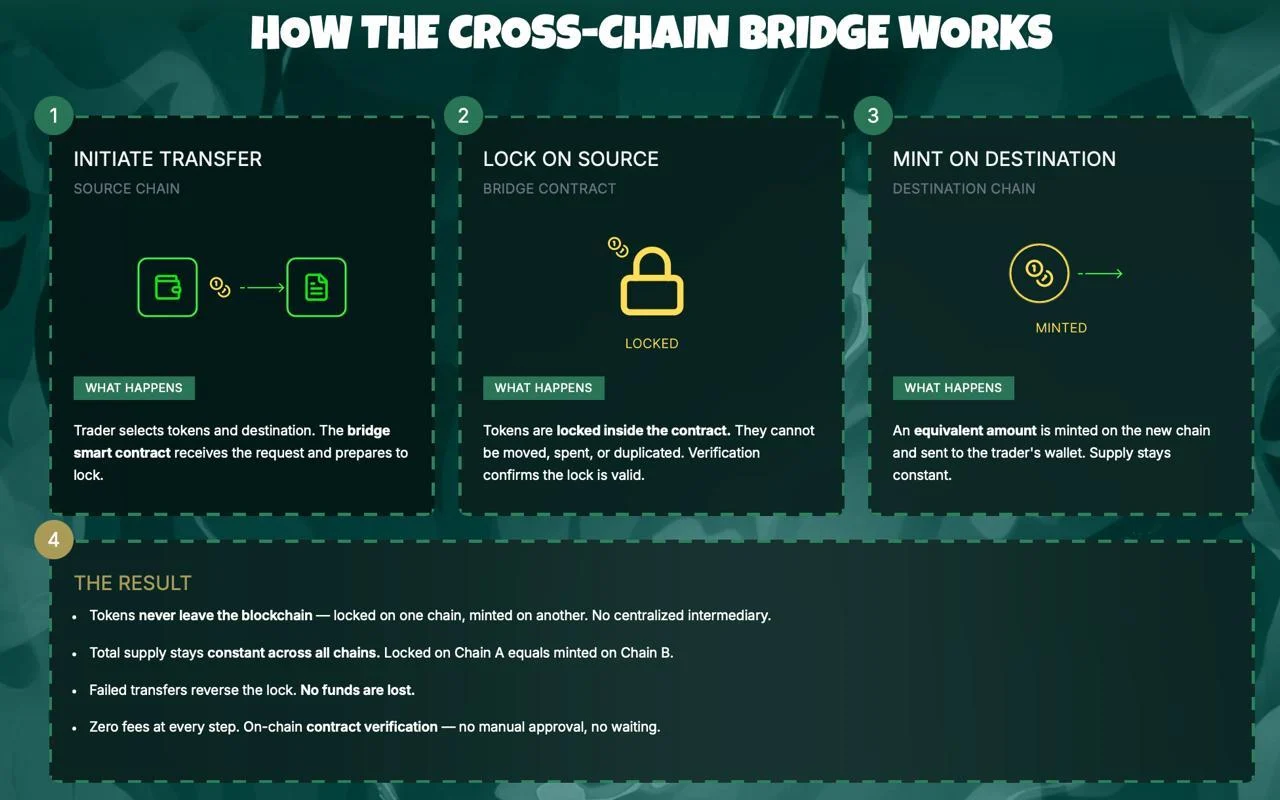
Pepeto runs a working zero-fee exchange connecting Ethereum, BNB Chain, and Solana, removing gas costs and failed fills that drain DeFi wallets daily. A cross-chain bridge shifts assets without charging fees, and a live AI scanner flags risky contracts before a wallet signs. The Pepe cofounder who built a project to a $7 billion cap leads this team, a former Binance executive manages delivery, and SolidProof cleared every contract line.
Each trade, bridge transfer, and scan routes value through the Pepeto token, creating the same token-level demand engine that took BNB from $0.15 at ICO to $634. Over $9.45 million is in at $0.0000001866, staking runs at 178% APY, and the Binance listing sits directly ahead.
A $2,000 entry at $0.0000001866 buys over 10.7 billion Pepeto tokens. Analyst desks project 100x once the first exchange trade prints, turning $2,000 into $200,000 the moment listing volume confirms the target.
The math is simple and the window is short. Every presale stage that closes pushes the price higher, and the day Binance opens the order book, no wallet on earth can buy at this level again. BNB proved what exchange tokens do when the product works. Pepeto follows that path at a lower starting price than BNB ever carried.
BNB Price at $634 as Osaka Hard Fork Deadline Hits April 28
BNB (BNB) trades at $634 per CoinMarketCap, down 1.4% on the day with support holding at $615 and resistance at $650.
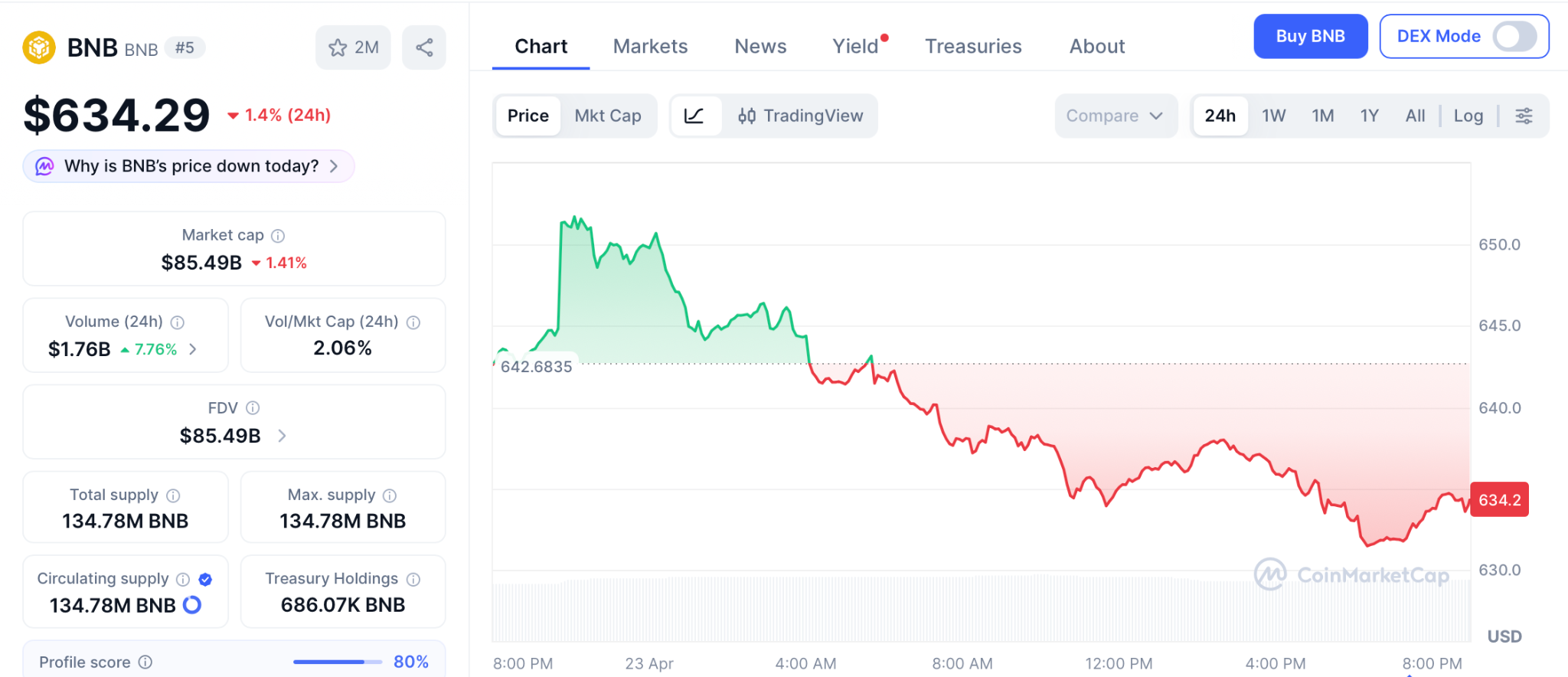
MEXC analysts target $665 by late April if the hard fork lands clean, and Binance user consensus points to $803 for 2026. The October 2025 all-time high of $1,375 sits 114% above the current price, solid for a large cap but far from the multiple that presale entries deliver at listing.
Solana (SOL) Price at $85 as Daily Users Hold Above 6 Million
Solana (SOL) sits at $85 per Coinbase, holding steady as daily active addresses stay above 6.3 million. Standard Chartered keeps $250 as its 2026 target, roughly 2.9x from current levels. Putting $1,000 into Solana at $85 buys 11 tokens, while $1,000 into Pepeto at $0.0000001866 secures over five billion tokens before listing day.
Conclusion:
The BNB price prediction keeps $800 and beyond on the table for 2026, and the Osaka hard fork on April 28 sets the next technical step. But 114% to ATH from an $86 billion cap is a different trade than catching an exchange token at presale before its first listing.
Pepeto sits at $0.0000001866 with $9.45 million raised, 178% APY staking live, and a confirmed Binance listing weeks away. One wallet that put $500 into BNB at $0.15 in 2017 held over $2 million by the 2025 high. Pepeto carries the same structure at a lower entry. The presale closes, the listing opens, and $2,000 today turns into $200,000 the moment the 100x target lands. Visiting Pepeto official website before the ticker goes live is how those positions are built.
Click To Visit Pepeto Website

FAQs
What is the BNB price prediction after the Osaka hard fork on April 28?
The BNB price prediction targets $665 to $803 for 2026 as the Osaka hard fork cuts block time and BNB holds $634 with support at $615. The October 2025 all-time high of $1,375 sits 114% above current levels.
Why is Pepeto drawing attention alongside BNB in April 2026?
Pepeto is drawing attention because it pairs a working zero-fee exchange with presale pricing at $0.0000001866 and 178% APY staking, giving buyers 100x potential before the confirmed Binance listing opens.
Disclaimer: This is a Press Release provided by a third party who is responsible for the content. Please conduct your own research before taking any action based on the content.



TLDR:
- Ripple says custody now anchors payments, staking, tokenization, and treasury operations for banks
- Kyobo Life became Korea’s first major insurer exploring blockchain custody with Ripple infrastructure
- Chainalysis and Securosys integrations strengthen compliance checks and enterprise-grade key security
- Figment partnership lets institutions offer ETH and SOL staking inside custody workflows safely
Ripple is expanding its digital asset custody business as regulated financial institutions push deeper into blockchain-based operations.
The company said custody now sits at the center of payments, tokenization, staking, and treasury management for banks entering digital assets.
Recent partnerships and integrations show Ripple is focusing on compliance, security, and faster institutional onboarding. The move comes as more banks and insurers shift from pilot programs to production-level digital asset platforms.
Ripple Digital Asset Custody Expands Across Banking and Insurance
Ripple said digital asset adoption is moving beyond early testing in Europe, the UAE, and Asia. Stablecoins are now entering treasury operations, while tokenized real-world assets continue gaining regulatory support.
The company argues custody has become the governance layer for these services. Without secure custody, compliance gaps and operational risks can slow institutional adoption.
Since late 2025, Ripple has expanded Ripple Custody across several core areas. These include wallet infrastructure, transaction compliance, enterprise security, and institutional staking.
Its acquisition of Palisade added wallet infrastructure and scalable transaction signing. Ripple also integrated Chainalysis tools for real-time transaction screening and policy enforcement.
The Securosys integration introduced cloud-based hardware security module support. At the same time, Ripple partnered with Figment to add institutional staking for Proof-of-Stake networks.
Ripple also announced a partnership with Kyobo Life Insurance in South Korea. According to Ripple, the insurer will explore blockchain-based custody and on-chain settlement infrastructure.
Kyobo is one of Korea’s largest insurers and the first major insurance firm there to take this step. Ripple said this reflects broader institutional movement into digital asset operations.
Ripple Custody Adds Staking and Cloud HSM Security Tools
Ripple said institutions want custody platforms that fit into existing banking systems without major operational changes. The company is pushing an API-first structure designed for banks, custodians, and regulated enterprises.
It said clients want fewer vendors and faster deployment. This reduces delays and lowers infrastructure costs for digital asset operations.
Ripple listed partners including BBVA, DBS Bank, DZ Bank, and Intesa Sanpaolo. The company said these institutions use Ripple Custody for digital asset management and related services.
In Europe, Intesa Sanpaolo is using Ripple Custody for its digital asset initiatives. This reflects growing demand from major banks for compliant crypto infrastructure.
Through Securosys, Ripple now offers CyberVault HSM and Cloud HSM integrations. These tools allow institutions to manage cryptographic keys without large hardware deployments.
Ripple said this helps banks meet security requirements while reducing onboarding time. It also supports compliance across different regulatory jurisdictions.
The Figment partnership adds staking for Ethereum and Solana directly inside custody workflows. Ripple said institutions can offer staking without building their own validator systems.
This allows staking to remain under existing governance and compliance controls. Ripple sees this as a key step for institutions expanding digital asset services.


Cryptocurrency markets remained on the back foot Friday as macroeconomic signals from Japan, one of the world’s largest economies, compounded uncertainty driven by the Iran war.
Bitcoin hovered near $77,800, having struggled to break above the Thursday high of $78,700 during the early Asian trading hours, according to CoinDesk data. The broader uptrend, which began in late March near the $65,000 mark, appears to have stalled since Wednesday.
Ether (ETH), the second-largest cryptocurrency by market capitalization, traded around $2,300, slipping 0.8% since midnight UTC and underperforming bitcoin’s relatively modest 0.6% decline.
The cautious tone in crypto markets coincided with fresh inflation data out of Japan. The country’s Corporate Service Price Index (CSPI) rose 3.1% year-on-year in March, exceeding forecasts of 3.0% and underscoring persistent price pressures in the services sector.
Additional government data showed core inflation rising to 1.8% in March from 1.6% in February, marking the first acceleration in five months. Headline inflation edged up to 1.5% from 1.3%, though it remained below the Bank of Japan’s 2% target for a second consecutive month. Meanwhile, core-core inflation, which excludes both fresh food and energy, eased to 2.4%, its lowest level since October 2024.
The uptick in headline inflation aligns with rising energy costs linked to geopolitical tensions, particularly disruptions to oil shipments through the Strait of Hormuz amid the ongoing Iran conflict.
apan, a major crude importer, remains especially vulnerable to such price shocks. WTI crude futures have risen over 40% to $96 since the onset of the Iran war in late February.
Market participants are now turning their attention to the Bank of Japan’s upcoming policy meeting. Analysts at InvestingLive suggest a shift in tone may be imminent.
“The Bank of Japan looks set to hold fire next week but deliver a pointed warning that rates are heading higher, with June firmly in play as war-driven inflation risks build,” analysts said.
Hints of tighter monetary policy and potential rate hikes could lift the Japanese yen (JPY) and influence global market sentiment. It’s especially plausible now, given that speculative positioning in the yen is currently bearish, according to the latest CFTC data. As a result, there is room for a sharp bullish reaction in the yen if the Bank of Japan turns hawkish.
As for the broader market impact, a stronger yen may not be favorable. Historically, the yen has been used to fund purchases of risk assets worldwide. A sudden appreciation in the currency could therefore trigger an unwinding of those trades, leading to increased risk aversion.
Speaking of the Iran war, Iran has deployed additional naval mines in the Strait of Hormuz this week, according to Axios. Shipping traffic through the Hormuz, which
accounts for 20% of the world’s seaborne oil, fallen sharply since the conflict intensified.
The Pentagon warned lawmakers that it would take at least six months to clear mines in the Strait, with the process only beginning after the war ends. It also cautioned that inflation in the U.S. could remain elevated this year, potentially making it harder for the Fed to cut rates.
The FTX bankruptcy estate sold a 5% stake in Cursor for $200,000 in April 2023.
Summary
- FTX estate sold its 5% Cursor stake for $200K during bankruptcy asset liquidation in 2023.
- Cursor’s $60B SpaceX-linked valuation now puts the former FTX stake near $3B in value.
- The sale has renewed scrutiny over FTX estate asset sales and missed upside from early exits.
The sale matched the original amount Alameda Research invested in Anysphere, the company behind Cursor, in April 2022.
The stake has drawn fresh attention after Cursor’s reported valuation rose sharply. SpaceX said it secured the right to acquire Cursor later this year at a $60 billion valuation.
At a $60 billion valuation, the former FTX-linked stake would be worth about $3 billion. That marks a large difference from the $200,000 sale price recorded during bankruptcy asset liquidation.
The new valuation came after SpaceX secured acquisition rights tied to Cursor. SpaceX could also pay a $10 billion breakup fee if the transaction does not move forward.
Bankruptcy sales face renewed review
The Cursor sale has added to questions over how the FTX estate handled early asset sales. The estate moved to liquidate assets after FTX collapsed and Alameda entered bankruptcy.
Sam Bankman-Fried has criticized the bankruptcy process from prison. Earlier this year, he wrote, “FTX was never bankrupt. I never filed for it.” He also claimed, “The lawyers took over the company and 4 hours later, they filed a bogus bankruptcy so they could pilfer it for money.”
FTX creditors have since received repayments in dollar terms under the restructuring plan. The repayments included claim values plus interest, though some former users have argued they missed gains from crypto and venture assets.
Bull Theory estimates wider missed value
Financial research platform Bull Theory estimated that assets sold early by the FTX estate could now be worth about $114 billion if held through recent market cycles. The analysis listed Anthropic, SpaceX, Solana, Robinhood, Genesis Digital, and Cursor among the missed gains.
Bull Theory wrote, “SBF was a genius at picking generational winners and a criminal at managing their money.” The platform also noted that the estate recovered about $18 billion for users.
Bankman-Fried is serving a 25-year federal sentence after his conviction on fraud and conspiracy charges. Prosecutors said he misused billions of dollars in customer funds from FTX through Alameda Research, investments, political donations, and personal spending.

Bitcoin reached multi-month highs at $79,000 as bulls regained control and exchange reserves tightened, signaling buyers returning and reduced sell pressure.


OKX has added BitGo’s Off-Exchange Settlement platform for institutional clients in the United States. The integration allows firms to trade on OKX while holding their assets in BitGo’s cold custody.
Summary
- OKX added BitGo’s OES platform to support US institutional trading with third-party custody controls.
- The setup lets clients trade on OKX while assets remain secured in BitGo cold custody.
- The move follows ICE’s investment in OKX and its renewed push into the US market.
The move is designed to reduce the need for clients to pre-fund exchange accounts before trading. It also gives institutions a way to keep assets with a third-party custodian while accessing liquidity on OKX.
OKX said the setup supports capital efficiency for professional traders and firms. Under the arrangement, BitGo serves as the custodian and settlement provider for trades executed on the exchange.
Exchange targets institutional growth in the US
The BitGo integration comes as OKX continues to build its US business. The exchange reentered the US market in April 2025 and appointed former Barclays director Roshan Robert as its US CEO. Robert said institutional investors need both asset protection and trading access.
“Institutional capital entering crypto requires capital to be protected and to be put to work,” he stated. “Our proprietary custody infrastructure has been proven at scale, and our partnership with BitGo gives clients flexibility in how they protect assets while freeing capital to work harder.”
The comments point to OKX’s effort to serve firms that want custody options outside the exchange.
ICE investment shapes OKX’s US plan
OKX’s latest step follows an investment by Intercontinental Exchange in early March. The investment valued OKX at $25 billion and gave ICE executives a board seat at the crypto exchange.
OKX Global CEO Star Xu said at the time that the partnership would help shape the company’s US strategy. He also described the exchange’s local presence as a “blank sheet of paper.” Xu said custody remains a core part of OKX’s business.
“At the same time, we’ve expanded our custody partnerships with trusted leaders like BitGo to give clients greater flexibility and choice in how they secure their assets,” he stated.
Moreover, BitGo has offered off-exchange settlement services for several years. The platform supports settlement for digital asset trades made on third-party exchanges while assets remain under BitGo custody.
However, BitGo has also disclosed risks tied to the service. In its January IPO filing, the company cited operational, regulatory, and counterparty risks.
“Operational risks associated with our OES services include potential errors in processing trade data, delays or failures in asset transfers, employee or insider misconduct, cybersecurity incidents, technological disruptions and reconciliation errors,” BitGo said.
Crypto World
Eric Trump, Michael Saylor, and Anatoly Yakovenko headline Consensus Miami 2026 as crypto's biggest stage returns

The industry’s premier festival will host 20,000 attendees, merging heavy-hitting traditional finance integration with unmatched Miami nightlife.

MetaMask co-founder Dan Finlay is stepping down from ConsenSys citing burnout, as long-time crypto figures such as Bitcoin advocate Preston Pysh also pull back from public roles.
Crypto World
Wisconsin joins prediction market fight, suing Kalshi, Coinbase, Polymarket, Robinhood and Crypto.com


Prediction markets have a consistent line: their products are financial instruments, not bets. Wisconsin isn’t buying it, and in a new complaint targeting Kalshi, Coinbase, Polymarket, Robinhood and Crypto.com, the state is citing the companies’ own marketing to call them unlicensed gambling venues.
“Thinly disguising unlawful conduct doesn’t make it lawful,” Attorney General Josh Kaul said in a press release announcing the complaints on Thursday.
The question underneath the lawsuits is straightforward: are these contracts financial instruments under the Commodity Futures Trading Commission (CFTC), or bets under state gambling law? The answer determines whether a fast-growing market operates under a single federal rulebook or is carved up across 50 states under the jurisdiction of local gaming regulators. And it’s almost certainly headed to the Supreme Court.
Wisconsin’s complaints, filed in Dane County, target three parallel ecosystems.
One names Crypto.com and its derivatives arm. Another goes after Polymarket and affiliated entities. A third pulls in Kalshi alongside distribution partners Robinhood and Coinbase (both Robinhood and Coinbase route prediction market orders to Kalshi), arguing the platforms together facilitate sports betting for state residents.
Across all three, the legal theory is that so-called “event contracts” are wagers: users pay money to take a position on a real-world outcome and receive a fixed payout if they are correct.
In one example cited in the filings, traders could buy contracts tied to NCAA tournament games at prices that reflect implied probabilities, with winning positions paying out $1 and losing ones returning nothing.
State prosecutors also cite Kalshi’s own Instagram ads, which claim the platform is “The First Nationwide Legal Sports Betting Platform,” and Polymarket’s, which calls itself “a platform where people can bet on the outcome of future events.”
The state argued that the structure of prediction markets falls squarely within its statutory definition of a bet, regardless of how the products are labeled or who takes the other side of the trade.
The complaints also emphasize that platforms generate revenue by charging transaction fees on each contract, likening the model to a casino taking a cut of wagers placed on its floor.
Setting up a federalism fight
The industry’s defense rests on federal preemption. Kalshi, in particular, has argued that its contracts are swaps listed on a regulated exchange and therefore fall under the CFTC’s exclusive jurisdiction.
That position received a boost earlier this month when the Third Circuit sided with the company, treating the regulator’s decision not to block the contracts as effectively settling the jurisdictional question.
Across the U.S., state courts are consistent in taking a different position.
Nevada called the contracts “indistinguishable” from gambling. New York AG Letitia James said “each contract is a bet.”.
For now, Wisconsin’s suits add to a growing list of state challenges, each building a record that could ultimately force the Supreme Court of the United States to decide whether calling something a financial contract is enough to keep it from being treated as a bet.


Lido says only about 9% of EarnETH’s TVL is tied to hacked rsETH, roughly $70M has been recovered, and a $3M DAO first‑loss buffer stands between users and any final hit.
Summary
- Lido says roughly 9% of its EarnETH vault’s TVL is exposed to hacked rsETH, but its core staking protocol remains unaffected.
- Around $70 million in ETH has been recovered so far, and a $3 million DAO-funded first-loss buffer is available if users ultimately face losses.
- Other Earn vaults are operating normally, though one sub‑vault is under pressure from circular staking strategies and higher lending rates.
Lido has outlined the fallout from the KelpDAO rsETH exploit, stressing that the incident is contained to its leveraged Earn vaults and that its flagship staking products stETH and wstETH “remain unaffected” and “safe and stable.” The Kelp cross‑chain bridge hack on April 18 drained about 116,500 rsETH — roughly $292 million — and forced multiple DeFi protocols to freeze rsETH markets, including Lido’s EarnETH product.
According to Lido, only the EarnETH vault has direct rsETH exposure, representing around 9% of its total value locked — approximately $21.6 million via a leveraged rsETH/ETH position on Aave. Deposits and withdrawals for EarnETH have been paused by the vault’s managers while they work with Kelp, LayerZero, and lending protocols to determine how any losses or bad debt will be allocated.
9% rsETH hit, $70M recovered, first-loss buffer
The team said that about $70 million worth of ETH linked to the broader exploit has already been recovered, with additional asset recovery and loss-distribution talks still in progress. In parallel, EarnETH managers have “reduced leverage and optimized the position structure,” significantly cutting the vault’s wETH debt exposure to ease liquidity pressure in stressed lending markets.
If there is a residual loss once recovery efforts are complete, EarnETH can tap a $3 million “first-loss protection mechanism” funded by the Lido DAO treasury. That buffer, part of a $5 million DAO allocation approved in March, is designed so that DAO-owned vault shares absorb losses before they hit other depositors, effectively putting LDO governance capital in front of users in a downside scenario.
Other vaults steady, GGV under pressure
Lido added that its DVV and EarnUSD vaults are not exposed to rsETH and continue to operate normally. A GGV sub‑vault, however, is currently showing negative returns because it combined circular staking strategies with rising on‑chain lending rates, a mix that has become more expensive and less sustainable in the current environment.
Managers say they are actively rebalancing GGV’s positions and adjusting strategy parameters, while withdrawal requests across the Earn suite will be processed using valuations from before the Kelp incident to keep treatment consistent during the review period. Lido reiterated that the rsETH issue “does not involve the Lido staking protocol itself,” underscoring the separation between its experimental Earn products and the core liquid staking infrastructure that underpins stETH and wstETH across DeFi.

US prosecutors alleged that Gannon Ken Van Dyke asked Polymarket to delete his account after profiting from trades tied to the military operation in Venezuela.

Virginia Tech AD Whit Babcock moving into new role

This AI bot does the mindless internet scrolling for you so you can skip the brainrot

A Day in the Life of a Financial Advisor | Indeed

Manchester United reach agreement with Casemiro over contract clause amid transfer speculation

US brings back mandatory military draft registration

Steven Gerrard disagrees with Gary Neville over ‘shock’ Chelsea and Arsenal claim | Football


-

 Sports7 days ago
NWFL Suspends Two Players Over Post-Match Clash in Ado-Ekiti
-

 Fashion6 days ago
Weekend Open Thread: Theodora Dress
-

 Politics6 days ago
Palestine barred from entering Canada for FIFA Congress
-
Entertainment4 days ago
NBA Analyst Charles Barkley Chimes in on Ice Spice McDonald’s Fiasco
-

 Tech5 days ago
Auto Enthusiast Scores Running Tesla Model 3 for Two Grand and Turns It Into Bare-Bones Go-Kart
-

 Business5 days ago
Powerball Result April 18, 2026: No Jackpot Winner in Powerball Draw: $75 Million Rolls Over
-

 Politics5 days ago
Zack Polanski demands ‘council homes not luxury flats for foreign investors’
-

 Crypto World6 days ago
Russia Pushes Bill to Criminalize Unregistered Crypto Services
-

 Politics3 days ago
Gary Stevenson delivers timely reminder to register to vote as deadline TODAY
-

 Business2 days ago
Rolls-Royce Voted UK’s Most Iconic Trade Mark as IPO Register Hits 150
-

 Politics1 day ago
Disabled people challenge government SEND proposals over segregation concerns
-

 Politics1 day ago
Making troops accountable for war crimes threatens US alliance, ex-SAS colonel warns
-

 Crypto World6 days ago
Russia Introduces Bill To Criminalize Unregistered Crypto Services
-

 Politics2 days ago
Starmer handler McSweeney to be dragged from shadows by Foreign Affairs Committee
-
Politics2 days ago
Wings Over Scotland | How To Get Away With Crimes
-

 Politics1 day ago
Zack Polanski responds to home secretary’s taser threat
-
Crypto World5 days ago
Kelp DAO rsETH Bridge Hack Drains $292M as DeFi Losses Top $600M in Two Weeks
-

 Politics1 day ago
‘Iran is still a nuclear threat’
-

 Crypto World2 days ago
New York sues Coinbase, Gemini over prediction market offerings
-
 Sports7 days ago
Kevin Kisner apologizes for Masters criticism: ‘I crossed the line’
You must be logged in to post a comment Login