

Crypto World
BP Rockets Nearly 90% as Backpack Unveils Traditional and Tokenized Stock Trading


BP has seen an impressive spike in its value within the last 24 hours after Backpack launched a new securities trading platform that supports both tokenized and traditional stock trading. Data posted by CoinGecko indicated the coin gained 89.2% over the last 24 hours.
Key Takeaways
- BP rose by 89.2% in just one day after the launch of Backpack’s securities trading platform
- CoinGecko says the cause for this price movement was the merging of stock trading in both tokenized and traditional forms
- The price managed to reach around $0.28 from $0.15 earlier in the day
CoinGecko Post Draws Attention to BP Rally
CoinGecko said that BP increased by 89.2% following the launch of a securities exchange by Backpack which was meant to cater to both traditional and tokenized stock trading. This post received significant attention from cryptocurrency traders given the token’s strong intraday performance.
From the chart on CoinGecko, BP traded near $0.15 before starting an upward trend and moved to about $0.28, representing one of the biggest gains for the token in recent times.
There were several instances when the token consolidated before the final breakout. Throughout the trading session, buyers appeared to push prices higher.
Backpack Expands Into Securities Trading
The recently introduced platform by Backpack aims to integrate traditional financial assets with blockchain-based tokenized stocks. The product places the company among firms attempting to link traditional markets with digital-asset infrastructure.
Tokenized stocks have drawn growing interest in the digital asset industry as firms seek blockchain-powered access to equity markets. With the launch of this product, Backpack has added another venue for interaction between traditional and tokenized assets.
The launch comes amid increasing interest in tokenized real-world assets. Some market participants view tokenized securities as an area that may attract both crypto and non-crypto investors.
Market Reaction Drives Trading Activity
The movement in BP’s price indicates a high level of market enthusiasm following the announcement. The token rallied through multiple resistance levels to reach new short-term highs during trading.
Market participants watched for signs that the surge would create a new support area or trigger profit-taking after the sharp rally. While BP’s near-90% gain drew attention, it remains important to monitor how the Backpack securities exchange affects ongoing participation.

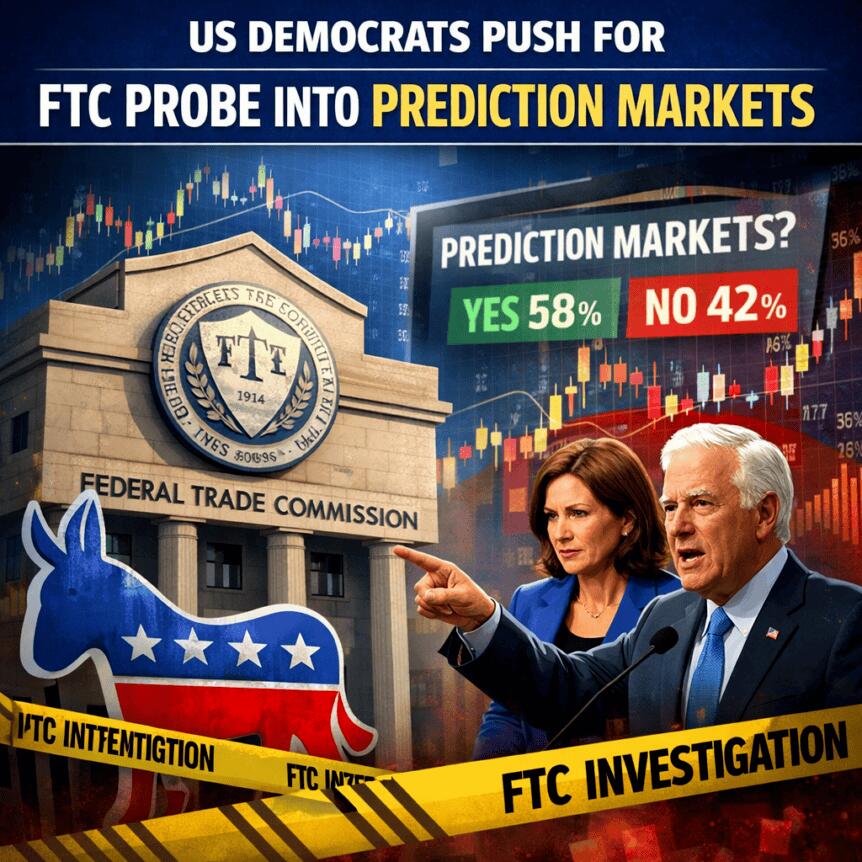
Nine Democratic lawmakers in the U.S. House of Representatives have urged the Federal Trade Commission to open an inquiry into how prediction-market platforms market themselves to consumers versus how they present their activities to regulators. In a letter released this week, Representatives Kevin Mullin and Gabe Vasquez contend that online prediction markets describe themselves as gambling platforms in marketing materials while telling regulators they are financial tools offering investment products. They call for the FTC to investigate whether the advertising and public messaging mislead consumers about the applicable rules and protections.
The request arrives amid ongoing congressional scrutiny of Kalshi and Polymarket following insider-trading concerns on those platforms. Congress launched a probe in May into the two companies’ responses to insider-trading incidents, underscoring regulators’ heightened attention to how these markets operate and how they are regulated. The lawmakers’ letter seeks detailed information by June 29 on whether the FTC plans to take investigative or enforcement action against prediction-market platforms for potential deceptive practices, and whether the agency has received consumer complaints or considers public perception and legal filings when evaluating such conduct.
Prediction markets, which allow traders to place contracts on the outcomes of future events, have grown into a notable real-world use case for blockchain technologies. Some platforms settle transactions using crypto rails and stablecoins, a factor that has attracted institutional attention and regulatory interest. March data showed a surge in prediction-market activity as investors and the public engaged with contracts around political and geopolitical events, reflecting broader accessibility and a shifting regulatory posture for the industry.
A group of nine Democratic lawmakers is calling on the FTC to launch a probe into prediction markets. Source: Kevin Mullin
In the letter, Mullin stated: “These prediction market companies are presenting themselves differently to regulators than they are to the public, and that kind of contradictory messaging can mislead consumers about what rules and protections actually apply. We are urging the FTC to investigate these practices and ensure consumers are protected from this potentially deceptive activity.”
Among the signatories are Representatives Jared Huffman, Raul Ruiz, Salud Carbajal, Mike Levin, Dina Titus, Paul Tonko, and Valerie Foushee, in addition to Mullin and Vasquez. The lawmakers are seeking clarity on how the FTC interprets and enforces consumer-protection standards in relation to platforms that operate at the intersection of gambling labels, financial instruments, and crypto-based settlement rails.
As coverage of the evolving regulatory landscape notes, the case against prediction markets sits at the nexus of consumer protection, financial-market supervision, and digital-asset oversight. Kalshi’s and Polymarket’s experiences have already drawn attention from lawmakers concerned about insider trading and platform governance. Kalshi, in particular, has faced scrutiny over election-betting activity and related restrictions, which have fed into broader debates about market integrity and disclosure requirements.
Key takeaways
- The FTC is being urged to investigate whether prediction-market platforms misrepresent themselves to consumers by advertising as gambling venues while describing their services to regulators as financial tools offering investment exposure.
- The lawmakers request a formal update from the FTC by June 29 on whether enforcement action is planned for potential deceptive practices and whether complaints have been received.
- The push follows a congressional probe into Kalshi and Polymarket over insider-trading incidents, highlighting ongoing regulatory interest in governance and market integrity.
- Prediction markets have grown as a real-world blockchain use case, with settlements increasingly leveraging crypto rails and stablecoins; March transaction volumes reached record levels amid rising interest in political and geopolitical event contracts.
- The letter is signed by nine lawmakers, indicating sustained congressional attention to the regulatory and compliance dimensions of prediction-market platforms.
Regulatory framing and enforcement risk
The core question raised by the lawmakers concerns how platforms classify and communicate their business model. If a platform markets itself as a sports-betting-like product while presenting itself to regulators as a financial tool or investment product, questions arise about the consistency of disclosures, consumer protections, and licensing obligations. The potential for misalignment between public-facing advertising and regulatory filings could implicate a range of enforcement authorities, including state gambling regulators, the Commodity Futures Trading Commission, and the Federal Trade Commission’s consumer-protection remit.
From a legal and compliance perspective, the discrepancy matters because it shapes which rules apply to user interactions, marketing disclosures, know-your-customer and anti-money-laundering controls, and the scope of permissible marketing claims. If regulators determine that platforms employ misleading or deceptive practices, consequences could extend beyond remedial disclosures to penalties, corrective advertising requirements, or restrictions on specific product features. The discussion also intersects with broader regulatory developments for digital assets, including how stablecoins and crypto settlement rails are treated under consumer-protection and financial-market rules.
The debate sits within a larger policy environment that is increasingly attentive to how digital markets intersect with traditional framework considerations. While the EU’s MiCA framework aims to harmonize crypto-asset regulation, U.S. agencies—such as the FTC, the SEC, and the CFTC—continue to refine an enforcement and oversight posture for platforms that blend gambling-like marketing with financial-instrument claims. For platforms operating across borders, this creates a heightened need for clear, consistent disclosures and robust compliance programs to manage cross-jurisdictional differences.
Political scrutiny and ongoing probes
The letter’s timing aligns with ongoing congressional scrutiny of prediction-market platforms, particularly in light of insider-trading concerns that have prompted formal inquiries. The May probe into Polymarket and Kalshi highlighted regulators’ focus on how these platforms handle information, market integrity, and user protections. Lawmakers have sought to understand responses to incidents on these platforms and how governance, disclosures, and enforcement actions would address potential conflicts of interest and market manipulation risks.
In parallel, the industry has emphasized the practical uses of prediction markets for forecasting and hedging, aided by technological rails that leverage blockchain infrastructure. The regulatory conversation thus far has centered on whether such markets should be treated as gambling products, financial instruments, or a hybrid with distinct regulatory obligations. The June deadline for the FTC to outline potential enforcement actions underscores the degree to which federal regulators may shape the operational boundaries for prediction-market operators in the near term.
Public reporting on Kalshi’s actions—such as incidents involving political betting—has contributed to a broader conversation about how platforms guard against misuse and how they communicate risk and compliance standards to users. As the sector evolves, the alignment of marketing, product design, and regulatory disclosures remains a focal point for policymakers and industry participants alike.
Operational implications for platforms and market structure
Prediction markets’ growing adoption has been supported by the use of crypto rails for settlement and payments, as well as the reliability of stablecoins to facilitate cross-border transactions and liquidity management. This operational model raises specific compliance considerations, including AML/KYC controls, sanctions screening, and the need for transparent disclosures about the nature of the instruments being traded and the protections users can expect. If enforcement actions materialize, platforms may face new licensing requirements or restrictions that affect market access, product features, or advertising practices.
From an institutional standpoint, the regulatory lens on prediction markets could influence how exchanges and financial intermediaries interact with these platforms. Banks and custodians evaluating participation in crypto-asset ecosystems may take cues from the FTC’s actions and related regulatory signals when assessing risk, client disclosures, and the suitability of offering or supporting prediction-market services within a regulated framework. The evolving policy environment also shapes how cross-border collaboration and data-sharing arrangements could support or constrain enforcement and vigilance efforts.
Looking ahead, the outcome of the FTC inquiry—along with continued congressional oversight—could recalibrate the balance between innovation and protection in the prediction-market space. As platforms optimize governance, disclosure, and compliance to meet stricter expectations, the industry may see clearer delineations of permissible advertising versus regulatory classifications, with potential implications for licensing trajectories and investor protections.
Related developments continue to unfold, including case studies of platform governance and enforcement risk. For instance, coverage of Kalshi’s and Polymarket’s experiences highlights that market integrity, transparency, and consistent messaging are central to regulatory confidence. These considerations are likely to inform ongoing policy deliberations and the practical design choices of prediction-market operators as they navigate a rapidly evolving, cross-jurisdictional landscape.
Closing perspective: As the FTC weighs a formal stance, stakeholders should monitor not only the agency’s forthcoming action but also complementary regulatory signals from state authorities and other federal agencies. The convergence of consumer protection, financial-market oversight, and digital-asset regulation in this space will shape the governance, licensing, and operational thresholds for prediction markets in the months ahead.

Key Takeaways
- Athletic apparel company Lululemon releases fiscal Q1 FY26 results after today’s closing bell on June 4, with analysts projecting earnings of $1.68 per share — representing a 35.3% decline from last year’s quarter
- Analysts forecast revenue growth of approximately 2.5%, reaching $2.43 billion
- Shares have tumbled more than 39% since the start of the year amid heightened competition, tariff headwinds, and weakening consumer demand
- The options market suggests traders are anticipating approximately a 10% swing in the stock following the earnings release
- Analyst consensus stands at Hold, with a mean price target of $169.53 — representing potential upside of roughly 34.5% from current trading levels
Athletic apparel retailer Lululemon Athletica (LULU) is scheduled to unveil its fiscal first quarter FY26 financial results following market close today, June 4. Currently trading near $126, shares have plunged more than 39% year-to-date, with Wall Street maintaining tempered expectations for the quarterly release.
Lululemon Athletica Inc., LULU
Wall Street forecasts earnings per share of $1.68 — marking a steep 35.3% decline compared to the year-ago period. On the top line, analysts anticipate revenue of $2.43 billion, translating to modest year-over-year growth of 2.5%.
The bearish profit forecast stems from mounting challenges including tariff-induced cost pressures and sluggish demand across U.S. markets. Discretionary consumer spending has faced headwinds, and Lululemon has not escaped these market dynamics.
Ahead of the earnings announcement, the company eliminated a potential distraction by resolving its proxy battle with founder Chip Wilson through an agreement on two board nominations. This settlement clears away some uncertainty surrounding the release.
Analyst Sentiment and Key Focus Areas
Evercore analyst Michael Binetti lowered his price objective from $175 to $130 while maintaining a Hold rating. His primary concern centers on the possibility of a “significant reset” to full-year FY26 projections, though he acknowledged the stock’s valuation has become increasingly compelling.
Rick Patel from Raymond James also maintains a Hold rating. His analysis suggests Q1 performance should exceed the company’s conservative internal projections, citing sequential improvements in both physical store traffic and online visitor metrics. However, his research uncovered mixed signals — notably, mobile application monthly active users demonstrated deceleration.
Patel’s attention focuses on whether fresh product introductions can spark renewed customer interest. The Get Low collection launched in January failed to resonate with the customer base. On a more positive note, his field research indicates stronger reception for the Unrestricted Power and ShowZero product lines. While cautiously hopeful, he remains unconvinced these represent transformative catalysts.
“Net, we see potential for estimates to increase but believe it’ll take more time for LULU to earn confidence that this is the beginning of a durable turnaround,” Patel said.
Valuation Metrics and Corporate Insider Moves
LULU currently trades at a P/E multiple of 9.37x, significantly compressed compared to historical norms. The forward-looking P/E of 10.13 indicates market expectations for continued subdued expansion.
The company’s GF Score registers at 77/100, with both profitability and growth metrics achieving top marks of 10/10. Financial strength earns a 6/10 rating, while momentum receives an F grade — mirroring the stock’s dismal year-to-date performance.
Corporate insiders have demonstrated buying activity, with two separate purchases during the previous three months totaling 9,365 shares. These transactions may indicate internal optimism despite external challenges.
The options market is pricing in approximately a 10% post-earnings movement in either direction. For perspective, LULU’s historical average absolute post-earnings move across the last four quarters has been 12.95%.
The Street consensus stands at Hold, derived from 20 Hold recommendations and one Buy rating. The mean analyst price target of $169.53 suggests potential appreciation of approximately 34.5% from present levels.

Polymarket has officially finalized one of this year’s most controversial events. It’s a prediction market on whether Strategy will sell Bitcoin in May, and it resolved to “No,” meaning that, according to the platform, the company didn’t sell BTC that month.
Here’s the kicker: the firm did sell BTC in May, as confirmed not only by its executives but also by an official filing with the US Securities and Exchange Commission. So what’s the reason for the resolution, you may ask? Well, the fact that confirmation came after the deadline.
The decision rests entirely on the timing of the announcement. The filing came on June 1st (which is what literally everyone expected, because that’s when these filings are… filed), after the May 31 deadline had passed.
Polymarket’s decision has drawn massive criticism not only because of the outcome, but because the platform added a clarification after the market had closed, stating that announcements made after the deadline would not count toward resolution, as seen in the screenshot below.

What is even odder is that all subsequent time frames for the new markets for the same event lack this “additional context,” meaning traders can be easily misled again.
Critics argue that this effectively changed the market’s rules after traders had already taken their positions, which is objectively true. Many traders started taking positions on June 1st (which is after the deadline), because the market hadn’t been closed by Polymarket yet.
A May Sale, a June Filing
To give further context on the happening – at the center of this dispute is the difference between when an event took place and when it became publicly confirmed – these are two completely separate events. One is tied to an objective outcome; the other is tied to the announcement of that outcome. Had the event been framed as “MicroStrategy confirmed to have sold any of its Bitcoin by 11:59 PM ET on May 31,” then there is no room for interpretation.
But the market was “MicroStrategy sells any of its Bitcoin by 11:59 PM ET on May 31,” which they did. It was just announced later.
Polymarket didn’t treat the actual outcome as decisive – it treated the time of the announcement. Even though this distinction may seem technical, it has huge implications for traders. A market framed around whether a company sold Bitcoin can produce one answer if judged by the transaction date, and the opposite answer if judged by the disclosure date.
A Rule Changed After the Fact
What made this entire thing even more contentious is the fact that Polymarket added its “post-deadline announcements do not count” rule only after the market had been closed.
This raises very serious questions. Prediction markets depend on participants knowing the settlement criteria before they trade. Retroactively changing those criteria, especially after the relevant event has occurred, risks undermining confidence in the platform’s broader neutrality.
A trader claimed to have lost around $500K after backing the “Yes” side, while other observers criticized the decision. The controversy has also sparked broader concerns about how prediction markets handle events that occur before a deadline but are confirmed only afterward.
So, to put it in simple terms – Strategy did sell BTC in May according to its own filing. According to Polymarket, it didn’t.
The post Strategy Didn’t Sell Bitcoin in May, According to Polymarket appeared first on CryptoPotato.
Production of NVIDIA processors is concentrated in Taiwan via TSMC, making the company sensitive to US trade policy. In the first quarter of fiscal 2026, NVIDIA recorded a $4.5bn write-down due to restrictions on H20 chip exports to China. At the same time, the revenue structure remains resilient — around 69% of revenue comes from the US domestic market, where hyperscalers continue to increase purchases of accelerators for data centres.
In the fourth quarter of fiscal 2026, revenue reached $68.1bn, representing a 73% year-on-year increase, while full-year revenue totalled $215.9bn (+65%). In late March, the company announced an expansion of its strategic partnership with Marvell Technology, including a $2bn investment and integration via the NVLink Fusion ecosystem, further extending its presence in the Physical AI and robotics segment. However, the overall macroeconomic backdrop remains subdued.
Technical picture
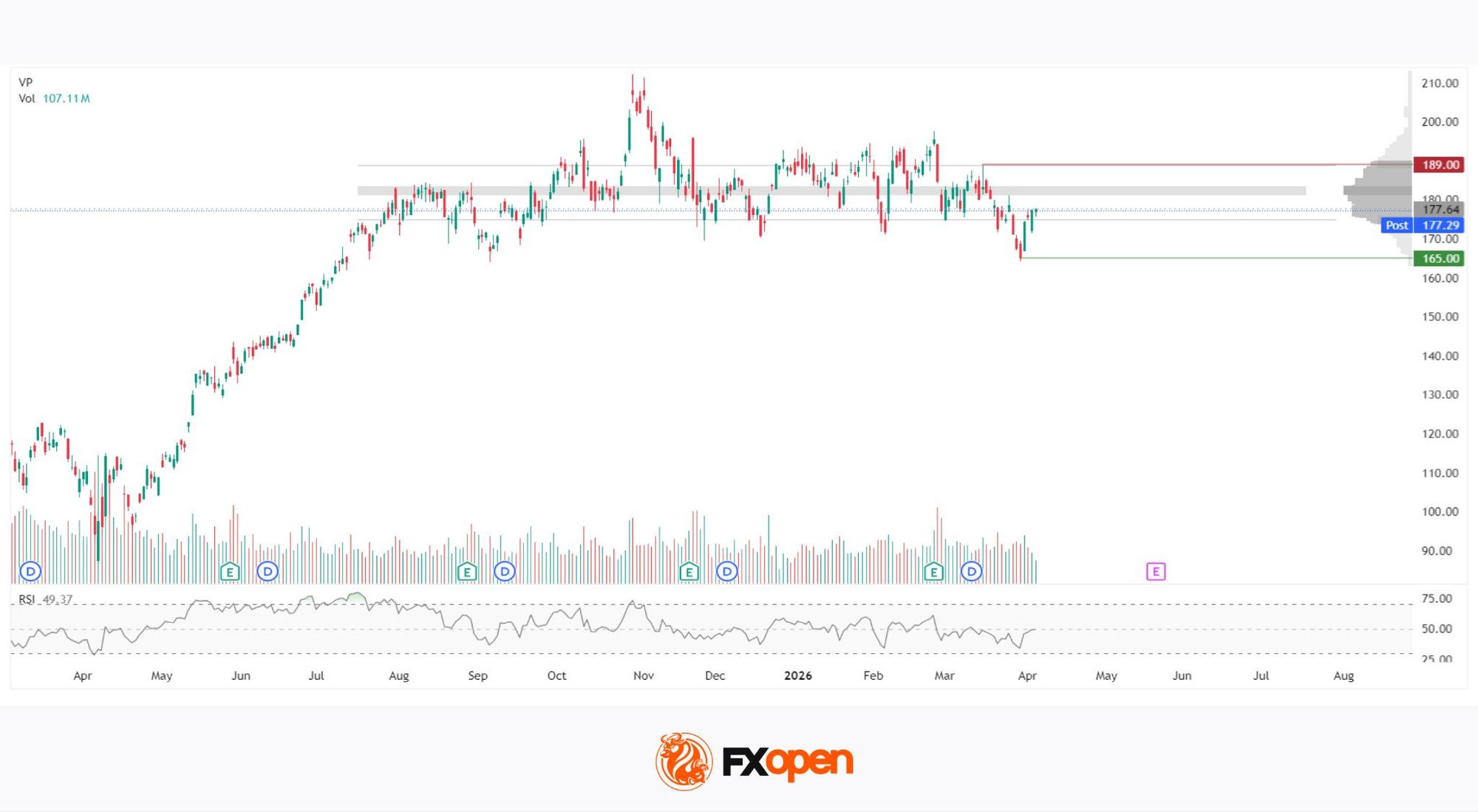
After reaching an all-time high near 210 in November 2025, the stock entered a corrective phase. The low of this correction was marked at 165 on 30 March 2026. A rebound followed from this level; however, the price remains around 177, without showing a convincing recovery. The horizontal volume profile provides further clarity.
The highest concentration of trading activity over the period under review is located in the 181–183 zone, where the point of control (POC) is situated. This area reflects the most active trading over several months, making it a key reference zone for market participants. Above current levels, the volume profile remains dense up to 189, which coincides with the local highs from the second half of 2025 and acts as the nearest resistance level.
The RSI stands at 49.37 and remains in neutral territory, offering no clear directional advantage. The latest session’s volume reached 107.11 million shares, indicating sustained market participation. However, it should be noted that the most pronounced spikes in volume and volatility have historically occurred ahead of and following quarterly earnings releases. As a result, the stock may continue to consolidate within the current range until new fundamental catalysts emerge.
Key takeaways
NVIDIA remains in a prolonged consolidation phase, supported by strong operational performance but a muted macroeconomic backdrop. The volume profile shows a significant supply overhang above current price levels, while the RSI does not favour either side. Market participants continue to assess incoming signals without committing to a sustained directional bias.
Buy and sell stocks of the world’s biggest publicly-listed companies with CFDs on FXOpen’s trading platform. Open your FXOpen account now or learn more about trading share CFDs with FXOpen.
This article represents the opinion of the Companies operating under the FXOpen brand only. It is not to be construed as an offer, solicitation, or recommendation with respect to products and services provided by the Companies operating under the FXOpen brand, nor is it to be considered financial advice.


- Bitcoin ETF outflows remain negative for 11 straight days, pressuring BTC.
- $749 million in liquidations have accelerated the Bitcoin price drop.
- RSI below 18 shows oversold conditions, but trend stays bearish.
Bitcoin (BTC) has been under sustained pressure, trading around the $63,548 level after a sharp multi-week decline that has erased a large portion of its recent recovery.
Notably, the BTC price decline reflects a combination of institutional selling, forced liquidations, and weakening market structure that continues to dominate short-term price action.
Even though technical indicators now show deeply oversold conditions, the broader flow of capital suggests that downside risk remains active.
The current setup places Bitcoin in a zone where short-term relief rallies are possible, but sustained recovery has yet to form.
Bitcoin ETF outflows weigh heavily on the BTC price
One of the most consistent pressures on Bitcoin has been the ongoing withdrawal of capital from US spot Bitcoin exchange-traded funds.
Data shows a stretch of 11 consecutive days of net outflows, including a single-day redemption of roughly $519 million on June 2.
Over the past ten days from May 25, 2026 to June 3, 2026, Bitcoin ETFs have witnessed over 3 billion worth of outflows according to CoinGlass data.
This pattern has effectively removed a major source of steady institutional demand.
According to Citi analysts, ETF flows account for about 45% of weekly return variation, highlighting how strongly prices now respond to institutional positioning.
With flows turning negative for nearly two weeks, Bitcoin has been left without its primary demand driver at a time when selling pressure is already elevated.
This shift is important because ETFs were previously absorbing large amounts of Bitcoin supply during the recovery phase.
The current reversal means that instead of acting as a stabilizing force, ETFs are now contributing to downside momentum.
Without a clear return of net inflows, price stability above the mid-$60,000 range has remained difficult to sustain.
Liquidations and macro pressure amplify the decline
Alongside ETF outflows, leveraged positions in the derivatives market have added fuel to the downturn.
More than $749.982 million in leveraged long positions have been liquidated within a 24-hour window during the sell-off, according to market data.

These forced closures have accelerated price movement lower rather than allowing gradual adjustment.
Bitcoin’s drop below key technical zones has triggered additional selling, reinforcing a cascading effect where falling prices lead to further liquidation pressure.
At the same time, macroeconomic conditions have reduced the overall appetite for risk assets.
Strong US employment data has pushed expectations for Federal Reserve rate cuts further into the future, reinforcing a “higher-for-longer” interest rate environment.
This has reduced liquidity flowing into speculative markets, including crypto.
In addition, geopolitical tensions, particularly renewed instability involving Iran and broader global risk concerns, have also contributed to defensive positioning across financial markets.
In this environment, Bitcoin has continued to trade in line with high-risk assets rather than acting independently.
Technical structure shows oversold conditions but no confirmed reversal
From a technical perspective, Bitcoin is showing some of the most extreme oversold readings in recent months.
The 14-day Relative Strength Index has dropped to around 17.7–18, a level that typically reflects heavy selling exhaustion.
Historically, readings this low have often preceded short-term relief rallies.
However, other technical indicators present a more cautious picture.
Bitcoin is currently trading below all major exponential moving averages, including the 10-day, 20-day, 50-day, 100-day, and 200-day EMAs. This alignment signals a strong bearish trend across multiple timeframes.

Looking at the short-term Bitcoin price projections, the immediate support zone sits near $62,964, while a broader structural floor is located around the $60,000 region, which also aligns with long-term trend indicators.
A breakdown below $62,964 would increase the likelihood of a move toward lower liquidity zones near $60,000 and potentially $55,000.
On the upside, Bitcoin would need to close above $69,124 to shift short-term momentum. If that level is reclaimed, the next resistance zone is positioned near $71,589, which would signal early signs of structural recovery.
But until then, the trend remains heavily influenced by downside momentum rather than reversal signals.
Ethereum price has slid about 10% over the past week as on-chain demand collapsed and liquidations spiked.
The chain is clear. Spot ETFs have bled for 17 straight sessions, the most loyal holders pulled back hard, and stretched funding then set off forced selling.
Ethereum Spot ETF Outflows Set the Stage
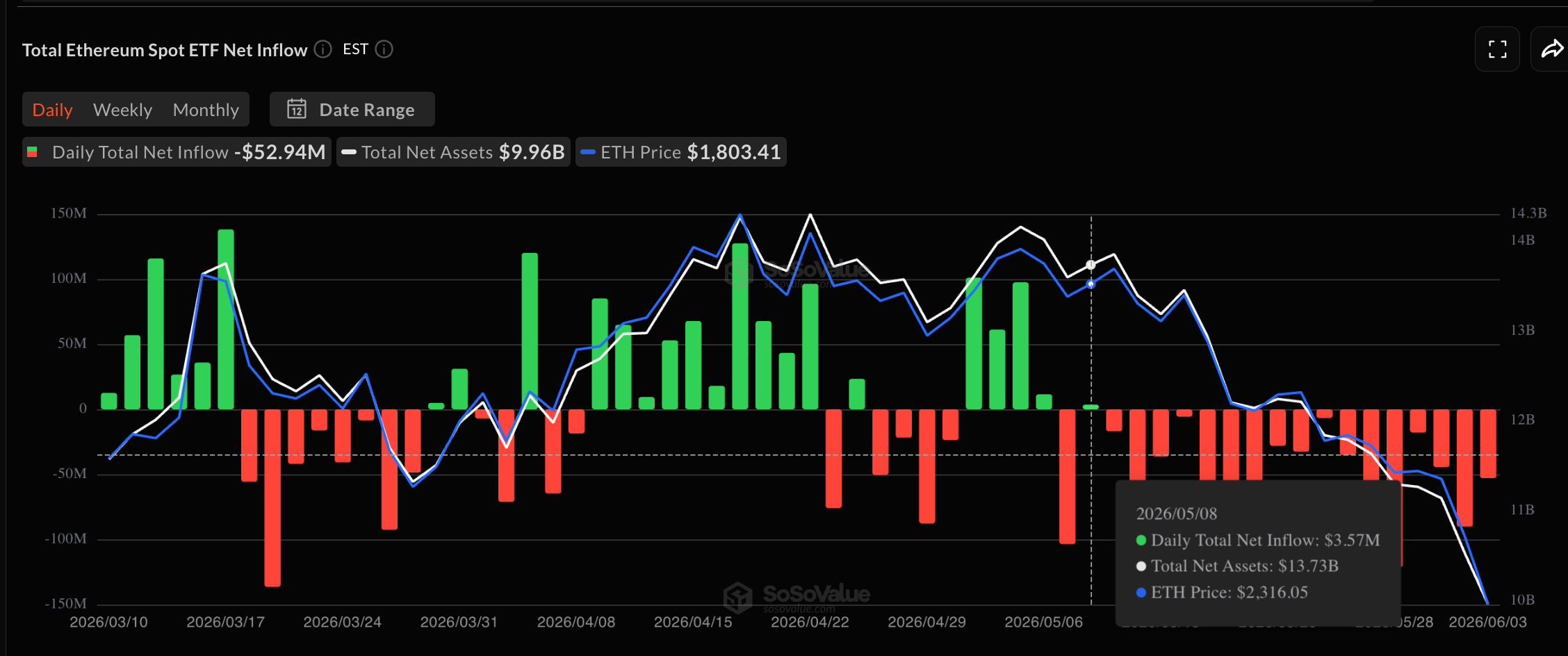
The selling started with the institutions. Ethereum spot ETF demand has vanished, with the funds now bleeding for 17 straight sessions.
Want more token insights like this? Sign up for Editor Harsh Notariya’s Daily Crypto Newsletter here.
The last day of net inflows was May 8. Every trading day since has been an outflow, and the latest reading showed about $52.94 million leaving the funds.

That run has cut total ETF net assets to roughly $9.96 billion. A streak this long is the clearest sign yet of institutional apathy toward ETH. When the steadiest buyers disappear for weeks, other holders take notice. The most loyal on-chain cohort cracked next.
Long-Term Holders Slash Their Buying
The most patient holders followed the institutions out. Glassnode’s hodler net position change tracks the monthly change in supply held by coins older than 155 days. It had been climbing into June.
It peaked at 339,222 ETH on June 1, the start of the new month. By June 3, it had collapsed to 68,470 ETH as they possibly felt that the ETF demand was returning.
That is a drop of about 80% in two days. Even the most loyal holders sharply slowed their buying, pulling a key source of demand out of the market.

With both institutions and hodlers stepping back, the door opened for leverage to do damage.
Funding Rates Spike and Liquidations Pile Up
Thin spot demand left the market leaning on leverage. CryptoQuant flagged that Ethereum funding rates on Binance hit their highest level since early 2026.
Funding rate is the periodic payment between traders holding long and short perpetual futures. A high positive rate means longs are crowded and paying to keep their bets open. CryptoQuant warned the setup raised the risk of long liquidations as Bitcoin slid. That risk played out fast.
Over the past 24 hours, about $368.63 million in Ethereum long positions were liquidated, or force closed. That was part of a $1.61 billion wipeout across crypto.

With demand gone and forced selling underway, the price chart shows where the damage landed.
Ethereum Price Levels to Watch After the Breakdown
The Ethereum price chart explains the cascade. Ethereum price broke down on June 2, slicing below the neckline of an inverted cup and handle.
An inverted cup and handle is a bearish reversal pattern, a rounded top followed by a small handle. It projects a downside target once the neckline breaks. The measured drop is about 21%.
That bearish target sits near $1,550. ETH now trades near $1,795 after the breakdown, with a long lower wick showing some buyers returned.

The setup stays bearish on the breakdown path. A fall of about 5% under $1,714 would open the way toward $1,550.
To turn the tide, ETH must reclaim $1,893 and then $2,004. A move back above $2,004 would erase most of the recent losses.
Still, sell volume remains steady, so the weakness likely holds until buyers reclaim $1,893. For now, $1,714 separates a slide toward $1,550 from a recovery attempt back toward the $2,000 zone.
The post Ethereum Buying Falls 80% as ETF Outflows Hit a 17-Session Streak appeared first on BeInCrypto.
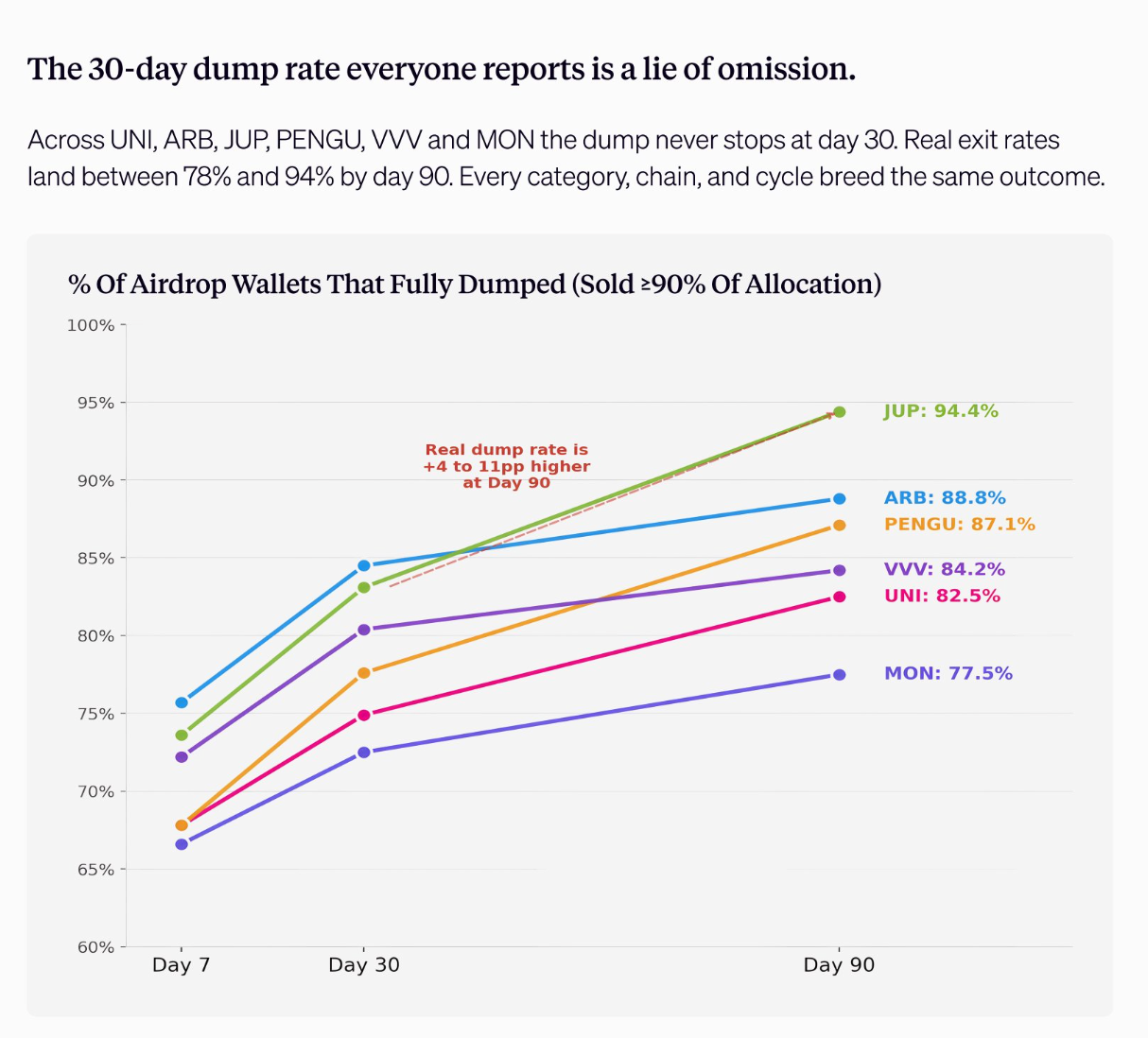
Delphi Digital says the airdrops are over, after finding that 78% to 94% of recipient wallets across six major tokens sold most of their allocation within 90 days.
The research firm tracked 3.7 million wallets over five years, arguing that free token giveaways now produce sellers rather than committed holders.
Are Airdrops Dead? Delphi Says Up to 94% of Wallets Dump Within 90 Days
Airdrops became a standard way for projects to seed communities and reward early users. However, the model has faced scrutiny lately.
Delphi studied Uniswap (UNI), Arbitrum (ARB), Jupiter (JUP), and Pudgy Penguins (PENGU), among other tokens spread across four chains. Exit rates rose over time rather than settling down.
Follow us on X to get the latest news as it happens

Delphi found real dump rates ran 4 to 11 percentage points higher at day 90 than at day 30. The widely cited 30-day figure, therefore, understates the number of recipients who leave.
The firm made four core arguments for why it could get worse for airdrops. First, the cost of running fake “sybil” wallets is collapsing toward zero as automated tools make farming cheap and detection unreliable.
Second, the next wave of issuers, including tokenized treasuries and regulated DeFi, won’t send tokens to anonymous wallets. Third, the acquisition math fails, with Arbitrum paying an estimated $1.16 billion to users who left within a month.
Finally, the firm also said that outlier wins prove little. Hyperliquid (HYPE) absorbed sales through buybacks, funded by more than $1 billion in revenue. Jito (JTO) avoided farming because its eligible group stayed small.
“Token economics are starting to require real protocol performance. MegaETH locked 53% of its supply behind performance targets. Pendle routes roughly 80% of revenue into buybacks for stakers. Token distribution is moving from handouts to performance,” Delphi added.
Independent tracking had already pointed the same way. A trader previously logged 30 airdrops received since December 2024, finding only one still trading above its launch price at the time. Several had collapsed almost entirely, reinforcing the pattern.
Subscribe to our YouTube channel to watch leaders and journalists provide expert insights
The post Delphi Says Airdrops Are Over as 94% of Wallets Dump Within 90 Days appeared first on BeInCrypto.

Key Takeaways
- Uber has allocated approximately $500 million to self-driving technology firm Nuro via a combination of upfront capital and performance-based payments.
- This arrangement forms part of a trilateral partnership involving Nuro and Lucid to launch 35,000 autonomous taxis across Uber’s platform.
- These vehicles will utilize Lucid Gravity SUVs equipped with Nuro’s autonomous driving technology.
- Nuro has successfully achieved its initial benchmarks, triggering the release of the first installment of performance-tied financing.
- Future disbursements depend on driverless trials scheduled for later this year, completely autonomous passenger services by year’s end, and expanded deployment in 2027.
On June 4, Reuters disclosed that Uber Technologies (UBER) has pledged approximately $500 million to self-driving vehicle developer Nuro, according to confidential sources. UBER stock registered a 0.10% gain following the announcement.
This financial commitment exceeds Uber’s original contribution and combines equity investment with performance-contingent funding mechanisms. The move expands upon Uber’s involvement in Nuro’s $203 million financing round, which assigned the startup a $6 billion valuation.
Nuro’s investor roster includes Nvidia and SoftBank, providing substantial financial backing as the company accelerates its self-driving technology initiatives.
The central objective involves deploying 35,000 autonomous taxis built on Lucid Gravity SUVs, alongside upcoming midsize vehicle variants. These automobiles will incorporate Nuro’s autonomous driving platform and function within Uber’s ride-sharing ecosystem.
Uber previously announced a $500 million investment in Lucid, positioning itself as a significant financial participant throughout various segments of the value chain — spanning vehicle manufacturing, software development, and service delivery.
Performance Benchmarks Trigger Initial Funding
The performance-based component of this agreement follows a structured framework built around specific development and operational objectives. Reuters’ sources indicate that Nuro has already met the first series of these predetermined targets.
This achievement has triggered the distribution of the initial performance-contingent capital allocation to Nuro. Subsequent payments hinge on conducting driverless trials later this year, launching completely autonomous passenger services before December, and implementing widespread service availability in 2027.
Nuro is presently conducting trials with safety operators in California’s San Francisco Bay Area in preparation for a public launch scheduled for later this year.
This past April, Nuro obtained California regulatory approval to test autonomous Lucid Gravity vehicles without safety operators across designated counties. The following month in May, the company secured permission to transport passengers during supervised trial operations.
Nuro Transitions From Package Delivery to Passenger Transport
Nuro initially developed compact autonomous delivery vehicles before strategically shifting in 2024 toward licensing its self-driving software to automotive manufacturers and transportation service providers. The Uber partnership represents a cornerstone of this strategic realignment.
This robotaxi deployment would constitute a significant milestone in that transformation, repositioning Nuro from a specialized delivery solution provider to a competitive force in the passenger transportation sector.
Meanwhile, Uber maintains a diversified strategy across multiple autonomous vehicle collaborations. The company has established self-driving partnerships with Baidu, Rivian, and Wayve, while also facilitating Waymo services in specific American markets.
UBER’s present price-to-earnings ratio stands at 17.88, accompanied by a GF Score of 83 out of 100. Recent insider transactions over the previous three months reveal $2.2 million in stock disposals, including a single sale of 30,000 shares.
Nuro’s latest California regulatory clearance, issued in May, permitted passenger transport during supervised testing phases — an essential prerequisite before launching any completely driverless commercial operations.

Key Highlights
- Google’s parent company completed an $84.75 billion equity financing round — marking the biggest AI-linked capital raise in market history
- The final amount exceeded the originally announced $80 billion target and features a $10 billion private transaction with Berkshire Hathaway
- Major Wall Street firms Goldman Sachs, JPMorgan, and Morgan Stanley served as joint book-running managers
- Anthony Gutman, Goldman Sachs International co-CEO, described the transaction as entering “unprecedented territory” in capital markets
- Shares of GOOGL finished Wednesday’s session down 0.76% at $358.68 as market participants assessed potential shareholder dilution
Shares of Alphabet (GOOGL) ended Wednesday’s trading session at $358.68, declining 0.76% following the tech giant’s decision to expand its equity fundraising to $84.75 billion — a significant increase from the $80 billion initially disclosed earlier this week.
This fundraising represents one of the most substantial equity capital events ever executed in connection with artificial intelligence expansion. In an exclusive conversation with CNBC, Anthony Gutman, co-CEO of Goldman Sachs International, characterized the transaction as pushing capital markets into uncharted waters.
“Let’s start by saying this is unprecedented territory, so we all enter it with a degree of humility and caution,” Gutman said in an exclusive interview Wednesday on CNBC’s Europe Early Edition.
The stock experienced downward pressure as market participants digested the implications of shareholder dilution. By expanding the total share count, existing stockholders face potential value compression unless the company delivers returns that justify the increased capital base.
The company stated the proceeds will be deployed toward AI computational infrastructure to address what it characterized as “unprecedented customer demand.” Its Gemini application has attracted nearly 900 million monthly active users.
Within the broader offering, Berkshire Hathaway committed $10 billion through a private placement arrangement. Under the leadership of Greg Abel, who succeeded Warren Buffett, Berkshire is providing anchor investor support for the transaction.
The trio of Goldman Sachs, JPMorgan Chase, and Morgan Stanley are managing the underwritten component as joint book-runners. Goldman additionally serves as the placement agent for the private portion.
Investor Sentiment and Market Reception
According to Gutman, demand from institutional investors for substantial equity issuances continues at elevated levels. When evaluated as a proportion of overall equity market capitalization, the offering appears “very manageable,” he noted.
“The Alphabet issuance yesterday augurs well for the pipeline. That was just a record level of issuance on any level,” he added.
Broader market indices displayed mixed performance on Wednesday. The S&P 500 retreated 0.74% to finish at 7,553.68. The technology-heavy Nasdaq declined 0.89%, closing at 26,854.
Among technology sector competitors, Meta posted gains of 4.24%, ending at $622.98. Microsoft experienced a 3.17% decline to close at $427.34.
The Broader Capital Markets Environment
Alphabet’s capital raise arrives as 2026 positions itself to become a banner year for capital markets transactions.
SpaceX has scheduled its initial public offering for June 12, pursuing a $1.75 trillion valuation on the Nasdaq exchange — which would establish it as the largest IPO in financial market history.
Artificial intelligence companies OpenAI and Anthropic have similarly revealed intentions to pursue public listings before year-end.
Gutman referred to these as “exceptional companies” and expressed confidence in their ability to successfully raise capital provided they execute the process correctly.
Since its 2004 market debut, Alphabet’s stock has appreciated 14,202%. The company currently commands a market capitalization of $4.3 trillion.
Wednesday’s trading activity for GOOGL occurred within a range of $358.10 to $366.39, with approximately 2 million shares changing hands — substantially below the 28.9 million share average daily trading volume.
Investors will be closely monitoring the company’s forthcoming quarterly earnings release and capital spending projections to evaluate whether returns from AI infrastructure investments will validate the massive capital deployment.
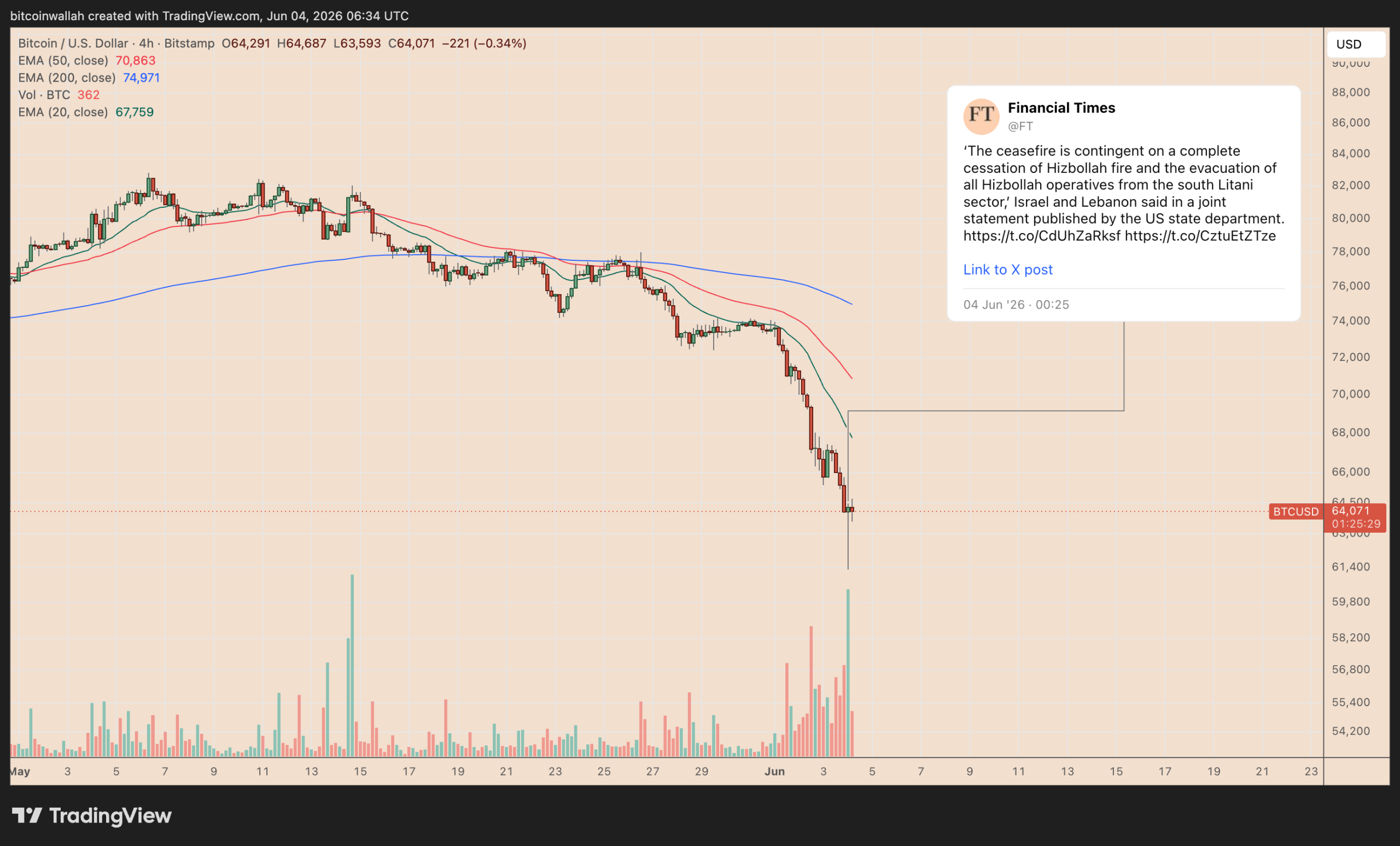
Bitcoin’s (BTC) brief plunge toward the $60,000 area triggered more than $600 million in long liquidations, raising doubts over whether the latest rebound marks a real bottom or only a relief bounce after a leverage flush.
BTC price may rebound toward $70,000 next
BTC fell to roughly $61,300 on Thursday before recovering 5.52% to around $64,690, with the rebound coinciding with reports that Israel and Lebanon had agreed to implement a ceasefire.
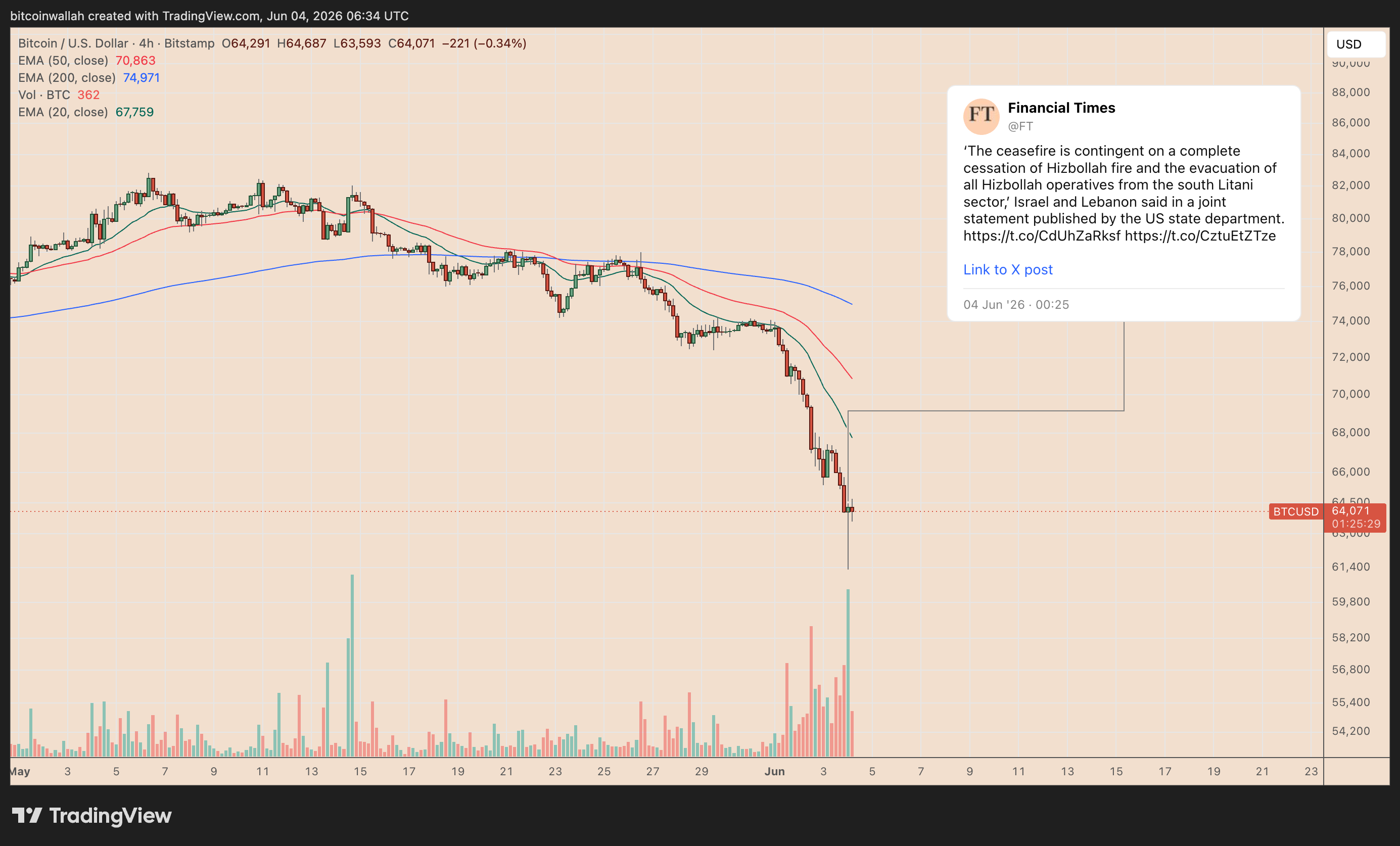
BTC/USD four-hour chart. Source: TradingView
The volatile move liquidated over $737 million in BTC positions on a 24-hour rolling basis, with long traders taking most of the hit, according to data resource CoinGlass.
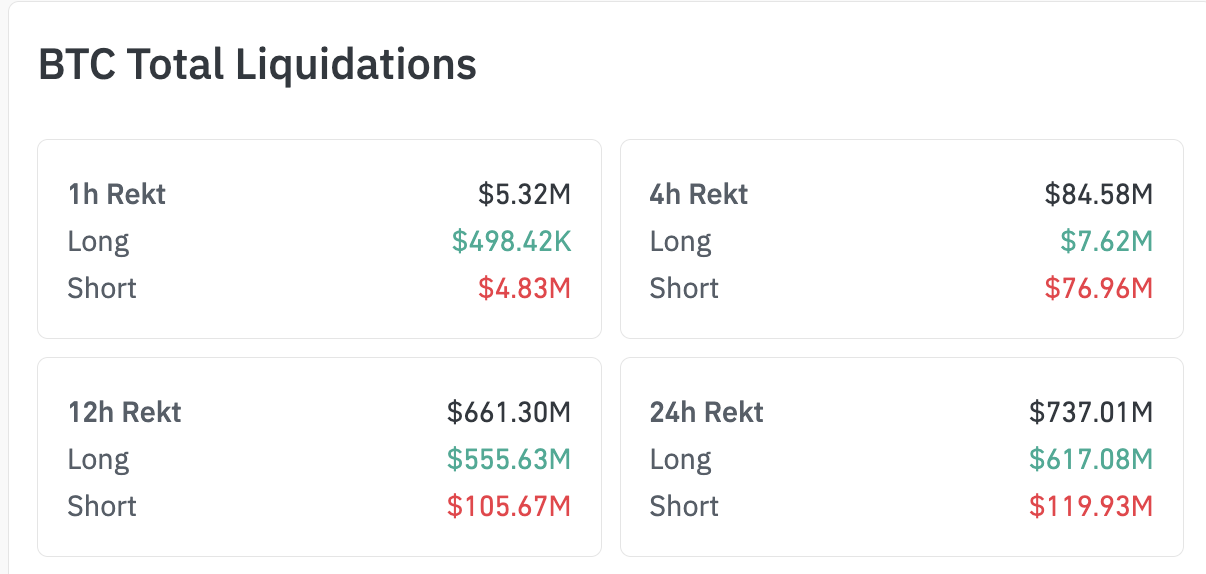
BTC total liquidations. Source: CoinGlass
Over $617 million in long positions were wiped out, showing how aggressively bullish traders were positioned before the sell-off.
Still, Bitcoin’s sharp 5.52% rebound encouraged some traders to call for a bottom.
Trader RidaaXBT said BTC could stage a relief bounce toward the $69,000–$70,000 range, implying that the liquidation-driven selloff may have exhausted near-term sellers.
Related: Analyst says Bitcoin’s $60K bottom signals weaken bear-market forecast
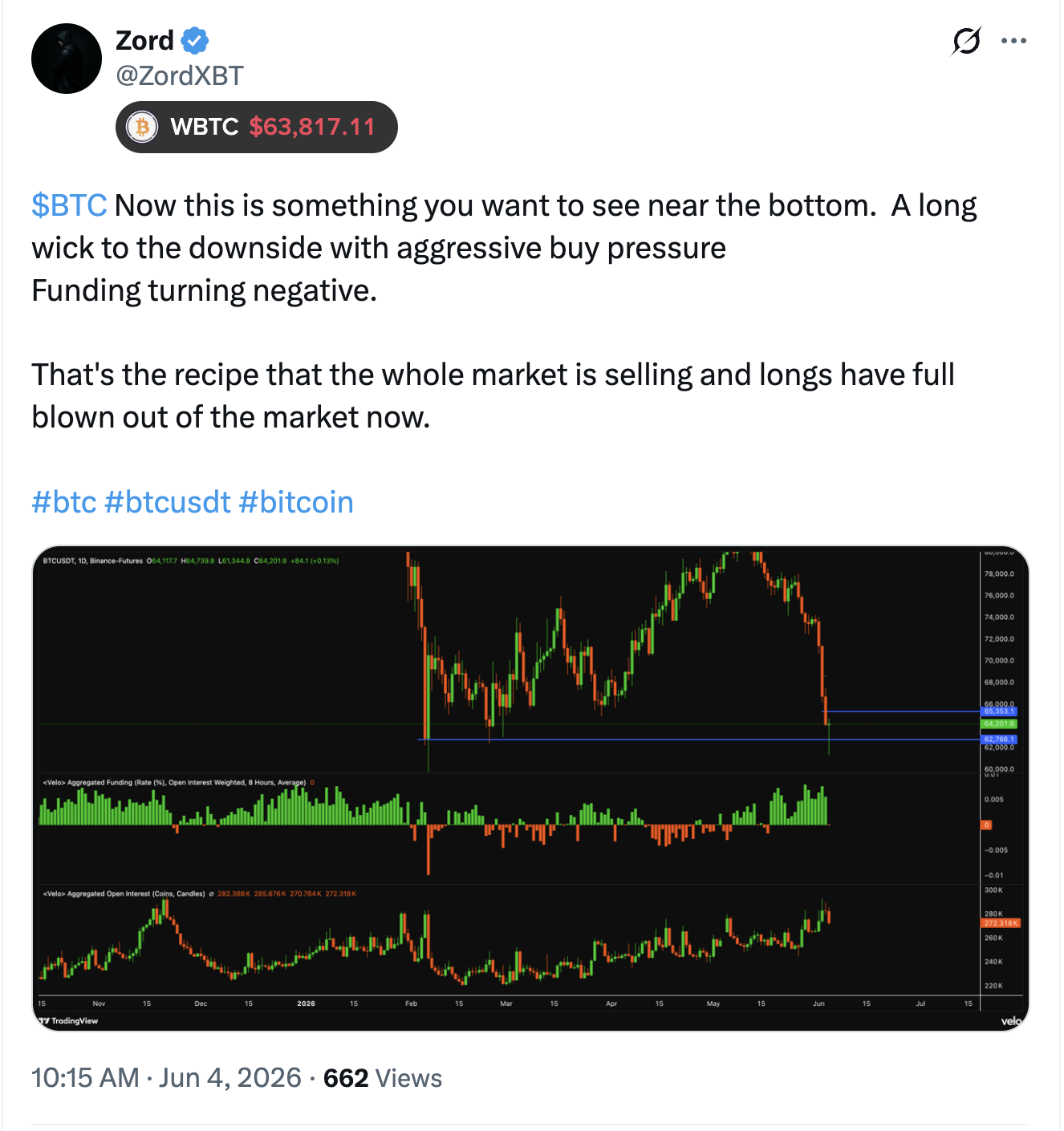
Analyst ZordXBT shared a similar view, pointing to Bitcoin’s long downside wick as a sign that buyers stepped in aggressively near the lows.
Source: X
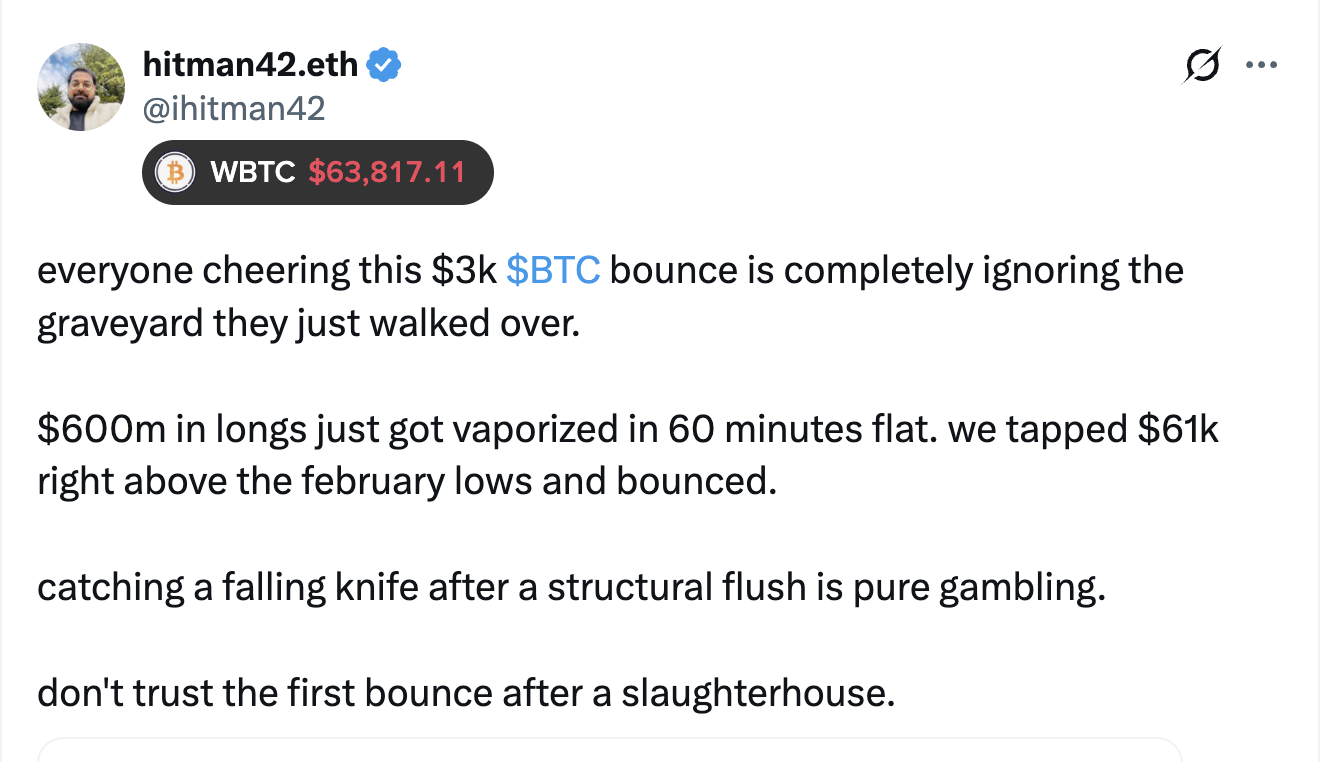
On the other hand, crypto trader Hitman42.eth warned that BTC bulls may be celebrating too early, noting that the Bitcoin bounce may end up trapping bulls.
Source: X
Bitcoin bear flag keeps $50K target in play
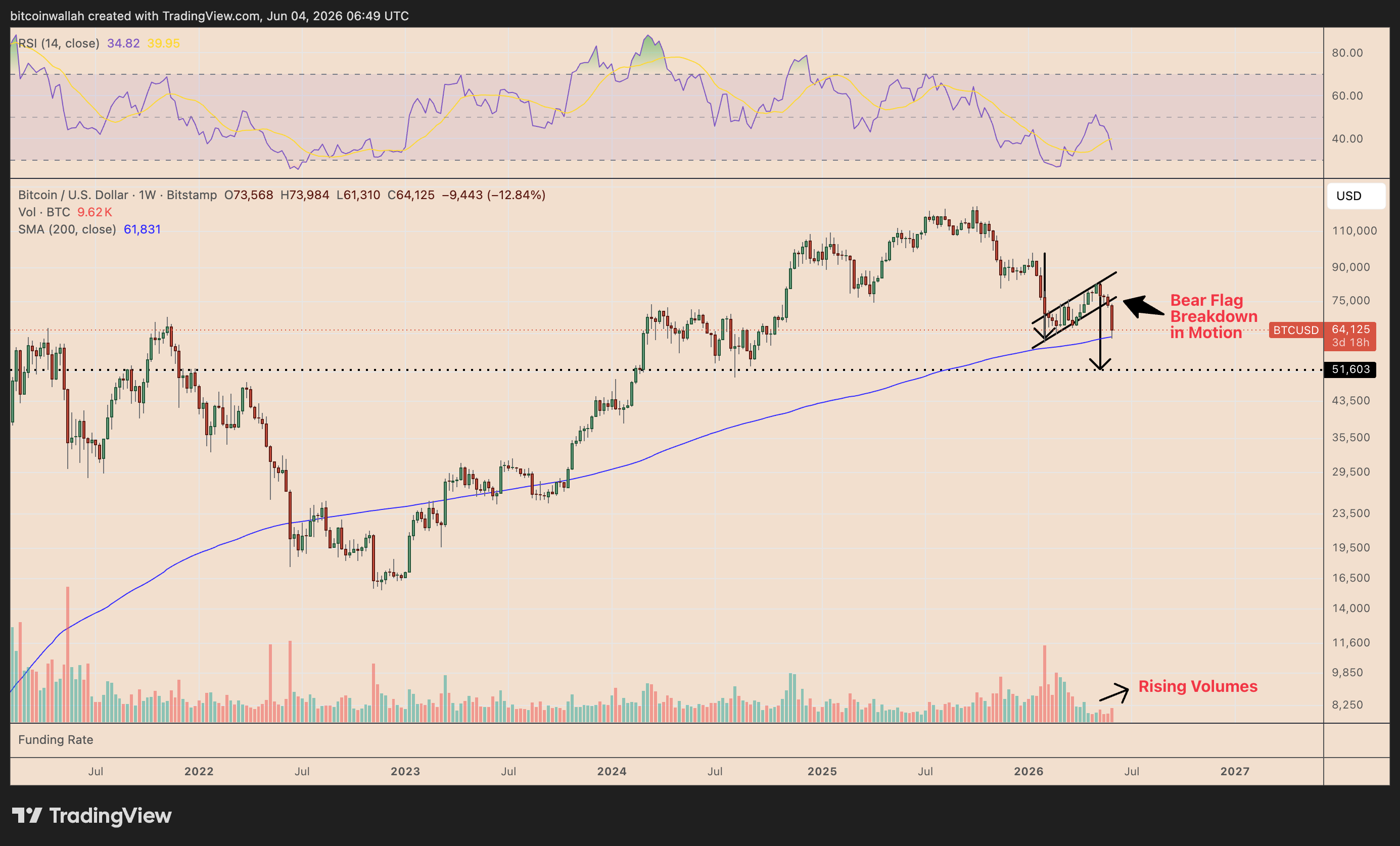
Bitcoin’s weekly chart still shows a bear flag breakdown in progress, keeping the risk of a deeper drop toward the $50,000–$52,000 area alive. The setup follows BTC’s failure to reclaim the flag’s upper trend line, with rising volumes adding weight to the downside move.
BTC/USD weekly chart. Source: TradingView
However, the bearish scenario is not confirmed as long as BTC trades above its 200-week simple moving average (200-week SMA, blue line) at around $61,800. This level has acted as a major cycle-bottom zone in past Bitcoin bear markets, including 2015, 2018 and 2020.
A strong rebound from the 200-week SMA would weaken, or potentially invalidate, the bear flag breakdown, putting BTC price in position to test $70,000 as the next upside target.

US Democrats Push for FTC Probe Into Prediction Markets

Womens World No 1 Aryna Sabalenka crashes out of French Open

Iowa football legend Sedrick Shaw selected to Hawkeyes’ 2026 Hall of Fame class



-

 Tech6 days ago
Waymo dominates autonomous vehicle registrations as Tesla trails behind
-

 News Videos6 days ago
This is BROKEN! INSANE 5x MONEY CAR WASH WEEK! The NEW GTA Online UPDATE Today! (GTA5 New Update)
-
 Tech5 days ago
SpaceX just won a second Golden Dome contract. This one is $4.16 billion.
-

 Business3 days ago
Jade Biosciences, Inc. (JBIO) Discusses Positive Interim Results From JADE101 Phase I Healthy Volunteer Study and Development Plans Transcript
-

 News Videos6 days ago
SHE IS KILLING XRP!!! WATCH URGENT AND ACT FAST
-
 NewsBeat5 days ago
FIRST NIGHT REVIEW: Take That bring the Circus back to life in spectacular sun-soaked style
-

 Business5 days ago
Is the Spurs Phenom Already Better Than Prime Diesel?
-
 Crypto World6 days ago
CFTC Has Approved the First Regulated Bitcoin Perpetual Contract in the U.S.
-

 Politics5 days ago
The House | Inside Andy Burnham’s Makerfield Campaign: “Nobody Thinks This Is In The Bag”
-

 Sports2 days ago
French Open 2026 results: Alexander Zverev beats Rafael Jodar and will play Jakub Mensik in semi-finals
-
 NewsBeat6 days ago
Novak Djokovic v Joao Fonseca LIVE: French Open latest scores and results after Jannik Sinner’s shocking collapse
-
 Entertainment5 days ago
Weak ‘Supergirl’ Box Office Tracking Amid Milly Alcock Backlash
-
 Crypto World6 days ago
Snowflake (SNOW) Stock Rallies on Strong Q1 Results and AI Product Growth
-

 Entertainment6 days ago
Maddox Jolie-Pitt Legally Requests to Drop Brad’s Surname
-

 Tech2 days ago
CryZENx Releases Fresh Playable Content Deep Inside Jabu-Jabu for His Ocarina of Time Remake
-

 Business5 days ago
Demand Conditions Improve In Chemicals Sector In April 2026
-
 Entertainment5 days ago
One of the Greatest Sitcoms of All Time Shoots Up Apple TV’s Charts 11 Years Later
-
 Crypto World6 days ago
MicroStrategy Moves $30 Million in BTC to Coinbase Prime: Is the Bitcoin Sell-Off Already Here?
-

 Tech6 days ago
This Week In Security: Ubiquiti Fixes, And FreeBSD Joins The Club You Don’t Want To Join
-
 Entertainment6 days ago
Bruce Willis’ Generosity Resurfaces Amid His Dementia
You must be logged in to post a comment Login