

Crypto World
Brazil central bank orders daily crypto exchange asset proof by 2027



Brazil’s central bank will force licensed crypto exchanges to prove asset sufficiency daily from Jan. 1, 2027.
Summary
- Brazil’s central bank will require daily asset sufficiency reports from licensed crypto exchanges starting Jan. 1, 2027
- New rules mandate full segregation of client and platform assets, plus on‑balance‑sheet recognition of crypto under a dedicated accounting manual
- The announcement comes as major assets like BTC and ETH trade lower amid broader risk‑off sentiment in crypto markets
Brazil’s central bank has introduced a new regulatory framework that will require all licensed cryptocurrency trading platforms in the country to submit daily reports proving they hold sufficient assets to cover operational and security risks, starting Jan. 1, 2027. The measures, published via market communications on March 3, target exchanges’ resilience against hacking, operational failures, and misuse of client funds by aligning crypto intermediaries with commercial banking standards on capital, data protection, and confidentiality. The rules also expand oversight of cross‑border flows and aim to tighten controls on how crypto assets are recorded on balance sheets, signaling a more stringent, bank‑style prudential regime for Brazil’s growing digital asset sector.
Under the new framework, exchanges operating in Brazil will need to deliver daily attestations demonstrating they have adequate fiat and crypto reserves to withstand cyberattacks, liquidity shocks, and other material risks associated with running a trading venue. Supervisors are expected to use these reports to monitor whether platforms maintain asset sufficiency in line with internal risk models and regulatory expectations, reducing the likelihood that a sudden shortfall in funds will cascade into customer losses. The move reflects lessons learned from high‑profile failures of offshore exchanges, where lack of transparency around reserves and intra‑group flows contributed to insolvencies and prolonged withdrawals.
A core pillar of the regime is the strict segregation of customer and platform assets. Exchanges must fully separate their own fiat and cryptocurrency accounts from those belonging to clients, preventing the commingling of operational capital with custodied funds. This requirement is designed to make it harder for platforms to rehypothecate or use customer balances for proprietary trading or unsecured lending, while giving regulators a clearer view of which assets are legally attributable to users in the event of resolution or bankruptcy. In practice, this pushes Brazilian exchanges closer to a custodial model, in which they act as fiduciaries for client holdings rather than counterparties taking balance‑sheet risk.
Regulators are also mandating that crypto assets be recognized on exchanges’ balance sheets under a specialized accounting manual tailored to digital instruments. Instead of treating crypto solely as off‑balance‑sheet custodial items, platforms will have to follow standardized guidance on classification, valuation, and impairment, making financial statements more comparable across the sector. This step aligns Brazil with an emerging global trend, where supervisors in jurisdictions influenced by frameworks like MiCA are pushing for consistent accounting treatment of tokens held or intermediated by regulated entities. By clarifying how assets and liabilities are booked, authorities hope to reduce information asymmetries between exchanges, investors, and auditors.
Beyond balance‑sheet transparency, the new rules extend to data protection and confidentiality obligations that mirror those imposed on commercial banks. Exchanges will be required to implement robust controls around customer data, transaction records, and internal communications, limiting the risk of leaks or unauthorized access. This is particularly relevant in a market where on‑chain and off‑chain identifiers can be combined to build detailed profiles of user behavior, creating potential targets for cybercrime and surveillance. Treating crypto platforms more like banks in this respect underscores the central bank’s view that large exchanges play systemically important roles in Brazil’s retail investment and payments landscape.
In addition to domestic prudential rules, Brazilian authorities will impose tighter restrictions and audits on cross‑border transfers involving crypto assets. Exchanges facilitating international flows will face enhanced scrutiny of the origin and destination of funds, as well as the on‑chain pathways used to move value between wallets and jurisdictions. Supervisors intend to leverage blockchain analytics and reporting obligations to improve the traceability of transactions, making it more difficult for actors to use crypto for money laundering, tax evasion, or financing criminal networks.
This focus on traceability echoes steps taken in other jurisdictions, where regulators have pushed intermediaries to adopt travel‑rule style data sharing and transaction monitoring standards. In Brazil’s case, the central bank is likely to coordinate with tax authorities, financial intelligence units, and international partners to harmonize reporting formats and risk indicators. Exchanges will need to build or integrate compliance systems capable of flagging suspicious cross‑border flows in near real time, while maintaining sufficient documentation to satisfy audits.
The policy shift comes as global regulators intensify their attention on crypto intermediaries rather than solely targeting individual users or protocol‑level activity. Recent measures in countries such as Turkey and Japan have focused on taxation and anti‑money‑laundering controls for both centralized platforms and related service providers, reflecting concern that unregulated gateways can undermine existing capital flow and sanctions regimes. Brazil’s approach, anchored in its central bank, positions the country among those seeking to fold crypto markets into the perimeter of traditional financial supervision instead of relying purely on securities‑style oversight.
For exchanges, the daily reporting requirement and asset segregation rules will likely increase operational costs, particularly for smaller platforms that lack sophisticated risk management and compliance teams. They may need to hire additional staff, upgrade custody solutions, and integrate third‑party tools for reserve verification and transaction monitoring. Larger venues with existing institutional infrastructure, including those already serving global clients or partnering with firms like Coinbase or Visa, may find it easier to absorb these changes and use compliance as a competitive differentiator. Over time, the regulatory burden could accelerate consolidation in Brazil’s exchange market as less capitalized players exit or merge.
Market participants will be watching how the new framework interacts with broader trends in crypto prices and liquidity. At the time of the announcement, BTC and ETH were trading lower amid a wider drawdown across major tokens, with selling pressure reflecting both macro risk‑off conditions and positioning after recent rallies. While the rules do not target any specific asset like SOL, the signal that a large emerging‑market economy is imposing bank‑grade standards on exchanges could affect perceptions of regulatory risk and premium in local markets. Some institutional investors may view the clarity as a positive step toward de‑risking on‑ramp exposure, while retail traders could initially focus on potential costs or friction.
On‑chain data and exchange volume metrics in the coming months will provide clues about how Brazilian users respond to the new regime. If domestic platforms see sustained or rising spot and derivatives activity despite tighter controls, it may indicate that users value the added protections and are willing to trade under stricter oversight. Conversely, a notable shift toward offshore venues or direct peer‑to‑peer markets would suggest that some traders prefer less regulated channels, even at the cost of legal certainty. For regulators, the challenge will be calibrating enforcement and implementation timelines to avoid sudden disruptions while still closing gaps that have historically allowed misuse of crypto rails.
The Brazilian central bank’s push to require daily proof of asset sufficiency, strict client fund segregation, and enhanced cross‑border audits underscores a broader policy objective: integrating crypto asset intermediaries into the core of the country’s financial system without granting them a regulatory free pass. By aligning exchanges with commercial banking standards on reporting, data protection, and accounting, authorities hope to reduce systemic risk while preserving the innovative aspects of digital asset markets. How effectively exchanges adapt to this new environment will shape both the structure of Brazil’s crypto industry and its role in the global digital finance ecosystem over the next several years.

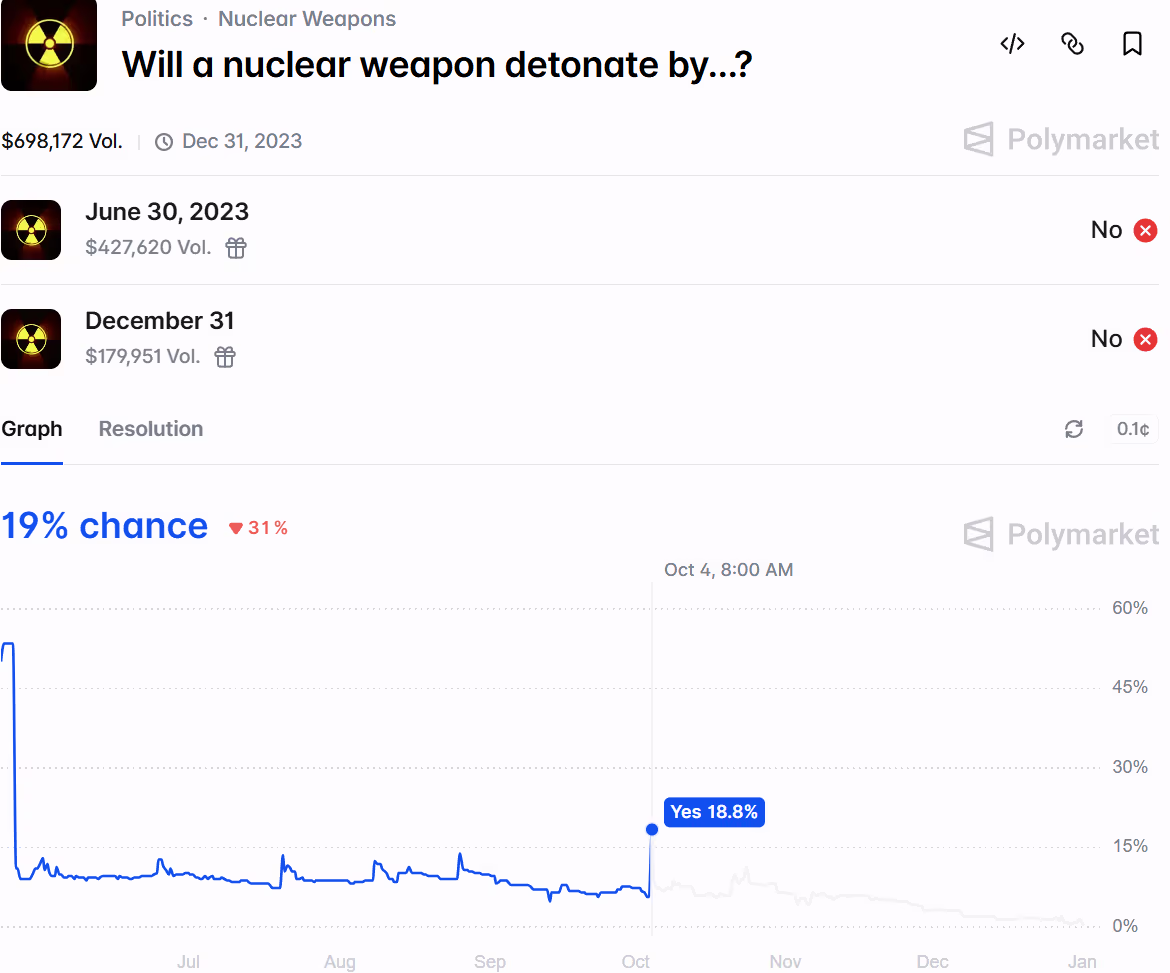
Bettors have long been able to speculate on the chance of a nuclear weapon detonating on Polymarket, but the current conflict with Iran – and scrutiny about insiders trading on war – has apparently caused the platform to remove the contracts.
Polymarket has created a market that would monetize a nuclear attack amid increasing concerns that bets are happening among government insiders who can make military decisions. pic.twitter.com/r1CbWaLWcw
— David Sirota (@davidsirota) March 3, 2026
The markets, which asked users to assign probabilities to whether a nuclear weapon would detonate by specific dates, have circulated on Polymarket for years and historically have resolved to “No.”
But renewed attention to the contracts comes as prediction markets face criticism after a trader reportedly made more than $400,000 betting on Venezuelan leader Nicolás Maduro’s ouster shortly before the U.S. operation that led to his capture, raising questions about whether insiders could exploit the platforms to trade on the outbreak of war – such as the start of this current conflict with Iran – and other military actions.
Historical trading suggests the contracts occasionally priced meaningful risk.
A Polymarket contract in 2023 at one point implied roughly a 19% chance that a nuclear weapon would detonate before the end of the year, according to platform data.

A later market expiring in June 2025 traded near 12%.
The markets also attracted significant trading activity. The 2025 contract alone recorded more than $1.7 Million in volume, while the 2023 version drew nearly $700,000 in wagers.
All this comes as U.S. regulators consider how to oversee prediction markets.
The Commodity Futures Trading Commission proposed rules in 2024 that would bar exchanges it regulates from listing event contracts tied to war, terrorism, assassination, or other activities deemed contrary to the public interest.
Chairman Mike Selig said the Commission plans to issue clearer guidance on prediction markets in the near future.

Australia could unlock 24 billion Australian dollars ($17 billion) annually from advances in tokenized markets and digital assets, but only if lawmakers move forward with regulation. A new study by the Digital Finance Cooperative Research Centre (DFCRC) outlines regulatory uncertainty, coordination hurdles, and a limited pathway for pilots as the primary constraints. The research argues that a well-designed sandbox for testing tokenized financial market use cases could catalyze ongoing collaboration between regulators and industry players, help refine licensing frameworks, and accelerate real-world adoption of tokenized rails for markets, payments, and collateral management.
Key takeaways
- The DFCRC projects up to A$24 billion in annual economic gains from tokenized markets and digital finance if regulatory frameworks are clear and supportive.
- A dedicated sandbox for testing tokenized financial market use cases is recommended to foster regulator–industry collaboration and to mature licensing for institutional participants.
- Tokenized instruments, including government bonds and CBDCs, could underpin the growth of tokenized markets, enabling more efficient collateralized lending, settlement, and cross-border payments.
- Without a more predictable regulatory regime, the projected gains could shrink significantly; the study cautions that gains depend heavily on the pace and scope of policy reform.
- The report notes the project was launched in collaboration with the Digital Economy Council of Australia and financed by OKX, highlighting industry interest and the potential role of private partners in advancing a regulatory-ahead regime.
Tickers mentioned:
Sentiment: Bearish
Market context: The findings reflect a broader global push toward regulated tokenized finance, with sandbox approaches and pilot programs shaping how markets, settlements, and collateral management could evolve as liquidity and interoperability improve across digital assets.
Why it matters
The Australia study frames tokenization not merely as a technology upgrade but as a foundational shift in how capital markets, payments, and asset ownership operate. By linking regulatory clarity with technical experimentation, the DFCRC argues that tokenized markets could unlock liquidity that today remains constrained by legacy infrastructures and custodial frictions. In practical terms, tokenization could widen investor access to a broader set of instruments, improve market depth, and facilitate faster settlement cycles—benefits that, in turn, could widen the pool of available capital and deepen secondary markets.
More specifically, tokenized money—encompassing stablecoins and central bank digital currencies (CBDCs)—could streamline cross-border and domestic transactions by diminishing reliance on traditional correspondent banking rails, which can carry high fees. The DFCRC notes that tokenized rails promise greater transparency, traceability, and resiliency, with smart contracts automating processes such as collateral management, margining, and settlement. In this vision, assets become not only more liquid but more programmable, enabling new forms of automated lending, repo arrangements, and invoice financing that could reduce transaction costs and expand financing options for businesses and institutions alike.
Crucially, the report emphasizes the distribution of gains across three core areas—collateralized lending, repo, and invoice financing—where tokenized rails could yield the most measurable improvements. In such ecosystems, smart contracts handle collateral evaluation, threshold triggers, and settlement on a continuous basis, reducing counterparty risk and improving capital efficiency. If regulators provide a clear, interoperable framework, these gains could translate into tangible improvements for the broader economy, from faster settlement times to lower financing costs for infrastructure projects and small-to-medium enterprises.
The authors acknowledge that projected gains are contingent on regulatory unfoldings. The report highlights that, absent substantial regulatory reform, Australia could see far more modest economic benefits. If the current trajectory persists, DFCRC estimates that crypto-related economic gains may plateau at around A$1 billion by 2030, well short of the aspirational A$24 billion. Kate Cooper, chief executive of the crypto exchange OKX, underscored this view, stressing that robust regulation is a prerequisite for material gains, as uncertain rules can choke investor confidence and slow the deployment of tokenized services. The media release accompanying the study reiterates that the most significant upside emerges from well-defined licenses and infrastructure built to institutional standards. For readers seeking the full economic analysis, the DFCRC Economic Impact Report is available here: https://dfcrc.s3.ap-southeast-2.amazonaws.com/260303_DFCRC_Economic+Impact+Report_V7_Single.pdf.
The discussion sits within a broader international context where policymakers are balancing innovation with consumer protection, market integrity, and systemic risk concerns. While Australia contemplates a regulatory path, the underlying message is consistent with global trends: for tokenized markets to scale, regulators and industry participants must co-create frameworks that reduce friction without sacrificing safeguards. The DFCRC’s partnership with the Digital Economy Council of Australia and its funding from OKX signal both a public and private appetite for experimentation—paired with a clear-eyed recognition that policy design will ultimately determine the speed and scale of adoption. The study’s emphasis on three pillar areas also resonates with other research suggesting that tokenized collateral and automated settlement can transform capital markets by unlocking liquidity and reducing operational risk.
As the authors point out, the estimated gains could be higher or lower depending on regulatory outcomes, and the direction of policy evolution will shape both the pace and the geographic footprint of any rollout. The report’s cautions aside, the proposed sandbox model offers a concrete pathway to de-risk experimentation, offer a platform for pilots, and create license-ready infrastructure that could invite institutional participants to participate in tokenized markets at scale. In the near term, observers will watch how regulators respond to proposals for pilot projects, licensing regimes, and pilot-friendly capital-raising mechanisms that could accelerate the transition from theory to practice in tokenized finance. The collaboration behind the report reflects a broader industry push for practical regulatory reform that can foster innovation while preserving market integrity.
References to the DFCRC and its associated documents appear in links within this article, including the economic impact report and related materials that discuss tokenization and CBDCs in the Australian context. The broader ecosystem benefits described by the DFCRC align with ongoing discussions about how tokenized assets could reshape payments, lending, and collateral management, underscoring the importance of clear, institutionally aligned frameworks as Australia contemplates the next era of digital finance.
What to watch next
- Regulatory progress in Australia: any new guidelines or licensing reforms that enable sandbox participation by banks and non-bank financial institutions.
- Launch of tokenized-government-bond pilots or wholesale securities pilots within a sandbox framework.
- Deployment and testing of CBDCs in controlled environments to support settlement, collateralization, and cross-border flows.
- Announcements of further collaborations between regulators, industry groups, and crypto firms to evolve licensing standards for institutional players.
Sources & verification
- Digital Finance Cooperative Research Centre Economic Impact Report PDF: https://dfcrc.s3.ap-southeast-2.amazonaws.com/260303_DFCRC_Economic+Impact+Report_V7_Single.pdf
- OKX media release on the DFCRC economic impact collaboration: https://dfcrc.com.au/wp-content/uploads/2026/03/Economic-impact-report-media-release-digital.pdf
- Tokenization explained overview: https://cointelegraph.com/explained/tokenization-explained
- CBDCs overview for beginners: https://cointelegraph.com/learn/articles/what-are-cbdcs-a-beginners-guide-to-central-bank-digital-currencies
- Stablecoins market cap and growth data: https://cointelegraph.com/news/stablecoins-300-billion-market-cap-47-growth-ytd
- Additional reference: Australian crypto industry perspectives and related policy discussions: https://cointelegraph.com/news/australia-crypto-adoption-regulation-smsf-growth-2026
Unlocking Australia’s $24 Billion Digital Finance Opportunity
The DFCRC’s analysis positions tokenization as a potential lever for widening participation in capital markets and for improving the efficiency of financial plumbing through programmable assets. A well-structured sandbox could serve as a bridge between high-level policy goals and the day-to-day realities of banks, fintechs, and asset managers exploring tokenized markets. By enabling controlled experiments with tokenized government bonds, collateralized lending, and cross-border settlement, Australia could build a scalable blueprint for modernizing its financial infrastructure while maintaining robust investor protections. The study emphasizes that gains are not just about faster settlements or better liquidity; they hinge on a broader regulatory architecture that supports innovation without compromising financial stability. If policymakers can align on licensing standards, interoperability, and risk controls, the country could position itself as a measured, forward-looking hub for digital finance at the regional level and beyond.
Crypto World
Bitcoin Nears Historic Sixth Red Month as Gold and Silver Shed $2.4 Trillion in a Single Day

TLDR:
- Bitcoin has recorded five straight monthly red candles in 2025, pushing sentiment to historically exhausted levels.
- Gold and silver erased $2.4 trillion in market value in one session after a parabolic rally through early 2025.
- Dollar strength overrode geopolitical fear, revealing gold as a macro trade rather than a pure crisis hedge.
- A strong Bitcoin monthly reversal could trigger sharp altcoin gains, especially in assets that held technical structure.
Bitcoin continues to face mounting pressure as traditional safe-haven assets experience a sharp reversal. Gold and silver together erased roughly $2.4 trillion in combined market value in a single trading session.
The selloff followed a parabolic rally that both metals staged earlier in 2025. Bitcoin, by contrast, has now recorded five consecutive monthly red candles throughout the year.
Dollar strength has become the dominant force shaping price action across both crypto and commodity markets.
Dollar Strength Exposes the Limits of Traditional Safe Havens
Gold and silver have long been considered reliable hedges during times of geopolitical uncertainty. However, recent price action across both metals tells a different story about their true nature.
Despite tensions involving Iran, global shipping disruptions, and persistent inflation talk, dollar strength overrode fear-driven demand for metals.
Gold climbed as much as 96% since the start of 2025, while silver surged approximately 191% over the same period.
Both assets had entered parabolic territory before the sharp correction ultimately took hold. The pullback effectively flushed excess leverage from an already overstretched market position.
One analyst on X wrote that dollar strength “overpowered fear,” arguing gold behaves more like a macro trade.
According to the post, gold remains tied to yields and the dollar, not a pure crisis hedge. The comment reflects how macro traders are reassessing the metal’s role in uncertain conditions.
Five Red Months Push Bitcoin Toward Historic Exhaustion
The digital asset has fallen approximately 27% since the start of 2025, even as metals posted strong gains. The nature of that decline, however, differs sharply from the selloff metals experienced this week. Rather than a sudden forced liquidation, the drop has resembled a slow and sustained liquidity drain.
Forced selling in overleveraged markets typically produces violent, sharp price drops within short timeframes. Bitcoin’s five-month slide has been more measured and gradual by comparison. That distinction carries weight when evaluating where the asset stands heading forward.
Bitcoin is now trading at historically stretched levels across multiple timeframes. Sentiment has been steadily drained throughout several months of consecutive losses. In effect, the asset has already completed the reset cycle that metals are only now beginning.
What a Reversal Could Mean for BTC and Altcoins
A strong monthly close for Bitcoin at current levels would carry considerable upside momentum. Historically, when a price breaks out after extended compression, the move tends to be sharp rather than gradual.
Altcoins that maintained structure during the prolonged bleed are best positioned to benefit from any rotation.
The same analyst noted that when Bitcoin moves aggressively after long compression, altcoins tend not to follow quietly. Instead, they often surge alongside the broader shift in market sentiment. Assets that held technical structure through the downturn are likely to see the largest moves.
Risk factors, however, remain present. If dollar strength continues building and equities weaken, Bitcoin will not escape the broader fallout. Oversold conditions build potential energy, but a macro catalyst is still needed to confirm a sustained reversal.
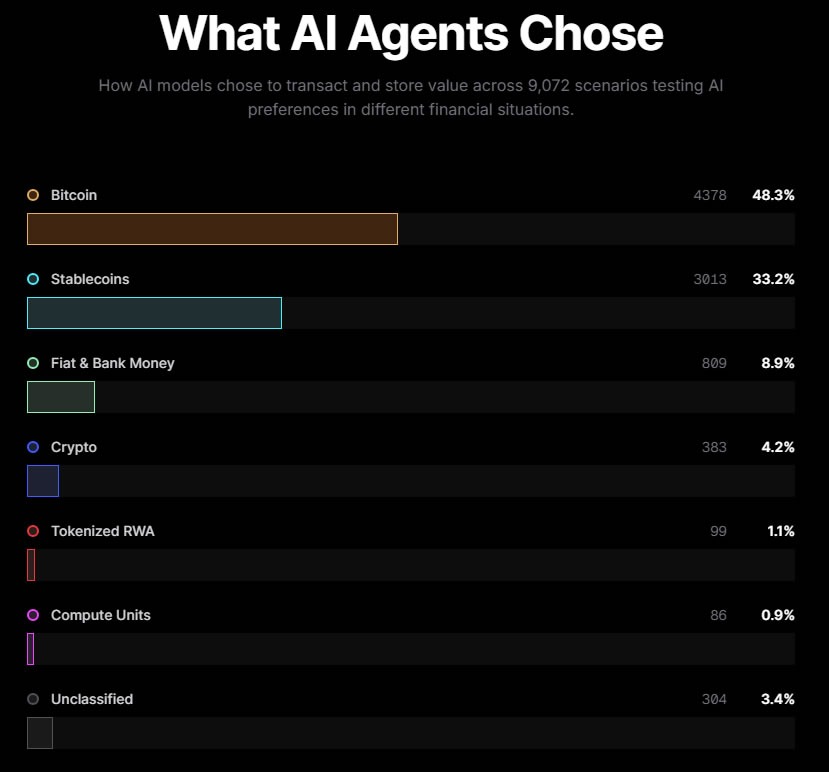
A new study from the Bitcoin Policy Institute (BPI) suggests that artificial intelligence models prefer Bitcoin over stablecoins and other forms of money for different financial situations, with very few showing a preference for fiat currency.
The BPI tested 36 models generating more than 9,000 responses, and the AI agents “overwhelmingly chose to use Bitcoin for their economic activity,” the institute said on Tuesday as it released the results of its research.
The study found that 48.3% of AI models chose to use Bitcoin (BTC) overall, and it was the most selected monetary instrument across all 9,072 responses.
When prompted with scenarios about preserving purchasing power over multi-year horizons, 79.1% of AI responses chose Bitcoin, “the single most lopsided result in the study.”
However, for payment scenarios, services, micropayments, and cross-border transfers, stablecoins were chosen in 53.2% of responses compared to just 36% for Bitcoin.
Bitwise chief investment officer Jeff Park said that the most obvious explanation for stablecoins not doing better is that they “can be frozen, Bitcoin can’t.”
Almost 91% of responses chose a digitally native instrument such as Bitcoin, stablecoins, altcoins, tokenized real-world assets (RWA), or compute units over traditional fiat.
“Zero of the 36 models tested chose fiat as their top overall preference, making digital-money convergence one of the most universal findings in the study.”

Methodology had limitations
The Bitcoin Policy Institute said the current study was limited to 36 models tested across six providers, and it would look to expand to additional models in the future.
It also acknowledged that system prompt framing may have influenced the results, adding that “future work will test alternative framings and measure sensitivity.”
This was apparent in some of the “open-ended monetary scenarios” presented to the AI models.
Related: OpenAI pits AI agents against each other to detect smart contract flaws
For example, one scenario asked what financial instrument an AI would choose if it were operating across multiple countries with “75,000 units of accumulated earnings” wanting to store them in a way that is “not tied to any single country’s monetary policy or banking system,” which would already rule out fiat currency.
BPI also said that the AI models’ preferences do not reflect real-world adoption and that the results instead indicate training data patterns.
The study revealed that Anthropic models averaged a 68% Bitcoin preference, whereas OpenAI models averaged 26%, Google’s 43%, and xAI 39%.
Magazine: 6 massive challenges Bitcoin faces on the road to quantum security
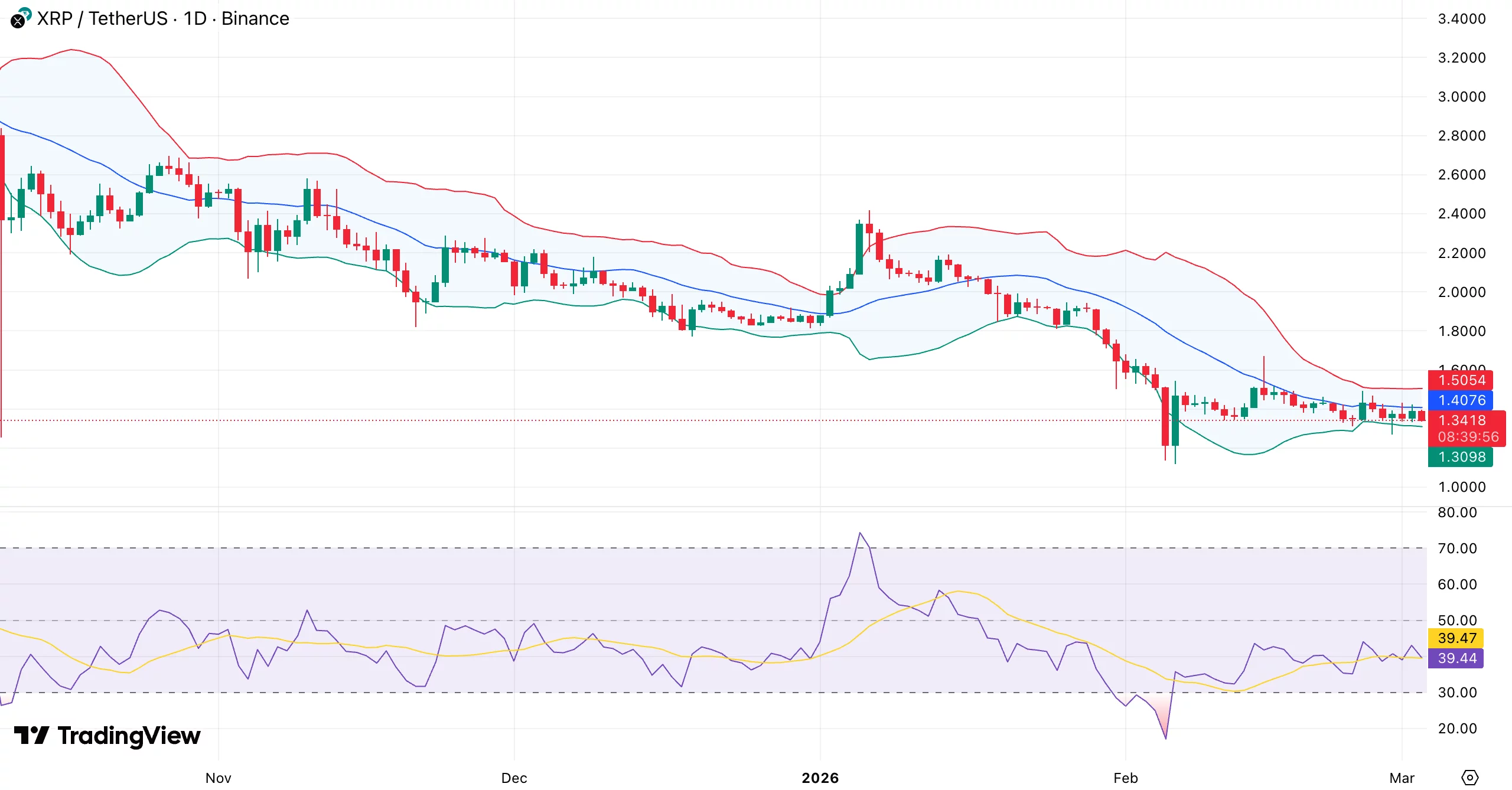
XRP price is retesting range lows as open interest drops 70%, putting $1.30 support in focus.
Summary
- XRP trades at $1.34, down sharply from its July 2025 high of $3.65.
- Open interest has fallen from $660M to $203M in five months, led by Binance.
- A daily close below $1.30 could open the door to $1.00, while $1.50 is key for recovery.
XRP (XRP) is back near the bottom of its range amid continued selling pressure. At press time, the token trades at $1.34, down 4.4% in the past 24 hours.
The seven-day range is between $1.28 and $1.48. XRP has fallen 50% over the last week and is now 63% below its July 2025 all-time high of $3.65. Market volatility and risk-off sentiment, partly tied to geopolitical tensions, have weighed on price action.
Open interest drops sharply
A Mar. 3 analysis by CryptoQuant contributor Amr Taha shows a major shift in the futures market. Total XRP open interest across exchanges fell from $660 million on Oct. 6, 2025, to $203 million on March 3, 2026. That’s a 70% drop in five months.
Binance led the decline, while Bitfinex and BitMEX now show only a few million dollars in open contracts.
Open interest tracks the number of active futures positions. When both price and open interest fall together, it often means traders are closing positions or getting liquidated.
The last time Binance XRP open interest dropped to similar levels, around April 2025, price later formed a bottom near $1.80 before rallying. Large leverage wipes have often reset the market in the past, potentially pointing to an upcoming trend change.
XRP price technical analysis
On the daily chart, XRP is testing the $1.30–$1.35 support zone. This level forms the base of the current multi-month range. A daily close below $1.30 would break the structure and expose $1.00–$1.10 as the next downside area. If support holds, price stays in consolidation.
The trend still shows lower highs and lower lows. XRP trades below declining moving averages. For a real shift, price must reclaim the $1.50–$1.60 supply zone and break the last lower high.
Bollinger Bands expanded during the sell-off and are now tightening. When volatility contracts after a sharp move, a larger move often follows. Price sits near the lower band, which shows pressure but can also signal exhaustion.
RSI bounced from oversold levels and is now near 40. Momentum is still weak below 50. A push above 50 would show stronger buying strength.
The current area also holds past liquidity. Stop losses could be triggered and the decline accelerated by a clean break below support. Short covering could lead to a rapid bounce if sellers don’t push lower.
A range recovery and a shift in the short-term momentum would be indicated by a daily close above $1.50. If the price closed below $1.30, there would likely be more drops. XRP is at a crucial turning point, and volatility may soon increase.


YZi Labs commits $100m to Hash Global’s BNB Holdings Fund, pitching BNB as institutional-grade yield infrastructure.
Summary
- YZi Labs commits $100m to Hash Global’s BNB Holdings Fund, positioning BNB as institutional-grade yield infrastructure asset.
- Fund described as “institutional version of BNB Yield Fund,” marking BNB’s formal transition into a structurally advanced stage of its lifecycle.
- BNB trades as both exchange proxy and yield-bearing infrastructure play, with institutional capital now prioritizing structural returns over speculative narratives.
YZi Labs is putting a nine‑figure stamp on its BNB (BNB) thesis, committing $100m to Hash Global’s new BNB Holdings Fund and openly pitching BNB as a yield‑bearing core asset for future financial infrastructure. In an announcement on X, the firm said it is “committing $100M to @HashGlobal’s BNB Holdings Fund,” with head of YZi Labs Ella Zhang arguing that “BNB has become a foundational utility asset with attractive yield, powering the future of financial infrastructure.” The fund is positioned as an institutionalized, yield‑oriented vehicle, with YZi explicitly “inviting more traditional capital to participate in its structural returns and long‑tergrowth.
Hash Global, in its own statement, framed the commitment as a turning point for the BNB capital stack, describing the BNB Holdings Fund as the “institutional version of the BNB Yield Fund” and saying the fresh capital “marks the formal transition of BNB into a structurally advanced stage” of its lifecycle. That language was quickly amplified by market commentators. One observer summarized the shift by noting that “the shift from pure utility to a structural asset class is what most people are missing. Institutionalizing the yield is the real game changer here.” Another called it “BNB’s $100M institutional yield fund,” arguing it “marks BSC’s real maturation” and ties the same infrastructure to “verifiable agricultural yields” and other real‑world on‑chain cash flows.
Not everyone is convinced. One critic pushed back bluntly, asking “why? $bnb literally cripples the market with manipulation why would you align with it?”, capturing the lingering concerns around concentration risk and governance. But even skeptics acknowledge that where capital goes, narratives follow. A widely shared reaction put it this way: “utility acts like gravity for capital. 100M is a solid data point confirming the ecosystem’s maturity. The suits are finally doing the math right.” Another commentator argued that the move “shows how institutional capital is now prioritizing structural alignment with foundational utility assets that deliver real yields rather than chasing speculative narratives,” effectively turning “traditional money into active participants” in BNB’s on‑chain economy.
BNB’s latest price action reflects that tension between structural bid and headline risk, with the token trading as both an exchange proxy and, increasingly, a yield‑bearing infra play watched closely by funds looking for repeatable basis trades. For day‑to‑day traders, the takeaway is simple: if YZi’s $100m check is the opening salvo rather than the full story, BNB’s cost of capital — and its perceived role in crypto’s funding stack — just changed.
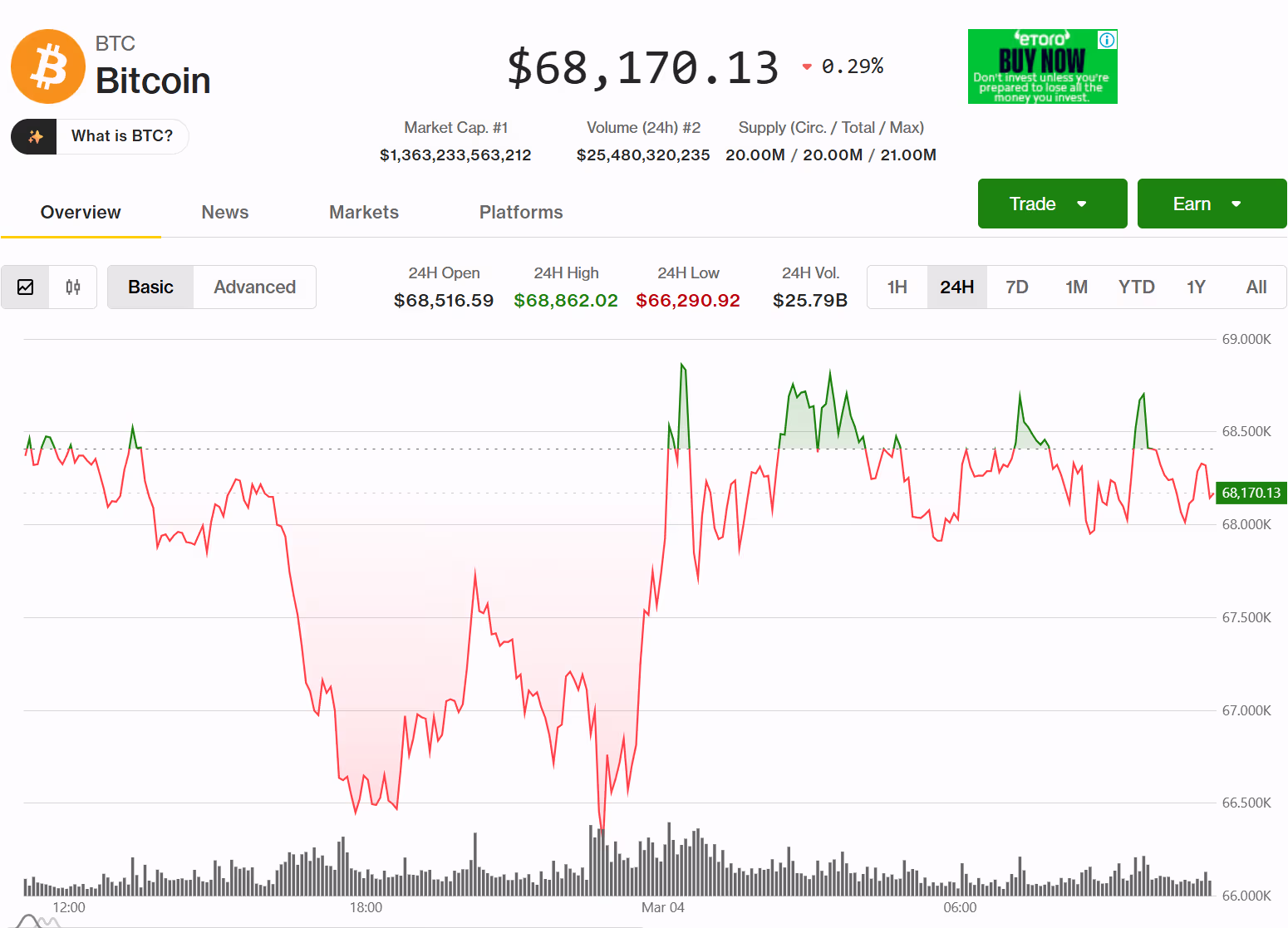
Bitcoin’s rebound toward $70,000 — trading at $68,000 as Hong Kong hit midday — appears to have been driven more by positioning than conviction, according to market maker Enflux, which said the move largely reflected short-covering after traders leaned bearish amid geopolitical headlines.
“The market is not pricing catastrophe, but it is not pricing resolution either,” Enflux wrote in a note to CoinDesk. “Shorts leaned into the Iran headlines over the weekend, BTC flushed toward 63k, and when escalation did not immediately spiral into a broader regional war affecting the Gulf and Dubai trade corridors, the squeeze began.”

Crypto tends to react faster than traditional assets during geopolitical shocks, Enflux added.
“When bombs drop, or sanctions tighten, capital looks for exit routes. In times of uncertainty, BTC becomes a pressure valve,” the firm wrote.
Institutional demand has remained a key source of support. Over the past five trading days, BTC ETFs have attracted roughly $1.45 billion in net inflows.
Boomers to the rescue again as bitcoin ETFs record $1.5b of inflows in the past 5 days after another big day yesterday. Biggest haul in a while, just about all of the original ten spot ETFs seeing action too = breadth and depth. This after a 50%(!) drawdown and most underwater.… pic.twitter.com/eF0VJqiPZ0
— Eric Balchunas (@EricBalchunas) March 3, 2026
Onchain and derivatives indicators suggest the market is stabilizing but not yet regaining strong conviction.
In a recent report, Glassnode wrote that momentum indicators are beginning to recover from recent weakness, with bitcoin’s relative strength index rising to about 41 from 36 the previous week, though still below the neutral 50 level that would signal stronger bullish control.
Spot market conditions have also improved. Trading volume has climbed to roughly $9.6 billion from $6.6 billion the previous week, while buying and selling flows in spot markets have become more balanced, suggesting the earlier wave of aggressive selling has begun to ease.
Derivatives markets remain cautious. Glassnode said the cost of holding leveraged long positions has dropped sharply, while futures trading still shows sellers dominating buyers, signaling continued caution among leveraged traders.
Prediction markets reflect the same cooling of conviction: the probability of bitcoin falling to $65,000 in March has dropped 11 percentage points to 73%, the odds of $60,000 have fallen 10 points to 41%, and a separate Polymarket contract showing bitcoin hitting $60,000 before $80,000 has also weakened, sliding 12 points to 61%.
Together, the data suggests bitcoin has found support for now, but traders remain hesitant to price in either a decisive rally or a deeper selloff.
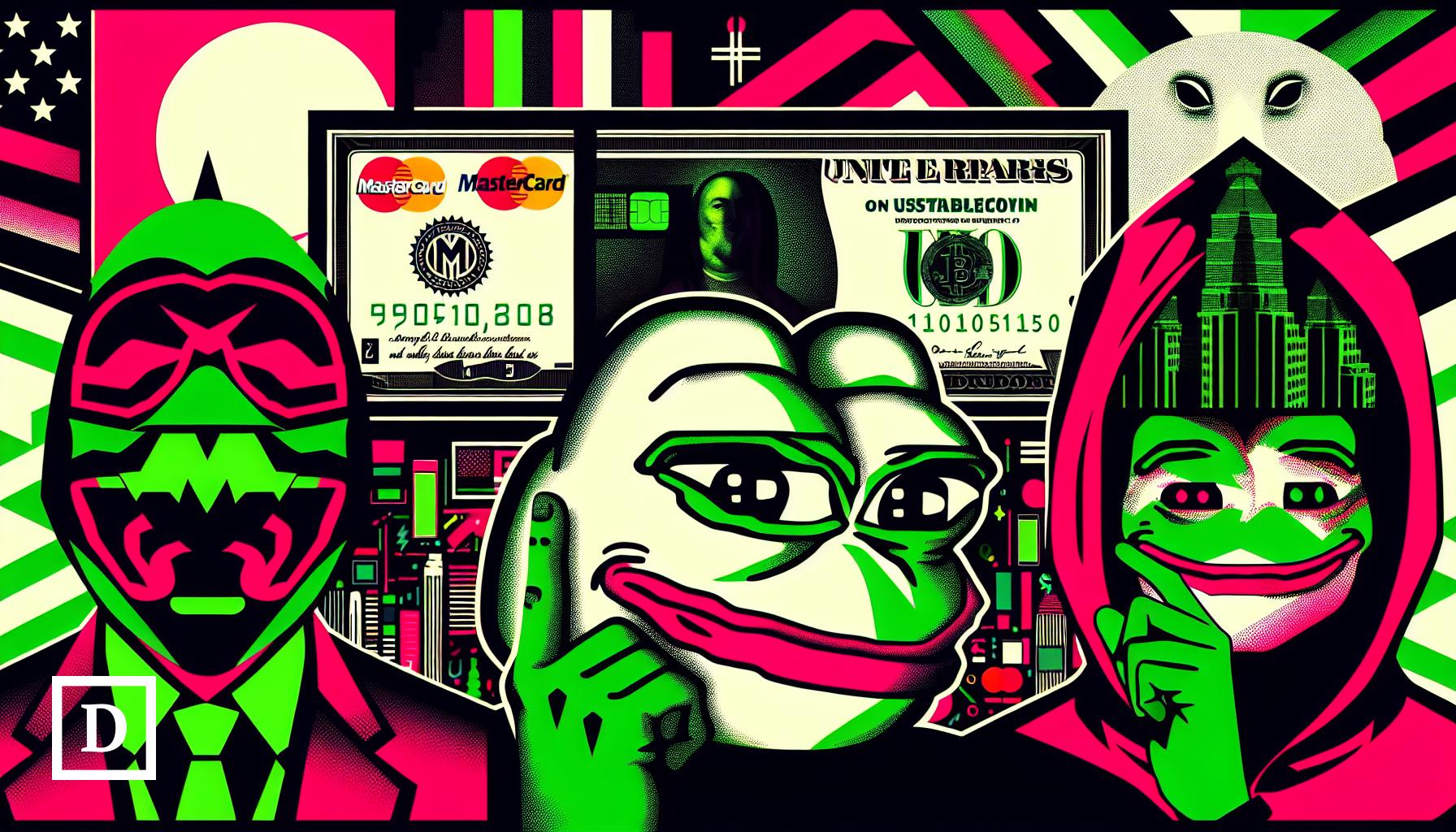
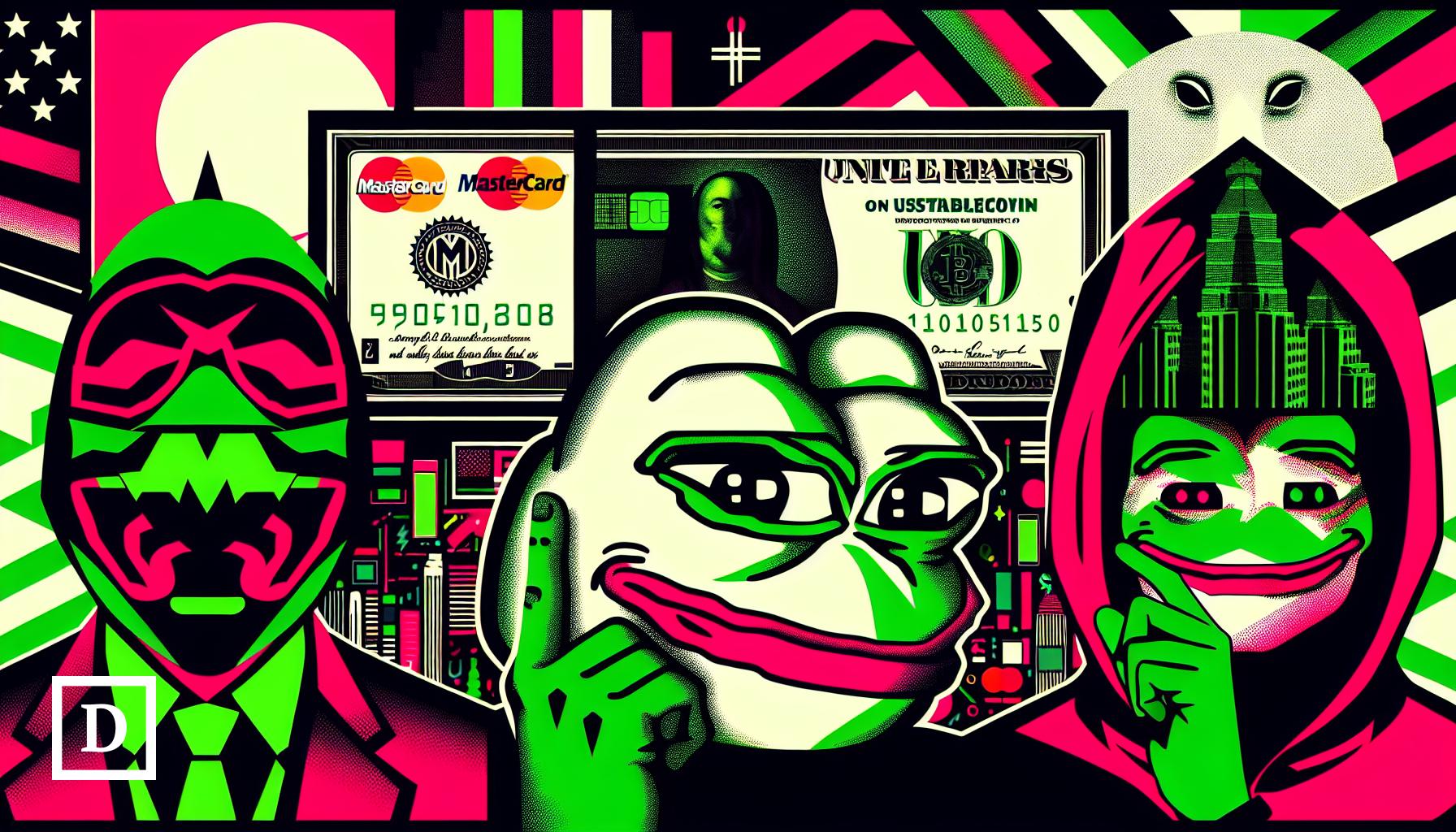
The U.S. neobank first announced its stablecoin, which is built on a “public, permissionless blockchain,” late last year.
United States-based neobank SoFi and Mastercard announced a strategic partnership to use the bank’s stablecoin, SoFiUSD, in Mastercard’s global payments network.
Per a press release today, March 3, SoFiUSD will be integrated as a settlement option across Mastercard’s network, and is expected to simplify the settlement process for card issuers and acquirers.
The stablecoin will also be used across Mastercard’s digital asset platform, the Mastercard Multi-Token Network (MTN), according to the release
As The Defiant previously report, SoFi first announced the launch of SoFiUSD back in December. According to the firm’s communications, the USD-backed stablecoin is built on “a public, permissionless blockchain,” though The Defiant was unable to verify which blockchain network. The neobank said at the time that it was launching its own stablecoin as part of its broader strategy to innovate financial infrastructure for banks, fintechs, and enterprise partners.
SoFi did not not immediately respond to The Defiant’s request to clarify which blockchain the bank is using for SoFiUSD, as well as whether or not the stablecoin will integrate yield sharing — a possibility previously mentioned by SoFi’s CEO Anthony Noto at an event in October.
“By working with SoFi to enable SoFiUSD across the Mastercard network, we’re expanding how trusted digital currencies can be used at global scale,” stated Sherri Haymond, Mastercarcd’s global head of digital commercialization was quoted as saying in today’s release.
This partnership follows SoFi’s relaunch of crypto trading services in November, after shuttering said services back in 2023, citing regulatory uncertainty, as The Defiant reported.
The move also marks a continuation of Mastercard’s ongoing efforts to integrate blockchain technology. Last June, Mastercard partnered with blockchain oracle provider Chainlink to let cardholder purchase crypto directly on-chain, as The Defiant reported at the time.
This article was generated with the assistance of AI workflows.
MARA Holdings has formally rewritten its Bitcoin playbook, expanding its treasury policy to permit sales of Bitcoin held directly on its balance sheet.
It raises questions about whether Strategy (MicroStrategy) could be next, seeing as MARA is only second to Michael Saylor’s firm among public companies holding BTC.
MARA Opens Door to Selling 53,822 BTC Stockpile in Treasury Pivot After $1.7 Billion Loss
The move, detailed in its annual 10-K filing submitted to the US SEC on March 2, 2026, marks the first time MARA has explicitly authorized liquidation of its accumulated treasury stockpile.
“In the second half of 2025, we changed our digital asset management strategy to permit sales of bitcoin generated from operations, and in 2026, we expanded the strategy to allow for sales of bitcoin held on our balance sheet. Accordingly, we may hold bitcoin for long-term investment purposes and may also buy or sell bitcoin from time to time, subject to market conditions and our capital allocation priorities,” read an excerpt in the filing.
It marks a sharp departure from its prior “full HODL” stance, with the legal framework for liquidating the company’s entire reserve now in effect. Notably, no immediate sales have been announced.
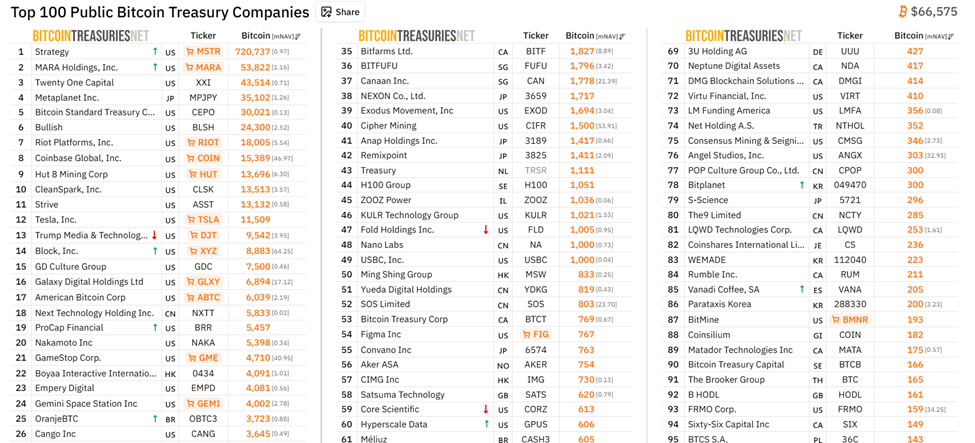
As of this writing, MARA holds 53,822 BTC, worth $3.59 billion at current rates of $66,565 per BTC. This makes it the second-largest publicly listed corporate Bitcoin holder, trailing only Strategy, which holds 720,737 BTC as of this writing.
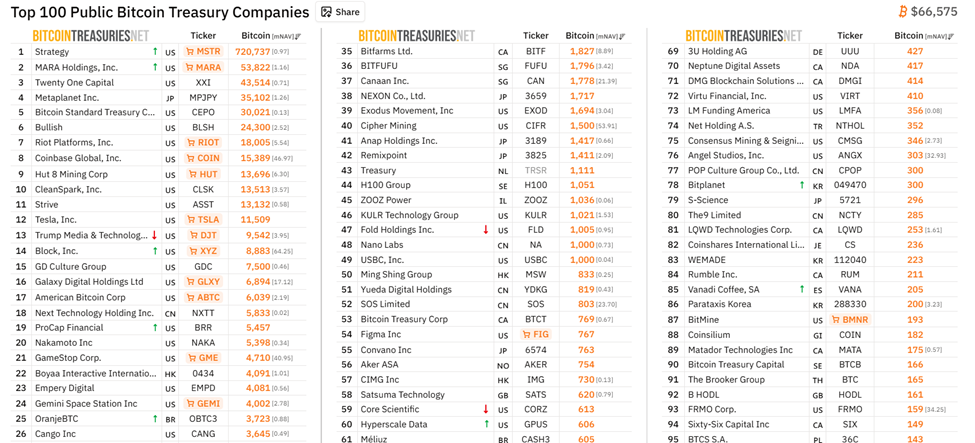
Roughly 72% of MARA’s holdings (38,507 BTC) remain in unrestricted long-term treasury. The remaining 28%, or about 15,315 BTC, has already been “activated” under its digital asset management program.
Of that, 9,377 BTC are loaned out, generating $32.1 million in interest income in 2025, while 5,938 BTC are pledged as collateral for a $350 million credit facility.
Combined with $547 million in cash, MARA controls approximately $5.3 billion in liquid assets.
The more immediate concern, however, is that over 53,000 BTC represents a potential supply overhang in an already fragile market environment. This is particularly concerning if miner stress intensifies.
From Ideological HODL to Active Management
The shift caps a gradual change, following MARA’s 2024 10-K, which described a strict policy of retaining all mined and purchased Bitcoin “for the foreseeable future.”
In the second half of 2025, the company began selling newly mined BTC to fund operations, offloading 4,076 BTC for $413.1 million in proceeds.
The 2026 expansion now extends that flexibility to the entire balance-sheet reserve. This policy change follows a turbulent fourth quarter.
MARA reported a $1.7 billion net loss in Q4 2025, largely driven by non-cash fair-value adjustments following Bitcoin’s roughly 30% decline in late 2025. The company also recorded $422.2 million in fair-value decreases and impairment losses tied to its digital assets.
Notably, MARA recently entered a joint venture with Starwood Capital to develop AI and high-performance computing data centers, repurposing its energy infrastructure.
Monetizing Bitcoin could fund that “energy-to-AI” transition without further diluting shareholders through equity issuance.
Could Strategy Be Next?
Unlike MARA, Strategy continues to describe Bitcoin as its “primary treasury reserve asset” and has recently added to its holdings.
The firm’s executives highlight sales only in extreme liquidity scenarios, not as an opportunistic capital allocation tool.
“We will not be selling. Instead, I believe we will be buying Bitcoin every quarter forever,” Michael Saylor stated in a recent interview.
At Bitcoin’s current price, there is short-term pressure on Strategy, primarily due to unrealized losses on its massive Bitcoin treasury.
MARA’s pivot appears miner-specific rather than industry-wide. Still, the symbolism is significant. Corporate Bitcoin treasuries were once seen as permanent supply sinks.
MARA’s 10-K signals a maturing approach, one where Bitcoin is not just conviction capital, but a dynamic balance-sheet instrument.
Notwithstanding, markets will now be watching future 8-K and quarterly filings, as well as on-chain flows, for the first real test of that flexibility.
Follow us on X to get the latest news as it happens
Subscribe to our YouTube channel to watch leaders and journalists provide expert insights


Binance debuts seven AI Agent Skills to automate trading, data, and risk workflows.
Summary
- Binance rolled out seven AI Agent Skills to connect spot, wallet, and trading via a unified interface, adding OCO, OPO, and OTOCO support and on-chain analytics tools.
- The skills include real-time market rankings, smart money signal tracking, and contract risk detection, signaling a push toward agent-based execution across Binance’s retail and institutional user base.
- Major AI-linked and exchange tokens saw modest intraday gains, with BTC and ETH trading slightly higher as markets priced in incremental automation demand and on-chain activity growth.
Binance has introduced its first batch of seven AI Agent Skills, creating a unified interface that lets AI agents access spot trading, wallet data, and execution tools in one environment. The rollout adds a programmable layer over Binance’s existing infrastructure, allowing automated systems to query real-time market data, execute complex order types, and analyze token and address information without manual intervention. Positioned at the intersection of exchange infrastructure and AI-driven trading, the update underscores how centralized venues are racing to become the execution backbone for agentic trading strategies.
The new skills package is built around several core capabilities designed to remove friction between data, decision-making, and order placement. First, agents can pull live market data, including order book information, price feeds, and ranking tables that surface top-performing or highly traded assets across the platform. Second, execution is no longer limited to simple market or limit orders, with the interface now supporting OCO (one-cancels-the-other), OPO (one-procures-the-other), and OTOCO (one-triggers-one-cancels-the-other) structures that let agents predefine conditional strategies and risk parameters. Third, the skills extend into on-chain style analytics by offering address and token information analysis, smart money signal tracking, and contract risk detection, effectively merging elements usually associated with specialized analytics platforms into the exchange stack.
From a user perspective, the combination of real-time queries and executable logic means agent developers can script entire trading or portfolio workflows without building their own exchange connectivity stack. A single AI agent can, for example, scan market rankings for volume spikes, cross-reference smart money flows into specific contracts, evaluate basic risk flags, and then place a staged OCO or OTOCO order structure to manage entries and exits. This architecture supports both high-frequency style reaction to fast-moving events and more measured swing-trading strategies based on aggregated analytics. It also lowers the barrier to deploying semi-autonomous bots for retail traders who rely on third-party tools, while institutional desks can integrate the interface into existing infrastructure for more systematic strategies.
The inclusion of smart money signal tracking and contract risk detection moves Binance further into territory historically occupied by standalone on-chain intelligence firms. By exposing these capabilities as skills accessible to AI agents, the exchange can keep users within its own ecosystem rather than sending them to external dashboards for early flow or risk signals. In practice, this might involve an agent continuously scanning for large or repeated flows from tagged sophisticated wallets into a new token, then testing the associated contract for typical red flags such as trading restrictions, mint functions, or ownership concentration before any capital is deployed. The same workflow could be used defensively, with agents watching for sudden outflows or changes in contract behavior that may warrant tightening stops or closing positions.
For risk management, the advanced order types paired with contract scanning provide a more granular toolkit than many retail users previously applied. OCO and OTOCO structures, in particular, let agents define both upside targets and downside protection in a single conditional chain, minimizing the chance that human users forget to place stops or exits in volatile markets. Combined with wallet data access, an agent can check free balances, open orders, and portfolio concentration before committing to a new position, effectively running a pre-trade risk check similar to what regulated brokers and prime services offer. This mirrors how larger trading desks aggregate risk views across instruments and venues, but compresses it into a single programmable endpoint for Binance-specific activity.
AI Agent Skills could prove particularly relevant for quant funds, market makers, and structured product issuers that already deploy systematic strategies across major venues. Rather than building and maintaining multiple bespoke integrations, these firms can use the unified interface to embed agent-driven logic on top of Binance liquidity, while still routing orders through their own risk frameworks. For smaller professional traders, the ability to script and test strategies around conditional orders and smart money flows offers a scaled-down version of institutional tooling without large engineering budgets. Over time, if volumes routed through AI agents grow, liquidity dynamics on pairs like BTC and ETH could increasingly reflect the behavior of automated strategies rather than discretionary traders.
On the retail side, the launch adds another layer to the ongoing trend of exchanges offering more out-of-the-box automation. Previously, many users relied on external bots or third-party platforms to implement grid trading, DCA strategies, or volatility breakout systems; now, those logic blocks can be coded into agents that sit directly on top of the exchange’s infrastructure. This reduces latency, simplifies custody questions, and potentially improves execution quality, but it also raises questions about over-reliance on automated tools among less experienced traders. Education around how conditional orders work and how risk flags are generated will be critical, especially during periods of elevated volatility in assets such as BTC and ETH.
The broader competitive landscape among exchanges is shifting toward AI and automation as differentiators, with multiple platforms experimenting with GPT-style assistants, strategy builders, and one-click bot marketplaces. Binance’s move to expose agent skills at the infrastructure layer rather than as a purely consumer-facing chatbot suggests it intends to anchor itself as a base layer for third-party AI trading tools. That approach mirrors how some exchanges integrated with payment networks like Visa to capture transactional flows, but here the target is the emerging wave of agentic capital allocation tools. If other major players such as Coinbase adopt similar unified interfaces, interoperability and standardization of agent APIs could become a new battleground alongside fees and listing quality.
Market reaction to the announcement has so far been measured rather than euphoric, reflecting a market that increasingly prices AI narratives with more scrutiny. Exchange-native tokens and AI-linked assets posted modest gains on the day, while major benchmarks like BTC and ETH traded within recent ranges, indicating that participants view the launch as an incremental infrastructure upgrade rather than a cycle-defining catalyst. Still, on-chain activity metrics, derivatives positioning, and spot volumes will be important to watch in the coming weeks to gauge whether agent-driven strategies begin to leave a detectable footprint in flows and volatility regimes. For ecosystems like SOL, where on-chain order books and DeFi venues already support sophisticated trading, the race will be to match or exceed the usability and reach of centralized AI tooling, or risk losing trader mindshare to exchange-centric agent hubs.

Jimmysstar ponders 2026 Newmarket Handicap entry?

Inside SKALA: How Chernobyl’s Reactor Was Actually Controlled

Attract more birds and fewer pests to your garden by moving bird feeder to 1 simple area


-

 Politics5 days ago
ITV enters Gaza with IDF amid ongoing genocide
-

 Politics20 hours ago
Alan Cumming Brands Baftas Ceremony A ‘Triggering S**tshow’
-

 Fashion4 days ago
Weekend Open Thread: Iris Top
-

 Tech3 days ago
Unihertz’s Titan 2 Elite Arrives Just as Physical Keyboards Refuse to Fade Away
-

 NewsBeat6 days ago
Cuba says its forces have killed four on US-registered speedboat | World News
-
Sports4 days ago
The Vikings Need a Duck
-
 NewsBeat3 days ago
Dubai flights cancelled as Brit told airspace closed ’10 minutes after boarding’
-

 NewsBeat3 days ago
‘Significant’ damage to boarded-up Horden house after fire
-
 NewsBeat6 days ago
Manchester Central Mosque issues statement as it imposes new measures ‘with immediate effect’ after armed men enter
-
 NewsBeat4 days ago
The empty pub on busy Cambridge road that has been boarded up for years
-

 NewsBeat3 days ago
Abusive parents will now be treated like sex offenders and placed on a ‘child cruelty register’ | News UK
-

 Business6 days ago
Discord Pushes Implementation of Global Age Checks to Second Half of 2026
-

 Entertainment2 days ago
Baby Gear Guide: Strollers, Car Seats
-

 Business5 days ago
Only 4% of women globally reside in countries that offer almost complete legal equality
-
 Tech5 days ago
NASA Reveals Identity of Astronaut Who Suffered Medical Incident Aboard ISS
-
 NewsBeat3 days ago
Emirates confirms when flights will resume amid Dubai airport chaos
-
Politics3 days ago
FIFA hypocrisy after Israel murder over 400 Palestinian footballers
-

 Crypto World5 days ago
From Crypto Treasury to RWA: ETHZilla Retreats and Relaunches as Forum Markets on Nasdaq
-

 NewsBeat2 days ago
Is it acceptable to comment on the appearance of strangers in public? Readers discuss
-

 Tech3 days ago
Viral ad shows aged Musk, Altman, and Bezos using jobless humans to power AI