
Crypto World
BTC above $65,000 even as the Senate punts the CLARITY Act to the fall

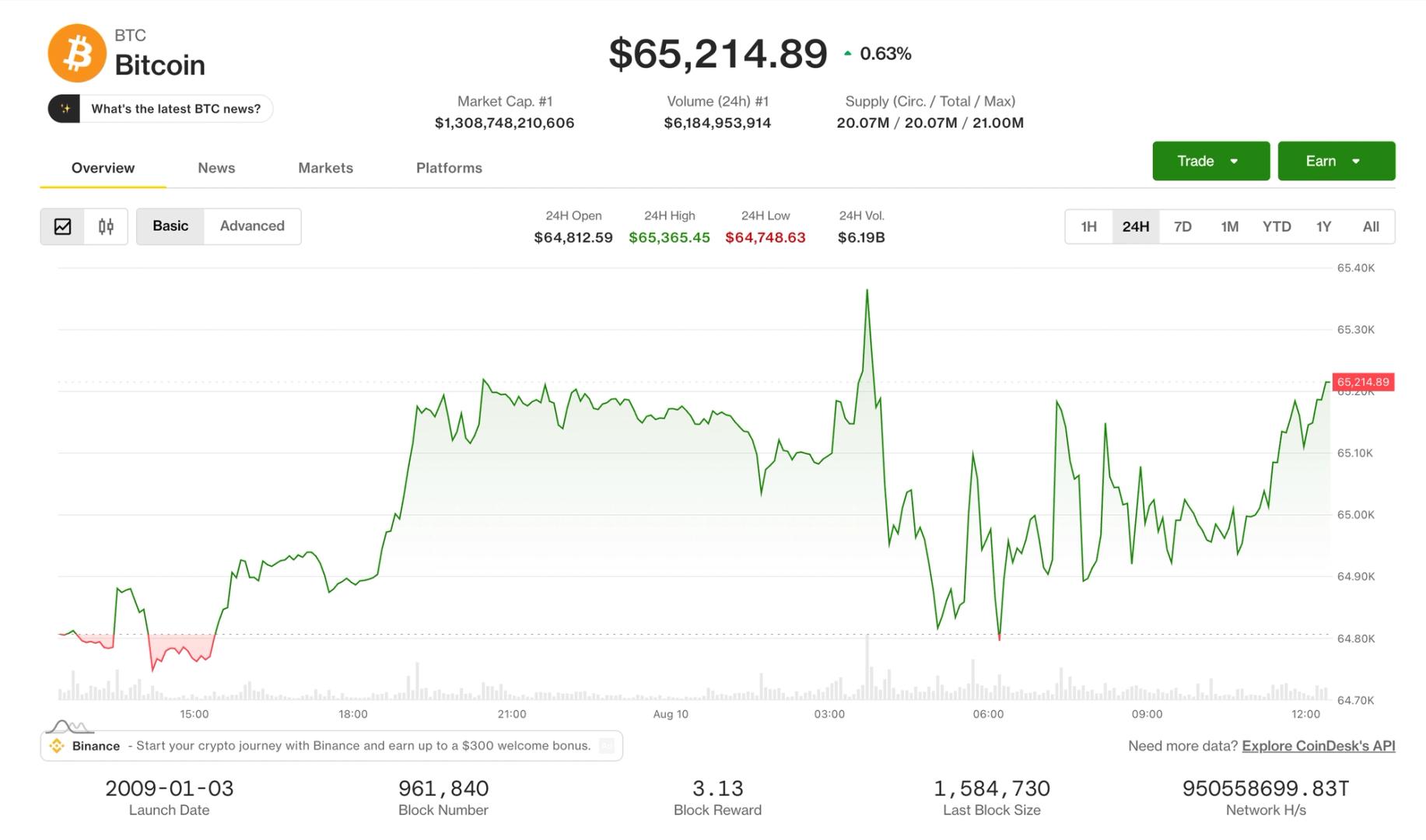
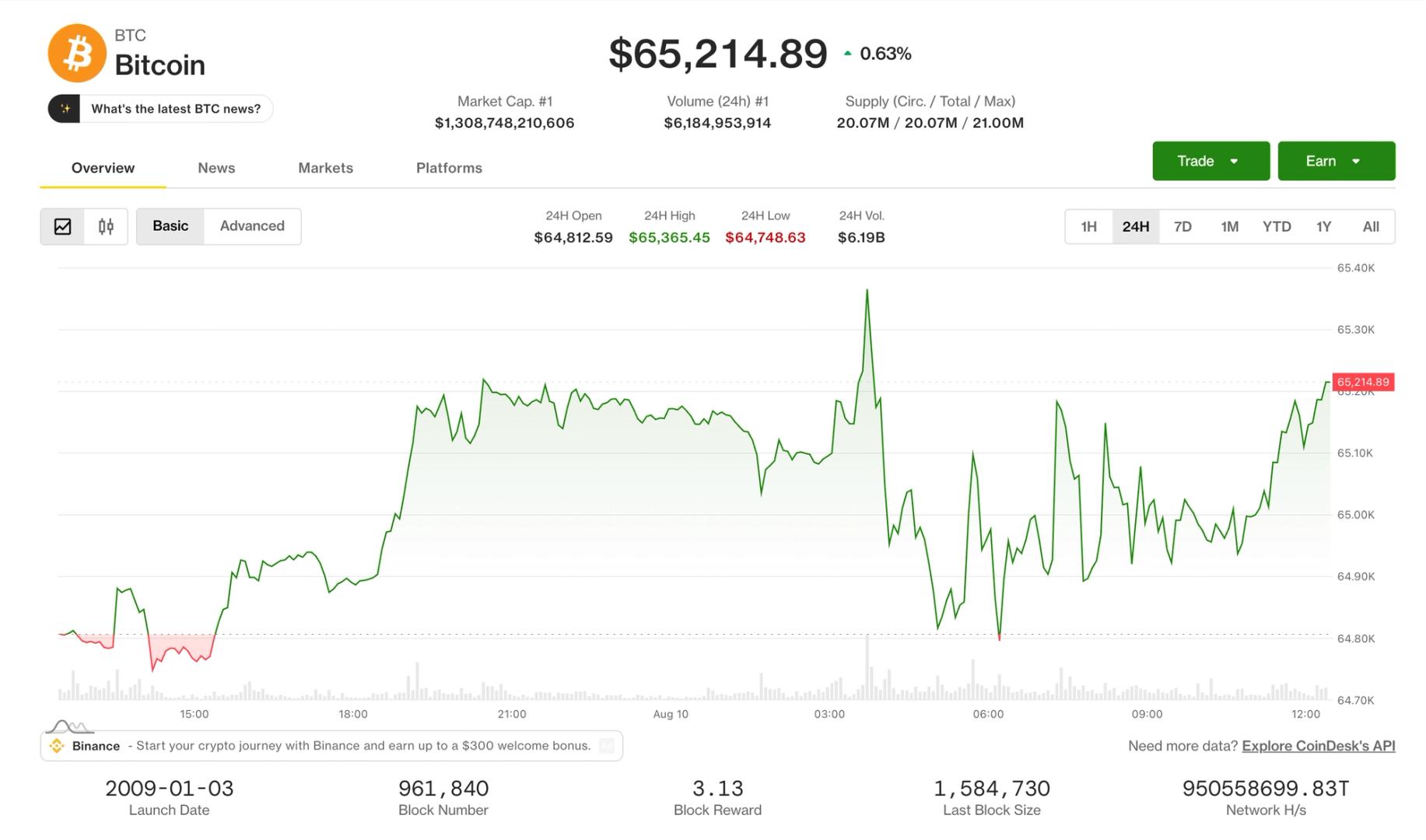
Bitcoin held near $65,200 on Monday, up 3.7% on the week, per CoinDesk data. The move caps a recovery from an early-August low near $62,000, and the whole top of the market came with it. Ether traded near $1,925 and BNB, Solana and TRON all posted weekly gains.
The strength held despite the Senate failing to pass the CLARITY Act before leaving for its August recess on Friday, mustering 51 of the 60 votes needed and pushing any action to September 14 at the earliest.
That the market rose anyway backs what strategists argued last week, that the delay was already priced, so the failure landed as confirmation rather than a fresh blow.
The bid is coming from flows, not headlines.
Spot ETFs have strung together consecutive days of inflows, and a softer dollar since the weak US jobs report has loosened the backdrop that pinned bitcoin through the summer.
Michael Saylor added to the mood over the weekend, posting Strategy’s bitcoin-buy chart with the caption “Doing business,” days after the firm disclosed selling about 1,638 BTC to fund buybacks, which markets read as a tease of another purchase.



The UK’s FCA is reportedly preparing a regulatory framework for tokenized gold and how these products may be used as collateral assets in wholesale markets.
The cryptocurrency market will welcome a wave of tokens worth more than $605.5 million in the second week of August 2026. Major projects, including YZY (YZY), Connex (CONX), and Arbitrum (ARB), will release previously locked supplies over the next seven days.
These unlocks could increase short-term volatility and influence price movements. So, here’s a breakdown of what to watch in each project.
1. YZY (YZY)
- Unlock Date: August 16
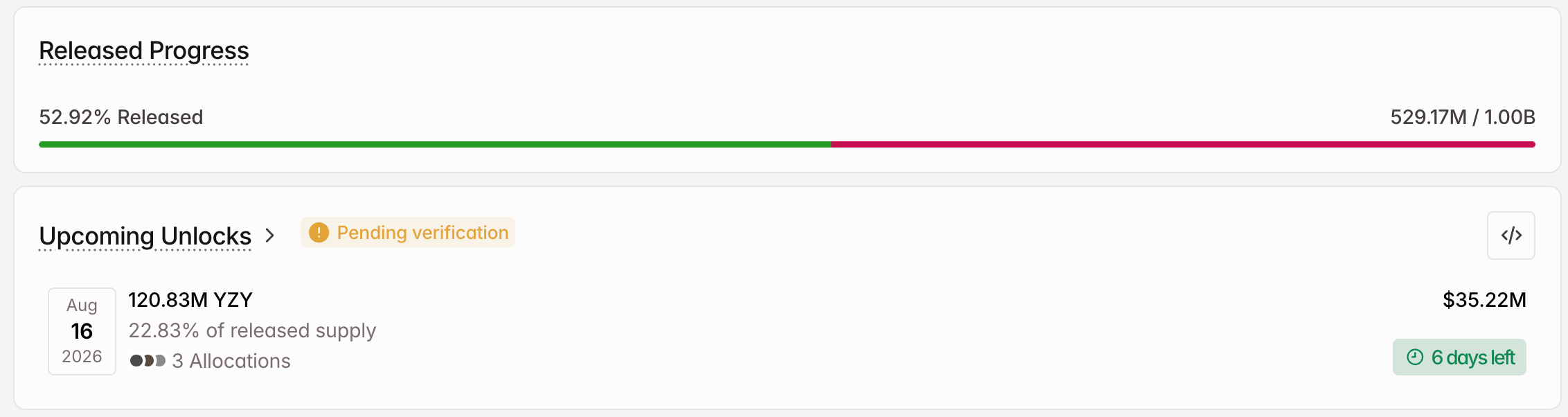
- Number of Tokens to be Unlocked: 120.83 million YZY
- Released Supply: 529.17 million YZY
- Total supply: 1 billion YZY
YZY is a cryptocurrency token associated with the rapper Ye (formerly known as Kanye West). It is positioned within the broader “YZY MONEY” ecosystem, which includes the YZY token, the payment platform Ye Pay, and the physical YZY Card.
On August 16, YZY will unlock 120.83 million tokens worth around $35.22 million. The tokens represent 22.83% of the released supply.

The team will allocate 100 million altcoins to Yeezy Investments LLC, Vesting 3 and 12.5 million tokens to Yeezy Investments LLC, Vesting 1. Moreover, it will direct 8.33 million tokens to Yeezy Investments LLC, Vesting 2.
2. Connex (CONX)
- Unlock Date: August 15
- Number of Tokens to be Unlocked: 1.32 million CONX
- Released Supply: 92.57 million CONX
- Total supply: 100 million CONX
Connex is a permissionless, open, and collaborative Web3 professional network. The project integrates blockchain with networking, promoting transparency and fair value exchange among professionals in the digital economy. Holders can use CONX for payments and governance.
Connex will unlock 1.32 million CONX tokens into the market on August 15. Moreover, the supply is worth approximately $11.55 million. It represents 1.43% of the released supply.

The team will allocate around 822,500 CONX to the ecosystem. Furthermore, the community treasury will get 500,000 altcoins.
3. Arbitrum (ARB)
- Unlock Date: August 16
- Number of Tokens to be Unlocked: 92.65 million ARB
- Released Supply: 5.74 billion ARB
- Total supply: 10 billion ARB
Arbitrum is a Layer-2 scaling solution built for Ethereum (ETH). It enhances transaction speed and reduces costs while maintaining the security of the Ethereum network.
The blockchain achieves this by utilizing ‘optimistic rollups,’ which process transactions off-chain and submit them to the Ethereum mainnet for validation.
On August 16, Arbitrum will unlock 92.65 million tokens into the market. The tokens are worth $7.19 million and represent 1.61% of the current released supply.

Arbitrum will award 56.13 million ARB from the unlocked supply to the team, future team, and advisors. Moreover, investors will gain 36.52 million tokens.
In addition to these, other prominent unlocks that investors can look out for in the second week of August include Linea (LINEA), Aptos (APT), Starknet (STRK), Sei (SEI), and more.
The post 3 Token Unlocks to Watch in the Second Week of August 2026 appeared first on BeInCrypto.
“They came to us highly recommended by an alumni CEO that we had already backed,” Rist told CoinDesk in an interview. “So, there was a lot of trust there, and this CEO said, ‘You got to meet these guys’. They were serial entrepreneurs coming out of South Africa. They’d never built businesses outside of South Africa, but they were hungry. They were relentless.”
Despite enjoying a sturdy exit, Rist said he feels mixed emotions toward the Mastercard acquisition, having been part of the whole BVNK journey. “It’s actually sad to sign the papers, almost like sending your son off to boarding school,” he said.
Chris Harmse, co-founder and chief business officer at BVNK echoed this: “It’s been an incredible journey,” he said in an email. “Concentric has been a valued partner throughout that journey.”
Stablecoins, one of the busiest areas of crypto, have become a focal point for the large card networks and payments players. The total stablecoin market cap is about $300 billion, according to CoinGecko data.
The proverbial cat was set loose among the pigeons when Stripe acquired stablecoin infrastructure firm Bridge in late 2024 for $1.1 billion. This probably put pressure on the likes of Visa and Mastercard to start kicking the tires of other stablecoin shops so as not to be outflanked by Stripe’s aggressive approach.

A Bitcoin soft fork built around BIP-110 split from the main chain after block 961,632 this week, and it barely got off the ground. The pool backing it, Roughnecks, mined exactly two blocks before the rest of the network’s hashpower left it stranded.
The split was supposed to test whether a determined group of node operators could force miners to fall in line on data spam. Instead, it showed how little leverage a minority actually has once the hashrate refuses to follow.
The Fork Stalls Within Hours
BIP-110 needed miners to signal support by block 961,632, or a mandatory signaling rule would take over. When AntPool mined the first non-signaling block, nodes running Bitcoin Knots split into their own chain. Roughnecks found blocks 961,632 and 961,633 on that branch, then nothing more. Bitcoin’s original chain kept moving at its usual pace and reached block 961,651, opening an 18-block lead within about a day.
The math comes down to difficulty. Bitcoin’s mining difficulty had just adjusted to 127.48T, a target both chains inherited. With only a sliver of total hashpower behind it, the BIP-110 branch found blocks far slower than the usual ten minutes.
BIP-110 supporter Matthew Kratter admitted that the minority chain would need “massive change” to catch up. It never came. By the time Michael Saylor addressed the split, he put the gap at more than 80 blocks and said roughly 99.85 percent of Bitcoin’s hashpower had stayed with the main chain.
Lyn Alden made a similar distinction on August 9, saying the majority of miners, economic nodes, and exchanges continued with the non-fork.
“It’s not that miners are in control,” she wrote. “The fork just didn’t have consensus.”
BIP-110 supporters have rejected that conclusion. Luke Dashjr wrote on August 9 that claims of the proposal’s failure were false. Earlier, he had argued that BIP-110 remained uncontested because no counter-fork had emerged.
However, Roughnecks put out a tweet asking those mining on the BIP-110 chain under the current algorithm to stop until further notice, with investor Fred Krueger pointing out that the lead had grown from “153 to 2.”
Bitcoin’s price barely moved through any of it. BTC traded around $65,000, up modestly on the day and nearly 4% for the week, though still down close to 45% from a year earlier.
Dispute Over Data, Not Just Block Counts
The underlying fight traces back to Bitcoin Core dropping its old limit on OP_RETURN data, which let more non-monetary data, like Ordinals and Runes, fill up blocks that BIP-110 backers wanted reserved for payments.
Farside Investors had warned weeks earlier that the fix carried its own risk. Wallets using Miniscript could still generate addresses built on soon-to-be-banned Taproot scripts, and any bitcoin sent to them after activation would become unspendable. Pay-to-public-key outputs, an old script format holding more than 1.7 million BTC, faced new restrictions too, though existing units could still be spent.
Not everyone who backed BIP-110’s goals agreed with how the attempt played out. Writer Secure Sovereign, who supported the underlying fix but not this activation path, said the effort left BIP-110 as “a distant minority with no realistic path to catching the main chain,” arguing miners never faced real risk of being forked off themselves.
Days later, Bitcoin developer Murch moved to remove Luke Dashjr from his role as a BIP editor, citing his handling of the proposal as a conflict of interest, a dispute still playing out on Bitcoin’s mailing list.
The post BIP-110 Soft Fork Implodes: Mines Just Two Blocks Before Grinding to a Halt appeared first on CryptoPotato.


Robinhood has begun offering cryptocurrency trading to eligible UK customers, giving users access to more than 50 digital assets through Bitstamp inside its main investing app.
Summary
- Robinhood has launched crypto trading for eligible UK customers with access to more than 50 digital assets.
- Crypto trades are provided through FCA registered Bitstamp UK, which Robinhood acquired for $200 million last year.
- The service has no trading, custody or account maintenance fees, while foreign exchange fees start at 0.1%.
- Robinhood has also introduced Cortex Digests for Crypto, an AI powered tool for analyzing crypto price movements.
- The launch follows Robinhood’s FCA crypto registration on July 31 ahead of the UK’s new authorization regime.
According to a Bloomberg report, the rollout starts this week and brings crypto trading alongside Robinhood’s existing UK products, which include equities, stocks and shares ISAs, options and futures.
Customers can buy and sell assets including Bitcoin, Ethereum, XRP and HYPE, with the trades handled by Bitstamp UK Ltd. Robinhood acquired the long-running crypto exchange for $200 million last year and has since used the business to support parts of its international crypto expansion.
The UK service carries no trading, custody or account maintenance fees, Robinhood said. Customers will instead pay a 0.1% foreign exchange fee when converting currencies, while certain conversions made during weekends will carry a 0.3% fee.
Robinhood crypto trading starts after FCA registration
The launch follows regulatory approval secured shortly before the product rollout. Robinhood’s UK subsidiary was added to the Financial Conduct Authority’s register of cryptoasset firms on July 31, clearing a regulatory requirement for providing cryptocurrency services in the country.
Under the existing UK system, crypto firms must register with the FCA and comply with anti-money laundering requirements before offering covered services. Robinhood had previously disclosed during its July 29 second-quarter earnings report that it planned to introduce crypto products in the UK but did not provide a launch date at the time.
Crypto trading is being provided through Bitstamp UK Ltd, which is registered with the FCA as a cryptoasset service provider. Robinhood warned that cryptocurrencies held through Bitstamp UK are not protected by the Financial Services Compensation Scheme or covered by the Financial Ombudsman Service.
Jordan Sinclair, president of Robinhood UK Ltd and general manager of Bitstamp UK Ltd, said the company sees digital assets becoming an important part of investment portfolios among a new group of UK investors.
“With today’s launch, we’re taking another major step toward becoming the all-in-one investment platform for the UK,” Sinclair said.
Robinhood enters the market before another regulatory change scheduled for the UK crypto sector. Applications under the country’s incoming crypto authorization framework are expected to open at the end of September and remain available until the end of February 2027, with the full regime scheduled to take effect in October 2027.
The FCA registration obtained under the current anti-money laundering framework does not replace authorization under the incoming system. Companies seeking to continue providing covered crypto services after the transition will need to meet the requirements of the new regime.
Cortex adds AI analysis to Robinhood’s UK crypto service
Alongside trading, Robinhood is introducing Cortex Digests for Crypto to UK customers as part of the rollout.
The generative AI feature processes breaking news, technical indicators, market information and Robinhood’s proprietary data to provide explanations for price movements in individual cryptocurrencies. According to the company, the tool is designed to give investors additional market context when evaluating digital assets.
Adding the feature extends Robinhood Cortex into a crypto service that now sits inside the same application as the company’s other UK investment products.
The launch also connects UK customers to a crypto business that has expanded beyond buying and selling tokens. Robinhood has been developing its own blockchain infrastructure through Robinhood Chain, a permissionless Layer 2 network built using Arbitrum technology.
According to company figures, Robinhood Chain has recorded more than $18 billion in decentralized exchange trading volume and more than $840 million in total value locked since launching on July 1.
Developers worldwide, including those in the UK, can build applications on the network. Robinhood has described the blockchain as infrastructure developed to institutional standards.
During the company’s latest earnings period, CEO Vlad Tenev said Robinhood Chain had become the fastest Ethereum Virtual Machine-compatible blockchain to reach 100 million transactions.
Crypto revenue fell as Robinhood expanded other businesses
The UK rollout comes after Robinhood reported lower cryptocurrency transaction revenue during the second quarter despite expanding its digital asset products.
Crypto transaction revenue fell 38% from a year earlier to $100 million in the quarter ended June 30, according to financial results released on July 29.
Other parts of Robinhood’s trading business recorded stronger growth. Prediction markets generated $156 million during the quarter, exceeding crypto transaction revenue for the first time.
Total net revenue increased 32% year over year to $1.31 billion, while net income rose 48% to $573 million compared with the second quarter of 2025.
During the same period, Robinhood launched Robinhood Chain, expanded its Stock Tokens product to more than 120 countries, introduced Robinhood Earn and completed its acquisition of Canadian crypto platform WonderFi.
Prediction markets have also become a larger part of the company’s product lineup. The Wall Street Journal reported in July that Robinhood had discussed adding event contracts from Crypto.com to its prediction markets hub, although neither company confirmed an agreement.
Robinhood already distributes contracts through Kalshi and ForecastEx, while it also operates Rothera through a joint venture with Susquehanna International Group.
Robinhood has continued adding products outside crypto
Days before launching UK crypto trading, Robinhood also filed to raise as much as $200 million for its second publicly listed venture fund.
Regulatory filings showed Robinhood Ventures Fund II plans to offer 7.6 million shares at $25 each, with Robinhood separately selling another 400,000 shares. Subject to regulatory approval, the fund is expected to begin trading on the New York Stock Exchange under the ticker RVII on Aug. 13.
Unlike Robinhood Ventures Fund I, which concentrated on later-stage private companies including OpenAI, Stripe, SpaceX and Databricks, RVII is structured mainly around earlier-stage businesses.
The fund is expected to begin with investments in about 80 private companies and will primarily target seed-stage businesses connected to Y Combinator, including companies founded by current or former accelerator participants and YC alumni.
Robinhood Ventures head Sarah Pinto said the structure is intended to give retail investors access to companies earlier in their development rather than requiring them to wait until an initial public offering.
RVII also introduces fees that were not part of Robinhood’s first venture fund. Regulatory disclosures show investors will pay a 2% annual management fee and a 20% incentive fee on realized gains, while the prospectus warns that shareholders will not have redemption rights before liquidation.
The subscription period is scheduled to close on Aug. 12, according to the filing, with Goldman Sachs serving as lead bookrunner and Citigroup, JPMorgan, UBS and Wells Fargo acting as joint bookrunners.

UMX, the Unified Market Exchange incubated by Li Lin’s Avenir Group, launched an invitation only public beta on Aug. 10 for professional investors.
Summary
- UMX launched an invitation-only beta combining crypto trading with real U.S. stocks, ETFs and options.
- Users can convert USDT into dollars or borrow against crypto to fund securities purchases directly.
- UMX says securities positions represent actual shares rather than CFDs or purely price-tracking tokenized products.
- Stock holdings can be converted into tokens and counted toward crypto account margin requirements directly.
- Avenir held 18.28 million IBIT shares at March 31, retaining Asia’s largest institutional holder ranking.
The platform combines crypto trading with access to real U.S. stocks, ETFs and U.S. stock options, according to a PANews report citing official disclosures.
The beta is built around moving capital between crypto and securities accounts rather than keeping the two markets separate. UMX says eligible users can trade crypto spot, margin, contracts and options while also accessing U.S. securities through the same broader platform.
UMX beta combines crypto and real U.S. securities
UMX says its securities service gives users positions in actual U.S. shares rather than CFDs or products that only track stock prices. A Wu Blockchain review of UMX disclosures says the service includes stocks, ETFs, options and fractional shares, with trading spanning premarket, regular, after hours and overnight sessions.

The platform is aimed at global professional investors, but access depends on location, account status and product eligibility. The launch material does not establish that the securities service is available to U.S. residents. Offering U.S. listed assets and serving customers located in the U.S. are separate questions, so the distinction should remain clear until UMX publishes more jurisdiction specific details.
Cross asset tools connect stablecoins, crypto and shares
UMX’s main feature is the capital bridge between its crypto and securities sides. Through “Exchange Transfer,” users can convert stablecoins such as USDT into U.S. dollars and move the funds into a securities account. “Loan Transfer” allows crypto assets other than stablecoins to serve as collateral for purchasing power used to trade stocks, ETFs and U.S. stock options.
The platform also says securities holdings can be converted through a “Shares to Token” function into corresponding stock tokens. Those tokens can count toward crypto account margin at applicable discount rates and can later be converted back into securities. The launch reports reviewed do not identify the blockchain, token issuer or detailed custody structure behind those converted positions.
UMX is also testing cross asset margin treatment for eligible wealth management balances. During the beta, it advertises maximum annualized yields of “up to 2.5%” for BTC and “up to 5.5%” for USDT products. Those figures are platform advertised rates rather than guaranteed returns, and UMX says rates, limits and terms depend on the individual product.
Avenir brings a large Bitcoin ETF position to UMX
Avenir Group describes its strategy as integrating traditional finance and digital assets through investment, incubation and operations. The firm has also invested in trading infrastructure, including a February partnership with CoinRoutes aimed at improving institutional execution and capital efficiency across fragmented markets.
An SEC filing by Avenir Tech Ltd, signed by Li Lin, shows 18,276,100 BlackRock iShares Bitcoin Trust shares worth about $702.2 million as of March 31. The filing was submitted May 15 and remains the latest quarterly 13F available as of Aug. 10.
As crypto.news reported in earlier Avenir coverage, the group had already built a large regulated Bitcoin ETF position before expanding further into infrastructure connecting traditional and digital finance.
UMX also enters a market where crypto platforms are moving toward broader financial services. In Binance’s stock trading rollout, eligible users outside the U.S. gained access to thousands of U.S. stocks and ETFs. Meanwhile, recent NYSE tokenization coverage shows traditional exchanges pursuing blockchain based securities infrastructure from the opposite direction.
What happens next for UMX
The public beta remains invitation only. Users with a beta code can register, while those without one can reserve access to the full version and receive launch notifications. UMX has not disclosed a firm date for its wider release in the launch material reviewed.
The next details to watch are the legal entities providing each securities and crypto service, jurisdiction restrictions, custody arrangements and the mechanics behind stock token conversions. For now, the confirmed development is the beta itself: UMX is testing a framework designed to make stablecoins, crypto collateral and real U.S. securities usable within a shared capital system.

A Bitcoin security researcher says he lost access to an OpenAI capability used in his ongoing vulnerability reviews, forcing him to shift back to open-source Chinese AI models. The move underscores a broader concern within parts of the crypto security community: that the most advanced AI systems may be difficult for “defenders” to use, even when the intent is to reduce risk.
In a post on X Tuesday, AnchorWatch CEO Rob Hamilton said he began integrating OpenAI’s Trust & Cyber capabilities into his Bitcoin Red Team effort on Saturday, only to find his access restricted the next morning. “It absolutely guts me as a patriotic American to have to do this,” Hamilton wrote, adding that he would return to using Chinese open-source models to continue protecting Bitcoin infrastructure.
Key takeaways
- Rob Hamilton says access to OpenAI’s Trust & Cyber was restricted shortly after he began integrating it into Bitcoin Red Team work.
- Hamilton frames the change as a defensive tradeoff: open AI models are accessible, while certain frontier tools may be harder for defenders to retain.
- Bitcoin Red Team conducts vulnerability scanning across hundreds of open-source Bitcoin-related repositories using a mix of AI assistance and human review.
- Recent hacks in the hardware wallet space have increased pressure on teams trying to detect issues earlier in the development lifecycle.
How Bitcoin Red Team is using AI to find vulnerabilities
Bitcoin Red Team is a volunteer effort that scans a large set of open-source Bitcoin-related repositories for potential vulnerabilities. According to Hamilton’s account, the work relies on AI tools combined with human verification, with the goal of identifying weaknesses that may otherwise go unnoticed or be discovered only after exploitation.
The group’s efforts have reportedly intensified following a widely discussed incident involving a Coldcard hardware wallet hack, which earlier reporting described as resulting in more than $100 million in stolen Bitcoin. While Hamilton’s post does not quantify how the OpenAI access affected the rate or quality of findings, it does connect the research workflow to a broader urgency—namely, that attackers are actively searching for flaws in the systems people rely on to keep funds secure.
What Hamilton says changed after integrating OpenAI Trust & Cyber
Hamilton’s explanation is straightforward: he started using OpenAI’s Trust & Cyber capabilities to support his team’s review process, then lost the ability to continue the investigation that same week. He said he was “prevented from being able to continue the investigation in a further effort to make sure their code changes are sufficient” and also to determine whether other issues remained undiscovered.
In a follow-up argument about the incentive structure for AI access, Hamilton suggested there is a “local minima in policy,” implying that rules governing the availability of intelligence-focused AI capabilities may unintentionally narrow who can use them for defensive purposes. He added that while “black hats” would not hit these issues, “white hats” could be left on the sidelines if the tooling is restricted.
Hamilton’s characterization is notable because it positions the problem less as a technical limitation of AI and more as an access and policy constraint affecting security research workflows. For investors, users, and builders, the practical concern is that fewer defender teams may be able to run high-end analysis at scale—at the exact moment when vulnerabilities across crypto infrastructure need faster detection.
Broader friction over “frontier” AI access in crypto security
This complaint fits into a pattern that has already been raised by crypto executives. Earlier coverage from Cointelegraph noted that many of crypto’s largest players were “still waiting to gain access” to powerful new AI models to strengthen their code from attacks, with only a limited number able to obtain it. In that context, Hamilton’s experience appears as a micro-level example of how access can be uneven—even for teams working on vulnerability discovery rather than exploitation.
The tension is that crypto ecosystems can’t rely solely on open-source tooling if the industry’s risk profile increasingly demands rapid review of complex codebases. Yet, if leading AI providers constrain usage in ways that make defensive experimentation difficult to sustain, security efforts may end up dependent on a patchwork of what is available rather than what is best suited for the task.
Why the shift back to open-source models matters
Hamilton said he would return to Chinese open-source models after the access restriction. That change is significant for two reasons.
- Continuity: If defender access to frontier systems is inconsistent, researchers may need fallback approaches they can run without interruptions. Open-source models can be deployed and iterated on without waiting for new permissions.
- Coverage and speed: Teams scanning “hundreds” of repositories depend on automated support to review large volumes. If access to an advanced tool is removed midstream, the research cadence and scope can be affected unless an alternative system fills the gap quickly.
At the same time, Hamilton’s stance does not necessarily imply that open-source models are always inferior. Instead, his argument is that defensive research is being forced to operate within the boundaries of whatever AI is available—while attackers face fewer barriers to pursuing harmful goals. That framing raises a question for the community: how can security research leverage advanced AI while still operating under restrictions intended to prevent misuse?
For readers tracking crypto risk, this story is less about who “has” cutting-edge AI at any given moment and more about whether defender capability can be maintained over time. The next inflection point will be whether access policies are clarified, expanded, or made more predictable for security-focused use cases—especially as vulnerabilities continue to be discovered across wallets and other critical infrastructure.
Hamilton’s update leaves one key uncertainty: what specifically triggered the restriction and whether it was temporary or permanent. What readers should watch next is whether other security teams report similar access changes, and how quickly research workflows adapt without losing the ability to uncover vulnerabilities before they reach production.
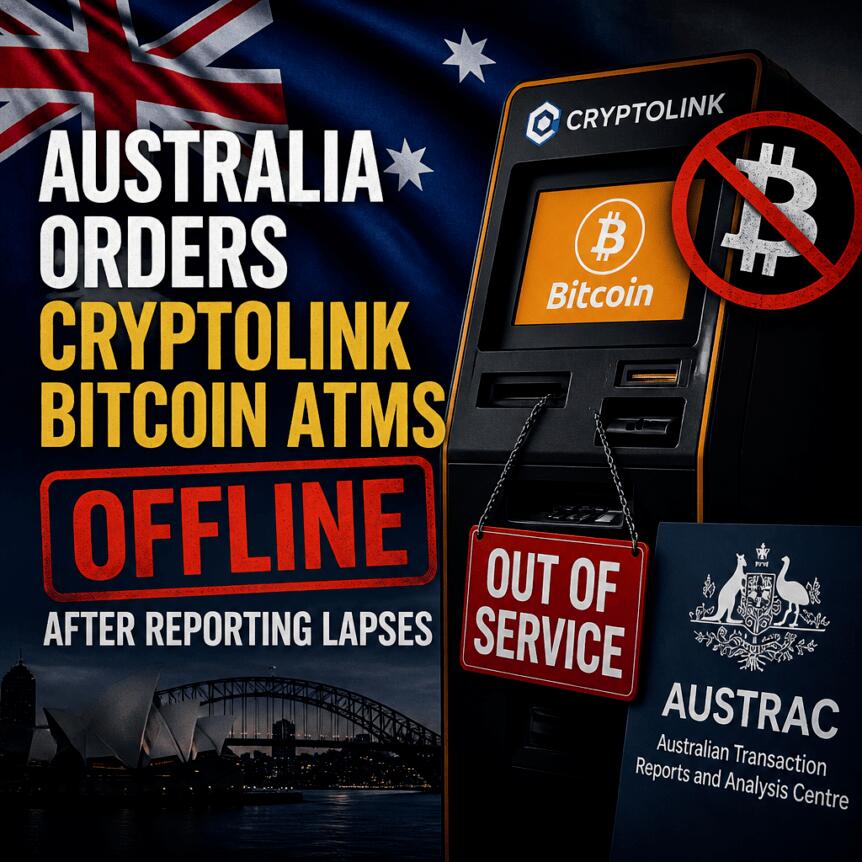
Australia’s financial crime regulator AUSTRAC has suspended the operation of Cryptolink’s Bitcoin ATMs for three months, citing ongoing concerns about the company’s compliance with anti-money laundering obligations. The decision pauses Cryptolink’s ability to run as a registered Virtual Asset Service Provider (VASP), effectively taking its crypto ATMs offline during the suspension period.
With Australia hosting the highest number of crypto ATMs in the Asia-Pacific region, the move underscores the regulator’s continued focus on reducing illicit activity linked to automated cash-to-crypto access—especially as authorities have escalated scrutiny of the sector since late 2024.
Key takeaways
- AUSTRAC suspended Cryptolink’s VASP registration for three months, meaning its Bitcoin ATMs cannot operate during that timeframe.
- The regulator cited failures to meet core reporting expectations, including threshold transaction reports, and noted the company did not respond to AUSTRAC requests.
- AUSTRAC said it has “ongoing concerns” about Cryptolink’s ability to manage high-risk transactions through its ATMs.
- The action follows prior enforcement steps tied to alleged late reporting and weaknesses in Cryptolink’s risk assessments.
- Cryptolink operates 96 ATMs across major Australian cities, offering cash-to-Bitcoin exchanges.
AUSTRAC suspends Cryptolink’s VASP registration
AUSTRAC CEO Brendan Thomas said the suspension begins Sunday and will last three months. According to AUSTRAC, Cryptolink’s registration as a Virtual Asset Service Provider has been halted, which directly prevents its cryptocurrency ATMs from operating while the order is in effect.
In a statement, Thomas linked the decision to what AUSTRAC described as ongoing concerns regarding Cryptolink’s capacity to handle high-risk activity associated with digital asset transactions. The regulator emphasized that its scrutiny centers on digital currency as a potential money laundering risk, particularly in contexts where cash can be converted into crypto through automated systems.
What AUSTRAC says went wrong
AUSTRAC said Cryptolink failed to meet basic compliance and reporting requirements. The regulator highlighted shortcomings in threshold transaction reporting, a category of submissions that helps authorities identify larger or otherwise significant transactions that may warrant additional attention under anti-money laundering frameworks.
AUSTRAC also stated that Cryptolink did not respond to a request for information from the agency. While the details of the request are not included in the available coverage, the combination of reporting failures and non-response was positioned as a core reason behind the suspension.
“As part of our continued focus on digital currency as a money laundering risk, AUSTRAC has ongoing concerns about the company’s ability to manage high-risk transactions through its CATMs,” Thomas said.
Enforcement background: October 2025 undertaking and a fine
The suspension does not appear as an isolated action. AUSTRAC noted that the move follows an enforceable undertaking Cryptolink entered into in October 2025, after a Cryptocurrency Taskforce identified alleged breaches. AUSTRAC cited alleged late transaction reporting and shortcomings in Cryptolink’s risk assessments as part of that earlier compliance outcome.
AUSTRAC also referenced a separate infringement notice issued to Cryptolink, which AUSTRAC said amounted to $56,340. Cryptolink paid the notice. Together, these steps indicate a regulatory pattern: initial enforcement and corrective expectations in 2025, followed by a further escalation once AUSTRAC concluded its concerns were not resolved.
Earlier AUSTRAC reporting about Cryptolink’s issues has also focused on late reporting, reflecting the regulator’s interest in whether transaction monitoring and reporting systems are robust enough to detect and flag suspicious activity in time.
Cryptolink’s ATM footprint and the compliance ripple effect
Cryptolink operates 96 ATMs in Australia. Its machines are concentrated in major cities, including Sydney, Melbourne, and Brisbane, enabling users to exchange cash for Bitcoin.
For everyday customers, the immediate impact is straightforward: with the suspension in place, Cryptolink’s ATMs should not be able to operate during the three-month window. For the broader market, the development highlights how compliance enforcement can translate into practical restrictions on on-the-ground access to crypto services—turning regulatory findings into operational downtime.
For investors and industry participants, the case is also a reminder that registration status can change quickly when regulators conclude that reporting systems, responses to information requests, or risk controls are inadequate. In a market where crypto ATMs have expanded across multiple jurisdictions, enforcement actions like this can affect how operators prioritize compliance tooling and internal controls, particularly around transaction monitoring and threshold reporting obligations.
Cointelegraph reached out to Cryptolink for comment; no additional response was included in the provided material.
As the suspension period progresses, the key question for readers will be whether Cryptolink can address the specific reporting and risk management concerns AUSTRAC raised—and what AUSTRAC will require to restore the ability for its machines to run. Operators across the sector are likely watching closely, because the regulator’s rationale suggests that both technical reporting performance and responsiveness to regulatory requests will remain central to any future decision on registration status.


Robinhood (HOOD) is introducing zero-fee crypto trading in the U.K. alongside stocks and shares ISAs, equities, options and futures, the company said on Monday.
The all-in-one Robinhood app will bring U.K. customers access to over 50 cryptos including Bitcoin , Ethereum , XRP (XRP), Hyperliquid (HYPE), accessed via Bitstamp, the exchange Robinhood acquired in 2025.
The trading firm is also introducing “Robinhood Cortex Digests for Crypto,” a generative AI-powered widget that analyses breaking news, market data, technical indicators and Robinhood’s proprietary insights. The AI service explains in plain English the key factors driving price movements in individual crypto assets, Robinhood said.
“Our new product provides a transparent, low-cost alternative to many incumbent U.K. platforms, which often rely on opaque pricing structures and apply wide spreads that can erode customers’ returns,” Robinhood said.
“It will begin rolling out to eligible U.K. customers this week.”
The product also expands Robinhood’s growing crypto ecosystem for UK customers. As such, UK developers can build on the highly popular Robinhood Chain, a layer 2 blockchain built on the Arbitrum platform.


Guren “Bobby” Zhou, the businessman identified as the person behind Aqua 1’s $100 million purchase of World Liberty Financial tokens, has remained linked to an active British money laundering investigation after his 2021 arrest, despite not being charged.
Summary
- Zhou was arrested in Britain in 2021 on suspicion of money laundering but has not been charged.
- Aqua 1 bought $100 million of World Liberty Financial’s WLFI tokens in 2025.
- The source of the $100 million used for the WLFI purchase remains unclear.
- Up to $75 million from the Aqua 1 purchase went to a Trump controlled entity.
- World Liberty has faced congressional scrutiny over separate UAE linked investments.
The New York Times reported Sunday that British authorities arrested Zhou in 2021 on suspicion of money laundering, while a court record filed last November accused him of participating with five other people in a laundering operation dating to 2019.
Two of Zhou’s longtime employees were charged in the case in September 2025, according to the report. One defendant has since pleaded guilty, while the trial involving the charged defendants is scheduled for 2028.
Zhou himself has not been charged with a crime.
The case has drawn attention because Zhou was identified as the businessman behind Aqua 1, the UAE-based investment vehicle that bought $100 million worth of WLFI governance tokens from World Liberty Financial. Reuters previously identified Zhou as the person behind the fund, while the purchase was publicly announced in June 2025.
Aqua 1’s $100 million World Liberty investment remains unexplained
A review of court records, confidential documents and interviews with Zhou’s former associates led the Times to examine how the businessman went from a series of troubled ventures in Britain to overseeing one of the largest publicly known investments in World Liberty.
The newspaper said it was unable to determine where the $100 million used for the WLFI purchase came from.
Blockchain activity examined as part of the report also connected Zhou’s earlier crypto business to the World Liberty transactions. According to the Times, blockchain analytics firm Arkham Intelligence determined that a wallet controlled by Web3Port bought $20 million worth of WLFI in January 2025.
A second wallet believed to be controlled by Aqua 1 purchased another $80 million in June, bringing the combined purchases to $100 million.
Before Aqua 1 emerged publicly, Zhou had led Web3Port, a crypto venture fund that announced a separate $10 million investment in World Liberty shortly after President Donald Trump’s inauguration in January 2025.
Corporate records reviewed by the Times showed that a Web3Port entity registered in the British Virgin Islands was later renamed Aqua 1 GP Limited. Aqua 1 announced its $100 million WLFI purchase about two weeks after the name change.
Aqua 1 had previously denied having a connection to Web3Port after earlier reporting linked the operations. The fund did not specify which parts of that reporting it disputed.
Zhou’s previous businesses faced financial problems
Before relocating from London to Abu Dhabi in 2024, Zhou operated businesses that later faced financial or credibility problems, according to the Times.
One was a British flooring retailer that entered restructuring without repaying roughly $5 million owed to a company controlled by Zhou’s father.
Zhou later launched Caduceus, a crypto project that raised about $7.6 million in funding. Its token had become effectively worthless by 2024, according to the newspaper.
Caduceus had announced backing from China Merchants Securities UK and the Bin Zayed Group, an organization founded by a member of Abu Dhabi’s royal family. Both organizations told the Times that claims about their involvement were “unauthorized and materially false.”
After moving to Abu Dhabi, Zhou became associated with Web3Port and subsequently Aqua 1, putting him behind investments that made the entities major buyers of World Liberty tokens.
The timing also placed Aqua 1 among several UAE-linked investments involving World Liberty that have drawn scrutiny from U.S. lawmakers.
World Liberty token sale sent millions to Trump-controlled entity
Under World Liberty’s revenue-sharing structure, as much as $75 million from Aqua 1’s $100 million token purchase went to a company controlled by Trump and his sons, according to the Times.
Previous reporting showed that 75% of proceeds from WLFI token sales flow to DT Marks DEFI LLC, an entity controlled by Trump.
Trump’s latest financial disclosure listed more than $65.6 million from the sale of equity in WLF Holdco and $236.25 million in distributed World Liberty token-sale proceeds.
The Aqua 1 transaction also benefited the family of World Liberty co-founder Zach Witkoff, according to the Times. His father, Steve Witkoff, serves as a special envoy in the Trump administration.
World Liberty spokesperson David Wachsman told the newspaper that the company had complied with applicable laws and regulations and maintained a compliance program that “meets or exceeds industry standards.”
Wachsman declined to say whether World Liberty knew where Zhou obtained the money used for the investment. He also disputed the newspaper’s portrayal of Zhou but did not identify specific factual inaccuracies in its reporting.
World Liberty investments have faced congressional scrutiny
Questions surrounding Aqua 1 come as U.S. lawmakers have already examined separate UAE-linked investments in World Liberty and whether foreign financial interests could create conflicts involving the Trump administration.
In June, five Democratic senators asked Republican committee leaders to hold hearings into a reported $500 million investment in World Liberty by Aryam Investment 1, an Abu Dhabi-based company backed by UAE national security adviser Sheikh Tahnoon bin Zayed Al Nahyan.
Citing Wall Street Journal reporting, the senators said Aryam acquired a 49% stake in World Liberty through an agreement signed in January 2025.
Their letter asked Congress to examine events that followed the transaction, including the Trump administration’s May 2025 approval of major arms sales and access to advanced artificial intelligence chips for the UAE. The lawmakers said U.S. national security officials had previously raised concerns that China could gain access to the technology.
Senators Elizabeth Warren and Andy Kim had separately asked Treasury Secretary Scott Bessent in February to determine whether the reported UAE investment required review by the Committee on Foreign Investment in the United States.
World Liberty has also faced regulatory questions over its plans to expand its financial operations. During a Senate Banking Committee hearing, Warren questioned Comptroller of the Currency Jonathan Gould about a reported application by World Liberty for a federal bank charter and whether the company had disclosed the foreign investment to regulators.
Gould declined to discuss a pending application and said the Office of the Comptroller of the Currency would follow its established procedures.
Trump has denied involvement in World Liberty’s daily operations. Speaking to reporters in February, he said he did not know about the reported UAE investment and said his sons were responsible for managing the business.
The White House has separately rejected conflict-of-interest allegations, saying Trump’s assets are held in a trust administered by his children and that administration decisions are made independently of his family’s business interests.

Apple Upgrade plan to preload your data nixed over privacy optics

where does it say prop money #shorts

Police urge motorists to ‘flee your vehicles if you want to stay alive’ as huge fire spreads across A31


-

 Fashion3 days ago
Frugal Friday’s Workwear Report: Cap-Sleeve Pointelle Crewneck Sweater
-

 Fashion3 days ago
Weekend Open Thread: Mattifying Sunscreen
-

 Sports4 days ago
Jordan Coyle & Cordiamo take Laya Arena Stakes at RDS
-
 Business4 days ago
US stocks: Dow closes at record on Mideast optimism; SpaceX, AMD drag Nasdaq
-

 News Videos2 days ago
Can Astrology Help Find Gold and Silver Trends? A Financial Astrology Guide
-

 Crypto World6 days ago
US Tech Stocks See Largest 5-Week Inflow in History: Can Nasdaq Break Its Downtrend?
-

 Politics4 days ago
Reform UK And Greens Sink To Lowest Favourability Ratings To Date
-

 Business5 days ago
Nvidia Stock Climbs 2.5% as Chip Sector Rally Builds Ahead of AMD Earnings, Nvidia’s Own Report Looms
-

 Crypto World6 days ago
Polymarket targets $20 billion valuation as competition heats up in prediction market sector
-

 Tech5 days ago
OpenAI, Anthropic AI agents targeted real people and systems in cyber tests
-

 Business4 days ago
Supply chain issues impact Ingredion
-
 Crypto World6 days ago
CLARITY Act Senate Vote Locked In, But 60-Vote Hurdle Looms Large
-

 Tech2 days ago
Rinn Pharma & Biopharma to join NordicPharmaTrain network
-

 Crypto World6 days ago
The Senate has one week: CLARITY’s last August window
-
 Crypto World5 days ago
Dow and S&P 500 Hit Records on AI Earnings: When Will the Bubble Burst?
-
 Crypto World7 days ago
California Wildfire Bets Expose Polymarket’s Dark Side
-

 Business22 hours ago
Datadog: Best Of Breed For Multiple Reasons
-

 Business1 day ago
How to Start a Cleaning Business: A Step-by-Step Guide
-

 Business6 days ago
CNH Industrial Shares Jump Over 15% After Beating Estimates and Raising Full-Year Earnings Guidance
-

 Crypto World6 days ago
New York sued, who is next
You must be logged in to post a comment Login