
Crypto World
BTC price drops to two-week low as $300 million in longs are liquidated

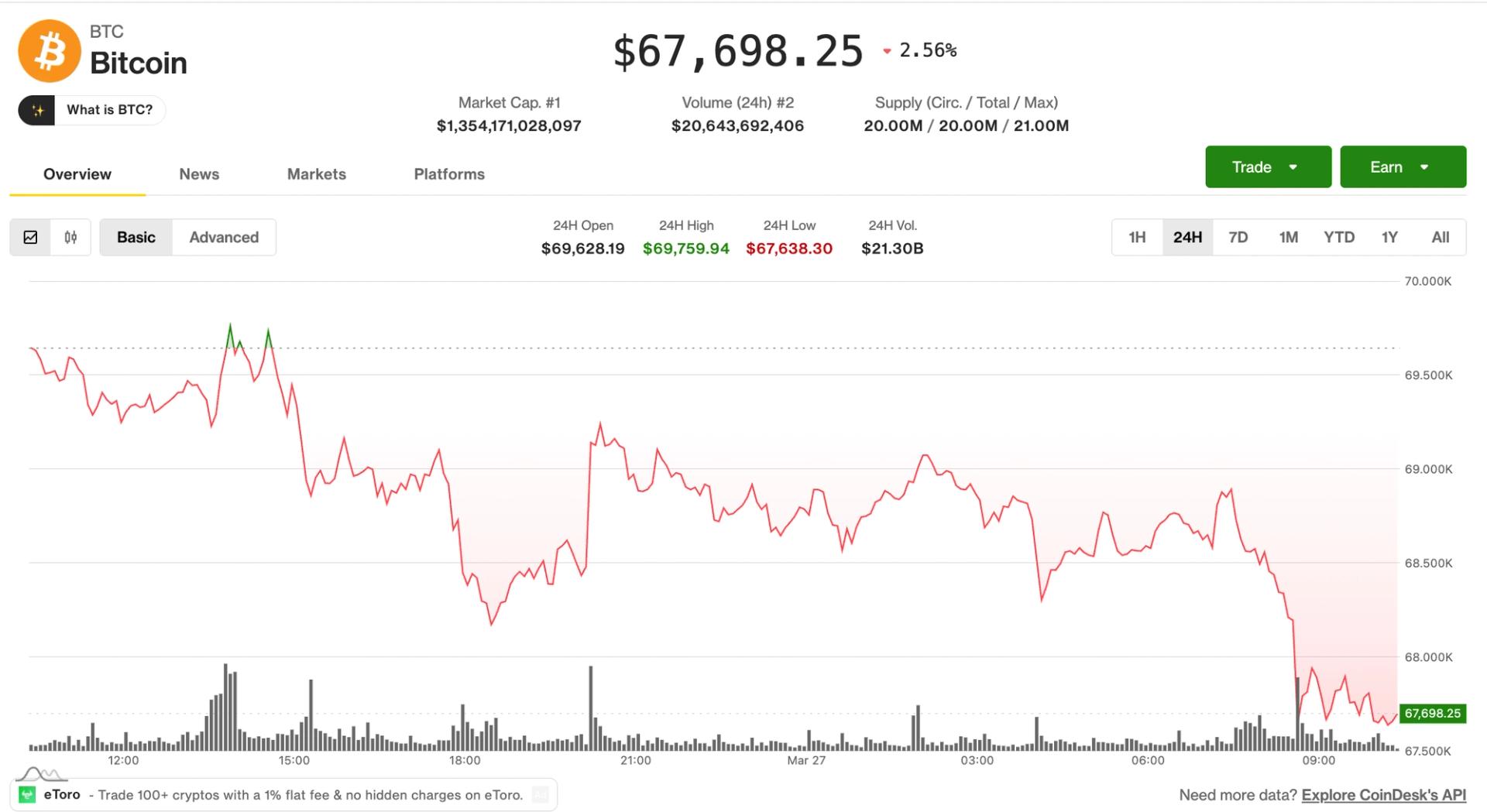
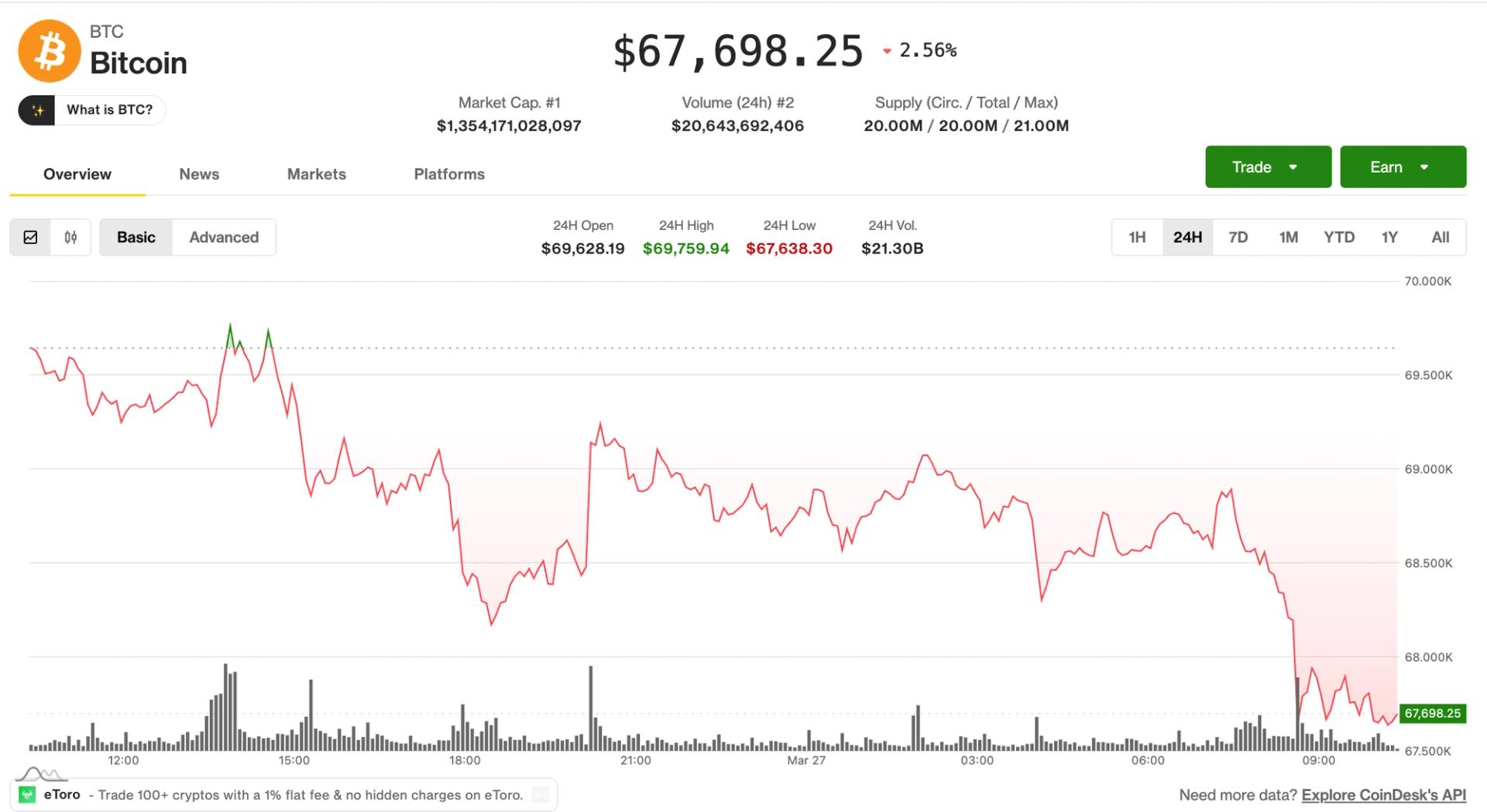
The crypto market tumbled to the lowest levels in more than two weeks, with bitcoin dropping below $67,000 and ether (ETH) closing in on $2,000. The CoinDesk 20 Index (CD20) lost 2.2% since midnight UTC, reaching its lowest since March 9.
The fall coincided with a drop in U.S. equities. Nasdaq 100 futures are now trading at 23,760, 10% below this year’s high from January.
The risk-off atmosphere was spurred by rising oil prices and fears that the war in Iran would not de-escalate as quickly as many had hoped. Oil remains above $100 per barrel, stoking inflation concerns.
Sections of the altcoin market were harder hit on Friday, with the likes of ETHFI losing 6% since midnight. WLD, WIF, SEI and FET all lost between 3.6% and 4.7%.
Derivatives positioning
- Long crypto futures bets, or bullish positions on market direction, bore the brunt of liquidations over the past 24 hours, with nearly $300 million liquidated, compared with just $50 million in short positions.
- That’s the fifth time in 10 days the longs have neared that level of punishment, an indication traders were predominantly positioned for the Iran war to translate into a price rally that has not materialized.
- XRP’s price fell over 2.5% in 24 hours, while open interest in futures has increased by 2% to 1.95 billion XRP, the most since Feb. 2.
- That combination represents renewed investor interest in shorting the falling market. Negative cumulative volume delta and sub-zero funding rates suggest the same.
- Futures tied to bitcoin, solana, dogecoin and BNB displayed an XRP-like bearish profile.
- Memecoin SHIB has the largest negative open-interest–adjusted cumulative volume delta among major tokens, signaling aggressive derisking, or shorting, by traders.
- Canton Network’s CC token stood out with positive funding rates and an increase in futures OI, both signaling growing demand for bullish exposure.
- Bitcoin and ether’s 30-day implied volatility indices, BVIV and EVIV, continued to drop despite weak spot prices, suggesting that traders aren’t panicking yet and do not anticipate a turbulent selloff.
- On Deribit, bitcoin options worth over $15 billion expired early Friday. So, the supposed expiry-related price magnet of $75,000 is no longer valid, which opens doors for deeper declines amid a worsening macro outlook.
- Bitcoin and ether puts are again trading at 6 to 8 volatility premium to calls across all expirations, risk reversal shows. It indicates sticky demand for downside protection.
Token talk
- The altcoin market showed its fragility again on Friday, failing to cling on to key levels of support in a low-liquidity trading environment.
- The CoinDesk Computing Select Index (CPUS) was the worst-performing benchmark, tumbling by 2.3% while the bitcoin-dominant CoinDesk 20 (CD20) dropped 1.2%.
- One token that bucked the bearish trend was ONDO, which rose after Ondo Finance, an asset management company, said it agreed to tokenize five Franklin Templeton exchange-traded funds (ETFs) and bring them to the Ondo Chain.
- The token is up by more than 8% in the past 24 hours, although it gave back some of those gains since midnight UTC.
- The average relative strength index (RSI) across all crypto tokens remains neutral despite the selloff, suggesting further declines are likely on Friday.

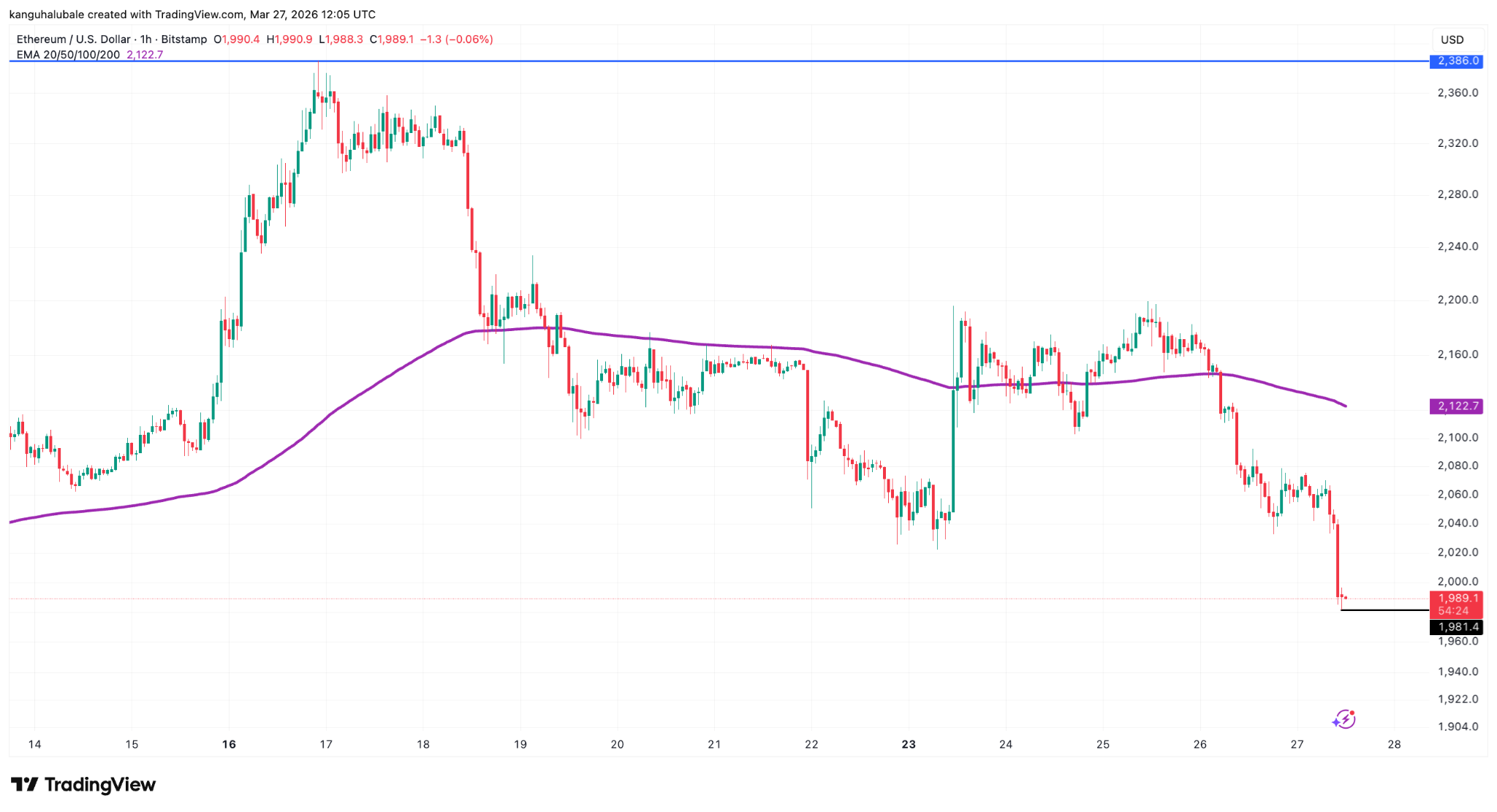
Ether’s (ETH) drop below the $2,000 on Friday put it at risk of a deeper correction in the coming weeks or months.
Key takeaways:
-
Ether’s price shows structural weakness as it fails to hold above the $2,000 psychological support.
-
Analysts say ETH price may drop further toward the $1,750-$1,850 support zone.
-
Ether’s demand stays negative, increasing its downward potential.
Ether traders anticipate a deeper correction
Data from TradingView showed ETH/USD trading at $1,975, down 5% over the last 24 hours. This drop was accompanied by more than $111 million in long ETH liquidations.
Related: Bitmine launches institutional Ethereum staking platform
The pair had failed to crack through resistance at $2,200 earlier in the week, as spot Ether exchange-traded fund (ETF) outflows, falling DEX volumes, and declining ETH futures premium derailed Ether’s recovery.

“$ETH keeps pressing into the same resistance, but the story sits beneath price action,” trader Onur said in an X post on Friday, adding:
“Even with strong long-term narratives, short-term demand still looks thin.”
Fellow analyst CryptoWZRD said a ETH could see a “further decline” toward the $1,800 support zone after the altcoin closed below $2,200 on Thursday.
“$ETH has dropped below the $2,100 level,” analyst and trader Ted Pillows said in a Friday X post, adding:
“This is a sign of weakness and shows what’s coming next for ETH.”
An accompanying chart suggested that the price could first drop toward the $1,800 support level, before rebounding.

As Cointelegraph reported, a close below the 50-day simple moving average at $2,000 may pull the ETH/USD pair to $1,900 and subsequently to the $1,850-$1,750 level.
Ether’s apparent demand hits 16-month low
Ether’s Apparent Demand has flipped negative after dropping to its lowest level since October 2024, as traders adopted a risk-off stance due to geopolitical uncertainty and macro headwinds.
Capriole Investment’s Ethereum Apparent Demand metric shows that the demand for ETH has been negative since March 3, bottoming around -58,000 ETH on March 16, marking 16-month lows. The metric has since improved to -23,475 ETH at the time of writing.

Meanwhile, spot ETH ETFs have recorded net outflows for seven consecutive days, totaling $391.8 million.

Global Ether exchange-traded products (ETPs) also recorded $27.2 million of outflows last week, reinforcing reduced appetite for ETH among institutional investors.
This article does not contain investment advice or recommendations. Every investment and trading move involves risk, and readers should conduct their own research when making a decision. While we strive to provide accurate and timely information, Cointelegraph does not guarantee the accuracy, completeness, or reliability of any information in this article. This article may contain forward-looking statements that are subject to risks and uncertainties. Cointelegraph will not be liable for any loss or damage arising from your reliance on this information.
Key Takeaways
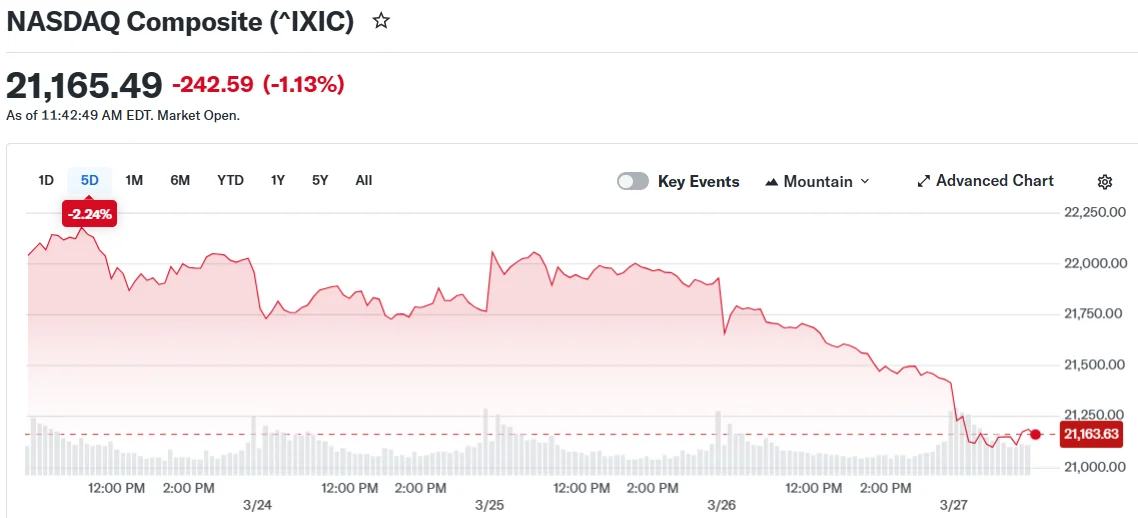
- The Nasdaq Composite tumbled 2.4% Thursday, confirming a correction after sliding more than 10% from its October 29 record peak
- Geopolitical instability from the U.S.-Israeli military action against Iran and concerns about escalating oil costs fuel the downturn
- American gas prices surged to $3.98 per gallon, marking a $1.00 increase within 30 days
- Meta Platforms plummeted 8% following dual court rulings holding the company accountable for damage to teenage users
- Major tech players Nvidia, Alphabet, and Tesla each declined between 3.4% and 4.2% during Thursday’s session
The Nasdaq Composite has officially entered correction territory following Thursday’s trading session. The tech-focused index shed 2.4%, placing it approximately 11% beneath the all-time closing high recorded on October 29, 2025. This represents the index’s first confirmed correction in twelve months.
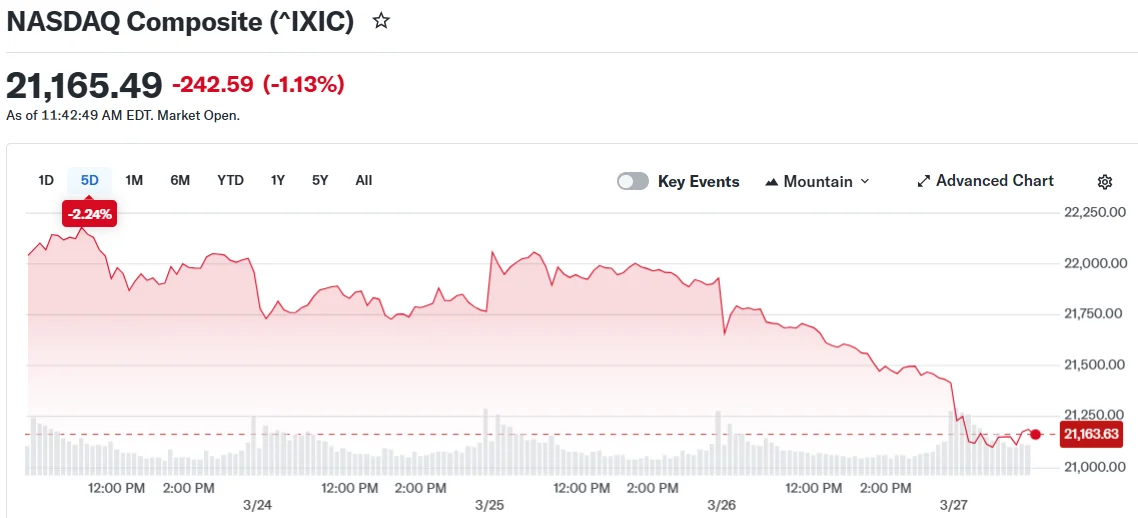
Thursday’s decline represents the index’s steepest fall since April 2025, when President Trump’s “Liberation Day” tariff declaration triggered a worldwide market retreat.
The Nasdaq has now surrendered nearly 8% of its value in 2026 and trades at levels last witnessed in early September 2025.
The primary catalyst behind the market retreat centers on persistent uncertainty surrounding the U.S. and Israeli military engagement with Iran. Market participants remain unclear about the conflict’s duration and its potential ramifications for worldwide economic stability.
A recent Seeking Alpha community survey revealed that most respondents anticipate the operation lasting up to three months. White House officials have projected a four-to-six week timeframe. This disconnect between projections continues to fuel market anxiety.
Energy costs are climbing rapidly. American motorists now face an average gasoline price of $3.98 per gallon, representing a $1.00 jump from just thirty days earlier. Seasonal consumption patterns are anticipated to drive prices even higher as spring approaches.
Market analysts suggest the energy price spike could either accelerate inflation or dampen consumer spending sufficiently to decelerate economic growth. The ultimate outcome hinges largely on the conflict’s duration.
Technology Sector Bears the Brunt
Technology equities have experienced substantial pressure. Nvidia declined 4.2%, Alphabet fell 3.4%, and Tesla surrendered 3.6%. The Roundhill Magnificent Seven ETF dropped 3.3% and has now retreated 17% from the Nasdaq’s October zenith.
Market participants are increasingly scrutinizing whether the enormous artificial intelligence expenditures by corporations like Microsoft, Alphabet, and Amazon are generating returns quickly enough. The primary concern centers on whether substantial infrastructure investments have yet produced significant revenue expansion.
“There definitely has been an erosion in market enthusiasm since hostilities broke out,” said Steve Sosnick, market strategist at Interactive Brokers.
Meta Compounds Market Weakness
Meta Platforms emerged as one of Thursday’s heaviest drags on the index, plunging 8%. Two separate court decisions determined Meta bears responsibility for harm inflicted on young users, sparking concerns the social media giant may need to fundamentally restructure its advertising framework.
The widespread losses throughout Big Tech are magnified because these corporations now constitute a substantial portion of both the Nasdaq and the S&P 500. Any retreat in these stocks delivers an outsized impact on the broader indices.
Jim Carroll, senior wealth adviser at Ballast Rock Private Wealth, characterized the market’s volatile swings as sufficient to “make people seasick.”
The Nasdaq previously tumbled nearly 23% from its 2024 peak before rallying through October 2025. Investors are now monitoring whether this current correction will trace a comparable recovery trajectory, or deteriorate further.



- Stargate Finance (STG) surged 40% on strong volume and breakout momentum.
- Holding $0.24–$0.25 will keep the bullish momentum intact.
- However, overbought conditions suggest possible short-term consolidation.
The price of STG has surged by more than 40% in just 24 hours to hit an intraday high of $0.2796.
This kind of sharp move rarely happens without a strong underlying force, and in this case, the signals point to a mix of heavy buying pressure and renewed interest in its ecosystem.
The rally stands out even more because it is happening while the broader crypto market is falling.
A breakout backed by market demand
The most important factor behind today’s Stargate Finance price surge is the explosion in trading activity.
According to CoinMarketCap, volume has jumped by over 869%, rising several times above its recent average, which shows that this is not a random spike.
Large inflows of capital tend to leave a clear footprint, and this move carries all the signs of serious buyers stepping in.
Price action has also confirmed this strength by slicing through previous resistance levels with little hesitation.
That kind of clean breakout usually signals conviction rather than speculation.
It also suggests that traders who were waiting on the sidelines have now started chasing momentum.
Fundamental analysis
Beyond the charts, sentiment around the project has turned noticeably positive.
Much of that optimism is tied to its connection with LayerZero, which continues to gain traction in the cross-chain space.
Prime Vaults now facilitates cross-asset and cross-chain liquidity, powered by @StargateFinance, built on @LayerZero_Core
Deposit directly from your preferred native chain and let us handle the cross-chain work while capturing the native token upside.
No additional fees. pic.twitter.com/RDzuSzCetq
— Prime Vaults (@PrimeVaultsHQ) March 25, 2026
Stargate’s position as a liquidity bridge gives it a strong use case, especially as more protocols look to move assets across different networks.
Recent integrations, including activity linked to Riverdot, have added to the sense that the ecosystem is expanding.
When fundamentals and narrative align like this, price often reacts quickly.
This is especially true in a cautious market where capital tends to rotate into projects with clear utility and active development.
Key levels that traders should watch
After such a strong move, attention now shifts to whether STG can hold its gains.
The $0.24 to $0.25 zone has become a critical support area following the breakout, especially with the RSI showing that the altcoin has entered the overbought region.
Often, short periods of consolidation are common after aggressive moves like this.
But if the price manages to stay above this range, it would signal that buyers are still in control.
On the upside, the next major level sits near $0.30, which could act as the next target if momentum continues.
However, if the price slips below support, analysts note that a pullback toward the $0.22 region would become more likely.

Anchorage Digital has added TRX custody and Tron crypto network staking to its platform, making it the first federally chartered crypto bank in the United States to bring the Tron network inside the regulatory perimeter.
Tron hosts $84 billion in USDT, more than Ethereum, yet has operated almost entirely outside U.S. institutional frameworks until now.
That gap closes here. A federally chartered custodian supporting Tron is not the same as a state-licensed exchange listing TRX. It is a different category of legitimacy, with different compliance obligations, different counterparty implications, and a different signal to the rest of the institutional market.
- Milestone: Anchorage Digital is the first federally chartered U.S. crypto bank to support Tron custody, bringing TRX and future TRC-20 assets—including $84 billion in USDT—into a compliant institutional framework.
- Regulatory Context: Tron and founder Justin Sun faced longstanding U.S. regulatory friction, including a 2023 Coinbase delisting of TRX; the SEC dismissed securities claims against Sun and the Tron Foundation earlier this month, clearing a key obstacle.
- Phased Rollout: Initial support covers TRX custody on Anchorage’s main platform and Porto institutional wallet; TRC-20 token support and native TRX staking infrastructure follow in subsequent phases.
Discover: The best crypto presales gaining institutional momentum right now
What Anchorage Bank Is Actually Building
The initial launch supports TRX custody on Anchorage’s core regulated platform and its Porto self-custody institutional wallet. TRC-20 token support and native TRX staking roll out in phases, a staged structure that allows regulatory validation at each step rather than a single broad deployment.
Anchorage Digital is your new access point to the @trondao ecosystem.$TRX custody is now live with support for TRC-20 assets and native TRX staking on the way. pic.twitter.com/f4xlKwmcir
— Anchorage Digital
 (@Anchorage) March 26, 2026
TRC-20 support is the operationally significant layer. It means institutions will be able to hold and manage Tron-based stablecoins—including the $84 billion USDT supply sitting on Tron—directly within a federally regulated custody account. That is the use case that matters to institutional treasury desks.
Anchorage co-founder Nathan McCauley framed the move as infrastructure-driven: “As TRON expands its presence in the U.S., institutions need trusted infrastructure to securely custody assets and participate in the network. By supporting TRON on Anchorage Digital’s regulated platform, we’re helping bring one of crypto’s largest ecosystems into an institutional framework.”
The federal charter distinction matters here. Anchorage holds a national trust bank charter from the Office of the Comptroller of the Currency—the same regulatory body that oversees JPMorgan and Citibank. State-chartered custodians operate under a patchwork of state regimes. A federally chartered institution conducting AML/BSA due diligence on Tron and clearing it for custody sets a compliance benchmark that state-level operators and foreign custodians cannot replicate by definition.
Tron’s network scale justifies the scrutiny. The chain has recorded over 371 million total user accounts and more than 13 billion total transactions. It is not a niche protocol. It is core stablecoin infrastructure that U.S. institutions have been structurally locked out of engaging with compliantly—until now.
Discover: The best crypto to diversify your portfolio with
Tron Crypto Regulatory Clearance as a Market Structure Event
The background context is critical. Coinbase delisted TRX in 2023 under regulatory pressure. The SEC pursued securities violations against Sun and the Tron Foundation, claims dismissed only earlier this month, with Rainberry, the corporate parent of Sun’s BitTorrent network, paying a $10 million fine over undisclosed BTT token promotions.
That legal overhang suppressed U.S. institutional engagement with Tron for years. Its removal, combined with Anchorage’s federal-level due diligence clearance, reopens the market.
Anchorage’s federal imprimatur gives other U.S.-regulated entities—prime brokers, custodians, asset managers, a compliance reference point.
When America’s only federally chartered crypto bank conducts AML/BSA diligence on a network and approves it for custody, that functions as a de facto institutional clearinghouse signal.
Expect other regulated venues to accelerate their own Tron evaluations.
Discover: The best crypto presales gaining institutional momentum right now
The post Anchorage Becomes First Federally Chartered US Bank to Custody Tron Crypto appeared first on Cryptonews.


US spot Bitcoin exchange-traded funds posted their largest daily outflows in weeks on Thursday, as Bitcoin fell below $70,000 and market risk stayed elevated.
Summary
- US spot Bitcoin ETFs recorded $171 million in outflows, the largest daily withdrawal since March 3.
- BlackRock, Fidelity, ARK, and Grayscale led withdrawals as Bitcoin dropped below the key $70,000 level.
- Despite Thursday outflows, US spot Bitcoin ETFs still attracted $1.36 billion in March net inflows.
The sell-off came after a strong month for US-listed Bitcoin ETFs, which had already attracted fresh capital in March.
US spot Bitcoin ETFs recorded $171 million in net outflows on Thursday. That marked the largest daily withdrawal since March 3, when the group lost $348 million.
BlackRock’s IBIT led the redemptions with $41 million in outflows. Fidelity’s FBTC followed with $32 million, while ARK 21Shares’ ARKB lost $30.5 million. Grayscale’s GBTC also posted $24 million in withdrawals, based on data from Farside Investors.
The weak session interrupted a broader recovery in ETF demand this month. Sosovalue data showed that spot Bitcoin ETFs had already brought in $1.36 billion in March and were moving toward their first month of net inflows since October 2025.
That trend showed that institutional interest had not disappeared, even as Thursday’s trading pointed to caution. ETF flows often act as a clear sign of how large investors are positioning around Bitcoin.
Bitcoin fell below the $70,000 level on Thursday and traded near $67,780 at the time of writing. CoinGecko data showed the asset had dropped almost 5% over the past seven days.
The move added pressure to ETF sentiment, as falling prices often lead to short-term withdrawals from listed crypto products. Even so, Bloomberg ETF analyst Eric Balchunas said the market was “one good day away” from reversing year-to-date ETF outflows.
Balchunas also said the funds had shown “incredible fortitude” during Bitcoin’s 46% decline from its October 2025 all-time high of $126,198. His comments pointed to continued resilience among ETF holders despite the recent price weakness.
Middle East tension keeps investors cautious
Market attention also stayed fixed on geopolitical risk. Reuters reported earlier this week that the US Department of War was sending thousands of soldiers to the Middle East.
On Thursday, President Donald Trump said the ceasefire on Iranian energy infrastructure would be extended by 10 days to April 6. He said the move followed ongoing negotiations, but traders still feared a sudden shift over the weekend.


Coinbase CEO Brian Armstrong says big banks are “undermining” President Trump’s crypto agenda by pushing CLARITY Act language that would ban 4–5% stablecoin yields now fueling Coinbase’s $1.35b revenue line.
Summary
- Coinbase CEO Brian Armstrong says big banks are “undermining” President Trump’s crypto agenda by trying to ban yield on stablecoins.
- The fight centers on whether platforms like Coinbase can share 4–5% Treasury returns on stablecoins with users under the GENIUS and CLARITY Acts.
- Banks warn trillions in deposits could migrate to crypto if yields are allowed, while Coinbase defends a $1.35 billion stablecoin revenue stream.
In a Fox Business interview, Coinbase CEO Brian Armstrong accused major U.S. banks of “trying to undermine the president’s crypto agenda” by pushing to strip Americans of the ability to earn yield on stablecoins. He described the latest Senate draft as a “giveaway to the banks” that would “ban their competition” by shutting down yield on digital dollars. Armstrong argued banks are “taking money out of the pockets of hardworking, average Americans and putting it into the coffers of big banks hitting record profits.”
Under the 2025 GENIUS Act, stablecoin issuers must fully back tokens with cash or short-term Treasuries and are barred from paying interest directly, but exchanges like Coinbase have been allowed to pass on roughly 4–5% Treasury returns to customers via rewards programs. A new CLARITY Act compromise circulating in Washington would prohibit stablecoin yield “directly, indirectly, and through anything economically or functionally equivalent to bank interest,” while allowing only activity-based rewards. Coinbase has told senators it “cannot support” the current text.
Trump’s Support and the Banking Lobby’s Fears
President Donald Trump has publicly sided with crypto firms, accusing banks on Truth Social of “threatening and undermining” the GENIUS Act and “holding the CLARITY Act hostage” over stablecoin yield. “Americans should earn money on their money,” Trump wrote, urging Congress to move the market-structure bill “ASAP.” According to reporting from Bloomberg, banks have cited Treasury studies suggesting they could lose up to hundreds of billions in deposits if stablecoin yields are permitted, warning this could pressure smaller institutions and weaken loan funding.
The numbers at stake explain the intensity. Coinbase generated about $1.35 billion in stablecoin revenue in 2025, roughly 19% of its total, driven largely by interest on USDC reserves backed by U.S. Treasuries. Total stablecoin volume reached an estimated $33 trillion last year, with USDC accounting for around $18.3 trillion of that flow. Analysts at Bloomberg Intelligence have projected that if USDC payment adoption accelerates, Coinbase’s stablecoin revenue could grow two- to sevenfold from its 2025 base.
For now, the yield fight has become the fulcrum of U.S. crypto policy: banks lobbying to close what they call a “loophole,” crypto platforms lobbying to preserve a core revenue line and a 4–5% return for users. With Trump publicly pressuring banks and Armstrong warning of “regulatory capture,” the eventual shape of the GENIUS–CLARITY framework will determine whether stablecoins remain a high-yield alternative to bank deposits or revert to being low-yield digital cash.
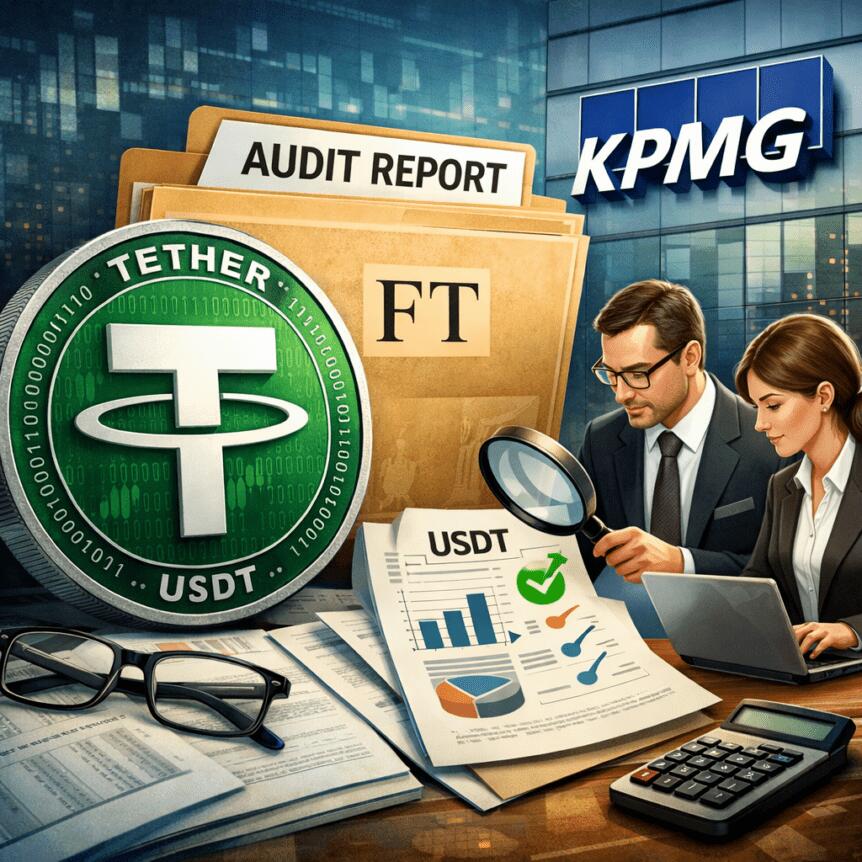
Tether is moving toward deeper financial transparency with a landmark step: hiring KPMG for its first full audit of USDT’s financial statements, while PwC assists in strengthening internal systems. The Financial Times reported the move, noting that the audit will extend beyond reserve snapshots and aim to cover the company’s assets, liabilities, and internal controls. This development follows Tether’s earlier pledge to enlist a Big Four firm for an inaugural financial statement audit, and it arrives as the company weighs broader ambitions in the US market amid evolving stablecoin regulation.
USDT remains the largest stablecoin by market capitalization, with about $185 billion in circulation. Tether disclosed in January that it held more than $122 billion in direct U.S. Treasury securities and about $141 billion in total Treasury exposure, including related instruments such as overnight reverse repurchase agreements. This backdrop helps frame why a comprehensive audit—beyond reserve attestations—could be pivotal for market confidence as the sector contends with regulatory scrutiny and evolving frameworks.
Related: Financial Times coverage highlights that Tether’s engagement with a Big Four firm for its inaugural financial statement audit marks a notable shift in its disclosure posture, following years of relying on reserve attestations from BDO Italia. Tether has publicly billed the forthcoming audit as “the biggest ever inaugural audit in the history of financial markets.”
The backdrop to the audit move includes ongoing corporate funding conversations and regulatory considerations. Reports last year suggested Tether was exploring a substantial equity raise, potentially up to $20 billion, which would imply a significant valuation. Tether’s leadership has disputed specific figures while continuing to point to a broader valuation target around $500 billion, anchored in earnings and market position. This context underscores why independent verification could be influential for both investors and regulators as the company presses ahead with its growth strategy.
Key takeaways
- First full audit under way: Tether has engaged KPMG to conduct its inaugural complete audit, with PwC assisting in enhancing internal controls and systems. The engagement follows years of reserve attestations and no disclosed audit timeline.
- Audit scope expanded beyond reserves: The KPMG engagement is expected to examine the full balance sheet—assets, liabilities, and internal controls—in addition to reserves, a move described by Tether as raising the standard for the digital-asset economy.
- Big Four selection and process: The choice of a Big Four firm came after a competitive process, and Tether notes it already operates to Big Four audit standards, though no completion date has been announced.
- Historical scrutiny and settlements: Tether has faced regulatory action in the past, including a $41 million CFTC fine and an $18.5 million settlement with the New York Attorney General, tied to reserve disclosures and investor disclosures. The NYAG agreement requires quarterly reserve reporting for two years.
- Market and regulatory context: USDT remains dominant with about $185 billion in circulation. The wider regulatory landscape, including the GENIUS Act, adds urgency to transparent, auditable reserve practices as policymakers weigh a federal framework for stablecoins.
Audit momentum and the broader implications
The decision to bring in KPMG for a full-scope audit signals a notable pivot toward verifiable governance for USDT. While previous attestations from BDO Italia provided periodic oversight of reserves, a full financial statement audit would offer a comprehensive view of Tether’s balance sheet and internal controls. By aligning with KPMG and leveraging PwC’s internal systems work, Tether appears intent on elevating both external credibility and internal risk management ahead of strategic moves in the U.S. market.
From an investor and user perspective, the audit could help address lingering questions about reserve composition, liquidity cushions, and the overall health of the issuer’s treasury management. In a market where stablecoins have become central to liquidity and trading, independent, auditable financial statements may influence counterparties’ risk pricing, collateral arrangements, and regulatory discussions. The timing also matters as stablecoin policy moves forward in Washington, with proposals like the GENIUS Act aiming to establish a clear federal framework for stablecoins and stablecoin issuers.
Beyond the audit itself, Tether’s broader financing ambitions—reported in earlier coverage as a potential equity raise—add another layer of complexity. While CEO Paulo Ardoino has pushed back on specific figures, the prospect of large-scale fundraising underscores the need for transparent financial reporting to support a higher enterprise valuation and broader investor appetite. Past enforcement actions, including a CFTC settlement and NYAG settlement, have already shaped public expectations around reserve management and disclosure discipline, making independent verification even more consequential for market trust.
Industry observers will be watching whether the audit timeline is announced and how the resulting financial statements address questions that have persisted since USDT’s early days. The intersection of rigorous audit standards with an evolving regulatory regime could set the tone for how stablecoins are funded, backed, and governed as they scale and compete for a larger share of the global payments and liquidity infrastructure.
As the process unfolds, readers should monitor the progress and the eventual release of the full audit results, alongside any updates from Tether on internal-control enhancements and related governance reforms. The coming quarters could reveal whether independent, multipoint verification translates into tangible improvements in transparency, resilience, and regulatory clarity for the stablecoin sector.
Sources consulted for context include coverage from the Financial Times detailing the audit mandate and the Big Four engagement, as well as prior Cointelegraph reporting on Tether’s audit strategy, past settlements, and the broader regulatory environment shaping stablecoins in the United States. For readers seeking deeper background, see the Financial Times article and related coverage linked above.
Five years have passed since Michael Saylor’s possibly home-destroying advice about using a mortgage to keep a hold of bitcoin (BTC).
As of this week, the US government-sponsored mortgage system will finally allow Saylor’s acolytes and other BTC owners to belatedly follow this advice.
When Saylor originally told an audience to mortgage their houses to buy BTC on March 10, 2021, BTC was trading near $56,000. If anyone actually took that advice, by November of the following year, BTC had cratered 72% to $15,500.
As a result, and given the high collateralization requirements of BTC-backed loans at that time, they would have likely lost their house — unless they had access to additional assets to re-collateralize their loan.
On Thursday, Coinbase and its Better Home & Finance partner announced their first crypto-backed mortgage that conforms to Fannie Mae standards.
Coinbase’s first BTC-backed mortgage
Like Freddie Mac, Fannie Mae is a government-sponsored enterprise (GSE) under conservatorship of the US Federal Housing Finance Agency. The net worth of GSEs are periodically swept to the US Treasury.
A “conforming mortgage” is a standardized loan that enjoys interest rate subsidies from GSEs and can be easily packaged together with other, similar loans and re-hypothecated across Wall Street.
Borrowers receive two loans. The first is a standard, USD Fannie Mae mortgage on the home. The second, secured by the borrowers’ BTC or USDC, covers the initial down payment. Only two digital assets, BTC and Coinbase’s USDC, qualify at launch.
Incredibly, borrowers receive just 40% of the market price of BTC for its pledge as collateral. In other words, a borrower must lock up $250,000 in BTC to cover a $100,000 down payment.
USDC, a stablecoin that has traded in a somewhat narrower range between roughly $0.86 and $1.10 against USD on Kraken, gets a more generous 80% credit.
Customers reliquish private key control to their crypto, holding it in custody at Better’s Coinbase Prime account for the life of the mortgage loan.
Bill Pulte’s BTC mortgage pipeline
Federal Housing Finance Agency (FHFA) Director William “Bill” Pulte ordered Fannie Mae and Freddie Mac on June 25, 2025 to prepare to count cryptocurrency as a qualifying mortgage asset.
This product is the direct result of his initiative.
Pulte is a quintessential trust fund kid, the 37-year-old grandson of the billionaire PulteGroup founder. He made his name through Twitter philanthropy engagement farming, giving away cash to strangers on social media.
His Twitter antics earned him a retweet from Donald Trump in 2019, and eventually a nomination to run the FHFA.
His family’s charitable foundation has publicly distanced itself from him, and PulteGroup’s board removed him from his decision-making role.
Pulte’s financial disclosures list up to $1 million in BTC, similar holdings in Solana tokens, and $5-25 million in Mara Holdings, a BTC mining company.
After Trump’s nomination, he installed himself as chairman of both Fannie Mae and Freddie Mac boards, stacked them with allies, and then ordered the very crypto underwriting rules from which his BTC portfolio stands to benefit.
This time, at 60% LTV, no margin calls
Coinbase immediately highlighted the technicality that this BTC-backed mortgage features, after an initial 60% haircut on its market value, no further margin calls or collateral top-ups.
If BTC drops 50%, the borrower owes nothing extra as long as the pre-agreed USD payments continue. The borrower pays interest on two loans, not one, and the non-crypto backed USD mortgage is entirely USD denominated from the start.
The pledged crypto cannot be traded. Coinbase’s partner returns it only after the mortgage is fully repaid.
If the borrower falls 60 days behind on payments, Better can liquidate the BTC and/or USDC.
Foreclosure on the home begins at 180 days.
Read more: Michael Saylor went from ‘sell a kidney’ to $20 billion loss at Strategy
Criticism
Consumer groups have been less enthusiastic than Coinbase or Saylor about crypto-backed mortgages.
The Consumer Federation of America and National Consumer Law Center wrote to Pulte that “a system built on crypto-related assets threatens to grow the market based on what may turn out to be a house of cards.”
Amanda Fischer at Better Markets told The American Prospect the directive “seemed to be based on some tweets.”
Multiple senators have warned Pulte about his “serious conflict between your ability to order and approve the enterprises’ proposals as FHFA Director and to ultimately influence the development of such proposals as chair of the enterprises’ boards.”
The Government Accountability Office began investigating Pulte in December 2025.
Better CEO Vishal Garg, the product’s chief evangelist, fired 900 employees over a Zoom call in December 2021.
Saylor’s original vision for a BTC-backed mortgage arrived before a 72% collapse in BTC within two years.
Now, the US government-backed mortgage system is officially in the business of making that bet easier in 2026 at a 60% loan to value (LTV) that wouldn’t even have covered that drawdown.
Got a tip? Send us an email securely via Protos Leaks. For more informed news, follow us on X, Bluesky, and Google News, or subscribe to our YouTube channel.
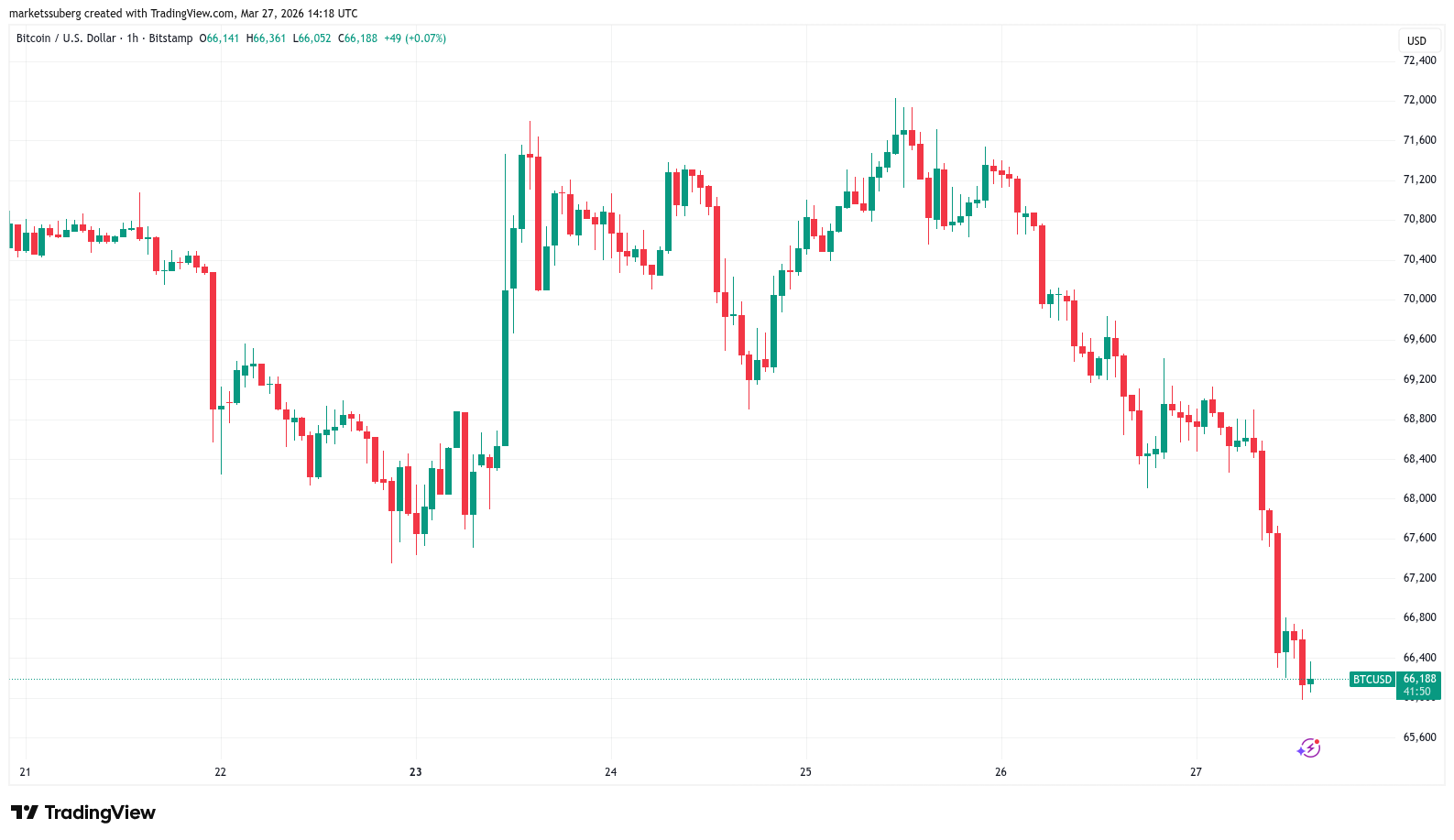
Bitcoin (BTC) neared $66,000 at Friday’s Wall Street open as analysis called US inflation trends “objectively unsustainable.”
Key points:
-
Bitcoin drops further on oil-supply woes as Iran closes the Strait of Hormuz.
-
BTC price performance is set to seal its sixth straight month of losses at the March close.
-
Traders eye the lows with $70,000 back as resistance.
Oil squeeze creates US bond-market havoc
Data from TradingView captured ongoing BTC price losses, which approached 4% on the day and threatened to turn March into Bitcoin’s sixth consecutive “red” month.

Macro headlines drove weakness across risk assets. US stocks opened downward after Iran closed the Strait of Hormuz, sharpening nerves over global oil supplies.
With the US-Iran war set to extend into April, markets showed stress everywhere — including US bonds.
“The US bond market is in major trouble today,” trading resource The Kobeissi Letter warned in a post on X.
Kobeissi noted that the 10-year Treasury note was now at its highest levels since the war began, creating a major headache for the Federal Reserve as it tries to tame inflation as labor-market conditions worsen.
“In less than one month, markets have gone from discussing rate cuts to rate hikes, with the base case showing a Fed PAUSE for the next 18 months,” it continued.
“Keep in mind, the Fed was cutting interest rates because the labor market was weak, and it remains weak. However, inflation expectations have just become an even bigger problem than the labor market. This is objectively unsustainable.”

As Cointelegraph reported, oil prices have a pronounced impact on US inflation trends, while markets have also raised expectations of recession hitting in 2026.
“Inflation expectations have become so bad that the market is trading like an emergency Fed rate hike is imminent,” Kobeissi founder Adam Kobeissi added.

Bitcoin price resistance settles in at $70,000
Among Bitcoin traders, the mood was just as wary as BTC/USD circled its lowest levels in three weeks.
Related: Bitcoin value ‘off the chart’ as BTC price metric hits record lows in 2026
Analyzing four-hour time frames, Telegram trading resource Technical Crypto Analyst predicted a “likely” return to $64,000 next.
“BTC has clearly broken its ascending trendline and is now showing lower highs under the 70–72K supply, confirming a short-term bearish shift; with price losing the 68K support, continuation toward the 64–65K demand zone is likely, and only a reclaim above 70K would invalidate the bearish momentum,” it told subscribers.

Data from CoinGlass revealed the high stakes for price into the March monthly close, with BTC/USD readying its first six straight months of losses since the end of its 2018 bear market.

“Indeed seeing the market derisking into the weekend as expected and as we’ve been seeing several weeks now,” trader Daan Crypto Trades continued.
“Eyes on that $65.6K low from last week Monday. Main area to watch for me will be the range low. Seeing there’s still quite a bit of liquidity around that area.”

This article does not contain investment advice or recommendations. Every investment and trading move involves risk, and readers should conduct their own research when making a decision. While we strive to provide accurate and timely information, Cointelegraph does not guarantee the accuracy, completeness, or reliability of any information in this article. This article may contain forward-looking statements that are subject to risks and uncertainties. Cointelegraph will not be liable for any loss or damage arising from your reliance on this information.

XRP price is trading at $1.35, down almost 2% on the day, and the headline reason for optimism is, paradoxically, part of the prediction problem. Ripple’s freshly announced AI security upgrade for the XRP Ledger landed this week with institutional fanfare. The price barely moved. What’s actually driving the tape right now tells a more complicated story.
On March 26, Ripple published a detailed blog post outlining an AI-driven security framework for XRPL: adversarial code scanning for every pull request, AI-assisted code reviews, dedicated red-team fuzzing, and large-scale attack simulations.
— Crypto Briefing (@Crypto_Briefing) March 26, 2026
 NEW: Ripple is rolling out AI-driven security testing across the XRP Ledger, deploying an AI-assisted red team that has already identified new vulnerabilities. pic.twitter.com/1kjhAlIEcu
Data flags surging Binance open interest, repeated long liquidations, and a bearish wedge breakdown as the dominant near-term forces. Fundamental upgrades and derivative-market mechanics rarely move on the same clock.
With leverage rebuilding and technical structure under pressure, the question isn’t whether XRPL is becoming more secure; it clearly is, but whether the market cares right now.
Discover: The best crypto to diversify your portfolio with
XRP Price Prediction: Can Ripple Price Hit $1.5 Before Month-End?
The technical picture is cautious. XRP has spent the past several weeks range-bound, printing a bearish pin bar rejection at the upper boundary of a consolidation channel that has defined price action since late January. The token hit $1.60 earlier in March before a 3.3% retreat, a level that now acts as near-term resistance.
Key levels to watch: $1.27 is the critical floor, aligning with the 23.6% Fibonacci retracement and what analysts describe as the bear market support line. To the upside, $1.51 represents the 61.8% Fibonacci retracement; breaking and holding above it would signal a structural shift.

On-chain data shows limited meaningful resistance until the $1.75–$1.80 range, where approximately 1.85 billion XRP were accumulated. But it’s a long way to go.
Longer-dated year-end forecasts range from $1.64 to $2.15, with AI models flagging a “significant disconnect between market panic and a projected H2 surge.” That may well play out, but traders watching the daily chart need $1.51 to flip before conviction builds.
Discover: The best pre-launch token sales
LiquidChain Targets Early Mover Upside as XRP Tests Key Levels
XRP holding the $1.27 floor is far from a disaster, but the asymmetry here is limited; even a clean breakout to $1.80 represents roughly 31% upside from current levels. For traders already positioned and watching leverage risk accumulate, that risk/reward ratio demands scrutiny.
Early-stage infrastructure plays offer a different calculus entirely, particularly when the macro argument (cross-chain liquidity, institutional rails) overlaps with XRP’s own use case.
LiquidChain is a Layer 3 infrastructure project building what it calls the Cross-Chain Liquidity Layer, fusing liquidity from Bitcoin, Ethereum, and Solana into a single execution environment. The architecture centers on a Unified Liquidity Layer, Single-Step Execution, Verifiable Settlement, and a Deploy-Once structure that lets developers access all three ecosystems without redeployment.
A new layer emerges. Only a few see it first. — LiquidChain (@getliquidchain) March 24, 2026
The future is LiquidChain  ⟁https://t.co/vqvBcdSj94 pic.twitter.com/R7ZeZ0NPGl
The presale is currently priced at $0.014, with more than $600K raised to date. The project also offers more than 1700% APY staking rewards for early buyers.
The early-stage entry price is the obvious draw. Presales carry meaningful risk — no live mainnet, no exchange listing yet, and liquidity post-launch is never guaranteed. Traders weighing XRP’s compressed near-term range against alternative positioning may find the comparison useful. Research LiquidChain here before the current presale tranche closes.
This article is not financial advice. Crypto markets are highly volatile. Always conduct your own research before investing.
The post XRP Price Prediction: AI Growth Not Lifting XRP, For Now appeared first on Cryptonews.

Ethereum Loses $2K as Traders Expect a Deeper Correction in ETH Price

‘Something Very Bad Is Going to Happen’ Creator Explains the Finale’s Twist Ending and Rachel’s Fate

FBI director gets his personal email hacked by ‘Iran-linked group’ and shared online


-
 Crypto World7 days ago
NIO (NIO) Stock Plunges 6.5% as Shelf Registration Sparks Dilution Worries
-
 NewsBeat2 days ago
Manchester United reach agreement with Casemiro over contract clause amid transfer speculation
-

 Fashion7 days ago
Weekend Open Thread: Adidas – Corporette.com
-

 Politics7 days ago
Jenni Murray, Long-Serving Woman’s Hour Presenter, Dies Aged 75
-

 Crypto World6 days ago
Best Crypto to Buy Now: Strategy Just Spent $1.57 Billion on Bitcoin During Fear While Early Investors Quietly Enter Pepeto for 150x Potential
-

 Crypto World6 days ago
Bitcoin Price News: Bhutan Sells $72 Million in BTC Under Fiscal Pressure, but the Smart Money Entering Pepeto Sees What the Market Does Not
-

 News Videos2 days ago
Parliament publishes latest register of MPs’ financial interests
-

 Sports4 days ago
Remo Stars and Kano Pillars Strengthen Survival Hopes in NPFL
-

 Sports4 days ago
Gary Kirsten Accuses Pakistan Cricket Board Of ‘Interference’, Mohsin Naqvi Responds
-

 Business5 days ago
No Winner in March 21 Drawing as Prize Rolls to $133 Million for Next
-

 Tech5 days ago
Give Your Phone a Huge (and Free) Upgrade by Switching to Another Keyboard
-

 Sports7 days ago
2026 Kentucky Derby horses, odds, futures, preview, date: Expert who nailed 12 Derby-Oaks Doubles enters picks
-

 Tech5 days ago
AI enters the chat: New Seattle dating app relies on tech to facilitate meaningful human connections
-

 News Videos4 days ago
Ch 9 Financial Management Part 1 | Detailed One Shot | Class 12 Business Studies Boards 2026
-
Business7 days ago
Columbia Sportswear enters $500 million credit agreement with JPMorgan Chase
-

 Tech6 days ago
Today’s NYT Connections Hints, Answers for March 22 #1015
-

 Business19 hours ago
Instagram, YouTube Found Responsible for Teen’s Mental Health Struggle in Historic Ruling
-
 Crypto World7 days ago
Small-cap Russell 2000 enters correction territory
-

 Business5 days ago
Will Duke Basketball Win It All? Duke Basketball Enters Second Round as Third Favorite to Claim NCAA Title
-

 Sports4 days ago
2026 Kentucky Derby horses, odds, futures, preview, date: Expert who hit 12 Derby-Oaks Doubles enters picks
You must be logged in to post a comment Login