
Crypto World
BTCC Exchange Announces Platinum Sponsorship of TOKEN2049 Singapore and Launches “0-Barrier Trading” Flagship Theme



BTCC, the world’s longest-serving cryptocurrency exchange, announces its participation in TOKEN2049 Singapore 2026 as a Platinum Sponsor. Taking place October 7-8 at Marina Bay Sands, the world’s largest crypto event is expected to convene over 25,000 global industry leaders, investors, and enthusiasts.
As BTCC celebrates its 15th anniversary this year, the exchange’s high-profile presence at TOKEN2049 signals the next chapter in its brand evolution: 0-barrier trading.
Theme of the Next Chapter: 0-Barrier Trading
BTCC’s TOKEN2049 showcase centers on its commitment to making futures trading accessible, reliable, and cost-efficient. Driven by the core pillars of 0 Fees, 0 Friction, and 0 Panic, BTCC removes all barriers to trading, allowing cost-conscious traders to navigate global markets with confidence.
On-site, BTCC’s booth at TOKEN2049 will bring its yearlong 0-Fee Festival campaign to life through a large-scale receipt-style installation designed for social sharing. Alongside the merch counter, the booth features a rotating, backlit cylinder that highlights the exchange’s core zero-barrier commitments.
Attendees can stop by to participate in interactive activities, engage with the team, and collect official BTCC swag bags.
The BTCC Traders Club
A key highlight of BTCC’s presence at TOKEN2049 is the BTCC Traders Club. Styled around BTCC’s partnership with the Argentine Football Association (AFA), the exclusive private lounge features dark wood decor in a cozy, luxurious atmosphere where BTCC’s most meaningful TOKEN2049 conversations will take place. During the event, the lounge will receive VIP traders, key opinion leaders, community partners, and invited guests to connect and collaborate.
Global Giveaways & Live Coverage
For the global community participating virtually, BTCC will host live streams on X featuring prominent industry KOLs directly from the Marina Bay Sands exhibition floor.
Online participants can join special campaigns throughout the event, with rewards including USDT prize pool giveaways and exclusive limited-edition merchandise.
To stay updated on BTCC’s announcements and activities at TOKEN2049 Singapore, visit BTCC’s official X.
#BTCC15 #BTCCTOKEN2049
About BTCC
Founded in 2011, BTCC is a leading global cryptocurrency exchange serving over 12 million users across 100+ countries. As the official regional sponsor of the Argentine Football Association (AFA), BTCC offers secure and accessible cryptocurrency trading services, focused on delivering a user-friendly experience while adhering to applicable regulatory standards.
The post BTCC Exchange Announces Platinum Sponsorship of TOKEN2049 Singapore and Launches “0-Barrier Trading” Flagship Theme appeared first on BeInCrypto.


In this video, Gary Thomson explores why the Japanese yen has weakened again after briefly recovering following US-Japan currency intervention, with USD/JPY back above 159.
👉 Key topics covered:
✔️ Why the Yen Recovery Faded — The wide US-Japan rate gap continues to weigh on the yen and support carry trades.
✔️ Geopolitics and Oil — Middle East tensions and higher oil prices are adding pressure on Japan while supporting the dollar.
✔️ Investment Flows — Strong US investment, particularly in AI, continues to attract capital away from Japan.
✔️BoJ Rate Hike Expectations — Markets are increasingly pricing in a potential September rate hike, but could one move be enough to reverse the yen’s trend?
✔️Potential Intervention — With USD/JPY above 159, traders are watching for further action from the BoJ and Japanese authorities.
Interest-rate differentials, capital flows, geopolitical risks and intervention continue to drive the USD/JPY pair.
💬 Don’t forget to like, comment, and subscribe for more market insights every week.
Watch it now and stay updated with FXOpen.
This article represents the opinion of the Companies operating under the FXOpen brand only. It is not to be construed as an offer, solicitation, or recommendation with respect to products and services provided by the Companies operating under the FXOpen brand, nor is it to be considered financial advice.
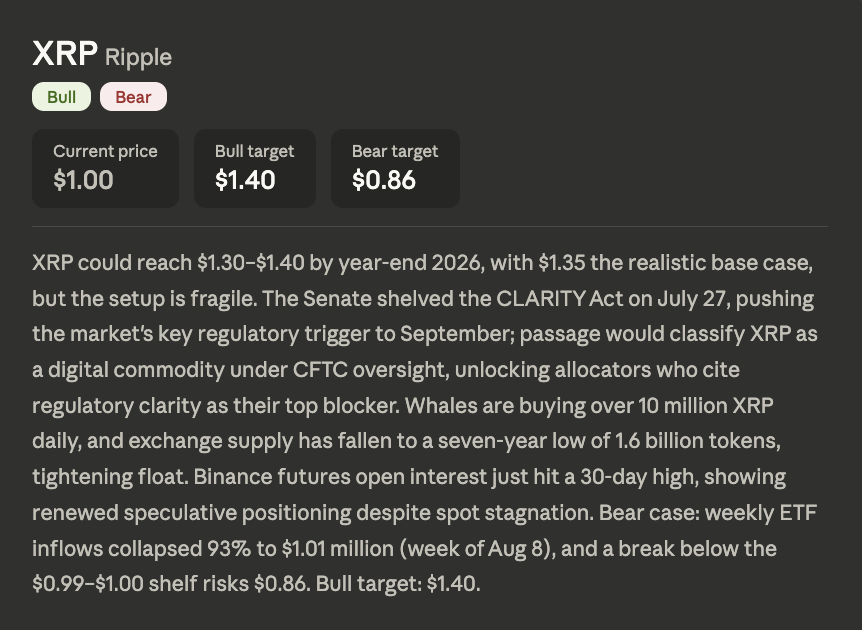
Whales are absorbing more than 10 million tokens a day while exchange supply drains to a seven-year low. Claude AI predicts that squeeze matters, and the XRP price prediction lands at $1.30 to $1.40 by year-end 2026, with $1.35 as the realistic base case.
The regulatory piece is the largest variable. The Senate shelved the CLARITY Act on July 27, pushing that trigger to September.
Passage would classify XRP as a digital commodity under CFTC oversight. Claude notes allocators cite regulatory clarity as their single biggest blocker.
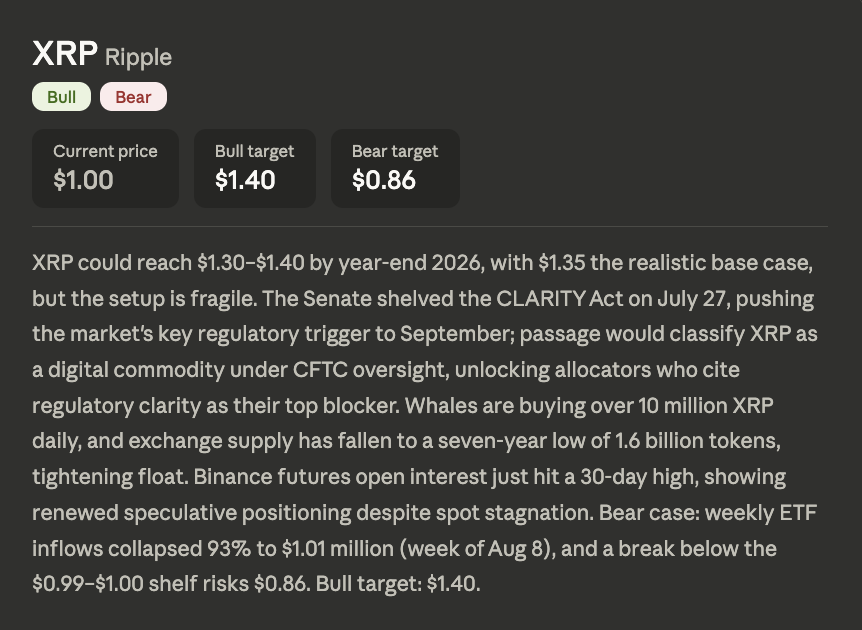
The supply side is already tightening without it. Exchange balances have fallen to 1.6 billion tokens, the lowest in seven years.
Speculative positioning is returning too. Binance futures open interest just hit a 30-day high despite flat spot action.
Claude calls the whole setup fragile rather than confident. That framing runs through the entire thesis.
The bear case has a hard number behind it. Weekly ETF inflows collapsed 93% to $1.01 million in the week of August 8.
The $0.99 to $1.00 shelf is the line that matters. A break below it puts $0.86 in play.

Discover: Everyone’s Got a Take. Get Free $25 to Actually Trade Yours
XRP Price Prediction: Whales Are Loading While Washington Stalls Until September, Is Claude AI Predicts Happening?
The chart explains why the word fragile keeps appearing. XRP peaked above $3.55 last July and has declined for thirteen straight months.
October brought a violent single-candle drop toward $1.60. February broke the $1.80 region and carried price near $1.15.
Spring produced a range between $1.30 and $1.50. That looked like a floor until June broke it decisively.
Summer has been a steady grind lower with no bounce of consequence. Price now sits at the lowest point anywhere on this chart.
The close reads $1.00425, down 0.42% and $0.00426 on the session. The daily range covered $1.00281 to $1.01308.
Support sits at $1.00, then $0.99 as the shelf Claude flags, with $0.86 beneath it. Resistance appears at $1.10, then $1.20 and $1.40.
RSI reads 35.81 with its signal line above at 39.59. The oscillator trails by nearly 4 points, which keeps sellers firmly in control.
That reading sits just above oversold territory. Momentum is weak and still pointed lower.
Claude’s bull target sits 40% above a market making new lows. September is when Washington either supplies the catalyst or confirms the fragility.
Discover: Your Market Calls Are Worth Something. Start With Free $25 on Kalshi
If September Is the Catalyst, Kalshi Lets You Trade the Outcome Before XRP Moves
XRP traders are effectively waiting on Washington. The difference with Kalshi is that you do not have to express that view through XRP itself.
Kalshi lets users trade directly on real-world outcomes, including politics, economic data, Fed decisions, crypto milestones, and other events that can move markets. Instead of guessing how XRP might react to the CLARITY Act, traders can take a position on the underlying event itself.
That matters when the asset is sitting on fragile support and the next major catalyst has a date attached to it. Kalshi turns those binary questions into tradable markets, giving users another way to act on the same thesis before it shows up in price.
Eligible new users who sign up through CryptoNews can also receive $25.
Don’t Miss Out on Our $1,000 USDT Airdrop on ByBit
The post Dario Amodei Claude AI Predicts the Next Chapter for XRP in 2026 appeared first on Cryptonews.


StablecoinX shares have climbed more than 12% after the Nasdaq-listed company disclosed a 3-billion-token ENA treasury and reported its first quarterly results since going public.
Summary
- StablecoinX held approximately 3 billion ENA tokens, equal to about 20% of the total supply.
- The ENA treasury was valued at $218.4 million, or about $9.09 per Class A share.
- StablecoinX recorded a $34.2 million quarterly net loss, largely caused by a non-cash impairment charge.
- Infrastructure services produced $62,372 in revenue during the final two weeks of June.
StablecoinX values its ENA treasury at $218.4 million
StablecoinX said in its Aug. 14 quarterly results release that its ENA treasury totaled approximately 3 billion tokens at the end of the second quarter, giving the company control of roughly 20% of ENA’s 15 billion-token supply.
Using ENA’s June 30 closing price of $0.07204, StablecoinX valued the position at $218.4 million. The treasury was worth approximately $9.09 for each of the 24,029,375 Class A shares outstanding on that date, according to the company.
Around 284.95 million ENA tokens came from the Ethena Foundation as part of StablecoinX’s business combination. Cash and in-kind investments made by private investment in public equity participants accounted for another 2.75 billion tokens.
StablecoinX reported total assets of $232.6 million at quarter-end, including $18.9 million in cash and cash equivalents. Its balance sheet carried $212.9 million in digital intangible assets, consisting mainly of ENA recorded at cost after impairment.
Shares rose more than 12% during early U.S. trading on Friday following the results. The stock reaction came less than two months after StablecoinX completed its merger with special-purpose acquisition company TLGY Acquisition Corp.
As crypto.news reported in June, the business combination closed on June 25, with StablecoinX’s Class A shares and public warrants starting Nasdaq trading one day later under the symbols USDE and USDEW.
A non-cash ENA charge drove the quarterly loss
For the three months ended June 30, StablecoinX recorded a net loss of $34.2 million, equal to $15.27 per share. Most of the loss came from a $36.2 million impairment charge tied to its digital intangible assets rather than spending by its operating business.
After excluding the impairment and changes in the value of digital asset-related instruments and warrant liabilities, the company calculated an adjusted non-GAAP net loss of $188,204. StablecoinX had used $81,680 in cash for operating activities during the first six months of 2026.
Revenue remained limited because the company’s infrastructure operation only began producing income near the end of the reporting period. StablecoinX generated $62,372 from infrastructure services during the final two weeks of June, with no revenue reported from its other planned business lines.
Chief Executive Edward Chen described the quarter as StablecoinX’s first reporting period as a public company and said the completed merger had opened a stock-market route into yield-bearing digital dollar products.
“Our first quarter end as a public company reflects the successful close of our business combination.”
The company’s ENA position leaves its asset value and reported results closely tied to the market price of Ethena’s governance token. StablecoinX also identified ENA volatility, changing regulatory conditions, and difficulties launching its planned products as risks that could affect its financial performance.
For U.S. investors, StablecoinX provides exposure through Nasdaq-listed shares rather than requiring the direct purchase or custody of ENA. Its public status also requires the company to disclose financial results and material developments through filings with the U.S. Securities and Exchange Commission.
Infrastructure services have processed $3 billion
Beyond the token treasury, StablecoinX operates a decentralized verifier node that checks and delivers cross-chain messages for Ethena products. The company said the node had verified more than 10,000 messages and surpassed $3 billion in cumulative cross-chain volume as of Aug. 12.
Every message verified by the node had been delivered successfully, according to StablecoinX. Fees from the infrastructure service are based on processed volume rather than the number of individual transactions.
During July, the company began rolling out a second business line through its StablecoinX Harness middleware platform. The initial phase launched on July 2, and StablecoinX signed its first Harness client eight days later.
Harness is designed as a single application programming interface through which companies can access payment routing, cross-chain bridging, liquidity, treasury management, and institutional reporting tools. StablecoinX also opened applications for a design partner program covering payments and agents, blockchain networks and protocols, and institutional users.
A third business line, Distribution Services, is planned for 2027, subject to market and regulatory conditions. StablecoinX said the service would give investors indirect access to USDe and could generate distribution and management fees from deployed capital.
Ethena has expanded institutional access to USDe
StablecoinX’s original treasury plan began with a $360 million PIPE financing announced in July 2025. A further $530 million round disclosed in September brought committed PIPE funding to approximately $890 million, with YZi Labs, Brevan Howard, Susquehanna Crypto, and IMC Trading among the participants.
The financing agreements called for part of the proceeds to purchase locked ENA at a discount from an Ethena Foundation subsidiary. StablecoinX also entered a long-term collaboration agreement that allows it to acquire additional tokens directly from Ethena under agreed terms.
While the treasury gives StablecoinX a large position in Ethena’s governance system, its operating plan depends on demand for USDe and other products connected to the protocol. USDe uses crypto assets, hedged derivative positions, and other backing arrangements to maintain its target value, while holders of its staked form, sUSDe, can receive rewards.
By July 31, USDe supply had settled at approximately $3.9 billion, according to StablecoinX. The protocol’s backing ratio stood near 101.7%, while the annual percentage yield on sUSDe increased from 3.8% to 4.1% during July. Ethena has generated more than $800 million in cumulative protocol fees and distributed over $750 million in ecosystem rewards since its launch.
Institutional distribution has continued despite the decline from USDe’s previous supply peak. In June, BlackRock integrated USDe into Aladdin, allowing financial institutions using its investment management platform to access the synthetic dollar through existing portfolio and risk systems.
Coinbase also introduced an Ethena-powered lending vault in June. The product lets users lend USDC through Morpho markets while Ethena-related assets form part of the vault’s collateral structure.
Ethena has since added FalconX to an institutional lending program that already included agreements with Anchorage Digital, Maple Institutional, and Coinbase Asset Management. Ethena’s June governance report placed institutional lending at approximately $310 million, or 6.9% of USDe’s backing portfolio.
Crypto World
Polymarket CLARITY Act Odds Crashed From 82% to Under 20%, Does September 15 Save the Bill?

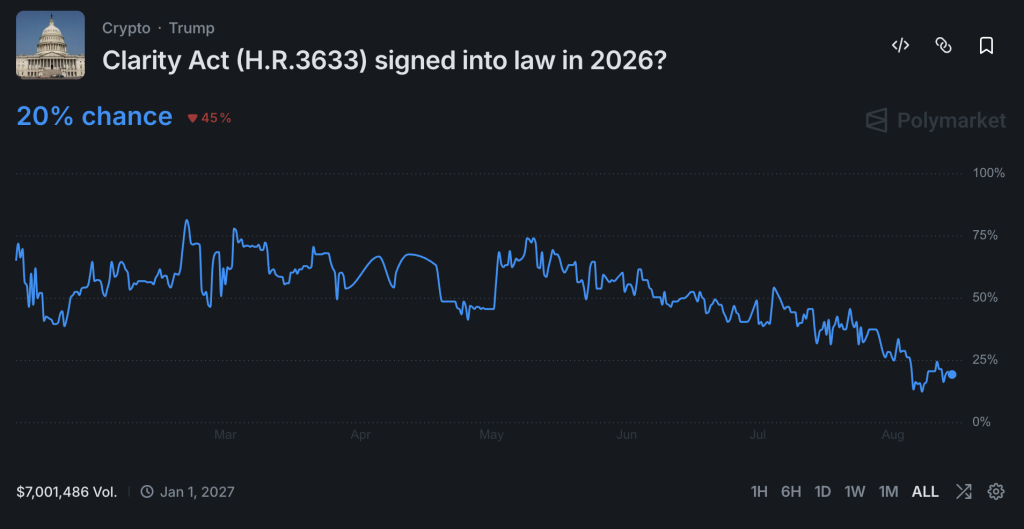
Polymarket CLARITY Act odds being signed into law this year fell below 20% early this week. The decline followed months of uncertainty over whether the Senate can advance the crypto market-structure legislation.

Discover: Everyone’s Got a Take. Get Free $25 to Actually Trade Yours
Polymarket CLARITY Act Odds: The Recess That Reset The Clock
The Senate adjourned for its August recess without a vote on the bill. Before lawmakers left town, Senate Majority Leader Thune scheduled a vote for September 15, American Banker reported.
American Banker described September 30 as the last clear deadline before Congress turns more fully toward campaigns and partisanship.
JUST IN: — Bitcoin Magazine (@BitcoinMagazine) July 29, 2026
 American Bankers Association CEO tells CNBC "There's a lot of good in the Clarity Act"
"I do think that the crypto and the banking sectors can coexist. I think we can be the crypto capital of the world."
"We're working with the Senators" on this bill. pic.twitter.com/3SldlEBEOS
The scheduled September vote keeps the bill in play, but negotiations over its remaining provisions have yet to produce a final outcome.
Discover: Your Market Calls Are Worth Something. Start With Free $25 on Kalshi
What Moved The Odds
Polymarket traders gave the bill a 20% chance of passing by year-end, down from a high of 82% on February 19.
The odds had declined since early May as the Senate calendar narrowed and lawmakers faced questions about assembling bipartisan support.
Senate negotiations have remained focused on unresolved ethics provisions. CoinDesk described the absence of bipartisan ethics language as one of the bill’s largest obstacles, while American Banker noted that a merged text combining the Banking and Agriculture Committee versions had recently been released.
What the Bill is Designed to Address
If enacted, the Clarity Act would establish a federal framework for digital-asset markets and draw a clearer line between assets regulated by the Securities and Exchange Commission and those overseen by the Commodity Futures Trading Commission.
Supporters of the measure argue that clearer statutory rules would reduce regulatory uncertainty and bring crypto activity onshore. They have also argued that legislation would provide durable rules rather than leaving the industry to operate under agency guidance.
The September 15 vote is the next scheduled milestone for the legislation. American Banker argued that September 30 is the last clear deadline before campaign considerations make further movement more difficult.
For now, the sub-20% Polymarket reading reflects skepticism about whether the Senate can resolve the outstanding issues and move the bill forward this year. The bill’s House passage, Senate committee approval and scheduled September vote show that the legislation remains active, but its unresolved ethics provisions continue to weigh on its prospects.
Don’t Miss Out on Our $1,000 USDT Airdrop on ByBit
The post Polymarket CLARITY Act Odds Crashed From 82% to Under 20%, Does September 15 Save the Bill? appeared first on Cryptonews.


Israel’s Bank Leumi has partnered with Galaxy Digital to let customers trade Bitcoin (BTC), Ether (ETH), and Solana (SOL) through the bank’s investment platform, with the service expected to launch in early 2027.
The companies said Friday that customers of Leumi and Pepper, its mobile banking arm, will be able to buy, hold and sell the three cryptocurrencies through a dedicated section of the Leumi Trade app. Leumi and Galaxy said the rollout would make Leumi the first Israeli bank to offer digital asset trading services to customers.
Leumi will use GalaxyOne Institutional for trading and related services, while Galaxy’s custody infrastructure platform, formerly known as GK8, will support the bank’s digital asset infrastructure.
According to Leumi, the bank serves millions of customers across its retail and business operations.
The partnership comes after Galaxy reported an $85 million net loss in the second quarter, which it attributed largely to declining digital asset prices. Despite the loss, its digital assets business generated $66 million in adjusted gross profit, up 34% from the previous quarter.
Galaxy Digital, founded and led by Mike Novogratz, began trading on the Nasdaq under the ticker GLXY in May 2025. Its shares were trading at $21.38 on Friday morning, up about 2% on the day but down roughly 25% over the past year, according to Yahoo Finance data.
Magazine: Solana’s fee overhaul increases burn and makes resource hogs pay
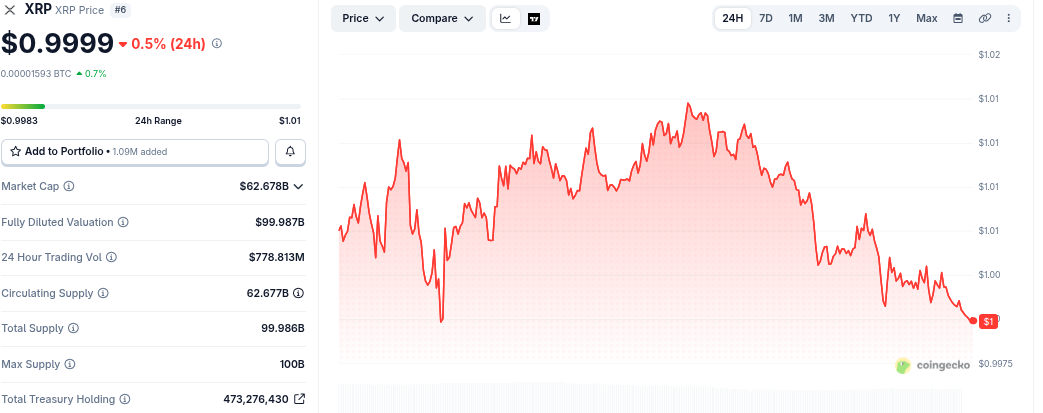
XRP price slipped below $1 again in the past 24 hours, despite record adoption metrics across the XRP Ledger (XRPL). The altcoin is currently testing a level it defended for years.
The breakdown complicates a thesis built almost entirely on institutional demand and network growth.

What the Price Action Actually Shows
A psychological support level is a round number that traders defend collectively, often regardless of underlying fundamentals. XRP has held above $1 for 635 consecutive days.
The streak ended on August 11. The token printed $0.9915, its first move below the level since November 2024. Each return to that zone carries weight. Repeated tests suggest sellers keep probing for weakness beneath a floor that once looked solid.
The symbolism cut deeper than the arithmetic. At the recent low, XRP briefly traded below RLUSD, Ripple’s own dollar stablecoin. Technical levels now define the range.
Analysts identify $0.70 to $0.90 as the next support, with a broader zone extending toward $0.86 if selling accelerates.
Follow us on X to get the latest news as it happens.
Reclaiming ground requires specific progress. Buyers would need to push above $1.03 to meaningfully improve the short-term structure.
Fund flows offer little encouragement. Spot product net inflows totaled $3.27 million so far in August, down roughly 88% from the $27.29 million recorded in July, according to SoSoValue data.

The Case Analysts Keep Defending
Some analysts point elsewhere entirely. The monthly relative strength index reached its most extreme reading in twelve years, deeper than the pandemic crash or the 2018 bear market.
Institutional adoption anchors their case. Aviva Investors, which manages $351 billion, launched a tokenized fund on the XRP Ledger with approval from the Central Bank of Ireland.
Ecosystem metrics reinforce that argument. Real-World Assets value on the XRPL sits near $4.06 billion, after adding roughly $2.5 billion over six months.
“…The bears say the ledger can succeed without the token capturing value. The bulls say the settlement layer of the bridge currency function create structural demand that grows with adoption. Both arguments have merit. The honest answer is that the token network relationship is genuinely unresolved and at historic RSI lows with institutional adoption accelerating the riskreward for being wrong on the bearish side is significant…,” Lark Davis said.
On-chain data shows accumulation, too. Santiment recorded 32 new wallets holding at least 1 million XRP over three months, though single entities can control multiple addresses.
One structural detail complicates the thesis considerably. Ripple’s ten major institutional deals during 2026 all settled in RLUSD rather than XRP. That fact anchors the bearish case. The XRPL can grow commercially while the token captures little of that activity, since institutions need infrastructure rather than the asset.
Analyst targets diverge accordingly. Standard Chartered maintains $2.80 while analyst Ali Martinez flags downside risk toward $0.62. History provides an uncomfortable reference.
XRP lost 95%of its value in the two years following its 2018 peak, and it currently trades roughly 72.5% below its July 2025 record, according to BeInCrypto data.
The disconnect defines everything now. Adoption data shows where infrastructure gets built, not whether holders eventually see that value reflected in price.
Subscribe to our YouTube channel to watch leaders and journalists provide expert insights.
The post XRP Price Falls Below $1 Again Despite Record Network Adoption appeared first on BeInCrypto.
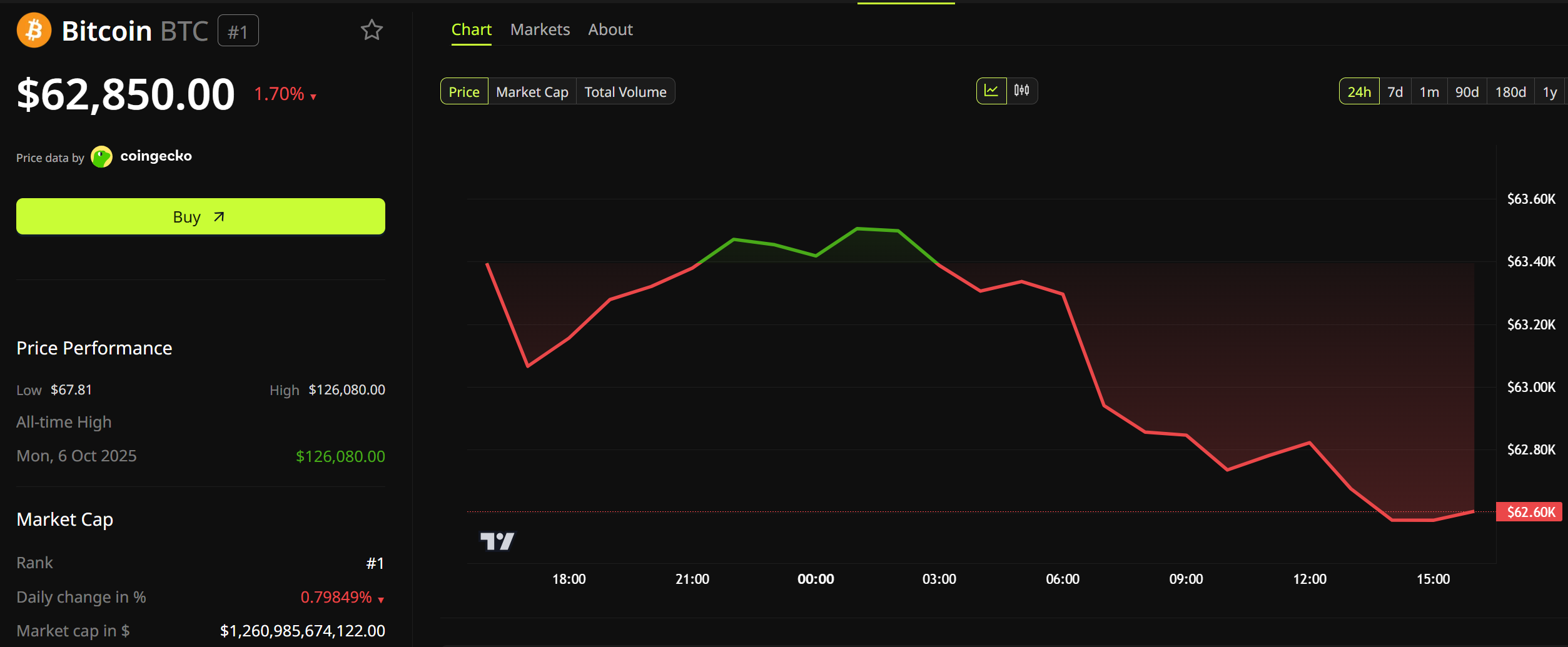
China’s central bank injected a net 348 billion yuan, about $51.7 billion, into its banking system on Friday. Bitcoin (BTC) fell 1.7% anyway.
It was the first mid-month use of overnight reverse repos by the People’s Bank of China (PBOC), according to Bloomberg. Three more injection days are already booked, each capped near $88 billion.

Beijing Already Booked Three More Injection Days
Start with what the tool actually does. An overnight reverse repo is a one-day loan from the central bank to commercial banks. The banks repay it the next morning.
Two days before Friday, the PBOC published its schedule. It would lend on August 14, then again from August 17 through August 19, local media reported.
Each day carries a ceiling of 600 billion yuan, close to $88 billion. Friday used only 58% of that room.
Add up all four days and the ceiling reaches 2.4 trillion yuan. That is a liquidity corridor, not a one-off gesture.
The corridor exists because Beijing has stopped cutting rates. The PBOC has held its one-year benchmark lending rate at a record low 3% since May 2025. Plumbing has replaced rate cuts.
China’s Bond Market Broke Ranks With Everyone Else
Domestic bonds moved first. China’s 10-year government bond yield slipped to 1.68%, its lowest since July 2025. A government bond auction the same day drew the weakest 10-year yields in over a year.

Now compare that with the United States. The 10-year Treasury yield sat near 4.63%. The gap between the two is roughly 295 basis points.
Japan’s 10-year yield closed at 2.87% on Thursday, still near multi-year highs. Bitcoin trades against that global cost of money, not China’s.

Rising Western borrowing costs have squeezed risk assets all year. The highest 30-year Treasury yield since 2007 arrived in July. Bitcoin has traded heavily since.
Currency stress added to the strain. Traders watched yen intervention fade again this month, and global funding stayed tight.
Whether Any of This Cash Reaches Bitcoin
There is now a precedent worth checking. The PBOC launched this tool on June 29 with 300 billion yuan, about $44 billion. Bitcoin fell then too. BTC dropped 2.26% to $58,504 by the following morning, according to Fortune data.
Two injections, two declines. The sample is small, but it is the only direct evidence available.
The longer view reads differently. Bitcoin has gained roughly 7% since that June operation. Slow drift, not injection-day pops.
Analysts describe Friday as tuning rather than easing. Mid-month tax bills drain cash from banks, and the PBOC refilled the hole.
“The stance toward liquidity management appears unchanged, in that the PBOC aims to smooth liquidity but not overflood the market,” said Frances Cheung, head of foreign exchange and rates strategy at Oversea-Chinese Banking Corp., in published remarks.
Capital controls are the harder barrier. Chinese banks cannot send reserves to offshore crypto markets. Domestic trading stays banned.
Any effect on Bitcoin therefore arrives indirectly, through mood and currency markets. Crypto has leaned on that hope before. Last November, central banks flooded markets on both sides of the Pacific, and bulls read it as a starting gun.
Still, calmer funding costs matter to leveraged traders.
“The better-anchored market repo rates, with likely lessened volatility of overnight funding costs ahead, could lift conviction in carry trades in the near term,” Jeffrey Zhang, strategist at Credit Agricole CIB, in the same report.
Carry trades borrow cheap money in one currency to buy assets elsewhere, including Bitcoin near $62,800. Steadier overnight rates in China trim one cost in that chain.
Monday brings July activity data and the next injection window. China grew 4.3% in the second quarter, its weakest pace since late 2022. July consumer prices also missed forecasts.
Friday delivered the cash and Bitcoin still dropped. If Chinese liquidity can move global risk appetite, Aug. 17 through Aug. 19 should prove it.
The post China Injected $52 Billion and Bitcoin Fell, Three More Days Are Scheduled appeared first on BeInCrypto.

Metaplanet CEO Simon Gerovich has publicly denied speculation that the treasury company was selling its Bitcoin holdings after a routine transfer sent rumor mills into overdrive.
Gerovich clarified that the Bitcoin treasury company moved 5,014 BTC, worth around $320 million, between its custodial wallets, not to an exchange.
Metaplanet Shuts Down Bitcoin Sale Speculations
Gerovich confirmed the Bitcoin treasury company’s Bitcoin holdings remain unchanged after blockchain trackers spotted a transfer from wallets linked to the company. The transfer fueled speculation that Metaplanet was following Strategy’s lead and cashing out on some of its holdings. However, Gerovich moved quickly to calm speculation, stating that it was a routine transfer between company wallets.
“We transferred 5,014 BTC between Metaplanet custodial addresses over the past 24 hours. This was a routine custody operation. No bitcoin was sold, and our holdings remain 43,000 BTC. All of our addresses are published, which is why the transfers were observable in real time. Total network fees to move $322 million in bitcoin: approximately $8.”
Metaplanet’s wallet addresses are public, allowing anyone to view transfers on-chain. However, the company’s commitment to transparency around its holdings briefly worked against it, setting off alarm bells in the community. Metaplanet currently holds 43,000 BTC, worth around $3 billion at current prices. With BTC’s steep decline, the company is sitting on an unrealized loss of around $1.4 billion, according to data from Arkham Intelligence.
Recent Strategy Sales Increase Scrutiny On Bitcoin Treasury Companies
Strategy’s recent Bitcoin sales have soured market sentiment and increased scrutiny of Bitcoin treasuries. This is why Metaplanet’s routine transfer created significant speculation about an imminent sale, with investors assuming it is following Strategy’s footsteps. Strategy, the largest corporate holder of Bitcoin, has been strategically selling BTC to fund dividend obligations on its preferred STRC stock and buy back STRC. It is also selling MSTR to fund its dollar reserve.
Future Bitcoin Acquisitions
Metaplanet’s Bitcoin stash has grown steadily in 2026, despite a substantial decline in BTC’s price. The company added 5,075 BTC during Q1 2026, followed by a 2,823 BTC purchase in Q2, taking its total stash to 43,000 BTC. Metaplanet is the third-largest Bitcoin treasury company in the world and the largest in Asia. It plans to increase its Bitcoin holdings to 100,000 BTC by the end of 2026 and 210,000 BTC by the end of 2027.
The Bitcoin treasury company has also launched BitBonds, a fixed-rate debt program to fund future Bitcoin acquisitions and other corporate obligations. The program allows Metaplanet to raise capital without issuing stock or dipping into its Bitcoin holdings.
The company stated, “The Company intends to continue issuing bonds under the Program in light of market conditions and other factors and, over the medium to long term, as the scale of issuance expands, to put in place the arrangements necessary to enable public bond offerings made under a securities registration statement or similar filing.”
Metaplanet is also expanding beyond Bitcoin accumulation, establishing Metaplanet Ventures in March 2026, and pledging 4 billion yen ($25 million) over two years toward Bitcoin and crypto infrastructure in Japan.
Metaplanet Posts 3.33 Billion Yen Operating Profit
Metaplanet published its revenue numbers for the first half of 2026 on Thursday, reporting 4.94 billion yen ($33 million) in first-half revenue, a 134% increase year-over-year. It also reported a 3.33 billion yen ($20.3 million) operating profit, up 136%, while reporting a 182.8 billion yen net loss ($1.2 billion), driven by a non-cash Bitcoin valuation loss. Metaplanet noted that it sold no Bitcoin in 2026 and added 7,898 BTC during H1 2026, taking its holdings to 43,000 BTC.
The company reported 4.7 billion yen in revenue from its Bitcoin income business and a 4.2 billion yen profit. The majority of this revenue came from Bitcoin derivatives trading, with option premium income accounting for 4.5 billion yen.
Disclaimer: This article is provided for informational purposes only. It is not offered or intended to be used as legal, tax, investment, financial, or other advice.

Bitcoin moved lower into Friday’s Wall Street open, with traders increasingly focused on whether the market is setting up for a renewed downside break. While broader risk assets managed to hold momentum after encouraging US inflation developments, BTC failed to participate, slipping toward month-to-date lows around the low-$62,000s.
Market attention has now shifted to the next major US macro release: the Aug. 26 Personal Consumption Expenditures (PCE) index, which is the Federal Reserve’s preferred inflation gauge. QCP Capital said the crypto sector’s muted response to softer inflation so far makes the upcoming PCE print especially important for what comes next.
Key takeaways
- BTC is trading below $63,000 and is nearing new August lows, despite US equities hitting record highs.
- Rekt Capital highlighted $63,220 as a weekly-close threshold, warning that staying below it could encourage a deeper breakdown.
- TradingView data showed BTC down about 1.3% on the day to roughly $62,570, near month-to-date lows.
- QCP Capital pointed to the upcoming Aug. 26 PCE release as the next critical test for whether macro tailwinds can translate into sustained crypto demand.
BTC underperforms as stocks press to new highs
According to TradingView, BTC/USD was down about 1.3% on the day to $62,570, trading close to its lowest levels month-to-date. This comes as US stocks continued to climb, with the S&P 500 and the Nasdaq Composite both posting gains by the time of writing on Thursday’s close—an environment that has typically supported risk-on assets.
The divergence matters because it suggests Bitcoin is not simply tracking the improving equity tape. Earlier coverage noted that inflation relief in the US had reduced expectations for further interest-rate pressure, but Bitcoin still lacked the follow-through traders often look for when macro conditions improve.
$63,220 on weekly close as a decision point
One of the clearest near-term signposts is $63,220. Trader and analyst Rekt Capital warned that the Sunday weekly close needs to be above that level to avoid setting up what he described as “a breakdown.” In a post on X, Rekt Capital also stressed that $63,000 is no longer behaving like reliable support after weakening throughout August.
Rekt Capital further tied the current structure to prior market behavior, noting that a 50-month exponential moving average (EMA) near $65,827 appears to be acting as resistance. He framed this as reminiscent of the 2022 bear-market pattern, emphasizing that BTC has recently struggled to reclaim key levels that would normally help stabilize price action.
For traders, the practical implication is straightforward: the market is approaching a level where confirmation could shift from “range behavior” to “trend continuation lower” if price fails to regain momentum on the weekly timeframe.
Derivatives positioning and liquidation risk remain in focus
The caution around a potential breakdown has also been linked to positioning in derivatives markets. Earlier coverage from Cointelegraph reported increasing odds of a liquidation event as BTC approached an area of liquidity around $61,000, alongside rising open interest (OI) in futures and other derivatives venues.
That setup can amplify volatility when price breaks downward, particularly when leverage is concentrated on one side of the market. In a recent edition of its newsletter, onchain analytics platform Glassnode summarized the broader imbalance: “Traders have added substantial risk, most of it long, into a market that shows no matching demand,” according to The Week Onchain.
In this context, the market’s inability to rally alongside stocks becomes even more notable—if demand doesn’t show up when price is supported by the macro narrative, leveraged long positioning can become vulnerable quickly when technical levels fail.
PCE on Aug. 26 becomes the next macro catalyst
Beyond technical levels, QCP Capital argued that the crypto market’s response to improved inflation conditions has been inconsistent. In its latest analysis, QCP said the phenomenon is “increasingly important,” distinguishing between “resilience” and “momentum.” The firm noted that BTC absorbed several negative headlines without a sustained breakdown last week, but that softer inflation data have only produced a muted response so far.
QCP’s key point for investors is that the market may be waiting for a more decisive macro signal rather than reacting to incremental improvements. The firm said macro traders are now focused on the Aug. 26 PCE index release—widely recognized as the Federal Reserve’s preferred inflation gauge.
According to data referenced by QCP, the PCE “last print” in July marked its first monthly decline since 2020, based on figures from the Bureau of Economic Analysis. That makes the upcoming reading notable: if the data reinforces a cooling inflation trend, traders may look for whether crypto can finally convert the narrative into sustained buying demand rather than staying range-bound or weakening.
At the same time, the key uncertainty is timing and translation. So far, the pattern described by QCP suggests that macro relief hasn’t yet been strong enough to move crypto into a clear uptrend. With BTC sitting below key technical thresholds, the PCE release could influence whether leveraged traders choose to reduce risk or add exposure—potentially affecting volatility regardless of the direction of inflation prints.
Heading into the Aug. 26 PCE report, traders will likely watch both the weekly technical level near $63,220 and whether derivatives positioning continues to build risk on the long side. If BTC remains unable to reclaim that threshold, the market may be setting up for sharper downside moves; if it does recover, investors will want to see whether the macro narrative finally produces sustained momentum rather than a brief relief rally.
JPMorgan Chase (JPM) continues to grind higher, ranks first in Investor’s Business Daily’s Banks-Money Center group and was just added to IBD’s Big Cap 20 list. So traders might consider taking some bullish exposure on JPMorgan stock, using options in a limited risk way. One way to do that is by using a bullish butterfly spread. This is a similar idea…
Copyright ©2026 Investor’s Business Daily, LLC. All rights reserved. 87990cbe856818d5eddac44c7b1cdeb8

Ralph Fiennes backs Bell Inn bid

Why Has the Yen Weakened After Intervention?

Paris Jackson Has Savage Reply To ‘Dirty’ Tattoo Critic


-

 Fashion7 days ago
Weekend Open Thread: Mattifying Sunscreen
-

 News Videos6 days ago
Can Astrology Help Find Gold and Silver Trends? A Financial Astrology Guide
-

 Business5 days ago
Datadog: Best Of Breed For Multiple Reasons
-

 Tech7 days ago
Rinn Pharma & Biopharma to join NordicPharmaTrain network
-

 Business6 days ago
How to Start a Cleaning Business: A Step-by-Step Guide
-

 Business6 days ago
BDC Weekly Review: Private BDC Q2 Numbers Are Strong
-
 NewsBeat3 days ago
Communication cards help banking customers access services or report scams
-
 Business4 days ago
Oil Price Today (August 11): Crude oil rises to $88 after Trump’s compensation demand dents Hormuz opening. Here’s why
-

 Fashion7 days ago
Weekly News Update, 8.6.26 – Corporette.com
-
 Entertainment6 days ago
10 R-Rated Drama Movies That Can Be Called Masterpieces
-

 Fashion5 days ago
Amazon Sundays: Closet Care Before Fall
-

 Business6 days ago
SharkNinja Keeps Eating
-

 Politics6 days ago
Be quiet, Miriam! – spiked
-

 Business6 days ago
Mutual Fund Manager Scoops Up Beaten-Down Stocks
-

 Business5 days ago
5 Things You Must Know About Jorge Messi, the Father and Longtime Agent Who Shaped Lionel Messi’s Career
-

 Politics5 days ago
Ben-Gvir’s crocodile project halted but abuses at Ketziot Prison continue
-

 Entertainment7 days ago
Warren Hudson’s Dad Releases Audio Of Threats
-

 Politics7 days ago
Welsh independence campaign group YesCymru sets 2032 referendum target
-

 Politics5 days ago
The Church of England’s ruinous reparations racket
-
 Crypto World4 days ago
Why Did Nvidia Stock Fall on Monday Despite a $500 Billion Wall Street AI Deal?
You must be logged in to post a comment Login