

Crypto World
Cardano activates van Rossem hard fork, paving way for Leios



The upgrade reduces smart contract execution costs while laying the groundwork for Ouroboros Leios, a major scalability upgrade expected later this year.



SummerFi, a DeFi access point operating for seven years, said it will wind down Summer.fi and sunset its user interface, attributing the decision to a recent exploit on its Lazy Summer Protocol. "After 7 amazing years building in DeFi, the recent exploit on the Lazy Summer Protocol has forced us… Read the full story at The Defiant
Bitcoin (BTC) starts the last full week of July holding key support while macro clouds continue to gather.
Key points:
- Bitcoin preserves its 200-week trend line at the weekly close, leading to short-term BTC price targets of up to $67,000.
- US-Iran war rhetoric ramps up, with oil prices hitting five-week highs ahead of a week of corporate earnings reports.
- Bitcoin spot demand retreats from its early-July uptick despite ETF inflows.
- Bitcoin’s Puell Multiple heads higher, but analysts are wary of calling a “generational low.”
- Crypto market sentiment hits highest levels since the start of June.
Trader sees “further relief” for Bitcoin bulls
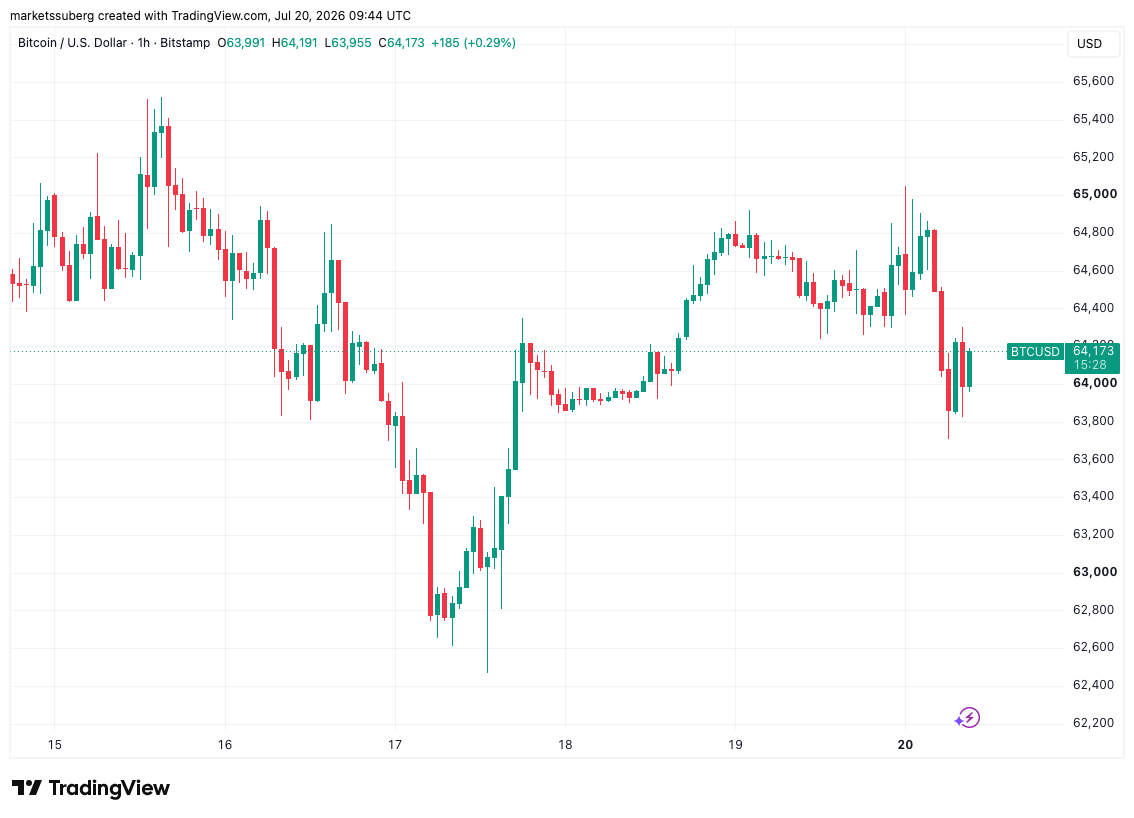
In a familiar move, Bitcoin saw sell-side pressure soon after the weekly close going into Monday morning, with local lows reaching $63,700, data from TradingView confirms.
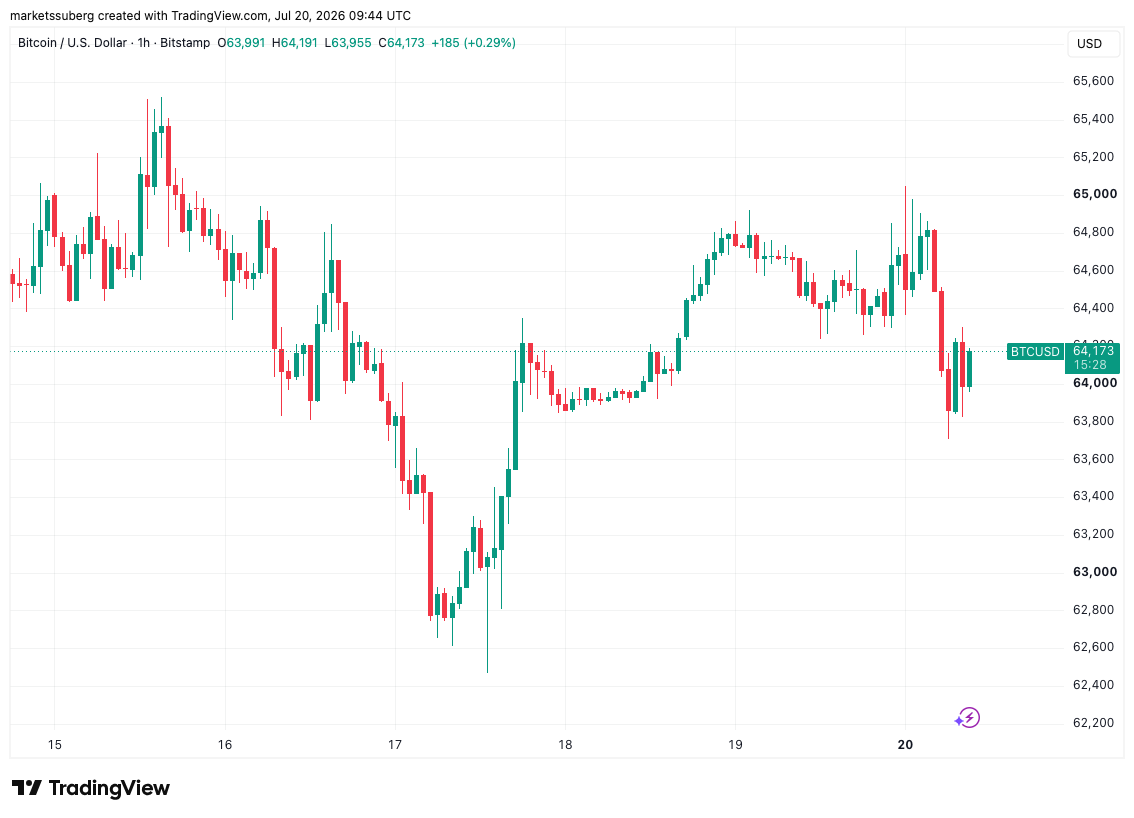
BTC/USD one-hour chart. Source: Cointelegraph/TradingView
Despite this, traders are becoming increasingly optimistic on shorter time frames as range lows continue to hold.
“Wouldn’t surprise me if we see some further relief this week – towards 65-67k,” trader Jelle predicted in his latest analysis posted Monday morning on X.
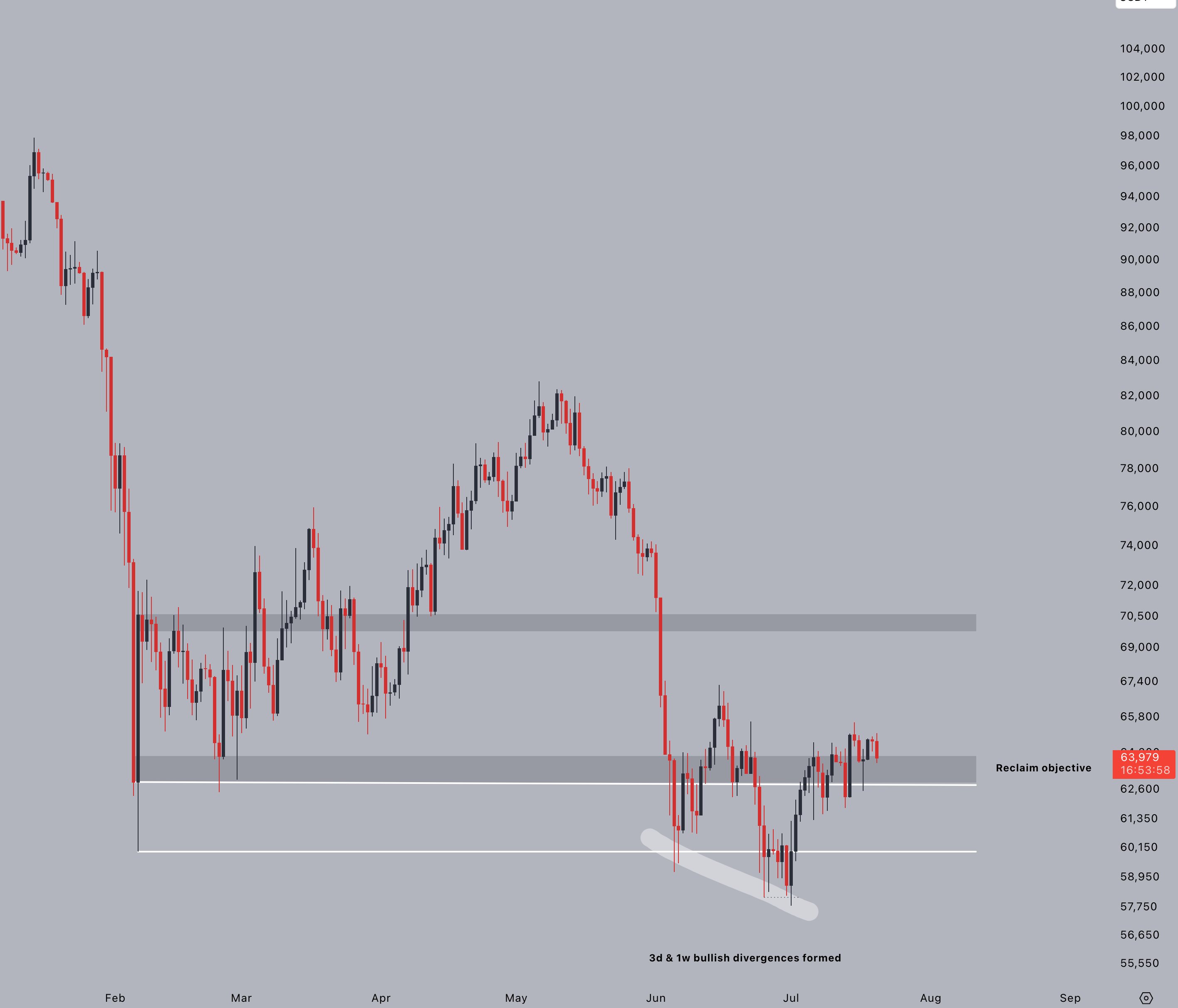
BTC/USD one-day chart. Source: Jelle/X
Trader Daan Crypto Trades noted that BTC/USD had sealed its third consecutive weekly close above the 200-week simple moving average (SMA), currently at $63,322.
“To really get this interesting you want to see a strong push higher now to retrace that last leg down and get back above the Weekly 200EMA,” he told X followers, referring to the 200-week exponential moving average (EMA) at $68,521.
“Until then, we’re just caught in this $60K choppy price range.”
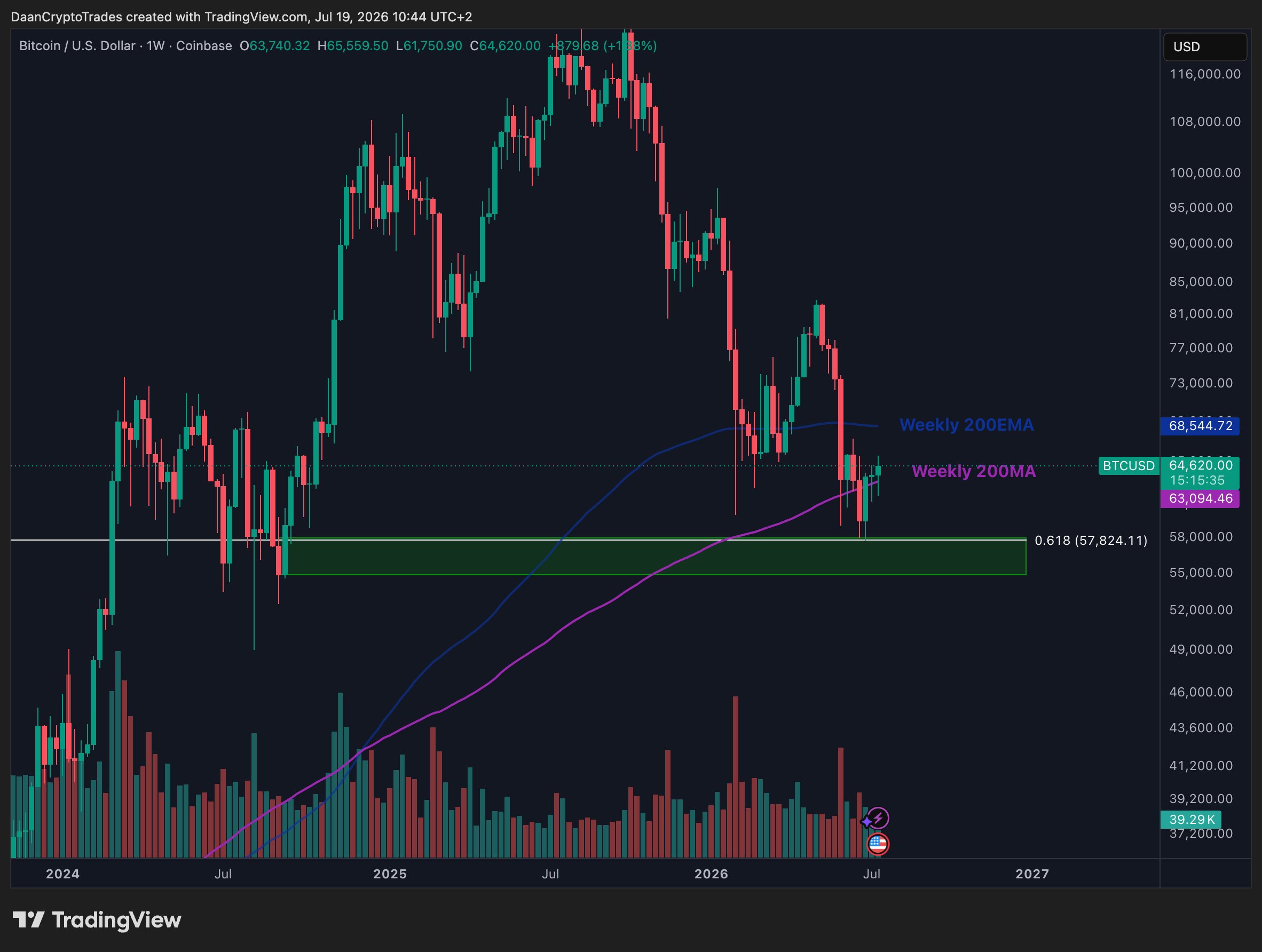
BTC/USD one-week chart. Source: Daan Crypto Trades/X
Others doubled down on bullish conviction, with trader Roman again flagging multiple bullish divergences across BTC price metrics, including the relative strength index (RSI), a classic leading indicator.
Contrasting the optimism was seasonality, with BTC price cycle history demanding another year of bear-market moves.
“Bitcoin is more than halfway through its second year in the current BTC Four Year Cycle. 2025 proved to be the year of the $BTC Bull Market peak. And 2026 has proven itself to be the year of the Bitcoin Bear Market,” trader and analyst Rekt Capital summarized.
“2027 will be the Bottoming Out year to precede an entirely brand new future Bitcoin Bull Market.”
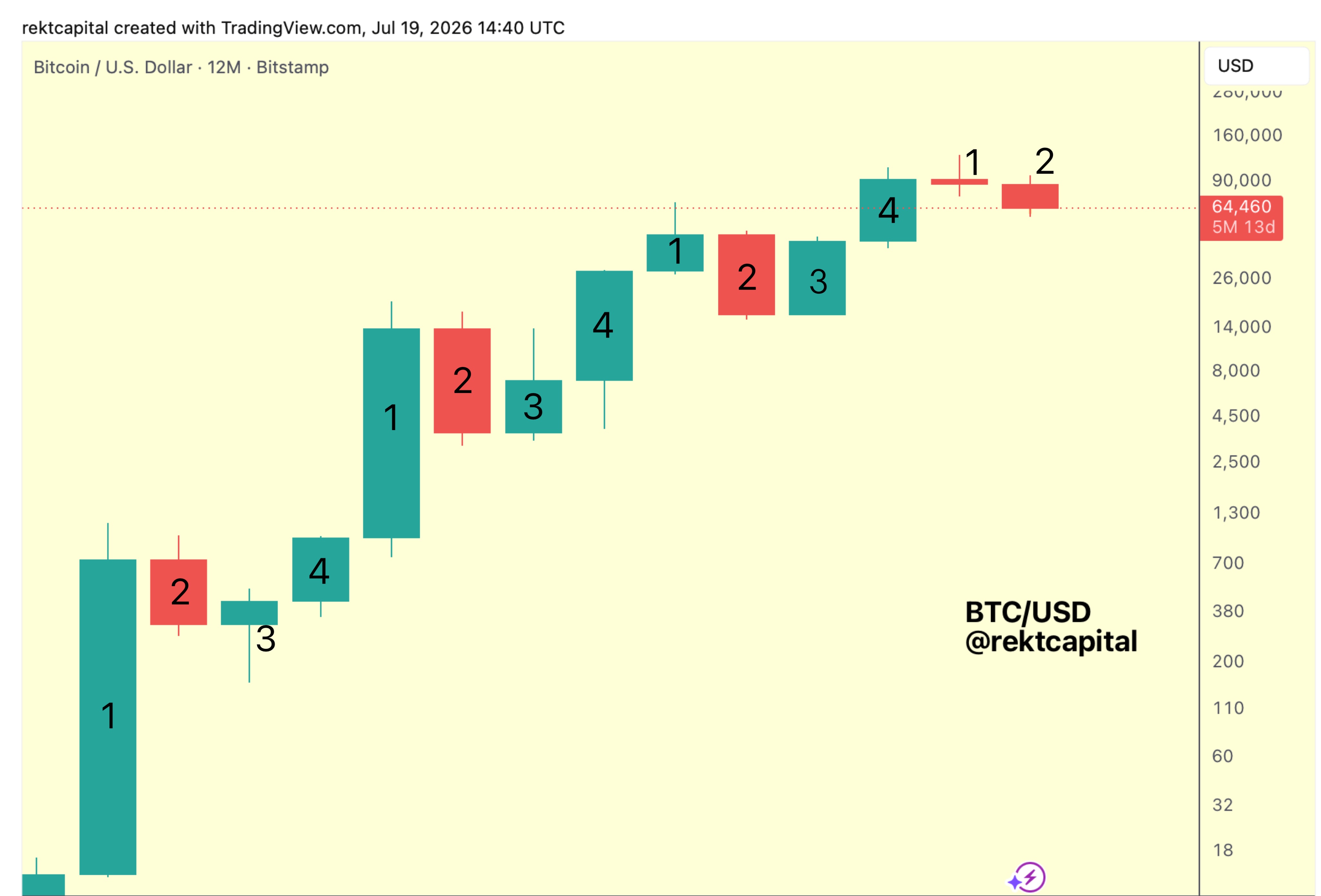
BTC/USD 12-month chart. Source: Rekt Capital/X
As Cointelegraph reported, Rekt Capital now calculates the current bear market to be just over 70% complete.
Iran worries send oil prices higher
Geopolitical risk is top of the agenda for risk-asset traders this week as the US-Iran war escalates once again.
Iran’s foreign minister warned of potentially “unresolvable” nuclear disputes while US President Donald Trump called on lawmakers to add Iran to a sanctions bill that was initially directed at Russia.
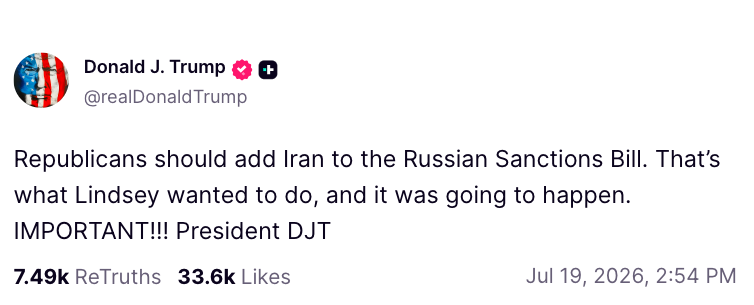
Source: Truth Social
Oil futures surged at the weekly open, with WTI crude at five-week highs above $80 per barrel and Brent crude topping $90.
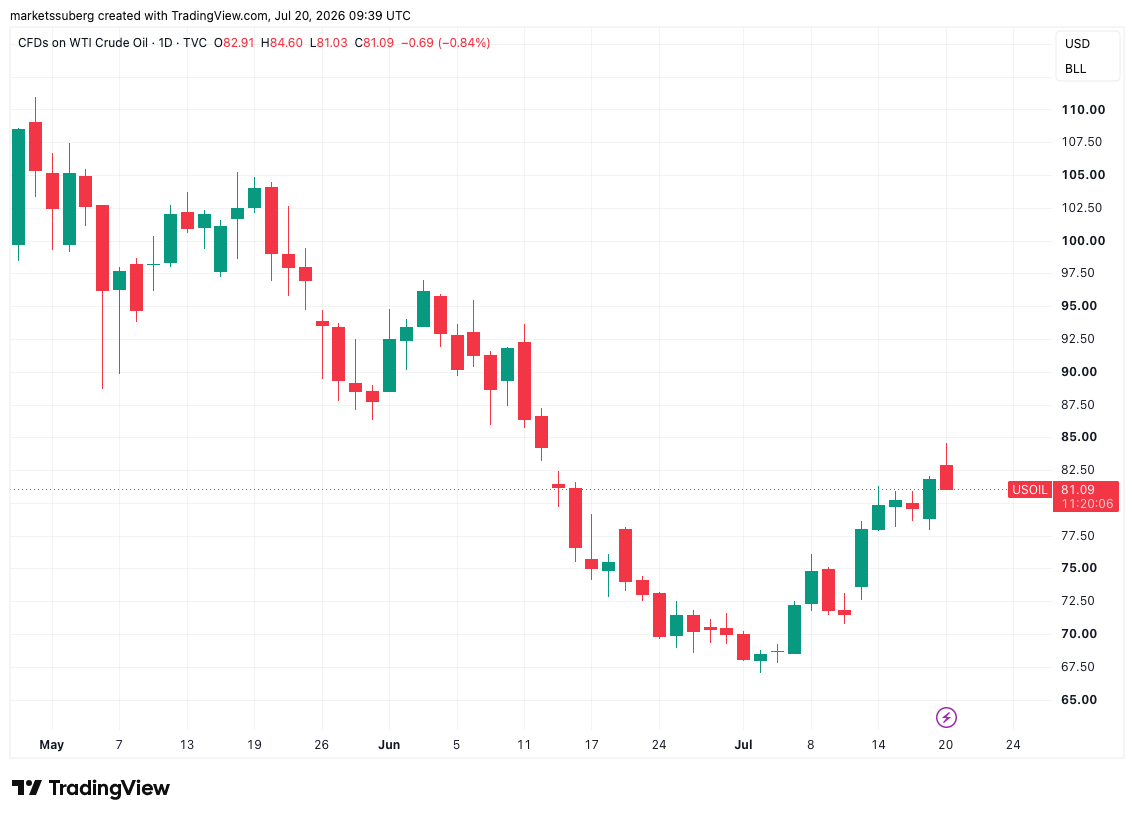
CFDs on US WTI crude oil one-day chart. Source: Cointelegraph/TradingView
As Cointelegraph reported, the return of the conflict saw the swift closure of the Strait of Hormuz, a key global oil route, that was briefly cleared for traffic as part of the now-failed US-Iran peace deal.
The latest Iran events provide volatile backdrop to the week’s macro outlook, which focuses on major corporate earnings as tech stocks face new headwinds.
In the coming days, Tesla, Alphabet and Intel will all report, providing a potential short-term volatility catalyst across risk assets.
“Earnings season is officially in full-swing,” trader resource The Kobeissi Letter summarized in a thread on X.
Following last week’s lower-than-expected US inflation data, meanwhile, Trump was buoyant, calling the numbers “great news.”
“As Investment pours into our Country, Factory Construction surges, Manufacturing Jobs rise, and Prices fall, there is so much to be proud of — The Golden Age of America is here!” he wrote in a post on Truth Social.
Markets remained conservative on policy changes from the Federal Reserve, with the latest data from CME Group’s FedWatch Tool showing consensus for a 0.25% interest-rate hike in September.
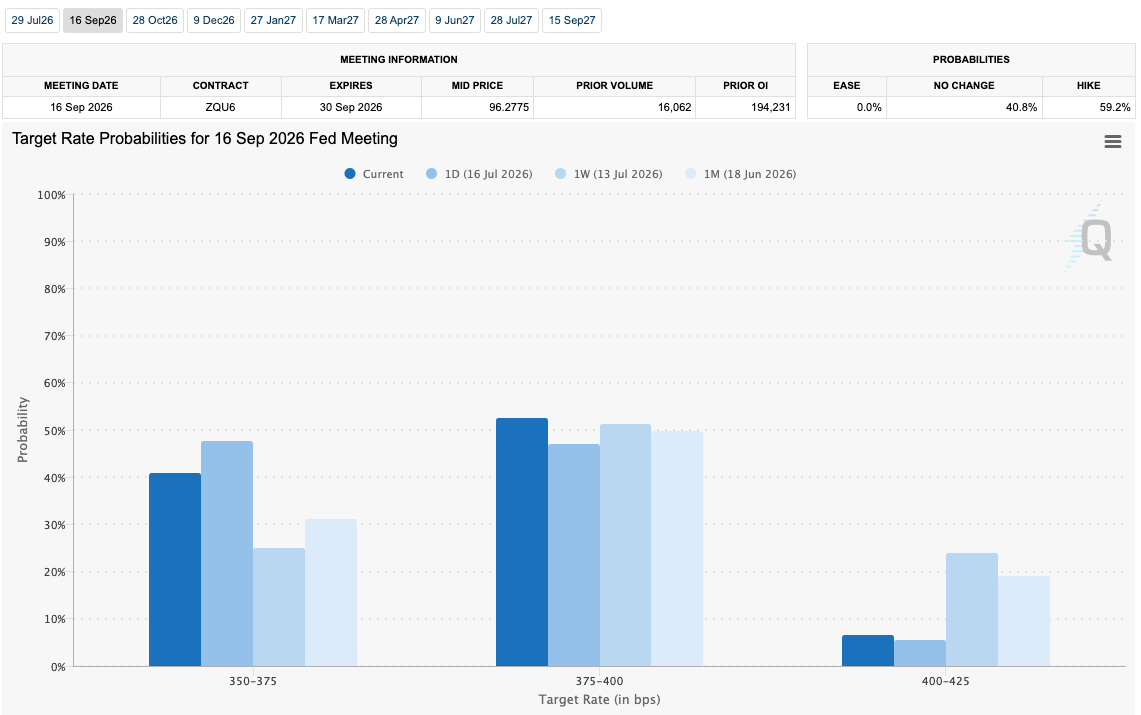
Fed target-rate probabilities for September FOMC meeting (screenshot).
Source: CME Group
Bitcoin spot demand returns lower
Lackluster spot-market demand remains a key stumbling block on the road to bull-market recovery, research says.
In a blog post on Monday, onchain analytics platform CryptoQuant revealed that a modest supply increase at the start of July had already dissipated.
“Bitcoin’s 30-day Spot Demand recovered sharply to around -80K BTC in early July but has since deteriorated again to nearly -170K BTC,” contributor ScenarioX wrote.
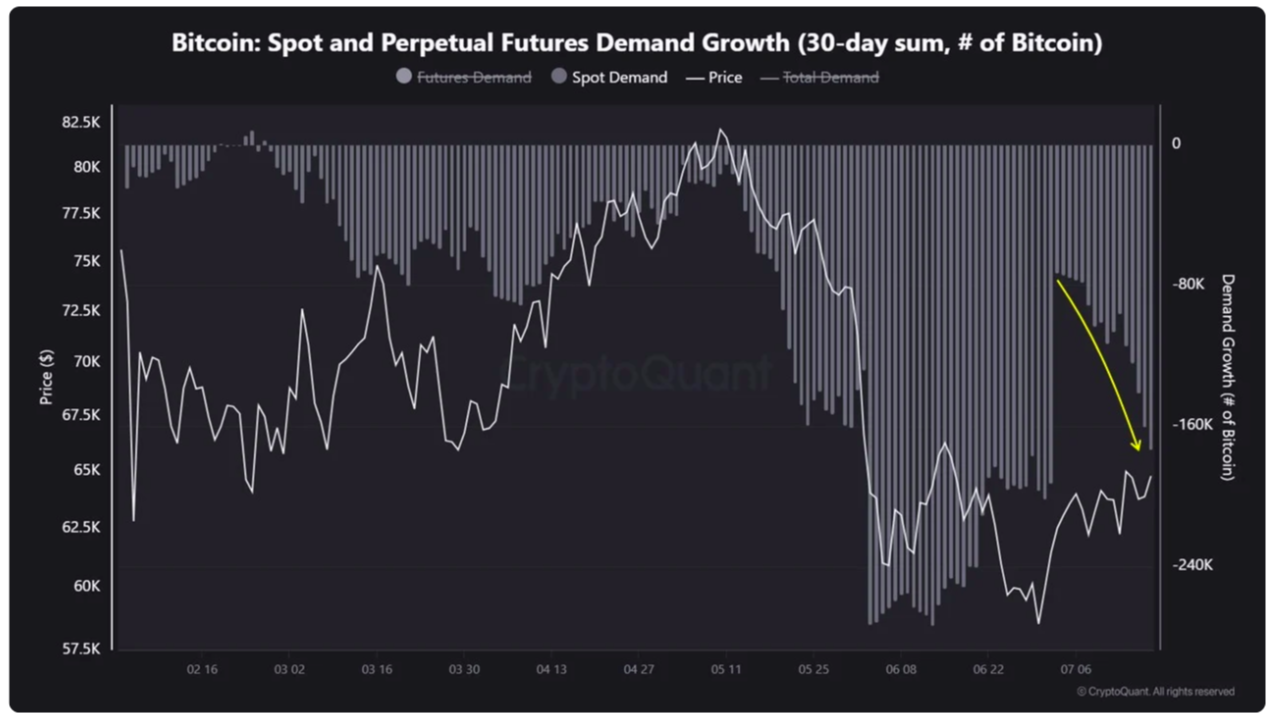
Bitcoin demand data (screenshot). Source: CryptoQuant
Earlier, Cointelegraph reported on spot demand staying negative while recovering significantly on a rolling 30-day basis as BTC/USD hit $64,000. At the same time, futures markets saw a more pronounced influx of interest.
This was reflected in net flows to the US spot Bitcoin exchange-traded funds (ETFs), which were positive for four out of five days last week, per data from UK-based investment manager, Farside Investors.
“Despite this significant decline in spot demand, Bitcoin’s price has remained relatively stable, mainly due to easing short-term selling pressure and short covering in the derivatives market,’ ScenarioX said.
“However, derivatives demand remains insufficient to support a sustainable uptrend on its own. This leaves the market in a structurally fragile state, where renewed spot selling could trigger a sharp downside move.”
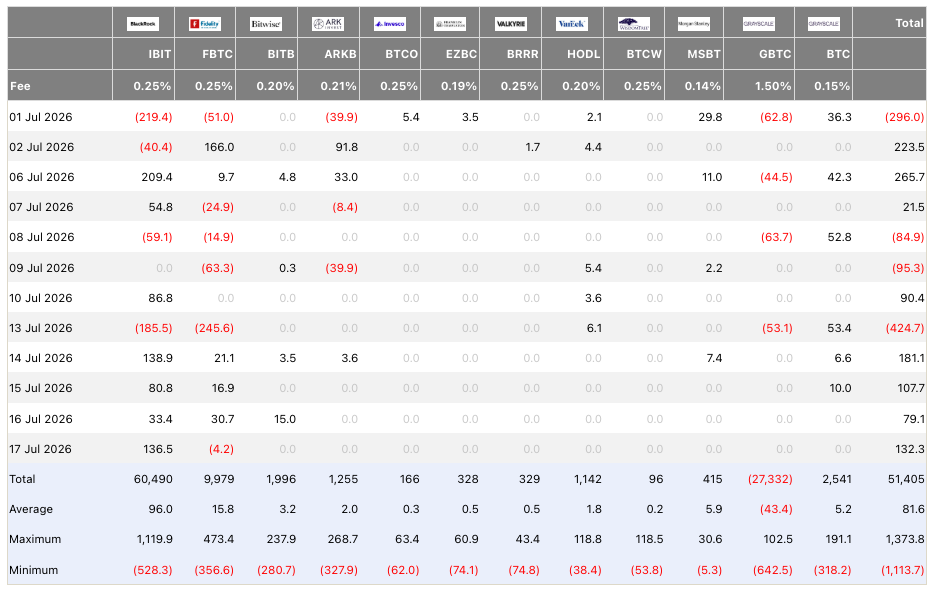
US spot Bitcoin ETF netflows (screenshot). Source: Farside Investors
CryptoQuant suggested that the market could still continue to gain “for a while” before futures demand was exhausted.
“However, the rally without meaningful spot demand is likely to end in a significant long liquidation event,” ScenarioX warned.
Puell Multiple lows fail to convince
A classic BTC price metric is showing signs of a reversal this month, but CryptoQuant warns that it is too early to talk of a “generational low.”
The Puell Multiple, which measures the USD value of newly issued BTC each day relative to its 365-day moving average, continues to head higher after seeing macro lows in early June.
“A low reading means miner income is well below normal,” CryptoQuant contributor TheChessOnChain explained in a blog post.
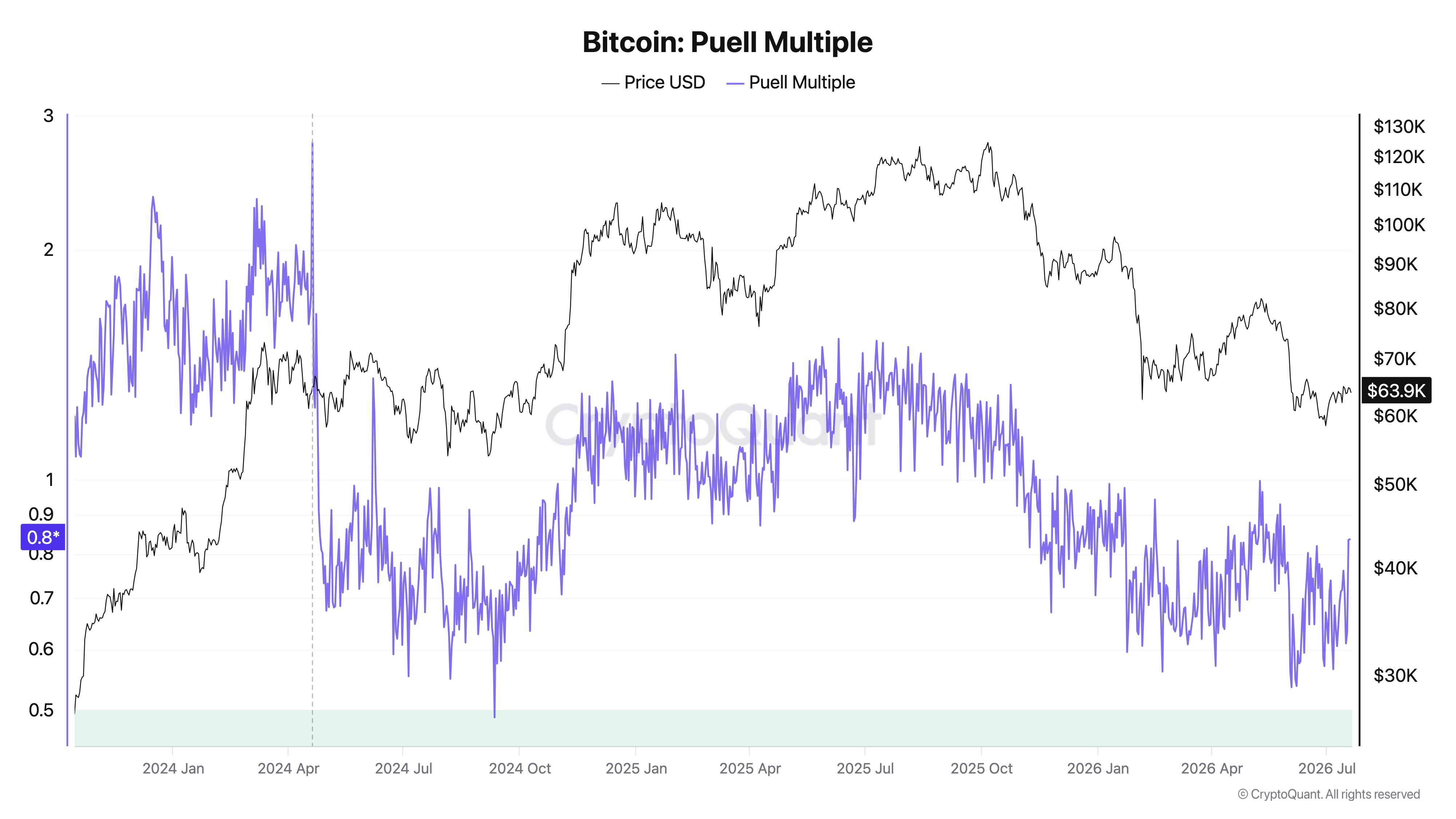
Bitcoin Puell Multiple. Source: CryptoQuant
Puell in turn reflects on Bitcoin miners’ financial stability, and June’s 0.87 reading was the lowest since September 2024. Zooming out, however, each BTC price cycle has delivered higher lows for Puell, potentially boosting that latter reading’s chances of forming the next floor.
“These bottoms are getting shallower, and the four-year supply cut (the halving) is not the cause: the metric scales both sides of its ratio, so cutting new supply cancels out. The real driver: price falls less each cycle (down 83% in 2018, 77% in 2022, less since), so miner income never sinks as deep,” TheChessOnChain said.
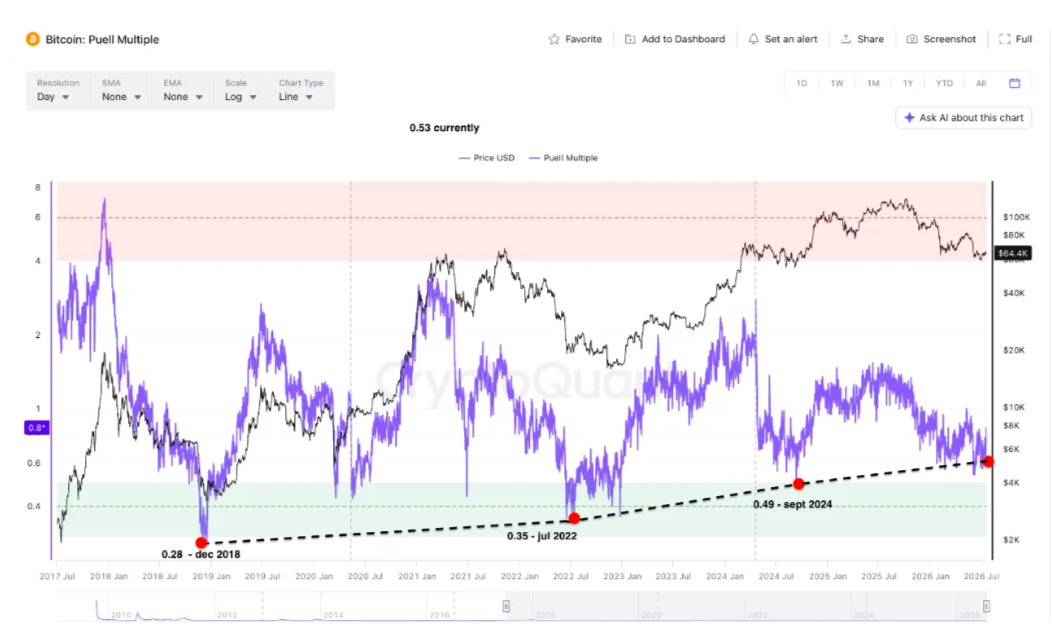
Bitcoin Puell Multiple data (screenshot). Source: CryptoQuant
While Puell lows do not strictly correspond to BTC price bear-market bottoms, TheChessOnChain suggests that waiting for new lower readings — including the metric’s classic deep value territory — may be a flawed strategy.
“The 2024 and 2026 lows came with price still high, so they are Puell lows, not price bottoms. Waiting for the classic sub-0.5 zone, where miners sell at a loss, may mean waiting for a level that no longer prints,” they said.
“Today reads as easing miner pressure, not a generational low. It turns decisive only if it holds beneath recent lows for weeks.”
Crypto sentiment gauge nears two-month high
Despite macro headwinds brewing over the weekend, crypto market sentiment continues to post a steady recovery.
Related: Bitcoin bottom countdown nears 50 days after BTC supply in loss passed 50%
The latest readings of the Crypto Fear & Greed Index show panic slowly dissipating among the broader investor base.
On Monday, the gauge measured 29/100 — still within its “fear” bracket but at its highest levels since the start of June. For much of the intervening period, crypto was gripped by “extreme fear.”
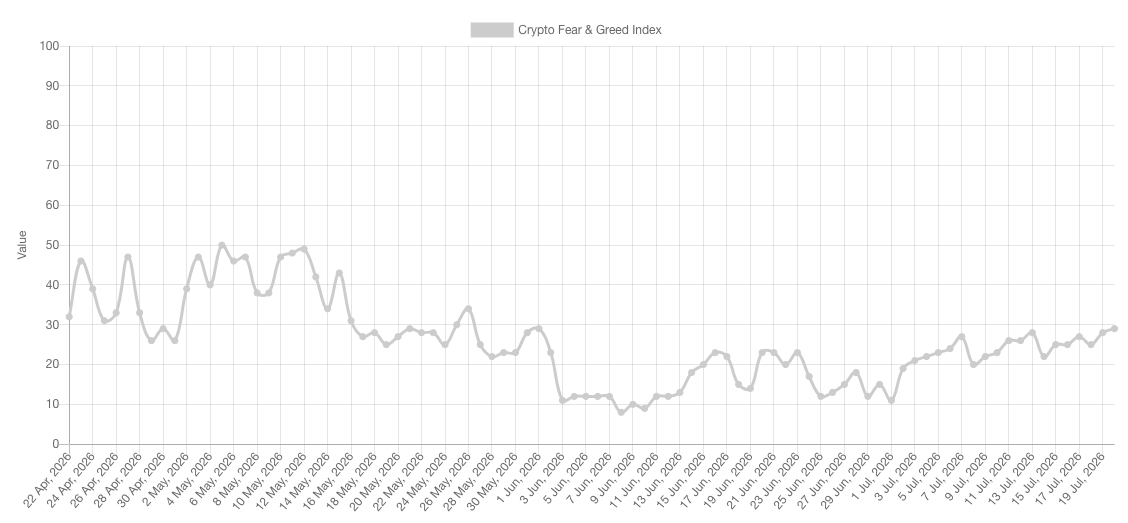
Crypto Fear & Greed Index (screenshot). Source: Alternative.me
In commentary on the rebound last week, research platform Santiment underscored its timing with the return of ETF inflows.
“After a long outflow stretch throughout May and June, this shift signals ETF demand is back and confidence in crypto is starting to pick up again,” it wrote on X.
Santiment argued that “encouraging” US inflation data had helped boost risk appetite, while “crypto policy optimism added another reason for sidelined buyers to re-enter.”


As lawmakers in the US Senate are likely to vote soon on the Digital Asset Market Clarity (CLARITY) Act, representatives from advocacy organizations and companies are providing details of closed-door negotiations over the bill, which is expected to be the most comprehensive piece of legislation affecting the crypto industry.
In a Monday CNBC interview, Coinbase vice chair Ryan VanGrack said while the final negotiations over text of the CLARITY Act were taking place in the Senate, Democratic lawmakers had added additional protections for customers to give what he called “more teeth” to the legislation. He did not explicitly mention any progress on adding ethics provisions to the bill, which many Democrats said will be necessary for their votes.
“[A]t the end of the day, this is about customer protections,” said VanGrack. “The status quo lacks this infrastructure, lacks these protections, and the Democrats used this opportunity, wisely, to make sure that customers were first and foremost in [this bill].”
Notably, Coinbase CEO Brian Armstrong may have contributed to a delay for a markup of an earlier version of the bill in the Senate Banking Committee, when he announced in January that the exchange could not support the legislation as written. Several Coinbase executives have since come out publicly in favor of the Senate passing the bill, including chief legal officer Paul Grewal.
Related: Ethics remain sticking point as crypto market structure bill goes to markup
Under the Biden administration, the US Securities and Exchange Commission (SEC) filed a lawsuit against Coinbase for allegedly operating as an unregistered securities exchange, broker and clearing agency. The case was dropped shortly after US President Donald Trump took office, with the agency headed by his pick for acting SEC chair, Mark Uyeda.
CLARITY has Trump’s support, but ethics could leave bill in limbo
Last week, following the death of Senator Lindsey Graham, Trump said on social media that members of the Senate should pass the CLARITY Act “in honor of” the South Carolina lawmaker, who he claimed had been “a big supporter” of the bill.
Republican lawmakers reportedly met with Trump on Thursday to discuss the bill amid Democrats’ concerns about the president’s ties to the crypto industry. In June, the president disclosed $1.4 billion in earnings related to his memecoin, Official Trump (TRUMP), his family crypto company World Liberty Financial and other digital asset investments.
Senate Democrats also reportedly held a closed-door meeting on Wednesday to assess their positions on the CLARITY Act. As of Monday, lawmakers had not released the final text of the bill or scheduled a floor vote.
Magazine: Will the crypto lobby’s $189M campaign get CLARITY over the line?


Nigeria’s President Bola Tinubu has signed an executive order targeting regulatory gaps in a crypto market that received about $59 billion in inflows between July 2023 and June 2024, according to the International Monetary Fund.
Summary
- Tinubu’s executive order coordinates crypto oversight without creating a new regulator.
- Nigeria will tighten registration, tax reporting and supervision of virtual asset firms.
- IMF data shows Nigeria received $59 billion in crypto inflows within one year.
Tinubu’s office said the order will coordinate digital asset oversight across Nigeria’s financial, tax and capital market agencies while preserving the legal powers of each regulator.
Signed on Friday, the directive creates a common framework for virtual asset regulation and seeks closer cooperation among agencies responsible for supervising Nigeria’s financial system. Presidential special adviser Bayo Onanuga said the framework will also protect users from fraud, support responsible innovation and preserve financial stability.
Rather than forming another watchdog, the order creates a virtual asset council led by senior financial regulators. According to Onanuga, the council will guide policy and help agencies address regulatory gaps that previously allowed some unregistered businesses to operate without oversight.
“Each institution retains its full statutory mandate and independence, and the framework coordinates their work rather than replacing it.”
Registration requirements will depend on the service offered and the type of asset involved, according to the presidential adviser. Onanuga said the activity-based model will give operators more certainty while making it harder for companies to avoid supervision by falling between the mandates of different agencies.
The Nigerian Revenue Service will separately issue more information about how the order affects taxpayers. Although the directive does not set out new tax rates, it places tax enforcement within the coordinated framework for digital asset oversight.
Order coordinates regulators without replacing them
Nigeria currently divides crypto supervision among agencies with separate responsibilities for securities, banking, revenue and financial crime. Tinubu’s order keeps those mandates intact but directs the institutions to work through a shared policy structure, according to the presidency.
Onanuga described the order as a response to fragmented oversight rather than an attempt to transfer authority. Under the framework, regulators will register businesses according to their activities, meaning an exchange, payment provider or investment platform may face different requirements based on the services it provides.
Legislative work on crypto regulation has also continued alongside the executive action. Earlier in June, Nigeria’s Senate advanced the Virtual Asset Service Providers Regulation Bill, 2026, after approving it at second reading.
Listed as SB 956, the bill would establish licensing, transparency and compliance requirements for crypto exchanges and other virtual asset businesses serving Nigerian users. Deputy Senate President Barau Jibrin sponsored the proposal, while Senate Chief Whip Mohammed Monguno presented it during the debate.
Senators supporting the bill said formal supervision and consumer protection rules could help curb fraud and improve order in Nigeria’s digital asset market. The proposal has moved to the Senate Committee on Capital Market, which can review its provisions, consider amendments and invite public input.
Second-reading approval has not made the proposal law. Under Nigeria’s legislative process, SB 956 must still complete committee review, pass a third reading and clear the remaining required stages before it can take effect.
Tax authorities have already introduced reporting measures while lawmakers consider the bill. Since the start of 2026, Nigeria has required crypto service providers to connect transactions with tax identification numbers and, in some cases, national identification numbers under the Nigeria Tax Administration Act 2025.
The reporting system places Nigeria in line with the Organisation for Economic Co-operation and Development’s Crypto-Asset Reporting Framework, which took effect on Jan. 1, 2026. Under that framework, participating authorities can collect, assess and exchange information about cross-border crypto transactions.
Stablecoin growth increases pressure for clearer rules
Nigeria’s regulatory action follows rapid growth in the use of cryptocurrencies and stablecoins. In a June report, the IMF estimated that Nigeria received about $59 billion in crypto-asset inflows from July 2023 through June 2024.
The IMF also estimated that Nigeria has accounted for around 60% of all stablecoin inflows into sub-Saharan Africa since 2019. According to the fund, households and small businesses increasingly use U.S. dollar-pegged tokens to receive remittances, pay overseas suppliers and protect savings during periods of pressure on the local currency.
Those uses have turned stablecoins into an important cross-border payment route, but the IMF warned that their growth is testing existing monetary and regulatory systems.
“It is also testing the limits of existing monetary and regulatory frameworks,” the IMF said in its June assessment.
According to the fund, policymakers face the task of reducing the problems that made alternative payment channels attractive while controlling the risks created by their growing use. The IMF called for a clear strategy that allows new financial services but remains tied to sound economic policy and effective supervision.
Tinubu’s executive order addresses the regulatory part of that challenge by coordinating agencies, clarifying registration and bringing tax enforcement into the same structure. Further details from the Nigerian Revenue Service, the work of the new virtual asset council and the Senate’s review of SB 956 will determine how the framework applies to crypto businesses and their customers.
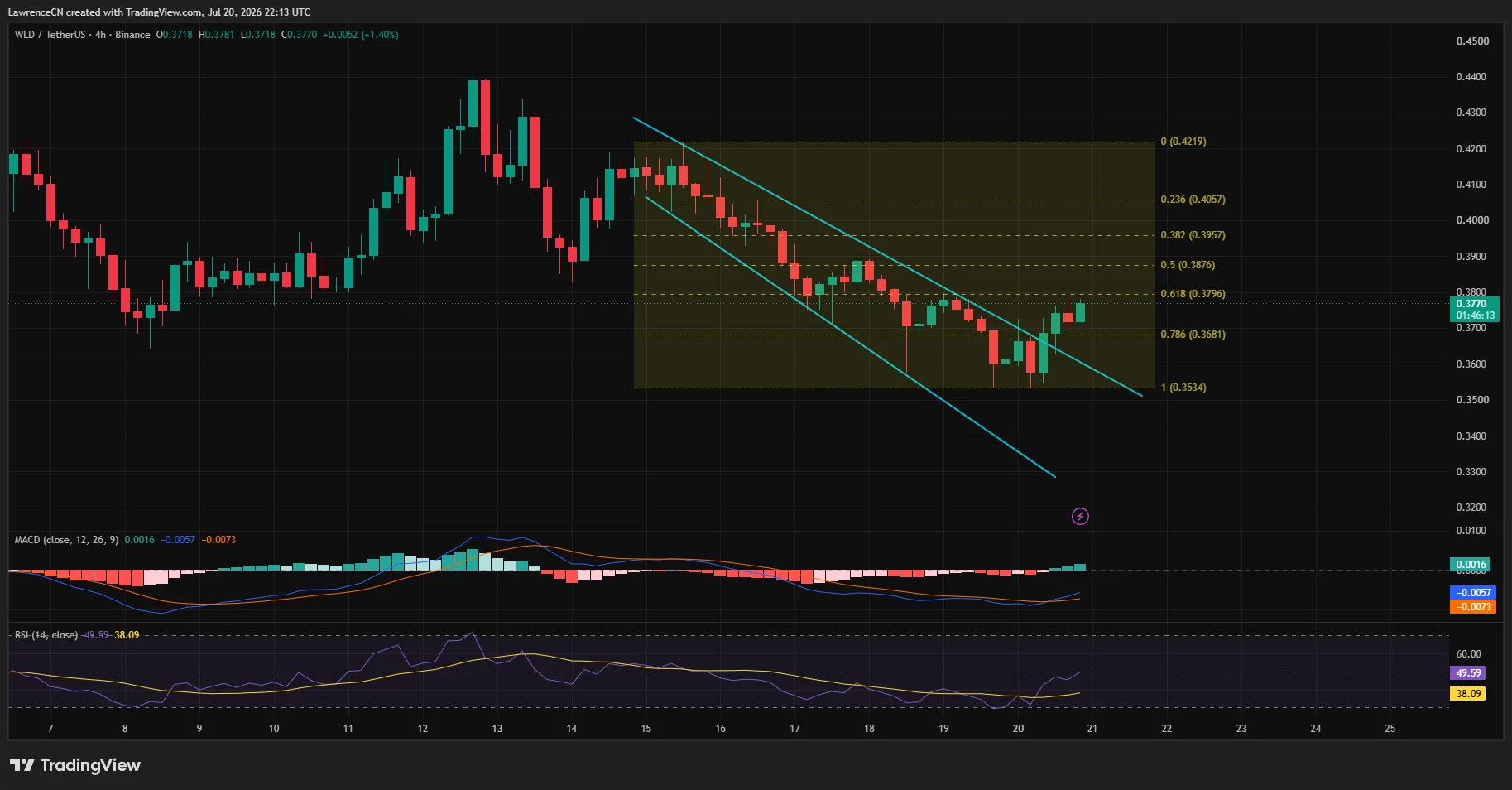
WLD has climbed about 4.5% to $0.37 after Grayscale filed with the US Securities and Exchange Commission to launch an ETF holding the World Network token directly.
Summary
- Grayscale has filed to list a spot Worldcoin ETF on Nasdaq under GWLD.
- WLD gained 4.5% and broke above a descending channel on the four-hour chart.
- Regulatory concerns over biometric data and WLD’s status remain key risks.
According to Grayscale’s registration statement, the proposed Grayscale Worldcoin ETF would trade on Nasdaq under the ticker GWLD and offer investors exposure to WLD without requiring them to buy or store the token.
The fund’s shares would follow the value of its WLD holdings through the CoinDesk Worldcoin Benchmark Rate. Fees and operating expenses would be deducted from the value of the trust, although Grayscale has not disclosed the management fee.
Several other terms also remain open. Grayscale left blank the initial seed investment and the quantity of WLD represented by each share, indicating that later amendments to the prospectus will add those details.
If approved, GWLD would become a passive investment vehicle with WLD as its only principal asset. Grayscale’s filing states that the trust would not use leverage or derivatives, limiting its activity to holding the token and processing share creations and redemptions.
GWLD would give investors direct WLD price exposure
Under the proposed structure, authorized participants would create or redeem shares in blocks of 10,000, which the filing calls baskets. Participants could complete those transactions by delivering WLD or through cash orders handled with the help of liquidity providers.
BitGo Bank & Trust would hold the trust’s WLD assets, according to the registration statement. The Bank of New York Mellon would act as administrator and transfer agent, while CSC Delaware Trust Company would serve as trustee.
Grayscale has presented the fund as a way for shareholders to gain WLD exposure through a traditional brokerage account. Investors would therefore avoid the technical steps involved in opening a crypto wallet, securing private keys, and trading the token on a digital-asset platform.
The filing does not guarantee that the SEC will approve the product or that Nasdaq will list its shares. Because the document is a registration statement with incomplete terms, Grayscale may need to submit amendments before regulators can allow the ETF to begin trading.
WLD serves as the native token of World Network, a digital identity project first developed by Tools for Humanity. Sam Altman and Alex Blania founded the company behind the project, which was previously known as Worldcoin.
World Network includes World ID, a proof-of-personhood system designed to confirm that a user is a unique human. Its other products include the World App, the Ethereum layer-2 network World Chain and Orb devices that use iris images during identity verification.
As of June 30, roughly 3.5 billion WLD tokens were in circulation, according to figures included in Grayscale’s prospectus. Their combined market value stood at approximately $1.4 billion, while the token recorded daily trading volume of $135.1 million.
Those figures placed WLD as the 41st-largest crypto asset by market capitalization at the time of the filing. The data also showed that the proposed fund would track an asset with substantially lower market value and trading activity than tokens such as Bitcoin and Ethereum.
WLD has broken above its four-hour falling channel
Following news of the filing, Worldcoin (WLD) advanced about 4.5% to $0.37. The token nevertheless remained nearly 97% below its March 2024 record high of $11.80.
On the four-hour chart supplied through TradingView, WLD was trading around $0.377 after rebounding from the $0.353 support area. Price also moved above the upper boundary of a descending channel, indicating that selling pressure has started to ease.
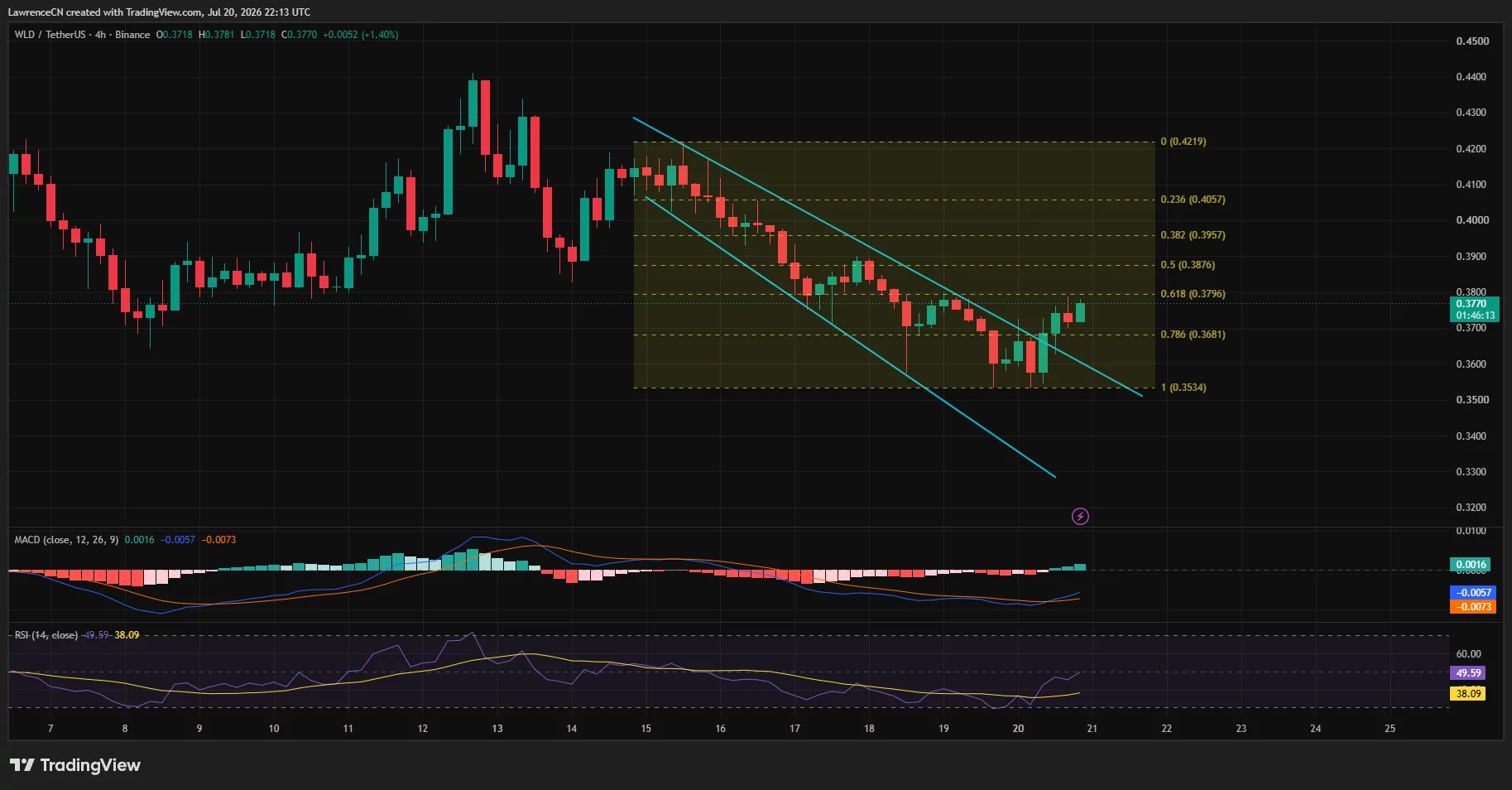
TradingView’s Fibonacci levels place immediate resistance at $0.3796. A sustained move above that barrier could expose $0.3876, followed by $0.3957 and $0.4057.
Below the current price, the chart identifies $0.3681 as the closest support. Losing that level could send WLD back toward $0.3534, where buyers recently stopped the decline.
Momentum readings have also improved, although they do not yet confirm a strong bullish trend. The four-hour relative strength index stood at 49.59, up from its moving average of 38.09 and close to the neutral 50 level.
TradingView’s MACD line remained below zero at -0.0057 but had crossed above its -0.0073 signal line. The positive 0.0016 histogram suggests bearish momentum is fading as WLD tests the $0.3796 resistance.
Grayscale’s prospectus identified biometric data collection as a central product risk because World Network relies on iris imaging through its Orbs. According to the filing, the project has faced regulatory restrictions, enforcement measures and court rulings in several jurisdictions over its biometric practices.
The registration statement also pointed to World Chain’s centralized sequencer, sharp WLD price swings and possible securities-law treatment as material risks. Grayscale warned that an adverse regulatory decision involving WLD or related transactions could reduce the token’s value or require the trust to close.
Disclosure: This article does not represent investment advice. The content and materials featured on this page are for educational purposes only.
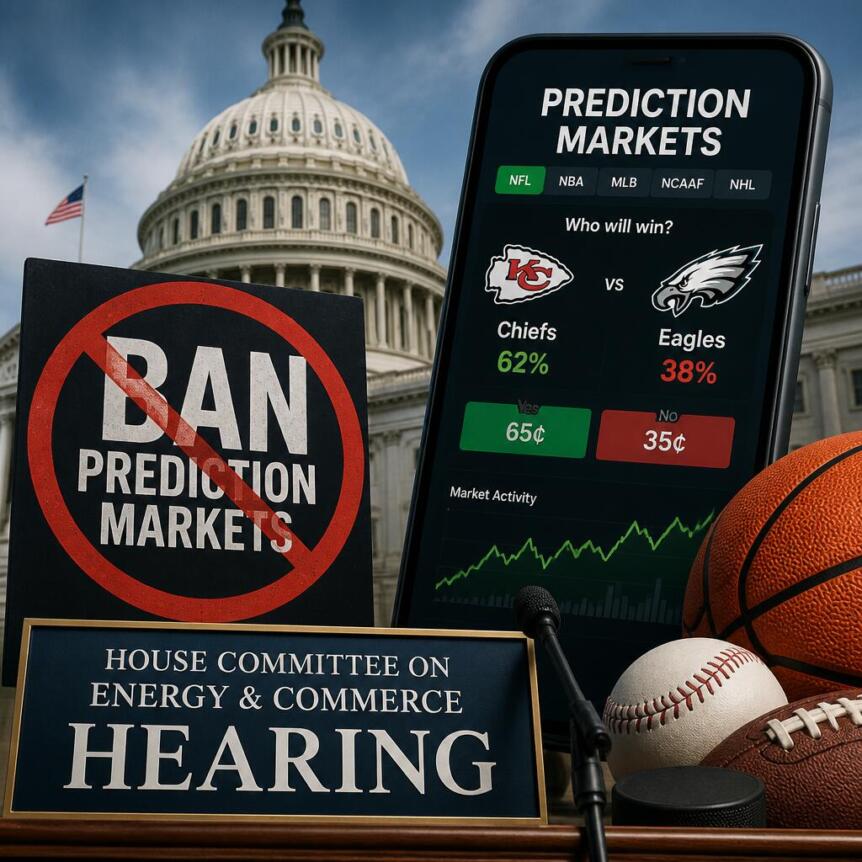
The U.S. House Agriculture Committee will examine sports prediction markets during a hearing scheduled for tomorrow. The session follows rising legal disputes and regulatory pressure on platforms including Polymarket and Kalshi. Lawmakers will review customer protections, market integrity, and the growing debate over sports event contracts.
House Committee Examines Sports Prediction Markets and Regulatory Oversight
The House Agriculture Committee scheduled the hearing through its Subcommittee on Commodity Markets, Digital Assets, and Rural Development. The session will focus on customer safeguards and market integrity across sports prediction markets. It also follows growing concerns about the legal status of sports-related event contracts.
The witness list includes legal experts alongside representatives from American and Indian gaming associations. These groups continue pressing lawmakers to prohibit sports contracts on prediction market platforms. Meanwhile, the hearing will examine whether existing federal laws provide enough regulatory authority.
The debate has intensified because several jurisdictions have challenged the operations of prediction market platforms. Regulators have questioned whether these contracts function as financial products or sports betting markets. Consequently, lawmakers now face increasing pressure to clarify the legal framework.
Gaming Associations Increase Pressure for Sports Contract Ban
Gaming industry representatives plan to argue that sports contracts resemble traditional sports wagering. They maintain that these products compete directly with regulated gaming markets across several states. Therefore, they support stronger restrictions on platforms offering these contracts.
Legal expert Daniel Wallach outlined the expected testimony before the congressional hearing. According to his summary, several witnesses believe the Commodity Futures Trading Commission already holds sufficient regulatory authority. They argue that Congress does not need additional legislation to oversee prediction markets.
One witness, Robert Schwartz, maintains that the existing regulatory framework already provides strong enforcement tools. He argues that the CFTC can reject contracts that conflict with public policy. His testimony also points to current legal authority without requesting additional congressional action.
Legal Challenges Shape the Future of Prediction Markets
The legal debate extends beyond Congress because courts and regulators have increased scrutiny of prediction market platforms. France recently blocked access to Polymarket after determining that the platform promoted illegal gambling services. That decision added international pressure to the broader regulatory discussion.
The United States also recorded an important legal development involving Kalshi and sports event contracts. Judge Analisa Torres ruled that New York gambling laws apply to Kalshi’s sports-related contracts. As a result, the ruling challenged the argument that federal commodities regulation alone governs these markets.
Wallach also referenced the Dodd-Frank Act while discussing the CFTC’s authority over event contracts. He argued that the law allows regulators to prohibit contracts involving gaming when public interest concerns arise. That interpretation may become an important topic during the congressional hearing.
David Bean, Chairman of the Indian Gaming Association, plans to present concerns about sports prediction contracts. He argues that these products closely resemble conventional sports gambling despite their financial market structure. His testimony supports stronger limits on sports-related contracts offered through federally regulated exchanges.
The American and Indian gaming associations continue advocating for a complete ban on sports contracts. They believe prediction market platforms bypass regulatory systems that govern traditional sports betting operators. Consequently, they argue that equal standards should apply across both industries.
The hearing comes during a period of rapid growth for prediction markets across the United States. Platforms including Polymarket and Kalshi have expanded their offerings beyond politics into sports and other real-world events. However, that expansion has also attracted greater legal scrutiny from regulators, lawmakers, courts, and gaming organizations.
Congress will now examine whether existing federal laws adequately address these evolving markets. The discussion may influence future regulatory priorities for prediction platforms and sports event contracts. Even so, the hearing itself will primarily focus on oversight, customer protections, market integrity, and the legal boundaries governing sports prediction markets.
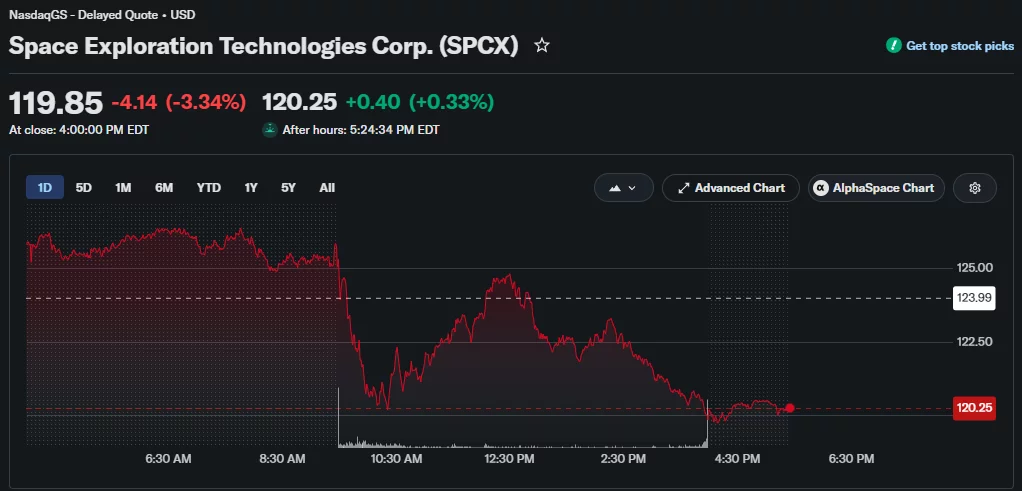
SpaceX stock has fallen to $119.79 after seven straight losing sessions, leaving SPCX 11% below its $135 IPO price before Tesla’s second-quarter earnings and a renewed Starship launch attempt.
Summary
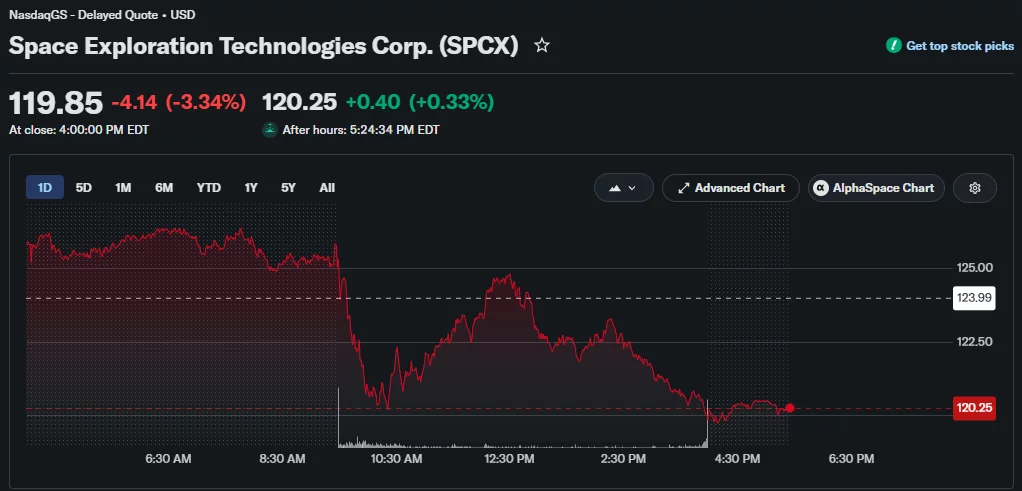
- SpaceX stock closed 3.34% lower at $119.85 before recovering slightly after hours.
- SPCX faces resistance near $125 as Tesla earnings and Starship Flight 13 approach.
- ARK Invest bought another $18 million in shares despite continued selling pressure.
TradingView’s one-hour chart shows SPCX pressing against the lower boundary of a descending channel that has guided the stock down from around $170 at the start of July. The shares closed 0.93% lower in the chart’s latest session after trading between $119.69 and $121.03.
Although SPCX gained about 1.6% before Monday’s opening bell, the advance faded during regular trading as sellers extended the stock’s losing run. T/he shares ended Monday below $120, about 47% under the post-IPO peak above $225 reached in June. SpaceX’s investor relations page placed the stock near $122.50 earlier in Monday’s session.
Attention has now turned to Tesla, which will publish its April-to-June results after markets close on July 22. Tesla’s investor relations department said management will hold its earnings webcast at 5:30 p.m. Eastern Time on the same day.
Tesla’s own analyst consensus calls for quarterly revenue of $27.58 billion and net income attributable to common shareholders of about $1.28 billion. The estimates follow second-quarter production of 451,758 vehicles and deliveries of 480,126 vehicles, according to the electric-car maker.
Speculation about a combination between Tesla and SpaceX has increased the report’s relevance for SPCX investors. According to JPMorgan analyst Ryan Brinkman, a possible transaction appears “strategically coherent on paper,” given the companies’ shared leadership and overlapping activities.
JPMorgan identified possible links across artificial intelligence, robotics, energy, transport and space. The bank also noted that Elon Musk leads both companies, while their engineering resources and long-term technology plans could support operational cooperation. However, JPMorgan presented the transaction as a possible strategic fit rather than a confirmed negotiation.
Descending channel keeps SPCX under pressure
On the one-hour chart, SPCX remains inside a falling parallel channel formed through a sequence of lower highs and lower lows. TradingView data places the lower channel boundary around $118 to $120, making this range the first technical level to watch after the stock’s slide below $123.
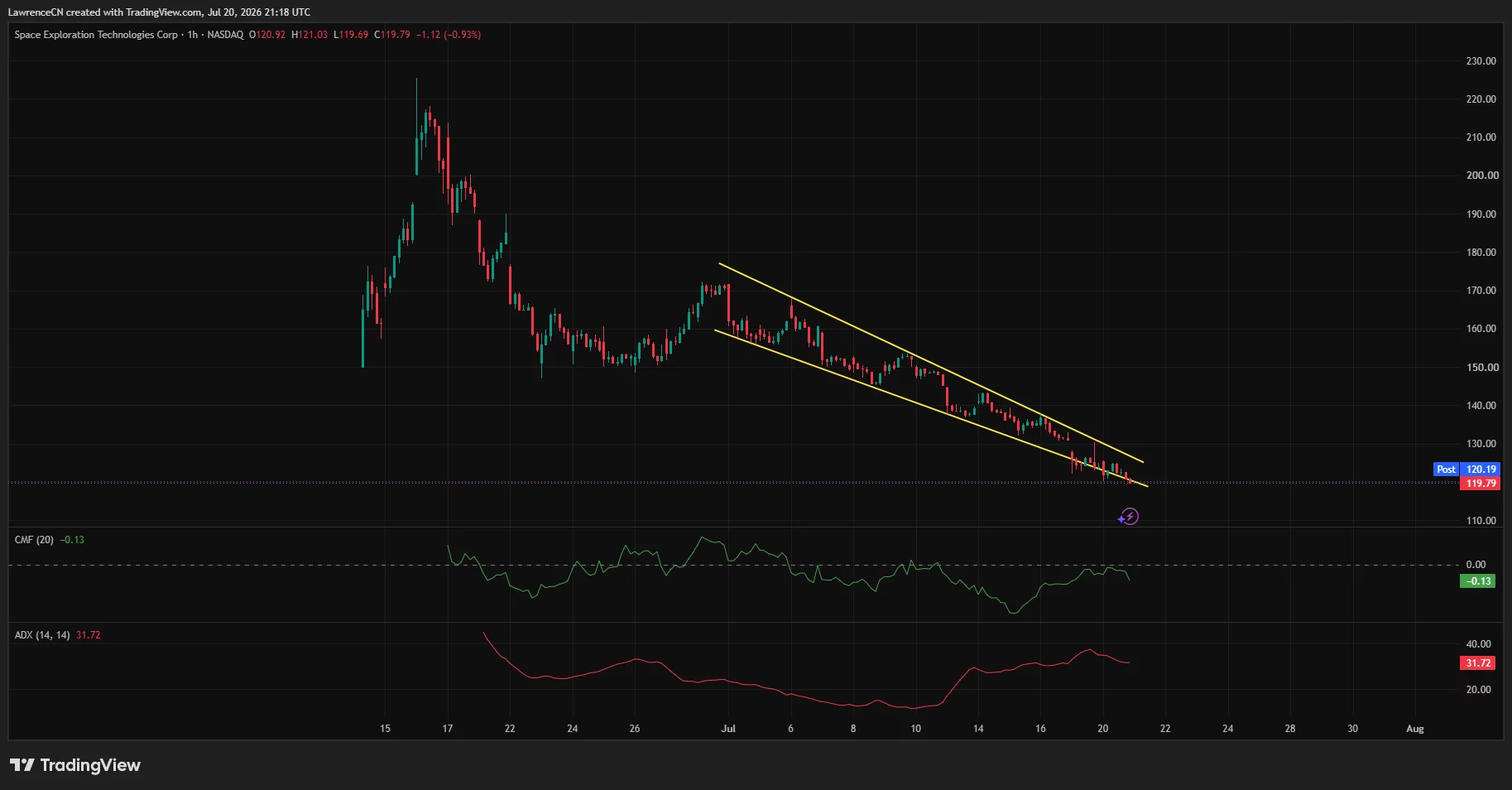
A rebound from the channel floor would initially bring the upper boundary near $125 into focus. Based on the chart structure, a confirmed move above that line would break the immediate pattern and could open a recovery toward the $135 IPO price, which has changed from support into resistance following last week’s decline.
Failure to hold $118 would instead extend the channel breakdown and remove the clearest visible support on the one-hour timeframe. Under that scenario, the chart leaves the psychological $100 level as the next major downside area, although price would need to confirm a close beneath the channel before that target becomes active.
Selling pressure remains visible in the Chaikin Money Flow reading of minus 0.13. A value below zero means the indicator has recorded more distribution than accumulation during its 20-period window, limiting evidence that buyers have taken control at current prices.
At the same time, the Average Directional Index stands at 31.72. As ADX readings above 25 usually signal a developed trend, the indicator shows that SPCX’s existing downtrend still carries strength even as the stock tests the channel floor.
ARK Invest has continued buying during the decline. As crypto.news reported, Cathie Wood’s firm purchased 147,805 SpaceX shares worth more than $18 million on July 17, dividing the position among four exchange-traded funds. The purchases followed a weekly loss of nearly 15%, which pulled SPCX below its offer price. Investor’s Business Daily
According to Barchart data, retail traders bought about $320 million of SPCX shares during July, making SpaceX the most sought-after U.S. stock among individual investors over the measured period. Earlier demand was also strong at listing, with crypto.news reporting that retail orders exceeded $70 billion before the June IPO.
Pentagon talks and Starship test offer catalysts
Operational developments could compete with Tesla’s results for investors’ attention. Reuters reported that SpaceX is discussing a deal to provide the U.S. Department of Defense with data-center capacity for running AI models, citing an earlier Wall Street Journal report. People familiar with the talks reportedly valued the potential arrangement in the billions of dollars.
Such an agreement would add to SpaceX’s existing military work. In May, the U.S. Space Force awarded the company a $2.29 billion fixed-price contract to build a secure satellite network connecting military sensors and weapons systems.
SpaceX has also rescheduled Starship Flight 13 for July 23 after engine trouble stopped the July 16 attempt moments before launch. As crypto.news reported, the company modified the vehicle’s propulsion system and plans to carry 20 Starlink satellites during the test.
With SPCX sitting at the bottom of its falling channel, the TradingView chart makes $118 support and $125 resistance the immediate boundaries, while Tesla’s earnings, Pentagon negotiations and Thursday’s Starship test provide three event-driven catalysts.
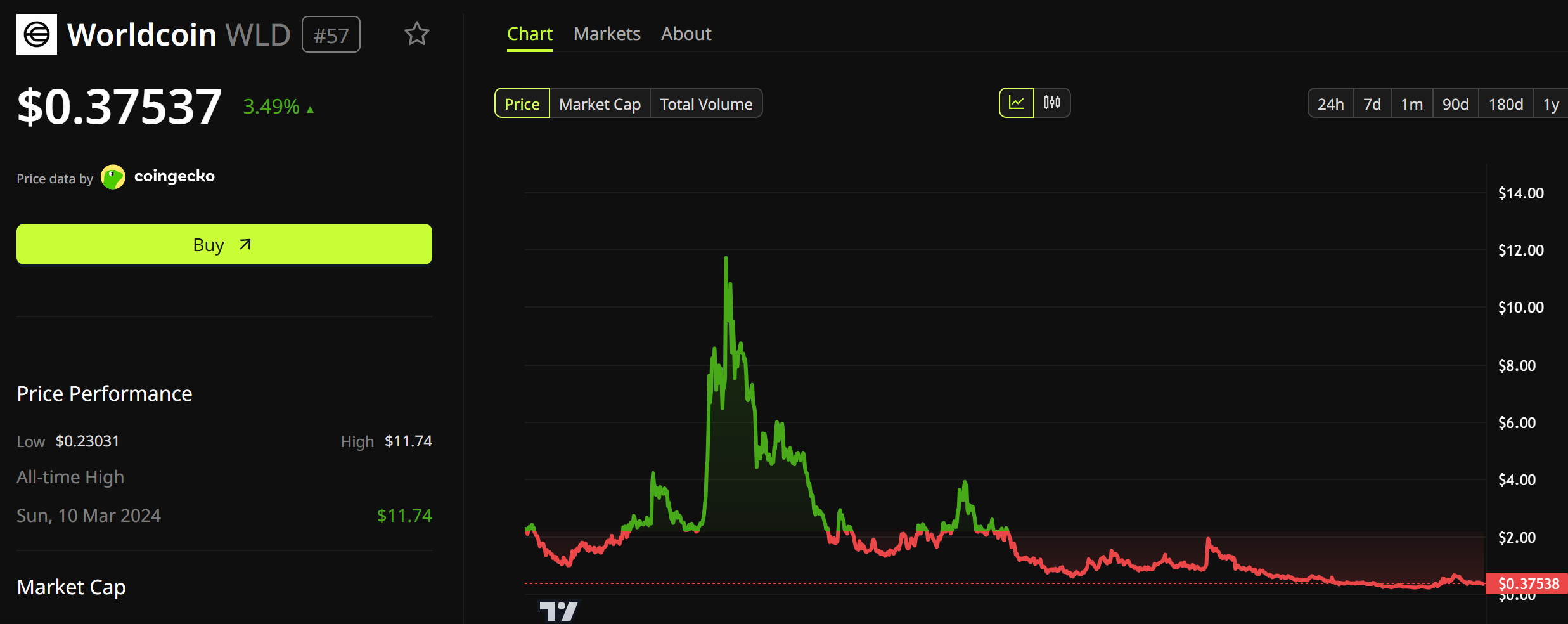
Grayscale filed with the SEC on July 20 for a spot Worldcoin (WLD) exchange-traded fund. The fund would trade on Nasdaq under the ticker GWLD.
Bloomberg ETF analyst James Seyffart confirmed the filing on X. The twist is that Grayscale’s own paperwork spells out why WLD is such a risky bet.
What the Grayscale Worldcoin ETF Filing Says
The SEC filing shows Grayscale moved fast. It formed the trust on July 10 and filed just 10 days later. BitGo will hold the WLD, and BNY Mellon will run the fund’s books.
Follow us on X to get the latest news as it happens
Grayscale knows this path well. Its Bitcoin Trust became a spot ETF in January 2024 after the firm beat the SEC in court. Solana and Dogecoin funds followed in late 2025.
Some details are still missing. The fee is blank, and no trading partners are named yet.
The Risks Grayscale Itself Lists
Worldcoin verifies humans by scanning their eyes with a device called the Orb. The filing admits regulators pushed back hard. Spain, Portugal, Germany, Hong Kong, Brazil, Kenya, and Indonesia all took action between 2024 and 2025.
The token math looks rough too. The 100 largest wallets hold about 90% of circulating WLD. Team and investor tokens keep unlocking until around July 2028.
Then there is the price. WLD trades near $0.375, up 3.3% on the day. That is still about 97% below its March 2024 peak of $11.74.

A June treasury purchase gave the token a brief lift. Meanwhile, Tools for Humanity layoffs at the project’s lead developer dragged it back down.
GWLD cannot trade until the SEC signs off and Nasdaq clears the listing. Easier access may help, but WLD’s path forward likely hinges on those token unlocks.
The post Grayscale Wants a Worldcoin ETF, but WLD Is Down 97% From Its Peak appeared first on BeInCrypto.


EDX Markets, an institutional-only crypto trading venue with its own central clearinghouse, closed a $76 million Series C funding round led by SBI Holdings, the firm said in a press release. The Tokyo-listed financial group becomes a strategic investor in the U.S. exchange. The capital will fund… Read the full story at The Defiant
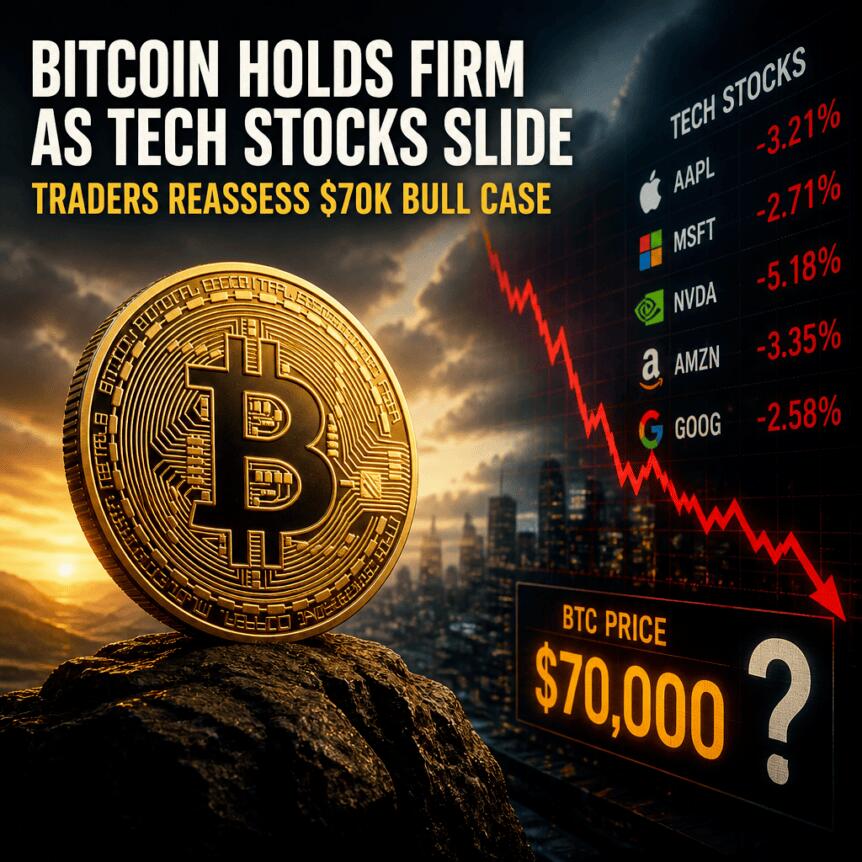
Bitcoin demonstrated resilience over the past week, holding up better than many risk assets even as investors pulled back from parts of the technology complex. While BTC failed to reclaim the level above $65,500, it still managed to rebound after the weekend and traded through $65,000 on Monday—highlighting a growing disconnect between the world’s largest cryptocurrency and broader market moves.
That relative strength comes as market participants remain cautious in Bitcoin derivatives. Perpetual funding and options positioning suggest large players have been more focused on limiting downside than pressing for an aggressive upside push toward $70,000. At the same time, macro pressures—especially rising Treasury yields and renewed geopolitical risk—have been feeding a broader risk-averse tone across markets.
Key takeaways
- Bitcoin’s perpetual funding rate sat near neutral at around 8% on Monday, while trader behavior remains oriented toward hedging rather than leverage.
- Bitcoin’s spot strength amid declines in AI-linked equities points to continued decoupling from traditional risk assets.
- Deribit data shows a 30-day options put-call delta skew of 13% on Monday, indicating premium pricing for downside exposure versus upside calls.
- Rising US Treasury yields and weaker tech sentiment have pressured sentiment broadly, even as BTC found support.
Derivatives signal hedging focus despite BTC strength
Bitcoin’s derivative tape did not mirror the weekend’s price firmness. According to the article’s metrics from Laevitas, the Bitcoin perpetual futures annualized funding rate was at roughly the 8% neutral mark on Monday, unchanged from a week earlier. When funding runs above 12%, it typically reflects elevated demand for bullish leverage; the last time that threshold was observed was July 10, indicating that leverage appetite has cooled since then.
The options market added another layer of caution. The piece cites Deribit data (via Laevitas) showing the Bitcoin 30-day options delta skew at 13% on Monday. Under neutral conditions, the metric is expected to sit between -6% and +6%. The move from the prior week’s 19% reading suggests slightly less intensity in bearish demand than before, but the still-positive skew implies that puts (downside) continued to trade at a premium relative to calls (upside).
In practical terms for traders, these indicators point to a market where large participants and makers are not fully committing to a sustained rally. That can matter because when hedging costs remain elevated, upside follow-through can be harder to sustain—particularly if macro factors keep risk appetite in check.
Tech weakness, Treasury moves, and the case for “decoupling”
The article links Bitcoin’s comparatively stable performance to sharp sell-offs in parts of the AI and broader semiconductor/technology landscape. It notes declines across companies including IBM, SanDisk, Oracle, ARM, SpaceX, and Intel, alongside a rise in US Treasury yields. The connection is reinforced by the piece’s reference to TradingView data for the Nasdaq-100: Nasdaq-100 futures dropped below 28,800 on Friday for the first time in five weeks, while BTC showed relative strength over the weekend.
Meanwhile, macro pressures have been pushing yields higher. The article states that the US 5-year Treasury yield rose to 4.33% on Monday, up from 4.22% two weeks earlier. It also notes that gold has been trending downward since mid-May, underscoring that the deterioration in global growth outlook and ongoing Middle East geopolitical tensions have weighed broadly across asset classes.
This is where the “decoupling” narrative strengthens: even as traditional risk proxies weakened and the market priced higher returns for holding government bonds, Bitcoin found its way back toward $65,000. In the article’s framing, the move supports the idea that BTC may be responding more to liquidity and monetary-base expectations than to equity beta alone.
Strategy’s cash raise helps ease BTC-sell-pressure fears
One near-term factor highlighted in the article is corporate positioning involving Strategy. It points to Strategy’s reported raise of $263 million in cash by selling common stock during the prior week, linking it to easing concerns that the company might be forced into selling Bitcoin.
The market focus is understandable. The article notes that investors had grown anxious about Strategy’s $1.76 billion annual dividend payout to its preferred perpetual equity shareholders, alongside $2.6 billion of convertible debt maturing in 2028 and 2029. According to the piece, Strategy raised cash reserves to $3.22 billion with the stated goal of reducing uncertainty related to unrealized Bitcoin losses reflected on its balance sheet.
Why this matters for broader traders: when a prominent Bitcoin-linked corporate holder strengthens its liquidity buffer, it can reduce perceived forced-selling risk. Even if BTC derivatives show caution, improved balance-sheet confidence can help stabilize spot demand during periods when sentiment elsewhere is deteriorating.
Geopolitics and the upside catalysts investors still watch
The article connects the risk environment to geopolitics and policy. It states that US President Trump vowed to retaliate against Iran following a missile strike that killed US soldiers in Jordan, pushing risk assets “on high alert.” In such conditions, traders often scramble for hedges, which can help explain why Bitcoin’s derivatives metrics leaned toward downside protection rather than fresh bullish leverage.
Still, the piece argues that Bitcoin’s ability to hold near $65,500 strengthens the case for continued separation from traditional markets—particularly if monetary conditions remain supportive. It also identifies a potential trigger for upside if macro and corporate signals shift: weak corporate earnings could keep pressure on traditional equities while potentially redirecting attention toward crypto, with the article specifically flagging the AI sector as a place where disappointment could deepen.
For readers, the key is to watch whether the derivatives caution persists as price tests higher levels. If funding and delta skew move closer to neutral while BTC maintains support, it would suggest hedges are becoming less necessary and a rally attempt could gain traction. If, instead, skew and leverage indicators worsen alongside renewed equity stress, BTC’s decoupling could remain more fragile than it appears on the surface.

Who’s in Andy Burnham’s new Labour cabinet?

JPMorgan Chase CEO Jamie Dimon says markets underestimate risks

SummerFi to Wind Down After Seven Years, Citing Exploit

Renter of Home in Anne Heche Crash Denies Settlement With Son

No Jackpot Winner as $257 Million Prize Rolls Over to $269 Million Monday Draw

Weekend Open Thread: Staud – Corporette.com

Bitcoin Near Collapse As Crypto Bill Heads To Senate Vote

China Debt Trap Busted: Why Bangladesh Urgently Requested Massive Financial Aid Package From India

WHY WILL XRP BE EXPENSIVE? BECAUSE IT WORKS! – CAN TOKENIZATION PUSH XRP TO $10K
-
 NewsBeat4 days ago
London Mayor Sadiq Khan handed a peerage by Keir Starmer alongside 15 other Labour figures… just days before the PM leaves No10
-

 Fashion3 days ago
Weekend Open Thread – Corporette.com
-

 Politics3 days ago
The House | The City of London can help the new chancellor deliver growth in every postcode
-

 Politics5 days ago
Young campaigners urge incoming PM to act on outdoor junk food ads
-

 Crypto World5 days ago
CFTC blocks Kalshi from unwinding Michigan trades after court order
-
 Crypto World4 days ago
Two July Windows Left: The CLARITY Act’s Senate Fight and What Failure Means
-

 Crypto World3 days ago
Ripple Payments Joins MiCA With 14 Firms, Does It Mean Anything For XRP?
-

 Business5 days ago
Nvidia Stock Slips After Big Tuesday Rally as Huang Confirms Vera Rubin Chip Is Now in Production Today
-

 Politics1 day ago
Democrats look to World Cup watch parties to register thousands of voters
-
 Entertainment5 days ago
Disney’s Most Ambitious Failed Star Wars Attraction Is Coming to SDCC
-

 Crypto World3 days ago
Ripple wins EU-wide access as ESMA adds it to MiCA register
-

 Business5 days ago
Palantir Shares Rise After Expanded Nvidia Partnership and Fresh Analyst Upgrades Ahead of Earnings Day
-

 Crypto World4 days ago
Injective Submits SEC Transfer-Agent Registration to Onchain Ownership Records
-

 NewsBeat3 days ago
Registration is now open for March for Men with Kev 2026
-

 Tech7 days ago
Get Your ESP32 Sunny Side Up With This Solar Dev Board
-

 News Videos6 days ago
XRP BOMBSHELL… XRP OMBOARDED FOR TRANSACTIONS!!!
-

 Tech6 days ago
Dark Secrets Emerge When Jailbreaking LLMs
-

 NewsBeat12 hours ago
Unregistered fitter used Gas Safe logo on business flyers
-
 Sports5 days ago
New Cornerback Enters Vikings Trade Rumor Mill
-

 News Videos4 days ago
Money | Class 12 Economics | CBSE Board Exam 2026-27
You must be logged in to post a comment Login