
Crypto World
Cardano Founder Warns IOG YouTube Channel Has Been Compromised


Cardano founder Charles Hoskinson said early Friday that someone has hijacked the official Input Output Global (IOG) YouTube channel.
He warned the community not to click on any links on the platform or trust any videos that someone might post there.
Team Working With YouTube
Hoskinson posted the warning on X, saying:
“The IOG YouTube apparently has been compromised. Do not trust any videos or click on any links on it.”
He also said the team was working with YouTube to take the channel down and reset credentials.
At the time of writing, IOG’s own X account had not mentioned the alleged compromise, although several Cardano-focused accounts had echoed Hoskinson’s warning.
Bitcoin investor Lark Davis also shared the news with his 1.5 million X followers, urging them to always do their own research and triple-check everything.
The channel itself does not show obvious signs of a scam broadcast yet, with its newest uploads still the same ones IOG posted a couple of weeks ago, including a Musashi Dojo update, a Leios explainer, and a Lace wallet interview with Nate Strang.
A Familiar Playbook For Crypto Users
Compromised social media accounts belonging to established crypto brands and leading personalities have become one of the more reliable scam formats around, mostly because an account with years of posting, uploading videos, and interacting with a huge follower or subscriber base often reads as trustworthy to anyone scrolling past it.
The bigger the following, the more convincing a fake post or livestream giveaway would become to someone who hasn’t clocked that the channel has changed hands, making it easier for them to be hit with phishing links that could drain funds from their wallets.
The alleged IOG incident has also come right when crypto is facing a major account and data security issue. As CryptoPotato reported recently, an attacker using a real government agency’s email domain convinced Revolut to hand over customer information, including passports, verification selfies, and complete Bitcoin transaction histories.
Later, a group calling itself Revolut Smilik started publishing the information while demanding 10,000 BTC to stop.
While the two incidents are not exactly the same, both show how much damage a convincing impersonation can do before anyone gets the chance to double-check.
The post Cardano Founder Warns IOG YouTube Channel Has Been Compromised appeared first on CryptoPotato.

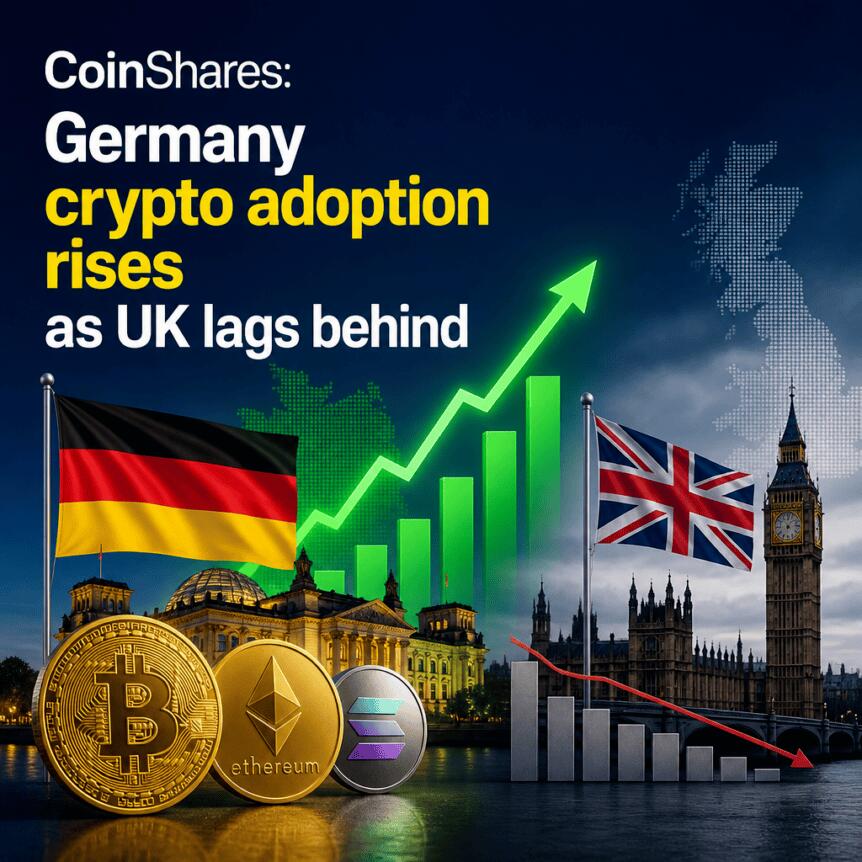
Germany is seeing faster crypto adoption than the UK, with CoinShares researcher Luke Nolan pointing to stronger institutional involvement and younger investors treating digital assets as a more accessible place to deploy inherited wealth. Speaking to Cointelegraph, Nolan said German demand is being driven by a mix of family offices, wealth managers and individual advisors—while the UK remains constrained by regulatory lag.
Behind the headline difference is a clear divide in regulatory momentum: Germany and the wider EU have been working through Markets in Crypto-Assets (MiCA) licensing, while the UK’s crypto market is still “nascent” after the Financial Conduct Authority (FCA) only recently resumed retail access to certain crypto exchange-traded products.
Key takeaways
- CoinShares’ Luke Nolan says Germany’s crypto adoption is advancing quickly, led by advisors and younger investors seeking exposure to inherited wealth.
- Nolan argues the UK is behind largely because FCA retail crypto-product restrictions were lifted less than a year ago, leaving the market still early-stage.
- Germany has 89 licensed crypto-asset service providers, representing 25.5% of firms listed on ESMA’s MiCA register.
- Major German banks are moving toward crypto custody for institutions as regulatory approval milestones approach, including Deutsche Bank’s expected license window.
- The UK FCA is progressing its new authorization framework, with licensing applications opening Sept. 30 and interim transitional arrangements tied to a 2027 timetable.
Why Germany is pulling ahead with younger and advisor-led demand
Nolan described Germany’s adoption trajectory as “very good progress,” emphasizing the role of wealth intermediaries. According to his comments to Cointelegraph, family offices, wealth managers and individual advisors are helping bring crypto into mainstream investment conversations—particularly among younger investors.
A notable behavioral driver, Nolan added, is the growing interest in investing inherited wealth in digital assets. That dynamic matters because it links crypto demand to long-term financial planning rather than short-term speculation, increasing the likelihood of sustained client education and repeat allocations through established advisory channels.
UK market remains “nascent” after FCA timing gaps
In contrast, Nolan said the UK is “still very much behind.” His explanation centered on timing: the FCA lifted its ban on crypto exchange-traded products for retail participants less than a year ago, following a prior ban introduced in January 2021.
That regulatory gap helps explain why the UK digital asset market is described as early-stage. Even as UK regulators move to bring broader crypto activity under formal oversight, investor access and product availability take time to rebuild after restrictive periods—especially for retail-oriented exchange-traded formats.
MiCA licensing momentum: Germany’s weight in the EU register
Germany’s regulatory groundwork under MiCA is also reflected in licensing totals. ESMA’s updated MiCA register shows Germany has 89 licensed crypto-asset service providers, accounting for 25.5% of companies in the register. ESMA’s MiCA-related listings provide the basis for this share of the market within Europe.
Germany has also been positioned as an EU leader by authorization volume. Cointelegraph previously reported that Germany topped the bloc by MiCA authorization in June, reaching 57 authorized crypto companies—underscoring that the country’s pipeline did not merely grow late in the process.
For investors and service providers, licensing concentration can be a signal of both regulatory confidence and operational readiness: firms licensed earlier often have more time to build compliant products, custody workflows and customer onboarding processes.
Big banks in Germany edge closer to institutional crypto custody
The adoption story is not confined to independent advisors. It is also drawing attention from Germany’s largest financial institutions as they prepare for regulated crypto services.
Deutsche Bank revealed on Wednesday that it was awaiting regulatory approval to launch crypto custody solutions for institutional clients in Europe, with a license expected in October. Earlier this year, Cointelegraph reported that Landesbank Baden-Württemberg—described as Germany’s largest federal bank—began offering crypto custody solutions in partnership with Bitpanda for its institutional custody platform (launched in April 2024).
Together, these moves indicate a gradual institutionalization of custody: as banks approach licensing milestones, the market may see improved infrastructure for professional-grade storage, controls and reporting—features that matter to institutional allocators who need compliant operational pathways.
UK regulators advance authorization and enforcement
While Germany presses ahead through MiCA licensing, the UK FCA is working through its own framework for regulating crypto activities. On Wednesday, the FCA issued final guidance describing when crypto activities may require authorization under the UK’s incoming regulatory regime.
According to Cointelegraph’s coverage, licensing applications will open on Sept. 30, with a Feb. 28, 2027 deadline for firms seeking transitional arrangements ahead of the new regime taking effect on Oct. 25, 2027. The timetable suggests the UK is moving toward a structured authorization environment, but it also means firms and users may still be waiting for full operational clarity until the later stages of the schedule.
The FCA also continued enforcement actions. On Thursday, it announced that it had sent a cease-and-desist letter to three London locations suspected of facilitating illegal peer-to-peer crypto trading. Separately, UK Parliament approved regulations bringing digital assets within the FCA’s regulatory remit in February, and the regulator later finalized a package of rules and guidance in June.
For readers watching how Europe’s crypto markets diverge, the key uncertainty is timing: Germany’s progress is being reinforced by MiCA licensing and bank-level infrastructure moves, while the UK’s broader framework is still rolling out. The next thing to track is how quickly FCA authorizations and transitional arrangements translate into new, compliant product availability—especially for institutions and retail channels that have been rebuilding since the end of earlier restrictions.
The digital asset industry diverged starkly Wednesday after the Federal Reserve hiked its key interest rate. Bitcoin and cryptocurrency stocks traded lower amid a disappointing start to the week after the Senate on Tuesday failed to advance the Digital Asset Market Clarity Act. Mining stocks and AI infrastructure providers trended higher on reports of bullish energy news for Cipher Digital.…
Copyright ©2026 Investor’s Business Daily, LLC. All rights reserved. 87990cbe856818d5eddac44c7b1cdeb8

Sunbelt Rentals Holdings, Inc. (NYSE:SUNB) reported on September 9 that fiscal first-quarter revenue increased 11.2% to $3.115 billion, including $2.927 billion of rental revenue, up 12.5%. The quarter ended July 31, 2026.
Management raised fiscal 2027 rental-revenue growth guidance to 7% through 10%, while increasing planned net rental-equipment capital expenditures to $2.4 billion through $2.8 billion. Demand supports expansion, but investors need to assess how much cash remains after funding the fleet.

BULL CASE
North America Specialty rental revenue grew 25.3%, giving Sunbelt Rentals Holdings, Inc. (NYSE:SUNB) a strong source of growth beyond general equipment rentals. Specialized services can deepen customer relationships and create opportunities to supply several needs on the same project.
The company estimated that the FIFA World Cup contributed 2.5 percentage points to quarterly rental-revenue growth. Serving complex events demonstrates the commercial value of a broad equipment network. The investment opportunity is to turn that capability into recurring work across industrial, energy and construction customers.
Adjusted EBITDA increased 8.7% to $1.315 billion. This company-defined non-GAAP measure adds taxes, net interest, depreciation, amortization, stock-based compensation and specified restructuring costs to net income. Its margin is adjusted EBITDA divided by revenue.
GAAP operating margin improved to 22.2% from 21.3%, helped by lower depreciation expense relative to revenue. The business is generating higher operating profit as management commits more capital to future rentals.
BEAR CASE
Cash conversion weakened. Operating cash flow declined to $840 million from $868 million, while company-defined non-GAAP free cash flow fell to $70 million from $468 million. Free cash flow deducts rental and non-rental equipment purchases, net of disposal proceeds, from operating cash flow.
That means net equipment spending absorbed approximately 92% of quarterly operating cash flow. Equipment purchases can precede rental income, but the gap places greater importance on deploying new assets quickly and keeping them rented.
The revised outlook increases that obligation. At the guidance midpoints, planned annual net rental-equipment spending rose by $350 million, while expected adjusted EBITDA increased by $70 million. Those revisions show why stronger earnings guidance does not automatically mean more near-term cash available to shareholders.
Adjusted EBITDA margin also declined to 42.2% from 43.2%. Management attributed the decline primarily to faster growth in ancillary revenue, partly offset by improved rental rates. The World Cup contribution also makes recurring demand after the event an important test.

Key takeaways
- The failed CLARITY Act vote and the Federal Reserve’s rate increase have weighed on sentiment.
- XRP futures open interest fell from 2.25 billion to 2.12 billion tokens, signaling softer speculative demand.
- The 50-day and 100-day EMAs provide support between $1.28 and $1.26.
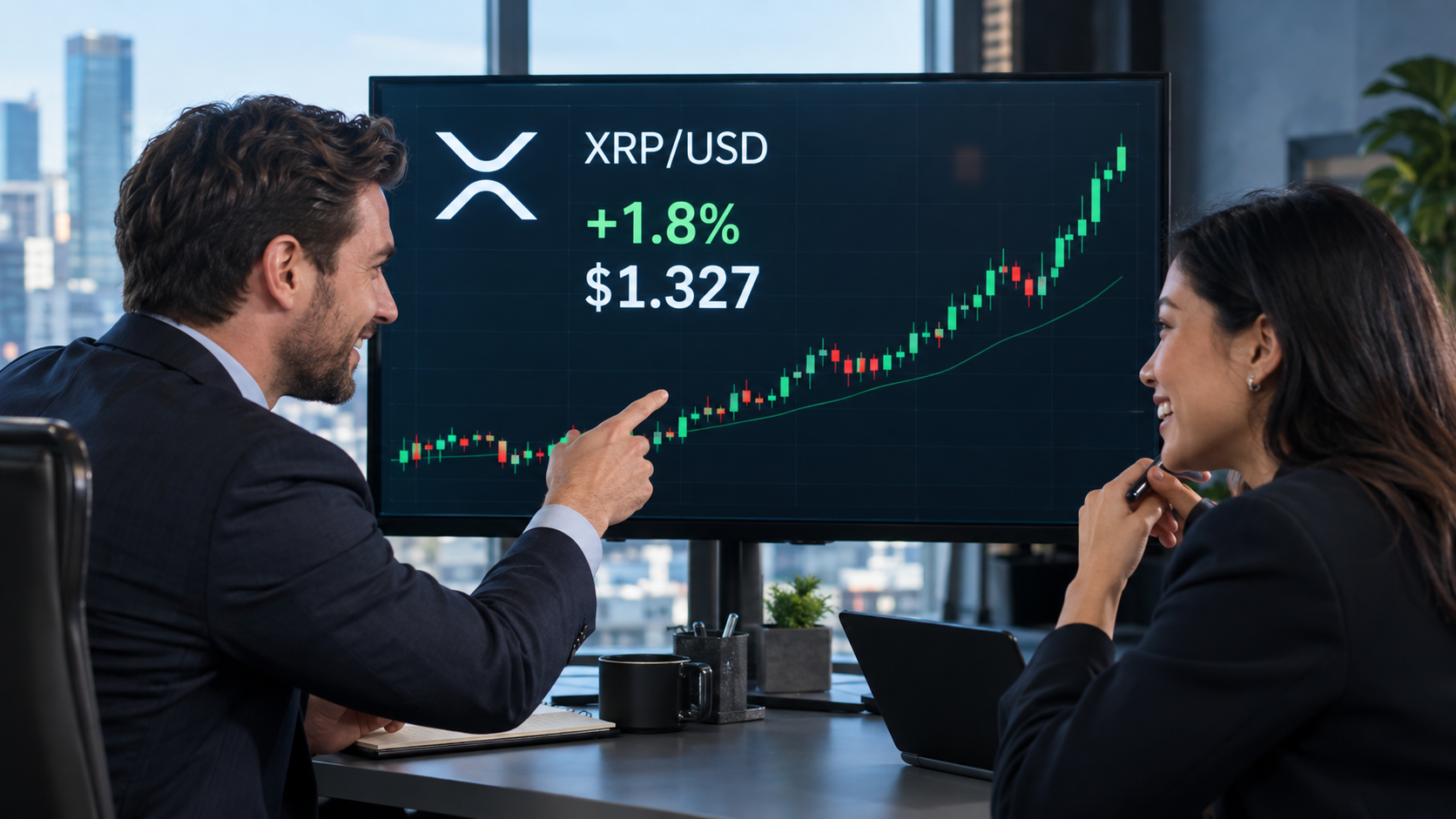
Ripple’s XRP remained under bearish pressure on Friday, trading just above $1.30 as buyers attempted to defend a cluster of short-term moving-average supports.
The token has struggled since rising to $1.50 on Monday. Sentiment weakened after the U.S. Senate failed to advance the CLARITY Act and the Federal Reserve raised its benchmark interest rate by 25 basis points to a range of 3.75% to 4.00%.
Higher interest rates can reduce liquidity and weaken demand for risk assets, including cryptocurrencies. However, the Fed’s decision was widely anticipated, limiting the immediate market reaction.
Ripple highlights XRP’s existing legal clarity
Despite the legislative setback, Ripple maintains that XRP already has a meaningful legal advantage following the company’s lengthy court battle with the Securities and Exchange Commission.
Ripple said the litigation established that XRP is not inherently a security, giving the company and token firmer legal footing even without a comprehensive U.S. digital-asset framework.
The company acknowledged that the CLARITY Act could have offered greater certainty across the broader crypto industry. Still, it argued that XRP remains on “settled ground” compared with many other digital assets.
Derivatives activity has weakened alongside XRP’s fading price recovery. Futures open interest fell to 2.12 billion XRP on Friday from 2.25 billion the day earlier. It has also retreated considerably from the 2.78 billion XRP recorded on August 15.
Falling open interest indicates traders are closing leveraged positions or becoming less willing to establish new ones. If the decline continues, XRP may struggle to attract the speculative demand needed for a sustained move back toward $1.50.
The token nevertheless displayed some resilience following the Fed’s expected rate increase.
XYO co-founder Markus Levin noted that the central bank’s improved growth outlook suggests policymakers do not believe the U.S. economy is approaching a severe downturn.
However, the effects of higher borrowing costs could emerge gradually as financial conditions tighten.
XRP bulls defend the $1.26-$1.28 support zone
XRP remains above the 50-day and 100-day exponential moving averages, which provide support around $1.28 and $1.26, respectively.
The 200-day EMA at approximately $1.36 represents the first major resistance. A decisive break above that level could improve momentum and reopen the path toward $1.50.
Technical indicators currently point to consolidation with a bearish tilt. The Moving Average Convergence Divergence indicator has fallen further below zero, while its expanding negative histogram suggests bullish momentum is weakening.

Meanwhile, the Relative Strength Index stands at 49, slightly below its neutral midpoint.
A daily close below the $1.26-$1.28 support cluster would strengthen the bearish outlook and potentially trigger a deeper correction.
Conversely, holding this zone and reclaiming $1.36 would provide an early sign that buyers are regaining control.
Bitcoin has climbed above $77,400 on Sept. 18 after the Bank of Japan raised its benchmark interest rate by 25 basis points to 1.25%, its highest level in roughly 31 years, while the yen weakened following the decision.
Summary
- Bitcoin traded above $77,400 after the Bank of Japan raised rates to 1.25% on Friday.
- BOJ approved the 25-basis-point increase by seven votes to two, its second hike since June.
- CoinGecko showed Bitcoin near $77,409, up 1.4%, with $77,624 marking the daily high during trading.
- U.S. spot Bitcoin ETFs drew $159.5 million on September 17, led by BlackRock’s IBIT fund.
- RSI remained neutral-bullish while bearish MACD crossover showed short-term momentum had weakened after Bitcoin’s rebound.
The Bank of Japan said the Policy Board approved the increase from 1.0% by a 7–2 vote as officials responded to inflation risks and continued progress toward the central bank’s 2% price stability target. Reuters reported that policymakers retained guidance indicating rates could rise further if economic activity and prices develop in line with the BOJ’s projections.
Bitcoin price holds above $77K after BOJ decision
At the time of checking, CoinGecko showed Bitcoin at $77,409.41, up 1.4% over 24 hours. The cryptocurrency had traded between $75,971.64 and $77,623.53 during the period, placing the current price close to the upper end of its daily range.
The move followed an overnight decline toward $76,200. BTC recovered to roughly $77,400 after the BOJ decision, while BTC/JPY on Tokyo-based bitFlyer rose around 0.5% to 12.06 million yen.
Foreign-exchange trading moved in the opposite direction. USD/JPY rose from around 156.20 before the rate announcement to approximately 156.70 afterward, showing that the yen weakened despite the higher Japanese policy rate.
Reuters said investors focused partly on the two dissenting BOJ members and the lack of stronger language pointing toward rapid additional tightening. The yen therefore failed to strengthen after a rate decision that had already been widely expected.
Bitcoin’s rise should not be attributed solely to the BOJ meeting. BTC had already started recovering from the $76,000 area before the announcement, while U.S. ETF flows, Federal Reserve policy, Treasury yields, oil prices and geopolitical conditions were moving at the same time.
As recent Bitcoin central-bank coverage previously reported, analysts had identified the BOJ meeting as a potential source of volatility because tighter Japanese monetary policy can increase the cost of yen-funded positions.
BOJ raises rates as inflation risks stay elevated
Friday’s increase took the BOJ policy rate from 1.0% to 1.25%, extending a tightening cycle that has moved Japan further from the ultra-low borrowing costs maintained for much of the previous three decades.
The increase was the BOJ’s second rate hike in roughly three months after policymakers raised the benchmark to 1% in June.
Two Policy Board members opposed Friday’s increase. Reuters reported that the dissenters argued economic conditions did not yet justify another increase, while the majority pointed to inflation risks connected with import prices, energy costs and domestic price-setting behavior.
Japan’s central bank said the economy had continued recovering moderately, although some sectors remained weak. Officials maintained that underlying consumer inflation was gradually moving toward 2%.
Higher oil costs remain one source of pressure because Japan imports much of its energy. A weaker yen can raise those costs further by making dollar-priced commodities more expensive in local currency terms.
The BOJ said it would continue raising its policy rate and adjust monetary accommodation if its economic and inflation outlook is realized. The statement does not commit the bank to a date or size for the next increase.
As earlier BOJ crypto coverage reported after the June increase, higher Japanese rates have drawn attention from digital-asset traders because yen borrowing has historically financed leveraged positions across global markets.
Yen carry trade remains a crypto risk factor
For years, very low Japanese borrowing costs encouraged investors to borrow yen and deploy capital into currencies or assets offering higher returns.
Higher BOJ rates increase the funding cost of those strategies. A rapid rise in the yen can create an additional problem because traders who borrowed the currency must repay liabilities at a stronger exchange rate.
The latest decision did not produce that pattern immediately. The yen weakened and Bitcoin rose after the announcement, meaning Friday’s first reaction did not resemble a disorderly carry-trade unwind.
The interest-rate gap with the U.S. remains sizable. The Federal Reserve raised its target range to 3.75%–4.00% earlier this week, compared with Japan’s new 1.25% policy rate. The difference remains approximately 2.5 to 2.75 percentage points. The Fed’s own rate data confirms the latest U.S. range.
The August 2024 market selloff remains a common reference point because equities and crypto dropped sharply as yen-funded trades came under pressure. Past market behavior does not establish that the same response will occur after subsequent BOJ decisions.
Meanwhile, U.S. monetary policy remains another factor for Bitcoin. Reuters reported that Goldman Sachs and BofA Global Research expect the Federal Reserve to raise rates again in October. Most major brokerages expect another increase later in 2026, commonly in December.
Morgan Stanley does not currently share the October call cited in some reports. Reuters said Morgan Stanley and Macquarie expect a December increase followed by another rate hike in March 2027.
Bitcoin ETFs return to $159.5M net inflows
Institutional flows provided another data point for Bitcoin before the BOJ announcement.
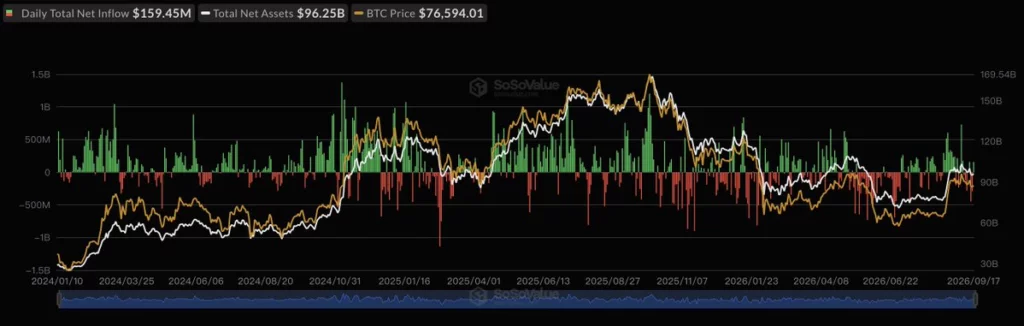
U.S. spot Bitcoin ETFs recorded $159.5 million in net inflows on Sept. 17, reversing two consecutive trading sessions of withdrawals, according to SoSoValue data.
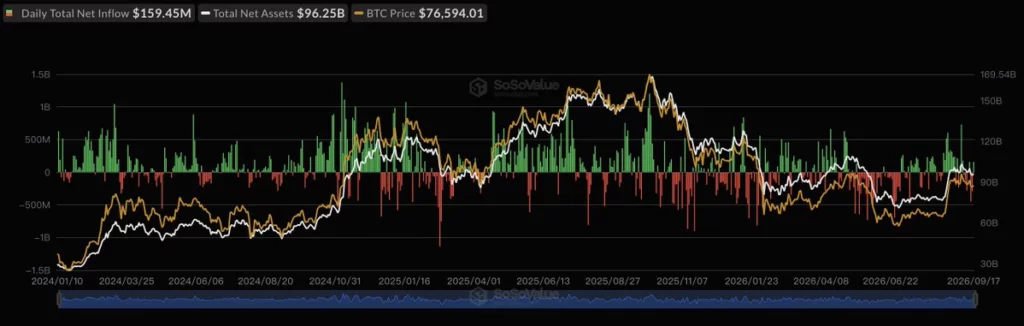
BlackRock’s iShares Bitcoin Trust recorded $183.7 million of net inflows. Fidelity’s FBTC posted $16.6 million in outflows, while VanEck’s HODL lost $7.6 million. The remaining products recorded no meaningful net movement in the reported figures.
The result means IBIT was the only fund with positive net flows in the Sept. 17 dataset, but saying it received $159 million would be incorrect. BlackRock attracted more than the group’s net total because withdrawals from Fidelity and VanEck reduced the combined result.
The inflow followed withdrawals of roughly $450.4 million on Sept. 15 and $295.9 million on Sept. 16, according to the same Farside-based data.
BlackRock’s product remains the largest U.S. spot Bitcoin ETF by holdings. Bitbo data placed U.S. spot ETF holdings collectively at approximately 1.259 million BTC as of Sept. 17, with IBIT holding roughly 784,526 BTC.
In earlier U.S. Bitcoin ETF coverage, the funds recorded a much larger $730.9 million daily inflow on Sept. 3, showing that daily institutional flows have remained volatile through September.
RSI and MACD show momentum cooling below $77,600
The supplied Bitcoin chart shows price recovering from approximately $76,200–$76,400 into the $77,400–$77,600 area before moving into a narrower consolidation.
The 14-period RSI stands at 56.89, below its moving average of 60.55. A reading above 50 keeps the indicator on the positive side of neutral, while remaining below the 70 level commonly associated with overbought conditions.
With the RSI below its moving average, the chart indicates that momentum has eased compared with the earlier stage of the rebound.
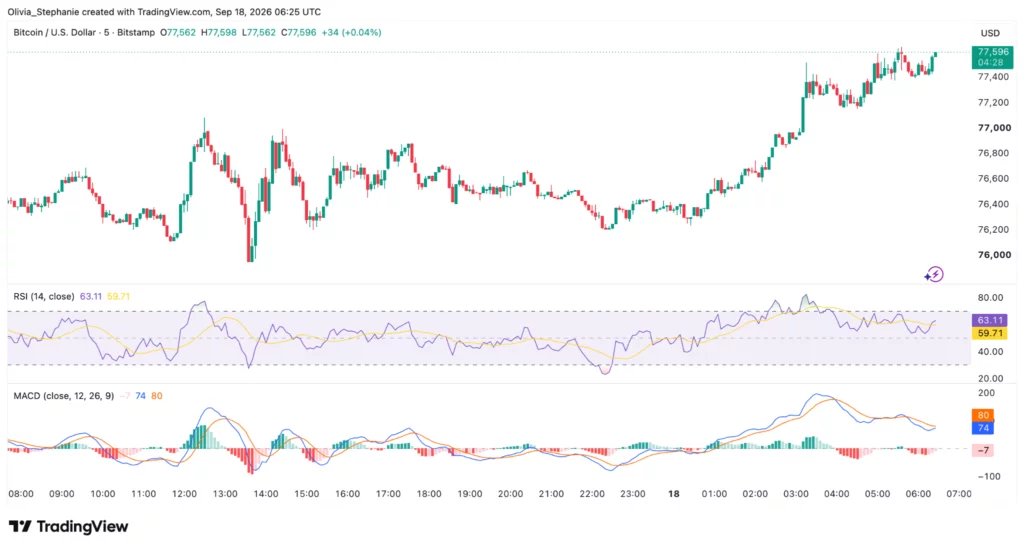
The MACD gives a more cautious reading. Its line is close to 73, below the signal line near 91, while the histogram is approximately -19. The bearish crossover shows that short-term momentum has weakened even as Bitcoin holds above $77,000.
Current CoinGecko data places the 24-hour high at $77,623.53, closely matching the $77,600 area where the supplied chart shows recent candles encountering resistance.
Below the market, the latest CoinGecko range places the daily low near $75,972. Earlier Bitcoin technical coverage identified the $75,000–$76,000 region as an area where buyers had recently returned.
The BOJ’s next policy moves remain conditional on inflation and economic data. For Bitcoin, the immediate market now combines the Japanese rate increase, a still-large U.S.-Japan policy-rate gap, recovering ETF inflows and technical resistance around the upper $77,000 to $78,000 region.
Disclosure: This article does not represent investment advice. The content and materials featured on this page are for educational purposes only.
Solana has cut its target slot time from 300 milliseconds to 250 milliseconds, increasing the rate at which the network produces slots by nearly 17% without raising its overall processing ceiling by the same amount.
Summary
- Solana has reduced its target slot time from 300ms to 250ms, bringing the network to four targeted slots per second.
- The faster clock cuts each validator’s four slot leader window from 1.2 seconds to one second.
- Overall processing capacity remains roughly unchanged because computation and data limits fall as slot duration decreases.
- The 250ms setting shortens an expected Solana epoch from roughly 36 hours to 30 hours.
- A final reduction to 200ms would bring Solana to five slots per second, but no mainnet date has been set.
According to blockchain data, the new setting went live on Sept. 18 and brings Solana to four targeted slots per second, compared with roughly 3.3 under the previous 300ms configuration. The change is the third stage of SIMD-0525, which is designed to gradually reduce slot times from the network’s original 400ms setting to a final target of 200ms.
A slot is the period in which a designated validator can produce a block. Shortening that period gives wallets, exchanges and trading applications more frequent updates on the state of the network.
Validators continue to serve as leaders for four consecutive slots. With each slot now targeted at 250ms, a validator’s nominal leader window has fallen from 1.2 seconds at the previous setting to one second.
Solana slot time reaches 250ms
Solana began the current rollout in August when it cut its slot time from 400ms to 350ms for the first time since the network launched, as crypto.news previously reported.
SIMD-0525 divided the process into four stages at 350ms, 300ms, 250ms and 200ms instead of moving directly to the final target. Each reduction requires a separate feature activation, allowing developers and validator operators to assess network performance before moving ahead.
At 250ms, four slot opportunities arrive each second. The shorter intervals can give applications a more current view of transactions and network state while passing block production from one validator to another sooner.
Oracle based markets and automated market makers are among the applications covered by the proposal because their operations can depend on the age of onchain data. A shorter interval reduces the amount of time between network updates, while users can see transaction status changes sooner.
For swaps, the shorter timing can narrow the period between a transaction being submitted and reaching the network. The underlying proposal identifies faster confirmations and more frequent updates as benefits of reducing slot duration.
The change does not increase Solana’s raw transaction capacity by nearly 17%.
Under SIMD-0525, resource limits are reduced in proportion to the slot duration. More slots are produced over a given period, but each slot is permitted to carry less computation and data, keeping the amount of work the network can process over real time at roughly the same level.
At the 60 million compute unit baseline used by the proposal, the per slot limit falls as the clock gets faster. The 250ms configuration corresponds to a 37.5 million compute unit limit, while the planned 200ms stage would lower it to 30 million.
Faster blocks change Solana infrastructure requirements
Infrastructure providers now have more individual blocks to process and store even though the wall clock processing ceiling remains broadly unchanged.
Applications that calculate elapsed time by multiplying slot numbers by a fixed slot duration may need to account for the faster clock. Blockhashes expire sooner in real time as slots advance more quickly, leaving less time for transaction processes involving offline signing or delayed human approvals.
Epoch timing changes for the same reason. Solana keeps each epoch fixed at 432,000 slots, meaning an epoch becomes shorter as the duration of each slot falls.
At the earlier 300ms target, an epoch lasted roughly 36 hours. The 250ms setting cuts the expected duration to around 30 hours. A move to the final 200ms target would reduce it to approximately 24 hours.
Solana’s staged slot reductions form part of the Agave 4.2 rollout. The client release began activating several network changes in August, including lower onchain storage rent, larger transactions and the path toward 200ms slots.
The staged design includes a safeguard tied to block skip rates. Progress toward the next slot setting can be halted if skip rates rise beyond the level developers consider acceptable, giving validators time to operate under each configuration before another reduction is activated.
No mainnet date has been set for the 200ms stage.
Solana upgrades extend beyond faster slots
Slot timing is only one part of the network changes being rolled out through Agave.
Solana separately introduced Transaction V1, which raises the maximum serialized transaction size from 1,232 bytes to 4,096 bytes. The larger transaction format can accommodate data heavy operations such as zero knowledge proofs and complex multisignature instructions within a single transaction.
Transaction V1 is optional, while legacy and version zero transactions remain supported. Applications that read blocks need to support the newer format to correctly handle V1 transactions.
The transaction size increase is separate from SIMD-0525. Larger individual transactions therefore do not determine the slot clock, while shorter slots do not automatically increase the maximum size of a transaction.
Solana has been activating the changes independently through feature gates. The structure allows one upgrade to proceed without requiring the other features included in Agave 4.2 to activate at the same time.
Solana is still targeting 200ms slots
The final stage under SIMD-0525 would reduce the target slot time from 250ms to 200ms, bringing the network to five targeted slots per second.
A four slot validator leader window would consequently fall to roughly 800ms. Epoch duration would decline from around 30 hours under the current 250ms setting to approximately 24 hours.
Solana developers have not provided a mainnet activation date for the final reduction. Progress depends on network behavior under the current setting, including whether validators can maintain acceptable block skip rates.
The slot reductions are separate from Alpenglow, Solana’s planned consensus redesign. Alpenglow is intended to replace TowerBFT with a voting system called Votor and remove onchain vote transactions from the network’s core consensus process.
The Alpenglow consensus upgrade targets roughly 150ms finality. Its code has been included for testing, while mainnet deployment has been tied to Agave 4.3 rather than the slot time feature gates used for SIMD-0525.
Alpenglow entered community validator testing earlier in 2026, allowing operators to run the consensus design on a test cluster before deployment on mainnet. Anza has described the system as the largest consensus change in Solana’s history.
For SIMD-0525, the network remains at the 250ms stage until developers activate the final feature gate. The 200ms configuration would complete a rollout that began at 400ms and moved through 350ms, 300ms and 250ms while reducing resource limits at each step.


Top 10 Creations (All ETFs)
|
Ticker |
Name |
Net Flows ($, mm) |
AUM ($, mm) |
AUM % Change |
|
2,719.26 |
169,683.58 |
1.60% |
||
|
1,248.34 |
687,534.29 |
0.18% |
||
|
1,046.61 |
1,081,648.28 |
0.10% |
||
|
1,009.58 |
226,987.84 |
0.44% |
||
|
911.04 |
107,011.88 |
0.85% |
||
|
553.96 |
46,651.80 |
1.19% |
||
|
538.74 |
191,214.84 |
0.28% |
||
|
428.88 |
17,483.18 |
2.45% |
||
|
405.50 |
462.46 |
87.68% |
||
|
391.27 |
144,066.35 |
0.27% |
Top 10 Redemptions (All ETFs)
|
Ticker |
Name |
Net Flows ($, mm) |
AUM ($, mm) |
AUM % Change |
|
-2,358.15 |
800,577.47 |
-0.29% |
||
|
-1,987.27 |
820,628.41 |
-0.24% |
||
|
-534.09 |
47,177.83 |
-1.13% |
||
|
-302.22 |
79,585.21 |
-0.38% |
||
|
-220.17 |
1,417.25 |
-15.54% |
||
|
-212.67 |
27,728.48 |
-0.77% |
||
|
-212.42 |
30,583.75 |
-0.69% |
||
|
-206.93 |
67,897.75 |
-0.30% |
||
|
-187.57 |
3,583.54 |
-5.23% |
||
|
-171.65 |
17,039.23 |
-1.01% |
ETF Daily Flows By Asset Class
|
Net Flows ($, mm) |
AUM ($, mm) |
% of AUM |
|
|
Alternatives |
572.89 |
155,975.51 |
0.37% |
|
Asset Allocation |
74.58 |
47,369.02 |
0.16% |
|
Commodities E T Fs |
978.53 |
344,374.05 |
0.28% |
|
Currency |
350.05 |
129,232.05 |
0.27% |
|
International Equity |
172.31 |
2,946,759.89 |
0.01% |
|
International Fixed Income |
719.37 |
459,622.37 |
0.16% |
|
Inverse |
19.31 |
14,396.50 |
0.13% |
|
Leveraged |
714.10 |
175,868.07 |
0.41% |
|
Us Equity |
5,727.02 |
9,757,886.79 |
0.06% |
|
Us Fixed Income |
1,095.26 |
2,187,929.26 |
0.05% |
|
Total: |
10,423.42 |
16,219,413.52 |
0.06% |
Disclaimer: All data as of 6 a.m. Eastern time the date the article is published. Data is believed to be accurate; however, transient market data is often subject to subsequent revision and correction by the exchanges.
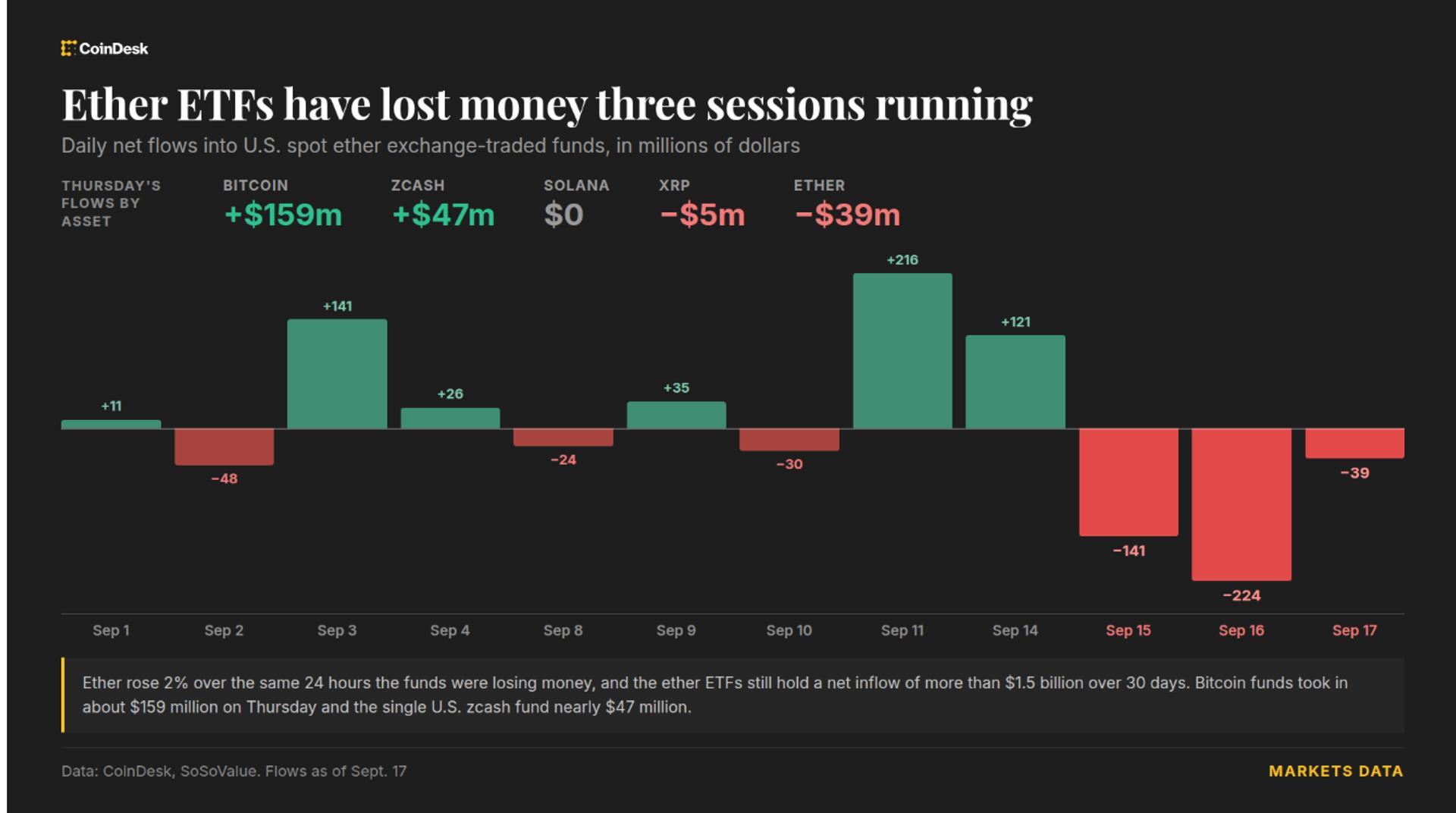
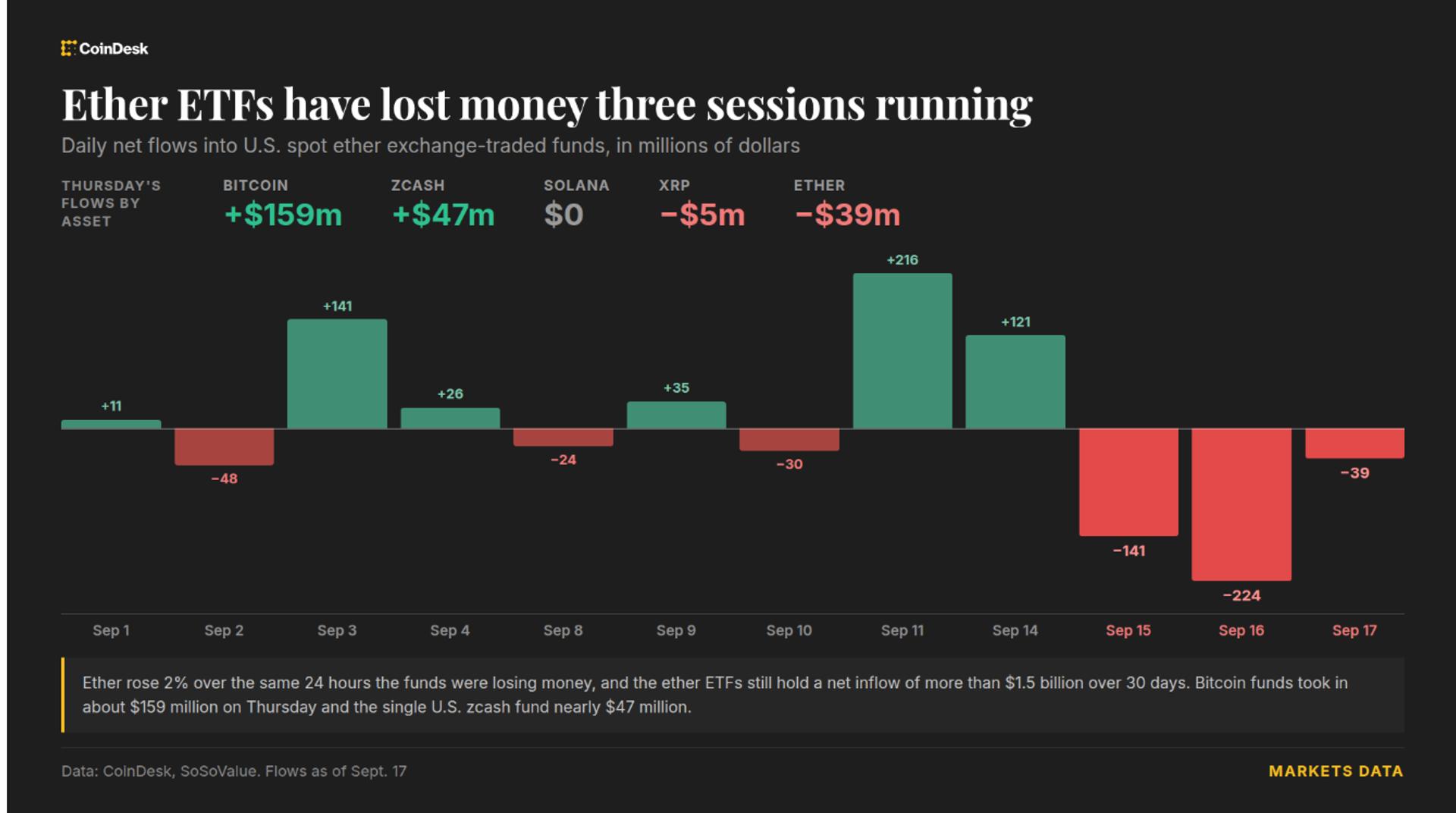
U.S. spot ether exchange-traded funds recorded roughly $39 million of net outflows on Thursday, a third consecutive day of withdrawals after about $224 million left on Wednesday and $141 million on Tuesday, according to SoSoValue. Ether itself rose 2% to about $2,470 over the same stretch.
XRP funds lost about $5 million, reversing a small inflow the day before. Bitcoin ETFs took in roughly $159 million, and the single U.S. Zcash fund added nearly $47 million, its strongest showing yet in a month that has brought it more than $230 million.
Over 30 days the ether funds remain more than $1.5 billion ahead and bitcoin nearly $2.5 billion.
Zcash led the majors again at 10% higher to about $1,488, with hyperliquid’s HYPE close behind at nearly 10% to just above $86. Solana gained 5% to nearly $105 and BNB nearly 4% to about $750. Dogecoin rose about 4%, ether and XRP 2% each, and bitcoin more than 1% to about $77,216, according to CoinDesk data. Tron was the only major that barely moved.


World has launched World Money, a self-custody financial “super app” combining stablecoin payments, digital asset rewards and trading.
The rollout began Thursday in more than 150 countries, World said, with features varying by location. Users can send supported digital assets, including stablecoins, to a recipient’s World username, deposit eligible assets to earn rewards, and buy and sell digital assets through exchanges.
The app lets users access “Mini Apps” such as Kalshi, Credit and Morpho. A partnership with Stripe allows users to fund their accounts and buy stablecoins with Apple Pay, starting with users in the US.
World has been expanding the financial capabilities of World App since its launch in May 2023, when it combined World ID with a crypto wallet, stablecoin transfers and token trading.
In October 2024, World introduced World App 3.0 as a “super app for humans,” adding third-party Mini Apps and a Vault feature for earning on assets. In November 2025, it piloted virtual bank accounts in the US before rolling it out to more countries a month later, allowing paychecks and bank deposits that are converted into USDC.
Related: Tools for Humanity expands World app toward super-app model
With the launch of World Money, World said its identity and financial services are now split across two dedicated apps.
World ID App handles identity verification and credentials, while World Money provides wallet, payment and other financial features. Existing World App and World ID App users can use their existing accounts for World Money, the company said.
World Money is operated by Tools for Humanity, the company co-founded by Sam Altman and Alex Blania that develops technology for the World network.
Magazine: Bitcoin treasury firms can outperform BTC… but is the risk worth taking?
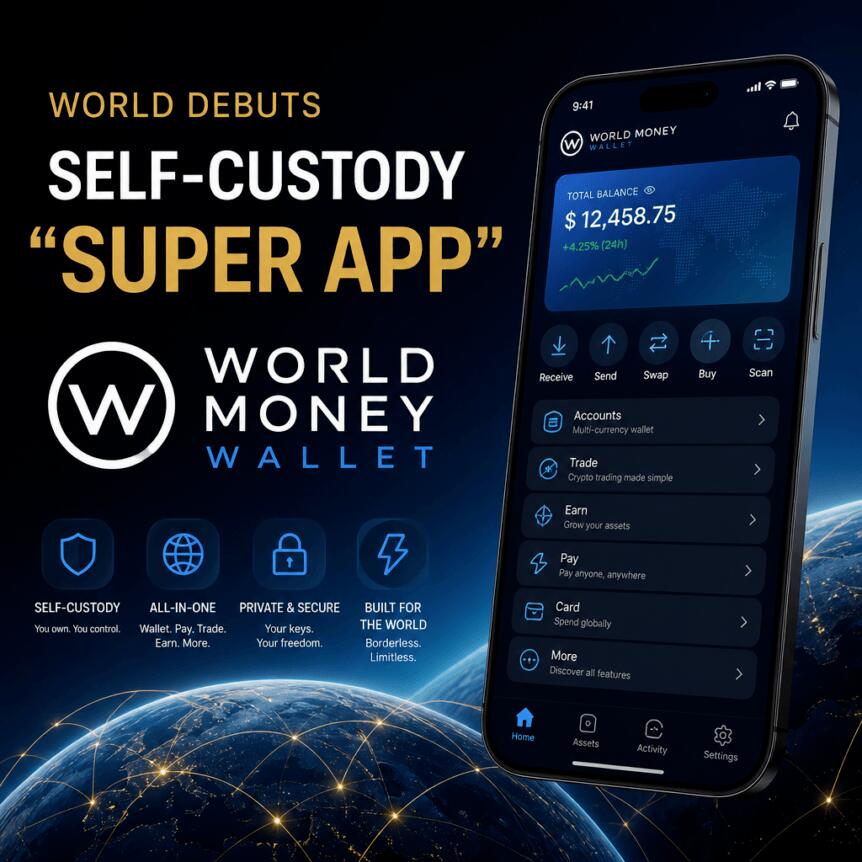
World has rolled out “World Money,” a new self-custody financial super app that combines stablecoin payments, digital asset rewards and in-app trading. The launch began Thursday in more than 150 countries, with some functions varying by region, according to World’s announcement on its website (https://world.org/blog/announcements/world-money).
The app is designed to let users move supported digital assets—such as stablecoins—to recipients using a World username, deposit eligible assets to earn rewards, and buy or sell digital assets via built-in exchange access. World is also positioning the product around its broader ecosystem, including “Mini Apps” that bring third-party services into the same interface.
Key takeaways
- World Money launches in 150+ countries, with feature availability tailored by location.
- Self-custody wallet functions include stablecoin transfers to a World username, rewards for eligible deposits, and trading access.
- Mini Apps extend functionality through third-party integrations such as Kalshi, Credit and Morpho.
- Stripe integration enables funding and stablecoin purchases via Apple Pay initially for users in the US.
- World is splitting responsibilities across apps: World ID App for identity, and World Money for wallet and financial services.
What World Money adds for users
World Money brings together several functions that are typically distributed across different financial apps. World says users can send supported assets—including stablecoins—to another person’s World username. That approach aims to simplify transfers by avoiding traditional address-sharing workflows, while still keeping the process connected to the app’s self-custody wallet experience.
Beyond transfers, the platform includes a rewards mechanism. World states that users can deposit eligible assets to earn rewards, though the specific reward parameters are not detailed in the rollout description. The app also provides access to buy and sell digital assets through exchanges, positioning World Money as more than a payments layer.
World further emphasizes an app-to-app experience through its “Mini Apps.” These third-party modules—named by World as Kalshi, Credit and Morpho—are meant to expand the range of financial actions available without requiring users to leave the World Money interface.
Funding and stablecoin onboarding via Stripe
A key part of any stablecoin “super app” strategy is removing friction from onboarding and account funding. World says it partnered with Stripe to let users fund their accounts and buy stablecoins using Apple Pay, starting with users in the US.
In practice, that means eligible users can convert fiat purchasing power into stablecoins without switching to a separate exchange app for initial funding. For traders and everyday users alike, this can reduce the steps needed to go from payment rails to on-chain asset usage—particularly important for stablecoin payments where timing and convenience matter.
Splitting identity and financial services into two apps
With the introduction of World Money, World says its identity and financial stack is now split across two dedicated applications. The World ID App handles identity verification and credentials, while World Money provides the wallet, payments, trading and other financial capabilities.
World also says existing World App and World ID App users can use their existing accounts for World Money. That matters because it keeps the onboarding path consistent for users who already hold identity credentials or have previously engaged with World’s wallet and trading features under the prior unified app experience.
How this fits World’s “super app” roadmap
World has been steadily expanding the World App concept since its launch in May 2023, when it combined World ID with a crypto wallet, stablecoin transfers and token trading.
In October 2024, World introduced “World App 3.0” as a “super app for humans,” adding third-party Mini Apps and a Vault feature aimed at earning on assets. Then, in November 2025, the company piloted virtual bank accounts in the US—before rolling them out more widely a month later—allowing paychecks and bank deposits to be converted into USDC.
Against that timeline, World Money appears to be both a product expansion and a structural change. Functionally, it continues the super app direction: wallet + payments + rewards + trading access. Strategically, it clarifies the user journey by separating identity tooling from financial operations, which can make the ecosystem easier to understand and maintain as more services are added.
World Money is operated by Tools for Humanity, the company co-founded by Sam Altman and Alex Blania that builds technology for the World network. The rollout therefore links the app’s financial features directly back to the organization behind World ID and the infrastructure underneath World’s ecosystem.
What to watch next
For users, the immediate open questions are how rewards are structured and which specific digital assets and exchanges are available in each region. For builders and investors, the bigger signal is whether World Money can sustain a seamless onboarding funnel—especially via Apple Pay and Stripe—while keeping self-custody and identity credentials tightly integrated as the app expands beyond its initial US-focused funding path.

Chelsea Handler Disputes Comedian’s Firing Claim

John Healey to urge EU ministers to include UK in ‘Made in Europe’ trade scheme
Euro zone current account surplus narrows in July



-

 Fashion7 days ago
Weekend Open Thread – Corporette.com
-

 Tech5 days ago
The Latest Weird Thing to Play Doom Is the Mapped-Out Brain of a Fruit Fly
-

 Crypto World7 days ago
XAG/USD: Silver’s Short-Term Rally Meets Its Moment of Truth
-

 Crypto World7 days ago
Diesel Tops $6 a Gallon for the First Time as 28 States Set Records
-

 Crypto World3 days ago
Kraken Lets xStocks Holders Earn Yield Through DeFi
-

 Crypto World1 day ago
US Charges Robinhood Engineers Over Crypto Listing Trades
-

 Crypto World6 days ago
Can AI Build a Startup in 72 Hours? Elon Musk's Team Will Livestream the Test
-

 News Videos7 days ago
Facing Financial Fears
-

 Crypto World4 days ago
Elon Musk Drops a Bombshell: Grok 5 Could Be the AGI Breakthrough
-

 Entertainment6 days ago
News Specials, Movies, Shows, More
-

 Business5 days ago
Rivals Sam Altman and Elon Musk Rally Behind Dario Amodei’s Call for a Slowdown in AI Development
-
 Crypto World5 days ago
New Tesla Roadster Uses SpaceX Tech. Will It Impact the Stock Price?
-
 NewsBeat4 days ago
‘Sick conspiracy’: Trump says only guardrails AI needs is ‘a strong and smart (High IQ!) president’ in all-caps rant
-

 Crypto World6 days ago
Robinhood Chain Never Stopped But its Blobs Did Stop Reaching Ethereum For 14 Minutes
-

 Crypto World2 days ago
What Is the Status of the U.S.-Iran Peace Talks? Here's What Both Sides Are Saying
-
 Entertainment6 days ago
New Horror Movie Officially Earns a Rare Stephen King Recommendation
-

 Crypto World3 days ago
DOJ Seeks to Seize $61M in Iran Oil Funds From Binance Accounts It Vouched For
-

 Business6 days ago
Marvell: Most Potent Setup Of The AI Factory Decade
-
 Crypto World4 days ago
3 Token Unlocks to Watch in the Third Week of September 2026
-

 Crypto World6 days ago
Bitcoin ETFs lose $462.7M as Ethereum funds gain $196.9M
You must be logged in to post a comment Login