
Crypto World
Casino Operators, Sportsbooks and Affiliates Get a Purpose-Built Media Distribution Service From Kooc Media

The online gambling ecosystem depends on three interconnected business types — casino operators who run the platforms, sportsbook brands who set the odds and gambling affiliates who connect players with both. Each one needs media visibility to succeed. Each one struggles to get it. Kooc Media, a PR distribution agency that has served the gambling and crypto industries since 2017, has launched a media distribution service that addresses all three at once.
The service gives casino brands, sportsbook operators and affiliate businesses guaranteed press coverage on established news publications, professional editorial support, global newswire distribution and transparent campaign reporting. It is the first time a single service has been designed to cover the full range of businesses that make the online gambling industry work.
A Shared Frustration Across the Industry
Spend enough time in online gambling marketing circles and a pattern becomes obvious. Whether someone runs an online casino, manages a sportsbook or owns an affiliate network, the frustration with PR is identical. They know press coverage would help their business. They have tried to get it. The results were either nonexistent or so poor that the entire exercise felt like a waste of money.
Casino operators have been told by agency after agency that gambling falls outside their acceptable client categories. Sportsbook brands have heard the same, sometimes with the added insult of being passed over during the exact sporting events when coverage would matter most. Affiliate businesses — despite producing editorial content as their core product — have found it almost impossible to secure press coverage that builds their own brand rather than the operators they promote.
The common denominator is an industry that generates enormous revenue but receives almost no attention from the mainstream media ecosystem. Publications that routinely cover fintech, gaming technology and digital entertainment draw a line at gambling. PR agencies that proudly serve controversial sectors in other industries refuse to touch betting or casino clients.
Kooc Media exists specifically because of this gap. The agency has provided gambling PR and crypto PR as core services since its founding and has built the distribution infrastructure needed to deliver results where other agencies consistently fail.
“Casino operators, sportsbooks and affiliates are three sides of the same industry,” said Michelle De Gouveia, spokesperson for Kooc Media. “They all need media distribution that actually works. We have built one service that handles all three.”
The Distribution Infrastructure
Kooc Media’s service runs on a combination of owned media and partner distribution that eliminates the uncertainty of traditional PR.
The agency owns and operates multiple established news websites including Blockonomi, CoinCentral, MoneyCheck, Parameter, Beanstalk and Computing. These publications have built strong domain authority and consistent readerships across finance, technology, cryptocurrency and iGaming through years of editorial output. Because Kooc Media controls these sites, every placement booked through the service is published. There is no editorial pitch. No third-party gatekeeper. No possibility of paying for coverage that never materialises.
Beyond the owned network, press releases are distributed through a partner system reaching hundreds of additional media outlets and thousands of syndication channels across multiple countries and content categories. Premium distribution packages extend reach to major international platforms including Business Insider, Bloomberg, Benzinga, MarketWatch and USA Today.
Content is produced by the agency’s in-house editorial team when clients need writing support. The writers understand the specific language, regulatory sensitivities and audience expectations of the casino, sportsbook and affiliate sectors. Clients who prefer to provide their own material can do so and use Kooc Media purely for placement and distribution.
The full cycle operates at the speed the gambling industry demands. Briefing to live publication can happen within a single day. After distribution completes, a detailed report containing live links to every published article is delivered to the client.
What Media Distribution Does for Casino Brands
The online casino market is saturated with operators competing for the same players through increasingly similar means. Bonus offers, game libraries, loyalty programmes and website designs have converged to a point where many casinos are virtually interchangeable from a player’s perspective.
Press coverage provides differentiation that product alone cannot. A casino brand covered by independent news publications carries a perception of legitimacy and establishment that uncovered competitors lack. Players searching for a new casino encounter that coverage during their research and factor it into their decision. The brand feels safer. The signup feels less risky. The deposit happens more readily.
Over time, the SEO value compounds. Each article on a strong domain generates a backlink that improves the casino’s organic search positioning. For brands targeting terms like “best online casino,” “new casino sites,” “top casino bonuses” or “online slots,” those accumulated backlinks provide a lasting competitive advantage in search rankings.
What Media Distribution Does for Sportsbook Brands
Sportsbooks face a unique combination of pressure. They need to build long-term brand trust while simultaneously capitalising on short-term windows of opportunity around sporting events. A sportsbook that is invisible during a major football tournament or boxing event misses the exact moment when potential bettors are most actively searching for a platform.
Kooc Media’s same-day distribution capability allows sportsbook brands to time PR campaigns precisely around these events. A press release can go live on the morning of a major match day, putting the sportsbook’s name in front of audiences when interest is at its peak.

Beyond event-driven campaigns, sportsbooks accumulate the same trust and search benefits as casino brands. Bettors research operators before committing funds. Coverage on trusted publications reduces hesitation. Backlinks from those publications help sportsbooks compete for terms like “best sportsbook,” “sports betting sites,” “football betting platform,” “live betting odds” and “online betting offers.”
For sportsbooks entering newly regulated markets, press coverage provides immediate positioning. A brand that arrives with published coverage across recognised publications starts ahead of competitors who enter with no media presence at all.
What Media Distribution Does for Affiliate Brands
Gambling affiliates occupy a peculiar position in the industry. They are media businesses whose entire model depends on producing content and attracting audiences. Yet most affiliates invest nothing in promoting their own brand through external media channels.
The missed opportunity is significant. An affiliate brand with press coverage on established publications gains credibility with both players and operator partners. Players encountering an affiliate’s comparison site or review platform are more likely to trust its recommendations if they have seen the brand mentioned elsewhere in independent media. The affiliate stops being just another faceless review site and becomes a recognised name in the space.
Operator partnerships benefit too. Casino and sportsbook companies evaluating potential affiliate relationships assess the affiliate’s brand strength, traffic quality and public profile. An affiliate with documented media coverage across credible publications presents a stronger case for favourable commercial terms than one with no presence beyond its own website.
The SEO advantages are particularly relevant for affiliates. The gambling affiliate market is one of the most competitive organic search environments in existence. Hundreds of sites target the same high-value keywords. Backlinks from authoritative publications built through consistent PR campaigns strengthen domain authority in ways that internal content strategies alone struggle to match.
Packages That Fit Each Business Type
Kooc Media offers standard packages and custom campaigns to suit the different needs of casino operators, sportsbook brands and affiliate businesses.
Standard packages deliver guaranteed placements across the agency’s owned sites and partner network with optional content creation and comprehensive reporting. They work for casino brands maintaining steady promotional coverage, sportsbooks keeping their name visible throughout the sporting calendar and affiliates building brand authority through regular media output.
Custom campaigns address specific strategic moments. A casino launching a new brand or entering a new market needs coordinated multi-publication coverage. A sportsbook timing a campaign around a major sporting event needs rapid distribution with precise scheduling. An affiliate network expanding its portfolio or rebranding needs press that introduces the new identity to the industry. Any of these businesses integrating cryptocurrency features needs content bridging traditional gambling and crypto audiences.
Kooc Media manages every campaign from planning through content production, distribution and final reporting.
About Kooc Media
Kooc Media is a PR distribution agency founded in 2017, specialising in online gambling, crypto, fintech and technology. The company operates its own network of news publications and distributes content through a broad global partner network to guarantee media placements. Services include press release writing, sponsored articles, homepage features, newswire distribution and complete campaign management.
Kooc Media’s gambling PR packages are available now through the company’s website at https://kooc.co.uk.
Disclaimer: This is a Press Release provided by a third party who is responsible for the content. Please conduct your own research before taking any action based on the content.



Bitcoin remained anchored around the $78,000 level on Friday as markets awaited fresh geopolitical and macro cues amid heightened U.S.-Iran tensions. The absence of a decisive catalyst kept risk assets in a cautious, sideways drift, even as oil and equities wobbled in response to the evolving backdrop.
With U.S. equities treading water and oil oscillating near the high $90s to mid-$95 per barrel area, traders said the market’s next move hinges on clarity over the Middle East conflict and its potential spillovers into energy prices and economic growth. The lack of a clear triggers pushed Bitcoin into a consolidative phase, slowing any attempt to reclaim the $80,000 ceiling that has been a looming target for months.
“Market is eagerly awaiting clarity from the conflict in the Middle East. The longer it drags on and oil keeps moving higher, the more pressure will be put on these assets.”
— Daan Crypto Trades, via social commentary on market dynamics
Key takeaways
- Bitcoin trades near $78,000, struggling to push back above $80,000 as U.S. stocks drift and oil prices stay firm.
- Oil’s resilience and geopolitics loom as near-term risk catalysts, with traders watching how energy moves influence risk appetite.
- Earnings season is viewed as a potential driver for the next leg higher in equities, which could spill over into crypto.
- Analysts warn of vulnerability around nearby bid liquidity and the possibility of a deeper retracement if macro cues worsen.
Markets pause as BTC hangs near a pivotal level
TradingView data reflect a quiet price action for BTC as the week closes, with the benchmark hovering around the $78,000 area. The lack of a clear directional impulse kept Bitcoin anchored, even as macro components painted a mixed picture: U.S. equities paused after a period of strength, while crude futures retraced from earlier peaks but stayed elevated relative to late-year lows.
In social-dial commentary, traders highlighted the delicate balance between growth optimism and geopolitical risk. The absence of new cues from the Iran-related developments left risk-on assets in a state of limbo, characterized by tight ranges and cautious positioning.
Meanwhile, the broader commodity complex showed oil trading in a high-range channel, with volatility linked to supply expectations and geopolitical risk. The energy-price backdrop remains a key variable for the trajectory of risk assets, including BTC.
Analysts and traders weigh the next move
As Bitcoin clings to critical support, several traders flagged potential headwinds for a sustained upside move. One market observer noted that the immediate price structure suggests the possibility of a deeper retracement if the current macro environment persists without a clear catalyst.
In the meantime, analysts emphasized the role of earnings season in shaping risk appetite. Mosaic Asset Company argued that positive earnings momentum would be essential to sustain any upside for equities, noting that the S&P 500 had been marching toward record highs as the reporting cycle approached. Their analysis underscores the dynamic between corporate fundamentals, equity risk, and the spillover into crypto markets.
Technically, observers also monitored order-book dynamics and liquidity around key levels. Material Indicators observed that bid liquidity near the $76,500 area had already shown signs of vulnerability, with lower-timeframe order flow trending downward. They added that it was surprising liquidity below the spot price had not been withdrawn, a factor that could precipitate a sharper move if the market loses momentum.
Other data points pointed to a potential news-driven push in the near term. A separate analysis thread highlighted that BTC’s price action in the lower timeframes had run up into a short-term peak, suggesting the rally could falter without fresh fundamental catalysts.
What to watch next
The coming sessions will hinge on geopolitical developments, energy-price movements, and the trajectory of corporate earnings. If the Middle East tension cools and oil resumes a clear downtrend, risk assets could gain room to extend, potentially nudging BTC back toward the $80,000 level. Conversely, renewed volatility or a deterioration in macro indicators could test support near the mid-to-high $70,000s.
Traders should watch liquidity around critical levels, the evolution of the earnings outlook, and any unexpected shifts in oil markets that could alter risk sentiment. The path forward remains uncertain, but the next moves in equities, energy, and macro data will likely dictate Bitcoin’s near-term direction.
US banking groups have escalated their campaign against the CLARITY Act by calling Senate offices directly, with the North Carolina Bankers Association confirmed on April 18 to be urging member banks to phone Senator Thom Tillis’s office personally to demand changes to the stablecoin yield compromise already agreed with the crypto industry.
Summary
- The North Carolina Bankers Association has been urging member banks to call Senator Tillis’s office directly to oppose the stablecoin yield compromise, confirmed by journalist Eleanor Terrett on April 18.
- Banking trade associations have since broadened the campaign, lobbying other Senate Banking Committee members beyond Tillis and co-negotiator Senator Angela Alsobrooks.
- The escalation has pushed the Banking Committee markup from April into May at minimum, threatening the entire CLARITY Act timeline ahead of the Memorial Day recess.
Fox Business journalist Eleanor Terrett reported on April 18 that the North Carolina Bankers Association, a state banking trade group, was sending emails to member banks urging them to call Senator Thom Tillis’s office directly and weigh in against the stablecoin yield compromise language in the CLARITY Act. The move came just weeks after Tillis and Senator Angela Alsobrooks had reached a bipartisan agreement in principle on yield that both sides had described as nearly final.
CLARITY Act Stablecoin Yield Fight Enters Aggressive New Phase
As crypto.news reported, the North Carolina Bankers Association’s campaign targeted Tillis specifically because he represents the state where many of the most exposed community banks are headquartered, and because he was the lead Republican negotiator on the stablecoin yield language. The outreach did not stop at Tillis. According to sources cited by Disruption Banking, banking trade associations have since broadened the campaign to target other members of the Senate Banking Committee beyond the two lead negotiators, a move that crypto industry insiders describe as an attempt to reopen a deal the banks already lost in the closed-door negotiating room. White House Crypto Council executive director Patrick Witt responded by writing on X that the banks are “further lobbying out of greed or ignorance” and warning that the CLARITY Act must not be held hostage by yield concerns the administration’s own data has already refuted.
The Numbers Behind the Banks’ Argument and Why the White House Rejected Them
The banking industry’s core claim is that permitting stablecoin yield could trigger up to $6.6 trillion in deposit flight from the traditional banking system, a figure that has shaped the conversation in Senate Banking Committee meetings since January. The White House Council of Economic Advisers directly challenged that figure with a 21-page analysis finding that banning stablecoin yield would increase bank lending by just $2.1 billion, approximately 0.02% of total US loans, while imposing an $800 million net welfare cost on consumers. As crypto.news tracked, the Tillis-Alsobrooks compromise that banks are now trying to unwind drew a firm line: passive yield on stablecoin balances is banned, while activity-based rewards tied to payments, transfers, and platform use remain permitted. The American Bankers Association has argued that even this restricted version gives stablecoins a structural advantage over bank deposits, a position the White House report explicitly rejected.
What the Bank Campaign Means for the CLARITY Act Timeline
The aggressive lobbying has directly pushed the Senate Banking Committee markup from April into May at minimum, compressing an already narrow legislative window before the Memorial Day recess on May 21. As crypto.news documented, the bill faces five sequential hurdles after any markup: a 60-vote Senate floor threshold, reconciliation between the Agriculture and Banking Committee versions, reconciliation with the House-passed text from July 2025, and a presidential signature. Senator Bernie Moreno has warned that if the bill does not reach the Senate floor by May, it may not advance before the 2026 midterm election cycle closes the window entirely. As crypto.news noted, more than 120 organizations sent an April 23 letter to the Banking Committee demanding an immediate markup, warning that delays are pushing investment, jobs, and technological development offshore.
Senator Tillis has floated hosting an in-person crypto and banking meeting to resolve remaining issues, a step he acknowledged would add time but said is necessary because “there are still issues to negotiate.”

Key Highlights
- Alphabet shares gain ground following confirmation of $40B Anthropic partnership
- Multi-phase investment structure ties funding to performance benchmarks
- Massive computing power commitment positions Google Cloud for AI dominance
- Partnership intensifies competition in enterprise AI and developer tools
- Custom chip strategy challenges Nvidia’s market leadership
Shares of Alphabet (GOOG) climbed following disclosure of a substantial artificial intelligence partnership centered on infrastructure growth. The stock reached $340.97, posting a 0.95% gain during the trading session. Investor sentiment strengthened as the tech giant reinforced its commitment to next-generation computing and AI-powered cloud platforms.
Multi-Billion Dollar Commitment Transforms AI Capabilities
Alphabet has significantly expanded its financial backing of Anthropic through a milestone-based investment framework. An initial $10 billion infusion will be followed by potential additional funding of $30 billion, contingent upon achieving specific operational objectives. This approach ties capital allocation directly to demonstrable progress in artificial intelligence development.
The arrangement solidifies Google Cloud’s position as a critical infrastructure backbone for cutting-edge AI applications. Under the terms, the company pledges to deliver 5 gigawatts of computational capacity spanning five years. This substantial infrastructure promise underscores a strategic bet on cloud-hosted AI workload dominance.
The collaboration also advances Google’s proprietary chip development efforts through expanded tensor processing unit deployment. These specialized processors represent a direct challenge to Nvidia’s dominance in AI hardware. By promoting its custom silicon, Google aims to establish a competitive, scalable computing alternative for machine learning applications.
Investment Wave Reflects Surging Enterprise AI Adoption
Anthropic has emerged as a magnet for major capital inflows as artificial intelligence systems gain traction in corporate environments. Beyond this Google commitment, the AI startup recently obtained $5 billion from Amazon, with provisions for additional funding. This investment pattern demonstrates robust market confidence in the commercial viability of generative AI technologies.
The company currently maintains a $350 billion valuation, consistent with its earlier February financing round. Industry speculation suggests future valuations could approach $800 billion as competitive dynamics intensify. Such dramatic valuation growth underscores the fierce rivalry among premier AI innovators.
Anthropic’s technology portfolio generates substantial infrastructure requirements across development organizations. Its Claude Code platform facilitates large-scale automated software engineering. Meanwhile, the Cowork agent broadens accessibility by enabling non-technical users to leverage AI capabilities, accelerating enterprise adoption.
Complex Dynamics Define Google-Anthropic Relationship
The alliance between Google and Anthropic represents a unique blend of cooperation and rivalry in artificial intelligence advancement. Both organizations compete for enterprise market share through sophisticated models and robust infrastructure offerings. This coexistence of partnership and competition characterizes the contemporary AI marketplace.
Internal concerns persist regarding market position in AI-enhanced development platforms. Anthropic has captured significant developer mindshare, intensifying competitive urgency. In response, Google continues expanding investments to preserve its standing in this critical segment.
The initiative builds upon existing collaborations featuring Broadcom and cloud infrastructure enhancement projects. These alliances integrate networking architecture, computational resources, and software platforms into a cohesive technological ecosystem. Through these efforts, Alphabet fortifies its comprehensive strategy spanning AI hardware and cloud services.
Founded by Dario Amodei in 2021, Anthropic maintains aggressive expansion despite operational complexities. The company preserves strong Google connections while pursuing overlapping market objectives. Nevertheless, regulatory oversight and defense-sector considerations remain persistent elements of its strategic risk landscape.
This investment highlights a fundamental industry transition toward infrastructure-centric AI development. Major technology corporations increasingly merge financial backing with computational resource provision to establish market influence. This emerging framework continues reconfiguring competitive dynamics across cloud computing, semiconductor manufacturing, and artificial intelligence platforms.
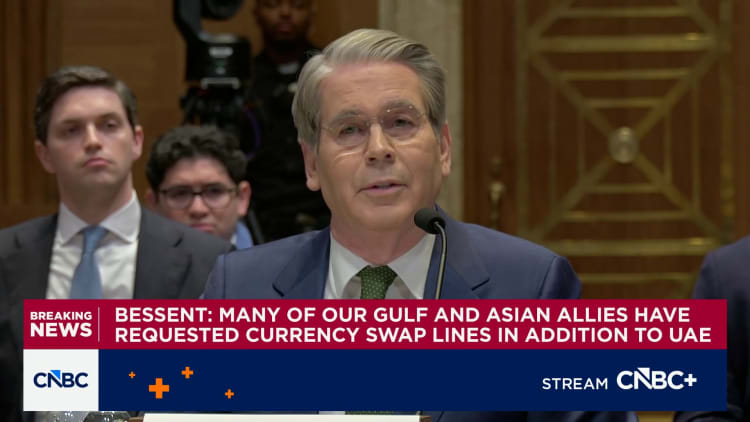
Secretary of Treasury Scott Bessent testifies during a during a Senate Appropriations Subcommittee on Financial Services and General Government hearing on the Treasury Department’s 2027 budget request in Washington, DC on April 22, 2026.
Nathan Posner | Anadolu | Getty Images
Treasury Secretary Scott Bessent on Friday defended the possibility of the U.S. participating in currency swaps with allies in the Persian Gulf and Asia who are seeking financial backstops due to the Iran war.
Discussions with those countries about U.S. dollar swap lines “are part of ongoing, routine conversations that @USTreasury has been having with our partners over a number of years,” Bessent said in an X post.
“They are a testament to the U.S. dollar’s primacy and the strength of America’s economic shield,” he said of the potential swaps.
The assertion of swap lines’ benefits and commonness comes as the Trump administration considers offering the financial lifeline to the United Arab Emirates, CNBC reported Tuesday.
It also comes two days after Bessent said that “many” allies in the Persian Gulf are seeking the same backstop as the ongoing war wreaks havoc on the oil-rich nations’ economies.

Swap lines involve two countries’ central banks agreeing to exchange equivalent amounts of each other’s currency, while agreeing to swap back those quantities at a specified future date. The U.S. maintains “standing U.S. dollar liquidity swap line arrangements” with the central banks of Canada, England, Japan and Switzerland, as well as the European Central Bank, to “enhance the provision of U.S. dollar liquidity,” according to the Federal Reserve.
The tool dates back to the 1960s and has been used to stabilize the Mexican economy in the 1980s, following the Sept. 11 terrorist attacks, during the 2008 financial crisis and at the beginning of the Covid-19 pandemic, according to a report by the Yale School of Management.
The maneuver is aimed at easing strains on global funding markets, giving breathing room to households and businesses of both participating countries.
Treasury can provide its own version of swaps using its Exchange Stabilization Fund, though traditional swaps are most often offered by the Federal Reserve.
The arrangements can pose political risks for President Donald Trump, whose approval ratings on the economy have sunk as war-induced supply shocks rapidly raise prices for gasoline and other products, exacerbating Americans’ existing inflation woes. The CNBC All-America Survey released Thursday found that 60% of respondents disapprove of how Trump is handling the economy.
A potential swap line runs the risk of being seen as an unnecessary bailout of a foreign country — especially if it’s a rich one like the UAE, which has one of the world’s highest per capita incomes.

Trump, asked on CNBC’s “Squawk Box” Tuesday about a possible UAE swap line, appeared to say he is in favor of it.
“If they had a problem … I would be there for them,” Trump said.
Bessent in Friday’s X post gave a full-throated defense of additional swap lines.
They “can benefit our nation by reinforcing dollar usage and liquidity internationally, maintaining smooth functioning in dollar funding markets, promoting trade and investment with the United States, and, in hypothetical stress scenarios, preventing disorderly sales of the U.S. assets as well as disruptions to U.S. markets, businesses, and households,” he argued.
“Many of these countries have pristine sovereign balance sheets and large dollar holdings – larger than many major economies with whom we maintain permanent swap facilities,” he wrote. Bessent didn’t name any countries in the post and he and Trump earlier this week only specified the UAE.
“I applaud our allies’ foresight and watchful risk management by exploring additional financial buffers during periods of market quiescence. Extending permanent swap lines can be a major first step in creating new U.S. dollar funding centers in the Gulf and Asia.”
Dollar dominance and reserve currency status are strengthened by constant long-term initiatives, including countering the growth of problematic, alternative payment systems,” he added. “Under @POTUS, this is American Economic Leadership at work.”
— CNBC’s Eamon Javers contributed to this report.
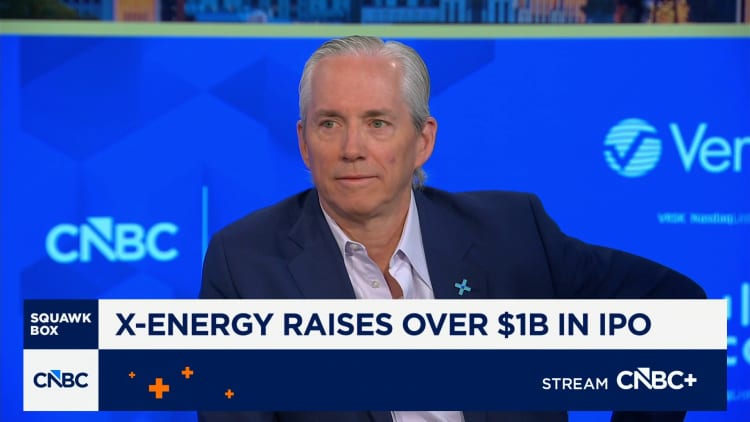

Advanced nuclear reactor company X-energy began trading Friday as the AI boom and electrification broadly spark a flurry of interest in the nuclear industry.
The stock opened at $30.11, after upsizing its initial offering, pricing at $23 per share — ahead of the initial range of $16 – $19 per share. The company raised more than $1 billion, making it the largest nuclear public offering on record. Shares last traded 26% higher.
The company’s xe-100 reactor is 80 megawatts, and can be bundled together with additional reactors to scale up to 960 megawatts. The xe-100’s model is a high-temperature gas-cooled reactor. In addition to generating electricity, its high temperatures mean it can be used in hard-to-decarbonize industrial applications such as chemical production.
All of the nuclear reactors currently in operation in the U.S. are light water reactors.
The company has yet to begin construction on any of its reactor facilities, but it already has an order pipeline of more than 11 gigawatts thanks to partnerships with companies including Amazon, Dow and Centrica.
Prior to going public, the company raised more than $1.4 billion – most recently a $700 million Series D fund in November – with backers including Amazon, Jane Street, ARK Invest, Citadel’s Ken Griffin and Ares Management funds. The company has also received funding from the U.S. Department of Energy.
X-energy is the first sizable advanced reactor company to pursue a traditional IPO route, after competitors Oklo and NuScale went public via SPAC transactions. X-energy previously pursued a listing via a SPAC merger, but ultimately abandoned that plan in 2023.
The company’s business model is also different from some of its competitors, since it does not plan to own and operate nuclear plants. Rather, it will license its technology. X-energy will also sell nuclear fuel that’s produced at its fabrication facility in Oak Ridge, Tennessee, where construction began in 2025.
X-Energy’s TRISO Facility.
Courtesy: X-Energy
In March 2025, X-energy and Dow submitted a construction permit application to the U.S. Nuclear Regulatory Commission for their proposed project in Seadrift, Texas. The review process is expected to take 18 months, and is part of a two-step process, which also includes applying for an operating license.
X-Energy is also working with Amazon to deploy 5 gigawatts across the U.S. by 2039. The first project will be a 320-megawatt facility with Washington utility Energy Northwest, the companies previously announced.



Tom Lee’s Bitmine Immersion Technologies has bought 10,000 ether (ETH) from the Ethereum Foundation (EF) through an over-the-counter (OTC) transaction. The trade settled at an average price of $2,387, the foundation has confirmed.
The deal moves roughly $23.9 million worth of ether from the foundation’s treasury. The buyer is one of Ether’s most vocal institutional accumulators. It has also revived familiar criticism of the foundation’s selling cadence.
Foundation sells again from its safe multisig
The 10,000 ETH was left in a foundation-controlled safe wallet through an OTC block trade, according to the EF’s announcement. Proceeds at the stated average price of $2,387 amount to approximately $23.87 million.
The foundation said the sale funds core operations, including protocol research, ecosystem grants, and community funding programs.
It pointed to a treasury policy published last June that formalized periodic ETH sales as part of ongoing treasury management.
BitMine Accumulates What the Foundation Divests
On the other side of the trade sits a very public ETH believer. Tom Lee is the co-founder of Fundstrat and the chair of BitMine Immersion Technologies (BMNR).
He has steered the firm toward an aggressive ETH treasury strategy since 2025. The firm has become one of the more visible corporate buyers of ether on public markets.
The contrast has drawn fresh pushback. Pseudonymous researcher 0xfoobar argued the foundation is signaling weakness in its own asset by refusing to pay staff in ETH.
“There’s an element of dogfooding you’re strongly missing here. If the EF employees and contractors hate/misunderstand crypto so much that they’re unwilling to take payment in ETH, they shouldn’t be working there. Period,” the user wrote.
The sale tests the foundation’s argument that periodic divestments are routine operational housekeeping. Bitmine is emerging as a repeat institutional buyer of ether.
The contrast between Ethereum’s stewards and its biggest believers is becoming harder for the community to ignore. The foundation has yet to respond to the latest dogfooding critique.
The post Tom Lee and BitMine’s Latest Ethereum Purchase Faces Community Backlash appeared first on BeInCrypto.
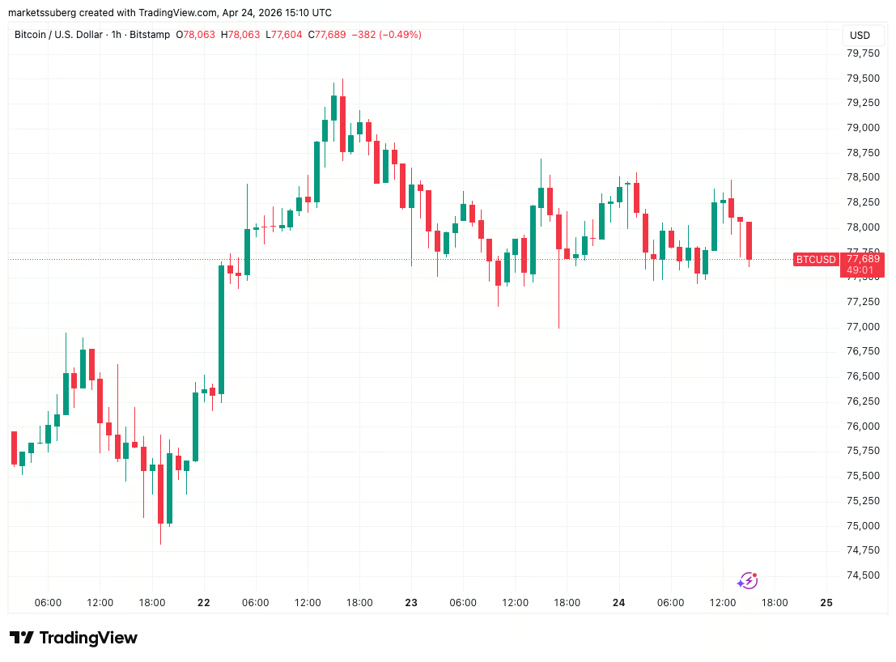
Bitcoin (BTC) stayed glued to $78,000 on Friday with markets “awaiting clarity” from the US-Iran war.
Key points:
- Bitcoin stalls in its bid to recapture $80,000, as US stocks tread water.
- Strong earnings are needed to sustain the equities push, says analysis.
- BTC price support is at risk of giving way next.
Bitcoin joins risk assets “chopping sideways”
Data from TradingView tracked flat BTC price action into the week’s last Wall Street trading session.
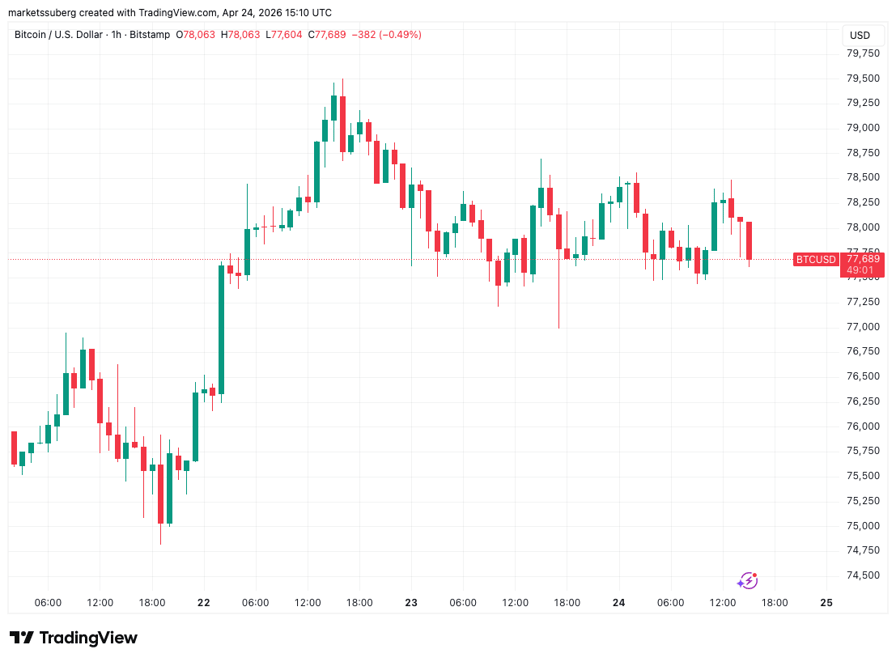
BTC/USD one-hour chart. Source: Cointelegraph/TradingView
Amid a lack of fresh geopolitical cues, risk-asset catalysts presented a mixed picture, leading to sideways movements for US stocks. WTI crude oil, after nearing a rematch with the $100 mark, cooled to $95.
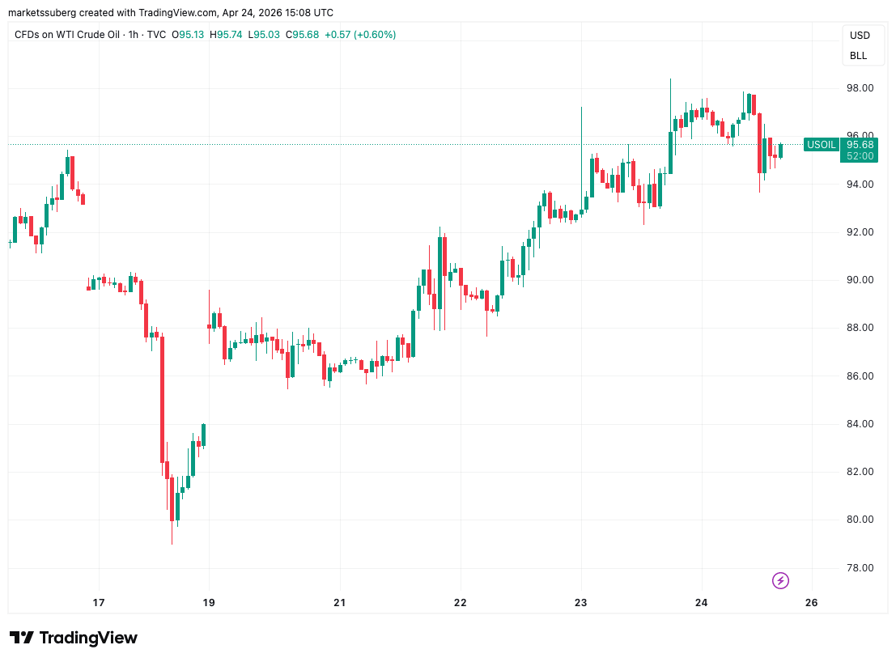
CFDs on WTI crude oil one-hour chart. Source: Cointelegraph/TradingView
“$BTC & Stocks started the week off strong as metals have sold off. But as $OIL has been starting to move again the past few days, risk assets have stalled and are now chopping sideways,” trader Daan Crypto Trades responded in a post on X.
“Market is eagerly awaiting clarity from the conflict in the middle east. The longer it drags on and oil keeps moving higher, the more pressure will be put on these.”
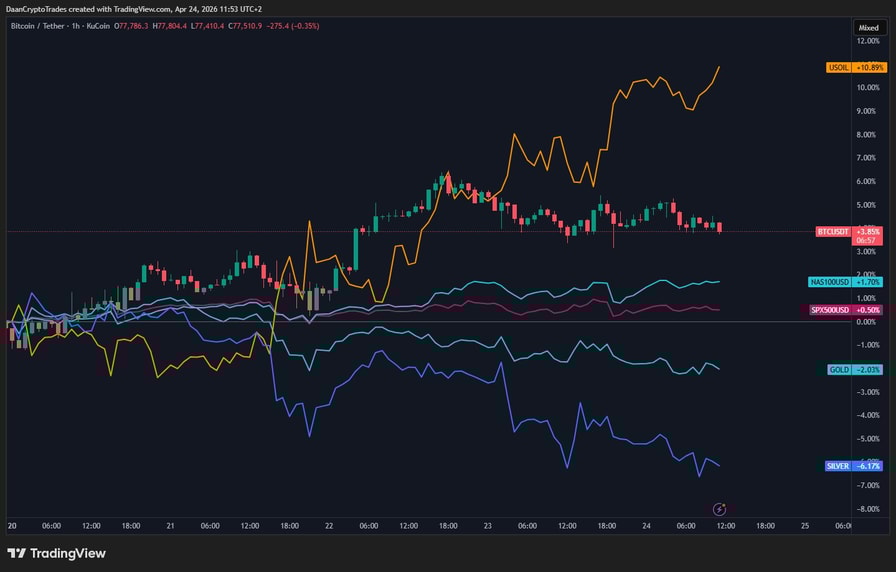
Macro asset price comparison. Source: Daan Crypto Trades/X
The day prior, trading resource Mosaic Asset Company said that positive earnings figures would be essential to sustain continued upside for stocks, with the S&P 500 already hitting new record highs.
“With the first quarter reporting season about to pick up, it will be crucial to monitor forward earnings estimates for any changes in trend since the start of the year,” it wrote in its latest analysis.
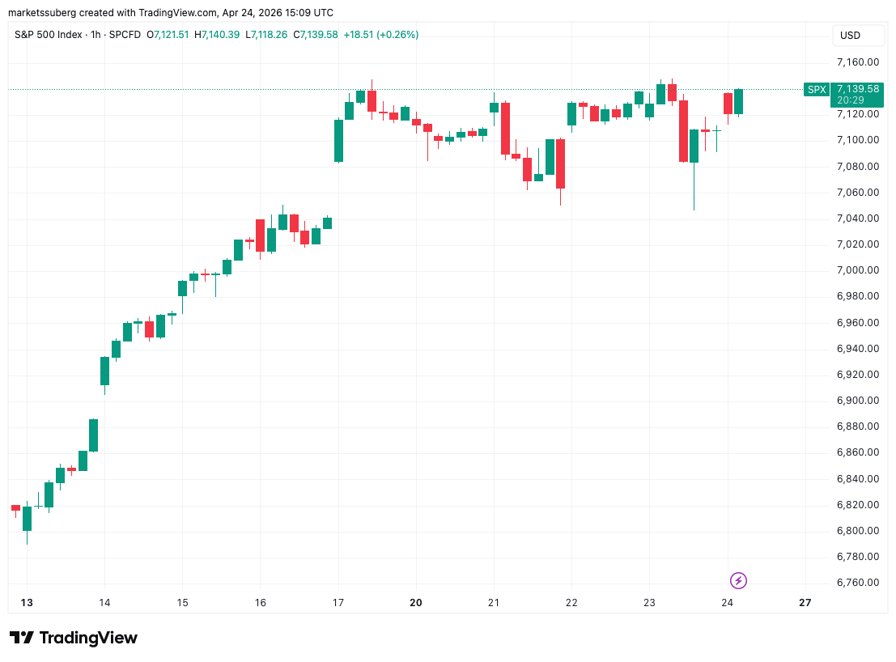
S&P 500 one-hour chart. Source: Cointelegraph/TradingView
Analyst “surprised” that BTC price support holding
Focusing on BTC/USD, trading resource Material Indicators hinted at early signs of a deeper retracement next.
Related: Bitcoin price set for best gains since Q4 2024 with $77.5K monthly close
“Bid liquidity at $76.5k already rugged, as predicted yesterday, and LTF order flow is trending down,” it wrote on X, referring to data from one of its proprietary trading tools.
Material Indicators added that it was “surprised” that bid liquidity below spot price had not been pulled.
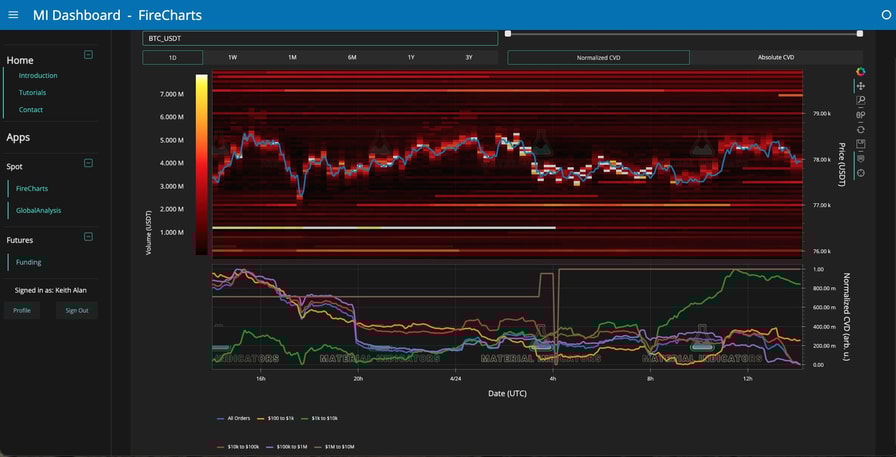
BTC/USDT order-book liquidity data with whale orders. Source: Material Indicators/X
Trading account JDK Analysis referenced a “news-driven pump” as further evidence that the low-time frame rally was overextended.
“The profile shows $BTC at the upper value extreme of the past two days,” an X thread read, analyzing exchange order-book data.
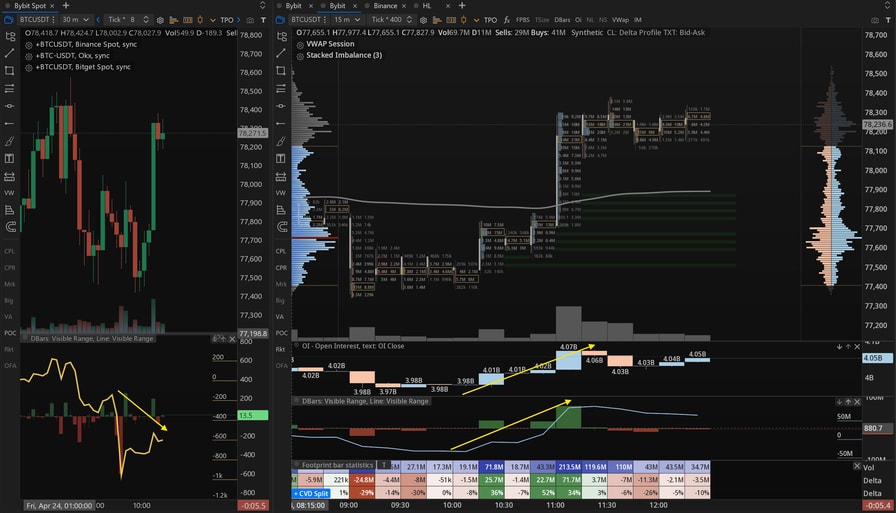
BTC/USDT order-book data (Bybit). Source: JDK Analysis/X

The European Central Bank has taken a concrete step to reduce the technical barriers surrounding a potential digital euro by signing agreements with three European standards bodies to reuse existing open payment standards for euro-area transactions. The move is intended to ease integration for banks, merchants and payment service providers as the bloc contemplates a broad roll-out of central bank digital money.
According to the ECB, the deals with the European Card Payment Cooperation, Nexo standards and the Berlin Group will enable the reuse of established open standards for several core capabilities. These include contactless tap-to-pay payments, merchant-to-payment-provider interfaces and alias-based payments—such as transactions initiated with a phone number rather than a bank account. The intention is to leverage widely adopted, interoperable specifications rather than rely on bespoke, bank- or vendor-specific solutions.
The ECB underscored that using open standards would help minimize adoption costs and support a uniform digital euro user experience across the euro area. However, it stressed that the agreements are a cost-mitigation step rather than a guarantee of a low-cost rollout, noting that broader implementation costs remain a central policy and practical consideration for banks and payment players.
In parallel with the standards push, Reuters reported an ECB analysis estimating that the digital euro could cost EU banks between €4 billion and €6 billion over four years. The ECB has previously signaled that the total cost of implementation is a complex mix of technical upgrades, staffing, compliance processes and ongoing operational considerations. The new agreements address only one leg of that broader cost equation—the choice and harmonization of technical interfaces.
The actions signal the ECB’s intent to reduce one of the primary technical hurdles to mass adoption: achieving interoperable, open-standards-based infrastructure across a fragmented payments landscape that is currently dominated by proprietary protocols and card schemes. By aligning standards now, the central bank aims to smooth the path for banks, merchants and PSPs should a digital euro be launched in the future.
The standards collaboration is part of a broader effort to prepare Europe’s payments infrastructure for the digital euro’s potential deployment. The ECB has indicated that a universal open standard ecosystem remains lacking in Europe, with much of the current ecosystem still tied to proprietary technologies owned by international card schemes and global digital wallet operators. The ECB’s initiative seeks to establish a common technical layer ahead of any pilot or launch, reducing the risk of later fragmentation.
Key takeaways
- The ECB has formalized cooperation with three European standards bodies to reuse open payment standards for the digital euro, targeting key capabilities like contactless payments, merchant-to-provider connectivity and alias-based transactions.
- The move is framed as a cost-mitigation measure intended to lower integration costs for banks, merchants and PSPs, though it does not guarantee low overall implementation costs.
- Regulatory and cost considerations remain central, with ongoing assessments of the total financial burden on EU banks and the broader compliance ecosystem required for any potential issuance.
- A digital euro pilot is planned, with a 12-month duration starting in the second half of 2027, involving a limited set of payment service providers and merchants, under Eurosystem oversight.
- Technical standards are expected to be announced by summer, reflecting the ECB’s emphasis on early coordination among market participants and standardization bodies to support a coherent rollout if pursued.
Operational scope and regulatory context: harmonizing the digital euro toolkit
The agreements with the European Card Payment Cooperation, Nexo standards and the Berlin Group focus on reusing familiar, cross-market specifications to govern essential digital euro functions. In practice, this means enabling a smoother experience for end users—whether they pay at a merchant, tap a card or mobile device, or initiate a payment from alias-based identifiers like phone numbers—without forcing banks to rebuild disparate systems from scratch. For policymakers, the emphasis on interoperable standards aligns with regulatory objectives to maintain financial stability, support cross-border payments and ensure robust AML/KYC controls as new forms of central bank money enter the ecosystem.
Despite the optimism around open standards, the ECB’s stance remains cautious. While harmonization can reduce upfront capital expenditure and ongoing integration challenges, the total cost of a potential digital euro program extends well beyond interfaces. Banks would still need to update core processing systems, risk controls, fraud prevention measures, settlement capabilities, data protection protocols and compliance workflows to accommodate a central bank digital currency at scale. The interplay between technical interoperability and regulatory compliance—especially around privacy, data residency and cross-border flows—will shape the ultimate feasibility and timeline of any market rollout.
Regulatory and cost implications for banks and payment ecosystems
From a regulatory perspective, the push to standardize interfaces interacts with broader EU policy frameworks governing payments, digital finance and market infrastructure. The digital euro’s design and governance sit at the intersection of Eurosystem oversight and EU financial services law, with potential implications for licensing, supervision and cross-border settlement arrangements. While MiCA covers crypto assets and related activities, the digital euro itself remains national sovereign money, and its deployment would be subject to the Eurosystem’s governance. Nonetheless, the surrounding regulatory architecture will influence how payment institutions plan, procure and operate if a digital euro moves from concept to a defined program.
The cost dimension remains a central point of attention for banks and PSPs. Reuters’ reporting of an €4–6 billion potential hitting banks over four years illustrates the scale of investment anticipated in systems, processes and talent. Even with a shared standards approach, institutions will face ongoing costs associated with regulatory compliance, operational resilience, cybersecurity, third-party risk management and customer due diligence. The ECB has repeatedly described the expected pilot as a learning phase to validate interoperability, security and user experience, rather than a foregone conclusion of a wholesale market launch.
For lenders and payment firms, the cost and regulatory calculus will influence decisions about timing, participation and the depth of integration with existing networks. Institutions will need to weigh the benefits of a more seamless, open-standard digital euro against the resource commitments required to modernize infrastructure, ensure compatibility with existing payment rails and maintain strict compliance controls. The EU’s ongoing emphasis on openness, transparency and supervision will shape not only technology choices but also licensing and operating models as banks navigate cross-border operations and potential future harmonization efforts across member states.
Pilot planning, governance and timeline: preparing for a measured test of the architecture
Beyond standardization, the ECB is actively laying the groundwork for a controlled digital euro pilot. The central bank has begun recruiting payment service providers to participate in a 12-month trial slated to start in the second half of 2027. The pilot will involve a limited cohort of PSPs, a restricted set of merchants and Eurosystem staff, with PSPs playing a central role in digital euro distribution. The goal is to test the operational viability of the chosen technical framework, assess the readiness of payment rails and ensure that risk, fraud prevention and privacy controls are robust before any broader deployment.
ECB officials have signaled that the technical standards that will govern the pilot are expected to be announced by the summer. This timeline underscores a deliberate approach: coordinate with standards bodies early, align market participants’ capabilities, and create a governance environment in which lessons from the pilot can inform any potential scaling. The effort is not only about technology but also about regulatory alignment, governance, data stewardship and the creation of clear lines of accountability for participating institutions.
For observers and participants, the pilot represents a critical inflection point. It provides a structured setting to evaluate interoperability across payment terminals, digital wallets, and merchant interfaces while exploring how alias-based and contactless flows perform under real-world conditions. From a compliance perspective, the pilot will offer a laboratory to refine AML/KYC controls, data protection measures and cross-border settlement arrangements within a controlled Eurosystem framework.
Closing perspective
As Europe advances its preparations for a potential digital euro, the emphasis on reusable open standards marks a meaningful shift toward interoperability-driven implementation. While the cost picture remains uncertain and contingent on the scale of adoption and regulatory requirements, the current path aims to reduce one of the clearest technical barriers to a future rollout. The coming months will be pivotal as the ECB outlines key technical standards, confirms pilot participation, and clarifies how these standards will translate into a coherent, supervised payments ecosystem across the euro area.

Familiar players ramp up Bitcoin and Ether bets as markets hint at a rebound, while institutions test blockchain rails and US lawmakers stall on crypto rules this week.

Key Highlights
-
Treasury bill introduces comprehensive framework for digital asset oversight
-
Mandatory declaration requirements for cryptocurrency holders above threshold
-
Border enforcement powers expanded to include digital asset searches
-
Penalties reach one million rand and five-year imprisonment for violations
-
Capital flow framework extended to encompass cryptocurrency transactions
The National Treasury of South Africa has released draft legislation designed to bring cryptocurrency under comprehensive regulatory oversight. The proposed bill establishes mandatory reporting requirements and introduces enhanced enforcement mechanisms for digital assets. This legislative move represents a fundamental transformation in the country’s approach to cryptocurrency governance and financial monitoring.
Treasury Bill Integrates Digital Assets Into Capital Controls
The National Treasury has unveiled draft regulations that position cryptocurrency within South Africa’s existing capital flow management system. Under these proposed rules, individuals holding digital assets exceeding specified limits must formally declare their holdings to authorities. The framework also requires specific transactions to be processed through approved intermediaries or obtain regulatory clearance beforehand.
According to the draft provisions, asset holders will have a 30-day period to comply with declaration obligations once the threshold is met. The legislation further stipulates that digital assets purchased for designated purposes must be liquidated if those objectives are not fulfilled. This mechanism creates a direct connection between cryptocurrency ownership and stated financial objectives.
The legislative initiative seeks to modernize regulations by replacing the Exchange Control Regulations established in 1961. This proposal demonstrates increasing governmental focus on capital mobility and financial transparency. Furthermore, the framework integrates digital currencies into established financial disclosure protocols.
Enhanced Border Security and Compliance Mechanisms
The proposed legislation significantly expands crypto regulation enforcement capabilities at border crossings and throughout the financial infrastructure. Customs officials would receive authorization to conduct searches for undeclared cryptocurrency holdings when individuals cross international boundaries. Travelers may be required to provide access information related to their digital asset portfolios.
The bill criminalizes unauthorized international transfers of cryptocurrency under the broadened regulatory framework. It establishes mandatory disclosure requirements for digital assets when entering or exiting South African territory. These provisions enable authorities to maintain closer surveillance over both incoming and outgoing asset movements.
Non-compliance with the regulatory framework carries substantial consequences, including monetary penalties reaching one million rand and potential incarceration for up to five years. These sanctions specifically address violations and unauthorized asset transfers. Consequently, enforcement mechanisms constitute a fundamental component of this policy transformation.
Regulatory Evolution and Strategic Considerations
South Africa has previously established legal recognition for digital assets within its financial regulations, forming the foundation for current policy developments. The Financial Sector Conduct Authority designated cryptocurrency as a financial product in 2022. The newly proposed legislation expands regulatory reach from service providers to individual asset holders themselves.
This initiative emerges amid increasing cryptocurrency adoption throughout the African continent and growing concerns regarding financial system stability. It also addresses potential risks associated with stablecoins and capital flight scenarios. The Treasury aims to strengthen regulatory frameworks to preserve monetary policy effectiveness.
The public consultation process continues, though submission deadlines appear inconsistent across official documents. Stakeholder input during this comment period will shape the final regulatory structure. Ultimately, the finalized provisions will determine the extent to which authorities incorporate digital assets into national financial supervision frameworks.
Marked-up Mac minis flood eBay amid shortages driven by AI

Filey bar plan for outdoor drinking at Banks Lounge rejected

Tesla and BYD Dominate Early Race

Manchester United reach agreement with Casemiro over contract clause amid transfer speculation

US brings back mandatory military draft registration

Steven Gerrard disagrees with Gary Neville over ‘shock’ Chelsea and Arsenal claim | Football


-

 Business5 days ago
Powerball Result April 18, 2026: No Jackpot Winner in Powerball Draw: $75 Million Rolls Over
-

 Politics7 days ago
Palestine barred from entering Canada for FIFA Congress
-
Entertainment5 days ago
NBA Analyst Charles Barkley Chimes in on Ice Spice McDonald’s Fiasco
-

 Tech6 days ago
Auto Enthusiast Scores Running Tesla Model 3 for Two Grand and Turns It Into Bare-Bones Go-Kart
-

 Politics5 days ago
Zack Polanski demands ‘council homes not luxury flats for foreign investors’
-

 Crypto World7 days ago
Russia Pushes Bill to Criminalize Unregistered Crypto Services
-

 Politics4 days ago
Gary Stevenson delivers timely reminder to register to vote as deadline TODAY
-

 Politics2 days ago
Making troops accountable for war crimes threatens US alliance, ex-SAS colonel warns
-

 Business2 days ago
Rolls-Royce Voted UK’s Most Iconic Trade Mark as IPO Register Hits 150
-

 Politics2 days ago
Disabled people challenge government SEND proposals over segregation concerns
-

 Crypto World7 days ago
Russia Introduces Bill To Criminalize Unregistered Crypto Services
-

 Politics2 days ago
Zack Polanski responds to home secretary’s taser threat
-

 Politics2 days ago
Starmer handler McSweeney to be dragged from shadows by Foreign Affairs Committee
-
Politics2 days ago
Wings Over Scotland | How To Get Away With Crimes
-
Crypto World6 days ago
Kelp DAO rsETH Bridge Hack Drains $292M as DeFi Losses Top $600M in Two Weeks
-

 Politics2 days ago
‘Iran is still a nuclear threat’
-

 News Videos7 days ago
AP Politics, Buggana Analyzes Reasons For Financial Instability Due To Amaravati
-

 Crypto World3 days ago
New York sues Coinbase, Gemini over prediction market offerings
-

 Business2 days ago
The Job Benefits Most Men Don’t Know to Negotiate
-

 Crypto World9 hours ago
Michael Saylor says BTC winter is over. Market analyst disagrees, says bitcoin was in a pullback
You must be logged in to post a comment Login