
Crypto World
CertiK Says H1 2026 Web3 Losses Topped $1.31B, Up 28% Excluding Bybit Baseline



Web3 security incidents cost the industry more than $1.31 billion across 344 events in the first half of 2026, according to CertiK's Hack3D H1 2026 Report, published Monday. Net losses stood near $1.2 billion after frozen and recovered funds, the blockchain security firm said. Headline totals show… Read the full story at The Defiant

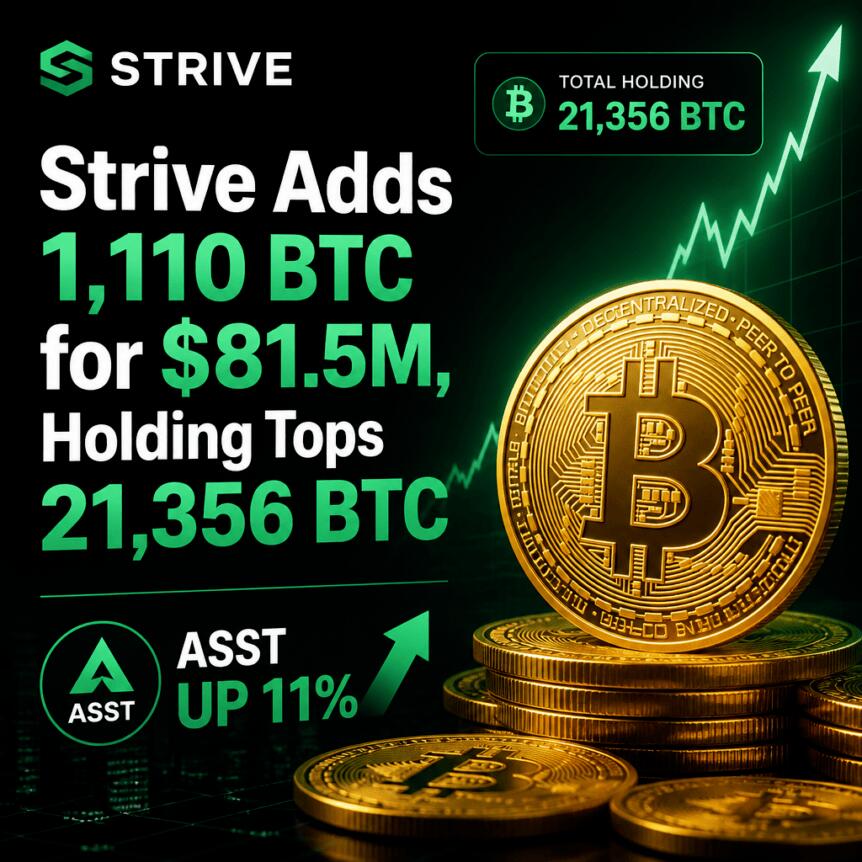
Strive, the Nasdaq-listed firm known for a corporate Bitcoin treasury program, bought 1,110 Bitcoin for roughly $81.5 million in the week of Aug. 17–Aug. 21, according to a filing with the US Securities and Exchange Commission. The purchases brought its total holdings to 21,356 BTC.
In the same filing, Strive said it paid an average of $73,409 per Bitcoin (including fees and expenses) for the tranche acquired during that period. Cash and cash equivalents increased by $17.1 million to $171.9 million, while its Class A shares outstanding rose by 3.65 million to 79.89 million.
Key takeaways
- Strive added 1,110 BTC between Aug. 17 and Aug. 21, lifting total holdings to 21,356 BTC.
- The company’s average purchase price was $73,409 per BTC (with fees/expenses), versus Bitcoin trading near the $79,000 level on Monday.
- Strive’s latest buying strengthens its position among public corporate Bitcoin holders, moving it into the top tier tracked by BitcoinTreasuries.NET.
- Strive also reported improvements in liquidity (cash up $17.1 million) alongside share growth during the same reporting window.
- Separately, Strive’s SATA preferred shares returned to the company’s $99–$101 target range after trading near $83.30 in late June.
Another tranche adds to Strive’s corporate Bitcoin stack
The latest treasury update underscores how Strive continues to pursue a steady acquisition cadence. The SEC filing details that Strive paid $73,409 per BTC on average for the 1,110 coins purchased between Aug. 17 and Aug. 21.
That average cost was below the approximate $79,000 Bitcoin price level referenced on Monday in the company’s disclosure context, meaning the new buys were made at a discount to the market price at the start of the week. While the filing does not frame the transactions as a hedging strategy, investors generally focus on the relationship between treasury purchase prices and the prevailing spot market as a signal of how aggressively a company is adding during different market regimes.
BitcoinTreasuries.NET ranks Strive among the largest publicly traded corporate holders. Based on that site’s data, Strive moved to the seventh-largest position behind Bullish and ahead of SpaceX.
Why investors track Strive alongside its asset management business
Strive’s corporate treasury is only one part of its broader footprint. The company operates a Bitcoin-focused treasury strategy alongside an asset management business that, according to its own overview page, manages nearly $3 billion across exchange-traded funds and a direct-indexing platform.
The combination matters because it ties the company’s market positioning to both Bitcoin holdings and recurring business activity in capital markets products. For public-market investors, that dual exposure can influence how the equity trades: sentiment about corporate Bitcoin accumulation can amplify interest, while performance expectations for the asset management segment can affect overall valuation.
In addition to Bitcoin, Strive reported holding 505,000 shares of Strategy’s STRC preferred stock valued at $48.6 million as of Aug. 21, reflecting the cross-ecosystem nature of corporate Bitcoin finance. The disclosure also offers a reminder that corporate Bitcoin holders often maintain diversified positions across preferred structures, not just spot-equivalent BTC exposure.
SATA preferred shares return to the $100 target band
Beyond Bitcoin purchases, Strive’s filing and market commentary also draw attention to SATA, the company’s variable-rate perpetual preferred stock. SATA closed at $100.01 on Friday, returning to management’s targeted $99-to-$101 trading range after having fallen as low as $83.30 in late June.
Strive previously narrowed the trading range from $95–$105 to $99–$101 in March. The company also stated that it would not issue SATA through at-the-market or follow-on offerings below $100, a term designed to limit dilution at lower price levels and to support the intended trading band.
The instrument launched in November 2025, initially selling 2 million shares at $80 each for $160 million in gross proceeds. SATA’s structure includes a stated amount and an initial liquidation preference of $100 per share.
Operationally, Strive positions SATA as an income-oriented product, with a variable dividend rate intended to help keep the shares near $100. In April, the firm raised the annualized dividend rate to 13% and began switching from monthly to daily dividend payments starting June 16, per Strive’s SEC filings.
On Monday, SATA performance suggested renewed stability after a period of weakness. That pattern is important for investors who treat preferred shares differently from common stock: preferreds typically attract buyers seeking income characteristics, but their market price still depends on interest-rate mechanics, dividend expectations, and confidence that the issuer will maintain the design guardrails.
Cross-comparison with Strategy’s STRC and its BTC pause
Because SATA is similar to STRC, the variable-rate perpetual preferred stock issued by Strategy, many traders compare their pricing and dividend behavior. Strategy’s STRC was trading near $97 on Monday, below Strategy’s $100 target, while Strategy reported no Bitcoin purchases for the week ended Aug. 23, according to earlier coverage.
That contrast highlights a potential asymmetry in corporate accumulation behavior: Strive continued buying into the Aug. 17–Aug. 21 window, while Strategy’s most recently reported week showed no purchases. Even without making assumptions about future timing, investors typically watch for whether pause periods broaden or remain temporary—especially because accumulation schedules can affect how markets price treasury companies’ future cash flows, dividend capacity, and balance-sheet momentum.
Strive’s SATA returning toward its target band adds another layer to those comparisons. When preferred instruments track toward their $100 reference points, it may reinforce confidence in the issuer’s dividend-setting framework, even as the underlying Bitcoin market fluctuates.
Looking ahead, investors should monitor two things closely: whether Strive’s BTC purchasing pace continues across the next reporting windows, and whether SATA sustains its return to the $99–$101 band as dividend mechanics respond to broader market conditions. The next few filings should also clarify if corporate accumulation and preferred-share stabilization remain aligned—or diverge.


BNB Smart Chain (BSC) activated its Pasteur hard fork on Tuesday, closing bridge verification and validator authorization gaps while introducing a new route intended to fit more transactions into each block.
In a Tuesday post, BNB Chain confirmed that Pasteur was live on the BSC mainnet. The team said the upgrade strengthens the network’s bridge, staking and governance security while giving blocks more capacity without changing its 450-millisecond block time.
The upgrade combines three BNB Evolution Proposals. BEP-682 rejects duplicate validator entries during cross-chain light-block verification, while BEP-695 tightens controls involving validator key rotation, slashing and governance voting. Furthermore, BEP-675 changes how specialist builders submit blocks to validators.
The upgrade prevents validators from being counted more than once in bridge approvals, removes authority from old validator keys and blocks restricted addresses from voting, while aiming to fit more transactions into blocks during busy periods.
Pasteur targets fuller blocks
Under BSC’s previous block-building route, a builder executed transactions before submitting a proposed block, and the validator executed them again before signing it. BNB Chain said the repeated work took time away from builders operating within the network’s 450-millisecond block window, sometimes leaving blocks underfilled.
BEP-675 allows builders to submit blocks they have already executed. Validators check the proposed block against consensus rules, sign and broadcast it, then complete full execution verification afterward. Builders can also continue using the previous route, under which validators execute transactions before signing.
Related: BNB Chain pursues legal action after ex-employee’s memecoin launch
In tests conducted on QANet, an internal environment designed to mirror BSC’s geographically distributed validators, the new route increased throughput by about 88%, from 1,237 to 2,324 transactions per second. Average gas used per block rose from 46.35 million to 84.15 million while the block interval and 100-million gas limit remained unchanged.
BNB Chain cautioned that the figures came from a controlled test workload and were not mainnet measurements.
Pasteur follows previous upgrades centered on reducing block times. BSC’s Maxwell hard fork reduced its average block time from 1.5 seconds to about 0.8 seconds in June 2025, while BNB Chain said the subsequent Fermi upgrade brought it down to 450 milliseconds.
Magazine: MiCA cracks down on USDT in Europe… but no one else cares


Blockchain Association asked five U.S. agencies to clarify that customer identification requirements under the GENIUS Act apply to direct issuer relationships, not independent peer-to-peer stablecoin transactions.
Summary
- Blockchain Association supports primary-market identity checks but opposes extending them to peer-to-peer stablecoin transfers downstream.
- Five federal agencies proposed joint identification standards for permitted payment stablecoin issuers in June 2026.
- Issuers would collect names, addresses, birth or formation dates and identification numbers from customers directly.
- Final rules would take effect twelve months after issuance under agencies’ proposed compliance timeline currently.
- GENIUS Act generally begins restricting unlicensed U.S. payment stablecoin issuance on January 18, 2027, nationwide.
The industry group filed its comments by the Aug. 21 deadline and summarized its position on Aug. 24. It supported the proposal’s main approach but requested clearer definitions, less duplicated compliance work and explicit flexibility for digital identity tools.
FinCEN, the Office of the Comptroller of the Currency, Federal Reserve, Federal Deposit Insurance Corporation and National Credit Union Administration jointly proposed the customer identification program in June.
Stablecoin identity checks focus on direct customers
The proposed rule would require a permitted payment stablecoin issuer to establish a written, risk-based customer identification program. The program would form part of the issuer’s wider anti-money laundering and counterterrorist financing controls.
An issuer would generally collect a customer’s name, address, date of birth or formation and identification number before opening an account. It would then use documentary or non-documentary methods to form a reasonable belief that it knows the customer’s identity.
Records containing the identification information would generally remain on file for five years after the account closes. Verification records would remain available for five years after their creation.
As previously reported, U.S. regulators proposed bank-style identification requirements for stablecoin issuers. The proposal follows the GENIUS Act’s decision to treat permitted issuers as financial institutions under the Bank Secrecy Act.
Blockchain Association wants a firm P2P boundary
Blockchain Association agreed that the program should apply when an issuer maintains a direct customer relationship. Examples include issuing, redeeming, converting, repurchasing or providing custody for a payment stablecoin.
The organization said the rule should not reach transactions between users when the issuer does not intermediate, facilitate or approve them.
“They should not extend to downstream, peer-to-peer stablecoin transactions,” the Association argued, although agencies have not finalized that boundary.
The agencies’ proposal largely follows that position. It says simply owning or controlling an issuer’s stablecoin does not establish an account. A transfer involving an issuer only through its smart contract would also generally fall outside the proposed definition.
The proposal calls these interactions secondary-market activity. Examples include transfers from self-hosted wallets, purchases from intermediaries, exchange trades and direct payments to vendors.
The agencies estimated that approximately 99% of stablecoin transaction activity occurs in secondary markets. They acknowledged that issuers have limited ability to obtain identities for people using tokens without interacting with them directly.
Digital identity and duplicate checks remain contested
Blockchain Association also asked regulators to preserve flexibility in how issuers collect and verify information. It specifically supported digital identity tools and interoperable verification technology.
The proposal already permits documentary and non-documentary verification. It asks whether the final text should explicitly address digital identities or verifiable credentials and seeks feedback about their benefits and risks.
The group also requested protection against duplicative compliance obligations. Stablecoin issuers frequently interact with banks, exchanges and other regulated institutions that already conduct customer checks.
Under the proposed rule, an issuer could rely on certain work performed by another federally regulated financial institution. That reliance must be reasonable, governed by a contract and supported by annual certification. The issuer would remain responsible for compliance.
Blockchain Association wants the final rule to clarify how this arrangement works across affiliates, intermediaries and state-regulated entities.
Agencies must now complete the GENIUS Act rules
The public comment period closed Aug. 21. Regulators will now review submissions and may modify the definitions of “account,” “customer” and “digital asset service provider” before issuing a final rule.
The proposal gives issuers 12 months after the final rule’s publication to comply. No final publication date has been announced.
The wider GENIUS Act framework is expected to begin restricting unlicensed payment stablecoin issuance in the U.S. on Jan. 18, 2027. In related coverage, regulators missed the law’s original rulemaking deadline, shortening the preparation period available before the licensing framework begins.
The final customer identification rule must still operate alongside separate proposals covering licensing, reserves, anti-money laundering programs, sanctions compliance and lawful orders. The treatment of direct redemptions, digital credentials and reliance on third parties will determine how much additional work issuers face.
Ethereum saw one of its biggest weekly moves in years after staging an impressive 30% rally. The altcoin crossed $2,500 briefly, then slipped back slightly below that level.
New data shared by crypto analyst Ali Martinez suggests that ETH could be on a path toward $5,000 if it clears a major resistance zone.
Growing Buying Pressure
On August 19, Ethereum’s MVRV Ratio formed a golden cross above its 160-day moving average. Martinez also pointed to stronger whale accumulation. The number of addresses holding more than 10,000 ETH has increased by 1.74%. In fact, 17 new whale addresses joined the network over the past week.
At the same time, the token supply is moving off exchanges. More than 180,764 ETH, which is worth about $440 million, has been withdrawn over the past week. Martinez said the trend supports the case for increasing buying pressure.
However, it still faces a major resistance zone between $2,722 and $2,970. URPD data shows that 16.70 million were previously acquired within this range, which makes it a major supply wall. If Ethereum breaks through the zone, the next major MVRV Pricing Band is near $5,363, at the 2.4 level. The analysts also noted that a rejection could first send the altcoin back toward the Realized Price near $2,235 before a potential move toward the 2.4 MVRV band.
Besides, Ethereum has once again reached its 200-week moving average, which happens to be the 11th such instance over the past five years, ‘The Long Investor’ found, who pointed to a repeated pattern in the crypto asset’s price history. Each time it has moved below the 200 WMA, it has later returned to the moving average.
The analyst therefore called any percentage below the level “free money” and said investors cannot lose.
Additionally, ETH’s 50-week and 200-week moving averages are now at the same level. This creates a confluence zone. If the asset turns that level into support, the analyst expects bulls to take it back to its all-time highs. ETH remains a buy.
ETFs Draw Fresh Capital
US spot Ethereum ETFs have attracted their biggest inflows since October 2025, as demand picked up sharply during the mid-week. Net inflows stood at $30.85 million on Monday and $71.47 million on Tuesday. The pace increased after Wednesday’s announcement from the US Treasury Department. The department said it would double the maximum size of liquidity-support buybacks for longer-dated government debt, lifting them from $2 billion to at least $4 billion per operation. Wednesday recorded a capital influx of $189.15 million.
The figure rose again to $220.77 million on Thursday, while Friday recorded another strong $185 million in net inflows.
The post $5,000 Ethereum? Analyst Identifies the Levels That Could Decide ETH’s Next Move appeared first on CryptoPotato.
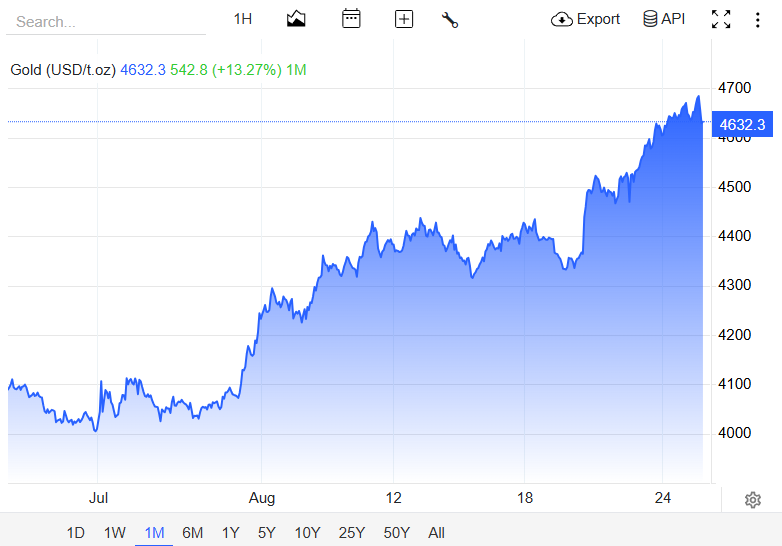
Bitcoin (BTC) climbed as high as $81,165 on Tuesday before easing to $80,792, up 4.5% in 24 hours, as gold pushed to its highest price in more than three months. Both assets are climbing on the same forces.
A weakening US dollar and falling bond yields are pulling money into both gold and Bitcoin at the same time. Investors are also watching for signals on where interest rates head next.
Gold Extends Its Rally Toward a 27-Year High
Spot gold gained 0.6% to $4,677.19 per ounce on Tuesday, its best level since mid-May, with the metal up around 13% so far this month. Gold futures also touched a three-month high near $4,720.

UOB analysts pegged the move as gold’s best monthly performance since 1999, based on data cited in the report. The last comparable monthly surge came in September 1999, when a group of European central banks agreed to cap their gold sales, ending a prolonged slide in prices.
This month’s rally has a different driver, with investors reacting to a weaker dollar and renewed concern over Fed independence rather than a central bank supply shock.
The Dollar and Yields Are Doing the Heavy Lifting
The US Dollar Index has fallen 0.8% this month, making dollar-priced gold cheaper for foreign buyers. Treasury yields have stayed elevated through most of August, but the government’s bond buyback plan has kept them roughly 3 basis points lower for the month, easing the opportunity cost of holding non-yielding bullion.
Bitcoin has moved in a similar direction. The asset briefly lost the $80,000 level last week as critics questioned the same Treasury buyback plan, before reclaiming it and pushing higher. A Strive executive recently pointed to Bitcoin’s breakout against gold as evidence the asset’s bear market has ended.

All eyes are now on Federal Reserve Chair Kevin Warsh, who speaks ahead of this week’s Jackson Hole symposium, an annual central bank gathering where officials often signal future policy direction.
A hawkish tone could stall both rallies. Citi analysts said a dovish surprise would instead push markets to refocus on the “debasement trade,” reflecting renewed concerns over Fed independence and US debt sustainability.
Bitcoin’s reaction to this week’s Fed signals remains an open question, given the asset’s history of diverging from traditional safe havens even when the macro setup looks aligned. Both markets are now pricing similar risks.
A softer dollar and capped yields have driven the rally so far, and the Fed’s next move could decide whether it extends or stalls.
The post Bitcoin Tops $81,000 as Gold Notches Its Best Month Since 1999 appeared first on BeInCrypto.


Bitcoin (BTC) just posted its strongest three-day rally since 2023, and two prominent investors now say the move reflects capital finally leaving an overheated artificial intelligence (AI) trade.
There has been much speculation about the role AI investing has played in Bitcoin’s own market. Now, with this rally, and concerns over an AI bubble, many are noting thw way the capital is rotating.
Big Names Now Confirm the Shift
Analysts have flagged this possible shift for months without confirming it was happening. Research firm K33 warned in June that Bitcoin was losing ground as institutions chased AI returns instead.
Investor Steve Eisman went further in July, saying he had sold his Google position to cut AI exposure, warning the entire market had become one crowded trade. Then, in late July, veteran macro investor Jordi Visser argued that AI’s easy-money phase was ending and that Bitcoin stood to benefit next.
Bill Miller IV, chairman and chief investment officer at Miller Value Partners, is now making the same case with fresh conviction. His comments this week, paired with Visser’s, mark two of the clearest signals yet from named, established investors that the rotation out of AI and into Bitcoin is actively underway, not just theorized.
He pointed to two forces behind the reversal. Growing doubt about AI capital expenditure returns is pushing “longdated thinkers” back toward crypto, he said.
At the same time, governments have intervened twice in quick succession. Japan and the US supported the yen in late July, and the US Treasury Department said last week it would double its long-dated bond buybacks, a move that eased pressure on yields and coincided with one of the largest short-liquidation waves crypto markets have seen.
A Rotation Play and a Hedge at Once
Miller argued Bitcoin is not just absorbing AI’s spillover capital. He framed it as a structural hedge against government debt, noting that this year’s $1.8 trillion US budget deficit alone exceeds Bitcoin’s entire market capitalization, a comparison meant to illustrate how much new currency is being created against Bitcoin’s fixed supply.
Miller said, arguing investors keep returning to harder, more transparent forms of money across market cycles.
That dual framing, tactical rotation target and long-term hedge, echoes recent reactions to the Treasury’s buyback plan from other prominent voices.
Robert Kiyosaki called the move another round of quantitative easing in disguise, while Arthur Hayes argued that suppressed yields are pushing capital out of fixed income and into scarce assets like Bitcoin and gold.
Whether the rotation holds depends on whether AI valuation concerns deepen from here or fade. Miller’s own view is that once governments start intervening to manage market stress, they rarely stop at one round.
The post Big Investors Admit Bitcoin Rally Signals Capital Fleeing an Overheated AI Trade appeared first on BeInCrypto.
Bernstein has maintained an Outperform rating and $140 price target on Circle Internet Group, implying about 59% upside after CRCL closed Friday at $87.98, as the brokerage expects USDC adoption to support the company even without passage of the CLARITY Act.
Summary
- Bernstein maintained its Outperform rating and $140 Circle price target, implying about 59% upside from Friday’s close.
- USDC supply increased by about $1.7 billion over the past week after nearly six months of largely flat growth.
- Adjusted stablecoin transaction volume is tracking at a $17 trillion annualized rate through July, according to Bernstein.
- Bernstein said Circle’s growth cycle can continue even if the CLARITY Act does not pass in September.
- Circle said more than 900 paid services use Agent Stack, with 99.3% of x402 agent payment volume settling in USDC.
Bernstein analysts led by Gautam Chhugani said in an Aug. 24 note that Circle’s next growth cycle does not depend on Congress passing the U.S. crypto market structure bill during the September session.
Circle shares gained more than 5% on Aug. 21 before closing at $87.98, according to Yahoo Finance data. The $140 target would put the stock about 59% above Friday’s closing price, although it remains below Bernstein’s previous $190 target from earlier this year.
Chhugani’s team tied its outlook to several sources of demand, including stablecoin payments, blockchain-based capital markets, tokenized assets and payments made by autonomous software agents.
The analysts also pointed to changes in global liquidity conditions. Bernstein said Bitcoin has benefited from demand for scarce assets while stablecoins have become another destination for dollars as the U.S. Treasury issues more short-term government debt.
USDC supply has started expanding again
After spending almost six months largely flat, USDC supply increased by about $1.7 billion during the past week, according to Bernstein.
The brokerage said USDC has become an important collateral asset across decentralized finance, tokenized equities, prediction markets and perpetual futures tied to real-world assets. Bernstein estimated that Circle’s stablecoin accounts for about 80% of decentralized exchange trading and finance volumes.
Stablecoin activity outside speculative trading is also expanding, according to the firm. Adjusted transaction volume, which Bernstein said excludes bots and high-frequency activity, reached about $11 trillion during 2025 and was running at an annualized pace of roughly $17 trillion through July 2026.
That pace represented an increase of about 60% from a year earlier, according to the brokerage.
Circle has also been expanding the institutional infrastructure through which businesses can use USDC. In July, crypto.news reported Circle received approval from the Office of the Comptroller of the Currency to establish Circle National Trust, a federally supervised national trust bank.
The approval allows the institution to provide digital asset custody services and could eventually place management of reserves backing USDC within the federally regulated entity, according to Circle.
Institutional access has expanded through banks and digital asset infrastructure providers as well. Circle said during its second-quarter results that Standard Chartered had introduced direct USDC minting and redemption access for institutional customers.
A separate July integration also brought USDC settlement through Fireblocks, allowing institutions to manage USDC balances across supported blockchains and route payments into local fiat currencies through Circle Payments Network.
Fireblocks said stablecoins accounted for 69% of transaction volume across its platform during the second quarter, while Circle said its Payments Network reached $14.7 billion in annualized transaction volume at the end of the quarter.
Circle sees agent payments as another USDC market
Machine-to-machine payments form another part of Bernstein’s Circle thesis, with the analysts pointing to USDC’s early lead in payments made through the x402 protocol.
Circle launched Agent Stack in May as infrastructure that allows software agents to hold assets, discover services and make programmable payments.
By the second quarter, Circle said the platform had more than 900 paid services, while 99.3% of x402 agent-payment volume was settling in USDC.
Independent data has also shown heavy USDC use in the category. A Keyrock report covered in May found that AI agents had settled $73 million across 176 million transactions over 12 months, with USDC handling 98.6% of those payments.
Circle has built Agent Wallets, an agent marketplace and nanopayment tools around the same use case. The company said Agent Stack lets developers set spending limits, allowlists and other controls while permitting agents to make USDC transactions without requiring a human to approve each payment.
For Bernstein, adoption of such services could create another source of stablecoin transaction demand outside cryptocurrency trading.
CLARITY Act outcome does not change Bernstein’s Circle thesis
Regulation remains one of the largest variables for Circle because U.S. lawmakers are still negotiating how stablecoin rewards and digital asset market structure should work.
Bernstein said the outcome of the CLARITY Act would not materially change its investment case.
“We believe, this growth cycle is independent of the Clarity Act passing in the September session,” the analysts wrote.
The brokerage said failure to secure Senate support during the expected Sept. 15 vote could prompt the Securities and Exchange Commission and Commodity Futures Trading Commission to take a larger role in providing regulatory guidance.
“We believe, the SEC/CFTC intervention would accelerate if the Senate does not support Clarity in the Sept. 15 vote,” Bernstein said.
Stablecoin rewards remain one of the contested parts of the legislation. Under the scenario outlined by Bernstein, failure of the bill would leave third-party reward programs operating under the existing model.
If the legislation passes, the analysts expect rewards to become more closely tied to customer activity instead of payments simply for holding an idle stablecoin balance.
Bernstein views either structure as workable for USDC.
Its view has remained consistent even as the language around stablecoin incentives has changed. In May, Bernstein backed Circle’s regulatory position after lawmakers advanced language that restricted deposit-like yield on passive stablecoin balances.
At the time, the brokerage said such restrictions could prevent stablecoin issuers from competing mainly by paying higher returns to token holders, reducing pressure on Circle to enter what the analysts described as an interest-rate competition.
Banking groups have since pushed lawmakers to tighten the rules further. Several U.S. banking organizations urged Senate leaders in July to revise provisions dealing with stablecoin rewards, arguing that some structures could still function like interest-bearing accounts.
Circle faces competition as payment infrastructure expands
Bernstein’s bullish call comes as Circle faces increased competition from other regulated stablecoin models.
Open USD has emerged as one challenge because its consortium structure distributes part of the reserve economics to participating companies, creating a different model from Circle’s approach of earning income from the assets backing USDC.
Mizuho downgraded Circle to Underperform in July and cut its target to $50, citing pressure that Open USD could place on Circle’s margins.
Circle President Heath Tarbert later defended the company’s position, arguing that USDC’s liquidity, existing integrations and regulatory infrastructure would be difficult for new competitors to reproduce quickly.
Circle has continued adding payment partners while competition develops. Its agreement with Japan’s JCB, announced in July, includes tests of USDC for corporate treasury transfers before possible use in merchant payments, while separate partnerships with Kakao and Toss are examining stablecoin settlement and programmable payments in South Korea.
USDC also entered BNY’s Digital Asset Custody platform in June, allowing institutional customers to mint, redeem, hold, and transfer the stablecoin through the bank.
Bernstein disclosed that Chhugani holds long positions in several cryptocurrencies and that the brokerage or its affiliates have maintained investment banking or other business relationships with Circle during the past 12 months.


Germany has extended its lead in European Union MiCA authorizations after six cooperative banks joined the latest register, taking the country’s total number of licensed crypto asset service providers to 79.
Summary
- Six German cooperative banks were added to ESMA’s latest MiCA register.
- Germany now leads the EU with 79 authorized CASPs, ahead of France with 35 and the Netherlands with 29.
- The EU’s total number of authorized crypto asset service providers has increased to 331.
- ESMA’s token and non compliant entity registers remained unchanged.
The European Securities and Markets Authority updated its interim Markets in Crypto Assets register on Friday, raising the number of authorized crypto asset service providers, or CASPs, across Europe to 331.
Compared with ESMA’s Aug. 12 update, all six newly added providers were German cooperative banks: Raiffeisenbank Aidlingen, Ihre Volksbank, VR Bank Mittelfranken Mitte, Volksbank Euskirchen, VR Bank Ried Überwald and Volksbank Backnang.
Germany now has more than twice as many authorized CASPs as France, which ranks second with 35, while the Netherlands follows with 29.
Germany’s MiCA lead has widened since June
Germany already held the top position before the latest additions. In late June, the country had 57 licensed providers, representing about 23% of the EU total at the time.
As crypto.news previously reported, ESMA’s register contained 244 valid MiCA licenses as of June 29, with Germany and France accounting for more than one third of the authorizations then issued across the bloc.
The latest count means Germany has added 22 authorized providers since that late June snapshot, while the overall European register has increased by 87.
Licensing continued after the July 1 end of MiCA’s transitional arrangements. By July 23, ESMA had recorded 309 authorized providers after another 15 CASPs entered the register.
Among that group were four German entries, including Raiffeisenbank Falkenstein Wörth, Spar und Kreditbank Rheinstetten, VR Bank Augsburg Ostallgäu and JT Technologies. BNY’s Belgian banking subsidiary also joined during the same update after receiving authorization for crypto custody and transfer services, according to previous register coverage.
Cooperative banks add to Germany’s MiCA count
The latest six approvals add another group of cooperative banks to a German licensing pool that already includes several institutions from the same banking network.
Germany’s cooperative banking sector has also started expanding direct access to cryptocurrencies for retail customers. A July report showed that DZ Bank had begun rolling out crypto trading through participating cooperative banks, allowing customers to buy and sell digital assets through their existing banking relationships.
DZ Bank had received BaFin approval under the MiCA framework in January for its meinKrypto platform following about a year of trials. The service was prepared with support for Bitcoin, Ethereum, Litecoin and Cardano, while Boerse Stuttgart Digital was selected to handle custody.
Through the setup, participating cooperative banks can provide crypto trading within their existing customer services instead of requiring users to open separate accounts with cryptocurrency exchanges.
Germany’s licensing numbers include institutions whose permitted crypto activities differ by authorization and business model, meaning the CASP total does not show how many providers offer the same set of services.
MiCA covers several categories of crypto activity, including custody, operation of trading platforms, exchange of crypto assets for funds or other crypto assets, execution of client orders, portfolio management and transfer services.
BaFin links Germany’s lead to its financial sector
Germany’s Federal Financial Supervisory Authority, BaFin, told Cointelegraph in June that the country’s high number of MiCA authorizations partly stems from the size of its financial sector and the number of credit institutions eligible to provide crypto services.
BaFin also pointed to Germany’s regulatory system before MiCA. Providers that had already operated under the country’s national licensing framework could, in some cases, use simplified procedures when seeking authorization under the EU rules.
Germany had classified crypto custody as a regulated financial service before MiCA became fully applicable, leaving the regulator with an existing supervisory framework for companies moving into the European regime.
MiCA introduced a common authorization system for crypto service providers across EU member states. Once approved by a national competent authority, a CASP can use passporting rights to provide covered services in other parts of the bloc after completing the required notification process.
The regulation entered full application at the end of 2024, although transitional arrangements allowed eligible companies operating under earlier national regimes to continue for a limited period.
Those arrangements reached their final deadline on July 1, 2026. Earlier reporting on the MiCA transition deadline found that providers without the required authorization could no longer rely on previous national registrations to continue covered services once their transition periods expired.
The authorization register consequently became an important reference for firms and customers checking which providers had secured permission under the common EU framework.
ESMA’s other MiCA registers remain unchanged
While the CASP list has continued to expand, ESMA made no changes in its latest update to the datasets covering asset referenced tokens, electronic money tokens and non compliant entities.
The asset referenced token register remained empty, while the electronic money token register continued to contain 43 entries.
ESMA’s list of non compliant entities also remained at 167.
The CASP register, by comparison, has continued climbing since late June. Authorized providers increased from 244 on June 29 to 309 by July 23 before reaching 331 in the latest update.
Regulatory work has also moved into supervision of companies that have already received licenses. In July, ESMA launched a review of MiCA authorized crypto custodians covering operational resilience, custody controls, key management, incident response procedures and risks involving third party service providers.
For the latest German additions, ESMA’s register identifies Raiffeisenbank Aidlingen, Ihre Volksbank, VR Bank Mittelfranken Mitte, Volksbank Euskirchen, VR Bank Ried Überwald and Volksbank Backnang as the six entries added since Aug. 12, leaving Germany with 79 authorized CASPs compared with France’s 35 and the Netherlands’ 29.


A margin call warns that your collateral can no longer support an open leveraged position. Ignore it and the exchange closes the trade for you.
Summary
- A margin call is a notification that a leveraged position’s equity has fallen below the exchange’s maintenance threshold, requiring additional collateral or a reduction in position size.
- Margin calls sit between healthy positions and forced liquidation; they are a warning, not an execution.
- On major exchanges such as Binance and Bybit, the maintenance margin rate for large-cap pairs like BTCUSDT starts at 0.5 percent of position value and rises with notional size.
- The October 2025 liquidation cascade wiped out roughly $19.3 billion in leveraged positions within 24 hours after traders ignored or could not meet margin calls fast enough.
- Understanding initial margin, maintenance margin, and liquidation price is the minimum knowledge required before opening any leveraged crypto trade.
A margin call is a concept borrowed from traditional finance that carries sharper consequences in cryptocurrency markets. In equities, a broker phones you (the origin of the word “call”) and gives you a day or two to deposit more money. In crypto, the process is automated, runs around the clock, and can escalate from warning to liquidation in minutes.
The distinction matters because crypto markets never close. A margin call that arrives at 3 a.m. on a Sunday gives a trader the same narrow window to respond as one that arrives at noon on a Tuesday. That permanent availability, combined with the volatility common to digital assets, is why margin calls in crypto deserve their own explanation rather than a footnote in a broader trading guide.
How margin trading works
Margin trading lets a trader control a position larger than the capital in the account. The trader deposits collateral, the exchange lends the rest, and the combined amount opens the position. If the trade moves favorably, profits scale with the full position size. If it moves against the trader, losses also scale with the full position size.
Two numbers govern the arrangement. The first is the initial margin, which is the deposit required to open the trade. At 10x leverage the initial margin is 10 percent of the position. A trader wanting to control $10,000 in bitcoin deposits $1,000.
The second is the maintenance margin, which is the minimum equity the account must hold to keep the position open. On Binance, the maintenance margin rate for a BTCUSDT perpetual position under two million USDT is 0.5 percent of position value. On Bybit, the same pair at the same tier carries an identical 0.5 percent rate. These figures rise as position size increases, a tiered structure designed to limit systemic risk from outsized bets.
The gap between initial margin and maintenance margin is the buffer zone. As long as account equity stays above the maintenance threshold, the position remains open. When equity falls into that gap, the margin call fires.
It is worth noting that the term “margin trading” covers two distinct products on most exchanges. Spot margin trading borrows the actual asset (bitcoin, ether, or stablecoins) and uses the trader’s portfolio as collateral. Futures margin trading uses collateral to open a derivatives contract that tracks the asset’s price without owning it. Both are subject to margin calls, but the mechanics of liquidation and the fee structures differ. Spot margin typically charges an hourly or daily borrowing rate, while futures margin involves funding rates exchanged between long and short holders every eight hours.
What triggers a margin call
A margin call fires when account equity falls below the maintenance margin requirement. The math is straightforward but the speed at which it happens in crypto markets is not.
Consider a trader who opens a 20x long position on bitcoin at $100,000 with $5,000 in collateral, controlling $100,000 in notional value. The maintenance margin at 0.5 percent is $500. That means the account can absorb a loss of $4,500 before the maintenance threshold is breached, which translates to a 4.5 percent decline in bitcoin’s price.
A 4.5 percent move in bitcoin can happen in under an hour during volatile sessions. On October 11, 2025, bitcoin fell from roughly $122,000 to under $105,000, a decline of more than 13 percent, in a matter of hours. Every trader holding a 20x long with less than 13 percent of position value as collateral was not just margin called but liquidated outright.
Three factors determine how quickly a margin call arrives: the leverage multiple, the volatility of the underlying asset, and whether the trader uses isolated or cross margin. A fourth factor, often overlooked, is the accumulated cost of funding rates. A trader holding a leveraged long position during a period of positive funding pays a percentage of the position value every eight hours. Over days or weeks, those payments silently reduce the equity cushion, pulling the account closer to the margin call threshold even when the price has not moved.
Isolated margin versus cross margin
Exchanges offer two margin modes and the choice directly affects when and how margin calls arrive.
In isolated margin mode, the collateral assigned to a position is fixed at the amount the trader allocates at entry. If that position moves against the trader, only the isolated collateral is at risk. The margin call and any subsequent liquidation affect only that one trade. Other positions and the remaining account balance are untouched.
In cross margin mode, the entire account balance serves as collateral for all open positions. This means a winning trade on one pair can subsidize a losing trade on another, delaying margin calls. The downside is that a single catastrophic loss can drain the entire account because the exchange will pull from all available equity before liquidating.
Most exchanges default to cross margin because it reduces the frequency of liquidations, which benefits both the trader and the exchange. However, cross margin also means that a margin call on one position is a warning about the health of the entire portfolio, not just a single trade.
The choice between modes carries practical consequences beyond risk management. In isolated mode, a trader can run multiple independent positions with separate risk profiles. A high-conviction, high-leverage trade on bitcoin can coexist with a conservative, low-leverage position on ether without the two interfering. In cross mode, a sudden spike in bitcoin volatility can drain the equity supporting the ether position, triggering a margin call on a trade that was performing well on its own.
What happens after a margin call
A margin call is not a liquidation. It is the step before liquidation. The trader has a narrow window to respond in one of three ways.
The first option is to deposit additional collateral. Adding funds to the margin account raises the equity above the maintenance threshold and cancels the margin call. In cross margin mode this can be as simple as transferring stablecoins from a spot wallet to the futures wallet.
The second option is to reduce the position. Closing part of the trade lowers the notional exposure, which reduces the maintenance margin requirement. A trader holding $100,000 in exposure who closes half now only needs to maintain margin on $50,000.
The third option is to do nothing and accept the risk of liquidation. If the price continues to move against the position and equity falls to the liquidation threshold, the exchange closes the trade automatically. The trader loses the margin posted to that position, and on some platforms, an additional auto-deleveraging mechanism may activate to settle imbalances.
The window between margin call and liquidation varies by exchange and by how quickly the price is moving. During calm markets it may last hours. During a cascade it can collapse to seconds. On some exchanges, the margin call notification arrives as an email, a push notification, or both. On others, the only signal is the changing margin ratio displayed on the trading interface. Relying on email notifications during a fast-moving market is unreliable because the price can breach the liquidation threshold before the email reaches the inbox.
How margin calls differ across exchanges
Each major exchange handles margin calls slightly differently, and understanding these differences matters when choosing where to trade.
Binance uses a tiered maintenance margin system. As position size grows, the maintenance margin rate increases in steps. A BTCUSDT position under $50,000 requires 0.4 percent maintenance margin. Between $50,000 and $250,000, the rate rises to 0.5 percent. Above $5 million, it reaches 5 percent. Binance sends margin call notifications via app push, email, and SMS when the margin ratio approaches the liquidation threshold.
Bybit uses a similar tiered structure and offers both unified and standard margin accounts. The unified margin account allows traders to use unrealized profits from one position as collateral for another, which can delay margin calls but also increases the blast radius of a single bad trade. Bybit also provides an auto-deposit function that transfers funds from the spot wallet to the derivatives wallet when the margin ratio falls below a user-configured level.
OKX implements a portfolio margin mode for larger accounts that calculates risk across all positions using a stress-testing model. Under portfolio margin, the maintenance requirement reflects the net risk of the portfolio rather than the sum of individual position requirements. This can significantly reduce the margin needed for hedged positions but requires a minimum account balance of $10,000.
Decentralized perpetual exchanges like Hyperliquid and dYdX operate differently. They have no margin call notification system. The on-chain liquidation engine simply closes positions when the margin ratio hits the threshold. There is no warning, no email, and no buffer period. The speed of liquidation depends on the blockchain’s block time and the efficiency of the liquidation bots monitoring the protocol.
Common mistakes that lead to margin calls
Reviewing the trading histories of liquidated accounts reveals patterns that repeat across market cycles. The most frequent mistake is treating leverage as a volume dial rather than a risk multiplier. A trader who profits at 5x leverage does not double their profits by moving to 10x; they double their exposure to liquidation while the market’s volatility remains unchanged.
The second most common mistake is ignoring unrealized losses. A trader holding a losing position often convinces themselves that the market will reverse before the margin call arrives. In traditional markets, where trading halts and circuit breakers provide cooling-off periods, this reasoning occasionally works. In crypto, where there are no circuit breakers and liquidity can evaporate in seconds during a cascade, waiting for a reversal is a strategy with no structural support.
A third pattern is overconcentration. Traders who place their entire margin account into a single leveraged position on a single asset have no diversification to absorb shocks. Even traders who use cross margin benefit from holding multiple uncorrelated positions, because a loss on one pair can be partially offset by a gain on another. A portfolio consisting solely of a 20x long on bitcoin is not a portfolio; it is a single bet with borrowed money.
The fourth mistake is failing to account for slippage during volatile periods. The liquidation price calculated at entry assumes that the exchange can close the position at exactly that price. In practice, during a cascade, the actual execution price can be significantly worse due to thin order books and rapid price movement. This slippage means the trader may lose more than the margin posted, particularly on less liquid altcoin pairs where the bid-ask spread widens dramatically during sell-offs.
Finally, many traders neglect the compounding effect of trading fees on their margin buffer. Opening and closing leveraged positions incurs maker or taker fees, typically 0.01 to 0.06 percent of notional value on major exchanges. At 20x leverage, a round trip (open and close) on a $100,000 notional position costs $20 to $120 in fees alone. For active traders executing multiple trades per day, these costs accumulate and silently reduce the equity available to absorb losses. A margin account that appears healthy at the start of a trading session can drift toward a margin call purely through fee erosion, without a single losing trade.
Liquidation cascades and why margin calls matter at scale
The reason margin calls matter beyond individual trades is the cascade effect. When a large number of leveraged positions receive margin calls simultaneously and traders cannot meet them, the resulting liquidations flood the market with forced sell orders. Those sell orders push the price lower, which triggers more margin calls, which triggers more liquidations.
The October 2025 cascade is the clearest example. Approximately 1.6 million traders were liquidated, and total forced closures reached $19.3 billion in 24 hours. Market makers estimated the true total approached $30 to $40 billion once undisclosed positions on less transparent venues were included. Over $560 billion in total market value was erased.
The pattern repeated in 2026. On January 20, more than 182,000 traders lost over $1.08 billion in a single day, nearly all of it long bitcoin and ethereum perpetual futures positions. On February 1, a session labeled “Black Sunday II” erased $2.2 billion in 24 hours, with ethereum longs alone losing $961 million.
These events share a common thread: leverage rebuilds after every cascade. Data from derivatives analytics platforms shows open interest recovering to pre-crash levels within two to four weeks after each event, setting the stage for the next round of margin calls. The speed of recovery suggests that many traders view liquidation as a cost of doing business rather than a signal to reduce risk, which virtually guarantees that cascades will continue to recur.
How to calculate your liquidation price
Knowing the liquidation price before entering a trade is the single most practical defense against an unexpected margin call. The formula differs slightly between isolated and cross margin, but the core logic is the same.
For a long position in isolated margin mode: liquidation price equals entry price multiplied by one minus one divided by the leverage multiple, adjusted for the maintenance margin rate. At 10x leverage with a 0.5 percent maintenance rate and a $100,000 entry, the liquidation price is roughly $90,450. At 20x leverage with the same parameters, the liquidation price rises to approximately $95,225. The difference between 10x and 20x is not just a wider or narrower buffer; it is the difference between surviving a routine pullback and getting wiped out by one.
For a short position, the formula inverts: liquidation price equals entry price multiplied by one plus one divided by the leverage multiple, again adjusted for the maintenance margin rate.
Every major exchange displays the estimated liquidation price when a position is opened. The number updates in real time as the price moves and as collateral is added or removed. Ignoring it is the most common mistake among new margin traders. A useful habit is to note the liquidation price immediately after opening a position and set a price alert at a level 20 percent above it (for longs) or 20 percent below it (for shorts). That alert serves as a personal margin call that arrives before the exchange’s automated one.
Margin calls in DeFi versus centralized exchanges
Margin calls on centralized exchanges like Binance or Bybit are managed by the exchange’s risk engine, which monitors positions and sends notifications. In decentralized finance, the process is handled by smart contracts and there is no notification.
On lending protocols like Aave or Compound, borrowers post crypto collateral and receive loans. Each position has a health factor, a ratio of collateral value to debt. When the health factor drops below one, the position becomes eligible for liquidation by any third party running a liquidation bot. There is no margin call in the traditional sense. The transition from healthy to liquidated can happen in a single block, roughly 12 seconds on Ethereum.
This difference means that DeFi margin management requires more proactive monitoring. Traders who use basis trading strategies across centralized and decentralized venues must account for the fact that their DeFi positions have no warning stage.
DeFi liquidations also carry an additional cost that centralized exchange liquidations do not: the liquidation penalty. When a position on Aave is liquidated, the liquidator receives a bonus (typically 5 to 10 percent of the collateral) as an incentive for performing the liquidation. This penalty is deducted from the borrower’s remaining collateral, meaning the borrower loses more than just the position. On centralized exchanges, the liquidation fee is typically a flat rate (0.5 to 1.5 percent) applied to the remaining margin. The DeFi penalty structure means that getting liquidated on a lending protocol is proportionally more expensive than getting liquidated on a centralized exchange.
Practical steps to manage margin risk
Managing margin risk is not about avoiding leverage entirely. It is about sizing leverage to survive the volatility that the chosen asset routinely produces.
Check historical drawdowns before choosing leverage. Bitcoin has produced intraday drawdowns exceeding 10 percent multiple times per year. At 10x leverage, a 10 percent move liquidates the position entirely. Running 10x on an asset that regularly moves 10 percent in a day is not trading; it is a coin flip with extra steps.
Set alerts at the maintenance margin level, not at the liquidation price. Most exchange apps and third party tools allow custom price alerts. Setting one at the price that would trigger a margin call gives time to act before the exchange acts for you.
Use isolated margin for directional bets. Isolated margin caps the damage to the collateral assigned to that specific trade. Cross margin is appropriate for hedged portfolios where positions offset each other, not for one-way speculative bets.
Keep a collateral buffer. Maintaining equity at least 15 to 20 percent above the maintenance threshold provides a cushion against sudden moves. Research from derivatives analytics platforms suggests that this buffer alone reduces the incidence of margin calls by more than 60 percent among active traders.
Know the funding rate. On perpetual futures contracts, a funding rate is exchanged between longs and shorts every eight hours. When funding is deeply negative, long holders pay shorts, which slowly erodes margin even when the price does not move. A position that looks safe on price alone can drift toward a margin call through accumulated funding payments.
Size positions to survive worst-case scenarios. Before opening a leveraged trade, ask one question: can this position survive the largest single-day drawdown the asset has experienced in the past 12 months? If the answer is no, the leverage is too high. This single test eliminates most margin call risk because it forces the trader to size for reality rather than for the best case.
What this article does not cover
This article does not cover the tax treatment of liquidation events, which varies by jurisdiction and requires professional advice. It does not cover the mechanics of options margin, which follows a different model based on Greeks and volatility surfaces. It also does not cover specific exchange interfaces or step-by-step trading tutorials, as those change frequently and are better served by exchange documentation.
What is a margin call in crypto?
A margin call is a warning from an exchange or lending protocol that a leveraged position’s collateral has fallen below the required maintenance threshold. It prompts the trader to deposit more funds or reduce the position to avoid forced liquidation.
How is a margin call different from liquidation?
A margin call is the warning stage; liquidation is the execution stage. The margin call notifies the trader that equity is dangerously low. If the trader does not respond and equity continues to fall, the exchange closes the position automatically through liquidation.
What is maintenance margin in crypto trading?
Maintenance margin is the minimum amount of equity that must remain in a margin account to keep a leveraged position open. On major exchanges, the maintenance margin rate for large-cap pairs like BTCUSDT starts at 0.5 percent of notional position value.
Can I get a margin call on a DeFi lending protocol?
DeFi protocols like Aave do not send margin calls. Instead, positions become eligible for liquidation by third-party bots when the health factor drops below one. There is no warning notification; the transition from healthy to liquidated can happen in a single blockchain block.
What is the difference between isolated and cross margin?
Isolated margin limits collateral to a single position, capping potential loss. Cross margin uses the entire account balance as collateral for all positions, which delays margin calls but exposes the full account to a single bad trade.
How much leverage is safe in crypto?
There is no universally safe leverage level because it depends on the asset’s volatility. For bitcoin, which routinely moves 5 to 10 percent in a day, leverage above 5x leaves very little room before a margin call. Many professional traders operate at 2x to 3x for directional positions.
What caused the October 2025 liquidation cascade?
The October 11, 2025 cascade followed President Trump’s announcement of a 100 percent tariff on Chinese imports. Bitcoin fell from roughly $122,000 to under $105,000 in hours, liquidating approximately 1.6 million traders and erasing $19.3 billion in leveraged positions within 24 hours.
How can I avoid getting margin called?
Keep leverage low relative to the asset’s typical volatility, use isolated margin for directional bets, maintain a collateral buffer of at least 15 to 20 percent above the maintenance threshold, set price alerts at the margin call level rather than the liquidation price, and monitor funding rate costs on perpetual futures positions.
Disclaimer: This article is for informational purposes only and does not constitute financial, investment, or trading advice. Margin trading and leverage involve substantial risk of loss. Always conduct your own research and consult a qualified financial advisor before making any trading decisions. Published August 24, 2026.


Etherscan is the most widely used Ethereum blockchain explorer. It turns raw on-chain data into searchable records of transactions, wallets, smart contracts, and gas costs.
Summary
- Etherscan is a free blockchain explorer and analytics platform that indexes every transaction, address, token transfer, and smart contract deployed on Ethereum since the network launched in 2015.
- Founded by Matthew Tan in 2015, Etherscan now operates explorers for more than 30 blockchains through its parent company Blockscan, including BscScan, PolygonScan, and the acquired Solana explorer Solscan.
- The platform processes data from over 2.8 billion cumulative Ethereum transactions and tracks more than 300 million unique addresses.
- Core features include a gas tracker, token approval checker, contract verification tool, and an API that serves over 500 million calls per day from wallets, portfolio trackers, and DeFi dashboards.
- Etherscan is not a wallet and cannot move funds; it is a read-only window into blockchain activity that anyone can use without creating an account.
Most people encounter Etherscan for the first time when a transaction takes longer than expected and they want to know what happened. They paste a hash into the search bar, see a wall of unfamiliar fields, and close the tab. That reaction is understandable because Etherscan surfaces raw blockchain data with minimal hand holding.
The tool is worth learning because every interaction with Ethereum leaves a permanent, public record, and Etherscan is the standard interface for reading those records. Whether the goal is confirming that a transfer arrived, inspecting a smart contract before approving a token spend, or checking whether current gas prices justify a swap, the answer lives on Etherscan.
How a blockchain explorer works
A blockchain explorer is a search engine for on-chain data. Ethereum nodes store the complete history of every block, transaction, and state change since the genesis block on July 30, 2015. That data is public but not easily readable in its raw form. An explorer like Etherscan runs its own Ethereum nodes, indexes the data into a searchable database, and presents it through a web interface.
The indexing process is what separates an explorer from a node. A standard Ethereum node can answer queries about specific blocks or transactions, but it cannot efficiently search across the entire chain. Etherscan builds and maintains database indexes that allow users to search by address, transaction hash, block number, token name, or ENS domain and receive results in milliseconds.
This architecture means Etherscan is a centralized service reading decentralized data. The blockchain itself remains trustless and permissionless, but the explorer layer is operated by a private company. If Etherscan went offline, the data would still exist on every Ethereum node. Users would simply need a different tool to read it. Alternatives like Blockscout (open source and self-hostable), Dune Analytics (SQL-based custom queries), and Tenderly (developer-focused debugging) exist, but none matches Etherscan in mainstream adoption or breadth of indexed data.
Reading a transaction on Etherscan
Every Ethereum transaction has a unique identifier called a transaction hash, a 66-character string starting with 0x. Pasting this hash into the Etherscan search bar opens the transaction details page, which displays several fields.
Transaction hash is the unique identifier. Status shows whether the transaction succeeded or failed. A failed transaction still consumes gas and is recorded on-chain. Block is the block number in which the transaction was included. Timestamp shows when the block was mined. From is the sender address. To is the recipient address, which can be a wallet or a smart contract.
Value shows the amount of ETH transferred. Transaction fee shows the total gas cost in ETH. Gas price shows the price per unit of gas in gwei, where one gwei equals one billionth of one ETH. Gas limit and usage shows the maximum gas the sender was willing to spend and how much was actually consumed.
For transactions that interact with smart contracts, an additional section called Input data shows the function call and its parameters. Etherscan decodes this data for verified contracts, translating hexadecimal input into human-readable function names and arguments. For unverified contracts, the input data appears as raw hexadecimal, which requires external tools to decode.
A detail that new users often miss is the internal transactions tab on the transaction page. When a smart contract calls another smart contract during execution, those nested transfers appear as internal transactions. They are not separate entries on the blockchain but sub-operations within the parent transaction. A single swap on Uniswap, for example, can generate multiple internal transactions as the router contract moves tokens between liquidity pools. Checking this tab is essential for understanding the full flow of funds in complex DeFi interactions.
Reading a wallet address
Searching for an Ethereum address on Etherscan opens the address page, which serves as a complete financial history of that wallet. The overview tab shows the ETH balance, the dollar value at current prices, and the total value of ERC-20 tokens held.
The transactions tab lists every ETH transfer sent or received by the address, ordered by time. The internal transactions tab shows transfers triggered by smart contract execution, which do not appear in the standard transaction list. The token transfers tab shows every ERC-20 and ERC-721 (NFT) movement associated with the address.
For addresses that are smart contracts, Etherscan displays additional tabs. The contract tab shows the source code if the developer has verified it. The read contract and write contract tabs allow users to interact with the contract’s public functions directly through the Etherscan interface, though writing requires connecting a wallet.
One practical use of the address page is checking whether a wallet has granted unlimited token approvals to smart contracts. The Token Approvals tool, accessible from the More menu, lists every contract that has permission to spend tokens on behalf of the wallet. Revoking unnecessary approvals is a basic security hygiene step that many users overlook.
Etherscan also labels known addresses. Exchange hot wallets, bridge contracts, and flagged scam addresses carry visible tags that appear next to the address. These labels are curated by Etherscan’s team and by community submissions. If an address you are about to interact with carries a warning label, stop and investigate before proceeding. The label system has identified thousands of phishing contracts and helped users avoid sending funds to malicious addresses.
The gas tracker
The Etherscan gas tracker is one of the most visited pages on the platform. It displays real-time gas prices in three tiers: low, average, and high. Each tier shows the estimated cost in gwei and the approximate confirmation time.
As of mid-2026, Ethereum mainnet gas prices have dropped dramatically following the Dencun upgrade and the migration of transaction volume to Layer 2 networks. Average gas prices in early 2026 fell to roughly 0.47 gwei, down from 1.67 gwei a year earlier. Mainnet transaction fees dropped approximately 95 percent to about $0.01 per transaction for simple transfers.
The gas tracker also shows the estimated cost in dollars for common operations: a simple ETH transfer, an ERC-20 token transfer, a Uniswap swap, and an NFT mint. These estimates update every few seconds and are useful for deciding whether to execute a transaction now or wait for a cheaper window.
Below the real-time tracker, Etherscan publishes historical gas price charts that show trends over days, weeks, and months. These charts reveal patterns such as lower gas during weekends and early morning hours in US time zones, which can inform timing decisions for non-urgent transactions. Understanding these patterns can save meaningful amounts on gas-intensive operations like deploying contracts or interacting with complex DeFi protocols, even with the lower base fees of 2026.
Verifying smart contracts
Contract verification is one of Etherscan’s most important features for security. When a developer deploys a smart contract to Ethereum, only the compiled bytecode is stored on-chain. Bytecode is machine-readable but not human-readable. Verification is the process of uploading the original source code to Etherscan so that anyone can read it and confirm that the bytecode on-chain matches the source code.
A verified contract displays a green checkmark on its Etherscan page. Users can read every function, check the logic, and verify that the contract does what the project claims. An unverified contract displays only raw bytecode, which requires specialized tools to decompile and is never as clear as the original source.
Before interacting with any DeFi protocol, checking whether its core contracts are verified on Etherscan is a minimum due diligence step. Unverified contracts are not necessarily malicious, but the inability to inspect the code removes a layer of transparency that verified contracts provide. Projects that refuse to verify their contracts after being asked should be treated with caution, as there is no legitimate reason to hide source code for a protocol asking users to deposit funds.
Using Etherscan for security and due diligence
Beyond basic transaction lookups, Etherscan is a powerful tool for investigating the legitimacy of tokens, contracts, and projects before committing funds.
Token holder distribution. Searching for a token contract on Etherscan reveals the Holders tab, which shows how the token supply is distributed across addresses. A token where a single non-exchange wallet holds 40 percent of the supply presents a concentration risk that the project’s marketing materials will not mention. Comparing the top holder addresses against known exchange hot wallets (which Etherscan labels) helps distinguish between genuine distribution and artificial concentration.
Contract creation history. The contract creator address and creation transaction are visible on every contract’s Etherscan page. Checking the creator address reveals whether the same deployer has launched other contracts, and whether any of those previous contracts were flagged as scams. A deployer address with a history of abandoned or rug-pulled tokens is a warning sign that no amount of marketing can override.
Transaction pattern analysis. Examining the transaction history of a contract over time can reveal suspicious patterns. A DeFi protocol that claims thousands of active users but shows only a handful of unique addresses interacting with it is misrepresenting its adoption. Similarly, a token with high reported trading volume but very few actual on-chain transfers may be the subject of wash trading on centralized exchanges.
Event logs. The Events tab on a contract page shows every event emitted by the contract. Events are structured log entries that contracts use to record significant actions (transfers, approvals, swaps, liquidations). Advanced users can filter events by type to track specific activity, such as all large transfers above a certain threshold or all ownership changes in a protocol’s governance contract.
Etherscan’s API
Behind the web interface, Etherscan operates an API that serves over 500 million calls per day. The API provides programmatic access to the same data available on the website: account balances, transaction lists, token transfers, contract ABIs, gas prices, and block data.
Free API accounts are limited to five calls per second. Paid plans increase the rate limit and add features such as higher throughput, priority support, and access to archival data. The API is the backbone of many third-party tools: portfolio trackers like Zapper and DeBank, wallet interfaces like MetaMask (for transaction history), and DeFi dashboards all pull data from Etherscan’s API.
Developers building on Ethereum use the API for tasks such as monitoring wallet activity, tracking token transfers, verifying contract deployment, and estimating gas costs. The documentation covers endpoints for accounts, transactions, blocks, tokens, gas, stats, and logs, with response formats in JSON. For applications that need real-time data, Etherscan also supports webhooks that push notifications when specific on-chain events occur, such as a deposit arriving at a monitored address.
Beyond Ethereum: Blockscan and multichain explorers
Etherscan started as an Ethereum-only tool, but the team recognized early that the multichain future would require explorers for every network. In June 2020, Matthew Tan launched Blockscan, a parent platform that now operates explorers for more than 30 blockchains.
The most prominent are BscScan for BNB Chain, PolygonScan for Polygon, Arbiscan for Arbitrum, and Optimistic Etherscan for OP Mainnet. Each explorer maintains the same interface conventions as the original Etherscan, so users who learn one can navigate them all.
In early 2024, the company acquired Solscan, the leading Solana blockchain explorer. The acquisition extended the Blockscan family beyond EVM-compatible chains for the first time, signaling an ambition to become the default explorer layer across the entire industry.
Blockscan also operates a multichain search engine that allows users to search an address or transaction hash across all supported chains simultaneously. This is useful for tracking assets that have been bridged between networks, where a single address may have activity on Ethereum mainnet, Arbitrum, and Polygon. The unified search eliminates the need to manually check each chain’s explorer when tracing cross-chain fund flows.
ENS domain lookups and name resolution
Etherscan integrates with the Ethereum Name Service (ENS), which maps human-readable names like vitalik.eth to Ethereum addresses. Searching for an ENS name on Etherscan resolves it to the underlying address and displays the same address page as a direct address search. This integration makes it possible to look up any ENS-registered wallet by name rather than memorizing or copying a 42-character hexadecimal address.
The ENS integration extends beyond simple lookups. Etherscan displays the ENS name alongside the address throughout its interface, including in transaction sender and recipient fields, token holder lists, and contract interaction logs. This contextual labeling makes transaction histories significantly easier to read, as “vitalik.eth” conveys more information at a glance than “0xd8dA6BF26964aF9D7eEd9e03E53415D37aA96045.”
ENS names can also reveal information about a wallet’s purpose or owner. Project treasury wallets, DAO multisigs, and known community members often register descriptive ENS names. When investigating an unfamiliar address, checking whether it has an ENS name associated with it is a quick first step that can provide immediate context.
Tracking whales and large transactions
Etherscan provides several tools for monitoring large-scale on-chain activity. The top accounts page ranks all Ethereum addresses by ETH balance, providing a real-time view of the largest holders on the network. The token holder pages for individual ERC-20 tokens offer the same ranking for specific assets.
For users who want automated monitoring, Etherscan’s address watch list feature (available to registered accounts) sends email alerts whenever a watched address sends or receives funds. This is commonly used to track exchange cold wallets for signs of large deposit movements (which can precede sell pressure), protocol treasury addresses for grant disbursements, and known whale wallets for position changes that may signal market direction.
The combination of labeled addresses, ENS names, and transaction history makes Etherscan the primary tool for on-chain researchers who track fund flows across DeFi protocols, bridge exploits, and exchange movements. When a major hack or exploit occurs, the first public analysis typically references Etherscan transaction links as evidence of how funds moved from the victim to the attacker and through subsequent laundering steps.
Common misunderstandings about Etherscan
Several misconceptions about Etherscan persist among both new and experienced users. The most common is the belief that Etherscan can reverse or cancel transactions. Once a transaction is confirmed on the Ethereum blockchain, it is permanent. Etherscan displays it but has no ability to modify, reverse, or cancel it. The only entity that could theoretically reverse a confirmed transaction is the Ethereum network itself through a hard fork, which has happened exactly once in its history (the 2016 DAO hack) and is extremely unlikely to recur.
A second misconception is that Etherscan shows all activity related to a wallet. While Etherscan is comprehensive for Ethereum mainnet, it does not display activity on Layer 2 networks like Arbitrum, Optimism, or Base. A wallet that appears inactive on Etherscan may have significant activity on L2 chains that requires checking the respective Blockscan explorer (Arbiscan, Optimistic Etherscan, or BaseScan) to see.
A third misconception is that “verified” on Etherscan means “safe.” Verification means the source code matches the deployed bytecode. It does not mean the code has been audited, that the contract is free of vulnerabilities, or that the project behind it is legitimate. Verified scam contracts exist. Verification is a transparency measure, not a safety certification. Users should still check whether the contract has been audited by a reputable security firm, whether the project has a track record, and whether the contract’s ownership and upgrade patterns are appropriate before depositing funds.
A fourth point of confusion involves pending transactions. When a transaction is broadcast to the network but not yet included in a block, it appears in Etherscan’s pending transaction pool (mempool viewer). Users sometimes mistake a pending transaction for a failed one and attempt to send a replacement, which can result in duplicate transactions if the original eventually confirms. Checking the status field (pending, success, or failed) before taking action prevents this costly mistake. If a transaction is stuck as pending due to a low gas price, the correct approach is to send a replacement transaction with the same nonce but a higher gas price, which Etherscan’s documentation explains in detail.
Finally, some users believe that Etherscan requires an account to function. The core features, including all transaction lookups, address searches, contract verification checks, gas tracking, and token holder analysis, work without any account. Creating a free account adds convenience features like address watchlists, private name tags, transaction notes, and API key generation, but the fundamental read-only explorer functionality is available to anyone with a web browser.
What this article does not cover
This article does not cover how to check Ethereum transactions step-by-step with screenshots, as interfaces change frequently. It does not cover alternative explorers such as Blockscout, which is open source, or Dune Analytics, which specializes in custom SQL queries against blockchain data. It does not cover the technical details of how Etherscan’s indexing infrastructure is architected.
Practical checks before trusting an Etherscan page
Confirm you are on the real site. Etherscan’s domain is etherscan.io. Phishing clones exist at similar-looking domains. Bookmark the real URL and use the bookmark, not search engine results, to navigate there.
Check the contract verification badge. A green checkmark means the source code has been uploaded and matches the on-chain bytecode. No checkmark means the contract is unverified and the code cannot be inspected.
Review token approvals regularly. The Token Approvals page lists every smart contract with permission to spend tokens from your wallet. Revoke approvals for contracts you no longer use.
Cross-reference gas estimates. The gas tracker shows real-time prices, but confirm against your wallet’s estimate before submitting. Gas conditions can change between loading the page and signing the transaction.
Use labels and tags. Etherscan labels known addresses (exchanges, bridges, scam addresses). If an address you are about to interact with carries a warning label, stop and investigate before proceeding.
What is Etherscan?
Etherscan is a free blockchain explorer and analytics platform for the Ethereum network. It indexes every transaction, address, token transfer, and smart contract on Ethereum and presents the data through a searchable web interface.
Is Etherscan free to use?
Yes. All core features, including transaction lookups, address searches, gas tracking, and contract verification checks, are free. Creating an optional account unlocks additional features such as private name tags, API access, and wallet activity alerts.
Can Etherscan access or move my funds?
No. Etherscan is a read-only tool that displays publicly available blockchain data. It cannot initiate transactions, access private keys, or move funds. Any site claiming to be Etherscan that asks for your seed phrase or private key is a phishing scam.
What is a transaction hash on Etherscan?
A transaction hash is a unique 66-character identifier (starting with 0x) assigned to every Ethereum transaction. Pasting it into the Etherscan search bar displays the full details of that transaction, including status, sender, recipient, value, and gas cost.
What does the gas tracker on Etherscan show?
The gas tracker displays real-time Ethereum gas prices in three tiers (low, average, high) along with estimated confirmation times and dollar costs for common operations such as ETH transfers, token swaps, and NFT mints.
What does it mean when a contract is verified on Etherscan?
A verified contract has had its source code uploaded to Etherscan and confirmed to match the compiled bytecode deployed on-chain. This allows anyone to read the contract’s logic, check its functions, and assess whether it behaves as the project claims.
Does Etherscan work for blockchains other than Ethereum?
Etherscan’s parent company, Blockscan, operates explorers for more than 30 blockchains including BNB Chain (BscScan), Polygon (PolygonScan), Arbitrum (Arbiscan), and Solana (Solscan). Each explorer follows the same interface design as the original Etherscan.
How do I check token approvals on Etherscan?
Navigate to the Token Approvals page (accessible from the More menu or by searching your address and clicking the token approvals link). The page lists every smart contract with permission to spend tokens from your wallet. You can revoke unnecessary approvals directly from this page by connecting your wallet.
Disclaimer: This article is for informational purposes only and does not constitute financial, investment, or security advice. Always conduct your own research before interacting with smart contracts or blockchain applications. Published August 24, 2026.

Strive Adds 1,110 BTC for $81.5M, Holding Tops 21,356; ASST Up 11%

Brydon Carse: Michael Vaughan says England need punishment to ‘send a shiver’

Adaptable Engineers Hold Key Skills in the AI Era





-

 Fashion3 days ago
Weekend Open Thread: Madewell – Corporette.com
-

 Business3 days ago
Musk’s Tesla, SpaceX Confirm $16.8 Billion ‘Terafab’ Chip Plant as World’s Largest Building in Texas
-

 Crypto World3 days ago
anatomy of crypto’s biggest liquidation event since 2021
-

 Business7 days ago
SMA Solar Technology AG (SMTGY) Q2 2026 Earnings Call Transcript
-

 Politics3 days ago
6 months on, Irish renters crushed by effects of government housing bill
-
 NewsBeat3 days ago
The ‘Lucky Dip Gang’ causing carnage for clicks: After five thugs were killed speeding in the wrong direction on a motorway, GUY ADAMS investigates a sick new trend… and why police aren’t even allowed to pursue them
-

 Tech6 days ago
GLM-5.3 hits the API at $1.4/$4.4 per million tokens
-

 News Videos5 days ago
Don’t Leave Your Financial Future To Chance | August 19, 2026
-

 Business2 days ago
Mystery AI Model ‘Ox Alpha’ Draws Developers With Free Access as Chinese Lab Origins Remain Debated
-

 Tech7 days ago
Keychron K8 Ultra 8K review: a great value keyboard with comfort issues
-

 Business4 days ago
Five Below: Kids Discount Retailer Reaps Rich Rewards
-

 Business7 days ago
Stock Market Today: Tech Futures Slide As Treasury Yields Jump; Nvidia, Micron, Sandisk Sell Off
-

 Business5 days ago
Marvell Shares Jump 7% as Google Chip Deal Confirms Custom AI Silicon Partnership, Analysts
-

 Tech7 days ago
Ken Okuyama’s Kode89 Supercar Features Three Pedals and a Choice of V12s
-

 Politics7 days ago
The House Opinion Article | Security means more than military spending
-

 Tech7 days ago
Payments giant Stripe is about to drop over $7 billion to become a gateway to AI token sales
-
 Business7 days ago
Walmart, Target, Home Depot, Housing, Fed Minutes, and More
-
 Crypto World7 days ago
Compound approves $52M institutional DeFi program
-

 Tech7 days ago
Lock It Up: Android 17’s Latest QPR2 Beta Introduces a Built-In App Lock
-

 Tech7 days ago
This May Look Like Plastic Rods and a Hand Lever, But It’s Acutally a Digi-Comp 1 Mechanical Computer from 1963
You must be logged in to post a comment Login