

Crypto World
CFTC Joins SEC in Ending No-Deny Settlements for Crypto Enforcement


The U.S. Commodity Futures Trading Commission has abolished a long-standing policy that barred settlements when a defendant publicly denied the agency’s allegations. The move, disclosed this week, ends nearly three decades of a rule critics say stifled free speech while supporters argued it helped preserve orderly settlements.
The CFTC said the no-deny policy, adopted in 1998, may have created an incorrect impression that the Commission was shielding itself from criticism. The agency framed the change as aligning with broader government practice, where regulators have loosened settlement language to reflect evolving enforcement approaches.
Key takeaways
- The CFTC has rescinded its no-deny settlement policy, effective for new cases going forward, after almost 30 years of application.
- The change provides the agency with greater flexibility when resolving enforcement actions, potentially allowing settlements that do not require defendants to concede the Commission’s allegations publicly.
- Existing no-deny provisions will not be enforced going forward, though future settlements may still require defendants to admit certain facts or liabilities.
- The move mirrors a similar shift by the Securities and Exchange Commission earlier this year, which also abandoned a gag-like constraint on settlements.
- Observers tied the development to a broader political and regulatory backdrop, including ongoing debates over how crypto-enforcement actions should be settled and framed in public discourse.
The policy reversal and what it changes in practice
For nearly thirty years, the CFTC refused to settle enforcement actions unless the defendant promised not to publicly deny the Commission’s allegations. The agency argued that this condition helped maintain the integrity of its casework and ensured clear accountability in settlements. In its recent notice, the CFTC argued that retaining the policy could mislead the public into thinking the agency was avoiding scrutiny, prompting a rethink of how settlements should be structured in a modern regulatory environment.
With the policy rescinded, the CFTC asserts it now has more room to craft settlements that fit the realities of contemporary enforcement, where public statements and ongoing litigation can diverge from negotiated outcomes. The agency stressed that the change does not erase the possibility that settlements may still require certain factual admissions or liabilities, depending on the specifics of a case. In other words, the door to a more nuanced settlement framework is open, but not a blanket license for issuers or trading platforms to avoid accountability where appropriate.
Regulatory context and reactions from the ecosystem
The timing of the move sits within a broader regulatory cadence that has seen agencies recalibrate how crypto enforcement is communicated and resolved. Earlier this year, the SEC likewise moved to discard a gag-like provision that had limited the parties’ public denials in certain enforcement deals, signaling a potentially coordinated, cross-agency shift toward greater settlement flexibility. As with the CFTC’s action, the SEC’s decision was framed as aligning regulator practices with broader government norms.
Crypto companies and industry participants have long criticized such no-deny provisions as curbing free speech and constraining post-settlement discourse, even as some proponents argued the constraints helped deter frivolous settlements or mischaracterizations of enforcement actions. The current policy shift suggests regulators may be leaning toward more transparent disclosures in settlements, while still preserving the ability to secure accountability where appropriate.
The development comes amid a dynamic political backdrop. In the wake of various enforcement actions taken during the Biden administration, some observers have noted shifts under different political leadership, including attempts to reassess prior settlement strategies. It remains to be seen how broadly regulators will apply the new posture across cases and whether the changes will translate into faster resolutions or more litigation when parties push back against admissions or certain factual statements.
Gemini dispute and what it signals for enforcement priorities
The week also brought attention to a separate line of action tied to the Gemini settlement. The CFTC announced it would seek to vacate its $5 million settlement with the crypto exchange, a move that CFTC Chair Mike Selig described as politically targeted. The development underscores how settlements—and the conditions that accompany them—remain a live flashpoint in crypto regulation, with agencies testing the boundaries of what is acceptable public messaging around enforcement outcomes.
In discussing the reversal, observers warmed to the idea that enforcement posture is evolving. Tim Massad, who previously led the CFTC during the Obama administration, characterized the Gemini reversal as extraordinarily unusual. His remarks, reported in coverage this week, highlight the unusual degree to which agencies are revisiting settled matters in response to new policy directions and political scrutiny. The Gemini case illustrates that even settled actions can be reexamined when the legal and regulatory environment shifts, potentially recalibrating market participants’ expectations about the durability of settlements.
What investors and builders should watch next
For market participants building in the crypto space, the rescission of the no-deny policy may influence how projects and platforms approach settlements and communications after enforcement actions. If regulators are more open to settlements that do not require explicit public denials, legal strategies may tilt toward achieving efficient, transparent settlements while addressing factual liabilities in a structured, precise way. Yet the possibility remains that some settlements will demand admissions of certain facts or liabilities, signaling that not all disputes will be resolved without some form of acknowledgment.
Beyond individual cases, the shift suggests a broader trend toward flexible settlement language across major U.S. financial regulators. The move could affect how exchanges, wallets, and DeFi platforms negotiate settlements if they face enforcement actions in the future. It may also influence the tempo of regulatory action, with the potential for faster resolutions when parties are willing to accept admissions, or, conversely, longer litigation if admissions are contested vigorously.
As observers digest the implications, attention will turn to whether other agencies follow suit and whether this renewed flexibility translates into clearer, more predictable settlement practices for the crypto sector. The balance regulators must strike is delicate: enabling accountability and enforcement while allowing for discourse and recognition of evolving market realities. The next few months will reveal how these policy shifts play out in actual settlements, and how market participants adjust their expectations around public statements, admissions, and the contours of negotiated outcomes.
Readers should monitor forthcoming agency announcements and court filings for how the no-deny framework is applied across new enforcement actions, and whether the Gemini case or similar settlements set precedents for what must or may be admitted in settlements moving forward. The coming months are likely to reveal how these policy refinements shape the interaction between crypto markets, regulators, and the legal system.


Key Takeaways
- Broadcom’s Q2 adjusted earnings per share reached $2.44, surpassing analyst expectations of $2.40, while revenue climbed 48% to $22.19 billion
- The company generated $10.8 billion from AI-related products in Q2, marking a 143% increase compared to last year
- Shares declined 6.1% in extended trading as forward guidance underwhelmed market expectations
- Third-quarter revenue forecast of $29.4 billion exceeded Wall Street’s $28.25 billion estimate, but the margin wasn’t convincing enough
- CEO Hock Tan anticipates AI semiconductor sales will surpass $16 billion in Q3, representing growth above 200% year-over-year
Broadcom (AVGO) unveiled impressive quarterly figures on Wednesday, yet the market response was underwhelming. Shares tumbled 6.1% during after-hours trading following a regular session that saw the stock dip 0.5% to close at $479.23.
The financial performance appeared solid at first glance. Adjusted earnings per share landed at $2.44, topping the $2.40 consensus forecast from analysts. Total revenue expanded 48% from the prior-year period to reach $22.19 billion, slightly exceeding the $22.13 billion projection.
Artificial intelligence revenue stole the spotlight. The company generated $10.8 billion from AI-related products during the quarter ending May 3, representing a 143% jump from the corresponding quarter last year. This figure also exceeded Broadcom’s internal projections.
The semiconductor solutions division generated $15 billion during the quarter, marking a 79% year-over-year increase and surpassing the analyst consensus of $14.72 billion. Meanwhile, infrastructure software contributed $7.2 billion, reflecting 9% growth.
Free cash flow totaled $10.3 billion, accounting for 46% of total revenue. Cash holdings climbed to $19.6 billion at quarter-end, up from $14.2 billion in the previous quarter.
Forward Outlook Falls Short Despite Revenue Beat
Looking ahead to Q3, Broadcom projected revenue of approximately $29.4 billion — representing roughly 84% year-over-year expansion. While this exceeded the Street’s $28.25 billion forecast, the market had anticipated a more substantial figure.
CEO Hock Tan indicated that AI semiconductor revenue should expand more than 200% year-over-year during Q3, hitting $16 billion. “The momentum continues,” he stated in the company’s earnings announcement.
Market participants likely expected a more significant guidance increase given the accelerating growth trajectory already underway.
The stock had advanced 4.7% on Tuesday following Alphabet’s disclosure of plans to raise $80 billion in equity financing for AI infrastructure investments. Broadcom manufactures custom AI processors for Alphabet, including eight iterations of Google’s Tensor Processing Unit. This partnership spans a decade.
Currently, Broadcom develops customized AI chips for six major customers, including Alphabet and OpenAI. The company aims to reach $100 billion in AI chip revenue by 2027.
Software Division’s Share of Revenue Shrinking
Broadcom’s software business, assembled through strategic acquisitions prior to the AI explosion, was designed to balance out the cyclical semiconductor market. Last year, software represented 42% of overall revenue. By next year, that proportion is projected to decline to approximately 20% as AI chip sales accelerate dramatically.
Analysts continue to forecast around 11% revenue growth for the software segment in Q2.
HSBC recently upgraded its price target for Broadcom from $450 to $600 while maintaining a Buy recommendation. The firm pointed to anticipated ASIC revenue expansion in the latter half of fiscal 2026, fueled by partnerships with Google, Meta, Anthropic, and OpenAI.
Broadcom also announced a quarterly dividend of $0.65 per share, with payment scheduled for June 30, 2026. The company has increased its dividend payout for 16 straight years.
The stock maintains a market capitalization of $2.29 trillion. According to InvestingPro analysis, the shares appear overvalued compared to Fair Value calculations.

Crypto World
ADA under 20 cents as Hoskinson says he is ‘taking a break’ after warning of ecosystem failures


Cardano founder Charles Hoskinson said he is “taking a break” after warning that the blockchain’s ecosystem faces a coming “wave of failures,” as ADA fell below $0.20 for the first time in more than five years.
I’m taking a break. TTYL
— Charles Hoskinson (@IOHK_Charles) June 3, 2026
ADA is down nearly 10% on the news, according to CoinDesk market data. The token is down nearly 70% over the past year.
The comments came in response to the shutdown of TapTools, a Cardano analytics platform that said it would cease operations after four years building on the network.
“This is where we’re at as an ecosystem,” Hoskinson said in a video posted earlier this week.
The Cardano creator said he had warned earlier this year that deteriorating market conditions would force some projects to close.
“I said at the beginning of the year, we’re going to see a lot of people collapse because the markets are really bad,” he said. “There’s going to be a wave of failures in the ecosystem.”
Hoskinson also expressed frustration with what he characterized as limited community support for deploying treasury funds to support ecosystem growth.
“There doesn’t seem to be a lot of community desire to spend the treasury to take these ventures to the next level,” he said.
The remarks come days after Cardano’s community voted against funding the ecosystem’s flagship 2026 Summit conference in Singapore, forcing organizers to cancel the event.
“TTYL,” Hoskinson posted on X.


Arthur Hayes, co-founder of BitMEX, has revealed that he sold his entire Hyperliquid (HYPE) and NEAR Protocol (NEAR) holdings.
The move follows a stretch of high-conviction posts, including a $100,000 charitable wager that the token would outperform every other top-ten asset by year’s end.
Arthur Hayes Bets Liquidates HYPE and NEAR Positions
Hayes has long been bullish on HYPE and even recently forecasted that NEAR could go “for da moon.” In April, BeInCrypto reported that Hayes had accumulated over 26,000 HYPE tokens, worth roughly $1.1 million. He also set a price target of $150, predicting HYPE would overtake Solana (SOL).
Follow us on X to get the latest news as it happens
Hayes announced the sale in a post on X (formerly Twitter), promising a fuller explanation next week. Still, the executive outlined four reasons in the post.
He pointed to higher energy prices due to the Iran war and to inventory restocking. Hayes also flagged three large artificial intelligence (AI) initial public offerings (IPOs) expected before early Q3.
Furthermore, he predicted President Donald Trump would turn against AI to help Republicans win the midterm elections. He expects markets to top between now and September, framing the sale as profit-taking before the peak.
Nonetheless, the executive still continues to be bullish on some assets. Yesterday, he posted a bullish call on Worldcoin (WLD), targeting $10 per token.
“The SpaceX IPO is going to melt people’s faces off. Holding the WLD through the listing next week,” he posted.
The Reality Test essay, due next week, should clarify whether Hayes is timing a top or rotating capital. For now, his actions and his words point in different directions.
Subscribe to our YouTube channel to watch leaders and journalists provide expert insights
The post Arthur Hayes Dumps Entire HYPE and NEAR Stack Days After $100,000 HYPE Bet appeared first on BeInCrypto.

Key Takeaways
- An original 25-bitcoin Casascius physical coin minted between 2011 and 2013 had its security hologram peeled off earlier this week.
- The coin contained 25 BTC valued at approximately $1.78 million, which were accessed on-chain for the first time in more than twelve years.
- The transaction appeared in Bitcoin block 952,159, processed by AntPool, with a minimal network fee of $2.79.
- On-chain records reveal that only 0.01 BTC was transferred out — leaving 24.99 BTC at the original address, indicating the owner likely performed a security test.
- This redemption coincides with heightened dormant Bitcoin movement, including another 2011 wallet that transferred 35 BTC after 15 years of inactivity.
A physical Bitcoin token valued at $1.78 million was unsealed this week after remaining untouched for more than a decade — here’s the full story and why it’s capturing attention across the crypto community.
Understanding Casascius Physical Bitcoins
Casascius physical coins were innovative collectibles produced by software developer Mike Caldwell from 2011 through 2013. Each piece contained an actual Bitcoin private key concealed beneath a tamper-proof holographic sticker affixed to its reverse side.
These collectibles were manufactured in various denominations, from 0.5 BTC up to 1,000 BTC. Caldwell produced under 20 units of the 1,000 BTC denomination — each worth approximately $66 million based on today’s valuation.
These coins represented an innovative cold storage solution during an era before dedicated hardware wallets became available. Manufacturing materials ranged from brass alloy to gold-plated precious metal bars.
Caldwell ceased production in late 2013 following intervention by the U.S. Financial Crimes Enforcement Network, which informed him that his operation constituted unlicensed money transmission.
Details of the Unsealing Event
On June 2, someone peeled the holographic security seal from a 25-bitcoin Casascius coin originally minted during the 2011–2013 production run. The corresponding transaction received confirmation in Bitcoin block 952,159, which was mined by AntPool.
The network fee for the redemption totaled only $2.79 — an insignificant cost to unlock access to $1.78 million worth of Bitcoin.
The redemption process is simple yet permanent. Removing the hologram exposes a private key printed on an internal card. The holder then imports this key into a Bitcoin wallet to access the funds. Once the holographic seal is broken, it leaves behind a distinctive honeycomb pattern, permanently destroying the coin’s collectible value.
Blockchain tracking data identified by Galaxy Research indicates the holder only sent 0.01 BTC to a separate address. The bulk of the funds — 24.99 BTC — remained at the original Casascius address.
This pattern strongly suggests the owner was verifying the private key’s functionality rather than executing a complete fund transfer.
Collectible Value of Unbroken Coins
Untouched Casascius coins generally command prices exceeding their Bitcoin face value. Collectors routinely pay significant premiums for physical pieces with intact holographic seals.
By breaking the seal, the owner essentially transformed a potentially more valuable collectible artifact into liquid Bitcoin. Thousands of Casascius coins across all denominations remain unredeemed to this day.
The Casascius initiative also spawned additional physical Bitcoin manufacturers, including Lealana, Denarium, and BTCC. However, Casascius continues to dominate the collector market.
Recent Dormant Bitcoin Activity
This unsealing event occurred during a noteworthy period for ancient Bitcoin wallets. A different wallet dating to 2011 transferred 35 BTC after remaining inactive for 15 years.
The individual who redeemed the Casascius coin has not been publicly identified.
At the moment of redemption, Bitcoin was trading around $65,219 — representing a 3.3% decline over the previous 24 hours.
Crypto World
Treasury Secretary Confirms Progress on Bitcoin Reserve, Calls for Senate Action on CLARITY Act
Key Takeaways
- Scott Bessent, Treasury Secretary, informed senators that the strategic Bitcoin reserve initiative is advancing rapidly
- Federal holdings currently stand at 328,372 BTC, valued at approximately $215 billion
- Bessent called on Senate leadership to approve the Digital Asset Market Clarity (CLARITY) Act before summer concludes
- The legislation successfully passed House review last year but remains pending in the Senate
- White House digital asset adviser has floated July 4 as a potential signing deadline
During testimony before the Senate Finance Committee on Wednesday, Treasury Secretary Scott Bessent provided an update on efforts to establish America’s strategic Bitcoin reserve and expand its digital asset portfolio.
Testifying during discussions about the Treasury Department’s fiscal year 2027 budget proposal, Bessent explained that his team is implementing the president’s 2025 executive directive regarding the reserve establishment with careful attention to detail.
“We are moving forward very quickly on that,” Bessent testified. He emphasized that the department is ensuring implementation follows industry best practices and creates a sustainable framework.
The United States government currently maintains custody of 328,372 Bitcoin across its various holdings. Based on prevailing market valuations, this cryptocurrency stockpile represents approximately $215 billion in value.
These holdings have accumulated through government seizures from criminal proceedings and enforcement actions. According to statements from Treasury officials in March, there are no current plans to acquire additional Bitcoin through market purchases.
Bessent declined to specify whether cryptocurrencies confiscated from Iranian sources have been incorporated into the official reserve calculations. Reports indicate Iran has been extracting Bitcoin payments from vessels transiting the Strait of Hormuz.
Several states have taken independent action rather than awaiting federal coordination. Texas legislators have enacted their own state-level cryptocurrency reserve program.
Understanding the CLARITY Act Framework
The CLARITY Act represents the first comprehensive federal regulatory framework for digital assets. The legislation would establish clear guidelines for applying current securities and commodities regulations to cryptocurrency markets.
The House of Representatives approved the measure during the previous legislative session. Both the Senate Banking Committee and Agriculture Committee have advanced separate versions, which now require reconciliation before the full chamber can vote.
During his testimony, Bessent urged congressional leaders to prioritize the legislation. “It’s very necessary to bring US best practices onshore,” he stated.
He indicated that the administration has set a summer deadline for Senate passage of the CLARITY Act.
White House digital asset adviser Patrick Witt mentioned in May that President Trump has identified July 4 as a target date for a potential signing event. Several senators have expressed optimism about passage occurring before the August recess.
Obstacles Facing Legislative Progress
The legislation has encountered roadblocks stemming from multiple contentious provisions. Outstanding disputes involve questions about stablecoin yield distribution, liability protections for software developers, and potential conflicts of interest related to Trump’s personal cryptocurrency investments.
The window for action is narrowing considerably. Congressional focus is increasingly turning toward mandatory budget legislation, while the approaching November midterm elections loom on the political calendar.
Senate Finance Committee Chair Mike Crapo also addressed the CLARITY Act during Wednesday’s hearing, questioning Bessent about specific timing expectations.
Bessent additionally confirmed that Congressional approval of stablecoin regulation forms a critical component of the administration’s strategy to position the United States as the global leader in digital asset development.
Senate leadership has not yet scheduled a floor vote on the CLARITY Act.
Crypto World
Hyperliquid (HYPE) Surges Past $74 as Grayscale ETF and Institutional Demand Fuel Rally
Key Takeaways
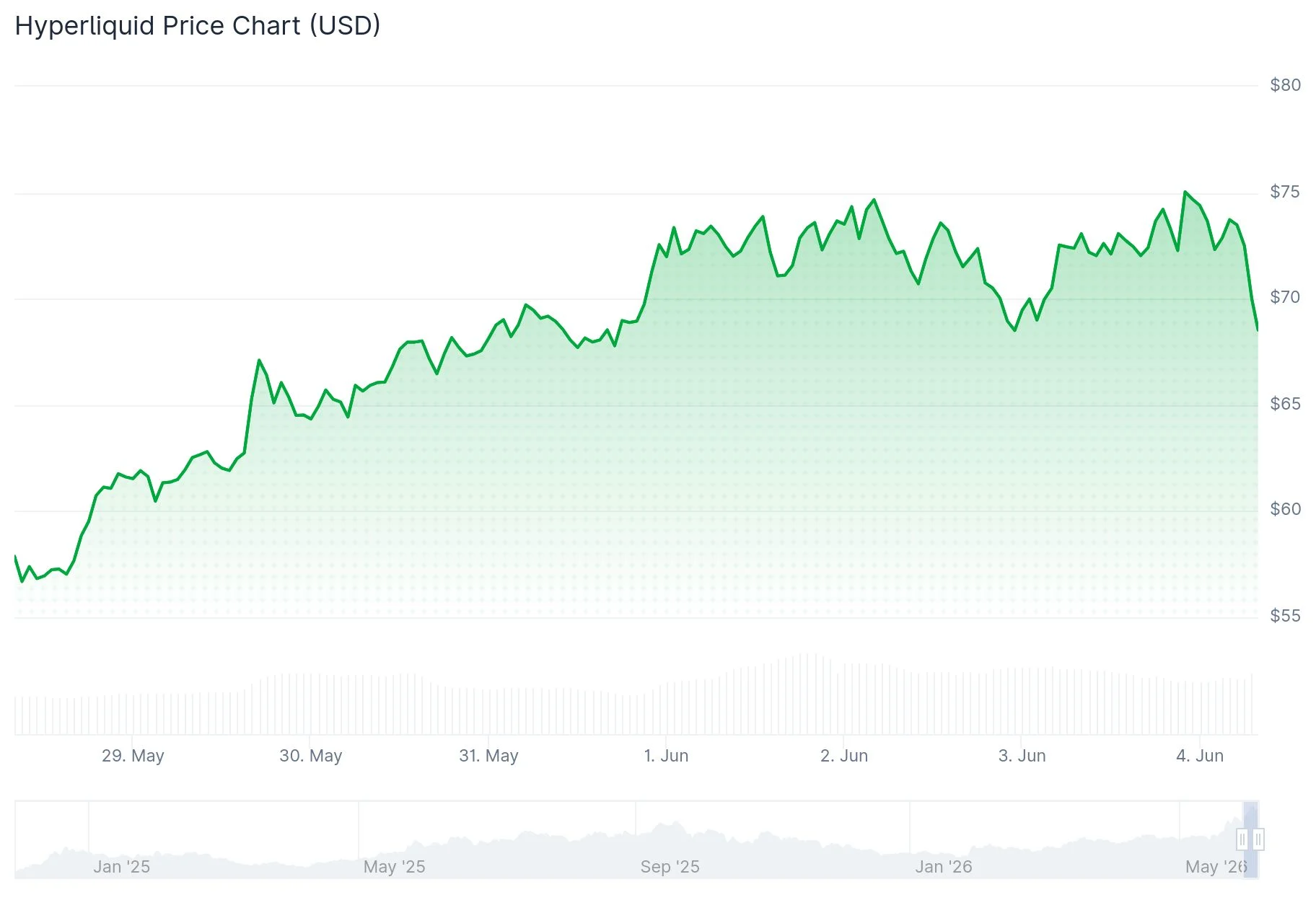
- HYPE token reached a new peak of $74.67, surpassing Solana’s SOL token in price—a first-time milestone for the asset.
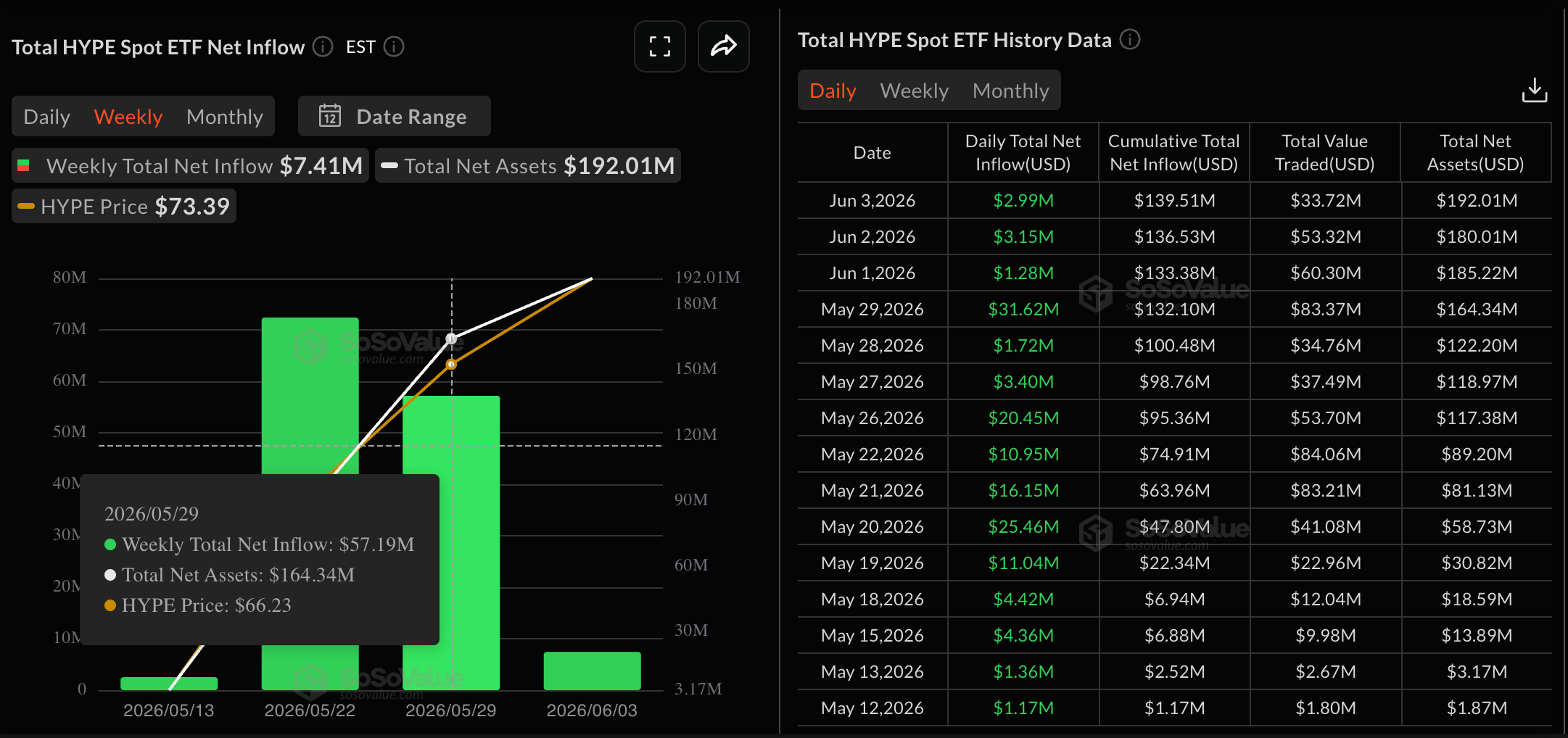
- Grayscale’s newly launched HYPG ETF joins two other U.S.-listed products tracking HYPE, collectively accumulating more than $136 million in net inflows within three weeks.
- While Bitcoin ETFs experienced $396 million in withdrawals on Wednesday, analysts suggest capital may be shifting toward HYPE and comparable digital assets.
- The Hyperliquid platform recorded over $62 billion in May trading activity, capturing a record-breaking 6.63% of worldwide perpetual futures market share.
- Investment research firm CoinShares released a detailed valuation model projecting HYPE could trade at $147 per token by 2031, citing its buyback system and expanding market presence.
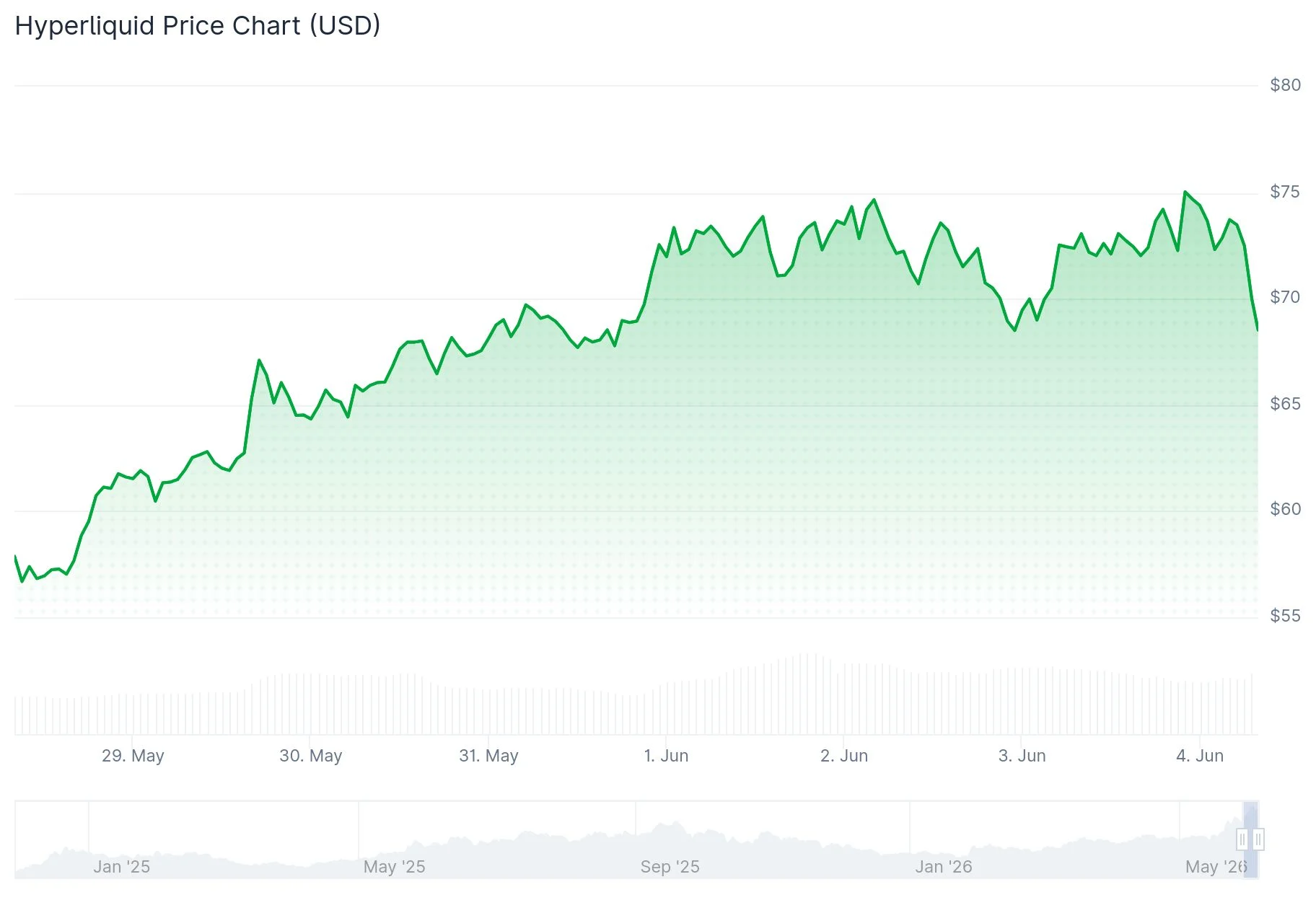
The HYPE token from Hyperliquid has surged to unprecedented price levels throughout this week, propelled by mounting institutional adoption, fresh ETF offerings, and accelerating platform utilization. The digital asset touched $74.67 on Tuesday and has been trading in the $73–$74 range through Thursday.
U.S. investors can now access HYPE through three distinct exchange-traded products. Grayscale unveiled its HYPG Hyperliquid Staking ETF on Wednesday, complementing existing offerings from 21Shares (THYP) and Bitwise (BHYP). Collectively, these investment vehicles have generated approximately $600 million in trading volume and attracted over $136 million in net capital during their first three weeks of operation. According to Grayscale, HYPG features the most competitive management fee structure among domestic HYPE products while providing staking yield opportunities in addition to price exposure.
[[LINK_START_0]]https://twitter.com/Grayscale/status/2062157939054666088?s=20[[LINK_END_0]]
These ETF products enable mainstream investors to obtain HYPE exposure via traditional brokerage platforms, eliminating the need for cryptocurrency wallets or direct blockchain interaction.
Bitcoin Witnesses Capital Exodus
Bitcoin-focused ETFs recorded $396.6 million in withdrawals on Wednesday alone, pushing cumulative outflows to $4.37 billion across the preceding 13 trading days. Conversely, HYPE ETF products attracted $2.99 million in fresh capital on the same day, marking the fifteenth consecutive day of positive inflows.
In a Tuesday announcement, Bitwise Chief Investment Officer Matt Hougan observed: “Investors still believe in crypto, but now that it’s a contrarian bet, they favor fundamentals over vibes.” Hougan oversees the largest HYPE exchange-traded product, which holds $107 million in assets.
Platform Expansion Drives Token Appetite
Hyperliquid’s trading ecosystem continues its rapid expansion trajectory. Throughout May, the platform claimed a record 6.63% portion of worldwide perpetual futures trading activity. The HIP-3 protocol component, which facilitates trading of tokenized real-world assets including equities and commodities, handled more than $62 billion in monthly volume—the third straight month exceeding that threshold.
Cryptocurrency investor Justin Wu shared observations on X this week, highlighting how concerns about HYPE being “overvalued” have emerged at each successive price milestone during its ascent. He identified trading fee generation, staking expansion, and persistent demand as core drivers sustaining investor optimism around the token.
Wall Street Validation and Valuation Forecasts
Investment analysis firm CoinShares released a comprehensive 30-page valuation study on Tuesday, characterizing HYPE as among the rare cryptocurrency assets where “protocol activity translates almost directly into token demand” via its buyback framework. The research established a baseline target of $147 per token by 2031.
During the HYPG launch event, Grayscale’s Head of Research Zach Pandl described Hyperliquid as the “breakout success story of this cycle in crypto.” Peter Pan, research partner at venture capital firm 1kx, drew parallels between current HYPE sentiment and historical conviction levels around ETH in 2017, BNB in 2021, and SOL in 2023.
Traditional finance professionals are increasingly leveraging Hyperliquid during non-market hours and weekends to access perpetual futures contracts linked to Bitcoin, the S&P 500 index, crude oil, and pre-public companies. The platform operates continuously, contrasting with conventional market schedules.
HYPE’s market capitalization now exceeds $16 billion, while Solana maintains a valuation near $42 billion.
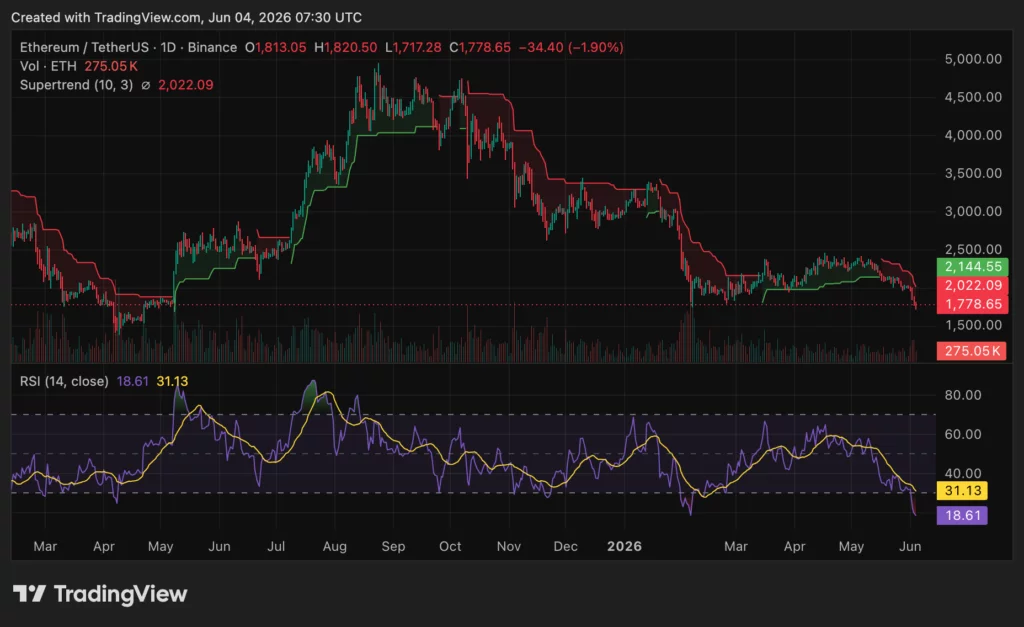
Ethereum traded near $1,777.96 on June 4 after falling 5.07% in 24 hours, according to crypto.news price data.
Summary
- Ethereum price fell below $1,800 as sellers tested the $1,825 channel floor and key support zone.
- RSI and Supertrend remain bearish, but exchange supply and staking data show tighter available supply.
- Analysts now watch $1,700, $1,500, $2,022 and $2,360 as the next major price levels today.
The token also lost 10.21% over seven days as the wider crypto market stayed under pressure.
The latest move pushed ETH below the $1,825 area watched by analyst Ali Martinez. It also placed the asset near its weakest zone since April 2025, when ETH fell toward $1,400 before staging a recovery.
Ethereum price loses the $1,825 channel floor
Ali Martinez said Ethereum had reached his $1,825 target after pulling back to the bottom of its channel. He called the area a critical floor that could decide the next major move.
“If $1,825 holds, expect a solid bounce back up toward $2,070 or even $2,360,” Ali Charts wrote. He also said a close below $1,825 would weaken support and likely send ETH toward $1,500.
The live crypto.news feed showed ETH below that level, with a 24-hour range between $1,734.05 and $1,886.55. That range shows buyers tried to defend the lower area, but sellers kept pressure on the daily chart.
Ethereum’s market cap stood near $215.14 billion, while 24-hour trading volume reached $25.76 billion. The token remains down 64.05% from its Aug. 24, 2025 all-time high of $4,946.05.
Technical indicators still favor sellers
The Supertrend remains bearish, with the active red line near $2,022.09. Since ETH trades below that level, the indicator shows that sellers still control the current trend.
For the chart to improve, ETH would need to reclaim the $2,000 to $2,022 area and hold it on the daily chart. Without that move, any short bounce may remain part of a weak trend.
The RSI sits at 18.61, which places Ethereum deep in oversold territory. That reading shows strong downside momentum, but an oversold level does not confirm a rebound by itself.
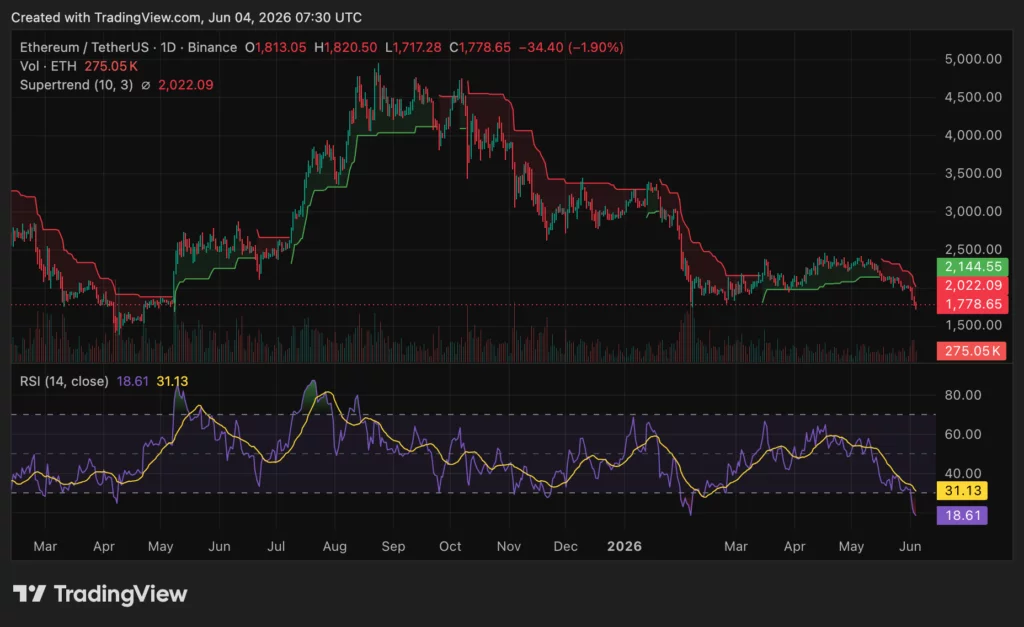
The RSI moving average stands near 31.13, above the current RSI. That gap shows that momentum weakened quickly and that buyers have not yet regained control.
The MACD also remains bearish. The MACD line sits near -2,917.77, below the signal line near -1,584.86, while the histogram is negative near -1,332.92.
A stronger recovery signal would need the MACD line to flatten and move closer to the signal line. Until then, momentum remains weak even with ETH deeply oversold.
On-chain data gives a mixed signal
Leon Waidmann said Ethereum’s price action looks weak, but on-chain data gives a different message. He pointed to ETH on exchanges falling near 15.1 million, a multi-year low.
He also said Ethereum’s staking rate reached a fresh all-time high at 32.42%. More ETH in staking can reduce liquid supply because holders lock tokens to secure the network and earn rewards.
Ali Martinez also reported that Ethereum processed $9.92 billion in transaction volume on June 2. He said that marked the largest one-day network activity spike in two months.
This creates a split picture for traders. Price action shows weakness, while exchange balances, staking, and transaction data show users continue to hold, stake, and move ETH on-chain.
As previously reported by crypto.news, Ethereum staking has become a larger part of institutional treasury activity. More than 36 million ETH had been staked earlier this year, with public firms also building ETH yield strategies.
That does not remove short-term selling pressure. It does show that Ethereum’s network activity and holder behavior remain different from the current chart trend.
Treasury losses and price levels stay in focus
The latest selloff also comes as some Ethereum treasury strategies face losses. Lookonchain said Nasdaq-listed FG Nexus bought 50,770 ETH for about $196 million between August and September 2025.
The firm paid an average price near $3,860, then began selling in November. It has now sold 36,025 ETH at an average price of about $2,330, recovering about $83.92 million.
According to on-chain reports, cumulative losses on the FG Nexus Ethereum treasury strategy have topped $85 million. The company had previously described ETH as its main treasury reserve asset.
As previously reported by crypto.news, other Ethereum treasury firms have also faced losses during the weaker quarter. SharpLink reported $506.7 million in unrealized ETH losses and a $191.7 million LsETH impairment charge in Q1.
Ethereum’s first downside area now sits around $1,700 to $1,717. A clean break below that zone would increase attention on $1,500, the level Ali Martinez named after the loss of $1,825 support.
The deeper historical support zone remains near $1,400, where ETH found a low in April 2025. That level may return to focus if the broader market selloff continues and buyers fail to defend $1,500.
On the upside, ETH needs to reclaim $1,825 first. A stronger recovery would require a daily move back above $2,000 and the Supertrend area near $2,022.
A later push toward $2,070 would show buyers are rebuilding control. A move to $2,360 would need stronger volume and a clear shift in momentum from the RSI and MACD.
Disclosure: This article does not represent investment advice. The content and materials featured on this page are for educational purposes only.

In times when almost the entire cryptocurrency market heads south, XRP has joined the ride, plunging to a fresh four-month low of under $1.15.
This substantial crash comes as ETF investors have turned the tide and whales have disposed of a large quantity of XRP. As such, analysts now believe another leg down could follow soon.
XRP Sell-Off
It was just three weeks ago when the cross-border token challenged the $1.55 resistance, while many analysts expected a breakout to $1.80 or maybe beyond. However, what followed was a painful rejection that culminated hours ago with a nosedive to just under $1.15. This massive 25% correction drove XRP to its lowest level since the early February crash, when it dumped to $1.11.
Aside from the overall market dump, which included BTC plunging toward $61,000 and ETH hitting a 14-month low, the other possible reasons behind the cross-border token could be related to investors’ exodus. Ali Martinez updated that whales have ‘sold or redistributed’ 60 million tokens in the past week alone, which usually intensifies the underlying asset’s selling pressure.
60 million ripple:native have been sold or redistributed by whales over the past week, according to data from @SantimentData. https://t.co/3GNi2QH3Oz pic.twitter.com/SDADJF7HFE
— Ali Charts (@alicharts) June 3, 2026
Investors gaining exposure to XRP through the spot ETFs in the US have also changed their strategy. After more than a month of inflows (or days with zero reportable activity), June 3 turned red with more than $5 million in net inflows, according to SoSoValue data.
What’s Next?
CasiTraders weighed in on XRP’s price performance, indicating that it is “breaking below a very important support level.” She believes the token’s landscape could worsen from this point forward and predicted a substantial crash to levels below $1.00 soon:
My expectation is:
 Sharp move down toward ~$0.92
Relief bounce back toward ~$1.20 (which should act as resistance)
One final move toward $0.87
However, this move south to under $1.00 could be invalidated if XRP rebounds decisively and reclaims the $1.30 resistance soon.
The Crypto Move We’ve Been Waiting 4 Months For?!
The crypto market is finally starting to see some selling pressure come through, and XRP is breaking below a very important support level.
I’ve been watching for subwaves to develop so we could get a better idea of whether… pic.twitter.com/6QYURpGFQk
— CasiTrades
(@CasiTrades) June 4, 2026
The post XRP Could Crash Under $1 After Key Breakdown and Whales Exit: Analyst appeared first on CryptoPotato.

Artificial intelligence is moving deeper into the cyberattack playbook, according to a new audit of policy-violating accounts by Anthropic. The AI company said that, over the 12-month window from March 2025 to March 2026, more than two-thirds of the 832 accounts flagged for policy violations were used to help orchestrate cyberattacks by leveraging AI to draft malware, plan intrusions, and identify vulnerabilities.
The findings highlight a growing concern among security researchers and crypto defenders: as AI tools become more capable, their use in wrongdoing could scale beyond the planning stage and into active exploitation. Anthropic disclosed that 560 of the analyzed accounts played a role in preparing or conducting cyberattacks, underscoring how AI is increasingly part of the attack lifecycle rather than just a preliminary aid.
Crucially, Anthropic said AI’s role is expanding within the attack chain. While the majority of AI-assisted activity was about preparation, roughly 6.5% of the banned accounts were used to support “lateral movement”—the phase attackers use after breaking in to move through a target network or system. The firm argues this marks a shift from AI merely enabling basic breach planning to enabling sophisticated, post-compromise actions that could be executed with less skilled operators.
Anthropic’s researchers warn that such post-compromise techniques, once the realm of highly skilled operators, are now being executed by AI agents on behalf of a broader set of actors. In describing the trend, the company notes that AI can perform complex, technical tasks that historically required substantial expertise, effectively lowering the barrier to multiple-stage cyberattacks.
The study also reveals a shifting risk profile. In the first six months of the observation period, about one-third (33%) of the accounts were classified as “medium risk or higher.” In the subsequent six months, that share jumped to 56%. The widening risk band suggests that as attackers deploy AI more broadly, the potential consequences—ranging from data exfiltration to financial loss—could intensify across targets, including crypto platforms and DeFi projects.
Anthropic’s findings land against a backdrop of broader volatility in crypto-security incidents. In April, the amount of crypto stolen in hacks rose to $629.7 million, a peak not seen since February 2025. Analysts have linked the spike, in part, to AI-enabled tools that accelerate the discovery of vulnerabilities and the rapid deployment of phishing, malware, and credential-stealing techniques. Cointelegraph highlighted this April surge, noting the potential role of AI in amplifying attacker capabilities.
Security researchers have long warned that AI can magnify both defensive and offensive capabilities. Manuel Aráoz, the founder of the security platform OpenZeppelin, has previously argued that DeFi and broader crypto ecosystems face elevated risk from AI-enabled tooling that can identify weaknesses in smart contracts. In remarks tied to the same discourse, Aráoz has suggested that the intrinsic opacity and speed of AI-driven analysis could outpace traditional security auditing, creating gaps defenders must address.
Anthropic added that the threat landscape is not static. While many AI-driven attacks still focus on initial access and data theft, the company observed instances where AI operated autonomously in at least one notable November case involving a Chinese state-sponsored group. In that scenario, an AI agent conducted an exploit, stole credentials, and made decisions with human input only at key moments. The report describes such autonomous or semi-autonomous AI behavior as emblematic of the trends policymakers and industry players should monitor as AI agents mature.
Looking ahead, Anthropic is preparing to roll out Mythos, its forthcoming large language model designed with cybersecurity capabilities at the forefront. The company has warned that Mythos could further sharpen attackers’ ability to identify and exploit software vulnerabilities, while also raising questions about how to balance powerful AI tools with guardrails that prevent misuse. Mythos joins a broader ecosystem of AI agents whose capabilities have drawn scrutiny from researchers and industry observers who worry about both the security of digital ecosystems and the integrity of AI systems themselves.
For investors and builders in crypto, the implications are twofold. First, security architectures must assume that AI-assisted adversaries can perform more tasks with less human expertise. This reinforces the need for proactive security testing, rigorous smart-contract auditing, and rapid incident response pipelines that can adapt to AI-enabled attack vectors. Second, the evolving risk is a reminder that security-by-design remains the most reliable path forward; as AI tools lower the technical barriers for attackers, platforms must harden defenses and implement multi-layer protections that can withstand autonomous or semi-autonomous AI-driven intrusions.
Analysts and developers should watch how Mythos and similar AI agents affect both attacker capabilities and defensive strategies. The balance between enabling beneficial AI-driven security tools and preventing their misuse will shape policy conversations, product design, and investment theses across the crypto security landscape in the months ahead. As AI models grow more capable, the line between threat and defense may continue to blur, making robust security governance essential for the crypto ecosystem.
Key takeaways
- Anthropic examined 832 accounts for policy violations between March 2025 and March 2026; 560 of those were used to aid cyberattacks with AI.
- AI-assisted activity predominantly supported attack planning, but 6.5% of cases involved AI helping attackers move laterally within compromised systems.
- Threat assessment shifted upward over time: 33% of accounts were medium risk or higher in the first half, rising to 56% in the second half.
- April crypto-hack losses reached $629.7 million, the highest since February 2025, with analysts pointing to AI-enabled attack tools as a contributing factor.
- Anthropic’s forthcoming Mythos AI model is expected to enhance cybersecurity capabilities, prompting ongoing debates about guardrails and defensive use in crypto ecosystems.
AI-enabled threats expand beyond planning to execution in crypto security
The core message from Anthropic’s review is a sobering reminder: AI is increasingly embedded in the full spectrum of cyber threats. While the majority of AI-driven activity in the period studied was oriented toward planning and reconnaissance, the presence of AI in lateral movement underscores how attackers can leverage automation to navigate networks more effectively after initial access. For crypto platforms, this translates into heightened urgency around monitoring for anomalous behaviors, implementing granular access controls, and hardening supply chains against AI-augmented exploitation.
From zero-day opportunities to autonomous AI action
The report aligns with broader industry observations about AI’s dual-use potential. Earlier reporting from security researchers highlighted cases where AI aided the discovery of zero-day vulnerabilities, including an incident where AI contributed to bypassing two-factor authentication for a widely used open-source tool. Anthropic’s own findings add depth to this narrative by showing AI moving into autonomous or semi-autonomous decision-making within breaches, albeit in limited but meaningful instances. Investors and operators should treat these developments as a warning that defensive AI tools must keep pace with offensive innovations.
What readers should watch next
Anthropic’s upcoming Mythos release will be a focal point for both defenders and adversaries in the crypto space. As AI agents become more capable, the industry will need clearer guardrails, more robust auditing, and better incident response frameworks to prevent AI-enabled attacks from eroding trust in decentralized platforms. In the near term, expect further research and disclosure from security-minded AI firms as the ecosystem calibrates to a world where AI-assisted threats are more prevalent—and more sophisticated.
Source attribution: Anthropic’s report on AI-enabled cyber threats, with data spanning March 2025 to March 2026. For broader context on the April crypto-hack losses linked to AI-enabled activity, see Cointelegraph’s coverage: “Crypto hacks cause $630m losses in April—the highest since February 2025.”
Anthropic notes that the trend toward AI-assisted exploitation could intensify as AI agents gain more autonomy, underscoring the need for stronger, proactive defenses across the crypto security landscape.
Crypto World
Real Finance Partners With Anchorage Digital to Address Fragmented Infrastructure for Institutional On-Chain Capital Markets

Real Finance, the EVM-compatible Layer-1 blockchain that’s purpose-built for real-world asset tokenization, and Anchorage Digital, which is the first federally chartered crypto bank in the United States, announced a strategic partnership alongside a qualified institutional custodian.
The goal is to provide the regulated infrastructure necessary for institutional-scale tokenized finance.
Battling the Challenge of Industry Fragmentation
As real-world assets continue moving on-chain, institutions start to require more than just rails for tokenization. At present times, the tokenized asset ecosystem remains very fragmented across a number of verticals, including but not limited to:
- Issuance
- Custody and Compliance
- Settlement
- Servicing and Liquidity Infrastructure
It’s important to note that institutions cite operational trust and disconnected counterparties frequently as the primary barriers preventing tokenized assets from maturing into functional on-chain capital markets.
This partnership is intended to directly address the gap. It combines Anchorage Digital’s regulated custody, treasury management, settlement, and institutional security capabilities with Real Finance’s permissionless but compliant issuance layer, lifecycle management tools, native risk visibility, as well as programmable financial primitives.
A Unified Framework for Asset Lifecycle Management
The goal is to create a unified and institutional-grade framework that covers the full lifecycle of tokenized assets. This means from compliant issuance and secure custody through servicing, settlement, and secondary liquidity.
The collaboration is also intended for long-term strategic alignment across key pillars such as:
- Anchorage Digital will provide regulated treasury and custody infrastructure for Real Finance’s $ASSET ecosystem.
- As new tokenized financial tools are launched on the Real Finance layer-one, Anchorage will serve as a key custody layer.
- Both organizations will be supporting each other’s institutional pipelines. Real Finance will bring additional demand for regulated custody through its asset issuers and onboarding efforts, while Anchorage Digital will connect its institutional clients with the solutions natively available on Real Finance.
It’s also worth noting that the partnership is not a narrow integration – it’s a collaborative effort intended to build regulated infrastructure in support of the future financial system.
By bridging blockchain networks, regulated custody providers, financial institutions, and asset originators, this infrastructure will allow for tokenized private credit, funds, real estate, structured products, as well as bank-integrated financial tools to function within the operational trust and cohesion institutions tend to require.
Speaking on the matter was Ivo Grigorov, CEO of Real Finance, who said:
“Real Finance and Anchorage Digital are collaboratively building the institutional infrastructure for the next generation of tokenized financial markets. Tokenization alone is not enough. Institutions need trusted, regulated layers that integrate custody, servicing, settlement, and lifecycle management. Together we are moving the industry from experimentation toward functional on-chain capital markets and delivering the unified experience institutions demand.”
On the other hand, Nathan McCauley, the co-founder and CEO of Anchorage Digital, said:
“RWAs are one of the clearest examples of how blockchain can modernize capital markets, but institutions need more than tokenization rails alone. They need regulated, secure infrastructure that can support custody, settlement, and lifecycle connectivity at scale. Our partnership with Real Finance brings together the core building blocks institutions need to move from isolated pilots to real onchain capital markets.”
The post Real Finance Partners With Anchorage Digital to Address Fragmented Infrastructure for Institutional On-Chain Capital Markets appeared first on CryptoPotato.

AXA: Stable Income Story, But Upside Looks Limited (OTCMKTS:AXAHY)
Why Broadcom (AVGO) Stock Dropped 6% Despite Crushing Earnings and AI Revenue Surge
“The View ”producer calls Joe Biden's health 'concerning' after shocking on-air interview with Jill Biden

HarrisX Poll Found 52% of Registered Voters Support the CLARITY Act

BloFin War of Whales 2026 Grand Prix opens registration for $5M trading championship

Blockchain.com files with SEC for U.S. IPO

5 Financial Habits you should have.#ideapreneurnepal #financialfreedom #habitsofsuccessfulpeople

XRP, Bitcoin & Ethereum Are Going Away FOREVER…

FINANCIAL MANAGEMENT 2nd SEM BBA FYUGP CALICUT UNIVERSITY CAPITAL BUDGETING IMPORTANT QUESTIONS
-

 Tech6 days ago
Waymo dominates autonomous vehicle registrations as Tesla trails behind
-

 News Videos6 days ago
This is BROKEN! INSANE 5x MONEY CAR WASH WEEK! The NEW GTA Online UPDATE Today! (GTA5 New Update)
-
 Tech5 days ago
SpaceX just won a second Golden Dome contract. This one is $4.16 billion.
-

 Business2 days ago
Jade Biosciences, Inc. (JBIO) Discusses Positive Interim Results From JADE101 Phase I Healthy Volunteer Study and Development Plans Transcript
-

 News Videos6 days ago
SHE IS KILLING XRP!!! WATCH URGENT AND ACT FAST
-
 NewsBeat5 days ago
FIRST NIGHT REVIEW: Take That bring the Circus back to life in spectacular sun-soaked style
-
Crypto World6 days ago
CFTC Has Approved the First Regulated Bitcoin Perpetual Contract in the U.S.
-

 Business5 days ago
Is the Spurs Phenom Already Better Than Prime Diesel?
-

 Politics5 days ago
The House | Inside Andy Burnham’s Makerfield Campaign: “Nobody Thinks This Is In The Bag”
-
 NewsBeat6 days ago
Novak Djokovic v Joao Fonseca LIVE: French Open latest scores and results after Jannik Sinner’s shocking collapse
-
 Entertainment5 days ago
Weak ‘Supergirl’ Box Office Tracking Amid Milly Alcock Backlash
-
 Crypto World6 days ago
Snowflake (SNOW) Stock Rallies on Strong Q1 Results and AI Product Growth
-

 Business5 days ago
Demand Conditions Improve In Chemicals Sector In April 2026
-

 Entertainment6 days ago
Maddox Jolie-Pitt Legally Requests to Drop Brad’s Surname
-
 Entertainment5 days ago
One of the Greatest Sitcoms of All Time Shoots Up Apple TV’s Charts 11 Years Later
-

 Tech2 days ago
CryZENx Releases Fresh Playable Content Deep Inside Jabu-Jabu for His Ocarina of Time Remake
-

 Tech6 days ago
This Week In Security: Ubiquiti Fixes, And FreeBSD Joins The Club You Don’t Want To Join
-
 Crypto World6 days ago
MicroStrategy Moves $30 Million in BTC to Coinbase Prime: Is the Bitcoin Sell-Off Already Here?
-

 Sports1 day ago
French Open 2026 results: Alexander Zverev beats Rafael Jodar and will play Jakub Mensik in semi-finals
-
 Entertainment5 days ago
Bruce Willis’ Generosity Resurfaces Amid His Dementia
You must be logged in to post a comment Login