

Crypto World
Chainlink Brings Samsung, Toyota and Sony Pricing On-Chain With APAC Equities Streams



**Deck:** Chainlink launched APAC Equities Streams on Monday, putting live pricing for large-cap Asian companies on-chain to power equity perps, prediction markets and structured products in Asian time zones. Chainlink launched APAC Equities Streams on Monday, an oracle feed that brings pricing for… Read the full story at The Defiant

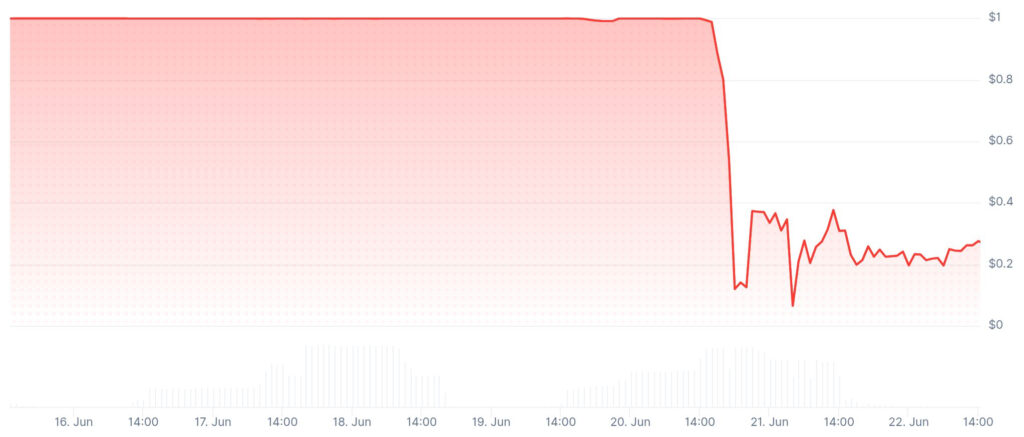
Main Street Finance’s stablecoin msUSD has depegged to $0.27, sparked by a post addressing the “shutdown of [its] third-party proof-of-reserves dashboard.”
The following day, the firm behind the dashboard in question, Accountable, announced it was terminating its asset verification services with msUSD’s issuer.
In classic DeFi fashion, the fallout appears to have led to a bank run on Altura’s USDT vault, leading to the firm deciding to close down the vault.
At least $8.5 million was withdrawn ahead of the announcement and before a sell-off of the AVLT vault token led to an 11% depeg.
The weekend’s depegs come on the back of ongoing troubles for DeFi stablecoins apxUSD and sUSDat, which are backed by Strategy’s struggling STRC.
Read more: Saylor distances himself from STRC-backed DeFi after stablecoin wobble
Main Street Finance: ‘Institutional-grade yield’
Late on Saturday, Main Street Finance published a long post to X reassuring users that it “remains fully backed,” calling the loss of its dashboard a “reporting issue, not a solvency issue.”
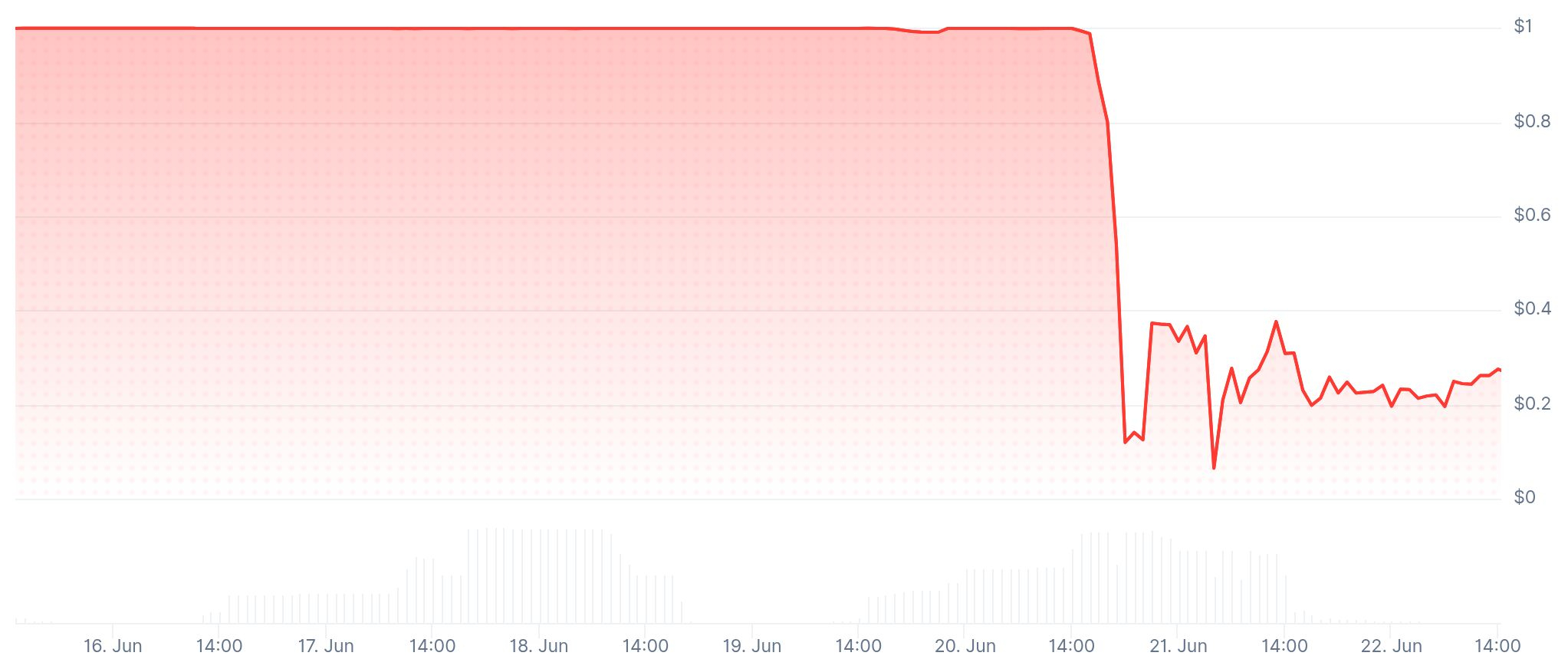
By the time of the post, the price of msUSD had already collapsed. It sat at around $0.12 after losing its $1 peg around six hours previously but has since rebounded to around $0.27 from a low of $0.06 in the early hours of Sunday morning (UTC).
The advance reaction led some to believe that “insiders… got the memo that they should take the available liquidity to get out.”
Then, on Sunday, RWA accounting firm Accountable announced that, following Main Street Finance’s failure to provide adequate proof of reserves, it was terminating its contract with the firm.
Others questioned Accountable’s lack of prior action, given that doubts over Main Street’s transparency were publicly raised back in April.
Accountable’s post positions it as “neutral verification infrastructure,” however it also claims it “did not retain an ongoing, source-level view of [Main Street’s] reserves,” raising concerns over the reliability of its data on other clients.
Read more: DeFi projects under fire for inflated TVL and murky lending loops
Given Accountable’s entire business case, the post also drew ridicule, with one user comparing it to May 2022’s infamous Three Arrows Capital AUM statement.
In addition to the depeg of msUSD, Main Street’s yield token, msY, which it promises “turns box spreads into market-neutral” 12% yield also collapsed in price.
Blockchain auditor Peckshield highlighted the Morpho msY/USDC market hitting 100% utilization, trapping $18 million of AlphaPing assets.
Read more: Resolv hack shows DeFi learned nothing from last contagion
Altura: “the yield engine”
Altura runs a HyperEVM-based USDT yield vault, currently offering almost 30% yield.
In a post on Sunday, Altura distanced itself from the msUSD depeg, stressing it “never had any exposure to Mainstreet or any of its underlying investment strategies.”
It also assured users that it had successfully redeemed over $5 million during the previous 24 hours.
Rather than reassuring depositors, however, it appears the post had the opposite effect.
Twelve hours later, Altura co-founder and CEO Ranveer Arora revealed that, due to “sustained withdrawal demand and current market sentiment” the firm would proceed with “an orderly wind-down of the Altura vault.”
Redemptions had now climbed to $8.5 million.
The rush for the exits was reflected in the price of the vault’s yield-bearing AVLT token. Over the past 24 hours it has dropped 14%, from $1.09 to $0.93 at the time of writing.
Between redemptions and price action, AVLT’s market cap dropped from $39 million to a low of $26 million over the weekend.
In a later update, Altura stated that “a maturity mismatch between our onchain and off-chain positions” forced it to pause withdrawals. It promised market making strategies would be closed within 72 hours but “RWA positions will take more time due to their inherent nature.”
On top of the $18 million exposed to the msY/USDC market, AlphaPing also has over $10 million of exposure to AVLT, according to its Morpho curator dashboard.
Read more: High yields to haircuts: Has DeFi learned anything from yield vault collapse?
DeFi’s risk curator “daisy chain”
Despite its premise as transparent, open finance, the DeFi sector has faced a number of shocks in recent months due to murky “daisy chains” and recursive lending.
In late October, concerns began to circulate over the stability of a number of high yield vaults. These tokens often used looped leverage against one another, inflating TVL far above the legitimate stablecoin backing.
The space exploded days later when one of the main offenders, Stream Finance, revealed it had lost $93 million. Its stablecoin, xUSD, immediately collapsed 75%.
Read more: Four months on, MEV Capital falls victim to $4B DeFi daisy chain implosion
Later, in March, a $23 million hack of Resolv’s USR due to a private key compromise wrought havoc across multiple yield vaults as opportunistic traders bought depegged USR and used it to drain liquidity in markets with hardcoded oracles.
So-called risk curators even continued to provide liquidity to the vulnerable markets via Morpho’s Public Allocator automation feature.
Such episodes go to show that rather than a novel financial system which operates autonomously and permissionlessly, DeFi is all too often forced to recur to the blame game when things go awry.
Got a tip? Send us an email securely via Protos Leaks. For more informed news, follow us on X, Bluesky, and Google News, or subscribe to our YouTube channel.


Elon Musk has backed NVIDIA’s claim that data center water use is far smaller than critics suggest.
Data centers face growing scrutiny over how much water and electricity they consume. NVIDIA says its latest cooling systems can nearly erase the water that older facilities lose to evaporation.
What NVIDIA Claims About Data Center Water Use
NVIDIA’s post cited a March 2026 estimate from the Manhattan Institute that data centers use roughly 0.2% of U.S. freshwater, most of it indirectly through power generation.
The company said its 45-degree Celsius liquid cooling lets AI factories in cool climates run on dry coolers rather than evaporative towers.
That shift can cut facility cooling water from about 2.6 million gallons per megawatt each year to near zero.
NVIDIA made the same case in 2025, claiming its Blackwell systems were 300 times more water efficient than air cooling.
Because cooling can reach 40% of a data center’s electricity, the design also trims power costs. Similar trade-offs now shape the global AI data center race.
Why Elon Musk’s Endorsement Matters
Musk, who runs large NVIDIA-powered clusters through xAI, has repeatedly praised NVIDIA’s latest chips as the backbone of his AI projects.
His endorsement supports NVIDIA’s push against the view that AI growth drains local water supplies. The company describes its system as a closed loop that recirculates coolant instead of consuming fresh water.
“The NVIDIA DSX reference design for AI factories has zero water consumption … we have eliminated massive amounts of power usage and pretty much all water usage,” Ali Heydari, director of data center cooling and infrastructure at NVIDIA
Follow us on X to get the latest news as it happens
The Case for Caution
The national figure hides the detail. NVIDIA’s near-zero claim covers direct cooling, the smaller part of the footprint.
U.S. data centers used about 17.4 billion gallons of water directly in 2023, a Berkeley Lab report found, plus another 211 billion gallons indirectly through the electricity they drew.
That indirect share climbs as AI scales, and direct use alone is projected to reach 38 to 73 billion gallons by 2028.
Dry coolers also depend on climate, working best in cool regions and less well in hot, dry states.
The strain is visible at Musk’s own xAI. Its Memphis Colossus site has drawn roughly 1.3 million gallons of drinking water a day from the local aquifer and ran dozens of gas turbines before securing permits, prompting a data center pollution lawsuit and community appeals.
How regulators and water-stressed regions respond may decide whether efficiency gains keep pace with the industry’s expansion and the wider contest for AI capital.
The post Elon Musk Backs NVIDIA As AI’s Biggest Environmental Criticism Takes a Hit appeared first on BeInCrypto.
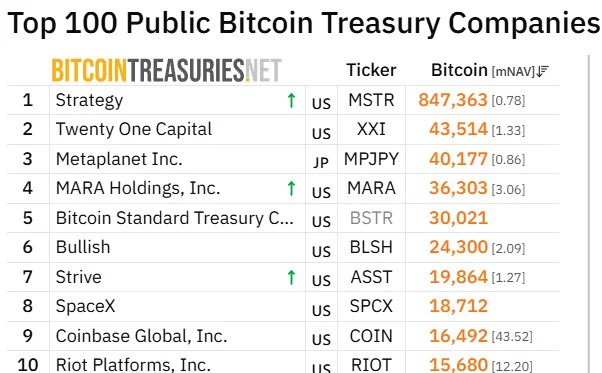
Strive has purchased 759 Bitcoin for roughly $50 million, recording its largest weekly acquisition in months and surpassing Strategy’s latest BTC purchase.
Summary
- Strive bought 759 BTC for roughly $50 million, increasing its holdings to 19,864 Bitcoin.
- The weekly purchase exceeded Strategy’s 520 BTC acquisition, a rare lead over the largest corporate holder.
- Backed by its SATA preferred stock program, Strive continues expanding its Bitcoin treasury toward a planned $4.2 billion deployment.
According to a June 22 Form 8-K filed with the U.S. Securities and Exchange Commission, the Dallas-based Bitcoin treasury company acquired the coins between June 15 and June 21 at an average price of about $65,850 per Bitcoin, including fees and expenses. The transaction lifted Strive’s total holdings to 19,864 BTC.
At the reported purchase price, the acquisition was worth approximately $50 million. The buying spree represented a sharp increase from the company’s previous two weekly disclosures, which showed purchases of just 32 BTC and 73 BTC, respectively, totaling around $6.8 million.
While Strategy remains the world’s largest corporate Bitcoin holder, Strive accumulated more BTC during the latest reporting week. Strategy disclosed the purchase of 520 Bitcoin over a similar period, making this one of the few occasions when a smaller treasury company added more Bitcoin than its larger rival.
Strive has accelerated Bitcoin accumulation again
Fresh SEC filings also showed that Strive’s cash and cash equivalents increased from $141.4 million to $144.5 million during the reporting period. At the same time, the company’s Class A common stock count expanded by roughly 1.9 million shares to 71.8 million, indicating continued capital raising activity through its at-the-market equity program.
Elsewhere on the balance sheet, Strive maintained its position of 505,000 shares in Strategy’s Variable Rate Series A Perpetual Stretch Preferred Stock, known as STRC. According to the filing, the fair value of those holdings edged lower to approximately $44.7 million.
The latest purchase extends a rapid expansion that began after Strive entered the public Bitcoin treasury sector through its January 2026 merger with Semler Scientific. The transaction added 5,048 BTC to the company’s balance sheet at closing and provided the foundation for its current accumulation strategy.
Since then, Strive has steadily increased its Bitcoin reserves. The company crossed the 15,000 BTC threshold in early May and later disclosed a roughly $185 million deployment in early June that added about 2,500 Bitcoin in a single week, one of the largest acquisitions since becoming a public company.
SATA funding model continues to support purchases
A significant portion of Strive’s buying activity has been funded through its Variable Rate Series A Perpetual Preferred Stock program, known as SATA. The preferred shares currently offer a Bitcoin-linked dividend structured at an annualized rate of 13%, calculated daily.
According to company disclosures, capital raised through SATA and other at-the-market programs is directed toward additional Bitcoin purchases. Strive Management has previously described Bitcoin as the benchmark against which it evaluates capital allocation decisions rather than simply a reserve asset held on the balance sheet.
Based on Bitcoin (BTC) prices near $64,000, Strive’s treasury of 19,864 BTC is currently valued at roughly $1.27 billion. Company filings indicate that its average acquisition cost remains above prevailing market prices, a position it shares with Strategy, which holds 847,363 BTC and remains the largest corporate Bitcoin holder globally.
With a previously announced $4.2 billion capital deployment plan still in place, recent filings suggest Strive continues to expand its Bitcoin position as the second half of 2026 approaches.


The CFTC asked the public to weigh in on running standard futures around the clock and on listing perpetual contracts tied to physically delivered energy commodities such as crude oil. The request opens the door to importing the crypto-native perpetual design into the oil and gas derivatives… Read the full story at The Defiant
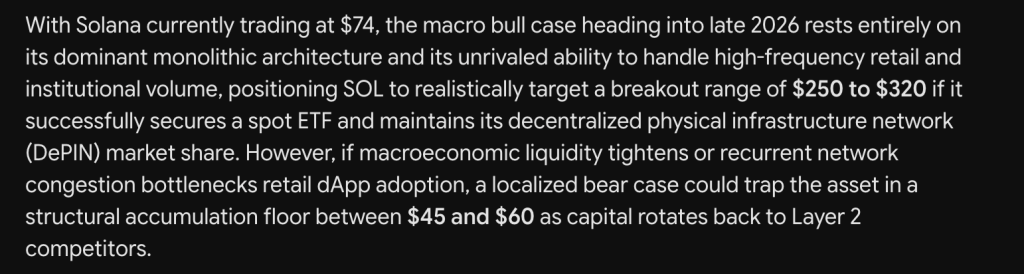
Google Gemini AI just put together a target price prediction for solana that demands a serious double take. The model predicts for a breakout range of $250 to $320 by late 2026, which would mean solana more than tripling from where it sits today.
The bull case rests almost entirely on architecture. Solana is trading near $74 right now, and Gemini frames its entire upside thesis around the network’s monolithic design and its ability to absorb massive high frequency volume from both retail and institutions.
That speed advantage has always been solana’s calling card, and the model treats it as the foundation for everything else. The key trigger here is a spot ETF actually getting approved, which would open the door for fresh institutional capital to flow in at scale.
Pair that with solana holding onto its market share in decentralized physical infrastructure networks, and you get a setup where the network keeps compounding its existing advantages rather than needing some brand new catalyst.
If those two pieces land together, the model sees a realistic path toward that $250 to $320 zone.
The bear case is grounded in things solana has actually struggled with before. If macro liquidity tightens across markets, that kind of broad pullback tends to hit higher beta assets like solana hardest.
Recurring network congestion is the other risk, since past slowdowns have pushed developers and users toward layer 2 competitors.
If both pressures show up at once, the model expects solana could get trapped in a structural accumulation floor between $45 and $60 instead of breaking out.

Solana Price Prediction: SOL Sets Up For A Make Or Break Summer Run
The daily chart shows solana at $73.99 after a long grind down from highs above $250 set last summer. That entire move lower has been one extended downtrend with very few real bounces along the way.
Price recently carved out a double bottom near $60, then pushed back above $70, which is the first sign of buyers stepping in with any real conviction.
Immediate resistance sits near $90, then a heavier zone around $100 where multiple rallies stalled earlier this year.
Support holds at $60, with the recent low near that level acting as a clear line in the sand. RSI is reading 51.53 against a signal line of 41.70, putting momentum well above its own average for the first time in a while.
That wide gap suggests buying pressure is building faster than the trend has confirmed yet, which often shows up right before a real breakout attempt.
Overall momentum looks like it just flipped from negative to cautiously positive. If solana clears $90 and holds it, the path toward that $250 target starts looking like a genuine multi month story instead of just a hopeful number on a chart.
You Might Like What Gemini AI Predicts About This New Layer 3 Called LiquidChain
Large caps are not in trouble. They are just out of the room. Bitcoin, Ethereum, and XRP have been testing the same ceilings for weeks with nothing breaking through.
Every macro catalyst has a new arrival date. Every institutional wave has a new quarter attached to it. Holding assets where the next leg depends entirely on someone else’s decision is not a trade. It is a waiting room.
The money that wins cycles never announces where it is going.
The capital that actually moves in cycles relocates before the destination has a name.
Small market cap infrastructure plays operate on physics that large caps simply cannot replicate. A rotation that would not register as a rounding error at Bitcoin’s scale can reprice an undiscovered project by multiples.
The opportunity lies in the distance between what something is genuinely worth and what the market has assigned it so far. That distance shrinks to zero the moment discovery happens. Before that moment, it is fully capturable.
Multi-chain fragmentation is one of the most consistently expensive problems in DeFi, and it has never been solved. Bitcoin, Ethereum, and Solana exist as completely isolated systems. No shared architecture. No native interoperability. Every time value moves between them, the disconnection extracts its cost in fees, slippage, and failed transactions. That cost hits every single crossing every single time.
LiquidChain makes the crossing free, as Perplexity AI predicts. All 3 networks inside one execution environment. Single deployment. Complete ecosystem access. No tax on any interaction.
The presale is at $0.01454 with just over $840,000 raised. Early and undiscovered.
Execution is unproven. Adoption is unknown. Established assets offer predictability toward a ceiling that the market already sees. LiquidChain is an entry point that does not exist once the market finds it.
Explore the LiquidChain Presale
The post Google Gemini AI Predicts Crazy Solana Price by End of 2026 appeared first on Cryptonews.
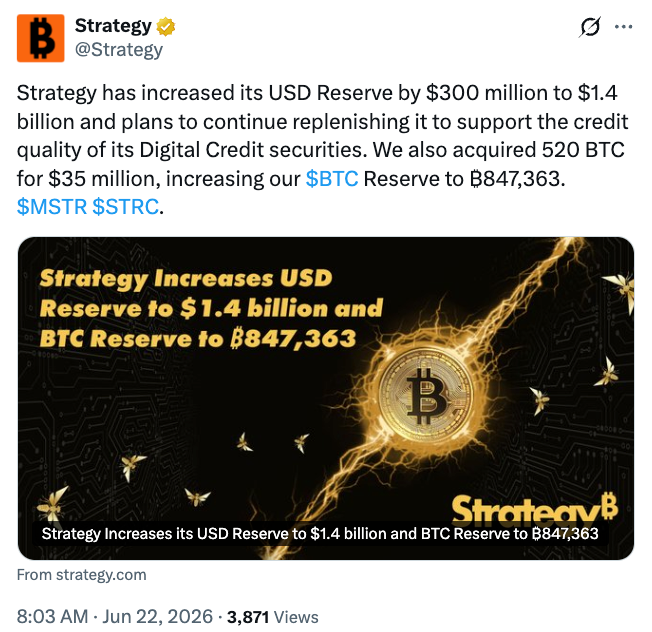
Michael Saylor’s Strategy has expanded its Bitcoin holdings and increased its US dollar reserve after its perpetual preferred stock STRC slipped below $90.
Strategy acquired 520 Bitcoin (BTC) for $34.9 million between June 15 and Sunday, according to a Monday 8-K filing with the US Securities and Exchange Commission. The purchase was made at an average price of $67,068 per BTC, bringing Strategy’s total Bitcoin holdings to 847,363 BTC.
Strategy’s cumulative purchases now total $64.1 billion, giving the company an average acquisition cost of $75,651 per Bitcoin.
Strategy said on X that it added $300 million to its US dollar reserve, bringing the total to $1.4 billion. According to the company’s 8-K filing, the figure includes expected cash proceeds from its at-the-market (ATM) share sales that had not yet settled.
Source: Strategy
Strategy’s financing decisions are closely watched because the company is the largest corporate holder of Bitcoin and one of the market’s most active buyers. The firm’s funding model has also become a template for a growing number of Bitcoin treasury companies.
MSTR share sales fund Bitcoin purchase and USD reserve
Strategy funded its latest Bitcoin purchase and liquidity reserve using proceeds from sales of its Class A common stock (MSTR). The company raised $335.5 million through its ATM equity program during the reporting period.
While $34.9 million of the proceeds was used to buy 520 Bitcoin, $300 million was allocated to Strategy’s US dollar reserve, which is designed to support dividend payments and debt obligations.
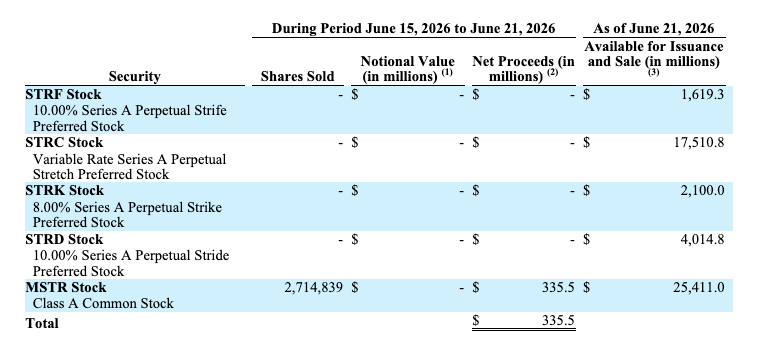
Source: SEC
“Strategy plans to continue replenishing the USD Reserve over time based on market conditions to support the credit quality of its Digital Credit securities,” the company said in the 8-K filing.
MSTR and STRC tumble at Thursday’s close
Ongoing volatility in Strategy’s shares and preferred stock continued to draw market attention, particularly as STRC, which is designed to trade near $100, fell below $90 last week.
MSTR dropped 3.46% to $112.53 at Thursday’s close ahead of Friday’s market holiday, according to Yahoo Finance data. STRC, the company’s perpetual preferred stock, slipped 0.46% to $88.59 at Thursday’s close. It traded at $90.59 during Monday’s premarket session.
Bitcoin advocate Samson Mow said on X on Monday that STRC has a “self-repairing mechanism” that activates when the security trades below its $100 reference level. He said that when the price falls below that level, the company stops issuing new shares through its ATM program, which limits new supply.
Related: Bitcoin doesn’t need Ethereum-style yield, says Strategy’s Michael Saylor
Mow added that lower prices effectively increase the yield for buyers relative to their purchase price, which can encourage demand and help push the price back toward $100. He described the structure as relying on market incentives rather than active intervention from Strategy to maintain stability.
Magazine: Bitcoin decouples from tech stocks, Ether eyes ‘selling wave’: Market Moves
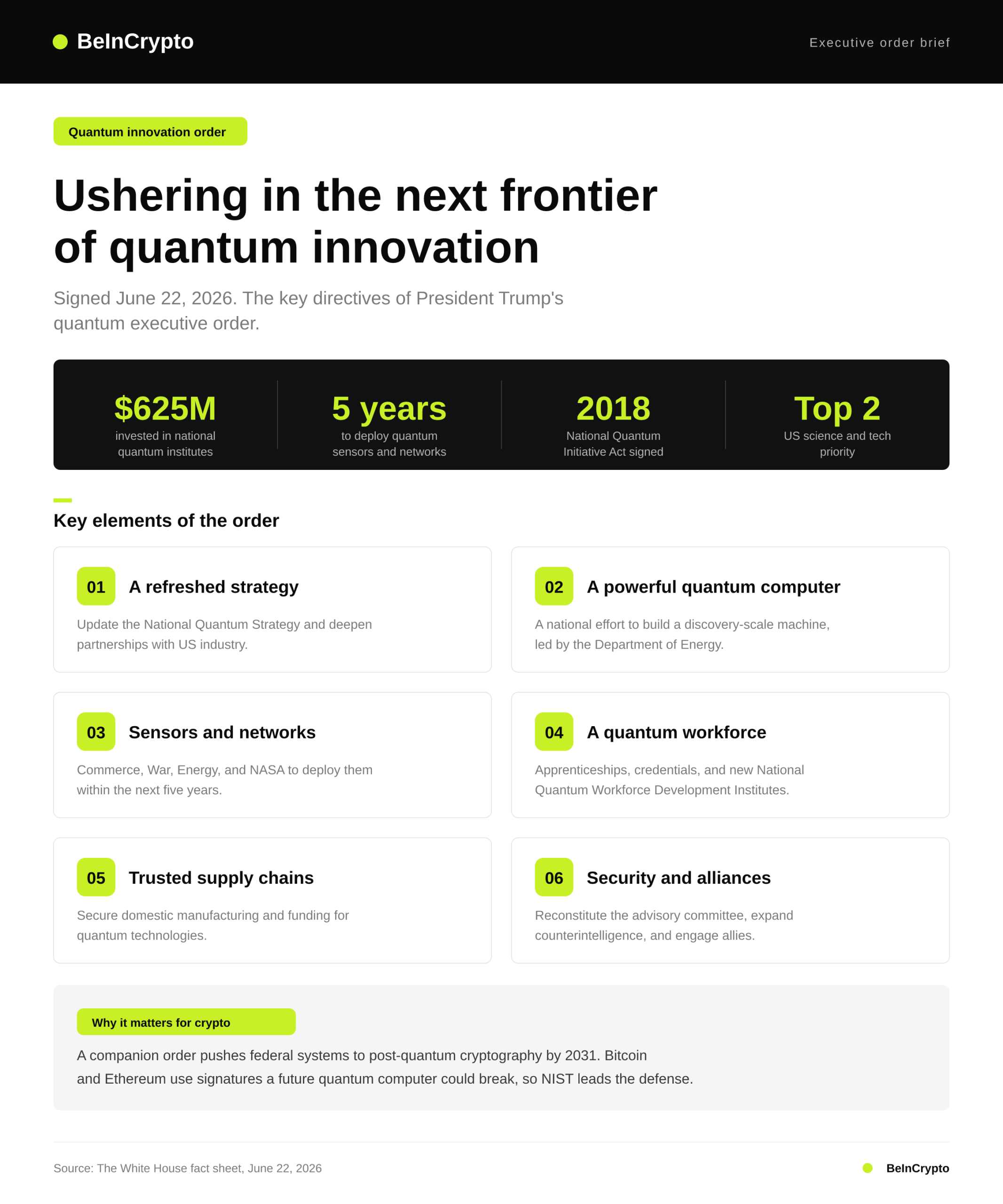
President Donald Trump signed two quantum executive orders on Monday. They push federal agencies toward quantum-resistant encryption and a more powerful quantum computer.
The orders revive a long-running question about quantum risks to Bitcoin and cryptocurrency in general. One sets a 2031 deadline for post-quantum cryptography, while the other targets quantum computing.
What the Quantum Executive Orders Do
The cryptography order accelerates a deadline that ran to 2035 under the 2022 National Security Memorandum-10. Agencies must now reach quantum-resistant standards years earlier.
Federal systems must use post-quantum cryptography for key establishment by the end of 2030. High-impact systems must move their digital signatures to the new standards by the end of 2031.
The order also tasks the Commerce Department and NIST with a pilot migration project. Federal systems should convert by the end of 2027, while CISA supports critical infrastructure operators.
A companion order is titled “Ushering in the Next Frontier of Quantum Innovation.” It launches a national push for a quantum computer that handles major scientific work.
The order also funds quantum sensors and networks over the next five years.
Officials frame the cryptography order around a threat called harvest now, decrypt later. Adversaries can store encrypted data today and try to unlock it once quantum machines mature.
That is a long-discussed risk to crypto holdings.

“The first Executive Order launches a national effort to produce a Quantum Computer capable of performing important scientific calculations, and to develop quantum-enabled sensors and networks in the next 5 years,” Trump remarks.
Follow us on X to get the latest news as it happens
What it Means for Crypto Security
Bitcoin (BTC) and Ethereum (ETH) secure ownership with elliptic-curve signatures. A large enough quantum computer running Shor’s algorithm could derive a private key from a public key.
The risk centers on coins whose public keys are already visible on-chain.
That exposure, often called Q-Day, gains a firmer government deadline through these orders. The timeline still gives developers room to respond.
The defensive tools already exist. NIST finalized three post-quantum standards on August 13, 2024, including ML-DSA for digital signatures.
Bitcoin contributors have floated a Bitcoin quantum migration plan and quantum-safe soft forks to adopt them.
Few researchers see urgency. A 2022 University of Sussex study estimated about 1.9 billion physical qubits to break a key inside Bitcoin’s block window.
Google’s Willow chip held just 105 qubits in December 2024, so many treat the threat as not an immediate risk.
Markets showed no immediate reaction. Bitcoin traded near $64,200 and Ethereum near $1,730, each up about 1% over 24 hours.

The orders set deadlines for government systems, not for decentralized networks.
Washington also holds the asset at stake, having established a Strategic Bitcoin Reserve in March 2025.
Bitcoin’s contributors moving as fast as federal agencies remains an open question.
The post Trump Signs Quantum Executive Orders: What Do They Mean for Crypto Security? appeared first on BeInCrypto.

Key Highlights
-
SBET shares climb following Ethlabs nonprofit announcement
-
SharpLink invests in independent Ethereum research organization
-
New nonprofit aims to enhance Ethereum institutional infrastructure
-
Ethlabs pursues improved settlement speed for enterprise users
-
Founding members include prominent Ethereum Foundation veterans
Shares of SharpLink, Inc. advanced 1.43% to close at $5.37 following the company’s participation in launching Ethlabs. This newly formed nonprofit entity aims to advance Ethereum research while building infrastructure suited for institutional deployment. During the trading session, SBET briefly touched $5.55 before settling lower.
New Nonprofit Receives Backing From Multiple Ethereum Supporters
SharpLink contributed funding alongside Bitmine Immersion Technologies, Joe Lubin, Anchorage, Octant, and SNZ to establish Ethlabs. The initiative operates as an independent nonprofit dedicated to advancing Ethereum’s technical capabilities. Priority areas include institutional finance requirements and supporting expanded onchain operations.
The organization was cofounded by five former senior-level researchers from the Ethereum Foundation. This founding team consists of Ansgar Dietrichs, Barnabé Monnot, Caspar Schwarz-Schilling, Josh Rudolf, and Julian Ma. Their collective expertise spans protocol finality, network scaling, data availability solutions, economic modeling, and virtual machine architecture.
The new entity offers these researchers consistent financial backing within a structured operational framework. Ethlabs maintains full autonomy from its financial contributors regarding research direction. Leadership retains complete authority over technical choices and overall development objectives.
Research Priorities Target Infrastructure Improvements
Initial research efforts will concentrate on accelerating settlement times, enhancing cross-network interoperability, and expanding Ethereum mainnet throughput. The organization will additionally support native digital asset creation and transfer mechanisms across interconnected blockchain systems. These developments could enable institutions to utilize Ethereum with improved efficiency, security, and predictability.
Rising adoption of stablecoins and tokenized real-world assets is expected to drive increased demand for robust Ethereum infrastructure solutions. Investment funds and automated trading systems may require enhanced settlement mechanisms and data processing capabilities. Consequently, Ethlabs intends to refine common standards that support applications throughout the ecosystem.
Having operated for over ten years, Ethereum currently underpins a substantial decentralized finance landscape. Nevertheless, broader institutional integration demands greater throughput and reliable cross-chain communication protocols. Ethlabs addresses these challenges through focused protocol research and infrastructure enhancement initiatives.
Governance Model Ensures Research Autonomy
A third-party grants administrator will oversee contribution vetting, asset assessment, and capital distribution processes. This arrangement maintains separation between financial backing and decisions regarding research initiatives and technical focus areas. The organization commits to publishing quarterly transparency reports alongside annual independent audits.
SharpLink characterized this investment as aligned with its commitment to Ethereum’s sustainable growth. The firm maintains ETH holdings and engages in initiatives designed to fortify Ethereum’s enterprise-grade infrastructure. This participation connects SBET’s corporate objectives with ongoing expansion throughout the Ethereum network.
Meanwhile, Ethereum’s development landscape continues evolving toward multiple independent research and governance entities. The Ethereum Foundation maintains its foundational mission while external organizations pursue complementary technical initiatives. Ethlabs enters this ecosystem with direct financial support from corporate entities and established community stakeholders.

Crypto startup Fomo has raised $75 million in a Series B funding round led by venture capital firm Index Ventures, which valued the social trading and token discovery platform at $550 million.
The funding round also received participation from Union Square Ventures and the company’s existing investor, Benchmark, along with angel investors including Zynga co-founder Mark Pincus, Eventbrite co-founder Kevin Hartz, Discord CEO Humam Sakhnini, Nexos AI co-founder Tomas Okmanas and others, Fomo announced on Monday.
Fomo allows users to trade assets across multiple blockchains without having to manually bridge funds or handle gas fees. The company said it has attracted more than 625,000 traders since launching a year ago, generating $4 billion in trading volume and 110 million social interactions.
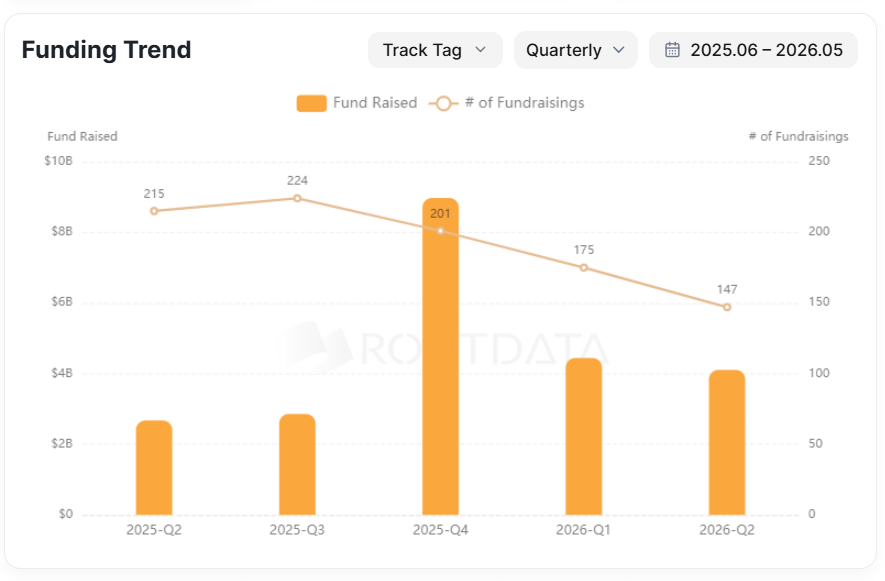
The raise adds to a growing list of crypto venture deals in 2026, even as digital asset prices remain below recent highs. According to RootData, crypto startups raised $4.1 billion across 147 funding rounds during the second quarter.
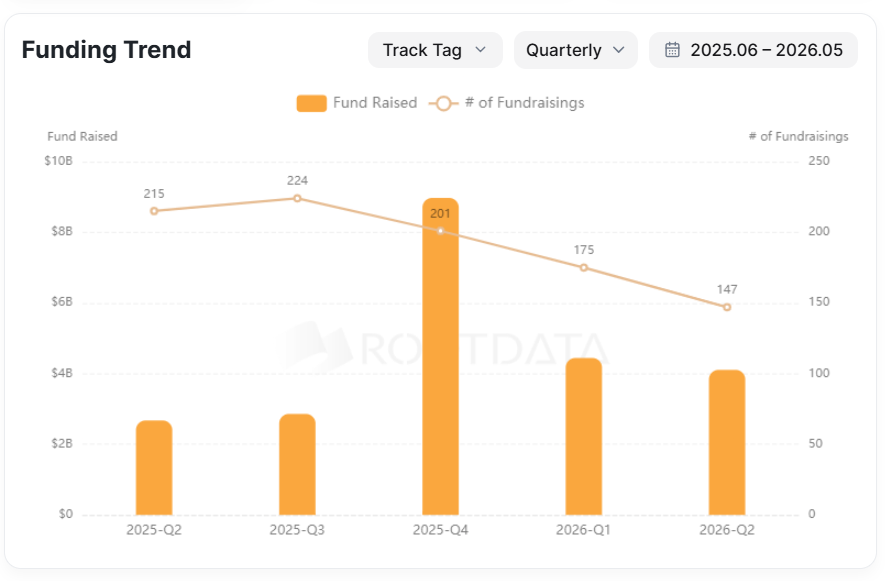
Crypto and Web3 funding by quarterly sum. Source: Root Data
Fomo says 68,000 users made first crypto purchase on platform
Fomo said more than 68,000 users made their first cryptocurrency purchase on the platform using Apple Pay, representing roughly $25 million in transaction volume.
Related: Kalshi in early IPO talks with investment banks: Report
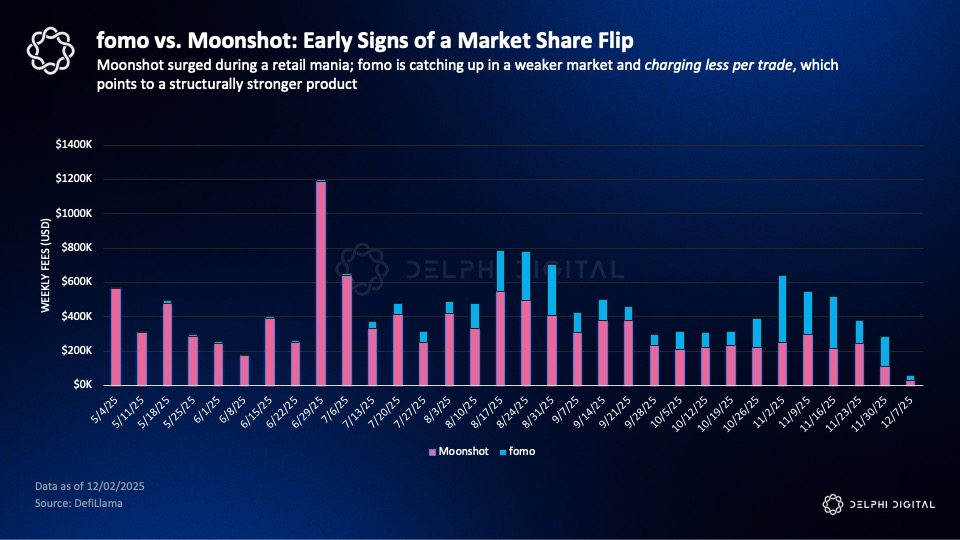
Crypto research firm Delphi Digital said in a December X post that the platform’s social features may be helping attract users by making trading feel “more like scrolling a feed than sitting at a terminal.”
“In November, @fomo_family generated more monthly fees than Moonshot, despite being a younger product with lower fees,” Delphi Digital wrote.
Source: Delphi Digital
Fomo allows users to view trades made by other users in real time and execute similar trades across multiple blockchains without manually bridging assets or managing separate wallets.
Other crypto exchanges offering copy-trading features include Binance, Bybit, OKX, Bitget, BingX, MEXC, Gate.io, KuCoin, Phemex and BitMart.
On June 11, Fomo launched perpetual futures contracts powered by Hyperliquid for users outside the United States. On June 2, the company said it had surpassed $2 million in referral fees paid to users.
Magazine: The legal battle over who can claim DeFi’s stolen millions
Secret Network's cross-chain bridge to Axelar has been suspended after an attacker exploited a years-old minting flaw to drain $4.67 million in wrapped tokens over seven undetected days. Both teams disclosed the incident on June 19, confirming approximately $4.67 million in assets were taken from… Read the full story at The Defiant

Is Lionel Messi the Greatest? Troost-Ekong Gives Verdict After World Cup Record

Surprise: Valve’s new Steam Machine is here, but the price is the real shocker

JAMES WALLIS DROPPED A MASSIVE XRP BOMBSHELL.. ($10,000???)


-

 Fashion3 days ago
Weekend Open Thread: Miami – Corporette.com
-
 Tech6 days ago
The Adder At The Heart Of Intel’s 8087 FPU
-

 Entertainment2 days ago
Renter of Home in Anne Heche Crash Denies Settlement With Son
-

 Tech12 hours ago
Microsoft accidentally kills epic Outlook email threads
-

 Business2 days ago
Soccer-U.S. defends Iran World Cup travel restrictions, says discussions ongoing
-

 Politics4 days ago
BBC Reporter Discusses Cross Party Criticism Of Trumps Iran Deal
-
 Business3 days ago
Wall Street Week Ahead: Investors see Micron earnings as pulse check of AI rally momentum
-

 Tech4 days ago
AWS enters the context layer race with a graph that learns from agents, not manual curation
-

 Crypto World3 days ago
HIVE shares jump as $220M AI deal speeds Bitcoin mining pivot
-
 Crypto World3 days ago
Can Charles Hoskinson Really Rescue Cardano?
-

 Crypto World3 days ago
Jake Chervinsky accuses CME of protecting derivatives monopoly
-

 Tech5 hours ago
Nearly 7,000 fake Amazon domains registered ahead of Prime Day 2026, researchers warn
-

 Business2 days ago
MHP SE 2026 Q1 – Results – Earnings Call Presentation (OTCMKTS:MHPSY) 2026-06-20
-

 Sports4 days ago
FIFA World Cup 2026: Canada beat 9-men Qatar 6-0 to register first ever win | FIFA World Cup 2026
-
 Tech1 day ago
Signal’s Meredith Whittaker says AI chatbots ‘are not your friends’ and calls Copilot agents a backdoor
-

 Business4 days ago
Brexit cost 6% of UK economy, Bank of England company data suggests
-

 Politics3 days ago
Andy Burnham and the meaning of Makerfield
-

 Crypto World5 days ago
Anthropic’s Dario Amodei Urged AI Unity at G7, Even as US Banned His Models
-

 Crypto World7 days ago
Robinhood opens AI-powered trading to all users, sending HOOD stock past $100
-

 Tech5 days ago
Weeks Of In-The-Field Testing And A Verdict
You must be logged in to post a comment Login