

Crypto World
Chainlink Holder Count Nears 900K as Wallet Growth Picks Up


TLDR:
- Chainlink holder count climbed to 892.8K Ethereum wallets after adding more than 8K holders in five days.
- Recent wallet growth accelerated sharply and pushed LINK closer to the 900K holder milestone.
- Santiment linked the increase to growing interest in tokenized assets and institutional blockchain projects.
- LINK holder growth continued even while the token traded near recent local price lows.
Chainlink has surpassed another important adoption milestone amid the recent surge in wallet growth over the last few days. The network now has 892,800 non-empty Ethereum wallets, which have swelled by over 8,000 in the last five days, according to fresh on-chain data.
The boost is part of a growing spotlight on the crypto market on tokenized assets and institutional blockchain projects. Despite LINK trading near recent lows, the latest stats suggest more people are joining the network.
Chainlink Holder Count Rises as More Wallets Join the Network
On-chain analytics platform Santiment reported that Chainlink’s holder count has entered a much steeper growth phase. The platform tracks non-empty Ethereum wallets holding LINK.
Its latest data shows the network added more than 8,000 holders over five days. That pushed the total number of wallets holding LINK to roughly 892,800.
The recent increase stands out from previous growth trends. According to Santiment, Chainlink could move beyond the 900,000-holder mark before the week ends if the current pace continues.
Holder growth remains one of the clearest ways to measure network adoption. A larger holder base often reflects increasing participation across an ecosystem, regardless of short-term market movements.
While price often attracts the headlines, wallet data can tell a different story. In Chainlink’s case, more users continue entering the network even as LINK remains close to recent local lows.
Institutional Blockchain Activity Keeps Chainlink in Focus
Santiment linked the recent wallet expansion to several developments involving real-world assets and institutional finance.
These include Project Pangea, DTCC’s collateral initiatives, tokenized assets, and 24/5 equity data streams.
Chainlink has become part of a growing number of blockchain projects supporting tokenized financial infrastructure.
Its oracle network provides external data that decentralized applications and financial platforms rely on. The latest wallet figures arrived during a period when institutional blockchain projects continue expanding.
Real-world asset tokenization has also remained one of the industry’s most active development areas throughout the year.
Although LINK has yet to stage a major price recovery, wallet growth has continued moving higher.
Santiment noted that the increase in holders has taken place while the token trades near local lows, suggesting network participation continues to build despite subdued market conditions.
Chainlink’s expanding holder base adds another metric to watch as adoption develops across the ecosystem. The latest on-chain figures show users continue accumulating LINK while institutional blockchain and tokenized asset initiatives remain active across the broader crypto market.




For years the XRP community has promised that XRP would flip SWIFT, the messaging network behind global banking. In 2026 the reality is stranger than the slogan. SWIFT is building its own blockchain ledger that pointedly leaves XRP out, even as XRP gets wired into SWIFT through a side door.
Summary
- The long-running claim that XRP will replace SWIFT has given way to a more complicated 2026 reality in which the two systems both compete and connect.
- SWIFT is a messaging network used by more than 11,000 institutions to move trillions of dollars a day, and it completed its migration to the ISO 20022 data standard in late 2025 and is now building its own blockchain shared ledger.
- That SWIFT ledger deliberately excludes public-network assets like XRP, keeping settlement in tokenized bank deposits, which undercuts the idea that XRP becomes the settlement rail.
- At the same time, a SWIFT integration with the payments firm Thunes gives banks optional access to Ripple’s liquidity products, including XRP as a bridge asset, so XRP is wired in as an option rather than a requirement.
- Ripple itself has hedged by pushing its RLUSD stablecoin as speed without volatility, pointing toward a future where XRP is one optional liquidity leg in a fragmented, interoperable system rather than the network that replaces SWIFT.
The single most durable promise in the XRP community is that XRP will one day replace SWIFT, the messaging network that sits behind nearly every international bank transfer on earth. It is a powerful story, the idea that a fast, cheap digital asset will sweep away a slow, decades-old system and capture the enormous value flowing through global payments, and it has motivated XRP holders for years. The trouble is that the story has always blurred two very different things: SWIFT, which is a messaging system that tells banks how to move money, and XRP, which is an asset that can actually move value.
In 2026, the relationship between the two has become more interesting and more complicated than the slogan suggests. SWIFT is not standing still, having finished a major data-standard overhaul and begun building its own blockchain ledger. Ripple, for its part, has quietly softened its rhetoric from replacing SWIFT to complementing it, and has hedged its own bets by leaning into a dollar stablecoin alongside XRP. The blunt replacement narrative no longer fits the facts.
What makes the question genuinely worth examining now is that both systems are making concrete moves that reveal how they actually see each other. SWIFT has built a blockchain ledger that deliberately leaves XRP out, a telling choice. Yet through a separate integration, XRP has been wired into SWIFT as an optional liquidity tool, an equally telling choice in the other direction.
The result is neither the clean replacement the bulls predicted nor the irrelevance the skeptics expected, but something messier: a fragmented, interoperable landscape in which XRP is one option among several, available but not required. This piece works through what SWIFT actually is and what Ripple actually built, the reality behind the ISO 20022 hype, SWIFT’s own blockchain project and why it excludes XRP, the side door through which XRP gets connected anyway, Ripple’s pivot toward its stablecoin, and an honest verdict on whether XRP is complementing the banking network or replacing it. The answer matters because so much of the XRP investment case rests on which of those two things is true.
What SWIFT actually is, and is not
To judge the rivalry clearly, you have to be precise about what SWIFT does, because the replacement narrative often gets this wrong. SWIFT is not a payment system that moves money; it is a messaging network that moves instructions about money. When a bank in one country needs to send funds to a bank in another, SWIFT carries the standardized message that says, in effect, pay this amount to this account.
The actual money moves separately, through the banks’ own accounts and the correspondent banking system. More than eleven thousand financial institutions use SWIFT, and the value of payments it helps coordinate runs into trillions of dollars every day, which makes it the central nervous system of cross-border finance. It is, above all, a trusted standard and a network, deeply embedded in how banks talk to one another.
The weaknesses the replacement narrative points to are real, but they live in the settlement layer beneath SWIFT, not strictly in SWIFT itself. Because a cross-border payment often hops through a chain of correspondent banks, each holding pre-funded accounts in various currencies and each taking a fee and adding delay, the traditional process can take one to three business days and is closed on weekends and holidays. A payment from Japan to Brazil might pass through three or four intermediaries before arriving.
SWIFT has worked to improve this. Its gpi service, launched in 2017, sped things up so that a large share of payments now credit within thirty minutes and effectively all within a day, with tracking along the way. But gpi modernized the messaging and tracking without changing the underlying correspondent-banking architecture, which still relies on pre-funded accounts and intermediaries. So SWIFT is best understood as the messaging and standards layer of a settlement system whose plumbing is slow, and the question is whether a blockchain alternative can replace that plumbing, the messaging layer, or both.
What Ripple actually built
Ripple’s pitch is aimed squarely at the settlement plumbing, and understanding its core product clarifies where XRP fits. Ripple is a blockchain financial-technology company built around the XRP Ledger, and its enterprise network, historically called RippleNet, lets financial institutions send payments to one another more directly than the correspondent system allows.
The mechanism that actually involves XRP is called On-Demand Liquidity, or ODL, and it is the heart of the XRP value proposition. Instead of a bank pre-funding accounts in every destination country, ODL converts the sending currency into XRP on a crypto exchange, moves that XRP across the XRP Ledger in three to five seconds, and converts it into the destination currency on the other side. The XRP acts as a bridge asset, a momentary carrier of value between two currencies, which removes the need for the expensive pre-funded accounts that slow the traditional system.
The advantages are concrete. An XRP Ledger transaction settles in seconds rather than days, costs a fraction of a cent, and runs around the clock, including weekends, with the network having processed billions of transactions cumulatively and supported tens of billions of dollars in liquidity volume. For a bank or payment provider, ODL promises to free up the capital that would otherwise sit idle in pre-funded foreign accounts, while settling far faster.
This is the genuine innovation behind the XRP thesis: not a new messaging standard, but a new way to handle the settlement leg, using a digital asset as a bridge so value can move without the correspondent-banking overhead. Whether this complements SWIFT or replaces it depends on whether banks adopt the bridge for the settlement leg while keeping SWIFT for messaging, or whether something more wholesale occurs. And as the rest of this piece shows, the 2026 evidence points firmly toward the former.
The ISO 20022 reality check
No discussion of Ripple versus SWIFT is complete without addressing ISO 20022, because few topics generate more confusion and hype in the XRP community. ISO 20022 is a global standard for the format of financial messages, replacing older, less structured message types with a richer format that carries far more data, such as detailed remittance information, compliance data, and structured identifiers.
It improves automation, transparency, and anti-money-laundering monitoring, and it has become the common language toward which the world’s major payment systems are migrating. SWIFT completed its full migration to ISO 20022 in November 2025, ending the long coexistence with legacy message types, a genuine milestone for global finance.
Here is where the confusion sets in. A persistent claim in XRP circles holds that XRP is ISO 20022 compliant in a way that guarantees it a central role once banks adopt the standard. The reality is more limited. Ripple did join the ISO 20022 standards body, becoming one of the first blockchain firms to do so, and RippleNet is built to send and receive ISO 20022 messages, which lets it interoperate cleanly with banks using the standard.
That is a real advantage for Ripple’s network. But the XRP token itself is not ISO 20022 certified, because ISO 20022 standardizes messaging formats and does not certify cryptocurrencies or blockchains at all. The standard governs how payment information is structured, not which asset settles a payment. So while RippleNet’s compliance gives Ripple a seat at the table and makes integration easier, the idea that ISO 20022 anoints XRP as the chosen settlement asset is a misreading.
The standard raises the bar for every payment solution, traditional or crypto, and SWIFT, as the established messaging hub that helped shape the standard, arguably benefits at least as much as Ripple does. ISO 20022 is a prerequisite for interoperability, not a victory for any single token.
SWIFT is not standing still
The replacement narrative tends to picture SWIFT as a static, aging incumbent waiting to be disrupted, but the 2026 reality is that SWIFT is actively building its own path into the blockchain era. After completing the ISO 20022 migration, SWIFT moved on to a more ambitious project: a blockchain-based shared ledger designed to enable round-the-clock cross-border settlement. Having run trials since 2025 with a group of more than forty banks, SWIFT completed the design phase of this ledger in early 2026 and began building its first working version, with the aim of processing real transactions before the end of the year.
The ledger is permissioned and compatible with common smart-contract tooling, and it is tied closely to the ISO 20022 messaging SWIFT already runs, so banks can plug into it through SWIFT’s trusted infrastructure instead of adopting an entirely new public blockchain.
Crucially, SWIFT has been explicit that this is about extending its existing role, not handing the rails to a competitor or issuing new money. Its chief innovation officer framed the effort as preserving settlement in central-bank money, commercial-bank money, or tokenized deposits, while adding the ability to lock in commitments, execute complex cross-border transactions atomically, and share a single auditable record across networks. In other words, SWIFT wants to keep value inside the regulated banking system while gaining the speed and programmability of a blockchain.
To get there, it has been stress-testing nearly every digital-asset rail available, running trials with major banks on tokenized deposits, tokenized bonds, and stablecoins, including a March 2026 interoperability trial that tested several stablecoins. The picture this paints is not of an incumbent asleep at the wheel, but of a network methodically absorbing blockchain technology into its own infrastructure, on its own terms, while keeping its central position as the orchestrator of global banking. That ambition sets up the most consequential detail for XRP holders.
The detail XRP holders cannot ignore
If SWIFT is building its own blockchain ledger, the obvious question for the XRP thesis is whether XRP is part of it, and the answer, pointedly, is no. SWIFT’s shared-ledger project is designed around tokenized bank deposits in currencies such as dollars, euros, and Canadian dollars, transferred between banks under the same regulations that govern wires, and it deliberately avoids public-network assets like XRP.
The design principle is that no value should escape regulated accounts, so reaching a public-ledger asset would require an additional step outside the system’s perimeter, a step the project intentionally does not take. SWIFT’s ledger is permissioned and built for the control and auditability that central banks and supervisors demand, which is precisely the opposite of XRP’s open, public network.
This is a genuinely important development that much of the bullish commentary glosses over. If banks get the round-the-clock, blockchain-based settlement they want from SWIFT’s own ledger, using tokenized deposits they already trust and within the regulated perimeter they are comfortable with, then a significant part of the problem ODL was meant to solve gets solved without XRP. SWIFT is, in effect, building a competitor to the settlement innovation that underpins the XRP thesis, and building it in a way that keeps XRP out by design.
For an XRP holder, this should temper any expectation that banks will inevitably route settlement through XRP simply because blockchain is faster. The institutions have a path to blockchain settlement that does not touch XRP at all, offered by the network they already use and trust. That does not mean XRP is shut out of the banking system entirely, because there is a side door, but it does mean the headline rail SWIFT is building is, by deliberate choice, an XRP-free one.
The side door: how XRP gets wired in anyway
The story has another turn, because even as SWIFT’s own ledger excludes XRP, XRP has been connected to SWIFT through a separate channel, and understanding this optionality is essential to an honest verdict. Through an integration involving the payments firm Thunes, the more than eleven thousand banks on the SWIFT network gain optional access to Ripple’s liquidity products, including XRP as a bridge asset.
The routing works in sequence: a company sends a payment via SWIFT, SWIFT can route it through Thunes, Thunes offers access to Ripple’s ODL infrastructure, and XRP settles that leg. The critical word in that sequence is optional. No step forces a bank to use XRP; the connection makes XRP available as one liquidity choice among others, not a mandated part of the flow.
This optionality is structurally meaningful, but it is a double-edged thing for XRP holders, and the distinction matters enormously for how to read the narrative. On one hand, being wired into SWIFT, even optionally, gives XRP distribution at a scale it could never reach through Ripple’s direct partnerships alone, putting an XRP settlement option in front of thousands of institutions. On the other hand, optional access creates demand optionality, not guaranteed volume.
The banks can use the XRP rail, but nothing compels them to, and many will default to the rails and assets they already know. So the SWIFT connection is real and potentially valuable, but it is a long way from the mandatory, network-wide adoption the replacement narrative imagined. The accurate way to hold it is that XRP now has a foot in the door of the world’s dominant banking network, as one option a bank can choose, while SWIFT simultaneously builds its own settlement ledger that bypasses XRP. Both things are true at once, which is exactly why the simple replace-or-die framing fails.
Ripple’s own pivot tells the story
Perhaps the clearest signal about whether XRP is replacing SWIFT comes from Ripple itself, which has been quietly repositioning in a way that speaks volumes. Alongside its push for XRP-based settlement, Ripple has been aggressively advancing its dollar-pegged stablecoin, RLUSD, and the rationale reveals how Ripple now sees the landscape.
RLUSD is fully reserved with cash and short-term government securities, audited regularly, and positioned as enterprise-grade infrastructure that offers the speed of blockchain rails without the price volatility of XRP. In effect, Ripple is offering banks and payment firms stablecoin-as-a-service: a way to get fast, programmable settlement while holding a stable dollar value instead of a fluctuating token. This directly complements SWIFT’s own tokenized-deposit strategy instead of trying to overthrow it.
The significance of this pivot is hard to overstate for the replacement debate. A company that truly believed XRP was on the verge of replacing SWIFT and capturing all that settlement value would have little reason to build a competing stablecoin product that settles without XRP. Ripple is hedging, building rails that work whether or not banks choose XRP, because it understands that enterprises often want stability over a bridge asset and that the future is more likely to be a fragmented mix of instruments than a single winner.
This is the same complementary posture Garlinghouse has signaled in softening from earlier replace-SWIFT rhetoric toward language about Ripple complementing existing systems. Ripple, in other words, has read the room. It is positioning itself as a provider of modern settlement infrastructure, of which XRP is one component and RLUSD is another, instead of betting everything on XRP displacing the incumbent network. When the company most invested in XRP’s success diversifies away from pure-XRP settlement, holders should take note of what that says about the realistic ceiling of the replacement thesis.
Complement or replace: the honest verdict
So where does this leave the question at the heart of the matter? The honest verdict is that XRP is complementing the banking network far more than replacing it, and that the 2026 evidence has largely retired the clean replacement narrative. The landscape that is actually forming is not winner-takes-all but fragmented and interoperable, a world in which several systems coexist and connect instead of one sweeping the others away.
SWIFT retains its position as the standards-setter and messaging hub of global finance, and it is extending that position into blockchain on its own terms, with a settlement ledger that keeps value inside the regulated banking system and deliberately excludes XRP. Ripple, meanwhile, controls a suite of modern settlement tools, including the XRP Ledger, the optional XRP bridge liquidity now reachable through SWIFT, and the RLUSD stablecoin, and it is selling all of them into a market that increasingly wants choice instead of a single rail.
Within that landscape, XRP’s realistic role is as one optional liquidity leg among many, valuable where it is chosen but never mandated, available to thousands of institutions through the SWIFT connection yet competing against tokenized deposits, stablecoins, and SWIFT’s own XRP-free ledger for each transaction. That is a meaningful role, and it is not nothing: a foot in the door of global banking, with genuine speed and cost advantages, is a real asset. But it is a long way from the world the slogan promised, in which XRP becomes the settlement rail of international finance and captures the value flowing across it.
For holders, the practical takeaway is to replace the binary replace-or-die framing with a more accurate one. XRP’s banking future is about optionality and adoption rates: how often institutions actually choose the XRP rail when given the option, and whether ODL volume grows enough to matter against the token’s large supply. The replacement dream made XRP a bet on inevitability. The complementary reality makes it a bet on competition, in which XRP must win each transaction against capable rivals, including the incumbent it was supposed to replace. That is a more sober thesis, but it is the one the facts now support.
Frequently Asked Questions
Is XRP going to replace SWIFT?
The 2026 evidence strongly suggests no, at least not in the wholesale way the community long predicted. SWIFT is a messaging network used by over eleven thousand institutions, and instead of being swept away, it has modernized, completing its ISO 20022 data-standard migration and building its own blockchain settlement ledger. That ledger deliberately excludes XRP, keeping value in tokenized bank deposits. XRP has been connected to SWIFT optionally through a Thunes integration, giving banks access to XRP as one liquidity choice, but participation is not required. The realistic picture is XRP complementing the banking network as one optional settlement tool, not replacing the network that coordinates global payments.
What is the difference between SWIFT and Ripple?
SWIFT is a messaging network that carries standardized instructions about payments between banks; it does not move the money itself, which travels separately through correspondent banking. Ripple is a blockchain company whose On-Demand Liquidity product actually moves value, converting a sending currency into XRP, moving it across the XRP Ledger in seconds, and converting it to the destination currency, which removes the need for pre-funded accounts. So SWIFT is primarily the messaging and standards layer, while Ripple targets the settlement layer beneath it. They operate at different points in the payment process, which is part of why they can complement each other instead of being pure substitutes.
Is XRP ISO 20022 compliant?
This is widely misunderstood. RippleNet, Ripple’s payment network, is built to handle ISO 20022 messages and Ripple joined the standards body, which helps its network interoperate with banks adopting the standard. But the XRP token itself is not ISO 20022 certified, because ISO 20022 is a messaging-format standard that does not certify cryptocurrencies or blockchains at all. It governs how payment data is structured, not which asset settles a payment. So the popular claim that ISO 20022 guarantees XRP a central role is a misreading. The standard raises the bar for all payment solutions and arguably benefits SWIFT, the established messaging hub, at least as much as it benefits Ripple.
Does SWIFT’s blockchain ledger use XRP?
No, and this is one of the most important developments for XRP holders. SWIFT’s blockchain shared ledger, which moved into its building phase in 2026, is designed around tokenized bank deposits and deliberately avoids public-network assets like XRP. It is permissioned, keeps value inside regulated accounts, and is built for the control and auditability central banks require. This means SWIFT is creating a path to round-the-clock blockchain settlement that does not involve XRP, solving much of the problem ODL was meant to address without the token. Banks wanting blockchain settlement have an XRP-free option from the network they already trust, which meaningfully tempers the case for inevitable XRP adoption.
How does XRP connect to SWIFT then?
Through a separate integration involving the payments firm Thunes. The arrangement gives the more than eleven thousand banks on SWIFT optional access to Ripple’s liquidity products, including XRP as a bridge asset. A payment can route from SWIFT through Thunes to Ripple’s ODL infrastructure, where XRP settles the leg. The key point is that this access is optional, not mandated. It gives XRP exposure to a vast network of institutions, which is truly valuable for distribution, but it creates demand optionality instead of guaranteed volume, since banks can choose the XRP rail but are never forced to use it over the alternatives available to them.
What does this mean for XRP’s value?
It reframes the XRP thesis from inevitability to competition. The replacement narrative implied XRP would automatically capture global settlement value; the complementary reality means XRP is one optional liquidity tool that must win each transaction against tokenized deposits, stablecoins, including Ripple’s own RLUSD, and SWIFT’s XRP-free ledger. XRP retains real advantages in speed, cost, and round-the-clock settlement, and its optional presence on SWIFT gives it broad distribution. But its value will depend on how often institutions actually choose the XRP rail and whether that volume grows enough to matter against XRP’s large supply, instead of on a wholesale replacement of SWIFT that the current evidence does not support.
This article is information, not investment advice. Details of SWIFT’s and Ripple’s products, integrations, and strategies reflect reporting available as of June 27, 2026, and can change. The competitive landscape in cross-border payments is evolving quickly. Nothing here is a recommendation to buy or sell XRP or any asset. Verify current details from primary sources and consider your own circumstances before making any decision.
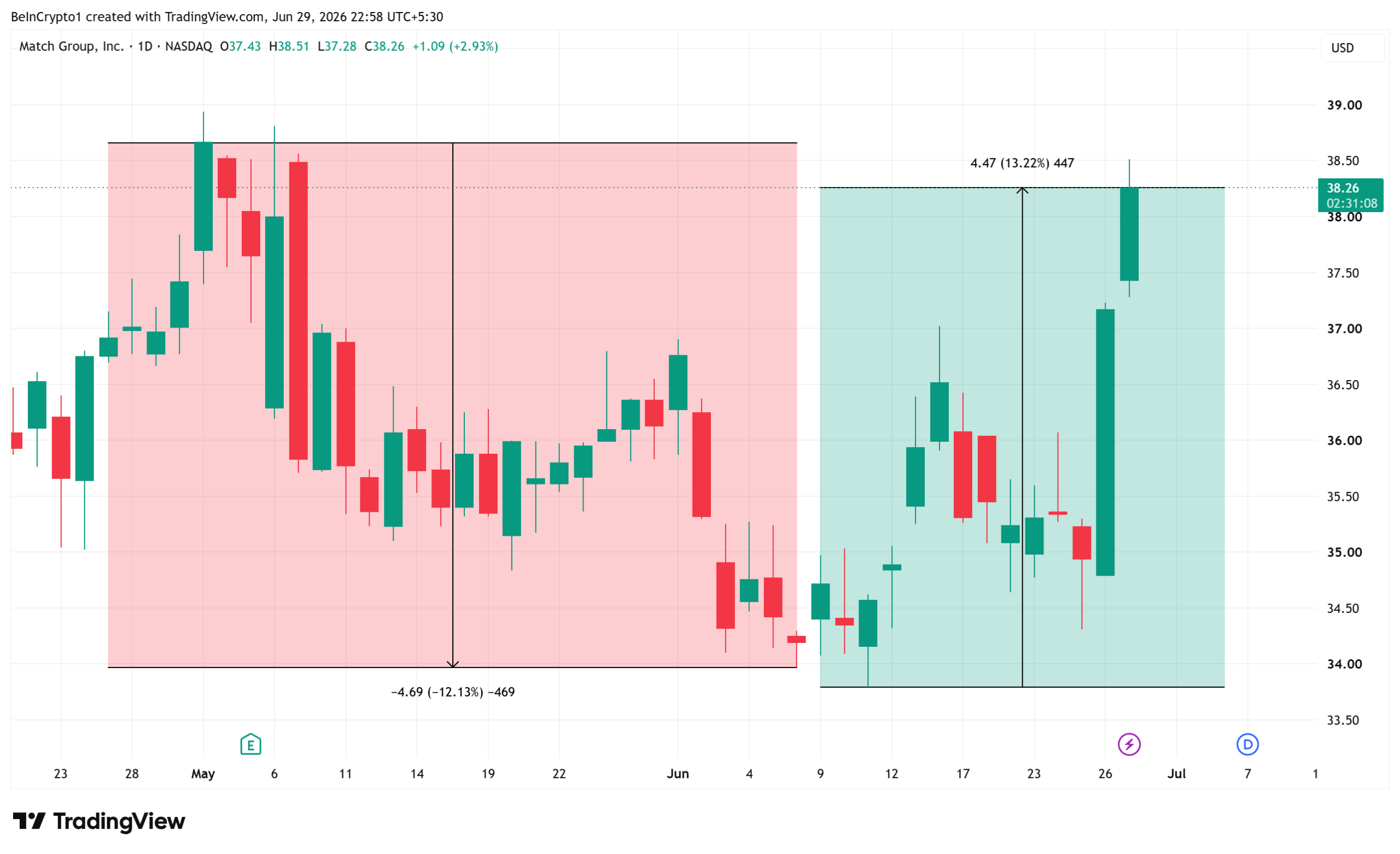
The most profitable World Cup trade this month was not a Polymarket bet on Spain or France. It was a Tinder boom that helped lift Match Group (MTCH) stock.
The stock had slumped about 12% before the tournament began on June 11. It has since climbed roughly 13%, erasing those losses and pushing back near its highs for the year.

Prediction Markets Grabbed the Headlines
Sports betting drove most of the World Cup money story. On Polymarket, the tournament winner market has drawn hundreds of millions of dollars in wagers, with Spain and France the narrow favorites.
The buzz around World Cup prediction markets was easy to see. Sector open interest hit a record $1.48 billion in mid-June as fans piled into match outcomes.
Yet the smarter equity trade ran through dating apps. Match Group, the parent of Tinder and Hinge, watched its shares rebound as fresh engagement data reached investors.
Inside Tinder’s World Cup jump
Tinder logged its gains in the tournament’s first six days, from June 11 to 16. Compared with June 2025, US matches jumped almost 60%, while total users rose 15%.
Follow us on X to get the latest news as it happens
Across the 16 host cities in the United States, Mexico, and Canada, activity from international fans climbed 47%, according to data reported by Fast Company. The figures track the influx of traveling supporters.
That timing mattered. The data circulated in late June, just as Match Group shares closed at $37.17 on June 26 after a 6.4% jump.

The Quieter World Cup Trade
The rebound lands on a longer turnaround story. Tinder had shed users for nearly two years, drawing activist investors Elliott Investment Management and Starboard Value, who pushed for change and a new chief executive.
In March, Tinder registrations returned to year-over-year growth for the first time in almost two years, while Hinge revenue grew 28%. New CEO Spencer Rascoff framed the shift in the company’s first-quarter results.
Tinder works better today than it did before. Our product changes are resonating with Gen Z and driving improvements in leading indicators.
A World Cup engagement bump fits that narrative, which is why investors rewarded it. While bettors split their money between Polymarket and Kalshi, Match Group offered a calmer way to trade the same event.
Even so, the average analyst target sits near $40, a consensus Moderate Buy that leaves limited room above current levels.
The caution is in Match Group’s own numbers. Tinder paying users still fell 5% in the first quarter, so engagement has not yet become revenue.
With the final set for July 19, the test is whether the swiping outlasts the tournament. A few traders banked millions on Polymarket, but the cleaner bet was the stock.
The post The Hottest World Cup Trade Wasn’t Sports Betting, It Was Tinder appeared first on BeInCrypto.

The EU’s Markets in Crypto-Assets Regulation (MiCA) is now shaping crypto licensing across Europe—but the rollout is uneven, with some jurisdictions moving quickly while others are still absent from the authorization map. According to an ESMA interim register compiled on Friday, Germany has issued the largest number of MiCA authorizations so far, even as the new EU framework begins to take effect this Wednesday.
ESMA’s data shows Germany has approved 57 crypto-asset service providers (CASPs) under MiCA. That figure represents about 23% of the 244 total MiCA licenses issued across the EU and EEA jurisdictions tracked in the register. France is next, with 26 CASP authorizations (around 11% of the total), placing it alongside the Netherlands as one of the bloc’s leading hubs for late-June licensing.
Key takeaways
- Germany leads MiCA authorizations: 57 CASPs approved—roughly 23% of all licenses reported in ESMA’s interim register.
- France accelerated late-June: five CASP approvals between June 18 and June 22, the highest in that specific window among the jurisdictions listed.
- Several EU states have yet to issue any MiCA licenses: ESMA interim data indicates Greece, Hungary, Poland, Portugal, and Romania reported zero authorizations as of June 26.
- Fragmentation persists before the July 1 transition deadline: implementation speed varies, despite MiCA’s aim to standardize rules across the EU.
- Regulator expectations differ: Germany’s BaFin said it is difficult to predict whether Germany’s dominance will hold as other countries’ processes mature.
Germany’s licensing lead—and what BaFin says explains it
Germany’s dominant share of MiCA-approved CASPs comes at a time when the market is preparing for MiCA’s July 1 transitional deadline. BaFin, Germany’s financial regulator, told Cointelegraph that the country’s comparatively high number of authorizations is influenced by the size of its financial sector. BaFin specifically pointed to the presence of many credit institutions, which can provide crypto-asset services under MiCA.
BaFin also highlighted a second factor: Germany’s earlier national licensing regime. Under MiCA transition rules, some providers were able to rely on simplified authorization pathways, which may have helped accelerate approvals compared with jurisdictions without the same pre-existing structures.
However, BaFin cautioned against assuming Germany will keep leading indefinitely. The regulator said it is difficult to forecast whether Germany’s dominant share will remain as MiCA implementation progresses. BaFin noted that outcomes will depend on broader market developments, innovation patterns, and the number of pending applications in each member state. It added that authorizations in other EU countries are expected to rise over time, generally tracking the size of their national financial sectors.
France pushes a late-June approval wave
While Germany leads overall, France’s recent behavior stands out for speed. ESMA interim data indicates France issued five CASP approvals between June 18 and June 22—more than any other jurisdiction in that window. In total, 11 approvals were reported across EU and EEA jurisdictions during the June 18 to June 22 period, with Malta following France with two authorizations.
Among the CASPs included among France’s approvals were Bpifrance Investissement, RCUBE Asset Management, Paymium, Leonod, and Meria.
The late-cycle rush in France matters because MiCA’s enforcement timeline is compressing the window for firms that want a fully authorized operating environment under the new regime. Even where the rules are harmonized at EU level, differences in how quickly regulators process applications can translate into real competitive advantages for providers that secure approvals earlier.
Not all jurisdictions are moving at the same pace
ESMA interim register data also shows that MiCA licensing has not yet reached every part of the EU. Five EU member states—Greece, Hungary, Poland, Portugal, and Romania—had issued no MiCA licenses as of June 26, according to ESMA.
Greece is particularly notable because Binance had applied for authorization in the country but later withdrew its application, shifting its licensing plans to another MiCA jurisdiction. (Earlier coverage from Cointelegraph reported both the application and the subsequent withdrawal.)
Poland presents a different dynamic. ESMA’s data leaves the country without a MiCA licensing framework by the time of the EU deadline, and Cointelegraph previously reported that delays in MiCA implementation legislation were followed by three reported presidential vetoes—contributing to uncertainty around the timing of regulatory readiness.
This kind of patchwork rollout underscores an important point for market participants: MiCA is intended to create a single EU-wide market framework, but regulatory capacity, domestic legislative timing, and transitional mechanics are still producing uneven outcomes. That mismatch is likely to remain a meaningful factor for businesses choosing where to seek authorization and for traders assessing which platforms may have smoother compliance paths in the run-up to full application of the rules.
Italy’s non-compliant register dominates—while others show sparse entries
Alongside the list of approved CASPs, ESMA also maintains a separate view of CASPs that are considered non-compliant. In that register, Italy dominates by far, accounting for 160 out of 162 entries as of Friday. By comparison, the Netherlands and Slovakia recorded one entry each, linked to MEXC and LWEX, respectively.
While the approved-license figures show where regulators are actively issuing authorizations, the composition of the non-compliant register hints at how unevenly firms are positioned to meet MiCA requirements—either because they are still in process, facing compliance gaps, or operating under different transitional assumptions. For providers, the practical question becomes how quickly regulators can move from non-compliant listings to approvals—and what guidance will narrow compliance uncertainty.
As MiCA’s effects roll in, the main uncertainty is whether Germany and France’s early momentum will persist or whether the authorization map will broaden as other regulators scale their processes. Readers should watch for changes in ESMA’s interim register in the days following the regime’s effective date, particularly which of the currently inactive jurisdictions begin issuing CASP licenses and whether the volume of pending applications reshapes the regional ranking.


Launching a memecoin used to be a one-time event. Now, on platforms like Pump.fun, the person who creates a token can earn a cut of every trade, potentially for as long as it trades. That single change has reshaped who launches coins, why, and how the money flows. Here is how creator fees work, how they are evolving, and where they go wrong.
Summary
- Creator fees are a share of trading activity that a memecoin launchpad routes to the person who created a token, turning a launch into a potential ongoing income stream rather than a one-time event.
- On Pump.fun, the dominant Solana launchpad, creator fees can reach a small percentage of each transaction, and the system has evolved from rewarding coin creation to trying to reward genuine trading.
- A 2026 update introduced creator-fee sharing, letting teams split fees across multiple wallets, transfer token ownership, and assign percentages to community administrators.
- The mechanic has produced a new playbook in which some creators airdrop their fees back to holders to build loyalty, while the same tools can sustain hype around a token the creator profits from.
- Creator fees align incentives in theory but introduce real risks in practice, from incentivizing spam launches to enabling fee extraction at the expense of retail traders.
Creator fees are payments that a memecoin launchpad routes to the person who created a token, taken as a small percentage of the trading activity in that token, which turns launching a coin from a one-time act into a potential source of ongoing income. This is a genuinely important shift in how memecoins work, and it is easy to miss if you only watch token prices. In the older model, someone who launched a token might profit only by holding and selling their own allocation; the act of creating the coin itself paid nothing directly. Modern launchpads changed that by sharing a slice of every trade with the token’s creator, so that a coin which trades actively can pay its creator continuously, sometimes substantially, regardless of whether the creator buys or sells.
That single mechanic reshaped the incentives of the entire memecoin economy: it changed who launches coins, why they launch them, how they behave afterward, and increasingly how communities and influencers are paid. Understanding creator fees is therefore central to understanding why the memecoin space looks the way it does. The mechanic also sits at the heart of recent flashpoints in crypto, from launchpads redesigning their fee systems to influencers pledging to airdrop their accumulated fees back to traders. To make sense of those stories, you need to understand what creator fees are, how launchpads make money around them, how the systems have evolved from rewarding mere coin creation toward rewarding real trading, the newer fee-sharing tools that let creators split and redistribute their take, the community playbook this has enabled, a concrete worked example of the money involved, and the real risks and abuses the model invites.
This guide walks through each. The goal is not to encourage launching coins or chasing fees, but to explain a mechanism that now shapes the behavior of nearly every memecoin you might encounter, so that you can read the incentives behind a token rather than just its price chart. Once you see who gets paid and how, a great deal of otherwise baffling memecoin behavior starts to make sense.
What creator fees actually are
At the simplest level, a creator fee is a cut of trading taken automatically and paid to a token’s creator. When a launchpad hosts a token, it typically charges fees on trades, and it can direct a portion of those fees to the wallet associated with whoever created the coin. Because the fee is a percentage of trading volume, the creator earns more when the token trades more, which ties the creator’s income to the activity around the coin rather than to a single sale of their own holdings. This is structurally different from the traditional way token creators made money, which was to hold an allocation and sell it, an approach that aligns the creator with dumping on buyers.
A creator fee, by contrast, pays the creator from the flow of trading itself, which in principle gives them a reason to want sustained activity instead of a quick exit. It helps to separate the creator fee from the other fees in the system, because a launchpad’s economics involve several layers. When you trade a memecoin on a launchpad, the fees on that trade can be split among multiple parties: the protocol, meaning the platform itself; the liquidity providers who supply the pool the token trades against once it has graduated to a normal market; and the creator. Each takes a defined slice.
The creator fee is the portion earmarked for the token’s originator, and on the leading Solana launchpad it can reach a small but meaningful percentage of each transaction. Multiplied across high trading volume, even a fraction of a % per trade can add up to large sums for a coin that catches fire. So the basic picture is this: every trade in a launchpad memecoin pays a toll, and one slice of that toll flows to whoever created the coin, for as long as people keep trading it. That simple arrangement is the engine behind much of what follows.
How launchpads make money around fees
To understand creator fees, it helps to understand the business of the launchpad itself, because the two are intertwined. A memecoin launchpad is, at its core, a fee machine: it earns from the enormous volume of trading that flows through the tokens it hosts, regardless of whether any individual token succeeds or fails. This is a crucial point that explains much of the industry’s behavior. The platform benefits from activity and speculation in aggregate, so its incentive is to maximize the number of coins launched and the volume traded, even though the vast majority of those coins will lose nearly all their value.
The launchpad wins on volume; the individual trader usually does not. The leading Solana launchpad illustrates the scale of this. It has captured a dominant share of Solana’s memecoin launches, on the order of three-quarters of them, and it has generated very large revenues from platform fees. Notably, it has directed the overwhelming majority of its platform revenue, well over 90%, into buying back its own token, retiring a substantial portion of that token’s supply, one of the most aggressive buyback programs in crypto.
That detail matters because it shows how the fee flows ultimately circulate: trading fees fund the platform, which funds buybacks of the platform’s token, which benefits the platform’s token holders. Creator fees are one branch of this larger fee economy, the branch earmarked for the people who create the coins. Seen this way, the whole system is an arrangement for converting speculative trading volume into revenue and distributing it among the platform, its token holders, liquidity providers, and creators. The traders supplying the volume are the source of all of it.
From rewarding creation to rewarding trading
Creator-fee systems have not stood still; they have evolved in response to the problems they created, and that evolution is instructive. An earlier generation of the dominant launchpad’s fee system, introduced in late 2025 as part of a broader program, was designed to reward successful token creators, and it worked in the sense that it pulled in a wave of new participants, many of whom had never used a crypto application before, who began launching coins to earn fees. Platform activity surged, with trading volumes reportedly doubling. But the design had a flaw that its own operators came to recognize: by rewarding the act of creating coins, it skewed incentives toward low-risk coin creation instead of toward the high-risk trading that actually sustains a launchpad’s health.
In other words, it paid people to mint tokens, which produced a flood of low-quality launches, when what the platform needed was active trading and liquidity. This led to a rethink. The platform’s operators concluded that creator fees needed to change so that they rewarded genuine trading activity and the people who provide liquidity, instead of simply rewarding deployment. They signaled a shift toward what they described as a market-based approach, in which traders, not the people deploying coins, would effectively determine whether a token’s narrative deserved fee support, moving the reward toward the activity that generates real volume.
The operators also made a pointed cultural statement, indicating that no member of the platform’s own team would accept creator fees, and framing the feature as being for the active traders the community calls trenchers. That is why who the fees are aimed at matters in the broader Solana memecoin culture. The direction of travel, then, is away from paying people merely to launch tokens and toward channeling fees in a way that supports trading and liquidity. Whether that fully works in practice is open to question, but the evolution itself reveals the central tension in creator fees: a reward meant to encourage good behavior can easily encourage the wrong behavior, and designing it well is genuinely hard.
Creator-fee sharing and the newer tools
The most consequential recent change to creator fees was the introduction, in early 2026, of a fee-sharing system that gave creators far more flexibility in how their fees are handled, and understanding it clarifies several recent headlines. Under the older model, directing fees to a specific person or address was cumbersome, and the system sometimes required users to trust others to allocate fees properly, which weakened transparency. The fee-sharing update addressed this by letting a token’s team split its creator fees across multiple wallets, up to ten of them, and assign specific percentages to each, as well as transfer ownership of a coin and revoke certain authorities over it. Importantly, the update also let community administrators, the people who take over a coin in what is called a community takeover, assign fee percentages after a token has launched, opening the fee stream to community structures instead of only the original deployer.
This may sound like a technical plumbing change, but its effects are significant. By making it easy to split and redirect creator fees, the update turned the fee stream into something that could be shared among a team, distributed to a community, or routed to specific purposes, instead of flowing solely to one anonymous creator. It enabled coordinated projects to pay multiple contributors, allowed communities that revive an abandoned coin to capture the fees, and, as the next section describes, made it practical for creators to redistribute their fees back to holders as a loyalty mechanism. The broader significance is that creator fees stopped being a simple, single-recipient reward and became a flexible tool that could be programmed to serve different incentive structures.
That flexibility is powerful, and like most powerful tools in this space, it can be used to align a community or to manufacture loyalty around a token the controllers profit from. The mechanics are neutral; the uses are not. This is why creator fees should be read as the incentive design behind tokens rather than as a simple reward feature. The question is never only whether fees exist; it is who controls them, where they flow, and what behavior they encourage.
The community playbook this enabled
The fee-sharing tools, combined with the sheer size of fees a viral coin can generate, gave rise to a new playbook that has reshaped how influencers and communities interact with memecoins. The traditional influencer-coin pattern was extractive: an influencer launches or promotes a token, the price spikes on their attention, and they sell into it, leaving followers with losses. The newer playbook inverts part of that. Instead of pocketing accumulated creator fees, some creators now airdrop portions of those fees back to the community of holders and traders, framing it as sharing the rewards with the people who drove the coin’s success.
This redistribution, returning earned fees to holders instead of extracting and exiting, has been received notably well in a culture long cynical about influencers benefiting at retail’s expense. A high-profile instance brought this playbook to wide attention when a prominent Solana influencer, amid a memecoin frenzy built on his name, publicly criticized the launchpad over its handling of rewards and pledged to airdrop his accumulated creator fees, reported in the hundreds of thousands of dollars, back to traders, framing it in the community’s own slang as giving them a boost the platform would not. That was the fee-airdrop playbook in action. The move generated goodwill and reinforced a narrative that the influencer had alignment and skin in the game.
But the same episode illustrates the playbook’s double edge. A fee-airdrop program is a truly community-friendly gesture, and it is also a powerful tool for sustaining attention and buying pressure around a token the creator holds a large position in and profits from. Redistributing fees can align a creator with holders, and it can also be a sophisticated way to keep a speculative coin alive a little longer. Both readings are valid, and the honest view is that creator-fee redistribution is a real improvement over pure extraction while remaining a tool whose ultimate effect depends on the intentions and holdings behind it.
The mechanic does not, by itself, make a memecoin safe. It may reduce one type of extraction while preserving others. It may prove genuine alignment, or it may simply extend the life of a trade that still depends on fresh buyers arriving. The difference depends on the creator’s holdings, transparency, and behavior after the airdrop.
A worked example: where the money goes
To ground the abstraction, walk through a simplified example of how creator fees flow, using round numbers for clarity instead of precision. Imagine a creator launches a memecoin on a launchpad where the creator fee is set at a small fraction of 1% of each trade, and the coin catches a wave of attention. Suppose that over a busy stretch the token does $50 million in cumulative trading volume as buyers and sellers churn through it. Even at a creator-fee rate of, say, around 0.5% of trading, that volume would generate on the order of a couple of hundred thousand dollars in creator fees flowing to the wallet associated with the coin, entirely separate from any gain or loss on the creator’s own token holdings.
This is why a single viral coin can pay its creator a life-changing sum from fees alone, and why the prospect of those fees draws so many people to launch tokens. Now layer on the fee-sharing tools. With the newer system, that creator could split the fee stream across multiple wallets, perhaps paying several contributors who help run the project, or assign a percentage to a community administrator after a takeover, or set aside a portion to airdrop back to holders. So the same $200,000 might be divided among a small team, partly redistributed to the community to build loyalty, and partly retained.
The numbers here are illustrative, not a claim about any specific coin, but they capture the real dynamic: meaningful sums, generated from the trading volume of ordinary buyers, flowing to creators and increasingly programmable into splits and redistributions. The essential point the example makes is where the money originates. Every dollar of creator fees comes from the trading activity of the people buying and selling the coin. The fee is a transfer from traders to creators, dressed up in various ways.
Understanding that is the key to reading any claim about creator fees with clear eyes, because it locates who pays and who is paid. A fee can be redistributed, split, or framed as community alignment, but it still begins as a toll on trading activity. That does not make it automatically abusive. It does mean the economic direction of the flow should be clear before anyone treats it as a benefit.
Risks, abuses, and what to watch
Creator fees, for all their cleverness, introduce a set of risks and potential abuses that anyone interacting with memecoins should understand. The first is that fees incentivize spam. When launching a coin can pay, people launch enormous numbers of low-quality coins purely to chase fees, flooding the market with tokens that have no purpose beyond generating trades, which is precisely the problem the launchpads themselves identified and tried to redesign around. The second is fee extraction layered on top of other extraction.
A creator can earn substantial fees while also holding a large token position, and the combination gives them strong tools and strong motives to pump attention around a coin, sustain trading, and benefit regardless of whether holders ultimately profit, which can shade into the pump-and-dump dynamics that critics attribute to influencer-driven micro-caps. That is where how fee extraction can shade into abuse becomes relevant. Not every creator-fee model is a rug pull, but the same environment that supports fee extraction also supports scams, liquidity drains, and insider exits. The difference often lies in wallet concentration, transparency, and whether the creator can profit while holders are left with the downside.
The third risk is trust and transparency in how fees are allocated. Because fee streams can be split, redirected, and assigned to various wallets, it is not always clear who is actually receiving a coin’s fees or what they will do with them, and earlier systems were criticized for requiring users to trust others to allocate fees properly. The fourth is that the entire structure is funded by retail traders, the people supplying the volume, most of whom lose money on the highly volatile tokens involved, while fees flow to creators and platforms regardless. There are also broader integrity questions hanging over the dominant launchpad, including a major lawsuit alleging an insider-driven system that favored privileged participants at retail’s expense, a reminder that the fee economy operates in a lightly regulated and contested environment.
The practical guidance that follows from all this is to read creator fees as an incentive structure, not a feature that benefits you. When you encounter a memecoin, ask who earns its fees, how large their position is, and whether the activity around it is organic or manufactured by people who profit from the trading. Creator fees explain a great deal of memecoin behavior, and almost none of it is designed in the interest of the trader supplying the volume. They are part of the launch mechanism fees ride on, and understanding both the curve and the fee stream is how you see the full extraction path.
Frequently asked questions
What is a creator fee in crypto?
A creator fee is a share of trading activity that a memecoin launchpad routes to the person who created a token, taken as a percentage of each trade. It turns launching a coin into a potential ongoing income stream, because the creator earns from the flow of trading instead of only from selling their own holdings. On the leading Solana launchpad, the creator fee can reach a small percentage of each transaction, which can add up to large sums for a coin that trades heavily. It is one of several fees on a trade, alongside the protocol’s cut and the fees paid to liquidity providers, and it is specifically the slice earmarked for the token’s originator.
How much can a creator earn from fees?
It depends entirely on trading volume, since the fee is a percentage of trading. For a coin that fails to attract attention, the fees are negligible. For a coin that goes viral and trades tens of millions of dollars in volume, even a fraction of a % per trade can generate hundreds of thousands of dollars in fees, separate from any gain on the creator’s own holdings. This is why viral coins can pay their creators life-changing sums from fees alone, and why the prospect draws so many people to launch tokens. The flip side is that the overwhelming majority of launched coins generate almost nothing, because most never attract meaningful trading.
What is creator-fee sharing?
Creator-fee sharing is a system introduced on the leading Solana launchpad in early 2026 that lets a token’s team split its creator fees across multiple wallets, up to ten, and assign specific percentages to each, as well as transfer a coin’s ownership and revoke certain authorities. It also lets community administrators who take over a coin assign fee percentages after launch. The effect is to turn the creator fee from a single-recipient reward into a flexible tool that can pay a team, fund a community, or be redistributed to holders. It made the fee stream programmable, which enabled new uses like airdropping fees back to a community, while also raising questions about who actually controls a coin’s fees.
Why do some influencers airdrop their creator fees?
Because it builds goodwill and a narrative of alignment. The traditional influencer-coin pattern is extractive, with the influencer selling into the hype they create. Airdropping accumulated creator fees back to holders inverts part of that, framing the influencer as sharing rewards with the community that drove the coin, which plays well in a culture cynical about influencer extraction. A prominent example saw a Solana influencer pledge to airdrop his fees back to traders during a frenzy built on his name. The honest read is that this is both a truly community-friendly gesture and a tool for sustaining hype around a token the influencer profits from, since the same move keeps attention and buying pressure alive.
Are creator fees bad for traders?
Creator fees are funded by traders, since every dollar of fees comes from the trading volume of people buying and selling the coin, so they represent a transfer from traders to creators and the platform. They also create incentives that often work against traders: they reward spamming low-quality coins, they give creators tools and motives to manufacture hype around tokens they profit from, and they fund a system in which platforms and creators earn regardless of whether holders win or lose. They are not inherently fraudulent, and redistribution can return some value to communities, but they are best understood as an incentive structure that benefits creators and platforms. That structure is funded by the speculative activity of retail traders who mostly lose.
Which launchpad pays creator fees?
The most prominent is the dominant Solana memecoin launchpad, which captured roughly three-quarters of Solana’s memecoin launches and built an elaborate creator-fee system, including the 2026 fee-sharing tools described here. It directs a small percentage of each trade to a coin’s creator and has evolved its system from rewarding coin creation toward trying to reward genuine trading and liquidity. Other launchpads on Solana and other chains have their own fee models, and the specifics vary. But the general concept, routing a slice of trading fees to token creators, has become a standard feature of the memecoin launchpad model instead of something unique to any single platform.
This article is educational information, not financial advice or an endorsement of launching or trading any token. Details of launchpad fee systems, rates, and features reflect reporting available as of June 29, 2026, and can change. Memecoins are extremely high-risk and frequently lose most or all of their value, and the fee structures described are funded by trading activity that mostly results in losses for participants. Verify current platform terms independently and consult a qualified professional before making any decision.
Strategy has unveiled a revised capital management plan that allows the company to sell part of its Bitcoin holdings to strengthen liquidity, support shareholder payouts and repurchase securities.
Summary
- Strategy has approved a new capital framework that allows up to $1.25 billion in Bitcoin sales to support dividends, cash reserves and share buybacks.
- The company raised the STRC dividend to 12% and increased its protected cash reserve to $2.55 billion while reporting no new Bitcoin purchases last week.
- The changes came after growing scrutiny of Strategy’s funding model as investors questioned its liquidity, preferred stock structure and capital raising plans.
According to a Form 8-K filed with the U.S. Securities and Exchange Commission on Monday, filed alongside the company’s latest weekly Bitcoin update, the new Digital Credit Capital Framework authorizes Strategy to monetize up to $1.25 billion worth of Bitcoin if needed.
Per the filing, proceeds may be used to increase cash reserves, fund preferred stock dividends, meet debt obligations, and buy back both preferred securities and Class A MSTR shares.
At the same time, Strategy increased the annual dividend rate on its STRC perpetual preferred stock to 12% from 11.5%. The company also disclosed that its dedicated cash reserve has reached $2.55 billion, enough to cover roughly 17 months of preferred dividends and interest payments. Under the new policy, the reserve can only be used for those obligations and must remain above 12 months of coverage unless the board approves otherwise.
Executive chairman Michael Saylor said the existing reserve, combined with the newly authorized Bitcoin monetization capacity, provides about $3.8 billion of dividend coverage, equivalent to nearly 26 months. Saylor also said Strategy intends to remain disciplined when issuing new MSTR shares, particularly when the stock trades near one times its modified net asset value, or mNAV.
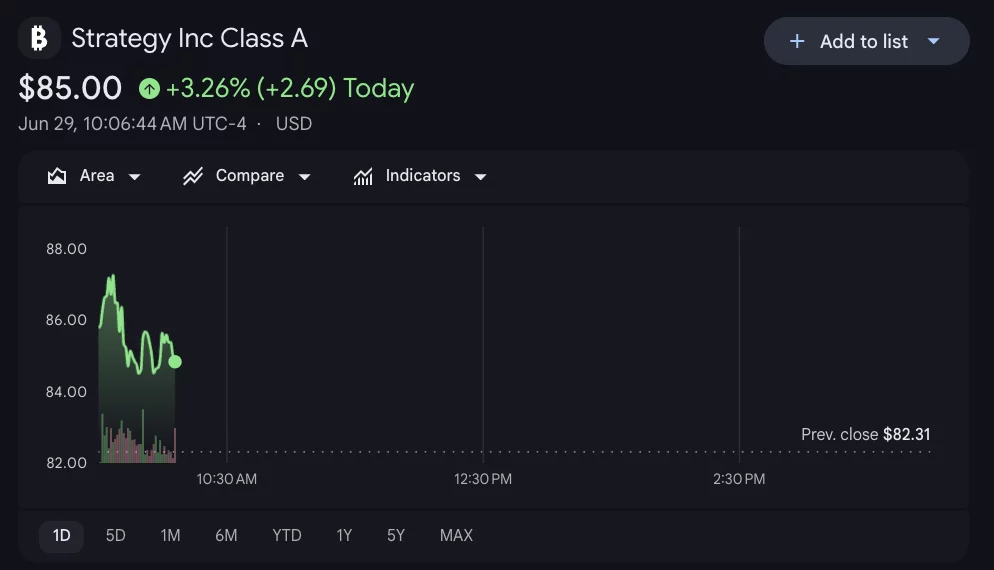
Nevertheless, Strategy shares appeared to respond positively to Monday’s announcement. Ahead of the Nasdaq opening bell, investors had pushed MSTR shares up more than 3.2% and another 2.69% in after-hours trading.
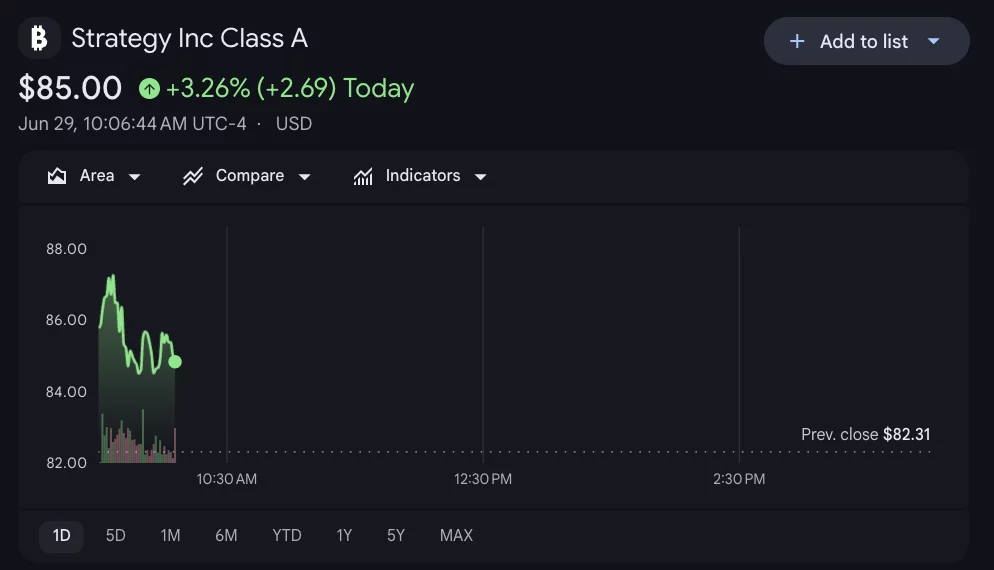
MSTR shares. Source: Google Finance.
Focus turns to liquidity instead of new Bitcoin purchases
Although Saylor had hinted at another Bitcoin acquisition over the weekend by posting Strategy’s Bitcoin tracker, the company reported no purchases during the week ended Sunday. Holdings remained unchanged at 847,363 BTC acquired for a combined $64.1 billion at an average purchase price of $75,651 per Bitcoin.
Even without a new weekly purchase, Strategy has added a net 3,625 BTC so far in June after buying 3,657 BTC and selling 32 BTC earlier in the month. The filing also showed the company raised about $1.15 billion in net proceeds through the sale of 12.67 million MSTR shares.
The revised framework follows several days of growing debate around Strategy’s funding model. Earlier this month, CryptoQuant warned that Strategy should pause Bitcoin purchases and strengthen its balance sheet, estimating that the company would need about $2.8 billion in cash to restore around two years of dividend coverage after annualized preferred dividend obligations rose to approximately $1.2 billion.
Other critics had questioned whether Strategy should continue relying on capital markets to fund Bitcoin purchases while its securities weakened. For instance, Ripple CEO Brad Garlinghouse has recently argued that issuing securities to acquire more Bitcoin does not create lasting value, while Bitcoin critic Peter Schiff suggested the company might eventually need to sell part of its Bitcoin holdings to finance share buybacks.
Strategy’s mNAV falling below 1 for the first time this cycle has also drawn attention to the economics of its fundraising model. The company had previously indicated that issuing common shares below roughly 1.22x mNAV could dilute Bitcoin per share for existing shareholders.

A wave of Solana memecoins carrying the name of influencer Ansem has gone parabolic, with one version running to tens of millions in market cap in under two weeks. But Ansem did not create most of them, has publicly disavowed several, and the eye-catching pump figures often do not survive a look at the chain. Here is what $ANSEM actually is, why it is trending, and what it teaches about influencer coins.
Summary
- $ANSEM is not a single coin but a cluster of competing Solana memecoins built around the online identity of crypto influencer Ansem, real name reported as Zion Thomas, who created none of them.
- The dominant “Black Bull” version on Pump.fun ran from a market cap in the tens of thousands to tens of millions of dollars within roughly 10 to 12 days in mid-to-late June 2026.
- Ansem amplified the frenzy by criticizing the launchpad Pump.fun and pledging to airdrop his creator fees to the community, while at the same time disavowing other $ANSEM tokens as impersonations.
- Several viral pump figures circulating on aggregator trackers did not hold up against live on-chain data, a reminder to verify the actual contract before trusting a headline number.
- $ANSEM is best understood not as a coin to buy but as a live case study in how an influencer’s name spawns a swarm of speculative and copycat tokens, and how easily retail buyers get hurt.
$ANSEM is the name shared by a cluster of competing Solana memecoins that sprang up around the online identity of the crypto influencer known as Ansem, whose real name is reported as Zion Thomas and whose verified account is @blknoiz06, and the single most important fact about it is that Ansem did not create these tokens and has publicly distanced himself from several of them. That makes $ANSEM less a single coin than a phenomenon: a recognizable name in crypto that, the moment it started trending, spawned a swarm of tokens using it, some promoted heavily, some outright impersonations, and no single official one among them. In late June 2026, one version branded as “The Black Bull” went parabolic on the launchpad Pump.fun, climbing from a market cap in the tens of thousands of dollars to tens of millions within roughly 10 to 12 days, while traders fought in what the culture calls the trenches over which $ANSEM coin, if any, was the real one. The story drew enormous attention, and it is a near-perfect illustration of how influencer memecoins actually work, who tends to benefit, and who tends to get hurt.
This guide treats $ANSEM the way it deserves to be treated: not as a coin to evaluate buying, but as a case study to learn from. Understanding it requires understanding who Ansem is and why his name carries weight, why there is no single official $ANSEM coin, how the frenzy unfolded and what catalyzed it, the disavowal and the copycats that complicate the story, the creator-fee twist that made it unusual, the gap between viral pump figures and on-chain reality, and the genuine risks that influencer memecoins carry for the people who chase them. The aim is that by the end, a reader could recognize the pattern the next time a famous name starts trending and a wall of tokens appears using it, because that pattern repeats constantly, and $ANSEM is simply its latest and loudest example. The lesson is in the mechanics, not the ticker.
Who Ansem actually is
To understand why a memecoin built on his name could run so far so fast, you have to understand the standing Ansem holds in crypto. Zion Thomas, who goes by Ansem and is sometimes called “The Solana Guy,” is one of the most-followed voices in the space, with roughly a million followers on the platform X. His reputation rests on a real track record: he was an early and vocal supporter of Solana and of memecoins like Dogwifhat and Bonk, and he is widely credited with calling Solana’s enormous 2023 rally, when the token climbed from around $8 to nearly $300. He has a background in computer science from Georgia Tech and worked as a software engineer before moving into crypto full time, and he holds a research role at an investment firm.

That combination of early correct calls, technical credibility, and a massive audience is why his name carries weight, and why a token attached to it can attract a flood of speculative buying on attention alone. But the picture is not uniformly flattering, and an honest explainer has to include the criticism, because it is directly relevant to the risks of any coin bearing his name. Ansem has drawn sustained accusations that he uses his influence to promote low-cap memecoins that spike and then collapse. In late 2024, the prominent on-chain investigator ZachXBT publicly accused him of promoting micro-cap coins in a way that resembled pump-and-dump dynamics, hyping risky tokens to a large following, watching them briefly surge, and leaving late buyers with losses.
These remain accusations rather than proven findings, and Ansem has his defenders, but the pattern they describe is exactly the danger retail buyers face with influencer coins. Notably, Ansem himself has at times acknowledged the problem: he has publicly admitted that supporting some celebrity-backed memecoins was a mistake, citing misaligned incentives that hurt retail investors. That admission is worth holding onto, because it comes from the very person whose name is now attached to a fresh memecoin frenzy, and it captures the core risk better than any outside critic could. In influencer memecoins, the audience is often the liquidity, and the audience is usually the last to understand that.
There is no single $ANSEM coin
The most common and costly misunderstanding about $ANSEM is the assumption that it refers to one coin. It does not. When Ansem’s name began trending, multiple distinct Solana tokens using the $ANSEM name appeared at the same time, and there is no single official one that Ansem created or endorsed as the canonical version. This is not unusual; it is the standard sequence in crypto. A well-known name starts trending, and within minutes a swarm of tokens appears using it, deployed by different anonymous creators all hoping their version becomes the one the market settles on.
The result was a chaotic competition, with the trading community flipping between rival $ANSEM coins and no clear winner crowned as the real one for a stretch, a dynamic participants describe as a player-versus-player battle in the trenches. Out of that scramble, one version did come to dominate the narrative: a coin branded as “The Black Bull,” launched on the Pump.fun launchpad in mid-June 2026, which became the token most associated with the headlines as it ran to tens of millions in market cap. Even so, the existence of that dominant version does not change the underlying reality that the name was contested and that other $ANSEM tokens continued to circulate alongside it, including ones Ansem explicitly disavowed. For anyone encountering the trend, the practical implication is severe: there is no safe assumption that a token labeled $ANSEM is the one being discussed, is endorsed by Ansem, or is anything other than an opportunistic deployment by a stranger.
The name on the token tells you almost nothing about who made it or whether it is connected to the person it references. That single fact, that the name is not the coin, is the first and most important thing to internalize about $ANSEM and about every influencer memecoin like it. This is whyverifying contracts and accounts matters before believing any viral ticker. A famous name can become a trap when anyone can attach it to a contract.
How the frenzy unfolded
The timeline of the $ANSEM surge shows how quickly attention converts into market cap in this corner of crypto, and what lit the fuse. The dominant Black Bull version gained real traction around the middle of June 2026 and then, over roughly 10 to 12 days, went parabolic, rising from a starting market cap reportedly in the tens of thousands of dollars to a level above $50 million and then $60 million at its peak, accompanied by gains measured in thousands of %. On-chain trackers recorded enormous short-window moves, with one tracker reporting a single-day surge of well over a hundredfold at one point, the kind of move that draws the entire trading community’s attention and pulls in waves of new buyers chasing the run.
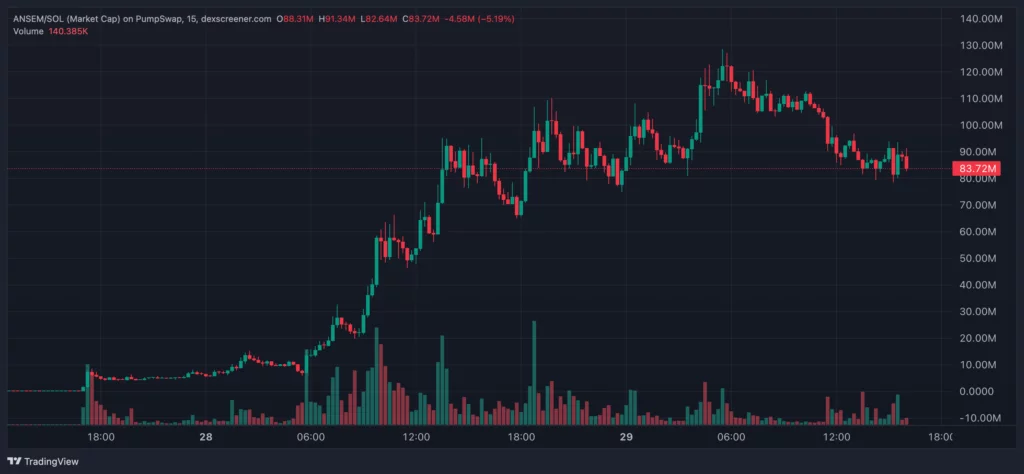
A specific catalyst supercharged the move. Ansem publicly criticized Pump.fun over how it handled rewards to users, and declared that he would deliver a financial boost directly to retail traders, a gesture he framed in the community’s own language. In a widely shared post on June 28, 2026, he wrote that he “had to give the trenches a stimmy since pump refuses to,” using slang for handing money to on-chain traders. That narrative, an influencer taking the side of small traders against the platform, spread rapidly across crypto social media and triggered a fresh wave of speculative buying that lifted the token’s valuation further.
The frenzy also minted dramatic individual outcomes that became their own marketing: in one widely reported case, a trader who put roughly $2,300 into an ANSEM-named token saw the position balloon to more than $600,000 after a parabolic rally, a return of tens of thousands of %. Stories like that, true but extraordinarily rare, are exactly what pull more people into the next frenzy, which is why they deserve to be read with as much caution as excitement. The setup also show how the launch pricing worked, because these early Solana memecoin moves often begin on bonding curves before attention pushes them toward graduation or collapse. The bigger the screenshot gain, the more important it becomes to ask who bought before the crowd and who is left buying after the move.
The disavowal and the copycats
Running directly against the bullish narrative is a fact that anyone tempted by $ANSEM needs front and center: Ansem publicly disavowed tokens trading on his name. According to posts reported from his verified account, he distanced himself from the activity, indicating that the coin being promoted was not him and that he was not endorsing any micro-cap tokens, and he clarified that he had only linked his account to a launchpad address to prove that he could, not to bless any particular coin. In other words, the person whose name was driving tens of millions of dollars in speculative value was, at the same time, telling people he had not created these tokens and was not endorsing them. That is a glaring contradiction at the heart of the trend, and it is the single clearest warning sign attached to it.
The disavowal points to the deeper pattern, which is the real lesson of $ANSEM. A recognizable crypto name reliably spawns a cluster of copycat and impersonation tokens, the overwhelming majority of which the named person never touched, because on a permissionless launchpad anyone can deploy a token and call it whatever they want. The Ansem case is a textbook instance: a swarm of $ANSEM tokens, no official one, and the real Ansem distancing himself from the activity even as it raged. The danger goes beyond merely buying the wrong version.
Ansem’s identity has been abused by outright impersonators before; reports describe a 2024 impersonation that phished roughly $2.5 million from victims, an event that had nothing to do with Ansem himself but used his name and likeness to steal. The takeaway is blunt: when a name is trending, impersonation and copycatting are not edge cases but the norm, and a token carrying a famous name should be treated as unaffiliated and unsafe until proven otherwise, a standard that becomes absolute when the person has publicly disavowed it, as Ansem did. The same pattern has appeared around other high-profile names and brands, including fake tokens designed to mimic official launches. That is why the first question should never be “how much is it up?” but “who actually created this contract?”
The creator-fee twist that made it unusual
One feature did set the $ANSEM episode apart from the typical influencer-coin story and helps explain both its momentum and the debate around it. Rather than simply launching his own token to capture the speculative interest, which is the usual influencer playbook, Ansem leaned into a different mechanic tied to how the Pump.fun launchpad pays out fees. Pump.fun routes a share of trading fees to a token’s associated creator account, and screenshots of Ansem’s launchpad profile indicated he had accumulated substantial creator fees, reported in the area of several hundred thousand dollars. In response to community suggestions, he announced that, instead of pocketing those fees, he would airdrop portions of them back to the community of traders, framing it as giving the trenches the boost the platform would not.
This redistribution, returning earned fees to holders rather than extracting and exiting, was received notably well in a culture used to influencers benefiting at retail’s expense, and it reinforced the narrative that Ansem had “skin in the game.” Indeed, reporting on his launchpad wallet suggested a very large exposure to the token, with a holding worth tens of millions of dollars making up the overwhelming majority of that wallet’s value. Supporters read this as alignment: the influencer profiting only if holders profit. Skeptics read it differently, noting that a huge personal position and a fee-airdrop program are also powerful tools for sustaining hype around a token the influencer benefits from, and that the same dynamics ZachXBT criticized, an influencer’s attention inflating a coin’s price, are present whether or not fees are shared.
Both readings can be true at once. The creator-fee twist made $ANSEM a more interesting and arguably more community-friendly episode than the average influencer coin, but it did not remove the underlying risk that the value rests on one person’s attention and could evaporate the moment that attention moves on. For context, the fee airdrop at the center of it belongs to a broader memecoin-launchpad incentive system where creators can earn from trading activity. Fee sharing can create alignment, but it can also keep attention locked on a coin long enough for others to exit.
The gap between the pump figures and the chain
A practical skill that the $ANSEM episode teaches, and one worth far more than any single trade, is the habit of checking on-chain reality against viral headline numbers, because the two frequently diverge. Some of the most eye-catching figures circulating during the frenzy, such as a roughly 1,900% single-day gain alongside a multi-million-dollar market cap, came from aggregator trackers and did not hold up when checked against live blockchain data. In at least one case, the token most associated with a headline pump turned out, on inspection, to be a coin dating to 2024 that had retraced to a market cap of only tens of thousands of dollars, with thin liquidity and minimal daily volume, a brief pump and fade instead of a sustained multi-million-dollar coin. Public data even dated that token’s all-time high to early 2024, which sat oddly with a supposedly brand-new 2026 surge.
The lesson is concrete and repeatable: never take an aggregator pump figure at face value without finding and verifying the actual contract address and reading the token’s real holder and liquidity profile. Aggregator trackers can display figures for tokens that are barely traded, can attach a trending name to the wrong contract, and can report point-in-time spikes that have already collapsed by the time a reader sees them. The discipline that protects you is to identify the specific contract, confirm it against the real person’s verified account where relevant, and screen it for safety using on-chain tools before believing any number attached to it. On Solana, traders commonly use a token-safety screener and a dedicated risk checker to read holder distribution, liquidity depth, and contract red flags before acting.
This habit, verifying the chain instead of trusting the headline, is the single most valuable thing the $ANSEM frenzy can teach, because it applies to every trending name that will follow. The same lesson appears whenever scammers reuse well-known names, whether they imitate a celebrity, a protocol, or a market-data brand. A ticker is not identity, and a chart is not verification. The chain is where the claim has to survive.
A worked example: telling the real from the fakes
To make the lesson usable, walk through how a careful person would have navigated the $ANSEM trend in real time, because the same steps apply to any influencer-name frenzy. Suppose you see the name $ANSEM trending and a post claiming a particular token is the official Ansem coin, up thousands of %. The first step is to assume nothing: a trending name attached to a token is, by default, unaffiliated until proven otherwise. The second step is to find the actual contract address being promoted, not just the ticker, since dozens of tokens can share the name $ANSEM while having entirely different contracts.
The third step is to check the real person’s verified account directly. In this case, doing so would have surfaced Ansem’s own posts distancing himself from tokens trading on his name and stating he was not endorsing micro-caps, which is a decisive red flag against treating any of them as official. The fourth step is to screen the specific contract on a Solana safety tool, reading the holder distribution, the liquidity, and any contract warnings. A token where a tiny number of wallets hold most of the supply, or where liquidity is thin, is one where a few holders can crash the price at will.
The fifth step is to compare the on-chain figures with the viral claim; if the chain shows a token that has already retraced to a fraction of the headline market cap, the claim is stale or misleading. Running these steps during the $ANSEM frenzy would have revealed exactly the situation this guide describes: multiple competing tokens, no official one, a disavowal from the named person, and headline figures that the chain did not support. The point of the exercise is not that doing this guarantees a profitable trade; it is that it protects you from the most common and costly mistakes, which are buying an impersonation, chasing a stale pump, or trusting a famous name as if it were due diligence.
The worked example is really a checklist for skepticism, and skepticism is the only durable edge in this part of crypto. When a token’s story rests on a famous name, the burden of proof should be higher, not lower. If the contract, liquidity, holder distribution, and verified account do not line up, the safest conclusion is that the coin is not what the crowd says it is. That is especially true when the person whose name is being used has already denied involvement.
Risks: why a name is not a reason to buy
Stepping back, $ANSEM concentrates nearly every risk that makes influencer memecoins dangerous, and naming them plainly is the most useful thing this guide can do. The first is extreme volatility: tokens like this can rise thousands of % and fall just as fast, and a coin that is up a hundredfold one day can be down 90% the next, with most such tokens ultimately trending toward zero. The second is the copycat and impersonation problem already described, where the name on a token tells you nothing about who made it, and where buying the wrong contract or an outright scam is a constant hazard. The third is the disavowal itself: when the person a coin is named after publicly states it is not theirs and that they do not endorse it, that is not a detail to trade around but a signal that the coin’s entire premise is unsupported.
The fourth risk is the pump-and-dump dynamic that critics, including ZachXBT, have attributed to influencer-driven micro-caps, where attention inflates a price that collapses when the attention moves on, leaving late buyers holding losses, a pattern Ansem himself has acknowledged can hurt retail. The fifth is the absence of any fundamental value: these tokens have no product, no cash flow, and no utility; their price is pure attention and speculation, which makes them closer to gambling than investing. That is also the scam pattern to watch for in celebrity or influencer-linked micro-caps, even when the token does not follow a classic liquidity-drain rug. The underlying danger is that attention becomes the product and late buyers become the exit.
The honest framing, which the responsible sources on this episode share, is that there is no official Ansem coin to buy, that any token using the name should be assumed unaffiliated until proven otherwise, and that chasing a celebrity name on vibes alone is among the fastest ways to lose money in crypto. None of this is a judgment of Ansem personally, who has at times warned about these very dynamics; it is a description of how the mechanism works and whom it tends to harm. The name is the bait. It is not, and never is, a reason to buy.
Frequently asked questions
Is there an official $ANSEM coin?
No. There is no single official $ANSEM coin created or canonically endorsed by Ansem. When his name began trending, multiple distinct Solana tokens using the $ANSEM name appeared at once, deployed by different anonymous creators, and Ansem publicly distanced himself from tokens trading on his name, indicating he was not endorsing micro-caps. One version branded “The Black Bull” came to dominate the headlines after running to tens of millions in market cap, but its prominence does not make it official, and other $ANSEM tokens, including impersonations, circulated alongside it. The safe assumption is that any token using the name is unaffiliated until proven otherwise.
Who is Ansem?
Ansem, whose real name is reported as Zion Thomas, is a prominent crypto influencer with roughly a million followers on X, sometimes called “The Solana Guy.” He has a computer science background and a research role at an investment firm, and he built his reputation as an early supporter of Solana and memecoins, widely credited with calling Solana’s 2023 rally from around $8 to nearly $300. He is also a controversial figure: the investigator ZachXBT accused him in 2024 of promoting low-cap memecoins in a pump-and-dump-like pattern, and Ansem has himself admitted that supporting some celebrity-backed memecoins was a mistake due to misaligned incentives that hurt retail investors.
Why is $ANSEM trending?
A combination of factors. Ansem’s name carries weight after years of influence and a famous correct call on Solana, so tokens using it attract attention automatically. The frenzy accelerated when he publicly criticized the launchpad Pump.fun over its handling of rewards and pledged to airdrop his accumulated creator fees back to traders, framing it as giving the community a boost the platform would not. That narrative spread quickly, dramatic individual gains became their own marketing, and the dominant version ran to tens of millions in market cap. The trend sits within a broader meta of influencer-linked memecoins on Solana, where a famous name plus social momentum can move a token enormously in days.
How do I avoid buying a fake influencer coin?
Treat any token bearing a famous name as unaffiliated until proven otherwise. Find the specific contract address being promoted, not just the ticker, since many tokens can share a name. Check the real person’s verified account for whether they actually launched or endorsed it; a disavowal, as with Ansem, is a decisive red flag. Screen the contract on a Solana safety tool to read holder distribution and liquidity, watching for a tiny number of wallets holding most of the supply or thin liquidity. Compare on-chain figures against viral claims, since aggregator pump numbers often do not match reality.Never treat a celebrity name as a substitute for verification. Famous names are exactly what scammers and opportunistic deployers use because they create instant attention. The safest first assumption is that the token is not official unless the person or project proves otherwise from a verified channel. Even then, the contract itself still needs to be checked.
Is $ANSEM a good investment?
This guide does not recommend buying it or any memecoin, and the honest answer is that $ANSEM carries the full set of risks that make influencer memecoins dangerous. It has no product, cash flow, or utility; its price is pure attention and speculation. It is extremely volatile, with most such tokens trending toward zero. There is no official version, copycats and impersonations are rampant, and the named influencer publicly disavowed tokens using his name.Critics have described influencer micro-caps like this as prone to pump-and-dump dynamics that harm late buyers. Treat any participation as high-risk speculation closer to gambling than investing, and never risk money you cannot afford to lose. The educational value of $ANSEM is not that it offers a clean trade, but that it shows how influencer-name tokens form, spread, and hurt careless buyers.
This article is educational information, not financial advice or an endorsement of any token. Details about $ANSEM, Ansem, market caps, and on-chain figures reflect reporting available as of June 29, 2026, are point-in-time, and can change rapidly. Memecoins are extremely high-risk and frequently lose most or all of their value. References to individuals reflect reported information and, where noted, unproven allegations. Verify any contract independently and consult a qualified professional before making any decision.
The fate of the US Digital Asset Market Clarity (CLARITY) Act has become harder to predict as lawmakers head into another round of state work periods and President Donald Trump disrupts the legislative calendar by delaying related signings.
After clearing the US House in July 2025 and advancing through the Senate Agriculture Committee and Senate Banking Committee in January and May respectively, the CLARITY Act is still positioned for Senate consideration—potentially as early as July. But recent presidential actions and broader concerns inside Congress, particularly around ethics and how the bill treats stablecoin-related issues, have introduced fresh uncertainty for investors and crypto businesses waiting for regulatory clarity.
Key takeaways
- The CLARITY Act passed the US House in July 2025 and advanced through two Senate committees on party-line votes, but its path to the full Senate remains exposed to scheduling and political conditions.
- President Donald Trump canceled a signing ceremony for a separate housing bill that includes a CBDC ban, tying his signature to passage of the SAVE America Act—adding unpredictability to the legislative outlook.
- Senate Republican leaders have said they want a CLARITY vote in July, but Democrats’ demand for ethics provisions could complicate the math.
- With the Senate needing 60 votes to proceed on many matters, any failure to reach that threshold before August could push debate into the next Congress.
- Senator Cynthia Lummis said the bill’s latest work focuses on areas including DeFi, illicit finance, and ethics, with lawmakers aiming to release text around July 4 before moving forward in July.
CLARITY’s stalled momentum enters a tighter window
Since its House passage in July 2025, the CLARITY Act has faced a series of internal and stakeholder challenges that delayed a clean march toward the Senate floor. According to earlier reporting, it has drawn pushback from parts of the industry, including around stablecoin rewards, while also attracting scrutiny from lawmakers concerned about ethics.
Procedurally, the bill advanced in the Senate in steps. It cleared the Senate Agriculture Committee in January and the Senate Banking Committee in May, with those panels voting along party lines. That movement placed CLARITY on a path toward potential full-chamber consideration, but the calendar has continued to matter as much as the votes themselves.
Now, with the US Senate scheduled to be out of Washington, DC and in state work periods until July 13, Republican leaders are effectively working with a shortened window to move the bill before an August state break lengthens the delay risk.
Trump’s broader legislative pause clouds the near-term outlook
While Trump’s comments and actions concerned a different piece of legislation, they still ripple into how the CLARITY timeline is being interpreted across Washington.
Trump canceled the signing ceremony for the 21st Century ROAD to Housing Act—reportedly because it contains a ban on central bank digital currencies (CBDCs). The president said he would not sign the bill until Republicans in Congress pass the SAVE America Act, which would require voters to provide proof of US citizenship in person to register.
Trump also indicated in March that he would “not sign other bills” until SAVE America is enacted. If that stance extends to the CLARITY Act or related legislative efforts, the bill’s timing could face further complications, even if the Senate reaches agreement.
The question then becomes whether Trump would ultimately sign CLARITY if it lands on his desk. The Constitution provides a mechanism if a president neither signs nor vetoes a bill within 10 days while Congress is in session: the measure would automatically become law. Otherwise, if Trump vetoes CLARITY, Congress could still override him with a two-thirds vote in both chambers.
That framework means the clock is not only about Senate scheduling; it is also about how quickly CLARITY could reach Trump’s desk in a Congress that is already planning around recurring legislative breaks.
Senate Republicans press for a July vote—but ethics demands raise the stakes
Senate Republicans have publicly argued for momentum. Republican leaders, including Senate Banking Committee chair Tim Scott and majority leader John Thune, said they are pushing to pass CLARITY in July.
However, passing legislation in the Senate is rarely just about whether a bill exists—it is also about whether the coalition can meet the thresholds required for floor action. With Republicans holding a slim majority, the Senate often needs some level of Democratic support to move quickly. Many Democratic lawmakers have pushed for ethics provisions in CLARITY.
Those demands have been tied to broader concerns about potential conflicts of interest, referencing reporting about the Trump family’s connections to the crypto industry through the president’s memecoin and his sons’ involvement in the World Liberty Financial platform and a Bitcoin mining company.
If Republicans are unable to secure the support needed to reach the Senate’s 60-vote threshold before the August state work period, experts cited in earlier coverage expect passage could slip into the next Congress—potentially 2027. For stakeholders, that matters because “clarity” delayed can be nearly as costly as clarity denied: businesses may continue operating under patchwork enforcement, and market participants may remain cautious until rules stabilize.
Where the bill stands: DeFi, illicit finance, and the push to release text
Even as scheduling becomes the central political variable, lawmakers have also continued to refine the substance. Senator Cynthia Lummis, a prominent CLARITY proponent, told Fox Business that negotiations have been ongoing for months and emphasized that the bill’s remaining work includes multiple contentious areas.
In comments published last week, Lummis said lawmakers are still working on “DeFi,” “illicit finance,” and “ethics,” describing the process as arduous. She added that the goal is to put out the bill’s text around July 4 so “people” can review it thoroughly, followed by movement in July.
“We’re still working a little bit on DeFi, we’re working [on] illicit finance, we’re working [on] ethics [..] We’re finally to the point where we’re going to put out the text over the July 4th, and give people one last really thorough look at the bill, and then we’re moving in July.”
That sequencing is significant. Releasing draft text close to a major holiday can compress the time for stakeholders to analyze changes and for lawmakers to negotiate amendments—while also signaling that the bill is still not “final-final.” For investors and builders, that implies the next few weeks could feature meaningful edits rather than mere procedural motion.
At the same time, ethics-focused amendments remain a live wire. If Democrats insist on changes tied to conflict-of-interest concerns and Republicans resist, the Senate’s ability to reach a supermajority—or even to command broad enough support for the path to proceed—could remain uncertain right up to the critical vote window.
What to watch next
Readers should watch whether Senate leaders stick to a July push before the July 13 break, and—just as importantly—what changes appear when CLARITY text is released around July 4. The ethics negotiations will likely determine whether the coalition can clear the Senate’s 60-vote hurdle, while Trump’s broader willingness to sign or hold other bills may influence how investors think about timing after the Senate acts.
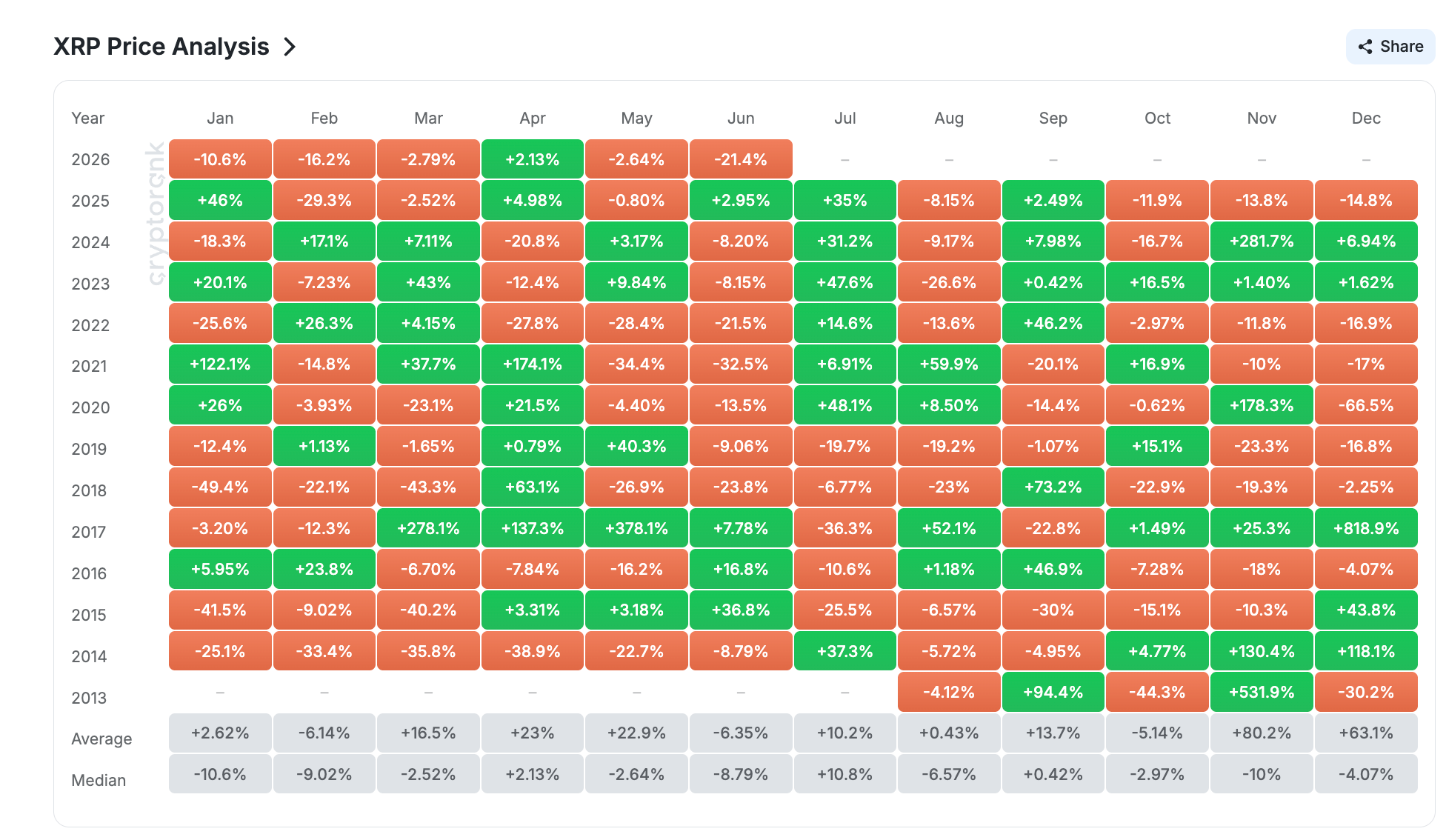
XRP (XRP) price trades near $1.05, caught between a year-long downtrend and a sudden burst of buying.
July has historically rewarded XRP holders. This year the month arrives with on-chain accumulation and steady institutional flows, raising the question of whether they can finally crack a falling channel.
XRP Price Eyes a Bullish July as the Falling Channel Tightens
History gives bulls a reason to watch. July is one of XRP’s strongest seasonal months, with an average return near 10% and a median close to 11%. May behaved as expected, slipping 2.64% in line with its median, before June sold off hard.

That seasonal hope meets a difficult chart. Since mid-July last year, the XRP price has traded inside a falling channel. Each attempt to reach the upper boundary has failed.
Want more token insights like this? Sign up for Editor Harsh Notariya’s Daily Crypto Newsletter here.
The 20-period Exponential Moving Average (EMA), a trend gauge that weights recent prices more heavily, sits at the center of those failures. On the three-day chart, price reclaimed it on January 4 and again on May 13, only to be rejected near the upper trendline both times.

Now the 20-period EMA rests directly on that upper trendline. A break would clear both barriers at once. Volume offers a quieter clue. Selling pressure has faded since early June even as price drifted lower, a possible sign that downside conviction is thinning. A bearish crossover, a key headwind, with the 100-period EMA slipping under the 200-period, has concluded.
Seasonality and structure set the stage, but flows show whether anyone is acting on them.
Exchange Outflows and ETF Inflows Build a Demand Base
The clearest shift is on-chain. The exchange net position change, a metric that tracks tokens moving in and out of exchanges, has turned sharply negative. A deeply negative reading suggests coins are leaving exchanges, which often points to accumulation rather than selling.
On June 22, the figure stood near 40.7 million XRP. It has since deepened to roughly 123 million XRP, an increase of about 200% that nearly tripled the outflow in days. The data suggests buyers may be pulling supply off exchanges with intent.

Institutions appear to share the bias. XRP ETF inflows have now run positive for eight straight weeks, with the week of June 26 adding $22.99 million and cumulative net inflows reaching about $1.47 billion. That steady drip gives XRP a base of committed demand.

With spot and institutional flows aligning, the price chart becomes the decider.
XRP Price Prediction for July 2026 and the Levels That Decide It
The first hurdle is the 0.382 Fibonacci level near $1.18 ($1.178 to be exact). Above it sits the 20-period EMA around $1.22, the level that has capped every recent bounce.
The cost basis heatmap, which maps where supply was last acquired, reinforces both. Roughly 22.8 million XRP cluster at the $1.18 to $1.19 band, and about 27.4 million XRP sit between $1.21 and $1.22.

Those are supply walls where trapped holders may sell to break even.
A clean break of $1.18 followed by $1.22 would lift XRP out of its bearish channel into neutral territory, validating the on-chain accumulation thesis.

The downside is just as defined. Immediate support sits at the 0.5 Fibonacci level near $1.02. A 3-day candle loss there opens the 0.618 level around $0.87 and weakens the bullish case.

One caveat matters. The fading sell volume is a hint, not a signal. A rejection at $1.18 on weak follow-through would keep the channel intact. The $1.18 level separates a seasonal July recovery from another leg lower toward $0.87.
The post XRP Price Prediction for July 2026: Can Buyers Finally Break the Downtrend? appeared first on BeInCrypto.

Crypto markets have continued to attract regulators worldwide, with new rules and enforcement actions spanning exchanges, social media promotions, and stablecoin infrastructure. In Singapore, the Monetary Authority of Singapore (MAS) added decentralized perpetuals platform Hyperliquid to its Investor Alert List, while Indonesia introduced certification requirements for influencers promoting crypto and other digital financial assets.
Meanwhile, South Korea fined Bithumb after it was found to have transferred user data overseas without separate consent, and Japan advanced mainstream exchange consolidation as SBI Holdings agreed to acquire Bitbank in a 46.7 billion yen (about $289 million) deal. Elsewhere, stablecoin projects also moved closer to wholesale finance use cases through new initiatives involving banks and financial institutions.
Key takeaways
- MAS inclusion on Singapore’s Investor Alert List flags potential consumer-protection concerns, not a prohibition or enforcement action.
- Indonesia’s new 2026 regulation requires qualified certification for “finfluencers” promoting crypto, alongside tighter limits on which assets and exchanges can be promoted.
- South Korea’s Personal Information Protection Commission fined Bithumb for transferring personal information overseas without separate consent during order book sharing and asset transfer.
- SBI’s Bitbank acquisition, expected to close around October subject to approval, would strengthen SBI’s position in Japan’s exchange and custody landscape.
- Stablecoin infrastructure efforts are increasingly focused on FX settlement and wholesale financial plumbing rather than consumer payments.
Singapore flags Hyperliquid on the Investor Alert List
On Friday, Singapore’s financial regulator MAS added Hyperliquid to its Investor Alert List. According to the listing, the entry includes the Hyper Foundation website and the Hyperliquid trading app.
MAS positions the Investor Alert List as a consumer protection tool designed to identify entities that might be misunderstood as licensed or regulated by MAS. Importantly, inclusion on the list does not indicate a ban or signal that enforcement action has been taken.
MAS has been expanding the list across recent months. The regulator added Bybit on June 17, and other crypto-related platforms—such as KuCoin and Bitget—appear on the list as well.
Hyperliquid responded by saying it has never claimed it is licensed or authorized by MAS and that nothing about its permissionless infrastructure has changed. For users, the practical effect is less about service disruption and more about clarifying how the platform is perceived in relation to Singapore’s regulatory oversight.
Indonesia tightens crypto influencer promotions with certification rules
Indonesia’s Financial Services Authority introduced certification requirements aimed at influencers who recommend crypto and other digital financial assets. Under Financial Services Authority Regulation No. 6 of 2026, announced Wednesday, individuals promoting digital assets must obtain competency certifications unless they are already covered by a separate licensing requirement.
The regulation also restricts what influencers can recommend: they may promote only digital assets listed on authorized exchanges. Service providers promoted by influencers must also be licensed. In addition, marketing campaigns must be carried out through regulated financial services businesses, which are responsible for the promotional content and must distribute it through their official communication channels.
These changes align Indonesia with a broader global trend. The rules mirror tightening approaches already underway in jurisdictions such as Australia and the United Kingdom, which have introduced broader controls for investment promotions and finfluencer activity, and the Philippines, which has adopted crypto-specific marketing restrictions.
For the Indonesian market, the key question now is how compliance will be implemented in practice—particularly how certification is obtained, enforced, and verified, and how platforms and promoters will ensure that promoted assets and counterparties match the authorized framework.
South Korea fines Bithumb for overseas transfer of user data
South Korean authorities moved from market oversight into direct privacy enforcement. According to a Thursday notice from the Personal Information Protection Commission (PIPC), Bithumb was ordered to pay a fine of $136,000 after investigators found the exchange breached personal information protection rules when it sent user data overseas.
The PIPC said its investigation determined Bithumb “transferred personal information overseas without the separate consent of the data subjects” during order book sharing and virtual asset transfers with overseas virtual asset exchanges.
The incident, as described by the regulator, relates to Bithumb sharing its Tether (USDT) order books between September and November 2025 with BingX, despite having consent to share data with Stellar. The PIPC also cited Bithumb sharing user information with 13 overseas exchanges.
Regulatory consequences in this area matter beyond a single exchange: data-transfer practices are a core operational issue for firms operating globally or linking liquidity across venues. The case underscores that “consent” can be treated as specific and separate for particular counterparties and use cases—not a one-time blanket approval.
SBI’s Bitbank acquisition and the push for institutional crypto infrastructure
In Japan, consolidation continues. Japan’s SBI Holdings has signed agreements to acquire full control of crypto exchange Bitbank through a transaction valued at 46.7 billion yen (about $289 million), advancing an earlier deal first disclosed in May. SBI expects the transaction to close around October, subject to regulatory clearance.
The deal would expand SBI’s regulated crypto exchange footprint and customer base. It also suggests potential cross-sell opportunities around stablecoins, tokenized assets, and onchain financial products—areas where large, regulated institutions typically seek additional distribution channels.
CoinGecko data shows Bitbank’s daily trading volume has generally stayed below $50 million for most of the past four months, with the BTC/JPY pair accounting for 39.5% of volume. XRP/JPY and ETH/JPY each accounted for 19.7%. SBI said combining Bitbank with SBI VC Trade would yield about 1.1 trillion yen in assets under custody and roughly 2.92 million crypto accounts, positioning the combined business as the largest Japanese crypto exchange group.
Stablecoins move further into FX settlement experiments
Beyond exchanges and marketing rules, institutional use cases are also advancing. Chainlink said it joined a working group with European and South Korean banking organizations to explore how stablecoins could be used for foreign exchange (FX) settlement.
Announced as Project Pangea, the initiative brings together multiple participants: South Korean digital asset infrastructure provider FairSquareLab; the Unified Korea Alliance (UniKA), a consortium that includes more than a dozen Korean commercial banks; and Qivalis, a euro stablecoin consortium backed by 37 European banks. The project’s goal is to evaluate direct, atomic swaps of euro- and South Korean won-denominated stablecoins using Chainlink’s data infrastructure alongside FairSquareLab’s onchain FX settlement technology.
This continues a notable shift in how stablecoins are being tested by finance: rather than focusing solely on consumer payment rails, institutions increasingly evaluate stablecoins for wholesale settlement and back-office infrastructure.
Readers should watch for how regulators operationalize these new frameworks—especially Indonesia’s influencer certification requirements and privacy enforcement approaches in Asia—as well as whether Japan’s Bitbank deal progresses on schedule and whether FX settlement pilots involving stablecoins transition from experiments into regulated deployments.
Crypto World
Amazon (AMZN) Stock Surges Nearly 5% on Record Prime Day Sales and Bullish Analyst Upgrades

Key Highlights
- Amazon shares climbed as high as 4.8% during Monday’s session following a record-breaking Prime Day that saw consumer spending reach $26.4 billion, marking a 9.3% increase compared to last year.
- Wells Fargo initiated coverage with a buy recommendation and set a $312 price target, implying approximately 35% potential upside from the current trading range near $232.
- Citizens JMP reaffirmed its Market Outperform stance with a $315 target, highlighting robust artificial intelligence infrastructure demand.
- Amazon Web Services announced a 20% hourly GPU rate increase starting July 1, signaling strong cloud computing pricing authority.
- Major enterprise clients are securing 3-to-5-year AWS capacity agreements, which Wall Street analysts view as a positive indicator for revenue stability and margin expansion.
Amazon (AMZN) shares surged by as much as 4.8% during Monday’s trading session, reaching an intraday peak of $246.76 after starting the day at $234.21. The significant upward movement followed a confluence of positive developments across both the company’s e-commerce and cloud computing divisions.
The company’s extended Prime Day promotional event concluded its four-day span with record-breaking consumer expenditure totaling $26.4 billion, representing a 9.3% year-over-year growth, based on data from Adobe Analytics. This year’s strategic calendar adjustment moved the shopping event from its traditional July slot to June, deliberately avoiding scheduling conflicts with major events including the FIFA World Cup and America’s 250th Independence Day celebrations.
This calendar realignment also capitalized on peak summer vacation spending patterns and early back-to-school purchasing behavior. Bank of America Securities analysts highlighted that this scheduling change is projected to drive a 5% boost in overall gross merchandise value.
Prior to this week’s rally, the stock had experienced significant downward pressure. AMZN declined more than 14% throughout June, retreating from its $270 peak to approximately $232. This substantial correction left market participants searching for support levels.
Wells Fargo stepped in to address that uncertainty. Ken Gawrelski, analyst at the firm, published a buy rating on Friday, June 26, establishing a $312 price objective. This target represents roughly 35% appreciation potential from present levels and translates to an $80-per-share gain for investors entering positions around $232.
Cloud Computing Pricing Strength Draws Wall Street Focus
Citizens JMP also released commentary Monday, maintaining its Market Outperform rating alongside a $315 valuation target. The research firm highlighted AWS’s forthcoming 20% increase in hourly GPU pricing, scheduled to begin July 1, as tangible evidence of sustained AI infrastructure demand and meaningful pricing power in the cloud services market.
AWS Chief Executive Matthew Garman discussed the company’s strong visibility into customer demand extending through the next three to six months. Major enterprise organizations are executing multi-year capacity commitments spanning three to five years, which Citizens JMP characterizes as risk-reducing factors that provide AWS with enhanced revenue predictability.
The investment firm maintains that artificial intelligence technology adoption remains in nascent stages and anticipates demand resilience even if current supply limitations prove temporary. Amazon’s top-line revenue expanded 14% over the trailing twelve-month period, while InvestingPro calculates a Fair Value estimate of $261 compared to the current market price of $233.
Favorable Market Conditions Supported the Rally
Broader market dynamics provided additional tailwinds for Amazon’s performance. The Nasdaq Composite advanced 1.2% Monday while the S&P 500 climbed 0.7%, indicating a return of risk appetite following a challenging previous week that saw significant technology sector selling pressure.
Mega-cap technology stocks experienced widespread gains, though Amazon benefited from company-specific catalysts beyond general market sentiment.
The convergence of exceptional Prime Day performance metrics, favorable analyst commentary from two prominent firms, and the AWS GPU pricing adjustment provided market participants with multiple distinct rationales for renewed buying interest. Market observers are now focused on the company’s upcoming quarterly financial release to determine whether these positive developments will materialize in improved earnings results.

Trump tours historic D.C. golf course he wants to renovate, paints bleak picture

The worst financial advice #overconsumption #moneytips #moneyconfidence #moneywisdom

York named one of the prettiest places to live in Britain

No Jackpot Winner as $257 Million Prize Rolls Over to $269 Million Monday Draw

Renter of Home in Anne Heche Crash Denies Settlement With Son

Two goals and an assist by sheer aura: Cristiano Ronaldo just entered the World Cup chat
The worst financial advice #overconsumption #moneytips #moneyconfidence #moneywisdom

All Banking Exam in 2026 | Banking & Financial Awareness | GA Practice Set-182 I By Chandan Sir

Crash Incoming? Gold, Silver, Crypto & Your Financial Future #shorts
-
Sports6 days ago
Two goals and an assist by sheer aura: Cristiano Ronaldo just entered the World Cup chat
-

 Fashion3 days ago
Weekend Open Thread: Staud – Corporette.com
-

 Politics4 days ago
The House | Manchesterism won’t survive the painful trade-offs unless it gets citizens on board
-

 Politics4 days ago
Potential 2028er World Cup attendee leaderboard
-

 News Videos1 day ago
MAJOR BITCOIN & MARKET UPDATE!!!! (MUST WATCH ASAP!!!)
-

 Business4 days ago
Asia stock markets slide as tech shares slump
-

 Tech4 days ago
A Look At A Gaggle Of Transputer Boards
-

 Crypto World6 days ago
Securitize Wraps Roubini's SEC-Registered ETF as Dubai VARA Digital Security
-
Crypto World6 days ago
Bitcoin (BTC) Dips Below $62K, Ethereum (ETH) Plunges 6% Daily: Market Watch
-
 Crypto World4 days ago
Dell (DELL) Shares Tumble Over 5% Following Analyst Downgrade to Hold
-

 Crypto World2 days ago
Coinbase, Circle Deepen Crypto Stock Losses Despite Resilient S&P 500
-
Business6 days ago
Entergy settles forward sale agreements, raises $672 million in cash proceeds
-

 Crypto World3 days ago
Kraken's xStocks Opens Bending Spoons IPO Registration to EEA Retail
-

 Sports3 days ago
FIH Pro League: India defeat Pakistan 7-1, register biggest win of campaign | Other Sports News
-

 Tech3 days ago
Russian hackers now target Signal backup recovery keys
-

 Tech2 days ago
Bluekit phishing kit adopts browser-in-the-middle for login theft
-

 Crypto World4 days ago
Bitcoin Sparks $600M Hourly Liquidations With $65,000 Set To Become Resistance
-
Crypto World4 days ago
Hyperliquid Named on Singapore MAS Investor Alert Register
-

 Crypto World3 days ago
RTX holders must register wallets before token distribution begins
-
 Crypto World5 days ago
Ripple and SBI launch RLUSD in Japan after JFSA approval
You must be logged in to post a comment Login