

Connect with us

Crypto World

Chainlink unlocks DeFi lending for Coinbase tokenized stocks

Published

on

Chainlink connected SWIFT to crypto. LINK trades at $7

Chainlink has introduced price feeds for four Coinbase tokenized stocks on Base, giving DeFi protocols the data needed to assess NVDAc, METAc, AAPLc, and GOOGLc as collateral.

Summary

  • Chainlink Data Feeds provide continuous valuations for four Coinbase tokenized stocks on Base.
  • Lending protocols can use the feeds to manage borrowing limits, loan health, and liquidations.
  • Each B20 token represents an interest in a U.S.-listed share held through a regulated custody structure.
  • Coinbase restricts the products to eligible non-U.S. investors under its current offering terms.

Chainlink feeds support tokenized stock collateral

Chainlink said in an Aug. 26 X announcement that its Data Feeds allow DeFi protocols to integrate Coinbase Tokenized Stocks as collateral, extending their use beyond holding and secondary-market trading.

The first supported assets represent Nvidia, Meta, Apple, and Alphabet shares under the tickers NVDAc, METAc, AAPLc, and GOOGLc. Coinbase issued the products on Base using B20, a token standard developed for tokenized real-world assets.

Advertisement

According to Chainlink’s documentation, each feed reports the total return value of the corresponding B20 token. The calculation combines the underlying stock’s market price with a multiplier taken from Coinbase’s onchain oracle registry.

Corporate events can change how much underlying equity one token represents over time. Coinbase’s prospectuses state that dividends are generally reinvested in additional shares after fees and applicable U.S. withholding taxes, causing the deposit ratio to adjust. Chainlink’s multiplier allows its reported value to account for such changes rather than tracking only the quoted share price.

Applications read the values through Chainlink’s standard V3 aggregator interface, which is also used by many crypto price feeds. Because each B20 asset is identified by its contract address, Chainlink advises developers to verify addresses instead of relying only on ticker symbols, which can be copied by unrelated token issuers.

Advertisement

For lending markets, the resulting valuation can help determine how much a borrower may receive against deposited stock tokens. Protocols can also use updated prices to measure loan health and decide when collateral must be liquidated, although each application remains responsible for setting its own risk limits.

Coinbase tokenized stocks gain lending utility on Base

Coinbase launched four stocks on Base on Aug. 24, crypto.news previously reported, bringing one-to-one-backed exposure to Apple, Nvidia, Meta and Alphabet into self-custodial wallets.

Coinbase Onchain SPV Ltd., a company incorporated in the Abu Dhabi Global Market, issues the securities under prospectuses approved by the market’s Financial Services Regulatory Authority. For each token initially created, the issuer holds a corresponding share through a segregated custody account.

The offering documents name Alpaca Securities as the broker and custodian that buys, sells, and holds the represented equities. Alpaca is registered with the U.S. Securities and Exchange Commission as a broker-dealer and belongs to the Financial Industry Regulatory Authority and Securities Investor Protection Corporation.

Advertisement

Under the prospectus structure, tokenholders receive a beneficial interest in custodied shares rather than becoming the registered owners on the books of Apple, Nvidia, Meta, or Alphabet. Verified holders may submit voting instructions, but the issuer’s ability to act on them remains subject to legal, timing and operational limits.

Adding collateral support gives eligible holders another possible use for the tokens. Instead of selling a position to obtain funds, a holder could deposit an accepted B20 asset into a lending market and borrow another asset against its value, subject to the protocol’s collateral ratio, liquidity requirements and user-access rules.

Base has listed Aave, Morpho, and Euler among the protocols providing or preparing lending functions for B20 assets. Aerodrome supports tokenized-stock liquidity, while 0x, 1inch, KyberSwap and CoW Swap provide trading infrastructure. Support from a service provider does not mean every stock token is automatically available in every application, as individual protocols decide which markets to activate and under what conditions.

Equity trading hours create extra oracle risks

Although Base operates continuously, the U.S. shares supporting Coinbase’s tokens follow established equity-market sessions. Chainlink’s equity feeds provide 24-hour coverage from Monday through Friday by combining regular-session, extended-hours, and overnight-market data.

Advertisement

According to Chainlink, data quality and provider coverage vary across those sessions. Regular U.S. trading hours carry the strongest coverage, while overnight markets draw from fewer providers and usually update less often. During weekends, when the underlying equity markets are closed, the reported valuation may remain unchanged.

Chainlink also uses session-aware smoothing during transitions between trading periods. Its documentation warns that smoothing can reduce brief price spikes caused by thin liquidity but may cause the reported value to lag during rapid market moves.

Developers must therefore assess whether each feed fits the intended collateral market, Chainlink said. The company recommends setting suitable safeguards and checking Base’s layer-2 sequencer status before protocols rely on a valuation for borrowing or liquidation.

A separate Ethereum proposal published on Aug. 24 has addressed a related problem. The proposed asset status interface would let smart contracts distinguish a scheduled market closure from a failed data feed, a trading halt, or an unavailable redemption process.

Advertisement

Such distinctions matter for lending applications because an old price does not always signal a technical problem. Under the proposal, a protocol could continue operating during an expected exchange closure while applying different controls when an oracle fails or the represented stock is halted.

U.S. investors remain excluded from the B20 offering

Despite representing shares listed on U.S. exchanges, Coinbase Tokenized Stocks are not currently offered to U.S. persons. The securities have not been registered under the Securities Act of 1933 or with state securities regulators, according to the offering documents.

Coinbase uses Regulation S, which provides an exemption for qualifying securities transactions conducted outside the United States. The prospectuses prohibit offering, selling, or delivering the tokens in the country or for the account or benefit of a U.S. person.

American customers can use Coinbase’s separate brokerage service to buy conventional stocks and exchange-traded funds. Apex Clearing handles execution, clearing, and custody for that service, which operates independently of the ADGM-issued B20 securities available through Base.

Advertisement

Coinbase received Abu Dhabi approval earlier in August to arrange investment deals and provide custody services related to tokenized securities. The authorization does not allow the company to distribute the ADGM-issued products in the United States, where any domestic tokenized-stock offering would remain subject to U.S. securities laws and SEC oversight.

Access restrictions also apply to services built around the stock tokens. Bitwise, for example, has introduced three portfolios that use Coinbase’s assets inside self-custodial wallets, but its Automated Token Portfolios remain unavailable to U.S. persons.

Verified B20 holders may request redemption in the underlying stock, U.S. dollars, or an accepted stablecoin such as USDC, according to Coinbase’s prospectuses. The issuer charges a 0.05% redemption fee and may require identity, sanctions, anti-money laundering, and jurisdiction checks before processing a request.

Holders who acquire the tokens through DeFi without completing Coinbase’s compliance process remain unvested until they pass the required checks. Coinbase’s filings state that unvested holders cannot redeem tokens for shares or cash, receive certain holder rights, or submit voting instructions.

Advertisement

Source link

Continue Reading
Click to comment

You must be logged in to post a comment Login

Leave a Reply

Crypto World

Taylor Swift Revealed Her Coping Mantra. Here’s How to Find Yours

Published

on

Taylor Swift Revealed Her Coping Mantra. Here’s How to Find Yours

Taylor Swift already told us she can do it with a broken heart. That might be due to grit, stamina—or a little psychological trick called a coping mantra.

When she feels stressed by her circumstances, “I go through several processes and coping mechanisms,” Swift revealed in August during the Icon Sessions, a conversation presented by the Recording Academy’s Songwriters & Composers Wing. “And one of them is saying, ‘You chose this. You chose this every day. You could have opted out of this any day before it got unmanageably big.’ And I decided not to because I love it that much.”

Even if you don’t have plans to perform in stadiums worldwide, you might recognize the peculiar frustration of being trapped by something you chose—whether that’s the job you once desperately wanted, the committee you volunteered to lead, or the dinner party you insisted on hosting. “Where people tend to get really distressed is when they feel powerless, or like something’s being put upon you—you’re just sort of stuck in an achy feeling,” says Jill Stoddard, a clinical psychologist in Newburyport, Mass. “But if you remind yourself, ‘Wait a minute, this is actually a choice I made, and choices do come with difficult consequences, but I’m in charge here’—that empowers you to move forward.”

Enter the coping mantra: a short, deliberate phrase you can reach for when your brain starts sprinting toward the worst-case scenario. Stress leaves little room for nuance, says Dr. Jasmine Sawhne, a psychiatrist in Los Angeles. When your body is in fight-or-flight mode, you’re not going to reason your way out of it. A mantra gives your overloaded brain something simple to grab onto—and buys you a beat to choose what to do next. Here’s how to find one that actually helps.

Advertisement

Make your brain an offer it can believe

“Everything will be OK” is a lovely thought. It’s also a promise about a future you can’t see—which means your anxious brain might reject it before you finish the sentence.

From a cognitive behavioral therapy perspective, predicting that everything will work out is a form of fortune-telling, says Alison McKleroy, a San Francisco therapist and author of The Self-Compassion Journal. The same goes for affirmations like “I am confident.” If you feel unsure, your brain isn’t going to buy it. You can say it 1,000 times, McKleroy says, and still not believe a word of it.

Instead of predicting a rosy outcome or forcing a new personality, a useful mantra can state a choice that’s within your control. Swift’s is essentially: I’m choosing to keep doing this, difficult parts and all. “It’s a decision you’re making out loud,” McKleroy says.

Advertisement

Stoddard takes a slightly different—but equally reality-based—approach. When she’s crushed by too much to do and too little time, she tells herself, “I’ll get it done. I always do.” It works because in her case, it’s true. “I wouldn’t have a PhD in psychology if I didn’t always get it done,” she says.

If you’re someone who does not, in fact, always get it done, that phrase may not be for you. This isn’t an exercise in “blowing sunshine” at yourself, Stoddard says. The best mantra is simple, specific, memorable—and true.

Figure out what your brain forgets under pressure

In other words, don’t choose a generic mantra for “stress.” Identify your brain’s favorite way of making stress worse, then find a phrase that interrupts it. If you tend to predict disaster, McKleroy suggests: “I can’t know that yet” or “I don’t have a crystal ball.”

Advertisement

Sawhne’s stress takes a different form: She tries to solve everything at once. She runs a bicoastal psychiatry practice and has two children under 5, and she often catches herself mentally juggling five problems at the same time. Her mantra—“I don’t have to solve everything right now”—reminds her that urgency and importance aren’t the same thing. She doesn’t need the entire day, week, or situation figured out; she needs to identify what requires her attention first.

McKleroy, meanwhile, likes to over-research, add more information, and complicate projects past the point of usefulness. So she tells herself: “Let it be simple.”

“Things are usually naturally simple,” she says. “I just add stuff to it.”

Keep it short enough to say in one breath

Advertisement

Cap a coping mantra at about four words. When stress hits, “we just don’t have a lot of cognitive bandwidth,” Sawhne says, so you need a few words you can pull “out of your back pocket” as soon as your nervous system fires.

Shorter also means fewer words to obsess over. “Perfectionists are going to overthink it,” Hardis says. “You just want something that’s short enough that you can remember that’s going to orient you.” Her own mantra—“Discomfort, not danger”—passes the one-breath test with room to spare.

Use it to keep going while the feeling is still there

Nearly two decades ago, Hardis underwent exposure therapy for an intense fear of flying. When the plane hit turbulence, she would tell herself: “This may suck, but I can handle it.”

Advertisement

She still uses that mantra. During rough turbulence on a recent flight home from visiting her daughter, “I found myself saying it,” she recalls. In the past, she would have stared out the window, listened for every ominous noise, and asked a flight attendant if the plane was OK. This time, she calmly repeated her mantra and kept reading. “It helped me get through the flight and do what I knew I needed to do,” she says.

The fear was still there; it simply didn’t dictate her next move. “The goal in anxiety treatment isn’t to make the feeling go away,” Hardis says. It’s to help you decide what to do while the feeling is still there.

Borrow one—and make it sound like you

There are no bonus points for originality here. Anna Elton, a licensed marriage and family therapist in Palm Beach, Fla., and author of The Formula of Desire, uses “just keep swimming.” She borrowed it from Finding Nemo, which she watched with her kids. “That’s why it’s easy to remember,” she says. She also turns to “If it were easy, everyone would do it” when a project proves harder than expected. Her most exuberant mantra is a call-and-response: “Who is awesome? I’m awesome.” “I do it all the time,” she says. 

Advertisement

Once you settle on a potential mantra, say it out loud. Does it sound like something you’d actually tell yourself—or something embroidered on a throw pillow you’d try to hide? McKleroy recommends trying slightly different versions until one lands. “Brave” and “courageous” might look interchangeable on paper, for example, but one could feel much more natural coming out of your mouth.

You’ll know you’re getting close when the words produce even a small shift. The right phrase might bring “a little hit of relief,” McKleroy says, or make a spiral lose some of its momentum. If your brain instantly rejects it, change a word or scale it down. “Let it be simple,” for example, might become “Let it be simpler.”

Once you find one that works, practice it before you need it. Stoddard encourages clients to try new coping tools during low-stakes moments, when their emotions are relatively mellow. Call your mantra to mind when you’re running five minutes late, opening a mildly stressful email, or sitting down to a task you’ve been avoiding. Otherwise, summoning an unfamiliar phrase in the middle of a crisis will be “an uphill battle,” she says.

Put it where the problem lives

Advertisement

Years ago, when McKleroy was trying to stop procrastinating, she hung “Do it now” in big letters above her kitchen sink. “That was my command,” she says. “Just do the dishes.” After enough repetition, “do it now” stopped being a mantra and became a habit, and now she rarely procrastinates.

These days, “Let it be simple” hangs above her desk—prime territory for over-researching and adding just one more thing. McKleroy calls this “keeping it in existence,” or displaying the reminder exactly where you’ll need it.

That might mean taping your mantra to your computer monitor, writing it on the bathroom mirror, turning it into your phone lock screen, or putting it on the front of your journal. “If you’re really anxious, your mind’s not going to remember—it’s going to go blank,” Hardis says. A visual cue ensures the words are waiting for you when you need them.

Your reminder doesn’t even have to be made of words: McKleroy suggests drawing a circle on a stone and carrying it in your pocket or leaving it on the bathroom counter. To her, the circle represents simplicity. “A circle on a rock would be enough,” she says, to remind her to “let it be simple.” You could similarly choose a meaningful color, shape, or object. And—since this entire exercise began with Swift—you could even spell yours out on a friendship bracelet. 
Advertisement

Source link

Continue Reading

Crypto World

Upgrade Separates Consensus and Execution to Address Scaling Limits

Published

on

Crypto Breaking News

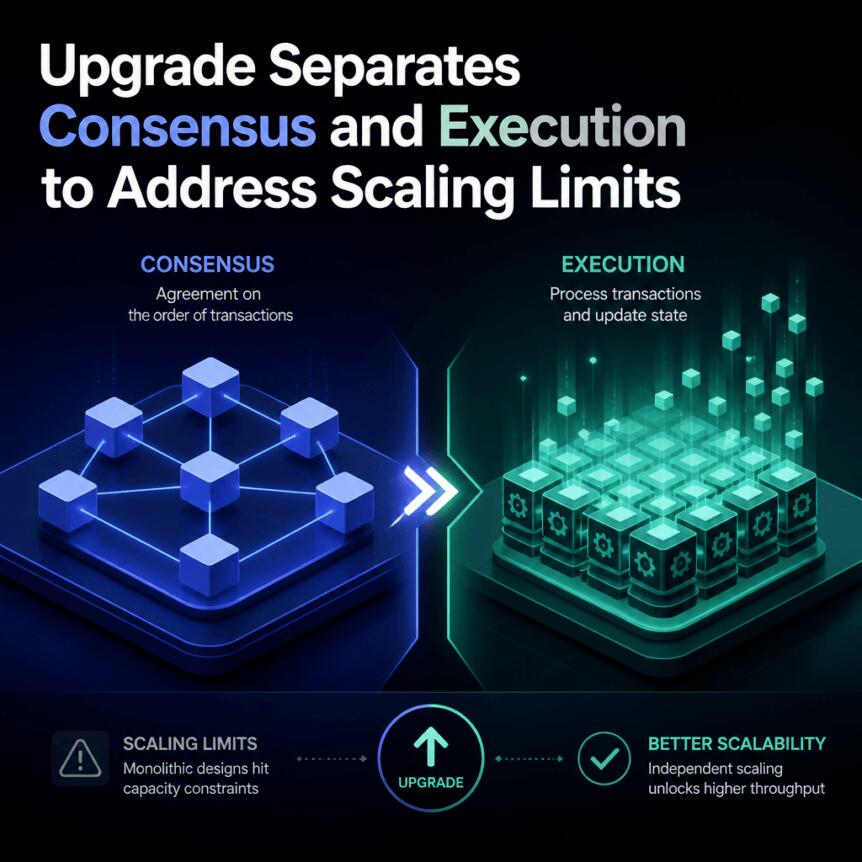
High-performance blockchain designs have long wrestled with a structural trade-off: when execution is tied directly to consensus, the network’s throughput becomes limited by how fast validators can process transactions. As research and engineering teams push improvements in finality and block propagation, execution itself is increasingly viewed as the next bottleneck to redesign.

MultiversX, a Cointelegraph Decentralization Guardians (CTDG) ecosystem participant, is now testing an approach that aims to remove that bottleneck. Its Supernova upgrade decouples consensus from transaction execution, enabling validators to vote without waiting for execution to complete—shifting computation into an asynchronous pipeline. Supernova is live on testnet, and deployment planning targets a mainnet activation date later this year.

Key takeaways

  • Supernova reorders the block workflow so proposers submit transaction blocks without executing first, while validators can vote immediately based on protocol validity.
  • Execution output is confirmed in subsequent block headers, with execution lagging consensus by roughly one block (about 600 milliseconds).
  • A “virtual mempool state” helps preserve validity by tracking pending nonces, expected balance consumption, and transactions already proposed but not yet executed.
  • EIE (Execution-Result Inclusion Estimator) limits how many execution results a block can reference, based on what minimum-spec nodes can safely handle.
  • Automatic backpressure reduces block capacity when execution falls too far behind, giving the system time to catch up.

Why execution-on-consensus became a scaling problem

In conventional synchronous blockchains, validators don’t just agree that a block is well-formed—they also must execute the transactions to verify state transitions before voting. That keeps the system deterministic and consensus-critical, but it also creates a shared bottleneck: the most computationally heavy transactions effectively slow the entire network.

Many networks have spent years optimizing around agreement speed and block dissemination. MultiversX’s framing is that these gains are not enough if execution remains on the critical path. The core question Supernova addresses is architectural: does execution have to stay inside the consensus loop, or can it be processed asynchronously while preserving safety and correctness?

Supernova’s asynchronous pipeline: voting first, executing after

Supernova, now live on testnet, introduces a changed block production sequence.

Advertisement

Previously, block production followed a more sequential pattern: a proposer selected transactions, executed them locally, and proposed a block containing those results. Validators then had to re-execute the same transactions to verify state transitions before voting, meaning execution sat directly inside the consensus-critical path.

With Supernova, that ordering changes. According to MultiversX’s description of Supernova’s decoupling, the proposer selects transactions and proposes the block without executing them first. Validators then verify that the proposal follows protocol rules and can vote right away. Execution continues asynchronously in the background, producing an output that is normally referenced and notarized in the next block header—so execution trails consensus by about one block, or roughly 600 milliseconds.

The practical consequence is that network responsiveness becomes less dependent on how quickly validators can execute every transaction before they can participate in consensus. Instead, consensus advances on protocol validity, while execution catches up in parallel.

Preserving validity when execution lags consensus

Decoupling execution from consensus creates an obvious safety and validity challenge: if execution is delayed, how does the network determine whether transactions included in a proposed block are likely to remain valid by the time their execution results are produced?

Advertisement

Supernova addresses this with a virtual mempool state. As described by MultiversX, the virtual mempool looks beyond the latest executed chain state and tracks forward-looking execution inputs such as pending nonces, expected balance consumption, and transactions already proposed but whose execution results have not yet passed consensus. That gives proposers a more accurate view of account activity so they can select transactions expected to execute successfully when their turn arrives.

To keep the system robust under varying validator performance, MultiversX also introduces two safeguards designed for operational stability:

  • Execution-Result Inclusion Estimator (EIE): EIE limits how many execution results can be referenced in a block. The cap is tied to what minimum-spec nodes can process safely, reducing the risk that weaker nodes are overwhelmed by referencing too many pending results.
  • Automatic backpressure: If execution falls too far behind, block capacity is reduced to allow the network to catch up—rather than letting lag accumulate indefinitely.

What Supernova changes for developers and users

For builders, the key message is that “in-shard finality” can arrive as soon as the proof is available. MultiversX states this typically happens within the same round at around 100–250 milliseconds, alongside more predictable execution conditions. This matters most for applications that rely on fast feedback loops—examples mentioned include high-frequency DeFi primitives and onchain order book systems, which can degrade when latency becomes a user-experience problem.

Supernova has also been producing 600-millisecond blocks on live testnet and devnet since Aug. 20. The network’s broader objective is to make onchain interactions feel more immediate, shifting the experience closer to responsive application infrastructure rather than delayed settlement.

On timeline, MultiversX indicates mainnet activation is expected for Sept. 10, 2026. While testnet performance does not always translate directly to mainnet behavior under full load, the architecture itself is designed to handle execution lag without forcing every validator to execute first during consensus.

Advertisement

Supernova within the CTDG and Cointelegraph ecosystem

The upgrade also lands within a broader infrastructure collaboration involving Cointelegraph Decentralization Guardians. Earlier coverage noted that Cointelegraph joined MultiversX as a validator through the CTDG program in March 2026, deepening the organization’s operational role beyond content and community work.

Cointelegraph’s CTDG Dev Hub is also described as a MultiversX official partner, connecting the protocol to a wider developer community. The input also references practical involvement such as the MultiversX Foundation delegating to a CTDG validator and the Dev Hub team building a dedicated validator dashboard on MultiversX.

From an industry perspective, this matters because protocol upgrades of this kind often require ecosystem alignment: performance improvements are only meaningful if infrastructure, tooling, and participating validators can adopt new execution and consensus mechanics reliably. Supernova’s focus on backpressure and minimum-spec safeguards suggests the design is attempting to make that transition smoother.

As Supernova moves from testnet toward the projected mainnet date, the most important things for users to watch are whether execution lag remains within expected bounds under real load, and how consistently EIE and backpressure prevent validators from falling behind without overly constraining throughput. The success criteria won’t only be faster finality—it will be whether execution remains dependable when consensus and execution operate on different clocks.

Advertisement

Risk & affiliate notice: Crypto assets are volatile and capital is at risk. This article may contain affiliate links. Read full disclosure

Source link

Advertisement
Continue Reading

Crypto World

Dolly Parton Was the Real-Life Buffy the Vampire Slayer

Published

on

Dolly Parton Was the Real-Life Buffy the Vampire Slayer

Well, of course Buffy resonated with Dolly. In many ways, she was the real-life equivalent of Buffy Summers. Creator Joss Whedon (a man whose relationship to feminism is notoriously complicated at best) conceived the character as an empowered antidote to the hot, scantily clad victim types of 1980s slasher flicks. He has said that he intended the original Buffy to be “one of these crappy, low-budget movies,” but one that “had a feminist agenda, had females in it who were people.” Instead of being saved by some heroic boyfriend, the busty, blonde cheerleader lead (played by Kristy Swanson in the film) “would have to get her own back.” Maybe Buffy looked like the stereotypical high school bimbo. But, especially in a TV series that paired the character’s battles against supernatural baddies with mundane teenage rites of passage, she also had intelligence, resourcefulness, depth, and, of course, a once-in-a-generation gift for slaying vampires. Being underestimated based on her beauty often put her at an advantage.

Source link

Continue Reading

Crypto World

Viral Altcoin RAIN Soars 20% Daily: What Fueled the Pump and What’s Next?

Published

on

The cryptocurrency market appears to have taken a small step back today (August 26) after the explosion in the past several days, with Bitcoin (BTC), Ethereum (ETH), Ripple (XRP), and many other digital assets posting minor losses.

However, this is not the case for Rain (RAIN), whose valuation rocketed by 20% on a 24-hour scale. Check out what triggered the rally and the next potential targets.

The Kept Promise

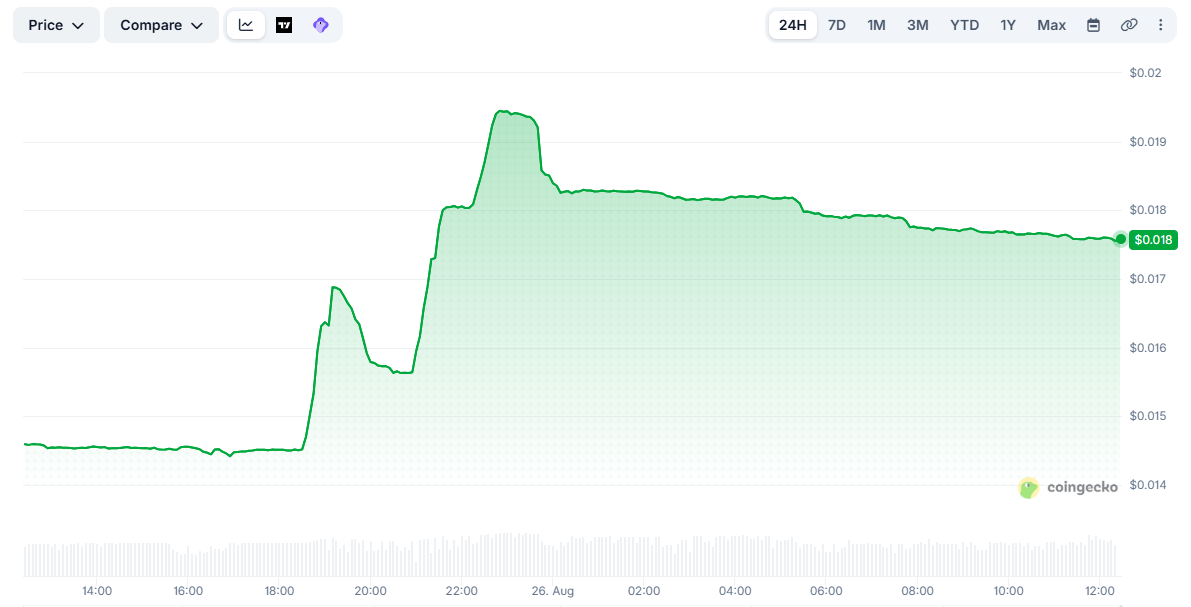
RAIN is the best-performing top 100 cryptocurrency today after rising to a new all-time high of almost $0.02 before slightly retreating to the current $0.0176 (per CoinGecko). Its market capitalization has increased to roughly $12.5 billion, making it the 13th-biggest digital asset.

RAIN Price
RAIN Price, Source: CoinGecko

The main catalyst for the uptrend seems to be the team’s decision to burn $108 million worth of the token – exactly as requested by the community during the first DAO governance vote.

The burning effort caught the attention of multiple industry participants. X user Route 2 FI claimed Rain Protocol is building the infrastructure layer so that anyone can make markets for anything, adding that they have invested in the project.

Advertisement

Another factor that may have positively impacted the price is the fact that the altcoin has recently become available on HyperliquidX. “A decentralized exchange purpose-built for trading, with the order book fully on-chain and fills settling into your own wallet. Permissionless protocol, permissionless venue,” the X post reads.

According to AltcoinSherpa, the development should help RAIN’s overall trading volume, arguing “there’s a lot of backing for this project.”

For his part, Keval Gala highlighted four main reasons for his bullish stance on the token: the major burn, Hyperliquid’s integration, the upcoming V2 with $100 million committed, and that 2.5% of trading volume is directed toward buybacks and burns. At the same time, the X user said he is closely monitoring the key resistance at $0.0195 and predicts that a drop below the $0.017-$0.018 range could trigger a deeper pullback.

What RAIN Actually Is?

Rain Protocol is a decentralized platform built on Arbitrum that allows users to create permissionless options on numerous subjects. Participants can define their own markets, set the possible outcomes, and trade freely – all in line with the project’s vision of transparency and user control.

Advertisement

The project’s native token is RAIN, launched last September and currently listed on popular exchanges such as Gate, MEXC, and BingX. It gained initial attention in November 2025 when the clinical-stage immunotherapy company Enlivex Therapeutics agreed to a private investment deal to purchase and sell $212 million in ordinary shares.

The firm intended to use the proceeds to implement the first RAIN prediction markets token treasury strategy. Interestingly, Matteo Renzi (former Prime Minister of Italy) is on Enlivex’s Board of Directors.

Despite its solid performance as of late, traders and investors should stay prepared for a potential short-term correction. The crypto market in general tends to head south following periods of serious gains, while RAIN’s holder distribution reinforces the bearish outlook.

Data show that the top 10 addresses control nearly 90% of the coin’s supply: a level of concentration that can be viewed as a red flag because it increases the risk of price manipulation.

Advertisement
RAIN Holders Distribution
RAIN Holders Distribution, Source: CoinMarketCap

The post Viral Altcoin RAIN Soars 20% Daily: What Fueled the Pump and What’s Next? appeared first on CryptoPotato.

Source link

Continue Reading

Crypto World

SEC Crypto Custody Rewrite Enters White House Review

Published

on

SEC Crypto Custody Rewrite Enters White House Review


The Securities and Exchange Commission’s proposed rewrite of custody rules for investment advisers and investment companies entered White House review on Aug. 25, placing a new crypto-focused framework into regulatory review after the agency withdrew a separate 2023 safeguarding proposal. The SEC’s… Read the full story at The Defiant

Source link

Continue Reading

Crypto World

GTA VI leaker’s token crashes despite ‘first true spoiler’

Published

on

GTA VI leaker's token crashes despite 'first true spoiler'

“CyberLeek,” the pseudonymous X user behind a series of recent GTA VI gameplay leaks, has shared the game’s “first true spoiler” today in the form of footage of one of its key protagonists.

That’s according to Forbes games journalist Paul Tassi, who warned his followers to mute specific words on X unless they want to risk seeing GTA VI spoilers.

So far the leaks have involved free-roam gameplay footage, but today’s are the first to cover GTA VI’s story elements.

GTA VI leaker says game is nowhere near ready

In a post to their site, CyberLeek reportedly claimed the GTA VI build in question is “actually recent,” and that “the game is not ready at all.”

Advertisement

CyberLeek also pleaded for followers to continue supporting their crypto token $CYBERLEEK.

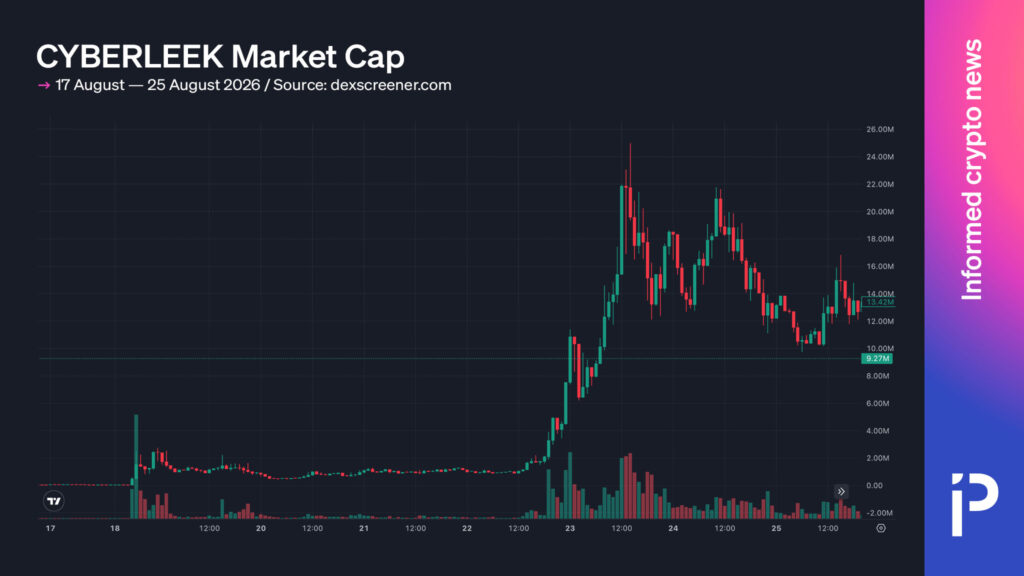
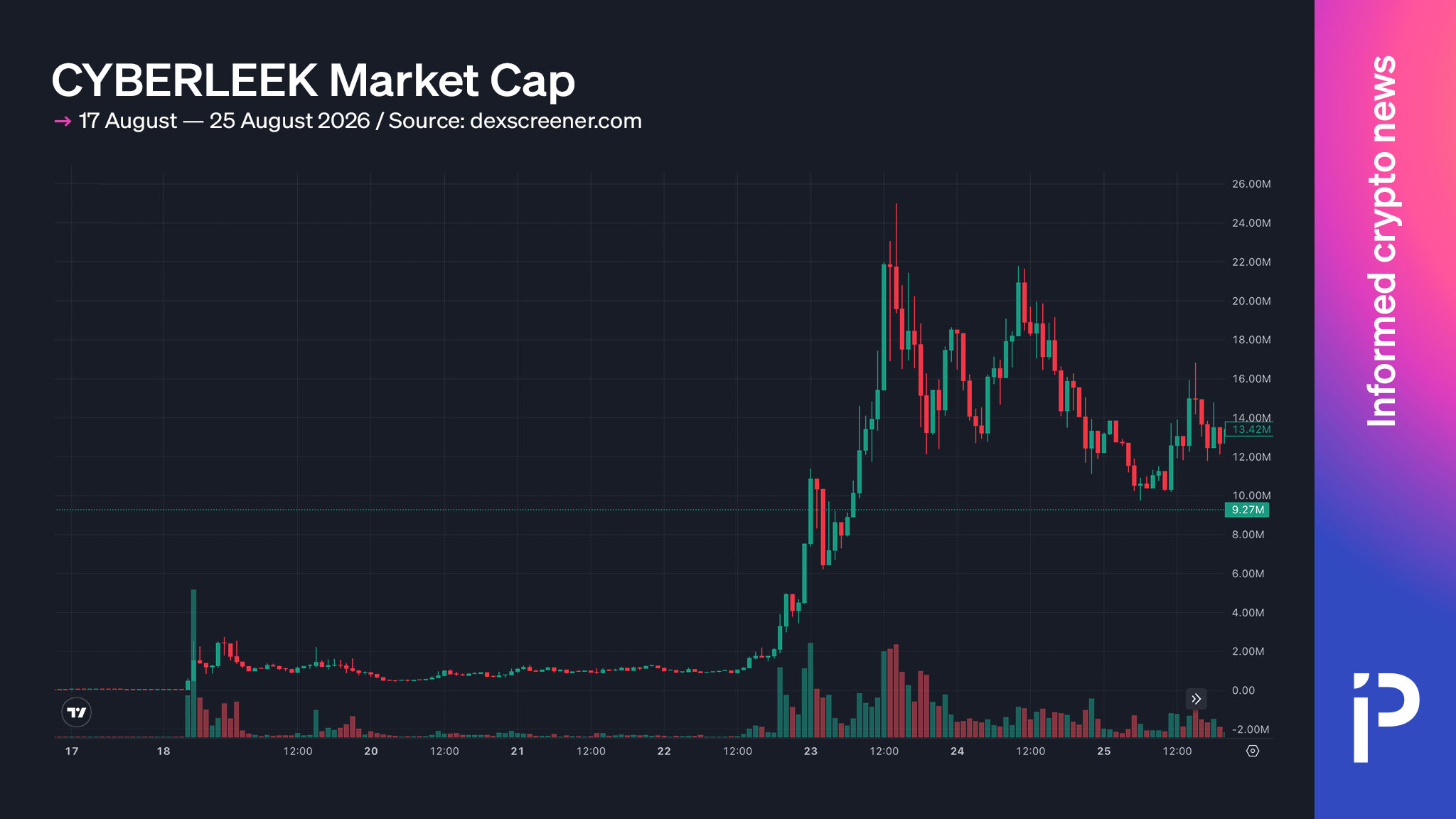
The token shot up from a $40,000 market cap to over $2 million when they first shared gameplay footage on August 18. By August 23, its market cap hit $25 million.

The market cap of CyberLeek’s token over the past month.

Read more: GTA VI leak investigation video raises crypto scam suspicions

At time of writing, the market cap has fallen 70% from this all-time high, and almost 40% over the last 24 hours, to a low of $7.5 million. 

Rockstar Games admits GTA VI isn’t finished

GTA VI developer, Rockstar Games, finally addressed the leaks today in a statement. It admitted that the game isn’t finished, and that the team is “heartbroken” by the leaks. 

Advertisement

It said, “While it is unfortunate that the intended game experience may now be impacted by some spoilers, we hope that everyone will wait a bit longer to experience the game for themselves on November 19.”

CyberLeek’s actions also threaten to disrupt a major extended gameplay reveal taking place on Netflix this Thursday.

Take-Two, Rockstar’s parent company, has been requesting to file subpoenas against Microsoft, Discord, and X in an attempt to expose and stop the leaker.

One user who vaguely predicted the leaks claims Rockstar employees questioned them at their home. These claims were doubted after footage of the exchange was used to shill their crypto. 

Advertisement

Got a tip? Send us an email securely via Protos Leaks. For more informed news and investigations, follow us on XBluesky, and Google News, or subscribe to our YouTube channel.

Source link

Advertisement
Continue Reading

Crypto World

Crypto retirement plans face opposition from 53% of Americans

Published

on

Crypto retirement plans face opposition from 53% of Americans

A new national survey has found that 53% of Americans oppose employers offering cryptocurrency in workplace retirement plans, while 77% consider such investments risky.

Summary

  • 77% of Americans view cryptocurrency in workplace retirement plans as risky.
  • 53% oppose employers adding crypto to their retirement investment menus.
  • 80% believe the United States faces a retirement crisis, up from 67% in 2020.
  • Federal regulators are considering rules for adding alternative assets to 401(k) plans.

The National Institute on Retirement Security reported in its survey that 46% of respondents considered cryptocurrency in workplace retirement plans “very risky,” contributing to the 77% who expressed some level of concern.

Crypto retirement plans face resistance from US savers

Opposition to workplace crypto options extended beyond respondents who viewed digital assets as risky. According to the institute, 53% did not support employers offering cryptocurrency as an investment choice within their retirement plans.

Advertisement

Public concern about digital assets emerged alongside deeper anxiety over the condition of the US retirement system. The survey found that 80% of Americans believed the country faces a retirement crisis, compared with 67% in 2020. Another 61% said they were worried about achieving financial security during retirement.

Household costs and debt also affected how respondents viewed their ability to save. According to the report, 68% said preparing for retirement had become harder, while 77% said debt prevented them from putting aside enough money.

Researchers gathered the findings as part of a national survey conducted by Greenwald Research from Oct. 24 through Nov. 14, 2025. The poll included 1,203 US residents aged 25 and older, with the results weighted by age, gender and income to represent the country’s adult population.

Advertisement

The findings indicate that resistance to crypto inside retirement plans is not limited to people who reject digital assets altogether. A May Federal Reserve survey found that 10% of US adults used or held cryptocurrency in 2025, up from 7% in 2024. Roughly 7% held crypto as an investment, while fewer respondents used it for payments or transfers.

Retirement concerns grow as debt limits savings

Financial pressure formed a central part of the National Institute on Retirement Security’s findings. With more than three-quarters of respondents saying debt hurt their ability to save, the survey placed the crypto question within a retirement system already under strain.

According to the institute, concerns over retirement security have increased even as workplace plans remain one of the main savings tools available to US employees. Respondents cited affordability problems alongside uncertainty about whether their savings would support them after they stopped working.

The institute’s separate research on retirement preparedness has also found large gaps in workplace plan access and accumulated savings. Its February 2026 analysis, based on US Census Bureau data, said the median retirement savings balance across the American workforce was below $1,000 and that many employees lacked access to an employer-provided plan.

Advertisement

Social Security supplied about 52% of retirement income for older Americans, according to the same analysis, while approximately 17% of workers had access to a defined-benefit pension as of December 2022. Unlike a traditional pension that promises a defined payment, a 401(k) generally places investment decisions and market risk on the employee.

Crypto can expose a retirement account to sharper price changes than many traditional plan investments. The US Government Accountability Office has previously described digital assets as having unique volatility and said reliable methods for projecting their future returns remain limited, according to a congressional letter citing the agency’s research.

US regulators have removed barriers to crypto in 401(k)s

Federal policy has moved in the opposite direction from the caution expressed by many survey respondents. In May 2025, the Department of Labor withdrew its crypto guidance, which had instructed retirement-plan fiduciaries to exercise “extreme care” before adding cryptocurrency to investment menus.

The department said the earlier standard departed from its usual neutral approach to investment types. After the rescission, officials said fiduciaries should make decisions based on their duties under the Employee Retirement Income Security Act without the government either endorsing or discouraging cryptocurrency.

Advertisement

President Donald Trump added another policy directive on Aug. 7, 2025, by signing an executive order on alternative assets. The order covered digital-asset investment vehicles as well as private equity, private credit, real estate, and other assets that are not commonly found in defined-contribution plans.

Under the order, the Labor Department was instructed to review its guidance on fiduciary duties and consider changes that could make alternative assets available to retirement savers. The Securities and Exchange Commission was also directed to consult with the department and examine regulatory changes for participants in employer-sponsored plans.

Five days later, the Labor Department rescinded a 2021 statement that had discouraged fiduciaries from considering private equity and certain other alternative investments. Officials said the statement had departed from a neutral, principles-based approach by treating one type of asset differently from others.

Removing the two pieces of guidance did not require employers to offer crypto. Plan sponsors and fiduciaries remained responsible for assessing each investment under ERISA, including whether its costs, risks, and structure were suitable for participants.

Advertisement

Labor Department proposal sets conditions for alternative assets

In March 2026, the Labor Department proposed a new rule explaining how fiduciaries could evaluate alternative assets for workplace retirement plans. The proposal included regulatory safe harbors intended to reduce litigation exposure for fiduciaries that follow specified review standards.

As crypto.news reported in March, the proposed framework covered more than 90 million retirement savers and required fiduciaries to examine performance, fees, liquidity, valuation, redemption terms, and participants’ ability to understand an investment.

Plan sponsors would not have to add cryptocurrency, private equity or private credit to their menus under the proposal. Employers choosing to include such products would need to document an objective review and show that the options met ERISA’s prudence requirements.

Department officials said the proposal would not provide unrestricted access to crypto or private funds. Instead, the rule would replace restrictions based on asset type with individual reviews by fiduciaries responsible for selecting and monitoring plan investments.

Advertisement

Political opposition followed the proposal. In June, three Democratic lawmakers—Sens. Bernie Sanders, Elizabeth Warren, and Rep. Bobby Scott asked the Labor Department to withdraw it.

In their letter, the lawmakers argued that cryptocurrency could expose workers to price volatility, fraud, and weaker safeguards than those available for public securities. They also questioned whether fiduciaries could assess certain digital assets using established methods for measuring value and expected returns.

“The application of securities laws to crypto assets is rapidly evolving,” the lawmakers wrote, adding that some protections available to investors in public securities “may not be available for crypto.”

Their request covered other alternative investments, including private equity and private credit, which the lawmakers said could carry high fees, limited liquidity and difficult valuation methods. The Labor Department’s proposal remained subject to the federal rulemaking process, under which the agency could revise, finalize or withdraw the framework after reviewing public comments.

Advertisement

Source link

Continue Reading

Crypto World

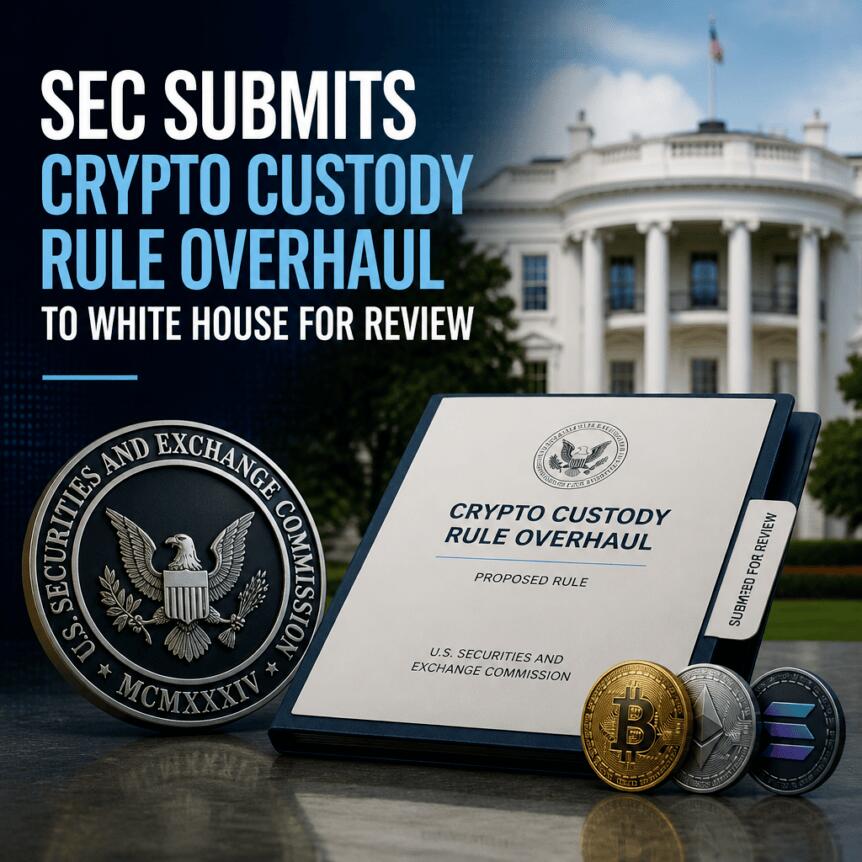
SEC Submits Crypto Custody Rule Overhaul to White House for Review

Published

on

Crypto Breaking News

The U.S. Securities and Exchange Commission (SEC) has begun moving toward a major update to custody rules that govern how investment advisers and investment companies hold client assets, a change that could directly affect institutional crypto custody.

According to the SEC’s regulatory filings, the agency submitted “Amendments to the Custody Rules” to the White House Office of Information and Regulatory Affairs (OIRA) on Aug. 25 as part of the federal review process. The proposal would then return to the SEC for internal consideration before potentially being released for public comment.

Key takeaways

  • The SEC has sent proposed custody rule updates to OIRA for review under White House regulatory procedures.
  • The changes target how investment advisers and investment companies hold client assets, including crypto, under the Investment Advisers Act and Investment Company Act.
  • The stated goal is to reduce uncertainty for institutions trying to comply with existing federal securities rules while holding digital assets.
  • The draft is not yet public, and OIRA and the White House Office of Management and Budget can request modifications before it returns to the SEC.

What the SEC is trying to change

The SEC’s regulatory agenda indicates that the custody proposal could amend existing rules or introduce new requirements under the Investment Advisers Act and the Investment Company Act. Those frameworks apply to firms managing client money and other assets, including assets that may be held in custody arrangements—an area where market participants have long sought clearer guidance for digital-asset holdings.

In its description of the effort, the SEC said the intended purpose is to clarify how companies can hold crypto for clients while remaining consistent with the agency’s securities-law custody framework. The SEC emphasized that the proposal is designed to address uncertainty, but it has not yet published the rule text for public scrutiny.

Once OIRA completes its review, the draft would come back to the SEC. From there, the commission would decide whether to circulate the proposal for public comment.

Advertisement

How the OIRA process could shape timing and scope

The custody rule effort is currently in a pre-publication stage. As reported by Bloomberg, the SEC sent the proposal to OIRA, which sits within the White House Office of Management and Budget, on Aug. 25. That step matters because it is not merely administrative: the White House can ask for changes before the proposal returns to the SEC.

Only after that review cycle would the SEC determine whether to release the proposal for public comment—an important milestone for institutions because public comments can influence how custody obligations, compliance expectations, and operational constraints are ultimately written into regulation.

At present, the main practical takeaway for affected firms is that the proposal is moving, but the actionable details remain unavailable. Custody providers and asset managers will likely be watching for the published draft text and any adjustments that occur during OIRA’s review.

Why this fits the SEC’s broader digital-asset direction

Bloomberg linked the custody rule initiative to the SEC’s wider effort to support the Trump administration’s digital asset agenda, even as a separate piece of market-structure legislation remains stalled in Congress.

Advertisement

The article noted that the broader goal is occurring while the CLARITY market structure bill is still pending in the Senate. According to Cointelegraph’s earlier reporting, the bill is expected to face a cloture vote after lawmakers return from the August recess in September, suggesting continued legislative uncertainty around digital-asset rules at the federal level.

In that environment, rulemaking inside the SEC becomes particularly consequential for institutional participants. Custody is not just a compliance checkbox; it affects how funds and advisers structure client asset handling, choose custody models, and document safeguards—core concerns for asset managers considering or already providing crypto exposure.

From enforcement to rulemaking: institutional impact

Crypto market participants have closely tracked the SEC’s shift in posture under Paul Atkins, who became chair in 2025. Multiple reports in the crypto industry described a move away from what critics called “regulation through enforcement” toward formal rulemaking.

Earlier coverage from Cointelegraph has said Atkins pledged to end the SEC’s prior approach and to pursue policy development through established rulemaking channels. That shift is reflected in reported enforcement decisions as well: Cointelegraph previously reported that the SEC dismissed several cases against prominent crypto companies in 2025, including its lawsuit against Coinbase, as it sought to reshape how it regulates digital assets.

Advertisement

The SEC’s custody-rule proposal fits into that broader pattern. Even though the SEC has been less aggressive in some enforcement areas, institutions still need regulatory clarity for the mechanics of custody and client asset protection—areas where existing uncertainty can slow adoption or increase compliance risk.

For investors and intermediaries, a clearer custody framework could translate into better-defined standards for eligibility, controls, and operational practices. It may also reduce the reliance on case-by-case enforcement logic when deciding how to hold and safeguard client assets that include crypto.

What to watch next

Readers should watch for the custody proposal to be published after the OIRA/OMB review and for the SEC’s decision on whether to open a public comment period. The key uncertainty remains the draft’s contents—especially how it will address crypto custody within established custody rules under the Investment Advisers Act and Investment Company Act.

Risk & affiliate notice: Crypto assets are volatile and capital is at risk. This article may contain affiliate links. Read full disclosure

Advertisement

Source link

Continue Reading

Crypto World

Cathie Wood’s ARKK has trailed BTC, S&P 500 since inception

Published

on

Cathie Wood’s ARKK has trailed BTC, S&P 500 since inception

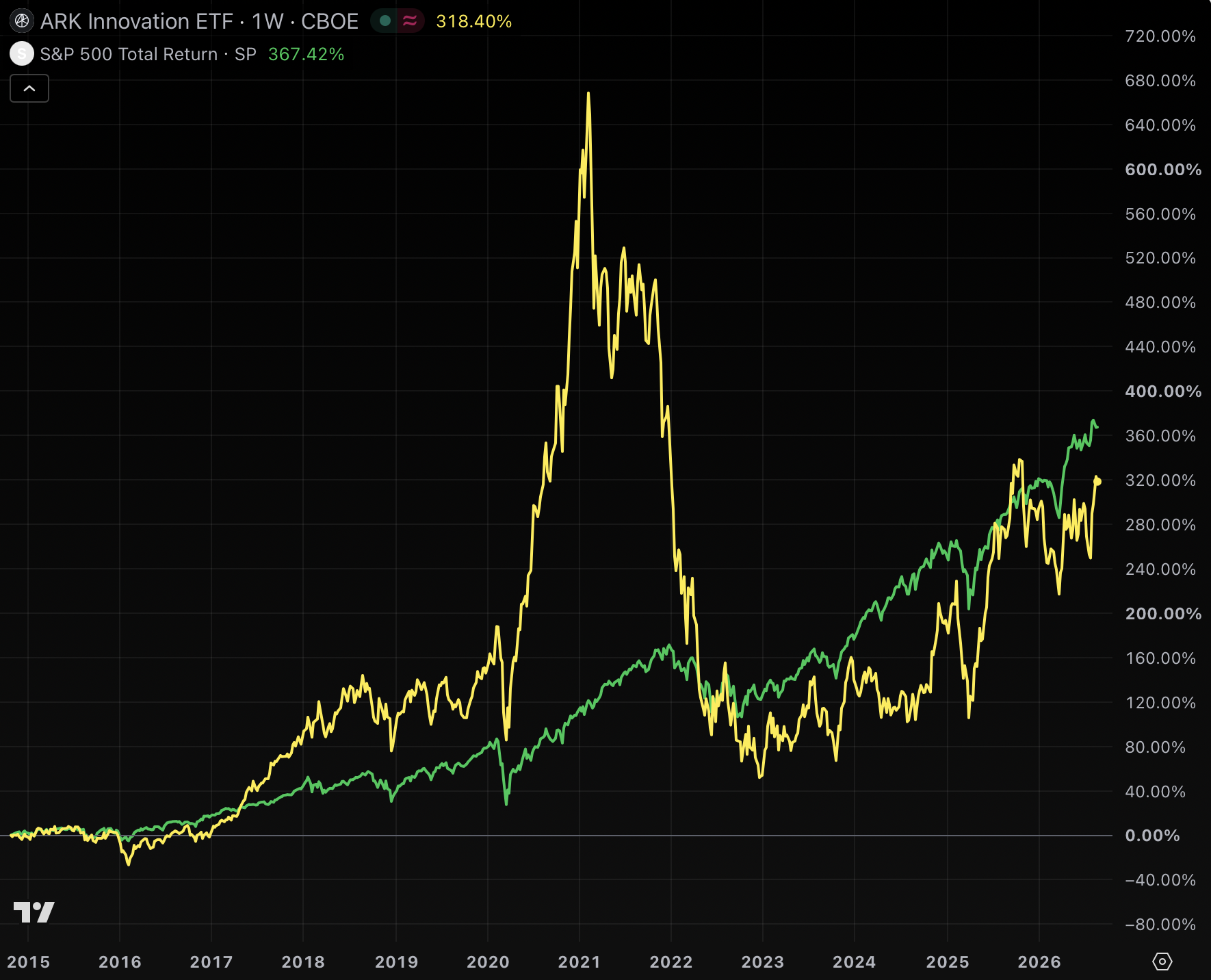
Cathie Wood’s flagship fund has spent more than a decade failing to beat her two most obvious benchmarks.

Her multi-billion dollar ARKK fund, which launched on October 31, 2014, has trailed the S&P 500’s total return, and BTC, since inception.

Even investors who might have tried to time their entries and exits out of Wood’s funds would have had a difficult time finding a slice of outperformance, as Ark Invest also underperformed most calendar years across that timespan.

It was easy for ARKK to outperform BTC during particularly bad years for the asset. For example, it crashed 73% in 2018 or -67% in 2022.


Advertisement

However, Wood’s pro-Tesla, pro-BTC, pro-AI, and pro-gene editing fund failed to beat its benchmarks over the long haul.

Cumulative returns over the full stretch, October 31, 2014 through yesterday’s close, are 318% for ARKK, 23,214% for BTC, and 367% for the S&P 500 with dividends reinvested.

S&P 500 Total Return versus ARK Innovation ETF (yellow) since inception. Source: TradingView

Trailing the market despite a decade of work

Although it’s embarrassing for any fund manager to work full-time for a decade only to trail a passive, labor-free investment in the S&P 500, ARKK’s 49% shortfall actually fails to illustrate how bad the past five years has felt for investors in Wood’s ETF.

On February 16, 2021, ARKK peaked at $159.70 per share, a price it’s never reattained. Since that date, ARKK has lost 46% of its value whereas the S&P 500 has gained 65%.

From the start of 2022, ARKK has trailed the S&P by 80%. Since the start of 2023, 60%. Since 2024, 8%.

Advertisement

Over the past five years, ARKK’s has declined 28% while the S&P has rallied 72%.

Read more: Crypto trading hamster outperforms Bitcoin, Warren Buffett, Cathie Wood

Cathie Wood dreamed big, failed to win

Wood’s investment strategy concentrates on a rotating list of “disruptive innovation” stocks.

The fund gained 152% in 2020 but lost 67% in 2022.

Advertisement

Morningstar ranked ARK Investments first among fund families for shareholder value destruction over the decade through 2023, estimating Wood’s family of funds wiped out roughly $14.3 billion and more than double the loss of the second-worst fund management firm on the list that year.

Wood has also been an outspoken BTC bull while underperforming BTC by miles. She’s published stratospheric, imaginary BTC price targets of $1 million, $1.2 million, and $1.5 million.

ARKK holds BTC price exposure and crypto equities including Coinbase, and ARK also co-sponsors a spot BTC ETF. However, ARKK’s own total return has still fallen short of BTC’s in most years since 2015, even as Wood’s firm bet heavily on the sector.

Got a tip? Send us an email securely via Protos Leaks. For more informed news and investigations, follow us on XBluesky, and Google News, or subscribe to our YouTube channel.

Advertisement

Source link

Advertisement
Continue Reading

Crypto World

Medpace Hovers Near Entry, Offers Second Chance After Spike

Published

on

Medpace Hovers Near Entry, Offers Second Chance After Spike

Drugmakers have to jump through several research and regulatory hoops before their treatments can reach pharmacy counters and store shelves. While pharmaceutical giants manage those challenges in-house, smaller companies outsource that work to companies like the Wednesday IBD 50 Growth Stock To Watch pick Medpace Holdings (MEDP). Shares of the medical research contractor soared to an all-time high after second-quarter…

Copyright ©2026 Investor’s Business Daily, LLC. All rights reserved. 87990cbe856818d5eddac44c7b1cdeb8

Source link

Continue Reading

Trending

Copyright © 2025