
Crypto World
China’s tech firms feast on OpenClaw as companies race to deploy AI agents

A man wears a lobster hat that represent the OpenClaw logo, an open-source AI assistant at the Baidu headquarter in Beijing on March 11, 2026.
Adek Berry | Afp | Getty Images
China is rapidly embracing the popular artificial intelligence tool OpenClaw, with major tech companies and even local governments rushing to expand access to the lobster-themed, open-source AI agent in recent weeks.
AI agents are digital assistants that can handle tasks such as sending emails, scheduling meetings and booking restaurant reservations with minimal human guidance. Unlike chatbots that simply respond to prompts, AI agents can take proactive actions, which often require broader access to data and systems and raise privacy and security concerns.
Chinese tech giant Tencent said Tuesday it had launched a full suite of easy-to-use AI products built on OpenClaw, which it dubbed “lobster special forces” and compatible with its popular superapp WeChat.
The same day, startup Zhipu AI launched its own local version of OpenClaw, offering an AI agent pre-installed with over 50 popular skills through “one-click installation.”
Similar moves by other Chinese companies have helped drive consumer interest, with usage of OpenClaw in China surpassing the U.S., according to American cybersecurity firm SecurityScorecard.
“In terms of adopting the new technologies, I think China definitely has a really large community that always wants to try what’s there, what’s new, and don’t want to be left behind,” said Jaylen He, CEO of Violoop, a Shenzhen-based startup building a device that claims to have similar features to OpenClaw but with lower security risks.
“I have friends who are not even in the tech industry … they are doing this, they are also running it,” he said.

As China’s economy continues to face headwinds, OpenClaw offers an opportunity that domestic tech companies, eager to attract paying users, are rushing to capture.
The nationwide OpenClaw craze has boosted the popularity of Chinese-developed large language models, said Winston Ma, adjunct professor at NYU School of Law.
Autonomous AI agents like OpenClaw are typically model-agnostic, which means they can be integrated with various large language models, such as OpenAI’s ChatGPT and Anthropic’s Claude.
According to OpenRouter, a startup offering developers access to AI models through a single interface, the top three tools used by OpenClaw users on its marketplace in the past month were all Chinese companies, with combined usage double that of the three most-used Google Gemini and Anthropic Claude models.
Chinese-made AI models released this year have increasingly narrowed the gap with their U.S. rivals, while offering AI capabilities at a fraction of the price.
That significantly lowers the bill for users running OpenClaw. First launched in November, the tool allows users to send requests through popular messaging apps such as Telegram and WhatsApp, enabling the AI agent to perform multiple tasks autonomously. The Austrian developer behind the tool, Peter Steinberger, joined OpenAI in mid-February.
Easing installation hurdles
While OpenClaw has surged in popularity in the tech world, experts have previously pointed out limitations to the AI agent’s mass adoption, including a complex installation process that’s challenging for nontechnical users.
Chinese technology companies are also trying to simplify installation for less technical users.
After an initial surge of interest last month, Chinese social media platforms have been flooded with posts about company-organized installation events. Some organizers have handed out red lobster plush toys, highlighting the project’s crustacean-themed branding.
Engineers (L) install and set OpenClaw, an open-source AI assistant for users at the Baidu headquarter in Beijing on March 11, 2026.
Adek Berry | Afp | Getty Images
TikTok owner ByteDance’s cloud unit Volcano Engine recently unveiled a version of OpenClaw called ‘ArkClaw,’ that can be used in a web browser, eliminating the need for complex local setup.
Meanwhile, some companies have even provided support to consumers in China who are looking to use OpenClaw with their tools.
Tencent held a free in-person OpenClaw setup session last week in the Chinese tech hub of Shenzhen, where it is headquartered, to help “hundreds” of people install the tool on TencentCloud.
JD.com on Tuesday launched a dedicated page where users can pay 399 yuan ($58) to get remote help from Lenovo’s information technology maintenance team, Baiying, to deploy the software. Meituan reportedly announced a similar partnership with Lenovo on Monday.
The growing interest in OpenClaw is changing how Chinese consumers pay for AI.
Engineers (front) install and set OpenClaw, an open-source AI assistant at the Baidu headquarter in Beijing on March 11, 2026.
Adek Berry | Afp | Getty Images
Violoop, which plans to launch its first device on Kickstarter in April at roughly $300 per unit and $30 a month for AI services, originally intended to focus on the U.S. and other overseas markets, CEO He said.
But now, the startup is focusing on a China launch instead.
“After 2026, after OpenClaw, I think we are seeing a significant rise, both in terms of [interest in] paying for good models and also that MiniMax and Kimi have released very capable models,” he said Wednesday. “I wouldn’t say that they can surpass maybe ChatGPT or Anthropic, but they are definitely approaching that and definitely are creating value for users. So this is a new change for us.”
The startup has already closed at least two rounds of initial funding this year, primarily to cover production costs.
Governments get involved
Despite official warnings published by China’s state media about OpenClaw’s security risks, several local governments have proposed incentives in the past week to encourage companies to develop applications using the AI tool.
Shenzhen’s Longgang district and Hefei’s high-tech development zone proposed equity financing support of up to 10 million yuan ($1.46 million), along with other direct subsidies aimed at “one-person companies” using OpenClaw. A district of Suzhou city said it would offer similar subsidies, along with 30 days of free office space, accommodation and meals.
The term “one-person company,” referring to one or a few individuals using AI to quickly build a business, has become increasingly popular in China, especially as Beijing this week wrapped up a meeting to formalize a five-year plan to spur domestic tech development.

Subscribe now
Increased Chinese participation in the OpenClaw craze is just adding to a global phenomenon. In a sign of its popularity, the AI agent project has gained more stars on the GitHub coding platform than Linux, a transformative open-source operating system that underpins modern computing.
“This is like the 2022 ChatGPT moment. This is like the 202[5] DeepSeek moment,” Violoop’s He said. “I think the craving, the desire, for a personal assistant that can really help the user, the desire has been there, and has been suppressed for a very long time.”
— CNBC’s Anniek Bao contributed to this report.
People queue to have their laptops install with OpenClaw, an open-source AI assistant at the Baidu headquarter in Beijing on March 11, 2026.
Adek Berry | Afp | Getty Images



Circle has launched cirBTC, a wrapped Bitcoin token backed 1:1 with native on-chain BTC reserves, deploying first on Ethereum mainnet and its own Arc blockchain.
The move is direct: Bitcoin holds over $1.7 trillion in market cap but generates almost no DeFi activity, and Circle is positioning itself as the infrastructure layer that changes that.
The institutional implication is immediate. With Bitcoin ETFs reversing months of outflows and fresh capital flowing into BTC exposure, the demand for yield-bearing Bitcoin products is structurally rising – and Circle is moving to own that pipeline before a competitor does.
- Circle has unveiled cirBTC, a wrapped Bitcoin token backed 1:1 with native on-chain Bitcoin reserves.
- The token launches initially on Ethereum mainnet and Circle’s Arc blockchain, with real-time reserve verification and no third-party custodians.
- cirBTC targets an estimated $1.7 trillion Bitcoin liquidity gap, integrating with USDC, Circle Mint, and major DeFi lending and derivatives protocols.
- This is Circle’s first major non-stablecoin product since its NYSE listing as CRCL in 2025, signaling a deliberate expansion beyond fiat-pegged assets.
Discover: The best crypto to diversify your portfolio during market turbulence
cirBTC: What It Actually Changes for Bitcoin Liquidity
The existing wrapped Bitcoin market is not small, WBTC launched in January 2019 and at its peak represented billions in DeFi TVL, but it has been defined by custodian opacity.
The 2022 FTX collapse accelerated distrust in centralized wrappers, and renBTC, which once held over $1 billion in TVL, faded as audit credibility eroded. Circle is betting that its track record with USDC, now above $30 billion in circulation, gives it the institutional credibility those products never had.
Rachel Mayer, VP of product at Circle and the Arc blockchain, put the thesis plainly in a post on X: “Bitcoin is sitting on the sidelines of DeFi. Not because people don’t want yield or liquidity – it’s because they don’t trust the wrapper.”
She followed directly: “cirBTC is Circle’s answer: 1:1 backed, on-chain-verifiable, and built on infrastructure the market already trusts.”
That distinction matters. WBTC routes through BitGo as custodian – a model that requires trusting an intermediary’s audit. cirBTC uses real-time onchain reserve verification with no third-party custodian sitting between holder and backing BTC.
For institutional desks and DeFi protocols that learned hard lessons from opaque collateral structures, verifiability isn’t a feature – it’s the threshold requirement. If Circle can demonstrate reserve proof holds under stress, the institutional case becomes difficult to argue against.
The mechanism integrates directly with Circle Mint for OTC desks and connects ready-made to USDC liquidity pools, creating a cross-collateral environment that no prior wrapped BTC product has had at launch.
The caveat: Circle’s infrastructure is centralized by nature, and IMF warnings around cross-chain tokenization risks apply here as they do across the RWA sector. The bear case accelerates if a bridge exploit or smart contract failure forces Circle to respond – and the firm’s 2023 inaction during $230 million in USDC bridge thefts on Multichain remains an open scar on its credibility.
What to Watch as Circle Bitcoin Moves Toward Full Rollout
Full rollout is targeted for Q2 2026, with DeFi protocol integrations and Circle Mint connectivity expected by May.
Expansions to Solana and additional L2s are on the roadmap but unconfirmed. The immediate variable to watch is DeFi TVL migration – specifically whether lending protocols route BTC collateral toward cirBTC or remain with WBTC given its deeper existing liquidity moats.
Regulatory backdrop matters here too. The 2025 U.S. stablecoin legislation created a clearer framework for fiat-pegged digital assets, but tokenized BTC products sit in a grayer zone.
Broader institutional regulatory clarity from the SEC and CFTC on tokenized assets could accelerate or stall adoption depending on how cirBTC is classified. Circle’s NYSE listing as CRCL adds public accountability that custodian-model competitors do not carry – a pressure point that cuts both ways.
If cirBTC captures even a fractional share of BTC held in ETF structures and redirects it toward DeFi yield, the liquidity impact on Ethereum and Arc protocols would be structural, not marginal. If adoption stalls at the institutional access layer due to regulatory friction or a trust event, it validates every skeptic who argued Circle’s credibility is stablecoin-specific and doesn’t transfer to Bitcoin infrastructure.
Explore: The best pre-launch token sales with asymmetric upside potential
The post Circle Unveils New Token Aimed at Expanding Bitcoin Utility appeared first on Cryptonews.

Decentralized email platform Dmail Network is shutting down after five years of operations, citing high infrastructure costs, weak monetization, failed funding efforts and limited token utility.
The platform said it will gradually cease all services starting May 15, and urged users to export their data before then. It said all nodes will shut down after that date, making emails and accounts inaccessible.
Dmail Network positioned itself as a Web3 communication platform focused on decentralized, wallet-based email, encrypted messaging and onchain notifications. In January 2025, DappRadar ranked Dmail second among AI DApps, with 4.9 million unique active wallets for the month.
Dmail’s closure suggests that user activity alone was not enough to sustain an infrastructure-heavy Web3 product once high operating costs, weak monetization and failed fundraising converged.

Dmail points to costs, failed fundraising and weak token use
Dmail said the economics of running a decentralized communication platform had become increasingly difficult to sustain. In its shutdown note, the company said bandwidth, storage and computing costs consumed a large share of its budget, with the expenses rising as users grew.
The company said it explored different paid models and monetization paths but failed to find a business model users were willing to support at scale.
Related: Big Tech firms back new x402 Foundation to advance agentic AI adoption
Dmail said that worsening market conditions added to the pressure. The team said multiple financing rounds failed, acquisition efforts fell through and funding was nearing exhaustion. It said departures among core staff left the team unable to keep maintaining its infrastructure.
It added that the project’s token never developed a clear, large-scale use case and that its economic design failed to create a self-sustaining loop. Following the announcement, Dmail Network’s token dropped to an all-time low of $0.0002067, according to CoinGecko.
Dmail joins growing list of Web3 closures
Dmail’s shutdown comes amid a recent wave of closures across Web3, as projects struggle with weak demand and funding pressures.
On March 18, DAO tooling platform Tally said it was winding down after concluding that there was no viable market for its products. On March 24, development company Balancer Labs said it was shutting down four months after an exploit that drained over $100 million.
Magazine: AI agents will kill the web as we know it: Animoca’s Yat Siu

Quick Overview
- Shares of SBAC rallied as high as 18.93%, reaching approximately $194.53, following disclosure that the firm is considering a possible acquisition.
- The telecommunications tower operator acknowledged engaging financial advisers to assess preliminary acquisition proposals from major infrastructure investment funds.
- Prior to this development, multiple Wall Street firms had reduced their price objectives, including Wells Fargo, JPMorgan, Scotiabank, and Morgan Stanley — the Street’s average rating stands at Hold with a $230.11 price objective.
- During its most recent quarterly report, SBA exceeded earnings per share projections ($3.47 versus $3.25 anticipated), although sales of $719.58 million fell marginally short of the $725.80 million forecast.
- The company also increased its quarterly cash distribution to $1.25 (annualized $5.00), compared to the previous $1.11, representing approximately 2.6% yield.
SBA Communications (SBAC) is presently changing hands near $194.53, representing a significant advance from its previous closing level of $171.56.
SBA Communications Corporation, SBAC
Shares of SBA Communications (SBAC) experienced substantial upward movement on Wednesday following media reports indicating the wireless infrastructure provider is investigating a potential transaction, with acquisition interest coming from prominent infrastructure investment entities.
The equity climbed as high as 18.93% during intraday trading. Most recently, it was hovering around $194.53, marking a considerable increase from the prior session’s close of $171.56. Trading activity registered below typical levels, with approximately 524,666 shares traded — about 44% beneath standard session turnover.
The company acknowledged retaining financial advisers to examine the preliminary interest being expressed. This official confirmation suggests legitimate potential acquirers may be involved, which propelled optimistic market sentiment throughout the trading day.
Market participants view any transaction supported by infrastructure investment vehicles as likely commanding a premium price, contributing additional momentum to the stock’s advance.
Prior to this development, the security had been experiencing downward pressure. For the year through yesterday, SBAC had declined approximately 10.7%.
Wall Street Had Been Lowering Expectations
Various equity analysts had been reducing their valuation targets for SBAC throughout recent months. Wells Fargo decreased its objective from $205 down to $195, maintaining an “equal weight” stance. JPMorgan reduced its target from $245 to $240 while keeping a “neutral” designation. Scotiabank adjusted downward from $233 to $223 with a “sector perform” rating, and Morgan Stanley moved from $225 down to $215 at “equal weight.”
Most recently, Truist launched research coverage assigning a “hold” recommendation with a $193 valuation target. The Wall Street consensus currently reflects a Hold assessment with an average price objective of $230.11.
The equity’s 50-day moving average was positioned at $187.32 and its 200-day at $190.97, both technical levels that today’s surge has now exceeded.
SBA’s latest quarterly financial results, disclosed February 26, delivered $3.47 in earnings per share — surpassing the $3.25 Street estimate by $0.22. Quarterly sales of $719.58 million registered slightly below the $725.80 million projection. Top-line growth increased 3.7% on a year-over-year basis.
Cash Distribution Increased Recently
The company also announced an enhancement to its quarterly shareholder distribution not long ago, raising it from $1.11 to $1.25 each quarter. This translates to an annualized rate of $5.00, establishing the yield at roughly 2.6%. The payment was distributed on March 27, with shareholders of record as of March 13 qualifying.
The firm’s current payout ratio registers at 52.47%.
Institutional ownership accounts for 97.35% of SBAC’s shares outstanding. In recent portfolio activity, Geneos Wealth Management expanded its position by 105% during Q1, purchasing 84 additional shares to reach a total holding of 164 shares.
SBA maintains a market capitalization approaching $20.72 billion with a price-to-earnings multiple of 20.59.
Wall Street analysts are currently projecting the company will deliver $12.57 in full-year earnings per share.


Key Takeaways
- Wall Street analysts anticipate TER will deliver Q1 2026 EPS of $2.08, representing a 177.3% surge from the prior year’s $0.75.
- The company exceeded earnings projections by 32.4% in Q4 2025, posting $1.80 per share against the $1.36 forecast.
- Shares have skyrocketed 271.3% during the past year, dramatically outperforming the S&P 500’s 16.7% gain.
- A 6.5% single-day decline occurred on March 30 as Iran-related geopolitical risks sparked semiconductor supply chain worries.
- Coverage from 17 Wall Street analysts yields a “Moderate Buy” consensus with an average price objective of $311.20.
Teradyne’s performance has been nothing short of exceptional. Shares have climbed approximately 61% since the start of the year and more than 271% over the trailing twelve months, propelled primarily by robust appetite for AI-driven semiconductor testing systems.
The semiconductor equipment maker has consistently surpassed analyst earnings forecasts across its last four quarterly reports. In the most recent period, Q4 2025, the company delivered $1.80 in earnings per share—32.4% higher than the $1.36 Wall Street consensus. Quarterly revenue reached $1.08 billion, significantly exceeding the $970 million projection and marking a 43.9% year-over-year increase.
As the Q1 2026 earnings announcement draws near, expectations are running high. Analysts project earnings of $2.08 per share, which would mark a substantial 177.3% improvement over the $0.75 reported during the same quarter last year. While this represents an ambitious forecast, Teradyne has demonstrated a consistent ability to exceed elevated benchmarks.
For the complete 2026 fiscal year, Wall Street consensus calls for EPS of $5.91—a 49.2% jump from the $3.96 achieved in fiscal 2025. Extended projections point to earnings of $7.62 per share in fiscal 2027, reflecting 28.9% year-over-year expansion.
The stock currently commands a price-to-earnings ratio near 89, which sits well above historical norms. The twelve-month trading range spans from $65.77 to $344.92, illustrating the dramatic shift in investor sentiment as AI infrastructure expenditures accelerated.
Institutional ownership remains exceptionally strong, with approximately 99.77% of outstanding shares held by institutions and hedge funds. Recent filings show several prominent investors expanding their positions, including Integrated Wealth Concepts, which increased its holdings by 12.8% during Q1.
Wall Street Sentiment and Price Objectives
The analyst community maintains a predominantly positive outlook. Of the 17 analysts tracking the stock, 11 rate it “Strong Buy,” one assigns “Moderate Buy,” and five recommend “Hold.” The consensus twelve-month price target stands at $311.20, implying roughly 1.4% potential appreciation from present trading levels.
Multiple major financial institutions have revised their targets upward in recent months. Morgan Stanley established a $306 price objective. Goldman Sachs upgraded its target from $230 to $300 while maintaining a “Buy” recommendation. Evercore increased its forecast from $200 to $280 alongside an “Outperform” rating. Cantor Fitzgerald adjusted its target higher from $240 to $270.
Robert W. Baird has additionally identified TER as a compelling appreciation opportunity, contributing to the optimistic analyst sentiment surrounding the upcoming earnings release.
Challenges on the Horizon
The upward trajectory hasn’t been without interruptions. On March 30, shares tumbled 6.5% during a single trading session. The decline stemmed from escalating geopolitical concerns related to the Iran conflict, which triggered widespread anxiety across semiconductor equities.
A particular concern emerged regarding possible disruptions to helium supplies—a critical gas utilized in chip manufacturing processes. Such supply chain uncertainties typically impact test equipment manufacturers significantly, given their direct exposure to semiconductor production rhythms.
Teradyne recently commemorated its 25th anniversary of Chinese operations at SEMICON China 2026, where it unveiled four innovative AI infrastructure and semiconductor testing solutions. This underscores ongoing commitment to a market that presents its own geopolitical complexities.
With a beta coefficient of 1.79, the stock exhibits considerable volatility characteristics. As the Q1 earnings release approaches, investors are keenly evaluating whether AI-fueled demand can substantiate what many consider an elevated valuation multiple.


Coinglass’ Bitcoin liquidation map shows a $1.143b long wall below $65k and a $754m short pocket above $68k, turning a small move into a potential $1.9b forced‑flow event.
Summary
- Coinglass data indicates that if Bitcoin drops below $65,000, cumulative long liquidation intensity on major centralized exchanges reaches an estimated $1.143 billion.
- If BTC instead breaks above $68,000, cumulative short liquidation intensity on mainstream CEXs climbs toward roughly $754 million.
- The map measures liquidation “intensity” rather than exact contract counts, highlighting where price moves are most likely to trigger outsized liquidity waves.
Derivatives analytics from Coinglass show Bitcoin (BTC) perched between two dense liquidation clusters where nearly $1.9 billion in leveraged positions could be forced out in either direction. According to the platform’s latest liquidation heatmap, if BTC slides below $65,000, cumulative long liquidation intensity across mainstream centralized exchanges spikes to about $1.143 billion — signalling that a break of that level could unleash a powerful wave of forced selling. This cluster reflects where heavily margined longs have stacked up with stops or liquidation prices just under current spot levels, turning a modest percentage dip into a potential air pocket.
On the upside, Coinglass data marks $68,000 as the next major pressure point for bears. Should Bitcoin push through that level, the cumulative short liquidation intensity on major CEXs jumps toward roughly $754 million, implying a sizeable pocket of short interest vulnerable to a sharp rally.
A clean breakout through $68,000 would likely force these positions to cover, adding fuel to any upside move as exchanges automatically close losing trades to protect margin. In a thin‑order‑book environment, that kind of short covering can produce price spikes that overshoot fundamentals in the short term.
Crucially, Coinglass stresses that its liquidation chart does not display the precise number of contracts or the exact dollar value of positions that will be liquidated at each price point. Instead, the vertical bars on the map represent the relative significance of each liquidation cluster compared with nearby levels — what the platform calls liquidation “intensity.” In practice, that means the heatmap is a sensitivity gauge: it shows how strongly the market is likely to react if the underlying price reaches a specific zone, not a guarantee that a fixed notional amount will be wiped out.
A higher bar on the chart indicates that when price tags that level, the ensuing reaction from liquidity waves — forced liquidations, slippage, and knock‑on order flow — should be more pronounced than at adjacent prices. For traders using leverage, the message is simple: the $65,000–$68,000 corridor is now structurally dangerous. A move below $65,000 threatens a cascading long wipeout, while a break above $68,000 risks a short squeeze, making risk management around these thresholds more important than any single directional call.
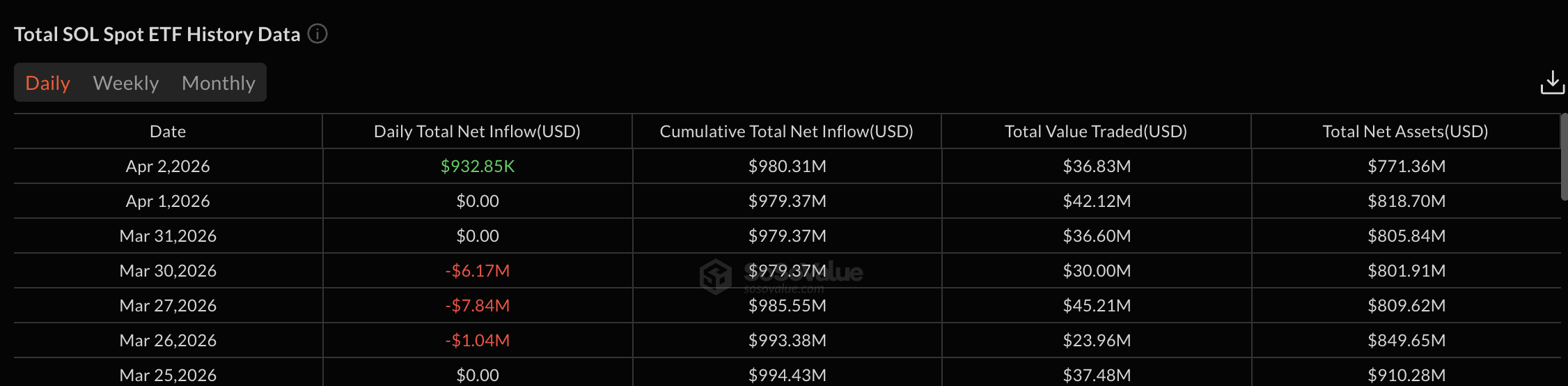
Solana (SOL) price trades near $79.30 on April 3, up 0.6% over the past 24 hours after its spot ETF recorded the first positive net inflow in six trading days.
The $932,850 inflow on April 2 broke a streak of zero and negative activity stretching back to late March. A bullish RSI divergence on the daily chart adds to the bounce case.
However, exchange data shows that participants are already selling into the early strength, a pattern that historically weakened prior rallies. The question is whether institutional flows through the ETF can overpower the selling pressure building on exchanges.
Solana ETF Comeback Meets a Familiar Divergence
Solana ETF flows turned positive on April 2 with $932,850 in net inflows, ending a six-day stretch that included three outflow days totaling roughly $15 million and three days of zero activity. The return of institutional interest, even at a modest level, provides a potential tailwind for the bounce that the daily chart is signaling.
Want more token insights like this? Sign up for Editor Harsh Notariya’s Daily Crypto Newsletter here.
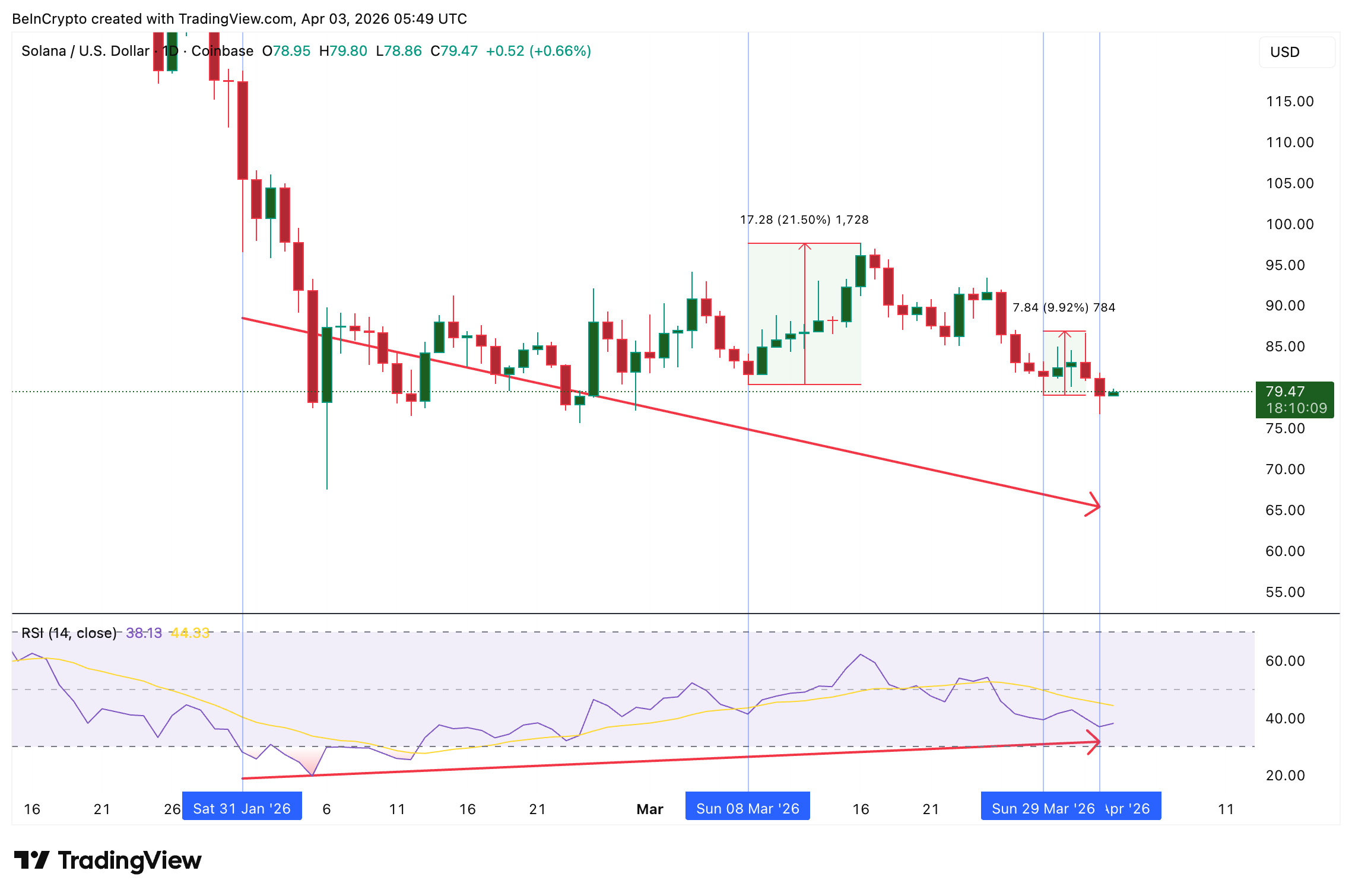
On the daily chart, between January 31 and April 2, Solana price made a lower low while the Relative Strength Index (RSI), a momentum oscillator, made a higher low. That standard bullish divergence signals weakening selling momentum.
This exact pattern has appeared twice before with different outcomes tied directly to ETF activity. The first divergence, confirmed around March 8, preceded a 21.5% rally between March 8 and March 16.
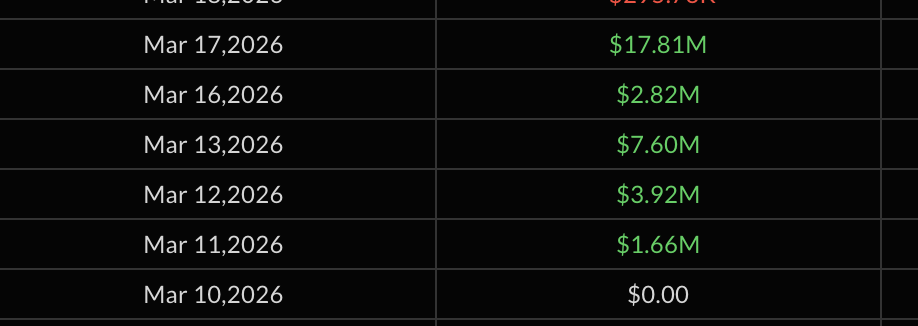
During that period, SOL ETF inflows were consistently positive, with daily flows of $1.66 million, $3.92 million, $7.60 million, and $2.82 million. The institutional tailwind helped the divergence convert into a sustained move.
The second divergence, confirmed around March 29, produced only a 10% bounce. Between March 29 and April 1, ETF flows were either flat or negative, offering no institutional support. The divergence technically worked, but lacked the fuel to sustain itself.
The current divergence, confirmed on April 2, now has its first day of positive flow. Whether the ETF streak continues will likely determine if this Solana bounce resembles the 21% rally or something weaker.
Exchange Sellers Are Already Moving
While the Solana ETF sent its first positive signal in nearly a week, on-chain exchange data tells a contrasting story. The exchange net position change, a Glassnode metric that tracks the net flow of tokens into and out of exchange wallets, turned sharply positive on April 2. The reading surged from 160,431 SOL on April 1 to 860,995 SOL on April 2, a more than fivefold increase in a single day.
A positive net position change means more SOL is flowing onto exchanges than leaving, which typically signals selling intent. The timing matters because this spike coincides with the early stages of the RSI divergence bounce.
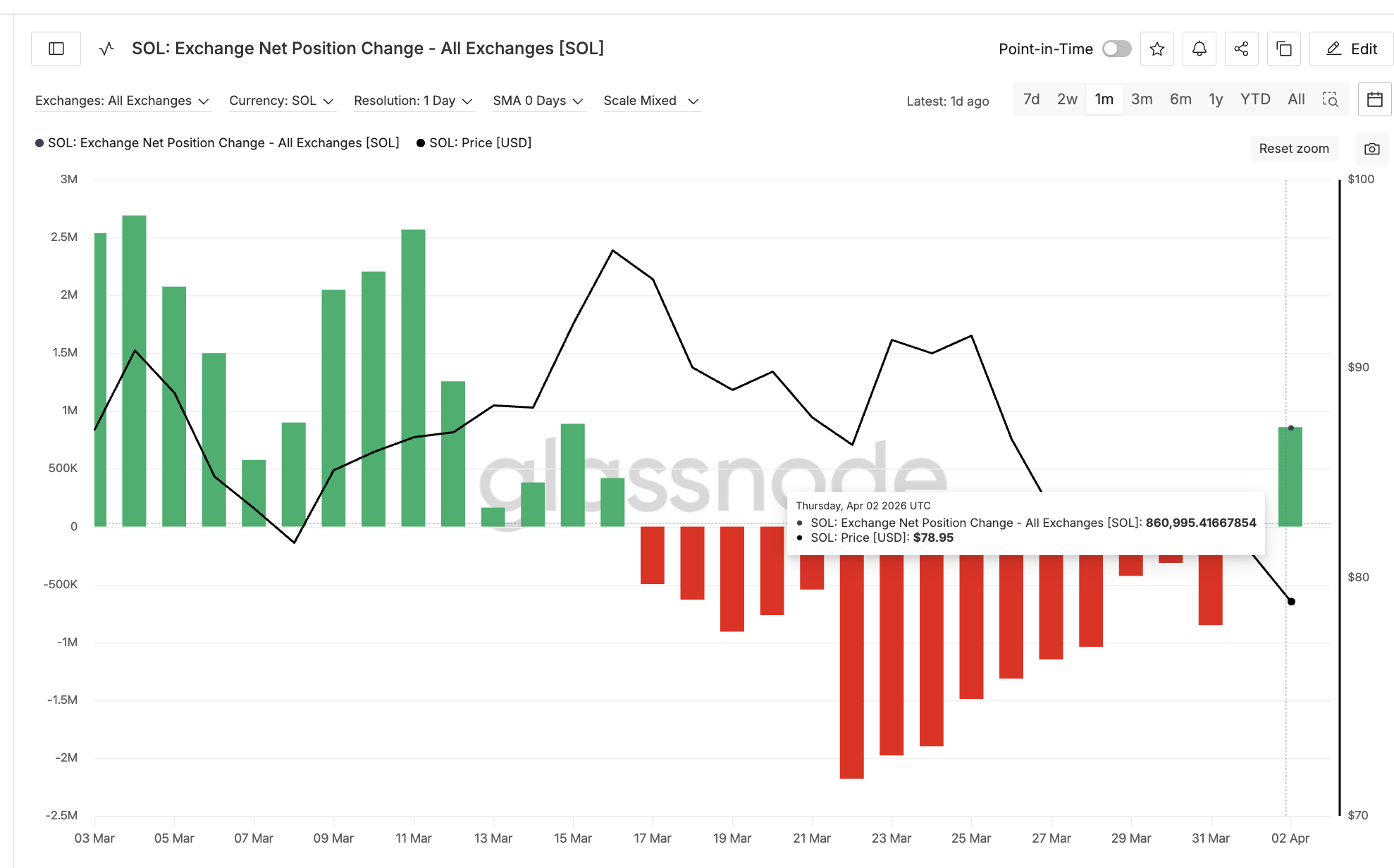
A similar dynamic played out during the March 8 to 16 rally. Throughout that entire 21% move, the exchange net position change remained in green, meaning sellers were active the whole time.
Despite that selling pressure, the ETF tailwind was strong enough to absorb it and push prices higher. When the rally ended and prices began correcting, the exchange metric flipped negative as participants started buying, effectively buying the top.
The current pattern suggests that exchange participants are once again selling into a bounce rather than accumulating ahead of it. This could also mean selling into strength to minimize losses.
If ETF inflows remain modest, this selling pressure may be enough to cap the move early. However, if institutional flows accelerate as they did in mid-March, the selling could be absorbed.
Solana Price and the $79 Floor
The daily chart frames every critical Solana price level from here. SOL currently trades at $79.30, sitting directly on the 0.618 Fib at $79.06. This level has historically acted as a strong support zone across multiple asset classes, and for Solana, it represents the most important floor in the current structure.
A daily close below $79 would weaken the bounce thesis and open the path toward $73.99, the 0.786 Fib. Below that, $67.53 becomes the next major support.
For the divergence to convert into a meaningful rally, Solana price needs to reclaim $82.62, the 0.5 Fib, followed by $86.18 at the 0.382 level. A move above $86 would confirm that the ETF tailwind is outweighing exchange selling and could target $90, representing approximately 14% upside from current levels. A push toward $97.71 would bring back the March 16 high.
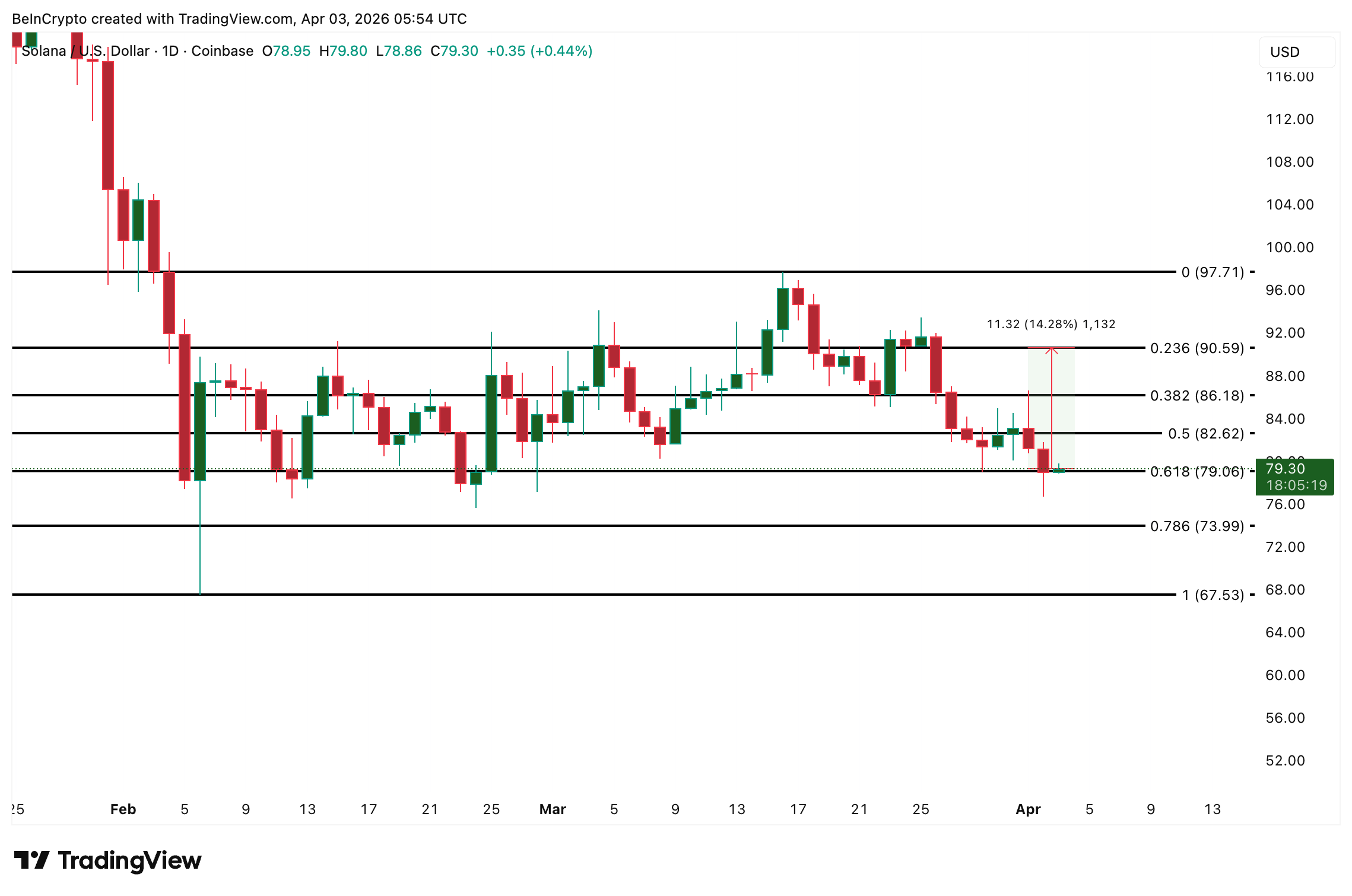
The divergence provides the technical signal, the ETF provides the institutional catalyst, and the exchange selling provides the headwind. The March precedent shows that when ETF flows are strong enough, the bounce survives despite active selling. When they are not, the bounce fades quickly.
A daily close below $79 separates a divergence-driven bounce from a deeper correction toward $73.99, while reclaiming $82.62 with sustained ETF inflows would confirm the rally has institutional backing.
The post A 6-Day Solana ETF Drought Just Ended, but Price Bounce Faces an Immediate Problem appeared first on BeInCrypto.
Crypto World
Microsoft to pour $10B into Japan for AI expansion, cyber defense, and talent development


Microsoft said on Friday it plans to invest $10 billion in Japan over the next four years, focusing on artificial intelligence data centres and supporting infrastructure.
Summary
- Microsoft to invest $10 billion in Japan over four years to expand AI data centres, cybersecurity partnerships, and train one million engineers.
- Initiative builds on a prior $2.9 billion commitment and includes collaborations with SoftBank, Sakura Internet, NTT, and NEC.
- Microsoft also launched new multimodal AI models, positioning them as lower-cost alternatives while continuing its partnership with OpenAI.
The announcement followed a meeting between Microsoft President Brad Smith and Japanese Prime Minister Sanae Takaichi in Tokyo. Smith described the move as a “response to Japan’s growing need for cloud and AI services.”
Companies across Japan, the world’s fourth-largest economy, are accelerating efforts to strengthen their position in the evolving AI sector. However, expansion of data centres in the country has been slowed by land constraints and relatively high electricity costs.
Microsoft said it will work with SoftBank Group and Sakura Internet to scale domestic digital infrastructure. The new commitment follows a $2.9 billion investment announced in 2024 aimed at boosting Japan’s AI capabilities and reinforcing cyber defences.
Alongside infrastructure, the latest plan allocates funding to deepen cybersecurity cooperation with government agencies and to train one million engineers. The initiative will be carried out with major telecom and technology firms, including NTT and NEC.
The surge in data centre construction across the Asia-Pacific region, particularly in India and Southeast Asia, has also raised environmental concerns. These facilities place growing pressure on electricity grids — many still dependent on fossil fuels — and require significant water resources to cool high-performance servers.
In a parallel development, Microsoft’s AI division unveiled three new foundational models capable of generating text, voice, and images, signalling a continued push to expand its in-house capabilities.
The models are now available through Microsoft Foundry, with some also accessible via the MAI Playground testing environment. Pricing has been positioned as a competitive advantage, with Microsoft stating the tools are cheaper than comparable offerings from Google and OpenAI.
The rollout underscores Microsoft’s dual-track strategy: building its own AI systems while maintaining its long-standing partnership with OpenAI.
The company has invested more than $13 billion into the collaboration and continues to integrate OpenAI’s models across its products, even as it develops alternatives internally.
Disclosure: This article does not represent investment advice. The content and materials featured on this page are for educational purposes only.
The crypto market traded $20.57 trillion in Q1 2026, but declining volumes and concentrated liquidity told a story of cautious recovery, not euphoria.
A new quarterly research report from CoinGlass breaks down how capital, trading activity, and market depth shifted among exchanges during the first three months of the year. The findings paint a picture of a market still digesting the aftershocks of late 2025.
A Market Still Healing From Q4’s Crash
Q1 2026 unfolded against a difficult backdrop. The October 2025 tariff shock triggered $19 billion in liquidations within 24 hours, the largest single-day deleveraging event in crypto history.
Bitcoin (BTC) declined roughly 35% from its all-time high above $126,000, and open interest across exchanges dropped more than 40%.
By January, signs of stabilization had appeared. Total market volume for the quarter reached approximately $20.57 trillion, split between $1.94 trillion in spot and $18.63 trillion in derivatives.
However, each successive month saw lower totals. January posted the highest activity, and March fell to the quarterly low.
The derivatives-to-spot ratio held at roughly 9.6x throughout the quarter, slightly above the 2025 full-year average.
That ratio suggests traders preferred hedging and short-term positioning through futures rather than making directional spot bets.
Binance’s Lead Extends Across Every Metric
The CoinGlass report measured exchanges across four dimensions, including trading volume, open interest (OI), order book depth, and user asset reserves. Binance ranked first in all of them.
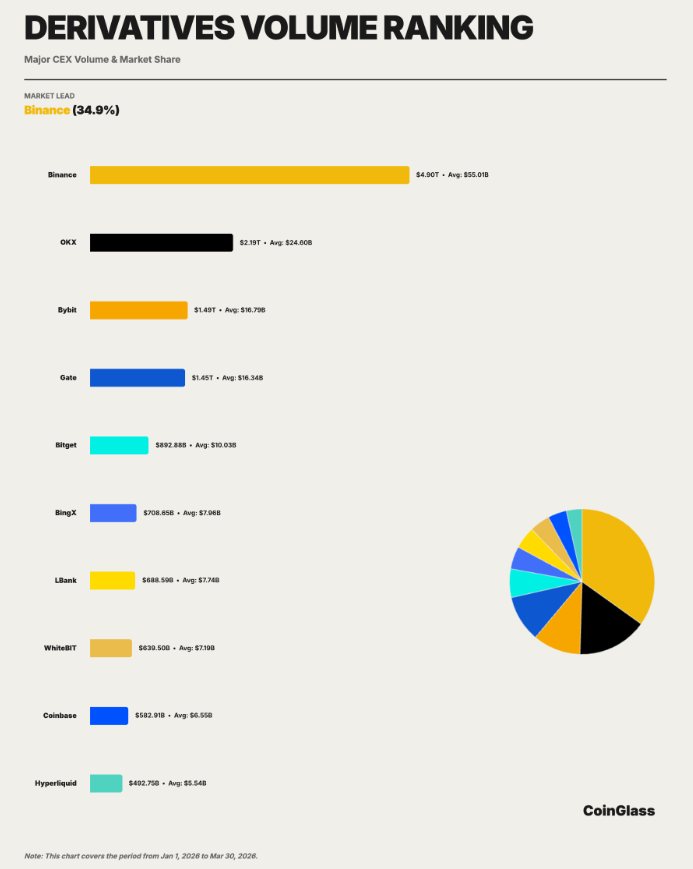
In derivatives, Binance posted approximately $4.90 trillion in cumulative volume, a 34.9% share among the top 10 exchanges.
That figure exceeded the combined totals of OKX ($2.19 trillion) and Bybit ($1.49 trillion). In open interest, Binance averaged $23.9 billion daily, roughly 2.2 times second-ranked Bybit.
Liquidity depth told a similar story. In BTC futures, Binance’s average two-sided depth within 1% of the mid-price was approximately $284 million.
OKX followed at $160 million and Bybit at $76.55 million. The pattern repeated across BTC spot, ETH futures, and ETH spot markets. No single competitor matched Binance across all four sub-markets simultaneously.
The starkest gap appeared in user asset reserves. Binance held approximately $152.9 billion in custodial assets, accounting for 73.5% among the top 10 exchanges. OKX was a distant second at $15.9 billion. Gate, Bitget, and Bybit all fell within the $5 to $7 billion range.
That concentration far exceeds Binance’s share in trading volume or open interest. The CoinGlass report noted that asset retention reflects brand trust, product ecosystem breadth, and on/off-ramp convenience, making it a stronger indicator of long-term competitive position.
Hyperliquid Enters the Mainstream Conversation
One of the quarter’s most notable developments was the rise of Hyperliquid (HYPE), a decentralized derivatives protocol that posted approximately $492.7 billion in Q1 trading volume.
That placed it inside the top ten.
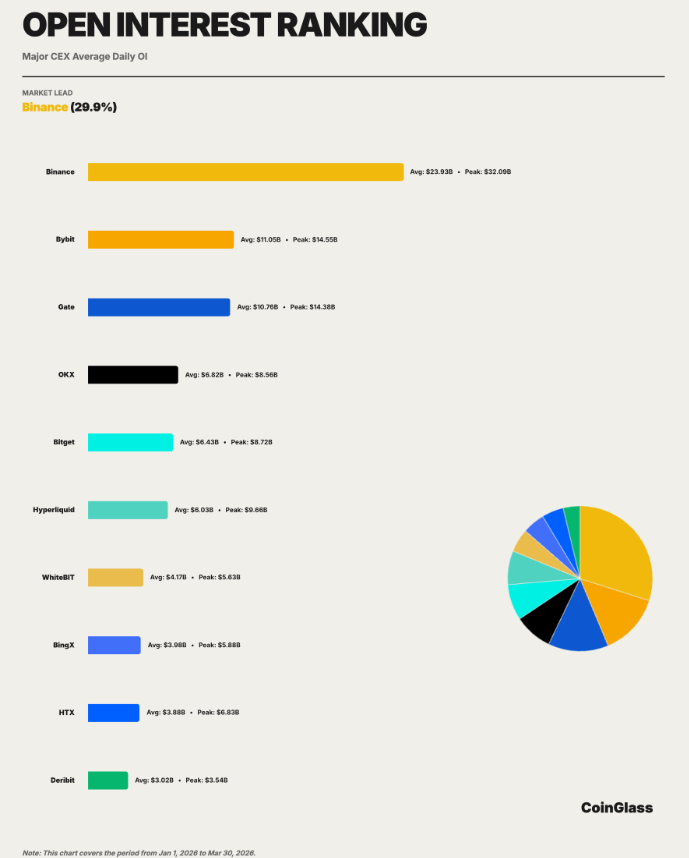
Its average daily open interest of roughly $6.0 billion, with a peak of $9.7 billion, drew close to that of centralized competitors like Bitget.
The growth validated what CoinGlass’s 2025 annual report had predicted, that decentralized derivatives were transitioning from proof-of-concept to actual market share competition.
JPMorgan flagged Hyperliquid in a March report, noting that demand for round-the-clock access to traditional assets was driving decentralized exchange growth and taking share from mid-tier centralized platforms.
Grayscale also filed an S-1 for a HYPE ETF in March, seeking a Nasdaq listing.
For now, Hyperliquid’s scale remains significantly below the leading centralized exchanges.
However, its entry into the competitive arena adds pressure to second-tier platforms competing for derivatives market share.
What Comes Next
The CoinGlass report identified several variables to watch heading into Q2. These include:
- The Federal Reserve’s monetary policy path,
- Changes in BTC spot ETF fund flows, and
- The progress of regulatory framework implementation across major jurisdictions.
Q1 was not about a return to all-time highs. It was about recovery, concentration, and a shifting market structure that is drawing clearer lines between the platforms that attract capital and those that risk falling behind.
The post New Report Finds Where All the Money Went in Crypto’s Brutal Q1 appeared first on BeInCrypto.
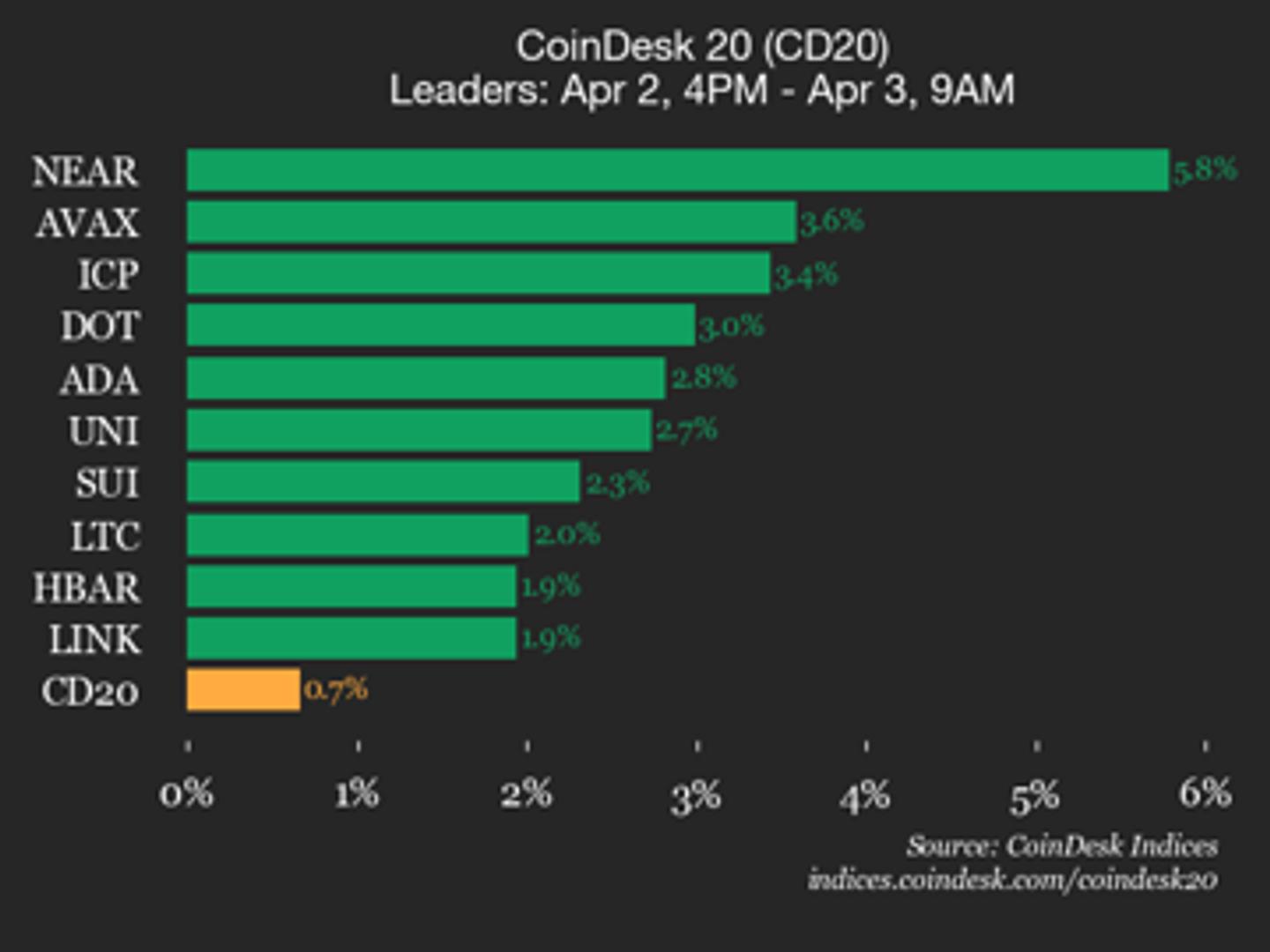
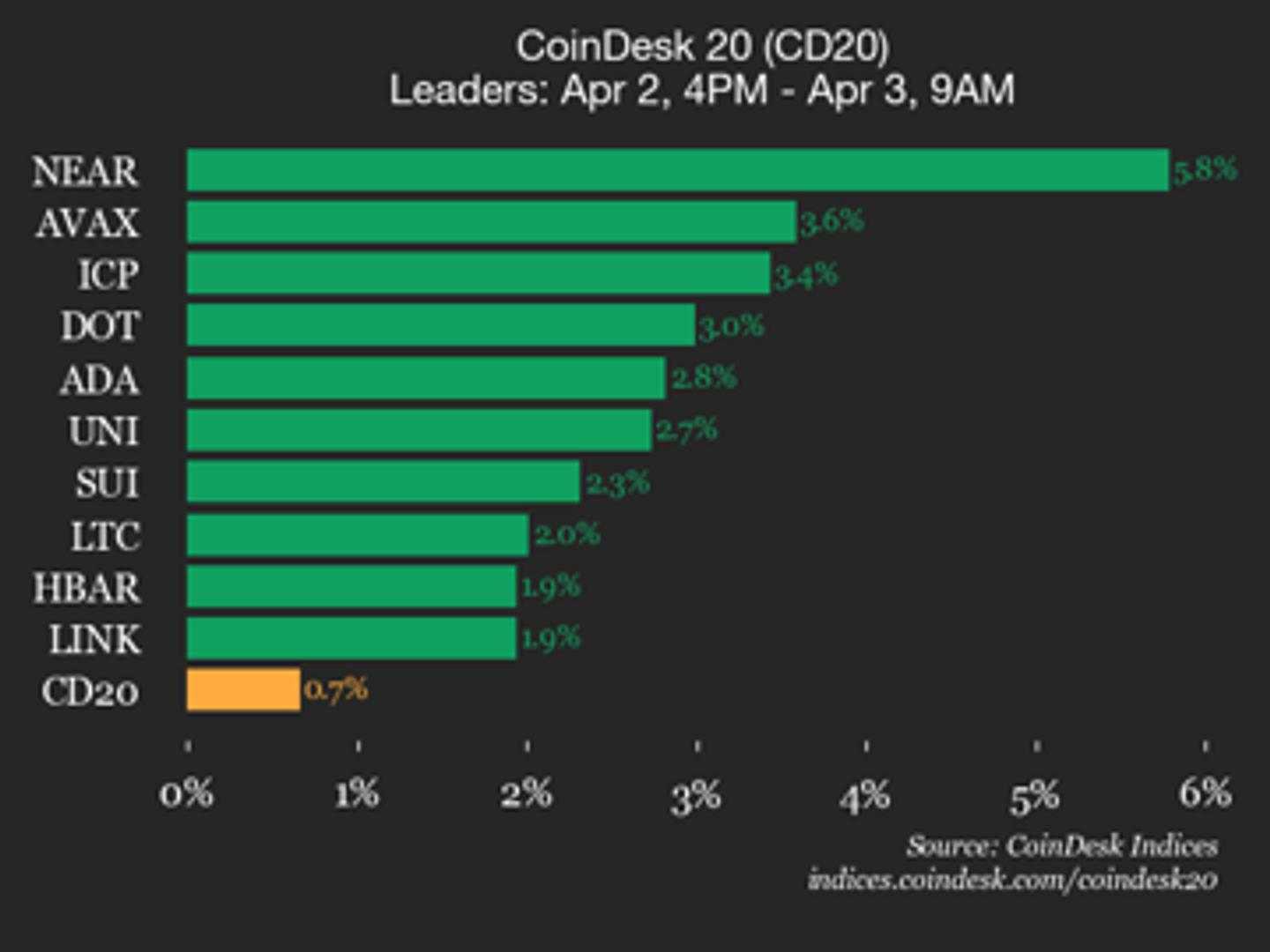
NEAR Protocol (NEAR) gained 5.8% and Avalanche (AVAX) climbed 3.6%.

Key Highlights
- ServiceNow (NOW) shares have declined approximately 32% year-to-date amid widespread SaaS sector pressure from AI disruption concerns
- CEO Bill McDermott reports that half of new business revenue originates from non-seat-based pricing models, including AI token consumption
- Benchmark launched coverage with a Buy recommendation and $125 price target, characterizing the decline as “unwarranted”
- McDermott demonstrated confidence by purchasing $3 million in NOW shares during February, describing it as an optimal entry opportunity
- Management projects 21% GAAP subscriber revenue expansion and identifies a $600 billion total addressable market opportunity
The shares of ServiceNow have experienced significant turbulence throughout 2026. With a decline of roughly 32% since the year began, the enterprise software provider has been swept up in a widespread retreat from SaaS investments that gained momentum in late 2025.
What sparked the exodus? Rapid advancements in AI capabilities from companies such as Anthropic and OpenAI exceeded market expectations, triggering investor anxiety that AI laboratories might erode traditional enterprise software demand.
CEO Bill McDermott challenges this interpretation. He maintains that ServiceNow differs fundamentally from conventional SaaS providers and is proactively pivoting toward AI integration rather than retreating from the technological shift.
“We’re not a feature company and we’re not a function company, we’re a platform company,” McDermott explained. He highlighted the company’s AI Control Tower solution, which orchestrates and oversees AI agents, models, and operational workflows throughout enterprise infrastructures.
Among McDermott’s most significant revelations: half of ServiceNow’s incoming business revenue derives from pricing structures unrelated to user seats. This marks the company’s first public disclosure of this metric.
Transitioning Beyond Per-Seat Licensing
The conventional software revenue model — billing based on individual user licenses — faces mounting challenges as artificial intelligence diminishes dependency on workforce expansion. ServiceNow is adopting a blended approach where clients pay for both user licenses and consumption-based AI tokens.
The strategy is clear: as the platform executes more autonomous functions, organizations purchase additional tokens. This decouples revenue expansion from employee headcount metrics.
Goldman Sachs analyst Gabriela Borges maintains a 12-month price target of $216 for NOW. She anticipates upward revisions to organic growth projections throughout the year as clients exhaust complimentary AI token allocations and transition to paid consumption after validating business value.
“Those packages are going to start getting burnt through, such that customers are now going to come back to ServiceNow and say, ‘Hey, we proved the value of this particular product. We are now ready to pay for it,’” Borges explained.
McDermott reinforced his optimism through action. During February, he acquired $3 million in NOW shares using personal funds.
Strategic Acquisitions and Market Expansion
ServiceNow has maintained an aggressive acquisition strategy recently. Last December, the company revealed plans for a $7.75 billion acquisition of cybersecurity provider Armis. Additional purchases included AI identity security specialist Veza and a $2.85 billion investment in Moveworks, a platform focused on AI assistance and reasoning agents.
During the Q4 earnings discussion, McDermott directly confronted shareholder concerns regarding acquisition velocity, emphasizing that purchases target innovation capabilities rather than revenue supplementation.
These strategic moves position ServiceNow more prominently within cybersecurity and customer relationship management sectors. McDermott asserts these expansions elevate the addressable market opportunity to at least $600 billion, a substantial increase from the $90 billion estimate when he assumed leadership in 2019.
On April 1, Benchmark launched coverage featuring a Buy rating alongside a $125 price target. Analyst Yi Fu Lee characterized the sell-off motivated by AI displacement concerns as “unwarranted” and positioned NOW as a primary beneficiary of the “Agentic AI super cycle.”
Wall Street consensus maintains a Buy recommendation for the company. ServiceNow’s price-to-earnings multiple registered approximately 61 times trailing 12-month earnings as of Thursday’s trading session.

Experts dispute US account of deadly Lamerd sports hall strike in Iran

United Airlines to introduce tiered fare categories for premium cabins

Circle Unveils New Token Aimed at Expanding Bitcoin Utility


-

 NewsBeat7 days ago
The Story hosts event on Durham’s historic registers
-

 NewsBeat19 hours ago
Steven Gerrard disagrees with Gary Neville over ‘shock’ Chelsea and Arsenal claim | Football
-

 Sports7 days ago
Sweet Sixteen Game Thread: Tide vs Michigan
-
Entertainment4 days ago
Fans slam 'heartbreaking' Barbie Dream Fest convention debacle with 'cardboard cutout' experience
-

 Crypto World2 days ago
Gold Price Prediction: Worst Month in 17 Years fo Save Haven Rock
-

 Business14 hours ago
No Jackpot Winner and $194 Million Prize Rolls Over
-
 Entertainment6 days ago
Lana Del Rey Celebrates Her Husband’s 51st Birthday In New Post
-

 Tech5 days ago
The Pixel 10a doesn’t have a camera bump, and it’s great
-
Crypto World3 days ago
Dems press CFTC, ethics board on prediction-market insider trades
-

 Sports3 days ago
Tallest college basketball player ever, standing at 7-foot-9, entering transfer portal
-

 Tech4 days ago
Avatar Legends: The Fighting Game comes out in July and it looks pretty slick
-

 Tech3 days ago
EE TV is using AI to help you find something to watch
-

 Fashion5 days ago
Amazon Sundays: Soft Spring Layers
-

 Business1 day ago
Login and Checkout Issues Spark Merchant Frustration
-

 Fashion6 days ago
When Evening Dressing Gets Colorful for Spring
-

 Tech3 days ago
How to back up your iPhone & iPad to your Mac before something goes wrong
-

 Tech5 days ago
Elon Musk’s last co-founder reportedly leaves xAI
-

 Tech4 days ago
Apple will hide your email address from apps and websites, but not cops
-

 Crypto World4 days ago
U.S. rule change may open trillions in 401(k) funds to crypto
-

 Politics4 days ago
Should Trump Be Scared Strait?
You must be logged in to post a comment Login