
Crypto World
Chip Stocks Drop During Dog Days Of Summer

Chip stocks tumbled Tuesday in a broad reversal from Monday’s solid gains, leaving investors with whiplash. Decliners included Micron (MU) stock and other memory names, and Nvidia (NVDA) and fellow AI chipmakers. The Philadelphia semiconductor index, known as SOX, fell 5% on the stock market today. On Monday, the SOX, which includes the 30 largest chip stocks traded in the…
Copyright ©2026 Investor’s Business Daily, LLC. All rights reserved. 87990cbe856818d5eddac44c7b1cdeb8

Crypto World
BitGo secures South Korea virtual asset license, says it's the first global crypto company to do so


Backed by Hana Financial Group and SK Telecom, BitGo Korea built a locally registered entity from scratch to serve institutional and enterprise clients, rather than taking the acquisition route.

It gives us great (mostly unbiased) pleasure to write such an article, especially after weeks and months and nearly a year of painful declines or lack of any actual upside movement. After all, the cryptocurrency market is used to explosive movements, but this wasn’t the case for a long time. At least not in the ‘right’ direction.
Let’s quickly recap what happened in the past 24 hours: bitcoin traded at $64,400, then exploded to $70,000, then it was briefly pushed back to $68,000, then went on the offensive again, and then rocketed past $71,000 minutes ago for the first time since very early June.
As Glassnode put it, this was its most impressive daily close since February, but that one followed a major retracement. What makes the current pump so spectacular is that it had “no crash to bounce off.”
The last daily bitcoin:native close this large was in February, and that was just the rebound from the -14% day before it.
This one had no crash to bounce off. Against its own 30d volatility it was a 5.8 sigma move – the largest to the upside since October 2023. pic.twitter.com/SqiitTuTYc
— glassnode (@glassnode) August 20, 2026
The Main Catalyst
Perhaps the most important factor behind this mind-blowing surge was the US Treasury Department’s announcement that it will at least double the maximum size of liquidity-support buybacks for longer-dated government debt. It will raise them from $2 billion to at least $4 billion per operation, and the changes will commence on September 9 and will continue until November 4.
This announcement came after the 30-year Treasury yield hit 5.34% on Tuesday, the highest level in nearly 20 years, as inflation concerns, heavy government borrowing, and concerns about the overall US fiscal outlook skyrocketed. The same Treasury yield dropped immediately to 5.20%, while stocks, gold, and crypto moved in the opposite direction. The dollar weakened as lower bond yields can make non-yielding and riskier assets relatively more attractive.
More US-Related Reasons
Since we are on the US topic, let’s explore two more possible factors that could be regarded as promising for risk-on assets. The first came from the POTUS, who paused the tariffs against Canada and later announced a deal to cut some of them from 25% to 15%. Tariff news has impacted BTC for over a year and a half, and trade deals tend to benefit the asset’s moves.
The other one, expectedly, also came from Trump. This time, though, it concerned Iran. Instead of warning of new ballistic attacks, the POTUS took a different approach, targeting the country’s economy.
After admitting that the Iranian government had failed to make a deal with the US, he outlined the new strategy, which will focus on bringing the country down through economic activity.
“I am announcing the MOST CRUSHING ECONOMIC OPERATION EVER TAKEN AGAINST ANY COUNTRY! This will be Economic Warfare and Isolation on an unprecedented scale. Their navy is gone, their air force is destroyed, their military factories are now rubble, their currency is worthless, and their country is hanging by a thread.”
Obviously, this is not the perfect outcome, especially for Iran, but at least there are no new damaging physical attacks or another threat of a nuclear massacre. Risk assets like that.
ETFs and OI
Now let’s focus more on BTC itself. The first reason here is the ETF inflows. Data from SoSoValue shows that the daily net inflows stood at just over $517 million for yesterday. This was the highest number since early May, when the flows were $630 million and $532 million for two consecutive trading sessions. Recall that bitcoin went on an impressive run back then, peaking at $83,000 within a week or so.
To put things into perspective, the netflows yesterday alone were a lot higher than the entire month of July, when the funds attracted $172.43 million.
Lastly, let’s examine the open interest, which had built up to its highest position since 2023. When leverage increases so much, every smaller move becomes much larger, which is evident from the cascade of liquidations of traders betting on the wrong side.
And the OI just a few days before yesterday’s explosion was even higher than before the October 2025 massacre, when the liquidations topped $19 billion. In other words, something was brewing for weeks, as BTC doesn’t like standing in one spot for too long.
The post What Sent Bitcoin Flying Above $71,000? 5 Factors Behind the Surge appeared first on CryptoPotato.


Key takeaways
- Pi Network trades at $0.09 after recording three consecutive bullish daily closes earlier this week.
- Expanded US Treasury bond buybacks have improved risk appetite and pushed Bitcoin toward $70,000, but PI continues to underperform.
- The token must break above the psychological $0.1000 level and the 50% Fibonacci retracement at $0.1022 to extend its recovery.
Pi Network (PI) trades around $0.090 on Thursday, preserving its three-day recovery from earlier in the week but continuing to lag behind the broader cryptocurrency market.
Renewed risk appetite has pushed Bitcoin above $71,000 after the US Treasury expanded its longer-term securities buyback operations.
However, PI has failed to attract enough buying pressure to produce a comparable rally.
The token must overcome the psychological $0.1000 threshold to strengthen its recovery and support a more sustained bullish move.
Treasury buybacks lift crypto sentiment
The US Treasury announced that it would at least double the maximum size of certain liquidity-support buyback operations from $2 billion to $4 billion per transaction.
The initiative is intended to support liquidity in the longer-dated Treasury market and address concerns surrounding rising borrowing costs.
Improving bond-market liquidity and easing long-term yields have strengthened investor confidence in higher-risk assets, including cryptocurrencies.
Bitcoin has benefited substantially from the shift in sentiment, advancing toward $70,000 alongside sharp gains across several major altcoins.
Pi Network, however, remains among the market’s notable underperformers. Derivatives data indicates a modest improvement in speculative interest around PI, but retail demand remains relatively weak.
CoinAnk data shows that PI futures Open Interest increased to $9.30 million from $8.82 million the previous day. Open Interest measures the total value of outstanding derivatives contracts and typically rises when traders establish new positions.
Despite the daily increase, the figure remains considerably below the July 15 peak of $12.14 million.
The subdued level suggests that traders remain hesitant to commit substantial capital to PI, even as improving market conditions encourage risk-taking elsewhere in the cryptocurrency sector.
Without a more substantial increase in participation, Pi Network may struggle to keep pace with the broader market recovery.
Technical outlook: Can PI rebound toward $0.10?
Pi Network trades near $0.090 on Thursday, maintaining a neutral short-term outlook.
The token recorded three consecutive bullish daily closes earlier this week, producing a cumulative gain of approximately 4%.
PI has also moved above the 78.6% Fibonacci retracement at $0.0839, measured from the downswing between $0.1341 and $0.0703.
Holding above this level preserves the possibility of an extended recovery. However, PI still faces significant resistance around the psychological $0.1000 mark.
The token’s immediate technical resistance sits at the 50% Fibonacci retracement level of $0.1022.
A decisive daily close above the $0.1000-to-$0.1022 zone could strengthen bullish momentum and attract additional retail participation.
Such a move would also suggest that PI is beginning to capitalize on the improving sentiment across the broader cryptocurrency market.
Failure to overcome this resistance zone could keep the token confined to its current range and increase the likelihood of renewed selling pressure.
PI’s daily momentum indicators reflect a cautious recovery rather than a decisive bullish reversal.
The Relative Strength Index is hovering near the neutral level of 50, indicating that neither buyers nor sellers have established clear control.
Meanwhile, the Moving Average Convergence Divergence indicator remains slightly above its signal line, while its bullish histogram gradually expands. This configuration points to mild upside momentum, but the signal remains too weak to confirm a sustained rally.
A stronger RSI move above 50, accompanied by further MACD expansion and rising Open Interest, would improve PI’s near-term outlook.

The 78.6% Fibonacci retracement at $0.0839 remains PI’s primary support level.
Buyers must defend this area to preserve the current recovery structure. A decisive break below $0.0839 could invalidate the latest rebound and expose the swing low at $0.0703.
Conversely, holding above $0.0839 while building momentum toward $0.1000 would keep the bullish recovery scenario intact.


GnosisDAO approved Gnosis Chain’s transition from a standalone layer-1 network to a ZK-proven Ethereum Economic Zone (EEZ) rollup.
GIP-153 received 123,158 GNO in support, 115 against and 151 abstaining across 54 voters, Gnosis Chain said in an X post. Turnout reached 123,425 GNO, exceeding the 75,000 quorum.
Under the proposal, Gnosis Chain’s validator set would be retired and the network would settle transactions on Ethereum, making Gnosis Chain a layer-2 (L2) that relies on Ethereum’s validators for settlement.
An initial launch is targeted for late 2026 or early 2027, subject to the required EEZ technology being ready.
The update would enable Gnosis Chain-native smart contracts to call Ethereum and use the result in the same transaction, giving it access to Ethereum mainnet assets and liquidity in an environment “optimized” for consumers, a capability the proposal says is not currently available on existing L2s.
Gnosis Chain to become first production EEZ instance
The EEZ is a framework for building Ethereum-aligned rollups, developed by Gnosis and ZisK, with funding from the Ethereum Foundation.
The initiative aims to unify Ethereum’s fragmented L2 ecosystem by enabling smart contracts across different rollups to execute synchronously without relying on bridges. It targets one of Ethereum’s main scaling trade-offs: improved throughput from dozens of L2 networks, which separate liquidity, infrastructure, and user activity across separate blockchains.
Gnosis Chain would become its first deployed instance while retaining its existing applications, balances and xDAI gas token.
Ethereum co-founder Vitalik Buterin previously raised concerns about the centralized sequencers and trusted bridging mechanisms as potential weak points in the design of some L2 networks. “The original vision of L2s and their role in Ethereum no longer makes sense, and we need a new path,” Buterin wrote in a Feb. 3 X post.
According to data from L2Beat, 22 Ethereum rollups currently secure $27.82 billion. Including validiums, optimiums and other scaling networks, the platform tracks $34.88 billion in total value secured.
Related: Ripple raises $275M for US prime brokerage to meet institutional demand
EEZ could reduce reliance on vulnerable infrastructure: Standard Chartered
EEZ could reduce reliance on blockchain bridges and increase activity within the Ethereum ecosystem, according to Geoffrey Kendrick, global head of digital assets research at Standard Chartered.
“The EEZ will have the benefit of reducing the need for bridges (where hacks tend to occur) and increasing the usability of assets in EVM chains,” he wrote in a May 28 report shared with Cointelegraph.
“Both of these are likely to lead to greater activity in the Ethereum ecosystem.”
Kendrick said the EEZ could create greater composability between assets, allowing smart contracts on different participating networks to interact within the same transaction.
Magazine: Ethereum’s EEZ could pull other blockchains into its orbit


HTX denied authorizing a series of disputed cryptocurrency microtransfers on Aug. 20 after some users alleged that funds originating from HTX-linked addresses caused compliance restrictions at Kraken and other exchanges.
Summary
- HTX said its internal review found no official accounts behind disputed small cryptocurrency transfers reported.
- Kraken said British sanctions require restrictions on funds transferred directly into affected customer accounts there.
- The U.K. government confirms its Huobi Global designation also applies to HTX through ownership rules currently.
- An HTX representative claimed known Kraken restrictions reached $4.2 million without publishing supporting records publicly.
- Onchain reports identified small transfers to Kraken addresses, but wallet labels cannot establish authorization alone.
An HTX representative using the @HTX_Molly account said an internal review found no activity from official company accounts. The representative suggested that affected users could have initiated transfers independently while trying to protest or test Kraken’s restrictions.
The same representative claimed that funds frozen at Kraken included cases worth as much as $4.2 million. HTX did not publish account records, transaction hashes or communications from Kraken supporting that figure. Kraken has not publicly confirmed the alleged maximum.
HTX says it found no official transfer activity
The reports began after users identified small unsolicited USDT transfers from addresses labeled as connected to HTX. Some commentators described the transfers as address poisoning intended to trigger compliance systems at other platforms.
HTX said its internal checks found no evidence that an official account initiated a coordinated campaign. Justin Sun separately called reports that HTX deliberately sent the transfers “made up,” while the exchange said it was examining address labels and the transfers’ sources.
Available onchain reporting has not established who controlled every sending address. One community review found that a batch of 7.5 USDT transfers from an HTX-labeled hot wallet went to addresses attributed to Kraken.
Wallet labels alone do not prove that HTX authorized a transfer. Exchange deposit addresses, payment processors, intermediaries and user-controlled withdrawal activity can complicate attribution. Public transaction hashes would be needed to test the findings independently.
As crypto.news previously reported, HTX’s initial investigation found no verified connection between disputed transfers and subsequent account freezes. The exchange has not released a complete address list or final investigation report.
Kraken confirms restrictions tied to U.K. sanctions
Kraken has confirmed a broader policy of restricting transfers associated with Huobi or HTX. The exchange said U.K. government sanctions require it to restrict funds transferred from Huobi into Kraken customer accounts.
Kraken has not said that every incoming transfer from an HTX-labeled address produces a full account freeze. It has also not confirmed that the recent microtransfers caused specific customer restrictions.
The policy followed the U.K.’s May 26 designation of Huobi Global S.A. under its Russia sanctions regime. The government said it had reasonable grounds to suspect that the company was involved in making funds or economic resources available to entities in Russia’s financial sector.
HTX disputed the designation’s application to its exchange. In its May statement, HTX argued that Huobi Global S.A. was distinct from the online platform and said its operations remained unaffected.
The U.K. Office of Financial Sanctions Implementation rejected that distinction. Its official guidance says the designation applies to the HTX exchange because OFSI considers Huobi Global to own it under U.K. sanctions rules.
Kraken’s restrictions therefore have a confirmed regulatory basis. Whether each affected customer’s transaction legally requires an extended freeze depends on the ownership, source, timing and sanctions exposure involved in that case.
The $4.2 million claim remains unverified
The @HTX_Molly representative said HTX had researched Kraken restrictions during the previous two days and found that some users remained unable to access funds. The representative cited $4.2 million as the highest known amount.
No evidence accompanying the statement established whether that amount belonged to one account, several linked accounts or a transfer under a specific legal hold. It is also unclear whether the restriction followed the recent microtransfers or earlier direct dealings with HTX.
The representative said HTX had created a group for affected Kraken customers to collect cases and seek the release of funds. HTX characterized those efforts as voluntary user activity rather than exchange-directed transfers.
Kraken advises restricted customers to respond to requests for documentation and contact its support team. The exchange may impose restrictions for sanctions compliance, account security, payment reversals or other reviews. These categories are separate from temporary withdrawal holds routinely applied after certain purchases or account changes.
The incident resembles compliance poisoning
Classic address poisoning usually involves sending small transfers from lookalike addresses. The attacker hopes a victim will later copy the fraudulent address from their transaction history and send funds to it.
The reported HTX transfers present a different scenario. The alleged objective would be to associate a recipient with a sanctioned or compliance-sensitive address, potentially triggering automated screening. “Compliance poisoning” is therefore a more precise description if intentional conduct is eventually established.
The current evidence does not establish intent. Receiving an unsolicited transfer also does not, by itself, show that a recipient knowingly dealt with a sanctioned entity.
HTX’s next step is to publish its final review, including verified sending addresses and transaction hashes. Kraken may also clarify how it evaluates unsolicited transfers and what documentation affected users need to restore access.
Until then, the official record supports three narrower findings: the U.K. sanctions apply to HTX, Kraken restricts affected transfers, and HTX denies authorizing the disputed microtransactions. The alleged $4.2 million freeze and any coordinated poisoning campaign remain unverified claims.
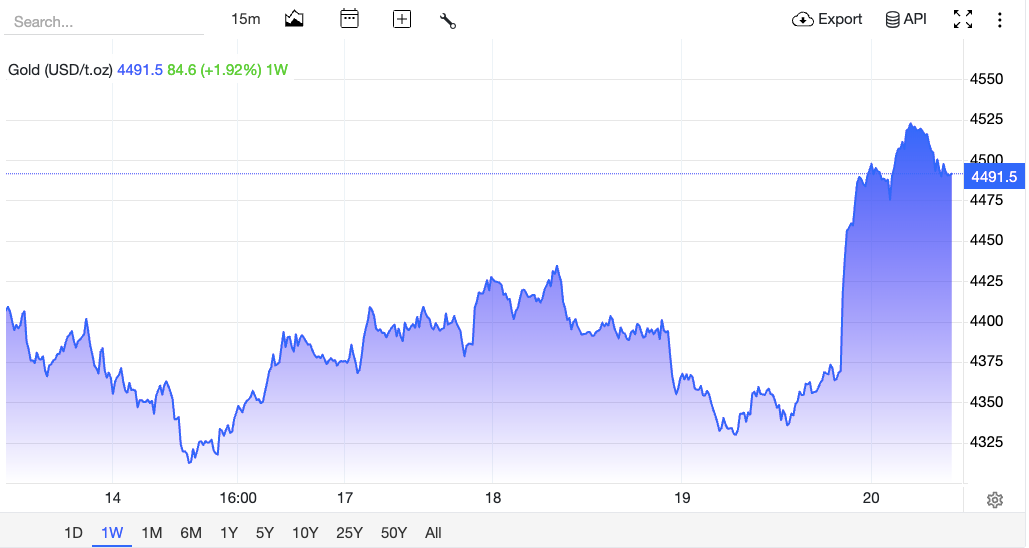
Spot gold traded just under $4,500 an ounce on Thursday, close to a two-month high. Prices touched $4,525 earlier in the session after gaining more than 4% on Wednesday. JPMorgan’s near-term target for gold in the fourth quarter of 2026 is $4,500 per ounce, a downward revision from its earlier projection of $6,000
The US Treasury doubled its long-bond buyback size on Wednesday, pushing yields lower. That move revived talk of gold reclaiming $5,000 before 2026 ends.
JPMorgan’s Moving Target
Gold set an all-time high above $5,300 in February 2026 before retreating sharply this spring. The pullback pushed prices roughly 25% below that peak by May, ahead of this week’s rebound.

Gold’s climb toward $4,525 puts it near a level JPMorgan no longer expects to hold. The bank’s own price target has swung sharply over the past year.
JPMorgan Global Research kept a $6,000 year-end target in mid-2026. The bank still trimmed its full-year average estimate to $5,243, down from $5,708. It then cut that Q4 forecast by roughly 25% in July.
JPMorgan cited softer demand from key buyers for the cut. Its new target sits at $4,500, roughly where spot gold trades now.
However, Thursday’s rally puts gold’s price action ahead of JPMorgan’s own downgraded target. That gap shows how quickly Wall Street forecasts can lag a volatile market.
Meanwhile, other banks show a similar pattern of shifting conviction. Goldman Sachs cut its year-end call to $4,900 in June, down from $5,400. It also pushed back its expected first Fed rate cut from 2026 to 2027.
In contrast, BloFin Research took a different view, comparing gold’s performance against equities instead of judging the drop alone. Gold sits 21% below its January peak, but the S&P 500 to gold ratio has rebounded roughly 40% this year.
Why Gold Is Rallying Again
A number of factors are pushing gold upwards again.
Treasury Secretary Scott Bessent doubled liquidity support buybacks for 10-to-30-year securities on Wednesday. The new minimum size is $4 billion per operation, up from $2 billion.
The announcement followed a bond selloff that pushed the 30-year Treasury yield to its highest level since 2007. Yields fell after the news, easing pressure on a strained bond market.
Total US federal debt topped $40 trillion this week, a new debt milestone that deepened fiscal concerns. Rising interest costs and social safety net spending continue to outstrip tax revenue, according to Treasury officials.
A weaker US dollar also added to gold’s appeal this week. The dollar recently touched a three-month low against major currencies, making dollar-priced gold cheaper for foreign buyers.
Federal Reserve minutes released this week revealed a split committee. Several policymakers said they would support a rate hike if inflation stays above the Fed’s 2% target.
Traders currently price a 32.7% chance of a September hike. They see a 67.3% chance the Fed holds steady, according to the CME FedWatch Tool. The tool tracks trader bets on upcoming Fed decisions.
US gold futures for December delivery rose 0.6% to $4,569.80. Other precious metals gained ground too. Spot silver rose 0.2% to $67.06 an ounce, while platinum slipped 0.4% to $1,816.78. Palladium added 0.3% to reach $1,339.05.
Rising debt service costs add another layer to the story. Net interest payments on federal debt hit $628 billion over the fiscal year’s first seven months, per Treasury data. That figure already tops the government’s $588 billion in Medicare spending over the same stretch.
What It Would Take to Reach $5,000
Central bank buying remains the clearest support under gold’s price. The World Gold Council reported a 62% jump in central bank purchases last quarter. China extended its buying streak to 21 straight months. Poland, Kazakhstan, and the Czech Republic also ranked among the largest buyers.
That demand creates a floor, but reaching $5,000 needs more than steady buying.
A Fed pivot toward rate cuts would be the clearest catalyst for gold. Lower real yields make non-yielding gold more attractive than bonds.
A weaker dollar could add momentum too. So could fresh geopolitical stress or a worsening fiscal outlook tied to the $40 trillion debt figure.
The post JPMorgan’s Q4 Gold Target Was Just Crossed: Is $5,000 Next? appeared first on BeInCrypto.
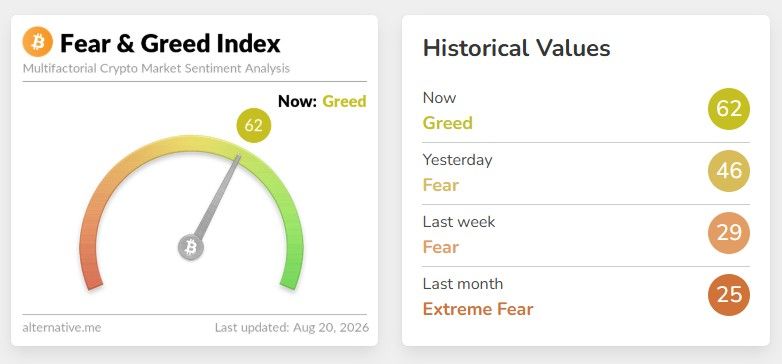
The crypto Fear and Greed Index climbed to 62 on Thursday, a Greed reading that wipes out yesterday’s score of 46. The 16-point daily jump ranks among the sharpest sentiment swings of 2026.
Bitcoin (BTC) drove the shift. The largest cryptocurrency gained 8.8% over 24 hours to trade near $69,803, while ether and other majors posted even bigger moves.
What Pushed the Crypto Fear and Greed Index Into Greed
The index blends five inputs, and two of them carry most of the weight. Volatility and market momentum count for 25% each. Both flipped hard once prices moved.
Ether (ETH) led the majors with an 18.5% daily gain to $2,259. Solana (SOL) added 11.9%, and XRP rose 11.2%. Meanwhile, Bitcoin’s market capitalization recovered to roughly $1.4 trillion.

The scale runs from zero to 100. Readings above 50 count as Greed. Scores near 25 signal Extreme Fear. Thursday’s print is the highest level on the index’s 30-day chart. Weekly investor surveys and Bitcoin dominance make up the smaller inputs.
Short sellers accelerated the climb. Roughly $1.23 billion in bearish positions unwound during the surprise crypto market rally, which forced traders to buy back exposure at higher prices.
Social media activity and Google search interest, which together account for a quarter of the score, typically spike after moves like this. Therefore, the reading may keep rising before it cools.

Why This Sentiment Flip Still Deserves Caution
Context matters here. The index printed 29 last week and 25 a month ago, deep inside Extreme Fear. Traders spent nearly all of July and early August below 35.
However, liquidity has not recovered at the same pace as the mood. Stablecoin balances held on exchanges have dropped about 20%, according to exchange stablecoin reserve data. Less idle cash therefore sits ready to absorb the next round of selling.
Contrarians read extremes in both directions. In late June, Fundstrat head of research Tom Lee argued that crypto sentiment had sunk below post-FTX levels. Coverage of those peak market fear signals looks early rather than wrong today.
Other traders watch market structure instead of mood. Bitcoin dominance has tested support since July, a setup that keeps the altcoin season debate open. In contrast to sentiment gauges, that signal has barely budged.
Leverage cuts both ways. The same short liquidations that lifted prices leave fewer bears to squeeze. A quiet session could drag the volatility and momentum scores straight back down.
One day of Greed confirms nothing on its own. Still, the index rarely travels 16 points without follow-through in one direction or the other. The next few readings will show whether buyers stay committed or whether fear returns just as quickly.
The post Crypto Fear and Greed Index Flips From Fear to Greed Overnight appeared first on BeInCrypto.


Blueprint Finance has completed a strategic funding round led by Polychain Capital to expand Concrete, its on-chain vault infrastructure for institutions, protocols, and asset managers.
Summary
- Polychain Capital led Blueprint Finance’s strategic funding round, with BitGo, FalconX, Bullish and other crypto firms participating.
- The funding will support the expansion of Concrete’s on-chain vault infrastructure for institutions, protocols and asset managers.
- Concrete combines execution, accounting, rebalancing and risk controls within a unified vault system.
- Blueprint Finance is also expanding the Concrete ecosystem through AssetCX and concUSD.
Blueprint Finance said on Aug. 19 that Bullish, Keyrock, BitGo, FalconX, G-20, Flowdesk, JPEG Trading, Sentient Capital, Andes and 2Square also participated in the round. The company did not disclose the amount raised or its valuation.
The financing will support further development of Concrete, which Blueprint describes as full-stack infrastructure for creating and managing vaults that deploy capital across on-chain strategies. Its system combines execution, accounting, risk controls, rebalancing and integrations with other protocols within the same vault architecture.
For institutions and asset managers, Blueprint said the structure is intended to reduce the operational work involved in managing strategies across separate DeFi protocols. The company has also been working with asset issuers, networks and institutional allocators on vaults that can support on-chain yield products and provide liquidity infrastructure.
Blueprint Finance funding will support Concrete’s vault infrastructure
Concrete is being developed around vaults that function as programmable capital allocation systems, allowing strategy rules and operational controls to be packaged within an on-chain product.
Blueprint said professional allocators require auditable accounting, defined operational permissions, scalable execution and transparent risk controls alongside access to DeFi markets. The company is positioning Concrete as the infrastructure connecting those requirements with on-chain execution.
“DeFi is moving beyond the era where capital allocation was defined by chasing the highest advertised yield,” Blueprint Finance CEO and co-founder Nic Roberts-Huntley said.
Roberts-Huntley said professional allocators increasingly need “controls, transparency, automation, and risk management” while retaining the features available through on-chain markets. He said the latest investor group brings experience from different parts of the digital asset industry as Blueprint expands Concrete.
Alongside its vault infrastructure, Blueprint is developing AssetCX and concUSD as additional products within the Concrete ecosystem. According to the company, the products are intended to extend Concrete into the development of new on-chain assets, markets and financial products.
The investor list also puts several companies involved in institutional crypto infrastructure behind the project. BitGo operates custody and trading infrastructure, while FalconX, Keyrock and Flowdesk have businesses spanning institutional trading, liquidity and market making.
Institutional DeFi access has added more controls
BitGo, one of the participants in Blueprint’s round, has expanded its own infrastructure for institutions seeking access to DeFi markets.
In June, crypto.news reported that BitGo had opened institutional DeFi access to Aave, Spark and Tesseract through an integration with Narval. Eligible institutions can interact with the protocols while their assets remain in wallets within BitGo Bank & Trust’s qualified custody environment.
Narval checks transaction details, approved smart contracts and internal policy rules before BitGo authorizes wallet signing requests. The setup allows institutional clients to define which protocols, addresses and transaction types can be used before assets interact with supported applications.
BitGo has continued building institutional infrastructure since then. On Aug. 3, the company launched Link, a dashboard that gives institutions a consolidated view of exchange balances, transfers, permissions and settlement across connected trading venues. The platform includes outside exchange accounts alongside assets held at BitGo and calculates buying power across connected venues.
The company also formed an institutional staking partnership with HashKey Cloud in July. Under the arrangement, HashKey Cloud provides non-custodial staking services to BitGo’s institutional clients, adding another service alongside its custody and DeFi infrastructure.
For Blueprint, Roberts-Huntley said the mix of companies in the strategic round was important because the investors operate across several parts of the digital asset market.
“Who participated in this round is as important to us as the capital itself,” he said.
DeFi vault products have expanded in 2026
Other crypto companies have also moved into managed vault infrastructure this year as firms package lending, yield and tokenized asset strategies into products that can be accessed through a single interface.
Wintermute entered the sector on May 19 when it launched the Armitage vault, its first direct move into DeFi vault curation. The trading firm said Armitage was designed to accept collateral types that competing curators may consider too complex or illiquid.
Built around Morpho’s vault model, the product allows an independent curator to determine strategy, collateral requirements and risk parameters without taking custody of depositor funds. Wintermute had not disclosed Armitage’s initial assets under management, targeted annual percentage yields or the specific collateral it planned to accept when the product was launched.
The move extended Wintermute’s operations from market making and liquidity provision into managed on-chain yield infrastructure. Bitwise had entered Morpho’s curator market earlier in 2026 with a product targeting institutional USDC depositors through overcollateralized lending markets.
Tokenized real-world assets have provided another use case for vault infrastructure.
On June 4, Plume and Ether.fi launched a $100 million RWA vault that gives Ether.fi users access to tokenized yield products from within its application. Ether.fi provided an exclusive $100 million allocation to the vault.
Plume said the underlying strategies included institutional assets such as overcollateralized credit pools, collateralized loan obligations and bond exchange-traded funds. Ether.fi said the product was designed for users seeking yield strategies with institutional risk controls and less direct exposure to conventional DeFi strategies.
Vault infrastructure is reaching crypto wallets
Distribution of tokenized yield products has also moved into crypto wallets, giving vault providers another route to reach users without requiring them to navigate individual protocols.
In July, Binance Wallet added Plume’s nBASIS vault, providing access to tokenized products tied to Bitwise and Invesco from within the wallet. The vault connects users with Bitwise’s USCC cash-and-carry fund and Invesco’s USTB tokenized Treasury product.
Plume had previously expanded its vault distribution through Ether.fi and Bybit, creating several access points for tokenized real-world asset yield. Its Binance Wallet integration placed Treasury and market-neutral strategies inside an interface already used for managing crypto assets.
Concrete is focused on the infrastructure used to construct and operate such on-chain vaults. Blueprint said its architecture combines automated execution, accounting, risk controls and quantitative strategy tooling for institutions, protocols, asset issuers and other capital allocators.
Roberts-Huntley said the companies participating in Blueprint’s financing bring experience across liquidity, execution, custody and distribution. Polychain Capital led the round, with Bullish, Keyrock, BitGo, FalconX, G-20, Flowdesk, JPEG Trading, Sentient Capital, Andes and 2Square participating.
Nexo has begun offering regulated, crypto-backed credit lines to eligible customers in Australia, positioning the service as a way to access liquidity without selling digital assets. The company said the rollout follows its registration as a credit representative under Australia’s National Consumer Credit Protection Act.
In an announcement shared with Cointelegraph on Tuesday, Nexo described credit lines that let borrowers take Australian dollars or stablecoins, while posting cryptocurrency collateral. The firm said payouts are typically available within 24 hours and that the products come with flexible repayment structures, no fixed term, and no origination fees.
Key takeaways
- Nexo Australia launched crypto-backed credit lines after becoming a credit representative under Australia’s National Consumer Credit Protection Act.
- Eligible customers can borrow either Australian dollars or stablecoins using cryptocurrency collateral, avoiding asset sales.
- Availability is generally within 24 hours, with flexible repayments and no fixed term or origination fees.
- Interest rates are described as ranging from 0.9% to 21.9%, tied to the selected credit line and the customer’s loyalty tier.
- Nexo cautioned that borrowing against digital assets involves margin-call and liquidation risks if collateral value declines.
What Nexo’s Australia launch covers
According to Nexo, the new credit lines are designed for clients who want to unlock value from their holdings without liquidating them. Borrowers can choose between taking funds in Australian dollars or in stablecoins, with their cryptocurrency acting as collateral.
The firm also said there are two variants—Smart and Standard credit lines. Peter Stanhope, general manager at Nexo Australia, told Cointelegraph that the main differences are in interest rates, which assets can be used as collateral, and how collateral is managed when a borrower’s loan-to-value ratio rises.
Rates, repayment terms, and product differences
Nexo said the credit lines generally have no fixed term and include flexible repayment options, alongside “no origination fees.” It also provided a wide interest-rate range—0.9% to 21.9%—depending on both the particular credit line and the customer’s loyalty tier.
While Nexo did not break down the full pricing schedule in the announcement, its explanation of Smart versus Standard credits focused on practical risk mechanics: the way collateral is handled as leverage increases. That matters for borrowers because crypto markets can move quickly, and changes in collateral value can directly affect whether a margin call is triggered.
Collateral risk: margin calls and possible liquidation
Nexo stressed that borrowing against digital assets carries built-in downside protections for the lender—along with potential losses for the borrower. In its statement, the company said credit products involve margin-call and liquidation risks. If the value of posted collateral falls, clients could lose some or all of their collateral.
For users, this highlights a key trade-off of crypto-backed lending: liquidity is obtained without selling, but the loan structure effectively subjects collateral to price volatility. Borrowers considering the service will need to understand how the loan-to-value ratio is calculated and what thresholds prompt additional collateral demands or liquidation events.
Regulatory milestone and compliance positioning in Australia
Nexo’s move is described as a regulatory milestone in a market where consumer credit rules have been a central theme. The company said its Australian entity is registered with AUSTRAC as a virtual asset service provider and that it is a member of the Australian Financial Complaints Authority (AFCA). These details place the firm within Australia’s broader compliance and dispute-resolution frameworks.
The launch also arrives after another notable step by a competitor earlier in the decade of Australia’s evolving crypto regulation. In May 2026, Block Earner became the first crypto loans company in Australia to secure its own Australian Credit License from ASIC, according to coverage Cointelegraph previously published here.
That comparison underscores an important distinction in how credit is being structured and authorized across the industry. Nexo’s approach hinges on being a credit representative under Australia’s consumer credit framework, while Block Earner’s earlier milestone involved obtaining a credit license from ASIC. For borrowers, the practical difference can come down to how lending activities are authorized and supervised, and what protections apply.
Why this matters for borrowers and the broader market
Crypto-backed loans have long appealed to users who want to maintain exposure to digital assets while accessing cash for spending or strategy changes. Nexo’s Australian rollout is notable because it frames that familiar model inside a regulated consumer credit pathway, potentially lowering friction for mainstream borrowers who want clearer standards for credit conduct and complaint handling.
At the same time, Nexo’s own warnings make clear that regulated access does not eliminate the core economic risk of lending against volatile collateral. The most consequential factor for customers will remain leverage management—how often and how quickly margin calls could be triggered as market prices change.
Investors and borrowers watching Australia’s credit market should pay attention to how these products perform during periods of volatility—especially around loan-to-value monitoring and the handling of margin events—as well as how other providers navigate the licensing versus credit-representative routes under Australia’s consumer credit regime.
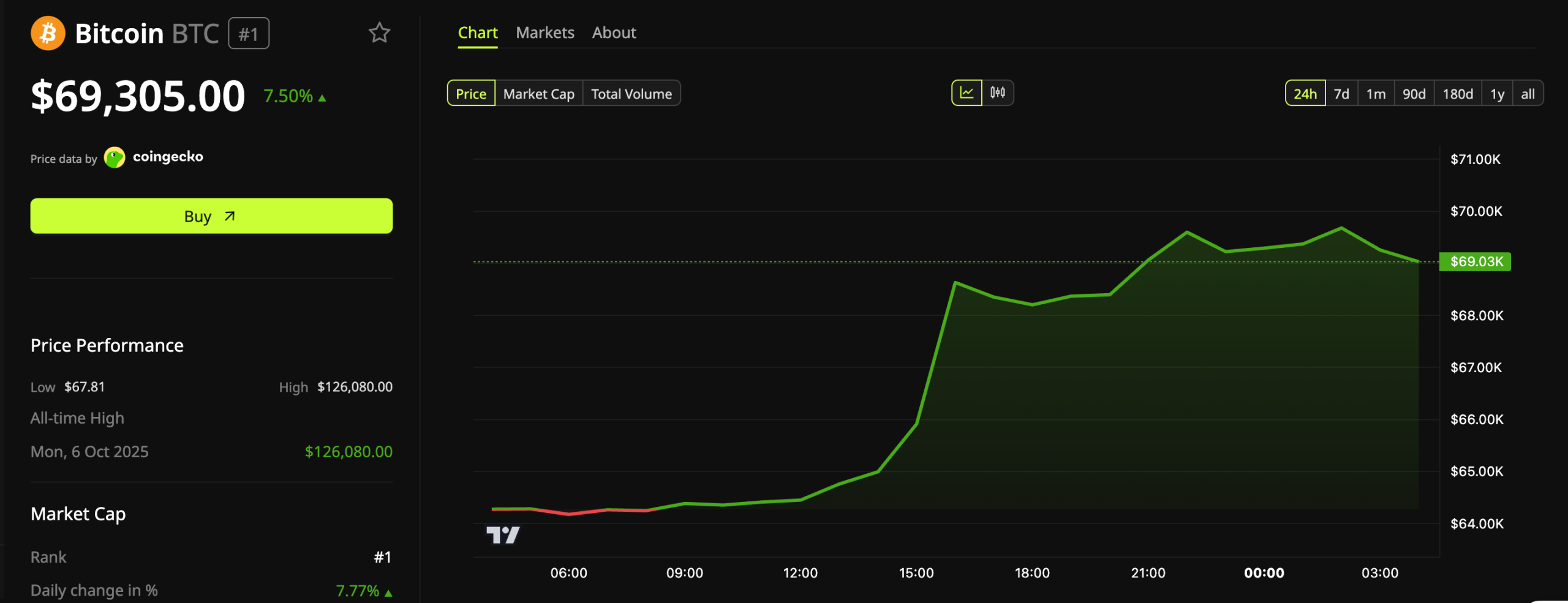
Bitcoin (BTC) briefly traded above $70,000 yesterday for the first time since June 2. Short liquidations reached $2.74 billion over the past 24 hours.
The rally started with policy signals from Washington. Forced short covering then amplified the move, turning a macro catalyst into a cascade across derivatives markets. Now, a key question arises: Will the rally last?
What Drove the Bitcoin Price Surge?
Two key developments sit behind the price move. BeInCrypto reported that the Treasury will double long-end debt buybacks to at least $4 billion each.
Furthermore, President Donald Trump suggested that a sizable government purchase of Bitcoin has been discussed.
Those catalysts pushed the price into crowded short positioning. Liquidations then fed the move, because closing a short requires buying, which lifts the price and triggers the next tier.
CoinGlass data shows 172,202 traders liquidated over 24 hours. Shorts absorbed $2.74 billion of that total against $256.66 million in longs.
Bitcoin alone accounted for $1.42 billion. BTC has since eased to $69,305, up 7.5% over the past 24 hours.
Follow us on X to get the latest news as it happens

CryptoQuant Says Spot Demand Is Close to Turning
CryptoQuant flagged a recovery in spot demand before the rally. The 30-day apparent spot demand climbed from negative 206,000 BTC on July 23 to roughly negative 5,000. The metric now sits close to positive territory for the first time since February 26.
The firm said Bitcoin has historically posted gains when spot apparent demand shifts from negative to positive. Over the following 60 days, BTC recorded a median return of 18.1%, with such signals producing positive outcomes 78% of the time across independent, de-clustered events.
“Spot demand is the signal that works,” the report read.
This leaves Bitcoin at a potential inflection point. A shift toward positive spot demand could determine whether the latest rally develops into a sustained recovery or fades as the current momentum subsides.
Glassnode Points to Levels Bitcoin Has Not Reclaimed
Meanwhile, Glassnode places the Short-Term Holder cost basis at $68,500. Bitcoin trades above that mark. However, the True Market Mean sits higher at $75,800.
“For as long as price remains below the Short-Term Holder Cost Basis, on-chain valuation models will continue to treat the market as capitulating, a phase where new buyers accumulate with elevated conviction while the market remains structurally vulnerable to any adverse macro catalyst,” the firm said.
The Realized Profit/Loss Ratio adds a second brake. That metric reads 0.75, well under the 2 threshold Glassnode treats as evidence of a genuine shift.
“Until this metric reclaims the 2 threshold, any recovery should be treated as a local rally rather than a regime change,” it added.

Bitcoin’s recent move marks a significant recovery, but the on-chain data suggests the rally has yet to prove itself. A sustained move above key on-chain resistance, coupled with positive spot demand, would strengthen the case for a broader recovery. Until then, Bitcoin’s latest surge remains a promising but unconfirmed reversal.
Subscribe to our YouTube channel to watch leaders and journalists provide expert insights
The post Bitcoin Tops $70,000 Amid a Short Squeeze, but 3 Metrics Hold the Real Signal appeared first on BeInCrypto.

Tottenham transfer news: Spurs in talks to sign Man City’s Omar Marmoush and Savinho

Power Finance Corporation and REC shares fall up to 3% after Morgan Stanley downgrade

BitGo secures South Korea virtual asset license, says it's the first global crypto company to do so





-

 Fashion6 days ago
Weekend Open Thread: Ann Taylor
-
 Sports6 days ago
This U.S. Amateur is a glimpse into golf’s future in more ways than you think
-
 Tech6 days ago
11 Ways to Rank Your Videos
-
 NewsBeat5 days ago
Myanmar says over 300,000 Rohingya refugees verified for repatriation as exodus enters ninth year
-

 Sports5 days ago
Birmingham 2026: Day 6 Timetable for Irish Athletes
-

 Politics5 days ago
SEQ Code: The Three Letter Boarding Pass Code That Could Give You The Worst Seat
-

 Tech7 days ago
DeepSeek Harness launches as open source rival to Claude Code, alongside V4-Pro on API with higher prices
-

 Tech2 days ago
Qwen3.8-27B runs frontier-class coding agents and reasoning locally, no cloud API required
-

 Crypto World2 days ago
OCC Greenlights Trump Family Crypto Firm for Trust Charter
-

 Crypto World5 days ago
Pi Network Protocol 27 endgame: last upgrade before what?
-

 Business2 days ago
SMA Solar Technology AG (SMTGY) Q2 2026 Earnings Call Transcript
-

 Fashion6 days ago
Weekly News Update, 8.14.26 – Corporette.com
-
 Tech5 days ago
Every fusion startup that has raised over $100M
-
 Entertainment6 days ago
10 Netflix Shows That Quietly Became Modern Classics
-
 Entertainment5 days ago
Marvel Studios Reveals New X-Men Cast Including Adam Driver and Sadie Sink
-

 News Videos5 hours ago
Don’t Leave Your Financial Future To Chance | August 19, 2026
-

 Business6 days ago
15 Ways to Make Money From Your Phone (2026 Guide)
-

 Fashion6 days ago
Silver bangles for women – Newbridge Silverware
-

 Business5 days ago
Facebook Down Now? Users Report Login And Loading Problems As Outage Trackers Monitor Ongoing Issues
-

 Fashion7 days ago
Thursday’s Workwear Report: Knit Pique Blazer
You must be logged in to post a comment Login