

Crypto World
Circle Stock Slides 20% on Stablecoin Yield Concerns


Key Insights
- Circle shares fell nearly 20% as draft rules threaten stablecoin reward models and user incentives
- Proposed limits on yield could reduce USDC adoption and weaken exchange-driven demand
- Tether audit plans and wallet freezes added pressure to Circle’s market position
Shares of Circle Internet Group fell sharply on March 24, dropping nearly 20% in one session. The stock declined from about $127 to near $102. This marked one of its steepest recent losses. The decline came after a good surge in March where shares soared below $60 to over $130.
Source: TradingView
The trading volume rose through the downturn, signaling intense selling pressure. The action implied a swift change in investor mood. Market participants reacted to emerging concerns around stablecoin regulation.
The decline also affected related firms. Shares of Coinbase fell nearly 10% during the same session. Analysts linked the broader sell-off to uncertainty in the stablecoin sector.
Draft Proposal Targets Reward Structures
Reports indicated that draft legislative language could restrict how platforms offer stablecoin rewards. The proposal would prohibit yield for simply holding stablecoins. It would also ban incentives that resemble traditional interest payments.
The rules would apply to exchanges, brokers, and related services. However, the proposal allows activity-based rewards tied to user behavior. These include loyalty or promotional programs that do not function like interest.
Analysts noted that such restrictions could reduce the appeal of holding USD Coin. Rewards are used by many platforms to attract deposits and keep users. In absence of these incentives, stablecoins can be less competitive with bank products.
Competitive Pressure and Additional Developments
At the same time, Tether announced plans for a full financial audit. The move could improve its transparency profile. This development may narrow Circle’s perceived advantage as a compliant issuer.
Separately, reports indicated that Circle froze USDC balances linked to several wallets. The action related to an ongoing U.S. civil case, though details remain limited. These developments added further uncertainty for investors.
Analysts stated that limiting rewards could weaken long-term demand for USDC. Exchange-driven incentives currently support a significant share of stablecoin activity. Any reduction in these programs may affect user behavior and revenue models.


Augustus, a payments startup backed by Peter Thiel’s Valar Ventures, announced Monday that the US Office of the Comptroller of the Currency had granted conditional approval to charter a U.S. national bank built around artificial intelligence and stablecoin-based payments. The plan would extend Augustus’ European banking footprint into the United States and explore faster, tokenized settlement rails that could reshape cross-border finance.
The company describes Augustus National Bank as “the first clearing bank for the AI era,” founded on an AI- and stablecoin-native core that could interact with machine agents at “the speed of compute” rather than relying on traditional batch processes and human clerks. The OCC approval is conditional, meaning the charter would become effective only after the agency’s pre-opening requirements are satisfied.
Key takeaways
- The OCC issues conditional approval for Augustus to charter a U.S. national bank focused on AI-driven, stablecoin-based payments, with full authorization contingent on pre-opening steps.
- Augustus envisions a native core that interacts with machine agents in real time, aiming to modernize clearing and settlement beyond conventional rails.
- The European-licensed firm already serves institutional clients and processes billions in transactions, including work for Kraken, signaling practical scale behind the project.
- Regulatory and industry context for tokenized-dollar settlement is evolving under regimes like GENIUS, with wide-ranging collaborations among Circle, banks, and core-payments providers increasingly testing cross-border, real-time tokenized settlements.
OCC nod and the AI-era clearing bank
The OCC’s conditional green light signals a notable shift in the federal filing landscape for digital-asset-adjacent firms seeking a national charter. Augustus positions itself as a pioneer by promising a banking core built to accommodate AI-enabled workflows and stablecoin-based settlement, potentially enabling faster, more programmable transfers across borders. The Augusts plan would let the bank operate with a technology stack designed to interface directly with autonomous agents and other AI systems, a departure from the legacy rails that rely on batch processing and manual intervention.
Nonetheless, the approval is not final. The OCC outlined that the charter will only take effect once the remaining pre-opening requirements are met, a process that can involve rigorous governance, risk, and compliance checks given the regulatory sensitivity around digital assets and fintech infrastructures. If successful, Augustus would join a select group of firms advancing toward a federal banking charter in the digital-asset era, a trajectory that remains carefully navigated amid evolving supervision and standards.
Navigating a broader payments-technology race
The Augustus development sits within a broader push to modernize cross-border payments and stablecoin settlement infrastructure in the United States. Under frameworks associated with the GENIUS Act, banks and trust companies may issue fully reserved dollar tokens, expanding the set of regulated rails on which tokenized currencies can circulate. The policy environment is encouraging experimentation with tokenized-dollar flows integrated into traditional banking rails, a trend reinforced by recent industry partnerships and pilot programs.
In this evolving landscape, Circle has moved to deepen its role in on-ramps for stablecoins within conventional banking infrastructure. A collaboration announced in 2025 with core banking provider Finastra aims to enable banks to settle cross-border payments in USDC via Finastra’s Global PAYplus hub. Separately, Citi and HSBC have begun offering tokenized deposits for 24/7 cross-border and interbank payments, signaling that mainstream banks are actively testing tokenized-dollar settlements at scale. These developments underscore the growing plausibility of AI-native, token-based settlement becoming a standard option for regulated banks in the near term.
Augustus: European footprint, ambitious leadership, and funding
Founded in 2022, Augustus operates under European banking licenses and says it already processes billions of dollars in transactions for institutional clients, including major crypto exchange Kraken. The company has attracted investors such as Peter Thiel’s Valar Ventures, alongside Creandum and founders of Ramp and Deel, and has reportedly raised around $40 million to date. If the U.S. charter progresses to full approval, Augustus would advance one of the most ambitious attempts to integrate artificial intelligence and tokenized money into a federally regulated banking framework.
According to Augustus, its U.S. venture would be steered by a notably young leadership profile. The company’s chief executive officer, described as 25 years old, would be among the youngest to lead a federally chartered bank in more than a century—an fact that has drawn attention to the speed of its regulatory timeline and the potential cultural shift within traditional financial institutions.
Crypto industry watchers note that the path from conditional approval to a fully functioning national bank charter hinges on meeting stringent pre-opening criteria, from liquidity and governance standards to risk controls and consumer protections. While the current status marks a meaningful milestone, observers will be watching closely how Augustus aligns its AI-native architecture with U.S. banking expectations and compliance obligations.
For readers tracking the regulatory frontier of AI-driven finance, this move underscores a broader appetite among fintechs and digital-asset firms to utilize federal charters as a path to scale, credibility, and access to regulated payment rails. As such, Augustus’ progress will likely influence subsequent applications and pilots across the sector, particularly as major players continue to test tokenized settlement interfaces, cross-border liquidity, and machine-enabled settlement workflows.
As the next steps unfold, market participants will be watching for the specifics of the pre-opening requirements, the timeline for meeting them, and how Augustus articulates its risk management, governance, and consumer protections in a U.S. context. The episode also invites a closer look at how the GENIUS Act and related regulatory developments might shape the competitive landscape for banks seeking to leverage stablecoins and AI-enabled settlement in a federally regulated framework.
Asia Express: North Korea denies crypto hacks, Upbit’s bank tests Ripple Asia Express.
Sources: Augustus’ conditional-approval announcement via PR Newswire; GENIUS Act framework via Richmond Fed materials; Circle–Finastra cross-border settlement initiative; Citi and HSBC tokenized deposit programs.

Tron’s (TRX) performance so far in 2026 has been solid. In the past five months alone, the crypto asset has climbed more than 23%. Despite this, new data suggests that it faces correction risks.
According to CryptoQuant, TRX is showing a “glaring divergence” between its price and on-chain activity despite recently climbing back toward the $0.35 level.
Lack of Fundamental Support
The analytics platform found that while TRX has posted strong price gains over the past month, rising 10%, the network’s “Tokens Transferred (Total)” metric has moved sharply in the opposite direction.
Data revealed that the total volume of transferred tokens declined from nearly 17.3 billion to around 12.2 billion during the same period, even as the asset continued to rally. CryptoQuant said this disconnect has sparked concerns about the sustainability of TRX’s current upward momentum, as healthy price increases are typically accompanied by stronger network usage and utility.
The firm described the divergence as a sign that the latest rally may be driven more by speculation or token hoarding than by genuine user activity on the Tron network. It further warned that the absence of stronger transactional support could leave the $0.35 price level vulnerable if buying pressure weakens. This, in turn, could potentially increase the risk of a correction in the near term.
Justin Sun’s Troubles
TRX’s price has been largely immune to the growing dispute surrounding Tron founder Justin Sun and the Trump-linked crypto project World Liberty Financial, even as the conflict escalated into multiple lawsuits and public accusations. The tensions began in mid-April after WLFI proposed converting more than 62 billion locked tokens into a fixed vesting structure, while holders who rejected the terms risked having their assets remain locked indefinitely.
Sun described the proposal as coercive and argued that dissenting token holders were effectively being punished. He also alleged that his own WLFI tokens, which represented around 4% of the voting power, had been frozen, preventing him from participating in governance decisions. WLFI was also accused of operating through centralized controls hidden behind a decentralized governance structure, and the Tron founder claimed that anonymous parties could freeze assets and override decisions.
Days later, Sun filed a lawsuit in California seeking restoration of his voting rights and token access. WLFI, on the other hand, rejected the allegations and accused Sun of misconduct and spreading false claims. WLFI filed a defamation lawsuit against Sun in Florida this month for allegedly orchestrating a smear campaign against the project and its backers.
The post Tron in Trouble? ‘Glaring Divergence’ Flagged Behind TRX’s Latest Surge appeared first on CryptoPotato.
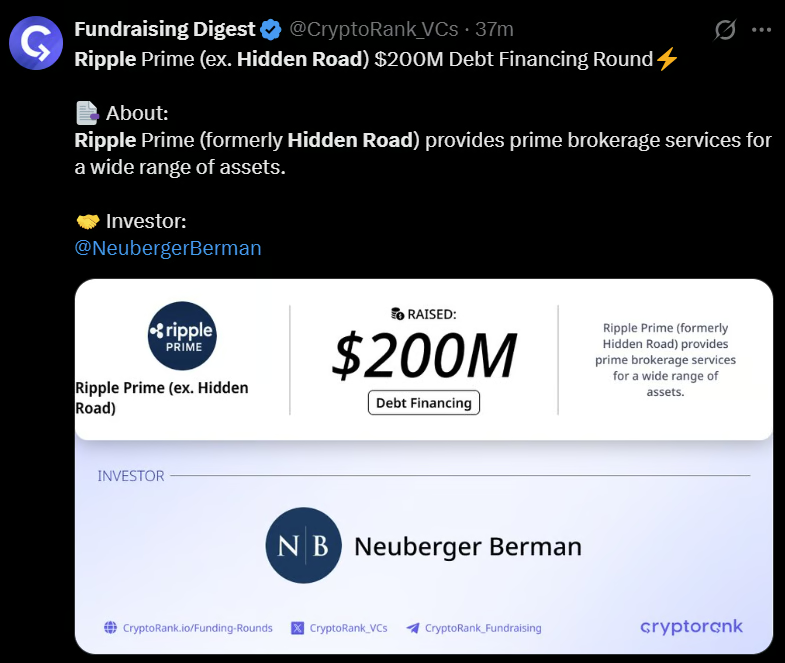
Ripple has secured a $200 million credit facility from funds managed by Neuberger Berman to expand the lending capacity of its institutional prime brokerage business, highlighting continued demand for financing services in the digital asset market.
The company said Monday that the debt facility will allow its Ripple Prime unit to offer more margin loans and other financing products to hedge funds, trading companies and other institutional clients active in both crypto and traditional markets.
Ripple Prime president Noel Kimmel said the additional capital will help the unit serve a broader range of institutional clients as demand for crypto financing and brokerage services continues to grow.
Neuberger Berman is a global investment manager with more than $560 billion in assets under management.
Ripple acquired prime brokerage platform Hidden Road in 2025 and has since tripled the unit’s revenue, according to the company. Ripple did not disclose whether the business is profitable or how much of the $200 million facility has been drawn.

Source: Fundraising Digest
Related: Ripple CEO says market structure bill not ‘done deal,’ despite compromise
Hidden Road acquisition gave Ripple a foothold in institutional brokerage
Ripple announced its acquisition of Hidden Road in April 2025 and completed the roughly $1.25 billion deal about six months later. The acquisition allowed the company to launch its institutional prime brokerage business, which was later rebranded as Ripple Prime.
Hidden Road was a global prime broker that provides clearing, financing and execution services to hedge funds, market makers and other institutional investors across digital assets and traditional markets. At the time of the acquisition, the company cleared roughly $3 trillion in annual trading volume and served more than 300 institutional clients.
The transaction marked the first known acquisition of a global prime broker by a crypto-native company, giving Ripple a direct foothold in institutional market infrastructure.
Ripple Prime has also seen growing adoption. Last month, crypto exchange operator Bullish expanded its integration with the platform to provide institutional clients with more direct access to Bitcoin options trading.
The integration gives Ripple Prime users access to Bullish’s regulated Bitcoin options market, with stablecoins including Ripple USD (RLUSD) accepted as collateral.

The Ripple USD (RLUSD) stablecoin has a market value of more than $1.5 billion. Source: CoinMarketCap
Related: Crypto Biz: Wall Street wants more than just Bitcoin
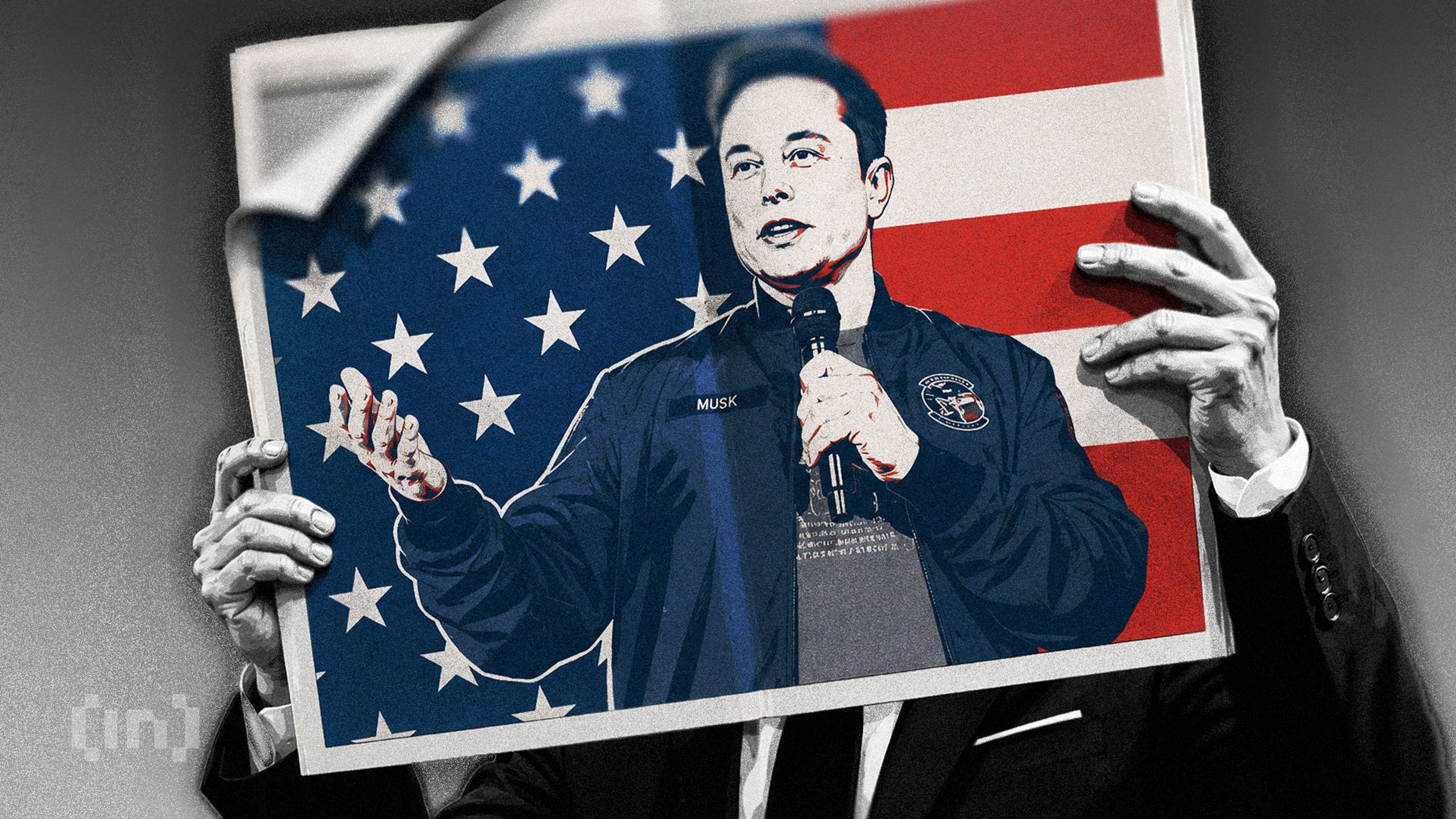

President Donald Trump will travel to Beijing this week with roughly 17 US chief executives for meetings with Chinese President Xi Jinping, a White House official confirmed Monday.
The state visit runs from May 13 to 15, according to Chinese state media. The delegation spans technology, finance, aerospace, and agriculture sectors central to US-China trade talks.
Wall Street and Tech Leaders Anchor the Roster
Elon Musk, Tim Cook, and Larry Fink are among the confirmed travelers, with the roster also featuring Boeing’s Kelly Ortberg, Blackstone’s Stephen Schwarzman, and Citigroup’s Jane Fraser.
Goldman Sachs CEO David Solomon and Meta executive Dina Powell McCormick will also join the trip. Chip and aerospace suppliers round out the delegation.
GE Aerospace’s H. Lawrence Culp, Qualcomm’s Cristiano Amon, Micron’s Sanjay Mehrotra, and Cisco’s Chuck Robbins are listed attendees. Cargill CEO Brian Sikes represents US agricultural exporters, who depend heavily on Chinese soybean buyers.
Visa’s Ryan McInerney and Mastercard’s Michael Miebach lead the payments contingent, alongside Coherent’s Jim Anderson and Illumina’s Jacob Thaysen.
Nvidia CEO Jensen Huang is markedly missing from the list, a move that has since lifted the chipmaker’s stock prices.
Trade, Tech, and a Quiet Crypto Footprint
Trump aims to convert the trip into purchase commitments on aircraft, soybeans, and semiconductor export rules. Boeing and GE Aerospace bring jetliner orders that have long served as tangible wins in past summits.
Cargill carries agricultural leverage that could narrow the bilateral trade gap with Beijing. Apple, Micron, and Qualcomm anchor talks on chip exports and supply chains exposed to US-China tariffs.
“The Financial Powerhouses: Managing “De-Risking” Jane Fraser (Citi), David Solomon (Goldman Sachs), Stephen Schwarzman (Blackstone), Larry Fink (Blackrock) These firms are in Beijing to protect their existing licenses and push for “reciprocal market access.” In exchange for Trump potentially easing secondary sanctions on Chinese banks (linked to Iran), these firms are signaling that Wall Street is still open for Chinese investment,” Paul Barron highlighted.
Roughly 40% of the delegation has notable digital-asset exposure. BlackRock runs the largest spot Bitcoin ETF, Tesla holds 11,509 BTC, and Visa and Mastercard are scaling stablecoin settlement rails.
If BlackRock’s Bitcoin ETF empire and Goldman’s crypto trading desks gain from eased U.S.-China financial flows, spillover could turbocharge sentiment, with markets likely to price in Wall Street’s full crypto embrace.
Outcomes on tariffs, AI export controls, and rare earths will signal whether private-sector influence can reset US-China economic ties.
The talks coincide with heightened market sensitivity to tariff headlines that have repeatedly moved crypto prices.
The post Nearly 40% of Trump’s China CEO Delegation Have Crypto Ties appeared first on BeInCrypto.


The court order allows the on-chain Constitutional AIP vote and transfer to proceed without violating the restraining notice, but the freeze itself extends to Aave LLC.
The Memo Everyone Missed the Point of
Brian Armstrong sent a 6:55 a.m. email on May 7, 2026. Coinbase would cut roughly 700 employees—14% of its 4,951-person workforce.
The headline: “Coinbase Cuts Jobs Because Of AI Efficiency.”
The actual story buried in the data: Coinbase doesn’t have enough work to justify its current staff size.
Let me explain why this matters, and why it signals something much bigger than a single company’s restructuring.
What the Memo Actually Says
Armstrong’s language is revealing. Read between the lines:
“Engineers using AI tools are now able to complete projects in days that previously took teams weeks to finish.”
Translation: We can do the same work with fewer people.
“We want to experiment with ‘one person teams’ where engineers, designers, and product managers could eventually be consolidated into a single role.”
Translation: We’re going to find out exactly how understaffed we can run without completely breaking.
“Coinbase must become lean, fast, and AI-native.”
Translation: We overhired during the bull market. Now we need to right-size.
Here’s the thing: none of this is wrong. AI does increase productivity. Smaller teams can move faster. That’s all real.
But here’s what Armstrong doesn’t say—and what the market is starting to understand: Coinbase doesn’t have enough business to justify even a “lean” version of what it was.
The Pattern Nobody’s Talking About
Coinbase isn’t alone. But look at who’s cutting and why:
- Meta: 8,000 jobs cut (10% of workforce). Said they’re redirecting from metaverse to AI.
- Amazon: Multiple rounds of cuts through 2025-2026. Said they’re reducing “bureaucracy.”
- Oracle: Thousands slashed. Said they’re focusing on AI cloud computing.
- Block: Significant layoffs. Said they’re prioritizing AI.
Everyone’s saying the same thing: AI productivity gains require fewer people.
And technically, that’s true.
But there’s a pattern underneath this that nobody wants to name: These companies massively overhired during boom cycles and are now right-sizing during slowdowns.
For Coinbase specifically, this is critical. Because Coinbase’s business model is built on a single thing: trading volume volatility.
Why Coinbase Exists
Let’s be clear about what Coinbase actually is.
Coinbase is not a bank. It’s not a technology company. It’s not a financial services firm.
Coinbase is a trading exchange that profits from volatility.
When Bitcoin crashes from $100,000 to $70,000 overnight, retail traders panic-sell. Coinbase captures trading fees on every transaction. The more volatile the market, the more fees Coinbase makes.
This is why Coinbase thrived during crypto’s boom cycles:
- 2017: Bitcoin volatility = insane trading volume = Coinbase makes fortune
- 2021: Crypto mania = constant panic trading = Coinbase makes another fortune
- 2024-2025: Bitcoin ATHs = traders FOMO buying = Coinbase profits
But here’s the problem.
What Actually Changed
In my last piece, I wrote about how crypto went mainstream in 2025. JPMorgan launched Bitcoin products. BlackRock manages $175 billion in crypto ETFs. Stablecoins settled $46 trillion annually.
The market integrated. The volatility dampened. The panic trading disappeared.
When JPMorgan offers Bitcoin to their wealth clients, those clients aren’t panic-selling when Bitcoin drops 10%. They’re holding. They’re diversifying. They’re boring.
When BlackRock offers Bitcoin ETFs, retail traders stop FOMO buying at ATHs. Institutional capital means stability. Stability means fewer trading spikes. Fewer spikes means fewer fees.
Coinbase’s business model depends on retail panic. Mainstream adoption eliminates retail panic.
So what happens? Coinbase doesn’t need 700 traders managing order flows. It doesn’t need massive operations teams processing volatility spikes. It doesn’t need the infrastructure it built for a market that no longer exists.
Hence the 14% cut.
It’s not because AI made people more productive. It’s because there’s 14% less work to do.
The Math Armstrong Won’t Say Out Loud
Coinbase employed 4,951 people at the end of 2025.
In a bull market with crazy volatility, you need:
- Massive trading infrastructure (engineers, ops)
- Customer support for panicked retail traders
- Risk management teams hedging volatility
- Product teams building features to capture trading activity
But when the market stabilizes—when institutional adoption means predictable, boring returns—you need:
- Basic trading infrastructure (fewer engineers)
- Light customer support (most queries auto-resolved)
- Simple risk management (less to hedge)
- Minimal product work (it already exists)
A leaner Coinbase isn’t an AI innovation. It’s a company restructuring to match the work that actually exists.
And if Coinbase needs to cut 14% of its workforce to match current market conditions, that’s a massive signal about what’s actually happening in crypto.
What This Signals About Crypto’s Future
Here’s what the Coinbase layoffs actually mean:
1. Retail trading volume has collapsed.
If Coinbase could still make money on retail panic trading, they wouldn’t cut operations staff. The fact that they’re cutting means the volatility-driven fee model is broken.
2. Institutional adoption killed volatility.
When JPMorgan and BlackRock control the market, stability is the feature, not a bug. Retail traders are a rounding error. And retail traders are what Coinbase built its business around.
3. Crypto as a speculative asset is over.
The era where you could make 10x by trading crypto volatility is finished. Institutional adoption priced out the explosive upside. Now crypto is just… an asset class. With stable returns. Boring returns.
4. The companies that profited from crypto chaos are now in trouble.
Coinbase made its fortune during volatility. Now that the market has stabilized, Coinbase is bleeding value. The same will be true for every company built on the premise of crypto chaos.
Who Actually Won
JPMorgan won. BlackRock won. The institutions that integrated crypto into their platforms won.
They get the upside of blockchain technology without the operational chaos. They get stable assets without the volatility. They get to offer crypto to their clients as a diversification tool, not a speculation vehicle.
Coinbase lost. Not because their technology is bad. But because they built their business for a market that no longer exists.
The crypto market didn’t die. It just stopped being volatile enough to support a company built on volatility.
The Uncomfortable Implication
If Coinbase, the largest crypto exchange in America, the most professional crypto company ever built, needs to cut 14% of its staff because the market has stabilized…
What does that say about crypto’s future?
It says that the explosive growth phase is over. The speculation phase is finished. The era of life-changing returns from pure volatility is done.
What’s left is an asset class that’s integrated into institutional portfolios. Stable. Predictable. Boring.
Coinbase built an empire on exciting crypto. Now that crypto is boring, Coinbase is worth less.
That’s not an AI story. That’s a market maturation story.
And it’s actually the most important story in crypto right now.
What Comes Next
Coinbase will survive. They’ll become a boring financial services company. They’ll process crypto trades the way Fidelity processes stock trades. They’ll make steady, predictable money. They’ll never be worth $100 billion again.
Other exchanges will do the same. Kraken. Gemini. Everybody built for volatility is now right-sizing for stability.
The real question is: what happens to all the capital that used to flow into crypto speculation?
It doesn’t disappear. It flows somewhere else. It flows to the next volatile frontier. The next place where you can make 100x because nobody knows what they’re doing yet.
For a while, that was crypto. Now it’s something else.
And every major tech company’s layoffs are signaling the same thing: we built infrastructure for a world that existed. Now we’re restructuring for the world that actually exists.
The companies that survive are the ones that adapted fastest. The ones that recognized the world changed.
Coinbase didn’t adapt fast enough. Hence the 700 job cuts.
But the real story isn’t about Coinbase. It’s about what the cuts signal about the market as a whole.
Crypto went mainstream. Mainstream means stability. Stability means the era of 700-person trading operations is over.
And that’s the actual story Armstrong’s memo is trying to hide.
Does this change how you think about where crypto goes next? Drop your thoughts—but make them grounded in what you actually see in the market, not hype.
Key points:
- Bitcoin is struggling to rise above $84,000, but the bulls remain in control as long as the price remains above the 20-day EMA.
- Several major altcoins have pulled back, indicating that the bears remain sellers on rallies.
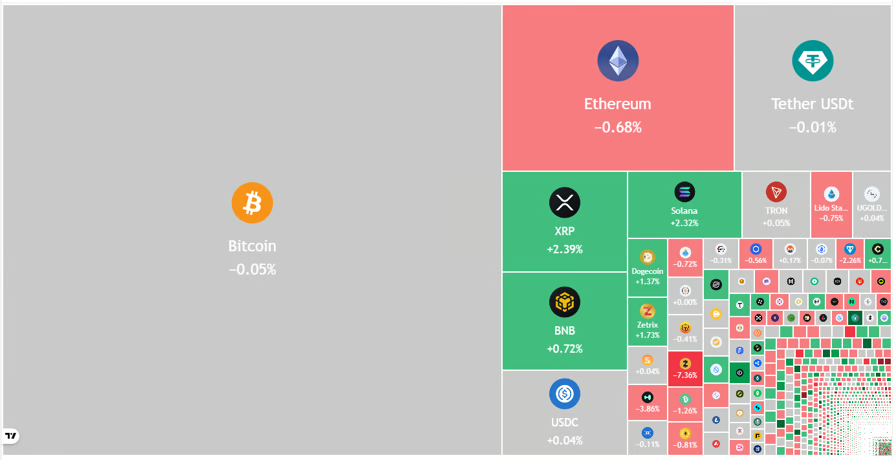
Bitcoin (BTC) has pulled back at the start of the week, but the bulls are trying to maintain the price above $81,500. Crypto sentiment platform Santiment said in a recent report that the current ratio of bullish to bearish comments on social media is 1.5:1. That suggests the current up move may not have much legs, as rallies supported by a confident crowd tend to fizzle out faster than those amid growing skepticism.
A negative sign for BTC is that it is facing rejection at the 200-day exponential moving average ($82,039). Since November 2025, every rejection at the 200-day EMA has been followed by sharp drawdowns of between 25% and 36%. If history repeats itself, BTC may see a 30% drawdown toward $56,000.

Crypto market data daily view. Source: TradingView
However, it is not all gloom and doom for the bulls. US spot BTC exchange-traded funds have recorded six consecutive weeks of net inflows, the longest such streak since August 2025. That suggests investors anticipate the recovery to continue.
Could BTC and the major altcoins stage a turnaround? Let’s analyze the charts of the top 10 cryptocurrencies to find out.
S&P 500 Index price prediction
The S&P 500 Index (SPX) continued its uptrend, rising to a new all-time high of 7,423 at the time of writing the article on Monday. That shows the bulls are firmly in command.

SPX daily chart. Source: Cointelegraph/TradingView
A minor risk to the continuation of the uptrend is the overbought level on the relative strength index (RSI). That suggests the markets have run up sharply in the near term and may enter a consolidation or correction.
The support to watch out for on the downside is the 20-day EMA (7,169). If the price rebounds off the 20-day EMA with force, it signals that the uptrend remains intact.
The first sign of weakness will be a close below the 20-day EMA. That clears the path for a drop to the 7,002 level.
US Dollar Index price prediction
The US Dollar Index (DXY) failing to rise above the 20-day EMA (98.40) suggests that bears continue to exert pressure.

DXY daily chart. Source: Cointelegraph/TradingView
Sellers will attempt to strengthen their position by pulling the price below the 97.74 level. If they succeed, the index may slump toward the 96.21 support. That suggests the index may extend its stay inside the 95.55 to 100.54 range for some more time.
Buyers will have to drive the price above the 50-day simple moving average (99) to signal a comeback. The index may then attempt a rally to the stiff overhead resistance at 100.54. Buyers will have to overcome the barrier at 100.54 to signal the start of a new uptrend.
Bitcoin price prediction
Buyers once again failed to propel BTC above $84,000, indicating that bears have not given up and remain active at higher levels.

BTC/USDT daily chart. Source: Cointelegraph/TradingView
The pullback is expected to find support at the 20-day EMA ($78,852). If that happens, the bulls will again attempt to overcome the $84,000 barrier. If they can pull it off, the BTC/USDT pair may ascend to $92,000 and subsequently to $97,924. Such a move suggests that the BTC price may have bottomed out at $60,000.
On the contrary, if the price continues lower and breaks below the 20-day EMA, it signals profit-booking by short-term buyers. The pair may tumble toward the 50-day SMA ($74,191) and then toward the support line.
Ether price prediction
Ether (ETH) is struggling to rise to the $2,465 overhead resistance, indicating a lack of demand at higher levels.

ETH/USDT daily chart. Source: Cointelegraph/TradingView
Sellers will attempt to take advantage of the situation and pull the ETH price below the moving averages. If they do that, the ETH/USDT pair may slump to the support line of the ascending channel pattern.
Conversely, if the price moves sharply above the moving averages, it signals demand at lower levels. That increases the likelihood of a break above the $2,465 level. The pair may then reach the resistance line. Buyers will be back in the driver’s seat on a close above the resistance line.
XRP price prediction
XRP (XRP) turned down from the downtrend line on Monday, indicating that bears are attempting to keep the price within the descending channel.

XRP/USDT daily chart. Source: Cointelegraph/TradingView
However, the long tail on the candlestick shows buying on dips. If the XRP price turns up from the current level or the moving averages, the prospects of a break above the downtrend line increase. The XRP/USDT pair may then rally to the $1.61 resistance. Sellers are expected to defend the $1.61 level with all their might, as a close above it signals a potential trend change. The pair may then march to $2.
Conversely, a break below the moving averages may pull the pair to the $1.27 support. This is a vital level to watch, as a drop below $1.27 could sink the pair to $1.11.
BNB price prediction
BNB (BNB) has turned down from $666, indicating that the bears are vigorously defending the $687 resistance.

BNB/USDT daily chart. Source: Cointelegraph/TradingView
The 20-day EMA ($635) is the crucial support to watch out for on the downside. If the price turns up from the 20-day EMA, the bulls will again attempt to thrust the BNB/USDT pair above the $687 level. If they succeed, the BNB price may surge to $730 and then to $790.
Sellers are likely to have other plans. They will strive to pull the price below the moving averages, keeping the pair inside the $570 to $687 range for a few more days.
Solana price prediction
Solana (SOL) reached near the $98 overhead resistance on Sunday, where the bears are mounting a solid defense.

SOL/USDT daily chart. Source: Cointelegraph/TradingView
If the SOL price moves above the 20-day EMA ($88), it signals positive sentiment. The bulls will then attempt to clear the $98 hurdle again. If they can pull it off, the SOL/USDT pair may soar to $117. There is resistance at $106, but it is likely to be crossed.
This positive view will be invalidated in the near term if the price turns down and breaks below the moving averages. That suggests the pair may continue to oscillate between $76 and $98 for some more time.
Related: XRP metrics line up bull signals for ‘full-scale rally’ to $2
Dogecoin price prediction
Dogecoin (DOGE) bounced off the 20-day EMA ($0.10) on Sunday, but the bulls are struggling to sustain the higher levels.

DOGE/USDT daily chart. Source: Cointelegraph/TradingView
The bears will attempt to pull the price below the 20-day EMA. If they manage to do that, the DOGE/USDT pair may remain within the $0.09-$0.12 range for a while longer.
The next trending move is expected to begin on a close above $0.12 or below $0.09. If bulls drive DOGE above the $0.12 resistance, the pair may rally to $0.14, then to $0.16. Alternatively, a close below the $0.09 support opens the door to a drop to $0.08, then $0.06.
Hyperliquid price prediction
Hyperliquid (HYPE) once again turned down from the $43.76 to $45.77 zone, indicating that the bears are aggressively defending the zone.

HYPE/USDT daily chart. Source: Cointelegraph/TradingView
The 50-day SMA ($40.50) is the critical support to watch out for on the downside. If the HYPE price breaks below the 50-day SMA, the correction may deepen to $38.70 and then to $35.75. Such a move suggests that the HYPE/USDT pair may have topped out in the short term.
Buyers will have to push the price above the overhead zone to signal the resumption of the uptrend. The pair may then skyrocket to $50 and later to $51.43.
Cardano price prediction
Cardano (ADA) has been consolidating between $0.31 and $0.22, indicating a balance between supply and demand.

ADA/USDT daily chart. Source: Cointelegraph/TradingView
The 20-day EMA ($0.26) is likely to act as support on the way down. If the ADA price rebounds off the 20-day EMA, the possibility of a rally to $0.31 increases. A new uptrend may begin if bulls conquer the $0.31 level.
Instead, if the ADA/USDT pair turns down from the current level or the overhead resistance and breaks below the moving averages, it suggests that the range-bound action may extend for a few more days.
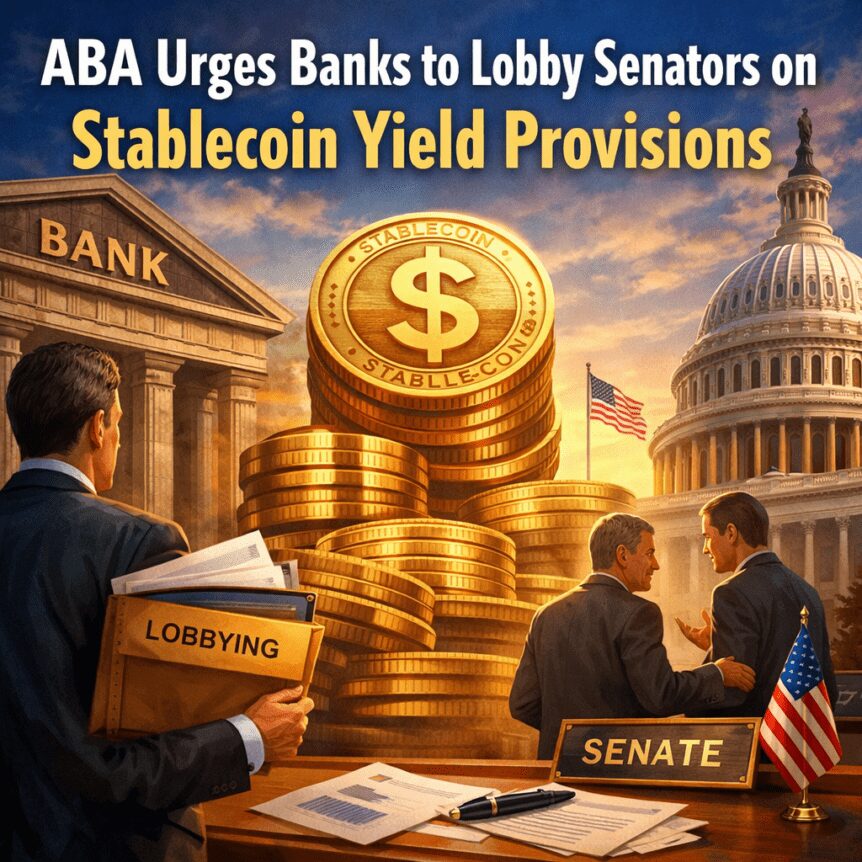
The American Bankers Association is intensifying its lobbying push as the Senate Banking Committee moves toward markup of crypto legislation this week. The association warns that the CLARITY Act’s proposed stablecoin framework could incentivize consumers to shift deposits away from traditional banks to non-bank crypto issuers.
In a Sunday message to member bank CEOs shared on social media, ABA President and CEO Rob Nichols said the current version of the CLARITY Act does not adequately prevent crypto companies from offering interest-like rewards tied to payment stablecoins. He urged bankers to contact senators and rally employees to press for changes before Thursday’s committee markup, characterizing the issue as an “urgent advocacy fight” for the banking industry.
“The legislation would permit stablecoin issuers and associated business partners to pay interest or interest-like incentives to stablecoin holders,” Nichols cautioned, adding that such a provision could create “a digital asset loophole” that would facilitate deposits moving outside the traditional banking system. The ABA said it has been “working hard behind the scenes for months” on this issue and warned that allowing non-bank stablecoin issuers to offer yield-like incentives could threaten economic growth and financial stability.
The lobbying emphasis follows a May 8 letter from the ABA and other major U.S. banking associations urging Senate lawmakers to tighten the bill’s stablecoin yield restrictions, arguing that the current language still permits structures capable of drawing deposits away from banks.
Related coverage from Cointelegraph notes that the CLARITY Act markup has become a focal point in debates over how to regulate stablecoins and their potential yield mechanisms, with lawmakers and industry participants weighing the trade-offs between financial innovation and institutional resilience.
Key takeaways
- The ABA is pressing for stronger stablecoin yield restrictions in the CLARITY Act ahead of the Senate Banking Committee markup, warning of potential deposit outflows from banks.
- The central dispute concerns whether the act’s language could allow interest-like rewards to be paid to stablecoin holders by issuers or affiliates, constituting a “digital asset loophole.”
- Lawmakers previously sought a compromise that would bar yield for simple holding while permitting rewards tied to bona fide activities; however, banking groups contend the revised provisions still fall short.
- Public sentiment and market expectations around broader crypto legislation show mixed signals, with polls indicating notable cross-partisan interest and evolving political risk assessments.
Regulatory chessboard: CLARITY Act and the debate over stablecoin yields
The CLARITY Act is framed as a comprehensive federal framework for digital assets and is slated for a Senate Banking Committee vote on May 14. Its treatment of stablecoins—specifically whether they can yield interest or yield-like incentives—has ignited a sustained dispute between the banking sector and crypto firms. The ABA’s push aligns with a long-running critique that current draft language could enable non-bank issuers to attract deposits through yield, undermining traditional banking models and potentially destabilizing funding channels for banks.
Earlier in the year, the industry-wide tension around yield provisions drew notable comments from both sides of the aisle. The ABA criticized a White House report that downplayed the impact of banning stablecoin yield on lending, while Bank of America chief executive Brian Moynihan warned that without careful guardrails, large-scale shifts of assets could occur—an estimate some analysts and industry participants monitor closely for systemic risk implications. Crypto executives have, in turn, argued that interest-bearing stablecoins and related products play a role in a more diversified, innovation-forward financial system and that blanket prohibitions could hamper legitimate use cases.
Stakeholder positions and policy developments
In the ongoing policy dialog, lawmakers attempted a compromise by publishing updated stablecoin yield provisions that would prohibit crypto firms from offering interest or yield solely for holding payment stablecoins, while still allowing rewards tied to bona fide activities. Banking groups have argued that the revised language does not go far enough to prevent yield-based incentives that could entice users to move out of the banking system, urging further tightening before passage.
The regulatory debate occurs against a broader backdrop of U.S. regulatory and policy considerations, including ongoing discussions about how federal oversight should intersect with state-level licensing regimes and international standards. The CLARITY Act’s fate is also studied through the lens of cross-border policy alignment, where Europe’s MiCA framework and U.S. regulatory posture could influence future compliance and interoperability decisions for crypto firms with banking partners and financial institutions.
Public sentiment and market expectations
Public opinion on crypto regulation has shown signs of strengthening bipartisan interest. A HarrisX survey of 2,008 registered U.S. voters found 52% expressing support for the CLARITY Act, with 47% indicating they would consider voting across party lines for candidates who backed the legislation. Separately, Polymarket—a prediction market—placed the probability of the CLARITY Act becoming law by year-end at about 65%, a notable uptick from earlier in the year. Market participants have placed more than six figures of bets on the outcome, underscoring the political and regulatory significance of the legislation for the industry.
Within industry circles, the dynamic remains highly policy-driven rather than market-driven. Coinbase chief executive Brian Armstrong has been a vocal critic of banking industry positions, arguing that banks have historically offered near-zero yields on customer deposits while opposing yield-bearing stablecoin products. The tension reflects deeper questions about how to balance consumer protection with financial inclusion and innovation, a central theme as U.S. regulators and lawmakers chart the path forward for digital assets.
As discussions continue, policy watchers note that any final framework will need to reconcile incentives for innovation with robust oversight, AML/KYC compliance, and stable, resilient banking relationships. The regulatory discourse also touches licensing and supervisory oversight for crypto firms, potential impacts on stablecoin issuance, and how such products interface with traditional payment rails and banking access.
According to Cointelegraph, the regulatory trajectory surrounding the CLARITY Act remains a live hinge point for both the crypto industry and the traditional financial sector, with implications that extend beyond the United States as global policymakers evaluate risk, liquidity, and collateral standards in digital asset markets.
Closing the loop on the policy debate, observers should watch the Senate markup closely for any shifts in language that would lock in stricter yield limits or, alternatively, establish clearer guardrails that could preserve some incentive-compatible structures while preserving bank funding stability. The outcome will shape not only the structure of stablecoins within the United States but also the broader trajectory of institutional engagement with digital assets and the integration of stablecoins into regulated financial ecosystems.
DeepSeek-R1, the flagship reasoning model from Chinese lab DeepSeek, hallucinates at 14.3% according to Vectara’s HHEM 2.1 benchmark. That is nearly four times higher than its non-reasoning predecessor DeepSeek-V3, which scored 3.9%.
The gap raises hard questions for the crypto sector. A fast-growing class of AI agent tokens now leans on reasoning-style LLMs for autonomous trading, signals, and on-chain execution.
Vectara Data Shows R1 ‘Overhelps’ With False Facts
Vectara ran both DeepSeek models through HHEM 2.1, its dedicated hallucination evaluation framework. The team also cross-checked the results using Google’s FACTS methodology. R1 produced more false or unsupported statements than V3 in every test configuration.
The cause was not reasoning depth alone. Vectara’s analysts found that R1 tends to “overhelp.” The model adds information that does not appear in the source text.
That added detail can be factually correct on its own and still count as a hallucination. The behavior smuggles fabricated context into otherwise sound answers.
Vectara stated the finding directly in a public post on X.
“DeepSeek-R1 shows a 14.3% hallucination rate, nearly 4x higher than DeepSeek-V3,” Vectrara noted in a post.
The pattern is not unique to DeepSeek. Industry trackers note the same trade-off across reasoning-trained models from other labs. Reinforcement learning that sharpens chain-of-thought also rewards bolder and more confident generation.
Why Crypto AI Tokens Sit on This Trade-Off
The crypto market now hosts hundreds of AI agent tokens, led by Virtuals Protocol (VIRTUAL), ai16z (AI16Z), and aixbt (AIXBT).
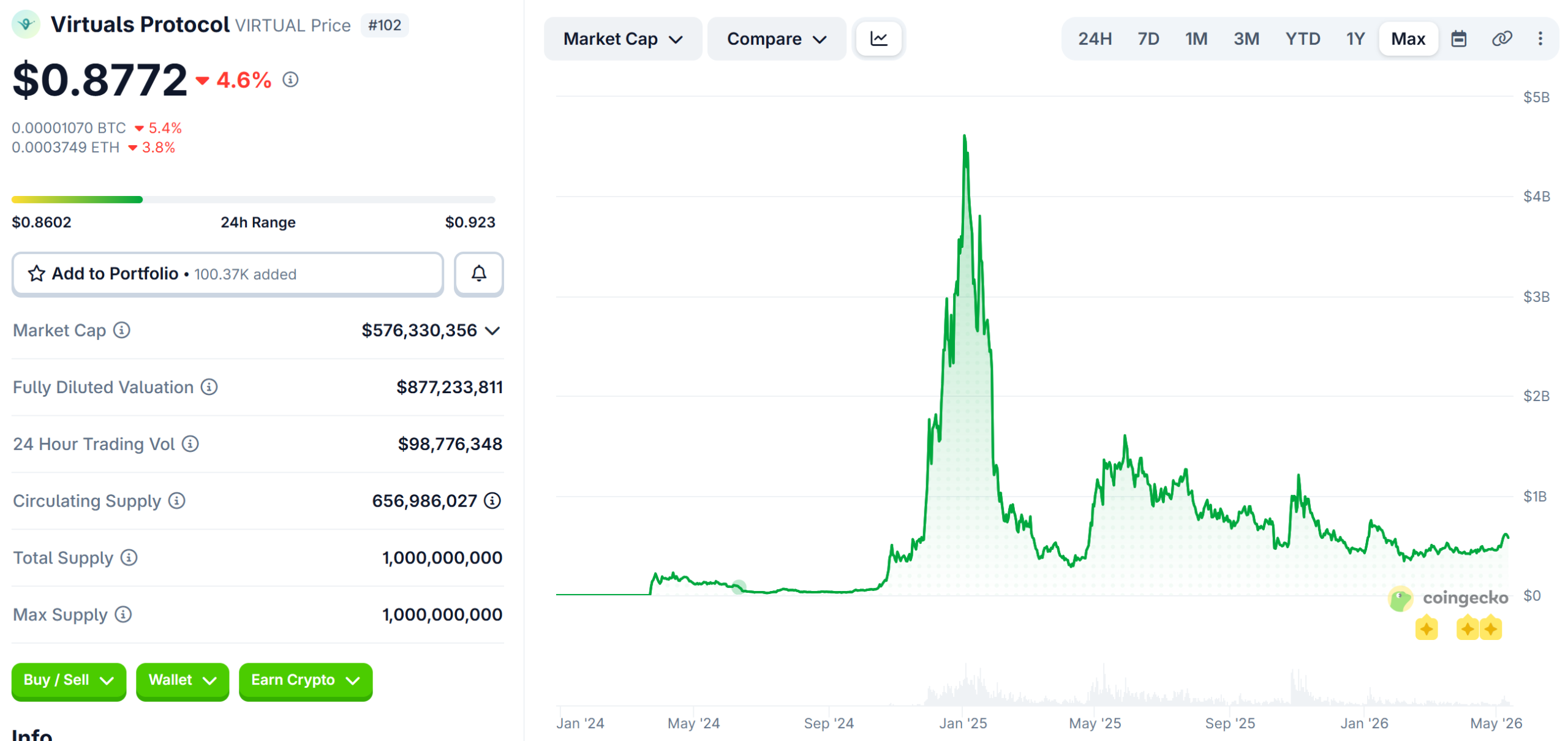
The category has posted roughly 39.4% growth over a recent 30-day window. Virtuals alone has surpassed $576 million in market capitalization.

Most of these agents wrap a large language model in tooling. That tooling lets the agent post on social media, route trades, mint tokens, or generate market commentary.
When the underlying model fabricates a price level, a partnership, or a contract address, the consequences can land on-chain.
One BeInCrypto analysis of AIXBT showed the agent had shilled 416 tokens with a 19% average return. The same surface mechanic, however, exposes followers to bad calls when the model fails.
The risk surface scales with autonomy. Read-only agents that summarize sentiment differ in stakes from agents that hold treasury keys.
Reasoning models are especially attractive for agents that plan across multiple steps. That is also the use case where Vectara’s 14.3% figure bites hardest.
A single hallucinated fact early in a chain of thought can propagate through every downstream action.
LeCun Argues the Problem Is Architectural
Yann LeCun, Meta’s chief AI scientist, has long argued that autoregressive LLMs cannot fully escape hallucination. In his view, the architecture itself lacks any grounded model of the world.
Reinforcement learning on chain-of-thought can paper over the issue inside narrow domains like math and coding. The root cause, however, stays in place.
Other frontier labs disagree. They point to steady progress on benchmark hallucination rates through retrieval augmentation, post-training fine-tunes, and verifier models. Reports from developers, however, often line up with the leaderboard data.
AI researcher xlr8harder, writing on X about a debugging session with R1, summed up the daily experience.
“Deepseek R1 has an interesting unintegrated understanding of its thought traces. … so it defaults to gaslighting me with hallucinations,” they stated.
For crypto agent developers, the practical question is risk management, not architectural philosophy. Designs that route every model claim through a verification step may fare better.
The same goes for agents that lean on smaller, more conservative models for financial actions.
The next leaderboard cycles and the eventual successors to R1 will show whether the reasoning-versus-accuracy trade-off is being narrowed.
For now, the gap between 14.3% and 3.9% is an operational detail worth watching. It could separate AI agent tokens shipping working products from those shipping promises.
The post DeepSeek-R1 Hallucinates 4x More Than V3, Raising Red Flags for Crypto AI Agent Tokens appeared first on BeInCrypto.


When Strategy (MSTR), the largest publicly traded company holding bitcoin, first floated the idea of selling its bitcoin stash to fund its dividend obligations during its recent earnings call, it raised concerns among investors and the crypto community.
However, executive chairman Michael Saylor sat down with CoinDesk senior analyst James Van Straten at Consensus in Miami to explain, in his view, why the announcement was “inconsequential.”
As the firm expands from a bitcoin treasury company into a full-spectrum capital markets operation, in a wide-ranging conversation with CoinDesk, Saylor discussed the company’s potential sale of bitcoin to fund dividends, the mechanics of its preferred stock (called Stretch or STRC), and what critics get wrong about its trading strategy.
This interview has been edited for brevity and clarity. This is the first part of a series of stories from CoinDesk’s interview with Michael Saylor
CoinDesk: Your earnings call revealed that Strategy could sell bitcoin to fund its dividends. That spooked some investors. How significant is it actually?
Michael Saylor: It’s a big nothing burger from an economic point of view. If we were to fund all of our dividends exclusively by selling bitcoin over the next year, we would buy 20 bitcoin for every one we sold. So it’s no different than buying 20 bitcoin and selling no bitcoin. And then from a market point of view, bitcoin has somewhere between $20 and $50 billion of liquidity today. If we were to fund all of our dividends with bitcoin, you would be talking about maybe $3 million; it’s immeasurable. It’s really inconsequential.
CoinDesk: So, how do you actually decide between buying bitcoin, retiring debt, or buying back your own stock?
Saylor: We use two metrics. The first is BTC yield. What’s the benefit to the common equity shareholder? If there’s no yield, it’s equity neutral. If there’s a negative yield, it’s dilutive. If there’s a positive yield, it’s accretive. The second metric is credit: what is the impact on the balance sheet? Does it create more risk?
For example, if we used all of our dollars to buy back stock, it would be equity-positive, it would create yield, but it would be credit-negative. The market price of bitcoin, of all our credit instruments, of all our bonds, is changing every day. Day to day, we adjust our capital markets activity to take advantage of yield opportunities and to meet our liabilities.
We prioritize trades that create more bitcoin per share. If we can create 10x more bitcoin per share doing one trade versus another, we’d prioritize that first.
CoinDesk: Bitcoin is currently around 36%-37% off its all-time high. Is this a good time to sell high-cost-basis Bitcoin and capture that tax credit?
Saylor: We have the option to capture up to $2.2 billion in tax credit. The value of that credit is changing every day, every minute. We also have the option to calculate the mispricing of the convertible bonds: there’s a massive yield in that. We also have the option to capture bitcoin in a trade. We make that decision week by week, day by day.
Everything we do precludes us from doing something else. So we always have to consider if this is equity-positive, but credit-negative? Maybe it’s screaming good for the equity, makes us $500 million, but it’s a little bit bad for the credit. If the credit is super strong, I would do something equity-positive and slightly credit-negative. If the credit is super weak, we wouldn’t.
We’re not going to telegraph exactly when or whether we do it. But the optionality is there, and it’s one of the more interesting trades on the table right now.
CoinDesk: Critics on X (formerly Twitter) say you always buy the weekly high on bitcoin. What’s actually happening?
Saylor: That’s an ignorant criticism. What’s going on is that when we’re buying bitcoin with an equity swap, it’s because the equity rallied and there’s a massive equity premium. When bitcoin surges, the equity surges, the premium expands, and it actually becomes more profitable for us to swap. We’re swapping a share of MSTR for a share of BTC when the premium expands, and that’s when bitcoin rallies.
In a week of 168 hours, there might be three hours during which the market has rallied, and we might raise $250 million of swaps in those three hours. So yes, we’re picking the top of the bitcoin market, but we’re also picking the top of the equity capital market and swapping the two of them — and we’re generating a much larger gain. We’re making money for our shareholders risk-free by doing these swaps.
If we wanted to do those swaps when the price is low, the premium is low. It makes much less money, or we would lose money for the common [shares] by swapping the equity when the bitcoin price is low. That’s why it appears that we might be buying the top, but we’re not buying it with money that’s been sitting around.
CoinDesk: STRC has been your breakout product. Can you explain how it differs from a typical bond?
Saylor: We constructed this instrument so it would be extraordinarily robust. The key is that we created a perpetual preferred that never comes due. When someone decides they want to sell $2 billion of STRC, we’re not redeeming it. There is no liquidation right. There is no put right. It’s not a bank deposit.
If I sell you $2 billion of a stablecoin on Friday, you can redeem it on Monday, and I have to come up with $2 billion of cash. But when we sell you $2 billion of Stretch, it’s a perpetual swap. We’re agreeing to pay you SOFR [Secured Overnight Financing Rate] plus a credit spread forever. You’re agreeing to give us the money forever. We’re planning to hold bitcoin forever.
The liquidity isn’t being provided by us. It’s being provided by the market. There are people at Soros and Millennium and Citadel that actually want to make fast trades in minutes or hours. If I pegged the entire thing at 100 and absorbed all the liquidity myself, they wouldn’t have the opportunity. And I would take on $100 billion of risk, which would be a problem for the equity, and I would deprive them of being able to make a very healthy annualized return nearly risk-free.
CoinDesk: Stretch has been trading at a slight discount to par recently and is taking longer to recover after dividend dates. What’s going on?
Saylor: You have to look at it on a full monthly cycles. We sold $3.2 billion in a couple of weeks on an instrument with a basis of around $5 billion. So we expanded the supply by a huge factor. It doesn’t surprise me that it takes a while for the market to digest that. Some of that was certainly people buying a billion to clip a 90-cent dividend and then selling back.
We’re at almost a 400% growth rate. Given the hypergrowth, it doesn’t surprise me that it’s [STRC] digesting it [the sell pressure]. Over the past few days, it’s [STRC] been trading within a five-cent [of $100 per share] daily range, three cents yesterday. All of that’s comfortable. We think of it the same way we designed an airplane wing: you want the wings to flex. If you try to make the flex go away, they snap. The instrument is designed to bend under stress, but not break.
Disclosure: The author of this story owns shares in Strategy (MSTR).
Read More: Michael Saylor’s latest tax strategy echoes Strategy’s 2022 bitcoin sale

IPL 2026 | ‘Won’t beat around the bush’: Shreyas Iyer fumes after Punjab Kings’ defeat to Delhi Capitals | Cricket News

Innovative Y-Zipper With Three Sides Just Solved a Decades-Old Puzzle in Robotics

William Gallas tells Chelsea to snub Cesc Fabregas and appoint La Liga manager instead | Football

Manchester United reach agreement with Casemiro over contract clause amid transfer speculation

US brings back mandatory military draft registration

Steven Gerrard disagrees with Gary Neville over ‘shock’ Chelsea and Arsenal claim | Football


![Samson Mow Just Said The UNTHINKABLE About Bitcoin & Ethereum! ["It's a Fake Crash"]](https://wordupnews.com/wp-content/uploads/2026/05/1778531899_maxresdefault-80x80.jpg)
-
 Crypto World3 days ago
HarrisX Poll Found 52% of Registered Voters Support the CLARITY Act
-

 Fashion3 days ago
Weekend Open Thread: Marianne Dress
-

 Crypto World5 days ago
Upbit adds B3 Korean won pair as Base token gains Korea access
-
 NewsBeat5 days ago
NCP car park operator enters administration putting 340 UK sites at risk of closure
-

 Tech2 days ago
Auto Enthusiast Carves Functional Two-Stroke Engine from Solid Metal
-

 Politics3 days ago
Politics Home Article | Starmer Enters The Danger Zone
-
 Business2 days ago
Ignore market noise, India’s long-term story intact, say D-Street bulls Ramesh Damani and Sunil Singhania
-

 Crypto World6 days ago
UAE Free Zone Deploys Blockchain IDs to Verify Registered Firms
-

 Tech15 hours ago
GM Agrees To Pay $12.75 Million To Settle California Lawsuit Over Misuse Of Customers’ Driving Data
-

 Crypto World5 days ago
BlackRock CEO Larry Fink Discusses a New Asset Class
-

 Crypto World5 days ago
Robinhood says Wall Street is building onchain
-

 Entertainment5 days ago
Sarah Paulson Called Out For Met Gala ‘Hypocrisy’
-
Entertainment7 days ago
Serena Williams hits Met Gala in metallic dress after GLP-1 reveal
-

 Tech6 days ago
Apple and Samsung are dominating smartphone sales so thoroughly that only one other company makes the top 10
-

 Tech6 days ago
I tested the Xiaomi 17 Ultra’s camera and I don’t think I’ll ever go back to an iPhone
-

 Fashion5 days ago
The Best Work Pants for Women in 2026
-
 Tech4 days ago
AI agents are missing all the discussions your team is having. SageOX has an answer: agentic context infrastructure
-
 Sports7 days ago
Everton v Man City LIVE: Haaland’s two-word response as visitors collapse to hand Arsenal advantage in Premier League title race
-
 Sports5 days ago
NBA playoff winners and losers: Austin Reaves is not loving Lakers vs. Thunder matchup, but Chet Holmgren is
-

 Entertainment5 days ago
Bold and Beautiful Early Spoilers May 11-15: Steffy Revolted & Liam Overjoyed!
You must be logged in to post a comment Login