
Crypto World
Coinbase chooses Abu Dhabi as global hub for tokenized securities



Coinbase has secured regulatory permission in Abu Dhabi to establish an international tokenization hub that will support the issuance and custody of securities backed by underlying shares.
Summary
- Coinbase has chosen Abu Dhabi as its international hub for tokenized securities.
- ADGM has approved the exchange to arrange investment deals and provide custody services.
- The securities will be backed by underlying shares and can be held in digital wallets.
- The hub expands Coinbase’s existing Abu Dhabi operations, including Project Diamond.
- Kearney estimates tokenized GCC assets could approach $500 billion by 2030.
Coinbase said the Financial Services Regulatory Authority of Abu Dhabi Global Market has granted it Financial Services Permission to arrange deals in investments and provide custody services for the planned tokenized securities business. The approval places the U.S. crypto exchange inside ADGM’s regulated financial system as it builds infrastructure for issuing traditional assets on blockchain networks.
The securities registered and issued through the framework will be backed by underlying shares and supervised by the FSRA. Verified holders will receive economic rights tied to the assets, while certain shareholder rights, including voting, depend on vesting conditions attached to the digital securities.
Investors will be able to hold the products in digital wallets without opening a traditional brokerage account or establishing a correspondent banking relationship for transactions involving the securities. Coinbase said transfers will remain subject to sanctions screening, with assets capable of being frozen or seized at the wallet level when required.
“This is the most significant step we have taken yet toward building the infrastructure for a more open, more accessible global financial system,” Coinbase said when announcing the approval on Aug. 11.
Coinbase tokenization hub builds on Project Diamond
Abu Dhabi was already part of Coinbase’s institutional tokenization plans before the latest license. The exchange established Project Diamond as a platform for issuing blockchain-based financial instruments, initially concentrating on digital debt products for institutional users.
Project Diamond received in-principle approval from ADGM regulators before issuing its first debt instrument, a short-term discount note denominated in USDC and issued on Coinbase’s Base blockchain. The platform was initially available to registered institutional investors outside the United States.
Coinbase later expanded the infrastructure supporting the project. In December 2024, crypto.news reported that Project Diamond had integrated Chainlink’s Cross-Chain Interoperability Protocol, giving institutions access to cross-chain connectivity and verifiable data for tokenized assets.
The platform uses Coinbase’s institutional technology stack, including custody services, on-chain wallets and USDC settlement on Base. Peregrine, an ADGM-regulated entity operated by PSG Digital, was named as its flagship user when the Chainlink integration was announced.
Coinbase Institutional co-CEO Brett Tejpaul said ADGM’s decision to introduce a virtual asset regulatory framework in 2018 was an important factor behind the company’s choice of jurisdiction.
“No major financial center has yet built a framework that treats tokenized equities simultaneously as securities, blockchain-native tokens, and DeFi-composable assets,” Tejpaul said.
The latest permission moves Coinbase from institutional debt infrastructure toward a regulated structure capable of supporting tokenized securities backed by shares.
Abu Dhabi has opened regulated routes for tokenized stocks
Coinbase is entering an Abu Dhabi market where other financial and crypto companies have already received permission to offer blockchain-based investment products.
In March, Ondo Finance received approval for tokenized U.S. stocks and exchange-traded funds within ADGM. Its digital securities were admitted for trading through a Multilateral Trading Facility regulated by the FSRA.
The products were structured as equity-linked notes and provided exposure to U.S. companies including Amazon, Apple, Microsoft and Tesla. Their admission created another regulated route for investors outside the United States to access blockchain-based versions of traditional securities.
Institutional custody infrastructure has developed alongside those products. BNY launched Bitcoin and Ether custody services in ADGM in May through a collaboration with Finstreet Limited and the ADI Foundation, with the bank also planning to support tokenized assets and stablecoins.
BNY had $59.4 trillion in assets under custody and administration when the service was announced, bringing one of the world’s largest traditional custodians into Abu Dhabi’s regulated digital asset sector.
Coinbase itself has already started offering tokenized equities elsewhere. In June, the exchange launched tokenized shares linked to SpaceX, Nvidia, Google, Strategy and Bitmine, with the company saying the products were backed 1:1.
Users could buy, hold, trade and redeem the assets on-chain while receiving economic exposure to dividends associated with the underlying shares. Coinbase presented the rollout as part of its Everything Exchange strategy, which combines crypto with equities, commodities, lending, payments and other financial products.
UAE expansion separates tokenization and derivatives operations
The Abu Dhabi hub forms one part of Coinbase’s expansion across the United Arab Emirates.
Its tokenized securities and on-chain capital markets operations will be centred in Abu Dhabi, while the company is developing its global derivatives business from Dubai. Coinbase has described the two businesses as among its largest international projects outside the United States.
The company had been pursuing an Abu Dhabi regulatory presence for several years. In 2023, Coinbase was in discussions with ADGM’s FSRA about obtaining regulatory permission while expanding its international operations.
Project Diamond subsequently provided the company with its first operational route into regulated blockchain-based financial instruments in the emirate. The latest FSP extends that presence into arranging investment deals and custody connected to tokenized securities.
ADGM Chief Market Development Officer Arvind Ramamurthy said Coinbase’s decision represented an endorsement of the financial centre’s regulatory framework as institutions experiment with blockchain-based capital markets.
“As tokenisation becomes an increasingly important part of capital markets infrastructure, ADGM remains committed to supporting innovation that enhances market access, transparency and investor confidence, while upholding the highest standards of regulatory oversight,” Ramamurthy said.
GCC tokenization could approach $500 billion by 2030
Coinbase is setting up the hub as governments, banks and investment firms across the Gulf put more capital and infrastructure behind tokenization.
Consulting firm Kearney and tokenization infrastructure company Ctrl Alt estimated earlier this year that tokenized real-world assets across the Gulf Cooperation Council could represent close to $500 billion by 2030.
Their estimate covers several asset classes, with private markets, investment funds and bank deposits expected to account for a large share of potential tokenized assets. Commodities alone could represent about $14 billion of the regional market by 2030, according to the research.
Abu Dhabi-based tokenization company KAIO has also attracted institutional funding for the sector. In April, the company raised $8 million from investors including Tether, Systemic Ventures, Further Ventures and Nomura-backed Laser Digital.
KAIO operates under Abu Dhabi’s regulatory framework and has worked on bringing traditional investment products from asset managers including BlackRock, Brevan Howard and Hamilton Lane onto public blockchains through tokenized feeder funds. At the time of the funding announcement, the platform managed about $100 million in on-chain assets and had processed more than $500 million in transactions.
ADGM’s digital asset rules predate much of the current institutional activity. The financial centre introduced one of the first regulatory frameworks for virtual assets in 2018, creating rules for companies providing regulated crypto and blockchain services from Abu Dhabi.
Coinbase said its new permission gives the company the regulatory basis to arrange investment transactions and provide custody for its planned tokenized securities, while transfers involving the products will remain subject to ongoing sanctions screening.



Ripple CEO Brad Garlinghouse said cryptocurrency had moved beyond the fringes of American finance on Aug. 20, citing an industry-backed estimate that more than 67 million Americans own digital assets.
Summary
- 67 million Americans own cryptocurrency, according to an NCA estimate developed with Harris Poll research.
- Garlinghouse cited the estimate after attending a White House meeting with senior financial regulators Thursday.
- The survey questioned 10,000 existing cryptocurrency holders, rather than a representative sample of all adults.
- 63% of surveyed holders reported greater interest in using cryptocurrency during 2026 than during 2025.
- The SEC separately proposed two registration exemptions for certain cryptocurrency investment contract offerings this week.
Garlinghouse made the statement after attending a White House meeting with President Donald Trump, Securities and Exchange Commission Chair Paul Atkins, Commodity Futures Trading Commission Chair Michael Selig and cryptocurrency industry executives.
“Crypto isn’t a fringe industry,” Garlinghouse wrote on X. He also described cryptocurrency owners as an active voting group, although the cited research measured ownership and usage rather than voting intentions.
Ripple CEO cites expanding U.S. ownership
The 67 million estimate comes from the National Cryptocurrency Association’s 2026 State of Crypto Holders Report. The organization developed the research with The Harris Poll and released it in May.
The estimate represents roughly one in four American adults and an increase of about 12 million owners from the association’s 2025 figure. The Harris Poll similarly said cryptocurrency was becoming part of Americans’ regular financial activity.
The survey questioned 10,000 U.S. adults who identified themselves as current cryptocurrency holders between Feb. 12 and March 3. Researchers weighted responses using demographic categories and extrapolated them to estimate national ownership.
That methodology matters because many of the report’s detailed findings describe existing holders, not all U.S. adults. The survey therefore supports conclusions about how owners use cryptocurrency, but it does not establish that one quarter of every demographic or political group supports the industry.
Ripple also has a connection to the organization producing the research. Ripple committed $50 million to establish the National Cryptocurrency Association, and Ripple Chief Legal Officer Stuart Alderoty serves as its president. Those relationships do not invalidate the survey, but they provide relevant context for interpreting its findings.
Alderoty previously argued that 67 million American owners challenge narrow cryptocurrency stereotypes, pointing to participation across different ages, professions and income groups.
Surveyed holders report broader cryptocurrency uses
The report found that 63% of respondents were more interested in using cryptocurrency in 2026 than they had been one year earlier. Respondents reported using digital assets for investing, payments, transfers to family and friends, charitable donations and business activity.
The research also found changes in the gender profile of newer participants. Women represented 42% of people who first acquired cryptocurrency in 2025 or 2026, compared with 34% among earlier adopters.
Ownership was not limited to the highest income categories. The NCA said 90% of surveyed holders earned less than $500,000 annually, while 23% earned $75,000 or less.
These findings show diversity within the holder population. They do not prove that cryptocurrency has universal acceptance, nor do they measure losses, consumer complaints or attitudes among Americans who do not own digital assets.
Garlinghouse’s claim that cryptocurrency is mainstream is an interpretation of the ownership estimate. The underlying survey provides evidence of broad participation, but “mainstream” has no single statistical definition.
Washington faces tests of crypto’s political reach
Garlinghouse’s comments came as the administration pressed Congress to advance the CLARITY Act, a proposed federal framework for dividing cryptocurrency oversight between the SEC and CFTC.
The Senate is scheduled to face a procedural test on Sept. 15. The motion would need 60 votes and would only begin formal consideration, not approve the legislation. Ethics restrictions, stablecoin rewards and financial crime safeguards remain disputed.
As crypto.news reported, the CLARITY Act’s September vote faces weakening expectations as the November midterm elections reduce the Senate’s available legislative time.
The SEC is also moving independently. On Aug. 18, it proposed Regulation Crypto Assets, which would create tailored registration exemptions for certain cryptocurrency investment contract offerings.
One exemption would permit eligible offerings of up to $5 million over four years. Another would cover offerings of up to $75 million during a 12-month period, subject to disclosure and reporting conditions.
The SEC proposal remains open to public comment and is not yet binding. Congress’ Sept. 15 procedural vote will offer the next clearer measure of whether a large ownership base can translate into bipartisan support for permanent market legislation.

The debut of Tesla’s Cybercab could happen as soon as this month. Tesla plans to start offering rides for employees in the robotaxi specific model in Austin, Texas, in coming weeks, before rolling them out to the public a few days later, according to The Information. The Cybercab is Tesla’s EV tailor-made for robotaxi rides. The model doesn’t have a…
Copyright ©2026 Investor’s Business Daily, LLC. All rights reserved. 87990cbe856818d5eddac44c7b1cdeb8

Crusoe, a privately held AI data center developer and power provider working under contracts with OpenAI, Oracle (ORCL), Microsoft (MSFT) and GE Vernova (GEV), is in IPO talks with four Wall Street banks, Axios reported. But Crusoe rival CoreWeave (CRWV) plunged on Tuesday amid a sharp selloff for AI-driven and AI stocks. Denver-based Crusoe is meeting with Bank of America…
Copyright ©2026 Investor’s Business Daily, LLC. All rights reserved. 87990cbe856818d5eddac44c7b1cdeb8
Keysight Technologies (KEYS) late Tuesday crushed Wall Street’s targets for its fiscal third quarter and with its outlook for the current quarter. KEYS stock rose in extended trading. The maker of electronic design, emulation, and test equipment earned an adjusted $3.07 a share on sales of $1.85 billion in the quarter ended July 31. Analysts polled by FactSet had expected…
Copyright ©2026 Investor’s Business Daily, LLC. All rights reserved. 87990cbe856818d5eddac44c7b1cdeb8


The Commodity Futures Trading Commission (CFTC) has requested public comment on compute derivatives contracts, its formal move toward overseeing a market that prices the computing power behind artificial intelligence.
The regulator announced the request on August 19, as the Chairman told a White House gathering that he wants the United States to dominate compute markets.
What the Agency Is Asking
The request asks about the size and liquidity of the compute cash markets. It also covers manipulation concerns, customer protection, and perpetual compute futures.
Comments will be accepted for 60 days once the notice is published in the Federal Register. The agency invited feedback on all aspects of compute markets, not just the topics it listed.
Michael Selig tied the exercise directly to competition with other countries over AI capacity.
“America cannot win the AI race without a robust derivatives market for compute…This request for comment is the first step toward establishing clear rules of the road for American compute markets,” he said.
He described compute as the commodity that will power what he called the intelligence economy, drawing a parallel to the industrial-era commodities that American exchanges once standardized.
Follow us on X to get the latest news as it happens
Why Washington Wants Compute Rules Now
Selig made the same argument at a White House event with President Donald Trump and crypto executives. He named Commerce Secretary Howard Lutnick as a partner in the effort and said some observers now describe compute as digital oil.
“I’m proud to be working with Secretary Lutnick and the Department of Commerce as well to make America the compute capital of the world. This may be the most important commodity of our day. Some call it digital oil. And America needs to dominate these markets to win the AI race,” he stated.
Exchanges have already moved ahead of the agency. CME Group and Silicon Data plan to list two contracts on October 5, pending regulatory review. The contracts will track indexes that measure hourly GPU rental costs.
“Each contract will represent a month’s worth of rent for the Nvidia H100, the chip central to today’s AI ecosystem, and the next-generation Nvidia Blackwell B200, respectively,” the notice read.
The outcome matters for crypto firms that now sell computing capacity. Several public miners, including MARA and CleanSpark, have shifted toward AI hosting revenue.
Whether the comment file produces rules before or after those contracts start trading is the question the next two months will settle.
Subscribe to our YouTube channel to watch leaders and journalists provide expert insights
The post Michael Selig Calls Compute the Most Important Commodity as CFTC Seeks Comment appeared first on BeInCrypto.

Most of July and August were highly dull trading periods for the entire cryptocurrency market, with little to no movement, a lack of actual interest, and missing volume.
It all changed yesterday afternoon when the market was revived with major price rallies across all assets. Ripple’s XRP also exploded alongside its peers, but there could be more to its story.
The Story
The cross-border token finally broke decisively away from the $1.00 danger zone, surging by double digits to a monthly peak at $1.14 before it retraced slightly to the current $1.10. There are several reasons, besides the big one behind the market’s resurgence, that can be attributed to XRP’s uptick.
As reported earlier this week, whale activity picked up on several fronts. The number of transactions worth more than $1 million soared by 280% within a single day, reaching almost 40 compared with roughly 10 during each of the preceding two days.
Although this wasn’t necessarily an accumulation signal since large transactions can be buying, selling, or simply transfers, it followed another notable whale development in which market participants holding between 10 million and 100 million XRP purchased roughly 72 million tokens in 24 hours.
The token supply sitting on exchanges was also moving in the right direction for months, as over 240 million XRP left Binance, Upbit, and Coinbase between June and mid-August. These platforms’ combined reserves went down from roughly 5.36 billion to 5.12 billion tokens.
Last but not least, the overall network activity has risen lately, with the XRP Ledger recording almost 50,000 active addresses within 24 hours, the highest figure in over two months.
XRP Bears Caught Off Guard
XRP open interest had skyrocketed to $2.7 billion earlier this week, the highest since the October 2025 massacre. 75% of these positions were positioned long. However, that didn’t mean three-quarters of the actual capital was betting on higher prices.
Notional exposure remained balanced because every derivatives contract has both a long and short side. Perhaps more importantly, the actual trading flow leaned bearish. Around $375 million in 24-hour short volume was recorded compared with $304 million on the long side.
Popular analyst Bird also weighed in on the OI, indicating that when it surged between 2022 and 2024, XRP ultimately got wrecked. However, it all changed in November 2024.
“That time was different. OI exploded… but instead of price rejecting and leverage being wiped out, XRP broke out with it. A completely new trend began.”
Bird added that XRP spent the past few months getting “absolutely destroyed,” as prices capitulated, leverage was flushed, and sentiment deteriorated. OI built up quietly again, and XRP responded with a massive green candle.
The analyst admitted that “one green candle doesn’t confirm anything,” but believes the comparison to previous cycles looks less like the failed leverage spikes of 2022-2024 and “increasingly” more like November 2024 as long as XRP “keeps moving higher while OI remains healthy.”
The post XRP Explodes to a Monthly High: These Signals Hinted a Big Move Was Coming appeared first on CryptoPotato.
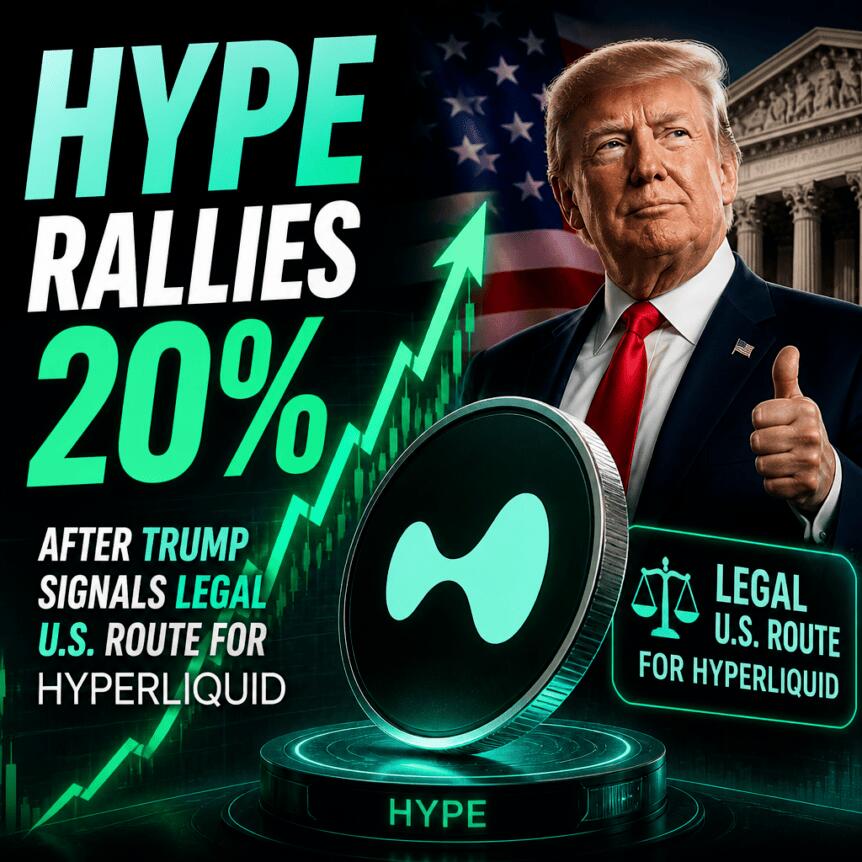
Hyperliquid’s native token, HYPE, jumped sharply after President Donald Trump said U.S. regulators are working on a “compliant and legal” pathway that could allow the decentralized trading platform to serve American users. The move highlighted how much market participants are willing to reprice crypto assets on the prospect of clearer access to the United States—despite the absence of concrete implementation details.
HYPE traded near $62 shortly before Trump’s remarks, then rose as much as 16% to a 24-hour high of $72.28, according to CoinGecko data. The token later settled around $70, up roughly 20% on the day, with 24-hour trading volume reaching about $1.4 billion.
Key takeaways
- HYPE surged more than 20% over 24 hours following Trump remarks about a compliant U.S. pathway for Hyperliquid.
- Price action likely reflected expectations of future U.S. access, which could change how HYPE is perceived and valued.
- Hyperliquid Strategies (Nasdaq: PURR) spiked alongside the token, but the company says it is independent of Hyperliquid.
- A large spike in PURR October $8 call options drew attention, though public data does not confirm the motivation or whether any trading involved nonpublic information.
Trump’s regulatory signal lifts HYPE
The catalyst came during a Wednesday White House event. Trump said he understood that CFTC Chair Michael Selig and “Mike” are working to bring Hyperliquid into the U.S. “in a fully compliant and legal fashion,” adding, “Working very hard on that.” The comments referenced the CFTC’s role in crafting regulatory pathways for market activity connected to digital assets.
For traders, the timing mattered: HYPE’s rally began immediately around the remarks and extended into the following hours. According to CoinGecko, the token’s intraday move ranged up to $72.28 before settling near $70. In practical terms, that kind of rapid repricing tends to occur when markets believe the probability of a regulatory breakthrough has increased—especially for networks associated with accessible on-ramps and clearer participation by U.S. users.
Still, the market reaction has not been matched with policy specifics. Neither the CFTC nor Hyperliquid has released a formal proposal describing what “compliant” U.S. access would look like, whether any application has been submitted, or when a compliant service could launch.
Why “U.S. access” can reprice decentralized platforms
Decentralized trading platforms often face a recurring challenge: how to reconcile the mechanics of open, protocol-driven exchange with U.S. regulatory expectations. When senior U.S. officials publicly suggest that regulators are working on a pathway, investors may anticipate changes that could broaden the addressable user base.
That expectation is visible in the way the token moved relative to the lack of concrete details. HYPE rallied on the notion that U.S. availability could reduce friction for American participants, which in turn can affect liquidity expectations and demand. The rally also appeared to extend to firms whose equities investors associate with the ecosystem.
However, it’s important to separate a “possible pathway” from a finished regulatory outcome. Without published requirements or a stated process, traders remain exposed to uncertainty: the implementation could take longer than markets expect, or the eventual structure could differ from what investors are currently pricing.
PURR shares surge—and options trading raises questions
Alongside HYPE, shares of Hyperliquid Strategies, a Nasdaq-listed treasury company trading under the ticker PURR, surged Wednesday. Yahoo Finance reported the stock closed at $9.39, up 30.4%.
The relationship is nuanced. While the company shares the Hyperliquid name, Hyperliquid Strategies’ own disclaimer states it is independent and not affiliated with Hyperliquid.
Options activity added another layer to the story. CNBC reported that roughly four hours before Trump spoke, someone reportedly paid about $65,000 for 719 PURR call options with an $8 strike price expiring in mid-October. CNBC said the contracts were purchased at approximately $0.90 each and were quoted at $2.45 by the close, implying a position value near $176,000 and an unrealized gain of roughly $111,000.
Public options data also corroborated unusually heavy interest in that contract. According to OptiView data cited by CNBC, 2,575 of the October $8 calls were traded during the session, compared with just 67 contracts in open interest beforehand. The same data indicated volume was more than 140 times the contract’s 30-day average.
At the same time, the publicly available information does not establish who placed the order, nor does it prove that the trades were based on nonpublic information. The data shows elevated activity but cannot confirm intent. There is also no clear evidence of insider trading in the reporting, and the CFTC had previously publicly disclosed a July 15 meeting with Hyperliquid Labs and Hyperliquid Strategies.
For investors, this matters because option flows can be an early indicator of where expectations are forming—yet they can also reflect hedging, speculation, or tactical positioning that is not directly tied to any official development. Without additional disclosures, the “why” behind the PURR options remains unresolved.
What to watch next
For now, HYPE’s rally underscores how quickly crypto markets can respond to regulatory signals—but the next move depends on clarity. Readers should watch for any follow-up from U.S. regulators or the involved companies that outlines an actual compliant framework, including application status, timelines, and how U.S. access would be operationalized.
Crypto World
Live updates: Bitcoin ETFs draw $517 million, ether pulls $189 million in biggest inflows in months
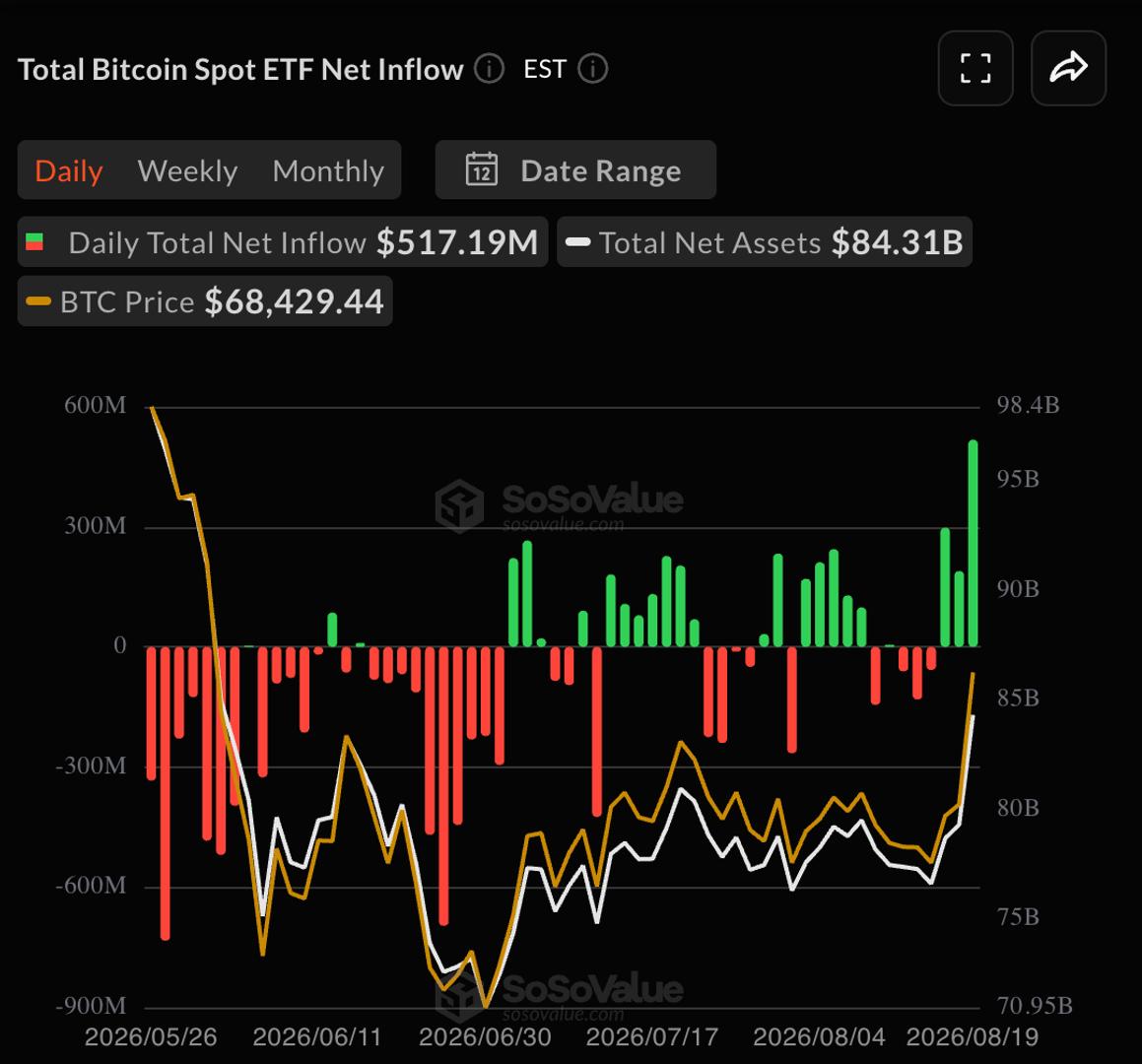
Spot bitcoin ETFs pulled in $517 million and ether funds $189 million on Aug. 19, the strongest daily hauls in months, as a broad rally torched $2.7 billion in bearish bets.
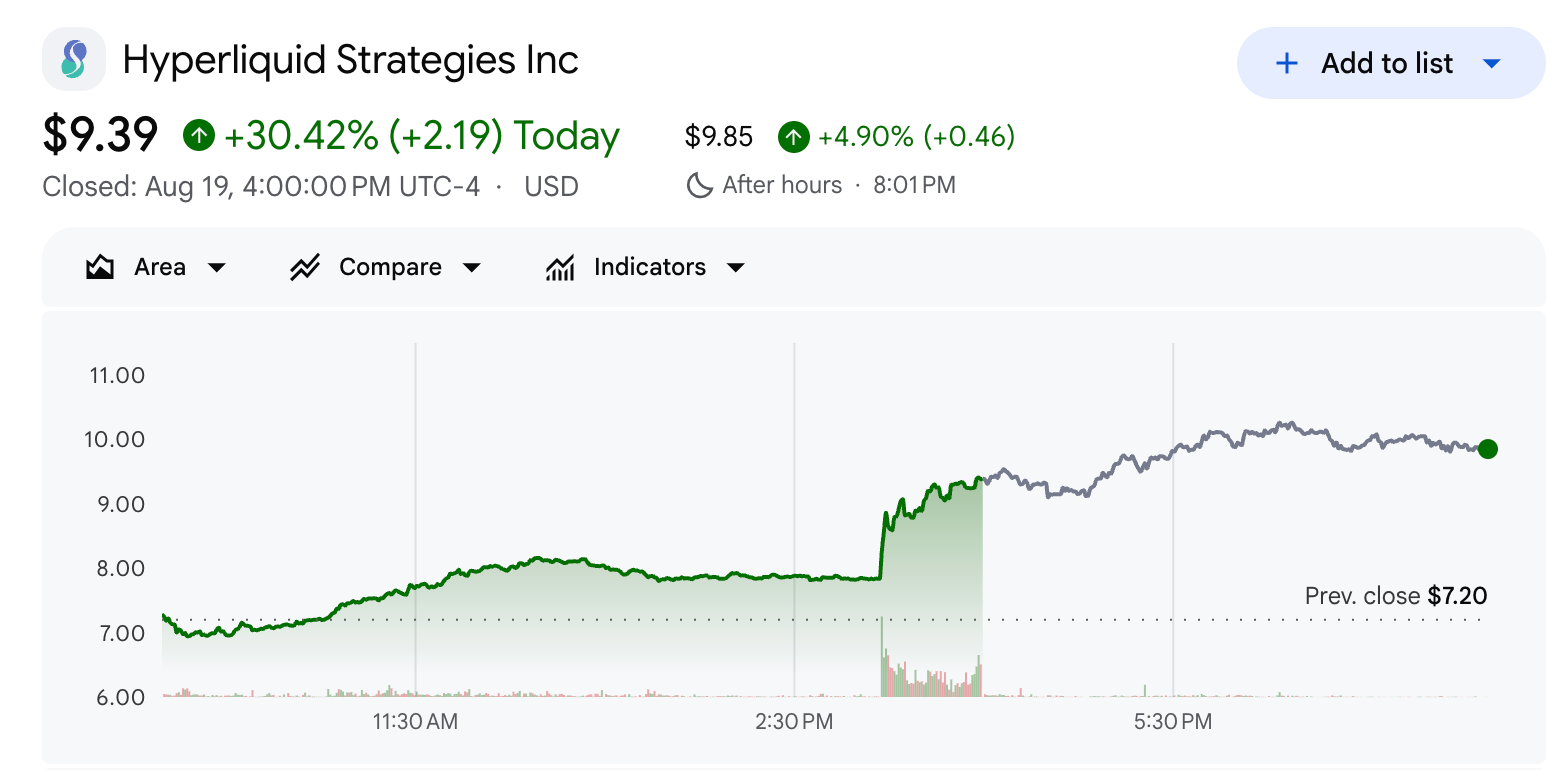
Hyperliquid Strategies (PURR) closed 30.4% higher on Wednesday, outpacing the gain in Hyperliquid (HYPE) token’s price after President Donald Trump said regulators are working to bring the exchange onshore.
The Nasdaq-listed company holds HYPE as a digital asset treasury. Its shares moved further on the news than the token sitting on its balance sheet.
Hyperliquid Treasury Stock Rose 30%, the Token It Holds 18%
Trump spoke at a White House meeting with crypto and financial executives on Wednesday. He credited Commodity Futures Trading Commission (CFTC) Chair Mike Selig with the effort.
“I understand that Mike (Selig) is also working to bring Hyperliquid into the United States in a fully compliant and legal fashion,” Trump said.
Hyperliquid currently operates outside the US and does not officially serve American traders. A regulated US presence would open it to a far larger pool of customers and capital.
Meanwhile, Trump’s remarks lifted HYPE 18.6% to around $69.22. The HYPE treasury stock did better.
Hyperliquid Strategies shares closed up 30.42% at $9.39. The stock continued to climb in after-hours trading, gaining another 4.9% to reach $9.85.

Incumbent venues moved the other way. Cboe Global Markets fell 3.5% and CME Group 1.7%. Each runs a regulated derivatives market, a licensed Hyperliquid would contest.
Follow us on X to get the latest news as it happens
HYPE Treasuries Are the Exception in a Broken DAT Trade
The digital asset treasury model has had a punishing 2026, with most vehicles now seeing sharp unrealized losses. Companies built around HYPE are the exception.
Artemis data shows just two treasury firms still sitting on unrealized gains: Hyperliquid Strategies and Hyperion DeFi (HYPD), and the asset on both balance sheets is the same.

The share prices tell the same story. PURR has gained more than 163% this year, while Strategy (MSTR) has fallen 33.6% and Bitmine Immersion (BMNR) has dropped 35.11%.
That gap explains why so many crypto-exposed companies went looking for a different narrative. For instance, Bitcoin (BTC) miners have been repricing on artificial intelligence.
TeraWulf, IREN, and Hut 8 have rallied this year on their pivot even as mining economics deteriorated. Wednesday reversed that. No AI pivot, no hyperscaler lease, just a crypto headline moving a Nasdaq stock 30%.
Subscribe to our YouTube channel to watch leaders and journalists provide expert insights
The post The Better Hyperliquid Trade Wednesday Was on the Nasdaq, Not Onchain appeared first on BeInCrypto.


Core Scientific’s transformation from bankrupt Bitcoin miner to U.S. artificial intelligence infrastructure provider accelerated during the second quarter of 2026.
Summary
- Core Scientific reported 1.1 gigawatts leased, representing over $24 billion in total potential contracted revenue.
- Second-quarter colocation revenue reached $136.7 million, while self-mining revenue declined to $21.5 million during 2026.
- AMD agreements cover five sites and 530 megawatts, with deployments scheduled to begin during 2027.
- Core Scientific spent $954.2 million on capital expenditures during 2026’s first six months, filings show.
- Long-term debt reached approximately $4.3 billion as AI construction increased financing needs and execution risks.
The company reported approximately 1.1 gigawatts of leased customer power capacity and more than $24 billion in potential revenue under long-term contracts.
The July 28 results also showed that high-density colocation had become the company’s largest business. Colocation produced $136.7 million of Core Scientific’s $164.2 million in quarterly revenue. Digital asset self-mining contributed $21.5 million.
The turnaround is supported by signed contracts with CoreWeave and companies deploying AMD technology. However, the $24 billion figure is neither cash received nor guaranteed profit. It represents potential revenue spread across contracts lasting as long as 15 years.
Core Scientific must still construct the facilities, deliver capacity on schedule and keep customers operating under those agreements. Its latest filing also shows that the transition requires heavy spending and considerably more debt.
Core Scientific preserved power assets through bankruptcy
Core Scientific filed for Chapter 11 protection in December 2022 after Bitcoin prices fell, electricity costs rose and financing conditions tightened. The company also faced a payment dispute with bankrupt cryptocurrency lender Celsius, previously one of its mining-hosting customers.
The company had about $4 million in cash when it filed. Its problem was not an absence of physical assets. It had already invested heavily in mining facilities, substations, land, equipment and access to utility power. Those assets could not produce enough cash to meet its immediate liabilities during the market downturn.
A Texas bankruptcy court confirmed the company’s reorganization plan in January 2024. Core Scientific emerged later that month and resumed Nasdaq trading under the CORZ ticker. The restructuring reduced its debt by approximately $400 million through conversions of equipment financing and convertible-note claims into equity.
More importantly, the company retained 724 megawatts of operating capacity across five U.S. states. That infrastructure became valuable as AI companies began competing for sites with secured power, fiber connections and space for high-density computing equipment.
Building a new data center can require years of grid studies, permits and construction. Core Scientific already controlled energized sites built for power-intensive Bitcoin mining. Management began marketing that infrastructure to AI customers seeking faster deployment.
CoreWeave established a new use for mining capacity
Core Scientific’s commercial shift began with CoreWeave. In June 2024, the companies signed 12-year agreements covering about 200 megawatts of high-performance computing infrastructure. Core Scientific estimated more than $3.5 billion of cumulative revenue under the initial contracts.
Several expansions increased CoreWeave’s contracted capacity to approximately 590 megawatts. Core Scientific now associates those agreements with approximately $10.2 billion in potential revenue over their terms.
The contracts also reduced some of Core Scientific’s initial financing burden. CoreWeave agreed to fund parts of the construction, with those amounts credited against future hosting payments. During the first six months of 2026, CoreWeave funded $180.9 million of Core Scientific’s capital expenditures.
As crypto.news previously reported, the company sold $208.3 million of Bitcoin to finance its AI transition during the first quarter. The sale represented a clear change from a model centered on accumulating and mining BTC.
CoreWeave attempted to acquire Core Scientific before the infrastructure transition was fully completed. Core Scientific rejected a $5.75-per-share cash offer in 2024, saying it undervalued the business.
The companies agreed to an all-stock transaction valued at approximately $9 billion in July 2025. Shareholders rejected the transaction on Oct. 30, after opposition focused on the fixed exchange ratio, valuation and exposure to CoreWeave’s share price. The companies then terminated the agreement but retained their commercial relationship.
AMD expands the Core Scientific AI pipeline
Core Scientific announced a wider infrastructure partnership with AMD on July 28, 2026. The arrangement starts with approximately 530 megawatts across five U.S. sites under 15-year agreements.
The company associates that initial capacity with more than $14 billion in potential base contract revenue. Deployments are scheduled to begin in 2027 and will support customers using AMD Instinct accelerators, EPYC processors and ROCm software.
AMD also received reservation rights covering another 1.925 gigawatts. If all reserved capacity becomes contracted, the partnership could reach approximately 2.5 gigawatts.
That larger figure remains conditional. Reservation rights are not the same as executed leases. Development will depend on customer demand, available grid capacity, construction progress and additional financing.
The arrangement gave AMD warrants to purchase as many as 30 million Core Scientific shares at $23.47 each. Approximately 6.5 million warrants vested after related leases were executed in July, according to Core Scientific’s quarterly filing.
Some initial capacity was leased to AI infrastructure operator Neocloud. AMD entered a credit-support arrangement connected to equipment installed for Neocloud, but the filed contracts do not describe AMD as an unconditional guarantor of every Neocloud payment.
The expansion reduces Core Scientific’s reliance on CoreWeave at the contracted-capacity level. Customer concentration nevertheless remains material because a limited number of counterparties support most of the company’s colocation revenue.
AI revenue has overtaken Bitcoin mining
Core Scientific’s financial results show that the transition has advanced beyond announced plans. Second-quarter colocation revenue rose to $136.7 million from $10.6 million one year earlier.
The segment produced approximately $80 million in quarterly gross profit and a margin near 59%. Self-mining produced $21.5 million in revenue but recorded a gross loss of approximately $12.2 million.
Core Scientific said 437 megawatts were generating billable revenue by the end of the quarter. That capacity represented about $635 million in annualized GAAP hosting revenue, based on the company’s calculation.
The business was not profitable under GAAP. Core Scientific reported a quarterly net loss of approximately $1.16 billion and an operating loss of $78.5 million.
About $1.05 billion of the net loss came from fair-value changes involving warrants and contingent value rights. Those expenses were non-cash accounting charges linked mainly to movements in Core Scientific’s share price. They did not represent an equivalent cash payment during the quarter.
Adjusted EBITDA reached $41.1 million. This is a non-GAAP measure that excludes several expenses and should not be treated as equivalent to net income or unrestricted cash flow.
CORZ traded near $18.72 on Aug. 20, giving the company a market capitalization of approximately $6.1 billion. The share price remained several times above its $3.44 closing price on the first day after its January 2024 relisting.
The $24 billion pipeline carries a financing test
Core Scientific spent $954.2 million on property and equipment during the first half of 2026. It also completed a roughly $232.5 million acquisition of land and development rights for a proposed 430-megawatt site in Hunt County, Texas.
The company financed part of its expansion by issuing $3.3 billion of senior secured notes in May. The notes carry a 7.75% interest rate and mature in 2031. Long-term debt reached approximately $4.3 billion by June 30, up from about $1.06 billion at the end of 2025.
Core Scientific held approximately $1.8 billion in cash, cash equivalents and digital assets at quarter-end. However, it expects continued construction spending as it converts former mining sites and develops new campuses.
The company’s first-half operating cash flow also requires context. It benefited from Bitcoin sales, customer construction funding and changes in working capital. Those sources do not show that recurring colocation income can already finance the full development program independently.
Similar economics are encouraging other miners to reuse power infrastructure. In related coverage, crypto.news found that Bitcoin miners are increasingly converting energized sites into AI data centers as mining margins weaken.
Core Scientific’s immediate targets include bringing more CoreWeave capacity online and starting the contracted AMD-related deployments in 2027. Delivery schedules, construction spending, customer performance and additional lease conversions will determine how much of the advertised backlog becomes recognized revenue.
The turnaround rests on a genuine shift in revenue, but its completion remains forward-looking. Core Scientific has exchanged direct exposure to Bitcoin prices and mining difficulty for construction, financing and customer-credit risks. The company’s next test is converting contracted megawatts into reliable, billable computing capacity without allowing its debt burden to outpace operating earnings.
FAQs
How much AI capacity has Core Scientific contracted?
Core Scientific reported approximately 1.1 gigawatts of leased customer power capacity at the end of the second quarter.
Is the $24 billion already guaranteed revenue?
No. It is the company’s estimate of potential revenue across long-term contracts. Recognition depends on construction, service commencement, uptime and customer performance.
How much capacity does AMD have under signed agreements?
The initial 15-year agreements cover approximately 530 megawatts across five sites. AMD holds reservation rights that could increase the partnership to 2.5 gigawatts.
Does Core Scientific still mine Bitcoin?
Yes, but the operation is shrinking. Self-mining generated $21.5 million in second-quarter revenue and recorded a gross loss.
What is Core Scientific’s largest financial risk?
Its principal challenges include construction spending, higher debt, customer concentration and delivering contracted capacity on schedule.

Daily Deal: memoryOS Expert Plan

UAE suspends trade, financial activity with Iran

How to appeal results or resit exams after GCSE results day





-

 Fashion6 days ago
Weekend Open Thread: Ann Taylor
-
 Sports6 days ago
This U.S. Amateur is a glimpse into golf’s future in more ways than you think
-
 Tech6 days ago
11 Ways to Rank Your Videos
-
 NewsBeat5 days ago
Myanmar says over 300,000 Rohingya refugees verified for repatriation as exodus enters ninth year
-

 Sports5 days ago
Birmingham 2026: Day 6 Timetable for Irish Athletes
-

 Politics5 days ago
SEQ Code: The Three Letter Boarding Pass Code That Could Give You The Worst Seat
-

 Tech7 days ago
DeepSeek Harness launches as open source rival to Claude Code, alongside V4-Pro on API with higher prices
-

 Tech2 days ago
Qwen3.8-27B runs frontier-class coding agents and reasoning locally, no cloud API required
-

 Crypto World2 days ago
OCC Greenlights Trump Family Crypto Firm for Trust Charter
-

 Fashion6 days ago
Weekly News Update, 8.14.26 – Corporette.com
-
 Tech5 days ago
Every fusion startup that has raised over $100M
-
 Entertainment6 days ago
10 Netflix Shows That Quietly Became Modern Classics
-

 Crypto World5 days ago
Pi Network Protocol 27 endgame: last upgrade before what?
-
 Entertainment5 days ago
Marvel Studios Reveals New X-Men Cast Including Adam Driver and Sadie Sink
-

 Business2 days ago
SMA Solar Technology AG (SMTGY) Q2 2026 Earnings Call Transcript
-

 Business6 days ago
15 Ways to Make Money From Your Phone (2026 Guide)
-

 Business5 days ago
Facebook Down Now? Users Report Login And Loading Problems As Outage Trackers Monitor Ongoing Issues
-

 Fashion6 days ago
Silver bangles for women – Newbridge Silverware
-

 Politics7 days ago
The migrant mega-dinghy – spiked
-

 Politics7 days ago
How the British state enabled Simon Levy’s atrocities
You must be logged in to post a comment Login