Even as the wider EU was grinding through a long, drawn-out process to figure out which regulatory levers to pull on kids’ safety online, France decided to YOLO it earlier this summer by jumping at the chance to ban all social media for kids under 15. This kind of thing has become popular with out of touch adults in the grips of an ongoing moral panic, since Australia led the way after gambling companies pushed the ban as an alternative to banning gambling ads. Australia’s ban isn’t doing very well, with the majority of kids figuring out how to work around it, and those being left out being the most marginalized and in need of community.
And yet, countries around the globe have all suddenly decided — some based on reading Jonathan Haidt’s badly reasoned book — that they must do this too.
France was the first in the EU, with President Emmanuel Macron gleefully treating France’s willingness to rush in with little thought or understanding as a selling point:
“France is leading the way in Europe in protecting our children and our teenagers,” Macron said. “We will keep on going.”
He wanted the ban to be implemented in mere months, just as kids returned to school.
Advertisement
But that’s all run into a bit of a stumbling block known as the French Constitutional Council, which has said the ban is an unconstitutional attack on kids’ rights to free expression and communication. The Council also flagged a second problem: you can’t enforce an under-15 ban without making every user, adults included, prove their age. The law demanded exactly that, without defining a single condition, limit, or technical standard for how that verification would work.
A court in France on Friday shot downa bill seeking to ban access to social media for under-15s from September — a major blow to President Emmanuel Macron that raises fundamental questions about efforts to protect kids on the internet.
The Constitutional Council, which reviews the constitutionality of French legislation, said the restrictions in the bill disproportionately infringe on minors’ right to freedom of expression and communication.
Reading through the Google translation of the actual ruling, it’s pretty short and to the point. Similar to how the First Amendment requires any restriction on speech to be narrowly tailored to a specific government interest, here the Council says the ban is way too broad and not based on any specific, narrowly defined harm, though it admits that the aims of protecting children are certainly legitimate:
Furthermore, while the established prohibition does not apply to online encyclopedias, educational or scientific directories, or platforms for developing and sharing free software or open-source educational digital projects, the exceptions provided for in the contested provisions remain limited. In particular, these exemptions do not cover collaborative services for sharing leisure, information, or mutual aid content, online communication applications, or online games with strong collaborative and social features, nor do they cover online social networks which, while not inherently educational, are created in connection with educational activities.
Thus, the prohibition established is likely to apply to online communication services whose risks to the health and safety of minors, relating in particular to their content or mode of operation, are not established.
Advertisement
In short, the law goes way too far in issuing a blanket ban of all children, no matter what the circumstances. If you have a legitimate, well-defined problem, come up with a narrowly tailored solution. The French government rushed this one through with little concern for things like that.
It also leaves little room for parents to decide for their own kids what’s appropriate:
… neither the contested provisions nor any other provision sets out the conditions under which the holders of parental authority or the legal representative of the minor, duly informed of the potential risks and safeguards presented by the services concerned, may, in the child’s best interests and in the exercise of their duties under the law, decide to lift the prohibition, limit its scope or authorise access to certain services.
Thus, the prohibition established does not give rise to any particular assessment of the risk to the minor, taking into account in particular his age, his degree of maturity, his family situation as well as the nature of the service concerned.
Also, the age verification attack on privacy is important to recognize:
Advertisement
By prohibiting access for any minor under fifteen years of age to certain online services, the contested provisions imply, in themselves, that any person, even an adult, must prove their age before accessing them.
The Council further notes that the law makes no real effort to figure out how one might implement age verification in a manner that protects the privacy rights of adults.
Of course, having hitched his own legacy to this thing, there’s no way Macron lets it go quietly:
In a statement late Friday, the French presidential office said the government would not be giving up on the bill. It has set a new target date for spring 2027, which coincides with when Macron will leave office.
The statement said Macron “has instructed the Prime Minister to work, as quickly as possible, on a legally sound draft that takes into account” the court’s decision. The ruling hinted at what would make the age restriction align with fundamental rights: giving parents more flexibility.
Politico also spoke to Peter Craddock, a Brussels-based attorney who works on social media regulation, who notes that any other EU country attempting a similar blanket ban is likely to run into exactly the same wall:
Advertisement
“The reasoning is actually equally relevant internationally, throughout the EU, because this fundamental freedom is not specific to France,” he said.
Which is a useful reminder that the freedom of expression problem here isn’t a quirk of French constitutional law. It’s baked into the whole approach — and no amount of “but it’s for the children” framing makes it go away. That’s even more true of the problems with age verification requiring the scanning of everyone’s ID, which is an even touchier subject in large parts of the EU than elsewhere.
Really, though, the bigger, more important message here should be to slow down. What’s incredible is that for all of the political and media class whining that social media is some rogue experiment on our children, none of them seem to consider that abruptly trying to block all social media from kids is just as much an experiment, and one that might have equally damaging effects.
Why not wait and see how the Australian ban actually works in practice? The early results are a mess. I get that Macron and other politicians want headlines and a legacy to point at, but it would be nice if they actually followed what the research shows and looked at how the early experiments of these bans have worked out.
So what France produced here was a total rush job that sacrificed the expression rights of every teenager in the country, the ability of parents to make their own judgment calls regarding their own kids’ access to information and — as a cherry on top — the privacy of every adult who would now need to prove their age at the door to the internet. Thankfully, the Constitutional Council caught all three.
Fortunately, the company had a policy of checking source code on GitHub first
PWNED Welcome back to PWNED, the column where we make fun of those who are security self-owned, so hopefully you don’t do the same. This week, we have a story that’s hot off the presses about a company almost sabotaging its security by using AI for programming.
Have a story about someone leaving a gaping hole in their network? Share it with us at pwned@sitpub.com. Anonymity is available upon request.
Advertisement
Our tale of machine learning malfeasance comes courtesy of Sergiy Fitsak, managing director of Softjourn, a consulting and software development company. He reminds us that, when it comes to AI, don’t trust: verify.
During the course of business, one engineer asked an AI agent to recommend a package that they needed for a common task. The agent came back with the name of a legitimate-sounding package, which was formatted like a familiar library.
At many organizations, this would have been the end of the story. The developer would have taken the AI agent’s advice and downloaded and installed the recommended package.
However, at Softjourn, the company has a policy which they actually followed: double-check any software recommendations made by AI to make sure they are legit. The developer skimmed the recommended package’s source code on GitHub and noticed that it had few downloads and had just been created a few days earlier. In other words, it was suspicious.
Advertisement
According to Fitsak, attackers have found a way to exploit package names hallucinated by AI models.
“The problem is that AI models sometimes invent package names that sound plausible but don’t exist, a pattern security researchers have started calling ‘slopsquatting,’” he told us. “Attackers have caught on and now register real packages under those exact invented names, betting that a developer under deadline pressure will install first and check later.”
If Softjourn hadn’t been so careful, they could have installed a malware package. We don’t know the exact payload, but this malware package could have given crims a backdoor into their systems and the ability to steal data or wreak other havoc.
“We caught it because we’d already built a habit of verifying download counts and reviewing source code on GitHub before installing anything an AI recommends, even when it looks routine,” Fitsak said. “It takes a few extra minutes. Skipping that step once is how a team ends up explaining a supply chain compromise instead of shipping a feature on time.”
Advertisement
The lesson here is a very simple one: Don’t trust the package names that AI agents recommend. Have a human check the supply chain. And always have a human in the loop so they can take the time to stop and approve any outside code that comes into a project. ®
memoryOS is a gamified mobile app designed to significantly improve your memory through short, interactive lessons. Guided by two-time World Memory Champion Jonas von Essen, the software teaches proven mnemonic techniques alongside spaced-repetition schedules. It features a digital library of 3D “Virtual Mind Palaces,” which allows users to easily visualize, organize, and store complex information for fast recall. You can get a 1 year expert plan subscription for $50, 3 years for $120, or 5 years for $150.
Note: The Techdirt Deals Store is powered and curated by StackSocial. A portion of all sales from Techdirt Deals helps support Techdirt. The products featured do not reflect endorsements by our editorial team.
Real world economic potential of tokens will depend on efficient usage of scarce compute resources, Stripe’s Patrick Collison said.
After weeks of speculation, Stripe has announced that it is acquiring New York-based AI marketplace OpenRouter.
Terms of the deal have not been disclosed, but recent reports suggest the acquisition would cost Stripe between $7bn and $10bn – dramatically higher than the $1.3bn valuation OpenRouter hit after a $113m round a few months ago.
Stripe said the acquisition will improve its services that help businesses optimise token costs – something it has undertaken over the past year. It is also gaining a user-base of more than 10m OpenRouter users globally.
Advertisement
Token optimisation is difficult, Stripe explained. “The sheer matrix of variables – which model to use for which tasks, at which speed and at what price – makes managing cost-versus-performance trade-offs in real time extremely difficult,” it said in a statement announcing the acquisition.
Founded in 2023, OpenRouter is a new type of marketplace that offers access to more than 500 large language models (LLMs), routing user requests to the best available AI provider and letting users shop around based on price, speed and reliability among other factors.
It claims to be the first of its kind of platform set up for LLMs, reflecting a growing appetite for AI models and a fast diversifying market and is already used by the likes of Nvidia, Zoom and Swedish vibe-coding start-up Lovable.
“Together, Stripe and OpenRouter will be able to help companies manage both sides of profitability in the AI era; maximising revenue and efficacy while minimising costs,” Stripe said.
Advertisement
The company’s co-founder Patrick Collison said: “Tokens are the central currency for companies building with AI and it’s clear that the real-world economic potential will depend on making good use of scarce compute resources.”
Alex Atallah, the co-founder and CEO of OpenRouter once described his company as an AI equivalent of Stripe.
“Stripe has spent over a decade building trusted, neutral infrastructure for businesses, and OpenRouter was built on the same philosophy,” he said.
“We believe intelligence will be multi-model: no single model will be optimal for every task, and developers need a neutral layer to orchestrate and manage them all. Joining Stripe lets us accelerate that mission and bring the full AI ecosystem to every business.”
Advertisement
Don’t miss out on the knowledge you need to succeed. Sign up for the Daily Brief, Silicon Republic’s digest of need-to-know sci-tech news.
There has been very little pushback against Apple’s new business terms in the EU, primarily from Epic Games, and even the European Commission has welcomed the changes.
The Digital Markets Act forced Apple to rethink its business model in the European Union, which was initially rejected due to the Core Technology Fee and confusing rates. After going back to the negotiating table, Apple seemingly has found a solution that makes almost everyone happy.
A report from Irish Independent detailed the European Commission’s response to Apple’s new business terms for the EU. They share that they welcome the changes and will monitor Apple’s implementation of the terms.
Here is the EC’s full statement:
Advertisement
“The Commission welcomes Apple’s changes to their business terms, which follow a close dialogue between the Commission and Apple after the Commission issued a non-compliance decision related to Apple’s steering terms as well as preliminary findings related to alternative app distribution, both in April 2025,” the spokesperson said.
“Following today’s announcement, the Commission will monitor Apple’s effective implementation of the new terms. Under the DMA, users in the EU have a right to full and effective choice of alternative app distribution channels.”
The point of the DMA was to open up competition and choice for developers, which the EC seems to believe Apple’s terms have accomplished. The new rates eliminate the Core Technology fee and rely upon percentages from 5% to 26% based on how the developer interfaces with Apple’s platform.
One vocal developer was not happy with the results. Predictably, it was Epic Games.
“The law makes it clear that Apple must allow developers to offer link outs to the web for purchases ‘free of charge’ and has to allow ‘effective use’ of competing stores. Apple’s terms deliberately violate the Digital Markets Act.”
Epic has made it clear in the US and the EU that any fee above 0% on purchases made outside of the App Store is too much. Given the EC’s approval of these new business terms, Epic may have to finally accept the reality of the situation.
Advertisement
Either Epic pays, or it can invent its own smartphone platform to profit from. Of course, Epic will continue to litigate until the sun expires.
We haven’t heard the last of Epic either. The lawsuit against Apple involving commission rates is still ongoing as Apple awaits the Supreme Court’s decision in October.
Software subscriptions are easy to justify one at a time.
£10 a month for cloud storage. £20 for an AI tool. £40 for security software. Another £30 for design, £50 for project management, then a few smaller subscriptions that barely seem worth thinking about.
The problem appears when you add them together.
Software has shifted decisively toward recurring billing, which means many of us no longer buy a program once and use it for five years. We maintain a collection of monthly and annual subscriptions instead. For businesses, freelancers and even individual users, those recurring software costs can become a meaningful part of the monthly budget.
Advertisement
The obvious response is to start cancelling things. That can save money, but it can also be a bad trade if you remove software that genuinely saves time or helps you work.
A better approach is to make the subscriptions you keep work harder.
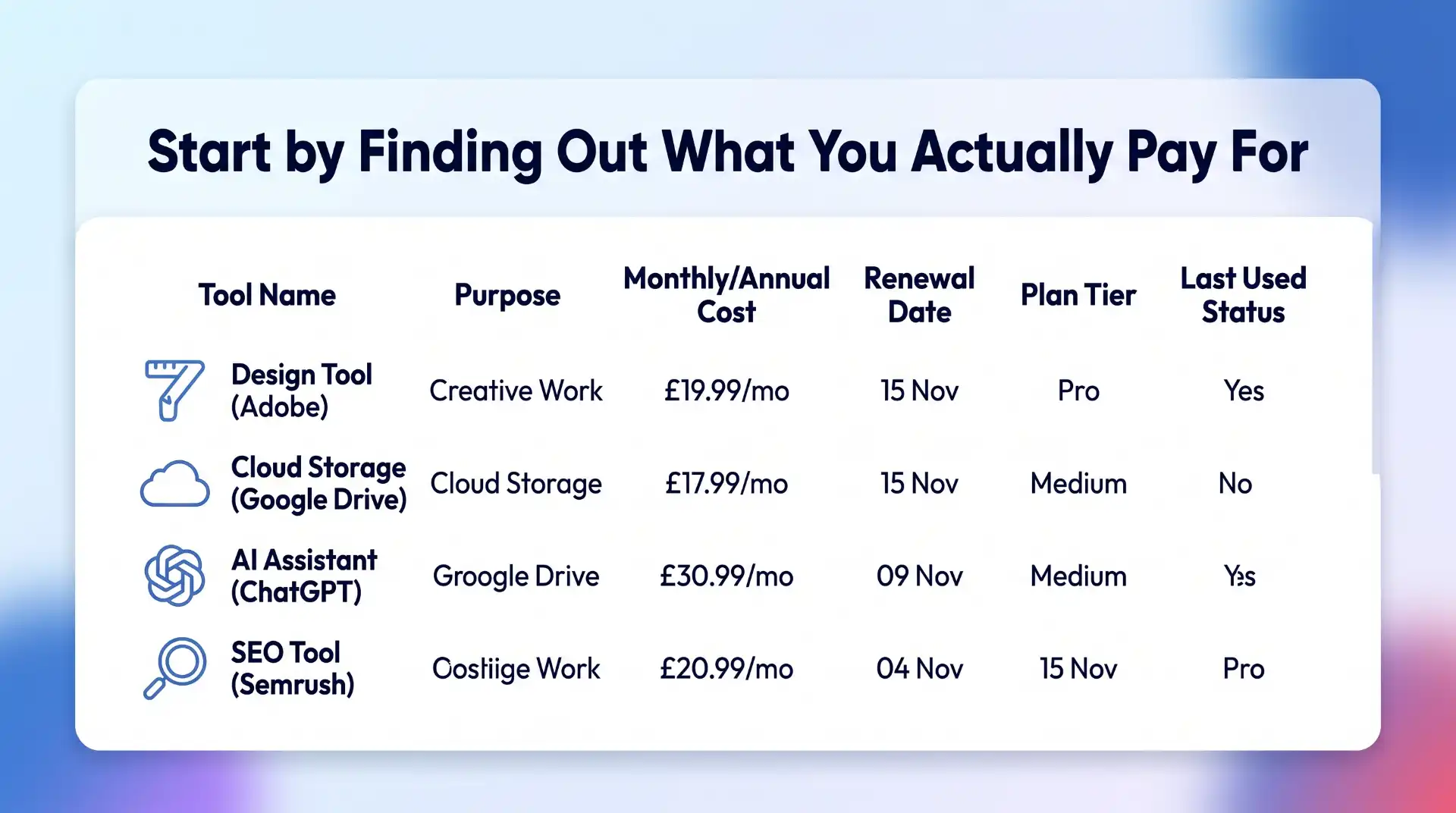
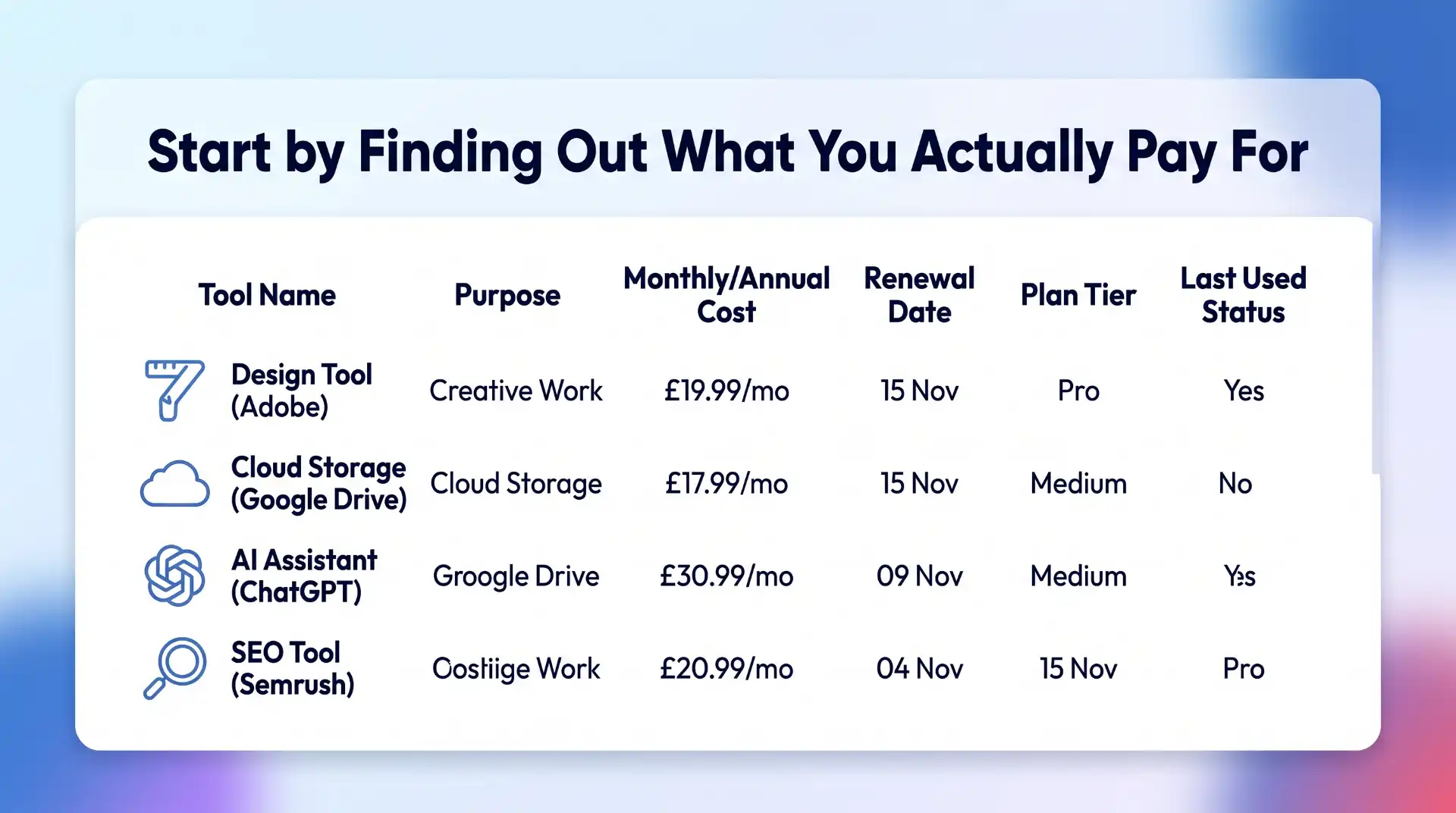
Start by Finding Out What You Actually Pay For
Before looking for cheaper software, work out what you already have.
This is less obvious than it sounds.
Advertisement
Subscriptions can be spread across credit cards, PayPal, app stores, business accounts and individual employee expenses. Annual subscriptions are particularly easy to forget because they disappear from view for eleven months before suddenly renewing.
Make a simple list containing:
Software name
Purpose
Monthly or annual price
Renewal date
Number of users
Current pricing plan
How frequently it is actually used
You do not need specialist subscription management software to do this. A spreadsheet is enough.
The important part is getting everything into one place.
Advertisement
You may find three categories almost immediately: software you use constantly, software you occasionally need, and software you forgot you were paying for.
The third category is the easiest place to start cutting.
Cancel Software You No Longer Use
Unused subscriptions are the least controversial saving.
Perhaps you needed a video editor for one project. You tested an AI research tool for a month. You signed up for a stock image service while redesigning a website.
Advertisement
The project ended. The subscription didn’t.
Small monthly payments are especially good at surviving unnoticed. A £12 subscription does not feel urgent enough to investigate, but £12 every month is £144 a year.
Multiply that across five or ten forgotten services and the numbers stop looking insignificant.
Before cancelling, check whether you have files or data stored in the platform that need to be exported. Once that is done, remove subscriptions with no current purpose.
Advertisement
There is no clever optimisation here. Stop paying for things you do not use.
Look for Overlapping Features
The next step requires a little more thought.
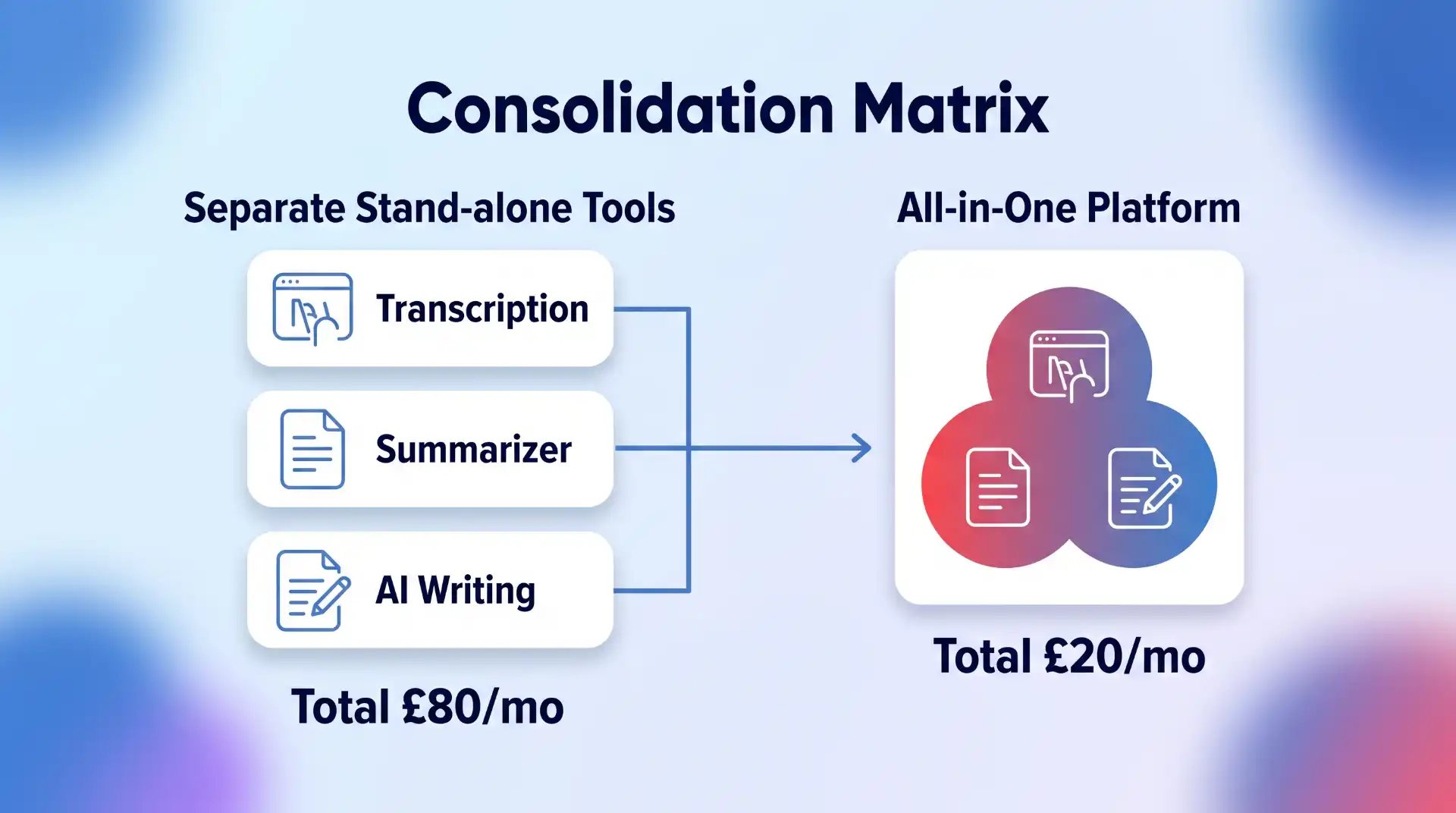
Software products rarely stay in their original lanes. Project management tools add document editing. Email platforms add CRM features. Design applications add AI image generation. SEO suites add content tools. AI platforms add research, coding and file analysis.
That means your software subscriptions may now overlap considerably.
Advertisement
Imagine paying separately for:
A meeting transcription tool
An AI assistant
A writing tool
A research platform
A document summariser
Two years ago, that might have made sense.
Today, one or two products may cover most of those jobs.
Go through the software you use and look at what each platform can actually do now, not what it could do when you first subscribed.
Advertisement
You might find that an existing subscription has quietly made another one redundant.
Do Not Replace Good Software Just Because Something Cheaper Exists
There is a trap at the other end of software cost cutting.
The cheapest subscription is not automatically the best value.
Suppose you pay £50 a month for software that saves five hours of work. Replacing it with a £20 alternative that adds two hours of manual work is unlikely to be a sensible saving.
Advertisement
Time has a cost too.
When comparing software subscriptions, consider:
Reliability
Time saved
Ease of use
Integrations
Support
Security
Export options
Collaboration features
Training required
Switching costs
This is especially important for software deeply embedded in a workflow.
Moving from one password manager to another is relatively manageable. Migrating a company CRM, automation stack or email marketing system can be considerably more disruptive.
Save money where the difference is largely financial. Be more cautious where the cheaper option creates operational problems.
Advertisement
Compare Monthly and Annual Software Plans
Once you know a product is staying, check how you are paying for it.
Many software companies charge less when customers pay annually rather than monthly.
The discount can be worthwhile, but only if you are confident you will use the software for most or all of the next year.
This creates a useful rule:
Advertisement
Use monthly billing while testing. Switch to annual billing once the software has proved itself.
Monthly plans cost more, but the flexibility has value when you are still deciding whether a product belongs in your workflow.
Annual billing makes more sense for established subscriptions.
If you have used the same software every week for three years and have no intention of replacing it, paying the monthly premium purely for flexibility probably achieves very little.
Advertisement
Check the actual saving before committing. Some annual discounts are substantial. Others barely justify paying twelve months upfront.
Compare the Real Annual Cost
Software pricing pages can make comparisons unnecessarily difficult.
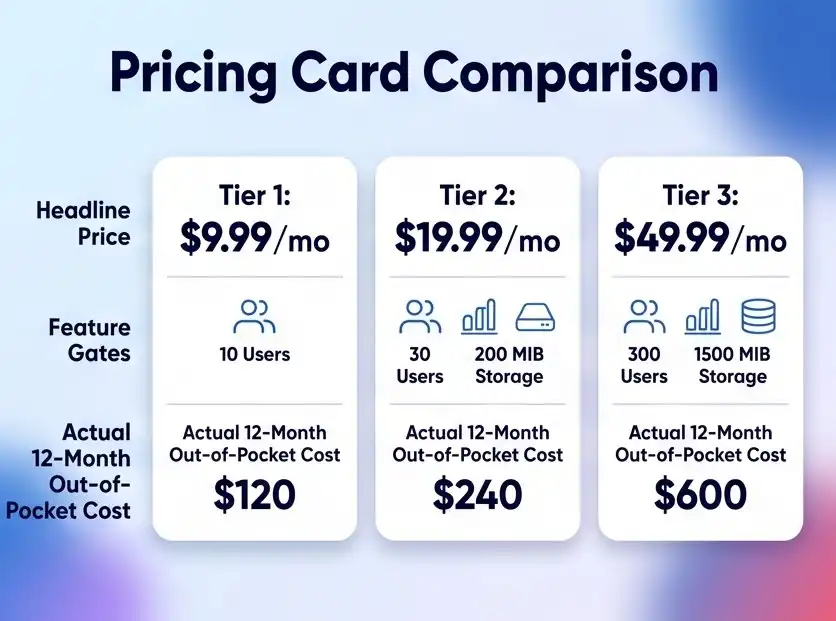
One service advertises “$9.99 per month” but requires annual payment. Another charges £14 monthly with no commitment. A third has a cheap starting plan but locks important functionality behind the next tier.
Compare the cost you will realistically pay over twelve months.
Advertisement
For example:
Software A: £10 per month billed annually = £120 upfront
Software B: £13 per month = £156 annually
Software C: £8 entry plan, but £16 for the features you need = £192 annually
Advertisement
Software A is cheapest in that example, but only if you are comfortable committing for the year.
The headline monthly price is not enough.
Look at the plan you actually need, billing frequency, taxes where applicable, user limits and any usage charges.
Review Your Pricing Tier
You may not need to change software at all.
Advertisement
You may simply be on the wrong plan.
Upgrades tend to happen for specific reasons. A team needs one premium feature. Storage reaches a limit. A business needs more users. An email list grows.
Months later, circumstances change but the expensive plan remains.
Look at the tier below your current subscription and ask what you would genuinely lose by downgrading.
Advertisement
Pay particular attention to:
Storage
Usage allowances
Number of users
AI credits
Export limits
Automations
Integrations
Reporting
Support levels
If you use premium features every day, keep them.
If you are paying an extra £40 a month for something nobody remembers using, downgrade.
Check Per-User Software Costs
Per-seat pricing can become expensive quickly.
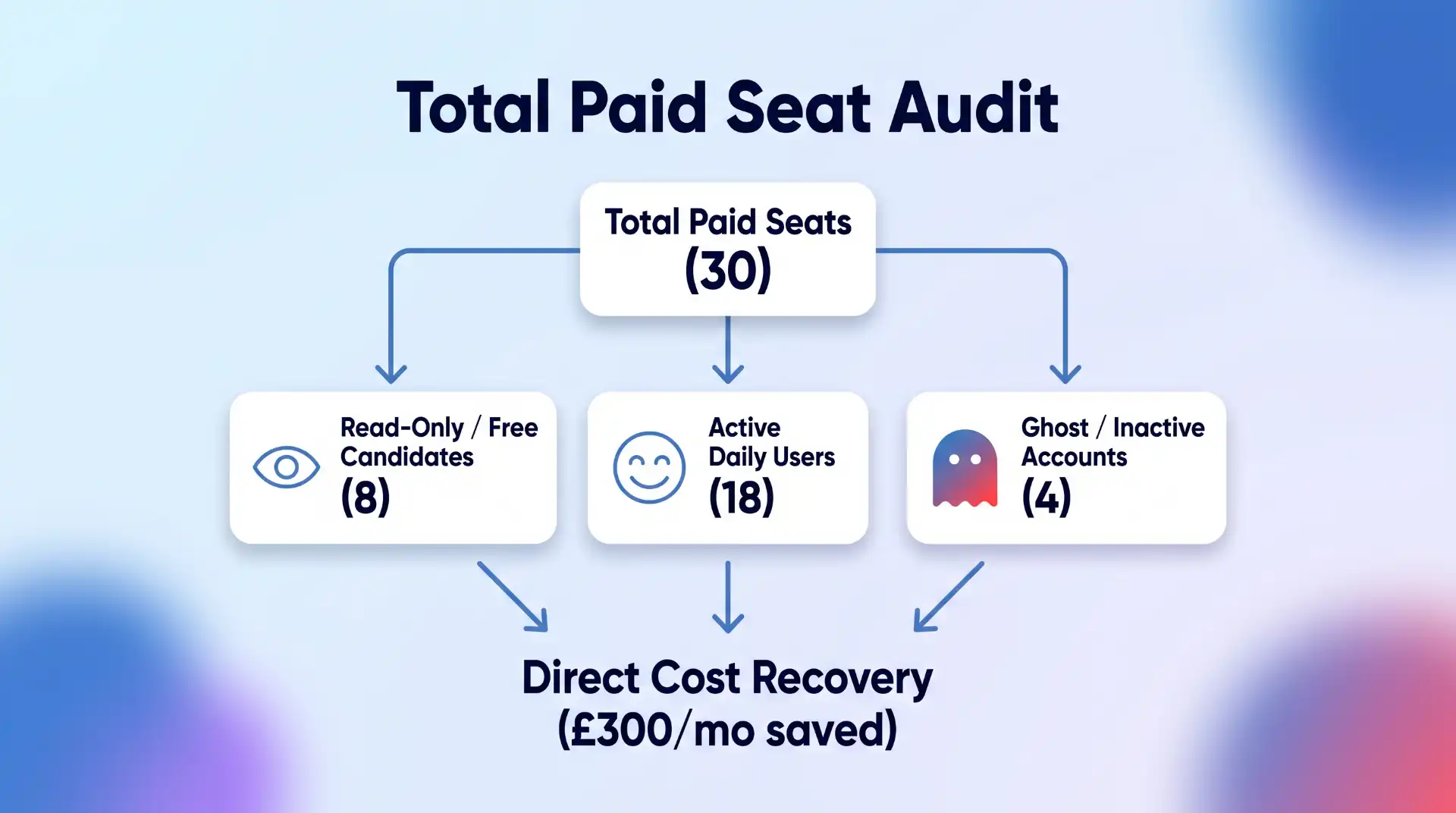
A tool that costs £25 per user looks reasonable for a team of three. At 30 users, it becomes £750 every month.
Advertisement
Regularly check who actually needs a paid account.
Former employees, temporary contractors and inactive team members sometimes remain on paid licences long after they stop using the software.
You may also find that some users only need view access or a free account.
For each major platform, compare the number of paid seats with the number of active users.
Advertisement
This is one of the simplest ways businesses can reduce software subscription costs without affecting productivity at all.
Be Careful With AI Subscription Creep
AI software deserves special attention because this market is moving unusually quickly.
It is easy to accumulate separate subscriptions for:
Writing
Research
Coding
Image generation
Video
Presentations
Transcription
Meeting notes
Search
Data analysis
The problem is that these categories increasingly overlap.
An AI platform you already pay for may have added a feature that makes a separate subscription unnecessary. Likewise, the specialist product may still be significantly better and worth keeping.
Advertisement
The point is not to consolidate everything automatically.
It is to keep checking.
AI tools can change considerably within a few months, so treating the software stack as something you review once a year may be too slow.
Compare Alternatives Before Every Major Renewal
Renewal dates create a natural opportunity to check the market.
Advertisement
If a software subscription costs £20 a month, you may decide that extensive comparison shopping is not worth your time.
If it costs £2,000 a year, the calculation changes.
Before renewing an expensive subscription, check:
What does the current plan cost now?
Has the price increased?
Are you still using all the features?
What do competing products offer?
Would switching create significant migration costs?
Is there a lower tier that now meets your needs?
Software markets change quickly.
The product that represented exceptional value three years ago may no longer be the obvious choice.
Advertisement
Equally, switching simply because a competitor is £5 cheaper is rarely worthwhile. Look at the whole package.
Look for Software Discounts Before Buying
Once you have decided which software you actually want, check whether you need to pay the full advertised price.
Depending on the product, there may be:
Annual billing discounts
Introductory offers
Student pricing
Startup programmes
Nonprofit discounts
Partner promotions
Seasonal sales
Bundled plans
Cashback offers
This step should come after choosing the software.
Buying the wrong product because it has a 30% discount is not saving money.
Advertisement
But if you were going to purchase the subscription anyway, there is little reason to ignore an available saving.
Platforms such as Rewardio offer cashback on software and digital subscriptions across categories including AI tools, marketing software, hosting, VPNs and other online services. Checking for cashback before going directly to the software provider can reduce the effective cost of a subscription without requiring you to switch to a different product.
That can be particularly useful for recurring software you already know you need.
Understand the Difference Between a Discount and Cashback
These are not quite the same thing.
Advertisement
A traditional software discount reduces the purchase price before you pay.
Cashback generally means you make an eligible purchase and receive part of the transaction value back afterwards.
For example, imagine a subscription costs £100.
A 20% discount might reduce the checkout price to £80.
Advertisement
A 20% cashback offer could mean paying £100 initially and receiving £20 back later, subject to the terms of the offer.
The economic result can be similar, but the process is different.
Always check:
Eligibility
Whether the offer applies to new or existing customers
Whether cashback is one-time or recurring
Minimum payout requirements
Tracking requirements
Excluded plans or products
Do not assume every offer works the same way.
Check Whether You Are Paying More Through an App Store
Some software subscriptions can be purchased either directly from the provider or through an app marketplace.
Advertisement
Compare the options.
Pricing, available plans and billing arrangements may differ depending on where the subscription originates.
Buying directly can sometimes give you more control over account management, billing and promotions.
There are also situations where an app-store subscription is more convenient, particularly if you actively manage multiple subscriptions through one account.
Advertisement
Convenience has value. Just make sure you know what you are paying for it.
Use Free Plans Strategically
Free software is not only for people who cannot afford paid tools.
Sometimes the free tier genuinely covers everything you need.
This is particularly common with:
Advertisement
Password managers
Cloud storage
Project management
Design tools
VPNs
Analytics
Note-taking apps
Developer tools
The mistake is assuming that “premium” automatically means “appropriate.”
For example, if you are choosing security software or a VPN, the decision should be based primarily on whether the product provides the privacy, performance and security features you need. BlogTheTech’s guide to Android VPNs is a good example of a category where both free and paid options can make sense depending on what you expect from the software.
Start with your requirements.
Then determine whether the paid tier actually solves a problem the free version does not.
Cancel Free Trials Properly
Free trials are useful because they reduce the risk of testing software.
Advertisement
They also have a tendency to become permanent subscriptions.
Whenever you begin a trial, immediately record:
Trial end date
Renewal price
Cancellation deadline
Whether payment details were required
Set a reminder several days before the trial converts.
That gives you time to decide properly rather than discovering the charge after it happens.
If you already know within two days that you do not want the product, cancel it immediately. Many services allow you to continue using the remaining trial period after cancellation.
Advertisement
Negotiate Business Software Contracts
Consumers generally pay the listed software price.
Businesses often have more room to negotiate, particularly when buying multiple licences or higher-value subscriptions.
If you are dealing with sales rather than simply entering card details at checkout, ask.
Questions worth raising include:
Advertisement
Is there a discount for annual payment?
Is there a better price for multiple seats?
Can unused features be removed?
Are there startup or small-business plans?
Is there a retention offer available?
What happens if we reduce our seat count?
Can the renewal price be fixed?
The larger the contract, the more worthwhile this becomes.
Do not assume the initial quote is necessarily the final commercial offer.
Watch Out for Introductory Pricing
A cheap first year can disguise a much more expensive long-term subscription.
Hosting companies, security software providers and other digital services sometimes advertise substantial introductory discounts.
There is nothing wrong with taking the deal.
Advertisement
Just check what happens afterwards.
If a service costs £30 in year one and renews at £120, think of it as a £120 subscription with a first-year promotion, not a permanently cheap £30 product.
Put the renewal date and standard price in your subscription list.
That prevents next year’s invoice from becoming an unpleasant surprise.
Advertisement
Do Not Ignore Software Bundles
Bundling can save money when you genuinely need several products from the same provider.
Perhaps one subscription combines:
Cloud storage
Email
Office software
Video calls
Or:
VPN
Password management
Security monitoring
Or:
Design
Photography
Video editing
Compare the bundled price with buying the components separately.
But apply the same rule as every other discount: only count features you would otherwise pay for.
A £50 bundle containing £200 worth of software is not a bargain if you only use one application that would cost £20 on its own.
Advertisement
Calculate the Cost Per Use
For smaller subscriptions, a useful test is to look at cost per use.
Suppose you pay £25 per month for a tool.
If you use it every working day, the cost per use is tiny.
If you open it twice a month, you are effectively paying £12.50 every time you use it.
Advertisement
That does not automatically mean you should cancel it. Specialist software used occasionally can still provide substantial value.
But cost per use forces you to think about whether the subscription model makes sense.
If you only need something occasionally, look for:
Pay-as-you-go alternatives
Monthly cancellation
Free versions
One-time purchase software
Open-source alternatives
A permanent recurring subscription is not always the right purchasing model.
Schedule a Software Subscription Audit Twice a Year
Software costs become difficult to control when nobody revisits them.
Advertisement
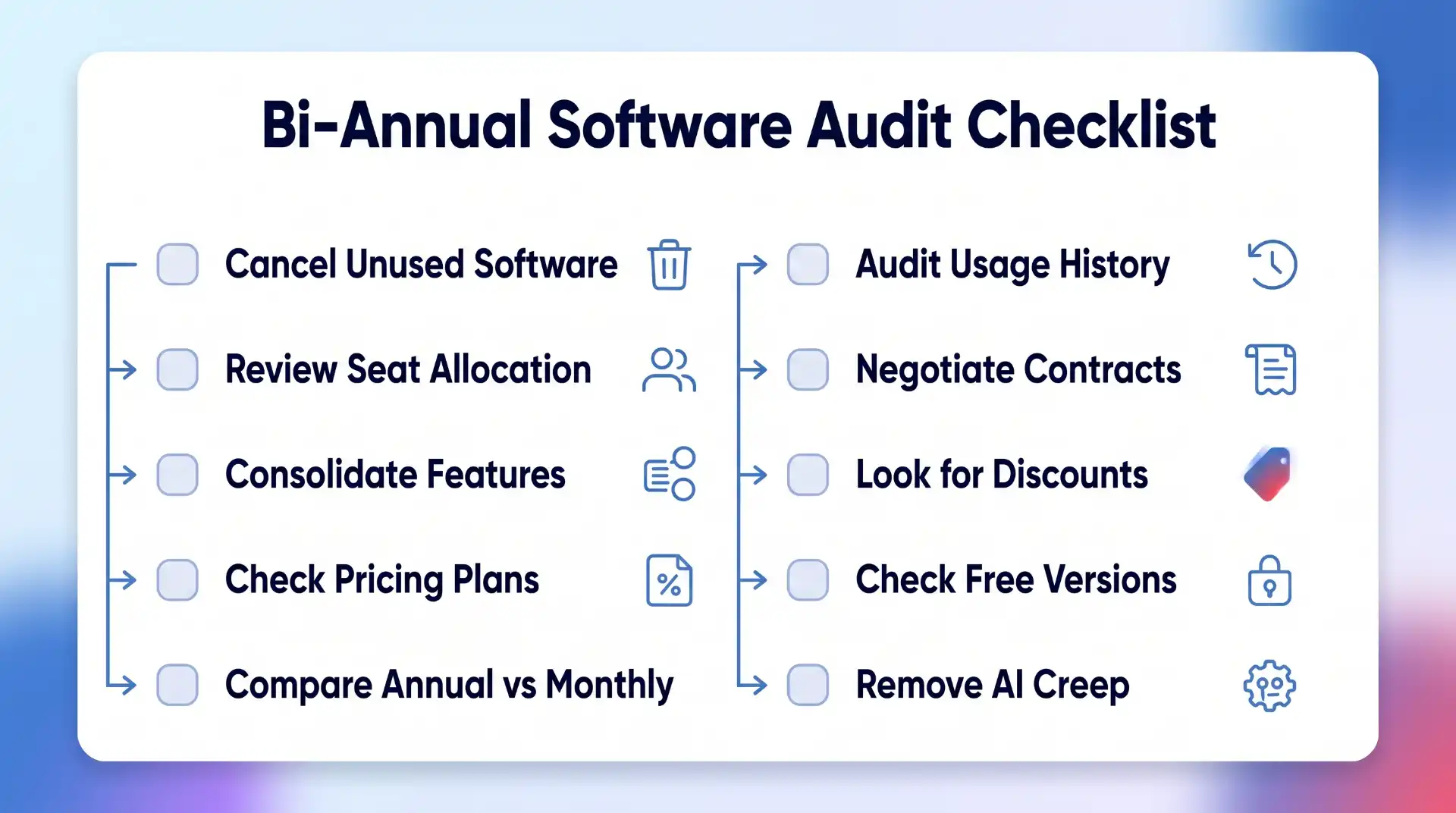
Put a recurring review in your calendar every six months.
During the review:
Cancel unused software
Remove inactive users
Check for duplicate functionality
Compare pricing tiers
Review expensive renewals
Check annual versus monthly pricing
Evaluate new alternatives
Remove unnecessary AI subscriptions
Check available discounts and cashback
Update renewal dates
For a business with a large technology stack, quarterly reviews may make more sense.
The process does not need to become bureaucratic.
Advertisement
You are simply asking whether each recurring payment still deserves to recur.
The Goal Is Better Value, Not Fewer Subscriptions
There is nothing inherently wrong with paying for a lot of software.
A developer may need several professional tools. A marketer might rely on paid SEO, analytics, design and email platforms. A business may run almost entirely on cloud applications.
Those subscriptions can be excellent investments.
Advertisement
The waste appears when software remains on the bill after it stops providing enough value.
So do not judge your software stack by how short you can make it.
Judge it by how much useful work you get for what you spend.
Keep the tools that save time, protect your data or help you earn money. Cancel the ones you forgot about. Consolidate genuine overlap. Use annual pricing where commitment makes sense. Compare competitors before major renewals. Check discounts and cashback before paying full price.
Advertisement
Software subscriptions are unlikely to disappear.
That makes learning how to manage them properly increasingly important.
A few small changes across several recurring subscriptions can produce meaningful annual savings, without giving up any of the technology you actually rely on.
Quick Share is a useful tool for flipping files between Android smart phones in a fuss-free wireless manner. [unrealJune] has now implemented the feature on Kindle devices.
You’ll need a jailbroken Kindle to use this, which is running the Kindle Unified Application Launcher and KOReader as well. You’ll also want SSH access, and a machine that has Go and Docker for you to build the project. [unrealJune] steps through the steps to compile and install the Quick Share plugin to KOReader, as well as explaining how it works. Notably, it’s receive only—so you can spit files onto the Kindle, but you can’t send them from the Kindle to other devices. The Kindle will also automatically accept files, which is worth noting if you’re security conscious. If there’s no network, the Kindle is also able to appear as its own AP if needed.
Think of this as a nifty convenience if you find yourself regularly trying to truck files on to your jailbroken Kindle. It’s also a neat to see a Quick Share implementation from the open source world. Between-device sharing still sucks, as we’ve discussed before, but there are at least attempts being made to make it better. That’s something!
Produced by Nick Matzke of Bayview Audio, “Beyond the Room” has been created to showcase the movement, dynamics, impact, and scale of high-performance home cinema systems.
“Beyond the Room” pays homage to a part of CEDIA many in the industry remember: discovering new demo material at the show, taking it back to the showroom, and having something exciting to put in front of customers. “Beyond the Room” brings that tradition back, reimagined for a new generation of listeners to discover the excitement of the classic demo disc.
As part of the Paragons of Home Cinema – Episode II 9.4.6 Channel System CEDIA Sound Room 7 experience, attendees will hear a special edition of “Beyond the Room” to open the Paragons demo. From there, the Paragons presentation will continue with a curated selection of additional clips chosen to showcase the very best in audio and video performance from NextLevel speakers, NextLevel Acoustics, and components by Lumagen, Christie, Storm Audio, Stewart Filmscreen, SpeakerPower, Simplified Acoustics, and Cinemotion Posters.
Advertisement
Why “Beyond The Room” Was Created
Rather than relying on typical regurgitated movie clips, “Beyond the Room” was created as dedicated demonstration content, with movement around and above the listener, powerful low-frequency moments, and precise placement of effects and large-scale transitions designed to make the room disappear.
“One of the things we always loved about CEDIA was finding a great new demo and bringing it back to share with friends, family, and customers,“ said Lee Weber, Co-Owner of NextLevel Acoustics. “That was the inspiration behind “Beyond the Room”. We wanted to create something people would be excited to experience at the show—and just as excited to bring home and play in their own theaters.“
In addition to the Paragons of Home Cinema Episode II demo in Sound Room 7, Beyond the Room” will also be featured at CEDIA Expo Booth 1346.
NextLevel Acoustics “Beyond The Room” FAQs
What is Beyond The Room?
Advertisement
Beyond the Room is an original 90-second demo created by NextLevel Acoustics as a modern tribute to the demo discs once handed out at shows like CEDIA. It has been designed as a fun, impactful way for dealers, calibrators, and enthusiasts to show off, demonstrate, and enjoy their surround sound systems.
How is Beyond The Room related to the Paragons of Home Cinema – Episode II demo in Sound Room SR7 at the 2026 CEDIA Expo?
In addition to providing all of the loudspeakers being featured in SR7, NextLevel Acoustics has created a special 1-minute, 47-second Paragons of Home Cinema – Episode II-branded edition of “Beyond the Room” that will serve as the opening segment of the SR7 presentation. Once the introductory clip concludes, the SR7 demo will continue with a curated selection of movie clips via Kaleidescape.
Advertisement. Scroll to continue reading.
Advertisement
When and where can I get “Beyond the Room” for dealer, calibrator, and home theater enthusiast use?
“Beyond The Room” will be available beginning September 2nd via the NextLevel Acoustics website, QR codes distributed at CEDIA for downloadable copies, and a limited number of physical copies (USB Drives) available at Booth 1346. Additional special editions and alternate versions are forthcoming. “Beyond The Room” will be available in the MP4 and MKV video formats.
Bottom Line
One of the great things about attending Audio and AV Tradehows, such as CEDIA, is taking in all the great demos that show off the latest and greatest speakers and components. However, after all the excitement dies down, many times all we have are memories of what we saw and heard.
In the past, one of the things that attendees and press always looked forward to was getting their hands on DTS, Dolby, THX, and other demo discs that they could use to test and show off the latest gear at dealers and at home.
Advertisement
The most popular test and demo discs available these days for testing and showing off gear are from Spears and Munsil and Trinnov. For 2026, Next Level Acoustics is joining in with a demo that takes users “Beyond The Room,” putting your speakers and components to the test in a home theater environment.
We won’t know the specific nature of the original audio demo clips that NextLevel that “Beyond The Room” will provide until its debut and availability begins on Sept 2nd, 2026.
China holds more than 97pc of the burgeoning humanoid robotics market despite lacking big budget VC attention.
Investors rushed to back China’s first publicly listed humanoid maker Unitree Robotics, sending the company’s share price surging by 460pc in its Shanghai trading debut today (19 August) after it raised $904m in its initial public offering (IPO).
At the peak of the spike, Unitree’s shares rose by nearly 630pc of their IPO price of 150.80 yuan – or roughly $22 – to 1,100 yuan. That figure is now down to 845 yuan.
The company said it plans to invest roughly 4.2bn yuan ($620m) from the IPO proceeds into research, innovation and development projects, and a robot manufacturing base.
Advertisement
Around 20pc of the company’s offering was allocated to select private investors, including Chinese AI research lab DeepSeek and state-owned enterprises including China National Petroleum and China Telecom.
DeepSeek has invested $20.8m in Unitree in exchange for 2.31pc of its shares. The companies have agreed to jointly develop AI models for humanoid machines.
Unitree’s prospectus showed revenue rose to 1.7bn yuan in 2025 from 392.77m yuan in 2024, with humanoid robot shipments exceeding 5,500 units in 2025.
Unitree’s listing comes amid China’s continued dominance over global humanoid robotics, with recent reports suggesting that the country alone holds more than 97pc of the burgeoning market, while also representing more than 85pc of global demand. The sector is expected to grow from nearly $5.5bn this year to more than $50bn by 2035.
Advertisement
Shanghai-based Agibot recently overtook Unitree to become the world’s largest humanoid robot vendor, capturing 44pc of the global market. Together, the two vendors account for 75pc of humanoid robot sales across the world. Behind the two leaders are Beijing-based Galbot, Shenzhen’s Ubtech and Guangdong-based Leju.
Growing advancements in physical AI are helping prove humanoids’ place in industrial settings, as global sales surged 272pc in a year, with shipments growing 14,000 units in the first half of 2026.
Venture capital funding into physical AI – the same technology behind robotaxis, drones, sensors and other industrial automation capabilities – reportedly surged fourfold in the first half of this year, compared to the six months beforehand, totalling more than $47bn across 521 deals.
Combined funding in this space between 2022 and 2024 amounted to $41.9bn, highlighting investor belief in the industry’s maturity.
Advertisement
Major VC investments in this space this year included Waymo’s $16bn Series D, defence company Anduril Industries’ $5bn raise, Germany’s Neura Robotics’ $1.4bn Series C and the UK’s Wayve securing $1.26bn.
AI2 Robotics, a Shenzhen-based start-up building wheeled humanoid robots with five-fingered hands, raised roughly $881m.
China’s humanoid advantage comes as a result of its vast network of component manufacturers and production capacity. Along with government support, this network is able to quickly develop and implement newer technologies with the economies of scale.
JP Morgan data finds that a typical humanoid robot’s materials cost roughly $46,000 in China versus $131,000 in the US. China also produces about 70pc of the global supply of actuators, a key component type in humanoids that can account for up to 50pc of a unit’s total cost.
Advertisement
Don’t miss out on the knowledge you need to succeed. Sign up for the Daily Brief, Silicon Republic’s digest of need-to-know sci-tech news.
Google is making Pixel Screenshots more useful with a new update that adds date, collection and app filters. These changes give Pixel users more control over a growing screenshot library, making it easier to find specific images without relying solely on text search.
The update arrives alongside the Pixel 11 series and expands the existing “Filter screenshots” menu. Previously, the menu was limited to tags such as Places, Articles, Events, Notes, Receipts and Tracking info.
With version 1.26.281.05, users can now filter screenshots by date range, with options covering the past 24 hours, seven days, 30 days, six months and one year. There’s also a Custom option that lets you specify a particular period when the preset ranges aren’t enough.
Google has also added Collections as a filter. Rather than opening collections individually, you can now use them to narrow down the screenshots shown in the main feed. The same filtering options are available within Collections, too.
Advertisement
The third addition is Sources, which lets you filter screenshots by the application they came from. Pixel Screenshots already records the source app and displays it in the bottom-right corner of each screenshot. Therefore, this update essentially makes that information more useful when searching through your library.
Advertisement
Together, the new filters should make it much easier to work through a large collection of screenshots. They also complement the app’s existing text search. This gives you another way to narrow down results when you know roughly when a screenshot was taken or which app it came from.
There aren’t any other major changes in this update. The previous Pixel Screenshots update, released in June, added cloud-based Private AI Compute for processing. It also introduced a “Use mobile data when processing” toggle in Settings.
Advertisement
Google is rolling out version 1.26.281.05 through the Play Store, and the update is already live on Pixel 10 devices.
Broadcom’s VCF-or-nothing licenses are coming to Azure
Microsoft has signalled it will end one of the last remaining ways to acquire VMware products outside of a big bundle.
Redmond’s main offer for Virtzillains is the Azure VMware Solution (AVS), a cloudy affair that includes vCenter, vSAN, vSphere, and NSX and licenses for them all – but not the Software-Defined Datacenter Manager tool that Broadcom uses to package its wares into a centrally-manageable hybrid cloud in its flagship Cloud Foundation (VCF) suite.
Advertisement
Since acquiring VMware, Broadcom has gone all-in on VCF and no longer sells a standalone low-end server virtualization product. The Register understands the VMware channel and sales team almost never sell licenses for vSphere Foundation, a bundle that’s useful on the edge or branch office, unless it’s part of a bigger deal that includes VCF.
Services like AVS therefore represent an alternative for orgs that want to keep using VMware, but don’t want to jump to VCF.
Broadcom isn’t keen on licensing anything other than the entire VCF bundle and made that plain with licensing changes that mean its hyperscale partners are not allowed to sell VMware licenses. The code-and-chips shop therefore requires customers to bring their own VCF licenses to any cloudy VMware service.
Microsoft this week announced that it will therefore retire the license-included version of AVS, and that customers who use the service will need to acquire a VCF license and move to a different Azure arrangement by August 30, 2027.
Advertisement
The Windows giant said it will stop selling license-included AVS from October 31, 2026 and warned users to start planning a move because their current rigs won’t work in the future.
“Allow plenty of time to purchase VCF licenses from Broadcom and complete the transition to AVS VCF BYOL,” the company advises. “For customers evaluating modernization opportunities, start assessing current AVS environments immediately, and develop a transition roadmap to ensure you have ample time to exit AVS and avoid service disruption on August 31, 2027.”
Broadcom announced the requirement for BYOL licensing late last year, and other hyperscalers have already adopted it, so VCS users should have had an inkling that change was coming.
For some, this will not be their first recent VMware migration, as Broadcom has twice made changes that meant smaller cloud providers had to discontinue service, making a move to an alternative provider or platform necessary.
Advertisement
Broadcom doesn’t mind much if smaller VMware customers move to another server virtualization vendor: it unashamedly focuses on larger customers it thinks will get the most benefit from VCF and points to most of its target customers acquiring the suite, and increased VMware revenue, as evidence its strategy is working. ®




























































You must be logged in to post a comment Login