

Crypto World
Coinbase Q1 2026 Revenue Falls 31% to $1.41 Billion in Major Wall Street Miss

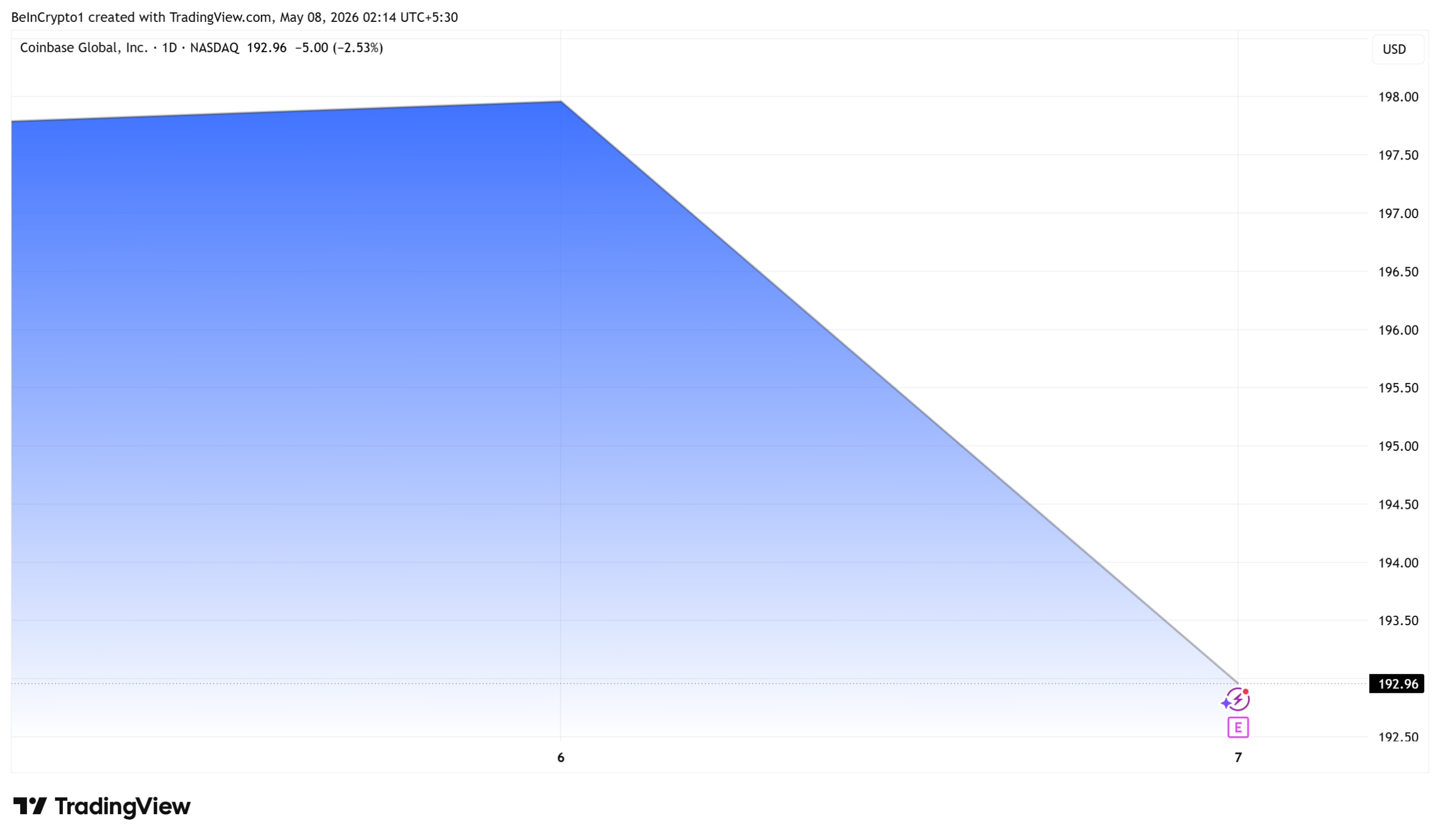
Coinbase (COIN) posted first-quarter 2026 revenue of $1.41 billion, missing Wall Street estimates as crypto trading volumes contracted. Revenue fell 31% year-over-year, and the exchange recorded a $394.1 million net loss, or $1.49 per share.
Transaction revenue of $755.8 million and subscription and services revenue of $583.5 million both came in below sell-side projections. Total crypto market capitalization fell more than 20% during the quarter, weighing on retail order flow.
Trading Slump Drives Coinbase Q1 Loss
Transaction revenue dropped 23% quarter-over-quarter, slightly outperforming the 28% decline in industrywide crypto trading volume. Spot trading on the platform fell 37% as Bitcoin and Ether prices retraced through the quarter.
Consumer transaction revenue came in at $567 million, while institutional transaction revenue fell 27% to $136 million.
The company recorded a $482.4 million unrealized loss on crypto held for investment. Peer holders such as MicroStrategy posted larger markdowns, with a $12.5 billion Q1 loss tied to its bitcoin treasury.

Coinbase’s COIN stock tumbled following the news, falling to $192.96 as of this writing.
Still, Coinbase reported a 13th consecutive quarter of positive adjusted EBITDA at $303.3 million, though the figure declined 46% sequentially.
Crypto trading market share reached an all-time high of 8.6% in the quarter.
Subscription Business Cushions the Blow
Subscription and services revenue accounted for 44% of net revenue, a record mix. The company has positioned the segment as a buffer against trading volatility. Stablecoin revenue contributed $305 million as USDC reached $80 billion in market cap.
Average USDC held in Coinbase products hit $19 billion, up 55% year-over-year, supporting stablecoin economics.
Management guided second-quarter subscription and services revenue between $565 million and $645 million.
The outlook also includes $50 million to $60 million in restructuring charges tied to a 14% workforce reduction.
The headline miss highlights how dependent Coinbase remains on crypto market activity, even as recurring revenue grows.
The post Coinbase Q1 2026 Revenue Falls 31% to $1.41 Billion in Major Wall Street Miss appeared first on BeInCrypto.


Bitcoin’s December 25 options expiry brings roughly $6 billion in open interest into focus, according to Deribit data. The picture that emerges is less about a single megabull thesis and more about hedging and neutral positioning that could shape price action as expiry nears. Traders appear to be leaning on sophisticated strategies that cushion against downside risk or lock in gains without requiring a dramatic daily move in BTC.
The backdrop includes a 33% rally off a February low near $60,130, which has revived bullish sentiment to some degree. Yet a substantial chunk of the options book is structured to function as protection or neutral bets, rather than as outright bets on a fresh, multi-month rally. Deribit dominates this market, accounting for about 92% of December’s BTC options open interest, with the caveat that the eventual payout at expiry will depend on the actual price path BTC traces on Dec. 25.
In this environment, the distribution of bets across strikes reveals a nuanced mix of optimism and caution. The market shows a heavy concentration of upside exposure at very high strikes, while sizeable protection at lower levels reflects ongoing nerve about downside risk. With that context, investors should watch how these positions translate into real-world liquidity and potential spillovers if BTC traverses key thresholds in the final days of the year.
Key takeaways
- About half of the $6 billion December BTC options open interest is tied to hedging or neutral strategies rather than directional bets on a decisive rally.
- Calls targeting extreme upside—specifically $115,000 and above—compose roughly $1.85 billion of open interest, highlighting a notable tilt toward upside scenarios, even if many of these are hedges rather than pure speculation.
- Puts at lower levels—around $55,000 and below—total near $1 billion, indicating substantial downside protection alongside the bullish tilt.
- Put options trade at a roughly 9% premium to equivalent calls, signaling modest fear of downside despite the rally’s progress; a single Dec. 25, $120k call costs about $2,202 to buy, offering leveraged upside exposure without requiring a large move from current levels.
Hedging-centric positioning dominates the December expiry
Deribit’s data shows that the December expiry is skewed toward strategies that do not depend on a dramatic price breakout. The lion’s share of open interest sits in hedges and neutral plays, as traders seek to protect gains or secure profits in a range-bound scenario. While a rally to new highs is not out of the question, the structure of the book implies that many participants are prepared for a more modest move and want to manage risk in a volatile environment.
Industry observers note that large derivatives books often grow in hedges and neutral hedges ahead of major option expiries, as participants use gamma, vega, and other Greeks to balance risk across a spectrum of potential outcomes. In this case, the sheer size of the hedged leg indicates a market that is mindful of downside risk even as price recovery has resumed in recent months.
Extreme-strike bets reveal a split in sentiment between fear and optimism
Across strike layers, the options distribution is telling. The $115,000-and-above calls account for about $1.85 billion of open interest, underscoring demand for upside leverage even as they are often part of hedging or complex price-mivoting schemes rather than straightforward long bets. In parallel, about $1 billion of open interest sits in puts at $55,000 and lower, reflecting risk controls and tail-risk hedging that persist despite BTC’s higher ground.
Crucially, the market appears to exhibit roughly equal weight of bets on “unlikely” downside and upside events, with both sides comprising around half of the overall open interest in their respective extreme segments. That balance suggests a market that remains mindful of outsized moves in either direction, rather than committing wholesale to a single directional narrative. For context, commenters have argued that even when the price advances appear compelling, the options market can stay skeptical about the permanence of such moves; see ongoing analyses of how far the rally can run alongside entrenched hedges.
Pricing signals and what traders are paying for exposure
The options market’s pricing signals reinforce a cautious but not pessimistic outlook. The 9% premium on put options relative to equivalent calls indicates a modest appetite for protection against a potential pullback, rather than a fear-driven rush to sell. In neutral conditions, the put-call skew typically sits within a narrow band; current metrics suggest investors are comfortable with upside but remain wary of a swift reversal that could catch bullish participants off guard.
One concrete data point: a Dec. 25, $120,000 call is priced to cost around $2,202, granting “unlimited” upside exposure relative to that strike at expiry. These structures exemplify how traders use high-strike calls to participate in outsized upside without committing to heavy upfront bets on BTC crossing multiple substantial resistance levels. The combination of high-strike calls and downside protection paints a picture of a market cautiously positioning for both tail-risk and potential upside, rather than a one-way bet on a sustained rally.
Observers also note that derivatives data from Laevitas and other analytics providers show the same general dynamic: a relatively flat six-month delta skew in certain regimes, punctuated by pockets of time-sensitive optimism around the $80,000 region, even as the market remains wary of a sustained breakout. For readers following the broader narrative, this nuance aligns with prior commentary that even as price recovers, the market’s appetite for risk remains tempered by a desire to maintain optionality without overcommitting capital. See related market analyses that discuss whether a final move to or beyond five-figure levels is sustainable in the near term.
As traders gaze toward Dec. 25, many will be watching not just BTC’s price, but how these hedges behave as expiry nears. The balance between protective positions and upside-capitalizing bets will influence liquidity, implied volatility, and potential gamma-driven moves on the last trading days of the year. The recent rally has rekindled bullish chatter, but the options book tells a parallel story of caution and risk management shaping the near-term outlook. For ongoing context, readers can refer to prior analyses on whether the rally can sustain under current derivatives dynamics.
This analysis draws upon Deribit’s December open interest breakdown and related derivatives metrics, with additional context from market analytics providers tracking skew and delta. It is intended to illuminate how a large, hedged options book can coexist with a bullish price trajectory, and what that means for traders, investors, and builders navigating a volatile end to the year.
Readers should monitor how BTC behaves as the expiry approaches. If price action remains within a mid- to high-range band, many hedges could simply yield minimal P&L changes, while a breakout in either direction could trigger rapid adjustments in the remaining open positions. The unfolding dynamics will help determine whether this expiry marks a pause in volatility or a prelude to a more decisive move in 2022–2023-like cycles.

Digital asset funds posted $117.8 million in inflows, continuing a five-week streak, though this was the smallest weekly gain in that period. The overall number indicated a late recovery.
Earlier in the week, from Monday through Thursday, the market saw $619 million in outflows over four consecutive days. A sharp reversal came on Friday, as $737 million entered in a single day, which managed to turn the weekly balance positive.
Friday Saves the Week
CoinShares stated that this is one of the largest daily inflows recorded in 2026, “likely reflecting a sharp improvement in risk appetite.” Meanwhile, total assets under management held steady at $155 billion.
Investment products tied to Bitcoin attracted over $192 million in the past week, bringing its total for the year to $4.2 billion. The figure is still below recent weekly averages of close to $1 billion.
A small group of investors still expect BTC to decline as Short Bitcoin products raked in $6 million in inflows. Multi-asset products brought in $3.6 million, while XRP recorded $3 million during the same period. Ethereum, on the other hand, saw $81.6 million exit, as it snapped a three-week streak of gains above $190 million. Solana also followed suit with over $11 million in outflows.
In its latest Digital Asset Fund Flows Weekly Report, CoinShares said,
“The narrowing in participation from nine assets to four this week is the clearest signal that sentiment softened through the working week before recovering on Friday.”
The US brought in $47.5 million, far lower than the $1.1 billion seen a week earlier amid a slowdown in the week. In contrast, Germany amassed $43.8 million, while Canada added $16 million, indicating steadier demand. Elsewhere, Switzerland and Australia recorded smaller inflows of $5.2 million and $4 million.
Choppy Trading Sessions Ahead?
Bitcoin has entered May on a strong note, after breaking above $80,000 for the first time since January 31. In a recent note to investors, Singapore-based QCP Capital observed that Bitcoin’s correlation with US stocks is rising back toward 2023 levels, in what appears to be a renewed link with broader risk assets.
Interestingly, BTC’s rally came even as Strategy paused its purchases, which can indicate “the market may be drawing strength from a wider base of support beyond that single narrative.” Institutional demand also remains steady. However, QCP noted that holding above the $82,000 to $83,000 range is important for continuation.
Implied volatility is near yearly lows, while the VIX is around 17, which essentially means that markets are largely looking past geopolitical risks. Despite this, the situation remains “fluid.” Upcoming labor data and earnings from Strategy, Coinbase, and Block could lead to choppiness over the coming sessions.
The post How $619M Midweek Bleed Was Erased by Massive One-Day Crypto Inflow appeared first on CryptoPotato.

Bitcoin (BTC) is currently on a roll, surging past the $80,000 mark and touching base above $81,000. While this rally could be a reason for positive sentiment, market experts believe otherwise.
In a weekly report from the crypto exchange Bitfinex, analysts warned that bitcoin’s rally to $80,000 is misleading because the market is not positioned for upside movement. According to the analysts, BTC is currently stuck between bulls and bears, conviction and caution. Considering market conditions, the leading digital asset is likely to lean toward the negative rather than the positive.
A Misleading Rally
To substantiate their claims, the Bitfinex analysts highlighted an improving but uneven demand wave. Based on historical data, BTC rallies have been sustained by strong demand, but that is not the case this time.
Underlying demand is improving with steady inflows from spot exchange-traded funds (ETFs) and continued accumulation from institutions like Strategy. However, the demand is not strong enough to absorb the overhead supply and confirm a sustained breakout. In fact, BTC is in a fragile yet constructive range, with short-term holders taking profits as they exit positions near breakeven.
“This behavior is a textbook pattern in bear markets: whenever the price approaches the breakeven level of the most price-sensitive cohort, the incentive to exit positions overwhelms incoming demand, exhausting upside momentum,” analysts stated.
Bitcoin requires heavy spot-led demand to sustain a rally. However, with a divided macro environment, no clear liquidity tailwind, and ongoing geopolitical risk in the Middle East, that may seem unlikely in the short term.
BTC Bias Tilts Toward Downward Pressure
Furthermore, bitcoin’s ongoing breakout stalled at the $78,000-$79,000 resistance zone, not because of aggressive selling but due to profit-taking by short-term holders. This zone is dense and defined by metrics like the True Market Mean, the Short-Term Holder Realized Price, and the weekly open. These indicators also double as support and resistance levels.
With the resistance confirming overhead challenges, Bitfinex believes the bias tilts toward further downward pressure. At the same time, analysts see the potential for a breakout from current resistance levels as ETF inflows and institutional accumulation continue.
A failure to reclaim and hold above the current resistance levels will keep the low $70,000s as the next key support zone, sustaining a downward momentum for BTC.
The post Bitcoin Market Not Positioned for Upside Despite Rally Above $80K, Says Bitfinex appeared first on CryptoPotato.


The largest DeFi protocol on Kraken’s Ink Layer 2 network is onboarding Chainlink and RedStone feeds before resuming its lending markets.
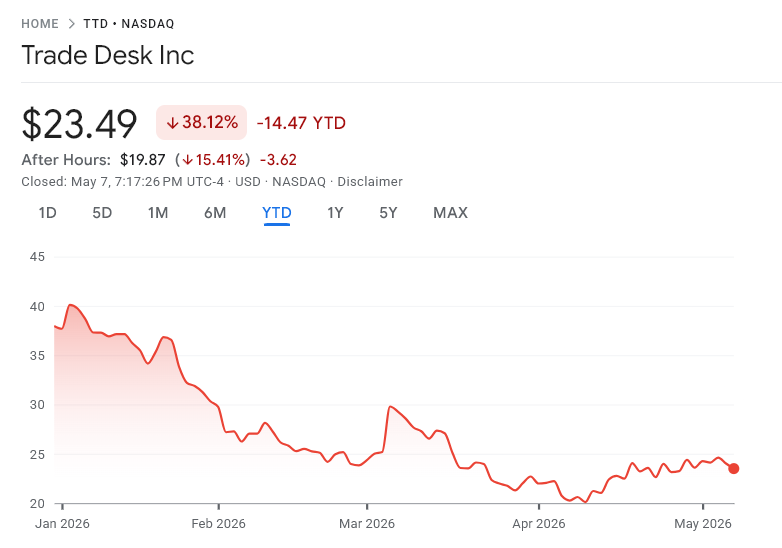
The Trade Desk’s stock collapsed again today after investors reacted badly to its latest earnings report and weak revenue guidance.
The adtech company reported first-quarter revenue of $689 million, up 12% year over year. That still showed growth, but it was not enough for a company once valued like one of the strongest winners in digital advertising.

The sharper problem was profit and guidance. Adjusted earnings per share came in at $0.28, below analyst expectations of about $0.32.
The company also guided for at least $750 million in second-quarter revenue, below market expectations.
That guidance suggested growth could slow to around 8% in the next quarter. For a company that once traded on a high-growth software valuation, that was a serious warning sign.
How a $3 Billion Corporate Giant Got Erased from the US Stock Market
The Trade Desk is not a small or obscure business. It is one of the most important companies in programmatic advertising.
Brands and agencies use its platform to buy digital ads across websites, streaming TV, mobile apps, audio, and other digital channels.
Its platform helps advertisers decide where to place ads, what audiences to target, how much to bid, and how to measure performance. In simple terms, it is software for buying ads across the open internet.
Its annual revenue reached about $2.9 billion in 2025, making it a large and highly profitable player in digital advertising.
However, Wall Street has started treating the company very differently.
The main issue is growth. The Trade Desk’s revenue increased 25% year over year in Q1 2025. In Q1 2026, growth slowed to 12%. Its Q2 guidance points to an even weaker pace.
Competition has also become a bigger concern. Amazon is now a direct threat to connected TV advertising. It has Prime Video, deep retail data, and its own advertising platform.
That creates pressure in one of The Trade Desk’s most important growth markets.
Advertisers are increasingly looking at platforms that combine media inventory, shopping data, and measurement inside one ecosystem.
Investors are no longer asking how big The Trade Desk can become. They are asking whether it can defend its growth against Amazon, agency pressure, weaker ad spending, and a more demanding market.
The post The Trade Desk Stock Collapses 40% YTD, Wall Street Loses Faith appeared first on BeInCrypto.


As many as 20 financial institutions and large tech companies are in a queue to issue their own stablecoins with Anchorage Digital, the U.S.-regulated cryptocurrency custody firm’s CEO Nathan McCauley said at Consensus Miami 2026 on Thursday.
“Since the Genius Act passed, Anchorage has won every single large stablecoin issuance mandate across the landscape,” McCauley said. “We have really a dozen to maybe even as many as 20 institutional issuers or large tech company issuers who are going to come in and issue their stablecoin with us.”
“The kind of inbounds we see are banks that want to achieve a very specific objective, stablecoin issuers who are saying, ‘Hey, I’ve got a distribution channel where I can put my stablecoin to good use,’” he added.
Anchorage was the U.S’ first federally chartered crypto bank, so it’s not surprising the firm is now reaping the benefits of an incipient regulatory framework in the States.
In order to better meet that demand, Anchorage, last month, announced a partnership with M0, a technology provider that allows global institutions to mint fully configurable stablecoins, which also works with the likes of Stripe, Moonpay and MetaMask.
Another significant announcement for Anchorage was AI-based “Agentic Banking,” a way for AI agents to transact and manage funds, in partnering with Google Cloud infrastructure.
McCauley described agentic commerce as “an entire reimagining of the landscape.”
“We’ve got that happening with AI agents, and at the same time we are seeing a fundamental replatforming of money itself via stable coins and digital assets. We’re here at this conference, and it’s the main thing we’re talking about. But I still think it’s vastly underestimated.”

Zug, Switzerland, May 7, 2026 – After years of research, engineering, and community collaboration, Panther Protocol Foundation announced that Panther Protocol is now live on Polygon.
The deployment introduces what the team describes as “programmable privacy” for decentralized finance — infrastructure designed to enable confidential on-chain interactions while supporting verifiable compliance when required.
The Panther interface is accessible at: https://pantherdao.app.
A new phase for privacy in DeFi

Panther combines zero-knowledge cryptography, non-custodial architecture, and DAO governance to support privacy-preserving interactions within decentralized environments.
Users interact directly with smart contracts while retaining full control of their assets, with cryptographic proofs generated locally in their own browser or device.
Compliance without surveillance
The initial deployment includes a compliance-enabled zone powered by credentials issued by independent providers such as AMLBot via PureFi tooling.
Participants present zero-knowledge attestations on-chain, allowing the protocol to verify eligibility without exposing personal data or transferring identity information to the DAO or protocol infrastructure.
According to the team, the model is designed to support privacy-preserving compliance workflows that may be compatible with institutional participation.
Integration with existing DeFi liquidity
The system is designed to integrate with existing decentralized liquidity sources, enabling confidential interactions without isolating users from broader DeFi markets.
Panther Reward Points (PRPs)
The network introduces Panther Reward Points (PRPs), a participation-based mechanism that recognizes protocol activity.
Users accrue PRPs through actions such as interacting with privacy-enabled zones and other qualifying protocol interactions, according to rules defined by Panther DAO governance.
According to the project, PRPs are intended to support long-term ecosystem participation as Panther expands across additional chains and integrations.
Built for the long term
Panther’s architecture includes Forensic Data Escrow, enabling governed disclosure of encrypted metadata under defined conditions, alongside a roadmap that includes:
- Multi-chain expansion
- Additional integrations and adapters
- New zones and participation models
A grant approved by Panther DAO will support open-source development work intended to enable a potential future community deployment on Base.
About Panther Protocol Foundation
Panther Protocol Foundation is a non-profit organization that supports the ecosystem through research funding, open-source development grants, and ecosystem initiatives.
The Foundation does not operate the protocol, deploy smart contracts, host interfaces, custody assets, or provide financial or digital asset services.
For more information, visit www.panther.org.
To learn more about Panther Protocol, visit www.pantherprotocol.io.
Media contact:
- Joris Koopman
- Marketing and Ecosystem Lead at Panther Protocol Foundation
- joris@panther.org
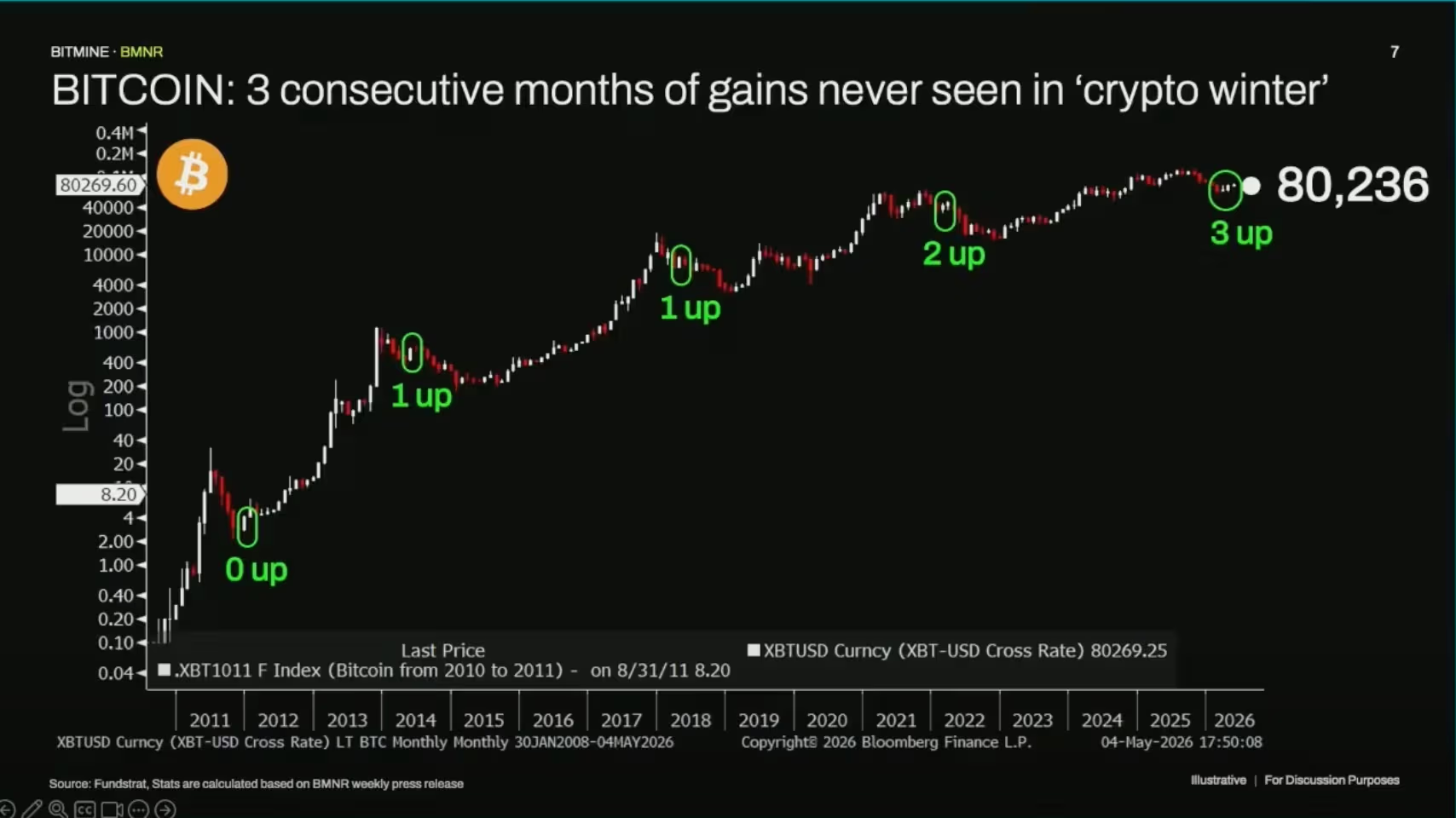
The crypto bear market is likely over, arguing that a fresh cycle driven by tokenization and artificial intelligence-powered financial services is beginning to take shape, said Tom Lee, chairman of Bitmine (BMNR) and co-founder of Fundstrat.
Speaking at Consensus 2026 in Miami on Thursday, Lee pointed to bitcoin’s recent strength as a historical signal that the market leaving behind the downtrend that saw prices crater from $126,000 in October to $60,000 in February.
After positive monthly returns in March and April, BTC is up another roughly 5% in May so far, which would be the third consecutive positive monthly return.
“You have never in a bear market if bitcoin closes up three consecutive months,” Lee said. “If bitcoin closes above $76,000 this month, the bear market is definitively over.”

The CoinDesk Bitcoin Price Index closed April at $76,300, while the asset is currently trading just below $80,000.
Lee said investors remain psychologically anchored to the last crypto downturn and are underestimating the strength of the current rebound. He also pointed to bullish technical signals from veteran trader John Bollinger, who recently said his trend models had turned positive on bitcoin.
Adding to the bullish narrative, Lee noted that software stocks — a sector that was battered amid concerns of AI disrupting its business model and Fundstrat recently upgraded — have historically traded in close correlation with bitcoin. Since tensions escalated between the U.S. and Iran, Lee added, crypto assets have outperformed most traditional markets, with ether (ETH) leading gains.
Tokenization and AI agents driving next cycle
Fueling the next bull market in crypto are two megatrends that are disrupting finance: all assets migrating onchain called tokenization and artificial intelligence (AI) agents using blockchain rails.
Lee argued that AI agents are going to need money to move value autonomously, and for that they will increasingly rely on blockchain networks and tokenized financial systems.
He pointed to stablecoin adoption as evidence the transition is already underway. Stablecoin transaction volumes have already surpassed Visa payments, he said, while he pointed to Grayscale’s report that the $300 trillion securities market will eventually migrate to blockchain rails as tokenized assets.
“The networks that host a large share of tokenized activity are going to capture the economic value,” Lee said.
That shift could radically reshape the economics of finance itself, he argued. Lee compared JPMorgan — projected to earn roughly $60 billion this year with 300,000 employees — to firms like stablecoin issuer Tether and trading giant Jane Street, which generate similar profit levels with just a fraction of the workforce.

“Native digital companies using blockchain as settlement eliminate a lot of processes and people,” he said.
In Lee’s view, crypto-native financial firms could increasingly resemble the internet companies that displaced legacy media and telecom giants over the past two decades.
“In 10 years, half of the largest financial institutions in the world will be native digital,” he said.
UPDATE (May 7, 17:01 UTC): Adds presentation slides cited by Tom Lee during his Consensus 2026 keynote.
Crypto World
Crypto Polo Cup returns for its fourth edition in Palm Beach during Consensus Miami week

Palm Beach, Florida, May 7, 2026 – Hosted by Luna PR, the fourth edition of the Crypto Polo Cup (CPC) will take place on May 9, 2026, at the Santa Clara Polo Club, alongside Consensus Miami. The invite-only event will bring together institutional leaders, founders, and investors across the digital asset and financial sectors.
Since its debut in Palm Beach in 2022, Crypto Polo Cup has established itself as a premier gathering the intersections of digital assets, finance, and culture. Now in its fourth year, the 2026 edition will welcome more than 500 guests for a day blending sport, entertainment, and high-caliber networking.

“The Crypto Polo Cup has grown into a global meeting point for leaders across industries, creating a space where meaningful relationships are formed, strategic conversations happen, and real collaboration takes shape,” said Nikita Sachdev, Founder and CEO of Luna PR. “We are proud to bring CPC back to Florida, where it first began, and to welcome our global community during Consensus Miami week.”
The event will feature two professional polo matches, offering a distinctive setting for meaningful conversations and high-value connections. Alongside the match, guests will have the opportunity to connect with senior leaders across the financial sectors in a more intimate environment.
This year’s edition is supported by a select group of partners whose involvement reflects the continued industry backing behind CPC including TEXITcoin, Binance, Naoris, AMINA, Solana Company, CakeWallet, Unicoin, Quantum, CoinRoutes, and Sailo Tech.
This year’s ambassador lineup spans across government, global exchange leadership, venture capital, media and digital asset innovation, reflecting the breadth of industries that CPC brings. Ambassadors include:
- Michael Carbonara, Congressional Candidate FL-22
- Rachel Conlan, Global CMO of Binance
- Yana Prikhodchenko, CEO of Cointelegraph Global
- Tess Hau, Founder of Tess Ventures
- Silvina Moschini, Founder of Unicorn Hunters
- Michael Terpin, Founder and CEO of Transform Ventures
- Matthew Jason Nordgren, Founder and Managing Partner of Arcadian Capital
- Ran Neuner, Founder of Crypto Banter
- Gary Hopkinson, Managing Director of Clear Street
- Analys Falchuk, Investor Relations Manager, OG Advisory Group.
Their participation reinforces the CPC’s position as a meeting point for leaders shaping the future of technology, finance, media, and global markets.
CPC continues to serve as a platform to major industry gatherings, offering a more informal environment for connection and collaboration. Attendance is invitation only. Limited media access is available upon request.
About Crypto Polo Cup
The Crypto Polo Cup is where the world of investment, innovation, and influence converges. Since its inception in Palm Beach, Florida, in 2022, it has become a premier invitation-only event that attracts the biggest players in venture capital, blockchain, and emerging technology. With billions in investment capital represented on and off the field, this is where deals are made, partnerships are formed, and the future of Web3 takes shape.
Powered by Luna Media Corp, a global powerhouse that houses eight companies, including Luna PR – the leading PR agency in Web3, the Crypto Polo Cup is a gathering of visionaries who are shaping the future of technology and finance.
Media contact

Institutional fund managers are quietly reawakening interest in digital assets, led by Bitcoin, as market sentiment improves and the pathway for regulated exposure broadens. CoinShares’ April 2026 Digital Asset Fund Manager Survey captures how 26 institutions, collectively managing about $1.3 trillion, are navigating a cautious entry into crypto portfolios. Allocations remain modest, hovering around 1% of assets under management, a level CoinShares describes as a typical entry sizing in a de-risking environment.
Bitcoin remains the digital asset with the most compelling growth outlook, CoinShares head of research James Butterfill wrote in the report.
Yet the picture is not uniform. The survey highlights incremental progress in exposure to core assets, with a notable tilt toward Bitcoin as the asset seen to offer the strongest upside, alongside modest improvements for Ether (ETH) and Solana (SOL) versus prior quarters. Specifically, about 32% of respondents reported already holding Bitcoin, while around 25% have exposure to Ether. The numbers signal a cautious but real shift toward established, highly liquid digital assets even as investors weigh internal governance standards and evolving regulatory guidance.
Key takeaways
- Bitcoin dominates the growth outlook among institutional participants, with 32% already invested and 1% average portfolio allocation, underscoring a measured entry approach in a maturing risk framework.
- Interest is broadening modestly to Ether, with roughly 25% of surveyed managers already holding ETH; Solana and other ecosystems show firmer but still tentative uptake.
- Overall crypto allocations remain restrained, as institutions balance potential upside against internal restrictions and ongoing regulatory uncertainty.
- Inflows into crypto investment products have been resilient, led by Bitcoin demand, signaling a stronger tilt toward regulated exposure and exchange-traded structures.
- Regulatory clarity and the continued expansion of spot Bitcoin ETFs are shaping the adoption path, even as managers pivot from legacy altcoins toward newer DeFi protocols and emerging blockchain sectors.
Rising inflows and the ETF tailwind
The upbeat tone from CoinShares aligns with broader institutional flow patterns seen in the first weeks of 2024 and beyond, as regulated vehicles gain traction. Data in recent weeks showed crypto investment products posting multiple consecutive weeks of inflows, with Bitcoin-led demand driving the trajectory. In a related momentum signal, exchange-traded products tracking digital assets attracted about $1.2 billion in inflows through April 27, marking the fourth straight week of gains and lifting total inflows in that stretch to roughly $3.9 billion.
The momentum has extended into early May, with U.S. spot Bitcoin ETFs reporting nearly $1 billion in net inflows in a single week as BTC traded back above the $80,000 level, according to SoSoValue data. This pattern reinforces a takeaway echoed by several surveys: regulated exposure is reducing operational frictions for institutions that previously faced custody and counterparty concerns.
The appetite for regulated exposure is also reflected in broader market surveys. A separate study conducted by Coinbase and EY-Parthenon found that about 73% of institutional investors plan to increase their digital asset exposure within the year, with most expecting crypto prices to move higher over the next 12 months. Taken together, these data points suggest that institutional demand for regulated crypto products is becoming more flexible and sustained as market sentiment improves and the regulatory backdrop gradually stabilizes.
From legacy altcoins toward new rails: what’s changing in allocation dynamics
One notable thread in the April survey is a shift away from “legacy” altcoins toward newer decentralized finance protocols and emerging blockchain sectors. While Bitcoin remains the anchor for growth prospects, the appetite for alternative chains is evolving. This mirrors a broader industry trend in which institutions seek exposure through regulated vehicles, yet also differentiate within the crypto ecosystem by favoring assets tied to scalable, real-world use cases or robust security and governance frameworks.
Internal constraints and regulatory ambiguity linger as the principal barriers to broader adoption. The survey underscores that even with a more constructive sentiment, institutional participants continue to navigate governance approvals, risk management policies, and compliance checks that can slow or cap how quickly and how much they allocate to digital assets. The dynamic suggests that while the market is progressing, the speed of institutional onboarding will remain contingent on policy clarity and the reliability of regulated product suites.
Regulatory momentum and the path ahead for institutions
Several factors contribute to the changing institutional calculus. The launch and expansion of spot Bitcoin ETFs have been widely cited as a turning point for institutions seeking regulated, regulated exposure without direct custody of digital assets. The ETF framework reduces friction around custody, settlement, and reporting, enabling more traditional asset allocators to participate in crypto markets with familiar risk controls.
For investors and builders, the implications are meaningful. As more regulated products gain traction and more institutions report incremental exposures, liquidity in Bitcoin and select blue-chip assets can strengthen, potentially supporting price discovery and stabilizing volatility in the near term. At the same time, the evolving regulatory landscape—particularly around custody, exchanges, and stablecoins—will influence how quickly inflows translate into long-term allocations and portfolio diversification strategies.
Looking ahead, market observers will watch several developments. In the near term, continued inflows into regulated products and any acceleration in the adoption of spot ETFs will matter for market structure and capital formation. In the medium term, the degree to which institutional desks implement risk controls, diversify into DeFi rails, and incorporate on-chain governance considerations will shape the pace and scope of institutional participation. Finally, regulatory clarity—especially around stablecoins and cross-border settlement—remains a pivotal hinge on how broadly the crypto market integrates into mainstream asset management.
In investors’ minds, Bitcoin’s role as a tested, liquid, and regulatory-friendly exposure appears to be the anchor around which broadened crypto exposure could revolve. James Butterfill’s summary underscores a pragmatic view: Bitcoin’s growth outlook remains the most compelling among digital assets, even as the market observes gradual improvements in other major holdings like Ether and Solana.
As the spring season unfolds, the question for readers is not only where allocations stand today but how quickly institutions will move from “entry sizing” to deeper, more diversified exposure. With regulated product suites expanding and sentiment turning more constructive, the coming quarters could reveal whether this uptick in professional interest translates into sustained, material changes in the crypto market’s institutional footprint.
Market-watchers should stay tuned for updates on ETF distributions, new fund launches, and any shifts in regulatory guidance that could alter banks’ and asset managers’ risk appetites. If the current trend holds, 2026 may prove to be a year when institutional participation becomes a more regular, if measured, feature of crypto market dynamics rather than a episodic surge.

Bruno Mars Ties Career-Long No. 1 Run as “I Just Might” Dominates Radio for 10th Week

Bitcoin Sets Sights on $115K by December as Data Weighs Feasibility

2026 Truist Championship Friday tee times: Round 2 groupings

Manchester United reach agreement with Casemiro over contract clause amid transfer speculation

US brings back mandatory military draft registration

Steven Gerrard disagrees with Gary Neville over ‘shock’ Chelsea and Arsenal claim | Football


-

 NewsBeat4 days ago
Channel 5 – All Creatures Great and Small series 7 new post
-

 Crypto World16 hours ago
Upbit adds B3 Korean won pair as Base token gains Korea access
-
 Tech6 days ago
Trump’s 25% EU auto tariff breaches Turnberry Agreement that also covers semiconductors and digital trade
-
 NewsBeat17 hours ago
NCP car park operator enters administration putting 340 UK sites at risk of closure
-
 Sports6 days ago
Paul Scholes issues Marcus Rashford reality check as agreement emerges over Man United star
-

 Entertainment6 days ago
Met Gala 2026 Rumored Guest List Is Turning Heads
-

 Business7 days ago
Strait of Hormuz Blockade Persists Amid US-Iran Standoff, Sending Oil Prices Soaring
-
Entertainment6 days ago
New on Prime Video in May 2026 — Full List of Movies and Shows
-

 Entertainment6 days ago
Kylie Jenner Hit With Second Lawsuit From Ex-Housekeeper
-

 Tech7 days ago
Meta ends Sama contract after Kenyan workers report seeing intimate footage from Ray-Ban smart glasses users
-

 Sports6 days ago
Cavaliers vs. Raptors Game 6 live score, updates, highlights from 2026 NBA playoffs first-round series
-
 Sports6 days ago
David Benavidez responds to team Canelo saying the fight will never happen
-
 Sports6 days ago
IPL 2026: ‘Love you darling’- Hardik Pandya’s reaction to MS Dhoni steals the show |Watch | Cricket News
-

 Entertainment6 days ago
Young and the Restless Next Week: Cane Arrested & Matt’s Deadly New Scheme!
-
Entertainment5 days ago
New Netflix Movies in May 2026 — My Top 3 Picks to Stream
-

 Entertainment5 days ago
Melissa Joan Hart and More Stars Attend 2026 Kentucky Derby
-

 Business5 days ago
Luka Doncic Injury Update: Doncic’s Hamstring Recovery Slows Lakers’ Hopes Against Thunder: Can He Run Yet?
-
 Crypto World5 days ago
Pi Network Mandates Protocol 23 Upgrade for All Mainnet Nodes Before May 15 Deadline
-

 Sports7 days ago
What Preity Zinta Said After Punjab Kings’ First Defeat Of IPL 2026
-

 Crypto World5 days ago
Bitcoin mining equities rise in 2026 as BTC lags behind
You must be logged in to post a comment Login