
Crypto World
Coinsbuy Announces $100K Reward After Sunday Security Breach


Crypto payments platform Coinsbuy says it has covered all client losses after wallets tied to the service were allegedly drained on Sunday. Blockchain investigator SpecterAnalyst reported that more than $7.9 million was moved out across Ethereum and TRON, with parts of the proceeds routed through exchanges and into Monero.
According to SpecterAnalyst’s Telegram post, the attacker initially began converting the stolen funds into Monero via exchange activity. The same report claimed ChangeNOW was involved in freezing a six-figure portion of the assets during the incident.
Key takeaways
- Coinsbuy confirmed an Aug. 9 security incident and stated affected client funds were fully covered from its own reserves.
- SpecterAnalyst alleged that attackers moved over $7.9 million across Ethereum and TRON, with additional steps to route value into Monero.
- Coinsbuy temporarily paused deposits and withdrawals, later restoring both services to normal operations.
- The platform offered a $100,000 reward for information leading to the identification of those responsible, with an extra bonus for help recovering the funds.
Alleged multi-chain drain and attempts to obscure proceeds
SpecterAnalyst’s report focused on on-chain activity tied to Coinsbuy-linked wallets. The investigator said the stolen funds were routed through multiple addresses and then moved onward into Monero through exchange interfaces, a strategy commonly associated with attempts to reduce traceability.
In the same Telegram post, SpecterAnalyst identified three addresses linked to the compromised funds—two on Ethereum and one on TRON—suggesting the attacker exploited access across more than one network rather than relying on a single chain or transfer pattern.
The alleged scale is central to why this case matters for the broader payments market: payments platforms typically sit at a crossroads between user custody, exchange-like routing, and business workflows. When that infrastructure is compromised, the incident can quickly ripple from a single compromised wallet into large cross-chain movements.
Coinsbuy response: coverage from reserves and operational restart
Coinsbuy acknowledged the incident in a statement shared with Cointelegraph. The company said unauthorized withdrawals affected several platform wallets, but that all affected client funds have been fully covered from its own reserves—meaning users were not expected to bear direct financial loss.
Coinsbuy also said the platform is back to normal operation, with deposits and withdrawals restored. SpecterAnalyst previously reported that Coinsbuy temporarily paused both deposits and withdrawals following the incident before reinstating service.
While Coinsbuy did not confirm or dispute the reported $7.9 million figure attributed by SpecterAnalyst, it did not provide additional technical details during the early stages of investigation. The company said it is still investigating and plans to disclose technical information only after its review is complete and findings are verified.
Freezing assistance and what remains unclear
SpecterAnalyst claimed that ChangeNOW helped freeze a six-figure portion of the assets during the incident. That point is important for investors and operators because it highlights how quickly counterparties can sometimes mitigate exposure once abnormal flows become apparent. At the same time, the overall timeline, the exact mechanism used by the attacker, and the full extent of assets that were frozen versus successfully moved were not fully substantiated in the publicly available reporting.
Coinsbuy’s statement did not detail the attack method or explain whether compromised keys, misconfigured permissions, or another failure mode was responsible. For readers, the key takeaway is that the public narrative currently rests on investigator tracing of blockchain activity and the platform’s assurance of coverage, rather than on confirmed technical findings.
Given that the platform is delaying technical disclosure until verification, what watchers should monitor next is whether Coinsbuy’s eventual investigation identifies the initial breach vector and whether it leads to changes in internal controls, monitoring, or custody procedures across its networks.
Incentives for information and possible recovery efforts
Beyond covering client funds, Coinsbuy said it offered a $100,000 reward for information that leads to identifying those responsible. The platform also indicated it would provide an additional bonus for help recovering stolen funds.
Rewards of this type can be a practical lever for incident response, especially when stolen assets are dispersed across exchanges and networks. They can also encourage third parties—such as analysts who can link wallets to identities or brokers who may have custody-relevant information—to share actionable details before assets become permanently difficult to trace.
For users of crypto payments infrastructure, the reward plus coverage stance provides some near-term stability, but it does not eliminate the longer-term concern that vulnerabilities in operational security can recur if root causes are not addressed. The most consequential follow-up will be whether Coinsbuy’s later disclosures point to structural weaknesses that can affect other platforms with similar architectures.
As Coinsbuy continues its investigation and refrains from releasing technical details for now, the next signals to watch are: any confirmed update on the attackers’ initial access method, whether additional funds beyond what was reportedly frozen can be recovered, and what operational or custody safeguards the company says it will change after verification.



Bitdeer has increased its Bitcoin production nearly fivefold year over year to 2,694 BTC in the second quarter of 2026, while revenue rose 47% as the miner expanded its self-mining capacity.
Summary
- Bitdeer mined 2,694 BTC in Q2 2026, up nearly fivefold from 565 BTC a year earlier.
- Revenue rose 47% to $228.8 million as average self mining hashrate increased 389% to 69.5 EH/s.
- Bitdeer ended the quarter with 150 BTC after liquidating its 943 BTC treasury in February.
- The company’s net loss widened to $92.3 million from $62.9 million a year earlier.
- Bitdeer has also signed a 16 year, $4.7 billion AI data center agreement covering 121 MW in Norway.
According to Bitdeer Technologies Group’s second-quarter report published Monday, the company generated $228.8 million in revenue, up from $155.6 million during the same period last year, while its net loss widened to $92.3 million from $62.9 million.
Self-mining generated $168.4 million of quarterly revenue as Bitdeer’s average self-mining hashrate climbed 389% year over year to 69.5 exahashes per second. The higher computing capacity helped production reach 2,694 BTC, compared with 565 BTC in the second quarter of 2025.
The revenue figure also came slightly above Wall Street expectations. Analyst estimates compiled by Yahoo Finance had placed consensus revenue at about $225 million for the quarter.
Despite producing substantially more Bitcoin, Bitdeer ended the quarter holding only 150 BTC on its balance sheet, down 90% from 1,502 BTC a year earlier. The lower treasury balance follows the company’s decision in February to liquidate all 943 BTC it held at the time.
Bitdeer said the February sale was made for liquidity purposes and did not represent a move away from Bitcoin mining, a business where the company has continued adding computing capacity, manufacturing operations and internally developed mining hardware.
Bitdeer Bitcoin production rises with self-mining capacity
The increase in quarterly production follows several months of higher output as Bitdeer deployed additional mining capacity. Its June operational update showed self-mining capacity had reached 73 EH/s, while the company produced 990 BTC during that month alone.
May production had already reached 921 BTC, representing an increase of about 370% from the same month in 2025. The two monthly figures accounted for more than 70% of the company’s second-quarter Bitcoin production.
Rather than relying only on third-party mining machines to support future expansion, Bitdeer has also continued developing its SEALMINER hardware business.
In July, the Singapore-based company announced a $36 million manufacturing facility in Sparks, Nevada, where it plans to produce key components for SEALMINER Bitcoin mining machines. Commercial production is scheduled to begin before the end of 2026.
The Nevada project received support from the administration of Gov. Joe Lombardo and local officials, including state tax incentives. CEO Catherine Guo told local media that the package included reduced qualifying sales taxes.
Unlike some of Bitdeer’s recent infrastructure investments, the Sparks facility is dedicated to Bitcoin mining equipment rather than artificial intelligence hardware. The company said the plant would allow it to manufacture more components in the United States and reduce reliance on external suppliers.
AI data centers add another revenue business for Bitdeer
While Bitdeer has continued spending on Bitcoin mining, the company has also converted parts of its power portfolio for artificial intelligence and high-performance computing workloads.
On Aug. 4, Bitdeer disclosed that its Tydal Data Center subsidiary had entered a 16-year colocation and services agreement with Volta Tydal AS covering 121 megawatts of critical IT capacity in Norway.
The contract is expected to generate approximately $4.7 billion in payments during its initial term, according to company projections. An eight-year renewal option could increase the potential contract value to about $8 billion if exercised and fully performed.
Volta plans to use the capacity for a leading AI laboratory operating NVIDIA graphics processing units, while Dell Technologies will provide technology for the project. Neither company identified the end customer.
Under the agreement, Volta will occupy 121 MW of critical IT capacity supported by about 133 MW of total power. Bitdeer said contract payments average roughly $202 per kilowatt each month during the first 16 years and will increase 3% annually, while electricity costs will be reimbursed by the tenant.
Management projects average annual revenue of $2.4 million per IT MW and a project net operating income margin of roughly 90%. Bitdeer cautioned that the figures are company projections rather than GAAP revenue or operating profit and exclude financing costs, depreciation, corporate expenses and other items.
The Tydal contract follows work started earlier this year to convert the Norwegian site into a 180 MW gross AI facility based on NVIDIA reference designs. In March, Bitdeer hired Data Center Installations AS for the conversion.
After allocating 133 MW of gross capacity to the Volta agreement, Bitdeer plans to develop two additional halls totaling 47 MW for potential AI and HPC customers during the second half of 2027.
Tydal requires about $500 million in additional investment
Securing the long-term contract does not remove the financing requirements attached to the Norwegian development.
Bitdeer estimates that completing the contracted Tydal capacity will require approximately $500 million in capital expenditure, equivalent to about $4 million per contracted IT MW. The company has said it plans to use additional debt to finance construction and other infrastructure projects.
Financial institutions have been engaged for the financing process, although Bitdeer has not disclosed expected borrowing costs, maturity dates or the final debt structure.
Volta’s contractual obligations are expected to be supported by approximately $1.3 billion in letters of credit arranged by affiliates of J.P. Morgan and another global financial institution. The credit support remains subject to customary conditions, and Bitdeer can terminate the agreement if Volta fails to meet specified milestones connected with the package.
The stated $4.7 billion contract value also depends on the agreement remaining in force for the full initial term. Volta has a no-fee termination right after ten years, while the additional eight-year extension remains optional.
Mining and AI investments continue alongside quarterly losses
Bitdeer’s higher second-quarter revenue and Bitcoin output came as the company remained unprofitable. Its $92.3 million quarterly net loss widened by nearly $30 million from the $62.9 million loss recorded a year earlier.
The result follows a $159.5 million net loss in the first quarter, when Bitdeer generated $188.9 million in revenue. At March 31, the company reported $297.7 million in cash and restricted cash and approximately $1.9 billion in borrowings.
Alongside the planned Tydal development, Bitdeer has continued operating its AI cloud business. Its June update placed AI cloud annualized run-rate revenue at about $76 million with utilization of approximately 95%.
Other publicly traded Bitcoin miners have also committed capital to computing infrastructure outside cryptocurrency mining. MARA Holdings disclosed plans in July to acquire a Texas site capable of supporting up to 2 gigawatts of AI and digital infrastructure capacity, while TeraWulf announced a 20-year data center lease with Anthropic that it said could generate roughly $19 billion over the contract period.
Bitdeer, however, has continued investing directly in its mining operations while developing the AI business. The Nevada SEALMINER facility is scheduled to enter commercial production before the end of 2026, while the remaining 47 MW planned at Tydal is being developed for potential AI and HPC customers during the second half of 2027.
Bitdeer shares rose about 1.5% in premarket trading Monday following the quarterly results, after falling approximately 15% over the previous month.
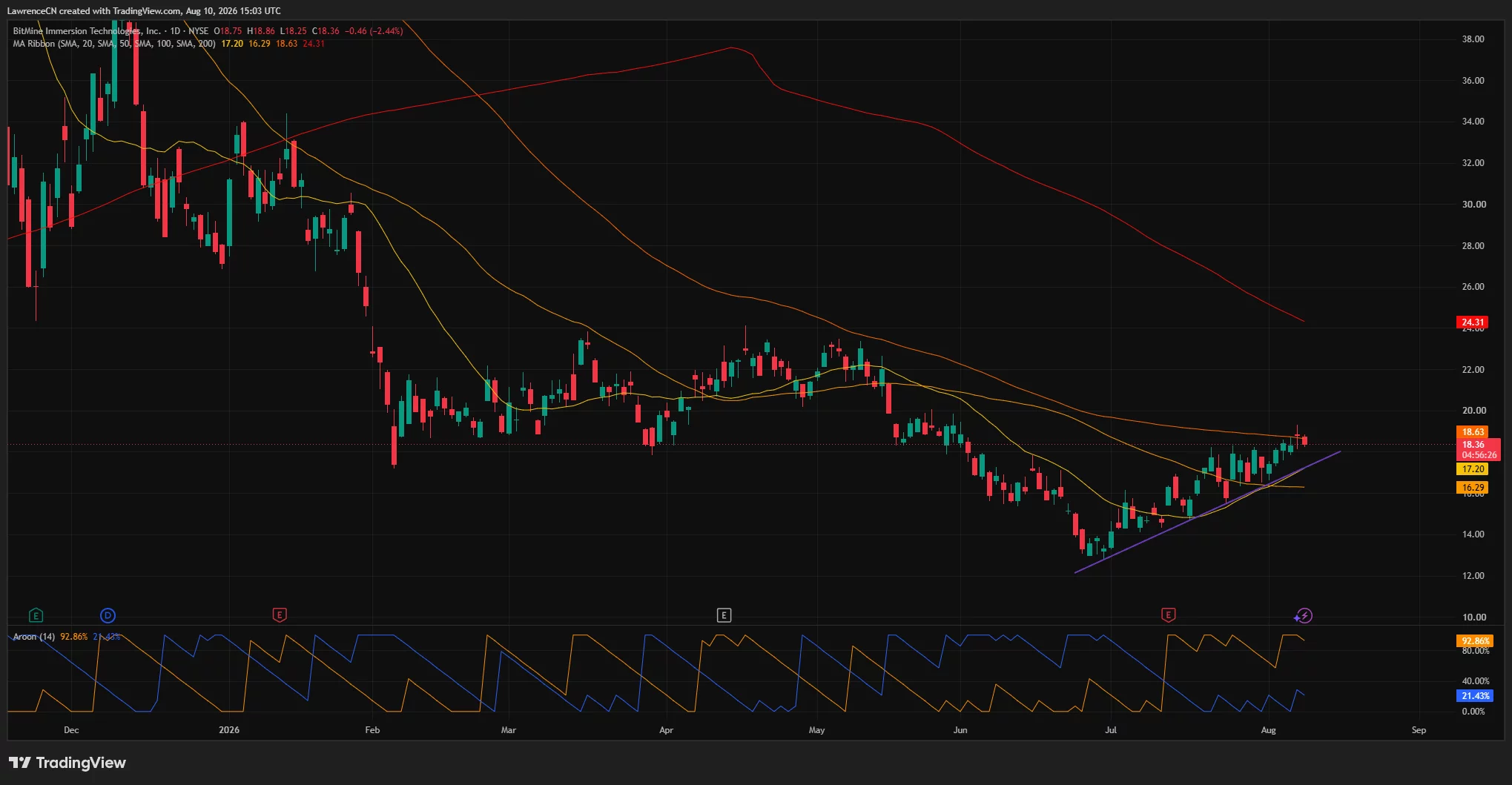
BitMine added 7,391 ETH and repurchased three million shares last week, but BMNR stock fell as its recovery ran into resistance near $18.63.
Summary
- BitMine’s holdings reached 5.81 million ETH, equal to roughly 4.8% of the supply.
- The company has staked 5.07 million ETH, projecting $194 million in annual rewards.
- BitMine repurchased three million BMNR shares, taking total buybacks to 19.1 million.
- BMNR fell 2.44% to $18.36, remaining below its 100-day and 200-day averages.
BitMine moves closer to its 5% Ethereum target
BitMine Immersion Technologies acquired another 7,391 Ethereum (ETH) over the past week, extending a run of weekly purchases that began after the company adopted its treasury strategy in June 2025.
According to an Aug. 10 company update, BitMine now holds approximately 5.81 million ETH. The position represents about 4.8% of Ethereum’s total supply and puts the company 96% of the way toward its goal of owning 5%.
The balance sheet also includes 206 Bitcoin, cash, marketable securities and investments in Eightco Holdings and Beast Industries. BitMine valued its combined crypto, cash and other holdings at approximately $11.6 billion.
The latest acquisition was smaller than the 10,399 ETH purchased during the previous week. crypto.news reported that the earlier transaction lifted BitMine’s treasury to 5.8 million ETH while the company continued buying back its own shares.
Staked ETH could generate $194 million annually
BitMine has placed 5,067,309 ETH into staking, representing about 87% of its Ethereum treasury. The company valued that position at approximately $9.8 billion based on recent market prices.
Its staking operations generated a seven-day annualized yield of 2.63%. BitMine projects approximately $194 million in annual staking rewards if that rate holds.
Staking has become central to the company’s revenue rather than serving only as an additional return on its treasury. A previous crypto.news report found that BitMine earned $45.7 million from staking and validation during its latest reported quarter, accounting for 98% of revenue.
The concentration also carries longer-term risks. BitMine’s position removes a large amount of ETH from the liquid market, but its scale leaves the treasury exposed to changes in Ethereum prices, validator yields and network issuance policy.
BitMine repurchases another three million shares
BitMine also bought back three million BMNR shares last week. Total repurchases under its $4 billion authorization have now reached 19.1 million shares since the program began in July.
Chairman Tom Lee said management continues to view the shares as undervalued. He argued that periods of ETH outperforming Bitcoin have historically been followed by BMNR outperforming ETH during the next month.
“We are disappointed that the CLARITY Act will not see a Senate vote before the August recess, but financial markets seem more focused on the recent softer inflation and jobs data.”
Lee added that lower expectations for another Federal Reserve rate increase could ease financial conditions and support crypto assets. The comments followed a weak July employment report that reduced concerns over an immediate rate hike.
BMNR stock tests resistance near $18.63
BMNR traded at $18.36 when the chart was captured on Aug. 10, down 2.44% for the session after opening at $18.75. The stock reached an intraday high of $18.86 before sellers pushed it back below nearby resistance.
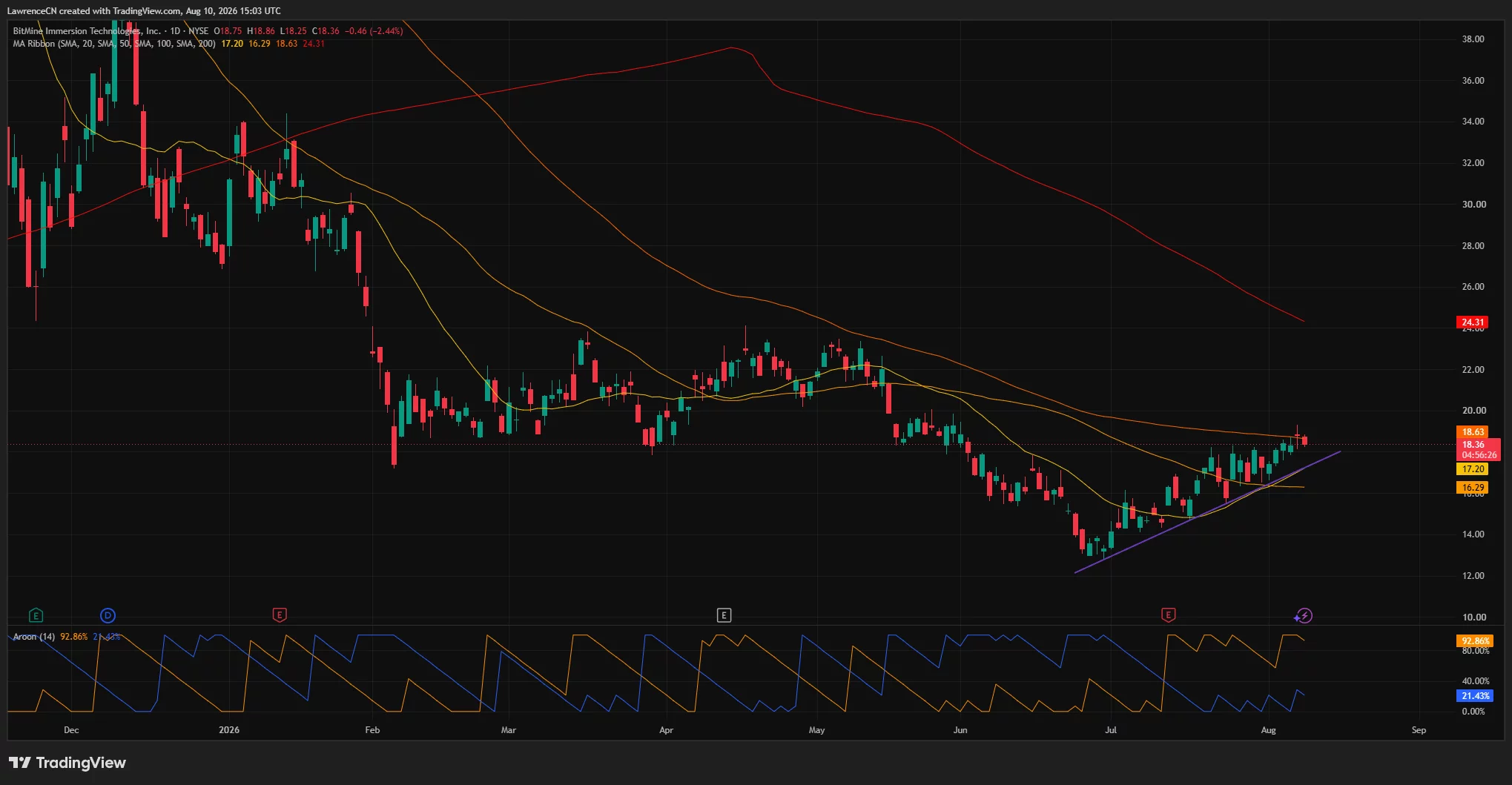
BMNR price remains above an ascending support line and the 20-day simple moving average at $17.20. The 50-day average at $16.29 provides a deeper support level if the recovery loses momentum.
However, BMNR has yet to reclaim its 100-day average at $18.63. A daily close above that level could open a move toward $20, while failure to hold $17.20 would weaken the short-term recovery and expose $16.29.
The broader trend remains under pressure because BMNR trades well below its 200-day average at $24.31. Aroon Up at 92.86% shows that recent highs still favor buyers, but the rejection near the 100-day average means a sustained breakout has not yet been confirmed.


SharpLink has posted a $394.3 million second-quarter loss after falling ETH prices produced $397.1 million in unrealized losses and write-downs.
Summary
- SharpLink recorded a $394.3 million net loss, compared with $103.4 million a year earlier.
- ETH market conditions generated a $321 million unrealized loss during the quarter.
- LsETH and weETH write-downs added $76.1 million in non-cash charges.
- The company held 886,881 ETH and ETH equivalents at the end of June.
ETH write-downs outweigh revenue growth
SharpLink’s second-quarter results showed that revenue reached $11.5 million during the three months ended June 30, up from about $697,000 one year earlier.
Most of the quarterly loss came from SharpLink’s cryptocurrency holdings rather than its operating expenses. The company recorded a $321 million unrealized loss on assets measured at fair value as ETH traded lower during the quarter.
Another $76.1 million impairment applied to its LsETH and weETH positions. SharpLink said both charges were non-cash items and did not reduce the number of ETH or ETH-equivalent tokens it controlled.
The impairment still lowered the carrying value assigned to the two liquid staking tokens under U.S. generally accepted accounting principles. According to the company, that reduction cannot be reversed if the market value of LsETH or weETH later recovers.
SharpLink reported a diluted loss of $1.88 per share, compared with $4.27 per share in the same period of 2025. Its overall net loss increased from $103.4 million a year earlier, when unrealized crypto losses totaled only $2.4 million.
The latest result follows an even larger loss during the opening quarter. Crypto.news previously reported that SharpLink posted a $685.6 million Q1 loss, including $506.7 million in unrealized ETH losses and a $191.7 million impairment on LsETH.
For the first six months of 2026, SharpLink’s net loss reached $1.08 billion. Its half-year accounts included $827.7 million in unrealized crypto losses and $267.8 million in impairment charges.
Staking produces most of SharpLink’s revenue
Revenue increased by more than 15 times from the year-earlier period after SharpLink operated its ETH treasury strategy for the full quarter. The company launched the strategy on June 2, 2025, leaving less than one month of related activity in the comparable period.
Staking supplied $11.2 million of SharpLink’s $11.5 million in second-quarter revenue. Staking revenue for the first half of 2026 reached $22.7 million, making ETH yield the company’s main source of reported income.
Costs rose alongside the expanded treasury operation. Selling, general and administrative expenses increased to $9.1 million from $2.4 million a year earlier because of higher personnel, custody, insurance, legal and accounting expenses.
SharpLink’s reliance on staking revenue has also placed the company inside Ethereum’s issuance debate. CEO Joseph Chalom recently opposed a proposal that could eventually eliminate issuance-based staking rewards, arguing that native yield helps distinguish ETH from non-yielding assets such as Bitcoin.
The company had earned more than 18,000 ETH in staking rewards when Chalom discussed the proposal. A reduction in validator issuance could therefore affect SharpLink’s treasury income even if the number of tokens on its balance sheet remains unchanged.
SharpLink holds $1.4B in crypto assets
SharpLink controlled approximately 886,881 ETH and ETH equivalents as of June 30. The total consisted of 632,784 native ETH, 181,321 ETH represented by LsETH on an as-if-redeemed basis and 72,776 ETH represented by weETH.
Its crypto portfolio carried a combined value of about $1.4 billion under U.S. GAAP. Assets measured at fair value accounted for $988.8 million, while crypto assets held at cost accounted for another $369.1 million.
Total assets declined to $1.42 billion from $2.43 billion at the end of 2025, primarily because of the lower value assigned to its crypto holdings. Stockholders’ equity fell from $2.42 billion to $1.41 billion over the same period, while the accumulated deficit increased to $1.89 billion.
For U.S. investors, SharpLink’s figures show how cryptocurrency price changes can cause large swings in reported earnings without an equivalent cash loss or token sale. Its $321 million unrealized loss moved through the income statement even though the company retained the affected ETH.
Cash and cash equivalents reached $56.2 million at the end of June, up from $28.5 million on Dec. 31. SharpLink used about $7.2 million in cash for operations during the quarter, separating its actual operating cash use from the larger accounting loss attached to its crypto assets.
Share offering funds another 10,000 ETH purchase
SharpLink completed a $75 million registered direct offering on June 23, issuing 10,013,351 common shares and accompanying warrants at a combined price of $7.49. The company said the offering was priced above its net asset value.
Part of the proceeds funded the purchase of approximately 10,000 ETH at an average price of $1,611. The transaction extended the company’s return to accumulation after crypto.news reported that SharpLink resumed buying ETH following an eight-month pause.
The company also repurchased about 2.1 million common shares during the quarter at an average price of $4.70, spending roughly $10 million. Since starting the program in August 2025, SharpLink has bought back 4,071,223 shares for a combined $41.7 million.
Although the offering increased the number of outstanding shares, the repurchases removed a smaller block from public ownership. SharpLink has described both transactions as part of its effort to manage the amount of ETH attributable to each share.
The Nasdaq-listed company joined the Russell 2000 and Russell 3000 indexes during their June reconstitution, making SBET eligible for ownership by U.S. funds that track those benchmarks. Its shares closed at $6.43 on Aug. 7, gaining 2.23% during the session before the results were published.
SharpLink’s treasury had increased to approximately 888,938 ETH and ETH equivalents by Aug. 3. After the quarter ended, it also committed $100 million to the $125 million Galaxy SharpLink Onchain Yield Fund, with Galaxy contributing the remaining $25 million and serving as its investment manager.

Quantum computing is increasingly framed as a looming break in the cryptography that underpins major blockchains, but one overlooked risk is operational: an attacker may not need to hack exchanges or wallets in the usual way. Instead, a sufficiently powerful quantum computer could derive private keys directly from public data on-chain, enabling theft without triggering clear evidence of a “cryptographic break,” according to Christopher Smith, CEO and co-founder of blockchain security startup Quantus Network.
Smith’s comments highlight why so-called “Q-day” — the moment when quantum machines can realistically defeat widely used public-key systems — could look less like a dramatic breach and more like confusing, untraceable losses. Combined with rapid progress in quantum-related research and algorithmic improvements, the discussion is shifting from whether quantum attacks are possible to how quickly they may become practically actionable.
Key takeaways
- Quantum attacks may be hard to detect because compromising keys via public information could leave little or no forensic trace of “how” funds were stolen.
- Early targets might not be the most famous holdings; researchers point to high-value administrative keys and hot-wallet access as more likely first moves.
- Estimates for when quantum systems can break elliptic-curve cryptography vary widely, with uncertainty still high across industry leaders.
- Several teams are already preparing post-quantum signature migrations, reflecting a view that waiting for certainty is not an option.
Why quantum theft could evade traditional incident response
In conventional attacks, a breach often leaves clues—malware, compromised systems, exposed credentials, or unusual access patterns. Smith argues that a quantum-enabled key derivation would be different. “When someone cracks your key, you don’t get a memo saying how they did it,” he told Cointelegraph.
In his scenario, an attacker could use the public keys available on-chain to infer the corresponding private keys using quantum computation, then move funds without necessarily breaching the victim’s internal infrastructure. This creates a high-stakes detection problem: even well-run organizations might only discover the problem after funds have already been drained, while forensic teams see no “breach” in the traditional sense.
Smith described this as potentially producing a confusing outcome where “the only forensic evidence would be that there was no breach.” For investors, exchanges, custody providers, and institutional operators, that distinction matters: if incident response teams are trained to look for signs of intrusion, they may need new playbooks designed around cryptographic compromise rather than system compromise.
What attackers might go after first
The public debate around Q-day often centers on Bitcoin and the fear that dormant holdings could suddenly become vulnerable. Cointelegraph notes that Satoshi Nakamoto’s estimated holdings are often cited in the tens of billions, with one reference in the report placing the figure at $63 billion at the time of writing. Smith’s framing, however, suggests the first targets might be different and could be driven by attacker economics and operational convenience rather than symbolic value.
He argued that state-grade targets could be prioritized, pointing to “military systems and state secrets.” Within crypto specifically, he suggested that the highest-value keys might be operational or administrative rather than widely celebrated. “If I’m focusing on blockchain, what’s the single most valuable key? It’s probably Tether’s minting key,” Smith said.
His reasoning is that a quantum-capable attacker might mint tokens from an administrative wallet and sell into the market before the issuer can fully react. The report further notes that USDT is multi-chain and that some networks supporting its issuance are already working on post-quantum migration efforts.
Security researcher Sean Cheetham from Blockchain Capital added another angle: rather than aiming at the most famous cold wallets, attackers could focus on hot wallets at exchanges. In his view, those targets are more likely to avoid triggering alarm bells because their access patterns can resemble ordinary operational risk.
Smith also described an alternative tactic: a quantum-enabled theft could be disguised through plausible deniability. He suggested an attacker might present the incident as an ordinary loss of keys, using the uncertainty of how the keys were compromised to reduce the chance of immediate escalation.
How the timeline for Q-day keeps slipping and sharpening
One reason Q-day remains difficult to plan for is that timelines are unsettled. The report highlights recent developments that have compressed estimates for when quantum machines could attack elliptic-curve cryptography.
It points to a March update in which Google accelerated a post-quantum migration timeline to 2029, citing an AI-assisted breakthrough indicating elliptic curve cryptography could be cracked with fewer physical qubits than previously thought. Cointelegraph also attributes an explanation for why forecasts may have missed the mark to the parallel growth of AI-assisted approaches to quantum problem-solving.
Still, consensus is lacking. Smith, whose company is building a blockchain network intended to be quantum-resistant from launch, said there is a “50-50” chance the capability arrives by 2028, while Cheetham expects the early 2030s as “almost a certainty” and frames an earlier arrival as a trailing probability.
Michael Coates, chief information security officer at the Solana Foundation, declined to give a precise estimate during an earlier interview, saying “there’s no way to know,” while noting that industry discussions have often treated quantum timelines as “five years away” for much longer than a decade. He added that while uncertainty should temper prediction, it should not delay action.
Across these views, the common theme is not a shared date but a shared urgency: improving forecasts may be faster than compliance cycles and security migrations, so teams are trying to reduce dependency on assumptions.
Post-quantum migrations are already becoming the default security posture
Even with timeline disagreement, the report emphasizes that blockchains are not waiting for a clear verdict. It quotes NGRAVE CEO Roy Blackstone arguing that threat models have underestimated how quickly AI could advance alongside quantum technology, but regardless of exact timing, the migration work is underway.
Smith said Quantus is focused on launching a blockchain designed to be quantum-resistant from the outset, reflecting a “bake it in” approach rather than a last-minute retrofit. Blackstone similarly stressed that damage would be “catastrophic” if systems did not migrate, and that blockchains have begun shifting toward post-quantum signatures.
For market participants, this creates a different way to think about quantum risk. Instead of treating Q-day as a single future cliff, readers may need to evaluate how resilient different networks are today—particularly whether they rely heavily on legacy public-key schemes, and whether migration strategies are actively implemented across critical components.
What to watch next is less about a single predicted year and more about measurable migration progress: whether major ecosystems complete post-quantum signature adoption in a verifiable way, and whether security teams update incident response procedures to account for cryptographic compromise that may not look like a conventional breach.
BitMart is facing a new insolvency allegation after an OpenGradient co-founder said his market-making team could no longer withdraw funds locked on the exchange.
Summary
- An OpenGradient co-founder said his market maker’s BitMart withdrawals remain frozen.
- He alleged BitMart encouraged token holders to lock assets shortly before restricting services.
- BitMart is winding down operations but maintains that withdrawals remain available.
- Founder Sheldon Xia denied misusing funds, but BitMart has not published a full proof-of-reserves report.
Market maker questions BitMart’s solvency
Matthew, a co-founder of decentralized AI network OpenGradient, said his market-making team has funds trapped on BitMart and questioned whether the exchange remains solvent.
According to Matthew, the team cannot withdraw its assets from the centralized trading platform. He also alleged that BitMart continued encouraging token holders to lock funds on the exchange about one week before halting the related services.
Matthew described the timing as “shocking” and claimed the lockup campaign may have been intended to bring additional liquidity onto the platform. BitMart had not issued a direct response to his allegations at the time of writing.
The claims have not been independently verified, and Matthew did not disclose the value or type of assets held by the market maker. There is currently no confirmed evidence establishing that BitMart is insolvent.
However, the complaint adds to mounting questions about the exchange’s ability to process withdrawals during its wind-down.
Withdrawal complaints follow BitMart shutdown
BitMart began a phased shutdown of its global exchange on July 26. It stopped accepting new registrations, crypto and fiat deposits, and new spot orders, while futures accounts entered reduce-only mode.
All spot, futures and other trading services are scheduled to end at 01:00 UTC on Aug. 26. BitMart plans to terminate its trading-platform operations on Jan. 31, 2027.
The exchange says withdrawals remain available. However, requests may undergo identity checks, source-of-funds reviews, wallet-ownership verification, sanctions screening and other security procedures.
BitMart recommended that customers submit withdrawal requests before 05:00 UTC on Aug. 26. Requests submitted later will move into a separate process that the company has yet to detail fully.
Scandic Coin has also reported delayed withdrawals. The project said requests involving approximately 21,898 USDT, 926,635 SNC and another 256 USDT remained unprocessed after being submitted on July 26.
The project did not state that BitMart was insolvent but called on the exchange to provide verifiable evidence that it had enough liquidity to meet its obligations.
BitMart founder denies misusing customer funds
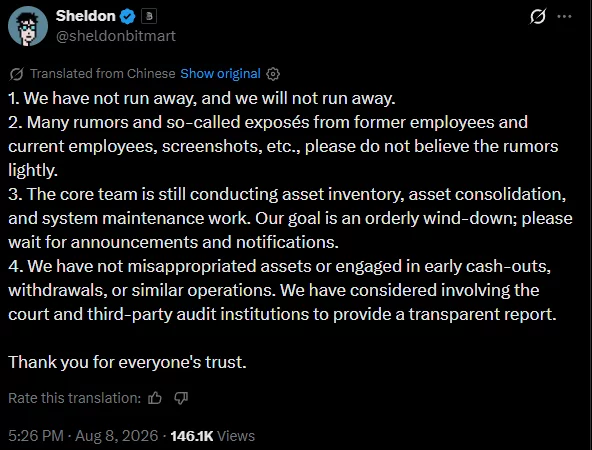
BitMart founder Sheldon Xia responded to broader concerns on Aug. 8, saying the exchange had “not run away” and “will not run away.”
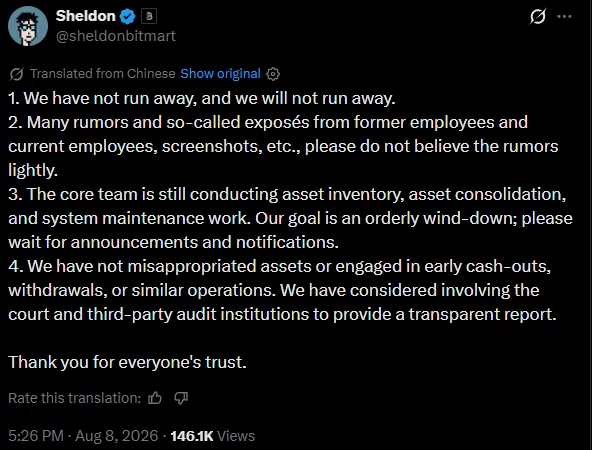
Xia said the company’s core team was conducting an asset inventory, consolidating assets and maintaining its systems. He promised that formal announcements would follow but did not provide reserve figures, withdrawal-processing data or a repayment timetable.
BitMart said in May that it was preparing to publish proof of reserves after earlier withdrawal complaints. That report has not been released.
Proof-of-reserves disclosures can help verify that exchanges control assets corresponding to customer balances. However, they do not establish solvency unless users can also assess the company’s liabilities and off-chain obligations.
The case resembles recent liquidity concerns involving AscendEX, where delayed withdrawals and apparently low hot-wallet balances preceded the exchange’s shutdown. BitMart has not acknowledged any asset shortfall.
US users face additional restrictions
BitMart stopped registering new US customers in May 2022, but the exchange said some older accounts could still be linked to US residents.
The company instructed affected US users to close positions, redeem assets and withdraw their remaining crypto by Aug. 8 at 23:59 UTC. It warned that accounts could face further restrictions after the deadline and that additional compliance reviews might be required.
For users unable to withdraw, the immediate questions are whether BitMart can publish verifiable asset and liability data and provide a clear processing schedule. Until then, the insolvency allegation remains unproven, while reports of frozen funds continue to test the exchange’s claim that its wind-down is orderly.

Ripple’s cross-border token has retraced by 3% over the past week and 7% on a monthly scale, currently trading at around $1.03 (per CoinGecko).
However, the popular analyst Ali Martinez outlined two factors that could serve as catalysts for a potential upcoming rally.
Major Pump Ahead?
According to him, the first element is the Tom DeMark Sequential indicator, which has flashed a buy signal on XRP’s monthly chart, “hinting at a possible macro shift from bearish to bullish momentum.”
He noted that over the last six years, this metric has marked several major reversals, including a 1,074% price explosion in April 2020 and a 973% jump in August 2022. In contrast, XRP nosedived by 57% in April 2025 after the indicator flashed a sell signal.
The second reason is the whales’ buying spree. Martinez revealed that large investors have scooped up more than 380 million XRP (worth nearly $400 million) in the past seven days. Their total holdings have risen to approximately 8.2 billion tokens, representing 13.1 of the asset’s circulating supply.
This is an encouraging sign, which shows that this cohort of market participants is perhaps preparing for the next leg up. The accumulation might also boost overall enthusiasm across the community and prompt smaller players to jump in as well: a wave of fresh capital that may ultimately support the price.
It is important to note that at the end of his analysis, Martinez paid special attention to the key resistance level of $1.06, where nearly 3 billion XRP were transacted. He thinks that a monthly close above this zone could clear the way for $1.35 and even open the door to a pump to $1.64.
This isn’t the first time he has focused on that mark. Earlier this month, he argued that a plunge below could result in a massive collapse to as low as $0.62.
Additional Forecasts
Late last week, XRP slipped to around $1.02 after it became clear that the crypto regulatory framework in the US, the CLARITY Act, will be delayed until September. X user Dark Defender noticed that the plunge pushed the asset’s RSI into an extreme oversold area, anticipating “the strongest revival in history” once it climbs above $1.05.
The analyst who goes by Gerla also paid attention to the Relative Strength Index, claiming it has printed a bullish divergence and predicted that a reclaim of $1.08 could send XRP into “a serious reversal.”
For their part, X user ChartNerd issued a much more bullish forecast. They spotted the formation of a multi-year cup-and-handle pattern that could be a precursor to a rally to as high as $27. As of this moment, that target seems quite unlikely, yet no one truly knows what the future might bring.
The post 2 Big Reasons Why Ripple (XRP) May Be Ready for a Bull Run appeared first on CryptoPotato.

Bitcoin dipped below $64,500 on Monday after Wall Street’s open, tracking a broader risk-off mood tied to fresh uncertainty around US-Iran tensions and the Strait of Hormuz. While crude prices moved higher, equities failed to hold their early direction, and BTC’s early weakness underscored how quickly macro headlines can dominate crypto price action.
At the same time, market attention is being split between geopolitics and FX—particularly the Japanese yen. The yen continued to weaken against the US dollar even after a rare joint Japan-US intervention, putting additional pressure on liquidity-sensitive assets like bitcoin.
Key takeaways
- Bitcoin slid to around $64,447 on Bitstamp shortly after the US open, reflecting risk-off positioning alongside US stocks.
- Iran’s deputy speaker, Ali Nikzad, said reopening the Strait of Hormuz has “no military solution,” adding to uncertainty for energy markets.
- USD/JPY pushed toward 160 in early Asia trading, as the yen remained under pressure after the Japan-US FX intervention.
- On-chain and derivatives signals show stronger institutional demand, but analytics firms describe spot-market recovery momentum as still not fully confirmed.
- US spot Bitcoin ETFs logged net inflows of $865.3 million last week, yet analysts still characterize the rebound as tentative.
Geopolitical uncertainty and macro spillover into BTC
According to TradingView data cited in the report, BTC/USD touched $64,447 on Bitstamp—its lowest level since Friday—before recovering modestly. The move closely followed the pattern in US equities, which initially fell as traders reassessed the likelihood that the Strait of Hormuz oil route would reopen.
Iranian officials added to that caution. Addressing the Islamic Consultative Assembly, deputy speaker Ali Nikzad reportedly said that the “opening of the Strait of Hormuz has no military solution,” a statement quoted by Al Jazeera and other outlets.
Energy markets reflected the same tension. US WTI crude oil was up nearly 5% to about $80.90 per barrel at the time of writing, even as the S&P 500 managed to turn green after dipping—still below Friday’s all-time highs. For bitcoin, the takeaway is less about oil’s direction alone and more about how quickly broader macro uncertainty is feeding into risk appetite.
Yen weakness after Japan-US FX action raises liquidity questions
Beyond geopolitics, the yen remained a focal point for markets. The Japanese currency continued to slide against the US dollar despite a rare joint intervention by Japan and the United States earlier, with USD/JPY reaching 159 on Monday and edging toward the 160 threshold during the first Asia session.
Economist Mohamed El-Erian warned that Japan may need stronger or more decisive policy follow-through for the intervention to translate into sustained FX stabilization. On X, he wrote that the yen has been weakening gradually since the joint Japan-US FX intervention, calling it a reminder that correcting a “mispricing” depends on getting the policy mix right—and that delays could make the intervention’s goal “more elusive.”
For crypto traders, this matters because FX stress can alter global liquidity conditions and risk positioning. When the yen weakens rapidly, it can coincide with shifts in cross-asset funding and hedging behavior—dynamics that often spill into high-beta markets.
Institutional inflows support the backdrop, but analysts see uneven momentum
While bitcoin’s price action looked shaky, institutional and on-chain data offered a more constructive—though not fully decisive—picture. Glassnode’s latest Market Pulse update pointed to what it described as improving components that typically precede more sustainable uptrends, but it also highlighted a key missing piece: the overall momentum in the spot market.
Glassnode said momentum had returned toward neutral and that spot taker buying had accelerated sharply. However, it noted that centralized exchange turnover remained subdued. In the report, the firm interpreted the gap between stronger spot absorption and weaker exchange activity as indicative of demand improving within a broader consolidation environment rather than a broad-based speculative expansion.
ETFs and derivatives hint at accumulation—yet “tentative” remains the watchword
Institutional flows were among the clearest positives in the week’s data. The report cited Farside Investors data showing that US spot Bitcoin ETFs recorded net inflows of $865.3 million last week. Such inflows can matter because they represent steady demand from traditional capital channels, often helping stabilize sentiment during choppy periods.
On the derivatives side, CryptoQuant data referenced in the report indicated that hedge funds had flipped to net long CME bitcoin futures. The CEO of CryptoQuant, Ki Young Ju, characterized the shift as “rare,” arguing that the typical positioning behavior had structurally favored being short via basis trades—an approach he said cannot easily be carried into net long positions. In his framing, hedge funds betting on upside suggests more conviction than simple hedging.
Still, the overall conclusion from the analytics commentary is that bitcoin’s rebound attempts are not fully “locked in.” The report described the comeback as “tentative,” with Glassnode’s divergence between accelerating spot taker buying and subdued exchange turnover serving as a caution signal. In other words: inflows may be arriving, but market breadth and turnover are not yet confirming a full expansion cycle.
Going forward, traders are likely to keep a close eye on whether macro uncertainty around the Strait of Hormuz continues to dominate price action, and whether FX conditions—especially USD/JPY—stabilize or deteriorate further. On the crypto side, the next test is whether ETF-led demand and derivatives positioning can translate into stronger spot-market momentum, rather than staying confined to consolidation.
Crypto World
CoinFerenceX and The Best Event Join Forces to Launch “CoinFerenceX The Best Event Singapore,” the Decentralised Summit

SINGAPORE, CoinFerenceX, the Web3 conference series known for curating high-signal gatherings of founders, investors, and builders, today announced it has combined forces with The Best Event, the events production group behind 80+ live experiences across 10+ global cities, to launch CoinFerenceX The Best Event Singapore, the next tier of the world’s first Decentralised Summit. The event will take place 5-6 October 2026 at Gardens by the Bay, positioning it as a leading alternative during Singapore’s Token2049 and Asia Crypto Week.
The partnership pairs CoinFerenceX’s content curation and community depth with The Best Event’s large-scale production and sponsor-activation track record, creating what the two companies describe as “the event nobody else can build.”
What sets the conference apart is its decentralized summit model: a 2 day event shaped by the industry rather than dictated by an organizer. Where traditional conferences sell booths and speaking slots, CoinFerenceX and The Best Event will invite the founders, funds and ecosystem leaders who show up to help shape the agenda itself, deciding which conversations matter and which builders take the stage. While the organizers handle the production and logistics, the direction of the summit is set by the Web3 players with real skin in the game. It’s a gathering built by the people driving the ecosystem forward, for the people driving it forward.
The Best Event brings a track record of 80+ delivered events, a presence in more than 10 global cities, over 50 million annual organic impressions, and north of 1 billion in social reach. The group’s attendance has grown from 35,000 in 2025 to a projected 70,000 in 2026. Its sponsor case studies point to concrete ROI, including one partner that turned a $50,000 investment into $1 million raised, another that saw a $50,000 spend convert into $1 million in ROI, and a third that converted two leads into a $400,000 deal.
At CoinFerenceX, partners help shape the agenda itself rather than simply buying booth space and a speaking slot. CoinFerenceX’s community includes 7,500+ curated attendees from more than 70 countries, over 500 ecosystem and media partners, and more than 300 VCs and investment funds. Roughly 60% of its attendees are C-level executives or founders, and independent feedback shows 94% of past partners say they would return, with 89% rating CoinFerenceX among the top 25% of Web3 events globally.
The combined summit is designed around four experience tracks:
- The Leaders Summit: an invite-only, C-level gathering where governance decisions and strategic partnerships take shape.
- Protocol Deep Dives: technical workshops where protocols demonstrate what they are actually shipping.
- The Founders’ Den: a venue for early-stage builders to pitch directly to 200+ VCs and investors.
- The Innovation Showcase: live product demos from established players and emerging protocols alike.
Early figures for the Singapore edition point to more than 4,000 curated attendees, 500+ VCs and investors, 400+ ecosystem and media partners, 85+ C-level speakers, and more than 8,000 total event registrations. As with prior CoinFerenceX editions, roughly 60% of attendees are expected to be C-level executives or founders.
Organizers say the agenda will be co-created by founders and ecosystem leaders with skin in the game, focused on sessions that deliver actionable insight or substantive content over celebrity keynotes.
“We’re incredibly excited for this edition, it’s bigger, sharper and more ambitious than anything we’ve done before. With the whole industry in Singapore that week, we’ve curated a stage and an audience that turns that energy into real conversations and real deals. This is CoinFerenceX The Best Event at its strongest,” shared Prince Gupta, Co-Founder of CoinFerenceX
Tobias Bauer, Co-Founder of The Best Event, added, “This partnership is the best of both worlds: CoinFerenceX’s curated speaker line-ups meet The Best Event’s scale of 50,000 attendees a year, the largest Web3 event series globally. Together we’re bringing one of the biggest two-day conferences to Singapore, our home market, with frontier thought leadership and production quality unlike anything else in the space.”
Event Details
- Event: CoinFerenceX The Best Event Singapore
- Dates: 5-6 October 2026
- Venue: Gardens by the Bay, Singapore
- Tickets & partner applications:coinferencex.com/singapore
About CoinFerenceX
CoinFerenceX is a global decentralized Web3 summit connecting founders, investors, blockchain companies, developers, and industry leaders to accelerate innovation and collaboration in the digital economy. Through its ecosystem-driven approach, CoinFerenceX creates a platform for meaningful networking, knowledge exchange, startup opportunities, and strategic partnerships shaping the future of Web3. The summit brings together the brightest minds across blockchain, AI, DeFi, gaming, and emerging technologies to explore industry trends, showcase groundbreaking solutions, and build the next generation of decentralized ecosystems.
About The Best Event
TBE is the events arm of TBV, an early-stage venture capital fund backing web2.5 and web3 startups across Southeast Asia and North America. TBE curates high-caliber gatherings that anchor the biggest weeks in web3, with a track record of 80+ delivered events across 10+ global cities. Every event is built around one goal: putting the right founders, funds, and operators in the same room so real deals and partnerships can happen. That network runs deep, backed by a 10,000+ strong Telegram community and a social following north of 100,000.
Media Contact
Anmol Malviya
Head of PR
CoinFerenceX
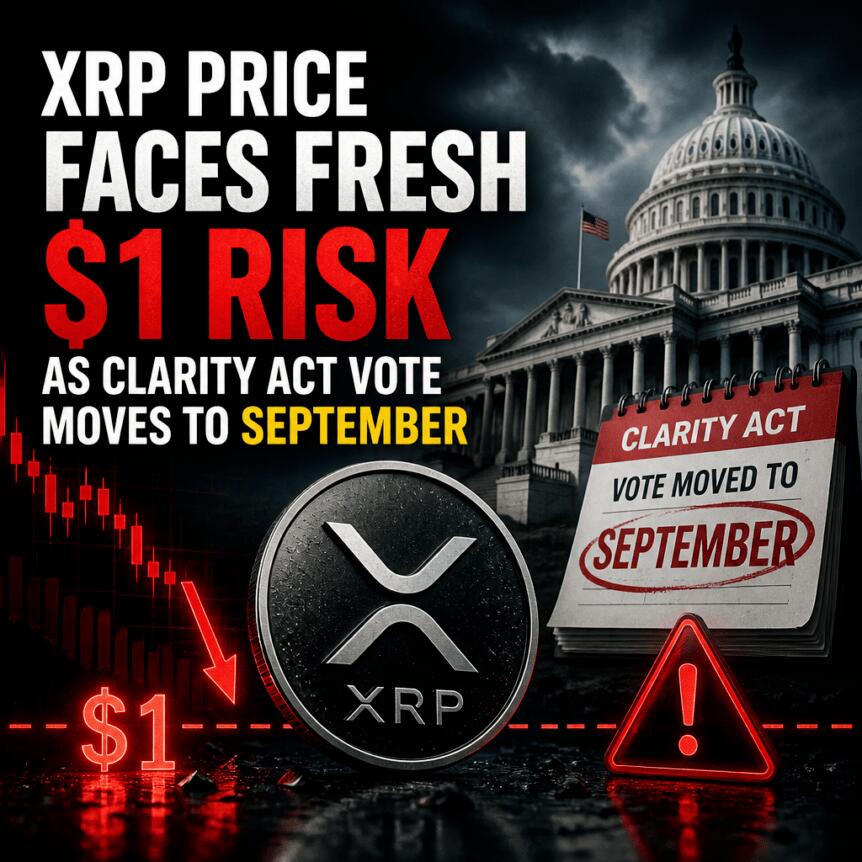
XRP faces renewed downside pressure as Polymarket traders assign strong odds to the token trading near the $1 level. The shift follows the delay of the CLARITY Act vote until September. Meanwhile, short-term markets show limited strength, while longer-term contracts signal weaker expectations for a major XRP recovery.
XRP Price Holds Near The $1 Support
Polymarket data shows a 71% probability that XRP will reach $1 on August 10. Another contract gives XRP a 99% chance of reaching the $1 to $1.10 range. However, the same market assigns only a 1% probability to the $0.90 to $1 range.
Separate contracts also show limited upside for XRP during the session. The token has a 28% probability of reaching $1.05, while another contract gives $1 a 5% probability. Therefore, current market activity places greater attention on the $1 area than higher price levels.
Short-term contracts remain stronger than daily and four-hour projections. Polymarket gives XRP a 96% chance of rising during the next hour, while 15-minute odds stand at 76%. However, five-minute odds fall to 50%, while daily and four-hour markets show only 10% and 7% chances.
XRP Faces Wider Weekly Price Pressure
Polymarket’s weekly contracts also show mixed expectations for XRP between August 10 and August 16. One contract assigns a 50% probability that XRP will not reach $0.90 during that period. Another standalone contract gives a 99% probability that XRP will reach $1.70.
These contracts measure separate price outcomes, so their probabilities do not represent a single price forecast. However, the data shows a wide range of possible outcomes as traders assess XRP’s near-term direction. At the same time, longer-term contracts show limited expectations for a new record high.
Polymarket places the probability of XRP reaching an all-time high by December 2026 at 5%. The probability for XRP reaching a record high by the end of September stands at 1%. Therefore, the market data points to restrained expectations despite possible short-term moves.
Clarity Act Delay Adds Pressure To XRP
The delayed CLARITY Act vote has added another source of uncertainty for XRP and the wider crypto market. Senate Majority Leader John Thune filed a cloture motion on the motion to proceed. The Senate now plans to consider the cloture vote on September 15 after the August recess.
The bill still faces disagreements over several provisions before lawmakers can advance it. Senators have raised concerns about stablecoin rules and provisions involving stablecoin yields. Meanwhile, law enforcement groups and prosecutors have objected to protections covering non-custodial blockchain developers.
The legislative outcome could influence XRP’s next major price move because the bill affects the broader digital asset framework. CoinGape analysis identifies $1.08 and $1.12 as key resistance areas for XRP. A stronger trading volume could push XRP toward $1.18, while a failed bill could send XRP back toward $1 and $0.95.

BlackRock is expanding its Canada-listed ETF lineup with two new iShares products that begin trading on the Toronto Stock Exchange (TSX) this week. The most notable addition blends traditional equities with a small, fixed allocation to Bitcoin exposure.
Both funds are managed by BlackRock Asset Management Canada under the RBC iShares alliance. They are designed for investors seeking diversified market exposure—either broadly outside North America, or a balanced mix that includes a Bitcoin sleeve.
Key takeaways
- BlackRock Canada launched two TSX-listed iShares ETFs: IBQT (equities plus a 3% Bitcoin allocation) and XINT (international equity exposure).
- IBQT’s structure targets a diversified equity core: 97% in equities via iShares ETFs, alongside 3% Bitcoin exposure via BlackRock’s Canadian iShares Bitcoin ETF (IBIT).
- XINT provides broad non-North America coverage: it tracks the MSCI ACWI ex North America IMI Index, spanning more than 5,000 companies across over 40 markets.
- BlackRock positions iShares as the platform: both funds rely primarily on other iShares ETFs rather than direct stock holdings.
- BlackRock’s US Bitcoin ETF scale remains a reference point: CoinMarketCap data shows its US-listed iShares Bitcoin Trust (IBIT) holds about $47.9 billion in assets under management.
What BlackRock launched on the TSX
On Monday, BlackRock Canada introduced two ETFs on the Toronto Stock Exchange: the iShares Equity + Bitcoin ETF Portfolio (IBQT) and the iShares Core MSCI All-International Equity Index ETF (XINT).
While both funds sit under the iShares brand and share a common management setup, they differ sharply in how they aim to deliver exposure. IBQT adds a defined Bitcoin component to an otherwise equity-focused portfolio, while XINT is a more traditional, index-tracking international equity fund.
IBQT: a “core equities + 3% Bitcoin” portfolio
The iShares Equity + Bitcoin ETF Portfolio (IBQT) is designed around a straightforward allocation framework. The fund allocates 97% of its portfolio to a mix of equities across Canada, the United States, international markets, and emerging markets. The remaining 3% is allocated to Bitcoin exposure through BlackRock’s Canadian iShares Bitcoin ETF (IBIT), which trades on Cboe Canada.
According to the launch details, IBQT does not seek to hold individual stocks directly. Instead, it primarily invests in other iShares ETFs to achieve both its diversified equity exposure and its Bitcoin sleeve.
This design choice matters for investors thinking about implementation. A fund-of-funds approach can make it easier to access multiple exposures within a single product, rather than requiring investors to combine separate equity and Bitcoin funds themselves—though investors will still want to review the underlying holdings and the total costs across the layered structure.
XINT: broad international equities outside North America
The second product, iShares Core MSCI All-International Equity Index ETF (XINT), is more conventional in its index approach. The ETF tracks the MSCI ACWI ex North America IMI Index.
Based on the provided index description, XINT offers exposure to more than 5,000 companies spread across over 40 developed and emerging markets, covering regions outside both Canada and the United States.
For investors who already hold North American equities and want a non-overlapping allocation, XINT’s benchmark selection is intended to fill that gap. By tracking a widely diversified index outside North America, it also reduces the need to make region-by-region allocation decisions, at least at the index construction level.
Why this matters for Canadian ETF investors
BlackRock’s move reflects a broader shift in how crypto exposure is being packaged for mainstream portfolios—often in small, rules-based allocations rather than all-in constructions. IBQT’s fixed 3% Bitcoin allocation is a concrete example of that approach: it aims to keep the portfolio heavily equity-oriented while adding a measured amount of BTC-linked exposure.
At the same time, BlackRock is keeping the rest of the implementation familiar. Both funds are described as relying primarily on iShares ETFs, which signals that BlackRock is leveraging its existing ETF ecosystem to deliver new outcomes—rather than creating a wholly separate investment framework for crypto-linked products in Canada.
BlackRock said its iShares business managed approximately $6.2 trillion in assets across more than 1,700 ETFs as of June 30. That scale can be relevant for Canadian investors because it suggests ongoing operational capacity and product development across the iShares range, including the integration of new crypto components into established ETF formats.
Bitcoin ETF momentum remains a key backdrop
The launch of IBQT also lands against ongoing momentum in BlackRock’s US Bitcoin ETF business. The US-listed iShares Bitcoin Trust (IBIT) is described as the largest US spot Bitcoin ETF by assets under management, with about $47.9 billion in AUM, according to CoinMarketCap.
While IBQT is a Canada-focused product and XINT is an equities-only index fund, BlackRock’s shared branding and ETF infrastructure underscore a key reality: the firm’s crypto products are increasingly becoming part of a broader ETF platform strategy, rather than operating as isolated experiments.
Going forward, investors should watch how IBQT’s trading and flows develop on the TSX, including whether the “small fixed Bitcoin sleeve” format draws demand from advisors and retail investors seeking easier portfolio integration. It will also be important to track how regulators and market participants continue to treat crypto-linked exchange-traded products in Canada, since that environment will shape how quickly similar portfolio-style offerings spread.

Bitdeer Q2 Bitcoin output surges 377% as self mining capacity expands

Anne Hathaway’s 4-Word Reply To ‘Fake’ Baby Bump Claims

SHOCKING NEWS!!! YOU NEED 4211 XRP BY JULY 4TH!?!


-

 Fashion3 days ago
Weekend Open Thread: Mattifying Sunscreen
-

 Fashion4 days ago
Frugal Friday’s Workwear Report: Cap-Sleeve Pointelle Crewneck Sweater
-

 Sports5 days ago
Jordan Coyle & Cordiamo take Laya Arena Stakes at RDS
-

 News Videos3 days ago
Can Astrology Help Find Gold and Silver Trends? A Financial Astrology Guide
-
 Business5 days ago
US stocks: Dow closes at record on Mideast optimism; SpaceX, AMD drag Nasdaq
-

 Politics5 days ago
Reform UK And Greens Sink To Lowest Favourability Ratings To Date
-

 Tech6 days ago
OpenAI, Anthropic AI agents targeted real people and systems in cyber tests
-

 Business6 days ago
Nvidia Stock Climbs 2.5% as Chip Sector Rally Builds Ahead of AMD Earnings, Nvidia’s Own Report Looms
-

 Crypto World6 days ago
Polymarket targets $20 billion valuation as competition heats up in prediction market sector
-

 Business5 days ago
Supply chain issues impact Ingredion
-
 Crypto World7 days ago
CLARITY Act Senate Vote Locked In, But 60-Vote Hurdle Looms Large
-

 Tech3 days ago
Rinn Pharma & Biopharma to join NordicPharmaTrain network
-
 Crypto World6 days ago
Dow and S&P 500 Hit Records on AI Earnings: When Will the Bubble Burst?
-

 Business2 days ago
How to Start a Cleaning Business: A Step-by-Step Guide
-

 Crypto World7 days ago
The Senate has one week: CLARITY’s last August window
-

 Business2 days ago
Datadog: Best Of Breed For Multiple Reasons
-

 Business2 days ago
BDC Weekly Review: Private BDC Q2 Numbers Are Strong
-
 Crypto World6 days ago
Dollar Index Trapped at 100 as Hawkish Fed Meets Official Selling
-

 Crypto World7 days ago
New York sued, who is next
-

 Business6 days ago
McDonald’s (MCD) Q2 2026 earnings
You must be logged in to post a comment Login