

Crypto World
Construction Begins on Quantum Facility Capable of Breaking Bitcoin


The quantum computing race is edging closer to a commercially viable milestone, with PsiQuantum revealing progress toward a facility that could house a million qubits. The company, which has tied its plans to a collaboration with Nvidia, says the ambitious Chicago site will rely on advanced error-tolerant architectures to deliver usable quantum power at scale. In parallel, the crypto community remains deeply engaged in the implications for Bitcoin’s security, a debate that has intensified as quantum research advances and real-world milestones creep closer to feasibility.
Key takeaways
- PsiQuantum is moving toward a 1-million-qubit facility described as capable of powering commercially useful quantum computation, backed by a $1 billion fundraising round announced in September and a collaboration with Nvidia.
- A construction update showed 500 tons of steel erected in six days for the Chicago site, underscoring the rapid pace of on-site development.
- The crypto community is split on risk: some warn quantum breakthroughs could threaten Bitcoin’s cryptography, while others expect the threat to remain distant, potentially a decade or more away.
- Analyses and statements emphasize that only a small portion of Bitcoin addresses would be susceptible today, with broader resistance possible through post-quantum upgrades and other safeguards.
- Key technical benchmarks frame the discussion: preliminary estimates suggest far more qubits than needed to break current cryptography, but practical, scalable quantum systems remain the central hurdle.
Tickers mentioned: $BTC
Sentiment: Neutral
Price impact: Neutral. The article frames potential quantum risk as a broad strategic consideration with limited near-term price signals.
Market context: Quantum progress is unfolding amid a broader crypto market focus on security, post-quantum readiness, and regulatory considerations shaping risk sentiment and investment flows.
Why it matters
The convergence of quantum computing and crypto security is more than a theoretical concern. If large-scale, fault-tolerant quantum devices become viable, the cryptographic foundations underpinning much of today’s digital assets could face fundamental redesigns. The Bitcoin network, which relies on elliptic-curve signatures, would be the most visible test bed for resilience in the face of quantum threats. In 2024, researchers and industry players have intensified discussions about preemptive upgrades, including hard forks and post-quantum cryptographic standards, as a means of safeguarding long-term security without interrupting existing operations.
PsiQuantum’s latest milestones illustrate the industrial-scale ambitions of quantum developers. The Chicago facility, designed to host one million qubits, is emblematic of the sector’s transition from lab-scale experiments to facilities that could underpin commercial computing for AI, simulation, and optimization workloads. A project of this magnitude hinges on both hardware breakthroughs—error correction, qubit coherence, scalable manufacturing—and software ecosystems capable of harnessing quantum advantage in practical use cases. The $1 billion fundraising and the Nvidia collaboration signal a broad, multi-industry push to de-risk the path to practical quantum advantage, even as critics note that true utility remains some years away.
From a crypto-security perspective, the debate has evolved beyond “if” to “when.” Some Bitcoin proponents argue a quantum-capable attacker could eventually compromise keys and signatures, potentially undermining the integrity of holdings and transactions. Others, including prominent voices in the ecosystem, emphasize that current cryptographic schemes can be fortified through a combination of longer-term keying practices and post-quantum cryptography, reducing the immediacy of risk. A widely cited line of reasoning holds that even if a quantum computer could break certain cryptographic keys, the actual volume of affected funds might be limited, given the distribution of private keys across the network and the ongoing movement toward more secure standards.
Academic and industry analyses also illustrate that the number of qubits needed to break modern cryptography is a moving target. A recent preprint suggested that cracking 2048-bit keys would require on the order of 100,000 qubits, while Bitcoin relies on significantly smaller 256-bit keys in its most widely used schemes. The contrast underscores both the promise and the uncertainty of leveraging quantum capabilities for cryptanalytic purposes. The scale and error-correction requirements for a practical attack remain substantial, and much of the crypto community views rapid, decisive “quantum bursts” as a longer horizon phenomenon rather than an immediate crisis.
Beyond the security implications, the quantum discourse intersects with broader tech policy and infrastructure planning. The industry’s attention to post-quantum resilience is feeding into discussions about upgrade paths, governance, and the choreography of ecosystem-wide transitions—whether through protocol-level changes, new cryptographic standards, or multi-year roadmaps to migrate away from vulnerable primitives. The ethical and operational challenges of such migrations—including compatibility with existing wallets, exchanges, and custodians—add layers of complexity to an already evolving landscape.
In public statements, PsiQuantum has stressed that it has no plans to exploit quantum capabilities to extract private keys from public ones. Co-founder Terry Rudolph reiterated at a Bitcoin-focused quantum summit that the company’s mission centers on building reliable quantum hardware and software, not on weaponizing cryptographic breaks. This distinction is important for framing the broader industry’s stance: while the threat is acknowledged, the path to actionable security solutions is a collaborative, proactive process rather than a single, dramatic inevitability.
Within the investment and research communities, assessments like those from CoinShares have suggested that even a quantum breakthrough would not instantly destabilize Bitcoin. They estimated that a relatively small subset of the total Bitcoin supply—roughly 10,230 BTC—would be at “quantum-vulnerable” addresses, which, at prevailing prices, could be managed through routine trading and standard risk controls. Such figures reinforce the view that the market’s immediate reaction to quantum news would likely be measured, with systemic safeguards and hedging strategies mitigating abrupt price shocks.
What to watch next
- Milestones for PsiQuantum’s Chicago facility: timelines for qubit generations, error correction performance, and integration with Nvidia’s hardware stack.
- Advancements in post-quantum cryptography standards and standardized migration plans for Bitcoin and other major networks.
- Regulatory and governance developments around crypto security, including any formal endorsements or requirements for post-quantum readiness.
- New research clarifying the practical qubit counts needed to threaten current cryptography, and whether optimistic estimates translate to real-world risk.
- Public disclosures from major exchanges and wallet providers about their preparedness for quantum-era threats and planned upgrade pathways.
Sources & verification
- PsiQuantum’s fundraising and Nvidia collaboration announcements
- Public posts by PsiQuantum co-founder Peter Shadbolt about the Chicago site and steel construction
- Official statements from PsiQuantum regarding non-use of quantum tools to derive private keys
- CoinShares’ February research on quantum risk to Bitcoin
- ArXiv preprint discussing qubit requirements to break various cryptographic standards
Quantum ambition tests crypto’s future guardrails
The case of PsiQuantum illustrates a defining moment for the crypto ecosystem: a single project’s trajectory toward a million-qubit capability is forging the boundary between theoretical threat and practical reality. The Chicago facility, described as capable of hosting a million qubits and powered by a plan that includes hundreds of tons of steel and a substantial funding package, embodies a new kind of industrial ambition. If realized, it would mark a leap from demonstrations in laboratory environments to a platform that can sustain complex computations at scale—an essential step for applications in AI, materials science, and optimization that quantum machines promise to accelerate.
Yet the same development timeline that excites researchers also intensifies crypto-security debates. The Bitcoin network, by design, relies on cryptographic primitives that must withstand not only current attack methods but also those that quantum machines might enable in the future. The cornerstone question—when could a sufficiently powerful quantum computer emerge to threaten private keys—drives ongoing discussions about potential fork strategies, cryptographic upgrades, and the transitional work needed to preserve user funds without disrupting network operation.
Industry observers emphasize that while the mathematical potential of quantum attacks is real, the practical path from theory to exploitation remains riddled with engineering hurdles. The demand for robust error correction, high-fidelity qubits, scalable control systems, and fault-tolerant software stacks creates a gulf between today’s research devices and a weaponized quantum infrastructure. In this sense, PsiQuantum’s progress is a reminder that the crypto security debate is less about overnight collapse and more about sustained vigilance, iterative upgrades, and cross-disciplinary collaboration among hardware developers, cryptographers, and policy makers.
As posture and preparedness become part of routine risk management, the crypto community’s emphasis on post-quantum resilience—whether through hybrid cryptographic schemes, larger key sizes, or forward-looking migration plans—will continue to shape investor sentiment and infrastructure decisions. The debate is not only about Bitcoin’s long-term security but also about how the wider financial system adapts to a quantum-enabled future. If the next few years deliver measurable progress toward scalable, reliable quantum systems, the industry could begin to operationalize safeguards well before any exploitation materializes, translating research milestones into practical risk management and clearer governance pathways.


Recent business landscape shifts have forced companies to rethink financial management. Remote work, global teams, scattered suppliers — all demand fast, cheap, transparent settlements. Traditional banking works, sure, but often feels like shipping packages by postal carriage in the drone era. That’s why businesses increasingly seek alternatives enabling settlements without intermediaries and currency conversions within minutes.
This piece isn’t about financial miracles or tech wonders. Rather, it’s about building smart payment infrastructure, cutting fees, speeding operations while staying legally compliant. We’ll examine real tools (from classic methods to cutting-edge solutions) and identify where hidden costs lurk.
Anatomy of Corporate Payment Expenses
When Airbnb was gaining momentum, the company faced a challenge: paying hosts across 190+ countries. Bank transfers took 3–7% commission plus several days. The solution became a proprietary payment system — a path later echoed by modern crypto solutions for business, though not every company can afford or justify such investment.
Typical cost structure looks like this: payment system fees (1.5-3.5%), currency conversion (another 2-4% on unfavorable rates), interbank charges ($15 to $50 per SWIFT), internal processing costs (accounting salaries, software). Annually, an average company with €10M turnover might spend up to €350K just on transactional expenses.
Stripe published a 2023 study showing businesses underestimate real payment costs by 40-60%. Hidden expenses include chargebacks, fraud, human error during manual entry, cash flow delays. One mistaken $100K payment can paralyze a department for a week.
Classic Banking: Where Money Gets Lost
Picture a Polish IT company paying contractors in the US, India, and Portugal. Through SWIFT, transfers take 3-5 days, passing through 2-3 correspondent banks, each taking $25-40. Exchange rates set by banks with their own markup. Result: from $5,000 sent, the recipient gets $4,820. The rest vanishes in fees.
An alternative — systems like Wise (formerly TransferWise) — use local accounts to simulate international transfers. Instead of physically moving money across borders, the company sends zloty to Wise’s Polish account, while the recipient gets dollars from their US account. Fees drop to 0.4-1%, timing to one day.
Revolut Business went further, offering multi-currency accounts holding 28 currencies simultaneously. For companies with constant multi-currency settlements, this means buying euros or dollars during favorable rates, not when payment’s due.
Yet classic systems have limits. Payments to certain countries (Argentina, Nigeria, partially Turkey) remain complicated due to currency controls. Weekends and holidays paralyze SWIFT. Most importantly, even modern neobanks still operate within fiat system limitations.
Cryptocurrency Rails: When Speed Matters
When Tesla announced accepting Bitcoin, that was more PR than business strategy. But there are spheres where cryptocurrencies solved real pain points. GameStop launched an NFT marketplace in 2022 not for hype, but to monetize digital assets without intermediaries.
Practical applications run deeper than they appear. Companies use stablecoins (USDT, USDC) for rapid international settlements. Transferring $100K in USDC between Berlin and Toronto takes 15 minutes and costs $2-5, regardless of amount. Particularly relevant for e-commerce: stores can accept payments globally without configuring local payment gateways in each country.
Ripple (XRP) was specifically created for banks — JPMorgan, Santander and others test it for interbank settlements. Settlement speed: 3-5 seconds versus 3-5 days with SWIFT, fees: fractions of a cent. Mass adoption hasn’t happened yet due to regulatory uncertainty.
Businesses need to understand: cryptocurrencies aren’t fiat money replacements, but additional tools. Bitcoin or Ethereum volatility makes them unsuitable for daily settlements without instant conversion. Yet for payments to freelancers in countries with limited banking (Venezuela, Zimbabwe), sometimes it’s the only option.
Multi-Chain Solutions and Their Role
Previously, transferring between different blockchains was a quest: exchange Bitcoin for Ethereum through an exchange, withdraw to wallet, wait for confirmations. Modern cross-chain crypto swaps like those offered by LetsExchange have automated this process, allowing direct asset exchanges between different networks without centralized intermediaries.
Thorchain, Cosmos, and Polkadot built infrastructure for blockchain interaction. Practical business benefit: accept payments in one cryptocurrency, make payouts in another, optimizing fees. For instance, receive USDT on Tron network (fee $1), swap to USDC on Polygon (fee $0.01), and withdraw through Ethereum when gas is cheaper.
Uniswap V3 allows companies to independently provide liquidity and earn from exchange commissions. Some fintechs use this as an additional revenue source: account balances work instead of just sitting idle.
Important nuance — regulatory. The European MiCA (Markets in Crypto-Assets) will take full effect from late 2024, establishing clear rules for crypto business. Companies should consult lawyers before implementing crypto products.
Automation and API Integrations
Shopify processes billions annually, and the key to efficiency is complete automation. Each payment automatically reconciles with invoices, splits between seller and platform, reserves for possible returns. Human intervention only occurs when problems arise.
Modern payment gateways provide APIs for integration with ERP systems (SAP, Oracle), CRM (Salesforce), and accounting (QuickBooks, Xero). This eliminates manual data entry — the main error source. When a client pays an invoice, the record automatically enters accounting, updates inventory, triggers shipping processes.
Plaid built an entire business on connecting financial systems. Through their API, apps can check balances, initiate payments, reconcile transactions without logging into each bank separately. For companies with dozens of accounts across different banks, this proves critical.
Artificial intelligence began analyzing payment patterns. Algorithms detect anomalies (unexpected large payments, new recipients), warn about possible fraud, forecast cash flow. Visa and Mastercard use ML models to block fraudulent transactions before completion.
Geographic Peculiarities and Local Methods
What works in the US can fail in Asia. WeChat Pay and Alipay control 94% of China’s online payment market. Western companies entering the Chinese market must integrate these systems, though they fundamentally differ from familiar card payments.
Latin America lives on Pix (Brazil) and Mercado Pago (Argentina, Mexico). Pix — a state instant transfer system launched by Brazil’s Central Bank in 2020. Within three years, 140+ million users registered. Transactions are free, instant, work 24/7. For business, this means zero fees on receiving payments.
Africa built a unique mobile money ecosystem. M-Pesa (Kenya, Tanzania) processes more transactions than Western Union worldwide. People pay utilities, receive salaries, take microloans — all through SMS, without bank accounts. International companies adapt systems to such realities.
Even within Europe, differences are significant. Germans dislike credit cards, preferring SEPA transfers and cash. Netherlands lives on iDEAL (direct bank payments). Scandinavia nearly abandoned cash. Global strategy must account for local specifics.
Security and Compliance: Invisible Costs
Equifax lost data on 147 million clients in 2017 through an unpatched vulnerability. Compensation cost $1.4 billion. Security investments seem like expenses until you become a hack victim.
PCI DSS (Payment Card Industry Data Security Standard) — minimum requirements for companies processing card data. Certification costs $5K to $500K depending on volumes. But the alternative is worse: data breach fines reach $100K plus card acceptance bans.
KYC (Know Your Customer) and AML (Anti-Money Laundering) — not just bureaucracy. For violations, the European Banking Authority fines millions of euros. HSBC paid $1.9 billion in 2012 for AML requirement breaches. Compliance automation through services like Onfido or Jumio saves money long-term.
Two-factor authentication, biometrics, card data tokenization — standards that became cheaper in recent years. Google Authenticator is free but reduces hack risk by 96%. Tokenization replaces real card numbers with one-time codes — if intercepted, they’re worthless.
Practical Steps Toward Optimization
Auditing current systems is the first task. How much does each transaction type cost? What’s average speed? How much time does accounting spend on reconciliation? Buffer reduced payment processing time from 40 hours monthly to 2 hours simply by switching from manual transfers to automated systems.
Provider diversification reduces risks. If the main payment gateway crashes (Visa and Mastercard had outages in 2018 and 2022), backup picks up the load. Plus you can switch between providers depending on fees for specific regions.
Fee negotiations work. Payment systems are willing to lower commissions for stable clients with predictable volume. One European marketplace reduced acquiring from 2.8% to 1.9% simply by showing annual statistics and inviting competing offers.
Team training investments pay off. Finance professionals need to understand the difference between SEPA Instant and SEPA Credit, know when to use cryptocurrencies versus traditional rails. Shopify Academy teaches payment basics for free — such resources are available to everyone.
Future of Payment Systems
Central banks are launching their own digital currencies (CBDC). Bahamian Sand Dollar has operated since 2020, Chinese digital yuan tests in millions of transactions, ECB plans digital euro by 2028. For business, this could mean instant settlements without intermediaries at all — payment goes directly from company account to recipient’s Central Bank account.
Open Banking forces banks to share data through APIs. In the EU, this is already reality thanks to PSD2. Result — apps like Revolut or N26 can show balances from all banks, initiate payments, build analytics. Traditional bank monopoly crumbles.
Quantum computers threaten modern encryption. IBM and Google work on post-quantum cryptography. Companies should monitor developments — in 5-10 years, entire security infrastructure will need updating.
Embedded finance makes financial services part of non-financial products. Uber doesn’t just call taxis but also credits drivers. Shopify issues business loans to sellers based on sales. Tesla allows buying electric cars on credit without banks. The blurring of lines between fintech and regular business will only intensify.
Cutting Costs Without Disruption
Operational payment costs aren’t fixed. Every company can reduce them by 20-40% without radical changes. An audit, choosing the right tools, and constant optimization suffice. The financial world changes rapidly, but basic principles remain: transparency, speed, security, and reasonable cost. The rest is finding balance between innovation and stability.


Short-selling firm Culper Research says it has taken a bearish position against Ethereum’s native token and companies closely tied to it, arguing that the blockchain’s economic model is deteriorating following recent network changes.
Summary
- Culper Research disclosed a short position against ether and ETH-linked stocks, including BitMine.
- The firm argues Ethereum’s fee revenue has collapsed, weakening the network’s economic incentives.
- Culper claims some network activity metrics may be inflated by spam transactions such as address-poisoning and dusting.
Short seller Culper targets Ethereum and BitMine in bearish report
In a report published March 5, Culper disclosed it is shorting Ethereum (ETH) as well as equity linked to the asset, including BitMine Immersion Technologies, a firm that has built a large treasury position in the cryptocurrency.
The report argues that Ethereum’s recent upgrades, designed to increase block capacity and reduce transaction costs, have had an unintended consequence: sharply reducing fee revenue that supports the network’s validator incentives.
Culper said Ethereum’s fee generation has collapsed in recent months, undermining the narrative that the network’s tokenomics are strengthening over time.
Ethereum’s fee revenue has collapsed, and with it the economic engine that once justified ETH’s valuation, the report stated.
According to the firm, the drop in fees is eroding staking yields for validators, potentially weakening long-term incentives to secure the network. Culper described the dynamic as a possible “death spiral,” in which falling economic rewards discourage participation while further undermining network security and investor confidence.
The report also singles out BitMine, which has accumulated millions of dollars worth of ether as part of a corporate treasury strategy. Culper argues the company’s valuation is heavily tied to the price of ETH and could face significant downside if the cryptocurrency continues to struggle.
Culper’s report also highlights recent on-chain transactions from wallets associated with Buterin, arguing that the Ethereum co-founder has sold tens of thousands of ETH this year, which the firm says undermines bullish narratives around the asset.
“Vitalik is selling, while bulls like Tom Lee are clueless as to ETH’s new reality,” the report said. “We’re with Vitalik.”
Culper also pushed back on bullish interpretations of rising Ethereum transaction counts and address activity, arguing that some of the increase may stem from spam-like on-chain activity such as address-poisoning or dusting transactions rather than organic user growth.
The short thesis arrives amid a period of volatility for crypto markets, with Ether and other major digital assets facing renewed scrutiny over their long-term economic models as scaling upgrades and layer-2 adoption reshape the blockchain ecosystem.


The end of another week has arrived, which means more crypto options contracts are expiring as spot markets eye recovery.
Around 31,700 Bitcoin options contracts will expire on Friday, Mar. 6, with a notional value of roughly $2.2 billion. This event is much smaller than last week’s, so there is unlikely to be any impact on spot markets.
Crypto markets have seen a little daylight this week, with around $150 billion added to total market capitalization since Monday, but things were starting to cool off again by Friday.
Bitcoin Options Expiry
This week’s batch of Bitcoin options contracts has a put/call ratio of 1.7, meaning that there are more expiring shorts (puts) than longs (calls). Max pain is around $69,000, according to Coinglass, which is a little below current spot prices, so many could be out of the money on expiry.
Open interest (OI), or the value or number of Bitcoin options contracts yet to expire, remains highest at the $60,000 strike price on Deribit as bearish bets remain dominant. Total BTC options OI across all exchanges has been climbing this month and has reached $41.7 billion.
Crypto derivatives provider Greeks Live observed the market rebound, noting that Bitcoin was firmly holding above the $70,000 psychological threshold and is “now poised to challenge $75,000.”
“However, options market data indicate that selling call options has dominated trading over the past two days. Despite ongoing price gains, momentum has slowed.”
March 6 Options Expiration Data
32,000 BTC options expired with a Put-Call Ratio of 1.69, maximum pain point at $69,000, and notional value of $2.3 billion.
184,000 ETH options expired with a Put-Call Ratio of 0.85, maximum pain point at $1,950, and notional value of $380… pic.twitter.com/wIZP4KDhg2— Greeks.live (@GreeksLive) March 5, 2026
In addition to today’s batch of Bitcoin options, around 184,000 Ethereum contracts are also expiring, with a notional value of $380 million, max pain at $1,950, and a put/call ratio of 0.85. Total ETH options OI across all exchanges is around $7.5 billion.
You may also like:
This brings the total notional value of crypto options expiries to around $2.6 billion.
Spot Market Outlook
Total market cap is down 1.2% on the day to $2.49 trillion; however, it remains at the upper bounds of its month-long sideways channel.
Bitcoin hit a four-week high of $74,000 on Thursday but was halted there and has pulled back to $70,300 at the time of writing. The asset has seen a strong recovery since the war in Iran started last weekend.
Ether prices stalled at $2,200 and had declined 2% on the day back to $2,065 during the Friday morning Asian trading session. The altcoins were mostly flat on the day and have failed to move in tandem with the top two this week.
Binance Free $600 (CryptoPotato Exclusive): Use this link to register a new account and receive $600 exclusive welcome offer on Binance (full details).
LIMITED OFFER for CryptoPotato readers at Bybit: Use this link to register and open a $500 FREE position on any coin!
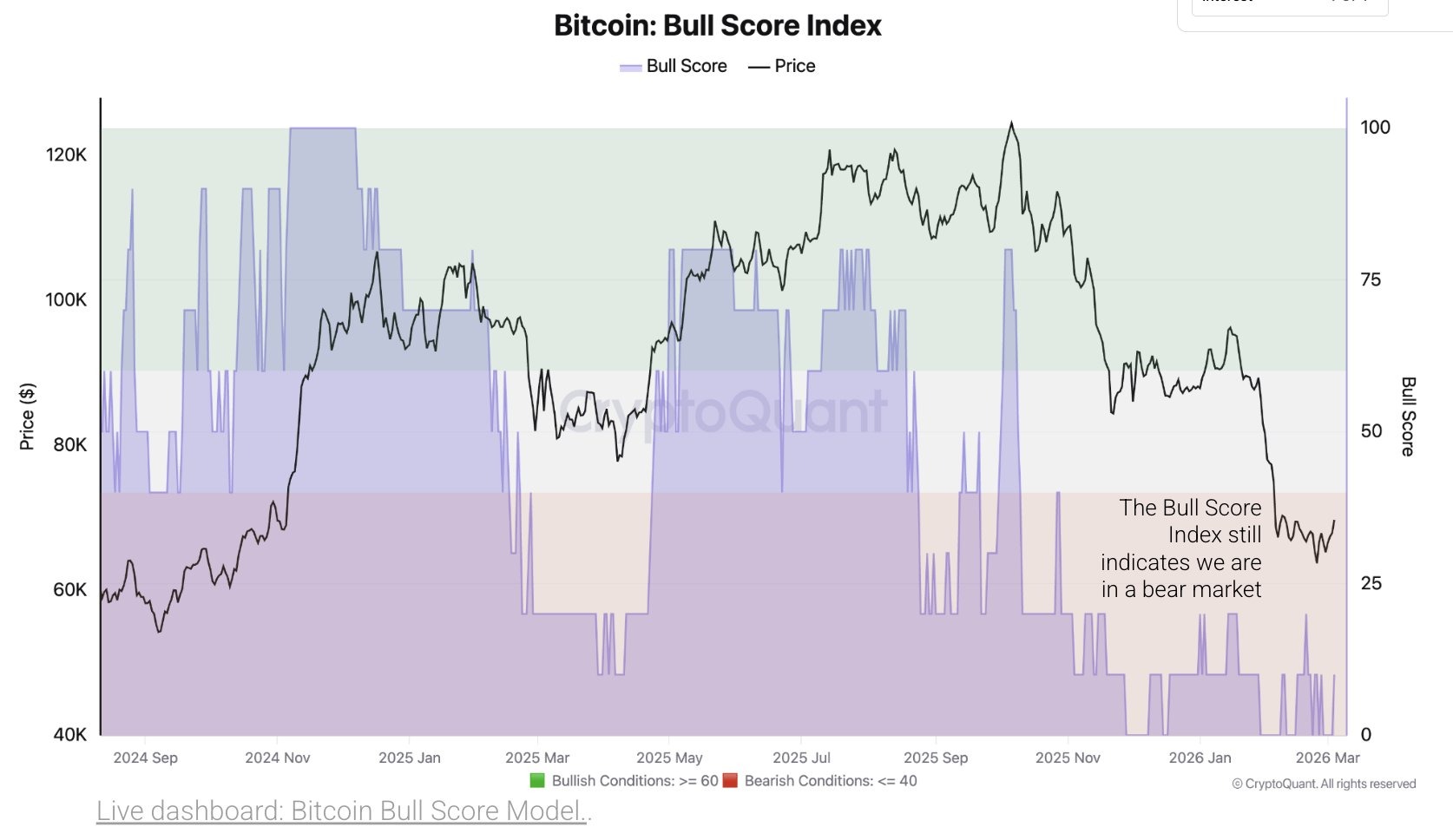
Bitcoin staged a brief relief rally above $74,000 on Thursday, but it has already petered out as analysts predict a persistent bear market will keep momentum subdued.
“Bitcoin is still in a bear market despite the recent rally,” on-chain analytics company CryptoQuant said on Thursday.
The platform’s Bull Score Index, a composite indicator that measures the overall health of Bitcoin (BTC) using a combination of fundamental and technical metrics, remains at 10 out of 100, “deep in bearish territory,” it said.
“Even after the recent price rally, fundamental and technical indicators still point to a bear market environment,” it stated.
“The current move is likely just a relief rally, not the start of a new bull phase.”
Bitcoin briefly tapped a one-month high of $74,000 on Coinbase on Thursday, touching the 50-day exponential moving average, according to TradingView. However, it has already lost more than $3,000, falling back below $71,000 during Friday morning trading.

Bitcoin still vulnerable to renewed downside pressure
Nick Ruck, the director of LVRG Research, told Cointelegraph that the crypto market’s recent relief rally came on “renewed risk appetite and ETF inflows,” but cautioned that the advance has “quickly faced headwinds with prices pulling back toward $71,000 amid persistent macro uncertainties and fading momentum.”
While the brief push provided a welcome relief rally amid supportive liquidity conditions, “ongoing bear market dynamics reinforce caution as softer macro signals, like the anticipated slowdown in February nonfarm payrolls, keep cryptocurrencies vulnerable to renewed downside pressure,” he said.

Bitcoin could see renewed buying interest
CryptoQuant said that a positive Coinbase Premium has signaled renewed US buying interest, driving the recent rally.
Related: Bitcoin slide slowing, but bear market still in play: Analysts
Bitcoin spot demand from US-based investors also switched from contraction to growth, as seen by the Coinbase Bitcoin Premium “switching from deeply negative territory in early February to the most positive since October,” they said.
Selling pressure from traders and long-term holders has also eased after unrealized losses reached levels not seen since July 2022.
Meanwhile, analysts at SwissBlock observed on Friday that “momentum is flashing a critical shift,” adding “We’re exiting peak negative momentum, the kind of transition that often precedes a regime change.”
Magazine: Would Bitcoin really be at $200K if not for Jane Street? Trade Secrets

PEI Licensing, the firm behind the clothing brand Original Penguin, has filed a lawsuit against the nonfungible token project Pudgy Penguins, alleging trademark infringement, dilution and unfair competition.
The lawsuit, filed in a Florida federal court on Wednesday, focused on claims around Pudgy Penguins’ apparel, accusing the company of using a “family of penguin trademarks that are confusingly similar” to its own.
“This action results from Defendant’s unauthorized use and attempted registration of various PENGUIN word and design trademarks in connection with apparel and related goods and services that are confusingly similar to PEI’s federally registered and famous PENGUIN and penguin design trademarks,” PEI said in its complaint.

PEI claimed in its lawsuit that it has used the “PENGUIN word mark at least as early as 1967” and first used a “penguin design” on apparel as early as 1956.
PEI Licensing said that it sent a cease and desist to Pudgy Penguins in October 2023, claiming its “products infringe and dilute PEI’s famous PENGUIN Marks.”
The letter also demanded that Pudgy Penguins abandon applications with the US Patent and Trademark Office “to register various PENGUIN marks,” according to the lawsuit.
PEI claimed that Pudgy Penguins had “misappropriated valuable property rights of PEI,” which was “likely to cause confusion or mistake, or to deceive members of the consuming public.”
PEI asked the court to order the USPTO to reject Pudgy Penguins’ applications and stop the company from allegedly infringing on its trademark.
Related: SEC ends case against Justin Sun with $10M settlement
It also requested that Pudgy Penguins be ordered to destroy any products found “likely to be confused” with PEI’s trademarks and be awarded all profits from the sales of such products.
Pudgy Penguins’ legal chief, Jennifer McGlone, told Cointelegraph the company “was surprised by the action, particularly as both parties had been engaged in productive discussions to resolve this matter privately.”
McGlone said the company had advanced applications with the USPTO and was “confident that PEI’s claims lack merit. The trademarks in question are visually distinct and serve entirely different audiences and markets.”
“We have the utmost confidence that we will prevail as Pudgy Penguins has already secured multiple trademark application approvals from the USPTO covering the Pudgy Penguins brand and related marks,” she said.
Meanwhile, the Pudgy Penguins X account posted a meme implying that its brand bears no similarities with Original Penguin.

Magazine: Clarity Act risks repeat of Europe’s mistakes, crypto lawyer warns


City officials in Vancouver are recommending that councillors abandon a proposal to integrate Bitcoin into municipal financial strategy, dealing a potential blow to a high-profile initiative championed by Mayor Ken Sim.
Summary
- Vancouver city staff recommend council drop Mayor Ken Sim’s proposal to explore making the city “Bitcoin-friendly.”
- The motion previously sought to examine accepting Bitcoin payments and potentially adding the asset to municipal reserves.
- Officials cited regulatory limits, financial risks, and operational challenges as reasons to halt further work on the proposal.
Vancouver staff throw cold water on the mayor’s Bitcoin city proposal
According to a staff report prepared for the Vancouver City Council meeting on March 10, officials advised councillors not to proceed with the mayor’s earlier motion to explore making Vancouver a “Bitcoin-friendly city.”
The proposal originally directed city staff to examine whether the municipality could incorporate Bitcoin into financial operations, including accepting cryptocurrency payments for municipal services or potentially allocating a portion of city reserves to digital assets.
The report outlines concerns related to regulatory authority, financial risk, and operational feasibility, ultimately recommending that council take no further action on the motion.
Sim first introduced the proposal in December 2024, arguing that Bitcoin could help protect the purchasing power of municipal funds amid inflation and economic uncertainty. The motion also framed the initiative as a way to position Vancouver as a global hub for blockchain innovation.
However, city staff said the proposal raises significant legal and policy issues under current municipal frameworks. Existing legislation governing local governments in British Columbia does not currently allow municipalities to hold or transact in cryptocurrencies as part of their financial management strategies, according to the report.
The recommendation comes after months of debate over the risks and potential benefits of integrating digital assets into public sector finance. Critics have argued that the volatility of cryptocurrencies could expose taxpayer funds to unnecessary risk, while supporters have promoted Bitcoin as a potential hedge against inflation.
The report will now be considered by Vancouver’s city council, which must decide whether to formally drop the proposal or pursue further analysis despite staff concerns.
If adopted, the recommendation would effectively halt the mayor’s push to explore Bitcoin’s role in the city’s financial reserves and payment systems.
TLDR:
- Vitalik Buterin calls for radical Ethereum application redesign while protecting core network security guarantees.
- Ethereum founder says AI may replace traditional crypto wallets and reshape how users interact with blockchain apps.
- Privacy now ranks alongside censorship resistance and security as a foundational Ethereum network principle.
- Buterin urges developers to rethink DeFi, oracles, and layer-2 roles using a first-principles approach.
Ethereum co-founder Vitalik Buterin has urged developers to rethink how applications operate across the network.
He said Ethereum must remain firm on its core principles while exploring new approaches at the application layer. His comments point to changes in privacy, artificial intelligence integration, and decentralized finance design.
The remarks arrive as developers debate Ethereum’s long-term architecture and its relationship with emerging technologies.
Vitalik Buterin Pushes Ethereum Developers to Rethink Crypto Applications
Buterin said Ethereum must keep its fundamental properties intact despite rapid technological shifts. He listed censorship resistance, open source development, privacy, and security as non-negotiable network principles.
He warned against uncertainty around the base layer’s guarantees. According to his post on X, developers must maintain trustless verification tools such as light clients.
At the same time, he urged the community to adopt a more experimental approach to applications. Ethereum’s ecosystem, he said, should reconsider existing assumptions about user interfaces and platform design.
Artificial intelligence formed a central theme in his comments. Buterin suggested AI systems could replace traditional crypto wallet interfaces within a year.
He noted that AI tools may reshape how users interact with blockchain software. Instead of discrete applications, AI agents may guide users through a continuous interaction layer.
According to Buterin, such changes could transform how developers build services on Ethereum. Applications may become modular systems that users assemble dynamically.
Ethereum Privacy and Layer-2 Strategy Take Center Stage
Buterin also emphasized the importance of privacy across Ethereum’s application stack. He said the ecosystem increasingly treats privacy as a core security property.
That shift could lead developers to rebuild large parts of the Ethereum software stack. Current infrastructure rarely prioritizes privacy at every layer.
He also pointed to growing work around private networking technologies. Several Ethereum Foundation initiatives focus on improving privacy across network communications.
Decentralized finance design also appeared in his discussion. Buterin suggested some DeFi systems could evolve into universal futures markets built on reliable decentralized oracles.
He proposed that oracles could combine cryptographic proofs with artificial intelligence models. These systems may verify data from trusted news sources using privacy-preserving technologies.
The Ethereum founder also encouraged the community to reconsider the role of layer-2 networks. He said developers should reassess which L2 designs best complement Ethereum’s base layer.
Buterin framed the discussion as a broader cultural shift within the ecosystem. Developers, he said, should challenge existing assumptions and rebuild applications from first principles.
TLDR:
- Solana’s TPV rose 755.3% YoY, nearly tripling the 268.24% median rate among fintech and L1 peers.
- Visa’s USDC pilot on Solana surpassed $3.5B in annualized volume; Worldpay cut processing times by 50%.
- Western Union’s USDPT stablecoin launches in 2026 to replace pre-funded accounts for 500K+ agents.
- Huma Finance hit $8.9B in transaction volume in 2025, replacing SWIFT with 24/7 onchain settlement.
Solana’s payments ecosystem posted explosive growth in the past year.
Total Payment Volume on the network climbed 755.3% year-over-year, according to a new Messari report. That figure nearly triples the median growth rate of 268.24% recorded across comparable fintech and blockchain platforms.
Global financial heavyweights, including Visa, Stripe, Worldpay, and Western Union, now use Solana as a live settlement layer.
Institutional Giants Bet on Solana’s Payment Rails
The institutions moving onto Solana are not experimenting quietly. Visa’s USDC pilot on the network has already surpassed $3.5 billion in annualized volume.
Worldpay cut its processing times by 50% after adopting the Global Dollar Network, known as USDG, for settlement. Solana hosts 57% of all USDG issuance, reflecting the network’s capacity to handle high-frequency institutional flows.
Fiserv, which processes payments for roughly 10,000 financial institutions globally, announced its own stablecoin on Solana called FIUSD. The move targets both its banking clients and merchant network.
Western Union is also building directly on the chain. The company plans to launch a stablecoin called USDPT in 2026, aiming to eliminate pre-funded accounts and cut international transfer costs for its 500,000-plus retail agents worldwide.
Stripe and Revolut are also part of the expanding ecosystem flagged in the Messari report.
PayPal’s dollar-backed token, PYUSD, reached a market cap of $834.7 million on Solana as of February 2, 2025. That marked a 500.9% year-over-year increase, driven by merchant integrations and a 4% reward rate offered to users.
Gusto launched a pilot in January 2026 to send instant USDC payouts to contractors for over 400,000 businesses. The integration, built with Zero Hash, targets the 11% of U.S. small and midsize businesses that hire international workers.
Traditional wire transfers take three to seven days. Solana settles in milliseconds.
Why Solana’s Infrastructure Attracts High-Volume Payments
The network’s technical profile explains much of the institutional interest.
Solana’s median block time sits at 392 milliseconds, with a median transaction fee of $0.0004, per the Messari data. That combination makes it viable for high-frequency, low-margin payment use cases that legacy rails cannot handle economically.
Legacy systems like SWIFT and ACH were built before the internet and depend on correspondent banking chains.
Settlement delays of multiple days trap trillions in pre-funded accounts globally. Solana merges messaging and settlement into one atomic step, removing that intermediary layer entirely.
Huma Finance recorded $8.9 billion in transaction volume during 2025, a 232% year-over-year jump.
Following its merger with Arf, the protocol originated $3.8 billion in onchain credit. It now replaces SWIFT settlement for global business payments with 24/7 stablecoin transfers.
Solana also hosts state-backed stablecoin pilots from Wyoming, Kazakhstan, and Bhutan. The Messari report places the network at the center of a payments stack that spans neobanks, digital wallets, treasury tools, and cross-border infrastructure.
AI Summary
- The blog post discusses the shift in the gaming industry towards metaverse gaming platforms, which offer persistent virtual ecosystems where players interact, trade assets, and participate in shared economies.
- Unlike traditional games, metaverse platforms operate as continuous worlds that evolve even when players are offline.
- The post details the key characteristics and components of metaverse gaming platforms, including the necessary technology stack for development.
- It emphasizes the importance of NFT integration, infrastructure requirements, monetization strategies, and enterprise use cases for metaverse platforms.
- The post also explores emerging trends in metaverse gaming platform development, such as interconnected ecosystems, AI-driven environments, creator economies, cross-platform accessibility, and tokenized digital ownership.
The gaming industry is moving beyond standalone titles toward persistent virtual ecosystems. Modern players expect digital ownership, interconnected worlds, and evolving economies that extend far beyond a single gameplay session. This shift is driving demand for metaverse gaming platform development.
Unlike traditional games, metaverse gaming platforms operate as persistent digital environments where users interact, trade assets, build communities, and participate in shared economies. These platforms require robust infrastructure, carefully designed architecture, and secure systems for asset ownership.
For enterprises and gaming studios entering this space, building a metaverse gaming platform is not simply about creating a game. It involves designing scalable ecosystems that support thousands or even millions of users interacting in real time.
Understanding the architecture and NFT integration behind these platforms is essential for building sustainable metaverse ecosystems.
Why Metaverse Gaming Platforms Are Different from Traditional Games
Traditional games are typically session-based experiences. Players log in, complete objectives, and exit the game environment. Metaverse gaming platforms, however, function as persistent worlds that continue evolving even when individual players are offline.
This difference introduces new technical requirements.
Metaverse platforms must support continuous interactions between users, assets, and virtual environments. They also enable economic activities such as asset trading, virtual land ownership, and NFT-based collectibles.
As a result, the development approach shifts from building isolated game mechanics to designing interconnected digital ecosystems. Key characteristics of metaverse gaming platforms include:
- Persistent virtual environments
- Player-driven economies
- Digital asset ownership
- Social interaction layers
- Interoperable game assets
- Continuous platform evolution
These features require specialized metaverse gaming platform architecture capable of supporting complex interactions at scale.
Core Components of a Metaverse Gaming Platform
A successful metaverse gaming platform is built on multiple interconnected systems working together to support gameplay, economy, and infrastructure. Important components include:
1. Virtual World Engine
This is the environment where players interact. It includes world-building tools, physics engines, and rendering systems that create immersive digital spaces.
2. Multiplayer Interaction Systems
Metaverse platforms must support thousands of concurrent users interacting within the same environment. Real-time networking infrastructure ensures smooth communication between players and servers.
3. Asset Management Systems
Digital items such as avatars, skins, equipment, and virtual land must be securely stored and transferable between players.
4. Economy and Marketplace Infrastructure
Virtual marketplaces enable players to trade assets, purchase upgrades, and participate in digital economies.
5. Identity and Authentication Systems
User identity management is critical for secure ownership of assets and personalized gameplay experiences.
Each of these components contributes to the stability and scalability of a metaverse gaming platform.
Metaverse Gaming Platform Architecture
Building a scalable metaverse platform requires layered architecture designed to manage both gameplay and blockchain interactions. A typical metaverse gaming platform architecture includes the following layers:
1. Experience Layer
This is the player-facing interface that includes:
- Game clients (mobile, PC, web)
- User interface systems
- Avatar customization
- Social interaction features
It is responsible for delivering immersive gameplay and seamless user interaction.
2. Game Logic Layer
The game logic layer controls gameplay mechanics, rule enforcement, and interaction logic. This includes:
- Quest systems
- Progression mechanics
- Player interactions
- Game physics
- Event triggers
Efficient game logic design ensures fair gameplay and consistent performance.
3. Blockchain Integration Layer
Blockchain infrastructure enables secure digital ownership within the metaverse ecosystem. Key components include:
- Smart contracts for asset ownership
- NFT minting systems
- Token-based reward mechanisms
- Wallet integration
This layer ensures that digital assets remain transparent, verifiable, and transferable.
4. Data and Infrastructure Layer
The infrastructure layer supports scalability and performance through systems such as:
- Distributed databases
- Cloud hosting environments
- Real-time communication servers
- Load balancing systems
Without reliable infrastructure, metaverse platforms cannot support large-scale user activity.
Planning to Build a Futuristic Metaverse Gaming Platform?
Technology Stack Used in Metaverse Gaming Platform Development
Metaverse gaming platform development requires a combination of game engines, blockchain infrastructure, cloud systems, and real-time networking technologies. The technology stack must support persistent virtual worlds, large-scale user interactions, and secure digital asset ownership. Choosing the right stack directly affects platform performance, scalability, and long-term sustainability. Below are the major technology layers commonly used in metaverse game development.
1. Game Engine and Rendering Layer
Game engines power the virtual environment, physics systems, and real-time graphics rendering of the metaverse platform. Common engines used include:
- Unity – widely used for cross-platform metaverse environments
- Unreal Engine – ideal for high-fidelity immersive worlds
- WebGL-based engines – used for browser-accessible metaverse platforms
These engines enable the creation of interactive environments, avatar systems, and multiplayer experiences across multiple devices.
2. Blockchain Infrastructure Layer
Blockchain technology enables decentralized ownership and secure asset management within metaverse ecosystems. Some of the commonly used blockchain networks include:
- Ethereum – widely adopted for NFT ecosystems
- Polygon – lower transaction costs for gaming platforms
- BNB Chain – scalable infrastructure for Web3 gaming
- Avalanche – high-performance blockchain for gaming ecosystems
These networks support smart contracts, NFT minting systems, and tokenized digital economies.
3. NFT and Digital Asset Layer
NFT standards define how digital assets are created, stored, and traded within the metaverse platform. Typical implementations include:
- ERC-721 for unique NFT assets
- ERC-1155 for semi-fungible game items
- NFT metadata storage systems for asset attributes
- Decentralized storage solutions such as IPFS
This layer enables players to own and trade digital assets securely.
4. Backend Infrastructure Layer
Metaverse platforms rely on robust backend systems that support real-time player interactions and persistent environments. Important infrastructure components include:
- Cloud computing platforms (AWS, Azure, Google Cloud)
- Real-time multiplayer servers
- Distributed databases
- Content delivery networks (CDNs)
- Microservices architecture
These systems ensure stable performance even when thousands of users interact simultaneously.
5. Wallet and Identity Integration
Wallet systems allow players to authenticate, store assets, and perform transactions within the metaverse ecosystem. Typical integrations include:
- MetaMask
- WalletConnect
- Phantom
- Custodial wallet systems for simplified onboarding
Wallet integration must be designed carefully to ensure secure and frictionless user experiences.
6. Analytics and Economy Monitoring
Metaverse gaming platforms generate large volumes of behavioral and economic data. Analytics systems help developers monitor platform performance and maintain balanced digital economies. Analytics tools are used to track:
- Player behavior patterns
- Asset trading activity
- Token circulation
- Gameplay engagement metrics
- Economic inflation within virtual marketplaces
These insights help developers continuously optimize gameplay mechanics and platform stability.
Why Technology Stack Decisions Matter
A poorly designed technology stack can lead to performance issues, security vulnerabilities, and limited scalability. Metaverse platforms must support persistent environments and complex interactions, making architecture decisions critical from the earliest development stages.
Experienced teams specializing in metaverse gaming platform development carefully evaluate technology choices based on platform requirements, scalability goals, and user experience considerations.
Selecting the right combination of game engines, blockchain networks, and backend infrastructure ensures that metaverse platforms remain stable as user communities grow.
NFT Integration in Metaverse Games
NFT integration in metaverse games plays a central role in modern platform development. NFTs allow players to own, trade, and transfer digital assets independently of centralized control. NFTs can represent various in-game elements such as:
- Character skins
- Weapons and equipment
- Virtual land parcels
- Unique collectibles
- Avatar identities
These assets can be bought, sold, or traded in decentralized marketplaces, creating real economic value within the game ecosystem.
From a development perspective, NFT integration requires careful planning to ensure that assets remain secure, scalable, and user-friendly. Smart contracts must be designed to prevent exploits, while wallet integration must be seamless for players unfamiliar with blockchain technology.
When implemented correctly, NFT systems enable sustainable digital economies within metaverse platforms.
Infrastructure Requirements for Persistent Virtual Worlds
One of the biggest challenges in metaverse gaming platform development is supporting persistent environments that remain active at all times. Infrastructure requirements typically include:
- High-performance cloud hosting
- Real-time communication servers
- Distributed storage systems
- Scalable database architecture
- Network latency optimization
These systems must handle large volumes of player interactions while maintaining stable performance. Metaverse platforms also require analytics pipelines to monitor user behavior, economic activity, and gameplay performance. This data helps developers optimize the platform and maintain balanced digital economies.
Want to Turn Your Game Idea Into a Metaverse Gaming Platform?
Monetization and Digital Asset Economy
Metaverse gaming platforms introduce new monetization opportunities that extend beyond traditional in-game purchases. Some of the common revenue models include:
- NFT asset sales
- Virtual land ownership
- Marketplace transaction fees
- Token-based reward systems
- Subscription or access models
Unlike conventional monetization models, metaverse economies are often partially controlled by the community, creating dynamic market behavior within the platform. Designing sustainable economic systems is one of the most complex aspects of metaverse platform development.
Enterprise Use Cases for Metaverse Gaming Platforms
While the term “metaverse gaming” often evokes images of entertainment-focused virtual worlds, enterprises are increasingly exploring metaverse platforms as interactive environments for engagement, branding, and digital commerce.
Metaverse gaming platforms combine immersive gameplay with persistent digital environments, making them valuable tools for organizations seeking new ways to interact with audiences. Common use cases include:
1. Virtual Brand Worlds
Brands are launching immersive environments where users can explore virtual spaces, interact with branded experiences, and purchase digital collectibles.
These environments often function as digital extensions of real-world brands and communities.
2. Community-Driven Gaming Platforms
Gaming studios and startups are using metaverse platforms to create persistent worlds where communities can participate in events, competitions, and social activities. Players become long-term participants rather than temporary users.
3. NFT Asset Ecosystems
NFT-enabled metaverse platforms allow players to own unique digital items such as:
- Character skins
- Equipment
- Vehicles
- Virtual land
- Event access passes
These assets often have real-world trading value and can be transferred across marketplaces.
4. Virtual Economies and Creator Ecosystems
Some metaverse gaming platforms enable users to create and sell content within the virtual world. Players can design custom assets, build environments, and monetize their creations, creating self-sustaining digital economies.
For enterprises and studios, these models unlock new revenue streams and deeper engagement with user communities.
5. Security and Asset Protection
Security becomes a critical priority because players own digital assets with real value. Hence, metaverse gaming platforms must implement:
- Smart contract auditing
- Anti-cheat systems
- Fraud detection mechanisms
- Secure wallet integrations
- Data encryption protocols
A single vulnerability in smart contracts or infrastructure can compromise the entire digital economy of the platform. Professional metaverse game development teams incorporate security practices throughout the development lifecycle.
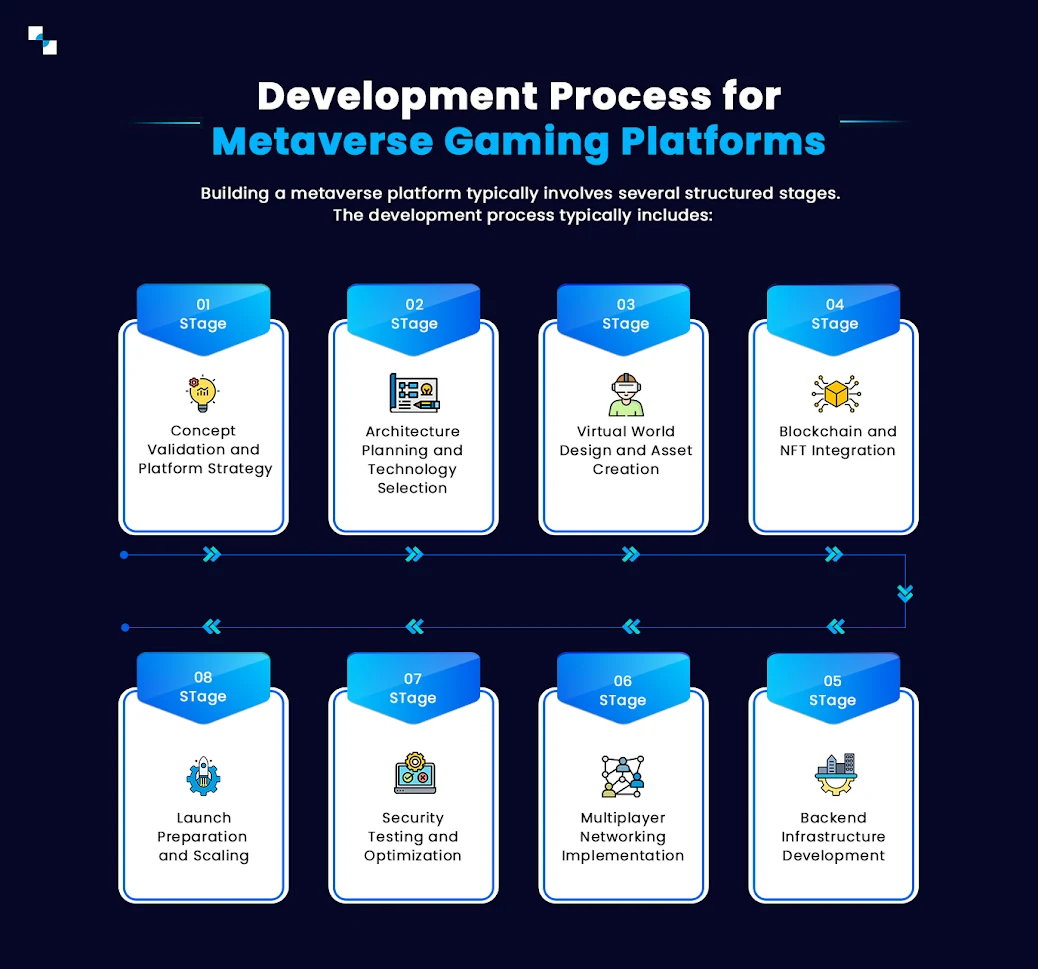
The Future of Metaverse Gaming Platform Development
Metaverse game development is still evolving. However, several emerging trends are shaping the next generation of virtual worlds.
1. Interconnected Metaverse Ecosystems
Future platforms are likely to enable interoperability between different metaverse environments, allowing assets and avatars to move across virtual worlds. This will create larger, interconnected digital ecosystems.
2. AI-Driven Virtual Environments
Artificial intelligence is increasingly being used to enhance player experiences through dynamic NPCs, personalized gameplay environments, and adaptive virtual worlds. AI systems can help maintain engagement within persistent digital spaces.
3. Creator Economy Expansion
User-generated content is expected to become a major component of metaverse gaming platforms. Players will be able to create, sell, and monetize digital assets within platform marketplaces.
4. Cross-Platform Accessibility
Metaverse platforms will continue expanding across devices including:
- Mobile devices
- Desktop systems
- VR headsets
- XR environments
Cross-platform accessibility will help metaverse platforms reach broader audiences.
5. Tokenized Digital Ownership
NFTs and blockchain-based identity systems will continue to shape how players own and manage digital assets. These systems allow players to maintain control over their virtual identities and possessions across platforms.
As technology continues evolving, metaverse gaming platforms are expected to become more immersive, interoperable, and economically sophisticated. Organizations investing in metaverse gaming platform development today are positioning themselves at the forefront of this transformation.
Partnering with a top-rated metaverse gaming platform development company like Antier brings several years of experience and technological expertise to the table, ensuring successful results.
Why Businesses Partner with a Professional Metaverse Game Development Company
Metaverse gaming platform development involves multiple technical disciplines, starting from real-time networking to blockchain infrastructure. Most enterprises lack the internal teams required to manage these complexities.
Antier, an experienced metaverse game development company, allows businesses to access specialized expertise in architecture design, blockchain integration, and large-scale platform deployment. Antier’s professional development team helps organizations reduce technical risk while accelerating time-to-market.
For enterprises exploring the metaverse opportunity, partnering with experienced developers can make the difference between launching a basic virtual environment and building a fully functional digital economy.
Frequently Asked Questions
01. What distinguishes metaverse gaming platforms from traditional games?
Metaverse gaming platforms are persistent virtual environments that evolve continuously, allowing users to interact, trade assets, and participate in shared economies, unlike traditional games which are session-based and end when players log off.
02. What are the key characteristics of metaverse gaming platforms?
Key characteristics include persistent virtual environments, player-driven economies, digital asset ownership, social interaction layers, interoperable game assets, and continuous platform evolution.
03. What are the core components necessary for a successful metaverse gaming platform?
Core components include a virtual world engine, which encompasses world-building tools, physics engines, and rendering systems to create immersive digital experiences, along with interconnected systems that support gameplay, economy, and infrastructure.

The euphoric altcoin seasons where almost every cryptocurrency rises across the market are probably not coming back, says Bitwise investment chief Matt Hougan.
“I think that game is over. I think we’ll see a non-traditional altcoin season,” Hougan said in an interview on Wednesday. “An altcoin season that rewards assets with real-world traction and real-world application.”
“I don’t think we’ll see the sort of rising tide lifts all buckets where you rotate from Bitcoin to ETH to DeFi to NFT pictures of rocks.”
Hougan said future altcoin seasons could instead see the market “rerate” certain tokens, particularly those tied to what he described as “huge businesses.”
Altcoin season likely to be “more differentiated”
“I just think it’ll be more differentiated than previous altcoin seasons,” Hougan said.

Crypto traders typically expect, based on past cycles, that Bitcoin (BTC) would first reach new all-time highs, then capital will rotate into Ether (ETH) and then into altcoins, kicking off altcoin season.
As for Bitcoin, which recently fell as low as $60,000 in February, Hougan said it was “starting to bottom and trend higher.” Bitcoin is trading at $70,237 at the time of publication, according to CoinMarketCap.
Altcoin season debate continues
The altcoin season debate has divided the crypto industry, with crypto analyst Matthew Hyland saying in November that traders should have confidence in an altcoin season arriving soon, citing the Bitcoin dominance chart as “bearish for many weeks.”
Related: 38% of altcoins near all-time lows, worse than FTX crash: Analyst
In December, BitMEX co-founder Arthur Hayes said, “There is always an altcoin season happening.”
“[If you’re] always saying altcoin season isn’t there, [it’s] because you didn’t own what went up,” Hayes said.
Crypto sentiment platform Santiment said on Wednesday that mentions of altcoins on social media reached their lowest level in two years, while indicators suggest investors are focusing on Bitcoin.
Magazine: Bitcoin may face hard fork over any attempt to freeze Satoshi’s coins
Beacon Energy completes LNEnergy acquisition, shares resume trading

How to Optimize Company Operational Costs: A Manual on Modern Payment Ecosystems

Jets trade Luke Schenn, Logan Stanley to Sabres


-

 Politics3 days ago
Alan Cumming Brands Baftas Ceremony A ‘Triggering S**tshow’
-

 Fashion7 days ago
Weekend Open Thread: Iris Top
-

 Tech5 days ago
Unihertz’s Titan 2 Elite Arrives Just as Physical Keyboards Refuse to Fade Away
-

 NewsBeat5 days ago
Abusive parents will now be treated like sex offenders and placed on a ‘child cruelty register’ | News UK
-
 NewsBeat6 days ago
Dubai flights cancelled as Brit told airspace closed ’10 minutes after boarding’
-
Sports6 days ago
The Vikings Need a Duck
-
 NewsBeat6 days ago
The empty pub on busy Cambridge road that has been boarded up for years
-

 NewsBeat5 days ago
‘Significant’ damage to boarded-up Horden house after fire
-

 Tech1 day ago
Bitwarden adds support for passkey login on Windows 11
-

 Entertainment4 days ago
Baby Gear Guide: Strollers, Car Seats
-
 Sports13 hours ago
499 runs and 34 sixes later, India beat England to enter T20 World Cup final | Cricket News
-
 Tech7 days ago
NASA Reveals Identity of Astronaut Who Suffered Medical Incident Aboard ISS
-
Politics5 days ago
FIFA hypocrisy after Israel murder over 400 Palestinian footballers
-
 NewsBeat5 days ago
Emirates confirms when flights will resume amid Dubai airport chaos
-

 NewsBeat4 days ago
Is it acceptable to comment on the appearance of strangers in public? Readers discuss
-

 Tech5 days ago
Viral ad shows aged Musk, Altman, and Bezos using jobless humans to power AI
-

 Video4 days ago
How to Build Finance Dashboards With AI in Minutes
-

 Business2 days ago
Guthrie Disappearance Enters Fifth Week as Family Visits Memorial
-
 Crypto World5 days ago
US Judge Lets Binance Unregistered Token Class Action Proceed
-
 NewsBeat4 days ago
Ukraine-Russia war latest: Belgium releases video showing forces boarding Russian shadow fleet oil tanker