
Crypto World
Cosmos Labs under fire over disclosure of bug affecting four blockchains



Cosmos Labs has faced backlash from across the crypto security community over its disclosure of a bug in its Cosmos EVM module which has led to issues on four blockchains.
Four networks using the module, MANTRA, TAC, KiiChain and Nesa, all appear to be affected by the bug, which was quietly patched last week.
The module’s developer, Cosmos Labs, was eventually forced to issue a warning over the incidents, advising that validators of affected networks “halt their chains.”
Read more: YZi Labs-backed BounceBit Chain shuts down after $3M exploit
The original disclosure, branded “negligent AF,” matches Cosmos’ policy of a “silent patch model.”
However, it appears that dissemination efforts of the fix were insufficient to avert the incidents on the aforementioned networks.
Although the release notes state that “this release contains important security fixes. We recommend all chains upgrade to this patch release as soon as possible using a coordinated upgrade,” there was no warning on Cosmos Labs’ official X account.
Protos has reached out to Cosmos Labs for details on any private disclosures, but hadn’t received a response by time of publication.
Read more: Saga becomes latest victim in DeFi hacking spree
Four blockchains affected
In advance of Cosmos Labs’ warning, both MANTRA and Nesa had advised of chain halts, with seemingly no user funds affected.
Two further networks, TAC and KiiChain, weren’t so lucky.
On August 22, KiiChain wallets were drained of a total of almost 150 million KII. The tokens were worth over $9 million at the time — in theory — however, the proceeds were dumped for just $1.6 million of BUSD, briefly crashing the token’s price.
KiiChain called the loss “avoidable” in a post mortem report to X, openly blaming Cosmos Labs’ disclosure process.
“Publishing a security fix in the open, before the chains running that code have been told privately and given time to patch, hands the vulnerability to anyone reading the commit,” it said.
The report also points to lack of advance notice, a failure to flag the update as critical and a delay in communicating the patch as contributing factors.
On the same day that KiiChain was exploited, Telegram-focused TAC network saw three billion TAC tokens, valued at around $7.5 million, drained from its staking contract.
In addition to this week’s chaos, another Cosmos EVM network, Saga EVM, lost approximately $7 million in January.
Got a tip? Send us an email securely via Protos Leaks. For more informed news and investigations, follow us on X, Bluesky, and Google News, or subscribe to our YouTube channel.


Better Mortgage and Coinbase have expanded their Bitcoin-backed mortgage option, moving it into general availability for eligible US homebuyers. The product is designed to let borrowers use Bitcoin as collateral for a down payment while keeping the primary home loan tied to a Fannie Mae-backed mortgage.
Announced Wednesday, the offering combines two linked loans: a Fannie Mae-backed home loan from Better and a separate down payment loan secured by Bitcoin. According to Coinbase’s Help Center, borrowers must pledge BTC worth at least 250% of the down payment loan amount, with the pledged Bitcoin transferred to Better’s custodial account on Coinbase Prime.
Key takeaways
- Better and Coinbase’s token-backed mortgage is now generally available to qualifying US borrowers.
- Borrowers pledge Bitcoin to secure the down payment loan, without having to sell BTC.
- Coinbase states Bitcoin price declines alone do not automatically trigger margin calls or mortgage term changes.
- Better may liquidate pledged BTC if a borrower is 60 days delinquent on payments.
- Eligible Coinbase One members can receive a Better rebate, subject to a $10,000 cap.
How the Bitcoin-collateral mortgage works
The structure is built around two synchronized components with shared repayment timing. Coinbase said both loans use the same interest rate and amortization term, and repayment occurs through a single monthly payment.
Once the mortgage is fully repaid or refinanced, the pledged BTC is returned, provided the loan terms are satisfied. Coinbase emphasized that the mortgage is not designed to reprice automatically based purely on Bitcoin volatility.
Specifically, Coinbase notes that declines in the BTC price by themselves do not trigger margin calls or change mortgage terms. The key exception is delinquency: if a borrower becomes 60 days past due on payments, Better has the ability to liquidate the pledged Bitcoin, according to Coinbase.
Eligibility and incentives for borrowers
Participation is limited to US residents with a verified Coinbase account, and borrowers remain subject to Better’s standard credit, income, and underwriting requirements. Coinbase also said the product is delivered through Better’s mortgage process, with BTC held in Better’s custody via Coinbase Prime.
Coinbase One members are eligible for a 1% rebate from Better, subject to a $10,000 cap. The rebate can be applied toward closing costs and fees, which may reduce upfront transaction expenses for qualifying borrowers.
Regulatory momentum behind crypto in mortgage underwriting
The rollout arrives during a period of increasing institutional attention to how digital assets could be treated within US mortgage risk models. In June 2025, the Federal Housing Finance Agency (FHFA) directed Fannie Mae and Freddie Mac to develop proposals to consider cryptocurrency held on US-regulated centralized exchanges as an asset in single-family mortgage risk assessments—without requiring that the crypto be converted to US dollars.
The FHFA directive also asked the enterprises to consider risk-mitigation measures tied to crypto’s volatility and to submit proposed changes to their boards for approval before the FHFA review process.
That direction is part of a broader shift in how lenders and regulators approach collateral quality and volatility. Rather than forcing borrowers to exit exposure to digital assets at origination, the emerging framework aims to evaluate crypto holdings directly, provided that volatility controls and governance are in place.
Other lenders moving—and what comes next for borrowers
Coinbase and Better are not the only players testing this approach. Mortgage lender and servicer Newrez announced in January that it would recognize certain cryptocurrency holdings in its mortgage application evaluations beginning in February, covering both home purchases and refinancing. The movement suggests that, while the specifics vary by lender, the market is increasingly experimenting with practical pathways for incorporating regulated crypto holdings into underwriting.
Housing affordability remains constrained even as crypto-linked collateral options expand. US housing price levels have stayed elevated by historical standards, even after some pullbacks: data compiled by the Federal Reserve Bank of St. Louis indicates the median sales price of a new US home was about $400,000 in 2026, using figures from the US Census Bureau and the US Department of Housing and Urban Development.
For investors and borrowers alike, the Better-Coinbase expansion is likely to be watched as an early test case for whether “hold-to-borrow” models can scale in mainstream mortgage workflows. Key uncertainties remain around how different volatility scenarios are handled across lenders, how regulators will evaluate risk-mitigation proposals, and whether more mortgage originators will follow Fannie Mae and Freddie Mac’s evolving guidance.

Switching to low-flow faucets, which use less water than older models, are “a low-hanging fruit,” says Helen Dahlke, professor of integrated hydrologic sciences at the University of California, Davis. “You can save several hundreds of gallons of water per year, and that will also show up on your water bill as a benefit.” When looking for a newer model, keep an eye out for products which have a WaterSense label, which meet EPA standards and can save up to 700 gallons per year.
Another tip: Check around your home for leaks, which can add up to a lot of wasted water over time.
“People would be surprised by how much water gets wasted due to leaks,” says Atkinson.
According to the EPA, household leaks waste more than 1 trillion gallons annually nationwide. That’s equal to the annual household water use of more than 11 million homes.
Where households use the most water
One of the biggest ways to save water is outside the home. The average homeowner uses 30% to 70% of their water outdoors—watering lawns, flowers and vegetables, the EPA estimates.
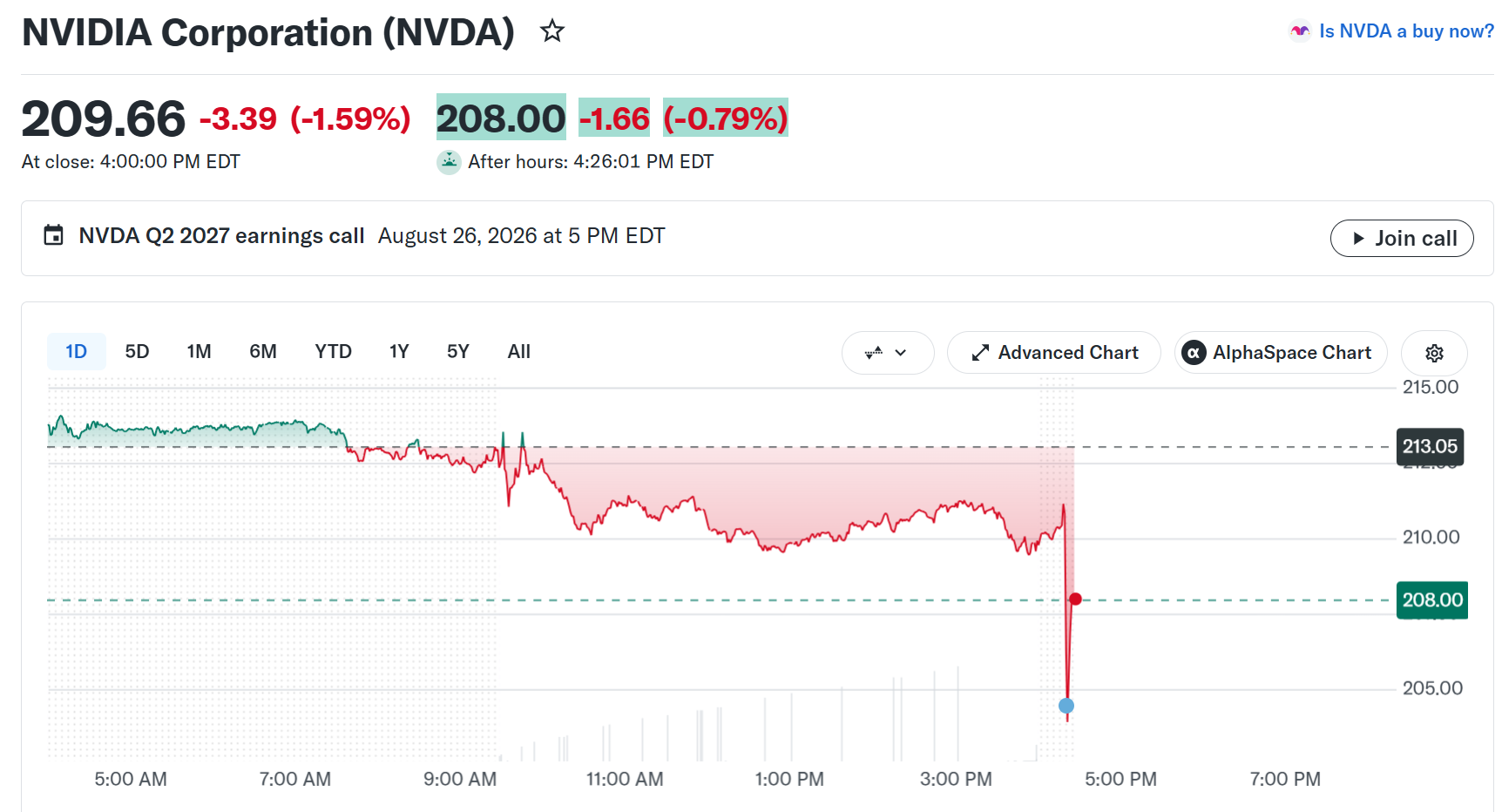
Nvidia’s Q2 earnings topped expectations on August 26, with revenue of $96.2 billion beating the $92.2 billion Wall Street estimate. The chipmaker guided the current quarter to $108 billion, yet Nvidia (NVDA) stock slipped in after-hours trading.
The company more than doubled its sales from a year earlier. Shares closed at $209.66, down 1.59%, then dipped toward $205 once the numbers landed, per Yahoo Finance data.

Nvidia Q2 Earnings Show a 106% Revenue Jump
Wall Street had braced for a monumental trading day with consensus near $92 billion. Nvidia cleared that bar by roughly $4 billion, while adjusted earnings per share (EPS) of $2.22 topped the $2.10 estimate.
Data Center revenue reached $89.0 billion against an $85.8 billion forecast, climbing 117% from a year earlier. Sales to hyperscalers, the largest cloud providers, hit $48.71 billion versus a $43.55 billion estimate.
That breadth eases concerns raised in the AI bubble debate over spending concentration among a few buyers.
Adjusted gross margin held at 75%, matching guidance. Adjusted net income climbed 118% to $54 billion, while free cash flow came in at $21.3 billion.
Q3 Guidance Clears the Whisper Bar
For the October quarter, Nvidia guided revenue to $108 billion, plus or minus 2%. That tops the $104.2 billion consensus. It also matches whisper numbers of $107 to $110 billion, the unofficial targets circulating among trading desks.
The outlook again assumes no Data Center compute revenue from China. Meanwhile, purchase commitments jumped from $119 billion to $279 billion, mostly tied to memory procurement. Gross margin guidance eased to 74%.
Nvidia also confirmed Vera Rubin, the successor to its Blackwell AI systems, is in full production. Racks are already running at partner sites.
“AI has reached its inflection point. It’s doing useful work. Its tokens are productive and profitable. Now, compute is revenue,” CEO Jensen Huang framed the demand backdrop in the company’s earnings statement.
Follow us on X to get the latest news as it happens
Why NVDA Stock Fell After the Beat
Despite the results, shares traded near $208 in extended hours, down about 0.8% from the close. Traders had warned of an earnings trap heading into the print. NVDA fell after each of its last four reports, even when results beat estimates.
Positioning had also turned cautious. The stock entered the report after a seven-session losing streak, while chipmakers showed matching triangle patterns that signaled indecision before the release.
Capital returns may cushion the reaction. Nvidia returned about $26 billion to shareholders during the quarter and still holds roughly $99 billion in buyback authorization.
The stakes stretch beyond one stock, as Nvidia and Micron together drive a third of Wall Street’s earnings growth. The earnings call will now decide whether the after-hours dip deepens or reverses. Commentary on memory costs and the Rubin ramp could set the tone for AI-linked assets into Thursday’s open.
The post Nvidia Q2 Earnings Reveal $96.2 Billion Beat, So Why Is NVDA Falling? appeared first on BeInCrypto.
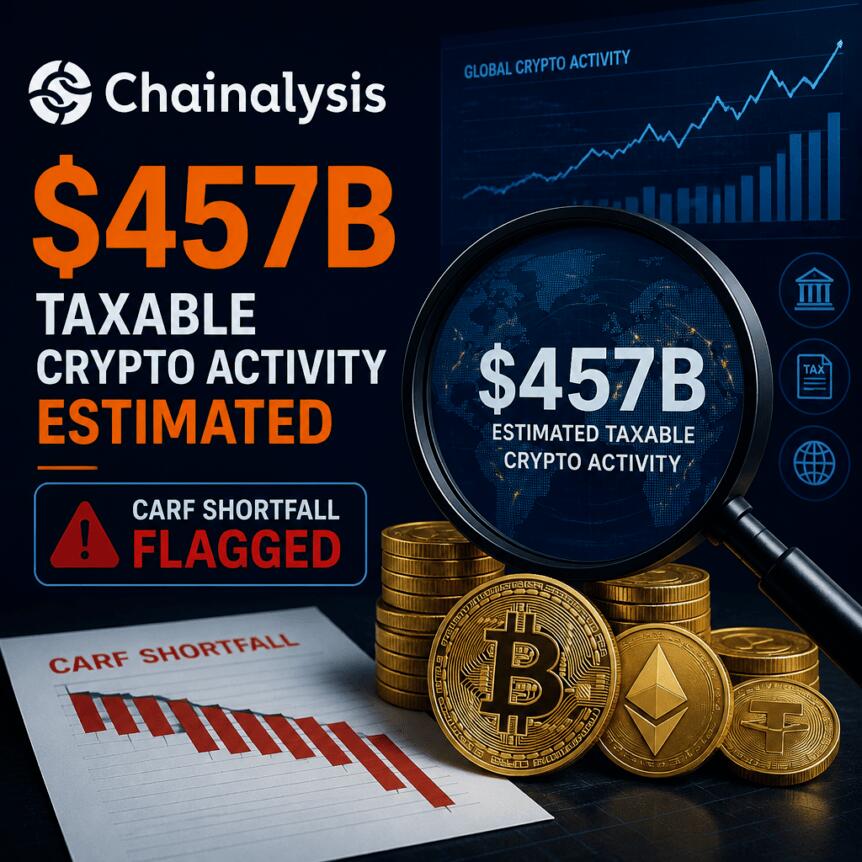
Crypto activity that could be taxable on-chain reached at least $457 billion worldwide in 2025, but the share likely captured by international tax reporting rules appears relatively small, according to a Chainalysis report on the OECD’s Crypto-Asset Reporting Framework (CARF).
Chainalysis estimates the United States accounted for $112.6 billion of that total, while North America led regions with $134.6 billion, followed by the European Union at $125.1 billion. The report also highlights a structural mismatch: CARF may cover only a limited portion of activity that taxpayers could potentially report.
Key takeaways
- $457 billion of potentially taxable on-chain crypto activity was identified globally in 2025, but CARF reportedly covers only 14% of it.
- CARF coverage begins in 2026, with reporting phased in across 48 jurisdictions.
- Chainalysis’ estimates include realized gains, crypto income (such as mining, staking, and lending), and crypto-denominated payments, but exclude trading on centralized exchanges.
- The gaps largely stem from CARF’s focus on centralized intermediaries—meaning much of DeFi may remain outside the reporting perimeter.
How much crypto activity could be taxable—and where it happens
Chainalysis’ analysis frames “potentially taxable” activity as on-chain events that can fall into common tax categories, including realized gains and income derived from blockchain activity. It also includes crypto-denominated payments—transactions where users may need to consider tax consequences even without traditional “trading” behavior.
Importantly, the report’s scope is not all crypto activity. Chainalysis states that its estimates cover activity across six major blockchains, but exclude trading and other activity performed within centralized exchanges. That means the $457 billion figure reflects an on-chain picture rather than a complete accounting of crypto taxation exposure.
Regionally, the data points to uneven concentration of taxable activity. The US estimate of $112.6 billion sits within North America’s higher total of $134.6 billion, and the European Union’s estimate of $125.1 billion underscores that the issue is cross-border rather than confined to a single market.
Why CARF may miss most of the taxable picture
Chainalysis says that transactions covered by CARF account for just 14% of the potentially taxable on-chain activity it identified, leaving an 86% gap. The report describes the uncovered portion as including activity on decentralized exchanges, peer-to-peer transfers, on-chain income streams, and crypto payments.
CARF itself was developed by the OECD and designed to reduce cross-border tax evasion by standardizing reporting obligations. Under the framework, covered crypto service providers gather customer-related information and report relevant transaction data to domestic tax authorities, which can then exchange that information internationally.
For investors, traders, and builders, the takeaway is not that taxes won’t apply outside CARF. Rather, it’s that the administrative mechanism to identify taxable activity—at least as implemented in CARF—likely won’t reach most on-chain behavior by default.
CARF coverage kicks in during 2026—48 jurisdictions included
Chainalysis reports that CARF data collection began on Jan. 1, 2026 across 48 jurisdictions, including major markets such as the United Kingdom and the European Union. As part of its onboarding requirements, covered platforms must collect additional information, including details about customers and their tax residency.
In practical terms, the framework is built around regulated intermediaries: crypto providers that operate within a compliance framework for customer due diligence and reporting. Tax authorities can then use those reports to identify potential liabilities and share relevant information across borders.
Still, Chainalysis’ estimates suggest that even with expanding CARF adoption, much of what users do on public blockchains—especially outside traditional custody and brokerage models—may not be captured.
DeFi’s structural problem: intermediaries are often absent
One reason CARF’s coverage is limited, according to Chainalysis, is that it focuses on crypto intermediaries. A key explanation came earlier from Colby Mangels, a former OECD adviser who worked on CARF. In January, Mangels told Cointelegraph that CARF was designed around the types of intermediaries that facilitate crypto transactions “as a business.”
Decentralized finance often lacks the centralized operator, custodial relationship, or clear business entity through which reporting requirements typically attach. In the absence of a responsible intermediary that regulators can compel to submit transaction reports, much DeFi activity may fall outside CARF’s reporting perimeter.
Mangels also pointed to a possible path forward: regulators may increasingly look to how DeFi platforms interact with anti-money laundering regimes and when DeFi operators could be treated as regulated crypto service providers. If that happens, the reporting boundary could expand over time—though it remains uncertain exactly when and how such rules will be applied in different jurisdictions.
For market participants, this evolving regulatory question matters because the current gap suggests that taxation compliance will remain uneven. Users interacting heavily through decentralized routes may face more reliance on self-reporting, while activity routed through covered centralized providers is more likely to be documented through standardized reporting channels.
Readers should watch how enforcement and rulemaking develop after CARF’s 2026 rollout: the biggest uncertainty is whether regulators will extend reporting obligations further into DeFi ecosystems, and whether AML-linked approaches will effectively bring more on-chain activity under a comparable reporting umbrella.

XRP is trading at a $1.40 price range after a run that saw the token outperform every other top-10 crypto asset by a wide prediction margin. A 50% surge, driven largely by Korean exchange turnover and heavy Binance positioning, put XRP back on trader radars this week.
However, overbought signals are flashing now, and the question now isn’t whether XRP rallied, but if it has anything left in the tank.
— Xaif Crypto (@Xaif_Crypto) August 21, 2026
 South Korean traders are coming back and $XRP is dominating the flow.
XRP/KRW is sitting at 623M in 24H volume, The volume surge across Upbit is being heavily driven by #1 XRP.  https://t.co/4Lkn3s3y7M pic.twitter.com/S8iSLddFTa
The move came on the back of a spike in exchange volume out of South Korea, paired with notable accumulation on Binance order books. One widely circulated chart this week showed XRP’s 14-day RSI pressing toward 87, a level that historically precedes a cooldown.
Zoom out, and the altcoin market is still digesting mixed signals: ETF flow data, regulatory clarity efforts under the CLARITY Act, and choppy macro liquidity are all fighting for influence over near-term price direction. XRP’s rally happened inside that noisy backdrop, which raises the stakes for what comes next.
Discover: The Best Crypto to Diversify Your Portfolio
XRP Price Prediction: Hit $1.60 This Week?
XRP sits at a tight range in the $1.40 area with intraday prints between $1.40 and $1.45. Volume remains elevated relative to XRP’s monthly average, a residual effect of the Korea/Binance-driven surge, though it’s cooling.
The token is testing a dense technical zone: $1.42 support (the 38.2% Fibonacci retracement) sits directly beneath the current price, with $1.36 as the next line of defense below that.
On the upside, $1.52 is the level bulls need to reclaim, a 23.6% Fib retracement that, if held, opens a path toward $1.64. Fail there, and the setup flips: a break below $1.42 risks a slide toward $1.36, then $1.31–$1.30.

- Bull case: XRP holds $1.42, reclaims $1.52, retests $1.64.
- Base case: Consolidation between $1.36–$1.52 as the RSI cools from overbought.
- Bear case: Loss of $1.42 sends price back toward the $1.00–$1.03 structural floor.
Traders watching the network activity data alongside these levels will get a clearer read on whether this rally has real legs or is running on exchange-driven momentum alone.
Trade XRP on Bybit and Get a Chance to Win Our $1,000 USDT Airdrop
LiquidChain Targets Early Mover Upside as XRP Tests Key Levels
XRP holders riding this rally are sitting on solid short-term gains, but a token already up over 40% with resistance stacked overhead at $1.52 and $1.64 isn’t exactly offering asymmetric upside from here.
The math gets less attractive the closer price creeps toward the top of its range, which is exactly when rotation capital starts hunting earlier-stage plays.
Writing the next layer into existence. — LiquidChain (@getliquidchain) August 14, 2026
 https://t.co/vqvBcdSQYC pic.twitter.com/nOCpXbl30D
LiquidChain ($LIQUID) is positioning itself as the connective tissue for a market that’s still fractured across chains. Its pitch: a Layer 3 infrastructure that fuses Bitcoin, Ethereum, and Solana liquidity into one execution environment, letting developers deploy once and reach all three ecosystems instead of building separate integrations.
The presale is currently priced at $0.01494, with $950K raised so far. Standout features include Single-Step Execution and Verifiable Settlement, both aimed at cutting the friction that’s plagued cross-chain liquidity for years.
Research LiquidChain directly before the presale closes.
Discover: The Best Token Presales
The post XRP Price Prediction: Korea and Binance Power the Rally, But Can XRP Keep Going? appeared first on Cryptonews.
Crypto World
TxFlow L1 Strengthens Its Infrastructure with OpenZeppelin Audit as Its On-chain Ecosystem Expands

Independent OpenZeppelin review of TxFlow’s bridge contract marks another step in TxFlow’s approach to security as its L1, DEX, and builder ecosystem continue to develop.
TxFlow announces the completion of an independent security audit by OpenZeppelin, one of the world’s most established blockchain security firms, trusted by major organizations and protocols including Coinbase, the Ethereum Foundation, Uniswap, Aave, Arbitrum, ZKsync, Compound, and others.
OpenZeppelin’s review covered TxFlow’s bridge contract, a critical component of the infrastructure supporting the movement of capital between external networks and TxFlow L1. OpenZeppelin’s review identified zero critical and zero high-severity findings. One medium-severity finding was identified and resolved during the audit process.
The independent review forms part of TxFlow’s broader approach to incorporating external security expertise as its financial infrastructure and ecosystem continue to develop. Alongside TxFlow DEX and continued L1 development, TxFlow is also building Builder Code, with additional details to be announced as both initiatives move closer to release. Together, these developments support TxFlow’s broader objective: to build a Layer 1 designed specifically for financial markets, bringing trading, liquidity, and financial applications onto one blockchain where all finance happens.
Security at TxFlow L1 is a continuous responsibility: An Independent Review by OpenZeppelin
As part of this commitment, we work with leading independent security experts to rigorously assess our infrastructure. In 2026, OpenZeppelin completed a security audit of Bridge2, the USDC bridge connecting Arbitrum One to TxFlow L1. TxFlow aims to continue to strengthen its security architecture, monitoring, and operational safeguards as the network evolves. The audit report provides the technical scope, findings, and assessment from OpenZeppelin and is available for the community to review directly.
TxFlow’s broader bridge infrastructure supports deposits and withdrawals across Arbitrum One, Ethereum, Base, Polygon PoS, and Solana. TxFlow’s documented bridge flow includes controls around the movement of funds, including validator-approved withdrawals and a built-in safety wait before withdrawals are completed.
These controls form part of TxFlow’s approach to protecting one of the most important functions of financial infrastructure: the movement of capital between networks.
Global-Grade Security from the Ground Up
TxFlow is building its security program with the standards expected of serious financial infrastructure in mind. To support that approach, TxFlow engaged OpenZeppelin, one of the world’s most established blockchain security firms. OpenZeppelin has completed more than 900 security audits, identifying more than 10,000 issues, including 700+ critical and high-severity vulnerabilities, across blockchain protocols and financial infrastructure.
Its security work spans major crypto organizations and ecosystems including Coinbase, the Ethereum Foundation, Uniswap, Aave, Arbitrum, ZKsync, Optimism, and Compound, as well as established financial institutions and infrastructure providers including DTCC, Fidelity Digital Assets, WisdomTree, ANZ, and CACEIS.
For TxFlow, working with globally recognized security specialists at an early stage establishes a clear approach: independently review critical infrastructure as the network and ecosystem grow. Security is not an add-on to financial infrastructure. It is part of the infrastructure itself.
Building Infrastructure for On-chain Finance
TxFlow L1 is designed specifically for financial markets and applications.
TxFlow DEX, a fully on-chain central limit order book for perpetual markets, is the first application built on TxFlow L1. The DEX is the first product operating on a broader infrastructure layer. TxFlow L1 is designed to support multiple financial applications and markets on the same network, including perpetuals, spot markets, prediction markets, and new categories of on-chain financial products. Through TxFlow Improvement Protocol (TIP) Liquidity Standards, Channels can connect to common execution, settlement, and liquidity infrastructure rather than operating as isolated applications.
For traders, that means infrastructure designed around markets from the start.
For builders, it creates a foundation for developing new financial applications on a network designed for trading, liquidity, and settlement.
What’s Next: Builder Code
Alongside continued development of TxFlow L1 and TxFlow DEX, the team is building two new ecosystem initiatives: TxFlow Builder Code.
Builder Code is being developed to expand how builders and ecosystem participants can contribute to and grow alongside the network. For the TxFlow community, these initiatives represent the next stage of ecosystem growth: more ways for traders to participate, more ways for builders to contribute, and more activity across the TxFlow network.
About TxFlow L1
TxFlow L1 is a high-performance blockchain built for on-chain financial infrastructure, organized around TIP Liquidity Standards that define how financial products are built, composed, and settled on-chain. TxFlow DEX is the first Channel on TxFlow L1, a CLOB orderbook DEX for perpetual trading, processing over 250,000 TPS with one-block finality. Through its TxFlow Improvement Protocol standards and Channel architecture, TxFlow enables spot markets, derivatives, prediction markets and future financial products to operate on the same chain while connecting to shared execution and settlement infrastructure where all finance happens. TxFlow L1 is building an open, composable and community-owned financial ecosystem in which each new application can strengthen the infrastructure available to those that follow.
About OpenZeppelin
OpenZeppelin is a leading security partner for on-chain finance, trusted by organizations including DTCC, Fidelity Digital Assets, WisdomTree, Coinbase, Uniswap, Aave, and the Ethereum Foundation. Since 2015, OpenZeppelin has secured more than $35 trillion in value transferred and delivered 900+ security engagements, surfacing more than 10,000 vulnerabilities across critical on-chain infrastructure. Its open-source smart contract libraries are an industry standard used across leading stablecoins, tokenized assets, and blockchain applications.
Learn more about TxFlow:
The post TxFlow L1 Strengthens Its Infrastructure with OpenZeppelin Audit as Its On-chain Ecosystem Expands appeared first on BeInCrypto.
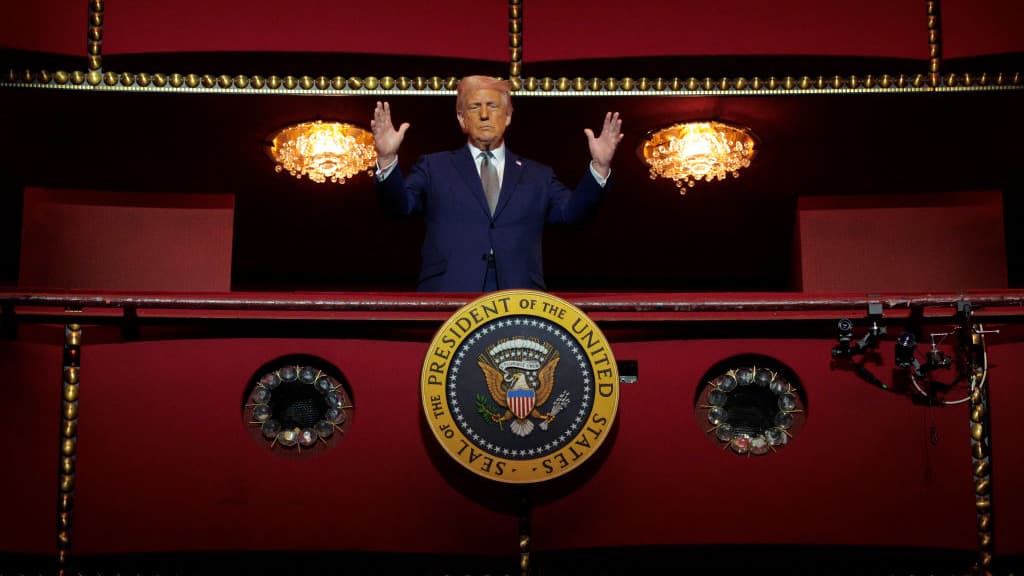
The filing suggested that the building could be replaced by a large outdoor amphitheater overlooking the Potomac River. The lawyers said that “such a replacement will fail to adequately honor President John F. Kennedy, but would be simpler and more economical to build, operate, and maintain.”
The filing marks an unusually explicit reference by the Trump Administration to the possibility of demolishing the venue, which first opened its doors in 1971 as a living memorial to President John F. Kennedy, who was assassinated in 1963.
How the fight over the Kennedy Center escalated to demolition threats
At the start of Trump’s second term, he overhauled the center’s governing board and replaced several members with allies. That board voted in December 2025 to rename the venue as the “Trump Kennedy Center.” In February, he also ordered the center to close for two years to make way for renovations.
In May, a judge ruled that only Congress could rename the center and temporarily blocked both the name change and the planned closure. The judge ordered Trump’s name removed from the building.
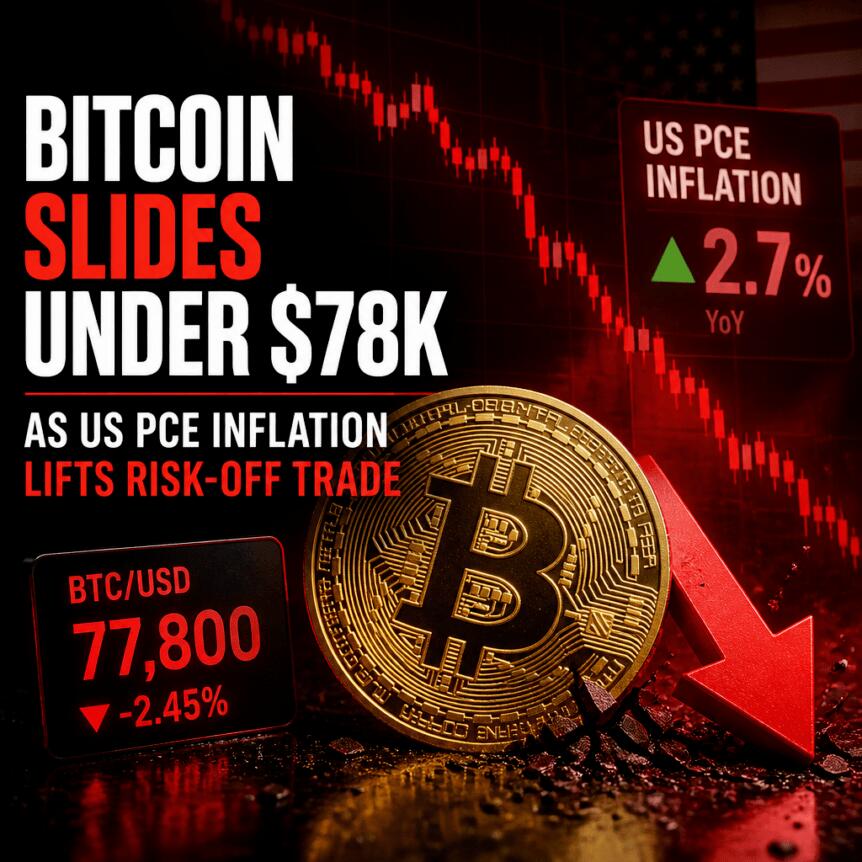
Bitcoin slipped below $78,000 shortly after the Wall Street open as US inflation data landed higher than expected, pushing risk assets lower and weighing on crypto sentiment. The move followed a stronger-than-forecast July Personal Consumption Expenditures (PCE) print—an inflation measure the Federal Reserve closely tracks—setting up a busy stretch for traders with additional catalysts later in the week.
With markets now parsing what the latest inflation signal could mean for the policy outlook, attention is also turning to Nvidia’s upcoming earnings release, widely viewed as a near-term driver of broader market volatility. Meanwhile, technical analysts are warning that recent strength may still fall short of a durable trend change.
Key takeaways
- July US PCE inflation came in above expectations, with the year-on-year rate at 3.7% versus 3.6% expected.
- BTC’s decline accelerated after the Wall Street open, aligning with weaker moves in US equities and gold breaking below $4,600 per ounce.
- Analysts are watching the August monthly close for confirmation or rejection of ongoing technical resistance themes.
- Traders are also looking ahead to Nvidia’s Q2 earnings as a potential volatility catalyst for risk assets.
July PCE surprises higher and pressures risk appetite
According to the Bureau of Economic Analysis’ official release, the July PCE price index increased 0.2% from the previous month, and the same 0.2% gain was reported for the core measure excluding food and energy. On the year, the headline PCE rate rose to 3.7%, edging above the 3.6% forecast.
TradingView data tracked intraday weakness of up to roughly 1% for BTC on the day as US markets opened lower. The same risk-off dynamic also showed up beyond crypto: the article notes US stocks were down at the open and gold dipped through $4,600 per ounce.
For investors, the key point is not only whether inflation is moving, but whether it is moderating quickly enough to influence expectations around monetary policy. The report highlights that markets had been reacting to June’s PCE slowdown—described as the first month-on-month decline in six years—so the July print reduced confidence that progress was continuing at the desired pace.
Commenting on the broader implication, trading resource The Kobeissi Letter said on X that US inflation remains “nearly double” the Federal Reserve’s 2.0% target, reinforcing the idea that the latest data did not offer immediate reassurance for rate-cut hopes.
Fed week ahead: inflation data before major policy messaging
The PCE release landed with the Federal Reserve’s annual Jackson Hole economic symposium approaching. The article notes that Fed chair Kevin Warsh is expected to deliver the keynote speech on Friday, which places a premium on how markets interpret the inflation trajectory into that event.
In practical terms, this means traders are likely to treat today’s data as an input into the policy narrative rather than a one-off market mover. If inflation readings stay stubborn, markets may scale back expectations for easing; if they ease further, pressure on risk assets could fade. Either way, the upcoming Fed communications increase the probability that volatility could rise again even if crypto’s move already reflects the immediate reaction.
Tech earnings on deck as Nvidia could set the tone
Beyond macro data, the article points to corporate earnings as the next plausible short-term driver for market behavior. It highlights Nvidia’s upcoming Q2 earnings release as a potential catalyst for risk-asset volatility.
While the piece does not claim new results, it cites expectations including quarterly revenue of $92.3 billion and notes that analysts at Raymond James forecast CPU revenue at Nvidia could grow from 3% to 5% of total by 2028, broadening its addressable market.
For crypto investors, Nvidia matters less for fundamentals inside the blockchain sector and more for how large-cap tech performance influences overall liquidity and risk appetite. If earnings are perceived as supportive, BTC could find follow-through buyers; if they disappoint, the broader de-risking impulse may continue to spill into digital assets.
BTC technical outlook: focus shifts to the August monthly close
After the pullback, market participants are increasingly turning to higher-timeframe technical levels rather than reacting to day-to-day candles. The article emphasizes an upcoming August monthly candle close as a key point for determining whether BTC can extend a rebound or whether it remains trapped within a broader downtrend structure.
Trader and analyst Rekt Capital warned that BTC/USD could continue forming “lower highs,” referencing a sequence that has been in place since October 2025. In an X post, he said that “a Monthly Close below the blue resistance” would not only confirm another “Macro Lower High,” but also build “confluent resistance” tied to a broader macro downtrend.
Rekt Capital also directed attention to the 50-week exponential moving average (EMA) near $77,251. The article notes that Bitcoin’s last monthly close above this level occurred in October 2025. In his view, maintaining a reclaim and hold around that trend metric would be necessary for the rebound to stop being categorized as merely a temporary “relief rally” within a larger bear market.
Notably, this framing sets up a clear debate for traders: whether recent upside is transitioning into a durable reversal, or whether the market is still only bouncing within a corrective regime. Because monthly closes carry more weight than intraday price action, this creates a well-defined checkpoint for bulls and bears alike.
The near-term downside pressure from macro data may not automatically invalidate technical bullish cases, but it increases the odds that resistance levels will be tested more aggressively before the month ends. In other words, the market is now balancing two competing forces—macro-driven risk sentiment and chart-driven trend confirmation.
Heading into the next sessions, traders should watch how BTC responds once the immediate PCE-driven reaction cools, whether Nvidia’s earnings shift broader risk appetite, and—most importantly—where Bitcoin’s price settles relative to the resistance and the 50-week EMA ahead of the August monthly close.

Acting alongside legends like Carol Burnett and Bernadette Peters, Curry cemented himself as a scheming villain, the type of role he would continue to play in movies like Home Alone 2, Muppet Treasure Island, and The Three Musketeers.
In a 2020 interview with Forbes, Curry reminisced on the experience: “Rooster was a hustler, and people love that kind of character,” he said. “He was a lot of fun.”
Clue
In the 1985 board game adaptation Clue, Curry played the energetic butler Wadsworth, where he showcased his physical comedy. One of the most memorable moments comes at the film’s end, when Wadsworth runs about the mansion, trying to summarize the night’s events and explain the identity of the killer.
Since his death, tributes from his Clue co-stars have poured in.
“What an unbelievable joy to have shared a sound stage with him and to engage with such a master talent,” Lesley Ann Warren, who played Miss Scarlet in the murder mystery movie, wrote. “I adored him.”


The group behind the Grand Theft Auto VI (GTA 6) leaks hit back at Rockstar Games within hours on Wednesday. It repeated its demand for physical discs and accused the studio of playing the victim.
CyberLeek, the account driving the leak campaign, posted its answer on X. The reply reignited a dispute that has run since June.
Rockstar Writes to Fans, But Skips the GTA 6 Physical Discs Question
Rockstar broke a week of silence on Wednesday with an open letter to its community. The studio called the leaks heartbreaking for its team. It apologized to fans for the long wait.
“It would be an understatement to say that having videos of Grand Theft Auto VI gameplay leak this way has been heartbreaking for our team, and this is obviously not how we intended for you to see the game after all this time.”
Rockstar Games, statement
The full Rockstar statement thanks supporters, confirms the Nov. 19 launch, and warns that spoilers may hurt the intended experience.
However, it never mentions discs and never names CyberLeek. That silence triggered the reply, which cast the studio as the aggressor rather than the injured party.
The group has released footage in daily batches since Aug. 18. Its demands include pressed discs for pre-orders and an offline fallback for single-player content.
It also wants an end to what it calls fake single-player expansions. That means content already sitting in the game files, locked until players pay again. CyberLeek says it will not stop until publishers apologize and commit to change.
Why the Ownership Fight Keeps Growing
Rockstar confirmed in June that boxed copies will hold a download code instead of a disc. Buyers therefore get a license, not a physical product. Take-Two chief executive Strauss Zelnick told analysts on Aug. 7 that discs no longer make sense for consumers.
Meanwhile, the wider industry is moving the same way. Sony will stop pressing game discs in January 2028. A PlayStation disc backlash petition has since gathered hundreds of thousands of signatures.
Still, the preservation movement itself has pushed back. Stop Killing Games, a campaign for continued access to purchased titles, rejected the leak tactics outright.
“Using illegal means to make a point is unacceptable to us and does nothing to protect our right to keep using what we paid for.”
Stop Killing Games, statement
Money clouds the protest further. CyberLeek also sells ad space inside its leak videos. Brands must send 400 Monero (XMR), worth roughly $172,000, just to open the conversation.
That fee buys no placement, only a reply. The privacy coin is trading near $431. A separate CyberLeek meme coin rally added 1,400% last week.
Take-Two has shed market value since the leak campaign started.
Netflix airs an extended GTA 6 look on Thursday, and Rockstar hopes official footage retakes the story. Whether that works or simply gives leakers a bigger audience becomes clear within days.
The post GTA 6 Leakers Demand a Physical Disc Release. Will Rockstar Accept? appeared first on BeInCrypto.
DAN HODGES: What my senior security sources are telling me about Russia’s alarming plans for Britain. Putin is determined to test Burnham… and this is how he’s going to do it

Top 10 Dynamics 365 partners in the UK for 2026

Better Launches Bitcoin-Backed Mortgages Using Coinbase Technology





-

 Fashion5 days ago
Weekend Open Thread: Madewell – Corporette.com
-

 Business4 days ago
Musk’s Tesla, SpaceX Confirm $16.8 Billion ‘Terafab’ Chip Plant as World’s Largest Building in Texas
-

 Crypto World21 hours ago
SpaceX stock could rise 75% to $240, JPMorgan says
-

 Crypto World5 days ago
anatomy of crypto’s biggest liquidation event since 2021
-

 Crypto World2 days ago
A $30 Billion AI Fund Implodes, Now the SEC Is Investigating Wall Street’s Role
-

 Politics4 days ago
6 months on, Irish renters crushed by effects of government housing bill
-
 NewsBeat5 days ago
The ‘Lucky Dip Gang’ causing carnage for clicks: After five thugs were killed speeding in the wrong direction on a motorway, GUY ADAMS investigates a sick new trend… and why police aren’t even allowed to pursue them
-

 Business3 days ago
Mystery AI Model ‘Ox Alpha’ Draws Developers With Free Access as Chinese Lab Origins Remain Debated
-

 News Videos7 days ago
Don’t Leave Your Financial Future To Chance | August 19, 2026
-

 Business6 days ago
Five Below: Kids Discount Retailer Reaps Rich Rewards
-

 Business2 days ago
Moderna CEO warns China is pouring state money into mRNA technology
-

 Crypto World18 hours ago
Did Trump Just Move SpaceX Stock With One Truth Social Post?
-

 Business5 days ago
UK firms in critical financial distress rise 9% to 53,756
-

 Business2 days ago
NVIDIA Stock Drops Nearly 2 Percent to $210 on Seventh Losing Day Ahead of Critical AI Earnings
-

 Sports4 days ago
Deshaun Watson fires back at Browns fans after being booed: ‘It’s a disrespectful thing’
-
 Entertainment7 days ago
10 Most Perfect Fantasy Shows of the Last 25 Years
-

 Crypto World6 days ago
Optimism-funded team's deciding vote shifts $49 million in OP tokens away from users
-

 Tech7 days ago
OpenAI confirms ChatGPT is down as logins and signups fail
-
 Crypto World3 days ago
Google Gemini AI Predicts Ethereum Could Become the Trade Retail Misses in 2026
-

 Business7 days ago
PayPal and Venmo now accepted for tuition at several universities
You must be logged in to post a comment Login