

Crypto World
Crossmint, Western Union to bring USDPT stablecoin to Solana



Western Union is moving deeper into blockchain payments with a new stablecoin initiative tied to the Solana network.
Summary
- Western Union partnered with Crossmint to support the USDPT stablecoin on Solana.
- The stablecoin will connect on-chain transfers with 360,000+ Western Union cash pickup points across 200+ countries.
- Anchorage Digital Bank will issue USDPT to support compliance and institutional access.
The company has partnered with Crossmint to support the rollout of USDPT, a U.S. dollar-denominated stablecoin that will operate on the Solana (SOL) ecosystem.
The collaboration was announced on March 4 by Crossmint and will connect the stablecoin to Western Union’s newly introduced Digital Asset Network, which links on-chain dollars to real-world cash access across its global payout infrastructure.
Stablecoin connected to Western Union’s payout network
USDPT was first revealed in October 2025, with a launch expected in the first half of 2026. The stablecoin will be issued by Anchorage Digital Bank.
Western Union’s Digital Asset Network links blockchain transfers with its global cash distribution system. Through the network, users can convert digital dollars into local currency using more than 360,000 collection points worldwide, spanning over 200 countries and territories.
Malcolm Clarke, Western Union’s vice president of digital assets, said the network connects digital wallets and platforms directly to the company’s payout infrastructure. Partners such as Crossmint provide the technology layer that allows these integrations to work across blockchain systems and traditional payment rails.
This setup allows stablecoin transactions to move on-chain while still connecting to familiar cash pickup services used in many remittance corridors.
Crossmint infrastructure supports wallets and fintech apps
Crossmint will integrate USDPT into its wallet infrastructure and payment APIs, allowing fintech platforms and developers to access the stablecoin through its existing tools.
Rodrigo Fernández Touza, co-founder of Crossmint, said the collaboration links digital dollar transfers with Western Union’s global payout network.
Developers using Crossmint’s APIs can build applications that send funds on Solana while offering recipients the option to collect cash through Western Union locations where available.
The system allows fintech apps to hold value in digital dollars, transfer funds instantly on-chain, and connect to Western Union’s payout network when users need local currency.
Solana’s fast settlement speeds and low transaction costs have made it a common choice for payment-focused blockchain applications, including stablecoin transfers and cross-border transactions.

Key Takeaways
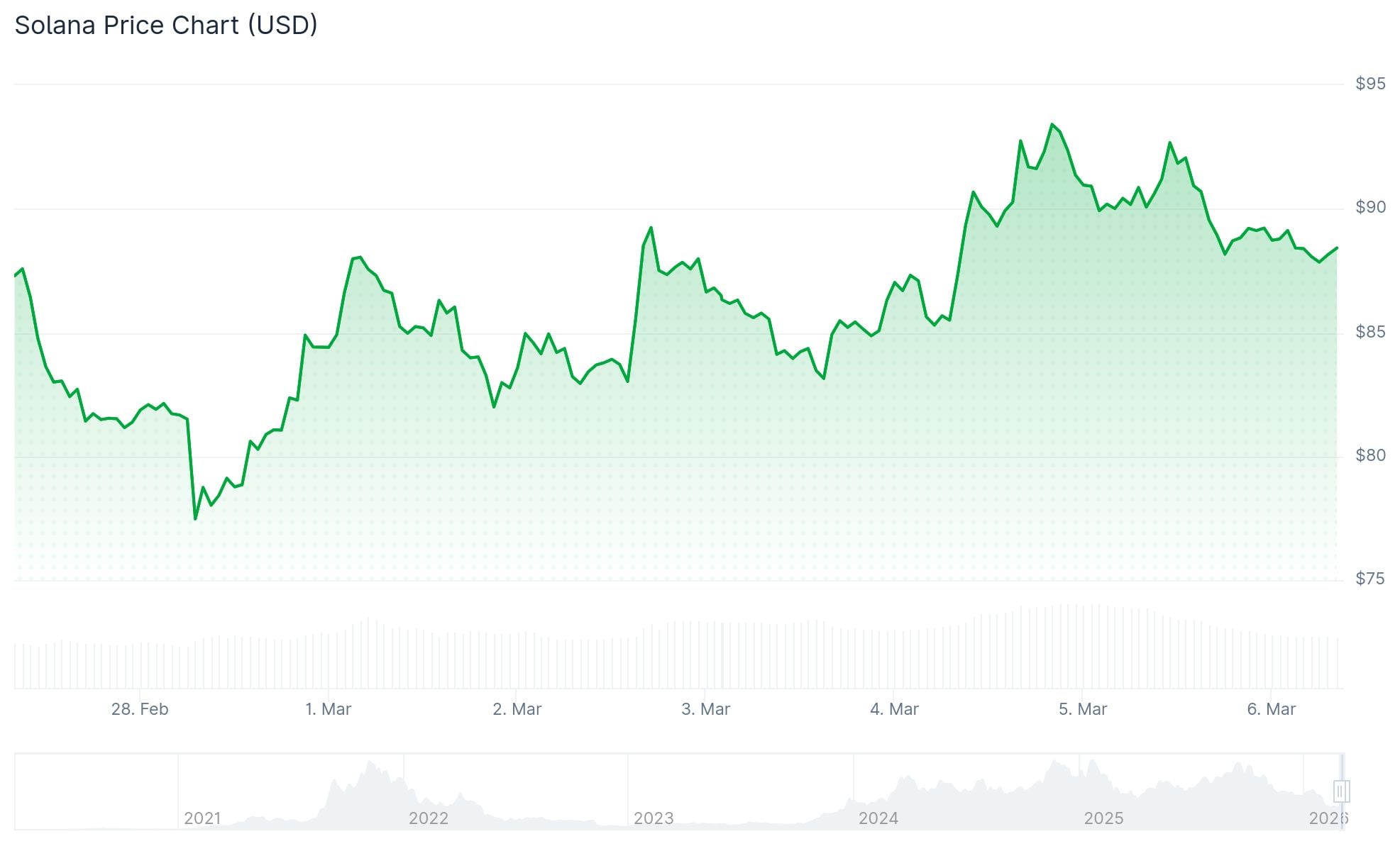
- SOL has declined 57% since US-based Solana ETFs debuted in July, currently trading around $88
- Despite price weakness, Solana ETFs have attracted $1.5 billion in net inflows with minimal redemptions
- Institutional investors account for 50% of total ETF capital inflows
- February 2026 saw Solana process a record-breaking $650 billion in stablecoin transactions
- The network now ranks second only to Ethereum in USDC supply across all blockchains
While Solana’s token price has experienced significant pressure since its exchange-traded fund launch in the US, underlying network metrics and capital flows paint a different picture.
The SOL token currently hovers around $88, representing a 57% decline from the July ETF launch price. The token has also retreated 70% from its January 2025 peak of $293, which occurred during a speculative memecoin trading frenzy.
Yet despite this substantial price deterioration, Solana-focused ETFs have accumulated $1.5 billion in net capital and retained nearly all of it, according to Bloomberg’s ETF specialist Eric Balchunas.
In a Thursday analysis, Balchunas highlighted that institutional investors represent 50% of total inflows, characterizing this as a “serious investor base.”
He emphasized that ETF products launching during such severe market downturns typically struggle to attract any capital whatsoever, and most funds would collapse if their underlying asset lost 57% of its value within the first six months of trading.
When normalized for relative market capitalization, Solana ETFs have effectively pulled in the equivalent of $54 billion in Bitcoin-adjusted terms—approximately double the comparative flow Bitcoin ETFs experienced at the same stage post-launch.
On Thursday, Solana ETFs experienced their first net redemption day in more than a month, with $6 million exiting the six available products. This followed a $19 million net inflow recorded Wednesday, based on CoinGlass tracking data.
Network Processes Unprecedented Stablecoin Activity
Beyond price movements, Solana’s blockchain infrastructure achieved a milestone $650 billion in stablecoin transaction volume throughout February 2026, as detailed in a Grayscale Investments research report.
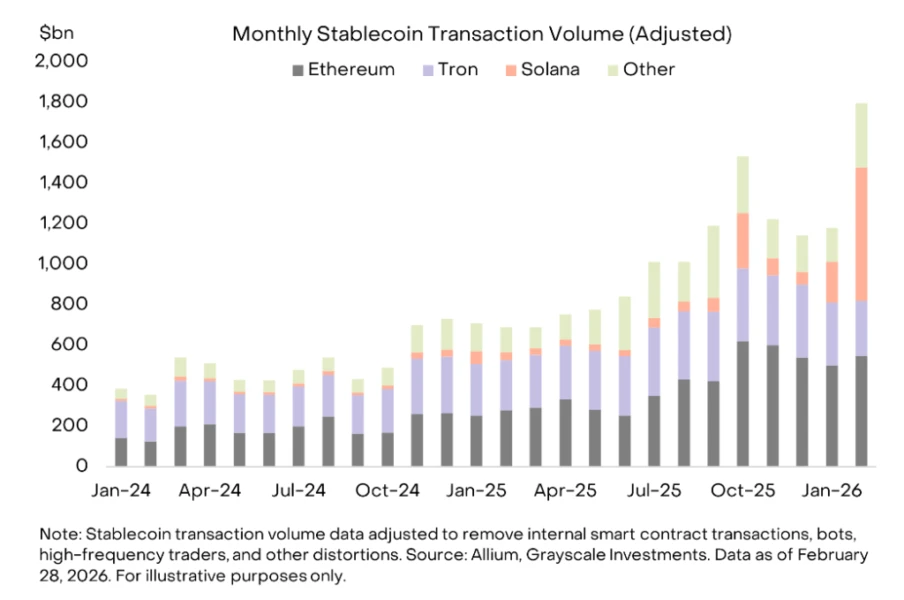
This represents the highest monthly stablecoin transaction volume ever documented on any blockchain network, accomplished within just 28 days. The figure more than doubled the previous record established merely four months prior in October 2025.
According to Grayscale’s analysis, this volume stemmed primarily from SOL-stablecoin trading activity and genuine payment transactions, rather than speculative memecoin speculation.
Solana’s minimal transaction costs have enabled economically viable small-value transfers, attracting developers creating payment infrastructure and micropayment applications that would be economically unfeasible on networks with higher fee structures.
Climbing the Stablecoin Ecosystem Rankings
Solana currently maintains the fourth-largest total stablecoin supply among all blockchain networks. When examining USDC exclusively, it holds the second position, trailing only Ethereum.
Given USDC’s preference among institutional market participants, Solana’s runner-up status in this specific category represents a significant indicator for market observers.
Ethereum continues dominating tokenized real-world assets, processing $15.57 billion over the trailing 30-day period compared to Solana’s $2 billion, based on rwa.xyz analytics.
SOL has declined 2.7% in the past 24 hours and 11% over the past 30 days, according to CoinGecko data. The token last changed hands at approximately $88.40.



The March 12 deadline comes just days after the protocol was updated to the v19.9. Here’s what’s next.
Pi Network’s native token continues to defy the overall market moves, as the asset has charted gains even in the past 24 hours when bitcoin and most other altcoins have posted losses.
The most probable reason behind this disparity could be linked to the recent updates announced by the team, including a deadline for the next big one.
PI Rockets Above $0.20
It was less than a month ago, on February 11, when Pi Network’s token was digging new lows almost daily. The broader market’s crash pushed PI south hard, but it finally bottomed on that day at $0.1312. This meant that it had lost roughly 95% of its value since its all-time high marked on February 26, 2025.
However, PI reacted well to this crash and quickly jumped past $0.20. That level was too strong for the PI bulls, and it slipped back down to $0.16. Another leg up followed that culminated earlier today as the token skyrocketed to over $0.20 once again, charting a new three-week high. As of now, it trades over 50% above its all-time low seen less than a month ago.
Its market capitalization has climbed to well over $1.9 billion, which makes it the 44th-largest cryptocurrency by that metric. However, it’s worth noting that there are some worrying signs about its future price performance that could jeopardize its rally. Some of those include the massive number of tokens scheduled to be unlocked tomorrow and the RSI, which is now within an ‘oversold’ territory.
New Deadline Approaches
PI has demonstrated in the past that it tends to move mostly in line with some big announcements or updates from the team. Just earlier this week, it jumped by 9% daily after the implementation of the v19.9 protocol update. Now, they have set their sight to the next one, which they claim is currently in progress and could be the driver of PI’s latest gains.
At first, the team said they wanted to complete the v20.2 update by Pi Day 2026 (March 14), but they have moved up the timeline to March 12.
You may also like:
Protocol upgrades in progress (Step 3 – Deadline: March 12): The Pi Mainnet blockchain protocol continues to undergo a series of upgrades. All Mainnet Nodes are required to complete this step before the deadline to remain connected to the network. Details here:…
— Pi Network (@PiCoreTeam) March 5, 2026
Binance Free $600 (CryptoPotato Exclusive): Use this link to register a new account and receive $600 exclusive welcome offer on Binance (full details).
LIMITED OFFER for CryptoPotato readers at Bybit: Use this link to register and open a $500 FREE position on any coin!
Disclaimer: Information found on CryptoPotato is those of writers quoted. It does not represent the opinions of CryptoPotato on whether to buy, sell, or hold any investments. You are advised to conduct your own research before making any investment decisions. Use provided information at your own risk. See Disclaimer for more information.
Crypto World
Arthur Hayes Predicts Fed Money Printing From US-Iran Tensions Could Propel Bitcoin (BTC) Higher
Key Takeaways
- Arthur Hayes, BitMEX co-founder, believes extended US-Iran military engagement may compel the Federal Reserve to reduce interest rates and expand monetary supply.
- Historical precedent shows the Fed has injected liquidity during previous US military operations, according to Hayes.
- Escalating oil prices resulting from regional tensions could drive 10-year Treasury yields upward, potentially prompting Fed intervention.
- Bitcoin dropped from approximately $66,000 to $63,000 when tensions intensified but has since rebounded to the $73,000 level.
- Market observers identify $70,685 as crucial Bitcoin support, with near-term price objectives ranging from $75,000 to $80,000.
Arthur Hayes, who co-founded BitMEX and currently serves as chief investment officer at Maelstrom, believes the escalating US-Iran tensions may initiate a sequence of events culminating in Federal Reserve monetary expansion — potentially benefiting Bitcoin prices.
In analysis published Monday on his blog, Hayes explained how prolonged US military operations in Middle Eastern regions have historically compelled the Federal Reserve to implement rate reductions and inject market liquidity. He cited the 1990 Gulf War, post-9/11 global counterterrorism efforts, and the 2009 Afghanistan troop surge as illustrative examples.
“The cure, as always, is cheaper and more plentiful money,” Hayes noted in his analysis.
In a March 6 post on X, Hayes cautioned that sustained increases in Brent crude prices stemming from US-Iran hostilities could cause 10-year Treasury yields to surge dramatically. Such market turbulence would elevate the MOVE Index — which tracks US bond market volatility — creating what Hayes considers a “prerequisite” for Federal Reserve monetary intervention.
Brent crude has climbed approximately 20% since conflict intensification began, fueled by concerns about Middle Eastern supply constraints. Nevertheless, oil prices declined over 1% Thursday to approximately $80 per barrel following Trump administration announcements of price stabilization measures, including a 30-day exemption permitting India to maintain Russian oil purchases.
Implications for Bitcoin Markets
Hayes contends that Federal Reserve rate reductions or balance sheet growth would increase market liquidity, historically providing positive momentum for Bitcoin and comparable risk assets.
Bitcoin’s response to the military tensions has shown volatility. Prices declined from roughly $66,000 to $63,000 immediately following hostilities escalation. Subsequently, the cryptocurrency has recovered and recently reached a one-month peak of $73,000.
Hayes recommends awaiting definitive indications of Fed policy adjustments — either interest rate cuts or balance sheet expansion — before initiating Bitcoin or altcoin purchases. He has not advocated for immediate market entry.
Probability of a rate reduction at the Federal Reserve’s March 17–18 policy meeting remains minimal. CME Group’s FedWatch tool indicates merely 2.7% odds of a cut at that gathering. Most market observers anticipate the Fed will maintain rates within the 3.50% to 3.75% range.
Expert Technical Analysis
Cryptocurrency analyst Ali Martinez has pinpointed $70,685 as a critical Bitcoin support threshold. Maintaining that price level could facilitate a near-term advance toward $75,000–$80,000, according to market technicians.
Inflation pressures represent an additional consideration. Should inflation remain persistent, the Federal Reserve may possess limited flexibility for rate cuts, potentially constraining any immediate rally in risk assets like Bitcoin.
Hayes has offered comparable forecasts repeatedly in recent months. In January, he suggested potential US military operations in Venezuela as a probable catalyst for Fed monetary easing. Last month, he indicated an AI-driven financial crisis as the subsequent trigger.
In December, Hayes forecasted Bitcoin would reach $200,000 this month, referencing reserve management acquisitions announced by the Fed during that period.
Currently, Bitcoin maintains trading activity within the $70,000–$73,000 corridor, with markets monitoring both Federal Reserve communications and Middle Eastern geopolitical developments.
Remember: Preserve all tokens like [[EMBED_0]], [[IMG_0]], [[LINK_START_0]], [[LINK_END_0]], [[SCRIPT_0]], [[FIGURE_0]] etc. exactly as they appear. These are placeholders for embeds, images, and links that must not be changed.


Bitcoin-focused Solv Protocol was exploited on Thursday, resulting in roughly $2.7 million worth of funds drained from one of its token vaults. The project has offered a 10% bounty to the attackers.
Summary
- Solv Protocol lost about $2.7 million after an exploit drained 38 SolvBTC from one of its Bitcoin Reserve Offering vaults, with fewer than 10 users affected.
- Security researchers estimate that the attacker abused a double-minting flaw in a BitcoinReserveOffering contract.
- The project has offered a 10% bounty for the return of the funds.
Solv Protocol is a DeFi platform that allows users to stake Bitcoin through its Staking Abstraction Layer.
According to a post incident update, roughly 38 Solv Protocol BTC (SolvBTC), which the project uses for yield-generating and lending activities across its ecosystem, was drained from one of its structured yield vaults called Bitcoin Reserve Offerings (BRO).
Solv Protocol said that the incident impacted fewer than 10 users and added that it would compensate for the loss of 38.05 SolvBTC, which amounts to roughly $2.7 million.
While a full post-mortem of the incident is yet to be published, third-party security analysts believe the attacker was able to abuse a double-minting flaw in a BitcoinReserveOffering contract.
Per security firm Decurity’s automated bot, the exploiter was able to trigger the vulnerability 22 times, which allowed them to inflate 135 BRO into roughly 567 million BRO tokens before converting the funds into SolvBTC.
Meanwhile, a pseudonymous crypto researcher identified as Pyro described the incident as a reentrancy attack, a common exploit where repeated calls to a smart contract allow attackers to manipulate internal accounting before balances are properly updated.
In the meantime, Solv Protocol has offered a 10% bounty if the attackers return the funds to the designated address. Further, the project claims to be working with its security partners to patch the vulnerability.
At the time of publication, the attackers have yet to indicate whether they intend to return the stolen funds.
This is one of the several attacks that have targeted DeFi protocols of late.
Earlier in the week, Curve Finance’s sDOLA LlamaLend markets were exploited through a vulnerability tied to the pool’s oracle configuration, and the attacker reportedly made about $240,000 by manipulating the pricing mechanism using a flash loan to trigger liquidations.
In early February, the cross-chain liquidity protocol CrossCurve also lost roughly $3 million after attackers exploited a flaw in its smart contract that allowed spoofed cross-chain messages to bypass gateway validation and unlock funds from the PortalV2 contract.
Bitcoin price fell to near $70,000 on Friday following a sharp rebound the previous day. A looming BTC options expiry event is now keeping investors on edge as the market anticipates potential volatility.
Summary
- Bitcoin price has given up a portion of its gains from this week.
- Over $2.22 billion worth of options set to expire today have spurred concerns around volatility.
- Bitcoin technicals remain bullish despite the current drawdown.
According to data from crypto.news, Bitcoin (BTC) price fell 4.5% to an intraday low of $70,177 on Friday morning Asian time before stabilizing around $70,400 at press time. The bellwether pulled back after facing rejection around $74,000, a key resistance level it had failed to break for over a month.
Bitcoin price fell as investors began booking profits after climbing over 15% in the past 5 days.
This came amid a broader risk-off environment triggered by the ongoing war between the U.S. and Iran, which has led energy prices to soar to multi-month highs. The military escalation has also triggered capital rotation into traditional safe-haven assets, which have seen relatively better performance amid the geopolitical uncertainty.
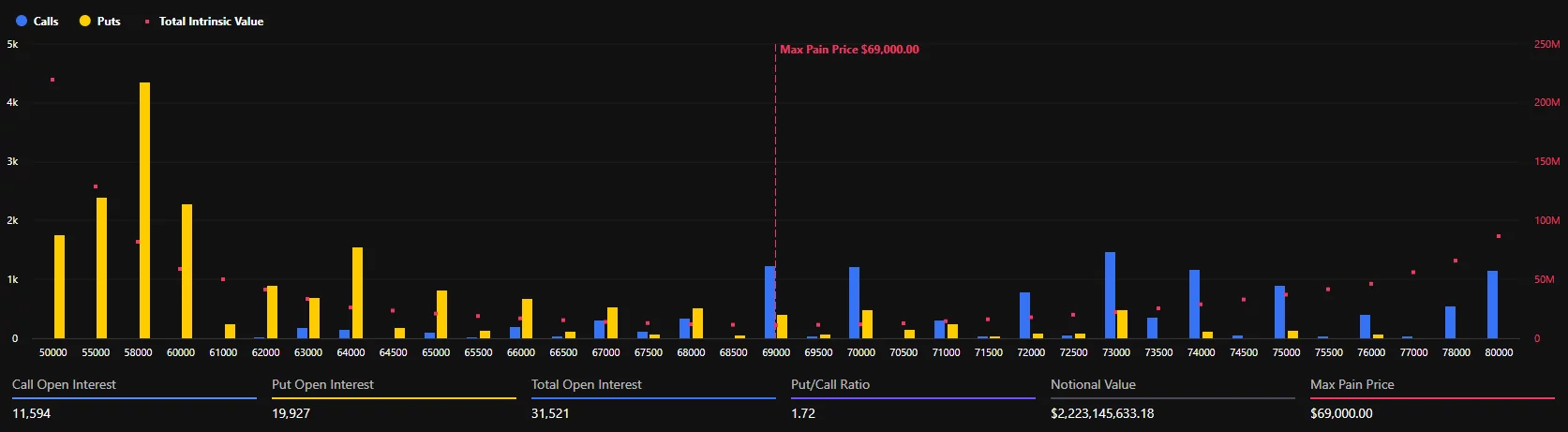
Today, investor sentiment is being kept in check as $2.22 billion worth of Bitcoin option expiry is set to be settled on the Deribit exchange at 8:00 a.m. UTC. Over 31,500 Bitcoin open contracts are set to expire.
At press time, the put-to-call ratio was at 1.72, meaning put options or traders betting on Bitcoin to go lower far surpass the calls that are betting on a rise. The maximum pain level for BTC or the price at which most option contracts expire worthless stood at $69,000, just $1,400 short of the current spot price.
The maximum pain level, also known as the strike price, tends to pull spot prices towards the center around expiry. Therefore, there remains a high risk that Bitcoin price could pull back towards the $69,000 mark as options reach expiry.
Bitcoin has failed to hold above $70,000 six times since the start of February, and losing this key psychological support once again could spook short-term traders who were betting on the current recovery rally.
Despite the concerns surrounding the massive options expiry today, BTC price charts have not yet shown signs of a breakdown.
On the Bitcoin/USDT 24-hour chart, momentum indicators still portrayed a positive outlook at least in the short term.
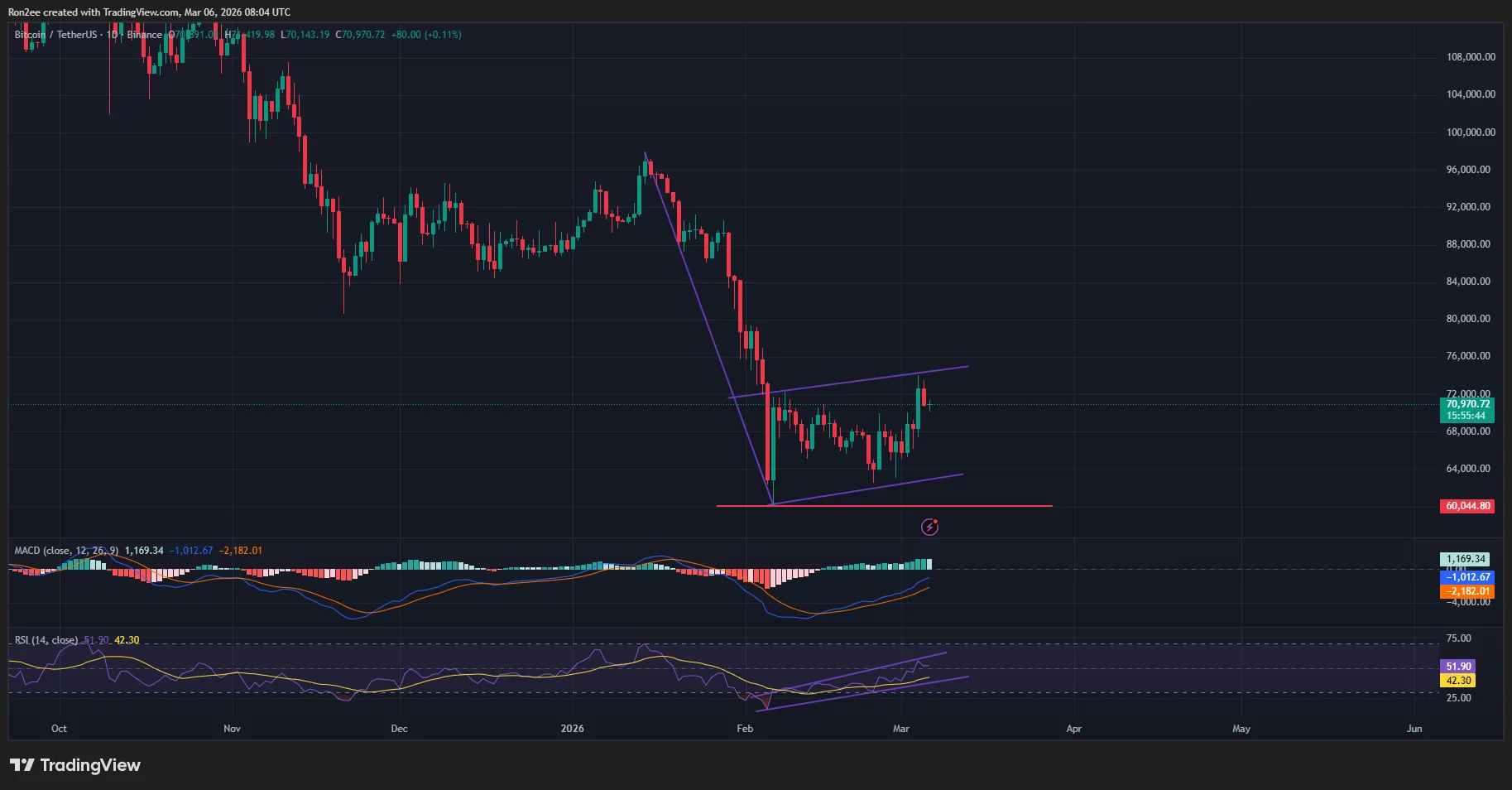
Notably, the MACD line was pointing upwards, suggesting growing buying pressure for the bulls in comparison to the selling pressure exerted by bears. At the same time, the Relative Strength Index has also formed a bullish divergence with the price action.
For now, bulls will be eyeing $72,000 as the next major resistance level to claim, a break above which could likely end its downtrend today.
On the contrary, a move below the $70,000 support could pull BTC price to $69,000 and successively as low as $60,000 as the broader structure remains confined within a bearish flag pattern, which is considered one of the most negative formations in technical analysis.
Disclosure: This article does not represent investment advice. The content and materials featured on this page are for educational purposes only.
Key Takeaways
- Ethereum declined 6% following a brief rally to $2,200, pressured by US equity market weakness and geopolitical tensions
- Options market skew reached 7%, indicating institutional traders are positioning for potential downside
- US spot Ethereum ETFs experienced combined net outflows totaling $91 million on March 5
- The validator entry queue expanded to 3.4 million ETH, while exit queue contracted to only 58,944 ETH
- Ethereum commands 65% of aggregate blockchain TVL across layer-1 and layer-2 networks, with $55.4B on mainnet
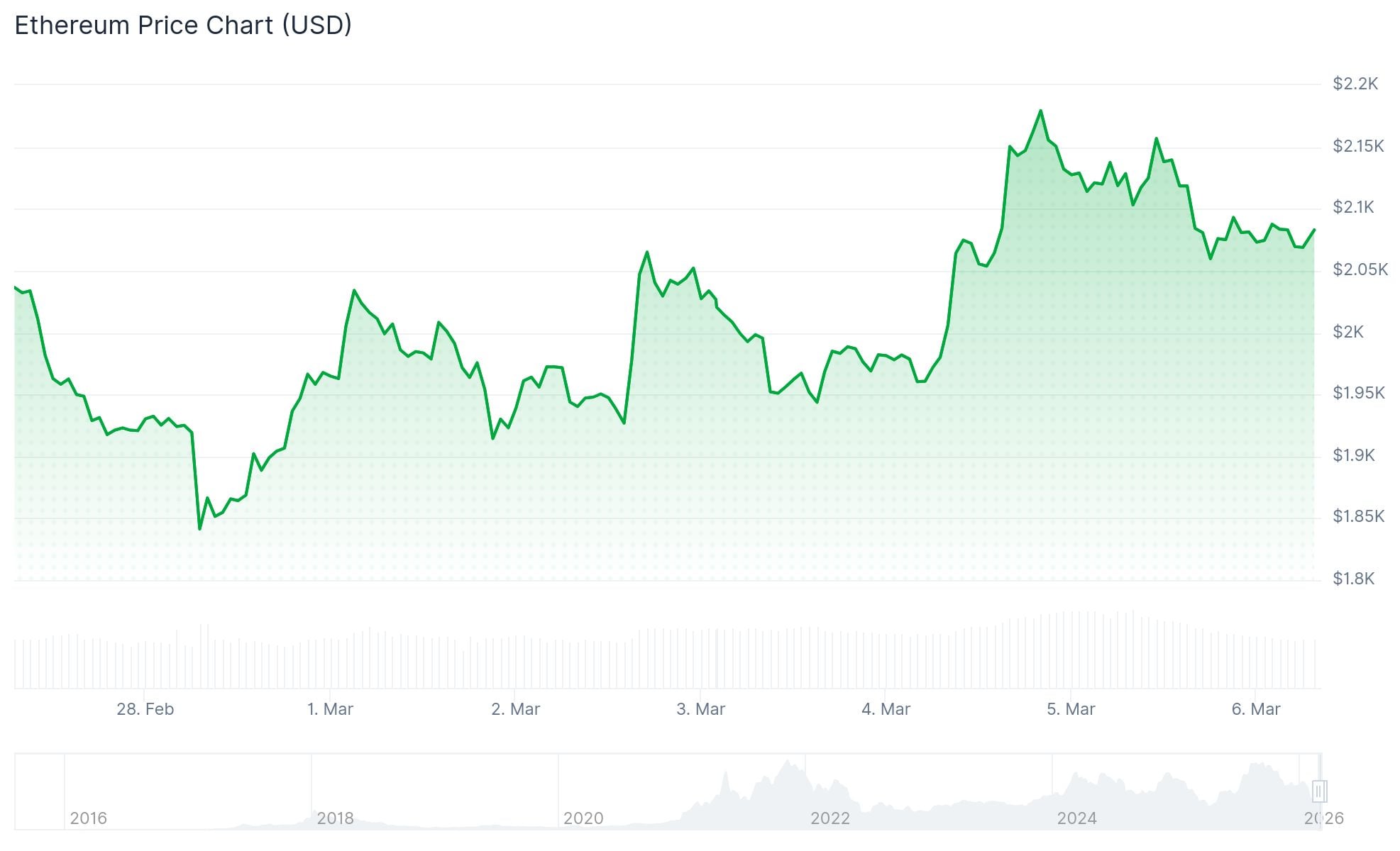
Ethereum is currently exchanging hands near $2,080 following its inability to sustain momentum beyond the $2,200 threshold this week. The pullback occurred amid deteriorating global market conditions, influenced by escalating Middle East tensions and a US judicial decision mandating government repayment exceeding $130 billion in tariff refunds to domestic enterprises.
The second-largest cryptocurrency had mounted an impressive 22% recovery from its February nadir of $1,800, but upward momentum dissipated rapidly. Wednesday’s temporary breach of $2,200 was swiftly followed by a 6% retracement, echoing broader risk-asset selloffs across US markets.
Futures market indicators paint a cautious picture. The 30-day annualized premium for ETH futures contracts remains significantly below the 5% neutral benchmark, suggesting limited appetite for leveraged bullish positions among derivatives traders.
The put-call skew for ETH options expanded to 7% on Thursday. Historical patterns indicate that readings exceeding 6% generally reflect heightened demand for downside protection among sophisticated market participants.
Liquidation data from CoinGlass reveals that ETH traders absorbed $58 million in forced position closures over a 24-hour period, with long positions accounting for $35.7 million of that total.
Institutional Flows and Staking Dynamics
The price deterioration coincided with unfavorable institutional flow data. March 5 witnessed US spot Ethereum ETF products recording aggregate net redemptions of $91 million, signaling a temporary retreat in institutional demand.
This outflow represented a sharp reversal from the more constructive inflows observed during earlier trading sessions in the week, underscoring how rapidly institutional sentiment responds to changing market dynamics.
Meanwhile, network staking metrics present a contrasting narrative. The validator activation queue has ballooned to approximately 3.4 million ETH, while the corresponding exit queue has diminished to merely 58,944 ETH. Prospective validators now face wait times approaching 57 days.
These figures indicate that substantial holders are preferring to stake their ETH for yield generation rather than liquidating positions during market turbulence.
Onchain Metrics and Ecosystem Dominance
Decentralized exchange activity on Ethereum has cooled considerably. Weekly DEX trading volumes contracted to $12.6 billion from $20.2 billion recorded one month prior. Decentralized application revenues similarly declined to $14.1 million over the trailing seven days, representing a 47% month-over-month decrease.
Solana experienced comparable trends, with DEX volumes contracting by 50% across the identical 30-day measurement period.
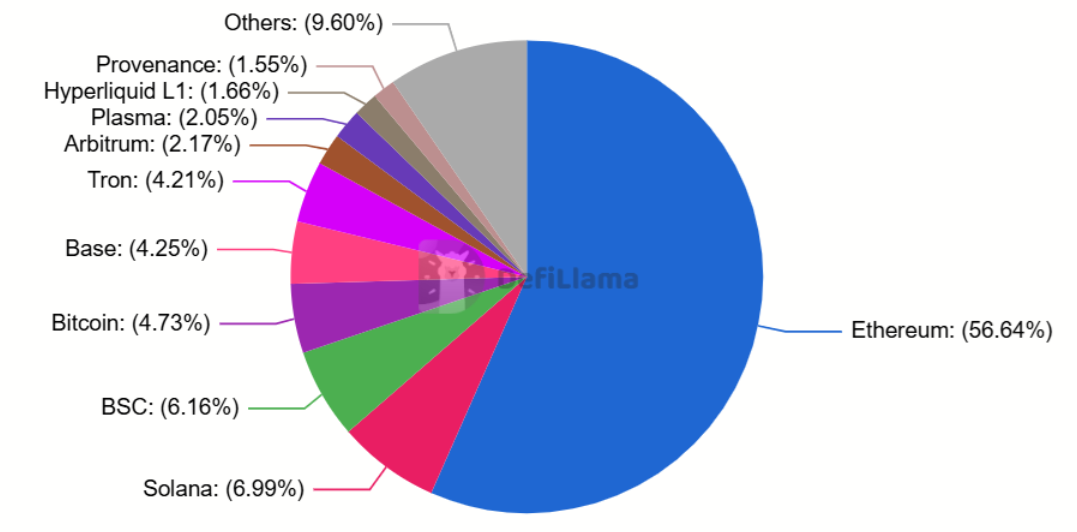
Notwithstanding reduced network activity metrics, Ethereum maintains its commanding position in value locked across the blockchain ecosystem. When accounting for layer-2 scaling solutions, the Ethereum infrastructure captures approximately 65% of total blockchain TVL. The mainnet alone secures $55.4 billion, substantially exceeding Solana’s $6.8 billion.
Technical analysis identifies immediate resistance at the $2,108 level on daily timeframes. A decisive close above this threshold could facilitate a move toward $2,388. Conversely, should support at $1,741 fail to hold, subsequent downside targets emerge at $1,524 and $1,404.
Analysts have identified $1,826 as the lower boundary of the current range structure, representing the next technical attractor should selling pressure intensify in the near term.
Cardano’s native token ADA is drawing renewed attention after the Cardano Foundation announced that the cryptocurrency can now be used for payments at Spar supermarkets across Switzerland, marking a real-world adoption milestone for the blockchain network.
Summary
- Cardano Foundation announced that Cardano can now be used at 137 stores of SPAR in Switzerland, expanding real-world crypto payment adoption.
- ADA is trading near $0.27 after weeks of consolidation following a broader downtrend from the $0.40 region earlier this year.
- Technical indicators show weak accumulation and slightly bearish momentum, with key support around $0.26 and resistance near $0.30.
According to the foundation, customers can now pay with the Cardano token (ADA) using a crypto payment integration powered by the OpenCryptoPay gateway, allowing seamless checkout transactions in participating stores.
The rollout makes the Swiss branch of the global retail chain one of the largest supermarket networks in Europe to accept ADA payments.
The initiative reflects Cardano’s broader push toward everyday payment use cases and could help strengthen the network’s reputation as a practical blockchain ecosystem beyond decentralized finance and token speculation.
Retail adoption has historically been a positive sentiment driver for cryptocurrencies, as it signals growing real-world utility. However, the impact on price tends to depend on broader market conditions and investor demand rather than adoption announcements alone.
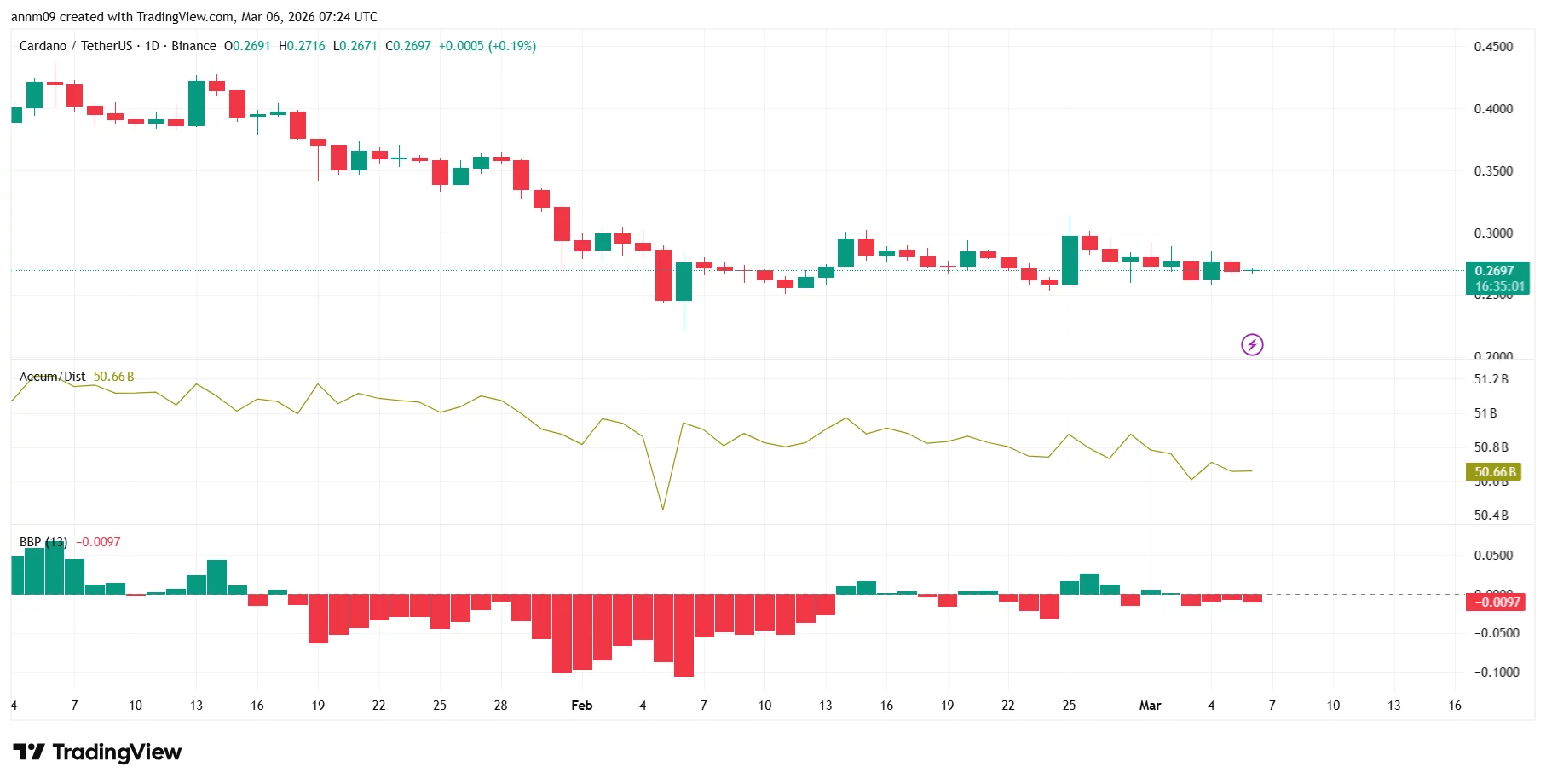
At press time, ADA is trading near $0.27, showing modest stabilization after a prolonged downtrend that began in early January.
Cardano price prediction after ADA payment rollout across Spar stores
The daily chart shows that Cardano has been trading in a tight consolidation range between $0.26 and $0.30 over the past few weeks following a steep decline from the $0.40 region earlier in the year.
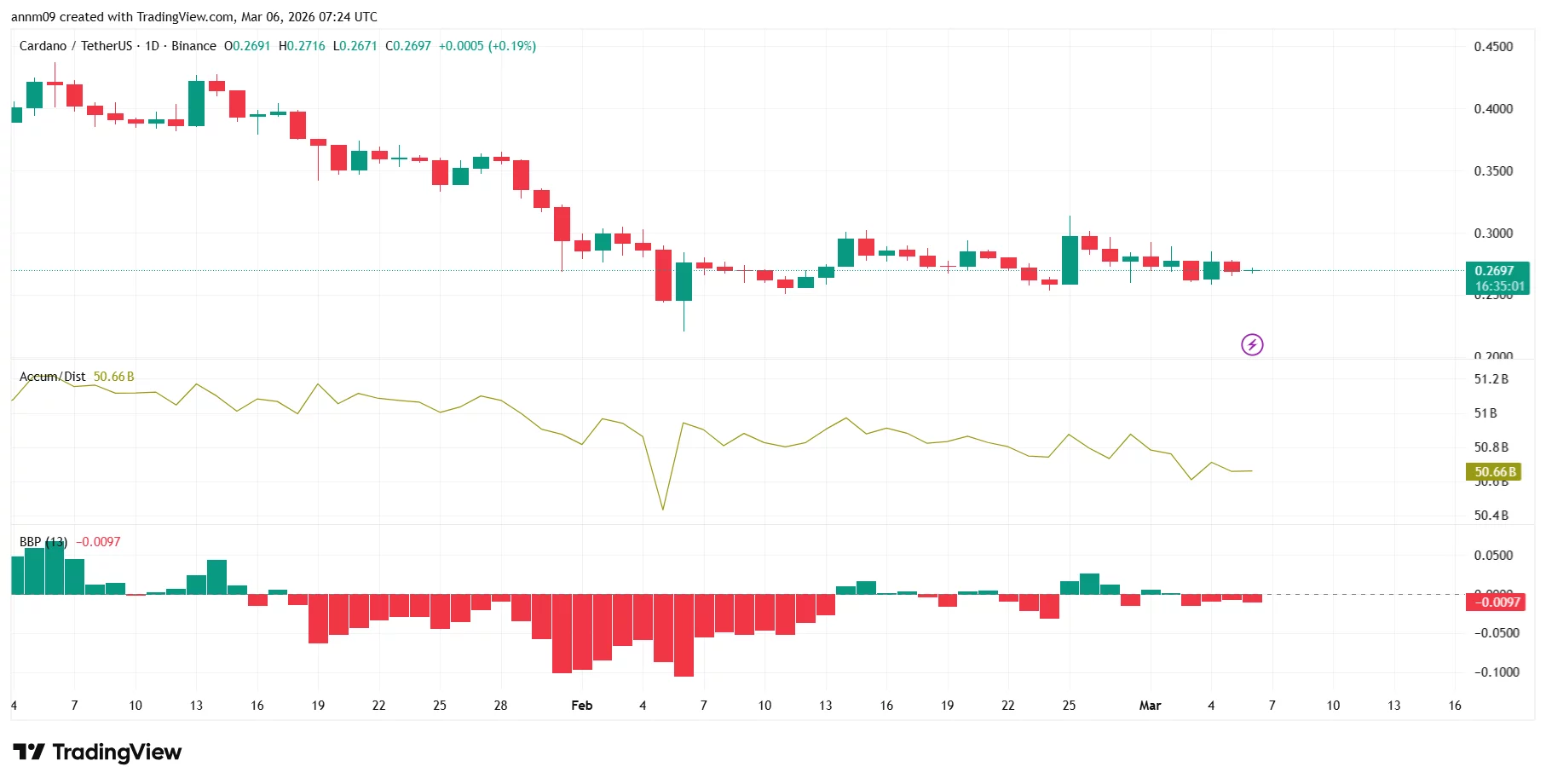
Price is currently hovering around $0.269, with the market forming smaller candles and reduced volatility — a pattern that often precedes a breakout move.
The Accumulation/Distribution indicator, sitting near 50.66B, has been trending slightly downward, suggesting that buying pressure remains limited and that large investors have not yet begun aggressive accumulation.
Meanwhile, the Balance of Power (BOP) indicator remains marginally negative at -0.0097, indicating that sellers still hold a slight advantage in the short term.
Key levels to watch include support near $0.26, which has held multiple times since mid-February. A breakdown below this level could expose ADA to further downside toward $0.24.
On the upside, resistance sits around $0.30, with a stronger barrier near $0.32. A sustained break above these levels could signal the start of a recovery rally if bullish momentum returns to the broader crypto market.
For now, ADA appears to be in a consolidation phase, with traders watching for a catalyst — such as increased adoption or broader market strength — to determine the token’s next major move.
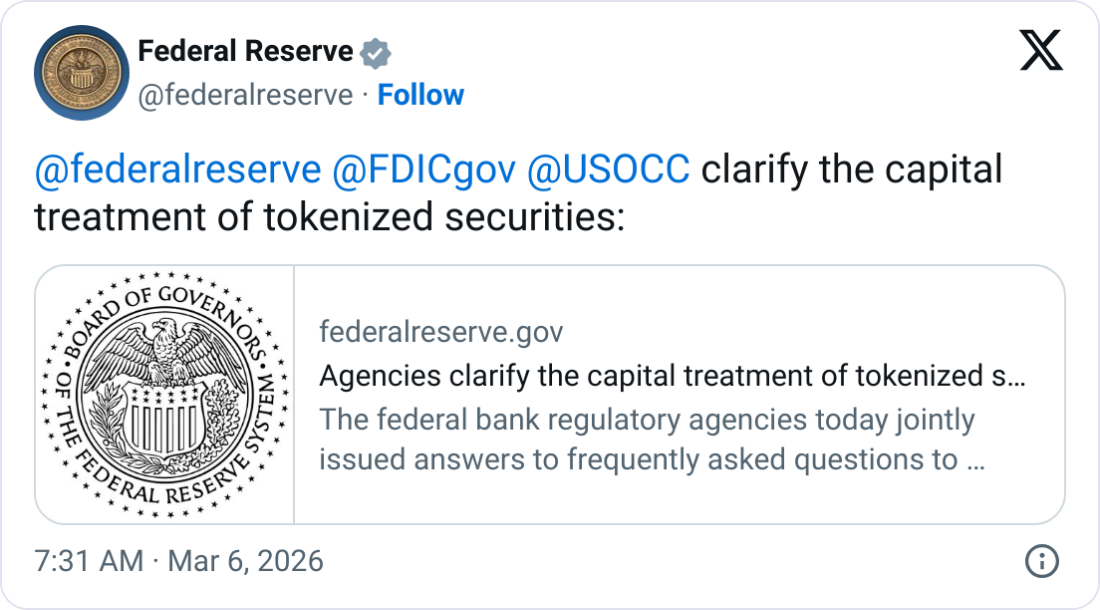
US regulators have clarified that tokenized securities will receive the same capital treatment as their traditional counterparts, saying the rules are “technology neutral.”
The Federal Reserve, the Federal Deposit Insurance Corporation and the Office of the Comptroller of the Currency said on Thursday that they would treat traditional and tokenized securities the same under bank capital requirements.
“The technologies used to issue and transact in a security do not generally impact its capital treatment,” the agencies said.
“An eligible tokenized security should be treated in the same manner as the non-tokenized form of the security would be treated under the capital rule,” the new guidance added.
Under the guidance, financial institutions won’t need to over-collateralize when holding tokenized securities on their balance sheets, as is required when holding unproven and volatile assets.
Many traditional finance companies have shown increasing interest in tokenization, which regulators said prompted them to issue the new guidance.

The agencies said that derivatives referencing an “eligible tokenized security” should also be treated, for capital purposes, as derivatives referencing the non-tokenized form of the security.
The regulators added that tokenized securities are also not affected in their ability to be legally deemed financial collateral, so long as they are liquid and legally owned or controlled by an institution that can sell them if the borrower fails to pay, as part of the terms of a collateral agreement.
“An eligible tokenized security that satisfies the definition of ‘financial collateral’ would qualify as financial collateral for purposes of the capital rule and may be recognized by the banking organization as a credit risk mitigant if all the other relevant requirements in the capital rule are met,” the regulators said.
Related: IRS proposes mandating electronic delivery of tax forms for crypto
Asset tokenization has been a keen point of interest for traditional finance firms, with a long list of heavyweights such as JPMorgan, BlackRock and Franklin Templeton, tipping into the market via investments or infrastructure plays.
One of the major selling points of the space is the ability to trade 24/7 via blockchain, rather than the standard day-trading windows of traditional markets.
Magazine: What’s a ‘Network State’ and are there real-life examples? Big Questions
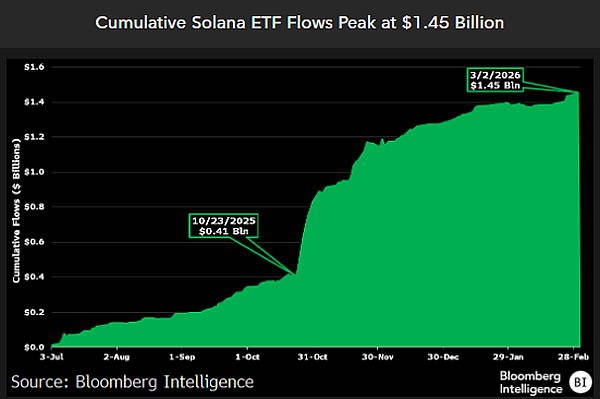
Exchange-traded funds tied to Solana have held on to their early inflows, despite the token having more than halved in price since the funds were launched, which analysts say indicates institutional resilience.
Solana (SOL) is down 57% since Solana ETFs launched in the US in July, but the funds have managed to accumulate $1.5 billion in flows and “not really give any of it up,” Bloomberg ETF analyst Eric Balchunas said on Thursday.
He added that 50% of the inflows to the ETFs are from institutional investors, which Balchunas called a “serious investor base” and a good sign for the future.
Solana ETFs beat Bitcoin on market size basis
Balchunas said that by adjusting Solana’s $50 billion market capitalization to Bitcoin’s (BTC), $1.4 trillion, Solana ETFs have seen the equivalent of $54 billion in net new flows, “which is about DOUBLE where Bitcoin was at the same point.”
Bitcoin had also gained in the months after Bitcoin ETFs were launched, compared to Solana’s price fall, which Balchunas said was “pretty impressive numbers given [the] size and condition of the underlying market.”

Balchunas said that ETFs launching into that kind of market downturn usually make it “near impossible to get inflows.”
“Most wouldn’t even make it to age one or two if they went down 57% in the first six months,” he said. “Solana [is] defying physics here.”
Related: 3 Solana platforms to shutter following devastating $40M hack
Solana ETFs saw their first net outflow day in over a month on Thursday with $6 million exiting the six products, according to CoinGlass. It followed a big net inflow day on Wednesday when $19 million entered the products.
Solana down 70% from all-time high
Solana hit an all-time high in January 2025 amid a memecoin minting frenzy that pushed the token to $293.
Today, it is 70% down from that peak, trading at around $88, having fallen 2.7% on the day and 11% over the past month, according to CoinGecko.

Magazine: Would Bitcoin really be at $200K if not for Jane Street? Trade Secrets

PEI Licensing, the firm behind Original Penguin, has filed a lawsuit in a Florida federal court accusing Pudgy Penguins of trademark infringement, dilution and unfair competition. The complaint argues that Pudgy Penguins’ apparel and branding employ a penguin motif and a family of marks that are confusingly similar to PEI’s federally registered PENGUIN marks. PEI points to a long history with the word mark and penguin imagery—claims the company has used since 1967 (word mark) and 1956 (penguin design on apparel)—and notes a cease-and-desist sent in October 2023 demanding Pudgy Penguins abandon USPTO registrations that resemble PEI’s marks. The dispute sits at the crossroads of traditional IP enforcement and the growing world of NFT-inspired merchandise, underscoring how digital brands are increasingly intersecting with physical goods.
Key takeaways
- PEI Licensing contends that Pudgy Penguins’ use of penguin imagery and the PENGUIN word mark in apparel constitutes infringement, dilution and unfair competition, arguing the marks are confusingly similar to PEI’s established branding.
- The lawsuit was filed in a Florida federal court and seeks sweeping relief, including actions with the USPTO to reject Pudgy Penguins’ trademark applications and to stop further infringement.
- PEI asserts decades of use for its marks, claiming the PENGUIN word mark dates to 1967 and a penguin design on clothing since 1956, bolstering its position on fame and protection against dilution.
- Pudgy Penguins has publicly contested the claims, stating that its marks are visually distinct, target a different audience, and have already received USPTO approvals for multiple applications.
- The case illustrates mounting tensions as NFT-driven communities move into physical goods, raising questions about branding, consumer perception and how the USPTO evaluates cross-domain marks.
Market context: The action sits within a broader trend of traditional IP owners vigilantly defending long-established marks against permutations created by NFT and Web3 brands. As projects push into apparel and lifestyle products, complex questions arise about how to balance protection with the creative expressions that draw communities together in the digital space.
Why it matters
For IP owners, the suit signals a willingness to apply established trademark law to a novel class of products tied to blockchain communities. If PEI succeeds in blocking Pudgy Penguins’ registrations or securing injunctive relief, it could reinforce a framework where decades-old marks are shielded not only from direct counterfeit goods but also from NFT-driven brands that attempt to translate digital identities into tangible merchandise. Such a decision would tilt the risk calculus for NFT projects considering cross-brand collaborations and licensed apparel, potentially encouraging more robust IP screening before launching physical lines.
On the other side, Pudgy Penguins argues that its branding is sufficiently distinct and that it has secured multiple USPTO approvals, which could complicate the path for PEI to demonstrate confusion. The company contends that its audience and market are different from Original Penguin’s, a distinction it believes undercuts PEI’s dilution and infringement theories. The dispute also raises practical questions about how the USPTO evaluates marks that straddle the traditional fashion sector and the evolving Web3 ecosystem, where brand narratives can be built around memes and community-driven imagery rather than conventional fashion houses.
Beyond the courtroom, the case highlights how NFT-native brands increasingly confront IP frameworks that were designed for physical goods and established consumer markets. If the court weighs in on the merits of likelihood of confusion, it could influence future decisions about how aggressively NFT projects pursue trademark protection for marks that sit at the intersection of crypto culture and lifestyle branding. For investors, the outcome may affect how brand licensing strategies are valued in NFT ecosystems—potentially shaping both the attractiveness of licensed collaborations and the perceived risk of dilution for iconic marks used in or alongside digital collectibles.
The dispute also underscores a broader strategic question for creators: when does the protection of a familiar mark justify intervention against a new brand approach that leverages similar visuals? The plaintiff-cum-brand-owner dynamic in this case could serve as a reference point for other NFT projects weighing whether to pursue formal trademark protection for family branding on apparel, or to explore alternative protection strategies that emphasize distinct, non-confusable branding elements while still capitalizing on the appeal of familiar tropes like penguin imagery.
In short, the PEI-Pudgy Penguins case is more than a single litigation. It tests the boundaries of trademark protection in an era where communities can spin up apparel lines quickly around digital assets, and it may influence how quickly regulators and courts adapt traditional IP doctrines to a rapidly evolving branding landscape within the NFT economy.
What to watch next
- Progress of the Florida court case, including any scheduling orders for pleadings or potential motions for preliminary relief.
- USPTO decisions on Pudgy Penguins’ trademark applications, including possible refusals or refusals that could shape the trajectory of the case.
- Any private settlements or public statements that signal a path toward resolution outside the courtroom.
- Subsequent branding initiatives from Pudgy Penguins or other NFT projects seeking apparel licenses might influence how the market interprets IP risk and brand strategy.
- Broader implications for how NFT-based brands structure IP portfolios, especially when expanding into physical goods and lifestyle products.
Sources & verification
- The CourtListener docket for PEI Licensing LLC v. Pudgy Penguins Inc., which outlines the complaint and related filings.
- Public statements from Pudgy Penguins leadership regarding branding and ongoing USPTO filings.
- The October 2023 cease-and-desist letter from PEI to Pudgy Penguins addressing alleged infringement.
- USPTO trademark application records for Pudgy Penguins’ marks cited in the filings.
Trademark clash reshapes NFT IP landscape
In a move that mirrors the growing convergence of fashion branding and blockchain culture, PEI Licensing has brought a formal action in a Florida federal court accusing Pudgy Penguins Inc. of infringing and diluting its long-standing PENGUIN marks. The complaint hinges on two facets: a word mark—PENGUIN—and a penguin design used on apparel. PEI contends that Pudgy Penguins’ branding, which leverages penguin imagery and similar phrasing, risks creating consumer confusion in the market for clothing and related goods. The company emphasizes that its PENGUIN word mark has a long formative history, with first use dating back to 1967 and the penguin design appearing on apparel as early as 1956, asserting that these elements have achieved a level of fame that warrants robust protection against similar use by others.
PEI’s action cites a cease-and-desist issued in October 2023, a document the company says demanded that Pudgy Penguins halt attempts to register PENGUIN marks with the USPTO. The core allegation is that Pudgy Penguins has “misappropriated valuable property rights” by pursuing registrations that could confuse consumers into associating Pudgy Penguins’ products with PEI’s established brand. PEI seeks a broad remedy: court intervention to block Pudgy Penguins’ registrations, to halt ongoing infringement, to destroy products that are likely to cause confusion, and to recover any profits tied to such items. The complaint frames the dispute within classic IP theory—trademark infringement, dilution and unfair competition—applied to a modern context where a digital-native brand seeks to translate a meme-driven identity into tangible merchandise.
Responding to the suit, Pudgy Penguins’ chief legal officer, Jennifer McGlone, told reporters that the company remained surprised by the action, noting that discussions toward a private resolution had been ongoing. She argues that Pudgy Penguins’ marks are visually distinct, target a different audience, and have already secured USPTO approvals for multiple applications, suggesting that PEI’s claims lack merit. The company further pointed to a social-media post as evidence of a clear separation from Original Penguin’s branding, attempting to frame the dispute as a misalignment of audiences rather than a direct encroachment.
The unfolding case spotlights a broader debate about how traditional IP frameworks adapt to the NFT era. As projects move from purely digital assets into physical goods—think apparel and accessories—mark owners must decide how aggressively to defend their portfolios. A ruling in PEI’s favor could reinforce protections against cross-brand apparel lines that resemble established labels, potentially slowing similar collaborations, while a decision for Pudgy Penguins might signal a degree of latitude for NFT–driven brands to leverage iconic imagery without encroaching on long-standing fashion trademarks. The CourtListener docket associated with the complaint offers a window into the procedural posture, including requests to direct the USPTO to reject registrations and to halt further use of marks likely to be confused with PEI’s branding.
Ultimately, this dispute is about more than a single brand’s legal rights. It reflects the evolving expectations of brand protection in a landscape where online communities can rapidly translate digital fame into real-world products. Outcomes could influence how NFT projects plan licensing strategies, assess IP risk, and structure their branding to preserve the trust and loyalty of their communities while navigating traditional trademark scrutiny. As the case progresses, observers will watch not only for a potential settlement but for how the court interprets the balance between protecting a venerable, historic mark and recognizing the creative expressions that drive the NFT ecosystem forward.

Tottenham star ‘smashes everything’ in fury on humiliating night: ‘A real head loss’ | Football

Expedia Group Shares Surge 13.7% on Dividend Hike and Event Demand Partnership

Solana (SOL) ETFs Continue Attracting Institutional Money Despite 57% Price Drop


-

 Politics3 days ago
Alan Cumming Brands Baftas Ceremony A ‘Triggering S**tshow’
-

 Fashion7 days ago
Weekend Open Thread: Iris Top
-

 Tech5 days ago
Unihertz’s Titan 2 Elite Arrives Just as Physical Keyboards Refuse to Fade Away
-

 NewsBeat5 days ago
Abusive parents will now be treated like sex offenders and placed on a ‘child cruelty register’ | News UK
-
 NewsBeat6 days ago
Dubai flights cancelled as Brit told airspace closed ’10 minutes after boarding’
-
Sports6 days ago
The Vikings Need a Duck
-
 NewsBeat6 days ago
The empty pub on busy Cambridge road that has been boarded up for years
-

 NewsBeat5 days ago
‘Significant’ damage to boarded-up Horden house after fire
-

 Tech1 day ago
Bitwarden adds support for passkey login on Windows 11
-

 Entertainment4 days ago
Baby Gear Guide: Strollers, Car Seats
-
 Sports14 hours ago
499 runs and 34 sixes later, India beat England to enter T20 World Cup final | Cricket News
-
 Tech7 days ago
NASA Reveals Identity of Astronaut Who Suffered Medical Incident Aboard ISS
-
Politics5 days ago
FIFA hypocrisy after Israel murder over 400 Palestinian footballers
-
 NewsBeat5 days ago
Emirates confirms when flights will resume amid Dubai airport chaos
-

 NewsBeat4 days ago
Is it acceptable to comment on the appearance of strangers in public? Readers discuss
-

 Tech5 days ago
Viral ad shows aged Musk, Altman, and Bezos using jobless humans to power AI
-

 Video4 days ago
How to Build Finance Dashboards With AI in Minutes
-

 Business2 days ago
Guthrie Disappearance Enters Fifth Week as Family Visits Memorial
-
 Crypto World5 days ago
US Judge Lets Binance Unregistered Token Class Action Proceed
-
 NewsBeat4 days ago
Ukraine-Russia war latest: Belgium releases video showing forces boarding Russian shadow fleet oil tanker