
Crypto World
Crypto-Backed PAC Scales Back Ad Spending in Massachusetts Primary

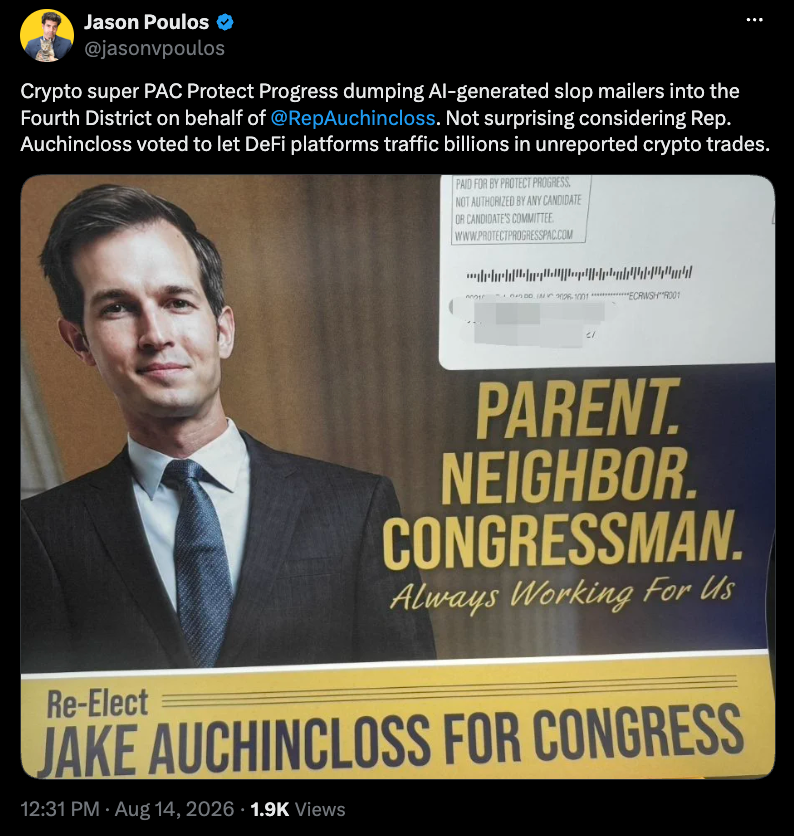
An affiliate of the political action committee (PAC) Fairshake, which was responsible for pouring more than $130 million in ads and media in the 2024 election cycle, is supporting at least one candidate in Tuesday’s primary in Massachusetts.
According to Federal Election Commission (FEC) records as of Tuesday, the Protect Progress PAC, a Fairshake affiliate, spent just over $189,000 on media to support Representative Jake Auchincloss running for reelection in Massachusetts’ 4th congressional district. Some of the funds, according to Democratic candidate Jason Poulos, were used to create “AI-generated slop mailers” supporting Auchincloss ahead of the Massachusetts primary, scheduled for Tuesday.
In an Aug. 16 letter, Poulos called on the Democratic lawmaker to “publicly renounce” Protect Progress’ efforts to potentially influence the primary and general election. The candidate claimed Auchincloss had accepted $77,500 directly from “crypto-industry sources” since 2020, pointing to the Massachusetts lawmaker’s record in voting for the Digital Asset Market Clarity Act in July 2025 — a market structure bill not signed into law as it awaits consideration in the Senate.
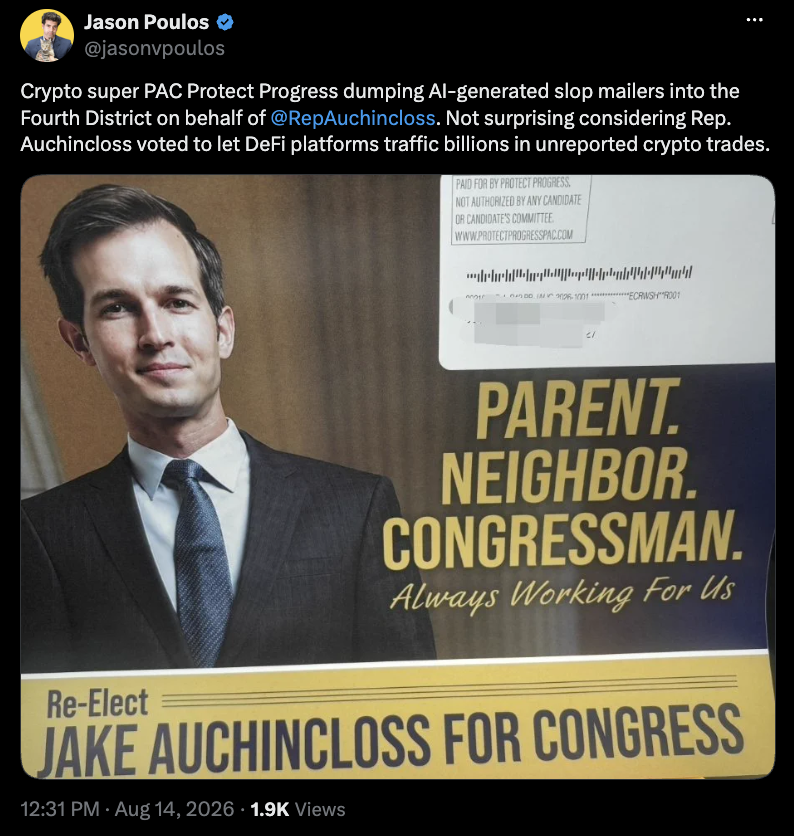
Protect Progress PAC mailer supporting Jake Auchincloss. Source: Jason Poulos
The $189,000 in spending marked Fairshake’s latest attempt to influence the 2026 elections through media and ads unrelated to candidates’ positions on crypto and blockchain. After the PAC and its affiliates spent about $3.6 million on House and Senate races in Alaska, Florida and Wyoming in August, Fairshake reported having $122 million cash on hand ahead of the 2026 midterms.
“With dozens of wins in House and Senate races across the country, and $122 million ready for the fall, we’re not slowing down heading into November,“ Fairshake spokesperson Geoff Vetter said in August.
Massachusetts will be one of the last US states to hold primaries, with just over two months until the general election. New Hampshire, Rhode Island and Delaware are all scheduled to hold primaries in September.
Related: Kalshi issues first lifetime ban for Republican politician over insider bets



X has begun investigating a wave of unsolicited password-reset emails and confirmation codes, although its initial review has found no evidence that the platform’s systems were breached.
Summary
- X users reported receiving password-reset messages they had not requested.
- The company has found no evidence of a breach during its initial investigation.
- X advised users to enable two-factor authentication and Password reset protection.
- The email wave coincided with X Money’s expansion to eligible U.S. subscribers.
X finds no breach in initial password-reset review
X Product Engineering team member Mridul Singhai said Tuesday that the company was examining reports from users who received unexpected password-reset emails and codes. According to Singhai, X had not identified a compromise of its internal systems at the time of his statement.
Several account holders said the messages arrived without any attempt on their part to change their login details. Some users also reported receiving several reset requests, raising questions about whether unknown parties were trying to take control of their accounts.
An unsolicited reset message does not by itself show that an account password has been exposed or that someone has gained access. X allows a person to start the recovery process by entering an account username, email address, or phone number, after which the platform sends a confirmation code to the registered contact method.
Even so, users should not share a reset code or approve a password change they did not request. Singhai advised account holders to enable two-factor authentication and avoid opening links sent through unexpected emails.
He also said attackers appeared to believe that increased access to X Money could make control of X accounts more valuable. The company has not disclosed who may be responsible for the requests, how many accounts received them, or whether the activity came from an automated campaign.
X security settings can restrict reset requests
Under X’s published account security guidance, users can turn on Password reset protection from the Security section of their account settings. Once enabled, the feature requires additional identifying information before X sends a password-reset link or confirmation code.
Depending on the information connected to an account, a user may need to provide an email address, phone number, or both. Requiring those details can make it harder for an unknown party to trigger repeated reset requests using only a public username.
Two-factor authentication adds another check during login. X currently supports text messages, authentication applications, and physical security keys, although the available methods can depend on the account type and subscription status.
According to the platform’s password recovery instructions, reset codes sent by email remain valid for 60 minutes. Completing a password reset logs the account out of all active X sessions, while changing a password from an existing session leaves the session used for the change active.
X specifically advises people who repeatedly receive reset emails they did not request to enable both Password reset protection and two-factor authentication. Its security page also tells users to check that a login page uses the x.com domain before entering account credentials.
Rather than following an email link, account holders can open the X application or type the platform’s address directly into a browser to review their settings. X says its legitimate emails come from addresses ending in @x.com or @e.x.com, do not include attachments, and never ask recipients to provide their password by email, direct message, or reply.
Anyone who entered credentials into an unfamiliar website should change the password through X, secure the email address linked to the account, and remove access for unrecognized third-party applications, according to the company’s guidance. A new password should also be different from credentials used on other services.
X Money expands access across the United States
The reset-email reports emerged as X expanded X Money to Premium and Premium+ subscribers with U.S. accounts. The service lets eligible users send money to one another without leaving the social platform and relies on Cross River Bank for its banking infrastructure.
As crypto.news previously reported, the X Money launch includes deposit accounts, instant transfers, and a Visa debit card. The service also offers annual yields of up to 6%, while eligible X Card purchases can earn 3% cash back.
Cross River holds customer deposits and connects X Money to the banking networks used for transfers. Deposits held directly at a Federal Deposit Insurance Corporation member bank can qualify for standard FDIC insurance of up to $250,000, subject to the agency’s rules.
X Money also uses a cash sweep program that places funds across participating insured banks. Eligible customers may receive aggregate pass-through FDIC coverage of up to $10 million, although X Payments is not a bank or an FDIC-insured institution.
The payment service uses passkeys for authentication and gives customers tools to set transaction limits and extra approval requirements. Visa provides security and risk-management measures for purchases made through the X Card.
Initial access had been limited to selected Premium+ users when the payment service began using Cross River’s infrastructure in June. X later added Premium subscribers as it expanded availability across the United States.
Despite Cross River’s past work with Ripple, neither X nor the bank has announced support for XRP or another cryptocurrency within X Money. The current service moves U.S. dollars through conventional banking and card networks.
X has also considered stablecoin creator payments
X’s financial plans extend beyond transfers between users. In August, the company was considering USDC payments and other stablecoins as possible options for creator rewards, according to a person familiar with the discussions.
No token, blockchain network, or launch date had been selected at the time of that report. X also had not disclosed whether creators would receive stablecoins automatically or choose them as an alternative to bank payments.
The discussions came ahead of the platform’s planned replacement of its Revenue Sharing program with Original Content Rewards on Sept. 8. Under X’s announced eligibility rules, creators need at least 500 verified followers and 500,000 Home Timeline impressions from verified users during the previous 90 days.
X has not confirmed that digital assets will be added to X Money. The platform’s payment service currently remains limited to eligible U.S. subscribers, and the company has not provided a timetable for access by free accounts or users outside the country.

Crypto’s mood has been getting dragged lower for months, even as market prices have started to rebound. In August, Bitcoin posted a strong monthly performance—reported as its best August in years—with returns cited at 26%, while Ethereum gained 34%. The renewed attention has also spilled into mainstream political moments, including President Trump’s comments at the White House praising a decentralized offshore perpetual futures venue, as covered by Cointelegraph Markets.
Yet a price uptick doesn’t automatically settle the deeper questions many long-time participants have been asking: whether crypto delivered on its most ambitious promises, and whether today’s “wins” look different from what the industry originally pitched.
Key takeaways
- Bitcoin’s reported best August in years and Ethereum’s jump have lifted attention, but the broader “sovereign money” narrative still clashes with custodial structures like ETFs.
- Perpetual swaps—once a key differentiator—have become standard across compliant exchanges, reducing the advantage held by early derivatives pioneers.
- Several industry leaders argue crypto’s impact is real, but less about replacing legacy finance and more about being absorbed into it through settlement, tokenization, and stablecoins.
- Despite growing legitimacy and wider adoption, users still face friction: too many networks, wallets, exchanges, bridges, and onramps to navigate.
- Self-custody remains a high-risk expectation, and the bear-market pain has been intensified by the difficulty of delivering a “future” that feels safer and easier.
From build-anything optimism to today’s “it’s absorbed” reality
The article’s interviews frame the current moment as a transition: crypto’s technology has spread beyond its original bubble, but the industry’s cultural promise hasn’t matched its commercial outcomes for everyone. Former BitMEX CEO Stephan Lutz argues crypto can’t simply vanish because key mechanisms are already woven into broader financial infrastructure.
Moonshot Capital founder Utkarsh Ahuja echoes that view, pointing to spillover effects including payment rails, settlement, and tokenization. He highlights stablecoins as a potentially durable part of financial payments and notes the expanding idea that “you can literally tokenize anything.” In his view, adoption outside crypto-native circles—across sectors such as energy, healthcare, and AI—is proof the work wasn’t wasted, even if the end result looks less like a separate parallel world.
Subsquid Labs CEO Wanja Oberhof makes a similar infrastructure argument through decentralization: DeFi’s value, he says, is the ability to verify a ledger in real time down to individual transactions, reducing reliance on an operator’s word. He also describes DeFi settlement speed—minutes rather than days—and market availability running 24/7, with lending protocols capable of processing large volumes transparently.
But Oberhof concedes that DeFi did not always land the experience users expected. He argues the sector “over-promised on timelines and under-delivered on user experience,” and suggests the real breakthrough comes only when the technology becomes invisible—embedded in products people use without consciously thinking about blockchains.
Derivatives didn’t fail—differentiation did
One of the clearest “winners and losers” examples comes from crypto derivatives history. BitMEX—described as an early Bitcoin futures exchange that helped popularize perpetual swaps and leveraged trading—has shut down operations in September after 11 years, according to earlier Cointelegraph coverage. Lutz characterizes BitMEX’s end as a case of being copied rather than being obsolete.
In a quote, Lutz says that what once made BitMEX distinctive—perpetual swaps and the associated funding mechanism that aligns longs and shorts—has become standard across “every legitimate crypto exchange.” In other words, the technology’s success removed the very edge the founders built around. As a result, today’s competitive landscape is less about inventing infrastructure and more about execution and aggressive market positioning, which some firms win and others can’t sustain.
This framing matters for investors and builders because it shifts the evaluation criteria. In the early years, differentiation often came from technical novelty. Now, according to Lutz’s argument, differentiation increasingly comes from scale, strategy, and market-share competition—factors that don’t always favor the original innovators.
Legitimacy rose, but convenience and trust lagged
Even while regulations have made crypto more acceptable to traditional institutions, the article suggests that “legitimacy” hasn’t automatically translated into simpler day-to-day use. Regulation has also contributed to a more regulated and, in some ways, more predictable environment—yet that predictability can reduce the borderless promise crypto markets advertised.
The text cites regulatory progress such as the EU’s implementation of Markets in Crypto Assets (MiCA) and the US move toward building a formal framework for crypto. It also references discussion around a potential CLARITY act. The implication is that the direction of travel is clear: rules are tightening, but they’re still not uniform enough to eliminate friction across jurisdictions.
Ahuja’s interview comments point to a mismatch between crypto’s stated goal—seamless value transfer—and the reality of national regulatory regimes shaping how assets can move. The article includes an anecdote from a Dubai-based crypto user who reportedly receives salary into a centralized exchange, loses money converting USDT into local currency, and pays a flat withdrawal fee of 75 AED (roughly $20). They say they wish they could receive a bank transfer instead.
For users, the practical takeaway is straightforward: even as on-chain rails exist, many real-world workflows remain routed through centralized platforms and local constraints. The promised simplification doesn’t fully arrive when compliance, conversion costs, and access rules dominate the experience.
Self-custody remains a paradox—and morale takes a hit
The article also highlights a tension at the heart of crypto’s original pitch: self-custody. While proponents have long argued that holding private keys is the route to real sovereignty, the piece points out that greater Bitcoin value can raise the stakes of holding keys—whether due to physical theft risks or the expanding threat environment, including cold wallet exploitation framed in the article.
It’s this “failure to deliver the future” that, in the article’s telling, has made bear-market shutdowns and closures feel especially harsh. The text notes that layoffs have been widespread throughout the industry and that projects that survived the 2022 bear market have since shut down or been forced to pivot. Some are reportedly reinventing themselves by leaning into AI, a newer trend that has seen adoption crypto can only dream of—at least in the sense of who is capturing attention and resources right now.
Meanwhile, the article argues that Lutz does not interpret BitMEX’s fate as proof the underlying technology failed. Instead, he suggests the derivatives model worked so well that everyone copied it, and the contest moved to a different game: market share and competitive aggressiveness. That distinction can help readers interpret closures without concluding that the core innovations were wrong.
What to watch next as narratives reset with price
With Bitcoin and Ethereum posting strong performance and public figures generating fresh headlines, narratives are likely to tighten around “why this rally will last.” But the article’s central warning is that price momentum doesn’t resolve the long-running issues around custodial versus non-custodial ideals, user friction, and the real-world risks of self-custody. The next signal to watch is whether infrastructure improvements translate into better usability and clearer pathways for everyday users—or whether the industry continues to measure progress primarily through charts.
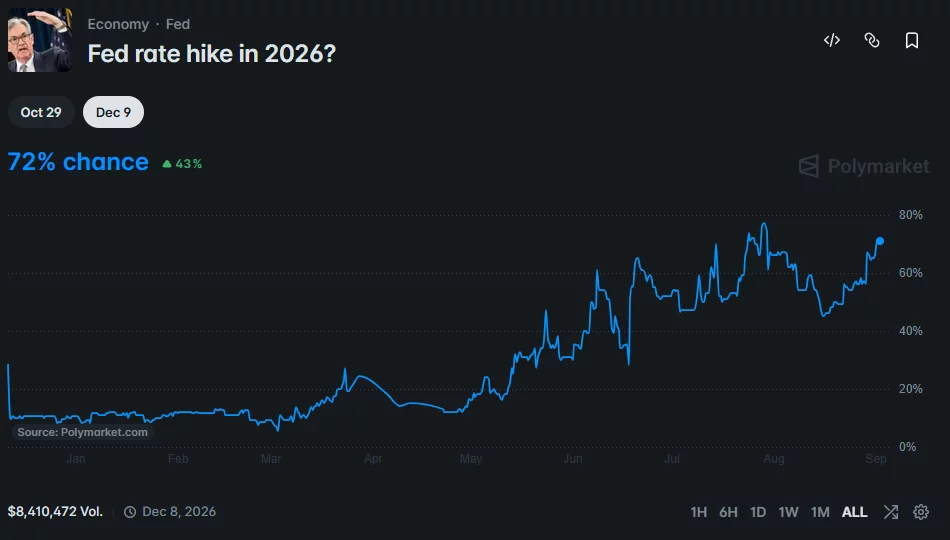
Federal Reserve Governor Michael Barr has backed a decisive interest rate increase if inflation fails to ease, as Polymarket traders place the chance of a 2026 hike at 72%.
Summary
- Barr said the Fed should raise rates decisively if inflation does not moderate enough.
- Polymarket traders assign a 72% chance to at least one rate increase in 2026.
- A separate contract places the probability of a September quarter-point hike at 57%.
- CPI, PPI and employment data could affect the Fed’s Sept. 15–16 decision.
Barr supports a Fed rate hike if inflation stays high
The Federal Reserve said in Barr’s Sept. 1 prepared remarks that inflation remains too high after more than five years above the central bank’s goal, leaving policymakers to decide whether current rates are restrictive enough.
Speaking at the Second Chance Lending Forum in Washington, Barr said the Fed has time to review the data before its Sept. 15–16 Federal Open Market Committee meeting. His position depends on whether upcoming reports provide clear evidence that price growth is returning toward the central bank’s 2% target.
“If trends in the data give me some confidence that inflation is moderating on a path to 2 percent, then I think we can take a bit more time to assess our policy stance,” Barr said.
If the data fail to provide that confidence, Barr said the central bank should respond without delay.
“However, if inflation appears not to be moderating sufficiently, then I think we should act decisively to raise rates,” he added.
Inflation fell from a peak of more than 7% in 2022 to slightly above 2% in 2024, according to Barr. Progress then stalled in 2025 as tariffs, the conflict in the Middle East and spending linked to the rapid expansion of artificial intelligence placed fresh pressure on prices.
Barr also pointed to persistent inflation in core non-housing services, which cover services other than housing and exclude some of the categories most affected by short-lived price changes. With inflation remaining above target for an extended period, he warned that price pressure could spread across more parts of the economy.
The latest Personal Consumption Expenditures data placed annual headline inflation at 3.7%, while core PCE inflation stood at 3.3%. The PCE price index is the Fed’s preferred inflation measure, making its path central to the rate debate.
Fed officials have raised pressure before September
Barr’s comments have added another voting member to the group of officials prepared to consider higher borrowing costs. As a member of the Federal Reserve Board, he holds a vote at every FOMC meeting.
Fed Chair Kevin Warsh delivered a similar message during his Aug. 28 Jackson Hole address, saying policymakers needed to be confident that inflation was moving toward the 2% objective “clearly and at sufficient speed.”
“We must be confident that underlying inflation is moving to our objective, clearly and at sufficient speed. Otherwise, we have work to do,” Warsh said.
As previously covered by crypto.news, Warsh described the 2% PCE inflation goal as a “firm, fixed target.” He also said that 54% of the 199 goods and services in the PCE basket had recorded price increases above 3% during the previous 12 months.
The Federal Open Market Committee held its target rate at 3.50%–3.75% during its July 28–29 meeting. Most members supported waiting for more information, but Minneapolis Fed President Neel Kashkari, Cleveland Fed President Beth Hammack, and Dallas Fed President Lorie Logan preferred an immediate quarter-point increase.
Earlier in August, Kashkari said it was time to start moving rates up gradually as inflation remained above target and the U.S. economy continued to withstand current borrowing costs. The July policy split left the September decision dependent on inflation, employment, and developments affecting energy prices.
Barr described the U.S. economy as solid, supported partly by investment in artificial intelligence. Consumer spending has remained resilient, while the labor market has stayed stable with relatively low unemployment, according to his remarks.
Traders raise Fed rate hike bets to 72%
Polymarket traders now assign a 72% probability to at least one Federal Reserve rate increase before the end of 2026, according to the prediction market figures cited in the supplied report. The probability stood at 68% following Warsh’s Jackson Hole speech and at 64% in early August.
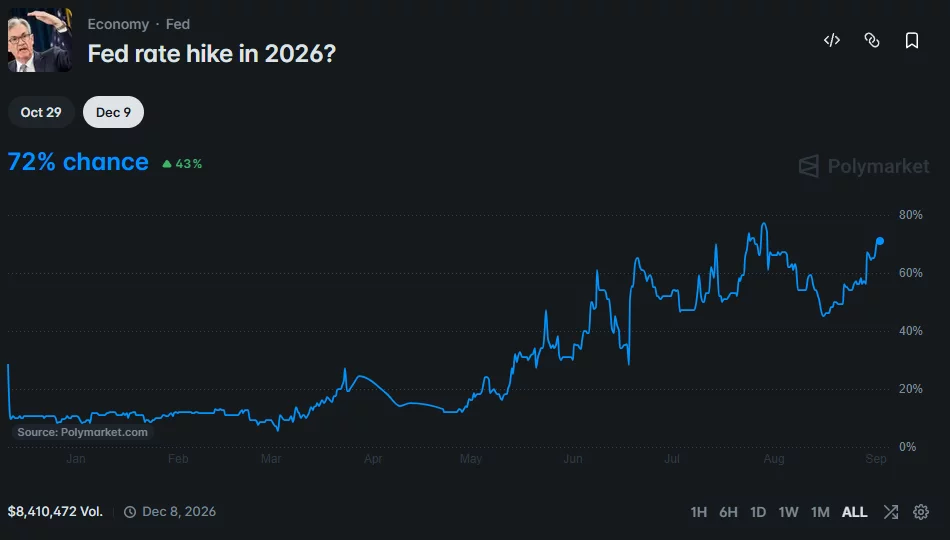
A separate Polymarket contract places the chance of a 25-basis-point increase at the September meeting at approximately 57%. Prediction-market probabilities change as traders open and close positions, and they do not represent a commitment from the Fed.
Market pricing has risen quickly in recent weeks. In early August, Polymarket traders assigned a 46% chance to a September quarter-point increase, while the probability of at least one hike during 2026 stood at 64%.
CME-based estimates also put the probability of a September increase at about 57% following Warsh’s speech, according to an Aug. 31 Bitfinex report. The figure had stood at 39.9% on Aug. 21, while the two-year U.S. Treasury yield later climbed to around 4.31%.
A rate increase would raise the Fed’s current target range to 3.75%–4.00% if officials approve a quarter-point move. Policymakers could also leave rates unchanged in September and consider an increase at one of the remaining meetings in October or December.
For U.S. crypto investors, a higher policy rate could affect Treasury yields, the dollar, and demand for assets that do not produce fixed income. BTSE Chief Operating Officer Jeff Mei said in an Aug. 31 report that higher rates could reduce the liquidity available to Bitcoin and other cryptocurrencies.
Bitcoin traded near $78,700 when the report was published after falling from above $81,000 to a low of $76,857 following Warsh’s address. U.S. spot Bitcoin exchange-traded funds still recorded $924.5 million in net inflows during the week, although investors withdrew $201.9 million on Aug. 28.
Oil and U.S. data could shape the September decision
Energy prices have created another inflation concern as fighting between the United States and Iran threatens oil shipments near the Strait of Hormuz. Brent crude moved above $90 on Aug. 31, while West Texas Intermediate also advanced as traders assessed the risk of supply disruptions.
Bitcoin held close to $78,000 during the initial market response, even as oil rose and equity futures declined. The oil-driven market pressure followed U.S. strikes on Iranian rocket launchers and warnings from Iran that it would respond.
Barr identified the Middle East conflict as one of the shocks that pushed inflation away from its previous path. Tariffs have also raised goods prices, while the AI construction boom has increased demand for equipment, electricity and other resources, according to his prepared remarks.
Before deciding on rates, officials will receive several U.S. reports that could change market expectations. The August employment report is scheduled for Sept. 4, with investors set to examine payroll growth, unemployment, and wages.
Consumer Price Index and Producer Price Index figures are also due before the Sept. 15–16 meeting. Barr said evidence that inflation is moving toward 2% would allow officials more time to assess policy, while insufficient progress would support decisive action to raise rates.

Long-dated sovereign bonds are drawing fresh attention after a broad sell-off pushed yields higher across key markets, with Japan’s 30-year JGB yield setting a new record level. The move comes amid heightened focus on how currency and debt-financing dynamics could spill into global risk assets, including Bitcoin.
On Tuesday, Japanese government bond pressure intensified: the 10-year JGB yield jumped above 3% for the first time since 1996, while the 30-year yield topped a record 4.18%. In the US, long-dated Treasuries also sold off, with the 10-year yield rising to a multi-year high and standing at about 4.78% at the time of writing.
Key takeaways
- Japan’s long end of the yield curve accelerated sharply, with the 30-year JGB yield clearing a record 4.18%.
- US long-term yields moved higher in parallel, reinforcing the idea of a synchronized global duration sell-off.
- Market commentary is reviving “debasement” narratives tied to potential future dollar-liquidity measures and yen stabilization efforts.
- Bitcoin held near $78,000 during the bond sell-off, but faces nearby resistance and a defined trading range from prior coverage.
- Equities and risk sentiment remained fragile as S&P 500 futures slipped and oil prices moved higher amid renewed Middle East tensions.
Japan’s long bond sell-off raises the stakes
The steepening in Japan’s longer-dated sovereign yields matters beyond domestic bond markets because it directly affects financing costs and the incentives around capital flows. In the article’s discussion of policy constraints, the core issue is a two-way bind for Japanese authorities regarding the yen and the government’s own bond holdings.
The argument presented is that Tokyo cannot simply raise policy rates to support the yen without risking operating losses that ultimately feed into the Finance ministry’s balance sheet. At the same time, forcing repatriation of capital without selling Treasuries could be difficult—particularly in a world where US financing needs remain substantial.
Industry commentators have previously framed this as an unstable combination: the yen weakens even as long-term yields keep rising, producing a “crisis” dynamic in the G10 context. In a post on X, Robin Brooks, senior fellow at the Brookings Institution, described Japan as being in a “Liz Truss” style bond-market stress episode where the currency falls while yields climb, calling it “deeply destabilizing.”
Could yen stabilization lean on dollar liquidity?
A key thread running through the coverage is whether Japan could eventually rely on a mechanism that creates dollars using its Treasury holdings—without immediately triggering a domestic bond-market shock. Arthur Hayes, in a post linked in the original report, has long argued that the Federal Reserve may use the Foreign and International Monetary Authorities (FIMA) repo facility.
Under that scenario described by Hayes, Japan’s Finance ministry could borrow dollars against Treasury holdings, then sell those dollars for yen—potentially strengthening the currency without forcing an abrupt adjustment that could destabilize sovereign debt markets.
The relevance for investors is that such a pathway would effectively introduce new dollar liquidity. The original reporting notes that Treasury Secretary Scott Bessent hinted at future use of the FIMA facility in August, and it also references a more recent development: Bessent’s announcement that the maximum size of debt buyback transactions would increase to $4 billion from September (covered earlier by Cointelegraph).
Separately, the article suggests that rising long-term yields could be the market starting to price in some version of this future policy calculus. The key uncertainty remains how and when any dollar-liquidity instrument would actually be used, and whether it would be sufficient to reverse the direction of yields and currency pressure.
Bitcoin steadies near $78,000 as macro pressure builds
Against the backdrop of higher bond yields, Bitcoin traded sideways around the $78,000 area after a modest pullback from an earlier move toward $79,000. The positioning is consistent with a market that is absorbing macro volatility without immediately extending upside.
Prior Cointelegraph coverage cited a “thick patch of resistance” spanning the area between the spot price and $86,000, which the original report says has slowed upward momentum. That same coverage also pointed to a more specific “demand test” above $83,000, referencing analysis from Glassnode.
In this latest read-through, sentiment is described as mixed to cautiously optimistic in the short term, with the $76,000–$82,000 zone highlighted as the near-term battleground. Traders typically treat ranges like this as a sign of indecision—macro-driven catalysts may be strong, but price is still searching for confirmation through either a breakout or further rejection.
Risk markets falter; oil rises on renewed Iran tensions
The bond move did not occur in isolation. The article notes that US equity futures were weaker: S&P 500 out-of-hours futures fell about 0.3% and hovered around 7,660, the lowest level since Aug. 4 at the time referenced.
Energy markets also turned firmer. Oil prices rose by more than 2%, with WTI around $88 per barrel and Brent above $92, linked to renewed US-Iran fighting concerns. The original reporting points to renewed strikes, tanker incidents in the Strait of Hormuz, and commentary attributed to President Donald Trump.
For crypto, the practical implication is that rising yields combined with energy-driven inflation risk can keep traders cautious: higher real-rate expectations can tighten financial conditions, while geopolitical risk can either support hedging demand or pressure broader risk appetite depending on how quickly markets reprice inflation and liquidity assumptions.
Going forward, watch whether Japan’s long-end yields keep pressing higher and whether US Treasury yields follow through. Those signals will likely determine whether the market is simply reacting to rates or beginning to price a deeper shift in how currency stabilization and sovereign financing could be handled. For Bitcoin, the key question is whether the $76,000–$82,000 range resolves upward with confirming demand—or rolls over as macro pressure intensifies.
Artificial intelligence could usher in a new wave of concern over financial privacy, according to a Grayscale research report. The firm’s Head of Research, Zach Pandl, expects AI to create new privacy threats and drive demand for new solutions.
He sees Zcash as one potential option.
Zcash For Blockchain Privacy
Public attention to financial privacy has historically increased alongside major technological changes. The first wave came in the 1970s, when computers enabled the digitization and automation of financial record-keeping. A second wave followed in the 1990s with the expansion of the Internet and growing concerns over online privacy.
Grayscale believes a third wave has now begun as AI becomes more widely used. Pandl said AI tools are likely to create new privacy challenges across the economy, and the issue is particularly pressing for public blockchains that are transparent by default.
For instance, on the Bitcoin network, every transaction is recorded on a public ledger and can be viewed by anyone. When blockchain activity is linked with off-chain information, user addresses could potentially be de-anonymized, a risk also noted in the Bitcoin white paper.
While that risk existed before AI, Grayscale said advances in the technology could make blockchain address labeling more effective and widely available, increasing the need for privacy protection. Unlike Bitcoin, Zcash offers additional privacy features through shielded transactions, which use zero-knowledge cryptography to conceal both the addresses involved in a transaction and the amount being transferred. Grayscale said this privacy feature could become a “must-have” for users who prioritize financial privacy.
Grayscale had made a similar point earlier, while noting that ZEC had surged about 20 times in the past year but was still worth less than 1% of Bitcoin’s market cap. The firm said Zcash’s privacy features and other advantages may not be fully reflected in its current valuation, which leaves room for further gains.
The comments come days after Grayscale converted its Zcash Trust, launched in 2017, into a spot ZEC ETF. The fund began trading on the NYSE Arca on August 25.
$1,800 Target
ZEC has posted a strong performance. The privacy-focused crypto asset gained nearly 80% over the past month alone. Following the sharp rally, ZEC is trading around $850, but crypto analyst Ali Martinez is betting on further upside.
He said that “Zcash is about to melt faces,” while identifying $1,800 as the “first stop.”
The post Zcash May Have a Bigger Role to Play as AI Threatens Financial Privacy: Grayscale appeared first on CryptoPotato.

Ripple has teamed up with digital asset infrastructure provider SettleMint to bring an end-to-end custody and token lifecycle stack to financial institutions in Asia-Pacific. The firms say the integration is designed to reduce operational complexity for banks and other regulated players that want to hold tokenized assets and manage them from issuance through ongoing administration.
Just days earlier, Coincheck Group announced a separate push in Japan toward institutional-grade custody and wallet technology, partnering with DFNS to deliver wallet-as-a-service capabilities. Together, the announcements highlight how Asia-Pacific institutions are trying to close the “infrastructure gap” that has slowed crypto adoption inside regulated finance.
Key takeaways
- Ripple and SettleMint will integrate Ripple Custody with SettleMint’s Digital Asset Lifecycle Platform to support custody, issuance, and management of tokenized assets.
- Coincheck Group’s Japan effort with DFNS focuses on wallet infrastructure and institutional-grade custody through a wallet-as-a-service model.
- Both partnerships target a persistent bottleneck: limited infrastructure that fits regulated financial workflows across the token lifecycle.
- Regulatory momentum in the region—particularly Japan’s evolving framework—adds urgency to custody and tokenization capabilities for institutions.
Ripple’s custody and token lifecycle integration
Ripple announced the partnership with SettleMint on Tuesday, framing it as a way to help financial institutions handle tokenized assets “across their full lifecycle.” According to Ripple’s announcement via PR Newswire, the collaboration will integrate Ripple’s institutional custody infrastructure, Ripple Custody, with SettleMint’s Digital Asset Lifecycle Platform (DALP).
The stated goal is straightforward: rather than stitching together multiple vendors and separate tools for custody and post-issuance operations, institutions can use an integrated approach that supports both securing assets and managing their lifecycle. Ripple’s coverage positions the combined stack as a less complex route for regulated firms that need robust custody controls while also participating in tokenized-asset issuance and administration.
Why this matters for investors and operators is that custody and lifecycle management are typically two of the hardest components to operationalize within traditional compliance requirements. If lifecycle tooling and governance controls can be packaged into a single institutional workflow, it can shorten deployment timelines for banks and asset managers that would otherwise face longer integration projects and higher operational risk.
Parallel momentum in Japan: Coincheck and DFNS
A day before Ripple’s announcement, Coincheck Group revealed its own initiative in Japan, partnering with wallet infrastructure provider DFNS to bring institutional-grade digital asset custody and wallet technology to the market. The development was reported in a Business Wire release.
DFNS’s wallet-as-a-service approach is designed to centralize operational management. The source describes it as supporting transaction lifecycle management, including workflow orchestration and governance controls, delivered under a single platform that supports more than 100 blockchain networks.
For institutions evaluating crypto infrastructure, that distinction—platform-level management rather than fragmented components—can be critical. Many regulated services require controls around approvals, governance policies, and operational workflows that extend beyond simple wallet access. A service positioned around “full transaction lifecycle management” suggests an attempt to meet those requirements more directly.
Infrastructure gap meets faster onchain growth in Asia-Pacific
Both partnerships arrive as Asia-Pacific continues to accelerate in crypto usage. According to Chainalysis’ 2025 Global Crypto Adoption Index, the Asia-Pacific region ranked as the fastest-growing area for onchain activity and saw a 69% year-over-year increase in value received.
While adoption growth alone does not guarantee institutional participation, it typically increases pressure on infrastructure providers to deliver enterprise capabilities that can handle real-world transaction volumes and compliance demands. The partnership announcements explicitly connect their work to an “infrastructure gap” that has hindered regulated financial institutions from entering digital asset activities.
In other words, the region is not just expanding in consumer and retail usage; it is building the case for institutional-grade custody, token issuance tooling, and governance-ready wallet and custody services that can operate under regulatory constraints.
Regulatory developments in Japan raise the stakes
Japan is central to the current wave of institutional infrastructure pushes. In July, the Japanese parliament passed revisions that classify crypto assets as financial assets under Japan’s Financial Instruments and Exchange Act, according to earlier coverage from Cointelegraph.
The regulatory direction matters because classification under financial rules generally changes how institutions think about onboarding, compliance, custody responsibilities, and product design. More clearly defined categories can help create predictable expectations for regulated market participants, but they can also require infrastructure upgrades to satisfy governance and custody standards.
Cointelegraph also reported that Japan’s Finance Minister Satsuki Katayama signaled an intent to bring crypto under the same umbrella as traditional finance assets in January. The stated aim was to ensure citizens can “benefit from digital and blockchain-based assets,” while keeping the framework aligned with established financial oversight.
Against this backdrop, the Ripple–SettleMint and Coincheck–DFNS announcements can be read as infrastructure groundwork for institutions trying to participate in a market where regulatory classification and operational expectations are becoming more formalized.
What to watch next
Investors and builders should watch how these partnerships translate into deployable institution-facing offerings—particularly around custody workflows, governance controls, and end-to-end token lifecycle operations. As Japan’s legal framework continues to take shape and as Asia-Pacific onchain activity grows, the competitive advantage is likely to accrue to providers that can integrate tokenization, custody, and compliance-ready operational tooling without forcing institutions into complex, multi-vendor builds.


Despite the rumors and fear-mongering, Quantum computers are still years away from threatening today’s financial systems. But the cost of preparing for them is already becoming real
In March, Google researchers estimated that a sufficiently advanced quantum computer could break widely used 256-bit elliptic-curve cryptography in minutes. This is the same level of cryptography used by crypto wallets, custody systems, blockchain signatures and much of the security infrastructure used by financial institutions.
Although Q-Day might not be tomorrow, governments have started planning. Because the risk is too great to ignore. The US is budgeting billions of dollars to move federal systems to new post-quantum standards, while NIST wants vulnerable algorithms phased out by 2035.
The transition is much harder for crypto. Assets worth billions can sit untouched for decades, old wallets may never be upgraded, and institutional custody systems were built around cryptography that quantum machines are expected to break.
BeInCrypto spoke with experts from BitGo, Nethermind and the cryptography community about what that migration will actually involve — and who will end up paying for it.
The Quantum Risk For Crypto’s Institutional Giants
All three of our interviewed experts agree on the same thing. Institutions need a complete record of where vulnerable cryptography is used, including signing systems, hardware, recovery procedures, authentication and long-lived keys.
Nigel Smart, who has a PHD in Computational Number Theory, describes this as a Cryptographic Bill of Materials.
“The post-quantum standards are already in place, as well as many production-ready implementations. What most organizations lack is the clear inventory, something called a Cryptographic Bill of Materials. Knowing where crypto is used in your organization, how keys are managed, and what algorithms are used.”
NIST similarly places discovery and prioritization near the beginning of the transition process.
For Akshay Thakur from BitGo, institutional custody introduces another critical requirement.
“Institutional custody runs on threshold signing; the key is never assembled in one place. NIST standardized for implementation simplicity, compactness, and conservatism. Thresholdability was not a standardized priority. Falcon, which Solana, Algorand and now TRON have all adopted, do not have viable threshold construction today. It’s an open research problem.”
NIST opened its first formal call for multi-party threshold schemes in January 2026, while research presented at its MPTS workshop found severe efficiency penalties for threshold signing with standard hash-based signatures.
Nitin Gaur from Nethermind, an engineering firm specializing in Blockchain Infrastructure, says the same issue extends across company systems.
“Cryptographic inventory across the estate: every use of RSA, ECC and Diffie-Hellman in TLS, JWT issuance, code signing, CA roots, API authentication, firmware. It is ten to fifteen per cent of programme cost and one hundred per cent of the critical path.”
Bigger Signatures, Bigger Costs
Post-quantum security comes with substantially larger keys and signatures. NIST’s ML-DSA-65 uses a 3,309-byte signature and a 1,952-byte public key, while commonly used elliptic-curve signatures are measured in tens of bytes. Some SLH-DSA variants reach tens of kilobytes.
On blockchains, more bytes mean greater bandwidth use, higher storage requirements and potentially higher fees.
For proof-of-stake networks, Nigel Smart also points to the difficulty of aggregating standardized post-quantum signatures efficiently.
“Post-quantum signatures can be substantially larger than today’s signatures, increasing bandwidth, storage, and verification overhead. In the blockchain space, we need signatures (for the consensus layer in proof-of-stake blockchains) which can be easily aggregated (which is currently non-trivial with standardized post-quantum signatures).
Thakur expects the user-facing cost to appear strongly at signing time, as larger payloads pass through multiparty protocols and add latency.
Hybrid periods, where classical and post-quantum signatures run together, can compound those costs further.
The Custody Issue
Institutional custody was built around elliptic-curve cryptography, with MPC, hardware security modules, recovery procedures and approval systems designed accordingly. Changing the signature therefore requires custodians to revalidate much of the control system around the key.
Gaur says MPC offers no quantum resistance by itself.
“MPC distributes the computation but does not change the algorithm: threshold ECDSA across five parties is still ECDSA. A quantum computer derives the private key from the public key alone, so it does not need to compromise any party and does not care how many there are. Every dollar spent distributing trust across signers buys exactly zero quantum resistance, and that is not well understood inside institutions that believe their custody is state of the art.”
Nigel Smart says some of the hardest systems to upgrade will be wallets, custody infrastructure and smart contracts already controlling assets.
Bitcoin shows why the clock matters. A June 2026 report estimated that around 1.7 million BTC still sit in early addresses where public keys are already exposed.
Many of those coins may never move, leaving them vulnerable if quantum computers become powerful enough before the network completes its migration.
Who Pays for the Migration?
Smart expects responsibility to be divided between protocol developers, custodians, service providers and asset owners, since each group controls a different part of the migration.
Gaur instead argues for a central budget with senior ownership.
“Centrally funded, CISO owned, CFO approved multi-year line, governed the way Y2K and LIBOR were. No business line will volunteer budget for a programme with no revenue and no customer asking, and funded that way it will not happen.”
Public blockchains are harder to govern because there is no single budget holder capable of forcing every participant to upgrade. A custodian can replace its own signing systems, yet it cannot compel dormant asset owners to move funds or impose consensus changes across an entire network.
Internet security shows that large migrations can still begin early. By April 2026, Cloudflare reported that more than two-thirds of human-generated TLS traffic reaching its network already used post-quantum protection.
An Unpriced Cost
Crypto still lacks a credible industry-wide estimate. Thakur outlined where the biggest costs are likely to fall.
“Most of the cost isn’t cryptography. It’s inventory and dependency mapping. It’s hardware that can’t be upgraded and has to be replaced. It’s running classical and post-quantum systems in parallel while you prove the new one preserves every control. It’s re-auditing and re-certifying. And there’s one category with no precedent in any previous cryptographic migration: paying on-chain transaction fees to move assets, at post-quantum signature sizes, on chains where those larger signatures have themselves pushed fees up.”
Nigel Smart commented on the timeline for such a migration.
“The transition is likely to take years rather than months, making early inventory, testing, and staged migration preferable to a last-minute upgrade. However, many governments and large companies have brought forward their timelines for transition quite aggressively over the last few months.”
The dates already give institutions enough to budget against. Ethereum is aiming for core post-quantum protections around 2029, while NIST’s transition timetable extends through 2035.
The uncertainty lies in when cryptographically relevant quantum hardware arrives, while procurement cycles, hardware replacement and custody redesign already operate on timelines measured in years.
The post The $7 Billion Race to Save Crypto From Quantum Computers appeared first on BeInCrypto.


The Monetary Authority of Singapore (MAS) is reconsidering its earlier restriction on stablecoins issued across multiple jurisdictions, proposing a route for some jointly issued tokens to qualify under its regulatory framework.
MAS opened a public consultation on Tuesday, covering legislative amendments to implement its stablecoin framework and additional policy proposals reflecting developments since 2023.
Under one proposal, stablecoins jointly issued by a Singapore issuer and a foreign issuer could be regulated under the framework and labeled “MAS-regulated stablecoins,” provided that the associated risks are sufficiently mitigated.
MAS is also considering recognizing a limited number of foreign-issued stablecoins regulated under comparable overseas frameworks, citing their potential use in cross-border wholesale transactions.
The proposals revisit MAS’s 2023 position that qualifying stablecoins must be issued solely in Singapore. The regulator finalized a framework that year covering single-currency stablecoins issued in Singapore and pegged to the Singapore dollar or a G10 currency.
At the time, MAS cited difficulties establishing regulatory equivalence and cooperation with other jurisdictions. It also noted technical challenges in tracing where commingled stablecoins originated and determining whether overseas reserves would be sufficient to meet redemption requests.
MAS proposes additional issuer safeguards
The broader consultation seeks to implement the 2023 stablecoin framework through amendments to the Payment Services Act (PSA), the primary law governing payment services and operators in Singapore.
The proposed requirements cover reserve-backed value stability, capital, redemption at par and issuer disclosures. Only issuers licensed under the framework would be permitted to market themselves as MAS-regulated stablecoin issuers and label their tokens “MAS-regulated stablecoins.”
Related: Japanese regulator requests tax filing exemption for trust-type stablecoins in 2027 reform
MAS also proposed prohibiting issuers from paying interest on regulated stablecoins and requiring them to conduct stress tests and maintain recovery and orderly wind-down plans.
Additional consumer safeguards would require issuers to protect customer money received before the corresponding stablecoins are issued. Stablecoins outside the dedicated framework would continue to be treated as digital payment tokens under existing rules.
MAS is accepting public comments on the proposals until Oct. 16.
Magazine: How Hong Kong is turning tokenized bonds into real market infrastructure
Bitcoin price has fallen below $77,000 as fresh U.S. military strikes on Iranian targets have pushed oil prices higher and triggered heavy selling across crypto and stock markets.
Summary
- Bitcoin price dropped to $76,762 after losing the $78,000 and $77,000 levels.
- Crypto traders suffered about $115 million in long liquidations within one hour.
- Brent settled at $94.65, while U.S. crude closed above $90 per barrel.
- U.S. strikes targeted Iranian positions after reported attacks near the Strait of Hormuz.
Bitcoin price falls below $77,000
The U.S. Central Command said American forces began striking Islamic Revolutionary Guard Corps targets in Iran at 12 p.m. ET on Tuesday, citing recent attempted attacks against commercial vessels in the Strait of Hormuz and U.S. military personnel stationed in the region.
Bitcoin (BTC) fell through $78,000 as reports of the operation emerged before extending its decline below $77,000. The cryptocurrency traded around $76,762 at the time of writing, after falling from an intraday high near $79,166.
Selling also reached Ethereum (ETH), which moved below $2,400 during the market decline. According to CoinGlass data cited in the original report, roughly $115 million in leveraged long positions across the crypto market were liquidated within one hour.
Liquidations occur when an exchange closes a leveraged position after the trader’s collateral can no longer cover mounting losses. A rapid price decline can therefore force the closure of long positions, adding more sell orders to an already weak market.
One day earlier, Bitcoin had held near $78,000 even as earlier exchanges between U.S. and Iranian forces pushed crude prices above $90. The latest round of strikes placed renewed pressure on that price area and erased the asset’s brief attempt to hold above short-term support.
The decline has also followed a strong August for Bitcoin. BTC gained about 23% during the month, according to market data cited in earlier coverage, before renewed geopolitical and interest-rate concerns weighed on the opening trading sessions of September.
US strikes increase pressure near the Strait of Hormuz
According to CENTCOM’s account, the operation followed alleged Iranian attempts to attack commercial shipping in the Strait of Hormuz and American service members deployed to the region.
Iranian state media reported explosions across several locations on the country’s southern coast, including Qeshm Island, Bandar Abbas and Chabahar. Reports cited by Axios also identified Jask, Konarak, Minab and Sirik among the areas struck.
Qeshm Island and Bandar Abbas sit close to the Strait of Hormuz, a key passage connecting Persian Gulf energy exporters with international markets. Before the current conflict, roughly one-fifth of global oil and liquefied natural gas supplies moved through the waterway, according to Reuters data previously cited in market coverage.
The Associated Press reported that Tuesday’s action ended roughly a month without direct military exchanges between the two countries. Earlier U.S. strikes on Sunday targeted rocket launchers on Larak Island, after which Iran launched missiles toward American sites in Jordan. Jordanian forces intercepted the missiles, while the United Arab Emirates said it stopped an Iranian drone over its waters.
Following Tuesday’s strikes, Iranian semi-official news agencies Fars and Tasnim reported that Tehran had started launching missiles and drones in response. An IRGC spokesperson said the United States “will regret its new attacks,” according to Fars.
President Donald Trump described the American operation as “large and powerful” and warned Tehran against further retaliation. According to Trump, another Iranian response would lead to a “much harder and higher level” of U.S. attack.
Iranian President Masoud Pezeshkian had said earlier on Tuesday that Tehran was prepared to return to a ceasefire agreement brokered with Washington in June if the United States followed its terms. Trump later questioned the value of another agreement during comments reported by the Associated Press.
Oil above $90 adds inflation and rate pressure
Crude prices accelerated as military activity returned to areas around the Strait of Hormuz. Reuters reported that Brent crude settled 4.6% higher at $94.65 per barrel, while U.S. West Texas Intermediate rose 5.2% to $90.22.
Oil traders were also monitoring reports that two tankers had been hit while leaving the strait. Iranian officials have warned that Gulf oil exports could face additional disruption if military and economic pressure on Tehran continues.
Earlier exchanges between Washington and Tehran had already exposed the sensitivity of financial markets to oil supply risks. In July, a warning of further U.S. strikes coincided with a $500 billion stock selloff as crude prices rose and Bitcoin came under pressure.
Higher energy prices matter to U.S. crypto investors because a sustained rise in fuel costs can feed into inflation data and influence Federal Reserve policy. U.S. Treasury yields rose during Tuesday’s trading, while the S&P 500 fell to its lowest level since Aug. 4, according to market data cited in the original report.
August inflation data and the Federal Reserve’s September policy decision could therefore affect Bitcoin’s next move. In August, Bitcoin rebounded after CPI data showed annual U.S. inflation at 3.4%, but oil supply disruptions could place fresh pressure on subsequent readings.
Federal Reserve Chair Kevin Warsh has maintained a firm position on inflation and left open the possibility of higher interest rates. Rising Treasury yields can increase the appeal of interest-bearing assets while raising financing costs, conditions that have previously weighed on Bitcoin and other assets that do not produce yield.
US markets fall as leveraged crypto positions unwind
Pressure from the military escalation has not remained confined to digital assets. U.S. equities declined as investors assessed the effect of higher oil prices, while the selloff in government bonds pushed Treasury yields upward.
Bitcoin’s fall below $77,000 placed the asset close to the lower end of the price range it had established after its August rally. The intraday low near $76,483 left the $76,500 area as an immediate level being tested by sellers, based on market pricing during the session.
A sustained break below that region would remove another support area that previously slowed declines. Any recovery would first require Bitcoin to regain $77,000, followed by the former support zone between $78,000 and $79,000.
Liquidation data offer another measure of the pressure facing leveraged traders. CoinGlass attributed the one-hour liquidation total of roughly $115 million mainly to long positions, indicating that traders positioned for higher prices absorbed most of the forced closures during the drop.
Meanwhile, Iran’s response remained active late Tuesday, with Fars and Tasnim reporting new missile and drone launches after the U.S. operation. American officials said the initial strikes were directed at Iranian radar and military capabilities associated with threats to commercial vessels and U.S. personnel.
The London Stock Exchange (LSE) and cryptocurrency exchange Kraken are reportedly launching tokenized stock trading on the stock market operator’s new night-time trading venue.
The LSE has partnered with Kraken’s parent company, Payward, to launch access to tokenized stocks tracking the value of leading UK equity products starting in 2027, Payward’s chief commercial officer, Mark Greenberg, told the Financial Times according to a Tuesday report.
The tokenized stocks will be listed on LSE’s new night-time trading venue, LSE 24, that will offer 24/5 trading, operating from Mondays to Fridays, the company announced on July 21.
The initiative makes the London bourse the latest traditional exchange operator to explore blockchain-based stock offerings that can be traded 24 hours a day with fractional ownership. Other traditional finance (TradFi) institutions exploring tokenized equity products include the Nasdaq, CME Group and the Intercontinental Exchange (ICE), the parent company of the New York Stock Exchange (NYSE).
In August, Nasdaq agreed to acquire LeveL Markets, the third-largest alternative trading system in the US by trading volume, as part of its push into tokenized markets with round-the-clock trading.
Related: Trump Jr.-linked 1789 Capital leads Polymarket’s $1B raise: Report
TradFi companies deepen tokenization push
Some of the world’s largest TradFi institutions have been exploring tokenized stock offerings.
In March, Nasdaq, the world’s second-largest stock exchange by market capitalization, partnered with Payward and its Backed subsidiary, the issuer behind xStocks, to develop an equities transformation gateway. The plan builds on Nasdaq’s tokenization proposal filed with US securities regulators in September 2025.
A week earlier, ICE invested in crypto exchange OKX to bring NYSE-listed tokenized stocks to the exchange starting from the second quarter of 2026.
In April, Deutsche Börse invested $200 million in Payward, as part of the German exchange operator’s plans to offer access to a wider array of blockchain-based securities and tokenized investment products and build on its prior partnership with Kraken.
In January, CME Group, the largest derivatives exchange by volume, announced plans to launch crypto futures contracts tied to Cardano (ADA), Chainlink LINK and Stellar (XLM). Three months later, CME announced plans to add Avalanche AVAX and Sui SUI futures contracts starting May 4, subject to regulatory approval.
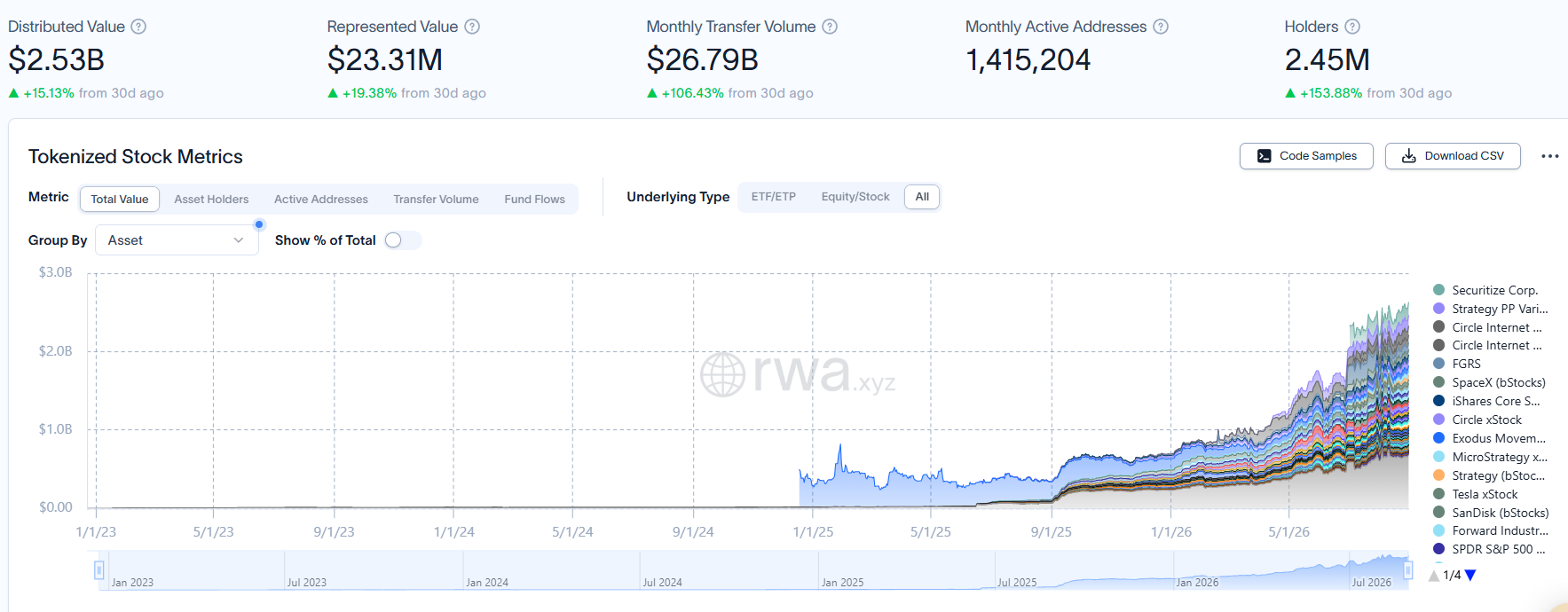
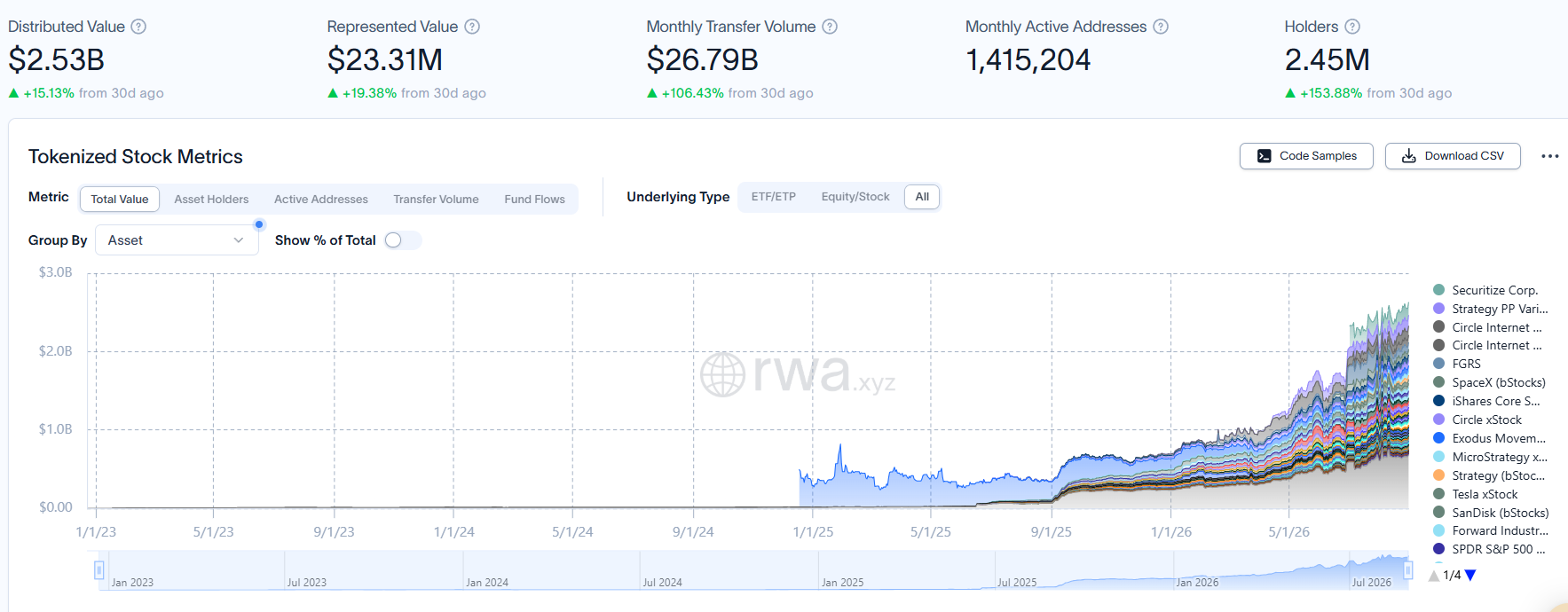
Tokenized stocks, total value onchain, all-time chart. Source: RWA.xyz
The value of tokenized stocks increased by 15% in the past 30 days to $2.53 billion, while the number of tokenized equity holders grew by 153% to 2.45 million, according to data provider RWA.xyz.
Magazine: What NYSE’s exploration of onchain systems means for financial markets

X probes password-reset email wave, finds no breach

Football: Europe’s top clubs scramble for last-minute signings

Why Are So Many New Cars Four Wheel Drive Now?





-

 Fashion4 days ago
Weekend Open Thread: Maeve – Corporette.com
-

 Crypto World5 days ago
Bitcoin’s 22% rally now needs real demand to outlast Treasury liquidity boost
-

 Crypto World6 days ago
Warsh Jackson Hole keynote puts financial innovation first
-

 Crypto World6 days ago
Elon Musk Grok Bot Promise: We Will Make You Whole if AI Loses Your Money
-

 Business5 days ago
Salesforce Stock Soars 19% as Blowout Earnings and Agentforce AI Growth Silence Software Skeptics
-

 Business5 days ago
Apple Confirms September 9 Keynote and Reveals Its Full Pre-Order Schedule
-

 Crypto World7 days ago
Did Trump Just Move SpaceX Stock With One Truth Social Post?
-

 Business4 days ago
Onto Innovation Stock: AI’s Next Bottleneck Is Yield (NYSE:ONTO)
-
 NewsBeat6 days ago
Lindsay Clancy jury braces for closing arguments as judge tells court: ‘You’ve heard all the evidence’ – Live updates
-

 Business6 days ago
Walmart takes aim at younger shoppers with new fashion brand
-

 Crypto World6 days ago
NVIDIA revenue hits $96.2B as AI demand doubles
-

 Crypto World4 days ago
Bitcoin price tests $82K resistance as Brandt stays long
-

 Business7 days ago
Thailand’s Eastern Economic Corridor Capital City (EECiti): Key Developments and Investment Opportunities
-

 Business4 days ago
iPhone 18 Pro Pre-Orders Could Shift to Saturday as Apple Reportedly Avoids September 11 Anniversary
-
 Crypto World6 days ago
Nvidia Q2 Earnings Reveal $96.2 Billion Beat, So Why Is NVDA Falling?
-

 NewsBeat7 days ago
Trump’s trade truce with China faces test with Iran effort
-
 Tech3 days ago
Hugging Face built a $4.5 billion empire on free AI models. Now Nvidia is buying it for $12.9 billion
-

 Tech6 days ago
Claude Cowork gets its own browser that doesn’t touch your tabs, bookmarks, or saved passwords
-

 Crypto World5 days ago
Truflation calls for Fed rate cut after PCE forecast
-

 Tech4 days ago
PaperCut releases second emergency patch for exploited flaws
You must be logged in to post a comment Login