
Crypto World
Crypto Exchanges Push into Stocks and Commodities: CoinGecko Report

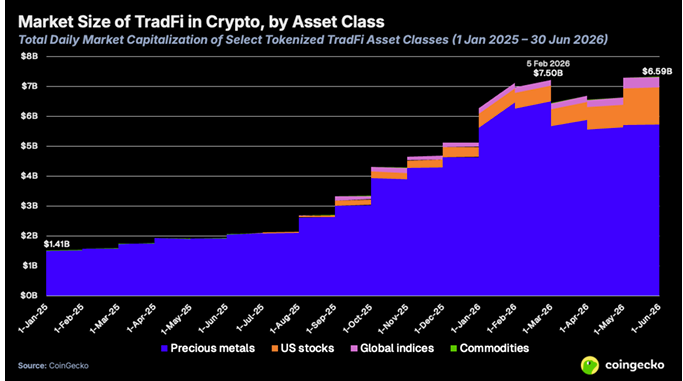
Intense competition from traditional brokerage and decentralized exchanges is pushing crypto exchanges to expand beyond digital assets into tokenized stocks, commodities and precious metals, CoinGecko said.
A study, released by the crypto data provider on Wednesday, found that the market capitalization of tokenized traditional assets, including precious metals, US stocks, commodities, global indexes and forex, grew to $6.6 billion in June 2026 from $1.4 billion in January 2025. The analysis covers activity across Binance, OKX, Bybit, Bitget, Gate and MEXC.
The market’s initial growth was fueled largely by tokenized precious metals before expanding into US equities. By mid-2026, US stock perpetual futures had overtaken precious metals in both trading volume and open interest, driven by investor interest in semiconductor stocks and anticipated initial public offerings, the report said.
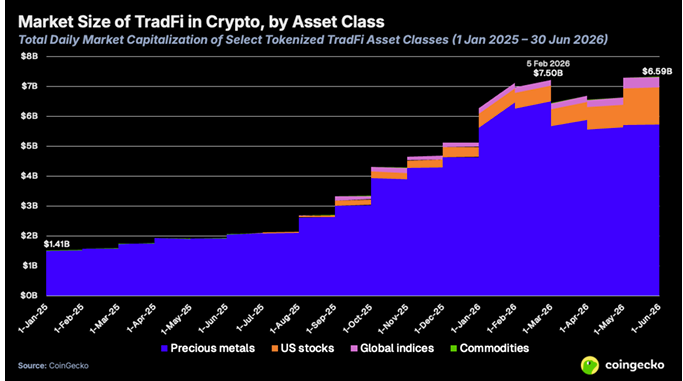
Tokenized traditional assets on crypto exchanges grew nearly fivefold over 18 months, with precious metals driving early gains. Source: CoinGecko
Perpetual futures account for the vast majority of trading activity, while spot markets remain comparatively small. According to the report, derivatives dominate because traders prefer leveraged products and exchanges can list perpetual contracts without issuing or custodying the underlying tokenized assets.
The expansion comes as centralized exchanges look beyond crypto trading to attract and retain users. CoinGecko said competition is intensifying from both decentralized exchanges, which have chipped away at market share, and traditional brokerages that are expanding their digital asset offerings.
Robinhood is among the brokerages that have significantly expanded their digital asset offerings, underscoring the growing overlap between traditional finance and digital asset platforms.
Related: Bernstein raises Robinhood price target, cites tokenization and prediction markets
Institutional demand fuels tokenization push
Institutional interest in tokenized assets continues to build. A June report by Standard Chartered projected that tokenization could help expand decentralized finance into a $2.7 trillion market by 2030 through the adoption of real-world assets. Separately, Bernstein analysts estimated the broader tokenization market could reach $4 trillion by the end of the decade as financial institutions increasingly embrace blockchain-based assets.
Like the convergence between crypto exchanges and traditional brokerages highlighted by CoinGecko, institutional adoption of tokenization underscores how fast the lines between traditional finance and blockchain infrastructure are blurring.
As Cointelegraph recently reported, BitGo and OTC Markets Group have partnered to expand access to tokenized securities for more than 150 broker-dealers. Separately, Tradable teamed with the Stellar network to bring up to $1 billion in private credit assets onchain, illustrating how banks, brokerages and crypto firms are increasingly building on the same blockchain infrastructure.
Related: Crypto Biz: When dollars disappear, stablecoins step in

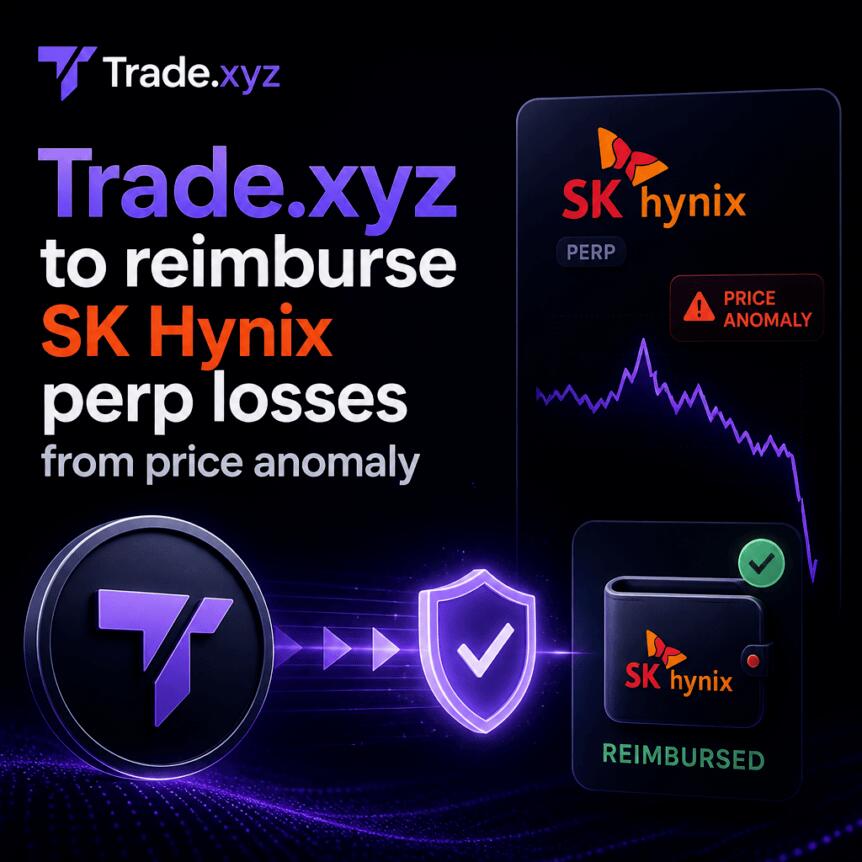
Trade.xyz, the operator of onchain perpetual markets on Hyperliquid, says it will reimburse eligible users for liquidation losses tied to a sudden “price anomaly” affecting its SK Hynix-linked contract. The announcement follows a sharp drop in the contract’s mark price after an off-chain trade was relayed through multiple independent data providers.
In a post on X, Trade.xyz stated that the SKHYNIX contract’s mark price fell to $917.25 from $1,127.90 at 23:01 UTC on Monday. It attributed the move to the way its oracle processes an external venue’s executed transaction, noting that eligibility requirements and details of the reimbursement are expected shortly.
Key takeaways
- Trade.xyz will cover eligible liquidation losses after a mark-price drop in its SK HynIX perpetual contract triggered liquidations.
- Trade.xyz said its oracle was “tracking” an external venue used as the primary South Korean pre-market and that it behaved according to specification.
- The affected contract is among Hyperliquid’s most active, with the platform reporting over $1.5 billion in 24-hour volume and nearly $600 million in open interest at the time of writing.
- Trade.xyz described reimbursement as a one-time discretionary decision and said it will review how prices are formed during extreme events.
- Hyperliquid/Trade.xyz is reportedly considering increasing the weight given to prices derived from its own order books during market stress.
Reimbursement after a mark-price break
The reimbursement plan centers on a specific event: Trade.xyz’s SKHYNIX contract mark price reportedly plunged within minutes, dropping from $1,127.90 to $917.25. According to Trade.xyz, the move was linked to an executed transaction on an external venue rather than a sudden distortion inside Hyperliquid’s own trading order book.
Trade.xyz did not disclose the number of users likely to qualify or the total amount it expects to distribute. It also said it would “announce soon” the eligibility requirements, with distributions expected “in the coming days.”
While the operator acknowledged the frustration traders can feel when liquidations occur during unusual market conditions, it framed the reimbursement as a “one-time discretionary decision.” It also signaled that the company plans to examine how its system handles price formation during extreme market events.
Why Hyperliquid’s mark price matters
On Hyperliquid, the mark price is not just a reference—it is a core input for risk controls. Trade.xyz said Hyperliquid uses mark prices to value positions for margin purposes and to determine when leveraged positions should be liquidated.
That design makes the accuracy and responsiveness of the mark-price mechanism critical. Even if the anomaly originates elsewhere, its impact can propagate quickly to trader margin calculations, particularly in highly leveraged perpetual markets.
Hyperliquid data cited by Trade.xyz indicates the SK Hynix contract is deeply liquid. On Wednesday, Hyperliquid’s interface showed the contract had produced over $1.5 billion in 24-hour volume and held nearly $600 million in open interest at the time of writing—figures that underscore why an oracle-driven disruption can quickly become a large-scale trader event.
How the anomaly appears to have transferred on-chain
Trade.xyz said the sharp move began with an executed transaction on an external market, not with trades on Hyperliquid itself. Its oracle tracks the US dollar value of one SKHX common share. The mechanism, according to Trade.xyz’s documentation, converts the underlying South Korean won price using the prevailing exchange rate.
In this case, Trade.xyz said the external print was processed by the oracle and contributed to the contract’s mark-price shift. It added that the oracle “worked as intended according to its specification,” a detail that helps clarify what the operator believes went wrong: not the system failing technically, but the market-data input producing a sudden reference-price dislocation.
The operator also suggested that Hyperliquid may adapt its approach for future stress periods. Trade.xyz said it is considering giving more weight to prices formed on Hyperliquid’s own order books, arguing that Hyperliquid’s internal liquidity and market signals may better reflect tradable conditions during volatility.
Perpetuals with external feeds under HIP-3
Trade.xyz’s SK Hynix market runs under Hyperliquid’s HIP-3 framework. HIP-3 enables perpetual contracts tied to assets with external price feeds, allowing builders to launch products when the primary pricing reference comes from venues outside the on-chain trading system.
Trade.xyz previously accounted for more than $22 billion of HIP-3’s first $25 billion in cumulative volume, according to coverage referenced in the source material. It has also launched an officially licensed S&P 500 perpetual using S&P Dow Jones Indices data, illustrating how HIP-3 has been used to bring traditional benchmark feeds into onchain perpetual trading.
This case highlights a central trade-off of external-feed perpetuals: while they expand asset coverage, they can also import volatility or idiosyncratic prints from other venues into margin and liquidation machinery. In moments when an off-chain venue’s execution data diverges sharply from the prevailing onchain trading picture, mark-price-based liquidation thresholds can behave abruptly.
What traders should watch next
For now, the key uncertainties are operational: how Trade.xyz will define eligibility for reimbursement and how it will adjust the balance between external feeds and Hyperliquid order-book prices going forward. Traders in external-feed perpetuals may want to pay close attention to any announced changes to oracle weighting and to monitoring around mark-price calculations during extreme events.
Crypto World
Fauci Pleads the Fifth at Senate Hearing on COVID, Escalating Long-Running Clash With Republicans
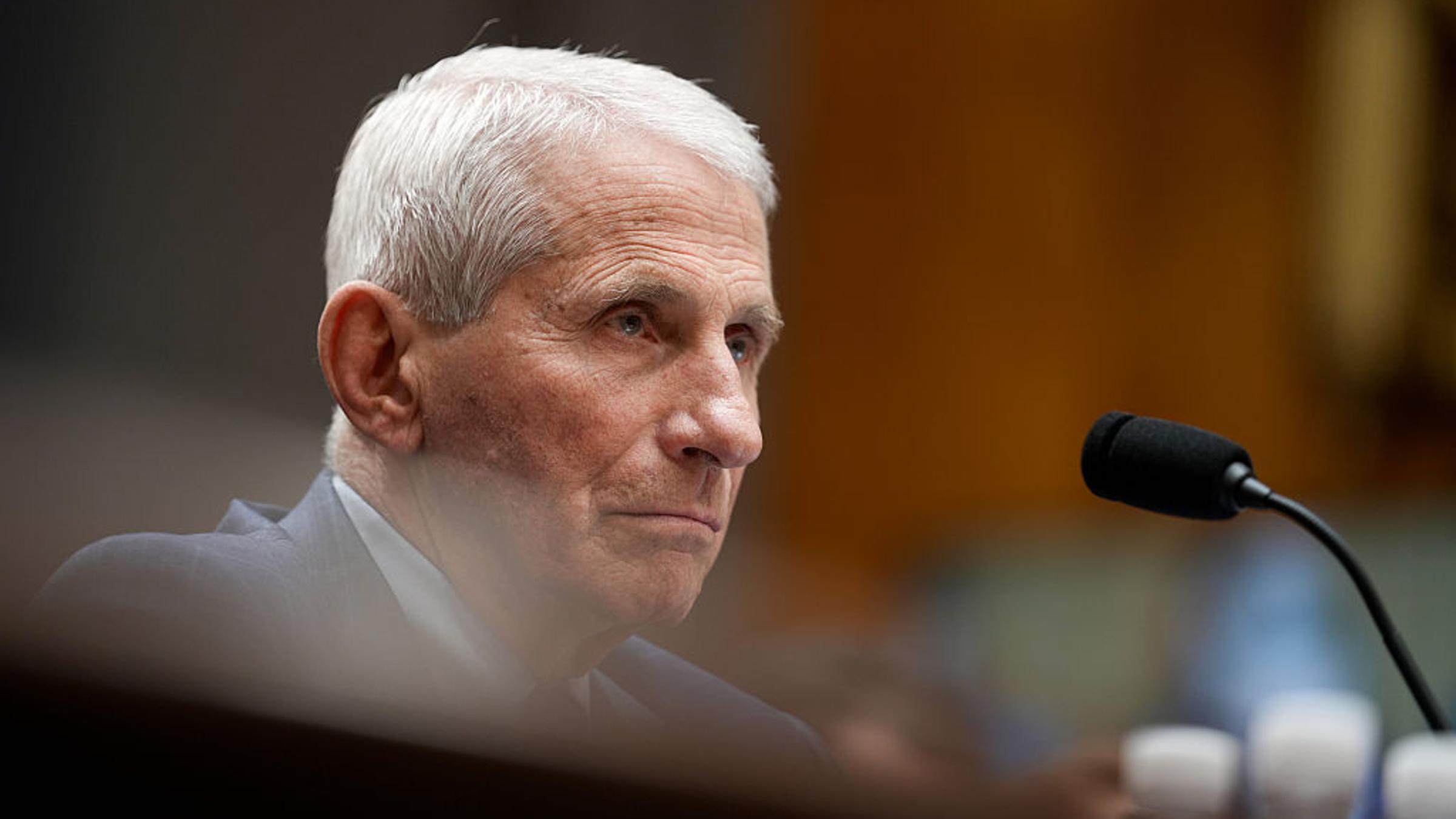
President Donald Trump likewise weighed in before the hearing, saying on Truth Social that Fauci “made too many bad calls” during the pandemic and asserting that he “didn’t let (Fauci) shut the Country down.” Trump has repeatedly criticized Fauci’s recommendations on masks, shutdowns, and other public health measures.
Biden’s pardon shielded Fauci from federal prosecution over actions and testimony connected to his government service during the pandemic. But Republicans have argued that any false statements made in new testimony could expose him to fresh legal jeopardy, a possibility Paul openly discussed before the hearing.
Asked this week about concerns that the hearing was designed to lure Fauci into committing perjury, Paul dismissed the criticism. “There’s no risk to perjury if you tell the truth,” he told reporters. “The only thing he can’t do is lie again.”
Democrats criticized the hearing as a partisan exercise. Senator Gary Peters of Michigan, the committee’s top Democrat, argued the panel should be focusing on current national security threats rather than revisiting disputes over the pandemic. “Instead of focusing on the national security challenges that we are facing in our country right now, today’s hearing looks backwards,” Peters said at the hearing. “Rather than building on that work to strengthen our preparedness against future disasters, we are instead relitigating the past.”


BNY, one of the world’s largest custodian banks, is taking a major step toward blockchain-based financial infrastructure by moving fund ownership records onchain.
The New York-based institution will launch a blockchain-based version of its transfer agency business, which manages fund ownership records and investor transactions, the Financial Times reported Wednesday.
“We think of BNY as modernizing a function that sits behind every single fund transaction by bringing the books and records on-chain,” Carolyn Weinberg, BNY’s chief product and innovation officer, reportedly said.
The move follows BNY’s broader digital asset expansion, including its European regulatory progress under the EU’s Markets in Crypto-Assets (MiCA) framework, as the bank positions itself for the next phase of institutional blockchain adoption.
What are transfer agency records?
Transfer agents are financial service providers that maintain official records of who owns shares in investment funds. They handle tasks such as processing investor transactions, issuing and redeeming fund shares, updating ownership records and supporting communication between funds and investors.
These records form part of the behind-the-scenes infrastructure that allows investment funds to operate. Traditionally, ownership information is stored across multiple systems used by fund managers, custodians and other market participants, requiring frequent reconciliation.
Related: USDC issuer Circle to acquire nearly 1,000 IBM blockchain patents
According to the report, BNY’s transfer agent services cover roughly $8.6 trillion in assets across 7.6 million accounts. The company, which oversees more than $59 trillion in assets under custody and administration, will reportedly maintain its traditional transfer agency operations alongside the new digital platform.
Baillie Gifford among early users for tokenized funds
By moving transfer agency records onchain, BNY aims to create a shared source of information for market participants, reducing reliance on separate databases and manual reconciliation processes.
Early users of BNY’s digital transfer agency reportedly include Edinburgh, Scotland-based asset manager Baillie Gifford, which plans to use the platform for what it described as the first “fully native” United Kingdom-regulated tokenized fund. BlackRock and BNY Dreyfus money market fund and cash management business are also expected to use the service for upcoming tokenized funds.
The firm has roughly $261 billion in assets under management, according to its website.
Related: Hong Kong prepares banks for quantum threats amid tokenization push
“What we have in the blockchain is a shared source of record-keeping between the participants,” Theo Golden, Baillie Gifford’s head of digital assets, said. “We agree that this is the source of truth when people are dealing with the asset that this is monitoring,” the executive said.
BNY has not disclosed which blockchain network will support the new platform. Cointelegraph approached the company for comment regarding the report but did not receive a response by the time of publication.
Magazine: The 5 types of real world assets being tokenized fastest onchain
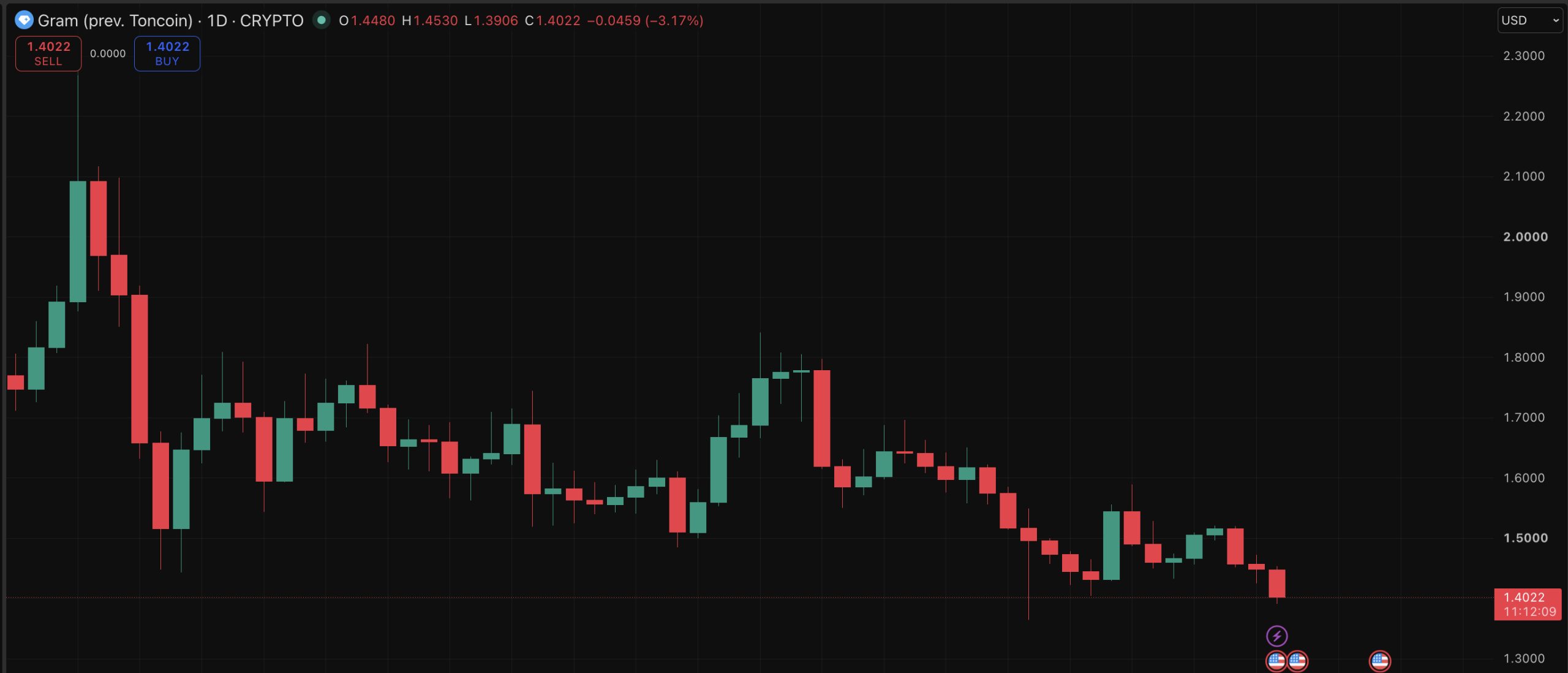
Russia’s FSB formally charged Pavel Durov with facilitating terrorist activities and placed him on an international wanted list. The move sent GRAM, formerly known as Toncoin, lower in early trading and added to its recent weekly losses. The case marks a major escalation from France’s ongoing investigation, shifting the focus from platform moderation to terrorism related allegations.
The FSB said the charges stem from Telegram’s alleged failure to remove material used by Ukrainian special services and terrorist or extremist groups to coordinate sabotage, mass killings, and cyber fraud operations inside Russia. Telegram’s official X account responded by posting an image of Durov making an obscene gesture but issued no written statement.
Durov’s whereabouts remain unclear. A May 16 Telegram post placed him in Dubai, while a July 23 update suggested he was in Georgia and expected to return soon. He holds Emirati and French passports and has not lived in Russia for more than a decade.
Discover: The Best Crypto to Diversify Your Portfolio
Muted Price Drop Masks a Bigger Pavel Durov Risk
GRAM’s initial decline looked relatively contained compared with the market reaction to Durov’s 2024 arrest. When French authorities detained him at Paris Le Bourget Airport in August 2024, Toncoin plunged sharply before the token’s later rebrand to GRAM, wiping billions of dollars from its market value. The smaller reaction suggests investors had already priced in some founder-related risk.
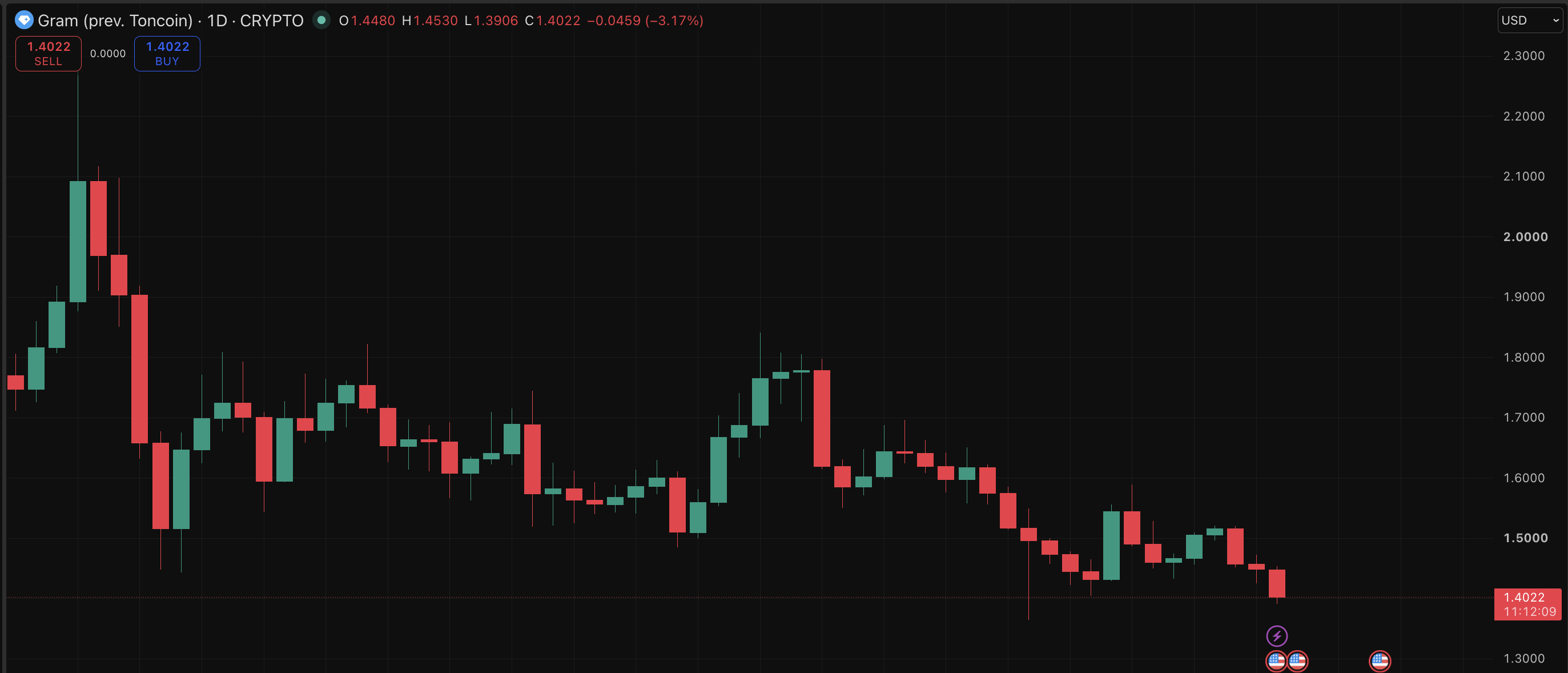
However, the terrorism allegations create a very different situation. Even without publicly released evidence outside Russia, the charges raise new concerns for banks, fiat on ramps, and exchanges supporting GRAM. The 2026 rebrand revived the token’s original identity and tied it more closely to Durov’s long-term vision, leaving less separation between the founder’s legal troubles and the token’s narrative.
Discover: The Best Token Presales
What Happens Next for GRAM and Telegram
Unlike the French investigation, which focuses on Telegram’s alleged cooperation with law enforcement, Russia’s case is framed around state security and wartime terrorism allegations. Russia has placed Durov on an international wanted list, although whether other countries act on it remains uncertain. The development follows months of mounting pressure, including reports that he was already under terrorism related investigation and an April summons delivered to a former Russian address.

The political backdrop adds another layer of uncertainty. Russia has repeatedly tried to restrict Telegram since 2018 while continuing to use the platform for official communications. In April, Durov said authorities appeared to accuse him of defending constitutional protections for free speech and private correspondence, adding that he was proud to be guilty of doing so. He has not publicly commented on the latest charges.
The immediate question for GRAM is whether the terrorism allegations prompt compliance-driven restrictions from exchanges or payment providers operating under AML and CFT rules. Telegram’s reported user base of more than one billion could still support adoption, but the founder’s legal situation is likely to remain a persistent source of headline risk. For now, markets appear more focused on continued uncertainty than on a quick resolution.
Trade Crypto on Bybit and Get a Chance to Win Our $1,000 USDT Airdrop
The post Russia Charges Against Pavel Durov Push GRAM Down as Founder Risk Deepens appeared first on Cryptonews.

It was sometime in 2015, on a hiking trail in Hong Kong, that the perpetual swap — also called a perpetual future or a “perp” for short — was born. Ben Delo, the mathematician and co-founder of BitMEX, was walking with a friend called Bavik, a derivatives trader, wrestling with a problem that had been nagging at him for months.
BitMEX had been trying everything. Quarterly futures, monthly futures, weekly futures, 48-hour futures, even a contract that lasted just 24 hours before resetting. Nothing was working. Customers kept complaining that their positions were closing without warning. They wanted something that looked like spot, traded like spot, but gave them the leverage that only a derivatives exchange could offer.
“What if a future never expired?” Delo asked.
Bavik’s answer was immediate. “Mathematically, it would be worth infinity,” Delo recalls him saying.
Technically, he was right. A futures contract’s value is partly derived from the time remaining until expiry and the cost of carrying the position. Remove the expiry date and that carrying cost compounds indefinitely, making the theoretical value infinite. But then Bavik offered a solution: just charge traders the bitcoin overnight rate, the way you might charge LIBOR (London Interbank Offered Rate) in traditional finance.
There was one problem. “I said, what’s that?” Delo recalls. “He said, ‘Hm, just charge them the overnight bitcoin interest rate’. I said, ‘I don’t think that exists.’”
So Delo built it. And in doing so, he invented one of the most consequential financial products of the 21st century.

Building BitMEX
To understand why the perpetual swap mattered, you have to understand what BitMEX was trying to be before it became the most liquid bitcoin market in the world.
When Delo and Arthur Hayes founded the exchange in 2014, they were not thinking about retail traders chasing 100x leverage. They were thinking about institutional hedgers. Hayes had worked at Deutsche Bank, while Delo spent years building high-frequency trading systems at JP Morgan. Their thesis was that bitcoin miners and payment companies needed a way to hedge their exposure, and BitMEX would provide the professional infrastructure to do it.
“We built it basically to look like a Bloomberg terminal,” Delo said. “We used Reuters instruction codes. Z14 meant expiring December 2014.”
The institutions never came. What came instead were traders, sophisticated but retail, people who had financial experience but were playing with their own money. And what they wanted was not guaranteed settlement or low leverage. They wanted to speculate, and they wanted to do it with as much size and leverage as possible.
BitMEX listened. By Halloween 2015, the exchange was offering 100x leverage, made possible by a real-time margining system that Delo had built from scratch. “I built the order matching engine, the position keeping system, the margining system, the PnL system, the settlement system,” he says. “Everything on that was me.”
The issue with futures, even short-dated ones, is basis, the premium at which a futures contract trades above the spot price of the underlying asset. A futures contract trades at a premium to the underlying asset, and that premium reflects an implied interest rate. In traditional finance, this is well understood. In crypto, in 2015, it confused almost everyone.
“Our customers would be like, why is bitcoin so expensive on your exchange?” Delo recalled “And we would say, ‘Well, if it is expensive, why don’t you short it?’ And that would blow some of their minds. You could short something rather than just long it.”
BitMEX kept shortening the expiry of its listed futures contracts. Weekly futures. Then 48-hour. Then a contract that relisted every single day.
“Every 24 hours, it would expire or settle. And people would say, ‘Why did you liquidate me?’ And we’d say, ‘We didn’t liquidate you. Your position closed at the index price. You got exactly the spot price,’” Delo said. “They’re like, ‘We don’t understand.’”
The customers knew what they wanted, even if they could not articulate it. They wanted a leveraged product that never went away. Delo’s hiking trail conversation gave him the framework to build one.
Inventing the funding rate
The perpetual swap launched in May 2016 with little ceremony. The core mechanic was straightforward: a futures contract with no expiry date, anchored to the spot price through a daily funding rate. Longs paid shorts, or vice versa, depending on whether the swap was trading above or below spot. BitMEX took no cut. The rate was purely a balancing mechanism.
The early funding rate was derived from third-party lending markets, primarily Bitfinex, where traders could borrow dollars or lend out Bitcoin. Take the dollar borrow rate, subtract the Bitcoin borrow rate, and you had something approximating the cost of holding a long position.
It worked, until it did not. As Bitcoin began its rise through 2016 and into 2017, demand for long exposure on BitMEX overwhelmed the funding mechanism. The swap started trading at a persistent premium to spot, causing the contract price to drift away from the actual price of bitcoin and undermining the mechanism designed to keep them aligned. The interest rate being imported from Bitfinex was simply not high enough to reflect what was happening on BitMEX itself.
“We had to dynamically adjust how we calculated that funding rate,” Delo said.
The original funding rate had been imported from external lending markets, a fixed reference point that could not respond to conditions on BitMEX itself. The new approach replaced that with a dynamic one, looking inward at how the swap was actually trading rather than outward at what Bitfinex was charging to borrow dollars.
The solution was elegant. Rather than looking outward to other markets, BitMEX would look inward. The exchange began measuring how far the swap was trading above or below spot over an eight-hour window, treating that gap as an implied basis, and back-calculating the annualized rate from it. That rate would then be charged at the end of the next eight-hour window.
“This was very important because you gave market makers notice of how you were calculating it, what it would be, and then when you would charge it,” Delo said. “Because it was paid from longs to shorts, if the swap was trading at a 1% premium, you would charge longs 1% but give 1% to shorts. And then immediately the market makers, knowing that, would come in, short the swap, and anchor it back down to the spot price. It was a dynamic equilibrium.”
This is, in essence, the funding rate mechanism that every major derivatives exchange in the world now uses.
The product that took over
By 2017, BitMEX was the most liquid bitcoin market on the planet. The exchange was processing $3-4 billion a day, and the perpetual swap was at the center of it all. Price discovery for bitcoin was happening not on Coinbase or Bitstamp but on the BitMEX order book.
The concentration of liquidity was itself a product of the swap’s design. Before it launched, BitMEX had been running quarterly, monthly, weekly, 48-hour and 24-hour contracts simultaneously, spreading market maker capital thin across six different tenors. The swap collapsed all of that into one instrument.
“By offering one product, they [traders] were able to consolidate their liquidity, which meant a more liquid market, tighter spreads,” Delo said.
Competitors noticed. Another competitor exchange copied so literally that it reproduced portions of the BitMEX FAQ without understanding how the product worked, Delo told CoinDesk. Others took the concept more seriously. Eventually, every major exchange in crypto offered its own perpetual swap, each one built on the funding rate architecture that Delo had begun assembling on that Hong Kong hiking trail.
“The fact that every other exchange has copied the swap just proves what a financial innovation it is,” he said. “I think it now does $40, 50 trillion dollars a year of turnover. It’s one of the most successful products in the history of capitalism.”
What comes next
BitMEX chose not to patent the perpetual swap. Delo says they considered it and decided the startup’s time was better spent building.
“We were a scrappy startup,” he says. “We thought, just get it out there. If it was any good, the market would show us.”
And show them the market did. Now, a decade on, the product is starting to attract the attention of traditional finance regulators. The CFTC is reportedly making room for perpetual swaps under its framework, and there is speculation that the CME could eventually list them on equities.
For Delo, that prospect is the final validation of something that started as a question on a hillside above Hong Kong, asked by someone who had grown tired of watching his customers complain about positions that kept disappearing.
“I think once traditional finance sees the benefits of this financial product,” he said, “it’ll be impressive.”
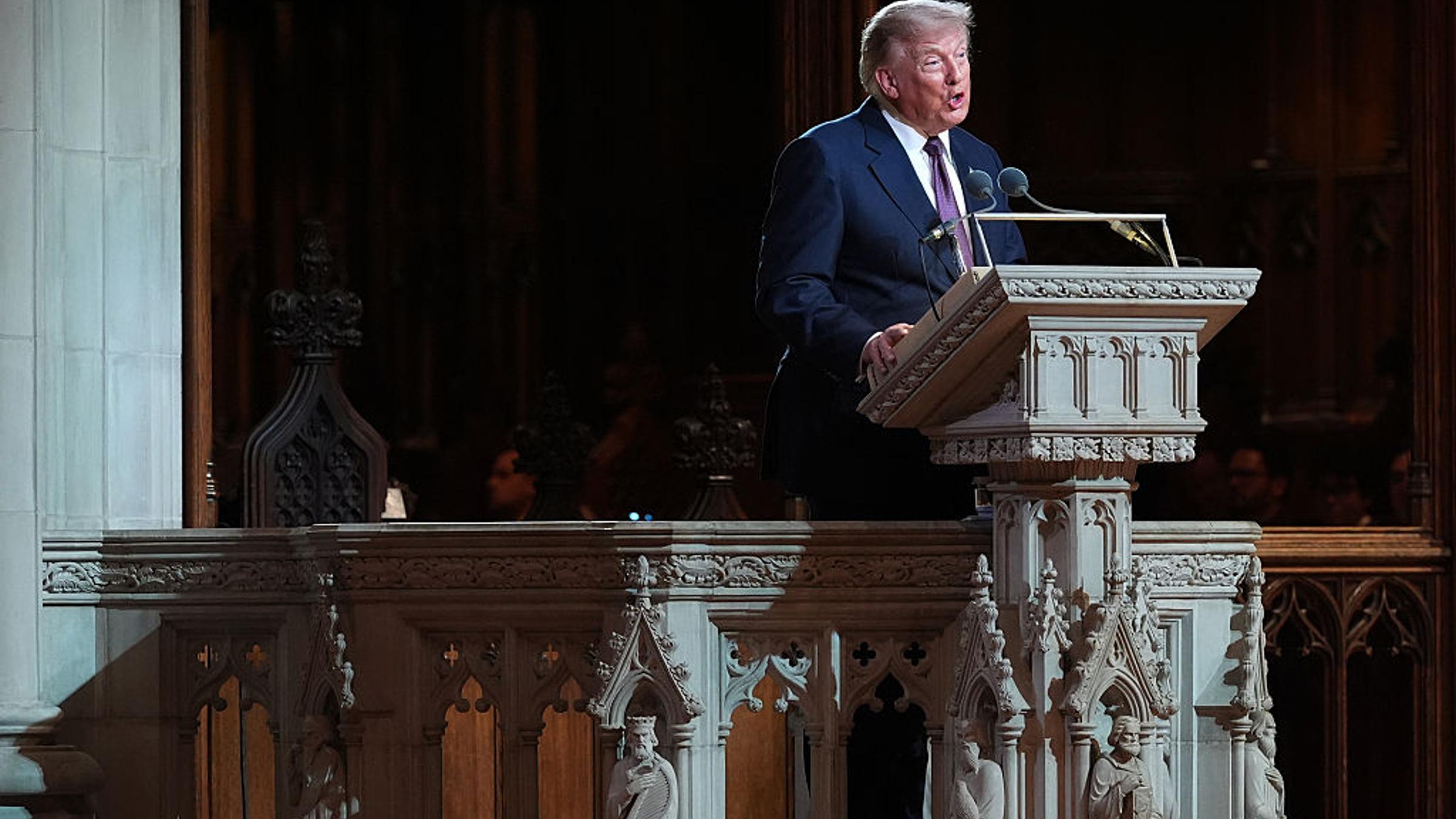
As Fox News host Sean Hannity reflected on that tension during his own tribute at the cathedral: “Lindsey and I did not always agree. Not on everything. But we could disagree and we could remain friends, and we remained friends for decades.”
And as Graham’s South Carolina pastor, the Rev. Tim Tate, said of the late Senator’s temperament in his eulogy: “You may not have liked him and he may not have liked you, but he would work with you for the common good of this country.”
Three of the best-known players in the conservative movement—Tony Perkins of the Family Research Council, Marjorie Dannenfelser of Susan B. Anthony Pro-Life America and the Rev. Franklin Graham—also spoke at the service, a reflection of the deep respect Graham garnered from across the modern GOP.
“Sen. Graham was very Washington, if you know what I mean,” Tate said. “But he was also very small-town.”
Graham was elected to the U.S. House during the 1994 Republican Revolution that elevated Newt Gingrich to the Speaker role, as the country’s politics were growing increasingly toxic. Graham quickly emerged as an unmovable conservative advocate for American military strength. He moved to the Senate after the 2002 elections, at the height of the post-9/11 trauma and shortly before the United States expanded its war on terror from Afghanistan to Iraq.
“Investments change fast; human nature and human aspirations stay constant.”
That’s how Meir Statman, behavioral finance pioneer and professor of finance at Santa Clara University, explains one of investing’s oldest puzzles. And it may be why every crypto cycle so far has been about chasing the next hot narrative rather than fundamentals, whether its DeFi, meme coins or decentralized compute.
In an industry that has spent years maturing into an ecosystem of institutional investors, revenue-generating protocols and real-world use cases, investor attention still gravitates toward the next shiny thing that can offer the promise of outsized returns.
“Crypto is still a young asset class, and price discovery in young markets tends to be driven by attention before it’s driven by analysis,” Samar Sen, head of international markets at Talos, tells Magazine.
“A new narrative gives investors a simple story to underwrite quickly, while assessing the fundamentals of an established protocol takes real work, from understanding usage and revenue to token design and competitive position.”
This behavior isn’t unique to digital assets; it’s just particularly pronounced in an industry that prizes memes over sustainable business models.
A Pokémon card, a digital asset and a tech stock
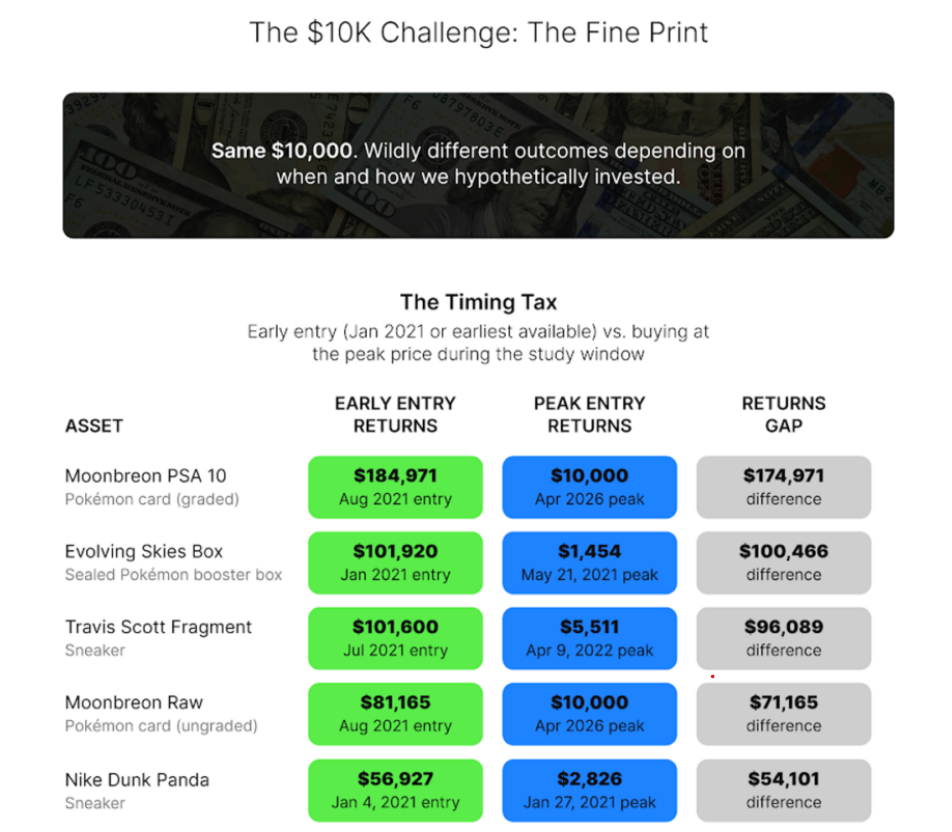
A recent MarketWise study compared hypothetical $10,000 investments across cryptocurrencies, stocks, exchange-traded funds and collectibles between January 2021 and April 2026.
The study found that a sealed Pokémon card box outperformed Bitcoin, while a pair of limited-edition sneakers nearly matched Dogecoin’s returns.
At the same time, some of Wall Street’s most popular artificial intelligence funds lagged the broader stock market despite AI dominating the investment headlines.
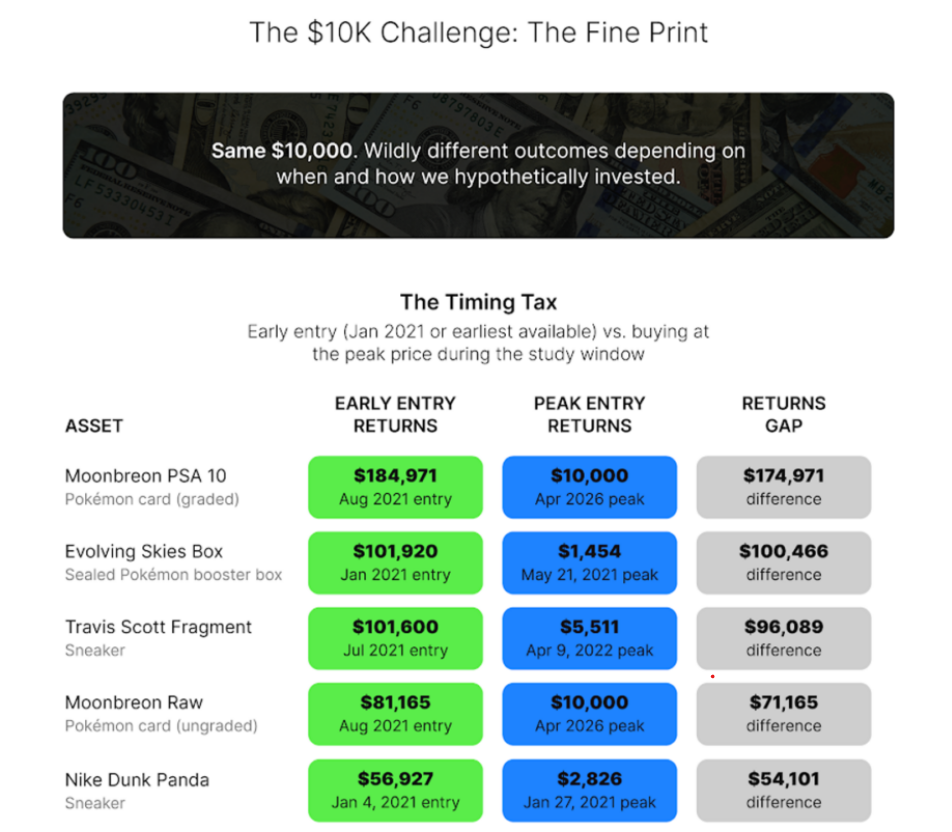
A $10K investment has very different outcomes. Source: MarketWise
What does a Pokémon card, a digital asset and a tech stock have in common? According to Statman, they’re driven by the same thing: investors aren’t simply looking for the best asset; they’re buying a lottery ticket to a life-changing outcome.
Investors are chasing transformation, not crypto
Traditional finance tends to assume that investors want to maximize returns while minimizing risk, but Statman argues that people often invest for a very different reason.
In an unpublished paper shared with Magazine, Statman argues that many investors mentally divide their wealth into two layers.
The first is a “not-poor” layer, which is designed to preserve their standard of living and avoid falling into poverty. The second is a “be-rich” layer, which is for transformative goals, like buying a house, becoming financially independent, or fundamentally changing their circumstances.
Within that framework, concentrated investments aren’t necessarily irrational; they exist because diversified investing, while statistically sensible, may never offer someone with limited capital a realistic chance of achieving those goals.
James Royal, a senior writer at MarketWise, tells Magazine:
“The asset class may change, but the behavior barely does… Investors aren’t exactly loyal to crypto, stocks or collectibles. Their loyalty is to whatever promises lucrative returns next.”
Statman says that, while some of today’s investors pin their hopes on meme stocks, “a century ago it was railroad stocks […] today’s investors are simply expressing the same aspirations through a new asset class.”
Investors aren’t becoming more tolerant of risk, however, just more willing to accept volatility for a chance of life-changing wealth.
“Investors aren’t necessarily on the hunt for risk, but they’ve got a case of FOMO on the next life-changing return, and that can lead them down a path of underestimated downside risk,” Royal says.
Why stories beat fundamentals
If investors are searching for transformation rather than simple returns, that helps explain why narratives so often overwhelm fundamentals, particularly in crypto.
The decentralized finance sector is a case in point. Despite some of its largest protocols like Aave or Uniswap generating substantial revenue, attracting billions of dollars in deposits and processing enormous trading volumes, their tokens struggle to capture the same excitement as newer narratives built around the latest craze.
Aave’s token was trading at around $98 at the time of writing, some 85% from its 2021 peak, but its TVL is over $14 billion, and had reached over $37 billion at the height of the bull market in October 2025.
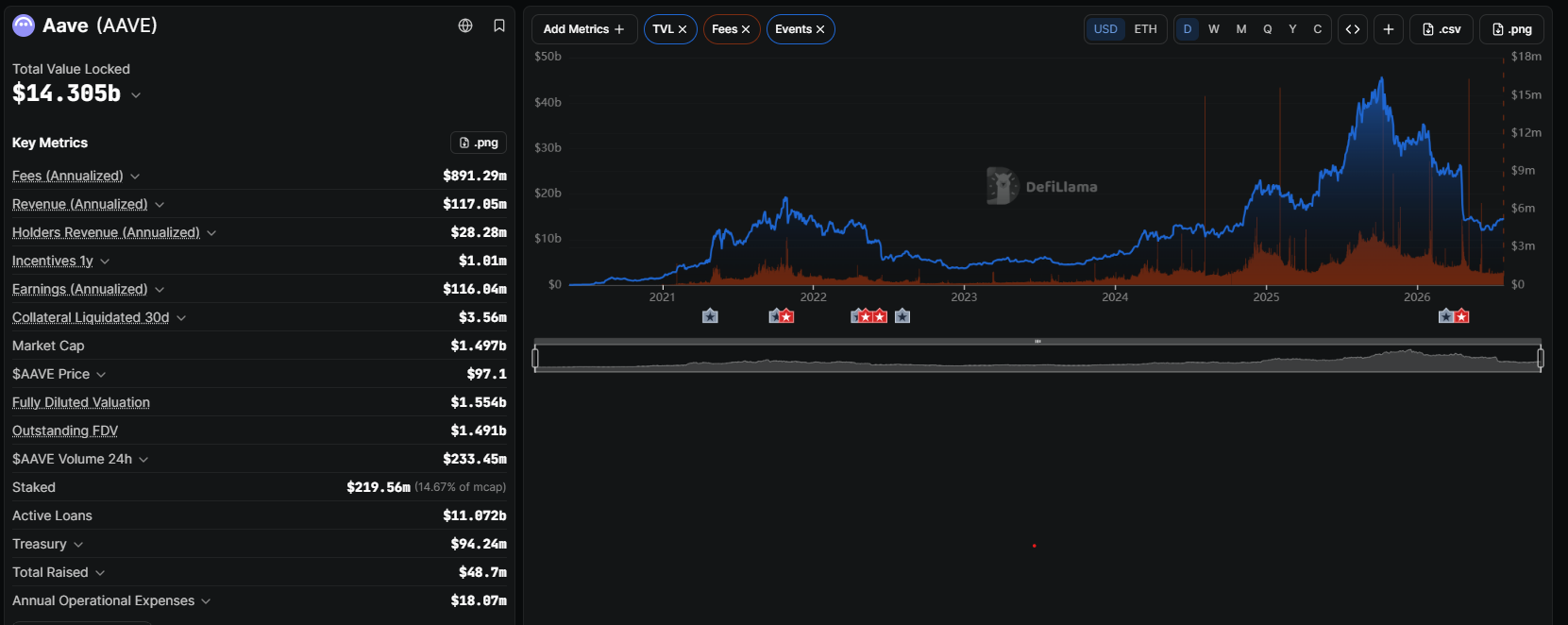
Aave’s TVL is over $14 billion while its token price is 85% from its 2021 peak. Source: DeFiLlama.
Thomas Probst, a research analyst at Kaiko market data provider, says that while assets may outperform in the short term, fundamentals will always be more important in the long term.
“Market fundamentals continue to play an important role, particularly resilience, liquidity, and volatility… [an asset’s] ability to establish itself over time also depends on the robustness of its market structure,” he says.
Yet, while a mature protocol generating sustainable cash flow may be an attractive long-term investment, it offers little appeal to investors allocating money toward their “be-rich” bucket. A token that might double over several years will always struggle to compete with the possibility, however remote, of a 100x moonshot.
“Investors like to confuse a great technological breakthrough with a great investment opportunity,” Royal says, which might explain why many AI-focused ETFs have underperformed, despite AI arguably becoming the defining investment narrative of our time.
“The real skill isn’t identifying exciting investments, it’s recognizing when optimism has already been priced in.”
That same skill comes in handy with market timing. MarketWise’s report found that investors who bought Bitcoin in January 2021 turned a hypothetical $10,000 investment into more than $24,000 by April 2026, with +141% gains.
Those who bought during its cycle peak in October 2025, however, saw the same investment shrink to just over $6,000 with a -38% return by April (and it’d be worth about $5,000 today).
Anyone who FOMO’d into AAAVE around the same time would be sitting on +85% losses today.
Institutions play a different game
Institutional investors approach investing from an entirely different perspective, Sen says:
“Institutional mandates simply don’t allow for chasing outsized, speculative returns. Institutions are underwriting risk-adjusted performance, liquidity, custody arrangements and operational resilience long before they look at upside potential.”
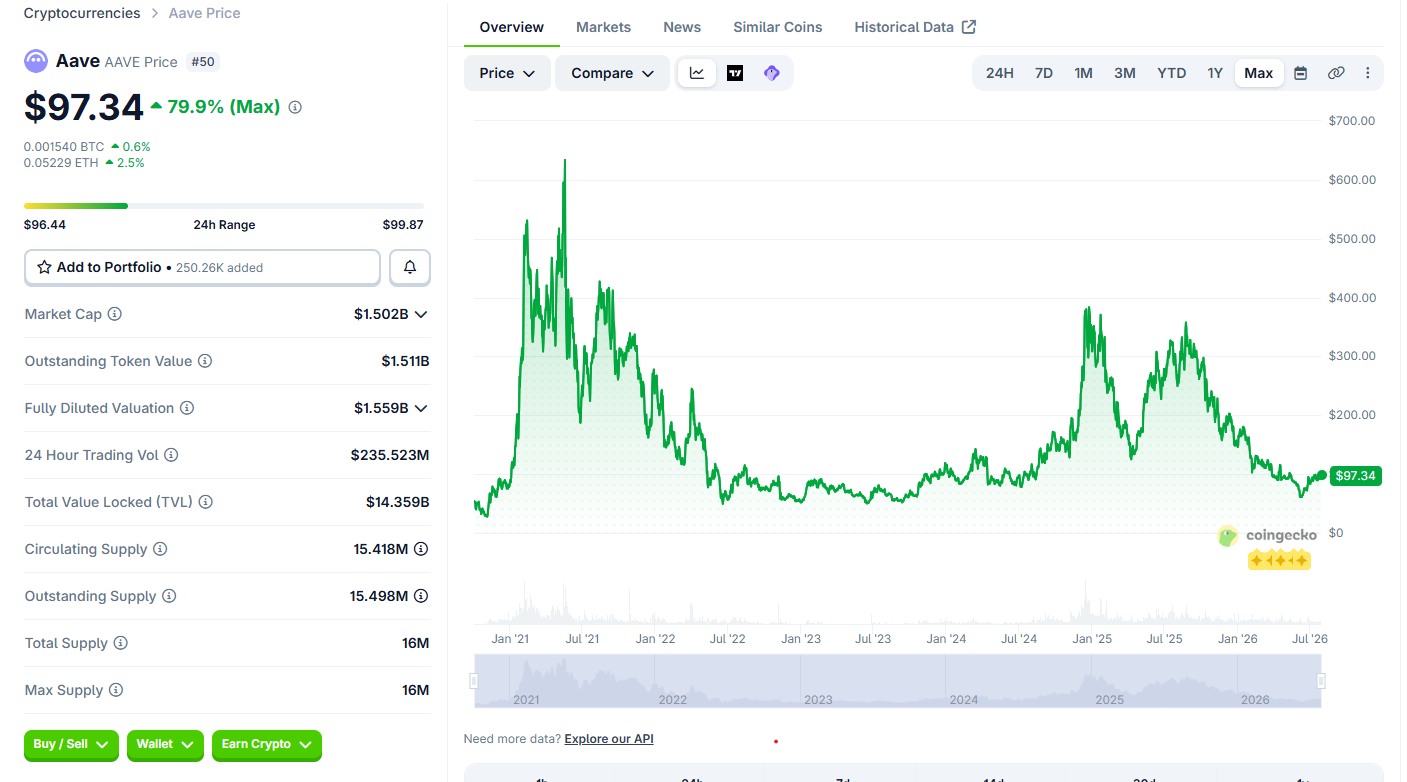
AAVE’s price performance since 2021. Source: Coingecko
And while that doesn’t mean institutions are immune to emerging narratives, they generally look at whether the underlying infrastructure can support meaningful capital allocation rather than whether the token could 100x.
“It’s usually a mix, and the order matters,” Sen says. “Most of these themes, DeFi, AI, memecoins, do start with a genuine shift: a real technical unlock or a new use case that wasn’t possible before.”
Once the narrative begins attracting speculative money, however, prices often move faster than fundamentals, he says.
“Investors arriving later in a cycle are often responding to the narrative as much as the fundamentals that started it […] Institutional capital, which tends to move on process and discipline rather than trend-following, is often a step behind the initial narrative and a step ahead of the correction.”
The next Bitcoin isn’t really the point
The search for the next life-changing investment is unlikely to disappear, and neither, Statman argues, is the human desire to improve one’s circumstances.
The next 100x token certainly exists, and investors will continue to seek it — even when the odds and fundamentals say they’re looking in the wrong place.
Magazine: The real reason DeFi projects that survived 2022 crash are shutting down now
Cointelegraph publishes long-form journalism, analysis and narrative reporting produced by Cointelegraph’s in-house editorial team with subject-matter expertise. All articles are edited and reviewed by Cointelegraph editors in line with our editorial standards. Some articles contain affiliate links, from which Cointelegraph may earn a commission. These relationships do not influence which products we review or our editorial conclusions. Content published in here does not constitute financial, legal or investment advice. Readers should conduct their own research and consult qualified professionals where appropriate. Cointelegraph maintains full editorial independence.
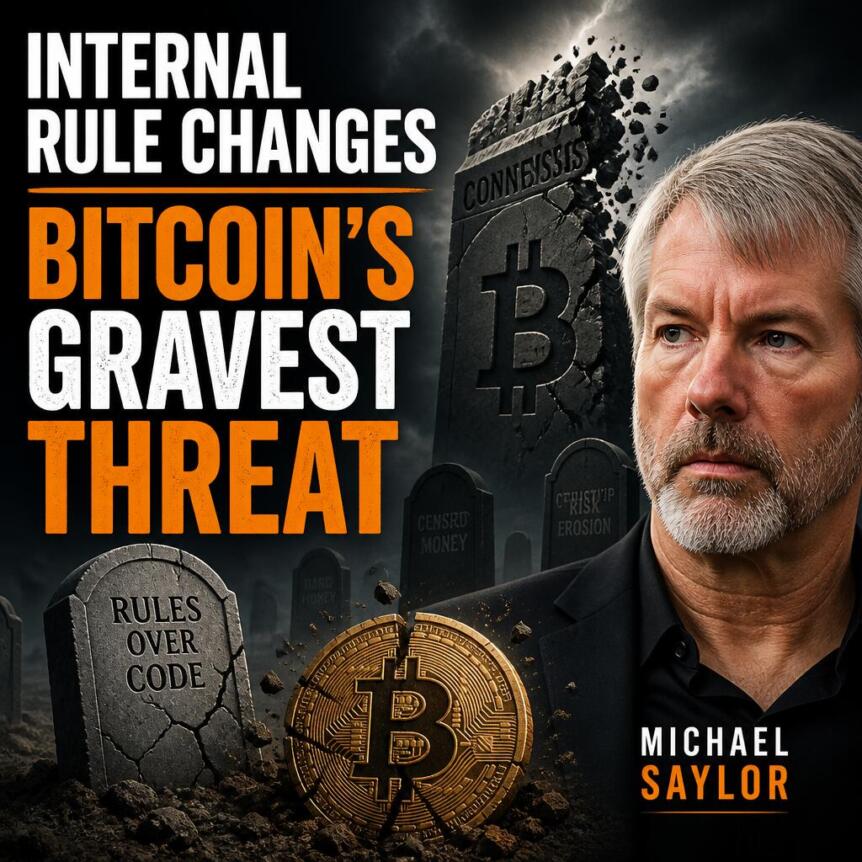
Strategy executive chairman Michael Saylor has warned that any changes to Bitcoin’s consensus rules pose a far greater threat than those posed by rival cryptocurrencies and external governments.
Saylor’s comments are likely part of his broader opposition to Bitcoin Improvement Proposal (BIP-110), a temporary soft fork that reduces arbitrary data stored on the blockchain.
Strategy Issues Bitcoin Warning
Michael Saylor issued the warning in a series of X posts, calling Bitcoin’s rules its constitution and describing how they determine ownership, scarcity, settlements, and what participants can and can’t change. Saylor stated,
“Bitcoin has won. Now it must survive victory. Its gravest threat is not an enemy at the gates, but corruption from within: factions that invent pretexts, rewrite the rules, and seize economic rights until freedom becomes permission and law becomes loot.”
According to Saylor, any changes to the protocol to benefit a single group would infringe upon the economic rights of the broader community, including miners, developers, investors, companies, custodians, and other users. He warned that if one group gained enough influence to change Bitcoin’s rules, others could use the same process for similar agendas.
Prolonged Governance Conflicts Harm Bitcoin
According to Saylor, protocol changes driven by a particular group could prolong disputes, which would drive away capital, slow development, and weaken security. Saylor has predicted Bitcoin could grow exponentially and become part of the infrastructure supporting global markets. The Strategy founder believes a poorly thought-out rule could hamper financial products and technologies in the future.
Saylor’s Opposition to BIP-110
If Saylor’s comments seem targeted, it’s because they are. Saylor has vehemently opposed BIP-110, a soft fork that reduces the arbitrary data stored on the blockchain. Supporters of the fork believe that limiting certain types of data eases storage requirements and reduces the burden on node operators. Additionally, they believe Bitcoin must focus on monetary transactions instead of tokens, inscriptions, or file storage.
While Saylor concedes that some on-chain data is redundant or could be linked to malicious activities, he argues that Bitcoin can’t use consensus rules to restrict block space to valid, fee-paying transactions. Saylor had said in an article dated July 18,
“Bitcoin does not need guardians of purity. It needs guardians of neutrality.”
Saylor’s latest comments also criticize proposals to add covenant functionality and increase block capacity, arguing that they create risks for Bitcoin’s base layer. Saylor is not the only one opposing BIP-110, with Adam Beck also publicly opposing the soft fork.
Fee Market and Network Security at Risk
Saylor believes imposing restrictions on valid transactions could weaken the fee market by reducing competition for block space, while larger blocks could reduce block space scarcity and raise bandwidth and hardware costs for node operators. He also argued that covenants could make Bitcoin’s consensus rules complicated and introduce new attack surfaces.
Saylor also warned that suppressing fee demand could substantially lower miner income, impacting the financial incentive that protects the network. He believes the base layer must be kept simple, neutral, scarce, and secure, while developers can build new functionality on a separate layer.
The Bitcoin Security Consortium
Strategy, along with Anchorage Digital, ARK Invest, BlackRock, Block, Blockstream, Coinbase, Fidelity Digital Assets, and Galaxy, has formed a consortium called the Bitcoin Security Consortium. The consortium has pledged $15 million over three years to support Bitcoin developers working on post-quantum solutions. However, the consortium will not take any position on protocol changes, nor control Bitcoin development.
Disclaimer: This article is provided for informational purposes only. It is not offered or intended to be used as legal, tax, investment, financial, or other advice.
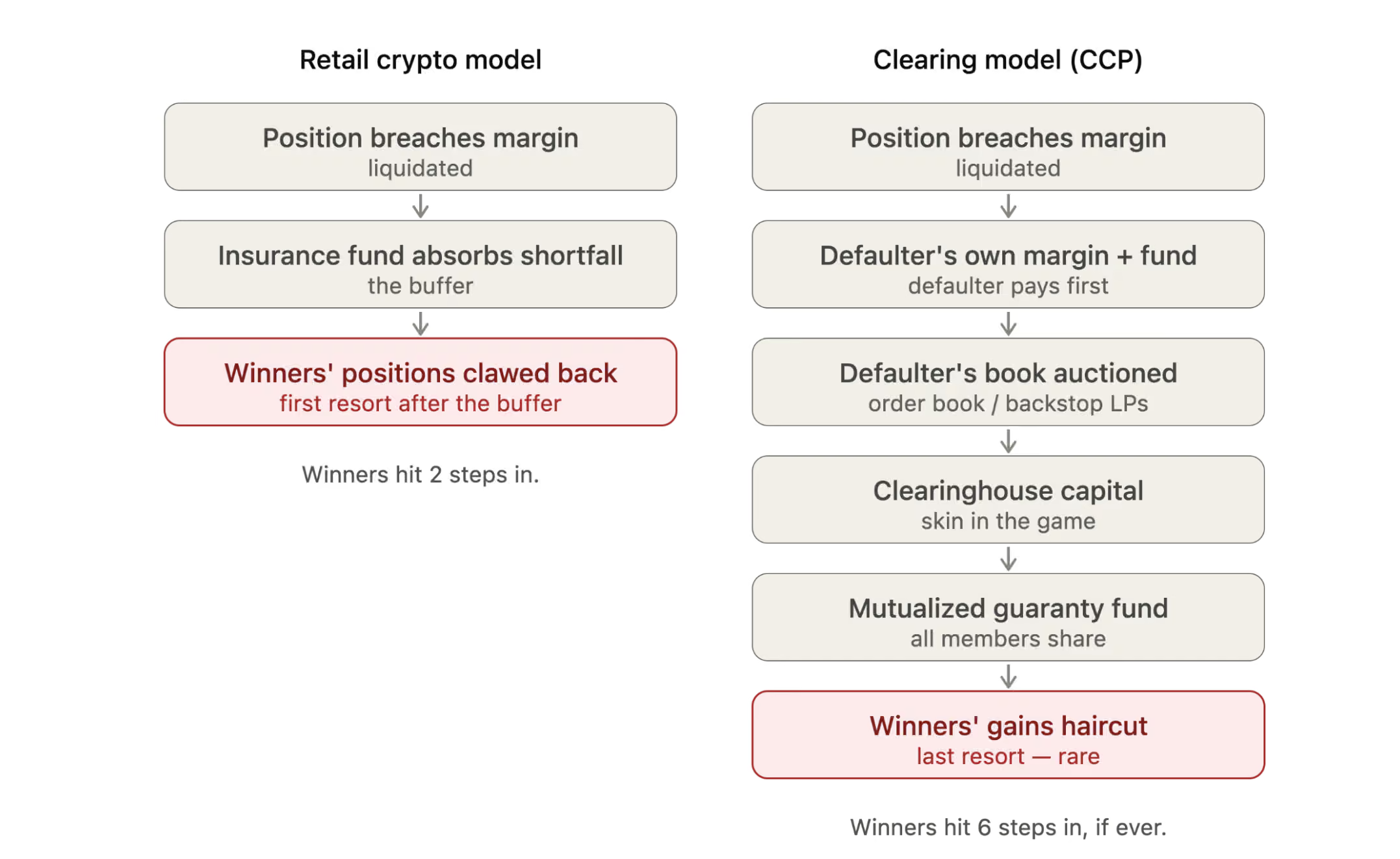
Perpetual futures are entering regulated markets, and the objection to them is serious: retail-driven, high-leverage instruments will import systemic risk. But the critique is aimed at the wrong target. Systemic risk in a derivatives market is a property of the venue on which the perpetuals are traded, not the contract. The risk is set by venue choices: leverage caps, margin, funding design, default management. None inherent to a no-expiry contract.
The concern isn’t baseless. Crypto’s sharpest deleveraging episodes — with the October 2025 cascade among the most recent — have many causes: macro shocks, stablecoin de-pegs, exchange outages, oracle failures, over-leverage and thin liquidity. What turns a sell-off into a systemic event is the risk transmission mechanism, and in crypto that is usually the liquidation cascade: forced liquidations depress prices, transmit to other venues through shared reference pricing and arbitrage, and trigger more liquidations. What makes the cascade violent are venue choices: a manipulable index that liquidates on false prices, and auto-deleveraging that claws back profitable trades to cover a shortfall. Neither is a feature of perpetuals.
So the real question is not whether perpetuals belong in regulated markets; it is how a given venue is built. Regulatory requirements are necessary to secure the baseline: segregated funds, a registered clearing entity, a supervisor’s oversight. How a venue handles a default under stress is a separate choice, and it varies even inside the regulated perimeter.
There’s a sharper objection worth taking seriously, and it isn’t about risk: maybe institutions don’t want perpetuals at all. A recent JPMorgan note found limited institutional appetite for perpetuals, treating them as speculative rather than a replacement for regulated futures – no term structure, and basis risk that makes them imperfect substitutes. That is correct when it comes to the mechanics: as a substitute for dated futures, perpetuals fall short. Unlike a futures basis, funding is variable and can’t be locked in; and for a hedger who needs term structure and delivery, they are the wrong tool.
But replacement is not how institutions reach for them. Running both an options market and a perpetual one, Bullish sees it firsthand: many of the institutions trading options on our venue use perpetuals to hedge delta (the options’ directional exposure to the underlying’s price), not as a stand-in for dated futures, but because that is where the liquidity is. Term structure is less relevant to delta hedging than liquidity. Many of crypto’s dated futures are thinly-traded, while perpetuals — liquid in part because of the retail flow their critics deride — are the deepest, most continuously tradable delta-one instruments available. A desk managing risk in real time takes execution over elegance.
And that liquidity edge is structural. Retail gravitates to perpetuals for what they are: no expiry, no roll, continuously tradable. The design that draws that flow concentrates liquidity in perpetuals. That is the overlooked prize in bringing perpetuals onshore: a deep, durable pool of liquidity in the instruments a hedging desk wants.
So the two halves of the debate are one. The liquidity institutions want already exists, drawn in large part by retail. What lets them use it safely is institutional-grade default management, the same thing that contains the systemic risk the critics fear.
The question was never “are perpetuals dangerous?” It is “when the market is under stress, how does a venue handle a default?” Regulated clearing has established the standard for decades, which is also the standard Bullish is building toward, having filed with the CFTC to operate as a regulated contract market and clearinghouse.
When a liquidation’s shortfall outruns the insurance fund, the backstop is to socialize losses: auto-deleveraging force-closes offsetting profitable positions at an off-market price in order to absorb the defaulter’s loss. The clearing model works differently. It starts with the defaulter, whose own margin and fund contribution absorb the first loss. The position is worked off through the order book or, if large, auctioned to other clearing members. Behind that sits a pre-funded guaranty fund sized to regulated clearinghouse standards, with broad loss-sharing only beyond that, and rarely.

None of this completely eliminates risk – nothing does. What it does is break the chain that turns one blown-out account into a market-wide cascade: a default absorbed at its source, not force-fed into a falling market. That is the difference between a venue that contains a failure and one that transmits it, and the transmission is the systemic risk the critics fear. Meet that standard and perpetuals become infrastructure institutions can use; miss it and we have the hazard critics describe, regulated or not. Perpetuals were never the whole story. The design is.
Large investors have seemingly decided to offload a substantial amount of ETH, raising concerns among some analysts that the asset could be gearing up for fresh bearish momentum.
At the same time, the optimists are just as vocal, forecasting a powerful move north in the near future.
The Whales’ Latest Move
Ali Martinez revealed that this group of market participants has sold or redistributed 226,435 ETH over the last 24 hours, marking one of the largest spikes in whale activity recently. At current rates, the stash is worth roughly $430 million, and these investors now control 26.64 million coins, about 22% of the asset’s circulating supply.
Such sell-offs from whales are usually viewed as concerning factors that could spread panic across the community and prompt smaller players to cash out, too. In line with the warning, Martinez said he is paying close attention to the $1,773 level, claiming that a breakdown below could “put the current bullish outlook on hold.”
Another analyst who outlined a rather pessimistic prediction is X user Crypto Lens. They think that ETH is stuck at the $1,860-$1,955 range for a reason, suggesting that the real bull trap is just getting started. In their view, the price may jump as high as $2,000, but shortly after, it might collapse to its final bottom test in the $1,400-$900 zone.
“There’s a chance we’ll wick a candle to update the 2022 minimum and sweep liquidity. I see a lot of hate toward Ethereum – this is done to disillusion the crowd. After that, whales will pump positivity around ETH when the price hits a new ATH,” the analyst concluded.
The Bullish Targets
Martinez has been quite indecisive about ETH lately, and earlier this week he was optimistic about an upcoming rally. He spotted the formation of a golden cross on the asset’s price chart, outlining the $1,980-$2,080 range as the first major resistance zone.
“If bulls manage to clear it, the next key level I’m watching for ETH sits at $2,773,” he said at the time.
MikybullCrypto and Gordon have also shared bullish predictions. The former described ETH as “one of the best plays right now” and projected a 5x move from current levels. The latter claimed that once the price breaks above $2K, “there’ll be no looking back.”
The most optimistic forecast came from CrediBULL Crypto, who believes that ETH is about to finish a multi-year base against BTC and is headed toward an all-time high of $20,000.
The amount of ETH stored on crypto exchanges adds weight to the positive scenario. Today (July 29), the figure fell to a new 10-year low of 15.13 million coins, suggesting that investors continue to abandon centralized platforms in favor of self-custody. This, in turn, reduces immediate selling pressure.

The post Ethereum Hit by Heavy Whale Selling: Where Could ETH Go Next? appeared first on CryptoPotato.

BASF SE (BASFY) Q2 2026 Press Conference Call Transcript

Trade.xyz to reimburse SK Hynix perp losses from price anomaly

Prospects report: Quinn Mathews back in the conversation


-

 Fashion5 days ago
Weekend Open Thread: Brooks Brothers
-
 Sports3 days ago
Commonwealth Games boxing: Jadumani Singh seals dominant 5-0 win over Pakistan’s Sumama Rehman to enter quarter-finals | Commonwealth Games News
-

 Tech3 days ago
Intel is reversing course and bringing hyper-threading back to its server chips
-

 Crypto World7 days ago
Ethics, other provisions in crypto Clarity Act to be further discussed
-

 Politics2 days ago
Luke Littler dismantles Gerwyn Price to retain title in Blackpool
-

 Crypto World4 days ago
Ripple bought a bank in pieces. The $4 billion audit
-

 Sports5 days ago
2026 3M Open leaderboard: Scottie Scheffler finds putter in Round 1, sits three back
-
 Entertainment5 days ago
A New Post-Apocalyptic Gundam Anime Series Blasts Into SDCC
-

 News Videos3 days ago
BITCOIN JUST ENTERED THIS CRITICAL ZONE…
-

 Politics1 day ago
The Part of the Electric Transition Nobody Wants to Discuss
-

 Fashion5 days ago
16 Dresses for the High Summer Event
-

 News Videos6 days ago
The Peugeot Family: How 200 Years of an “Old Money” Dynasty Died in A Boardroom
-

 Politics3 days ago
Spain sweeps the board at 2026 World Cup with individual awards
-

 Business9 hours ago
Major shareholder moves on Canyon
-

 Crypto World3 days ago
XRP Ledger adds $2.6B as RWA inflows rank second
-

 Crypto World6 days ago
Uniswap (UNI) pushes deeper into tokenized RWAs with permissioned trading pools
-
 Entertainment19 hours ago
‘Stargate’ Creator’s New Sci-Fi Series Returns for Season 3 Tomorrow
-

 Tech4 days ago
Anthropic launches Claude Opus 5, a cheaper AI model for coding, agents and enterprise workflows
-
Crypto World6 days ago
SEC Agrees to Overhaul Recordkeeping After Settling Coinbase Lawsuit Over Gensler’s Lost Texts
-

 News Videos18 hours ago
Claude: Build Financial Dashboards in Minutes (2026)
You must be logged in to post a comment Login