
Crypto World
Crypto Fear and Greed Index Flips From Fear to Greed Overnight

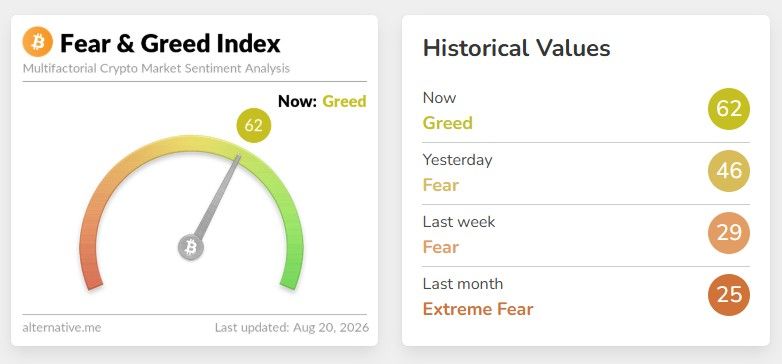
The crypto Fear and Greed Index climbed to 62 on Thursday, a Greed reading that wipes out yesterday’s score of 46. The 16-point daily jump ranks among the sharpest sentiment swings of 2026.
Bitcoin (BTC) drove the shift. The largest cryptocurrency gained 8.8% over 24 hours to trade near $69,803, while ether and other majors posted even bigger moves.
What Pushed the Crypto Fear and Greed Index Into Greed
The index blends five inputs, and two of them carry most of the weight. Volatility and market momentum count for 25% each. Both flipped hard once prices moved.
Ether (ETH) led the majors with an 18.5% daily gain to $2,259. Solana (SOL) added 11.9%, and XRP rose 11.2%. Meanwhile, Bitcoin’s market capitalization recovered to roughly $1.4 trillion.

The scale runs from zero to 100. Readings above 50 count as Greed. Scores near 25 signal Extreme Fear. Thursday’s print is the highest level on the index’s 30-day chart. Weekly investor surveys and Bitcoin dominance make up the smaller inputs.
Short sellers accelerated the climb. Roughly $1.23 billion in bearish positions unwound during the surprise crypto market rally, which forced traders to buy back exposure at higher prices.
Social media activity and Google search interest, which together account for a quarter of the score, typically spike after moves like this. Therefore, the reading may keep rising before it cools.

Why This Sentiment Flip Still Deserves Caution
Context matters here. The index printed 29 last week and 25 a month ago, deep inside Extreme Fear. Traders spent nearly all of July and early August below 35.
However, liquidity has not recovered at the same pace as the mood. Stablecoin balances held on exchanges have dropped about 20%, according to exchange stablecoin reserve data. Less idle cash therefore sits ready to absorb the next round of selling.
Contrarians read extremes in both directions. In late June, Fundstrat head of research Tom Lee argued that crypto sentiment had sunk below post-FTX levels. Coverage of those peak market fear signals looks early rather than wrong today.
Other traders watch market structure instead of mood. Bitcoin dominance has tested support since July, a setup that keeps the altcoin season debate open. In contrast to sentiment gauges, that signal has barely budged.
Leverage cuts both ways. The same short liquidations that lifted prices leave fewer bears to squeeze. A quiet session could drag the volatility and momentum scores straight back down.
One day of Greed confirms nothing on its own. Still, the index rarely travels 16 points without follow-through in one direction or the other. The next few readings will show whether buyers stay committed or whether fear returns just as quickly.
The post Crypto Fear and Greed Index Flips From Fear to Greed Overnight appeared first on BeInCrypto.


When we think about economic infrastructure, ports and power grids loom large. However, what stewards of the land—including farmers, herders, and pastoralists—have understood for generations is that healthy land is infrastructure too. It underpins livelihoods, food production, water security, the production of raw materials, and, by extension, the economy.
In fact, roughly $44 trillion of global GDP, around half of global output, is moderately to highly dependent on natural capital, including healthy land. Restoring degraded land should therefore be viewed as an investment in economic resilience. An added benefit is that responsible management and restoration of degraded agricultural land can help reduce emissions, including agricultural methane through improved livestock health and feed quality.
By 2050, three in four people worldwide are projected to be affected by drought, with significant knock-on effects for businesses and supply chains through disrupted production, higher input costs, and increased commodity-price volatility. For developing countries, the challenge is particularly acute. The countries most exposed to drought and land degradation are often those with less financial capacity to invest in resilience. A drought that reduces agricultural output can quickly become a wider economic shock by raising food-import bills, reducing rural incomes, and increasing pressure on public budgets and foreign-exchange reserves.


The U.S. Treasury doubled its long-end buyback operations on Aug. 19, compressing yields and triggering the largest single-day crypto rally since March. This is the plumbing story nobody else traced.
Summary
- The U.S. Treasury announced it will at least double the maximum size of its liquidity support buyback operations for 10-to-20-year and 20-to-30-year nominal coupon securities from $2 billion to at least $4 billion per operation, effective Sep. 9 through Nov. 4, 2026.
- The 30-year Treasury yield fell from a 19-year high of 5.34% to 5.19%, a drop of roughly 15 basis points from the Tuesday peak and 9 basis points on the announcement day alone.
- Bitcoin rallied 8.2% in under 12 hours, moving from an intraday low of $64,100 to a peak of $69,500, its highest level since early June.
- Forced short liquidations totaled $1.44 billion across major exchanges, with $1.29 billion closing within a single hour, the fastest concentrated squeeze of 2026.
- U.S. spot Bitcoin ETFs recorded a combined $487 million in net inflows across Aug. 17 and 18, with BlackRock IBIT capturing $143.6 million on Aug. 18 alone, confirming institutional participation before the rally accelerated.
On Aug. 19, 2026, Treasury Secretary Scott Bessent did something that barely made the front page of most financial outlets but moved more capital in a single afternoon than any Federal Reserve statement this year. The Treasury Department announced it would at least double the size of its long-end liquidity support buyback operations, raising the per-operation maximum from $2 billion to at least $4 billion for securities in the 10-to-20-year and 20-to-30-year maturity sectors.
The bond market reacted within minutes. The 30-year yield, which had touched a 19-year high above 5.34% the prior session, dropped 9 basis points to 5.19%. The 10-year fell to 4.647%. Stocks rose. And Bitcoin, which had been drifting sideways near $64,000 for most of the week, surged 8.2% to $69,500 in under 12 hours.
The move was not random. It followed a specific transmission chain that this piece traces step by step, from the Treasury press release to the crypto liquidation cascade, with the actual dollar flows at each node. Most coverage of the day focused on the price action itself. This piece focuses on the plumbing: what moved, why it moved, and how much money was involved at each stage of the chain.
What the Treasury actually announced
The official press release landed on the morning of Aug. 19. It contained a single operative change: beginning Sep. 9 and running through Nov. 4, 2026, the maximum size of nominal long-end liquidity support buyback operations would rise from $2 billion to at least $4 billion per operation. The number of long-end operations would also increase from two to four per quarter.
The program targets off-the-run securities. When the Treasury issues a new 10-year note, the previous 10-year note becomes off-the-run. It carries the same credit quality but trades less frequently, which makes it more expensive for primary dealers to hold on their balance sheets. The buyback program gives those dealers a reliable exit, allowing them to sell illiquid older bonds back to the government.
Critically, this is not quantitative easing. The Treasury funds these purchases by issuing new benchmark debt, often shifting duration toward shorter-dated paper and Treasury bills. Total net federal debt remains unchanged. What changes is the composition: less illiquid long-end paper sitting on dealer balance sheets, more liquid short-end paper in the market.
The Treasury stated the increase “reflects a desire to provide greater liquidity support in longer-dated nominal sectors.”
Analysts at Evercore ISI offered a blunter interpretation: Bessent was “hitting bond shorts with a surprise buyback on an August day with thin liquidity.”
Why yield compression is a crypto catalyst
The relationship between long-end Treasury yields and risk assets runs through a concept called the term premium, the extra compensation investors demand for holding long-dated government debt instead of rolling short-term bills. When the term premium rises, it signals that investors see more uncertainty ahead. Capital retreats from speculative assets and parks in guaranteed yield.
When the term premium compresses, the opposite happens. The relative attractiveness of risk assets improves because the guaranteed yield on safe havens falls. Capital that was earning 5.34% on 30-year Treasuries suddenly faces a lower return, pushing portfolio managers further out on the risk curve.
On Aug. 19, the 30-year yield fell from 5.34% to 5.19%. The 10-year dropped to 4.647% after trading near 4.75% earlier in the week. In dollar terms, these moves represent billions in mark-to-market gains for holders of long-dated bonds and, by extension, a loosening of financial conditions across the entire risk spectrum.
The scale of that repricing deserves a closer look. The outstanding stock of U.S. Treasury securities with remaining maturities above 10 years exceeds $7 trillion at face value. A 9-basis-point rally across that duration bucket produces roughly $50 billion to $60 billion in mark-to-market gains, depending on the weighted average duration. Those gains flow directly onto the balance sheets of pension funds, insurance companies, sovereign wealth funds, and the primary dealers themselves. Dealers with newly fattened balance sheets have more capacity to intermediate other markets, including equities and, increasingly, crypto ETFs.
Bitcoin has historically responded to yield compression with sharp upward moves. The mechanism is not mysterious: when the risk-free rate falls, the opportunity cost of holding a zero-yield asset like Bitcoin declines. Institutional allocators who benchmark against Treasuries find their hurdle rate lower, making speculative positions more defensible in portfolio construction terms. The tokenized Treasury market, which had crossed $15 billion in total value locked earlier in the summer, underscores the point: the same yield environment that pressures Bitcoin also attracts institutional capital into on-chain access to government debt, creating a direct pipeline between Treasury markets and crypto infrastructure.
Andre Dragosch, head of research at Bitwise, noted that “Bitcoin is the canary in the macro coal mine.”
The dollar flows at each step
This is the section a competitor could not have written, because it requires tracing the actual money through four separate venues in sequence.
Step 1: Treasury buyback announcement to dealer balance sheets. The announcement signaled that starting Sep. 9, primary dealers would have a guaranteed buyer for up to $4 billion in off-the-run long-dated paper per operation, up from $2 billion. Dealers holding illiquid 20-to-30-year bonds immediately saw the exit liquidity for those positions double. This is not a theoretical benefit. Primary dealers are required to make markets in Treasury securities, and when they accumulate large inventories of off-the-run bonds that trade infrequently, those positions consume balance-sheet capacity that could otherwise be deployed elsewhere. The doubled buyback gave dealers a clear path to offload those holdings, freeing capital for other market-making activities. The result was a repricing of the entire long end of the curve before a single buyback dollar changed hands. Markets are forward-looking, and the announcement itself was the catalyst.
Step 2: Yield compression to financial conditions. The 30-year yield dropping 15 basis points from its Tuesday peak (9 basis points on the announcement day) loosened financial conditions measurably. The Goldman Sachs Financial Conditions Index, which tracks the weighted contribution of bond yields, credit spreads, equity prices, and the dollar, shifted toward easier territory. For context, a 10-basis-point move in the 30-year yield translates to roughly $30 billion in mark-to-market value across the outstanding stock of long-dated Treasuries.
Step 3: Risk-on rotation to crypto. As financial conditions eased, capital rotated into risk assets. The S&P 500 rose on the day, with the Dow Jones Industrial Average adding 230 points. But the leveraged corners of the market moved faster and further. Bitcoin, which carries higher beta to financial conditions than equities, began climbing from its $64,100 intraday low within minutes of the yield move. The iShares 20+ Year Treasury Bond ETF (TLT) also surged, confirming that the rally was bond-led, not equity-led, a distinction that matters because bond-led risk-on moves tend to persist longer. Spot Bitcoin ETFs had already been accumulating: $297.6 million flowed in on Aug. 17 and $189.3 million on Aug. 18, with BlackRock IBIT alone taking in $143.6 million. That two-day total of $487 million meant institutional buyers were already positioned before the catalyst hit.
Step 4: Liquidation cascade. The derivatives market provided the accelerant. With Bitcoin rising past $65,000, then $66,000, then $67,000, leveraged short positions began hitting their liquidation prices. The data is stark: $1.44 billion in shorts were liquidated across major exchanges within 24 hours, with $1.29 billion of that total closing within a single hour. The largest single liquidation was a $32 million ETH-USD position on Bitget. More than 110,000 traders were liquidated in total. Each forced closure required buying the underlying asset, which pushed the price higher, which triggered more liquidations, a reflexive loop that carried Bitcoin from $67,000 to $69,500 in roughly 90 minutes.
The short positioning that made it possible
The liquidation cascade did not happen in a vacuum. In the days before Aug. 19, the derivatives market had built a pronounced short bias. On Binance, short positions accounted for 51.64% of open interest. On OKX, the figure was 51.13%. On Bybit, it was 52.25%, the most pronounced tilt of the three.
This positioning reflected a consensus view: with 30-year yields at 19-year highs and the S&P 500 recording its third consecutive decline on Tuesday, the macro backdrop appeared hostile to risk assets. Traders were betting that the bond selloff would continue, dragging crypto lower with it. Bitcoin had spent the previous 46 days in a funding-rate drain, a period during which perpetual futures funding had been consistently negative or near zero, reflecting sustained bearish conviction among leveraged traders.
The ratio of short to long liquidations on Aug. 19 tells the story of how wrong that conviction turned out to be. Short liquidations totaled $1.44 billion against just $168 million in long liquidations, a ratio of roughly 8.6 to 1. That imbalance meant the rally was overwhelmingly driven by forced buying from capitulating bears, not by new longs entering the market. The distinction matters because forced buying is mechanical and indiscriminate, amplifying price moves beyond what organic demand alone would produce.
The Treasury announcement inverted the bearish thesis in a single press release. Shorts that had been profitable for days suddenly faced a market moving against them with institutional ETF flows providing a persistent bid underneath. The funding rate on Bitcoin perpetual futures, which had been negative (indicating short dominance), flipped positive within hours. On Ethereum, the move was even more dramatic: the second-largest cryptocurrency jumped above $2,000 for the first time since June, gaining roughly 10% on the day, while Solana advanced 6.4%.
Paul Howard, senior director at Wincent, captured the sequence: by easing conditions in longer-dated Treasuries, the move provided “a more supportive backdrop for risk-taking and short-term speculation in crypto.”
What Bessent is really doing
The buyback expansion fits into a broader pattern that market observers have tracked since Bessent took office. The Treasury secretary has consistently used operational tools, rather than policy speeches, to manage the bond market.
The context matters. Long-dated Treasury yields had been rising since late June, driven by a combination of persistent deficit spending, downgraded sovereign credit outlooks, and a global selloff in government bonds that was not limited to the United States. The 30-year yield breached 5.0% in late May, hit 5.11% by early June, and kept climbing through the summer to that 19-year high of 5.34%.
Rising long-end yields create real economic friction. Mortgage rates track the 10-year yield. Corporate borrowing costs rise with the 30-year. When the 30-year yield sits above 5.3%, every new 30-year corporate bond issue prices at a higher coupon, every adjustable-rate mortgage resets higher, and every pension fund marks down the present value of its liabilities. A Treasury secretary who can compress the long end without changing fiscal policy or pressuring the Federal Reserve has a powerful lever, and Bessent has shown a willingness to pull it at moments of maximum market stress.
The buyback is that lever. By doubling the program, Bessent signaled to the market that the Treasury would not tolerate disorderly conditions in the long end. The timing was deliberate. The announcement landed on an August Wednesday, traditionally one of the thinnest liquidity days of the year, when a modest volume of buying can produce outsized price moves. Evercore ISI analysts described it as Bessent “again showing his tactical skill as an activist Treasury secretary.”
The political dimension is also relevant. With the administration pursuing an ambitious legislative agenda that requires continued access to debt markets, a disorderly bond selloff threatens the fiscal plan itself. Bessent has framed the buyback expansion as a technical liquidity measure, but the market read it as a policy statement: the Treasury will defend the long end.
Matt Cole of Strive offered a more cautious framing: “There is no painless path. The question is simply where the adjustment gets absorbed.”
How this compares to previous Treasury interventions
Treasury buybacks are not new. The modern program launched in 2000, was suspended in 2002, and restarted in May 2024. The 2024 relaunch initially focused on smaller operations, $2 billion per session, with a stated goal of supporting market liquidity rather than influencing yields. An IMF working paper published in May 2025 found that the program moderately narrowed bid-ask spreads and off-the-run yield spreads, confirming the liquidity benefit but stopping short of claiming a significant impact on outright yield levels.
But the Aug. 19 expansion represents a qualitative shift. Doubling the operation size and increasing the frequency to four per quarter moves the program from a maintenance tool to an active market management instrument. At $4 billion per operation and four operations per quarter, the Treasury will be repurchasing up to $16 billion in long-dated off-the-run paper per quarter, a pace that approaches the scale of a small quantitative easing program in its effect on the long end, even though the mechanism is fundamentally different.
The historical relationship between Treasury operations and Bitcoin has strengthened as the crypto market has matured and institutional participation through ETFs has grown. In previous cycles, Treasury operations had minimal direct impact on crypto because the transmission mechanism required too many steps and crypto markets lacked the institutional plumbing to respond quickly. A buyback announcement in 2001 would have taken days to filter through bond desks, equity markets, and finally into the nascent crypto trading community, which at the time consisted of a few thousand participants on message boards.
The existence of spot Bitcoin ETFs, which now manage tens of billions in assets and saw cumulative inflows exceed $60 billion for BlackRock IBIT alone, has shortened the transmission chain. When yields fall, ETF allocators can rebalance into crypto exposure within the same trading session, without touching an exchange or managing custody. The speed of the Aug. 19 move, from Treasury press release to Bitcoin at $69,500 in under 12 hours, would have been impossible without this infrastructure.
The two-day ETF inflow of $487 million heading into the announcement was not coincidental. Institutional flows often front-run Treasury operations because the quarterly refunding schedule and buyback calendars are published in advance. What was not published, and what caught the market off guard, was the doubling of the operation size.
The limits of the trade
The Treasury buyback trade has clear boundaries that traders should understand before extrapolating from a single day.
First, the buyback program is time-limited. The doubled operations run from Sep. 9 through Nov. 4. After that, the Treasury will reassess. If yields have stabilized, there is no guarantee the elevated size continues.
Second, buybacks do not reduce total debt. They shift composition. Every dollar spent buying off-the-run long-dated paper is funded by issuing new short-dated paper. If the macro environment continues to deteriorate, the additional short-end issuance could push bill rates higher, creating a different kind of pressure on financial conditions.
Third, the short liquidation that amplified the Aug. 19 move was a one-time event. Those 110,000 liquidated positions cannot be liquidated again. Future Treasury announcements will land in a market with different positioning, and the reflexive cascade may not repeat.
Fourth, Bitcoin at $69,500 sits below its all-time high and remains range-bound in a broader context. The rally brought it to its highest level since early June, but it did not break the structure of the consolidation that has defined 2026 trading. For Bitcoin to sustain above $69,000, it will need organic spot demand to replace the mechanical short-covering that drove the initial move. If that bid does not materialize, a retracement toward the $65,000 to $66,000 support zone is the base case.
Fifth, the broader macro picture has not changed. The federal deficit remains elevated, sovereign credit outlooks remain under pressure, and the global bond selloff that drove yields higher through June and July reflects structural forces that a buyback program cannot address on its own. The buyback buys time and improves market functioning at the margin. It does not resolve the underlying fiscal dynamics that pushed yields to 19-year highs in the first place, and traders who treat it as an all-clear signal may be disappointed.
What to watch
- Sep. 9 buyback execution: the first $4 billion operation will reveal whether the Treasury receives enough high-quality offers at the new scale, or whether the market has already priced in the full benefit.
- 30-year yield at the 5.0% level: a sustained break below 5.0% would confirm that the buyback program is achieving its goal of compressing long-end yields, which would support continued risk-on positioning in crypto.
- Bitcoin ETF flow direction in September: if institutional inflows accelerate above the $487 million two-day pace seen in mid-August, it would signal that allocators are treating the buyback expansion as a durable shift in financial conditions rather than a one-day event.
- Perpetual futures funding rates: positive funding rates (indicating long dominance) after the squeeze would suggest the market has repositioned from bearish to bullish, reducing the probability of another liquidation-driven spike.
- Treasury refunding announcement in late October: the quarterly refunding will reveal whether Bessent plans to extend the doubled buyback size beyond the Nov. 4 window, which would be the strongest signal yet that the Treasury is committed to active yield curve management.
What is a Treasury buyback?
A Treasury buyback is when the U.S. Department of the Treasury repurchases its own previously issued bonds from primary dealers. The program targets older, less liquid “off-the-run” securities and is funded by issuing new debt, typically shorter-dated paper, so total government debt does not change.
How much did the Treasury increase its buyback operations?
The Treasury doubled the maximum per-operation size from $2 billion to at least $4 billion for securities in the 10-to-20-year and 20-to-30-year maturity sectors. The number of long-end operations also increased from two to four per quarter. The changes take effect Sep. 9, 2026.
Why did Bitcoin rally 8% on Aug. 19?
The Treasury buyback announcement compressed long-end yields, loosening financial conditions and triggering a risk-on rotation. Bitcoin moved from an intraday low of $64,100 to $69,500 as $1.44 billion in short positions were liquidated, with forced buying accelerating the rally in a reflexive loop.
Is the Treasury buyback the same as quantitative easing?
No. Quantitative easing involves the Federal Reserve purchasing bonds and creating new money. Treasury buybacks are funded by issuing new shorter-dated debt, so total debt remains unchanged. The operation shifts the composition of outstanding debt instead of expanding it.
How do Treasury yields affect Bitcoin?
When long-end Treasury yields fall, the opportunity cost of holding zero-yield assets like Bitcoin declines. Institutional allocators face a lower risk-free rate, which makes speculative positions more defensible in portfolio construction. Bitcoin has historically rallied during periods of yield compression.
How much was liquidated in the short squeeze?
Total short liquidations reached $1.44 billion across major exchanges within 24 hours, with $1.29 billion liquidated within a single hour. More than 110,000 traders were affected. The largest single liquidation was a $32 million ETH-USD position on Bitget.
Will the doubled buyback operations continue after November?
The increased operations are scheduled from Sep. 9 through Nov. 4, 2026. Whether they continue depends on market conditions and the Treasury quarterly refunding announcement in late October. If long-end yields remain elevated, extension is likely. If yields stabilize, the Treasury may revert to smaller operations.
What role did Bitcoin ETFs play in the rally?
U.S. spot Bitcoin ETFs recorded $487 million in net inflows across Aug. 17 and 18, with BlackRock IBIT leading at $143.6 million on Aug. 18 alone. These institutional flows provided a persistent bid underneath the market before the Treasury catalyst hit, shortening the transmission chain from macro event to crypto price action. This is educational analysis, not investment advice.
Disclaimer: This article is for informational purposes only and does not constitute financial advice. Cryptocurrency investments carry significant risk. Always conduct your own research before making investment decisions. Published Aug. 20, 2026.
Selling pressure on the Japan 225 has intensified as markets increasingly anticipate a possible Bank of Japan rate hike in September. According to Reuters, policymakers are considering taking action at the 17–18 September meeting and may be open to tightening monetary policy at a faster pace than the current guidance of roughly two rate increases per year.
Market pricing points to a high probability of a September hike. At the same time, Japanese government bond yields have climbed to multi-year highs, reflecting growing expectations for tighter monetary policy alongside concerns over inflation and fiscal risks.
Technical Analysis of Japan 225
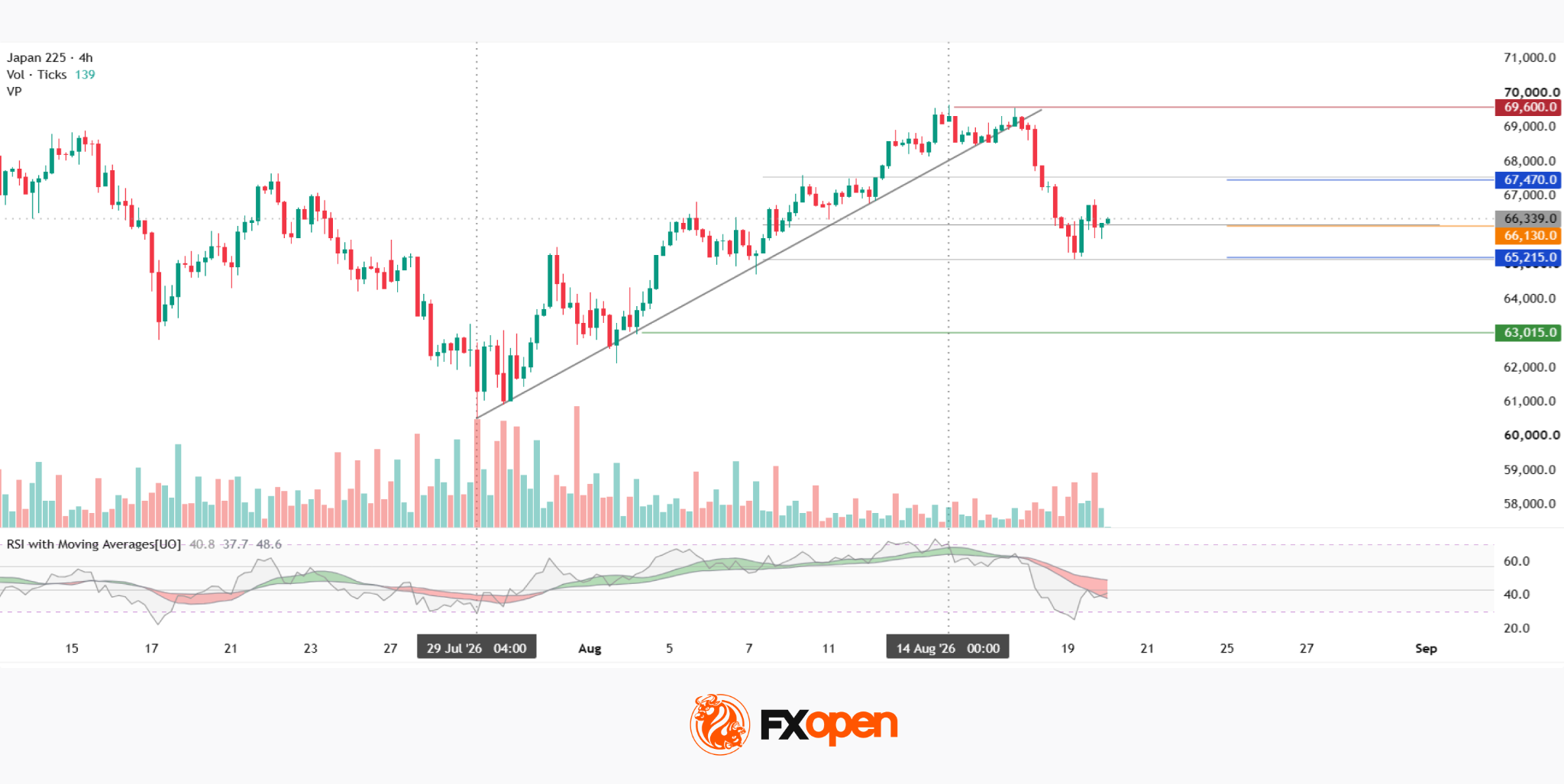
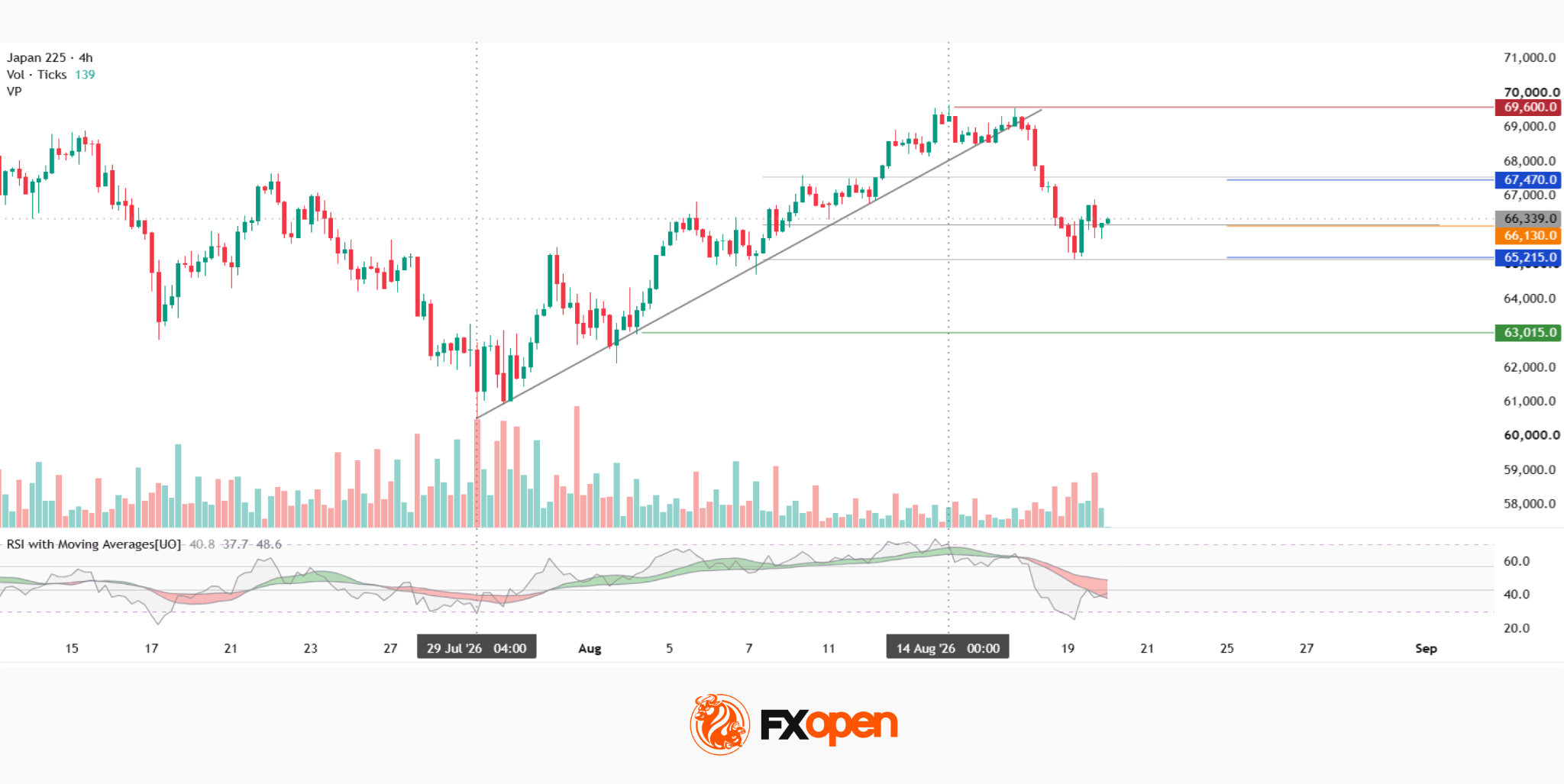
The H4 chart of the Japan 225 shows an upward trend that developed against a backdrop of declining vertical volume, with the index advancing from a local base formed in late July towards a peak of 69,600.
The trendline now appears to have been broken, with the move accompanied by a steady increase in trading volume. This suggests that the current decline is gaining more momentum than the preceding advance.
The index is currently trading around the Point of Control (POC) at 66,130, within the boundaries of the current market profile. The upper boundary is located at 67,470, while the lower boundary stands at 65,215.
If the breakdown extends and the price moves below the lower boundary of the profile, the next significant area of interest would be the 63,015 support zone, where the nearest concentration of market activity is located.
Conversely, if buyers regain control and successfully push the index back through the profile from below, the previous uptrend high at 69,600 would become the next major resistance level.
The RSI + MAs indicator currently shows readings of 39, 39 and 49. RSI has already entered oversold territory, while the fast moving average remains below the neutral zone and the slow moving average is positioned around its midpoint.
Key Takeaways
The fundamental backdrop remains mixed. Expectations of a Bank of Japan rate hike are weighing on the Japan 225, while weak domestic demand adds another source of uncertainty.
In the near term, the index is likely to remain sensitive to expectations surrounding the BoJ’s next policy decision, incoming inflation data, movements in the yen and changes in Japanese government bond yields. These factors could determine whether the current technical correction develops into a deeper decline or gives way to a renewed recovery.
Trade global index CFDs with zero commission and tight spreads (additional fees may apply). Open your FXOpen account now or learn more about trading index CFDs with FXOpen.
This article represents the opinion of the Companies operating under the FXOpen brand only. It is not to be construed as an offer, solicitation, or recommendation with respect to products and services provided by the Companies operating under the FXOpen brand, nor is it to be considered financial advice.
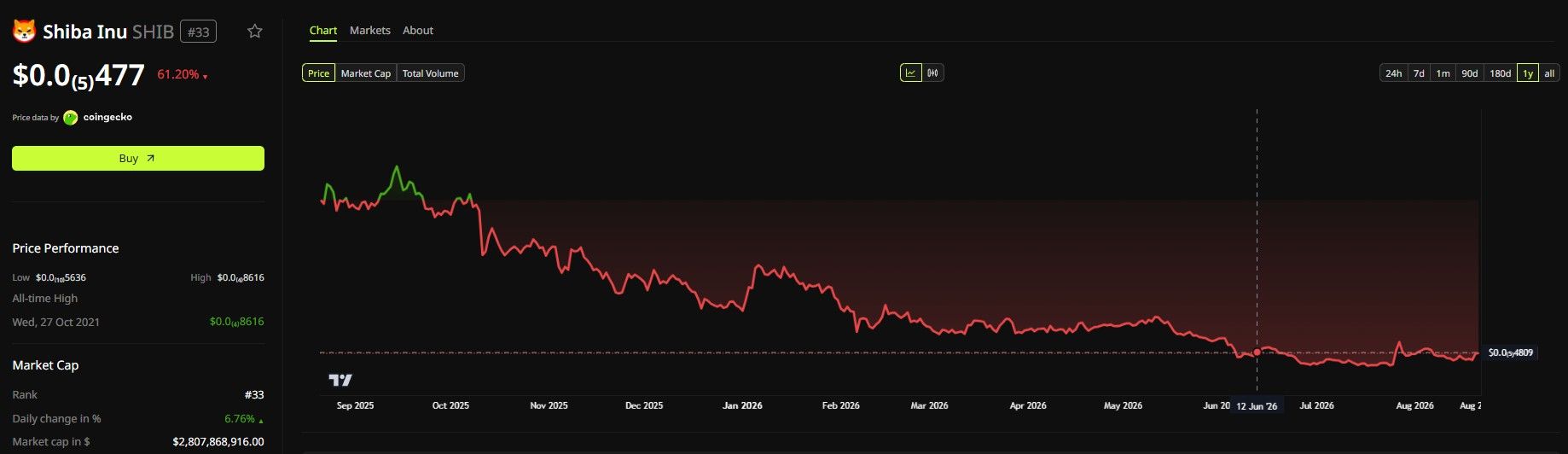
Shiba Inu (SHIB) rose 6.76% on Thursday, yet the meme coin trailed a market-wide rally that lifted Ethereum by 17.8%.
The project’s official account claimed credit for the bounce, telling followers that bears saw the token coming and chose cardio. Broader market flows suggest otherwise.
Why the Shiba Inu Price Move Tracked the Market, Not the Memes
The Shib team skipped any technical explanation. Instead, it’s post cast sellers as runners who abandoned the trade rather than defend it.
Almost every major asset moved the same way. Total crypto market value reached roughly $2.34 trillion on Thursday, about 9.32% above the previous day’s low.
Bitcoin (BTC) added 8.1% over 24 hours and trades at $69,515, while Ethereum (ETH) jumped 17.8% to $2,251.
The trigger sat far outside meme coin circles. Bitcoin reclaimed $70,000 on Wednesday after President Donald Trump floated a sizable government purchase, and $1.23 billion in short positions liquidated within an hour.
Smaller assets ran harder still. Solana (SOL) gained 10.2% and Pepe (PEPE) climbed 13.8%, which left Shiba Inu among the weaker names of the session.
Dogecoin (DOGE), the largest meme coin by market value, rose 6.8%. The two dog tokens therefore moved almost in lockstep, without any comparable posting campaign behind DOGE.
Hours later, the same account credited holders directly. Team members said the steady bullish posting had moved the market, then urged the community to keep going.
Correlation makes that claim hard to test. Shiba Inu has largely followed Bitcoin through 2026, so a market-wide bounce tends to lift it whatever the account posts.
Meanwhile, the playbook echoes late July. The team argued then that original crypto culture had never faded, and SHIB rallied close to 22% that week.
Bull Posting Meets Thinner On-Chain Data
However, one green day looks small next to the longer record. SHIB sits 61.2% lower than a year ago, and the token trades at $0.00000477.
Scale matters too. SHIB peaked at $0.00008616 in October 2021, which leaves Thursday’s level roughly 94% below the record.

Liquidity offers another check on the enthusiasm. Roughly $104 million changed hands over 24 hours, a modest figure for the 33rd-largest crypto asset.
Trader sentiment also stays split. In June, trader James Wynn dismissed Shiba Inu as old and dead while whales moved more than a trillion tokens onto exchanges.
Network data adds a further caveat. Shibarium activity fell sharply earlier this summer, and a six-month high in burns failed to shift the price at all.
Attention still matters for tokens with no revenue behind them. Yet it cuts both ways here, because the same flows that lifted SHIB lifted almost everything else harder.
Therefore, the session says more about broad risk appetite than about community sentiment. Shiba Inu price action has followed the wider market for most of this year.
The coming sessions should show whether Shiba Inu can lead rather than follow. BeInCrypto’s August price prediction flags $0.00000548 as the ceiling that rejected the token last month.
The post Shiba Inu Says Bears “Chose Cardio,” but SHIB Lagged Most of the Market appeared first on BeInCrypto.
Bitcoin (BTC) and altcoins are breaking records as short position liquidations pass $3 billion over two days.
Key points:
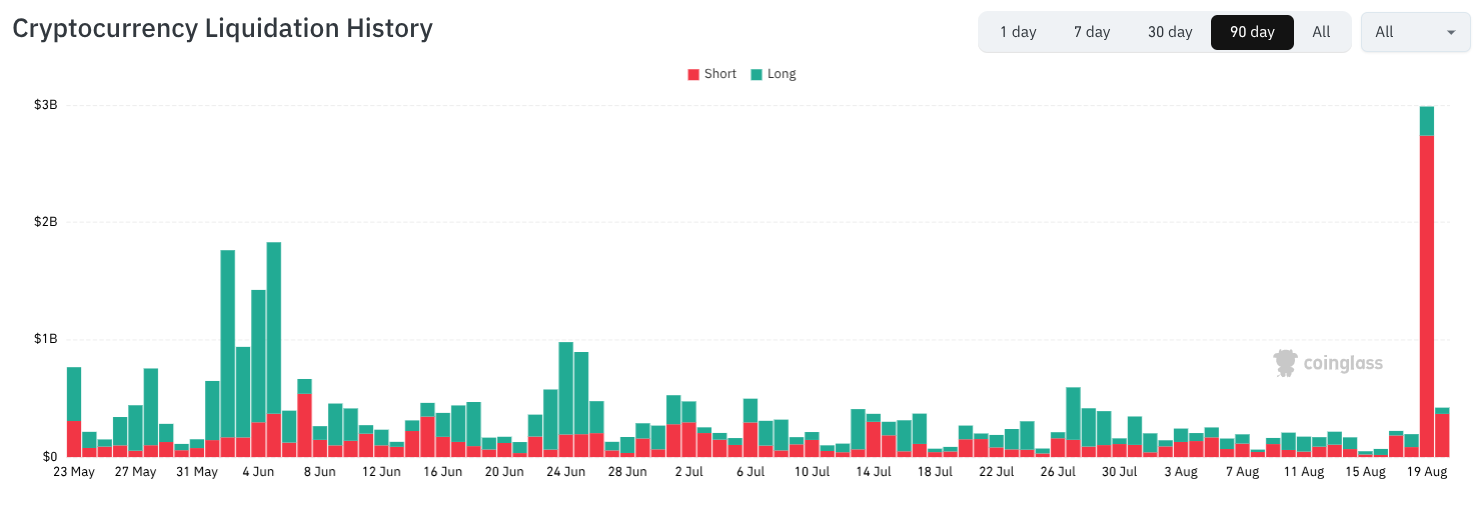
- Crypto short liquidations since Thursday are in excess of $3.1 billion, per CoinGlass data.
- Bitcoin continues its upside reaction to a US Treasury liquidity intervention, approaching $72,000.
- Bitcoin short-term holders take profit on previously underwater positions and move 43,300 BTC.
Two-day crypto short liquidations hit $3.1 billion
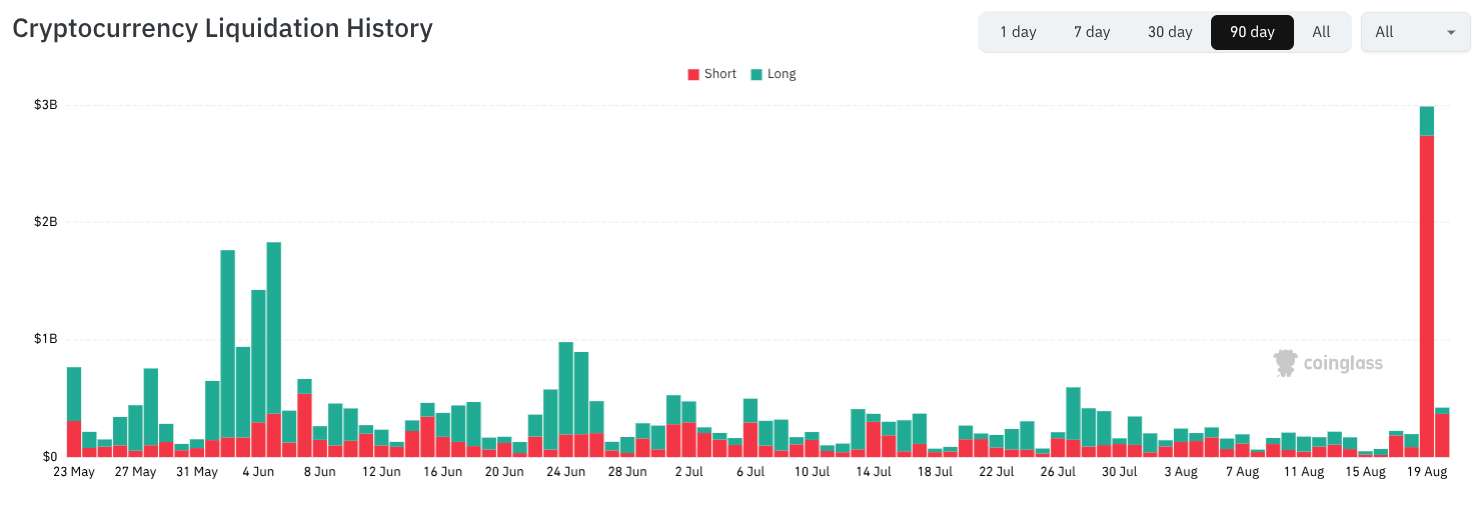
Data from CoinGlass shows ongoing crypto short liquidations at $3.1 billion for Aug. 19-20. Thursday’s tally was largest single-day wipeout of shorts ever recorded.
Crypto liquidations history (screenshot). Source: CoinGlass
On Wednesday, BTC/USD led the charge by reacting to a liquidity intervention by the US Treasury with a price spike to the highest levels seen since the start of June. At the time of writing, upside continues, with the pair reaching local highs of $71,992 on Bitstamp, per data from TradingView.
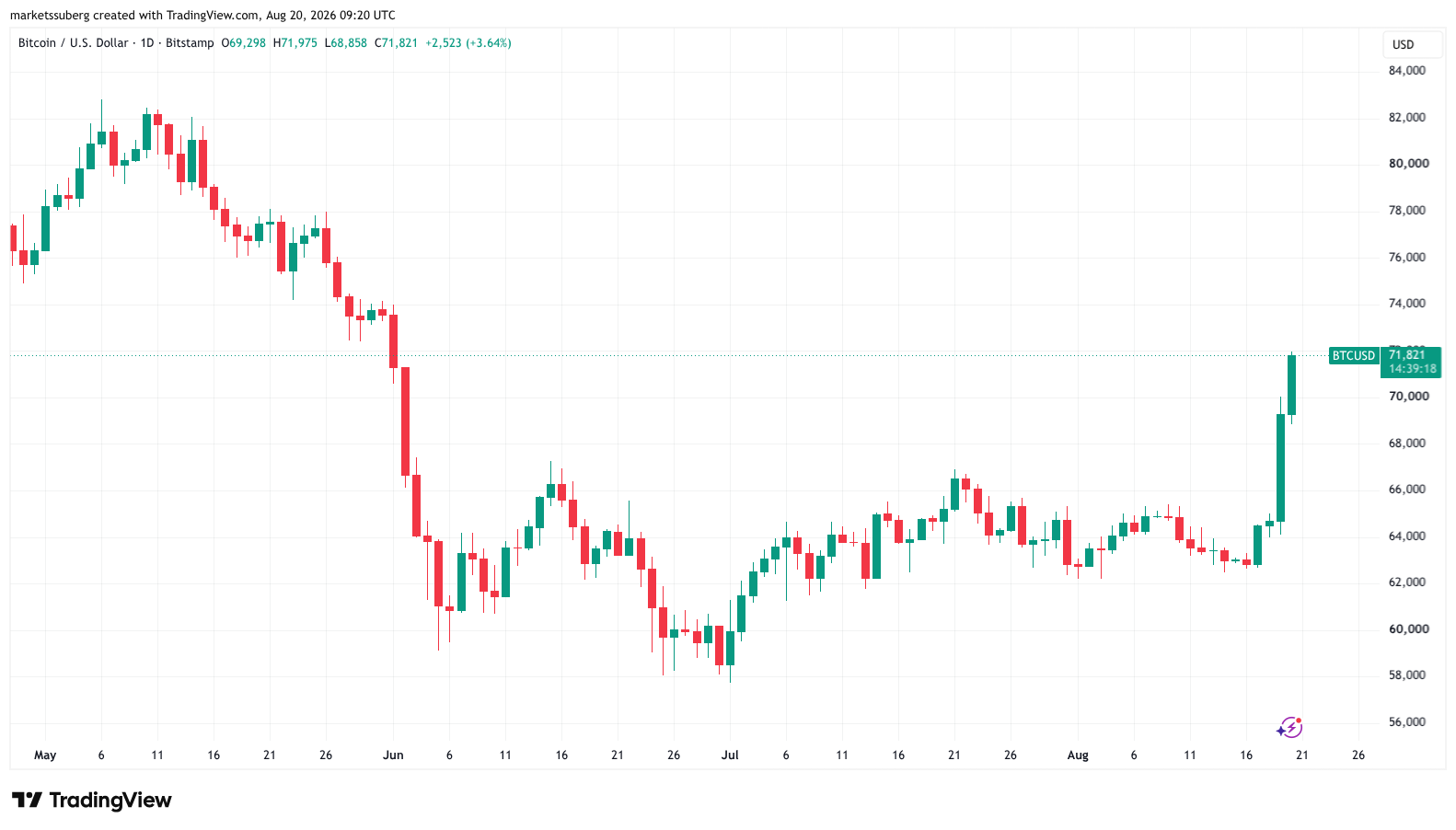
BTC/USD one-day chart. Source: Cointelegraph/TradingView
CoinGlass shows Bitcoin accounting for just over half of the total short liquidations at $1.65 billion.
The numbers do not represent the largest crypto liquidation event if long positions are included. It is dwarfed by the $20 billion long liquidation cascade that followed Bitcoin’s reversal from the most recent all-time high of $126,200 in October 2025.
In US dollar terms, data from CoinMarketCap puts Thursday’s total liquidations in seventh place historically, calculating the day’s long and short liquidations as $3.25 billion.
Bitcoin speculators take profit as cost basis returns
Bitcoin investors, meanwhile, capitalized on positions that were previously held at an unrealized loss.
Related: HYPE jumps 20% as Trump signals legal US path for Hyperliquid
Short-term holders — wallets holding a UTXO for less than 155 days — sent a record 43,300 BTC in profit to exchanges in their largest profit-taking move of 2026, per onchain analytics platform CryptoQuant.
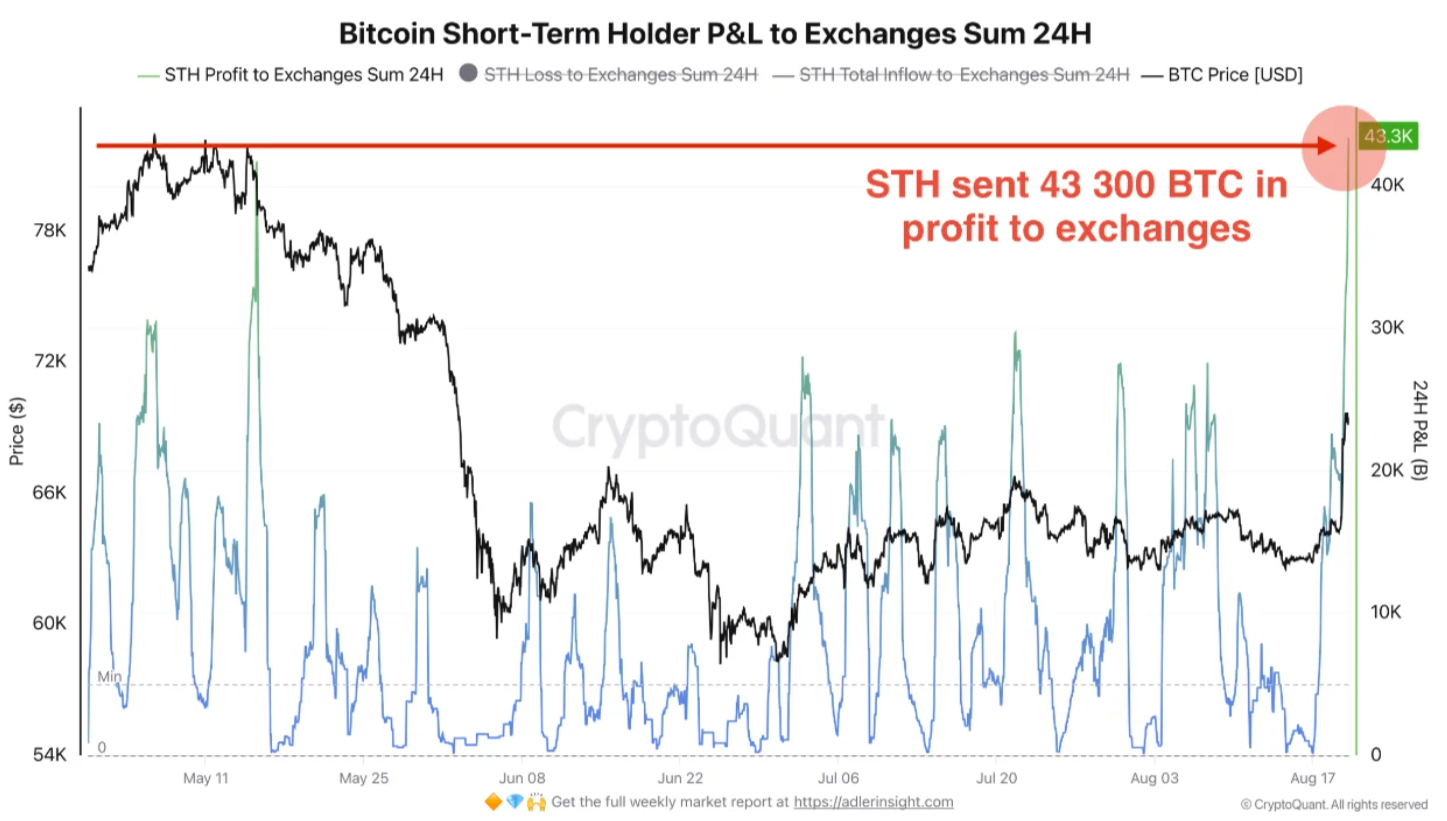
Bitcoin STH profit and loss to exchanges (screenshot). Source: CryptoQuant
As of Thursday, the spent output profit ratio (SOPR) metric for the short-term holder (STH) cohort stood at 1.01, its highest since April. This reflects that the majority of coins in UTXOs from STH wallets moved at a higher price than in their previous transaction.
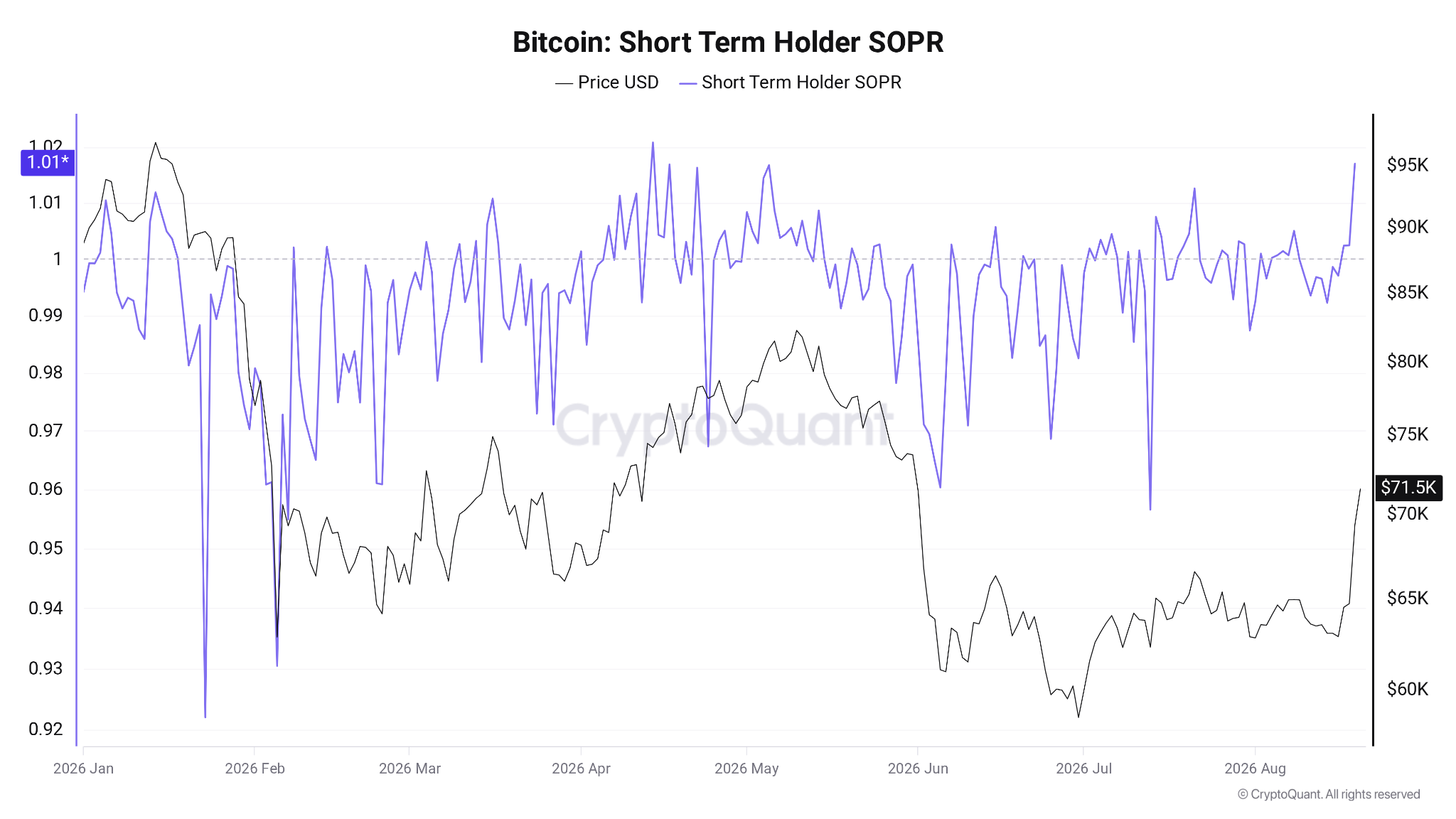
Bitcoin STH-SOPR data. Source: CryptoQuant
Previously, Cointelegraph reported that the STH cohort’s aggregate cost basis, also known as the STH realized price, stood at $68,700. At the time, analysis warned that any price upside could be stifled by the urge of investors in this cohort to exit underwater positions.
It was almost painful for days to write these price updates, but this isn’t the case today, as bitcoin recorded its most impressive surge in 2026 that wasn’t after a notable decline. The asset skyrocketed by several grand yesterday and tapped a two-month peak at over $70,000.
The altcoins have all turned green as well, helping the total market cap add $200 billion in the span of less than 24 hours.
BTC Rocketed Past $70K
It was less than a week ago, on Friday, when the bears appeared to be in control of the market, pushing the largest digital asset to $62,500. Although it rebounded in the following days, it remained sideways at $63,000 with little to no indication of an upcoming breakout.
The first signs emerged on Monday and Tuesday as the cryptocurrency gradually increased to $64,000 and even briefly tapped $65,000. It was stopped there and slipped to $64,400 yesterday before all hell broke loose. What took place in the following few hours was almost thought to be impossible in the crypto markets.
Bitcoin initiated a massive leg up that drove it higher by over $6,000 in hours. It smashed through several key resistance zones and finally touched $70,000 for the first time since mid-June. Although it was stopped there at first and slipped to $68,000, the bulls were more persistent and drove it higher to well over $70,000 as of press time again, while the community comments on the possible reasons behind this surge.
Its market capitalization has exploded by over $100 billion in a day to $1.410 trillion on CG. Its dominance over the alts stands tall at 57%.

Alts See Nothing But Green
Ethereum has taken the main stage during this revival, surging by over 17% to a multi-month peak of its own at $2,270. HYPE has also taken full advantage of the situation, especially after some promising words from Trump, and now sits at $72 following a mind-blowing 24% pump. SOL, XRP, DOGE, RAIN, ZEC, LINK, and BNB are all in the green.
There are a few exceptions, such as XMR and WLFI, but the dominant market sentiment among the alts has flipped significantly.
This has pushed the total crypto market cap to $2.470 billion as of press time – or roughly $200 billion higher than yesterday.

The post Crypto Markets Add Over $200B Daily as Bitcoin (BTC) Surges Past $70K: Market Watch appeared first on CryptoPotato.
Crypto World
BYDFi Joins Coinfest Asia 2026, Connecting with Institutions, Builders and Traders in Bali

Global crypto exchange BYDFi is participating as a Gold Sponsor at Coinfest Asia 2026, taking place August 20-21 at Melasti Beach in Bali. Positioned as “The World’s Crypto Festival Built for Institutions, Builders & Traders,” the event brings together participants across digital assets, finance, technology, and trading. Attendees can meet the BYDFi team at Booth A1 throughout the two-day event.
Coinfest Asia 2026 Returns for Its Fifth Edition
Coinfest Asia 2026 marks the fifth annual edition of the event, spanning five beach clubs at Melasti Beach as one integrated venue. With more than 150 CEOs and industry leaders expected across the two-day event, the program combines conference sessions, product discovery, networking, and community experiences within the beachfront setting.
The 2026 agenda is organized into three intent-based tracks: Institutional, Builders, and Traders. Together, they cover digital asset adoption, stablecoins, tokenization, regulation, AI, blockchain infrastructure, product development, market narratives, and trading strategy. Asia Go-To-Market Sessions add localized perspectives on regulatory environments, user behavior, and ecosystem development across key Asian markets.
Trading Conversations and Community Interaction in Bali
At Booth A1, BYDFi is meeting with traders, builders, institutional representatives, partners, and community members to exchange perspectives on market access, product usability, and changing trading needs. Visitors can also learn more about BYDFi’s trading experience across spot trading, perpetual contracts, copy trading, trading bots, and TradFi trading.
The booth features a Lucky Wheel where attendees can take part in on-site interaction and receive exclusive BYDFi merchandise. The activity has drawn a steady flow of visitors, with attendees gathering around the booth to watch, participate, and speak with the BYDFi team.

Reliability in a Fast-Moving Market
Coinfest Asia 2026 brings institutions, builders, and traders into one setting as digital assets become increasingly connected to the wider financial system. For BYDFi, the conversations taking place in Bali offer a timely view of shifts in technology, industry priorities, and user expectations.
This environment reinforces BYDFi’s focus on practical product improvement, steady execution, and a dependable trading experience. As user needs continue to change, that focus remains central to how BYDFi carries Built for Reliability forward.
About BYDFi
Founded in 2020, BYDFi now serves over 1,000,000 users across 190+ countries and regions. BYDFi is Newcastle United’s Exclusive Official Crypto Exchange Partner and is listed by Forbes Advisor Canada among the best crypto exchanges in Canada for 2026.
BYDFi is dedicated to delivering a world-class crypto trading experience for every user.
BUIDL Your Dream Finance.
- Website: https://www.bydfi.com
- Support email: cs@bydfi.com
- Business partnerships: bd@bydfi.com
- Media inquiries: media@bydfi.com
X (Twitter) | Instagram | Telegram | YouTube | TikTok | How to Buy on BYDFi
The post BYDFi Joins Coinfest Asia 2026, Connecting with Institutions, Builders and Traders in Bali appeared first on BeInCrypto.
Crypto World
BYDFi Joins Coinfest Asia 2026, Connecting with Institutions, Builders and Traders in Bali
[PRESS RELEASE – VICTORIA, Seychelles, August 20th, 2026]
Global crypto exchange BYDFi is participating as a Gold Sponsor at Coinfest Asia 2026, taking place August 20-21 at Melasti Beach in Bali. Positioned as “The World’s Crypto Festival Built for Institutions, Builders & Traders,” the event brings together participants across digital assets, finance, technology, and trading. Attendees can meet the BYDFi team at Booth A1 throughout the two-day event.
Coinfest Asia 2026 Returns for Its Fifth Edition
Coinfest Asia 2026 marks the fifth annual edition of the event, spanning five beach clubs at Melasti Beach as one integrated venue. With more than 150 CEOs and industry leaders expected across the two-day event, the program combines conference sessions, product discovery, networking, and community experiences within the beachfront setting.
The 2026 agenda is organized into three intent-based tracks: Institutional, Builders, and Traders. Together, they cover digital asset adoption, stablecoins, tokenization, regulation, AI, blockchain infrastructure, product development, market narratives, and trading strategy. Asia Go-To-Market Sessions add localized perspectives on regulatory environments, user behavior, and ecosystem development across key Asian markets.
Trading Conversations and Community Interaction in Bali
At Booth A1, BYDFi is meeting with traders, builders, institutional representatives, partners, and community members to exchange perspectives on market access, product usability, and changing trading needs. Visitors can also learn more about BYDFi’s trading experience across spot trading, perpetual contracts, copy trading, trading bots, and TradFi trading.
The booth features a Lucky Wheel where attendees can take part in on-site interaction and receive exclusive BYDFi merchandise. The activity has drawn a steady flow of visitors, with attendees gathering around the booth to watch, participate, and speak with the BYDFi team.

Reliability in a Fast-Moving Market
Coinfest Asia 2026 brings institutions, builders, and traders into one setting as digital assets become increasingly connected to the wider financial system. For BYDFi, the conversations taking place in Bali offer a timely view of shifts in technology, industry priorities, and user expectations.
This environment reinforces BYDFi’s focus on practical product improvement, steady execution, and a dependable trading experience. As user needs continue to change, that focus remains central to how BYDFi carries Built for Reliability forward.
About BYDFi
Founded in 2020, BYDFi now serves over 1,000,000 users across 190+ countries and regions. BYDFi is Newcastle United’s Exclusive Official Crypto Exchange Partner and is listed by Forbes Advisor Canada among the best crypto exchanges in Canada for 2026.
BYDFi is dedicated to delivering a world-class crypto trading experience for every user.
BUIDL Your Dream Finance.
- Website: https://www.bydfi.com
- Support email: cs@bydfi.com
- Business partnerships: bd@bydfi.com
- Media inquiries: media@bydfi.com
X (Twitter) | Instagram | Telegram | YouTube | TikTok | How to Buy on BYDFi
The post BYDFi Joins Coinfest Asia 2026, Connecting with Institutions, Builders and Traders in Bali appeared first on CryptoPotato.


Conversations with X are ongoing, according to a person who also works with other social media platforms testing stablecoins to pay influencers.


Key takeaways
- Hyperliquid’s HYPE token surged 22% to $71.91 following comments from President Donald Trump.
- Trump said CFTC Chair Michael Selig is working to bring Hyperliquid into the US through a compliant and legal framework.
- HYPE must overcome resistance between $73 and $76 to challenge its record high of $76.87.
Hyperliquid (HYPE) rallied more than 20% on Wednesday after President Donald Trump revealed that the Commodity Futures Trading Commission is working on a potential regulatory pathway for the decentralized perpetual futures platform to enter the United States.
HYPE jumped 22% to $71.61 following the remarks, approaching its all-time high of $76.87 as optimism surrounding potential US expansion added to a broader cryptocurrency market recovery.
Trump signals compliant pathway for Hyperliquid
Speaking during a White House meeting with cryptocurrency, financial and technology executives, Trump said CFTC Chair Michael Selig was working to establish a legal route for Hyperliquid to operate in the US.
“I understand that Mike [Selig] is also working to bring Hyperliquid into the United States in a fully compliant and legal fashion, working very hard on that,” Trump said. “We would really like to see it.”
The president’s comments do not mean that regulators have approved Hyperliquid to offer its services in the country. However, they confirm that the CFTC is considering how the platform could enter the US while complying with federal derivatives regulations.
The agency authorized the first perpetual futures contracts on registered US exchanges earlier this year, marking an important step toward bringing the popular cryptocurrency derivatives product into the domestic market.
Perpetual futures are derivatives contracts that allow traders to speculate on an asset’s price without an expiration date.
The products account for a substantial share of global cryptocurrency trading but have traditionally been concentrated on offshore and decentralized platforms due to regulatory restrictions in the US.
A compliant pathway could give Hyperliquid access to one of the world’s largest financial markets while potentially attracting greater institutional participation.
However, operating in the country would likely require the platform to satisfy rules governing registration, market surveillance, customer protection, anti-money laundering measures and derivatives trading.
Trump’s comments came during a wider White House gathering involving leaders from the cryptocurrency and traditional financial industries.
Attendees included Coinbase CEO Brian Armstrong, Ripple CEO Brad Garlinghouse, Robinhood CEO Vlad Tenev, Kraken co-CEO Arjun Sethi and Gemini co-founders Cameron and Tyler Winklevoss.
Nasdaq CEO Adena Friedman and Intercontinental Exchange CEO Jeffrey Sprecher also attended, alongside representatives from Chainlink and venture capital firm Andreessen Horowitz.
Government officials at the meeting included SEC Chair Paul Atkins, CFTC Chair Michael Selig and White House crypto adviser Patrick Witt.
Trump used the event to reaffirm his administration’s ambition to position the US at the forefront of emerging technologies.
“We’re ensuring that America remains the undisputed leader not only in Bitcoin and crypto but also technologies like prediction markets, artificial intelligence and much more,” Trump said.
He also criticized the previous administration’s policies, arguing that they discouraged digital asset innovation in the US.
HYPE approaches all-time high
HYPE climbed 22% to $71.61 after Trump’s remarks, placing the token within reach of its $76.87 all-time high.
The immediate resistance zone sits between $73 and $76. A decisive move above this area could allow HYPE to establish a new record and potentially target the next major resistance near $94.80.

Failure to overcome the $73-to-$76 region could trigger profit-taking after Wednesday’s sharp advance.
The rally also benefited from strength across the broader cryptocurrency market. Bitcoin, Ethereum and Solana recorded substantial gains as a market-wide short squeeze contributed to nearly $3 billion in liquidations over 24 hours.

A Reform councillor just resigned in the most embarrassing way possible

Max Verstappen signs new Red Bull contract until 2030

Google Messages RCS isn’t working for some users, but a weird VPN trick might fix it





-

 Fashion6 days ago
Weekend Open Thread: Ann Taylor
-
 Sports6 days ago
This U.S. Amateur is a glimpse into golf’s future in more ways than you think
-
 Tech6 days ago
11 Ways to Rank Your Videos
-

 Sports5 days ago
Birmingham 2026: Day 6 Timetable for Irish Athletes
-
 NewsBeat5 days ago
Myanmar says over 300,000 Rohingya refugees verified for repatriation as exodus enters ninth year
-

 Politics5 days ago
SEQ Code: The Three Letter Boarding Pass Code That Could Give You The Worst Seat
-

 Tech7 days ago
DeepSeek Harness launches as open source rival to Claude Code, alongside V4-Pro on API with higher prices
-

 Tech2 days ago
Qwen3.8-27B runs frontier-class coding agents and reasoning locally, no cloud API required
-

 Crypto World2 days ago
OCC Greenlights Trump Family Crypto Firm for Trust Charter
-

 Crypto World5 days ago
Pi Network Protocol 27 endgame: last upgrade before what?
-

 Business2 days ago
SMA Solar Technology AG (SMTGY) Q2 2026 Earnings Call Transcript
-
 Tech5 days ago
Every fusion startup that has raised over $100M
-

 Fashion6 days ago
Weekly News Update, 8.14.26 – Corporette.com
-
 Entertainment6 days ago
10 Netflix Shows That Quietly Became Modern Classics
-
 Entertainment5 days ago
Marvel Studios Reveals New X-Men Cast Including Adam Driver and Sadie Sink
-

 Business6 days ago
15 Ways to Make Money From Your Phone (2026 Guide)
-

 Fashion6 days ago
Silver bangles for women – Newbridge Silverware
-

 Business5 days ago
Facebook Down Now? Users Report Login And Loading Problems As Outage Trackers Monitor Ongoing Issues
-

 News Videos6 hours ago
Don’t Leave Your Financial Future To Chance | August 19, 2026
-
 Business5 days ago
Monarch Mutual Fund set to enter MF space with maiden overnight fund; files draft with Sebi
You must be logged in to post a comment Login