
Crypto World
Crypto firm RedotPay says it will defend itself ‘vigorously’ against Binance lawsuit



RedotPay, which describes itself as the world’s largest stablecoin payment card issuer, told CoinDesk Wednesday it will defend itself “vigorously” against a $470 million Binance lawsuit alleging it poached 470,000 users.
“RedotPay is aware of legal proceedings initiated by Binance and will vigorously defend all claims,” the firm said in an emailed statement. “The Company rejects the unfounded allegations made against it and its co-founders.”
Binance affiliates filed a lawsuit against the founders of the Hong Kong-based stablecoin payments company, alleging they diverted nearly half a million Binance customers to the competing platform in a scheme that caused nearly $473 million in losses, according to a Bloomberg report.
“Since March 2026, the Binance Group has discovered that RedotPay Group had been allowing and encouraging Binance Pay funds to be used, without segregation, for the prohibited use within RedotPay, including card top-ups for RedotPay Card,” Binance said in the filing, according to Bloomberg.
“While Binance does not comment on ongoing litigation, where necessary we will use courts and other forums to pursue what is right,” a spokesperson told CoinDesk via email.



Coinbase will suspend six cryptocurrency trading pairs on Aug. 6 after moving five markets into limit-only mode as part of its routine market review.
Summary
- Coinbase will suspend six trading pairs across its institutional and advanced trading platforms.
- Five markets entered limit-only mode before the scheduled Aug. 6 suspension.
- The exchange also added BIO, BNKR and TREE for supported Coinbase customers.
- Coinbase is preparing to move institutional derivatives accounts to Deribit on Sept. 9.
Coinbase places five markets in limit-only mode
Coinbase Markets said trading will end for LSETH-ETH, MINA-EUR, GRT-GBP, MASK-GBP, CHZ-USDT and CRO-USDT on Aug. 6, 2026.
Ahead of the suspension, the exchange placed MINA-EUR, GRT-GBP, MASK-GBP, CHZ-USDT and CRO-USDT into limit-only mode on Coinbase Exchange and Coinbase Advanced. LSETH-ETH was not included in the limit-only notice.
Users can place and cancel limit orders during this phase, while existing orders may continue to match. However, Coinbase will no longer accept market orders for the affected pairs.
The exchange attributed the decision to its regular review of supported markets. Coinbase monitors factors such as liquidity, trading activity and order book conditions to determine whether individual markets continue to meet its standards.
The move affects specific trading pairs rather than representing a full removal of the six underlying cryptocurrencies. Customers may still have access to other supported markets involving the same assets, depending on their location and Coinbase’s regional availability rules.
Market review follows earlier Coinbase suspensions
Coinbase has previously restricted or suspended markets after reviewing trading conditions, regulatory requirements and changes involving individual crypto projects.
One recent case involved Function X after the project suspended its supported smart contract and migrated from the FX ERC-20 token to Pundi AI’s PUNDIAI token. Coinbase initially placed FX trading into limit-only mode before announcing its suspension.
Removing thinly traded pairs can help an exchange concentrate activity in markets with deeper order books. Low trading activity can lead to wider spreads and greater price slippage, particularly when users place larger orders.
Coinbase also expanded its asset lineup during the week. Bio Protocol, BankrCoin and Treehouse became available through Coinbase’s website and mobile applications. Eligible customers can buy, sell, send, receive, convert and store BIO, BNKR and TREE.
Availability remains subject to regional restrictions. The listings show that Coinbase’s market reviews can result in new additions even as the company removes individual pairs that no longer meet its requirements.
Coinbase prepares institutional accounts for Deribit
The trading-pair suspensions come as Coinbase reorganizes its international derivatives business following its acquisition of Deribit.
As crypto.news reported on Aug. 4, Coinbase plans to transfer institutional clients’ International Exchange accounts, balances and open positions to Deribit on Sept. 9. Trading is expected to pause for about 30 minutes during the transfer.
Institutions that do not want to participate must close their positions and International Exchange accounts by Aug. 28. Coinbase will treat accounts that remain open after the deadline as having accepted the revised terms and migration.
Coinbase completed its acquisition of Deribit in August 2025 after agreeing to pay approximately $2.9 billion. The transaction gave Coinbase control of a major crypto options venue and created a path for consolidating its international derivatives operations.
The migration affects institutional derivatives accounts and is separate from the Aug. 6 spot trading-pair suspensions.
Circle agreement and ARK purchase draw attention
Coinbase also confirmed that its commercial agreement with Circle will renew automatically after both companies met the required contractual conditions. The update removes some uncertainty surrounding the USDC revenue-sharing arrangement following Coinbase’s participation in the Open USD consortium.
Chief Financial Officer Alesia Haas said the existing agreement would continue despite questions about whether Coinbase’s work on a potential alternative stablecoin network could affect its Circle partnership.
The exchange reported second-quarter revenue of $1.22 billion, missing Wall Street’s $1.29 billion estimate. Revenue fell 14% from the previous quarter as crypto trading activity weakened across several markets.
Coinbase shares closed the latest session at $146.50, up 0.16%. ARK Innovation ETF purchased 38,761 Coinbase shares worth approximately $5.68 million during the period.
The purchase followed ARK Invest’s acquisition of about $9.4 million in combined Coinbase and Circle shares on Aug. 3, as the U.S. Senate considered its next steps on the CLARITY Act. The buying shows continued institutional interest in the two companies despite weaker trading revenue and uncertainty surrounding U.S. crypto market legislation.


Western Union and stablecoin card issuer Rain launched Stablecard on Aug. 4, a digital wallet and Visa card that lets people receive money transfers as USDPT and spend the balance at any Visa merchant or ATM. Stablecard extends Western Union's onchain push from settlement infrastructure into a… Read the full story at The Defiant


Senator Cynthia Lummis is pressing the Senate to vote on the CLARITY Act before its August recess as bipartisan negotiations continue over several unresolved provisions.
Summary
- Lummis said lawmakers are negotiating the bill daily as the Senate’s legislative window narrows.
- Talks remain focused on CFTC authority, ethics rules, illicit finance and stablecoin yield.
- The legislation needs 60 Senate votes to overcome the chamber’s cloture threshold.
- Senate records had not confirmed a CLARITY Act cloture filing, leaving the vote timing uncertain.
Lummis says CLARITY Act talks continue daily
Lummis said Senate negotiators were still working toward an agreement after nearly 11 months of talks. During a Fox Business interview, the Wyoming Republican argued that lawmakers should consider the crypto market structure bill before leaving Washington.
The senator said Majority Leader John Thune had reserved time for the legislation on the Senate agenda for several weeks. However, her comments reflected her expectation about the bill’s path rather than confirmation of a scheduled procedural vote.
Lummis also said she had worked on provisions overseen by the Commodity Futures Trading Commission as negotiators tried to resolve differences between Republicans and Democrats.
“I am continuing to work with Democrats every day on the Clarity Act.”
She urged lawmakers to establish clear rules and prevent digital-asset companies from moving their operations outside the United States. In a separate Fox Business appearance, Lummis warned that regulatory uncertainty could push more crypto activity toward jurisdictions such as Switzerland and Singapore.
Ethics and CFTC provisions remain unresolved
Negotiations continue around ethics restrictions, illicit-finance safeguards, stablecoin rewards and the division of regulatory authority between the CFTC and the Securities and Exchange Commission.
Democrats have sought stronger restrictions preventing senior government officials from profiting from crypto ventures. They have also raised questions about who would enforce those restrictions and whether the bill provides sufficient anti-money-laundering protections.
The latest Senate proposal would place exchanges, brokers and dealers under Bank Secrecy Act requirements. It would also restrict passive stablecoin rewards while allowing incentives connected to transactions, according to a summary of the Senate bill.
Lummis said the package includes an ethics agreement covering the president, vice president, members of Congress and the federal judiciary. Still, Democrats have not publicly committed enough votes to guarantee that the legislation can advance.
Republicans hold 53 Senate seats, meaning the bill would likely require support from at least seven Democrats if every Republican votes for cloture.
Hagerty calls for a Senate floor vote
Senator Bill Hagerty has also urged Senate leaders to bring the CLARITY Act to the floor rather than extend negotiations indefinitely.
“We have to pass the CLARITY Act,” Hagerty said. “I think we should put it through a vote on the floor of the United States Senate and find out where Democrats stand.”
The pressure follows months of shifting expectations over the bill’s timing. The House passed the CLARITY Act in July 2025 by a 294–134 vote, including support from 78 Democrats. The Senate Banking Committee advanced its version in May 2026 with two Democratic votes, although those committee votes did not guarantee support on the floor. Senators Ruben Gallego and Angela Alsobrooks said negotiations remained fluid after the markup.
No cloture filing confirms a CLARITY Act vote
Despite lawmakers’ public calls for action, an official cloture filing remained the key procedural signal needed to confirm that a vote was approaching.
Senate records showed that Thune had filed cloture on other business, including a continuing-resolution vehicle. The Senate Daily Press also recorded Lummis speaking in support of H.R. 3633 but did not list a CLARITY Act cloture filing.
Without that step, claims of an imminent vote remain expectations rather than a confirmed floor schedule. Continued negotiations could still produce an agreement, but the shrinking calendar increases the risk that consideration slips beyond the August recess.
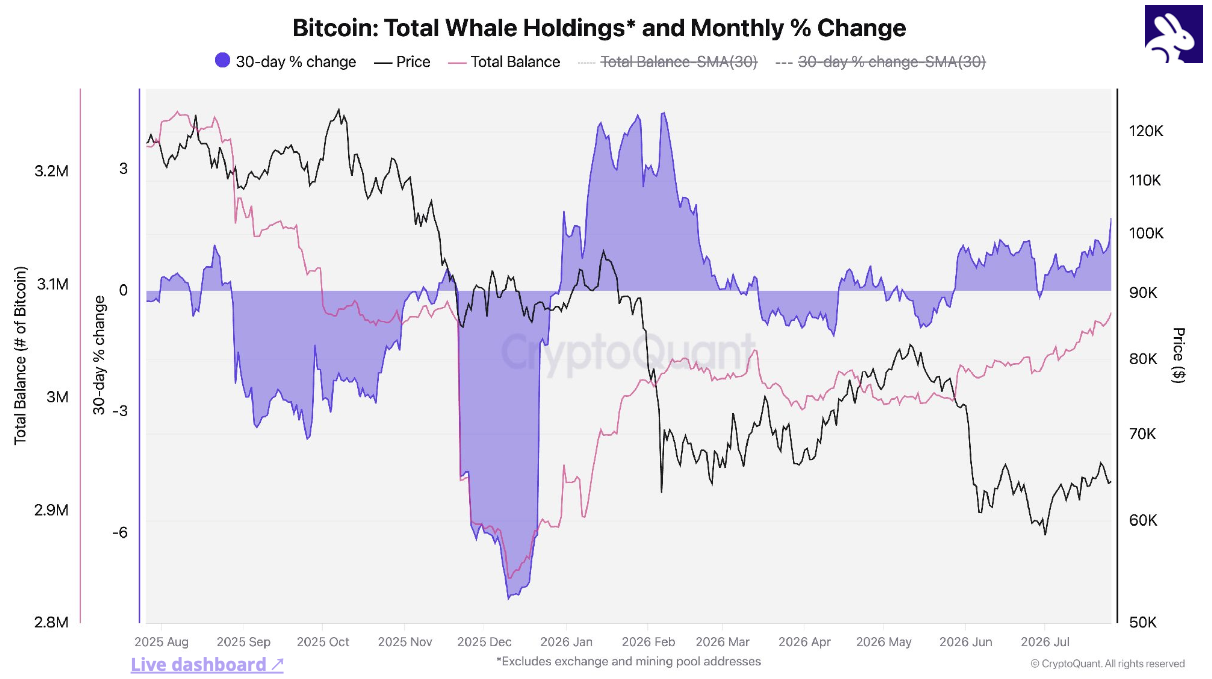
Large cryptocurrency holders are accumulating Bitcoin (BTC) and Ether (ETH) as valuations approach levels associated with the final stage of a bear market, according to CryptoQuant.
Rising whale balances during price weakness can reduce available supply and concentrate ownership among larger holders, the blockchain analytics company said in its latest Smart Money report seen by Cointelegraph.
Bitcoin whale holdings, excluding exchanges and mining pools, rose to about 3.06 million BTC from 2.87 million BTC in December 2025, with accumulation accelerating after Bitcoin dropped below $60,000 in June.
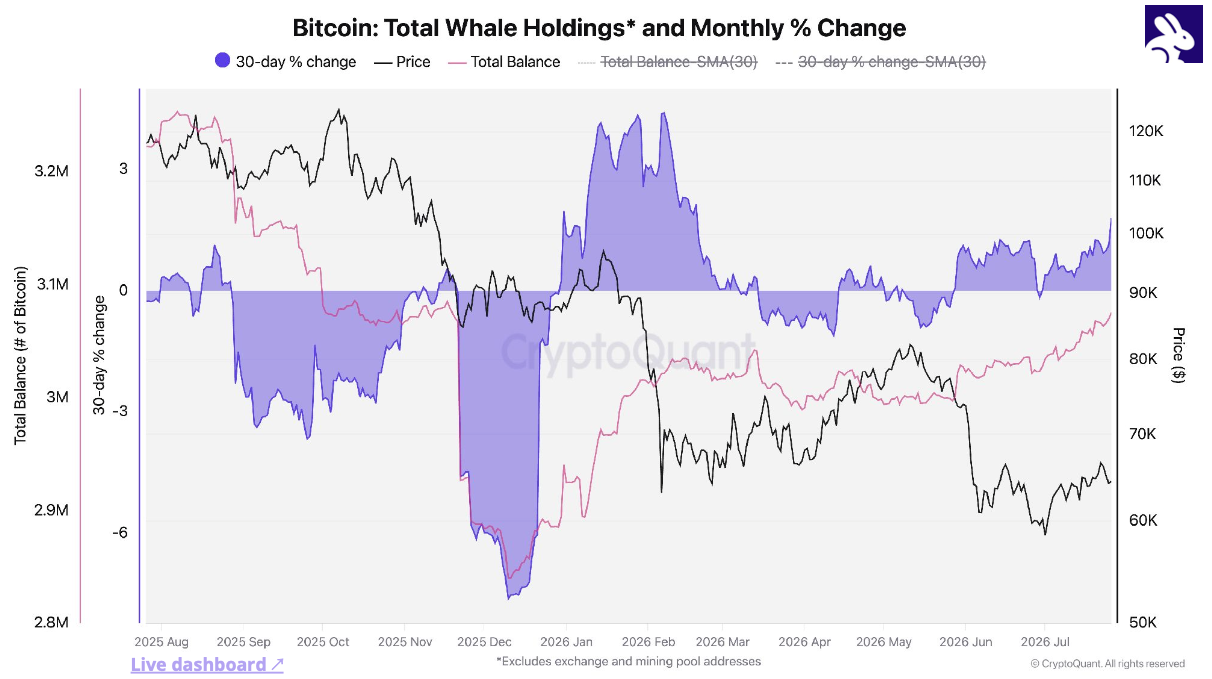
Source: CryptoQuant
Ethereum wallets holding 10,000 to 100,000 ETH collectively held a record 19.6 million ETH, while wallets holding more than 100,000 ETH added roughly 1.8 million ETH since mid-2025.
In XRP markets, average spot order sizes remained in CryptoQuant’s “big whale” category as the token traded between $1 and $1.20. However, neutral 90-day taker cumulative volume delta suggested passive absorption rather than aggressive buying, the report said.
Related: Bitcoin may have bottomed before its traditional cycle low: Grayscale’s Pandl
Valuations point to late-stage bear market
CryptoQuant also pointed to realized price, an estimate of the market’s average onchain cost basis, as evidence that the market may be approaching a bottom.
Bitcoin traded at $63,935 at the time of writing, according to CoinGecko, above its realized price of $52,900. Ether traded at $1,858, below its realized price of about $2,450. XRP traded at roughly $1.10 compared with a realized price of about $0.75.
“Rising whale balances into price weakness is the clearest smart-money tell,” CryptoQuant said, adding that the accumulation pattern has historically preceded market bottoms while cautioning that the market remains exposed to further downside.
CryptoQuant’s analysis comes as other researchers have also identified potential bottoming indicators.
On Monday, 10x Research said Bitcoin could confirm a bear-market bottom with a monthly close above $63,000. K33 said in a July 7 report that Bitcoin has historically reached cycle lows within weeks after more than half of its circulating supply was held at a loss.
Magazine: Do the Coldcard attacks mean all hardware wallets are now insecure?

As you can imagine, this specified “one night” would be especially mad in a city like New York, where people are often a little nuts to begin with, and that’s where One Night Only takes place. Owen (Callum Turner, rendering a reasonably believable American accent) runs a pizza joint, and he’s getting ready to close up shop as this special 12-hour night is set to begin. He’s not married, but he does have a girlfriend (played by Maya Hawke), who informs him, when they meet up for their date, that she wants to use this one free night of premarital sex to sleep with someone else. Owen is crestfallen. But he also figures he may as well try his own luck. That’s how he runs into Allie (Monica Barbaro), also on her own. She’s had a tough workday—she’s a singer, and she’s been toiling in the studio, recording a schmaltzy jingle for a psoriasis commercial—and her evening plans have fallen through: the pal she was set to go out with, Jacinta (King Princess), found herself a literal prince in the early hours of the evening and has taken off. Allie’s roommate (Quintessa Swindell), who happens to be gay and has no interest in these one-night-only shenanigans (“We’ve been dancing around your laws since before the Bible,” they explain, suggesting that the city’s gay population has pretty much ignored the premarital-sex ban altogether), urges her to make the most of the evening, kitting her out in a fetching, if minuscule, green sequined dress left behind by an ex-girlfriend. In this splendid and very hot outfit, completed with spindly heeled sandals, Allie reluctantly toddles off into the night to join her glimmering, mini-skirted sisters. On this night, New York has become a city of stems.


Cloudflare launched Cloudflare Wallets on Tuesday, giving AI agents that run on its network a stablecoin balance and a human-readable name to present when they pay for APIs, content and MCP tools. The product gives Cloudflare the buy side of agent payments a month after it built the sell side. Its… Read the full story at The Defiant

BlackRock is moving further into tokenized cash management in Europe, planning to launch tokenized versions of select money market funds using JPMorgan’s blockchain infrastructure, Bloomberg reported on Tuesday.
The initiative is expected to span multiple share classes of BlackRock’s Institutional Cash Series—covering pound sterling, euro, and US dollar—and Bloomberg said these funds collectively manage roughly $311 billion. The figure relates to the broader fund range, not the specific assets that will be tokenized.
Key takeaways
- BlackRock will tokenize select European money market fund share classes using JPMorgan’s blockchain infrastructure.
- Each token is intended to represent an interest in an underlying money market fund and be transferable between approved digital wallets.
- JPMorgan’s Kinexys will supply the tokenization layer, while JPMorgan will continue acting as transfer agent.
- The model targets investors and corporates seeking around-the-clock settlement and more flexible collateral movement.
- BlackRock’s push builds on its earlier tokenized fund launch of BUIDL in 2024, which has grown to about $2.67 billion in assets, per RWA.xyz.
What BlackRock’s tokenized cash product is designed to do
According to Bloomberg, BlackRock’s planned tokenized funds are structured so that each token corresponds to a share in an underlying money market fund. The tokens are designed to move in a near “always on” manner, enabling transfers around the clock between approved digital wallets.
For investors, the practical significance is less about trading speculation and more about operational efficiency: instant-style transfers can reduce frictions that typically accompany settlement windows, especially when money market exposure is used for liquidity management or collateral workflows.
How the JPMorgan infrastructure fits in
Bloomberg reported that JPMorgan’s Kinexys will provide the blockchain infrastructure for the tokenization. At the same time, JPMorgan will continue to serve as the transfer agent for the funds, suggesting a hybrid approach that keeps established fund services in place while adding digital issuance and transfer capabilities.
That division of responsibilities matters because tokenized fund launches often hinge on how well the “plumbing” connects to traditional fund operations. By keeping transfer agency functions within JPMorgan’s existing role, the structure may help reduce integration uncertainty for participants who already rely on regulated fund administration processes.
Why cash movements and collateral are the focus
BlackRock executives cited growing interest from market participants looking for more efficient ways to use cash in digital environments. Beccy Milchem—BlackRock’s global head of cash distribution and head of international cash management—told Bloomberg that the firm has seen demand from digital wallet providers, corporate treasurers, and capital markets participants seeking improved efficiency for collateral.
Hannah Winter, BlackRock’s head of digital cash, added that peer-to-peer transfer capability appealed to companies evaluating intracompany payments. In other words, the appeal is not only in settlement speed but also in internal treasury operations—where moving value between entities can be time-sensitive and require audit-ready processes.
Built on momentum from BUIDL
This European launch comes after BlackRock’s earlier entry into tokenized cash-management with BUIDL, its US dollar-denominated institutional liquidity fund. BlackRock previously introduced BUIDL in 2024 and the product has since grown, reaching $2.67 billion in assets according to RWA.xyz.
While BUIDL and this planned European offering are different in jurisdiction and currency exposure, the continuity in strategy is clear: BlackRock is treating tokenized cash as a scalable product category rather than a one-off experiment. Readers should note that growth figures for these funds can reflect broader market adoption, distribution partnerships, and participant comfort with tokenized settlement—not just underlying price performance.
What to watch next
With BlackRock and JPMorgan positioning tokenized money market fund shares for transfers between approved digital wallets, the next signals to monitor are the rollout timeline, which institutions qualify for wallet access, and how settlement and transfer-agent processes operate under real usage. Those details will determine whether tokenized cash becomes a convenient back-office upgrade—or remains limited to pilots and early adopters.


JPMorgan Chase CEO Jamie Dimon says margin debt has hit the highest level in market history. He also flags several risks he thinks investors are not watching closely enough.
Dimon spoke with CNBC on Wednesday. He named four sources of leverage: prime brokers, hedge funds, leveraged ETFs, and Treasury arbitrage trades. He said the combined total has built up to levels he called pretty high.
Risk One: Record Margin Debt Hides in Plain Sight
Dimon says margin debt sits at an all-time high. He adds that regulators cannot see all of it. Much of this borrowing skips the “margin debt” label entirely.
Banks and brokers book it under different names on separate balance sheets. That makes the true scale of leverage in the system hard to measure.
Risk Two: A Quick Shock Instead of a Slow Decline
Dimon warns that heavy leverage raises the odds of a sudden disruption rather than a gradual pullback. He points to the recent unwind of Situational Awareness, an AI focused hedge fund, as a live example.
JPMorgan served as one of its prime brokers. He says the market absorbed that unwind well. Still, Three Citadel funds gained sharply after buying the distressed shares at a steep discount. That shows how one firm’s leverage failure quickly becomes another’s opportunity.
Risk Three: The Fed Is Now Watching Private Credit
Dimon says the Federal Reserve started reviewing private credit markets this week. He does not call this a systemic threat today. But he thinks regulators should look closely. BeInCrypto already tracked a major private credit redemption halt at a large lender. That halt signals the sector already carries stress points.
Risk Four: Stretched Valuations in Stocks and Bonds
Dimon repeats a warning from his earlier comments on stocks and bonds. Dimon would not buy long-dated Treasuries or broad equities at today’s prices. He argues Treasury yields already price in inflation assumptions he sees as too optimistic.
He also notes stock valuations sit in the top five to ten percent of all-time levels. Still, he cautions against blanket statements. He says individual stocks can offer good value at any point in time. That rule applies globally, not just in the US.
Dimon frames all four risks as things to monitor, not reasons to panic. The Fed’s private credit review will show how much weight markets should give his warning.
“You do have a higher chance that something will disrupt the market in a quick way and people get rattled over it.”
Jamie Dimon, Bloomberg
The post Jamie Dimon Says Margin Debt Is Highest Ever: And Here’s the Risks appeared first on BeInCrypto.

Strategy has expanded its employee benefits by supporting the Trump Accounts contribution programme across its U.S. workforce. The company also confirmed annual and one-time contributions for eligible employees’ children after federal implementation begins. Meanwhile, Strategy maintained its long-term Bitcoin strategy despite recent treasury sales and continued on-chain wallet activity.
Strategy Adds Trump Accounts Benefit for Employee Families
Strategy announced plans to contribute $250 annually for every eligible child under 18 of its U.S. employees. The company will also provide a one-time $1,000 contribution that matches the federal seed deposit. However, the programme will begin only after the U.S. Treasury completes implementation and enables employer contribution systems.
The initiative places Strategy alongside Coinbase, Circle, Morgan Stanley, Goldman Sachs, and other firms supporting the Trump Accounts program. The initiative encourages long-term wealth building through tax-advantaged investment accounts for children. Moreover, participating employers will contribute only after federal systems become operational.
Strategy said the programme depends entirely on final Treasury guidance and the required administrative infrastructure. The company expects eligible employees to access the benefit after federal agencies complete the rollout. As a result, Strategy expanded its employee benefits while supporting a broader national savings initiative.
Strategy Maintains Bitcoin Treasury While Managing Capital
Strategy continued adjusting its Bitcoin treasury through routine capital management activities during the same period. A recent SEC filing showed the company sold 1,638 Bitcoin at an average price of $63,957. Even so, Strategy retained 842,138 Bitcoin acquired for approximately $63.51 billion at an average purchase price of $75,419.
Meanwhile, blockchain tracking platforms reported additional Bitcoin transfers involving wallets linked to Strategy. Lookonchain identified a transfer of 1,030 Bitcoin worth more than $66 million. In addition, Arkham data recorded several transactions ranging between $6 million and $21 million during the week.
Strategy has not confirmed whether those wallet movements represented additional Bitcoin sales. However, the company has consistently disclosed that treasury transactions support broader capital management objectives. Therefore, recent transfers have not changed Strategy’s stated long-term commitment to holding Bitcoin as its primary treasury reserve asset.
Trump Accounts Expand Corporate Participation in Savings Program
Trump Accounts aim to encourage long-term saving through investment accounts created for eligible children across the United States. Children born between 2025 and 2028 qualify for a $1,000 federal contribution under the programme. Furthermore, participating accounts will invest in mutual funds or exchange-traded funds tracking the S&P 500 or similar U.S. equity indexes.
Several major financial companies have already committed to supporting employer contribution programmes linked to the initiative. Strategy now joins that growing list through its planned employee benefit programme. Consequently, more corporations continue integrating long-term savings incentives into workplace compensation packages.
Strategy has also supported previous initiatives associated with President Donald Trump through corporate political contributions. The company, formerly known as MicroStrategy, donated $1 million to MAGA Inc. during January 2025. Coinbase and Circle also contributed $1 million each to Trump’s inaugural fund, providing additional background to their participation in the current savings initiative.
The latest announcement reflects Strategy’s effort to expand employee benefits while continuing its established Bitcoin treasury strategy. At the same time, the company maintained active capital management through selective Bitcoin transactions and public regulatory disclosures. Together, these developments highlight Strategy’s broader corporate approach, combining digital asset management with new employee-focused financial programmes under the emerging Trump Accounts framework.
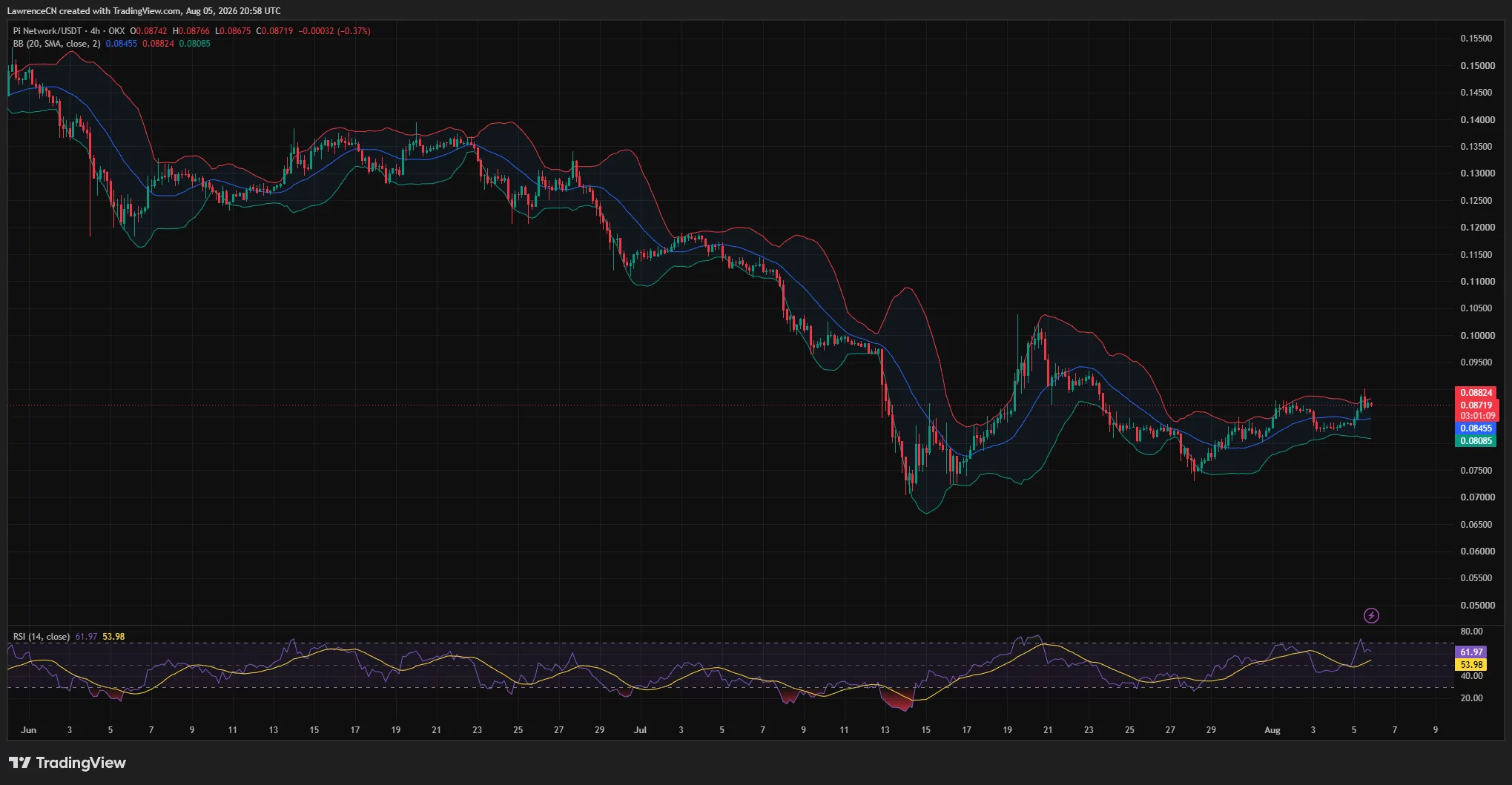
Pi Network price gained more than 10% this week as rising volume, the Protocol 26 upgrade, and a new RoboPay integration improved short-term demand.
Summary
- Pi Network price gained more than 10% this week, with trading volume rising 75% to $11.5 million.
- The token is testing resistance between $0.0882 and $0.0900 on the 4-hour chart.
- PI reclaimed its 20-day SMA at $0.08513, while Chaikin Money Flow turned positive.
- Protocol 26 requires Mainnet node operators to upgrade by Aug. 11 to remain connected.
Pi Network price tests $0.09 resistance
According to data from crypto.news, Pi Network (PI) price traded near $0.0872 on Wednesday after gaining more than 10% over the past week. The token rose as high as $0.0902 during the latest daily session before giving back part of the move.
Trading activity also increased. PI’s 24-hour volume rose 75% to approximately $11.5 million, showing that the recovery attracted more market participation than earlier low-volume moves.
The 4-hour chart shows PI pressing against the upper Bollinger Band at $0.08824. That level overlaps with the $0.088–$0.090 resistance zone that has limited several recovery attempts since late July.
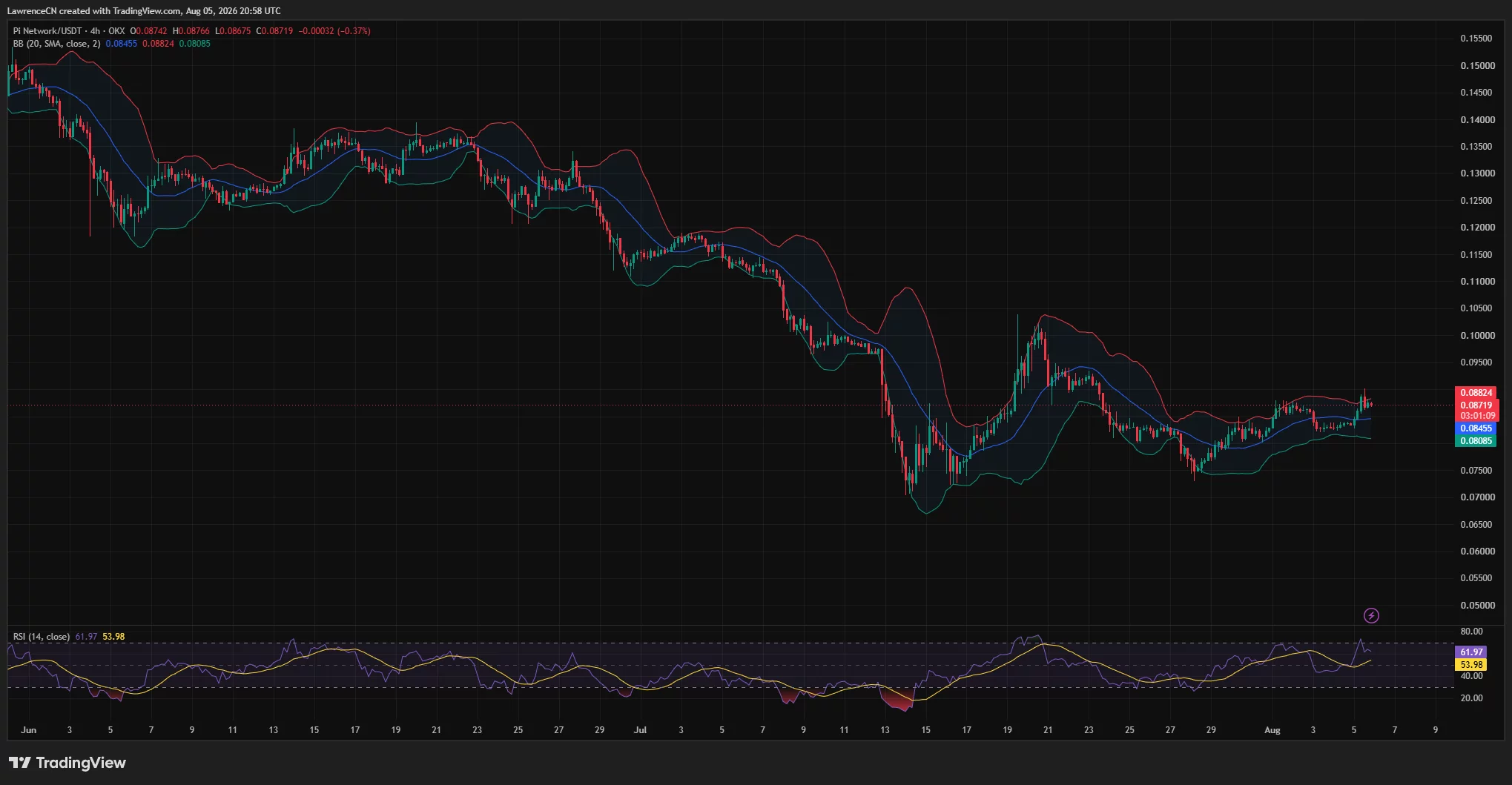
A 4-hour close above $0.090 would provide the first clear sign that buyers have broken the immediate ceiling. Until that happens, the latest advance remains a resistance test rather than a confirmed breakout.
PI’s 4-hour Relative Strength Index stood at 61.97, above its signal average of 53.98. The reading points to strengthening momentum but remains below the conventional overbought threshold of 70.
Protocol 26 deadline supports sentiment
The recovery comes as Pi Network prepares to complete its Protocol 26 Mainnet upgrade. The Pi Core Team has given node operators until Aug. 11 to install the update through the Pi Node software.
Operators who fail to upgrade risk losing their connection to the Mainnet, according to the project’s official announcement.
Protocol 26 follows eight upgrades completed during recent months. Pi Network has described it as a major step before Protocol 27, the final update currently planned in this upgrade cycle.
The upgrades are intended to bring the network’s protocol features and functionality up to date. However, they do not guarantee greater demand for PI or a sustained price recovery. Traders will be watching whether the technical work leads to increased development and activity across the ecosystem.
The Aug. 11 deadline may remain a short-term sentiment driver. Price volatility could rise around the event if node participation or the upgrade process differs from market expectations.
RoboPay adds a potential PI payment use case
Fabric Foundation also announced that Pi Network had joined RoboPay as a payment partner. The group said PI would be used to pay for robot services across the Fabric network.
“Pi will be used to pay for robot services across the Fabric network,” the Fabric Foundation said.
RoboPay is designed to let developers assign prices and execution rules to robotic tasks. A payment-authorized request can trigger a robot to perform an action and return a structured result once the task is completed or rejected, according to Fabric Foundation documentation.
Potential services include deliveries, security patrols, industrial inspections and interactions with humanoid assistants. These examples describe the planned scope of the system, however, and do not establish that each service is already widely available to PI holders.
The integration gives PI another proposed utility route beyond transfers and ecosystem applications. Its effect on token demand will depend on the availability of RoboPay services, user adoption, and the number of transactions ultimately settled with PI.
PI price faces larger moving-average barriers
The daily chart offers an improving short-term picture but shows that PI has not reversed its wider downtrend.
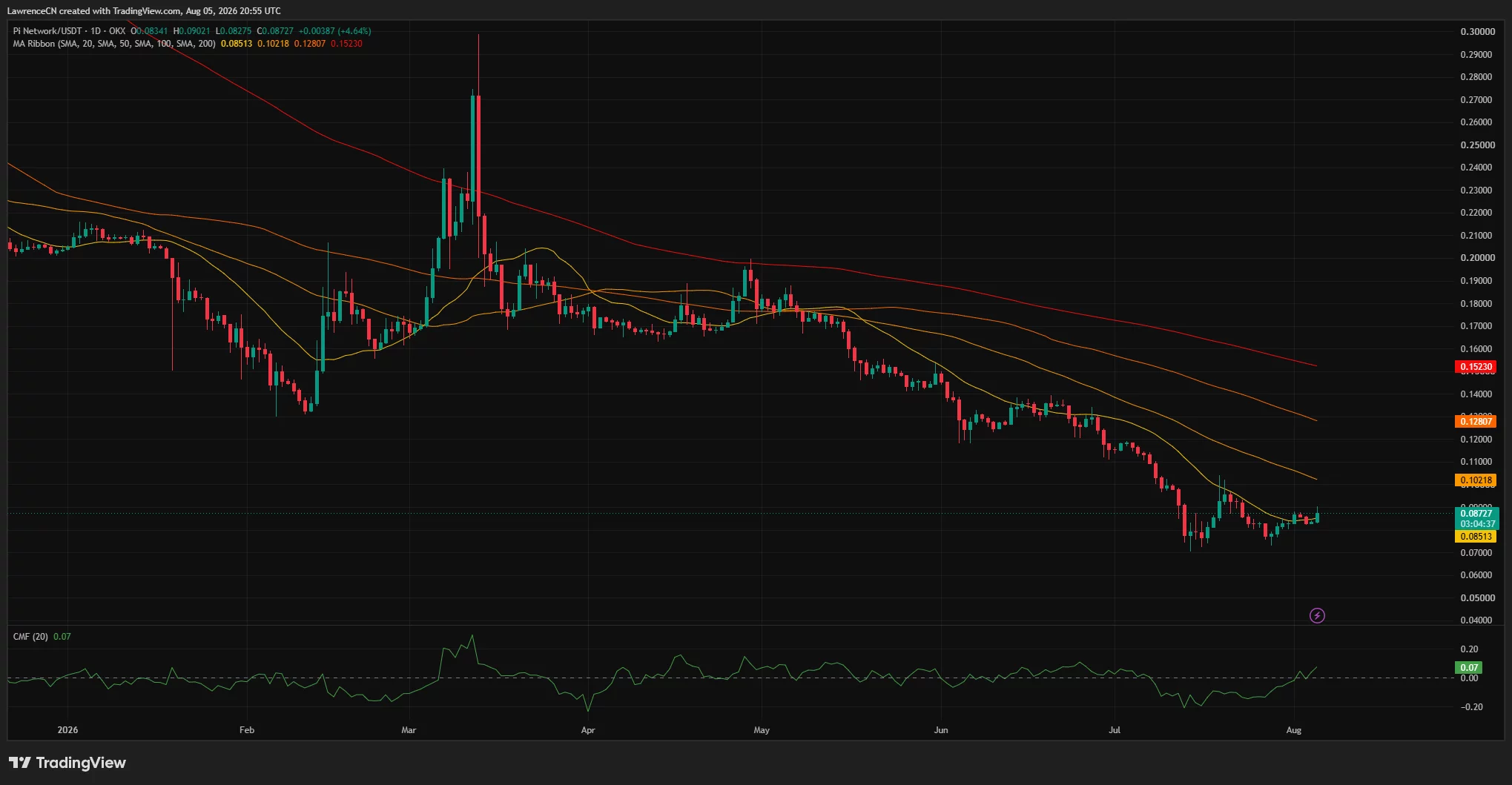
PI closed around $0.08727, above its 20-day simple moving average of $0.08513. Reclaiming that line gives buyers an initial support level following the rebound from July’s low near $0.070.
Chaikin Money Flow increased to 0.07, moving above zero as capital flows shifted modestly toward buyers. A sustained positive reading would add support to the recovery case.
The larger moving averages remain well above the market, however. PI trades below its 50-day SMA at $0.10218, the 100-day SMA at $0.12807, and the 200-day SMA at $0.15230. Their bearish alignment reflects the decline that has continued since the first quarter.
If PI closes above $0.090, the psychological $0.10 level and the 50-day SMA near $0.1022 would form the next resistance area. That would represent an advance of roughly 17% from $0.0872.
On the downside, the Bollinger Band midpoint and 20-day SMA create initial support around $0.0845–$0.0851. Losing that zone could expose the lower 4-hour band near $0.08085. A deeper reversal would put the July base between $0.070 and $0.075 back in focus.
For US traders, the setup also carries venue risk because PI access and supported trading pairs can differ by platform and jurisdiction. The displayed price comes from the OKX PI/USDT market, so spreads and available liquidity may not match those on other venues.
PI’s immediate outlook therefore depends on whether buyers can convert the current volume increase into a close above $0.090. Protocol 26 and RoboPay have improved sentiment, but the token must still clear its longer-term moving averages to establish a broader reversal.
Disclosure: This article does not represent investment advice. The content and materials featured on this page are for educational purposes only.

CAS sparks trader backlash as losses mount, Sebi holds firm

Games Inbox: Why are Call Of Duty: Black Ops 1 and 2 so popular?

Coinbase suspends six trading pairs after market review


-

 Fashion5 days ago
Weekend Open Thread: Wit & Wisdom
-

 Politics5 days ago
Meta enters AI-training agreement with far-right ‘propaganda rag’ Newsmax
-

 Politics3 days ago
Zack Polanski: an incitement to murder Nigel Farage?
-

 Crypto World4 days ago
MicroStrategy Post-Earnings CLARITY Act Push Could Add New Catalyst for Its Stock
-

 Crypto World5 days ago
XRP Ledger v3.3.0 brings five institutional features
-

 News Videos7 days ago
Bitcoin Enters the 3rd Stage of the Bear Market
-

 Politics6 days ago
Luke Littler’s dominance sparks GOAT debate
-

 Sports6 days ago
Seema Kaliramna Wins Discus Throw Bronze, Takes India’s CWG Medals Tally To 17
-

 Crypto World5 days ago
New York sues Kalshi over prediction market gambling
-

 Crypto World4 days ago
Crypto PAC spending tops $2M in Michigan House race
-

 Business5 days ago
Trump Announces Hamas Disarmament Agreement as Iran Strikes Kuwait Air Base and US Attacks Pause Overnight
-

 Business3 days ago
DTCR: Deleveraging And A Hedge Fund Collapse Point To A Possible AI Bottom
-
 Crypto World5 days ago
3 Fed Officials Just Explained Their Rate Hike Vote: Is Inflation Winning?
-

 Tech4 days ago
ESET tracks rise in malicious AI skills and adaptable malware
-

 NewsBeat7 days ago
Four people die trying to cross Channel in small boats
-

 Sports5 days ago
France Cricket implodes: letters hidden in a drawer and a board at war
-

 Tech6 days ago
Gemini Spark can now use Chrome logins and saved passwords to run errands on your behalf
-
 Tech6 days ago
Building A Reproduction PlayStation Motherboard
-
Crypto World3 days ago
XRP Ledger urges node upgrade after manifest flood
-

 Crypto World5 days ago
Moneyflip CEO charged in $40K murder-for-hire plot
You must be logged in to post a comment Login