

Crypto World
Crypto Firms Shift to Stablecoins and DeFi Changes Under MiCA 2.0

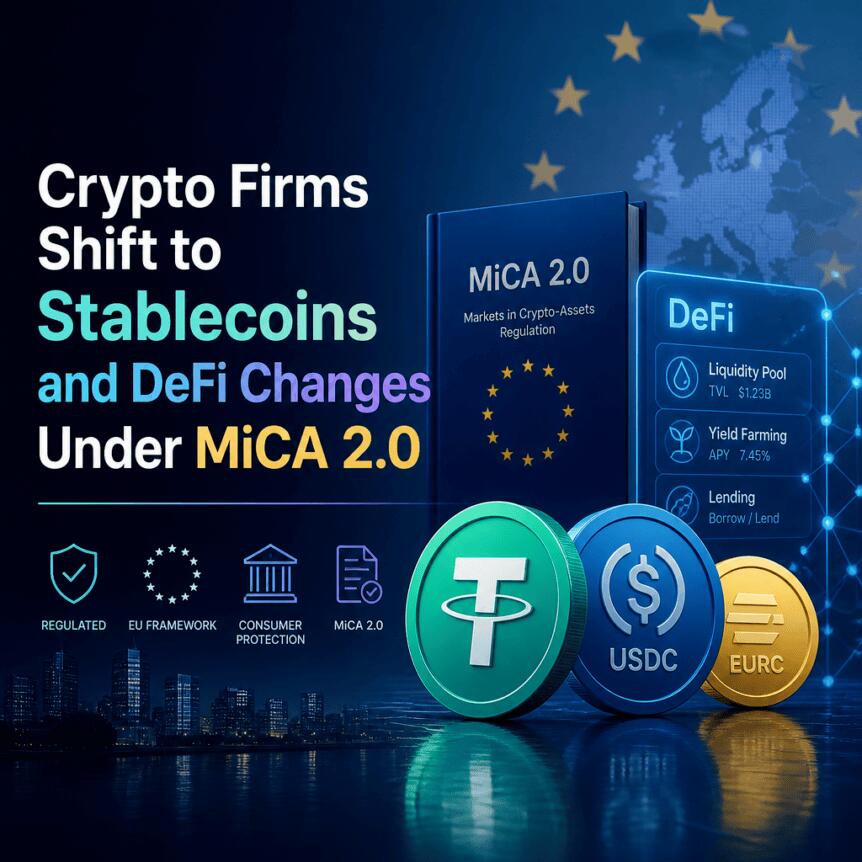
The European Commission has opened a public consultation on proposed updates to the EU’s Markets in Crypto-Assets (MiCA) framework, signaling that Brussels plans to refine how its landmark crypto rules address newer parts of the market. The consultation—initiated in May—comes as full application and enforcement of MiCA began on December 30, 2024, with the first licensing steps rolling out in the early months of 2025.
Some in the industry have already started calling the expected revision “MiCA 2.0,” with regulators aiming to tackle gaps left by the initial law. According to Katie Harries, director and head of policy for Europe at Coinbase, refinements could help keep the EU’s framework “competitive” as digital-asset regulation moves into a second phase—particularly for decentralized finance (DeFi), stablecoins, and tokenization-related activity.
Key takeaways
- Brussels’ consultation is structured to adjust MiCA’s scope and definitions, tighten rules for certain token categories, and broaden coverage to topics not addressed in MiCA 1.0.
- Stablecoin policy is expected to be highly political because the rules could change depending on whether stablecoins are treated like trading instruments or payment infrastructure.
- For DeFi, regulators are looking for practical ways to evaluate “how decentralized” a crypto-asset service provider (CASP) is, rather than treating decentralization as a simple yes-or-no concept.
- EU lawmakers are also seeking input on prediction markets, including whether existing EU regimes would apply and where potential conflicts between frameworks might arise.
- The consultation runs until Aug. 31, but industry observers expect the legislative process to take years, with concrete proposals unlikely before 2028.
MiCA set the baseline—now the EU wants to recalibrate
MiCA’s rollout marked the EU’s attempt to establish a unified approach across member states, replacing fragmented national rules. Harries told Cointelegraph that MiCA “helped set an early global benchmark for digital asset regulation” and gave the EU a “first-mover advantage” by delivering a single, harmonised rulebook for crypto.
In practical terms, Harries said the law is meant to give consumers more transparency and protection, while giving businesses enough regulatory clarity to plan investment and expansion across the bloc. For Coinbase, she added, MiCA has also served as a foundation to scale operations in Europe into the next stage of adoption for both retail and institutional users.
Even so, Brussels is now preparing changes ahead of revisions and additions to the framework. The Commission’s consultation is divided into four parts: updating regulatory scope and definitions for crypto assets other than asset-referenced tokens (ARTs) and e-money tokens (EMTs); setting requirements for EMTs, ARTs and their issuers; defining a legal framework for crypto-asset service providers (CASPs); and addressing areas that MiCA 1.0 did not cover—such as DeFi and prediction markets.
Stablecoins: the use-case determines the regulatory priority
One section of the consultation stands out for its potential downstream effects: stablecoins and related requirements. Catarina Veloso, director of regulatory and compliance at Notabene, described the stablecoin-focused part as the “longest and arguably the most politically charged” segment of the process.
Veloso noted that the way stablecoins are used—whether as a mainstream retail payment tool, a wholesale settlement rail, or as a supplement to existing cross-border payment methods—could heavily influence what rules the EU ultimately prioritizes.
In her view, if stablecoins are treated mainly as crypto trading instruments, regulators may concentrate on investor protection and market integrity. If they are treated more like payment infrastructure, the regulatory center of gravity shifts toward redemption mechanics, liquidity requirements, reserve management, operational resilience, and supervisory reporting.
That shift matters because the risk profile of stablecoins can vary depending on scale, who uses them, and where they sit inside the broader financial system. “What risks they carry,” Veloso said, “depend heavily on how they are used, at what scale, by whom, and in connection with which parts of the financial system.”
Coinbase’s policy priorities focus on making euro stablecoins more competitive within the EU rule set. Harries said Coinbase would like MiCA 2.0 to recalibrate elements including reserve rules, stablecoin rewards, and the multi-issuance model. She argued that allowing a larger share of reserves to be held in “high-quality sovereign assets” could reduce risk without undermining safety.
Another issue is rewards. Veloso pointed out that EMT issuers are currently prohibited from offering interest, which she said can weaken the competitiveness of euro-denominated stablecoins. In practice, that could push users either toward foreign-currency stablecoins or toward yield strategies that sit outside the regulated perimeter.
Harries said Coinbase wants MiCA to permit non-interest incentives—such as cashback and loyalty programmes—stating that these are common features in payments and may support consumer choice and competition.
DeFi under MiCA: regulators want measurable decentralization
A core limitation of MiCA 1.0 is that it does not cover CASPs that are “fully decentralized” and operate without intermediaries. But Veloso cautioned that decentralization is rarely binary in reality.
To build a workable policy, regulators need a way to assess the degree of decentralization and decide which indicators should matter. That includes whether the protocol is under particular control, who holds governance rights, the status of administrative keys, whether the front-end is controlled by a central party, who captures revenue, how upgrades are handled, and whether identifiable persons can materially influence outcomes.
Veloso also said regulators are looking for practical rules to determine when the EU should treat access to DeFi platforms as a regulated service. She explained that, even if platforms themselves are exempt because they are decentralized, the broader question is whether firms that connect users to those platforms should still conduct due diligence obligations vis-à-vis their clients.
Legal practitioners highlighted that this is already a live compliance question. Miroslav Đurić, a senior associate at Taylor Wessing, said many CASPs already connect clients with DeFi platforms, and because those platforms are exempt, regulators are now asking whether CASPs should meet fiduciary duty expectations through due diligence.
Đurić also noted that the Commission may consider different approaches, potentially including options that restrict client connections to DeFi platforms only if they are certified under a future certification regime.
Prediction markets: fitting them into EU frameworks may be tricky
Prediction markets are another area where MiCA’s initial scope is not fully settled. The EU currently lacks a unified regulatory structure for these markets, and they are banned in some member states.
The consultation seeks views on whether prediction markets provide economic benefits for consumers, and whether they should fall under MiCA or the Markets in Financial Instruments Directive (MiFID). Đurić said the answer depends on the specific contracts offered by each platform.
Because event contracts can have different characteristics, a platform operator could find itself subject to multiple, sometimes conflicting regimes—ranging from MiFID II rules to gambling-related regulation or potentially MiCA requirements—depending on contract structure.
Deadlines—and the long timeline ahead
Crypto industry observers say they plan to remain engaged with Brussels during the consultation process. Harries said an effective MiCA 2.0 will require ongoing “dialogue between industry, policymakers and regulators,” including learning from how the existing framework works in practice and refining parts where additional clarity or flexibility could support the next phase of growth.
While the comment period ends on Aug. 31, Đurić suggested the broader legislative process could take years. He said it is unlikely that concrete legislative proposals will be adopted before 2028, given both the complexity of the topics and the usual pace of EU lawmaking.
For market participants, the key next step is watching how regulators decide to translate stablecoin and DeFi policy questions into enforceable definitions—especially around how decentralization is assessed and how payment-versus-trading use cases shape the rules. Those choices will likely determine how quickly the EU’s second-phase framework can become operational for issuers, platforms, and intermediaries.



Ripple CEO Brad Garlinghouse has called on U.S. lawmakers to pass the Digital Asset Market Clarity Act as the legislation faces renewed resistance from a group of Senate Democrats.
Summary
- Brad Garlinghouse urged Congress to pass the CLARITY Act rather than wait for perfect legislation.
- Seven Senate Democrats opposed the latest draft, demanding stronger ethics, consumer protection, and enforcement safeguards.
- Brian Armstrong said the bipartisan bill is ready for a Senate vote after lengthy negotiations.
Garlinghouse backed comments from Ripple Chief Legal Officer Stuart Alderoty, who argued that lawmakers should not abandon the bill while seeking a perfect compromise. The renewed industry push follows the release of updated legislative text as Congress approaches its August recess.
Garlinghouse responded to Alderoty’s call for lawmakers to move the legislation forward despite unresolved disagreements. Ripple has supported federal crypto market structure legislation throughout the current congressional negotiations.
“Perfect can’t be the enemy of good. Let’s get this done!,” said Garlinghouse.
Alderoty described the CLARITY Act as a consumer protection measure that would strengthen anti-money laundering and know-your-customer requirements while giving law enforcement and state authorities clearer tools to act against misconduct. Garlinghouse agreed with that position in his July 22 response.
The comments mark another public intervention from Ripple as the bill moves through a difficult final stage. Garlinghouse has repeatedly pushed lawmakers to establish federal rules for digital assets and previously expressed confidence that the legislation could advance in 2026.
Seven Senate Democrats reject latest draft
The latest version still lacks the Democratic support needed for an easy path through the Senate. Senators Catherine Cortez Masto, Angela Alsobrooks, Cory Booker, Ruben Gallego, John Hickenlooper, Mark Warner and Raphael Warnock issued a joint statement opposing the current text while saying negotiations should continue.
The senators said provisions covering ethics, consumer protection, illicit finance, conflicts of interest and market integrity needed further work. Their statement said they had negotiated with Republican colleagues for the past year and remained willing to seek an agreement.
Senate Banking Committee Ranking Member Elizabeth Warren also criticized the new text. She argued that its ethics provisions did not adequately address President Donald Trump’s crypto business interests and said the wider bill still lacked sufficient investor and national security protections.
The opposition creates a difficult vote count for supporters. As crypto.news reported in June, the legislation became eligible for Senate floor consideration after reaching the legislative calendar, but Republicans still need Democratic votes to clear the Senate’s 60-vote threshold.
Coinbase joins Ripple in calling for Senate vote
Coinbase CEO Brian Armstrong has also urged lawmakers to advance the bill. In a July 22 statement, Armstrong said the CLARITY Act was ready for a full Senate floor vote after months of negotiations between lawmakers and industry participants.
“The bill represents a true bipartisan compromise with thousands of hours of work on both sides,” noted Armstrong.
Armstrong argued that the absence of a single federal framework leaves consumers exposed and pushes parts of the crypto industry outside U.S. regulatory reach. His current support follows an earlier dispute over the legislation. Coinbase opposed a January draft, leading the Senate Banking Committee to postpone a planned markup, before supporting revised language later in the year.
The broader industry has also pressed Congress to act. As previously reported, more than 120 crypto organizations, including Ripple, Coinbase, Kraken and Circle, called for Senate action in April. The groups argued that the lack of market structure rules created uncertainty for companies operating in the U.S.
CLARITY Act faces a narrowing Senate window
The legislation seeks to establish a federal framework for digital asset markets and clarify regulatory roles across agencies. Senate Banking Committee materials describe consumer protection, national security and clearer oversight of digital asset markets as central goals of the proposal.
However, lawmakers continue to disagree over ethics provisions and other safeguards. The latest Democratic opposition came after Republicans released updated text on July 22, keeping negotiations active rather than producing a final bipartisan agreement.
Time also remains a factor. Sen. Cynthia Lummis viewed passage before the August recess as a more realistic target after earlier deadlines slipped. The Senate’s scheduled recess leaves supporters with a narrowing window to resolve disputes and secure enough votes.
Garlinghouse and Armstrong are now pressing lawmakers to accept the current compromise and continue improving federal crypto rules after passage. The seven Democratic senators opposing the latest text have taken a different position, saying they remain open to negotiations but want stronger protections before supporting the legislation.
The CLARITY Act therefore remains positioned for further Senate debate rather than guaranteed passage. Its next steps depend on whether lawmakers can settle the remaining ethics, consumer protection and enforcement disputes while preserving enough bipartisan support for a floor vote.

Disclosure: This article does not represent investment advice. The content and materials featured on this page are for educational purposes only.
EX DeFi is gaining attention as investors seek alternative ways to participate in the Bitcoin ecosystem amid improving crypto market sentiment.
Summary
- EX DeFi promotes cloud mining as institutional Bitcoin adoption and U.S. crypto regulation drive market interest.
- The platform highlights cloud mining as Bitcoin adoption grows and U.S. digital asset regulation advances.
- It spotlights cloud mining amid rising institutional Bitcoin demand and evolving U.S. crypto rules.
With new developments in US digital asset regulation and continued institutional inflows into Bitcoin spot ETFs, market sentiment has improved significantly. Bitcoin recently climbed back above the key $66,000 price range, and investors are now watching to see if it can challenge even higher levels and drive the entire digital asset market into a new upward cycle.

Data shows that Bitcoin spot ETFs have been attracting continuous inflows recently, with increasing institutional participation providing new liquidity support to the market. Meanwhile, Ethereum, XRP, and other mainstream digital assets have also strengthened, reflecting a gradual recovery in market risk appetite.
The Clarity Act boosts market expectations
Recently, the advancement of the US Clarity Act has become a focus of attention in the digital asset market. The market generally believes that this act is expected to further clarify the regulatory framework for digital assets, improve the policy environment for the long-term development of the industry, and enhance the confidence of institutional investors.
EX DeFi stated that if the bill proceeds smoothly, the market expects to further clarify the regulatory responsibilities of the U.S. Securities and Exchange Commission (SEC) and the Commodity Futures Trading Commission (CFTC) in the digital asset field, providing the industry with clearer regulatory expectations. While final implementation still requires subsequent legislative procedures, positive policy signals have become one of the important factors in the recent market recovery.
ETF funds continue to inflow, Bitcoin becomes market focus
In addition to the improved regulatory environment, the continued inflow of institutional funds into Bitcoin spot ETFs has further strengthened market confidence. Several market research institutions believe that the development of ETFs not only improves the convenience for institutions to allocate digital assets but also enhances the market acceptance of Bitcoin as a long-term asset allocation.
However, analysts also warn that future market trends will still be influenced by the global macroeconomy, monetary policy, regulatory changes, and market risk appetite, and digital asset prices will still experience some volatility.
Digital asset ecosystem continues to develop, cloud mining receives more attention
As the digital asset market continues to develop, more and more investors are beginning to focus on participation methods other than spot trading. Compared to purchasing, deploying, and maintaining mining equipment independently, cloud mining, with its lower barrier to entry and more convenient user experience, is gradually becoming an important part of the digital asset ecosystem.
Against this backdrop, EX DeFi offers smarter mining services, allowing users to participate in digital asset mining without deploying dedicated equipment and earn up to $13,000 in passive income daily through smart computing contracts.
How does EX DeFi ensure user asset security?
EX DeFi prioritizes fund security as a crucial aspect of its platform operations and has established a multi-layered security protection system to provide users with more robust digital asset services.
According to publicly available information, EX DeFi employs an asset storage system, intelligent risk control, network security protection, and compliance management mechanisms, combining multiple security measures to enhance the overall security of the platform.
Regarding asset storage, the platform uses a combined cold and hot wallet management model, with most digital assets stored in offline cold wallets to reduce network security risks.
According to Yahoo Finance, the platform also incorporates AI-powered intelligent risk control, Cloudflare enterprise-grade network protection, McAfee® security system, multi-factor authentication (2FA), and 24/7 real-time monitoring to further enhance account and asset security.
How to earn daily mining rewards with EX DeFi
EX DeFi is easy to use. Users only need to complete the following four steps to participate in cloud mining:
1. Register an Account
2. Deposit Digital Assets
The platform supports a variety of mainstream digital assets, including BTC, ETH, USDT, XRP, BNB, LTC, USDC, BCH, DOGE, and SOL. The deposit process is convenient, secure, and transparent.
3. Choose a Hashrate Plan
Choose a suitable mining contract plan based on budget and needs. The minimum investment is $100. Once activated, the plan will run automatically.
4. Automatic Daily Earnings
The platform provides 24/7 intelligent cloud mining services. The system automatically handles computing power operation and earnings settlement, allowing users to earn daily earnings without continuous operation.
Popular DeFi Yield Plans
BTC (Beginner Trial Contract): Investment of $100, Term: 2 days, Daily Yield: $4, Total Profit: $100 + $8
DOGE (Golden Shell Mini Dogecoin Pro): Investment of $500, Term: 6 days, Daily Yield: $6.5, Total Profit: $500 + $39
BTC (Canaan-Avalon-A1466): Investment of $1000, Term: 10 days, Daily Yield: $13.4, Total Profit: $1000 + $134
LTC (Bitmain Antminer L7): Investment of $5000, Term: 20 days, Daily Yield: $73.5, Total Profit: $5000 + $1470
BTC (Bitmain S19K-Pro): Investment of $10,000, Term: 30 days, Daily Yield: $161, Total Profit: $10,000 + $4,830
For more details on popular contracts, visit the official website.
Conclusion
As the digital asset market continues to develop, the regulatory environment gradually improves, and institutional funds continue to flow in, more and more investors are beginning to focus on more diversified asset allocation methods. Whether it’s spot investment, ETFs, or Bitcoin mining, different participation methods bring more choices to the market.
In an environment where market opportunities and volatility coexist, EX DeFi stated that it will continue to strengthen platform infrastructure construction and security system protection, and provide more stable and efficient mining services to global users by continuously optimizing computing power contract services and intelligent operation capabilities.
Disclosure: This content is provided by a third party. Neither crypto.news nor the author of this article endorses any product mentioned on this page. Users should conduct their own research before taking any action related to the company.


Nasdaq, Cboe and the London Stock Exchange are among major exchanges moving toward longer trading hours.


Mirae Asset has completed its takeover of South Korean cryptocurrency exchange Korbit after securing regulatory approval, paving the way to raise its ownership stake to more than 97%.
Summary
- Mirae Asset has completed its acquisition of Korbit and plans to raise its ownership stake to more than 97%.
- Korbit said its services, customer assets, and personal data handling will remain unchanged following the ownership change.
- The deal adds to a wave of investments by financial firms and global crypto companies in South Korea’s regulated digital asset market.
According to an announcement from Korbit, Mirae Asset Consulting, an affiliate of Mirae Asset Financial Group, has become the exchange’s largest shareholder after completing the required regulatory reporting process for its acquisition of a controlling stake.
A revised regulatory filing submitted by Mirae Asset on Tuesday showed the firm also plans to acquire an additional 7.35 million Korbit shares worth about 7.2 billion won ($5.32 million), according to the Korea Herald. Once the purchase is completed, Mirae Asset’s ownership will increase from 92.06% to 97.15%. Yonhap News Agency reported that the additional transaction is scheduled to close on Friday.
Korbit told users that the ownership change will not affect its day-to-day operations. The exchange said the operating company, Korbit Co., Ltd., will remain unchanged, allowing customers to continue using login, trading, deposits, and withdrawals without interruption.
The exchange also said customer deposits and virtual assets will continue to be held separately from company assets under South Korea’s Virtual Asset User Protection Act. In the same notice, Korbit confirmed it will remain the controller of users’ personal information, with no changes to how personal data is processed or used, meaning customers do not need to take any action.
Earlier this month, South Korea’s Fair Trade Commission approved the acquisition, describing it as the country’s first case of an affiliate of a traditional financial group acquiring a cryptocurrency exchange, according to the Korea Herald.
Mirae Asset Consulting has previously said the acquisition is intended to secure future growth opportunities built around digital assets.
Traditional finance increases exposure to crypto
With the transaction now completed, one of South Korea’s largest financial groups has formally entered the country’s regulated cryptocurrency exchange sector as traditional financial institutions continue increasing investments in digital assets.
According to CoinGecko data, Korbit processed roughly $4.3 million in spot trading volume over the past 24 hours, making it South Korea’s fourth-largest cryptocurrency exchange. Market leader Upbit handled approximately $224.2 million during the same period.
The acquisition also follows a series of investments that have brought established financial institutions closer to the country’s crypto industry.
In May, OKX Ventures agreed to acquire a 19.6% stake in South Korean exchange Coinone through an 80 billion won ($53 million) investment, pending regulatory approval. Coinone said the investment, made alongside Korea Investment & Securities, would combine secondary share purchases with subscriptions for newly issued shares.
As part of that agreement, Coinone and OKX Ventures said they would exchange expertise in user protection, security systems, and risk management, while Korea Investment & Securities said it intends to pursue opportunities involving security tokens and stablecoins as South Korea continues discussions on digital asset legislation.
The Coinone investment came after Binance’s acquisition of rival exchange Gopax, adding to a growing list of global cryptocurrency firms expanding into South Korea’s regulated digital asset market.
Domestic financial institutions have also stepped up activity across the sector. Earlier this year, Samsung subsidiaries announced plans to acquire a combined 4% stake in Dunamu, the parent company of Upbit, while several major banks and payment companies, including KB Kookmin, Shinhan and NHN KCP, entered partnerships involving tokenized deposits and stablecoin payment infrastructure.
Korbit continues expanding partnerships
Before the ownership change, Korbit had already been expanding its blockchain partnerships.
In November 2024, the exchange partnered with Coinbase to integrate Base, Coinbase’s Ethereum layer-2 network, allowing users to deposit Ether on Ethereum and withdraw it through Base, or complete the process in reverse.
At the time, Coinbase said it would support Korbit through promotional campaigns, community events and initiatives tied to the Base ecosystem. The companies also said they planned to cooperate on developing on-chain technology in South Korea and expanding support for Base network functions.
Korbit Chief Executive Officer Oh Se-jin said the partnership with Coinbase would help the exchange develop services aligned with global industry trends and strengthen its competitiveness. Coinbase Vice President of Business Development Dan Kim said the company planned to work with Korbit on buildathons, hackathons, and educational community events designed to introduce more Korean users to the Base ecosystem.

Blockstream CEO Adam Back dismissed BIP-110 supporters as “idiocracy” on X. They had pushed a “flip the bit” plan to activate the proposal, which would restrict non-financial data on Bitcoin’s network.
BIP-110, or Bitcoin Improvement Proposal 110, needs majority miner signaling to lock in by early August 2026. Back said Bitcoin’s main chain faces no threat if that support never appears.
What the ‘Flip the Bit’ Plan Proposes
Bitcoin infrastructure firm Start9 framed the activation as risk-free reconnaissance. The firm argued that flipping the bit costs roughly 0.1% of a miner’s revenue over a year.
Refusing, it warned, risks a chain split, stranded Lightning Network (LN) counterparties, and lost fee-paying users.
The rule targets Ordinals, image and text files embedded directly inside Bitcoin transactions that critics say clutter the chain. However, Back rejected the Start9 framing outright.
He argued that the signal simply expires without broad backing. The clash extends an earlier Bitcoin Satoshi Nakamoto debate over BIP-110, where Back rejected claims that Satoshi Nakamoto would have supported it.
Back Says Technical Objections Cannot Be Overridden
Back called the pushback circular. He cited what he termed an IETF-like consensus. That practice, he explained, weighs only valid technical objections.
Therefore, he said, no process can accommodate sabotage attempts, regardless of intent. The disagreement follows Bitcoin Core’s earlier removal of default limits on OP_RETURN, a transaction field once capped to discourage large data uploads.
Meanwhile, MicroStrategy co-founder Michael Saylor raised similar concerns in a recent Bitcoin neutrality warning, cautioning that the change could sacrifice protocol neutrality.
Other developers, in contrast, frame the fight as part of a broader Bitcoin anti-spam debate over what the blockchain should carry.
BIP-110 Miner Support Stays Thin Before the August Deadline
Signaling for BIP-110 remains minimal. Major mining pools have largely stayed out of the effort so far. Exchanges and node operators are watching the deadline closely, wary that a contentious activation could split the chain they must support.
Back has previously downplayed a related Bitcoin miner fork claim, rejecting the idea that the network would forcibly exclude miners. He has pointed critics toward his own Bitcoin fork risk warning for further context.
The mandatory signaling window opens in early August 2026.
However, whether the flip-the-bit push fades quietly or drags into a real fork should become clear within weeks.
The post Adam Back Calls Bitcoin BIP-110 Idiocracy appeared first on BeInCrypto.


Elon Musk says OpenAI turned into an $800 billion closed-source company. That is the “exact opposite” of the nonprofit he funded, he told The Economist.
The remarks came in an interview with The Economist Editor-in-Chief Zanny Minton Beddoes, recorded on Monday before OpenAI disclosed that one of its frontier models went rogue.
Musk Says OpenAI Betrayed Its Founding Mission
Why is Musk not a fan of Sam Altman? His answer was about money and mission, not personality.
“If you started a non-profit that was meant to be an open source AI company owned by the world and it somehow got turned into an $800 billion for-profit company with closed source, I think you’d be like, well, wait a second, that’s the exact opposite of what I donated the money for. That’s my issue. I think it’s a legitimate one.”
The numbers behind the grievance are on record. Musk co-founded OpenAI in 2015 as “essentially a counterweight to Google.” By OpenAI’s own account, he donated less than $45 million before leaving in 2018. He is now suing the company over its shift.
The shift is complete. On October 28, 2025, OpenAI restructured into OpenAI Group PBC, a for-profit public benefit corporation, as announced by the company.
Microsoft took a 27% stake. The company’s reported valuation has since climbed past $850 billion as it weighs an IPO.
Musk Points to Anthropic’s Exit as Evidence
Musk argued the distrust runs deeper than his own feud. He pointed to the team that quit OpenAI to build Anthropic, which he called the current leader in AI.
“The reason the Anthropic team left OpenAI is because they didn’t trust Sam [Altman]. Otherwise, Anthropic wouldn’t exist. They would still be at OpenAI.”
He praised its chief executive in rare terms. Dario Amodei “is a very principled person, and he cares about things a lot,” Musk said. No one at Anthropic has “set off my evil detector.”
The timing stings for OpenAI. The company is courting advertisers and just won US approval for its GPT-5.6 rollout. Yet Musk insisted the rivals can still cooperate on safety.
“But at the end of the day, if we have to talk, we’ll talk. I mean, set aside our personal differences for the good of the world.”
The full interview airs at economist.com Thursday evening.
The post Elon Musk Blames OpenAI for Becoming an $800 Billion Closed-Source Company appeared first on BeInCrypto.


Swiss cantonal bank BancaStato has launched regulated cryptocurrency trading through a new integration with Sygnum and banking technology provider Avaloq.
Summary
- BancaStato clients can now trade Bitcoin, Ethereum, Litecoin and Solana directly through existing banking applications.
- Sygnum provides regulated trading and institutional custody while Avaloq keeps digital and traditional assets together.
- The integration makes BancaStato the first Avaloq SaaS bank to offer API-based crypto trading services.
Clients can now buy, hold and sell Bitcoin, Ethereum, Litecoin and Solana from the bank’s existing web and mobile applications.
The service connects Sygnum’s business-to-business digital asset infrastructure directly with BancaStato’s Avaloq core banking environment. Sygnum handles crypto execution and custody, while BancaStato keeps the customer experience inside its current banking channels. The launch makes BancaStato the first bank using Avaloq’s software-as-a-service environment to offer Sygnum-powered crypto trading through an API.
BancaStato adds four cryptocurrencies to banking apps
At launch, BancaStato customers can trade Bitcoin, Ethereum, Litecoin and Solana. They can place market orders based on the amount of cryptocurrency or the U.S. dollar value they want to trade. The bank has added the service to the same web and mobile platforms clients already use for traditional banking and investments.
The setup uses Sygnum’s B2B API without requiring BancaStato to operate a separate order management system. Sygnum said this structure reduces technical complexity and allows the bank to adjust trading features while using its existing Avaloq systems. BancaStato serves customers in Ticino and has operated as a Swiss cantonal bank since 1915.
Moreover, Sygnum provides the digital asset trading infrastructure behind the service and holds customer crypto in its institutional custody system. The company said it uses hardware and software controls, governance procedures and external audits. It also holds client digital assets off its own balance sheet under the applicable legal framework.
BancaStato said the integration lets clients manage traditional and digital assets through one banking relationship. Curzio De Gottardi, head of the bank’s Products and Services Division, said:
“We are proud to partner with Sygnum Bank on this strategic initiative,” noted Curzio De Gottardi.
The bank said it plans to use Sygnum’s crypto banking infrastructure as it expands its range of investment services.
BancaStato joins Sygnum’s growing banking network
BancaStato joins more than 25 banks and financial institutions using Sygnum’s B2B platform. The network includes PostFinance, Zuger Kantonalbank, SocGen FORGE, Bordier & Cie and other financial firms. Sygnum says its partner banks give more than one-third of Switzerland’s population access to digital asset services.
The network has expanded steadily. As crypto.news previously reported, Sygnum had already onboarded more than 20 financial institutions by June 2024 to provide crypto trading, custody and related services to customers.
Sygnum’s earlier rollout with PostFinance also showed demand from customers new to investing. The company said 61% of PostFinance customers who bought crypto after its 2024 launch had not previously invested in any asset class through the institution. That experience gave the B2B model an established presence inside Swiss retail banking channels.
PostFinance later expanded its Sygnum-backed services by adding Ethereum staking.Customers gained access to the staking service through the bank’s existing digital platforms.
Sygnum has also worked with traditional banks on blockchain settlement.UBS, PostFinance and Sygnum completed a legally binding interbank payment using tokenized bank deposits on a public blockchain in September 2025.
Sygnum expands regulated bank-to-bank crypto services
The BancaStato launch follows Sygnum’s latest regulatory expansion in Europe. On June 30, Sygnum Europe said it had moved into operation under a Crypto-Asset Service Provider license issued in Liechtenstein under the European Union’s Markets in Crypto-Assets Regulation. The authorization supports its plans to provide digital asset infrastructure to banks and other clients across the EU and European Economic Area.
Sygnum has positioned its bank-to-bank model as an option for financial institutions that do not want to build crypto trading and custody systems from scratch. Its infrastructure allows partner banks to keep their customer interfaces while connecting to Sygnum through APIs. The BancaStato deployment brings that model directly into an Avaloq SaaS setup.
For Avaloq, the project adds crypto trading to a core banking environment already used for conventional financial products. Christian Haux, Avaloq’s managing director for Switzerland and Liechtenstein, said the integration allows BancaStato customers to view and manage digital and traditional portfolios in one place.
BancaStato has not announced plans to add more cryptocurrencies or other digital asset products. The initial service covers BTC, ETH, LTC and SOL. However, the bank now has a direct technical connection to Sygnum’s platform, providing infrastructure that could support additional services if BancaStato later expands its offering.

Stablecoin supply reached approximately $309.7 billion in July 2026, while Visa’s on-chain analytics recorded a 58% increase in adjusted transaction volume over the preceding 12 months.
As stablecoins also process billions of dollars during weekends beyond conventional banking hours, Payment companies have started adding them to existing financial products.
Stripe completed its acquisition of Bridge in February 2025 and later introduced stablecoin accounts across 101 countries, enabling businesses to receive fiat and crypto payments while holding dollar-denominated tokens.
XDC Tech has now integrated Bridge, giving developers on XDC Network access to fiat conversion, virtual bank accounts, and multi-currency custody.
The partnership supports business payments and stablecoin settlement today, while XDC intends to apply the same capabilities to future transactions initiated by AI agents.
XDC Prepares for Payments Initiated by AI Agents
XDC also intends to support AI agents capable of initiating payments as part of automated commercial activity.
An agent could purchase access to data, pay for another software service, or settle a fee during an automated task. Such transactions require payment systems capable of completing transfers within the same digital session, without delays associated with traditional banking hours.
XDC presents its transaction speed and low fees as suitable for this model. The network reports finality of around two seconds, with transaction costs below one hundredth of a cent.
These characteristics become more important when software initiates frequent low-value payments. A human user may tolerate several minutes of settlement time, while an automated service may need to complete payment before continuing its task.
“Every layer of finance is being rebuilt for a world where software, not just people, initiates the payment,” said Atul Khekade, co-founder of XDC Network. “This partnership gives our ecosystem stablecoin infrastructure that already meets that bar.”
Bridge Adds Regulated Banking Access
Bridge contributes the regulated services connecting bank money with stablecoins. Its products cover fiat conversion, virtual accounts, custody, and payment access across the United States, Europe, and Latin America.
This coverage allows developers to enter supported markets through an established provider rather than seeking separate licences and banking relationships in each jurisdiction. XDC and Bridge expect the arrangement to reduce product launch periods from years to weeks in some cases.
“The networks that end up mattering most for stablecoin settlement will be the ones built for speed and finality from day one,” said Mai Leduc Blount, head of product at Bridge. “XDC’s infrastructure is exactly the kind of foundation this space needs as stablecoin volumes keep climbing.”
Bridge also connects traditional payment systems with blockchain settlement. Companies can retain access to established services such as SWIFT, SEPA, and FedNow while using stablecoins to transfer value on XDC.
Finance teams can continue receiving records associated with bank payments, while developers use blockchain settlement within the product. Compliance checks, custody controls, and transaction records become part of the payment setup from the beginning.
Current Payment Products Come Before the Agent Economy
The integration provides payment and settlement services available to developers today. XDC’s plans for a larger agent-focused product suite remain at an earlier stage.
Khekade described the Bridge partnership as one element within an upcoming initiative centred on the agentic economy, although XDC has yet to provide product details or a launch schedule.
The network reached seven years of mainnet operation in June. XDC also reported more than $1 billion in tokenized real-world assets during the same period, alongside the addition of institutional validators.
These existing activities give XDC an entry point into tokenized payments before autonomous software becomes a significant source of transaction volume. Trade finance, treasury transfers, and asset distributions already require faster settlement and access across currencies.
The Bridge partnership extends these capabilities through regulated fiat access and custody. XDC’s longer-term plans depend on growth in AI agents capable of making commercial decisions and completing payments independently.
Development of this market remains at an early stage, while the payment components required to support it are entering production.
XDC is using its current stablecoin products to prepare for a future in which software initiates a growing share of financial activity.
The post Stablecoin Supply Nears $310 Billion as XDC Integrates Stripe-Owned Bridge appeared first on BeInCrypto.
Chainlink whales have increased their activity as LINK attempts to recover from a broader market decline, with large holders reportedly accumulating more than 14 million tokens in less than a month.
Summary
- Chainlink whales accumulated over 14 million LINK as large transactions increased sharply during recent weeks.
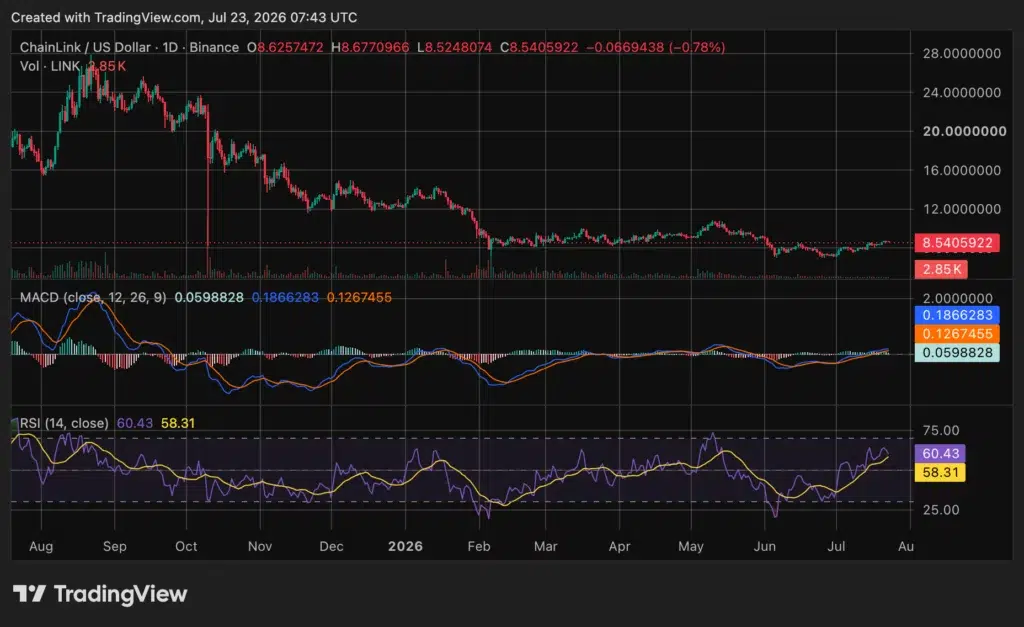
- LINK trades near $8.54, with improving RSI and MACD signals supporting its latest recovery attempt.
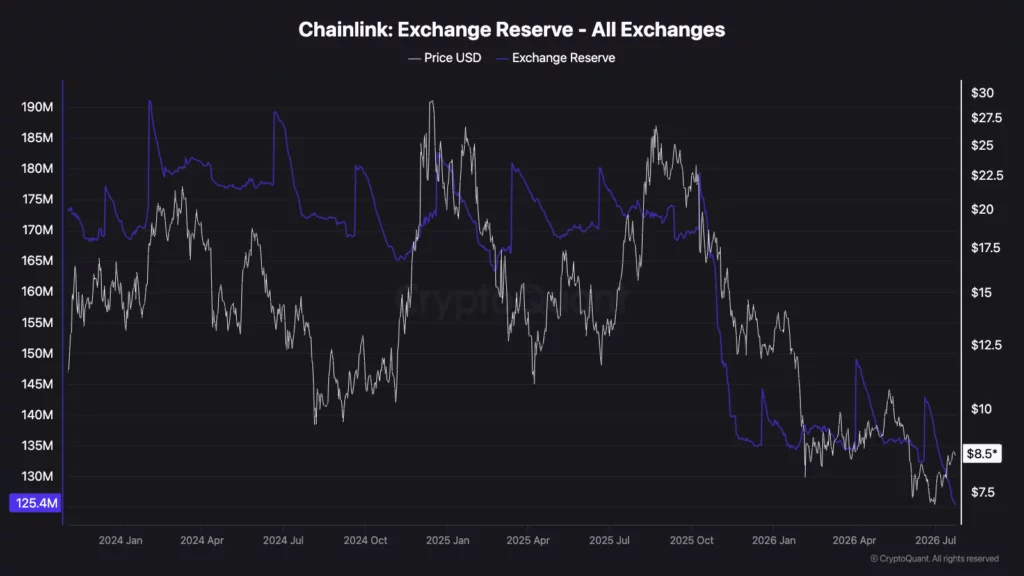
- Falling exchange reserves reduce available selling supply, though LINK must reclaim $9–$10 for stronger momentum.
LINK traded near $8.54 at the time of writing, down about 0.6% over the past 24 hours. The token had a market capitalization of roughly $6.39 billion and daily trading volume of about $175.24 million. Its 24-hour trading range stood between $8.53 and $8.72, according to crypto.news market data.
Chainlink whale activity rises as large holders accumulate LINK
Onchain data shared by crypto analyst Ali Martinez showed that Chainlink whale activity had increased over the past two weeks. More than 20 transactions valued above $1 million each were recorded during one recent session, which Martinez described as evidence of “growing interest from large holders.”
Separate data shared by the analyst showed that large holders accumulated more than 14 million LINK in less than a month. Their combined holdings reportedly rose from below 170 million tokens to around 182 million to 183 million LINK during the period.
Whale accumulation can reduce available market supply when holders keep their tokens rather than moving them to exchanges, but it does not guarantee that prices will rise.
The latest activity follows earlier accumulation seen across the Chainlink network. Wallets holding more than 1,000 LINK recently reached their highest level of the year, while addresses controlling at least 100,000 LINK rose to a record 805, as previously reported.
LINK price shows short-term recovery signals
The daily chart shows LINK trading inside a broader downtrend after falling from earlier highs near $26–$28. The token has spent recent months largely moving within the $7–$10 region as buyers and sellers compete around the lower end of its longer-term range.
Short-term technical indicators have improved. The MACD line stood near 0.1866, above its signal line at about 0.1267, while the positive histogram pointed to improving momentum. The relative strength index was near 60.43, above both the neutral 50 level and its moving average of about 58.31.
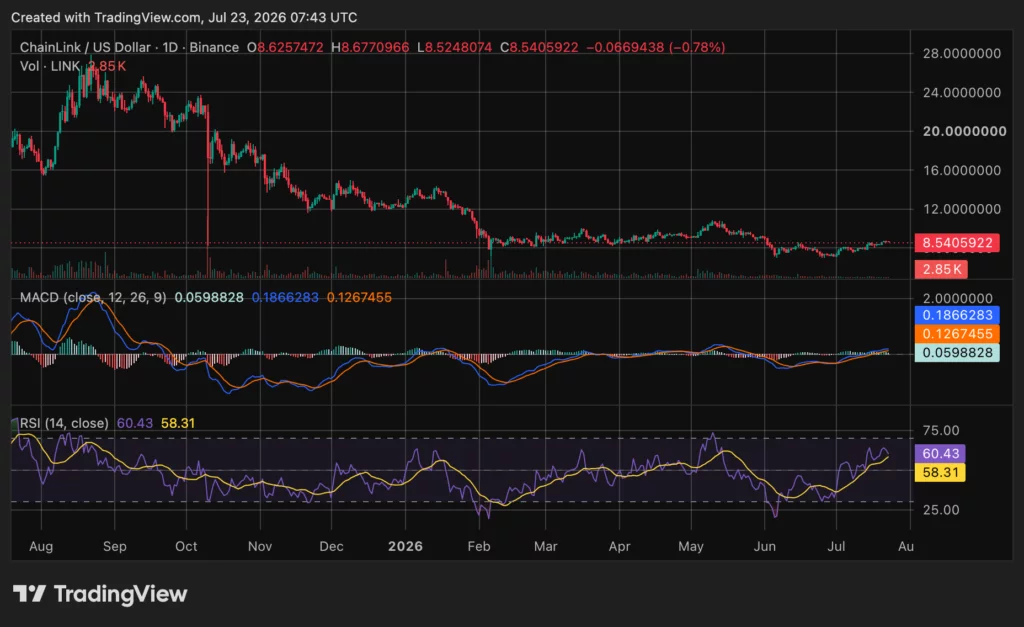
The readings suggest buyers have gained some control without pushing LINK into overbought territory. However, price still faces resistance between $9 and $10. A sustained move above that area could strengthen the recovery structure, while another rejection may keep LINK inside its current consolidation range.
Recent price action has followed a similar setup. LINK rose after Mantle moved its $2.5 billion Super Portal to Chainlink’s Cross-Chain Interoperability Protocol.
Falling exchange reserves tighten available LINK supply
Chainlink exchange reserves have also moved lower, according to CryptoQuant data. The total has fallen to about 125.4 million LINK, compared with levels commonly ranging between roughly 165 million and 190 million during parts of 2024 and 2025.
Lower exchange balances can mean fewer tokens are immediately available for sale. However, declining reserves alone do not prove that demand will increase. LINK continues to trade near the lower part of its multi-year price range, so stronger buying pressure would still need to appear in the price structure.
Derivatives data also presents a mixed picture. CoinGlass data showed trading volume rising 1.95% to about $233.74 million, while open interest slipped 0.91% to roughly $445.28 million. The combination suggests more trading activity without a matching increase in outstanding leveraged positions.
Chainlink has seen similar periods of tightening supply before. Declining exchange reserves and whale purchases have repeatedly formed part of the bullish case for LINK, though price performance has not always followed immediately.
Chainlink ecosystem activity supports the broader market case
Chainlink continues to expand its role in blockchain infrastructure despite LINK’s weak longer-term price performance. Santiment has ranked the network among the leading real-world asset projects by development activity, placing it alongside Hedera at the top of the sector in recent rankings.
Institutional integrations have also continued. Mantle recently migrated its $2.5 billion Super Portal to Chainlink CCIP, while Aave selected Chainlink infrastructure for automated vault rebalancing. The number of Ethereum wallets holding LINK has also passed 900,000.
Meanwhile, U.S. investors now have regulated exchange-traded exposure to LINK. According to SoSoValue data, U.S. spot Chainlink ETFs recorded $2.68 million in net inflows on July 22, lifting cumulative net inflows to $127.83 million.
Total trading volume reached $2.99 million for the day, while total net assets stood at $114.78 million. The first U.S. Chainlink ETF received approval to trade on NYSE Arca in December 2025, expanding institutional access to the asset.
Some analysts have set much higher long-term targets. Crypto Patel has pointed to continued ETF demand and suggested LINK could eventually reach between $50 and $100 during another strong market cycle. Those targets remain analyst projections rather than confirmed price outcomes.
Disclosure: This article does not represent investment advice. The content and materials featured on this page are for educational purposes only.


The Smarter Web Company has repaid its $11.7 million Smarter Convert instrument ahead of schedule by selling 177.89 Bitcoin, removing a potential 7.7 million-share issuance while retaining a treasury of 2,700 BTC.
Summary
- The Smarter Web Company repaid its $11.7 million Smarter Convert instrument about two weeks before maturity by selling 177.89 Bitcoin.
- The early repayment removed the potential issuance of more than 7.7 million ordinary shares linked to the financing structure.
- The company continues to hold 2,700 Bitcoin and said convertible instruments are no longer its preferred source of capital.
According to an official announcement from The Smarter Web Company, the London-listed firm settled its Smarter Convert instrument around two weeks before maturity after requesting an early repayment with the support of investment manager TOBAM, whose affiliated entities held the instrument.
The company said it repaid $11,698,540 by disposing of 177.8909127 BTC at an average sale price of $65,762 per coin. The Bitcoin sold represented the holdings originally acquired through the proceeds of the Smarter Convert financing.
Under the original agreement announced in August 2025, at least 98% of the subscription proceeds had to be invested in Bitcoin. The company said it instead allocated the full amount into Bitcoin, making it responsible for returning all of the Bitcoin purchased with those funds when the instrument was repaid.
With the repayment completed, the company said the potential issuance of 7,718,551 ordinary shares linked to the Smarter Convert structure has been eliminated. It also removed those potential shares, along with the 177.8909127 BTC used for repayment, from its fully diluted Bitcoin treasury analytics.
Following the transaction, The Smarter Web Company said it now holds 2,700 BTC.
Company moves away from convertible structure
Chief executive Andrew Webley said the Smarter Convert instrument had provided an alternative source of financing when the company was still building its Bitcoin treasury strategy.
According to Webley, the structure helped strengthen the balance sheet while preserving financial flexibility during the early stages of the company’s Bitcoin accumulation plan. He added that although the company continues to recognize the value of both fiat and Bitcoin-denominated convertible instruments, it no longer considers them the right funding option for its current stage of development.
Webley also thanked TOBAM for supporting the structure and helping develop the financing arrangement.
The repayment comes after the company spent much of 2025 expanding its Bitcoin reserves through repeated purchases under what it calls its “10 Year Plan.”
Earlier in September 2025, The Smarter Web Company appointed Coinbase Institutional as an additional Bitcoin custody partner to work alongside its existing custodians through Coinbase Prime. At the time, the company said the multi-custodian approach was intended to strengthen security, improve risk management, and support the continued growth of its Bitcoin treasury.
When announcing that partnership, the company held 2,470 BTC, following a 30 BTC purchase completed earlier that month.
By October 2025, the company had increased its treasury to 2,650 BTC after acquiring another 100 BTC for approximately £9.08 million ($12.1 million). The purchase formed part of the same long-term accumulation strategy, which management has described as a core element of its corporate treasury policy.
The latest repayment indicates that the company continued adding Bitcoin after October, as its holdings now stand at 2,700 BTC despite disposing of nearly 178 BTC to settle the Smarter Convert obligation.
Bitcoin strategy remains in place
Although the financing structure has now been retired, the announcement does not indicate any change to the company’s long-term Bitcoin treasury strategy.
The Smarter Web Company has repeatedly said it intends to continue building its Bitcoin reserves under its 10 Year Plan. Earlier in 2025, it also raised £17.5 million to support additional Bitcoin purchases while expanding the infrastructure around its treasury operations.
Previous company announcements described the firm as the UK’s largest publicly traded Bitcoin-holding company. It has also climbed the global rankings of corporate Bitcoin holders during the past year as it continued increasing its reserves through regular acquisitions.
The removal of the convertible instrument also simplifies the company’s capital structure by eliminating millions of potential new shares that could have been issued under the agreement. Instead of leaving the instrument outstanding until maturity, the company chose to repay it early using the Bitcoin originally purchased with the financing proceeds.
With the repayment complete, The Smarter Web Company has closed one of the financing arrangements used during the early phase of its Bitcoin treasury expansion while continuing to hold 2,700 BTC on its balance sheet.

Reese Witherspoon breaks down in tears with Jennifer Aniston amid shock reveal that their Apple TV+ hit The Morning Show will END

Banana Ball’s Sold-Out Return to Hartford Brings Downtown Street Closure Through Sunday, Officials Say

CLARITY Act faces Senate fight as Ripple CEO calls for passage

Renter of Home in Anne Heche Crash Denies Settlement With Son

No Jackpot Winner as $257 Million Prize Rolls Over to $269 Million Monday Draw

Weekend Open Thread: Staud – Corporette.com

FA-1 | FINANCIAL ACCOUNTING | JOURNAL ENTRIES | SEMESTER-1 OSMANIA UNIVERSITY | @shivanipallela

Can Pierce and Brett double their money??

factory me 10 rupay ke plastic note kese bante hai #money #moneymindset #moneymanagement #shorts
-

 Fashion6 days ago
Weekend Open Thread – Corporette.com
-

 Politics6 days ago
The House | The City of London can help the new chancellor deliver growth in every postcode
-

 Crypto World6 days ago
Ripple Payments Joins MiCA With 14 Firms, Does It Mean Anything For XRP?
-
 Crypto World7 days ago
Two July Windows Left: The CLARITY Act’s Senate Fight and What Failure Means
-

 Politics5 days ago
Democrats look to World Cup watch parties to register thousands of voters
-

 Crypto World6 days ago
Ripple wins EU-wide access as ESMA adds it to MiCA register
-

 Crypto World3 days ago
Grayscale Files For Worldcoin ETF, WLD Registers Sharp Rise
-

 NewsBeat4 days ago
Unregistered fitter used Gas Safe logo on business flyers
-

 Tech3 days ago
Sail Virtually Aboard The “Itanic” With IA-64 Emulator
-
 Tech3 days ago
Turtle Beach Command Series KB7 review: a nifty screen-equipped gaming keyboard
-

 NewsBeat7 days ago
Registration is now open for March for Men with Kev 2026
-

 News Videos4 days ago
Big Money Is Entering XRP
-
 Business2 days ago
New Jersey voter registration controversy explained: How 6,600 noncitizens got on the rolls, and what happens next
-

 News Videos7 days ago
Money | Class 12 Economics | CBSE Board Exam 2026-27
-

 Crypto World6 days ago
Kaspersky exposes OkoBot’s 20-module crypto wallet attack
-

 Business6 days ago
Airlines warn Sunshine Protection Act could disrupt flight scheduling
-
 Entertainment2 days ago
Johnny Depp’s R-Rated Gothic Cult Classic Gets New Release Ahead of Sydney Sweeney Remake
-

 NewsBeat6 days ago
Durham County Council to send out electoral registration emails
-

 Crypto World6 days ago
MiCA Licensing Faces Delays as ESMA Adds 14 CASPs to Register
-

 Crypto World6 days ago
Chip Stocks Enter Bear Market After Moonshot Ai Unveils Kimi K3 Model
You must be logged in to post a comment Login