
Crypto World
Crypto is Europe’s answer to Revolut’s fintech dominance


Disclosure: The views and opinions expressed here belong solely to the author and do not represent the views and opinions of crypto.news’ editorial.
Revolut’s fintech expansion across Europe and globally is severely constraining the playing field for European fintech founders. Attempting to build a European-scale fintech — which means competing directly with Revolut — has become extremely challenging, both from a product and marketing perspective.
Summary
- Revolut closed the fintech door — crypto opens a new one: Competing head-on with a 65M-user super-app is a losing game, but Revolut’s relative neglect of crypto creates a rare, defensible opening.
- MiCA turned crypto from a risk into a credential: Regulatory clarity doesn’t just unlock Europe — it boosts global trust, capital access, and turns licenses into real balance-sheet value.
- Europe is perfectly priced for crypto scale: Cheaper talent, growing stablecoin demand, and returning VC capital make crypto-finance Europe’s best shot at building the next pan-regional champion.
By September 2025, Revolut reached 65 million customers worldwide, with 12 million in the UK alone. The company has also announced a firm timeline for serving 100 million customers, aiming to hit this milestone by mid-2027. As a result, the window of opportunity for European fintech development is rapidly narrowing. Entrepreneurs are left with only two viable options: either build a super-niche project, both in terms of product and geography — think local payment services — or exploit Revolut’s main blind spot. In their pursuit of banking licenses and regulatory relationships, they haven’t been developing crypto services with sufficient intensity.
The latter model offers several compelling advantages. Due to certain characteristics of the European startup scene, a crypto-finance project has excellent chances for global expansion, or at a minimum, pan-European growth.
Regulation
The rollout of Markets in Crypto-Assets Regulation has given crypto projects a major boost — not because it specifically permitted or prohibited anything, but simply because it established clear, understandable frameworks for what a project must comply with to stay compliant in Europe.
There’s an unusual side effect to this regulation: MiCA enhances trust in crypto projects beyond Europe’s borders. For example, in Latin American markets, it creates an extremely positive attitude from regulators toward projects, so it becomes a notable green flag.
The workforce and economy
Compared to the US, hiring employees in Europe is significantly cheaper. Hiring one engineer in the US is equivalent to hiring two or three in Europe. It’s worth noting that in Europe, you can recruit the same developers or product managers from Revolut itself, which definitely makes sense in the context of expansion.
Cryptocurrency turnover is actively growing in Europe. Even our own statistics confirm that users are interested in receiving stablecoins to their accounts and using them as a means of payment.
Funding
While fintech attracted less and less money in recent years, the situation is now changing.
“If 2024 was defined by scarcity, 2025 was defined by bifurcation. The recovery in fundraising has been robust, with year-to-date figures reaching approximately €6.3 billion by September, surpassing 70% of 2024’s total.”
Part of this money is flowing into crypto, as the sector becomes institutionalized through MiCA. A license significantly capitalizes a company, transforming it in investors’ eyes from an unproven concept into a clearly understood fintech company.
“With MiCA fully live, we expect 2026 to be the year of Stablecoin Rails. Major European banks are already piloting Euro-denominated stablecoins. The ‘wild west’ of crypto is over; the institutionalization of digital assets is here, and it will likely become the standard for cross-border B2B payments.”
What could be improved?
Despite being a major benefit, MiCa still hasn’t fully solved compliance. Current legislation and regulators still stumble over crypto-specific issues when it comes to how businesses earn and spend money in crypto form. Moreover, since we’re dealing with an extremely young fintech instrument, tax incentives could facilitate its development and growth.
So if you’re feeling the pressure from Revolut on your European fintech business, we strongly advise taking a serious look at the crypto-finance market. Europe provides numerous benefits to fintech businesses that they can leverage for global expansion.


Key takeaways:
-
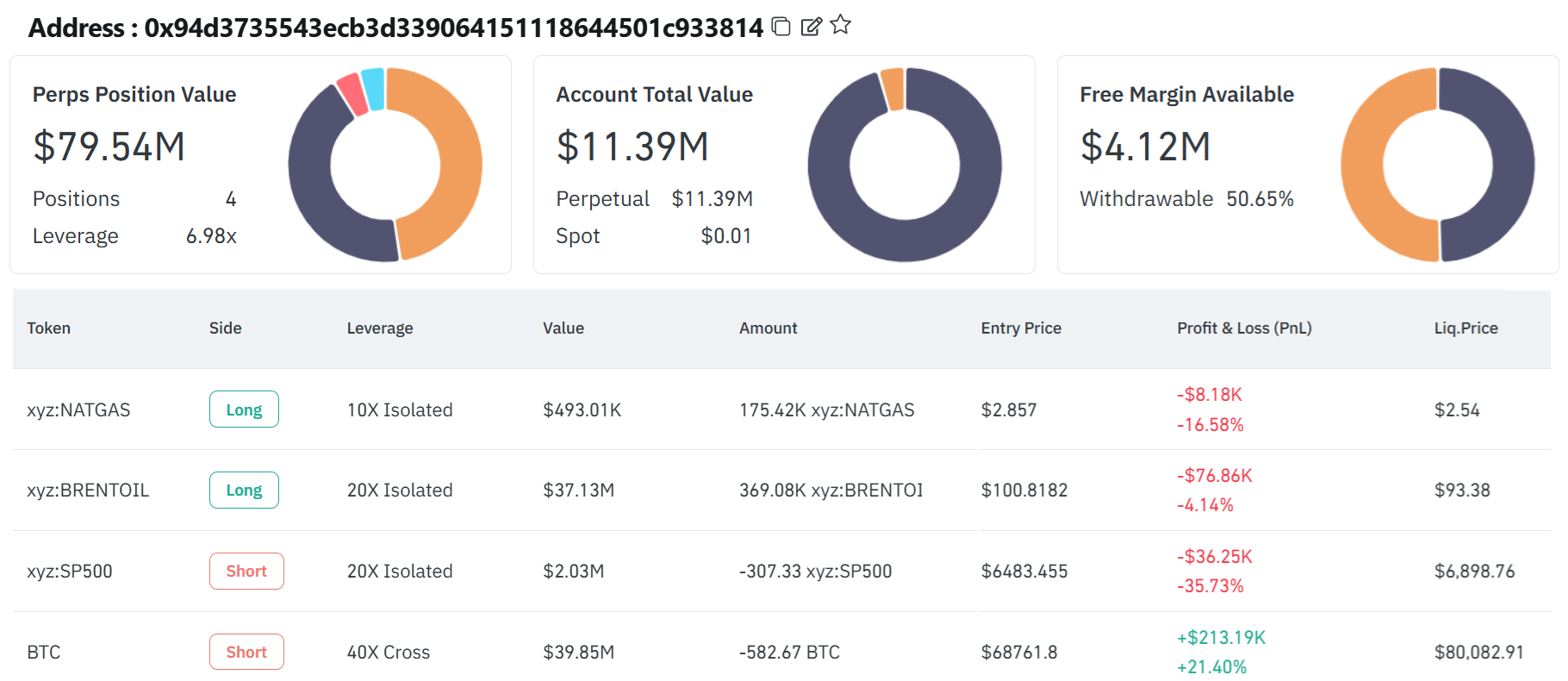
A Hyperliquid whale placed an $80 million bet against Bitcoin and the S&P 500 while going long on Brent crude oil prices.
-
The whale’s history of massive losses and inconsistent signals suggests the trade could fall on the wrong side of the market.
Bitcoin (BTC) showed strength on Wednesday, bouncing back from Tuesday’s $66,000 low after President Donald Trump teased a potential ceasefire in the US and Israel-Iran war. Even with Bitcoin trading above $68,000, one whale used Hyperliquid DEX to place an $80 million bet on a market collapse.
Traders are now watching closely to see if this whale’s massive position signals a looming Bitcoin price drop.

The Hyperliquid whale, linked to address 0x94d373…c933814, carefully built this nearly $80 million leveraged position between Tuesday and Wednesday. The trade includes a $40 million short (sell) on Bitcoin futures near $68,760, a $2 million short on synthetic S&P 500 Index contracts, and a $37 million long (buy) in synthetic Brent oil contracts.

The whale’s aggregate position leverage stood at 7 times, indicating high conviction. The Bitcoin futures liquidation price was $80,083, while the Brent oil position would be forcefully terminated above $93. The timing of the trade is curious as S&P 500 Index futures gained 4% between Tuesday and Wednesday as traders anticipate the US and Israel-Iran war dissipating over the next few weeks.
On Wednesday, President Trump said “Iran’s New Regime President” is considering a “ceasefire,” although the conditions to fully reopen the Strait of Hormuz remain unknown. Iran demands reparations and sovereignty. Thus, one could assume that the Hyperliquid whale is counter-trading the market’s optimistic take, betting that Brent crude oil prices will jump while Bitcoin loses its value.
This Hyperliquid whale previously lost $40 million
This address belongs to a particularly unlucky whale, or at least one who has been extremely unsuccessful since late January. The Hyperliquid whale apparently uses bots for execution, given the sheer number of small trades that build into huge positions, but it still managed to lose $37 million in its first month of activity in December 2025.
The same user was flagged by X user ‘lookonchain’ on Feb. 5 after taking a massive loss on leveraged bullish bets on Ether (ETH), Bitcoin, Solana (SOL), and XRP (XRP).

According to the analysis, the whale had previously made $25 million in profits from shorts in multiple cryptocurrencies, but decided to flip the position on Feb. 4, resulting in a $40 million loss. There is no way to know exactly what triggered this entity to place those bets, but the event proves that even whales can misinterpret the market.
Related: Warren Buffett bought $17B in US T-bills: A bad omen for Bitcoin price?
The erratic signals from President Trump regarding a potential full-on invasion and the war in Iran leave room for opposing views. Iranian Foreign Minister Abbas Araghchi denied there were talks for a ceasefire but confirmed to Al Jazeera on Tuesday that there was an intention to end the war, according to CNBC.
Given the history of this whale’s market positioning and its track record of losing trades, it’s possible that the current $80 million bet may fall on the wrong side of the market.
This article is produced in accordance with Cointelegraph’s Editorial Policy and is intended for informational purposes only. It does not constitute investment advice or recommendations. All investments and trades carry risk; readers are encouraged to conduct independent research before making any decisions. Cointelegraph makes no guarantees regarding the accuracy or completeness of the information presented, including forward-looking statements, and will not be liable for any loss or damage arising from reliance on this content.


According to the company CFO, Bithumb was “strengthen[ing] accounting policies and internal controls” ahead of its IPO plans, already delayed from 2025.
South Korea-based cryptocurrency exchange Bithumb is reportedly expecting its initial public offering (IPO) sometime after 2028, in another delay after restructuring and regulatory hurdles.
According to a Tuesday report from Maeil Business News Korea, a Bithumb official said that it would “focus on preparing for the listing until 2027.” CFO Jeong Sang-gyun said at the company’s annual shareholder meeting that Bithumb was “strengthen[ing] accounting policies and internal controls” following an IPO advisory contract with Samjong KPMG.
Shareholders reconfirmed CEO Lee Jae-won for a two-year appointment at the Tuesday meeting, but the delayed IPO timeline was the latest after Bithumb initially expected a 2025 listing. Under Lee, the exchange faced a six-month suspension and a $24 million fine from South Korean authorities for alleged anti-money-laundering violations.
A major South Korean exchange going public could impact local markets and crypto adoption in the country. Dunamu, the operator of crypto exchange Upbit, is reportedly planning an IPO following a share swap with Naver Financial, expected in September.
Related: South Korea tax agency seeks private crypto custodian after security lapses
Bithumb made headlines in February after the exchange mistakenly credited many users with about 2,000 Bitcoin (BTC) instead of 2,000 South Korean won. The error briefly created internal balances totaling more than $40 billion, though most of the funds existed only on the exchange’s internal ledger and were later reversed.
Mixed signals in South Korea’s crypto policy shift
Lee Jae-myung took office as South Korea’s president in June 2025, and his political party quickly moved to introduce legislation on the issuance of payment stablecoins.
South Korean lawmakers initially proposed a tax hike on crypto gains expected to take effect in 2021. However, the measure has faced repeated delays and may be scrapped entirely, according to reports from March.
As of March 2025, an estimated 16 million South Koreans held accounts on crypto exchanges.
Crypto World
CZ Says Crypto Can Survive Quantum Computing With Protocol Upgrades: Binance Co-Founder


Changpeng Zhao addressed quantum computing concerns, stating the crypto industry can upgrade to quantum-resistant algorithms to mitigate threats.
Crypto World
Dogecoin Price Prediction as MemeCore Flips Shiba Inu in Market Cap, But Pepeto Draws the Same Energy, Is This The Next Dogecoin?

MemeCore just flipped Shiba Inu to become the second largest memecoin by market cap, surging 32% in a single week and proving that meme sector capital rotates fast when a new narrative catches fire according to BSC News. The dogecoin price prediction crowd watched the flip happen in real time while DOGE sat at $0.093 unable to break above $0.10 resistance.
The meme energy that created billions in value during past cycles is now visible around Pepeto, which raised more than $8.69 million with the Pepe cofounder and a Binance listing approaching. The dogecoin price prediction caps at $0.21 for 2026, but analysts project 100x from the presale.
Dogecoin Price Prediction Gets Context as MemeCore Overtakes SHIB and X Money Launches April
MemeCore flipped Shiba Inu’s market cap with an 8% single-day surge and 32% weekly gain, capturing the meme sector rotation that DOGE has failed to attract according to BSC News. Meanwhile, Elon Musk confirmed X Money launches in April with Visa integration across 40 US states and Smart Cashtags for crypto trading on the roadmap, but there is no official confirmation that DOGE will be included as a payment rail according to CryptoNews.
DOGE active addresses jumped 28% in one week from 57,000 to 73,000 according to NewsBTC, but the price has not responded. Meanwhile Qubic’s Dogecoin mining mainnet launched on April 1, promising to make DOGE mining three times faster according to BeInCrypto.
The DOGE forecast waits for X Money to confirm crypto integration, and the exchange that carries the same meme energy with verified tools already built is where the compressed return lives before the listing.
Where the Meme Rotation Meets an Exchange That Delivers What DOGE Never Built
Pepeto: The Next Dogecoin
Despite the correction, the industry pushes forward, and smart traders keep asking which entry gives them what DOGE gave its earliest holders in 2021. Pepeto, with its Binance listing approaching, is not just positioned for near term returns from one event, the exchange is built for daily use that DOGE never offered.
What drives the conviction. The utility works, it is designed for daily trading, and it already runs. The exchange gives verified answers on every contract, with the risk scorer catching traps before your capital moves and PepetoSwap handling every trade at zero fees while the cross chain bridge sends tokens at zero cost. The same meme energy that MemeCore used to flip Shiba Inu overnight is forming around Pepeto, but this time there is a verified exchange behind it that the dogecoin price prediction never had supporting it.
Conviction is peaking. More than $8.69 million entered at $0.000000186 during extended extreme fear, with 190% APY staking compounding early positions. The person who built the original Pepe coin to $11 billion on 420 trillion tokens created the exchange with a former Binance expert, and every contract passed SolidProof’s review. When meme energy alone flipped SHIB’s entire market cap in a single week, imagine what the same force does with a working exchange behind it.
The next Dogecoin Pepeto is the entry where meme energy and verified tools meet in a single project, and the Binance listing turns this presale into the story everyone talks about.
Dogecoin Price Prediction: Can DOGE Hold $0.093 as X Money and Meme Rotation Stay Active?
DOGE trades at $0.093 as of April 1 with the SEC commodity classification confirmed, the 21Shares DOGE ETF live on Nasdaq, and X Money launching in April, according to CoinMarketCap.
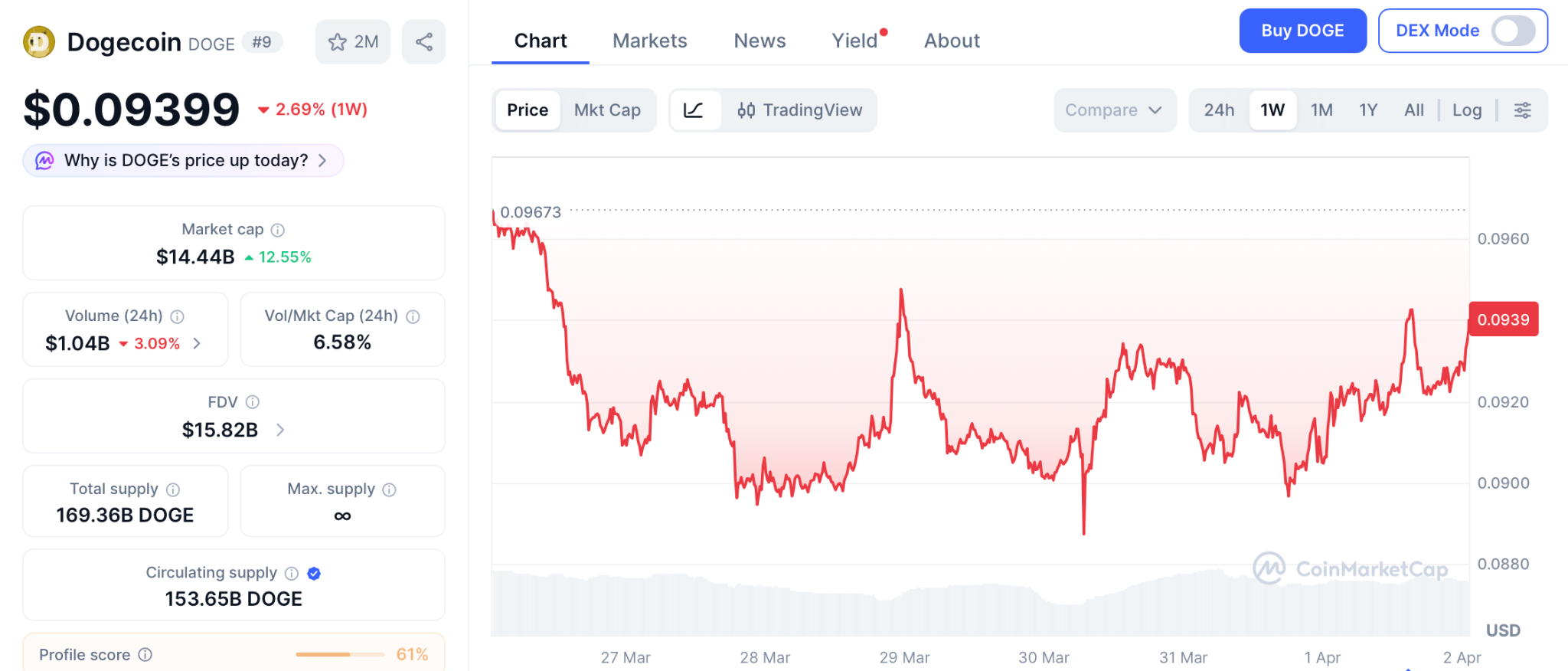
The dogecoin price prediction targets $0.10 as resistance with $0.21 as the 2026 ceiling according to CoinCodex. Support sits at $0.088 with $0.085 below. Active addresses jumped 28% in one week, but Fear and Greed at 8 keeps sellers in control.
The DOGE forecast depends on whether X Money confirms crypto, but even the bullish case takes quarters while the presale delivers 100x from one listing.
Dogecoin Price Prediction Confirms the Smart Money Already Calculated the Outcome and Following Them Is How You Collect
With X Money launching in April and MemeCore proving that meme sector capital rotates violently when a new project catches fire, the environment is the healthiest for meme energy to translate into real returns. Analysts project 100x from the Binance listing, and this may be the last window to enter something that delivers what DOGE delivered in 2021 but with a working exchange this time. More than $8.69 million raised during single digit fear proves the smart money already calculated the outcome.
The wallets that entered SHIB at $0.000007 all say they saw the signal before the crowd, and the same signal flashes now. The Pepeto official website is where following those wallets is how you collect when the listing opens, and entering now is how you capture returns from this cycle.
Click To Visit Pepeto Website To Enter The Presale

FAQs:
What does the dogecoin price prediction show after MemeCore flipped SHIB?
DOGE holds $0.093 while MemeCore overtook SHIB in market cap, with the 2026 ceiling at $0.21 and the next resistance at $0.10 while active addresses jumped 28%.
Will X Money launching in April affect the dogecoin price prediction?
X Money confirmed for April with Visa across 40 states, but crypto trading is only on the roadmap with no DOGE confirmation. The Pepeto official website is where the exchange with verified tools is still at presale pricing.
Is Pepeto the next DOGE based on the dogecoin price prediction pattern?
The same meme energy is building with a working exchange DOGE never had, the Pepe cofounder behind it, and a Binance listing confirmed with 100x projected by analysts.
Disclaimer: This is a Press Release provided by a third party who is responsible for the content. Please conduct your own research before taking any action based on the content.

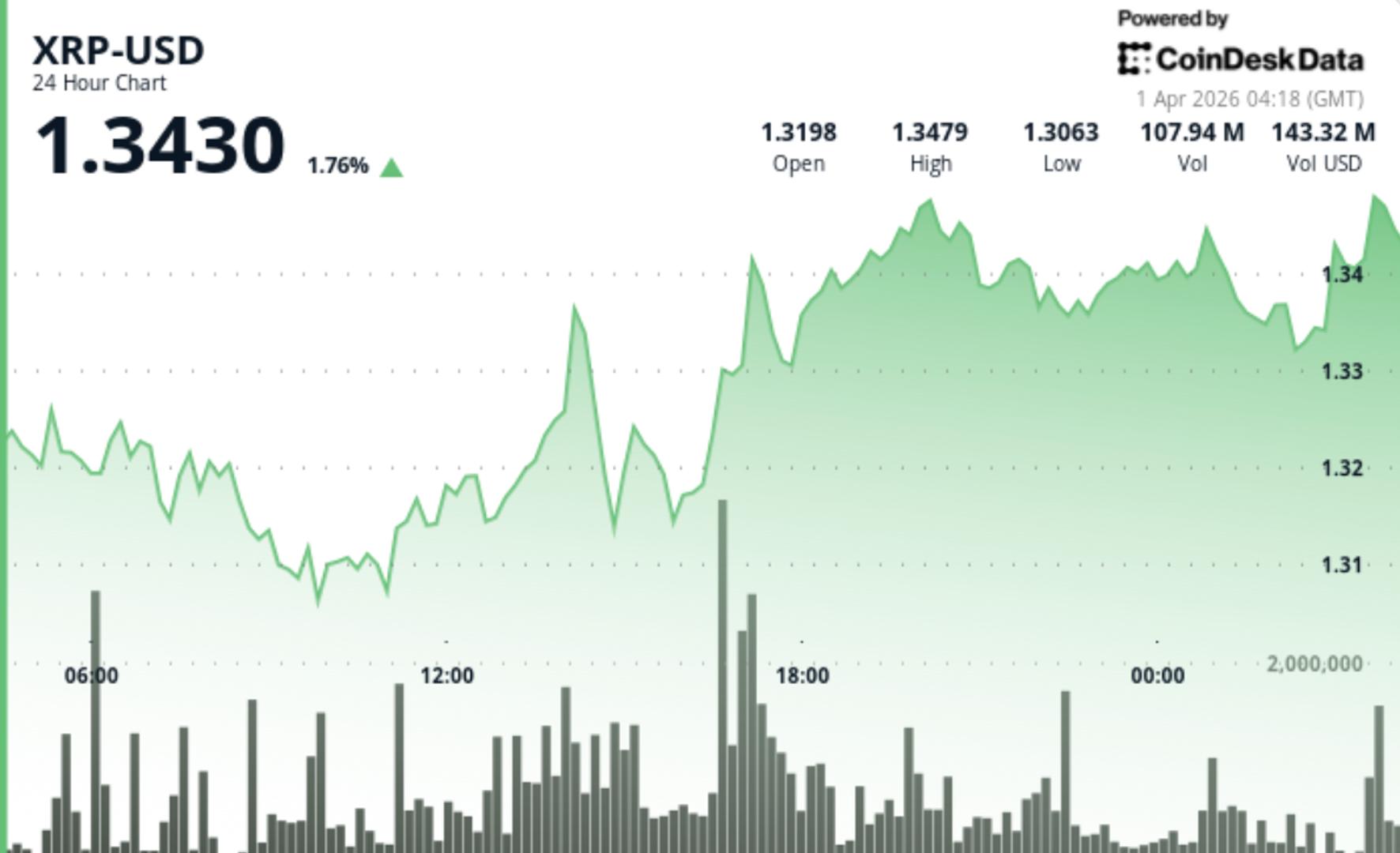
XRP is seeing large amounts of tokens leave exchanges, reducing available supply — but price isn’t responding yet. The token is hovering near $1.34 after a modest gain, creating a disconnect between tightening supply and muted price action that typically doesn’t last.
News Background
- XRP edged higher to $1.34 with volume rising 29% above its weekly average
- Around 7.03 billion XRP left exchanges in February, signaling supply compression
- Binance scarcity indicator climbed to 0.59, its highest level since 2024
Price Action Summary
- Price traded in a tight range, repeatedly testing the $1.33-$1.34 zone
- Early breakout attempts failed, with resistance forming just above current levels
- Buyers defended dips near $1.31, establishing a sequence of higher lows
- Late-session action showed steady buying, but no decisive follow-through
Technical Analysis
- The key setup is a mismatch: supply is tightening, but price isn’t expanding
- Large outflows usually reduce sell pressure, yet sellers are still capping rallies
- Elevated volume without price expansion points to positioning rather than conviction
- This kind of compression typically resolves with a sharper directional move
What traders should watch
- $1.34-$1.35 is the immediate trigger — a break opens room toward $1.42
- $1.31-$1.32 remains the key support zone holding structure intact
- If price continues to stall despite shrinking supply, it suggests sellers are still active overhead


SpaceX has reportedly filed confidential IPO papers with the SEC, eyeing a June 2026 listing at over $1.75T and up to $75B raised after its $1.25T xAI merger valuation.
Summary
- Elon Musk’s SpaceX has reportedly submitted a confidential IPO registration to the SEC, targeting a valuation above $1.75 trillion and a June 2026 listing.
- The listing could raise as much as $75 billion, eclipsing Saudi Aramco’s $29.4 billion offering, the current record for funds raised in an IPO.
- SpaceX’s recent $1.25 trillion valuation following its acquisition of Musk’s AI venture xAI positions it as the world’s most valuable private company ahead of its prospective debut.
SpaceX, Elon Musk’s rocket and satellite company based in the United States, has quietly filed a draft registration for an initial public offering with the Securities and Exchange Commission, in a move that could value the group at more than $1.75 trillion and bring the world’s biggest-ever listing to market as soon as June 2026.
People familiar with the process told Bloomberg that SpaceX is “targeting a confidential filing for an initial public offering as soon as next month,” a timetable that would keep the long-awaited flotation on track for a mid-year debut. Under U.S. rules, a confidential submission allows large issuers to work through several rounds of SEC comments before publishing an S-1 prospectus, limiting early scrutiny of detailed financials.
Insiders cited say the company has already submitted its IPO registration draft and is expected to go public in June, potentially the first of three so‑called “super IPOs” ahead of OpenAI and Anthropic, with banks including Bank of America, Citigroup, Goldman Sachs, JPMorgan Chase and Morgan Stanley lined up as lead underwriters. The same report suggests SpaceX could raise up to $75 billion in fresh capital, more than double the $29.4 billion Saudi Aramco raised in its 2019 IPO, which White & Case described as “the largest-ever initial public offering” at the time. In crypto markets, SpaceX’s looming deal follows similar large-cap listings that have intersected with digital assets, including Coinbase’s direct listing, and echoes recent coverage highlighting how major corporate treasuries are increasingly willing to hold assets like bitcoin alongside cash and bonds.
The IPO preparation comes just weeks after SpaceX acquired Musk’s artificial intelligence startup xAI in a record-setting all‑stock transaction that Reuters says values SpaceX at $1 trillion and xAI at $250 billion, creating a combined entity worth about $1.25 trillion. In a memo quoted by Reuters, Musk framed the tie‑up in typically expansive terms, writing that the merger “signifies not just a new chapter, but an entirely new book in the journey of SpaceX and xAI: expanding to create a conscious sun that comprehends the Universe and spreads the essence of awareness to the stars!” Coverage in the Financial Times and other outlets has stressed that the deal concentrates even more of Musk’s wealth and operational leverage into SpaceX just as bankers pitch investors on its satellite internet arm Starlink as the engine of long‑term cash flow.
The SpaceX listing adds to a pipeline of equity deals that could influence liquidity conditions across both traditional and digital asset markets, particularly if the company confirms reported bitcoin holdings or clarifies whether any related tokenized equity products will trade alongside the stock. In a previous crypto.news story, markets tracked how large technology listings and bitcoin‑linked balance sheets can amplify risk‑on sentiment across digital assets, while another story examined how Musk‑adjacent ventures have repeatedly acted as catalysts for renewed retail inflows into crypto during major funding milestones. With benchmark tokens like Bitcoin (BTC), Ethereum (ETH) and Solana (SOL), traders will be watching whether a SpaceX roadshow in early summer sharpens the bid for risk or drains liquidity into what could be the IPO of the decade.
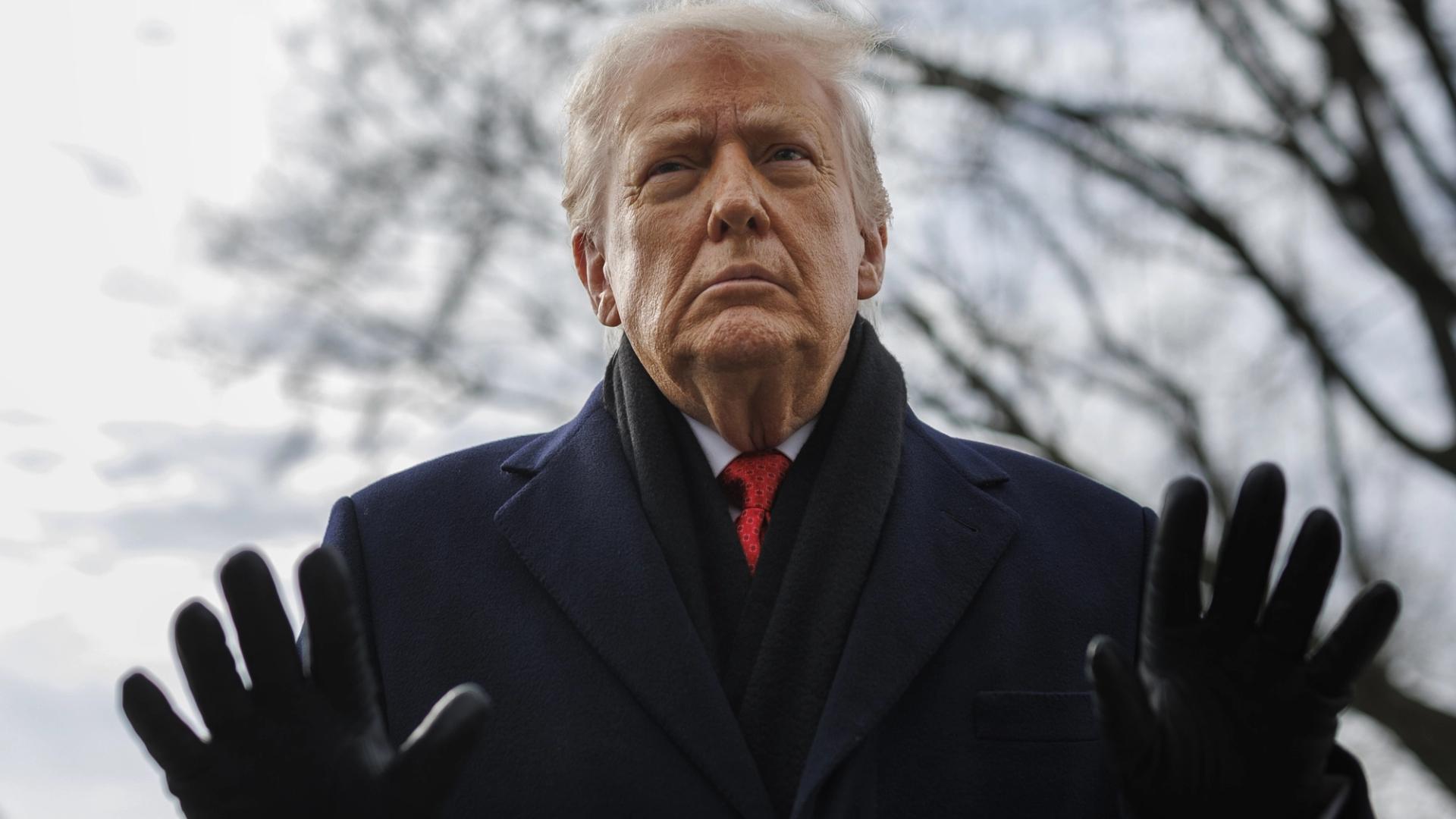
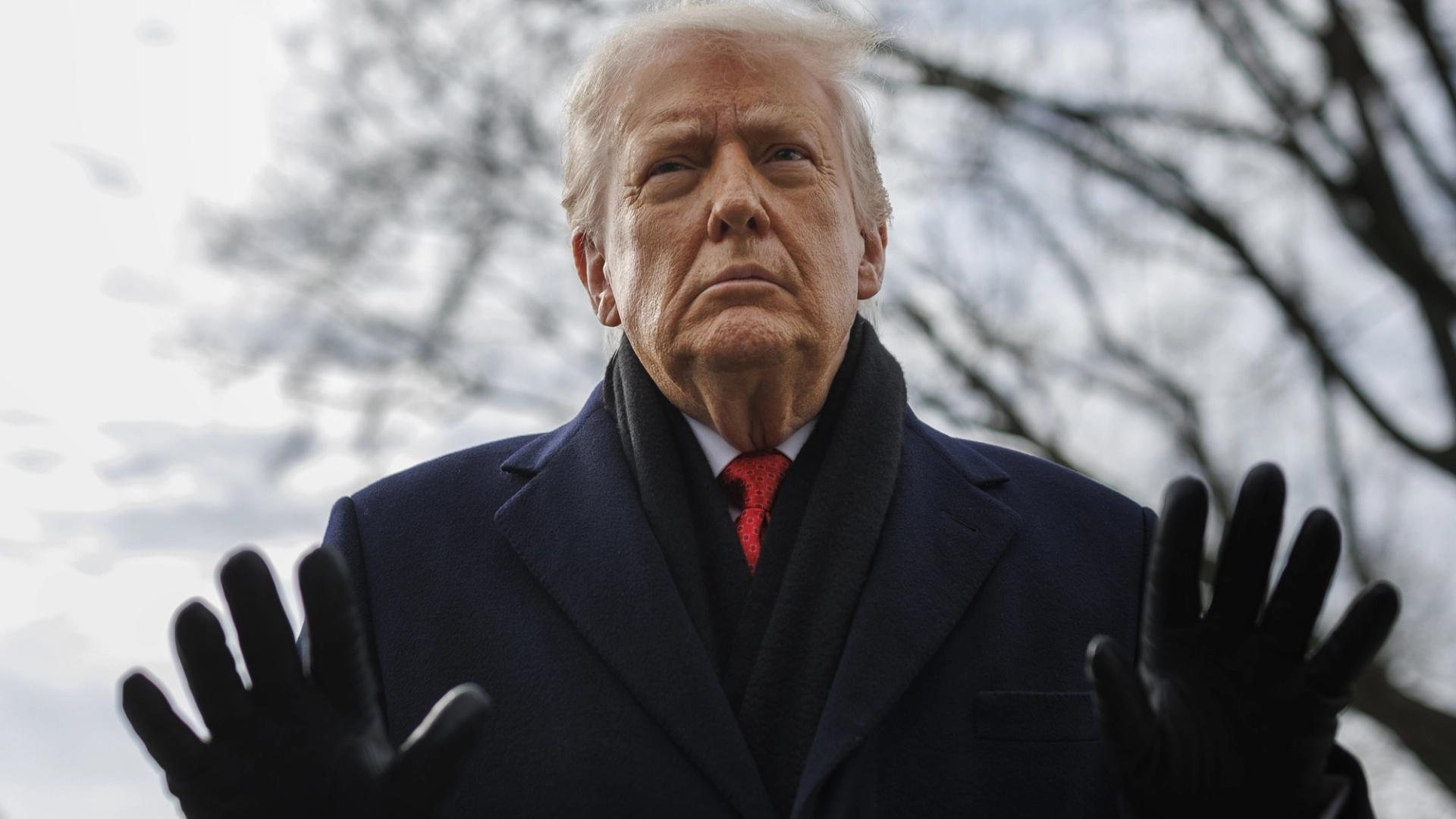
Asian stocks posted their best day in months and S&P 500 futures jumped after the president said he would address the nation Wednesday night with an “important update” on Iran. Oil pared losses as the UAE reportedly prepares to help reopen the Strait of Hormuz by force.
Bitcoin traded at $67,950 on Tuesday, up 0.2% over 24 hours, as a wave of optimism over a potential end to the Iran conflict lifted risk assets across the board. Ether rose 1.6% to $2,100, its strongest daily move in weeks.
XRP gained 0.5% to $1.34, dogecoin added 0.5% to $0.09, and BNB edged up 0.4% to $616. Solana’s SOL was the notable laggard, dropping 0.7% to $83.14 and extending weekly losses to 8.7%.
The MSCI Asia Pacific Index surged 4%, its best session since the war began, with nearly 10 stocks rising for every one that fell. Asian tech jumped 6.5%, led by Samsung and SK Hynix surging more than 9% each. S&P 500 futures climbed, and the index notched its biggest single-day gain since May.
The catalyst was Trump telling reporters he expected the war to end within two to three weeks and that a deal with Iran was not a prerequisite for concluding the conflict. He announced a national address Wednesday at 9 p.m.
Eastern to provide what he called an “important update.” Iran’s president Masoud Pezeshkian told the EU Council president that Tehran has “the necessary will to end this war” but expects guarantees against future aggression.
Separately, the Wall Street Journal reported that the UAE is preparing to help the U.S. and allies reopen the Strait of Hormuz by force, which would make it the first Gulf state to enter the conflict as a combatant. Brent crude edged back above $105 after Tuesday’s decline.
The crypto market’s reaction was muted relative to equities, a pattern that has held for weeks. Bitcoin has spent the entire war grinding between $65,000 and $73,000 while equities swing violently on each headline. The gap between crypto’s sideways range and the stock market’s correction-level drawdown remains the most notable divergence in the cross-asset picture.
There were reasons for cautious optimism beyond geopolitics. Morgan Stanley received approval for a bitcoin ETF charging just 14 basis points, 11 below the category average. The product opens access to Morgan Stanley’s 16,000 financial advisors managing $6.2 trillion, a channel that has not previously had direct bitcoin ETF exposure.
Alex Blume, CEO of Two Prime, pointed to three catalysts that could drive bitcoin higher in Q2 — the Morgan Stanley ETF, continued success of Strategy’s STRC preferred equity product in funding bitcoin purchases, and a swift resolution to the Iran war.
“A lot of market uncertainty could be resolved soon,” Blume said in an email to CoinDesk. “Coupled with new buying power, a strong Q2 may be ahead.”
Gold advanced for a fourth straight day to near $4,700, though its nearly 12% decline in March was its worst monthly performance since October 2008. The precious metal’s ongoing weakness during an active war continues to break historical precedent.
Whether Trump’s Wednesday address produces an actual off-ramp or just another headline in a month that’s been full of them will determine if this rally holds. As one analyst put it, “I’m not convinced over the longer term. Investors will soon want concrete evidence that the end of the war is in sight.”
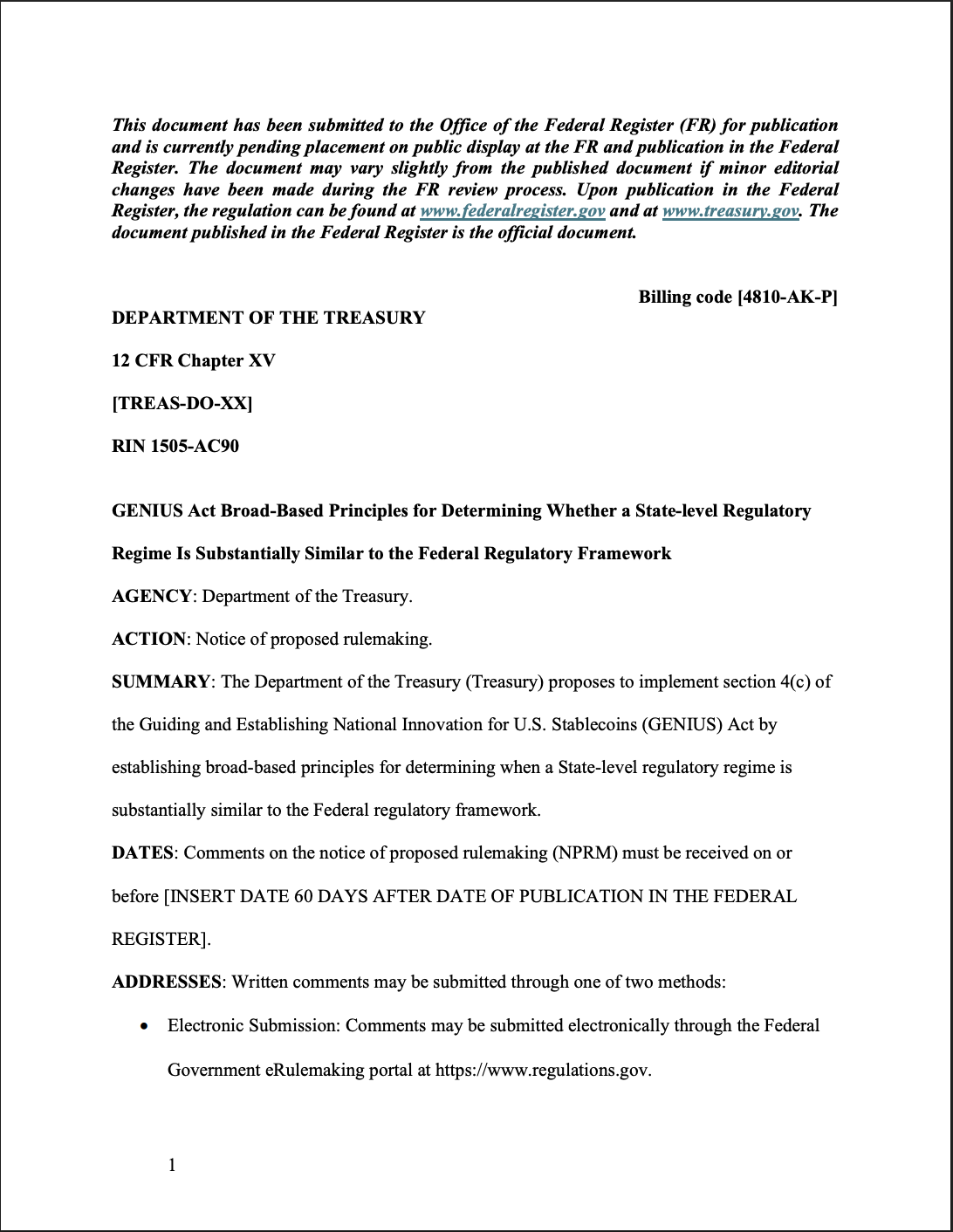
The US Department of the Treasury issued a notice of proposed rulemaking (NPRM) on Wednesday and is seeking public comment on proposed regulations for state-level stablecoin governance frameworks under the GENIUS Act.
The GENIUS stablecoin regulatory framework, also known as the “Guiding and Establishing National Innovation for US Stablecoins Act,” gives states the authority to regulate stablecoins with a market cap of less than $10 billion, as long as the regulations do not deviate significantly from federal policies.
The Treasury outlined several non-negotiable stablecoin regulations that must be in line with Federal regulations, including a 1:1 reserve backing with cash or high-quality cash equivalents and monthly reporting requirements.

States must also comply fully with federal anti-money laundering and sanctions policies for stablecoins, while upholding bans on token rehypothication, or using the same asset to support multiple claims.
Under the proposal, states are allowed to impose their own liquidity, reserve, risk management, regulatory procedures, enforcement and administrative rules, as long as the rules impose higher financial thresholds or are more restrictive than the federal regulations.
“State-level regulatory regimes must lead to regulatory outcomes that are at least as stringent and protective as the Federal regulatory framework,” the proposal said.
The public must submit comments within 60 days of the NPRM announcement. Once a stablecoin issuer passes the $10 billion threshold, it will automatically be under the regulatory jurisdiction of the federal government, meaning the largest stablecoin issuers will be regulated exclusively at the federal level.
Related: FSB flags dollar stablecoins as bigger risk for emerging markets in annual report
GENIUS Act becomes law, but uncertainty remains over yield-bearing stablecoins
US President Donald Trump signed the GENIUS Act into law in July, which was considered a landmark moment for crypto regulations.
Despite the landmark regulations, uncertainty about yield-bearing stablecoins and whether stablecoin issuers can share interest with token holders has stalled the CLARITY crypto market structure bill in Congress.
Some crypto companies, led by Coinbase, argue that yield-bearing stablecoins provide savers with a competitive alternative to traditional savings accounts, which typically have interest rates far below 1%.
The banking lobby continues to oppose yield-bearing stablecoins over fears that the tokens will cause deposit flight and erode the sector’s market share.
Magazine: GENIUS Act reopens the door for a Meta stablecoin, but will it work?
Crypto World
Caltech researchers project functional quantum computer feasible by 2030 with 10,000-20,000 qubits: Caltech


Caltech researchers estimate a working quantum computer could be operational before 2030 using far fewer qubits than previously thought, as crypto industry assesses vulnerability exposure.


Summary
- EthCC 2026 attendees reported noticeably fewer women at this year’s conference in Cannes, with industry participants linking the decline to market‑driven job cuts in marketing, PR and events roles
- Crypto recruiter PlexusRS says women still account for under 8% of crypto hires despite a 137% jump in female placements last year, underscoring how fragile recent diversity gains remain when markets turn.
- Broader corporate layoffs tied to artificial intelligence and cost‑cutting have hit non‑technical roles hardest across finance and technology, a pattern echoed in recent coverage by the Financial Times and Fortune.
Women’s visibility at Europe’s flagship Ethereum (ETH) conference appears to have taken a step backwards this year, as EthCC 2026 attendees in Cannes reported a marked drop in female participation just as crypto companies accelerate layoffs in marketing, PR and events. “There are less women this year because when the market turns the first jobs to get tinned are those where the female concentration is highest (events, marketing, PR),” wrote Sarah Akwisombe, a growth and community specialist, in a widely shared post from the conference, pointing readers to the Plexus “state of crypto hiring” report for further context. Other women in attendance echoed the sentiment on X, with user @ZoeCatherineF responding that they were “always the first to be binned – only the ‘essentials’ do the BD trips,” while another attendee, @Angel__Lou, said she had “definitely noticed it too.”
The Plexus State of Crypto Hiring report paints a stark statistical backdrop to those anecdotes, showing that women still account for less than 8% of all crypto hires despite a 137% year‑on‑year increase in female placements into Web3 roles. That concentration is especially pronounced in non‑engineering positions like marketing, community, communications and events, precisely the categories many crypto firms have targeted for cuts during the latest downturn and in response to structural shifts such as AI adoption. Research compiled by Plexus, based on more than 900 vacancies and over 300 hiring processes, concludes that while headline diversity metrics in crypto have improved, “the jobs market for women in Web3 remains disproportionately exposed to cyclical hiring freezes and non‑technical layoffs.”
The pattern emerging in crypto mirrors broader labour‑market pressures in technology and finance, where softer growth, rising rates and aggressive AI investments have combined to squeeze non‑technical roles. In March, Crypto.com announced plans to cut around 12% of its workforce, telling Bloomberg that it was integrating AI “across its business” and could therefore reduce headcount, in one of the latest examples of digital‑asset firms trimming staff outside core engineering and trading functions. A recent survey cited by Fortune found that 66% of large‑company CEOs plan to freeze or cut hiring through 2026 after more than 1.17 million jobs were eliminated in 2025, with labour‑market data showing a 30% drop in entry‑level listings and a 42% drop in middle‑management postings since 2022.
FT columnist Sarah O’Connor, who covers the world of work, has argued that such cuts often land first in “softer” functions like HR, marketing and communications, roles that tend to have higher female representation across industries. That dynamic appears to be playing out in crypto as well, compounding longstanding diversity gaps just as the market’s attention turns back to institutional adoption, regulation and infrastructure at events such as EthCC.
For women on the ground in Cannes, the impact is immediately visible. Akwisombe’s thread, posted from her @SarahAkwisombe account and tagged with @PlexusRS, noted that the roles most exposed to cuts are also those that had historically offered a pathway into crypto for people without a technical background. “The best events are always run by @lo_tech and I won’t hear otherwise,” she added in a follow‑up post, highlighting the outsized role women have played in shaping the social and cultural fabric of Ethereum conferences even as their headcount shrinks.
Industry data suggests the stakes extend beyond this year’s conference optics. CoinLaw’s 2026 employment statistics report that 28% of women in blockchain say they have experienced harassment or discrimination, while 60% of women in fintech have left jobs due to a lack of diversity. Combined with the cyclical vulnerability of non‑technical roles, those pressures risk entrenching a two‑tier crypto labour market in which engineering teams slowly diversify on paper even as women’s presence in public‑facing roles diminishes when markets tighten.

Prunes: The Dried Fruit That Can Boost Your Health In Older Life

Praggnanandhaa loses to Sindarov, slips to third in Candidates Tournament | Other Sports News

Apple expands iOS 18 updates to more iPhones to block DarkSword attacks

Smart energy pays enters the US market, targeting scalable financial infrastructure

Why Israel is blocking foreign journalists from entering

Bitcoin: We’re Entering The Most Dangerous Phase

WHITE HOUSE CRYPTO CZAR DAVID SACKS IS OUT! CRYPTO IN 401KS NEARS & COINBASE BITCOIN MORTGAGES!

Dr. Fazeela Breaks Silence On Financial Allegations #hamzaaliabbasi #nadiakhan #laundering | EB3Q

Brad Garlinghouse Just Made a Huge XRP Announcement. (This is massive)
-

 News Videos7 days ago
Parliament publishes latest register of MPs’ financial interests
-

 Business6 days ago
Instagram, YouTube Found Responsible for Teen’s Mental Health Struggle in Historic Ruling
-
 Tech6 days ago
Intercom’s new post-trained Fin Apex 1.0 beats GPT-5.4 and Claude Sonnet 4.6 at customer service resolutions
-

 NewsBeat5 days ago
The Story hosts event on Durham’s historic registers
-

 Sports5 days ago
Sweet Sixteen Game Thread: Tide vs Michigan
-
Entertainment2 days ago
Fans slam 'heartbreaking' Barbie Dream Fest convention debacle with 'cardboard cutout' experience
-
 Entertainment4 days ago
Lana Del Rey Celebrates Her Husband’s 51st Birthday In New Post
-
Crypto World1 day ago
Dems press CFTC, ethics board on prediction-market insider trades
-

 Sports1 day ago
Tallest college basketball player ever, standing at 7-foot-9, entering transfer portal
-

 Tech3 days ago
The Pixel 10a doesn’t have a camera bump, and it’s great
-

 Crypto World2 hours ago
Gold Price Prediction: Worst Month in 17 Years fo Save Haven Rock
-

 Tech2 days ago
EE TV is using AI to help you find something to watch
-

 Entertainment7 days ago
HBO’s Harry Potter Series Will Definitely Fail For One Big Reason, And It’s Not J.K. Rowling Or Snape
-

 Tech2 days ago
Apple will hide your email address from apps and websites, but not cops
-

 Tech2 days ago
Flipsnack and the shift toward motion-first business content with living visuals
-

 Fashion6 days ago
En Vogue in Brown Leather and Tailored Neutrals by Atelier Savoir, Styled by J Bolin
-

 Politics2 days ago
Should Trump Be Scared Strait?
-

 Tech2 days ago
How to back up your iPhone & iPad to your Mac before something goes wrong
-

 Crypto World2 days ago
U.S. rule change may open trillions in 401(k) funds to crypto
-

 Fashion5 days ago
Weekly News Update, 3.27.26 – Corporette.com
You must be logged in to post a comment Login