
Crypto World
Crypto leaked by South Korean tax officials stolen a second time



A stash of crypto worth almost $5 million that was stolen after South Korean tax authorities mistakenly leaked its seed phrase has been stolen for a second time after the original thief handed it back.
The country’s National Tax Service accidentally shared a photo of the 24-word seed phrase in a press release last month. The corresponding wallet contained $4.8 million worth of a crypto called pre-retogeum (PRTG) which was stolen shortly afterwards.
This thief reportedly submitted a confession to the police on March 28 and was arrested two days later. The thief claimed they “stole the cryptocurrency out of curiosity but then returned it.”
However, officials at a police press briefing this week revealed that they’re now tracking a second thief who stole the crypto again after it was returned.
“We will investigate the additional theft as we continue to investigate the previous suspect who confessed,” police said.
According to local reports, the police haven’t identified the second thief and haven’t clarified if they’re the original owner of the cryptocurrency, who was under investigation for tax evasion.
The stolen PRTG is believed to be almost unsellable due to the token’s unpopularity.
South Korea busy dealing with crypto crime
In another odd turn of events in South Korea, a legally “dead” man apparently returned to repay victims who fell for a crypto investment scheme.
The man fled to Cambodia in 2019 after orchestrating a crypto fraud and was deported back to South Korea this January. When he fled, a “declaration of disappearance” was issued, which classified him as legally dead.
This was challenged in courts, and $60,000 worth of frozen funds have since been returned to victims.
Read more: Game developer Sillytuna reports losing $24M of crypto in UK ‘wrench’ attack
Elsewhere, a police officer in charge of crypto investigations has been jailed for six years after accepting $82,000 worth of bribes to cover up a coin consignment fraud investigation.
Another man was handed over to South Korea’s prosecution after he allegedly extorted $25,000 worth of crypto from women who wanted him to take down personal photos from his “Joo-club” Instagram account.
Got a tip? Send us an email securely via Protos Leaks. For more informed news and investigations, follow us on X, Bluesky, and Google News, or subscribe to our YouTube channel.

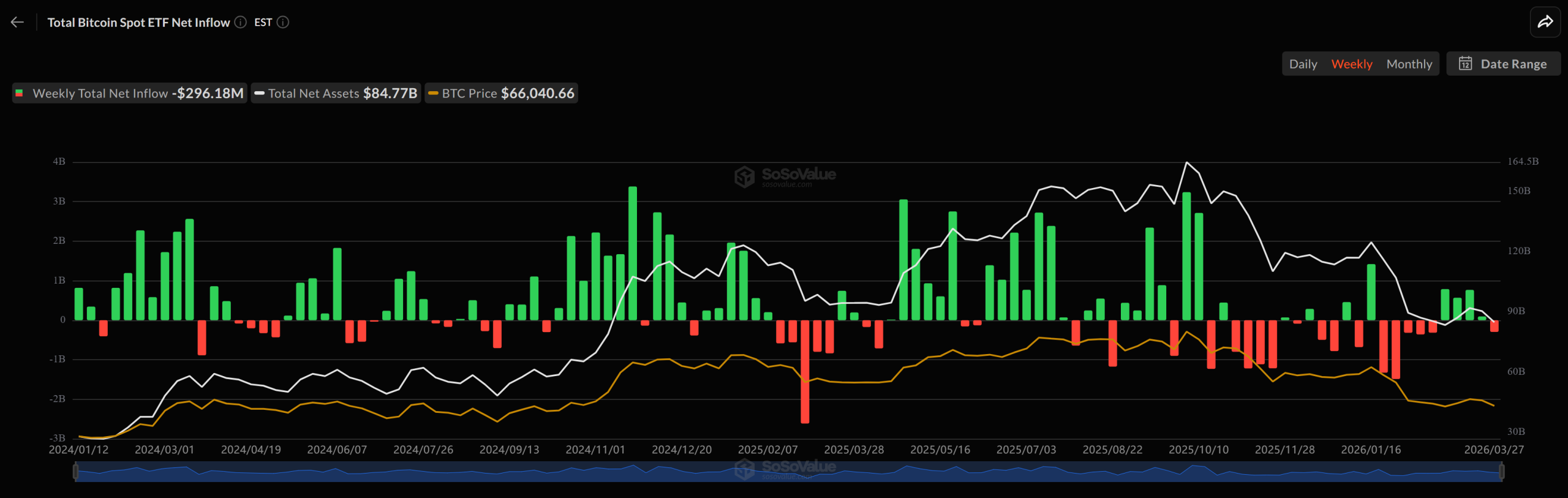
Spot Bitcoin exchange-traded funds (ETFs) snapped a four-week inflow streak, posting $296.18 million in net outflows for the week ending Friday.
The reversal follows a sustained run of inflows totaling more than $2.2 billion across four consecutive weeks, including $787.31 million, $568.45 million and $767.33 million in early March, before slowing to $95.18 million in the prior week, according to SoSoValue data.
The weekly outflow followed back-to-back daily withdrawals on Thursday and Friday totaling more than $396 million, including a $225.48 million outflow on Friday alone, their biggest day of redemptions since March 3, when they posted $348 million in outflows.

Notably, cumulative net inflows into spot Bitcoin (BTC) ETFs stand at $55.93 billion, while total net assets have slipped to $84.77 billion from over $90 billion a week earlier. Trading activity also moderated, with weekly volume falling to $14.26 billion from $25.87 billion earlier in March.
Related: Morgan Stanley sets 0.14% Bitcoin ETF fee, lowest in market if approved
Macro calm masks deeper risks
In a statement shared with Cointelegraph, a Bitunix analyst said the current macro backdrop is defined by “surface stability, internal imbalance,” as geopolitical risks remain unresolved while policymakers attempt to maintain outward calm. Developments such as the US–EU trade agreement and delayed tensions in the Middle East have temporarily eased market stress, but underlying risks remain.
In this environment, Bitcoin is behaving less like a breakout asset and more like a reflection of liquidity conditions, the analyst said. The asset remains range-bound between $65,000 and $72,000, with signs of demand absorption but limited follow-through on upside attempts.
“Capital is not exiting the market, but neither is it willing to take directional risk,” the analyst said, adding that price action is likely to remain volatile within established ranges until macro conditions align for a clearer trend.
Related: Morgan Stanley files amended S-1 for MSBT Bitcoin ETF
Ethereum ETFs extend outflow streak
Meanwhile, spot Ether (ETH) ETFs recorded $206.58 million in weekly outflows, marking a second consecutive week of losses and reversing the modest inflow streak seen earlier in March.
Daily data shows consistent outflows throughout the week. Funds saw withdrawals every trading day since March 18. The largest single-day outflow came on Thursday at $92.54 million, followed by $48.54 million on Friday.
Magazine: Bitcoin’s ‘biggest bull catalyst’ would be Saylor’s liquidation — Santiment founder


Ripple CEO Brad Garlinghouse said stablecoins may become the main way businesses enter the crypto sector as companies seek faster payment tools.
Summary
- Garlinghouse said CFOs and treasurers are weighing stablecoins for faster business payments and treasury use.
- Bloomberg Intelligence projected stablecoin flows could reach $56.6 trillion by 2030, supporting broader payment adoption.
- Ripple’s RLUSD ranks tenth by market cap as the company expands infrastructure through major acquisitions.
He told FOX Business that more boards, treasurers, and chief financial officers are now asking how stablecoins could fit into company operations.
Garlinghouse said stablecoins could become crypto’s “ChatGPT moment” for businesses. He said the main shift would come when company finance teams gain a direct option to use stablecoins for payments and treasury activity.
He said many firms are already discussing that move at the executive level. According to his remarks, companies from the Fortune 500 and Fortune 2000 are asking internal finance leaders what role stablecoins should play in their plans.
Bloomberg Intelligence said in early January that stablecoin flows could grow at a compound annual rate of 80% and reach $56.6 trillion by 2030. That forecast has added to the view that stablecoins may take a larger role in global payments.
Garlinghouse also said stablecoins processed more than $33 trillion in trading volume last year. He added that almost 90% of that volume came from Tether’s USDT and Circle’s USDC, which still hold the largest share of the market.
In addition, Ripple entered the market with Ripple USD, or RLUSD, in December 2024. CoinGecko data shows RLUSD is now the 10th largest stablecoin by market value, with a market capitalization of about $1.4 billion.
Ripple also expanded its payments and treasury infrastructure through acquisitions. The company bought institutional prime brokerage Hidden Road for $1.25 billion and corporate treasury platform GTreasury for $1 billion, adding more tools for business-focused blockchain services.
Regulation remains part of the strategy
Garlinghouse said U.S. regulation will play a major role in how quickly stablecoin payments expand. He said the CLARITY Act could help speed up adoption if Congress passes the bill and the president signs it into law.
He also said many market participants are watching the United States closely for clearer rules. In the interview, Garlinghouse said, “A lot of eyes are on what is US regulation going to look like and is it going to get done,” while also criticizing past regulatory approaches under former SEC Chair Gary Gensler.

Key Takeaways
- Brad Garlinghouse, Ripple’s CEO, described stablecoins as creating a “ChatGPT moment” for corporate cryptocurrency integration
- Transaction volumes for stablecoins exceeded $33 trillion in 2025, with Tether and Circle dominating the market
- Industry analysts at Bloomberg forecast stablecoin transaction flows will surge to $56.6 trillion by decade’s end
- RLUSD, Ripple’s proprietary stablecoin introduced in December 2024, currently holds a $1.4 billion valuation
- The proposed CLARITY Act could accelerate mainstream acceptance of stablecoins and distributed ledger technology, according to Garlinghouse
Brad Garlinghouse, CEO of Ripple, believes stablecoins are positioned to serve as the primary gateway for enterprise adoption of cryptocurrency — drawing a parallel to how ChatGPT catalyzed artificial intelligence adoption.
During a Friday conversation with FOX Business, Garlinghouse revealed that executive leadership at major corporations, including Fortune 500 and Fortune 2000 entities, are now actively pressing their chief financial officers and treasury departments about stablecoin strategies.
“Empowering the treasury and CFO with this capability represents the breakthrough we’ve been waiting for,” Garlinghouse explained.
He characterized this development as cryptocurrency’s “ChatGPT moment” — a pivotal juncture where enterprises move beyond theoretical discussions about blockchain technology and begin implementing it in practice.
Stablecoin transaction activity surpassed $33 trillion throughout 2025. While that figure appears substantial, approximately 90% originated from just two dominant players: Tether and Circle’s USDC token.
Bloomberg Intelligence analysts anticipate rapid expansion ahead. Their models suggest stablecoin transaction flows could expand at an 80% compound annual growth rate, potentially hitting $56.6 trillion by the end of the decade.
Ripple Enters the Stablecoin Arena
Ripple has moved beyond commentary to active participation in the stablecoin ecosystem — the company unveiled Ripple USD (RLUSD) in December 2024.
RLUSD currently ranks as the 10th largest stablecoin measured by market capitalization, with a valuation of $1.4 billion based on CoinGecko data.
Ripple has simultaneously strengthened its payment processing capabilities. The firm acquired Hidden Road, a prime brokerage serving institutional clients, in a $1.25 billion transaction.
Additionally, Ripple purchased GTreasury, a corporate treasury management platform, for $1 billion. Both acquisitions concluded during the previous year.
Garlinghouse reported that Ripple is tracking toward a “record quarter” and has experienced tremendous momentum following the completion of these strategic purchases.
Legislative Framework Will Determine Adoption Speed
Garlinghouse highlighted the CLARITY Act as critical legislation that could significantly accelerate stablecoin integration throughout the United States.
He emphasized the importance of regulatory clarity and expressed concerns about previous enforcement strategies implemented under former SEC Chairman Gary Gensler.
“We must prevent another situation where policy becomes weaponized for political purposes rather than serving America’s best interests,” Garlinghouse stated.
He noted that industry stakeholders are closely monitoring the evolution of US cryptocurrency regulation and whether comprehensive frameworks will be enacted.
While Ripple’s RLUSD maintains a $1.4 billion market capitalization — positioning it below Tether and USDC — it remains firmly established among the ten largest stablecoins worldwide.
Regulatory Environment and Industry Projections
The stablecoin industry facilitated over $33 trillion in transactions during 2025, and Bloomberg’s forecast of $56.6 trillion by 2030 would establish it as a dominant force in international payment systems.
Garlinghouse’s remarks arrive as Ripple broadens its presence in institutional payment solutions, supported by $2.25 billion in strategic acquisitions completed last year.

TLDR:
- Gold dropped over 17% from its all-time high above $5,300 reached at the end of January 2025.
- Binance recorded $6.6B in single-day gold futures trading volume as prices neared $4,400 on March 23.
- Weekly gold futures volume on Binance surpassed $17B, setting a record since its January launch date.
- Binance has logged over $72B in total gold futures volume in just three months since the product launched.
Gold has recorded a drawdown of over 17% from its all-time high above $5,300, reached in late January. This correction unfolded against a backdrop of intensifying geopolitical tensions and renewed inflation concerns.
Despite the sharp pullback, Binance reported record weekly gold futures trading volume of $17 billion. The decline triggered widespread margin calls and forced liquidations across leveraged positions.
Trading activity during this period reflects growing demand for tokenized gold exposure within the crypto ecosystem.
Gold’s Sharp Pullback Reflects Months of Leveraged Positioning
Since 2024, gold had delivered a return of roughly 160%, drawing large amounts of capital into the market. That sustained performance attracted both institutional and retail investors seeking a macro hedge.
As the rally extended, many traders built leveraged positions to maximize their exposure to the move.
When the price began to decline, those leveraged positions came under immediate pressure. Margin calls followed, forcing a wave of liquidations across the market. This type of cascading sell-off is a common outcome after extended, leverage-heavy rallies.
Beyond forced liquidations, a number of investors chose to exit positions voluntarily. Some moved to lock in gains accumulated during the long bull run.
Others reportedly used the proceeds to cover losses in equity or currency markets facing simultaneous pressure.
The price approached $4,400 on March 23, marking one of the sharpest moments in the drawdown. That level drew close attention from traders monitoring the correction. The pullback followed a period of outsized gains that had made the market susceptible to a reversal.
Binance Records All-Time High Gold Futures Volume During the Correction
As crypto analyst @Darkfost_Coc reported, Binance trading volumes surged to over $6.6 billion in a single day. This occurred as gold approached $4,400 on March 23.
The seven-day cumulative volume also crossed $17 billion over the same period. Both figures represent records since Binance launched its gold futures product in January.
Looking at the broader picture, Binance recorded over $72 billion in total gold futures volume across just three months.
That total reflects the level of engagement from crypto-native traders with gold as a tradable asset class. The pace of activity points to real and sustained demand for tokenized commodity exposure.
Binance introduced its gold futures to extend access to an asset class that crypto traders previously had limited reach to. The product addressed demand from investors who had primarily operated within the crypto ecosystem.
Gold, as a well-established macro asset, provided a familiar anchor for those navigating uncertain market conditions.
The record volumes recorded during the decline show that traders remained active even as prices fell. Engagement on the platform stayed high throughout the correction.
The data confirms that Binance has successfully addressed a gap in access to gold for the crypto-native investor base.
TLDR:
- Bitcoin STH inflows have fallen to their lowest recorded level of 25,000 BTC.
- Panic-driven selling by short-term holders has declined fourfold since February.
- Reduced STH inflows ease immediate selling pressure on Bitcoin exchanges.
- Bitcoin is in a consolidation phase after dropping more than 50% from its ATH.
Bitcoin STH inflows have dropped significantly, indicating calmer behavior among short-term holders. After Bitcoin fell below $60,000, panic selling pushed around 100,000 BTC to Binance in early February.
Since then, inflows from short-term holders have declined steadily, reaching roughly 25,000 BTC. This reduction suggests that the market is experiencing lower selling pressure, while Bitcoin navigates a consolidation phase following a steep correction.
Short-Term Holders Reduce Exchange Transfers
Bitcoin STH inflows were at a peak in early February when short-term holders moved large amounts to exchanges. Cryptoquant analyst Darkfost highlighted this in his analysis, noting the previous seven-day total of nearly 100,000 BTC to Binance.
Panic selling dominated this period, particularly among younger investors who are highly reactive to price fluctuations.
The trend has changed as inflows have now decreased by four times. Current seven-day transfers from short-term holders are around 25,000 BTC, the lowest recorded level. This shift reflects a stabilization in investor behavior as market volatility begins to ease.
Reduced STH inflows mean less BTC is available for immediate selling on exchanges. Consequently, short-term selling pressure has diminished.
The market is now experiencing calmer conditions, which support a more balanced environment for Bitcoin.
Market Consolidation Continues Amid Stability
Bitcoin is currently in a consolidation phase following a drop of more than 50% from its last all-time high. Such phases are common after large and rapid devaluations. The decline in STH inflows complements this stabilization by reducing short-term market reactions.
Short-term holders, known for their sensitivity, are transferring less BTC to exchanges. This behavior indicates a slower pace of reactive selling.
Analysts note that this adjustment helps maintain steadier market conditions amid ongoing economic and geopolitical challenges.
Lower selling activity aligns with reduced volatility and contributes to market equilibrium. Exchanges see fewer panic-driven transactions, allowing prices to find a more consistent range. While Bitcoin faces external pressures, STH activity suggests a measured response rather than abrupt reactions.
This pattern illustrates how the market adapts after rapid declines. The decreased movement of coins from short-term holders signals patience and a reduction in immediate supply pressure. The consolidation phase, combined with lower inflows, reflects a more orderly market environment.
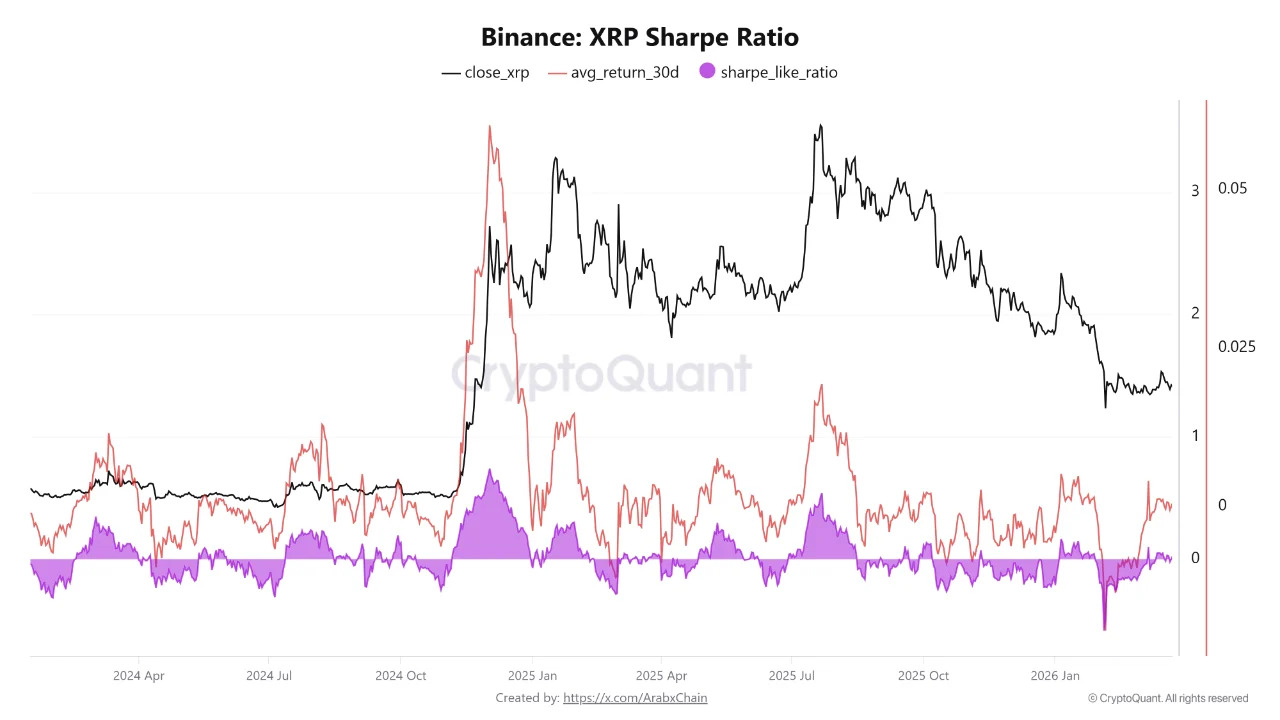
The Sharpe Ratio for XRP (XRP), a measure of return per unit of risk, turned slightly positive on March 26, after spending months near or below zero between October 2024 and February 2025.
A 30-day average return of 0.00063 supports this positive shift, while the Sharpe ratio stands at 0.0267, which reflects that the “current returns still exceed risk”.
Onchain data indicates that whales have steadily accumulated XRP over the past month, pointing to demand despite the weak price action.
XRP risk-adjusted returns hint at limited long-term downside
Crypto analyst Arab Chain noted that the recent improvement in the Sharpe Ratio aligns with a pickup in trading activity, pointing to better returns for XRP holders in the long-term. The analyst explained that the ratio indicates a gradual positive rebalancing, which may limit further downside for the altcoin. Yet, the analyst added,
“If the indicator falls back into negative territory, it could signal a return of volatility and weakening momentum.”

Reinforcing the positive narrative, XRP whale flows have climbed to a 30-day moving average of $9 million per day. The positive flows have held since Feb. 27, marking the longest accumulation phase since April to July 2025.
The last accumulation phase in Q2 2025 led to XRP’s expansion rally to its all-time high of $3.65 on July 18, 2025.

The combination of a positive Sharpe Ratio reading and steady whale inflows points to an improving sentiment alongside accumulation. The gains are minimal, with the volatility relatively stable. This alignment places focus on whether the whale inflows may continue to support consistent returns over time.
Related: XRP price risks 50% drop despite Goldman Sachs’ $152M ETF exposure
XRP open interest rises with fragile positioning
Crypto analyst Amr Taha noted that the 24-hour open interest change reached 14.8% on March 26, its highest level since March 4, indicating renewed trader participation. This rise in activity also coincides with repeated long-side pressure, with liquidation events above $2.5 million on March 18, followed by similar spikes of $2.45 million on March 21 and $2.15 on March 26.

These moves show that aggressive long positioning is still being cleared during the short-term volatility. Thus, while the futures activity has risen, the frequent liquidation signals create an unstable market, where traders are exposed to continuous resets.
The technical structure points to a clear bearish bias. XRP has invalidated its bullish ascending triangle pattern, declining 13.63% over the past 10 days. If the current market structure persists, the altcoin could retest support levels near internal liquidity at $1.27 and yearly lows at $1.11 in the coming weeks.

Related: Bittensor’s TAO price may plunge 40% within five weeks: Fractal data
This article does not contain investment advice or recommendations. Every investment and trading move involves risk, and readers should conduct their own research when making a decision. While we strive to provide accurate and timely information, Cointelegraph does not guarantee the accuracy, completeness, or reliability of any information in this article. This article may contain forward-looking statements that are subject to risks and uncertainties. Cointelegraph will not be liable for any loss or damage arising from your reliance on this information.

U.S. Senator Cynthia Lummis has sharpened her defense of the Digital Asset Market Clarity Act (CLARITY), arguing that Title 3 would deliver the strongest protections yet for DeFi developers and non-custodial innovators. In recent remarks, she contended that bipartisan changes to the bill would fortify safeguards for DeFi insiders and urged lawmakers to advance CLARITY in order to unlock these protections under the BRCA framework.
The comments come as crypto-savvy lawyer Jake Chervinsky challenged the bill’s current design, arguing that Title 3 could undermine protections by imposing Know-Your-Customer obligations on non-custodial software developers. Lummis responded by asserting that the ongoing revisions to Title 3 are aimed at strengthening DeFi defenses, while noting that the latest draft text has not yet been released publicly.
“Don’t believe the FUD,” Lummis wrote in a Friday posting, adding, “We have worked on a bipartisan basis for the last few weeks to make changes to Title 3 that make this bill the strongest protection for DeFi and developers ever enacted. We have to pass the Clarity Act to get these protections.”
The precise revisions to CLARITY—described by Lummis as a path to stronger, clearer protections for DeFi—have not been published, leaving observers to await the official language.
“Don’t believe the FUD. We have worked on a bipartisan basis for the last few weeks to make changes to Title 3 that make this bill the strongest protection for DeFi and developers ever enacted. We have to pass the Clarity Act to get these protections.”
Chervinsky has emphasized that DeFi protections in Title 3 have been overshadowed by attention to stablecoin-related provisions within CLARITY. His central concern is that the bill’s money transmitter definitions could still place many non-custodial DeFi builders at risk of liability, even as the BRCA’s Section 604 language clarifies that non-controlling developers and providers of non-custodial software should not be treated as financial institutions subject to Bank Secrecy Act KYC obligations.
The broader legal landscape isn’t lost on industry figures. The contrast between intent and enforcement risk is shaping the debate around what forms DeFi protection should take—whether liability shields should hinge on code architecture, custodial status, or the nature of on-chain activity.
The debate arrives amid a climate of high-profile regulatory pushback. In recent months, prosecutors have pursued crypto developers and platforms with renewed vigor, including the Tornado Cash case, where Roman Storm was convicted in August 2025 of conspiracy to operate an unlicensed money transmitting business. The outcome has underscored the urgency for clear, workable safeguards for builders who contribute to open-source or non-custodial tooling.
Legislative momentum around CLARITY appears to be advancing in tandem with broader efforts on stablecoins. U.S. lawmakers have signaled that CLARITY’s passage would be instrumental in delivering BRCA-backed protections for DeFi developers, with a Senate Banking Committee markup anticipated in April after progress on the stablecoin rewards provisions. The absence of publicly released text notwithstanding, supporters argue that the package’s architecture is designed to distinguish non-custodial code from regulated financial activity, reducing ambiguity for developers and users alike.
As the clock ticks toward committee consideration, investors and builders will be watching closely how Title 3 evolves and whether the revisions address non-custodial liability concerns without undermining legitimate regulatory aims. The next updates from Congress will determine not only the fate of CLARITY but also the practical implications for DeFi development, funding, and broader market adoption.
Readers should stay tuned for the formal release of the revised draft and subsequent committee milestones, as the balance between protection and compliance continues to shape the trajectory of DeFi regulation in the United States.
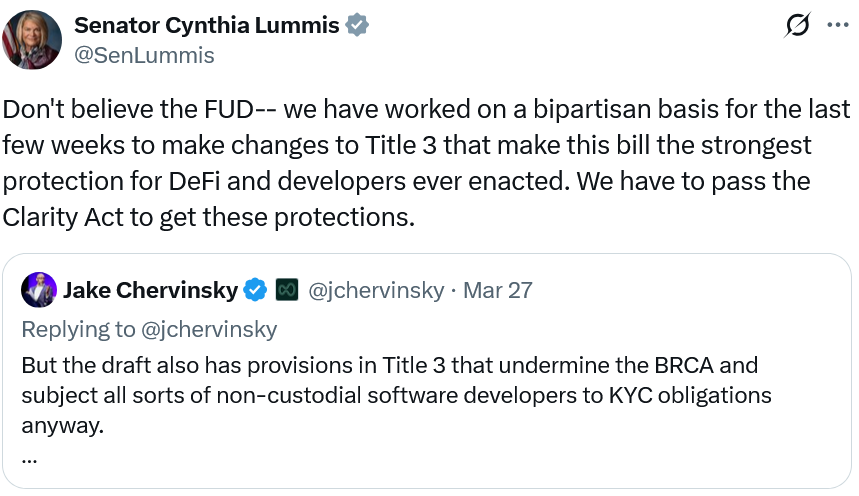
US Senator Cynthia Lummis has dismissed claims that the Digital Asset Market Clarity Act fails to protect decentralized finance innovators from legal repercussions, rebutting that recent changes to the draft will make it the “strongest protection for DeFi and developers ever enacted.”
Her comments on Friday came in direct response to crypto lawyer Jake Chervinsky, who argued that Title 3 of the current draft undermines the Blockchain Regulatory Certainty Act — another crypto bill focused on developer protections — by subjecting non-custodial software developers to know-your-customer obligations.
“Don’t believe the FUD,” Lummis said, adding, “We have worked on a bipartisan basis for the last few weeks to make changes to Title 3 that make this bill the strongest protection for DeFi and developers ever enacted. We have to pass the Clarity Act to get these protections.”
The latest changes to the CLARITY Act have not been publicly released.

Chervinsky said these DeFi protection provisions have been overshadowed by intense focus on stablecoin rewards provisions in the CLARITY Act.
His biggest issue with the Senate Banking Committee’s latest CLARITY Act draft is that Title 3’s money transmitter definitions could still expose many non-custodial DeFi builders to liability.
This is despite the CLARITY Act incorporating the BRCA in section 604, which clarifies that non-controlling developers and providers of non-custodial software are not to be treated as financial institutions subject to Bank Secrecy Act KYC obligations.
“The biggest challenge is ensuring non-custodial software developers aren’t misclassified as money transmitters,” Chervinsky argued.
“That’s non-negotiable for DeFi, and it’s still unsettled.”
His concerns come amid several high-profile prosecutions and convictions of developers in the US in recent months, including Tornado Cash co-founder, Roman Storm, who was convicted in August 2025 of conspiracy to operate an unlicensed money transmitting business.
Related: Delaware eyes stablecoin licensing framework under banking laws
US lawmakers have said the CLARITY Act is moving closer toward a Senate Banking Committee markup expected in April after recent bipartisan progress on stablecoin rewards provisions.
Passage of the CLARITY Act is necessary to ensure DeFi developers are afforded legal protections under the BRCA, Lummis noted.
Magazine: Are DeFi devs liable for the illegal activity of others on their platforms?


Ripple is overhauling how it secures the XRP Ledger, and AI is at the center of the effort.
Its engineering team outlined a new AI-driven security strategy for the XRP Ledger in a detailed post earlier this week, one that integrates machine learning tools across the protocol’s entire development lifecycle.
The strategy includes AI-assisted code scanning on every pull request, automated adversarial testing guided by threat models, and a dedicated AI-assisted red team that continuously analyzes the codebase and how features interact in real-world scenarios.
A newly-created ‘red team’ has already identified more than 10 bugs, with low-severity issues disclosed publicly so far and the remainder being prioritized and fixed. The team uses fuzzing and automated adversarial testing to simulate attacker behavior at scale, surfacing vulnerabilities earlier and with greater coverage than traditional auditing approaches.
“AI allows us to shift from reactive debugging to proactive, systematic discovery of vulnerabilities, strengthening the ledger faster and with greater confidence than ever before,” Ripple wrote.
The initiative comes as the XRPL handles an increasingly complex workload. The ledger has been operating continuously since 2012, processing over 100 million ledgers and facilitating more than 3 billion transactions.
A codebase of that age naturally reflects “design decisions made in earlier phases of the network, assumptions that held at smaller scale, and patterns that predate modern tooling.” The AI tools are designed to systematically find the edge cases and hidden failure modes that accumulate in any long-running production system.
The strategy is built across six pillars. Beyond the AI-assisted scanning and red team, Ripple is modernizing the XRPL codebase itself to address structural issues like limited type safety and inconsistent interaction patterns between features.
The company is expanding security collaboration with XRPL Commons, the XRPL Foundation, independent researchers, and validator operators. Standards for protocol amendments are being raised, with multiple independent security audits now required for significant changes alongside expanded bug bounties and adversarial testing environments.
And the next XRPL release will be dedicated entirely to bug fixes and improvements without new features, a signal that the engineering team is treating the hardening effort as a near-term priority.
The timing aligns with Ripple’s expanding institutional footprint.
The company is currently running a pilot under the Monetary Authority of Singapore’s BLOOM initiative, expanding Ripple Payments globally, pursuing an Australian financial services license, and pushing adoption of its RLUSD stablecoin.
A ledger targeting tokenized real-world assets, central bank-backed trade finance, and enterprise payment flows needs security infrastructure that scales alongside the use cases it supports.
The approach connects to a broader industry trend. Ethereum launched a dedicated post-quantum security hub this week backed by eight years of research and 10-plus client teams shipping weekly devnets. Google set a 2029 deadline for migrating its authentication services to quantum-resistant cryptography. Across both traditional tech and crypto, the emphasis is shifting from reactive patching to proactive, AI-augmented security engineering.
Meanwhile, the Ripple engineering team plans to publish security criteria for new amendments in collaboration with the XRPL Foundation and share findings transparently with the community in the coming weeks.

Ripple CEO Brad Garlinghouse framed stablecoins as the crypto sector’s potential “ChatGPT moment” for enterprise payments, arguing that faster, more efficient settlements could accelerate real-world adoption among large corporations. In an interview with FOX Business on Friday, he said boards of directors and chief financial officers at Fortune 500 and Fortune 2000 companies are already asking treasurers how stablecoins could fit into their operations, signaling a shift from experimentation to formal strategy.
Garlinghouse described the move as an “unlock” for corporate finance, arguing that giving treasurers a credible on-chain settlement option could accelerate the broader adoption of blockchain-enabled services. He suggested stablecoins could serve as an entry point to a wider ecosystem of digital-asset tools used by enterprises, beyond just payments.
Bloomberg Intelligence has projected that stablecoin payment flows could grow at roughly an 80% compound annual rate to about $56.6 trillion by 2030, underscoring the potential scale if regulation and infrastructure align with demand.
Garlinghouse also highlighted the sheer volumes already moving through stablecoins. He noted that last year stablecoins processed more than $33 trillion in trading volume, with nearly 90% of that activity coming from Tether’s USDt (USDT) and Circle’s USDC, illustrating the current concentration of liquidity in a small handful of assets.
Ripple’s foray into the stablecoin space includes RLUSD, a competitor stablecoin launched in December 2024. CoinGecko data shows RLUSD stands as the 10th-largest stablecoin by market cap, with about $1.4 billion in circulation.
Beyond stablecoins themselves, Garlinghouse highlighted Ripple’s broader push to bolster payments infrastructure through strategic acquisitions. The company bought Hidden Road, an institutional-focused prime brokerage, for $1.25 billion and GTreasury, a corporate treasury platform, for $1 billion. He said the acquisitions have helped Ripple enter a “record quarter” and that the firm has been “on a tear” since closing these deals.
Key takeaways
- Enterprises are increasingly viewing stablecoins as a payments enabler, with senior executives pressing treasurers to outline deployment plans.
- Global stablecoin trading volume last year exceeded $33 trillion, with about 90% concentrated in USDT and USDC, underscoring existing liquidity leadership.
- Ripple operates RLUSD, launched in December 2024, now ranking 10th among stablecoins by market cap at roughly $1.4 billion (per CoinGecko).
- Ripple’s acquisitions of Hidden Road ($1.25 billion) and GTreasury ($1 billion) are positioned to bolster enterprise payments and treasury management capabilities.
- Regulatory context matters: the CLARITY Act could accelerate crypto adoption if enacted, but policymakers must avoid weaponizing policy for political ends, according to Garlinghouse.
- Bloomberg Intelligence foresees stablecoin flows reaching $56.6 trillion by 2030, highlighting the potential scale of enterprise demand.
Stablecoins as a corporate catalyst
The conversation around stablecoins increasingly centers on real-world corporate utility. Garlinghouse framed the narrative around a critical shift: boards and CFOs are evaluating how stablecoins could streamline treasury operations, enable faster cross-border settlements, and unlock a broader set of blockchain-based services for their organizations. In this view, stablecoins are less about speculative trading and more about providing a practical, on-chain settlement layer that can integrate with existing financial workflows.
The enterprise lens also emphasizes risk management and liquidity considerations. Real-time settlements and improved cash visibility could reduce foreign exchange exposure and nested settlement delays that plague traditional cross-border payments. While these advantages exist in theory, they hinge on reliable rails, robust custody, compliance, and interoperability with conventional banking rails—a set of criteria Ripple has sought to address through its product suite and partnerships.
Ripple’s push to enterprise infrastructure
RLUSD represents Ripple’s commitment to building a native stablecoin option within its payments ecosystem. Launched in late 2024, RLUSD has quickly become a test case for how corporate users might leverage stablecoins to settle obligations on Ripple’s rails. According to CoinGecko, RLUSD ranks among stablecoins with a $1.4 billion market cap, placing it in the top tier of on-chain stablecoins by liquidity and size.
Concurrently, Ripple’s strategic acquisitions broaden the toolkit available to enterprises. Hidden Road provides institutional-grade prime brokerage capabilities, potentially easing access to liquidity and trading infrastructure for large clients. GTreasury, a corporate treasury management platform, adds cross-functional treasury tools, enabling better visibility and control over digital-asset holdings within corporate finance operations. Garlinghouse said these acquisitions have strengthened Ripple’s trajectory, contributing to what he described as a “record quarter.”
Taken together, the RLUSD initiative and the strengthened payments backbone position Ripple to offer a more complete enterprise solution: on-chain settlement via stablecoins, coupled with governance, liquidity, and treasury management tools designed for large organizations. For investors and users watching adoption curves, the question is how quickly these capabilities translate into tangible enterprise uptake and steady revenue streams for Ripple and its partners.
Regulatory context and market outlook
The regulatory backdrop remains a pivotal variable in the trajectory of stablecoins and enterprise crypto adoption. Garlinghouse emphasized the potential impact of market-structure legislation such as the CLARITY Act, arguing that Congress could push the sector forward if crafted with clarity and sound policy. He warned against policymakers weaponizing regulation for political ends and urged a measured approach that protects the United States’ competitive standing while fostering innovation.
The broader market context underscores why this regulatory moment matters. The ongoing debate around stablecoin disclosures, reserve standards, and liquidity requirements will influence whether corporate treasuries view stablecoins as a reliable part of their long-term liquidity strategy. As policymakers weigh risk controls and consumer protections, the ability for enterprises to adopt stablecoins at scale will hinge on clear, consistent rules and interoperable infrastructure that can withstand institutional scrutiny.
Looking ahead, the market will be watching how the CLARITY Act progresses through Congress and how Ripple, RLUSD, and related infrastructure adapt to any regulatory requirements. The combination of a strong enterprise narrative, improving payments infrastructure, and a favorable regulatory framework could accelerate corporate engagement with stablecoins, while lingering ambiguities or policy missteps could slow momentum.
Ultimately, the next phase of enterprise crypto adoption will hinge on demonstrated use cases, governance reliability, and the ability to deliver on real-world efficiency gains. For investors and builders, the key watch points are enterprise interest in RLUSD and Ripple’s broader treasury-management story, regulatory developments around stablecoins, and the degree to which large corporations actually embed stablecoins into their treasury operations and payment workflows.
As policymakers deliberate and corporates experiment, the landscape will reveal whether this era’s “ChatGPT moment” translates into durable, enterprise-grade crypto infrastructure and a measurable shift in how businesses move value across borders.
Watch for updates on CLARITY Act progress, RLUSD adoption by enterprises, and any new milestones from Ripple’s expanding payments ecosystem in the coming quarters.

Top 5 large cap mutual funds to invest in March 2026

Spot Bitcoin ETFs Break 4-Week Inflow Streak with $296M Outflows

Britney Spears Returns To Social Media After DUI Arrest


-
 NewsBeat3 days ago
Manchester United reach agreement with Casemiro over contract clause amid transfer speculation
-

 News Videos2 days ago
Parliament publishes latest register of MPs’ financial interests
-

 Crypto World6 days ago
Best Crypto to Buy Now: Strategy Just Spent $1.57 Billion on Bitcoin During Fear While Early Investors Quietly Enter Pepeto for 150x Potential
-

 Crypto World6 days ago
Bitcoin Price News: Bhutan Sells $72 Million in BTC Under Fiscal Pressure, but the Smart Money Entering Pepeto Sees What the Market Does Not
-

 Sports5 days ago
Remo Stars and Kano Pillars Strengthen Survival Hopes in NPFL
-

 Sports5 days ago
Gary Kirsten Accuses Pakistan Cricket Board Of ‘Interference’, Mohsin Naqvi Responds
-

 Business6 days ago
No Winner in March 21 Drawing as Prize Rolls to $133 Million for Next
-

 Tech5 days ago
Give Your Phone a Huge (and Free) Upgrade by Switching to Another Keyboard
-

 Tech5 days ago
AI enters the chat: New Seattle dating app relies on tech to facilitate meaningful human connections
-

 News Videos5 days ago
Ch 9 Financial Management Part 1 | Detailed One Shot | Class 12 Business Studies Boards 2026
-

 Tech6 days ago
Today’s NYT Connections Hints, Answers for March 22 #1015
-

 Business1 day ago
Instagram, YouTube Found Responsible for Teen’s Mental Health Struggle in Historic Ruling
-

 Business6 days ago
Will Duke Basketball Win It All? Duke Basketball Enters Second Round as Third Favorite to Claim NCAA Title
-

 Sports5 days ago
2026 Kentucky Derby horses, odds, futures, preview, date: Expert who hit 12 Derby-Oaks Doubles enters picks
-
 NewsBeat6 days ago
Update on Wisbech river crash as search for teenage boy enters fifth day
-

 NewsBeat10 hours ago
The Story hosts event on Durham’s historic registers
-
 Entertainment5 days ago
Cynthia Bailey Dishes on ‘RHOA’ Season 17, Discusses Kandi
-

 Tech4 days ago
Samsung will soon let you control smart home devices from your car’s dashboard
-

 Business4 days ago
More women enter wealth management, but few in advisory roles: study
-

 Fashion4 days ago
Does It Matter What You Wear When You’re Laid Off and Looking?
You must be logged in to post a comment Login