

Crypto World
Crypto Long Liquidations Hit $584 Million in 24-Hour Sell-Off

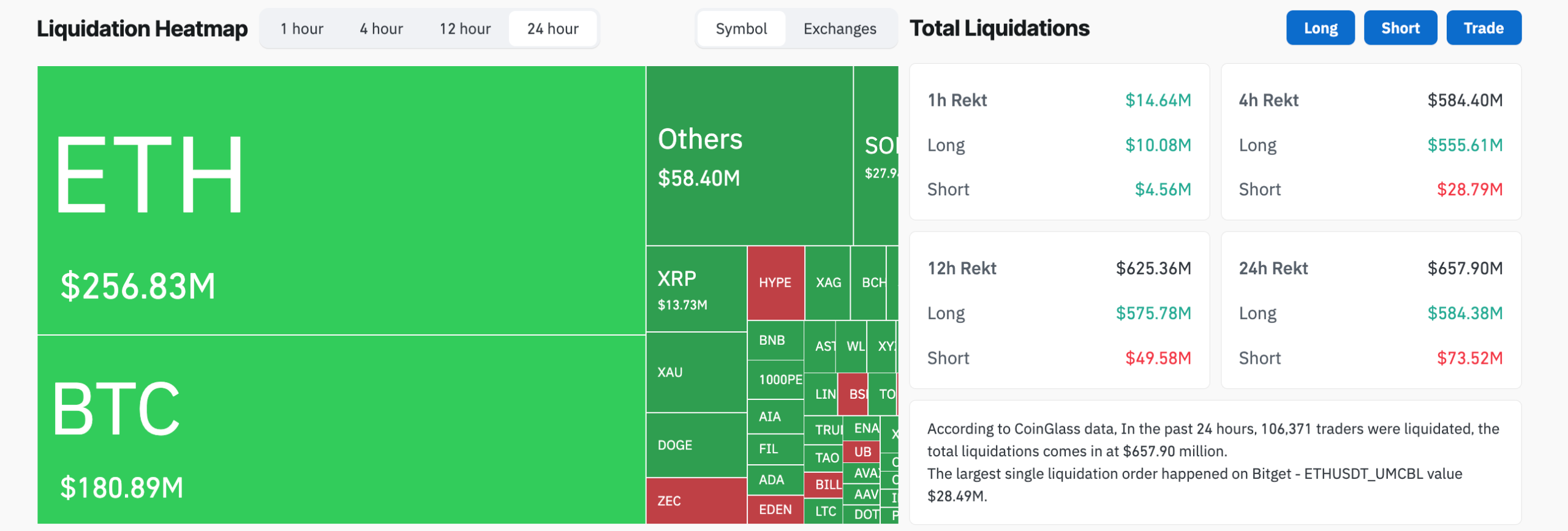
Crypto liquidations totaled $657.9 million over the past 24 hours, as the broader market slid.
Ethereum (ETH) accounted for the bulk of total liquidations, with traders betting on further upside taking the biggest losses in the latest wipeout.
Ethereum, Bitcoin Longs Drive Monday’s Crypto Liquidation Wave
According to data from Coinglass, roughly 106,371 accounts were liquidated over the past day. Long positions absorbed roughly 89% of the damage, with $584.38 million wiped out.
Meanwhile, short bets lost just $73.52 million, showing a one-sided flush of leveraged bulls.
Follow us on X to get the latest news as it happens

Ethereum took the heaviest hit by the asset, with $256.83 million in long positions wiped out. Meanwhile, Bitcoin recorded $180.89 million in liquidations. Together, the two largest cryptocurrencies accounted for roughly two-thirds of the day’s total.
The single largest liquidation order occurred on Bitget. An ETH/USDT perpetual contract worth $28.49 million was wiped out.
Risk-Off Mood Sets In After Trump Iran Warning
The liquidation wave hit alongside notable price declines across the crypto market over the past 24 hours. The drop was not entirely unexpected.
BeInCrypto previously flagged the possibility of a risk-off Monday after President Donald Trump signaled possible US strikes on Iran.

The total crypto market capitalization slipped roughly 0.93% over 24 hours to around $2.65 trillion. Bitcoin dropped below $77,000, extending weekly losses to 5.59%.
Ethereum slid under $2,120 and is down 9.98% on the week. Solana (SOL) led the broader decline, falling 11.22% over the past 7 days to $84.94.
Trump is expected to convene a Situation Room meeting on Tuesday to review military options against Iran. Further escalation could trigger more volatility across leveraged crypto positions.
Subscribe to our YouTube channel to watch leaders and journalists provide expert insights
The post Crypto Long Liquidations Hit $584 Million in 24-Hour Sell-Off appeared first on BeInCrypto.


WEMIX, the Layer-1 blockchain ecosystem developed by gaming brand WEMADE, today announced that its native coin (WEMIX) has been officially listed on Kraken, one of the world’s longest-standing, most liquid and secure cryptocurrency exchanges. Trading is scheduled to commence on 7 July 2026, allowing Kraken’s global user base to deposit, withdraw, and trade WEMIX against the USD.
Listing on Kraken represents a pivotal shift in liquidity and market exposure for WEMIX. While WEMIX has historically maintained an entrenched position within South Korea, South America, and regional Asian markets, this integration into Kraken vastly expands its global reach. It opens access for Western institutional and retail investors across regions including the U.S., Canada, the U.K., and Australia, which will serve as a base for international users interacting with WEMIX’s extensive digital economy.
Shane Kim, CEO of WEMIX and Vice President of WEMADE, said: “Aligning with partners who share our commitment to compliance and security is paramount. Given Kraken’s reputation, we are honored to collaborate with them as we scale our market reach, establish a strategic foothold in the U.S. — the world’s largest financial market — alongside other key Western regions, and evolve into a truly global blockchain ecosystem.”
As WEMIX sets its sights on scaling its Real-World Asset (RWA) initiatives, securing this major listing by tapping into the immense capital pool of the biggest financial market in the world also significantly elevates WEMIX’s global visibility, enables deeper liquidity, and positions the ecosystem to attract a vast new wave of participants.
WEMIX’s listing on Kraken comes amid its parent company’s aggressive expansion across fintech, cross-border payments, and the RWA market. Along with upcoming AAA game launches designed to solidify its market leadership and deepen the WEMIX Web3 gaming ecosystem, WEMADE recently launched StableNet, Korea’s first dedicated Layer-1 blockchain for KRW-backed stablecoins, and established the Global Alliance for KRW Stablecoin (GAKS). Key alliance members include Web3 behemoths such as Chainlink, Chainalysis, and CertiK.
“Bolstered by massive infrastructure leaps like StableNet and the GAKS alliance, WEMADE is building the future of Web3 gaming and its convergence with fintech. Now, cementing our footprint in the Western financial ecosystem further proves that WEMIX, our Web3 arm, is built for the global stage,” Kim added.
Beyond its milestone listing on Kraken, WEMIX remains committed to securing further high-profile exchange integrations, systematically driving global liquidity, and expanding access for its growing international community.
About WEMIX
WEMIX is a leading blockchain ecosystem for gaming and digital economies, powered by its highly scalable, EVM-compatible Layer-1 mainnet, WEMIX3.0. With a wide range of integrated services including NFTs, DeFi, stablecoin payments, and tokenized in-game assets, WEMIX enables seamless integration between gameplay and real-world value. Designed to be transparent, sustainable, and developer-friendly, WEMIX serves as the foundation for the global Web3 gaming ecosystem. For more information, please visit the official website.
About WEMADE
WEMADE is the only company combining over two decades of AAA game development success with a fully operational, game-proven blockchain ecosystem-built entirely on its proprietary Layer-1 mainnet, WEMIX3.0. Known for global hits such as The Legend of Mir, MIR4, NIGHT CROWS and Legend of YMIR, WEMADE is leading the industry in seamlessly integrating gameplay, tokenomics, NFTs, stablecoin payments, and blockchain infrastructure. Through WEMIX PLAY, WEMADE delivers a unified digital economy where players, creators, and investors can own, trade, and benefit from digital assets-powering the next generation of interactive entertainment and driving the evolution of Web3 gaming. For more information, please visit the official website.
About Kraken
Founded in 2011, Kraken is one of the world’s longest-standing and most secure crypto platforms globally. Kraken clients trade more than 600 digital assets, traditional assets such as US futures and US-listed stocks and ETFs, and 6 different national currencies, including GBP, EUR, USD, CAD, CHF, and AUD. Trusted by millions of institutions, professional traders and consumers, Kraken is one of the fastest, most liquid and performant trading platforms available.
Kraken’s suite of products and services includes the Kraken App, Kraken Pro, the Krak App, Kraken Institutional, Kraken’s onchain offerings and the Ninja Trader retail trading platform. Across these offerings, clients can buy, sell, stake, earn rewards, send and receive assets, custody holdings, and access advanced trading, derivatives, and portfolio management tools.
Kraken has set the industry standard for transparency and client trust, and it was the first crypto platform to conduct Proof of Reserves. It complies with regulations and laws applicable to its business, while actively protecting client privacy and maintaining the highest security standards.
For more information about Kraken, please visit the official website.
The post WEMIX Solidifies Global Reach with Listing on Kraken appeared first on BeInCrypto.


On July 6, 2026, someone spent about four million dollars buying BONK, used it to control almost a hundred percent of a seven-wallet vote, and legally walked off with twenty million from the DAO’s treasury. No code was hacked. The voting worked exactly as designed. Here is how governance attacks work, why they are getting more common, and what actually stops them.
Summary
- BonkDAO lost about $20 million after an attacker bought enough BONK tokens to dominate a governance vote without exploiting any code.
- Governance attacks allow attackers to use legitimate voting systems to approve malicious proposals when token ownership is concentrated and voter participation is low.
- Timelocks, quorum requirements, and emergency controls remain the main safeguards against governance attacks by making treasury takeovers harder to execute.
Most crypto thefts break something: a smart-contract bug, a stolen key, a spoofed website. A governance attack breaks nothing. It uses a decentralized organization’s own voting system, exactly as intended, to pass a proposal that hands the attacker the treasury. The code performs flawlessly. The rules are followed to the letter. And the money leaves anyway, because the rules themselves allowed it.
That is what happened to BonkDAO on July 6, 2026. An attacker quietly bought roughly four million dollars of the BONK token on exchanges over several days, accumulated a dominant share of voting power, and submitted a proposal to the DAO’s treasury. When the vote closed, wallets linked to the attacker controlled about 99.878 percent of the votes cast, the proposal passed, and around twenty million dollars in BONK drained from the treasury to attacker-controlled wallets. Only seven addresses voted at all. There was no exploit in the usual sense; there was a takeover, executed through the front door.
Governance attacks are becoming more common precisely because they require no elite technical skill, only capital and a poorly defended voting system, and a growing number of DAOs, many of them memecoin projects with outsized treasuries, hold large treasuries behind exactly such systems. This guide explains what a governance attack is, walks through the BonkDAO case in detail, covers the main variants including the flash-loan version that needs no upfront capital at all, surveys the historical record from Beanstalk to Compound to Tornado Cash, and lays out the defenses that actually work along with the reasons they are so rarely fully deployed. The through-line is a single uncomfortable idea: in a system where money votes, whoever can rent enough votes can rewrite the rules, a vulnerability distinct from the code exploits and key compromises that drain cross-chain bridges.
What a governance attack is
A decentralized autonomous organization, or DAO, replaces executives and boards with token-holder voting. Holders of the governance token submit proposals, other holders vote, and if a proposal reaches the required threshold, a smart contract executes it automatically. Proposals can adjust parameters, upgrade code, or move treasury funds, and the appeal is that no single person controls the outcome; the community does, transparently and on-chain.
A governance attack turns that openness into a weapon. Instead of finding a bug in the DAO’s code, the attacker acquires enough voting power through entirely legitimate means, usually by buying the governance token, and then uses that power to pass a proposal that benefits the attacker at everyone else’s expense, most often by transferring the treasury to themselves, a purely economic attack that needs no transaction-ordering exploit or mempool trickery. Because the acquisition of tokens and the casting of votes are both permitted actions, the attack is what security researchers call purely in-protocol: it cannot be prevented by cryptography or better code auditing, because nothing is being exploited except the voting mechanism working as designed.
This is what makes governance attacks conceptually different from every other crypto theft. A reentrancy bug or a stolen private key is a failure of implementation; the system did something it was not supposed to do. A governance attack is a failure of design; the system did exactly what it was supposed to do, and the outcome was still a robbery. Fixing it requires rethinking the rules of the vote, not patching a line of code, which is why these attacks keep succeeding against protocols whose smart contracts are flawless.
The root vulnerability is almost always token-weighted voting, the default model in which one token equals one vote. Token-weighted voting quietly assumes that large holders are aligned with the protocol’s success, because they have money at stake. That assumption fails completely against an attacker who does not care about the protocol’s future and only wants to control one vote long enough to drain the treasury. To that attacker, buying tokens is not an investment in the project; it is the purchase of a weapon, discarded the moment it has fired.
The BonkDAO case, step by step
The July 2026 BonkDAO attack is a near-perfect illustration, because it used no exploit at all and every step was visible on-chain.
The setup was patient accumulation. Over several days, the attacker bought roughly four million dollars of BONK using exchange wallets, building voting power gradually instead of in one conspicuous purchase. Because BonkDAO used ordinary token-weighted voting on a standard governance platform, that accumulated BONK translated directly into accumulated votes, and because the buying was spread out and routed through exchanges, it did not trigger alarm. To any observer, it looked like ordinary accumulation of a memecoin.
The execution was a proposal to the treasury. The attacker submitted a governance proposal and let it sit live for six days, the normal voting window. Here the fatal weakness showed: almost nobody else voted. When the window closed, only seven wallet addresses had participated, and wallets controlled by the attacker held about 99.878 percent of the total voting weight. The four-million-dollar token position was more than enough to dominate a vote that essentially no one else showed up for. The proposal passed, and the DAO’s smart contract did what passed proposals do: it executed, moving roughly twenty million dollars in BONK from the treasury to the attacker’s wallets.
Three design failures converged. There was no meaningful quorum requirement, so a vote decided by seven wallets counted as legitimate. There was no timelock strong enough to let the community notice and react to an anomalous treasury proposal before it executed. And there was no emergency check, such as a multisignature control over large treasury movements, to catch a proposal that would drain the treasury. Any one of these, properly set, might have stopped the attack; their combined absence made a four-million-dollar purchase sufficient to steal twenty million.
The aftermath followed the now-familiar script. BonkDAO traced the exchange wallets used to accumulate the tokens and began working with exchanges, cross-chain bridges, the network’s foundation, and law enforcement to pursue recovery, while at least one exchange suspended BONK transfers. But governance-attack recoveries are notoriously hard, precisely because the theft was executed through the DAO’s own legitimate process, not an exploit that might be reversed, and the token’s price fell sharply on the news. The attack also did not stand alone: it landed in a stretch of DeFi security incidents that had the market on edge, underscoring how quickly value can leave when the weakest link is the governance layer instead of the code.
The main variants
Governance attacks share a logic but come in several forms, distinguished mainly by how the attacker acquires voting power and how quickly they strike.
The slow accumulation attack is the BonkDAO model: buy tokens gradually over days or weeks, avoid suspicion, and strike when you control enough votes and turnout is low. A patient attacker can go further, spreading purchases across many anonymous wallets so the accumulation looks like healthy, distributed participation instead of a single entity building a weapon. Low voter turnout is the enabling condition because it lowers the number of tokens needed to dominate; in a DAO where almost no one votes, a modest position can control outcomes.
The flash-loan attack is the most dramatic variant, because it requires no upfront capital at all. A flash loan lets a user borrow a very large sum with no collateral, provided the loan is repaid within the same transaction. An attacker borrows a huge amount, uses it to buy or otherwise acquire a controlling block of governance tokens, votes to pass a malicious proposal, extracts the treasury, and repays the loan, all atomically in a single transaction that either fully succeeds or fully reverts. Because everything happens in one block, there is no window for anyone to react. This variant is what makes timelocks so important, since a mandatory delay between a vote passing and its execution breaks the single-transaction requirement that flash-loan attacks depend on.
Other paths to voting power exist. An attacker might exploit a flaw in how the protocol distributes or mints governance tokens, acquiring votes without paying market price. They might manipulate a price oracle to acquire tokens cheaply, exploiting a swap’s slippage and price impact to move a thin market in their favor. Or they might use a sybil strategy, splitting holdings across many accounts to appear as many independent voters while acting as one. What unites all variants is the goal: assemble enough voting weight, by whatever means, to pass a proposal the rest of the community would never approve, then convert that proposal into stolen funds before anyone can stop it.
A short history of governance attacks
The BonkDAO attack was severe but far from the first, and the historical record shows both the pattern’s persistence and how defenses have evolved in response.
The Beanstalk attack in 2022 is the textbook flash-loan case. An attacker took an enormous flash loan, used it to acquire a supermajority of the stablecoin protocol’s governance tokens, passed a proposal that drained the treasury, and repaid the loan, all in a single transaction. The haul was well over a hundred million dollars, and the entire operation lasted one block. Beanstalk became the canonical example of why any governance system that lets freshly acquired tokens vote immediately, with no delay before execution, is dangerously exposed to flash loans.
The Compound episode in 2024 showed a subtler form. A group associated with a well-known whale pushed through a proposal directing tens of millions in the protocol’s tokens to a vehicle they controlled, after delegating enough tokens to meet quorum. The community was divided over whether to call it an attack or aggressive-but-legitimate governance, and the resolution came partly through the threat of centralized intervention and partly through negotiation, a reminder that many DAOs retain a centralized backstop precisely because pure token voting can produce capture. It also illustrated that governance attacks are not always anonymous outsiders; they can be sophisticated insiders exploiting low participation and misaligned incentives in plain sight, the same fragility that shadows liquid staking tokens when one provider dominates.
The Tornado Cash case in 2023
The Tornado Cash case in 2023 delivered a chilling twist: an attacker passed a malicious proposal that granted themselves a controlling number of votes, effectively seizing the entire governance system, then, after extracting value, used their captured power to reset the malicious changes. The privacy protocol’s governance briefly ceased to exist as a decentralized entity because one proposal handed one actor total control. Smaller cases, from Build Finance to various memecoin DAOs, repeat the pattern at lower stakes. The consistent lesson across all of them is that treasuries are only as safe as the voting rules guarding them, and that a flawless smart contract offers no protection when the vote itself is the attack surface.
Why this is so hard to fix
If the defenses are known, a fair question is why governance attacks keep succeeding. The answer is that every defense trades away something a DAO values, and the trade-offs are genuinely uncomfortable, which is why so many projects postpone them until an attack forces the issue.
Consider the central tension. The entire premise of a DAO is open, permissionless participation: anyone can hold the token, anyone can propose, anyone can vote, and outcomes reflect the community instead of a gatekeeper. Every strong defense against governance attacks chips at exactly that openness. A high quorum requirement can paralyze a DAO whose members rarely vote, leaving it unable to pass even benign proposals. A long timelock slows the organization’s ability to respond to genuine emergencies, the very speed that on-chain governance was supposed to improve. An emergency multisignature or veto committee reintroduces a trusted group, which is a form of the centralization DAOs exist to escape. Each safeguard makes the DAO safer and less decentralized at the same time, and communities are understandably reluctant to give up the ideal that drew them together.
Low participation compounds the problem and resists easy solution. Most DAOs suffer chronically low voter turnout, with studies finding that a large share have only a handful of active voters, and low turnout is the single condition that makes governance attacks cheap, because it lowers the token threshold an attacker must reach. Yet turnout cannot simply be mandated; it reflects the reality that most token holders are passive, hold for price rather than participation, and have little time or expertise to evaluate proposals. Delegation, where holders assign their votes to engaged representatives, helps, but it concentrates power in delegates and introduces its own capture risks. The passivity that enables attacks is a structural feature of token ownership, not a bug that a single mechanism can eliminate.
There is also the deeper problem that a token market cannot distinguish a supporter from an attacker. Both are simply buyers willing to pay for tokens, and from the market’s perspective they are indistinguishable right up until the malicious proposal executes. Token-weighted governance assumes economic alignment, that anyone holding many tokens must want the protocol to succeed, but an attacker who plans to drain the treasury and discard the tokens has no such alignment, and no purchase-time signal reveals the difference. This is why some researchers argue that token voting alone can never be fully secure and that durable solutions require non-token inputs, reputation, identity, or contribution history, that markets cannot simply buy. Those approaches are early and hard to implement without reintroducing gatekeepers. The uncomfortable conclusion is that governance security is not a solved problem with a checklist to apply, but a live design frontier where every fix costs some decentralization, and where the cheapest, most open configuration, the one many DAOs default to, is precisely the one attackers find most inviting.
The defenses that work
Because governance attacks exploit design, not code, the defenses are matters of mechanism design, and a well-configured DAO can make an attack unprofitable even if it cannot make it impossible.
Timelocks are the single most important defense. A timelock imposes a mandatory delay between a proposal passing and its execution, and it does two things at once. It breaks flash-loan attacks entirely, because the borrowed tokens cannot be held across the delay, defeating the single-transaction requirement. And it gives the community a window to notice an anomalous proposal and respond before the treasury moves. The BonkDAO attack, with its six-day live window but apparently no effective execution delay or reaction, shows that a voting period is not the same as a timelock; what matters is a hard delay between approval and execution during which defenders can act.
Quorum requirements raise the bar for legitimacy. A quorum sets a minimum amount of voting participation for a proposal to pass, so a vote decided by a handful of wallets does not count. Had BonkDAO required a substantial quorum, a seven-wallet vote would have failed regardless of how the attacker’s tokens were distributed. Related measures include conviction voting, where voting power builds the longer tokens are committed, penalizing the sudden accumulation that attacks rely on, and delegation systems that raise overall turnout, which mechanically increases the tokens an attacker must acquire.
Emergency controls provide a last line. A multisignature control over large treasury movements, or a veto mechanism allowing trusted actors to pause or reject a clearly malicious proposal, can stop a drain even after a vote passes. These measures reduce decentralization, which is a real trade-off DAOs must weigh, but they exist precisely because pure token voting has repeatedly proven drainable. Many protocols keep a centralized safeguard for exactly the scenario Compound faced.
Finally, limiting what governance can do shrinks the prize. If a single proposal cannot unilaterally move the entire treasury, and if large disbursements require additional steps or approvals, the value an attacker can extract falls, and with it the incentive to attack at all. The unifying principle across every defense is to make the cost of acquiring enough votes exceed the value that could be stolen, or to insert enough delay and friction that the community can intervene before the theft completes. A DAO that has done neither, holding a large treasury behind cheap, immediate, low-turnout token voting, is not running a governance system so much as an unlocked vault with a suggestion box. BonkDAO’s twenty-million-dollar lesson is that the suggestion box, in the wrong hands and with enough tokens behind it, opens the vault.
The wider context is that governance is becoming a bigger target as DAOs hold more value. Memecoin communities in particular have accumulated substantial treasuries, often denominated in volatile tokens whose value can swing sharply, while running the simplest possible voting systems, and the combination of a rich prize behind a weak lock is exactly what attackers seek. As on-chain governance spreads from experimental protocols to organizations managing serious money, the gap between DAOs that have hardened their voting and those that have not becomes one of the clearest dividing lines in crypto security. The attacks are not going away, because the incentive is structural and the cheapest configuration is the most vulnerable one. What changes, DAO by DAO, is whether the treasury sits behind defenses proportionate to its size, or behind a vote that four million dollars and an empty room can win.
Frequently asked questions
What is a governance attack?
A governance attack is when someone acquires enough voting power in a DAO, usually by buying its governance token, and uses that power to pass a proposal that benefits them at the community’s expense, typically draining the treasury. It exploits the voting mechanism working as designed, not a bug in the code, which is what makes it different from a typical smart-contract hack.
How did the BonkDAO attack work?
The attacker spent roughly four million dollars buying BONK on exchanges over several days, accumulating dominant voting power. They submitted a treasury proposal that sat live for six days, and because only seven wallets voted, the attacker’s wallets controlled about 99.878 percent of the vote. The proposal passed, and roughly twenty million dollars in BONK drained from the treasury, with no smart-contract exploit involved.
Was any code hacked in a governance attack?
No. In a governance attack, the smart contracts perform exactly as designed. The theft happens because the voting rules themselves allowed a malicious proposal to pass and execute. This is why governance attacks cannot be prevented by better code audits alone; they require changes to the voting mechanism, such as timelocks, quorums, and emergency controls.
What is a flash-loan governance attack?
It is a variant that needs no upfront capital. The attacker borrows a large sum with no collateral, uses it to acquire a controlling block of governance tokens, passes a malicious proposal, drains the treasury, and repays the loan, all within a single transaction. The 2022 Beanstalk attack, which took over a hundred million dollars, is the canonical example, and timelocks are the main defense because they prevent execution within one transaction.
Why are governance attacks becoming more common?
They require capital and a weak voting system rather than elite technical skill, which lowers the barrier compared with finding code exploits. Many DAOs, especially memecoin projects, hold large treasuries behind simple token-weighted voting with low voter turnout, making them attractive targets. Accumulating enough tokens to control a low-turnout vote is often cheaper than the treasury it can capture.
Can stolen funds from a governance attack be recovered?
Recovery is difficult because the theft was executed through the DAO’s own legitimate process rather than an exploit that might be reversed. Projects typically trace the wallets, coordinate with exchanges, bridges, and law enforcement, and hope to freeze funds before they are laundered, but success is uncertain. BonkDAO began such efforts after its attack, with recovery unresolved.
What defenses stop governance attacks?
The main defenses are timelocks that delay execution after a vote passes, quorum requirements that invalidate low-turnout votes, conviction voting that penalizes sudden token accumulation, emergency multisignature or veto controls over large treasury movements, and limits on what a single proposal can do. Together, they aim to make an attack cost more than it could steal or to give the community time to intervene.
Is token-weighted voting the problem?
Token-weighted voting is the core vulnerability because it assumes large holders are aligned with the protocol when in fact, an attacker can buy votes purely to drain the treasury. Alternatives and supplements like conviction voting, quorum floors, delegation to raise turnout, and non-token reputation systems all aim to weaken the assumption that whoever holds the most tokens should control the outcome.
Disclaimer: This article is for informational purposes only and does not constitute investment advice. Digital asset markets are volatile, and you can lose your entire investment. Always do your own research. Information current as of July 7, 2026.

Key Takeaways
- Gemini rolled out commission-free U.S. stock trading Tuesday, providing access to thousands of exchange-listed equities through its mobile platform.
- Shares of GEMI declined 3.9% following the launch announcement; Coinbase (COIN) lost 2.4% and Robinhood (HOOD) slipped 2.3%.
- Real-time market data will be provided by Nasdaq; Apex Clearing Corp. serves as the clearing and custody partner.
- Alabama, Arkansas, Illinois, Massachusetts, Texas, Puerto Rico, Washington D.C., and Guam residents cannot access the new service.
- GEMI is currently priced at $4.35, representing an 86% decline year-over-year, despite recording 39% revenue growth over the trailing twelve months.
Gemini Space Station unveiled its commission-free stock trading platform for U.S. investors on Tuesday, marking a strategic expansion beyond cryptocurrency as the Winklevoss brothers pursue their vision of creating a comprehensive financial services application.
The cryptocurrency exchange will enable eligible users to access thousands of publicly traded U.S. securities through its existing mobile application. Market data will stream in real-time from Nasdaq, while Apex Clearing Corp., part of Apex Fintech Solutions, handles custody and clearing operations.
Gemini Galactic Markets, LLC, registered with FINRA and protected by SIPC, facilitates the securities offerings. While commission-free for standard trades, certain transaction categories may incur fees.
Gemini Space Station, Inc., GEMI
Prior to the announcement, GEMI stock was changing hands at $4.35 but tumbled 3.9% in early Tuesday session following the product launch. The equity has plummeted 86% over the past twelve months, leaving the company with approximately $526 million in market capitalization. Despite achieving 39% revenue expansion in the most recent twelve-month period, profitability remains elusive.
“Building financial platforms is something we’ve been doing for more than ten years,” noted Cameron Winklevoss, who co-founded Gemini and serves as president. “Crypto was our starting point, and stocks represent our expansion so customers can consolidate their financial activities within the Gemini ecosystem.”
Tyler Winklevoss, serving as CEO, stated: “We’re working toward integrating multiple financial instruments—ranging from cryptocurrencies and stocks to derivatives—within a single regulated infrastructure.”
This strategic pivot creates head-to-head competition with established players Robinhood (HOOD) and Coinbase (COIN). Market participants responded negatively to both competitors—COIN retreated 2.4% while HOOD declined 2.3% during Tuesday’s session.
Established Regulatory Framework
Gemini enters the brokerage space with regulatory infrastructure already established. The platform obtained broker-dealer authorization from FINRA in 2022. Subsequently, the company modified its registration to function as an introducing broker, enabling customer order routing for all NMS securities through Apex for trade execution and settlement.
Additionally, Gemini obtained a Derivatives Clearing Organization registration from the CFTC in April 2026—furthering its ambitions of constructing a comprehensive regulated trading ecosystem.
Currently, the stock trading functionality remains unavailable to residents of Alabama, Arkansas, Illinois, Massachusetts, Texas, Puerto Rico, Washington D.C., and Guam.
Financial Performance Shows Revenue Growth Amid Losses
During the first quarter of 2026, Gemini reported a loss of $0.93 per share, falling short of analyst expectations of -$0.61—representing an earnings miss of approximately 52%. Quarterly revenue reached $50.27 million, marking a 42% increase compared to the prior-year period.
Mizuho Securities revised its GEMI price objective downward from $12 to $10 earlier in the year while maintaining its Outperform recommendation, highlighting the firm’s transformation into a diversified financial markets operator.
During the company’s shareholder meeting, investors re-elected six board members, including both Tyler and Cameron Winklevoss, for terms extending through 2027.
According to InvestingPro analysis, GEMI shares appear undervalued based on current trading levels.

Crypto World
Cardano News: ADA Price Just Gave Back Half Its 27% Weekly Rally, Are Whales About to Pull the Rug?
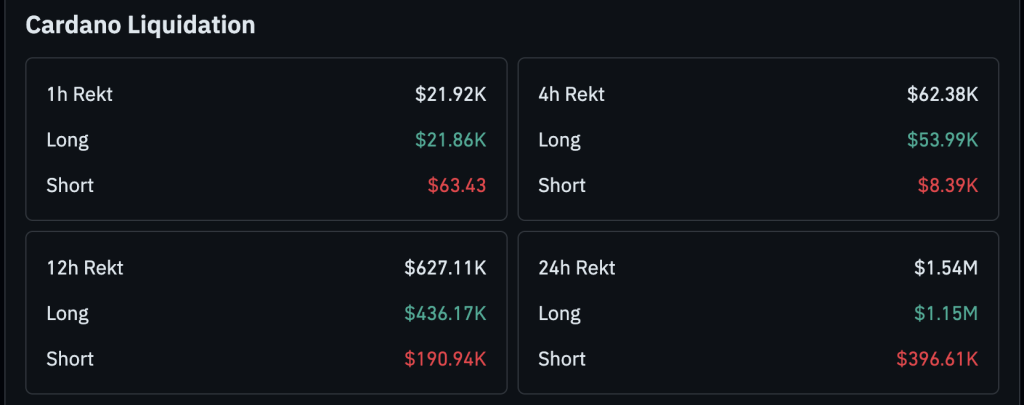
Cardano News: ADA price is bleeding. ADA is trading near $0.18, down roughly 3.5% in the last 24 hours, the third consecutive session of losses, and the derivatives data underneath is telling a sharper story than the candles alone.
Whether this is healthy consolidation after a punishing 27% weekly surge or the start of a structural rollover is the question every ADA position holder needs to answer before the next session closes.
CoinGlass data shows ADA futures Open Interest has dropped 8% in 24 hours to $434.34 million, a significant flush of leveraged exposure. The funding rate collapsed from 0.0093% to 0.0029% in the same window. Traders are no longer willing to pay a premium to hold ADA longs.
Long liquidations totaled $1.26 million of the $1.66 million wiped across the derivatives book. Santiment data adds another layer: whale cohorts holding 100 million to 1 billion ADA have flatlined near 2.53 billion ADA since Thursday, with no accumulation signal visible.
Whales watching. Retail retreating. That combination rarely resolves to the upside without a catalyst.
The broader macro sentiment across major crypto assets remains fragile, and ADA’s technical setup is now caught between a fading rally and a structural floor that sits considerably lower.

Cardano News: Can ADA Price Hold $0.18 or Is a 20% Drop the Base Case?
ADA is trading around $0.18, sitting below its 50-day EMA at $0.1861 and well beneath its 200-day EMA at $0.2940. Both moving averages are now overhead resistance, not support.
A daily close back above $0.1861 is the minimum requirement to neutralize the current bearish bias; absent that, the structure stays negative.
Volume context matters here: 24-hour turnover is running between $455M and $546M, depending on venue, which confirms this isn’t thin-air price action. Active positioning is underway; the direction just shifted.
The MACD is holding above its signal line, but the positive histogram is contracting, a classic early warning of momentum exhaustion. RSI sits at 56, rolling over before reaching overbought territory. That’s not a momentum failure yet, but it’s a quiet warning shot.
Three scenarios from here. Bull case: ADA reclaims $0.1861 on a daily close, volume picks back up, and the 27% weekly gain gets defended as a base for continuation toward $0.2940.
Base case: ADA chops in the $0.17–$0.19 band for several sessions as leveraged positioning bleeds out and whales wait for cleaner entry.
Bear case, and the one the derivatives data is quietly flagging, is a decisive close below $0.18 that opens the door to the June 26 structural low at $0.1385, a downside risk of over 20% from current levels.
ADA has shown resilience at key levels before, but the current derivatives setup demands respect. If whale accumulation doesn’t resume this week, the base case drifts toward bearish.
Maxi Doge Targets Possible 1000x as Bullrun is Coming Back
When an established large-cap like ADA stalls post-rally with whales sidelined and derivatives flushing out, capital doesn’t disappear; it rotates.
Some of it finds its way to early-stage presales, where the entry multiple hasn’t already been extracted by a 27% weekly move. That’s the trade logic worth examining here.
Maxi Doge (MAXI) is a meme token on Ethereum built around a specific cultural thesis: the 1000x leverage trading mentality, embodied by a 240-lb canine juggernaut who never skips leg day and never skips a pump.
The project has raised $4,823,777.41 in its presale at a current price of $0.0002827, with dynamic staking APY live for holders. Standout mechanics include holder-only trading competitions with leaderboard rewards, a retention structure that meme tokens rarely bother with, and a Maxi Fund treasury earmarked for liquidity and partnerships rather than purely marketing spend.
The meme-first, gym-bro viral marketing angle is either your thing or it isn’t (and that self-selection is actually part of the community-building strategy). Presale assets carry full loss risk; liquidity post-launch is never guaranteed.
The post Cardano News: ADA Price Just Gave Back Half Its 27% Weekly Rally, Are Whales About to Pull the Rug? appeared first on Cryptonews.

Vanguard is hiring its first Head of Digital Assets to build a multi-year crypto roadmap for Personal Wealth clients. The roughly $12 trillion asset manager still has no plans to launch its own Bitcoin ETF.
The role appeared on Vanguard’s careers portal on July 6 under requisition 179858. It lists hybrid seats in Malvern, Dallas, Scottsdale, and Charlotte.
From Blocking Bitcoin ETFs to Hiring a Crypto Chief
The job description positions the hire as Vanguard’s senior subject matter expert for digital assets across Personal Wealth. The mandate spans products, operating models, risk, and engagement with regulators.
“The Head of Digital Assets will lead Vanguard Personal Wealth’s digital assets strategy, roadmap, and enterprise execution,” the offer stated.
The posting marks a sharp break from Vanguard’s earlier stance. The firm blocked spot Bitcoin ETFs from its brokerage platform when they launched in January 2024. Executives long dismissed crypto as speculative.
In December 2025, however, Vanguard opened its platform to third-party crypto ETFs and mutual funds. The decision gave more than 50 million brokerage clients access to funds holding Bitcoin, Ethereum (ETH), XRP, and Solana (SOL).
The reversal came under Salim Ramji, who became Vanguard’s first externally hired CEO in July 2024. At BlackRock, he ran the iShares unit that launched the iShares Bitcoin Trust (IBIT). That fund alone held about $54 billion as of March 31, per an iShares fact sheet.
Why Vanguard Still Won’t Launch a Bitcoin ETF
Vanguard has never filed for a proprietary crypto ETF. The firm’s published guidance favors assets with transparent cash flows, and it offers crypto exposure only through third-party products, much like gold.
BlackRock and Fidelity, in contrast, run their own spot Bitcoin funds. Competition among issuers has since fueled a Bitcoin ETF fee war that pushed expense ratios as low as 0.14%. Meanwhile, Schwab’s index fee cuts raised the cost of standing still in traditional products.
Client demand also remains measurable. US spot Bitcoin ETFs held $74.37 billion in net assets as of July 2. That day, Bitcoin ETF inflows returned with $221.72 million after a 10-day outflow streak. As of this writing, total net assets stood at $77.32 billion.

Therefore, the new role looks broader than any single fund. A multi-year Personal Wealth roadmap could span custody, advised portfolios, and tokenization across global finance rather than a product launch.
The open question is whether the roadmap stays exploratory or produces client-facing offerings. The chief’s first moves may show which way Vanguard leans.
The post Vanguard Spent Years Fighting Crypto, Now It’s Planning for It appeared first on BeInCrypto.


Ctrl Wallet has announced the permanent shutdown of its services after a recent security exploit, giving users until Aug. 3 to move their crypto assets before core wallet functions go offline.
Summary
- Ctrl Wallet will permanently shut down on Aug. 3 and has urged users to move funds before wallet services end.
- Users can still recover assets later by importing their 12- or 24-word recovery phrase into compatible wallets.
- The shutdown follows a recent Cardano-related exploit and comes amid a string of crypto wallet and bridge security incidents.
Ctrl Wallet said in a blog post published Tuesday that it will disable sending, receiving, swapping and all other wallet functions from Aug. 3, leaving users with only the ability to export their recovery phrases.
The company also confirmed it will immediately stop new downloads and remove the application from browser extension and mobile app stores as part of the shutdown process.
The decision comes just weeks after Ctrl Wallet disclosed a security incident affecting some Cardano wallets. On June 23, the wallet provider said it had placed parts of its platform into temporary maintenance mode while engineers investigated the issue and worked to protect user assets.
Users have one month to transfer assets
Ahead of the shutdown deadline, Ctrl Wallet has strongly advised customers to move their funds to another wallet or exchange instead of waiting until services are disabled.
According to the company, users who do not transfer assets before Aug. 3 will still be able to access their funds by importing their 12-word or 24-word recovery phrase into another compatible wallet.
Ctrl Wallet identified MetaMask, Trust Wallet and Phantom as compatible alternatives for importing recovery phrases. The company stressed that users should securely back up their seed phrases before attempting any migration.
Alongside the shutdown notice, Ctrl Wallet warned that there will be no migration token, token swap, or airdrop linked to the closure. The wallet provider urged customers to ignore social media posts or websites claiming to offer compensation or rewards tied to the shutdown, cautioning that such offers are likely to be scams.
Formerly known as XDEFI Wallet, Ctrl Wallet lists more than 650,000 monthly users and a workforce of between 11 and 50 employees on its LinkedIn profile. The wallet supported more than 2,500 blockchain networks, including Cardano and Midnight.
Security incidents continue across crypto platforms
The shutdown follows a transition announced on April 29, when Ctrl Wallet said it had come under the Emurgo umbrella and that its multichain technology would continue through the SecondFi wallet. SecondFi, a self-custodial wallet developed by Emurgo after rebranding from Yoroi in April 2026, later suffered its own security incident.
On June 24, attackers exploited a vulnerability in SecondFi that resulted in the theft of about 16 million ADA, worth roughly $2.4 million at the time.
SecondFi later said it had secured about 129 million ADA through emergency measures, transferred those funds to an independent third-party custodian, and introduced a recovery process covering the 374 affected wallet addresses.
The latest shutdown also comes during a series of security breaches affecting crypto infrastructure. As previously reported by crypto.news, blockchain security firm Blockaid detected an active exploit against the DeFi platform Summer.fi that had drained about $6 million before the attack was disclosed.
Separately, Taiko urged users to withdraw assets from all bridges on its network after confirming its chain state verification mechanism had been compromised, while Blockaid estimated losses from the related ERC20 Vault attack at more than $1 million.
Days earlier, interoperability protocol Axelar disabled its Secret Network bridge connections after an exploit led to the loss of roughly $4.7 million in bridged assets.
According to Axelar, early findings indicated the issue originated in the Secret Network’s ICS-20 smart contract rather than Axelar’s core infrastructure, prompting the protocol to suspend affected connections while its investigation continues.


EDX Markets, an institutional cryptocurrency trading platform, said it raised $76 million in a Series C funding round led by SBI Holdings.
The company plans to use the funds to develop new products and grow internationally. EDX operates an institution-only crypto marketplace that separates trading from custody and settlement through a central clearinghouse. The model is designed to reduce counterparty risk and mirrors the structure used in traditional financial markets.
SBI Holdings has been one of Japan’s most active financial groups in crypto. Its SBI VC Trade unit offers access to Ripple’s RLUSD stablecoin in Japan, while SBI Shinsei Trust Bank recently issued JPYSC, a yen-denominated stablecoin developed with Startale Group.
Last month, SBI agreed to acquire crypto exchange Bitbank for 46.7 billion yen ($289 million), adding to its existing SBI VC Trade platform.
EDX has been moving beyond spot trading. The firm earlier this year introduced FlowConnect, a crypto-as-a-service product that allows financial firms to offer crypto trading to their customers.

The CLARITY Act picked up its first major public law enforcement endorsement on July 1 when the National Organization of Black Law Enforcement Executives (NOBLE) formally backed the bill, and two days later Major County Sheriffs of America withdrew its opposition entirely, shifting to neutral.
Two organized law enforcement bodies moving constructively on the same digital asset legislation within 72 hours is not coincidental, it reflects deliberate outreach and signals that the Senate floor fight is now a live negotiation, not a procedural formality.

Discover: The Best Token Presales
NOBLE’s Endorsement: What the Organization Said and Why It Matters
NOBLE’s July 1 letter to Senate Majority Leader John Thune and Minority Leader Chuck Schumer was addressed to the two officials who control Senate floor timing, a deliberate signal that the endorsement was meant to move the legislative calendar, not just the public narrative.
The organization, which represents more than 3,000 members across nearly 60 chapters worldwide including chief executives and command-level officials, cited four specific provisions driving its support: expanded regulatory obligations on digital asset businesses, enhanced forfeiture authorities, new transparency requirements, and oversight rules for digital asset kiosks.
Critically, NOBLE addressed the enforcement-gap argument head-on. The organization stated explicitly that the legislation does not alter the federal criminal authorities investigators and prosecutors rely on daily, money laundering, unlicensed money transmitting, conspiracy, aiding and abetting, and sanctions enforcement statutes all remain intact under the bill’s current text.
— Eleanor Terrett (@EleanorTerrett) July 3, 2026
 NEWS: The Major County Sheriffs of America (MCSA) has shifted to a “neutral” position on the Clarity Act after what it describes as “continued discussions in recent days regarding parts of Section 604,” aka the Blockchain Regulatory Certainty Act.
In a letter to Senate Banking… pic.twitter.com/24XIZTfWHR
That framing directly rebuts the criticism that had dogged earlier CLARITY Act drafts, where anti-corruption groups argued the bill could create exploitable gaps in illicit-finance enforcement.
Stand With Crypto, the crypto advocacy group representing more than 2.6 million U.S. supporters, called NOBLE the first major law enforcement organization to publicly endorse the CLARITY Act.
That distinction matters for Senate Democrats who have been most vocal about enforcement preservation, an endorsement from a respected law enforcement body with NOBLE’s institutional standing provides political cover that no industry lobbying group can supply.
“Law enforcement voices are engaging constructively on digital asset legislation, and the first major endorsement is on the books.”
Stand With Crypto said this after the NOBLE letter was made public, per reporting on the NOBLE endorsement development.
Discover: The Best Crypto to Diversify Your Portfolio
Major County Sheriffs Move to Neutral on Section 604
Major County Sheriffs of America, whose members collectively serve more than 130 million citizens through offices employing at least 700 personnel each, sent its own letter on July 3, this one addressed to Senate Banking Committee Chairman Tim Scott and ranking member Elizabeth Warren.
MCSA’s position shift from opposition to neutral turned on Section 604, the provision incorporating the Blockchain Regulatory Certainty Act, which establishes liability protections for blockchain developers and service providers who do not custody or control digital assets.

MCSA said continued review and discussions around Section 604 clarified how the administration interprets and plans to implement that provision.
The organization stopped short of endorsement, it explicitly noted room to further strengthen the legislation to support both responsible innovation and state and local law enforcement needs, but it withdrew formal opposition.
Removing an active opponent from the ledger is not the same as gaining a supporter, but in a Senate that requires 60 votes for floor passage, eliminating organized resistance from an association representing major population centers carries real procedural weight.
Don’t Miss Out on Our $1,000 USDT Airdrop on ByBit
The post NOBLE Endorses CLARITY Act as Major County Sheriffs Drop Opposition appeared first on Cryptonews.
Crypto World
AI trade loses steam as Samsung earnings fail to lift chip stocks amid open source AI shift
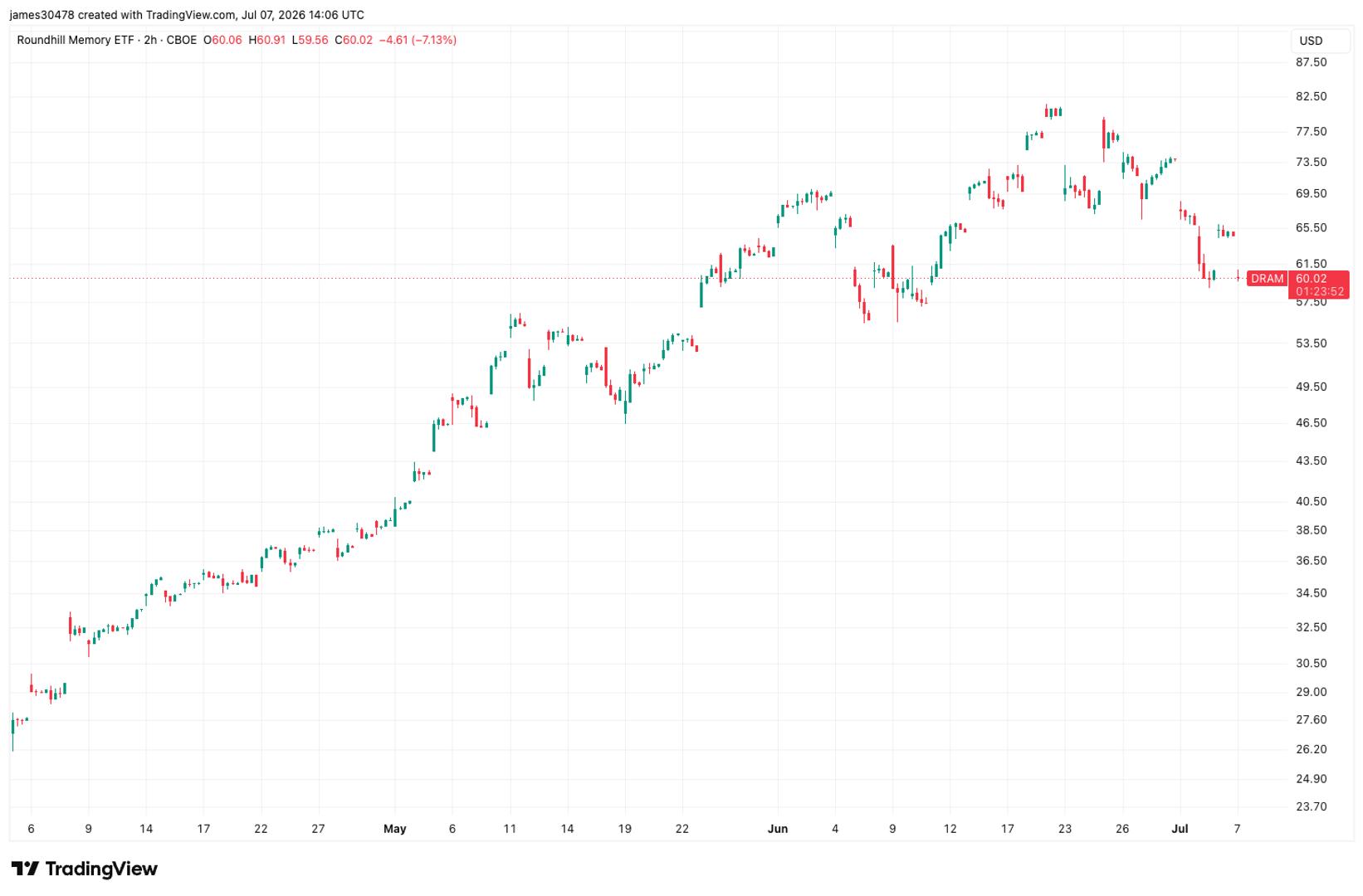
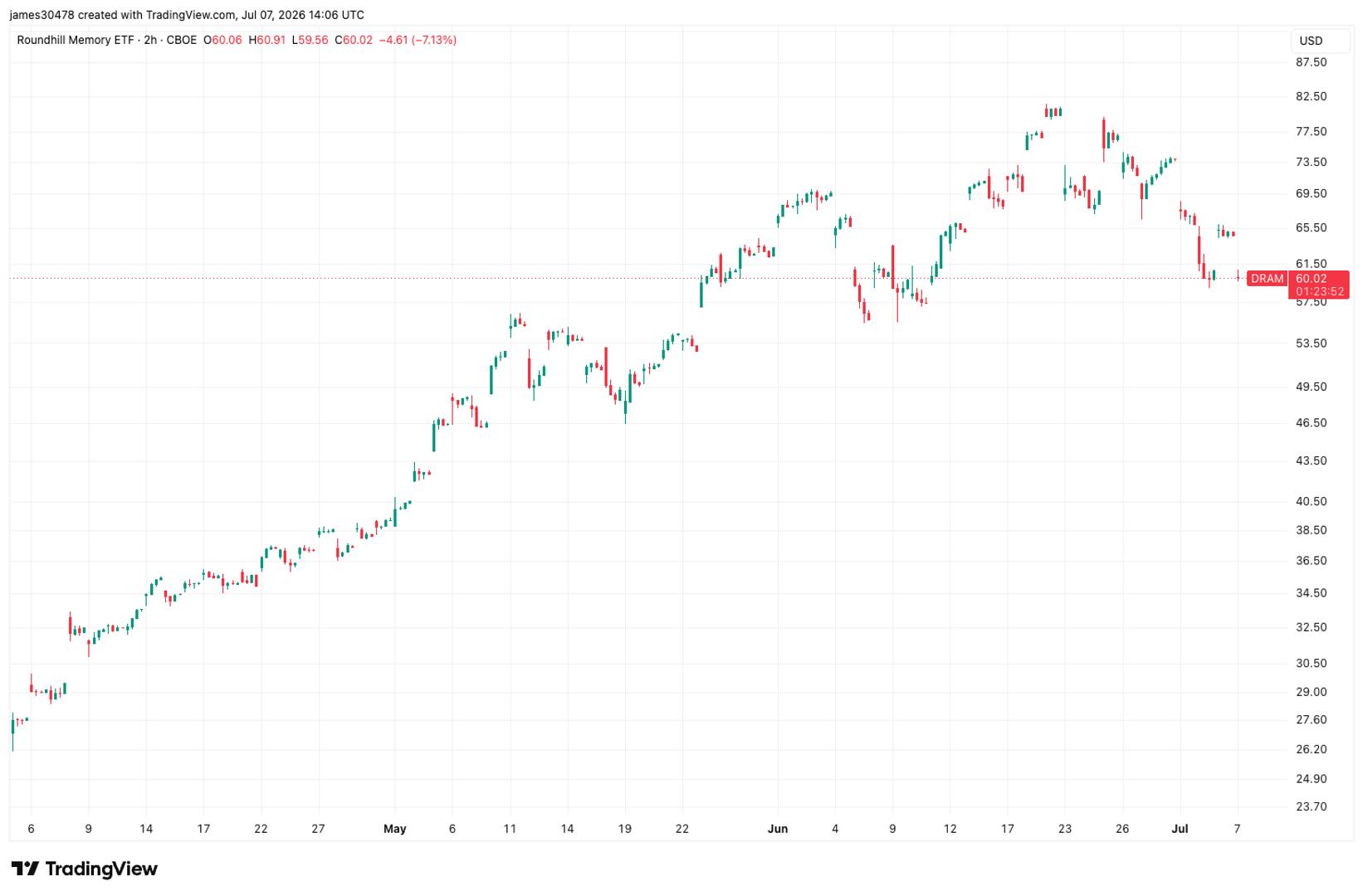
The AI trade, which incorporates semiconductors and memory stocks, is showing signs of fatigue as investors reassess whether the extraordinary spending boom on chips and data centers can be sustained.
Semiconductor and memory stocks such as Micron Technology (MU) and Sandisk (SNDK) came under heavy pressure on Tuesday, after Samsung Electronics (005930) reported record second-quarter earnings but missed revenue estimates.
Shares still fell nearly 7%, extending a broader selloff across AI-linked chipmakers. Concerns are growing that hyperscalers could slow AI infrastructure spending.
Meanwhile, rival SK Hynix is down 25% from its all-time high ahead of its U.S. listing this week, a deal that is also drawing investor capital away from existing chip stocks.
Adding to the changing narrative, China’s Zhipu AI, one of the country’s leading artificial intelligence startups, is exploring a custom AI chip as demand for its open-source GLM models surges, highlighting the rise of lower-cost AI ecosystems built around domestic hardware rather than cutting-edge US chips.
The shift comes just weeks after SpaceX’s blockbuster IPO and amid elevated valuations across AI-related stocks. Investors are increasingly questioning whether the next phase of AI will require ever more GPUs and high-bandwidth memory, or whether more efficient models will reduce demand for the infrastructure that has powered the AI rally.
Over the past year, bitcoin and the broader crypto market have suffered from the AI trade, and if investor enthusiasm for AI continues to fade, crypto bulls could see capital rotate back into digital assets.


Wall Street analysts have begun coverage of SpaceX (SPCX) following the expiration of the 25-day quiet period after the company’s June initial public offering (IPO), with nearly every major brokerage launching their coverage with a bullish rating.
The aerospace and satellite company, which held 18,712 bitcoin as of March 31, went public in June, raising $75 billion in one of the year’s largest IPOs. Shares were priced at $135 in the offering. The stock was trading at $150.93 on Tuesday, down more than 6% from recent post-listing highs but still above its IPO price.
The two lead underwriters, Goldman Sachs and Morgan Stanley, both initiated coverage with buy-equivalent ratings. Goldman analyst Eric Sheridan set a price target of $205, while Morgan Stanley’s Adam Jonas assigned a $300 target.
They were joined by analysts at Bank of America, Citigroup, Deutsche Bank, JPMorgan, Macquarie, RBC Capital Markets, UBS and Wells Fargo, all of which launched coverage with buy or equivalent recommendations.
The most optimistic forecast came from Raymond James, where analyst Brian Gesuale initiated coverage with a Strong Buy rating and an $800 price target.
Autopsy Scheduled, Internet Sends Support

Great British Bake Off could move from Channel 4 to ITV
UK’s High Pay Centre to close for good amid funding troubles

No Jackpot Winner as $257 Million Prize Rolls Over to $269 Million Monday Draw

Renter of Home in Anne Heche Crash Denies Settlement With Son

Weekend Open Thread: Staud – Corporette.com

Why Bitcoin is Facing More Pain Ahead (Data)

Music to Attract Fast and Urgent Money | Treasure of Abundance | Spiritual Wealth | 432 Hz

XRP v RLUSD, SHOCKING NeW OUSD, Stablecoin SANDWICH spreads, Flare is NEXT LEVEL, Validator Attacks
-

 Fashion4 days ago
Weekend Open Thread: High Hopes
-

 Fashion23 hours ago
Open Thread: What Great Books Have You Read Recently?
-
 NewsBeat2 days ago
Taylor Swift and Travis Kelce wedding staffer hilariously struggles to keep her cool while checking in megastars
-

 Politics4 days ago
The House | “Reframing the debate from a binary discussion of winners and losers”: Yuan Yang reviews ‘We Are Not Machines’
-
 Crypto World6 days ago
Airdrop Registration Becomes Key Focus For Remittix As RTX Launch Updates Approach
-

 Sports6 days ago
Broncos roster: OL Ben Powers (No. 74) entering final year of contract
-

 Crypto World5 days ago
Binance stock trading tops $1B in first month after launch
-

 Crypto World4 days ago
Standard Chartered Secures MiCA License as ESMA Adds 37 New Crypto Firms
-

 NewsBeat7 days ago
Presenter Caroline Flack’s brother Paul Flack dies aged 55
-

 Business21 hours ago
AXT Shares Jump Nearly 14% as Semiconductor Materials Maker Rebounds on AI-Linked Indium Phosphide Demand
-

 Crypto World6 days ago
Alibaba-affiliate Ant Group enters the humanoid robot market with 12 deals
-
Crypto World20 hours ago
SK hynix (000660.KS) Stock Dips as $28B Nasdaq ADR Offering Drives AI Memory Expansion
-

 News Videos24 hours ago
Best Time to Enter Small Caps Right Now? Another Bull Run? | Financially Free
-

 Crypto World2 days ago
South Africa proposes crypto tax guidance under existing rules
-

 Tech2 days ago
Lenovo laptops are now shipping with YMTC SSDs, a sign of Chinese NAND entering the mainstream
-

 Business6 days ago
Meta Platforms Stock Jumps 7% Today as Bloomberg Reports Company Plans to Enter the Cloud Business
-
 NewsBeat5 days ago
New exhibition reflects five decades of movement between island of Ireland and GB
-

 News Videos12 hours ago
Whats Hidden Inside This Cash Register? #treasure #reselling #money
-

 Business4 days ago
What a 10 Percent Drop Means for Buyers, Sellers and Renters
-

 Crypto World5 days ago
Binance Re-Enters Philippines As EU MiCA Rules Restrict Access
You must be logged in to post a comment Login