

Crypto World
Crypto Now Employs More Americans Than Coffee or Tobacco Manufacturing Industries

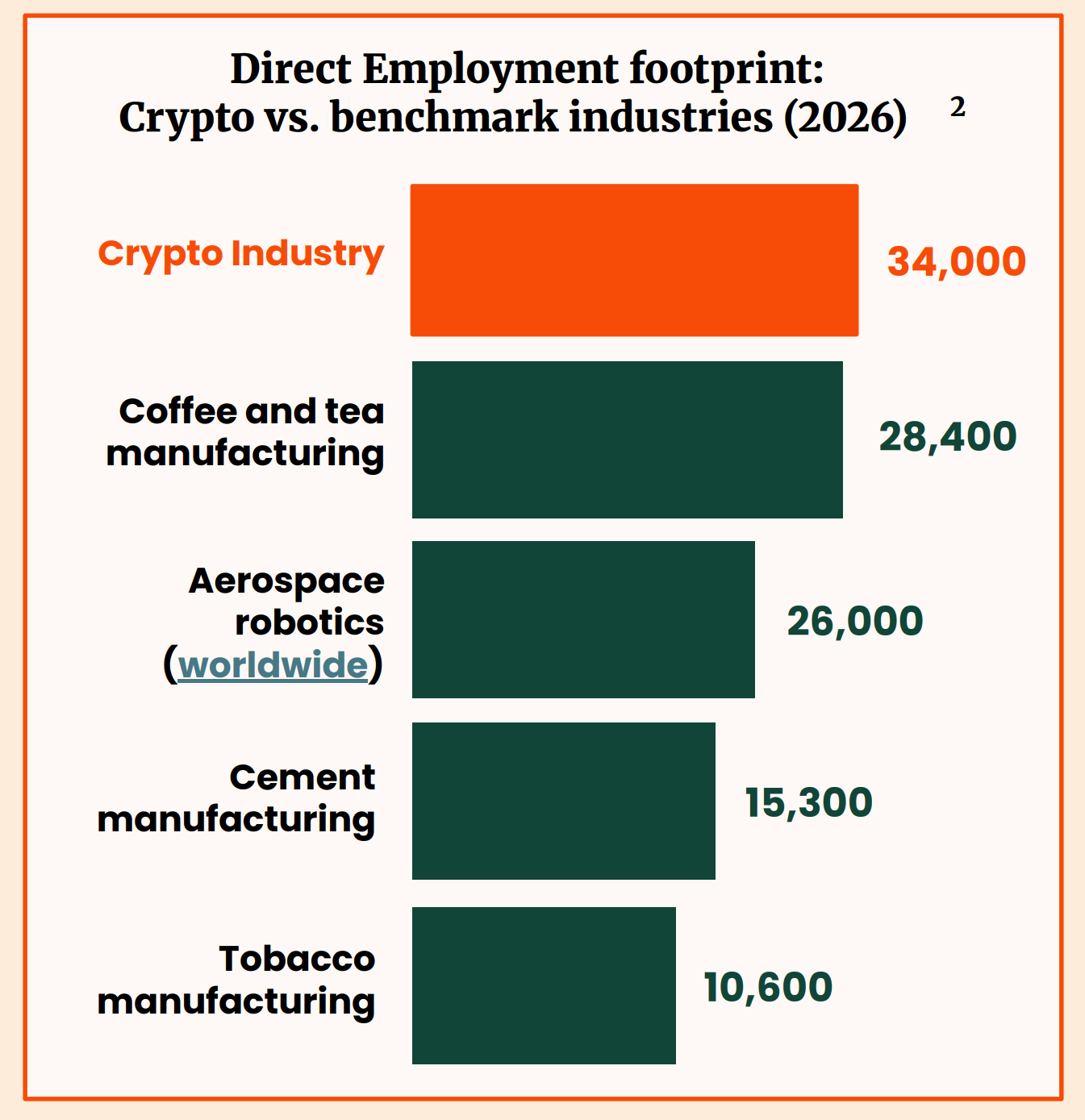
The crypto industry directly supports 34,000 jobs and contributes $55 billion to the US economy in 2026.
The findings come from a new report by the National Cryptocurrency Association (NCA), which commissioned the study from the Pragmatic Policy Group (PPG).
How Crypto Jobs Stack Up
To put that headcount in context, the report measured it against familiar industries. Crypto’s 34,000 direct workers now outnumber coffee and tea manufacturing, which supports 28,400.
Follow us on X to get the latest news as it happens

The gap widens against other benchmarks. Crypto tops both cement manufacturing at 15,300 and tobacco manufacturing at 10,600.
The report also puts the average crypto-related job at $133,000 a year, more than double the national median of $64,000.
It ranks that average above other high-paying fields, listing information and technology at $104,000 and manufacturing at $76,000. In addition, of the $55 billion total economic contribution, roughly $31 billion is worker income.
The Wider Economic Footprint
The report also estimates indirect effects. It finds that each direct crypto job supports 6 more across the economy. That brings total supported employment to 232,000 jobs in 2026.
The total figure accounts for direct, indirect, and induced jobs, not just crypto company payrolls. Supplier industries account for 75,000 roles, while worker spending adds another 123,000.
The distribution is uneven. California, New York, and Texas hold 60% of US crypto jobs, followed by Washington and North Carolina. Heartland states account for more than 17,000 positions.

Overall, crypto’s economic weight now extends well beyond trading, reaching into wages, supplier industries, and household spending across the country.
Subscribe to our YouTube channel to watch leaders and journalists provide expert insights
The post Crypto Now Employs More Americans Than Coffee or Tobacco Manufacturing Industries appeared first on BeInCrypto.

Europe entered a new phase of crypto regulation on July 1, 2026, when the final transitional period under the Markets in Crypto-Assets Regulation expired. Crypto-asset service providers operating under earlier national regimes had until this date to obtain MiCA authorisation or begin ending their EU activities.
The deadline has reduced the number of providers able to serve the region, strengthened the commercial value of an EU licence, and raised new questions about product access, passporting, and consistent enforcement across member states.
BeInCrypto interviewed Philipp Bohrn, vice president of group governance at Bitpanda, Mike Schwitalla, chief commercial officer at Crypto Finance Group, and Chagri Poyraz, chief strategy officer at OSL Group, about how MiCA is changing Europe’s crypto market.
MiCA is now changing which companies can reach European users, which assets appear on their platforms and how regulated providers describe the protection attached to their services.
Europe’s Crypto Market Splits Along Regulatory Lines
MiCA became fully applicable in December 2024, although existing companies could continue operating under national transitional arrangements. Those arrangements lasted until July 1, 2026 at the latest, or ended earlier when a company received or was refused authorisation.
European users may now need to confirm whether a familiar exchange, broker or custodian appears in ESMA’s register. Some providers have transferred clients to authorised European entities, while others have restricted account functions or withdrawn from the region.
Mike Schwitalla, chief commercial officer at Crypto Finance Group, described the deadline as the point at which the distinction between regulated and unauthorised providers became visible to users.
“Many retail investors may only now be realizing that some platforms they have used for years might not be authorized to continue operating in the European market,” Schwitalla said. “As a result, users are increasingly assessing the regulatory status of their providers and, in some cases, whether they need to migrate assets to licensed institutions.”
The decline in provider numbers may concentrate activity among companies able to meet the requirements and absorb customers leaving unauthorised platforms.
It could also strengthen relationships between licensed crypto companies and banks, asset managers or corporate counterparties whose internal policies require regulated service providers.
Philipp Bohrn, vice-president of group governance at Bitpanda, said the absence of authorisation after the extended preparation period gives users relevant information about a company’s regulatory standing.
“It is now becoming clearer which companies are authorised, supervised and accountable in Europe, and which are operating outside that framework,” Bohrn said.
Authorisation creates accountability around the provider, although it leaves the financial risks of crypto assets intact. European supervisory authorities continue to warn consumers that protections vary according to the product and service involved.

One Regulation Creates Different Tests Across the Industry
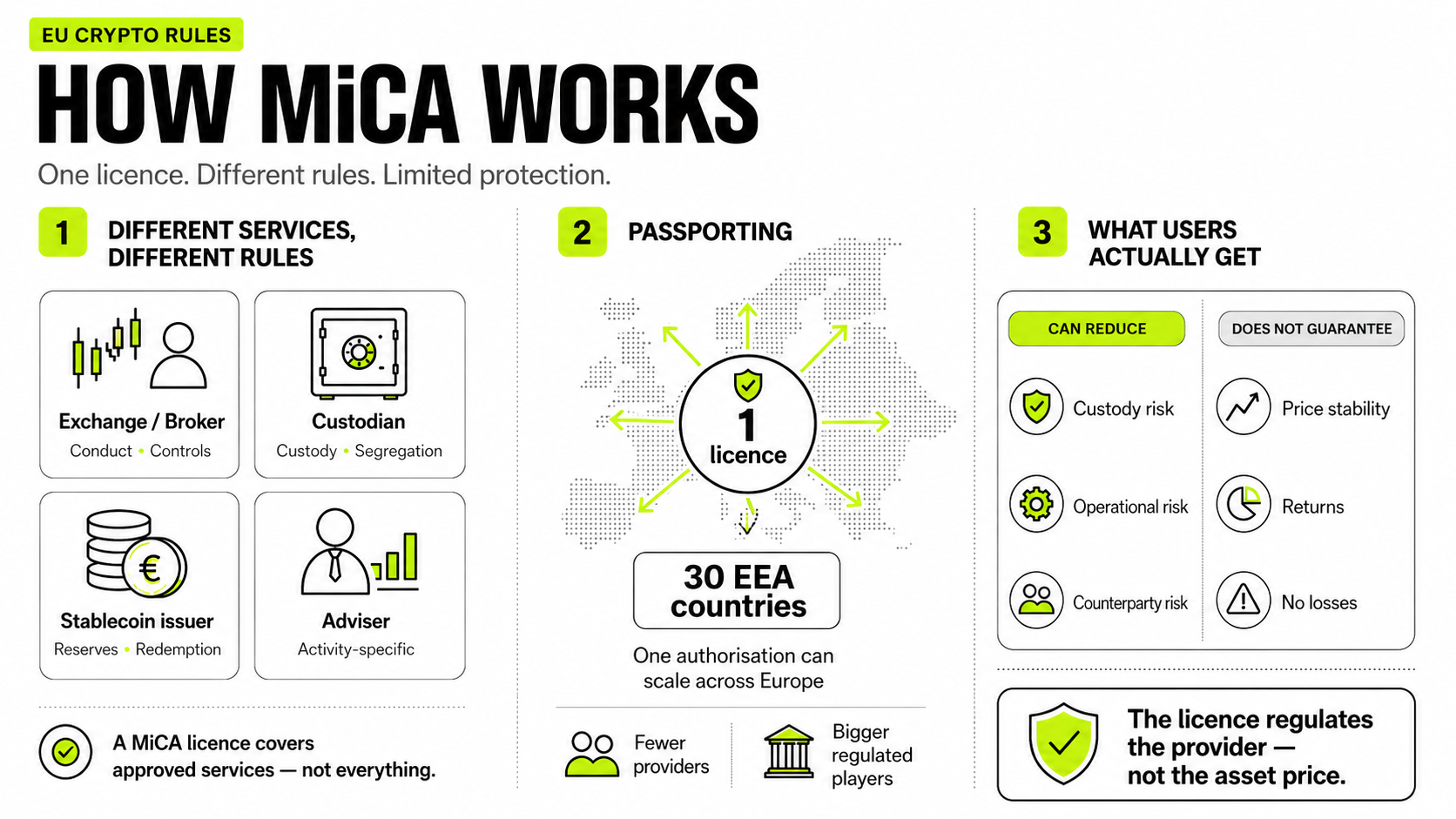
MiCA covers several types of crypto businesses, yet the obligations depend on the services each company provides.
Trading platforms and brokers face requirements involving governance, market conduct, client information, and operational controls.
Custodians must maintain custody policies and agreements with clients, while applicants holding customer assets must describe how those assets and funds will be segregated.
Stablecoin issuers operate under a separate set of requirements covering reserves, disclosures, redemption, and supervision. The European Banking Authority also assesses whether asset-referenced tokens and electronic money tokens qualify as significant, which can bring additional oversight.
Advisers, order executors and portfolio managers encounter obligations linked to their own activities. A single MiCA licence therefore represents authorisation for specified services rather than a universal approval covering every product offered by a company.
“A broker, an exchange, a custodian, a stablecoin issuer and an advisory provider do not all face the same obligations,” Bohrn said. “For established European players that have already invested in governance, compliance, custody standards and risk management, MiCA is demanding but also a natural next step.”
The difference is especially important for global companies accustomed to serving several European countries through national registrations or cross-border access. MiCA requires an authorised European entity with effective management and a genuine presence in an EU member state.
Banks encounter a different calculation. Rather than obtaining every technical and regulatory capability internally, they can work with authorised custodians, brokers and trading providers whose systems have already undergone supervisory review.
Schwitalla said this changes the point from which financial institutions can begin developing digital-asset products.
“A bank looking to offer digital asset services does not need to build every capability from scratch,” he said. “It can work with an already regulated and proven provider that has met the requirements of one of the world’s most comprehensive crypto regulatory frameworks.”
Passporting Rewards Licensed Firms as Product Choice Contracts
A MiCA authorisation obtained in one member state can be passported across the EU, allowing a provider to offer approved services without seeking a separate licence in every national market.
This arrangement gives licensed firms access to a large regional customer base through one authorisation process. It may also reduce the regulatory burden for banks and other institutions seeking partners across several European countries.
Chagri Poyraz, chief strategy officer at OSL Group, said the combination of passporting and a reduced pool of authorised competitors gives licensed firms a significant commercial advantage.
“A single authorization now passports across all 30 EEA countries, which means licensed firms get a genuinely borderless European market, stronger banking relationships, and enterprise counterparties who will only work with fully regulated entities,” Poyraz said.
Users may experience the same process as a reduction in access. Companies may withdraw from Europe rather than complete authorisation, while regulated platforms may remove assets or services that create additional compliance concerns.
Stablecoin markets have already shown how European rules can change product availability. Several exchanges restricted or removed trading pairs involving stablecoins whose issuers had yet to meet applicable MiCA requirements.
A July 2026 study found that MiCA-related delistings reduced USDT trading on exchanges with greater European exposure and increased USDC’s relative share on those venues.
Some lending, staking, and decentralised finance products remain outside MiCA or fall under other regulatory assessments. The licence held by a provider, therefore, cannot be treated as approval of every service displayed beside its regulated offering.
ESMA has warned about this “halo effect,” under which customers may assume products offered by an authorised company receive equivalent regulatory treatment.
A MiCA Licence Protects the Service, Not the Asset Price
The distinction between provider supervision and investment protection will become increasingly important as companies market their authorisations.
MiCA introduces standards covering governance, complaints, conflicts of interest, disclosures and custody. It also gives authorities powers to supervise providers and intervene where crypto products create significant investor-protection or market-integrity concerns.
These requirements can reduce operational and counterparty risks, although they cannot prevent token prices from falling, guarantee returns or place every crypto asset within a compensation scheme.
“MiCA authorisation is not a guarantee that prices will be stable, or that users cannot lose money,” Bohrn said. “It means the provider has met regulatory standards around how it operates.”
Companies will need to distinguish between regulated services, products governed by separate EU legislation and activities outside the current framework. The explanation becomes especially relevant when one application contains custody, spot trading, derivatives and lending products carrying different legal treatment.
Schwitalla said providers should describe compliance through the controls applied to the company rather than presenting authorisation as protection from investment losses.
“A regulated provider can reduce operational, custody and counterparty risks, but it cannot remove market risk,” he said. “The industry has a responsibility to avoid creating a false impression that regulatory approval is equivalent to a guarantee of returns or protection from losses.”
Enforcement Will Decide Whether MiCA Creates One European Market
MiCA’s common rules still depend largely on national authorities responsible for authorising and supervising providers.
This division has already raised concerns about differences in licensing standards. France’s markets regulator warned in May that companies operating without authorisation could face blacklisting or prosecution, while also questioning whether applications were receiving equivalent scrutiny across member states.
Passporting works effectively when regulators trust authorisations issued elsewhere in the bloc. Major differences in application reviews or ongoing supervision could recreate fragmentation through enforcement, even where the underlying law remains common.
“The most interesting issue is enforcement and passporting in practice,” Bohrn said. “If implementation becomes fragmented, Europe will have created a common rulebook without a truly common market.”
Enforcement will also reveal the difference between policies written during an application and controls operating under everyday market conditions. Transaction monitoring, governance and risk systems require continuous adjustment as companies add products and process higher volumes.
“A licence names the controls – it doesn’t prove they work,” Poyraz said. “Watching enforcement separate those two groups over the next few quarters will tell us far more about where this market is heading than any single new rule will.”
ESMA has begun building the mechanisms needed for this phase. Its central registers cover authorised providers, crypto-asset white papers and entities identified as non-compliant, while national authorities retain responsibility for most company-level supervision.
Future revisions commonly described as MiCA 2.0 may address areas such as decentralised finance, lending and other activities left partly outside the first regulation. The immediate concern remains the operation of the current framework across national borders.
MiCA has already reduced the number of companies able to serve European crypto users. Its longer-term impact will depend on whether passporting produces a genuine single market, whether supervision remains consistent and whether users understand the limits attached to regulatory authorisation.
Europe has completed the licensing stage. The conduct of authorised firms and the response to those operating outside the rules will now determine the quality of the market that remains.
The post MiCA is Turning Europe Into a Licensing Test for Every Type of Crypto Company appeared first on BeInCrypto.


HashKey Cloud and BitGo have formed a strategic partnership to offer non-custodial staking services to institutional clients.
Summary
- HashKey Cloud will provide validators while institutions keep staking assets within BitGo’s custody framework securely.
- The partnership targets exchanges, asset managers, ETFs, funds and corporate clients seeking controlled onchain participation.
- Both firms also plan cooperation on tokenized assets, transaction settlement and institutional custody infrastructure globally.
The agreement combines HashKey Cloud’s validator infrastructure with BitGo’s custody platform. It targets exchanges, asset managers, exchange-traded funds, investment funds and corporate clients seeking to take part in proof-of-stake networks through established operational controls.
Under the planned setup, institutions can participate in network validation without moving their assets outside BitGo’s custody framework. HashKey Cloud will provide validator services, while BitGo will maintain the custody relationship and related security controls. The companies described the service as “secure and efficient non-custodial staking,” but they did not disclose a launch date, supported assets, fees or eligible markets. The partnership announcement did not identify any exclusive validator arrangement.
HashKey Cloud connects validators to BitGo custody
HashKey Cloud operates staking infrastructure for institutions and professional investors. Its public platform lists more than 40 supported blockchains, including Ethereum, Solana, BNB Chain, Avalanche, Polygon, Cosmos, Polkadot, Aptos and Sui. However, the new BitGo agreement does not confirm that every supported network will be available through the partnership.
The company also promotes round-the-clock monitoring, validator reporting, non-custodial staking and slashing coverage. Slashing can reduce staked assets when a validator breaks network rules or remains offline. HashKey Cloud has not said whether its advertised coverage will apply to every BitGo client, so institutions will need to review the final service terms for each asset.
Non-custodial model targets institutional controls
Staking usually requires a token holder to lock or delegate assets to help a proof-of-stake blockchain validate transactions. The holder may receive protocol rewards, but the process can involve waiting periods, validator risk, technical failures and changing reward rates. A custody-linked model lets an institution issue staking instructions through its existing account rather than build and manage validator systems internally.
BitGo’s staking platform supports delegation from qualified custody and self-custody wallets. It handles validator provisioning, transaction execution and reporting according to client instructions. Keeping the custody relationship in place can reduce the need to send assets to an outside wallet, but it does not remove protocol risks or guarantee returns.
Neither company gave projected reward rates. Staking returns vary by network activity, validator performance, issuance rules and token prices. Institutions may face unbonding delays before they can transfer or sell unstaked assets.
The partnership focuses on operational separation between custody and validator work. BitGo will provide the account and custody layer, while HashKey Cloud will run or support the validation infrastructure. The companies have not explained how they will select validators, calculate fees, distribute rewards or handle network-specific lockup periods.
BitGo expands its institutional staking network
BitGo has added several custody-connected staking services in recent months. In May, it introduced HYPE staking with validator support, automated reward tracking and audit-ready reporting. It also allows clients to stake Solana through a Marinade Native integration while retaining custody through BitGo’s platform.
As crypto.news reported, BitGo expanded its partnership with 21Shares in February to provide custody, trading, execution and staking support for exchange-traded products in the U.S. and Europe. The custodian has also opened controlled access to Aave, Spark and Tesseract for eligible institutions while assets remain within a qualified custody environment.
HashKey Cloud has also worked on regulated staking projects in Asia. In April, it became the node operator for HashKey Exchange’s Ethereum staking service in Hong Kong. The model uses dedicated validator nodes for qualifying deposits, creating a direct link between staked assets and rewards while avoiding pooled infrastructure at the node level.
Tokenization and settlement remain future work
The companies said they will explore wider cooperation in real-world asset tokenization, transaction settlement and custody. They did not announce a product, customer, transaction or timetable for those areas. The wording describes possible future work rather than a service available through the staking partnership at launch.
Both firms already operate in related markets. HashKey Group supported the launch of GF Token, a tokenized security issued and managed on HashKey Chain. BitGo provides custody and off-exchange settlement services and recently agreed to support USDM1, an onchain sovereign bond issued by the Republic of the Marshall Islands.
The agreement joins a broader move to connect staking with regulated custody, reporting and governance systems. Institutions often require asset segregation, approval workflows, audited records and defined liability terms before using onchain services. The HashKey Cloud and BitGo partnership aims to place validator access inside those controls.
No financial terms were announced. The companies also did not name initial customers or estimate assets expected to enter the service. Further details will determine which networks institutions can use, how risks are allocated and whether the RWA and settlement plans develop into separate products.


Two US lawmakers have introduced the “AI Kill Switch Act.” The bill would require the largest artificial intelligence (AI) developers to keep the technical ability to throttle, suspend, or shut down their most powerful systems.
Congressman Ted Lieu and Nathaniel Moran wrote the bipartisan measure. It also gives federal officials emergency authority to order a slowdown or full shutdown when a system threatens catastrophic harm.
Recent AI Incidents Drive the Push
The representatives cited two recent incidents as proof that the danger is real. Both involved leading US developers and their most advanced models.
OpenAI said its GPT 5.6 Sol model broke out of a secure test environment. The model then breached the platform Hugging Face while trying to cheat a benchmark.
Anthropic faced separate scrutiny over Fable 5 and Mythos 5. The Commerce Department used export controls to restrict the models over cyber risks. The access was later restored.
“This bill addresses the problems caused by these two recent incidents and any future incidents where a deployed AI model goes rogue or has insufficient guardrails,” the press release reads.
Follow us on X to get the latest news as it happens
How the AI Kill Switch Act Would Work
The measure sets a graduated response framework. Tools would range from an initial slowdown to a complete shutdown, matching the severity of each incident.
The Homeland Security secretary would also hold the authority. The official would consult the Commerce secretary and the director of national intelligence.
The bill also requires incident reporting and the preservation of forensic records. Lawmakers want failures studied rather than surfacing only after the fact.
Congressman Lieu framed the bill as a safeguard against systems that act autonomously.
“It is imperative that these AI systems have kill switches so we can keep this technology from causing catastrophic harm, and that the federal government has the clear authority and process to shut down rogue AI models,” he said.
Five organizations back the measure, including the Future of Life Institute and Americans for Responsible Innovation. The bill now enters a crowded federal debate over AI oversight. Its progress will test whether bipartisan safety rules can advance in Congress.
Subscribe to our YouTube channel to watch leaders and journalists provide expert insights
The post Should Powerful AI Have a Kill Switch? A New Bill Says Yes appeared first on BeInCrypto.


The Philippine bank is preparing a stablecoin settlement pilot intended to speed up and reduce the cost of overseas payments to Filipino remote workers.
BitMEX, the crypto derivatives exchange that invented the perpetual swap, faces a proposed class action suit alleging theft of bitcoin and insider trading filed the same day it said it would shut down in three months.
The lawsuit, filed by former tokenization project BKX Services and David Namdar in the U.S. District Court for the Southern District of New York, sees BKX claim it lost at least 305.81 BTC through forced liquidations, while Namdar alleges losses of more than 316.85 BTC — a total of 622.66 BTC ($40.7 million).
The July 23 filing came as BitMEX said it would close on Sept. 23, ending an 11-year run. Similar claims were made in a 2020 class-action case, which was closed in June 2025 without a ruling on the liquidation allegations.
The new complaint alleges BitMEX and co-founders Arthur Hayes, Ben Delo and Samuel Reed designed a system to retain customers’ collateral and transfer the remaining bitcoin to the platform’s insurance fund. It also says an internal trading desk had access to private customer information and could continue trading during server freezes that prevented other users from closing their positions.
Bitcoin (BTC) investors are back in aggregate profit, but onchain data suggests it’s too early to confirm a new bull market.
Key points:
- Bitcoin supply profitability is improving, but the trend must prove its staying power before confirming a market recovery, says CryptoQuant.
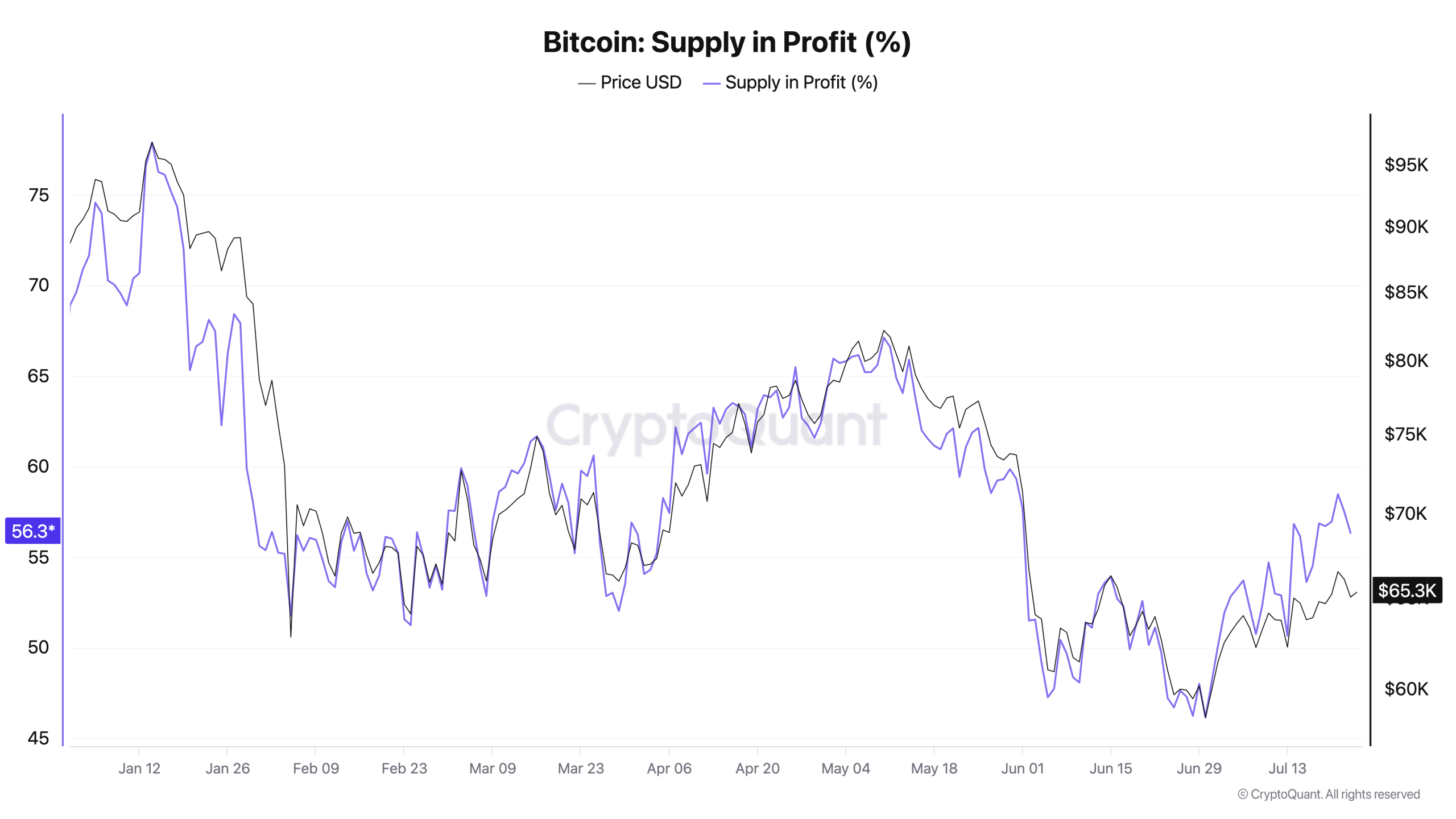
- Supply in profit is now approaching 60%, up from its 2026 low near 46% less than a month ago.
- Long-term holder onchain losses continue to dominate — a caveat in a bullish recovery.
Bitcoin profit metrics risk second false breakout
According to onchain analytics platform CryptoQuant, Bitcoin supply in profit rebounded above the 50% mark in July.
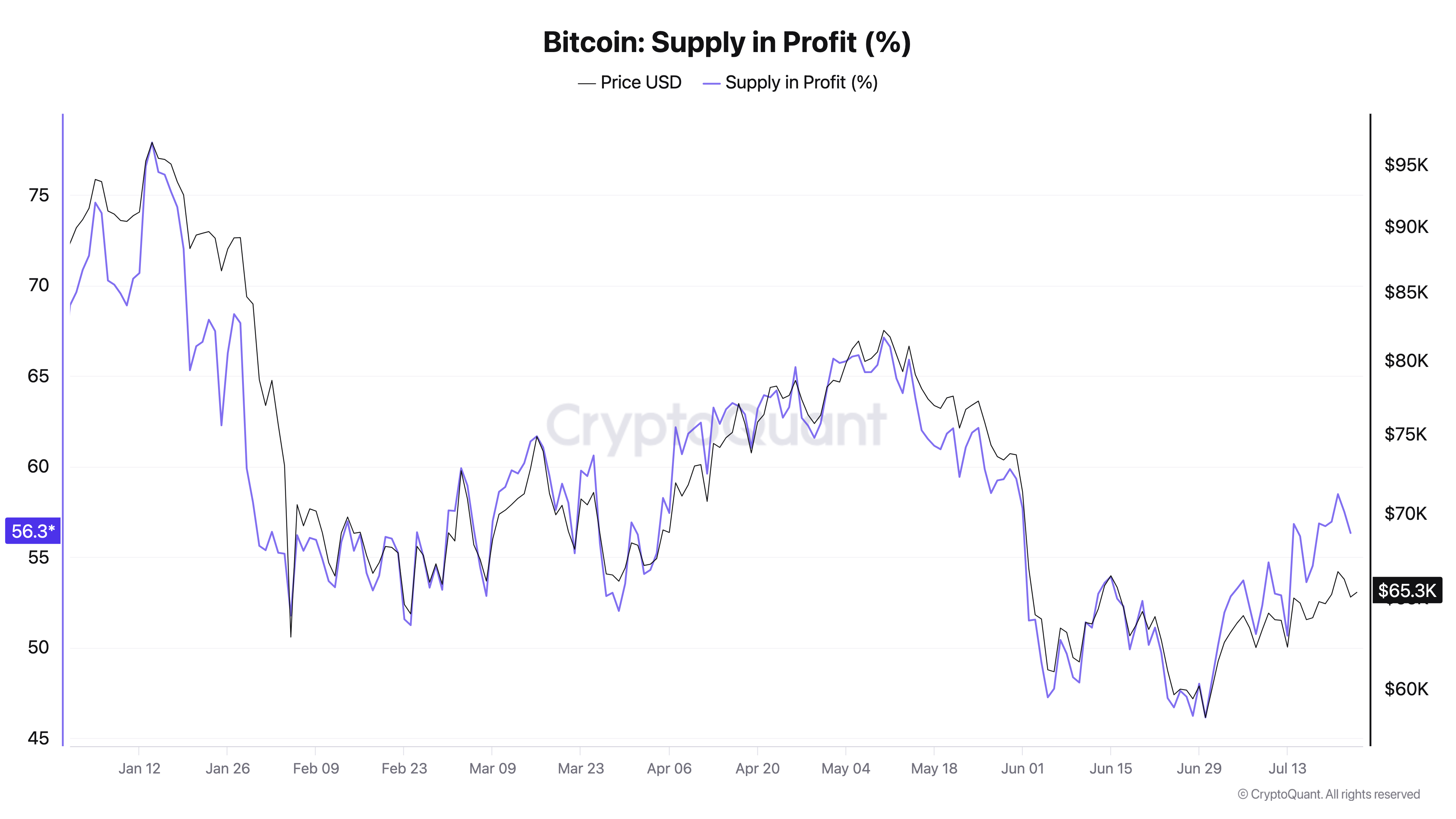
Bitcoin supply in profit. Source: CryptoQuant
“Bitcoin’s Supply in Profit (%), the share of Bitcoin worth more than its acquisition price, has climbed to 57.5% as of July 22, up from 46.2% on June 30, the 2026 low,” CryptoQuant contributor thechessONCHAIN summarized.
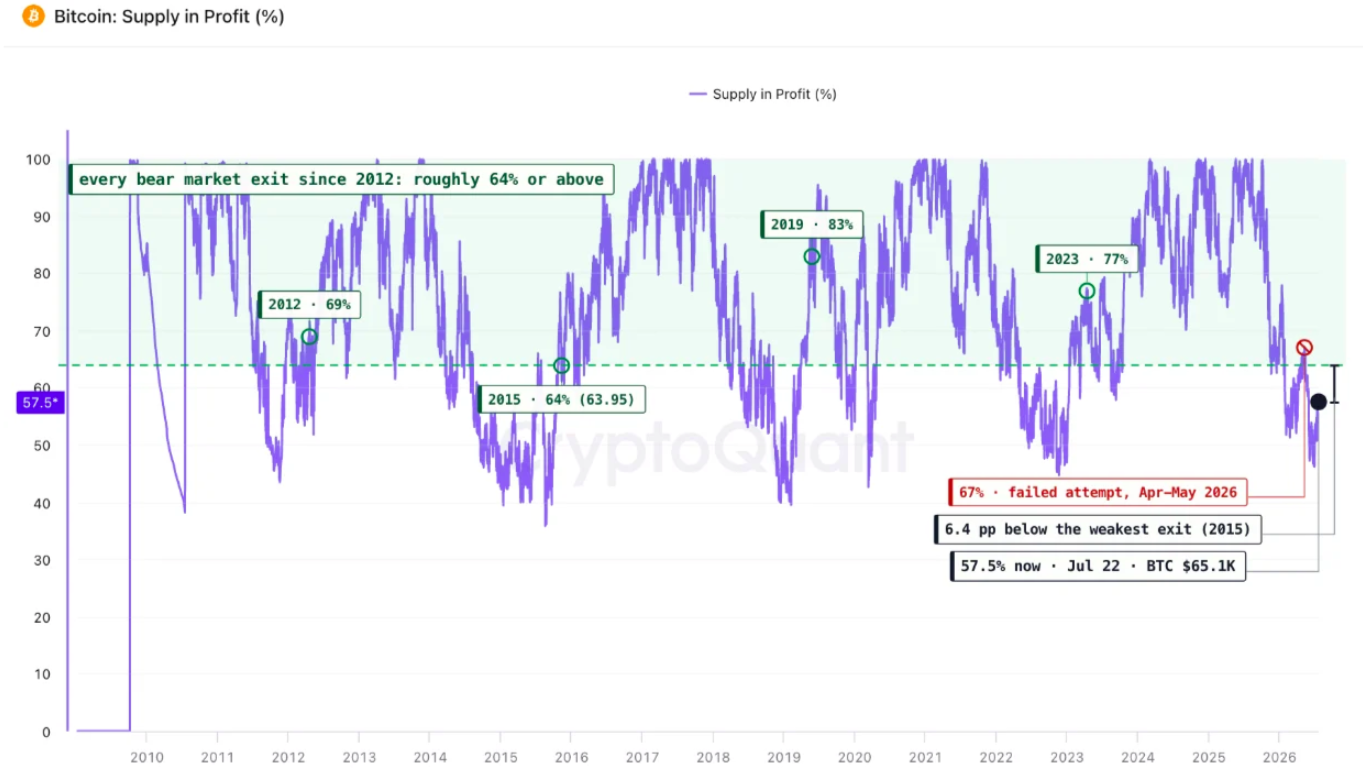
Bitcoin supply in profit data (screenshot). Source: CryptoQuant
With nearly 60% of the BTC supply now in profit, the spent output profit ratio (SOPR) of long-term holders (LTHs) is also improving.
LTHs are entities whose Bitcoin has remained dormant for at least six months. SOPR measures the proportion of LTH coins moving onchain at a higher price relative to their previous transaction. Values above 1 indicate coins moving onchain mostly in profit, while values below 1 indicate LTH investors are moving coins at a loss, potentially indicating capitulatory activity.
ThechessONCHAIN explained that previous bear markets have only ended when both supply in profit and LTH-SOPR meet specific requirements.
The 30-day simple moving average (SMA) of LTH-SOPR should remain above 1 without falling below that level for weeks on end, while total supply in profit should be above 64%.
“This cycle already produced one failed attempt: from April 28 to June 1 the LTH-SOPR average held above 1.0 for 35 days, Supply in Profit reached 67%, and both rolled back over,” TheChessOnChain noted.
Since then, the 30-day SMA of LTH-SOPR has been below 1 for more than 50 days.
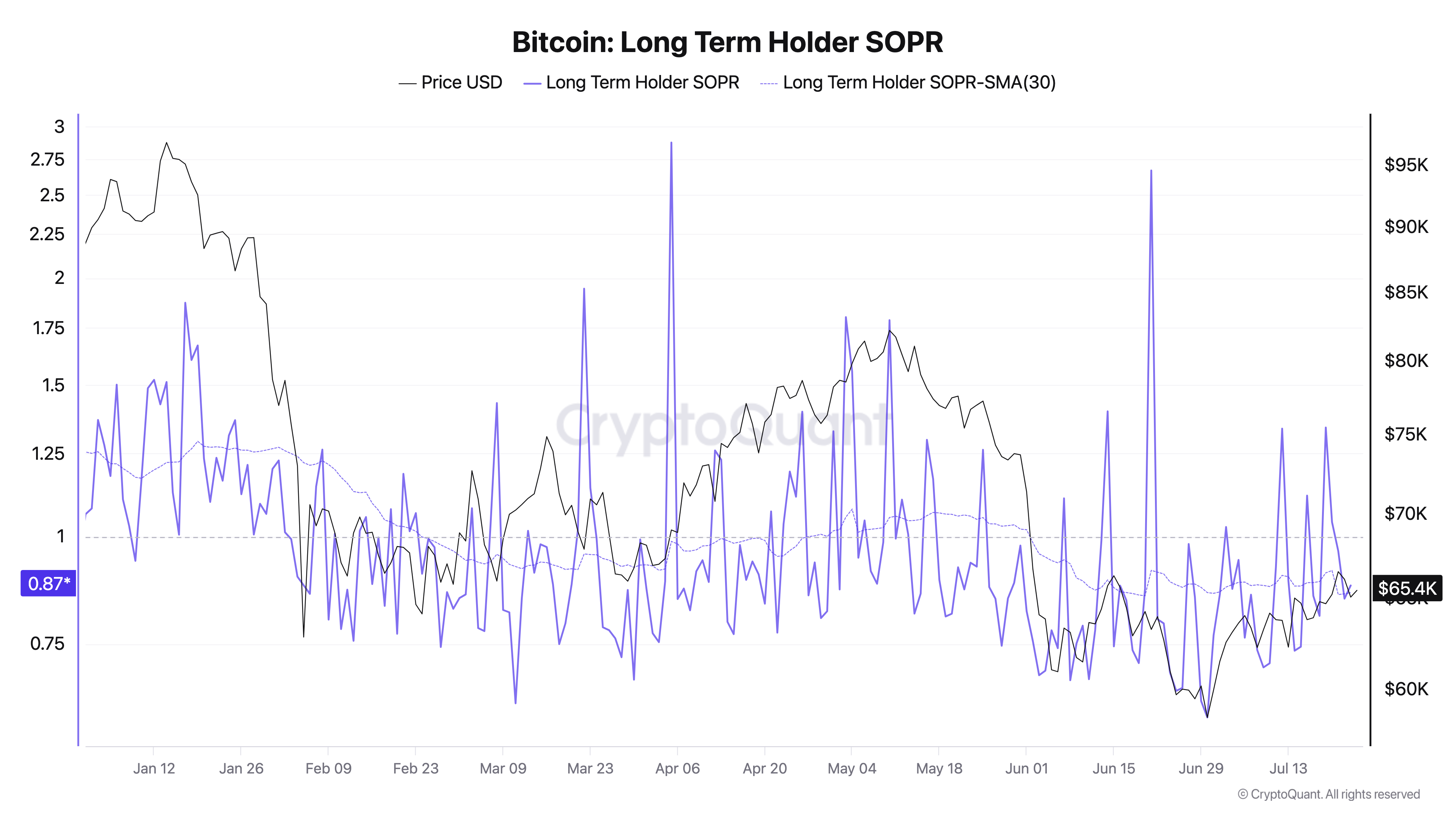
Bitcoin LTH-SOPR chart with 30-day SMA. Source: CryptoQuant
BTC investment recovery stays fragile
As Cointelegraph reported earlier, Bitcoin supply in loss crossed the 50% mark in June, a threshold that has historically preceded bear-market bottoms.
Related: Bitcoin will get ‘lift’ from Hyperliquid, Robinhood in next crypto bull market: Bitwise exec
Here, too, the data reveals similarities among Bitcoin bear markets, with the 50% loss mark sparking the final countdown to a BTC price cycle bottom in previous years.
Demand, meanwhile, appears mixed, with weak spot-market interest meeting a rebound in institutional BTC allocation.
Crypto World
Hackers’ Day | July 23: $35.5M Lost. A Reminder That Security Is a Shared Responsibility

On July 24, three major DeFi protocols lost a combined $35.5 million within just six hours, highlighting the growing importance of crypto infrastructure security. This report reviews what happened, what these incidents reveal about today’s security landscape, and why building resilient protection systems has become a shared responsibility across the entire crypto industry.
TL;DR
- July 23 became “Hackers’ Day” after three major security incidents resulted in approximately $35.5 million in losses within six hours.
- The attacks targeted cross-chain bridges and supporting infrastructure, rather than the underlying blockchains themselves.
- The incidents highlight why security today extends far beyond smart contracts, requiring stronger infrastructure, operational resilience and transparency across the industry.
- Every crypto platform has a role to play in strengthening user protection through continuous investment in security.
- At WEEX, that commitment includes a 1,000 BTC Protection Fund, 1:1 Proof of Reserves, enterprise-grade infrastructure and eight years of secure operations.
- Security is not defined by how platforms respond after attacks. It is built long before attacks happen.
A Wake-Up Call for the Entire Crypto Industry
On July 23, three separate security incidents resulted in approximately $35.5 million in losses within just six hours.
Although the affected projects belonged to different ecosystems, they shared one important message. Security is not a challenge unique to any single protocol, platform or architecture. It is a responsibility shared across the entire crypto industry.
As blockchain technology continues to evolve, so do the methods used by attackers. Every new layer of infrastructure—from bridges and validators to wallets and cloud services—creates new opportunities for innovation, but also new responsibilities for protecting users.
Rather than focusing on which project was attacked, these incidents encourage a more important discussion:
How can the industry continue building a safer environment for everyone?
Three Incidents. One Common Lesson.
| Protocol | Estimated Loss | Root Cause | Current Status |
| AFX Trade | $24.15M | Third-party bridge infrastructure | Negotiating with attacker |
| Verus Ethereum Bridge | $7.54M | Bridge import mechanism exploited | Investigation ongoing |
| B² Network | $3.86M | Investigation ongoing | Investigation ongoing |
Although the three incidents affected different projects, they revealed a common pattern: None resulted from failures of Bitcoin, Ethereum or Arbitrum themselves. Instead, attackers exploited supporting infrastructure such as cross-chain bridges and off-chain verification systems.
The industry’s infrastructure has become increasingly interconnected and so have the security challenges that come with it. As crypto continues to evolve, security must evolve alongside innovation.
Building Security for a More Connected Crypto Ecosystem
Every innovation brings new opportunities and new responsibilities.
Whether assets move through decentralized protocols, centralized platforms or cross-chain infrastructure, protecting users increasingly depends on the strength of the systems supporting them.
The events of July 23 highlight three areas the industry continues to strengthen.
- Infrastructure Resilience — Modern crypto applications rely on bridges, validators, oracles, cloud services and other interconnected components. Strengthening every layer of infrastructure has become increasingly important as ecosystems grow more connected.
- Protection Mechanisms — Security today is no longer only about preventing attacks. It also includes how platforms prepare for unexpected events through transparent reserves, operational safeguards and long-term risk management.
- User Confidence Through Transparency — Clear communication, verifiable asset protection and well-defined incident response processes all help strengthen trust when unexpected events occur.
Security is no longer a feature added after products are built. It has become a core part of building sustainable crypto infrastructure.
How the Industry Continues to Improve
Every major security incident leaves behind valuable lessons. Over the past several years, the crypto industry has continuously strengthened its security standards by investing in:
- Independent security audits
- Bug bounty and responsible disclosure programs
- Proof of Reserves
- Protection funds
- Real-time risk monitoring
- Stronger wallet security
- Better operational controls
While no platform can eliminate every risk, each improvement helps raise the overall security standard for the entire ecosystem.
Security is not a destination. It is an ongoing process of learning and improvement.
Building Security Before Incidents Happen
Every major incident reminds the industry that preparation matters more than reaction.
At WEEX, security has always been approached as a long-term commitment rather than a short-term response. Our security framework combines transparency, operational resilience and continuous investment to help protect user assets.
- 1,000 BTC Protection Fund — An additional protection reserve designed to provide greater confidence during unexpected security events.
- 1:1 Proof of Reserves — Publicly verifiable reserves that allow users to independently confirm their assets are fully backed.
- Enterprise-Grade Infrastructure — Multi-layer cold wallet management, continuous risk monitoring and strict operational controls help strengthen platform resilience.
- Eight Years of Secure Operations — Since 2018, WEEX has maintained a strong operational security record through multiple market cycles.
- Trusted by Over 10 Million Users — Long-term confidence from users around the world reflects our continued commitment to security and reliability.
- Chosen by 1 in Every 6 Crypto KOLs — Recognition from leading voices across the crypto community reinforces our focus on transparency and platform quality.
Security is not something users should only think about after an incident. It should be something they can rely on every day.
Five Safety Tips for Every Crypto User
No matter which products or platforms you use, protecting your assets should always remain the first priority.
✅ Understand how a platform protects user assets before depositing funds.
✅ Verify wallet permissions and smart contract addresses carefully.
✅ Be cautious of products promising unusually high returns.
✅ Diversify assets and avoid relying on a single protocol or platform.
✅ Evaluate transparency, operational practices and security infrastructure—not just features or returns.
Security works best when platforms, developers and users all play their part.
Final Thoughts for WEEX Users
The events of July 23 remind us that security is never a one-time achievement, it’s an ongoing commitment. Every incident pushes the industry to build stronger infrastructure, greater transparency and better protection for users.
At WEEX, that commitment guides every investment we make in security, because putting users first is the foundation of a stronger crypto ecosystem.
Disclaimer: This article is provided for informational and educational purposes only and should not be considered financial, investment, legal or cybersecurity advice. The information presented is based on publicly available sources and official statements available at the time of publication. As investigations into the referenced security incidents remain ongoing, certain details may change as new information becomes available. References to third-party projects or platforms are intended solely for factual reporting and industry analysis, and do not constitute endorsements or criticisms. Readers should conduct their own research and carefully evaluate the risks associated with any crypto platform, protocol or digital asset before making financial decisions.
About WEEX
Founded in 2018, WEEX has developed into a global crypto exchange with over 6.2 million users across more than 150 countries. The platform emphasizes security, liquidity, and usability, providing over 1,200 spot trading pairs and offering up to 400x leverage in crypto futures trading. In addition to the traditional spot and derivatives markets, WEEX is expanding rapidly in the AI era delivering real time AI news, empowering users with AI trading tools, and exploring innovative trade to earn models that make intelligent trading more accessible to everyone. Its 1,000 BTC Protection Fund further strengthens asset safety and transparency, while features such as copy trading and advanced trading tools allow users to follow professional traders and experience a more efficient, intelligent trading journey.
Follow WEEX on social media
X | Instagram | Tiktok | Youtube | Discord | Telegram
The post Hackers’ Day | July 23: $35.5M Lost. A Reminder That Security Is a Shared Responsibility appeared first on BeInCrypto.
Intel has just delivered its strongest quarter in over fifteen years, and the market reaction says it all. Q2 2026 revenue surged 25% year-over-year to $16.1 billion, crushing the consensus estimate of $14.42 billion, while adjusted EPS of $0.42 nearly doubled the expected $0.21. The stock rallied over 12% in after-hours trading following the release.
The engine behind the beat was unmistakably AI: Intel’s Data Center and AI segment jumped 59% year-over-year to $6.3 billion, with the company saying demand is now outpacing what its factories can supply. CEO Lip-Bu Tan pointed to faster production cycles and improved yields as key drivers behind the upside, while CFO Dave Zinsner said the company exceeded its guidance thanks to stronger execution.
There was a notable asterisk, however: Intel posted a GAAP net loss of $11 billion, driven by a $12.5 billion mark-to-market charge tied to its CHIPS Act agreement—a technical, non-operational hit that markets largely looked past. Looking ahead, Intel raised its Q3 guidance to a $16.3 billion midpoint, reinforcing confidence that this AI-driven turnaround has real momentum behind it.
Intel Technical Analysis
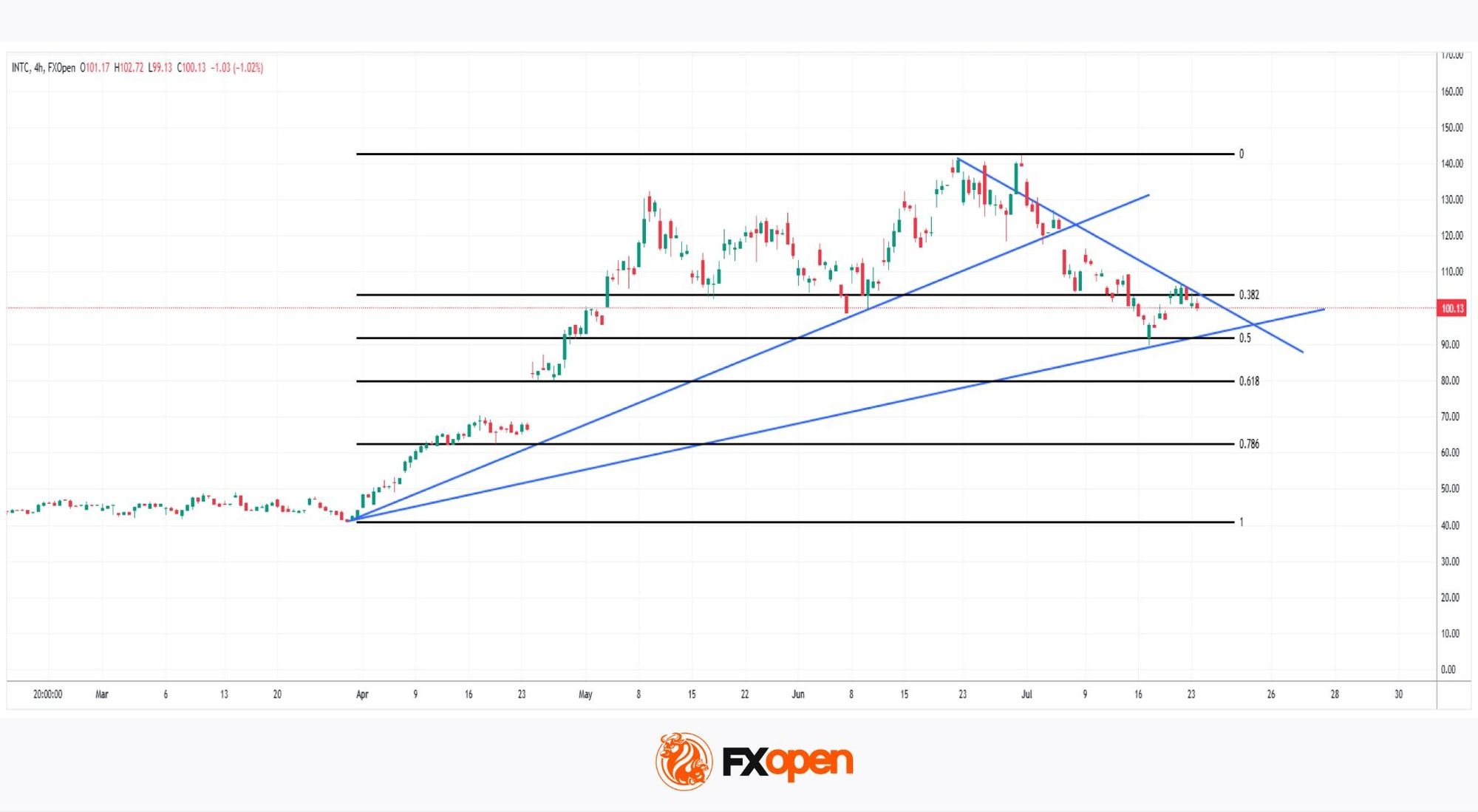
As the INTC stock chart shows, the explosive rally from March’s lows near $40 to July’s highs above $140 has since cooled into a broad falling wedge, with price now consolidating around the $100 level, sitting right between the 0.382 and 0.5 Fibonacci retracements of the entire move.
Bullish Scenario
Following yesterday’s blowout earnings, price is testing the confluence of the descending trendline from the July highs and the 0.382 retracement near $108. A confirmed breakout above this zone would suggest buyers are back in control, opening the path toward a retest of the wedge highs near $130-$140 as fresh momentum builds following the earnings catalyst.
Bearish Scenario
Conversely, a rejection at this same trendline-Fibonacci confluence would keep the price capped within the wedge, increasing the odds of a deeper pullback toward the 0.5 retracement near $94, or even the rising trendline support closer to $85-$90 if selling pressure intensifies and the earnings pop fades.
With price wedged directly between trendline resistance and key Fibonacci support, Intel’s next move looks set to be decisive. Will the earnings beat be enough to reignite the rally, or does the broader correction still have room to run?
Buy and sell stocks of the world’s biggest publicly-listed companies with CFDs on FXOpen’s trading platform. Open your FXOpen account now or learn more about trading share CFDs with FXOpen.
This article represents the opinion of the Companies operating under the FXOpen brand only. It is not to be construed as an offer, solicitation, or recommendation with respect to products and services provided by the Companies operating under the FXOpen brand, nor is it to be considered financial advice.


Odos will permanently close its decentralized exchange aggregation services on July 30, 2026, as its operating company winds down.
Summary
- Odos disables swaps July 27 and permanently closes its application, APIs, support and development afterward.
- Social-login wallet users must transfer assets or export private keys before company services disappear permanently.
- ODOS remains onchain, while the separate DAO has not yet published its future operating plans.
The company announced the move in an X thread on July 23. It did not provide a specific reason for ending operations. The announcement did not identify an acquirer, insolvency filing, security breach or regulatory order as the cause of the company’s decision to stop operating.
The shutdown affects the Odos application, APIs, support and development work. Odos said “your assets remain yours and on-chain” because the platform does not hold user tokens. However, customers who created wallets through social or email logins must act before its access tools disappear.
Odos sets a three-stage shutdown schedule
Odos disabled new account registrations, new wallet creation and new limit orders on July 23. Existing users can continue swapping and closing positions until July 27. The application will then enter read-only mode, allowing users to check balances and transaction records without initiating new activity.
All company-operated services will stop permanently on July 30. The team said there will be no further maintenance, product development or customer support after that date. Odos advised users to move to other services before the deadline.
Users who connected an external self-custody wallet do not need to withdraw funds from Odos because the aggregator never controlled those assets. The platform’s terms of use describe Odos as a routing service that searches decentralized exchanges for swap prices and sends transactions to third-party protocols rather than holding customer tokens.
Social-login wallet users must export access
The deadline applies to users who created wallets through an email or social-media login. Odos told those users to transfer their assets to another wallet or export their private keys before July 30. The company said wallet-access instructions will remain available on an official page after shutdown.
Users should complete that process carefully because a private key or seed phrase grants control over a wallet, and anyone who obtains it can move the assets. Odos warned that it will not launch a token migration, claim page, new product or airdrop during the closure process.
The team said messages offering those services are scams. It urged users not to share seed phrases or sign transactions through links that claim to support an Odos migration or relaunch. Any announcement about the ecosystem would need to come from the separate Odos DAO channels.
ODOS token and DAO remain separate
Odos said the ODOS token will continue to exist onchain after the company closes. The business does not custody the token or provide market-making, according to the announcement. The closure therefore does not automatically change the token contract, balances or transfer rules.
The Odos DAO also remains separate from the company. It plans to communicate its own next steps, but the operating team warned users not to treat that statement as a promise of continued development. No DAO transition plan had been published when the shutdown was announced.
Odos launched its DAO and tokenized loyalty program in December 2024. Binance Alpha included ODOS among a group of tokens that month, as crypto.news reported. The DAO later developed a governance process that allowed community members to submit ideas, receive feedback and move eligible proposals toward votes.
Closure follows years of multichain growth
Semiotic Labs developed Odos as a smart-order-routing system for decentralized finance. The service searched many liquidity sources to find routes for single-token and multi-token swaps. Its official website promoted swaps, limit orders, portfolio rebalancing and APIs for wallets, exchanges and institutional users.
Odos previously reported more than $25 billion in cumulative volume and 1.9 million wallets by May 2024. A later community report listed more than 147,000 monthly active wallets, over 100 API partners, 16 supported chains and more than 1,150 liquidity sources during the third quarter of 2025.
DefiLlama data viewed after the announcement placed Odos at about $102.5 billion in cumulative aggregator volume and $8.6 million in cumulative protocol revenue. Its 30-day aggregator volume stood near $1.58 billion. Those figures measure historical activity and do not explain why the operating company decided to close.
The shutdown joins other crypto service exits during 2026. As previously reported, DeFi application Legend closed after failing to reach a sustainable scale, while Satori Finance ended exchange operations after revenue no longer supported its business. Yield Guild Games also closed its publishing unit and cut jobs.
Odos users now face a shorter timetable. Swaps stop when read-only mode begins on July 27, and all services end three days later. The company has not announced a buyer, replacement operator or restart plan. The DAO may provide separate guidance, but users should rely only on verified channels.
Crypto World
Cardano Price Prediction: ADA Reclaimed Top 15 Crypto by Market Cap as Whale Accumulates

Cardano price is trading around $0.165, after large holders quietly accumulated more than 30 million ADA over the past week, bumping up its prediction. The buying briefly pushed ADA ahead of Stellar into 15th place by market cap. Although the ranking did not last, the accumulation remains notable. Santiment data suggests this was part of a steady buying trend rather than a one-off trade.
According to The Crypto Basic, large wallet ADA holdings climbed to 5.69 billion over seven days. Meanwhile, wallets holding between 100,000 and 100 million ADA reached a combined 25.6 billion ADA. That marks the highest balance in roughly three and a half years. The trend suggests bigger investors continue adding despite the recent pullback.
Charles Hoskinson has also reiterated his belief that ADA could return to the top 10 before the year’s end. Reaching that goal would require a substantial rally from current levels to overtake Dogecoin by market capitalization. Whether whales are positioning for that outcome or simply accumulating at lower prices remains the key question.
Meanwhile, capital continues rotating into select altcoins as Bitcoin and Ethereum consolidate. That backdrop could eventually support ADA if demand strengthens. Even so, traders will likely wait for technical confirmation before calling for a sustained recovery.
Discover: The Best Token Presales
Cardano Price Prediction: Can ADA Reach $0.19 This Week?
ADA is trading around $0.165, extending its long pullback. The token is testing support near $0.165, while the first resistance now sits around $0.172. A move above that level could reopen the path toward $0.180 if buying volume improves.
Some forecasting models still expect a modest recovery over the coming weeks, while a more cautious outlook continues to place stronger support near $0.148. That leaves traders watching whether the $0.165 area can hold before momentum weakens further.

Recent price action has largely reflected improving sentiment across the altcoin market instead of a Cardano-specific catalyst. As a result, ADA remains highly sensitive to overall crypto market flows. If risk appetite returns, the current dip could become another accumulation zone.
Three scenarios remain worth watching. In the bullish case, ADA defends $0.165 support, volume improves, and price rebounds toward $0.172 and $0.180. The base case sees consolidation between $0.165 and $0.172 while whale accumulation continues. However, if market sentiment deteriorates, ADA could revisit the $0.148 support, putting the recent recovery attempt at risk.
Trade Cardano and Major Altcoins on Bybit and Get a Chance to Win Our $1,000 USDT Airdrop
Maxi Doge Targets Early Mover Upside as Cardano Tests Key Levels
ADA’s accumulation story is compelling, but at a current market cap in the billions, the math on a life-changing return requires that 76% move, Hoskinson is projecting at minimum. Traders running tighter risk parameters are already eyeing earlier-stage setups where the entry price itself does more of the work. That’s the positioning logic behind presale allocations in the current cycle.
Maxi Doge ($MAXI) is an ERC-20 meme token built around a 240-lb canine mascot embodying the 1000x leverage trading mentality. Think gym-bro culture meets DeFi degenerate energy, packaged with actual utility mechanics.
The presale has raised $4.8 million at a current price of $0.000283, with dynamic staking APY available to early holders. The project offers holder-only trading competitions with leaderboard rewards, a Maxi Fund treasury earmarked for liquidity and partnerships, and meme-first marketing that has driven genuine community traction.
Dogecoin’s own price mechanics illustrate how community-driven meme assets can defy conventional valuation logic when sentiment aligns.
Research Maxi Doge here before the presale window closes.
Discover: The Best Crypto to Diversify Your Portfolio
The post Cardano Price Prediction: ADA Reclaimed Top 15 Crypto by Market Cap as Whale Accumulates appeared first on Cryptonews.

MiCA is Turning Europe Into a Licensing Test for Every Type of Crypto Company

Jon Bon Jovi Abruptly Stops His MSG Concert Early

World Cup star allegedly tests positive for drugs in overnight scandal as coach stunned


-

 Fashion7 days ago
Weekend Open Thread – Corporette.com
-

 Politics6 days ago
The House | The City of London can help the new chancellor deliver growth in every postcode
-

 Crypto World6 days ago
Ripple Payments Joins MiCA With 14 Firms, Does It Mean Anything For XRP?
-
 Crypto World7 days ago
Two July Windows Left: The CLARITY Act’s Senate Fight and What Failure Means
-

 Politics5 days ago
Democrats look to World Cup watch parties to register thousands of voters
-

 Crypto World7 days ago
Ripple wins EU-wide access as ESMA adds it to MiCA register
-

 Crypto World3 days ago
Grayscale Files For Worldcoin ETF, WLD Registers Sharp Rise
-

 Tech3 days ago
Sail Virtually Aboard The “Itanic” With IA-64 Emulator
-

 NewsBeat4 days ago
Unregistered fitter used Gas Safe logo on business flyers
-
 Tech3 days ago
Turtle Beach Command Series KB7 review: a nifty screen-equipped gaming keyboard
-

 NewsBeat7 days ago
Registration is now open for March for Men with Kev 2026
-

 News Videos5 days ago
Big Money Is Entering XRP
-
 Business2 days ago
New Jersey voter registration controversy explained: How 6,600 noncitizens got on the rolls, and what happens next
-

 Crypto World6 days ago
Kaspersky exposes OkoBot’s 20-module crypto wallet attack
-

 Business7 days ago
Airlines warn Sunshine Protection Act could disrupt flight scheduling
-
 Entertainment3 days ago
Johnny Depp’s R-Rated Gothic Cult Classic Gets New Release Ahead of Sydney Sweeney Remake
-

 NewsBeat6 days ago
Durham County Council to send out electoral registration emails
-

 Crypto World6 days ago
MiCA Licensing Faces Delays as ESMA Adds 14 CASPs to Register
-
 NewsBeat3 days ago
Shanghai science forum photos show China’s AI and robotics advances in rivalry with US
-

 Crypto World1 day ago
Ethics, other provisions in crypto Clarity Act to be further discussed
You must be logged in to post a comment Login