
Crypto World
Crypto scam network used war fear on X, says ZachXBT

On-chain investigator ZachXBT has reported a coordinated group of social media accounts that used war-related and political posts on X to direct users toward crypto scams.
Summary
- ZachXBT traced more than 10 X accounts using war panic posts to attract users into crypto scams.
- The network bought follower-rich accounts, reposted fear-driven content, then promoted fake giveaways and pump-and-dump tokens.
- On-chain data suggests the coordinated scam cluster earned six figures through misleading posts and social engineering.
His latest thread says the network included more than 10 accounts and relied on fear-driven content to gain reach during the ongoing Middle East conflict.
ZachXBT said the operators bought accounts that already had followers. They then began posting repeated negative updates about war and politics several times a day. The goal was to attract reactions from users who were already following fast-moving global events.
He described the pattern as a form of engagement farming tied to fraud. According to his thread, the accounts used emotionally charged posts to pull in views and replies. After gaining reach, the operators shifted attention toward scam content linked to crypto promotions.
ZachXBT said the scheme followed a clear sequence. The accounts would post alarming content, then use other linked accounts to repost the same messages and increase visibility. After that, they promoted fake giveaways or direct scam offers connected to crypto.
He added that the operators often changed usernames after running the campaigns. That step made the network harder to track and allowed the same accounts to appear unrelated over time. The use of several accounts also helped the group repeat the method across different topics and audiences.
Moreover, ZachXBT said some large X accounts replied to or interacted with the posts without knowing the source or purpose behind them. That activity gave the content wider exposure and helped it spread further across the platform.
He said the method relied on social engineering as much as account coordination. Users often react more quickly to negative or alarming posts, especially during war-related news cycles. That reaction can push a post higher in feeds and place scam promotions in front of more people.
On-chain data linked the network to crypto fraud
ZachXBT said 10 accounts in the monitored cluster promoted pump-and-dump crypto scams. He wrote that “on-chain evidence suggests the scheme profited six figures.” His statement tied the social media activity to financial gains rather than random spam.
He also warned about the broader risk of the tactic. ZachXBT wrote that “it’s scary to think about” how easily the same method could be used on a larger scale. He said platform manipulation should face bans and legal action because many users on X already fall for false information shared through coordinated posts.


Three presales are sitting on the table, each promising the moon, but only one is actually printing receipts. That’s the situation traders are staring at right now with BlockchainFX (BFX), NOCtura (NOC), and IPO Genie (IPO). Each project has its own pitch, its own crowd, and its own timeline. So which name actually deserves a spot in a serious 2026 portfolio, and which ones are just along for the ride?
Honestly, the answer keeps pointing back to one project. The best crypto presale chatter in May 2026 is dominated by BlockchainFX, the licensed super app that has already raised over $14.43M from 24,200+ participants and is closing fast on its $15M softcap. With a working product, real users, and the bonus code CEX60 unlocking 60% extra tokens, BFX is genuinely in a different lane.
BlockchainFX (BFX): The CEX60 Window Is Closing Fast
The current BFX presale price sits at $0.035, with a confirmed launch price of $0.05. Once that $15M target hits, the presale shuts down and BlockchainFX officially launches on exchanges. With over $14.43M already raised and 24,200+ buyers locked in, the final stretch is here. Why does that matter? Because every dollar in now is buying tokens at a discount that simply will not exist next month.
Here’s where things get interesting. BlockchainFX is the first true crypto super app, the only Web3 platform letting users trade crypto, stocks, forex, ETFs, and commodities in one dashboard. Compare that to Binance or Coinbase, which still box users inside crypto-only walls. On top of that, daily passive rewards in BFX and USDT are already flowing to holders, with staking payouts reaching up to $25,000 USDT. It’s regulated by the Anjouan Offshore Finance Authority, fully audited, and already live in beta.

Plug In CEX60 and Watch the Math Get Silly
So what does the bonus actually do? The CEX60 code, tied to the first exchange listing reveal, hands buyers 60% extra $BFX tokens, but only until June 1st at 6 PM Dubai time. A $5,000 buy at $0.035 grabs roughly 142,857 tokens, then CEX60 pushes that closer to 228,571. At the $0.05 launch price, that’s already around $11,400. Ride it to the analyst-projected $1 post-launch and the same stack flips into roughly $228,000.
Spend $100+ and qualify for the $500,000 Gleam giveaway too.
NOCtura (NOC): Privacy Layer Still Warming Up
NOCtura is currently in stage 1 of its presale at $0.1501 per token, with $102,311.31 raised against a $1.5M goal. The pitch is a Solana-native, compliance-ready privacy layer with a dual-mode wallet, letting users flip between public and fully shielded transactions using zk-proofs. Interesting tech, sure, but the numbers tell their own story when stacked next to BFX.
For context, NOC is trying to solve the privacy versus regulation tug-of-war, hiding sender, receiver, and amount details while staying compliant. It’s a niche play that could attract a specific crowd. However, with a tiny raise and a very early stage, the runway to meaningful traction is long, and that’s a polite way of putting it.
IPO Genie (IPO): Pre-IPO Access Hits a Million
IPO Genie has crossed $1.4M raised and is sitting around stage 91 or 92 of a very long presale. The project is an AI-powered platform tokenizing pre-IPO and private market deals, dropping the entry barrier to about $10 and offering AI-assisted research on potential unicorns. It’s a clever angle for retail investors locked out of Wall Street’s velvet rope.
That said, being deep into a 90+ stage structure means most of the early upside is already baked in. Buyers entering now are paying late-stage prices for a project still proving product traction. Compared to the urgency around BFX’s final stretch, IPO Genie feels more like a slow simmer than a boil.

Final Word: One Name Stands Above the Rest
Based on the latest research, the best crypto presale right now is BlockchainFX, hands down. NOCtura is too early, IPO Genie is too late, and BFX is in that rare sweet spot with a live product, regulatory clearance, real volume, and a presale about to close.
The window with CEX60 active is the cleanest entry investors will ever get. Once $15M lands, the doors shut. The best crypto presale of 2026 isn’t waiting around, and neither should anyone serious about being early.
Find Out More Information Here:
Website: https://blockchainfx.io/
X: https://x.com/BlockchainFX.com
Telegram Chat: https://t.me/blockchainfx_chat


Solana co-founder Anatoly Yakovenko called artificial intelligence the biggest near-term threat to crypto cryptography. He said AI could break post-quantum cryptography (PQC) signature schemes before the industry hardens them.
Bitcoin developers and analysts are converging on a consensus over future quantum threats without disturbing Satoshi Nakamoto’s holdings.
Yakovenko Pushes Multisig Defense for Post-Quantum Cryptography
The Solana co-founder argued the industry does not yet grasp the math or implementation weaknesses of PQC.
He wants wallets to combine multiple signature schemes through two-of-three multisig. This setup could be supported natively in Solana’s transaction processor through Program Derived Addresses.
“I think the biggest risk is that PCQ signature schemes will get broken by AI, we don’t know all the implementation footguns even, let alone the math footguns,” Yakovenko warned.
Curve Finance founder Michael Egorov asked whether formal verification could close the gap. However, according to Yakovenko, verification helps only when developers know exactly what to verify.
He still favors redundancy across two of three independent schemes.
Bitcoiners Reach Early Consensus on Satoshi’s Coins
Alex Thorn, head of firmwide research at Galaxy Digital, said a growing agreement is forming around Satoshi’s holdings. He cited talks held this week in Las Vegas with skeptics, advocates, and other Bitcoiners.
Satoshi’s estimated 1.1 million Bitcoin (BTC) sits across roughly 22,000 P2PK addresses of 50 BTC each. Thorn argued any long-range attack would have to crack each address separately. Exchanges, by contrast, can migrate to post-quantum addresses before Q-day.
He added that Bitcoin markets routinely absorb more than one million BTC of selling pressure. That suggests the network could withstand a worst-case unwind without compromising core property rights.
Whether wallet redundancy or protocol restraint offers the stronger near-term defense remains the open question as quantum research accelerates.
The post Solana’s Founder Warns AI Could Crack Post-Quantum Cryptography Schemes appeared first on BeInCrypto.


Bitcoin developers and crypto advocates are again debating how the network should handle Satoshi Nakamoto’s early Bitcoin holdings.
Summary
- Bitcoin advocates argue touching Satoshi’s coins could weaken the network’s core ownership promise for holders.
- Quantum risks have revived debate over early Bitcoin wallets and cryptographic security planning across markets.
- Developers support post-quantum research while rejecting forced action against dormant Satoshi-linked coins across Bitcoin network.
The discussion has grown as quantum computing concerns raise questions about old Bitcoin addresses and future security.
Alex Thorn, head of firmwide research at Galaxy Digital, said many Bitcoin developers and advocates agree that Satoshi’s original coins should remain untouched. He said he discussed quantum risks and Bitcoin security with several market participants in Las Vegas.
Thorn said the main concern is not only technical security. It is also about Bitcoin’s rule of ownership. He stated, “Satoshi’s coins should not be touched.” He added that violating those property rights could damage Bitcoin’s main value as a neutral money network.
Quantum risk renews debate over old wallets
The debate focuses on early Pay-to-Public-Key Bitcoin addresses. These addresses used an older structure and may become more exposed if powerful quantum computers can break current cryptography in the future.
Some users fear that Satoshi’s coins could become a large target. Thorn described the risk as lower than many people assume. He noted that Satoshi’s estimated coins sit across about 22,000 addresses, with many holding 50 BTC each. That structure would make a broad attack harder to execute.
Moreover, a major concern is what would happen if Satoshi’s coins moved or were stolen. Such an event would likely create panic, since those coins have remained untouched since Bitcoin’s earliest years.
Thorn argued that the Bitcoin market has already handled very large sell-offs in the past. He suggested that many Bitcoiners may accept even a deep drawdown rather than approve any forced action against Satoshi-linked wallets. He said, “Suffer a 50% drawdown” may be an acceptable trade-off for keeping Bitcoin’s property rights intact.
Developers still watch quantum threat
The support for leaving Satoshi’s coins alone does not mean the community is ignoring quantum computing. Developers continue to study post-quantum tools that may help protect Bitcoin users if the risk becomes more practical.
Active users, companies, exchanges, and custodians can also move funds to newer address types when needed. This makes large live wallets easier to protect than dormant coins whose owners may never return.
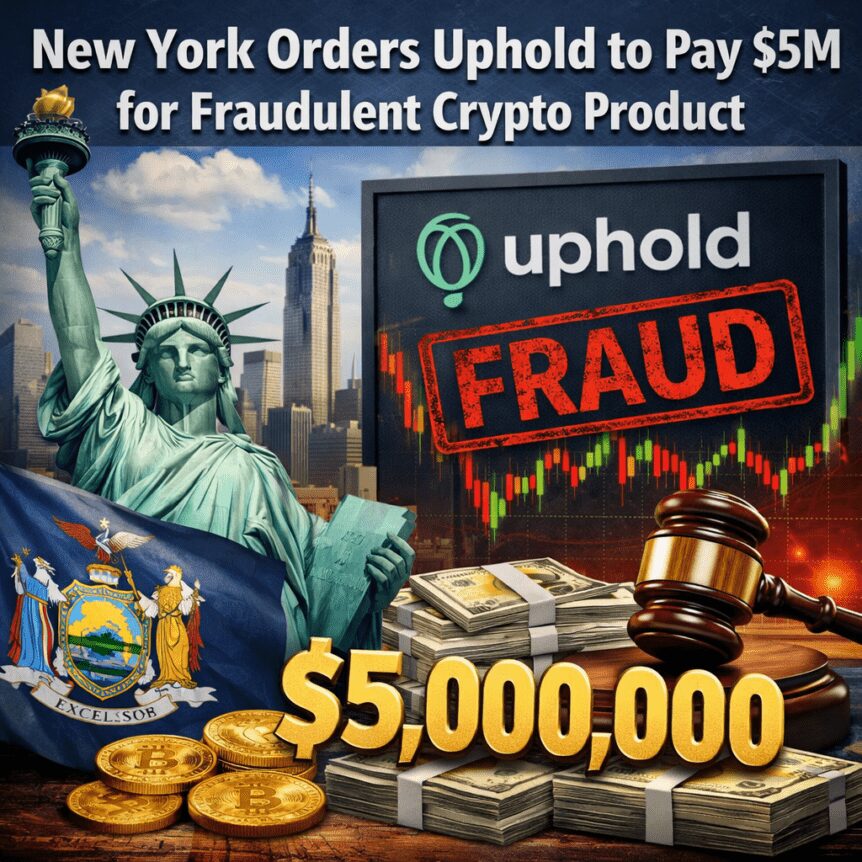
New York Attorney General Letitia James announced a settlement with Uphold, a cryptocurrency trading and wallet platform, over its promotion of CredEarn, a product offered by Cred, LLC and its CEO Daniel Schatt. The agreement secures more than $5 million in restitution to affected Uphold users and imposes ongoing compliance measures on the firm.
According to the Attorney General’s office, Uphold marketed CredEarn on its platform and mobile app between January 2019 and October 2020 as a safe, reliable savings product with attractive annual interest payments. Investigators found that Uphold did not disclose that CredEarn’s returns were generated by microloans to low-income video game players in China—borrowers typically lacking credit histories and access to traditional financial institutions. The office also determined that Uphold’s claim of “comprehensive insurance” protecting retail investors was false and not reflective of industry conditions at the time. In addition, Uphold operated without the required broker or commodity broker-dealer registration.
CredEarn’s marketing and the underlying product came under scrutiny as Cred began incurring losses from its lending practices in March 2020 and subsequently filed for bankruptcy eight months later, leaving thousands of Uphold customers affected, according to the attorney general’s announcement.
Key takeaways
- The New York attorney general secured more than $5 million in restitution for Uphold users connected to the CredEarn promotional program.
- The settlement centers on Uphold’s failure to disclose CredEarn’s risk profile and funding source, as well as a misrepresentation regarding insurance coverage and a lack of required broker-dealer registration.
- CredEarn’s returns were tied to microloans to Chinese gamers with little or no credit history, raising questions about cross-border lending and consumer protection in crypto products.
- Funds recovered from Cred’s bankruptcy estate, where Cred is owed a modest amount, will be redirected to harmed investors in addition to the direct restitution payment.
- The case illustrates ongoing regulatory focus on disclosures, licensing, and consumer protections in crypto platforms, with broader implications for enforcement trajectories in the sector.
Settlement details: Uphold, CredEarn, and the relief framework
Under the settlement, Uphold will issue $5 million directly to affected customers as restitution. The agreement also provides that any funds recovered by Cred’s bankruptcy estate— Cred is owed approximately $545,189 by the estate—will be allocated to harmed investors, where applicable. Affected Uphold users are slated to receive notice by email when the funds are deposited into their accounts.
“Investors should be able to trust the industry advice they receive,” said New York Attorney General Letitia James. “My office will always work to ensure bad actors are held accountable for endangering their customers’ financial security.”
Regulatory implications for crypto platforms and enforcement trends
The Uphold settlement adds to a widening pattern of state-level enforcement targeting misrepresentations and licensing gaps within crypto product offerings. The case reinforces expectations that platforms providing yield-generating products must clearly disclose risk factors, origin of returns, and any insurance or guarantee representations that could influence consumer decisions. It also underscores the necessity for proper registration where broker-dealer or other financial activity is involved, a point frequently cited by regulators in related proceedings.
Within a broader regulatory context, the action sits alongside a recent wave of U.S. regulatory activity. For example, New York has pursued actions against major exchanges over unregistered or allegedly inappropriate activities, and federal authorities have asserted jurisdiction in related areas of crypto markets, sometimes triggering jurisdictional tensions between state regulators and federal agencies such as the CFTC. The evolving framework contrasts with ongoing EU developments under the Markets in Crypto-Assets Regulation (MiCA), which seeks to harmonize licensing and consumer protections across member states, highlighting differing approaches to licensing, compliance, and cross-border supervision.
From a compliance perspective, the Uphold case reinforces ongoing scrutiny of advertising practices, disclosures, and insurance representations across crypto platforms. It also spotlights scrutiny of cross-border lending activities and the need for robust KYC/AML controls when platforms offer high-yield products funded by microloan-type portfolios. For institutions and exchanges, the decision signals heightened attention to registration status, permissible lending activities, and transparent risk communication in product marketing.
Legal and historical context: licensing, insurance claims, and cross-border considerations
The settlement draws a clear line on several fronts. First, Uphold’s lack of broker or commodity broker-dealer registration was a central factor in the enforcement action. Second, the assertion that CredEarn carried comprehensive insurance was deemed inaccurate, reflecting a broader industry reality in which retail investors did not have such protections at the time. Third, the cross-border element of CredEarn’s loan portfolio—financing microloans to borrowers in another country—highlights the regulatory complexities that arise when crypto platforms offer yield products tied to non-domestic lending markets.
In the larger policy context, the case illustrates how state authorities are blending consumer protection with securities-law considerations in crypto-for-investment products. It also underscores the importance for platforms to align their practices with evolving licensing regimes, cross-border compliance requirements, and rigorous disclosures aimed at safeguarding retail investors.
As enforcement posture continues to tighten, market participants should monitor developments in New York’s regulatory framework, parallel actions by other states, and the ongoing interplay between state and federal authorities in the United States, as well as the international regulatory landscape shaped by MiCA and related standards.
Closing perspective: The Uphold settlement demonstrates the growing emphasis on licensing compliance and transparent, substantiated marketing in crypto offerings, a trend likely to influence platform structuring, product design, and investor protection measures in the near term.


BlackRock has urged the Office of the Comptroller of the Currency to revise parts of its proposed GENIUS Act rules.
Summary
- BlackRock asked the OCC to remove a proposed cap on tokenized stablecoin reserve assets.
- The asset manager wants reserve rules based on liquidity, credit quality, and maturity risk.
- BlackRock’s BUIDL fund is gaining use as institutional collateral across crypto trading platforms.
The request centers on tokenized reserve assets and the assets that stablecoin issuers may hold.
BlackRock filed a comment letter asking the OCC to drop a proposed limit on tokenized reserve assets. The firm opposed a possible 20% cap under draft rules for permitted payment stablecoin issuers.
The asset manager argued that risk should depend on credit quality, maturity, and liquidity. It said the use of a distributed ledger should not decide whether an asset qualifies as safe or unsafe. The argument raises doubts around treating tokenized Treasury products differently from traditional versions.
GENIUS Act reserve rules face debate
The GENIUS Act created a federal framework for payment stablecoins in July 2025. The OCC’s proposal seeks to apply that framework to issuers under its supervision, including rules for reserves, redemptions, custody, and reporting.
The OCC proposal says stablecoin issuers must hold reserve assets that are diverse enough to manage credit, liquidity, interest rate, and price risks. It also says issuers should not rely too much on one financial institution or a small group of custodians.
BlackRock also asked the OCC to expand eligible reserve assets. Reports said the firm wants clarity that Treasury exchange-traded funds can qualify as stablecoin reserves when they meet safety and liquidity standards.
The OCC draft already lists several reserve assets. These include U.S. cash, Federal Reserve balances, demand deposits, Treasury bills, Treasury notes, Treasury bonds with 93 days or less to maturity, repo assets, reverse repo assets, and certain government money market funds.
The draft also allows some approved reserves in tokenized form. However, it asks whether the OCC should limit tokenized reserves to a set percentage, including a possible 20% cap.
BUIDL use grows in crypto markets
The comment letter comes as BlackRock’s tokenized Treasury fund, BUIDL, gains wider use in crypto market infrastructure. OKX recently added BUIDL to its institutional collateral system with Standard Chartered.
Eligible institutional and VIP clients can use BUIDL as trading margin. Standard Chartered will hold the collateral off-exchange, while OKX handles margining and liquidation.
BUIDL invests in cash, U.S. Treasury bills, and repurchase agreements. Crypto.news reported that clients keep ownership of the fund and its yield while using it inside OKX’s margin system.
New York Attorney General Letitia James has secured more than $5 million from cryptocurrency platform Uphold over its role in promoting a fraudulent investment product.
The settlement centers around Uphold’s promotion of CredEarn, a product offered by Cred, LLC and its CEO Daniel Schatt. Between January 2019 and October 2020, the platform marketed CredEarn to users on its platform and mobile app as a safe, reliable savings product with attractive annual interest payments.
However, Uphold didn’t tell customers that Cred was generating those returns by making microloans to low-income video game players in China, who are typically borrowers with no credit histories and no access to traditional financial institutions, the Attorney General’s office said in an announcement.

Source: NY AG James
Uphold also told customers that Cred carried “comprehensive insurance,” a claim the Attorney General’s office found to be false. No such insurance protecting retail investors from digital asset losses existed in the industry at the time. On top of the misleading promotion, Uphold was operating without the required broker or commodity broker-dealer registration.
Related: Canada Proposes Crypto ATM Ban to Tackle Scams, Money Laundering
Cred collapse hits Uphold users
Cred began racking up losses from its risky lending practices in March 2020 and filed for bankruptcy eight months later, leaving thousands of Uphold customers around the world holding the bag, according to the announcement.
Under the settlement, Uphold will pay $5 million directly to affected customers, more than five times the fees it collected from the arrangement. Any funds Uphold recovers from Cred’s ongoing bankruptcy proceedings, where it is owed $545,189, will also be passed on to harmed investors. Affected users will be notified by email when the funds hit their accounts.
“Investors should be able to trust the industry advice they receive,” James said, “and my office will always work to ensure bad actors are held accountable for endangering their customers’ financial security.”
Related: US Gov’t Sues Four States, RWAs Cross $30 billion
New York’s legal run-up with CFTC
Last month, New York sued Coinbase and Gemini, claiming their prediction market offerings violated state gambling laws.
The CFTC fired back by suing New York in federal court, arguing that federal law gives it sole authority over prediction markets and asking for a permanent injunction to block the state’s enforcement actions.
Magazine: AI-driven hacks could kill DeFi — unless projects act now

The US crypto sector is unlikely to lose momentum even if the CLARITY Act, the proposed framework intended to bring sharper regulatory guidance to digital assets, stalls in Congress. That is the view of Chris Perkins, chief executive of 250 Digital Asset Management, who told Cointelegraph’s Chain Reaction podcast that the industry should not hinge on a single bill. Perkins argued that the two key US regulators are already laying down workable frameworks that could outlive any one legislative effort.
Perkins pointed to ongoing work by the U.S. Securities and Exchange Commission (SEC) and the Commodity Futures Trading Commission (CFTC), particularly the agencies’ joint interpretation issued in March on how federal securities laws apply to crypto assets. He framed this as a crucial step toward real policy certainty, predictability, and a formal taxonomy for digital assets, rather than a political ideal.
Key takeaways
- Regulatory progress in the US is continuing independently of CLARITY Act passage, with ongoing policy work from the SEC and CFTC shaping the landscape.
- Token classification as securities has evolved from a “death sentence” to a pathway for structured compliance, thanks to deliberate policy creation and precedent.
- Passing the CLARITY Act could embed regulatory clarity for a long horizon, making it harder for future administrations to unwind the framework.
- The latest stablecoin yield provisions have intensified hopes that the CLARITY Act could move forward soon, signaling potential legislative momentum.
Regulatory momentum persists beyond a single bill
On the Chain Reaction podcast, Perkins emphasized that the two regulators are actively building a more coherent framework for digital assets. The March joint interpretation—reported as a synchronized stance by the SEC and CFTC—offers a concrete roadmap for compliance and enforcement that can endure beyond shifts in political leadership. Perkins called this development a meaningful advance, arguing that it provides certainty, stability, and a usable taxonomy for market participants.
“They’re creating policy and precedent every single day, and they are giving us the one thing we’ve needed for a very long time: certainty, stability, and ultimately a taxonomy,” Perkins said. He noted that the political climate around crypto regulation has shifted since earlier eras when token classifications as securities could trigger aggressive enforcement and delistings, leaving little room for compliant pathways in the United States.
Perkins did not frame CLARITY Act passage as the sole determinant of the industry’s fate. Rather, he suggested that even if the bill does not advance, the momentum created by regulators and the evolving framework would keep the market on a more navigable course. In his view, the direction of travel matters just as much as the destination, and that direction appears to be toward greater regulatory legitimacy.
CLARITY Act: a potential anchor for policy
Industry sentiment has grown more positive about CLARITY Act prospects in light of other regulatory developments. The article notes that the timing around the bill could be linked to broader regulatory negotiations, including the freshly published stablecoin yield provisions that have been the subject of bipartisan discussion in Congress.
Coinbase chief legal officer Faryar Shirzad weighed in on the moment, posting after Senators Thom Tillis and Angela Alsobrooks released a final text intended to resolve the stablecoin yield dispute between the banking and crypto sectors. Shirzad urged lawmakers to “get CLARITY done,” signaling industry enthusiasm for a clear and durable framework that could govern a broad swath of digital assets, not just stablecoins.
The bill’s potential to constrain future administrations from easily unwinding regulatory policy is a recurring theme among supporters. Perkins argued that once a law is enacted, unwinding it becomes more arduous, which he sees as a stabilizing factor for the industry. The saying that “it takes an act of Congress to do something” resonates with the view that legislative clarity could be a shield against abrupt reversals in policy direction.
Regulators’ emphasis on clear classifications and accountable oversight also aligns with broader market needs. Investors, traders, and builders want predictable rules around custody, exchanges, disclosure, and anti-fraud measures. If CLARITY Act advances, proponents contend, the US could offer a more stable environment for capital formation and innovation, reducing the risk of abrupt regulatory shifts that have previously unsettled the market.
What readers should watch next
The conversation around CLARITY Act remains closely tied to ongoing negotiations over stablecoins and the broader regulatory posture toward digital assets. Several senators have publicly weighed in on timing and necessity. Senator Bernie Moreno has signaled that he expects the CLARITY Act to be resolved by the end of May. On April 11, Senator Cynthia Lummis warned that “it’s now or never” for getting a resolution. These remarks underscore the continued political interest in providing a definitive, workable framework for crypto markets in the near term.
Analysts and industry participants will be watching several cross-cutting factors: the pace of the SEC-CFTC collaboration on enforcement and rulemaking; the specifics of any final CLARITY Act language and how it clarifies asset categorization, registration requirements, and compliance infrastructure; and the potential alignment of stablecoin governance with traditional financial regulatory regimes. The market will also be attentive to how regulators respond to new technologies and business models that emerge as crypto markets mature, such as on-chain finance tools, tokenized assets, and decentralized platforms that intersect with conventional banking rails.
In the longer run, Perkins and others argue that the most consequential outcomes may be less about any single bill and more about the durability of the policy framework that emerges. If the current policy trajectory yields a robust taxonomy and enforceable rules, the industry could benefit from stronger institutional participation, clearer pathways to listing and trading tokens, and more predictable interactions with banks and other financial partners. If not, the steady march of regulatory development—driven by the SEC, CFTC, and other federal agencies—could still deliver the clarity that the market has sought for years.
As the debate continues, readers should monitor updates on regulatory interpretations, the progress of the CLARITY Act, and the evolving stance of lawmakers on stablecoins, as these elements will collectively shape the operating environment for crypto companies, investors, and users across the United States.


Iran’s largest crypto exchange, Nobitex, is facing fresh scrutiny after Reuters reported that two brothers from Iran’s influential Kharrazi family founded the platform under an alternative surname.
Summary
- Reuters said Nobitex was founded by brothers from a powerful political family under another surname.
- Nobitex denied state links while investigators cited transactions tied to sanctioned Iranian entities and users.
- Crypto withdrawals from Nobitex rose sharply after Tehran strikes, though analysts differed on the cause.
The report comes as blockchain data shows rising crypto movements from Iran during conflict-related stress. Nobitex has denied government links and said it does not assist state bodies.
Ali and Mohammad Kharrazi founded Nobitex in 2018 using the surname Aghamir. The report said the brothers are part of a powerful Iranian family with deep political and clerical ties.
Nobitex has grown into Iran’s largest crypto exchange. Reuters reported that the platform claims 11 million users and handles an estimated 70% of Iran’s crypto transactions.
Exchange denies state connection
Reuters said blockchain records and interviews pointed to transactions linked to sanctioned Iranian entities, including the central bank and the Islamic Revolutionary Guard Corps. The report said Nobitex has become part of a parallel financial system used outside normal banking channels.
Nobitex rejected the claims of direct state links. The company told Reuters it is a “private and independent business” and said it had no relationship or contract with the IRGC, Iran’s central bank, or other government bodies.
Moreover, the report adds to long-running concerns about crypto use in sanctioned economies. Reuters cited blockchain analysis and investigators who said Nobitex has helped move funds beyond Western financial controls.
Crystal Intelligence executive Nick Smart told Reuters that Nobitex creates a difficult compliance issue because normal Iranian users and state-linked activity may share the same platform. He said it is “hard to separate the regime from the people.”
Outflows rose after Tehran strikes
The scrutiny also follows a sharp rise in Iranian crypto withdrawals after U.S. and Israeli airstrikes on Tehran. Crypto.news reported that Nobitex withdrawals jumped more than 700% within minutes of the strikes.
Elliptic data showed users withdrew more than $500,000 shortly after the first strikes. The figure later reached nearly $3 million between February 28 and March 1.
Crypto.news also cited Elliptic as saying Nobitex lets users convert rials into crypto and withdraw funds to outside wallets. That process can help users move money abroad when banking routes remain limited.
TRM Labs gave a more cautious view. It said the activity may have reflected lower transaction volume caused by internet blackouts, not only capital flight. Iran’s internet connectivity fell about 99% after the strikes began.

Key Takeaways
- A prominent crypto executive believes the digital asset sector will remain resilient regardless of whether the CLARITY Act becomes law
- Current regulatory agencies are already establishing frameworks that provide necessary guidance for cryptocurrency companies
- A bipartisan agreement on stablecoin yield restrictions emerged from Senators Tillis and Alsobrooks, resolving the legislation’s primary roadblock
- The compromise prohibits yield structures resembling traditional bank deposits while permitting rewards linked to genuine user engagement
- Major industry players including Coinbase, Circle, and the Blockchain Association endorsed the framework and called for swift committee action
Legislative momentum for the CLARITY Act accelerated following a breakthrough agreement on one of its most contentious provisions — the treatment of stablecoin yield payments. Yet despite this progress, a leading cryptocurrency executive maintains the sector’s prospects remain strong with or without congressional action.
During an appearance on Cointelegraph’s Chain Reaction podcast Friday, Chris Perkins, who leads 250 Digital Asset Management as CEO, expressed confidence in the industry’s current regulatory environment, regardless of new federal legislation.
Perkins highlighted the work being done by the Securities and Exchange Commission under Chair Paul Atkins and the Commodity Futures Trading Commission led by Chair Michael Selig. According to him, both agencies are actively developing policies and establishing crucial precedents.
“These regulators are delivering exactly what we’ve desperately needed — predictability, consistency, and most importantly, clear classification standards,” Perkins explained.
He emphasized a fundamental transformation in how securities classification impacts cryptocurrency ventures. During Gary Gensler’s tenure as SEC Chair, receiving a security designation typically triggered enforcement actions, exchange delistings, and regulatory dead ends. The landscape has fundamentally shifted.
“Previously, securities classification spelled disaster for projects. Today, it actually provides a viable regulatory pathway,” Perkins observed.
Perkins acknowledged that formal legislation would offer greater permanence against future policy reversals. “Congressional action creates durable frameworks — reversing statutory law proves exponentially more difficult,” he noted.
Breakthrough on Stablecoin Rewards
Friday brought the release of compromise language from Senators Thom Tillis and Angela Alsobrooks addressing stablecoin yield provisions, which represented the bill’s last significant hurdle.
The revised framework prohibits cryptocurrency platforms from distributing interest or yield on stablecoin holdings that functionally replicate traditional bank deposit products. Conversely, it permits reward structures connected to authentic platform engagement and transaction activity.
Companies will need to transition their incentive programs away from passive holding strategies toward models that reward active platform participation.
Blockchain Association CEO Summer Mersinger characterized the agreement as meaningful progress. She cautioned that continued regulatory uncertainty drives innovation and investment away from American shores.
Dante Disparte, Circle’s Chief Strategy Officer, offered unqualified support for the compromise, citing USDC’s expanding role in payment systems and capital markets infrastructure.
Coinbase faced particularly high stakes in the outcome. CEO Brian Armstrong responded to the released text with “Mark it up” on social media. Paul Grewal, the company’s Chief Legal Officer, confirmed the language safeguards reward programs connected to legitimate platform usage.
Lingering Industry Questions
While the Crypto Council for Innovation expressed support for the legislation, the organization identified potential concerns. CEO Ji Hun Kim noted the current language extends beyond last year’s GENIUS Act, which restricted only issuer-paid rewards. The updated provisions apply more broadly across digital asset market participants.
Despite reservations, Kim advocated for advancing the bill. “Our fundamental objective remains ensuring American leadership in cryptocurrency innovation,” he stated on X.
Senator Bernie Moreno projected the CLARITY Act would secure passage before May concludes. Senator Cynthia Lummis declared in April: “This represents our window of opportunity.”
The Senate Banking Committee had previously delayed markup proceedings scheduled for January.

Key Takeaways
- Recent Bitcoin ETF activity brought approximately $1.9 billion in fresh capital inflows
- Ethereum spot ETFs recorded around $101 million in net inflows on the first day of May, while Bitcoin ETFs attracted $630 million
- Solana remains under observation due to ecosystem expansion, transaction efficiency, and potential ETF approval prospects
- XRP continues attracting attention for its cross-border payment use case and responsiveness to regulatory developments
- Dogecoin delivered its most impressive monthly performance in nine months, surpassing both Bitcoin and XRP returns
As May unfolds, cryptocurrency market participants are focusing their attention on a select group of digital assets with compelling narratives. While Bitcoin maintains its position as the dominant cryptocurrency, Ethereum, Solana, XRP, and Dogecoin are capturing interest for distinct strategic reasons. Exchange-traded fund activity, regulatory developments, and renewed retail participation are influencing which tokens appear on investor radars this month. This analysis doesn’t suggest guaranteed price appreciation across all five assets—rather, it examines the specific factors making each worthy of close monitoring.
Bitcoin
Bitcoin possesses the most robust institutional adoption narrative entering May. The aggregate cryptocurrency market capitalization has climbed to approximately $2.6 trillion, with Bitcoin trading in the upper-$70,000 territory.
United States spot Bitcoin ETF capital flows have strengthened considerably, with data indicating roughly $1.9 billion in recent institutional demand. May 1st alone witnessed approximately $630 million in net capital flowing into Bitcoin spot ETFs.
Exchange-traded fund movements have emerged as a critical barometer for Bitcoin demand because they reflect participation from established, regulated financial institutions. The primary consideration is that Bitcoin has already mounted a substantial recovery from previous lows, meaning any deceleration in institutional flows could create headwinds near technical resistance zones.
Ethereum
Ethereum is capturing market attention as demand momentum builds, despite trailing Bitcoin in recent price appreciation.
Ethereum spot ETFs registered approximately $101 million in net inflows on the first trading day of May. Ethereum continues serving as the foundational infrastructure for decentralized finance protocols, stablecoin issuance, asset tokenization, and blockchain applications.
This comprehensive utility profile provides broader investment appeal compared to most major cryptocurrency assets. Some market participants are awaiting more decisive price momentum before increasing their allocation.
Solana
Solana ranks among May’s most closely monitored alternative cryptocurrencies. This prominent Layer-1 blockchain platform has gained recognition for transaction throughput, active retail trading, and new project launches.
Market observers are tracking network enhancements and the potential introduction of a regulated Solana spot ETF product. CoinDCX highlighted that Solana interest correlates with anticipated protocol improvements and the possibility of institutional capital access through approved exchange-traded funds.
While Solana confronts competition from Ethereum scaling solutions and alternative high-performance blockchains, its technical capabilities and engaged user community maintain its prominence on altcoin watchlists.
XRP
XRP maintains close scrutiny from retail market participants, particularly during periods of U.S. cryptocurrency regulatory activity. The asset features a well-defined cross-border payments thesis and benefits from an established, vocal community.
Recent market commentary has included XRP in discussions surrounding ETF developments and cryptocurrency sector rotation. The Motley Fool referenced that Ethereum, Solana, and XRP exchange-traded funds all experienced inflows during a recent timeframe, while emphasizing that brief periods of positive flows don’t necessarily establish durable trends.
XRP demonstrates pronounced sensitivity to regulatory announcements. Should policy developments disappoint or retail enthusiasm wane, price momentum can reverse rapidly.
Dogecoin
Dogecoin recorded its strongest monthly performance in nine months, delivering returns that exceeded both Bitcoin and XRP during that timeframe. This resurgence has returned the token to retail investor watchlists throughout social platforms and trading applications.
Unlike the other cryptocurrencies discussed here, Dogecoin lacks comparable fundamental value propositions. Price movement is predominantly influenced by market sentiment, social media trends, and general risk appetite among traders.
During periods when market participants demonstrate increased willingness toward speculative positioning, meme-oriented cryptocurrencies like Dogecoin frequently experience accelerated price action.
Final Thoughts
These five cryptocurrencies each present distinct narratives driving investor consideration throughout May 2026. Bitcoin commands attention through institutional capital flows. Ethereum dominates decentralized finance and Web3 infrastructure development. Solana represents a high-growth Layer-1 alternative. XRP connects to payment solutions and regulatory outcomes. Dogecoin reflects retail market sentiment and meme cryptocurrency dynamics.
According to the latest available data, Bitcoin ETF inflows constitute the strongest verifiable demand indicator currently visible in the market, with alternative cryptocurrency interest strengthening alongside improving overall crypto market sentiment in May.

Bitcoin Holders suddenly have a MAJOR PROBLEM

Hartlepool and Middlesbrough football fans banned

How redistricting and the Supreme Court have cut voters out of US House races

Manchester United reach agreement with Casemiro over contract clause amid transfer speculation

US brings back mandatory military draft registration

Steven Gerrard disagrees with Gary Neville over ‘shock’ Chelsea and Arsenal claim | Football
![Sick Luke - MONEY MACHINE (feat. Lazza & Tony Effe) [Official Visual]](https://wordupnews.com/wp-content/uploads/2026/02/1770843044_maxresdefault-80x80.jpg)

-

 Tech6 days ago
Register Renaming | Hackaday
-

 Politics6 days ago
Drax board avoid their own AGM, accused of greenwashing & environmental racism
-

 Tech6 days ago
Why Blue Badges Disappeared From Toyota Hybrids
-

 Tech6 days ago
Images of Samsung’s rumored smart glasses have leaked
-
 Sports7 days ago
IPL 2026: Ruturaj Gaikwad registers slowest fifty of the season, enters all-time unwanted list | Cricket News
-
 Tech2 days ago
Trump’s 25% EU auto tariff breaches Turnberry Agreement that also covers semiconductors and digital trade
-

 Fashion4 days ago
Kylie Jenner’s KHY Enters a New Era with ‘Born in LA’
-

 Business5 days ago
Most Commercial Energy Audits Miss the Real Losses
-

 Crypto World5 days ago
CFTC’s AI will review U.S. crypto registration applications, chairman tells CoinDesk
-

 Business6 days ago
(VIDEO) Charlize Theron Climbs Times Square Billboard to Promote New Netflix Thriller ‘Apex’
-

 Business4 days ago
Barclay Brothers Avoid Bankruptcy: HSBC Drops High Court Petitions After IVA Deal
-
 Sports2 days ago
Paul Scholes issues Marcus Rashford reality check as agreement emerges over Man United star
-
 Entertainment6 days ago
Alicia Keys Calls Out Music Industry ‘Boys Club’
-
 Business4 days ago
Tesla Officially Registers Elon Musk’s Stock: What Investors Need to Know
-

 Tech5 days ago
Get Ready for More Brain-Scanning Consumer Gadgets
-

 Tech7 days ago
Dyson Vacuums And The Curse Of Cooked Capacitors
-
Crypto World5 days ago
Robinhood Phishing Scam Exploits Gmail Dot Feature to Bypass Security
-

 Crypto World7 days ago
Only 3% of traders drive Polymarket’s accuracy, not the crowd, study finds
-

 Entertainment6 days ago
Sister Wives: Janelle Posts New Scary Warning
-

 Crypto World5 days ago
Gmail Dot Trick Underpins Robinhood Phishing, Sending Real-Looking Emails
You must be logged in to post a comment Login