
Crypto World
Crypto VC funding: Kaiko leads $180M week



Crypto and blockchain companies announced at least $180.25 million in disclosed financing across nine deals from Sep. 12 to Sep. 18. Crypto market data provider Kaiko led the week with a $110 million round backed by several major financial institutions.
Summary
- Nine crypto companies announced funding during the week, with disclosed capital totaling $180.25 million.
- Kaiko secured $110 million in the week’s largest transaction, led by S&P Global.
- Fin.com raised $20 million to expand its stablecoin-based cross-border payment infrastructure.
- dtcpay added $15 million, taking its combined Series A funding to $25 million.
- Payments, tokenized credit, and institutional infrastructure accounted for most disclosed funding.
Fin.com followed with a $20 million seed round, while stablecoin payment company dtcpay added $15 million to its Series A. Funding activity centered on market data, stablecoin payments, tokenized credit, and institutional financial infrastructure.
Data from Crypto Fundraising and company announcements showed seven deals with disclosed amounts and two investments with undisclosed terms. The total excludes acquisitions announced during the period, including S&P Global’s purchase of OpenZeppelin and Independent Research Forum’s deal for Nomina.
Kaiko raises $110 million from financial institutions
Kaiko secured $110 million in the largest crypto financing announced during the week. S&P Global led the transaction, with BNP Paribas, Nasdaq, Royal Bank of Canada, Bpifrance, and Susquehanna also participating.
The New York-based company provides market data, indices, reference rates, and other services covering more than 150 crypto exchanges and decentralized protocols. Kaiko said it would use the capital to improve its data services and expand its product range.
The investment followed an earlier agreement combining Kaiko’s digital asset indices and reference rates with S&P Dow Jones Indices’ crypto products under the S&P Kaiko Digital Asset Indices brand.
Participation from S&P Global, Nasdaq, and several large banks tied the week’s biggest round to growing institutional demand for regulated crypto data. Kaiko’s US operations also place it within a market where exchanges, asset managers, and financial companies need reliable pricing data for trading, tokenization, and investment products.
Fin.com secures $20 million seed round
Payments infrastructure company Fin.com raised $20 million in a seed round backed by Expa, Coinbase Ventures, Tenet Fund, and Second Sight Ventures. Expa founder and Uber co-founder Garrett Camp also participated.
Fin.com combines stablecoin infrastructure with local banking networks to help businesses send and receive cross-border payments. Its platform offers multi-currency accounts, fiat and stablecoin wallets, foreign exchange services, and embedded compliance through one application programming interface.
The company says its network connects businesses with regulated payment systems in more than 30 countries and supports over 40 currencies. Fin.com targets fintech companies, payroll providers, online marketplaces, and other businesses that would otherwise need separate banking connections in each market.
Coinbase Ventures’ participation gives the round a direct US link, while the company’s use of stablecoins reflects continued investor interest in connecting blockchain settlement with existing payment systems.
dtcpay adds $15 million to Series A
Singapore-based dtcpay received another $15 million in Series A financing from SBI Holdings and Genedant Capital. The investment took the company’s combined Series A funding to $25 million following an earlier $10 million close in March.
The company operates a regulated payment platform that allows businesses to accept, exchange, and settle fiat currency and stablecoin payments. Its products include checkout tools, point-of-sale payments, payment links, multi-currency swaps, and Visa card services.
SBI’s investment adds a large traditional financial group to dtcpay’s shareholder base. The company plans to expand its payment infrastructure and serve more businesses in retail, hospitality, and cross-border commerce.
The round was counted as $15 million in fresh weekly financing rather than the full $25 million cumulative Series A total.
Tare raises $13.25 million for onchain credit
Tare raised $13.25 million in seed financing for its blockchain-based credit infrastructure. Blockchain Capital led the round, with Janus Henderson Investors, Strobe Ventures, The Venture Dept, Neoclassic Capital, and the Avalanche Foundation participating.
Aave founder Stani Kulechov and Privy co-founder Henri Stern also joined the financing.
Tare is developing infrastructure for loan origination, servicing, portfolio monitoring, securitization, and structured finance. Its system uses Avalanche-based settlement and smart contracts while keeping much of the blockchain process out of the user interface.
The company’s target market includes loan originators and institutional investors seeking a shared record for private-credit transactions. The deal extended the week’s investment pattern beyond payments and into tokenized real-world assets.
Projects raising $10 million
- Finloop raised $10 million in Series A financing from HSBC and People’s Capital. The Hong Kong-based company provides AI-supported wealth-management services covering funds, bonds, structured products, digital assets, and tokenized real-world assets. The database records the transaction separately from a $10 million Series A announced in July 2025.
- Velocity secured $10 million in additional Series A financing at a reported $200 million valuation. Haun Ventures, Mirana Ventures, Circle Ventures, Ripple, Visa, and Translink Capital participated. The company develops stablecoin treasury and settlement services for businesses, payment providers, and financial institutions.
Funding under $10 million
- Tenka completed a $2 million pre-seed round led by Maven 11 Capital, with Gami Capital participating. The London-based company is building infrastructure for asset-backed finance and private credit, including standardized deal vaults, independent valuations, onchain reporting, and a secondary matching system. Tenka plans to launch its platform later in 2026.
Undisclosed strategic rounds
- PonyGo received an undisclosed investment from Pantera Capital. The project describes itself as a Web3 financial platform spanning asset management, yield products, real-world assets, token launches, and travel services. The investment was excluded from the disclosed weekly total.
- Rep closed an undisclosed angel round backed by Amber Group and a group of individual crypto investors. Rep is developing a portable reputation network that links verified onchain activity, social accounts, achievements, and community contributions to user-controlled profiles.



Singapore payment company dtcpay completed its $25 million Series A funding round, led by Vertex Ventures Southeast Asia & India in April, and now further anchored by Japanese financial conglomerate SBI Group.
The round also drew participation from Genedant Capital and existing investor Kwee Liong Tek.
The investment reflects institutional confidence in dtcpay ‘s vision of making stablecoins as seamless and accessible as traditional financial services, it said on Friday.
“We did not raise this round to sustain what we have built. We raised it to fundamentally change how money moves across borders,” said Alice Liu, founder and CEO of dtcpay.
Dtcpay made a series of early moves in the stablecoin payments space, and now the dtcpay Visa card enables spending across both fiat and stablecoins at more than 150 million merchant locations worldwide.
Payment system for in-store and online transactions
Cointelegraph reported in 2023 that dtcpay had launched a payment system using fiat and cryptocurrencies for in-store and online payments. It followed up in 2024 by reporting that dtcpay phased out support for cryptocurrencies like Bitcoin in favor of stablecoin-only transactions.
The completion of the Series A brings together a diverse group of investors that can contribute expertise as well as funds to drive the company’s growth.
Vertex Ventures Southeast Asia & India, part of Vertex Holdings, a wholly owned subsidiary of Temasek Holdings, led the initial tranche of the round. Vertex brings extensive experience scaling technology companies.
Related: Fragmented regulations limit stablecoin adoption in international finance: WTO head
SBI Group operates across banking, securities, insurance, asset management and digital assets.
Genedant Capital is a Singapore-based fund management firm licensed by the Monetary Authority of Singapore with over $2 billion in assets under management and advisory.
Dtcpay is licensed by the Monetary Authority of Singapore and also holds an Electronic Money Institution license in Luxembourg.
The company is authorized to deliver regulated payment services across the European Economic Area and also holds licenses and registrations in Hong Kong, Australia, the United States and Canada.
Magazine: 10 of the greatest unsolved crypto mysteries


Anthropic is weighing two key decisions as the firm plans to debut in public markets this year.
One concerns the timing of the listing, the other what it ships before the roadshow begins. Each decision may shape how investors price what could be the largest listing ever.
Anthropic Sets a November IPO Window
The Wall Street Journal reported that Anthropic is targeting November, later than the October listing investors expected. Advisers say the delay lets Anthropic show third-quarter financials before it meets investors.
Reuters reported separately that the listing could slip past the November midterm elections. Furthermore, according to the New York Times, Anthropic could release its offering documents publicly within weeks. The people also added that the plans could still change.
Concerns over AI safety have meanwhile pushed one rival’s plans back. OpenAI cleared the calendar this month, with Sam Altman ruling out a 2026 listing and calling the moment ill-advised.
Follow us on X to get the latest news as it happens
Astra Puts A Clock On The Second Decision
In addition to the IPO timing, three sources told Reuters that Anthropic is evaluating a new model after OpenAI released Astra on September 3. A safety review forms part of that decision.
The review sits against the case Chief Executive Dario Amodei made last week, in a 3,800-word essay titled We Must Pace the Frontier.
“We must slow the pace at which we improve the capabilities of AI models,” he said.
OpenAI’s Astra has seen strong enterprise adoption. The model took about 13% of enterprise AI spending tracked by Ramp. Claude Fable held roughly 8%.
OpenRouter also said its users spent more on OpenAI than Anthropic last week. That had not happened in over two years. Prospective backers want to know if Anthropic’s hold on enterprise AI is loosening, after a long stretch in which that position looked settled.
Meanwhile, Anthropic is expected to top $100 billion in annualized revenue by year’s end, against $65 billion in July. Investors are using that curve to argue for a valuation near $2 trillion.
However, investors who expect to buy into both offerings told Reuters that Astra has not dented Anthropic’s lead. Whether Anthropic ships a model before the roadshow will show investors which version of the pacing argument it is making.
Subscribe to our YouTube channel to watch leaders and journalists provide expert insights
The post Anthropic's Path to the Public Markets Just Got 2 New Developments appeared first on BeInCrypto.


U.S. spot crypto exchange-traded products recorded about $70.7 million in combined net outflows during the Sep. 14–18 trading week, as withdrawals from Ether funds outweighed demand for Bitcoin, Solana, and Hyperliquid products.
Summary
- Spot Bitcoin ETFs ended the week with a modest $6.1 million net inflow after attracting $433 million on Friday.
- Spot Ether ETFs lost about $140.6 million, extending their weaker flow trend despite a $143.7 million Friday rebound.
- Solana ETFs took in $60.7 million, led by $47.6 million entering Bitwise’s BSOL on Friday.
- Hyperliquid ETFs recorded $3.1 million in weekly net inflows after three positive sessions offset Tuesday’s withdrawals.
- The flows came during a volatile week in which the Federal Reserve raised interest rates by 25 basis points, and Bitcoin later reclaimed $80,000.
According to data from Farside Investors, the four U.S. crypto ETF categories tracked by the firm diverged sharply during the week. Bitcoin products recovered from $746.3 million of combined withdrawals on Tuesday and Wednesday, while Ether ETFs failed to erase their midweek losses.
Solana funds drew fresh capital in four of the five sessions, including their strongest day of the week on Friday. Hyperliquid products also finished positive, although their $3.1 million weekly gain remained small compared with flows into the larger crypto funds.
Bitcoin ETFs erase most weekly losses with $433M Friday inflow
U.S. spot Bitcoin ETFs posted a net inflow of $6.1 million for the week after two large redemption days nearly pushed the group to a steep weekly loss.
The funds began with a $159.9 million inflow on Monday before losing $450.4 million on Tuesday and $295.9 million on Wednesday. Investors returned on Thursday with $159.5 million, followed by $433 million on Friday, the largest daily inflow of the week.
BlackRock’s IBIT led the weekly rankings with $120.6 million in net inflows. Fidelity’s FBTC followed with $79.9 million after drawing $310.7 million on Friday, the biggest single-fund inflow recorded that day.
Morgan Stanley’s MSBT added $13.2 million, while Franklin Templeton’s EZBC received $4.6 million. The gains were partly offset by $141.9 million in withdrawals from ARK 21Shares’ ARKB and $62.3 million from Grayscale’s GBTC. Bitwise’s BITB lost $2.7 million, and VanEck’s HODL shed $5.3 million.
The late reversal coincided with Bitcoin’s return above $80,000 on Friday. The asset had come under pressure earlier in the week as the Federal Reserve raised its target rate by 25 basis points to 3.75%–4.00%, its first increase in more than three years. Bitcoin later rallied as oil prices eased and crypto-linked stocks recovered.
Ether ETFs post $140.6M weekly outflow
U.S. spot Ether ETFs recorded approximately $140.6 million in net withdrawals, making Ether the weakest of the four crypto ETF categories covered by Farside.
The group attracted $121.1 million on Monday but lost $142 million on Tuesday, $224.1 million on Wednesday and $39.3 million on Thursday. A $143.7 million Friday inflow reduced the weekly deficit without fully reversing it.
BlackRock’s ETHA accounted for a net weekly outflow of $56.1 million despite taking in $114.3 million on Friday. Fidelity’s FETH lost $25.9 million, while Bitwise’s ETHW shed $33.1 million.
Grayscale’s ETHE posted $31.4 million in withdrawals. VanEck’s ETHV lost $10.3 million, 21Shares’ TETH shed $1.9 million, and Invesco’s QETH recorded a $5.4 million outflow.
BlackRock’s ETHB and Grayscale’s lower-fee ETH fund moved in the opposite direction, taking in $7 million and $16.2 million, respectively. Farside’s daily totals contain rounded fund-level figures, which can produce small differences when individual entries are added.
Ether’s negative weekly result widened the gap with Bitcoin products. Bitcoin ETFs recovered nearly all of their midweek redemptions, while the Friday demand for Ether funds covered only part of the $405.4 million withdrawn across the prior three sessions.
Solana ETFs draw $60.7M as BSOL leads Friday demand
Farside’s Solana ETF data showed $60.7 million in net inflows for the week, the strongest total among the four tracked crypto assets.
Solana funds received $11 million on Monday, $1.3 million on Tuesday and $800,000 on Wednesday. Thursday ended with no net movement before Friday’s inflow reached $47.6 million.
Bitwise’s BSOL generated $58.7 million of the weekly total. Grayscale’s GSOL contributed a net $2 million after a $3.9 million Monday inflow was partly offset by a $1.9 million withdrawal on Wednesday.
The remaining Solana products reported no net flows during the week. Friday’s $47.6 million allocation went entirely to BSOL, giving the Bitwise fund almost 97% of the category’s weekly net intake.
Hyperliquid ETFs add $3.1M during mixed week
Hyperliquid ETFs ended the week with $3.1 million in net inflows. The products recorded no movement on Monday, followed by a $3.9 million outflow from Bitwise’s BHYP on Tuesday.
Flows turned positive during the rest of the week. 21Shares’ HYPG received $1.7 million on Wednesday, while Thursday brought $1.9 million into BHYP and $2.4 million into 21Shares’ THYP. BHYP added another $1 million on Friday.
The combined weekly data left Bitcoin funds close to flat, Ether products in net redemptions and the two smaller altcoin categories positive. Across all four categories, approximately $70.7 million exited on a net basis, with the $140.6 million Ether outflow exceeding the combined inflows into Bitcoin, Solana and Hyperliquid funds.
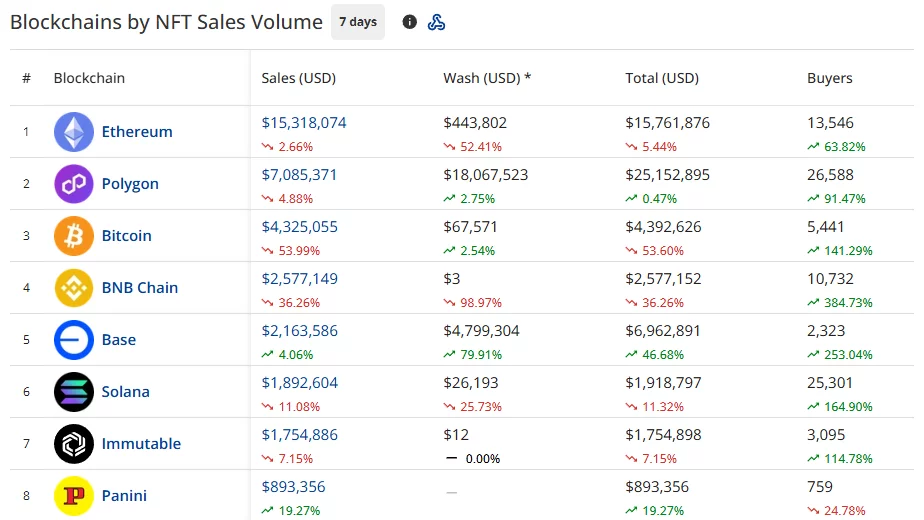
Global NFT sales volume fell 15.28% to $37.54 million over the latest seven-day period, even as the number of buyer and seller addresses more than doubled.
Summary
- NFT sales dropped 15.28% to $37.54 million, from approximately $44.31 million a week earlier.
- Buyer addresses rose 174.04%, while seller addresses increased 151.72%.
- Ethereum led with $15.32 million in sales despite a 2.66% weekly decline.
- Bitcoin NFT sales plunged 53.99% to $4.33 million.
- Courtyard led collections, while Alchemix V3 Transmuter #219 sold for $770,985.
According to data from CryptoSlam, captured on Sep. 19 with the “7 Days” setting selected, NFT sales declined while participation measures moved sharply higher.
Buyer addresses increased 174.04% to 114,977, while seller addresses rose 151.72% to 108,037. Those figures represent blockchain addresses rather than confirmed individual users.
The number of NFT transactions moved in the opposite direction, falling 9.08% to 808,432. The combination of more active addresses and fewer transactions showed that activity was spread across a larger pool of wallets, though CryptoSlam’s figures alone do not show whether those addresses belonged to new market participants.
The NFT decline occurred alongside a rebound in the wider crypto market. Bitcoin traded near $81,311, and Ethereum changed hands at approximately $2,647 when the market data was checked. The total cryptocurrency market capitalization stood near $2.79 trillion, according to CoinGecko.
The NFT and cryptocurrency market moves were concurrent, but the available data did not establish a direct causal relationship between them.
Ethereum leads NFT sales with $15.3 million
Ethereum remained the leading blockchain for organic NFT sales, generating $15.32 million during the seven-day period. Sales decreased 2.66%, while buyer addresses climbed 63.82% to 13,546.
The network also recorded $443,802 in wash-trading volume, down 52.41%. Including that activity, Ethereum’s total volume reached $15.76 million, a 5.44% decline.
Polygon ranked second by organic sales with $7.09 million, down 4.88%. The blockchain recorded 26,588 buyer addresses, up 91.47%.
Wash trading played a much larger role in Polygon’s figures. CryptoSlam identified $18.07 million in wash volume, lifting the network’s combined total to $25.15 million. Organic sales and wash trading are separate measures and should not be added when assessing ordinary NFT purchases.
Bitcoin placed third with $4.33 million in sales, representing a 53.99% weekly drop. Buyer addresses nevertheless climbed 141.29% to 5,441. The contrast showed that more Bitcoin addresses interacted with NFTs even as the dollar value of recorded sales fell.
BNB Chain followed with $2.58 million, down 36.26%. Its buyer count rose 384.73% to 10,732, the largest percentage increase among the six leading blockchains.
Base was the only top-five network to record higher organic sales. Volume increased 4.06% to $2.16 million, while buyer addresses surged 253.04% to 2,323. CryptoSlam also recorded $4.8 million in wash volume on Base, up 79.91%.
Solana ranked sixth with $1.89 million in sales, down 11.08%. Its 25,301 buyer addresses represented a 164.90% increase.
Together, the six leading networks generated approximately $33.36 million in organic sales, accounting for nearly 89% of the global total.
Courtyard tops weekly NFT collection sales
Courtyard on Polygon remained the leading NFT collection with $6.3 million in sales, down 0.93%. The tokenized collectibles marketplace recorded 123,504 transactions, up 21.52%, involving 18,459 buyer addresses and 14,921 seller addresses.
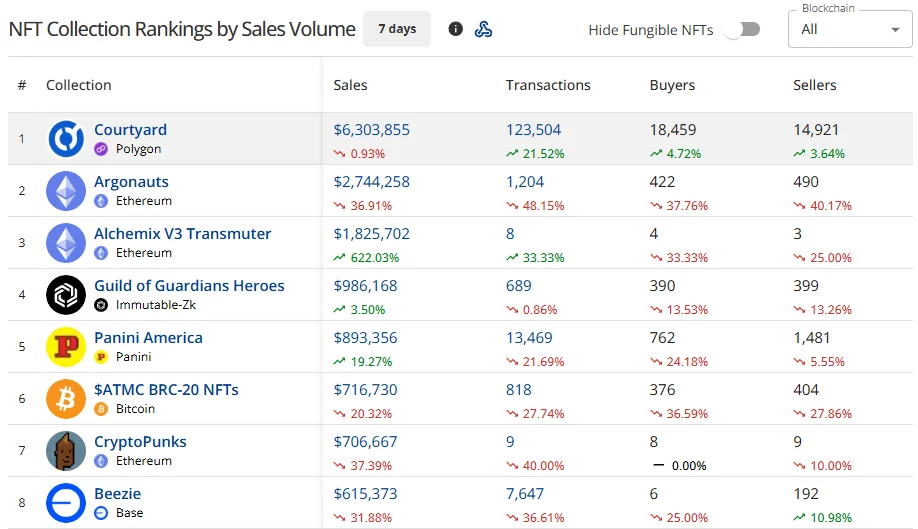
Ethereum-based Argonauts ranked second with $2.74 million, following a 36.91% decline. Transactions dropped 48.15% to 1,204, while buyer and seller addresses fell to 422 and 490, respectively.
Alchemix V3 Transmuter placed third after sales jumped 622.03% to $1.83 million. Almost all that volume came from eight transactions involving four buyer and three seller addresses.
The concentration matters because Alchemix V3 Transmuter tokens appear to be linked to positions within a decentralized finance protocol rather than conventional artwork or profile-picture collectibles. CryptoSlam classified the transfers as NFT sales, but the dashboard did not independently establish the economic purpose of each transaction.
Guild of Guardians Heroes on Immutable-Zk generated $986,168, up 3.5%. Its 689 transactions involved 390 buyer addresses and 399 seller addresses.
Panini America ranked fifth with $893,356 in weekly sales, an increase of 19.27%. The sports collectibles collection recorded 13,469 transactions, although buyer addresses declined 24.18% to 762. The collection provided a direct link to the U.S. sports card segment within the week’s NFT rankings.
Bitcoin-based $ATMC BRC-20 NFTs followed with $716,730, down 20.32%. CryptoPunks placed seventh with $706,667 after sales declined 37.39%, with nine transactions involving eight buyers and nine sellers.
Alchemix leads high-value NFT sales
Alchemix V3 Transmuter tokens accounted for four of the five largest individual transactions recorded during the seven-day period.
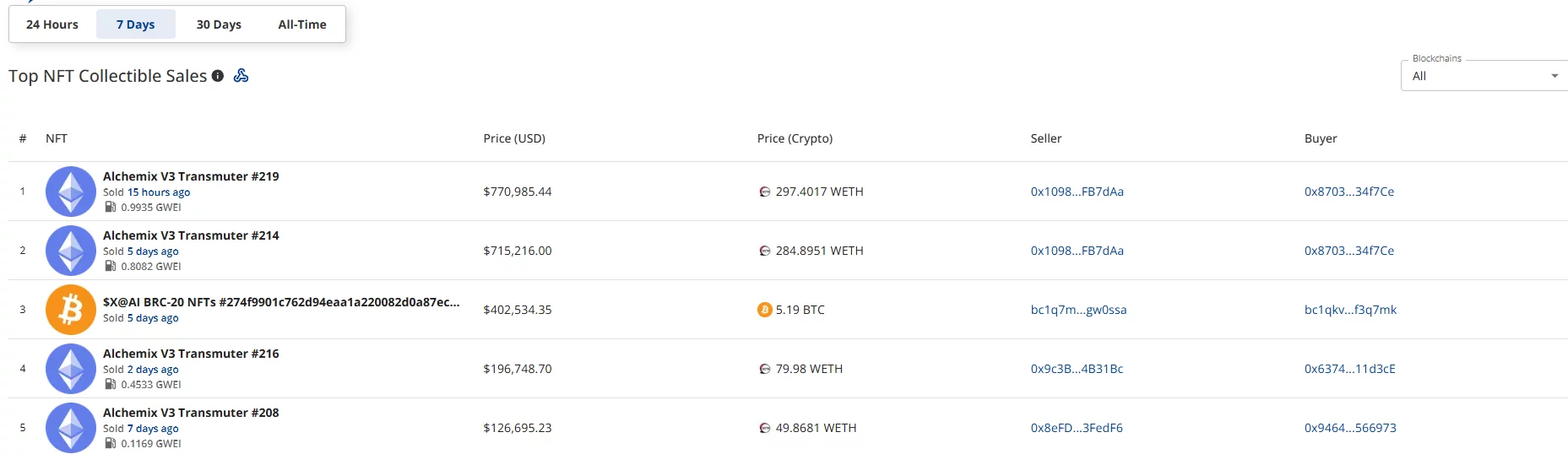
Alchemix V3 Transmuter #219 led the list at $770,985.44. The Ethereum-based token changed hands for 297.4017 WETH about 15 hours before the dashboard snapshot.
Alchemix V3 Transmuter #214 ranked second with a $715,216 sale settled in 284.8951 WETH five days earlier. The two leading tokens were sold by and transferred to the same respective blockchain addresses.
The third-largest sale came from Bitcoin. A $X@AI BRC-20 NFT sold for $402,534.35, or 5.19 BTC, five days before the snapshot.
Alchemix V3 Transmuter #216 followed with a $196,748.70 transaction involving 79.98 WETH two days earlier.
Alchemix V3 Transmuter #208 completed the top five after selling for $126,695.23, or 49.8681 WETH, seven days earlier. Together, the four Alchemix transactions generated approximately $1.81 million, accounting for nearly all the collection’s reported weekly sales.
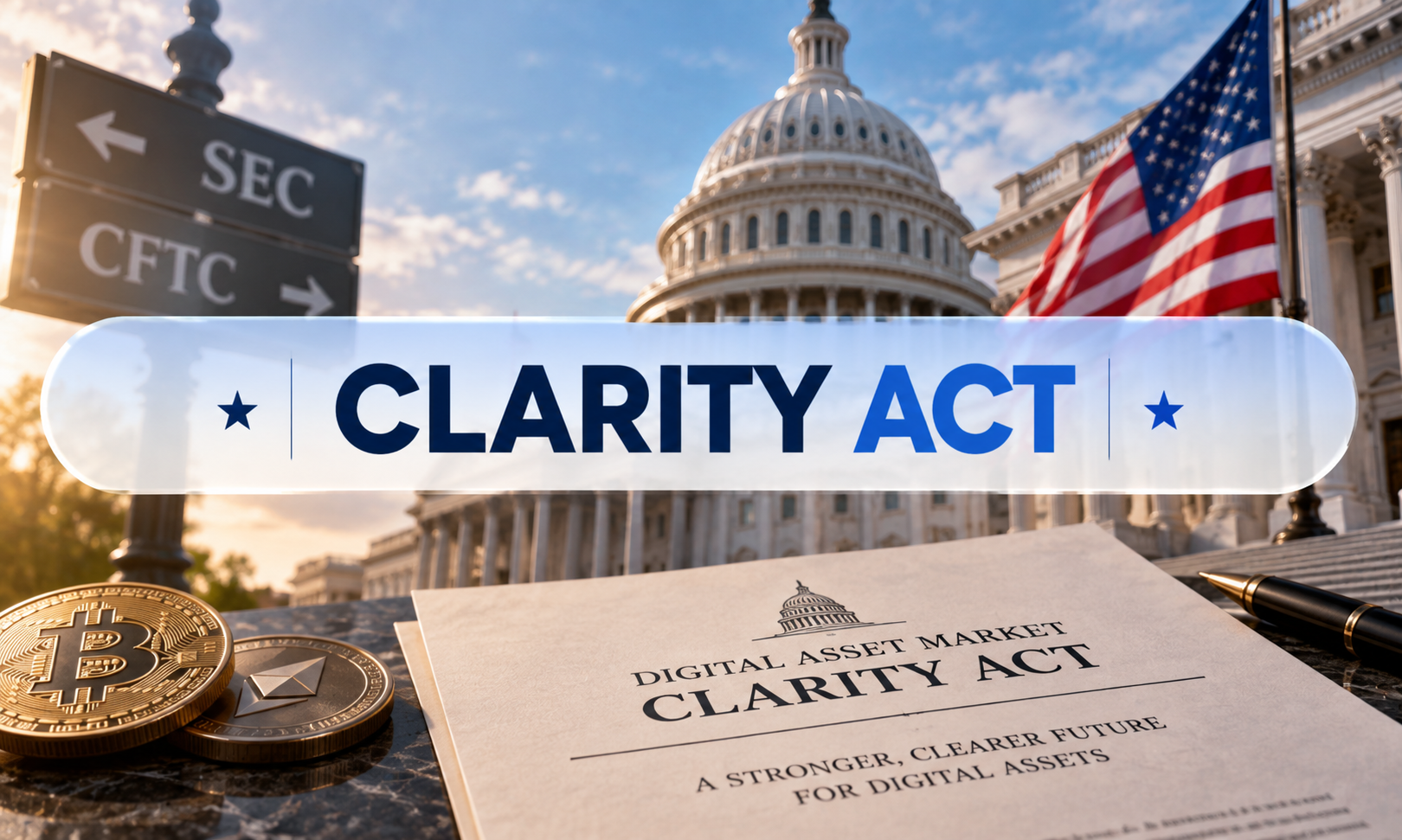
It was a massive week for the entire cryptocurrency industry, with essentially nothing going its way, and yet bitcoin managed to seemingly weather the storm, especially from the bigger blow – the failure of the CLARITY Act.
The cryptocurrency’s price dropped to a multi-week low at $75,000 immediately after the US Senate voted against advancing the key bill on September 15, but has since recovered all losses and even exceeded $81,000 on Friday.
Uncertainty; Not a New Crackdown
CryptoPotato reached out to several prominent crypto experts to see what their take is on the vote, which fell short of the 60 senators required to move the legislation forward. Alvin Kan, COO at Bitget Wallet, noted that the result should not be interpreted as Washington reversing its stance on the digital asset industry by imposing new restrictions.
“The CLARITY Act’s failure to advance has preserved the current US regulatory patchwork,” he said.
The legislation’s core idea was to establish clearer boundaries between the SEC and the CFTC and create federal rules covering the crypto markets and intermediaries. Its failure, though, leaves much of that work with regulators instead of Congress.
Kan explained that the vote did not introduce new restrictions on self-custody or self-hosted wallets. However, protections included in the proposed legislation remain without the stronger statutory foundation the bill could have provided. Some of those included provisions covering users controlling their own assets and developers providing non-custodial software.
Bitget Wallet’s COO argued that continued uncertainty affects smaller companies disproportionately. For instance, recent data from Electric Capital indicated that the US share of global crypto devs has dropped from 38% in 2015 to 19%. The country also captured somewhere between 2% and 5% of centralized-exchange volume growth between 2024 and 2025.
What Comes Next?
The CLARITY Act is not technically dead, as a procedural vote by Senator Thom Tillis preserves the possibility of reconsideration, although the legislative calendar makes passage this year increasingly difficult. Meanwhile, the two main regulatory bodies in the country are expected to continue using their existing authority.
The SEC already moved this week to introduce a five-week exemption facilitating certain tokenized-stock trading, showing that regulatory development can continue even without Congress, something that Bitwise’s CIO predicted.
Iliya Kalchev, Nexo Dispatch analyst, commented on BTC’s price reaction, indicating that the $3,000 drop to $75,000 should not be dismissed easily. However, the subsequent rebound shows that the vote was “already priced in beforehand, as markets treated a failed vote as the likely outcome for weeks; so this looked more like confirmation than surprise.”
“The US has already shown it will legislate crypto piece by piece when the politics allow it, and there is little reason to think market structure ends up the permanent exception,” he concluded.
The post Bitcoin Survived the CLARITY Act Setback: What Happens Next? appeared first on CryptoPotato.
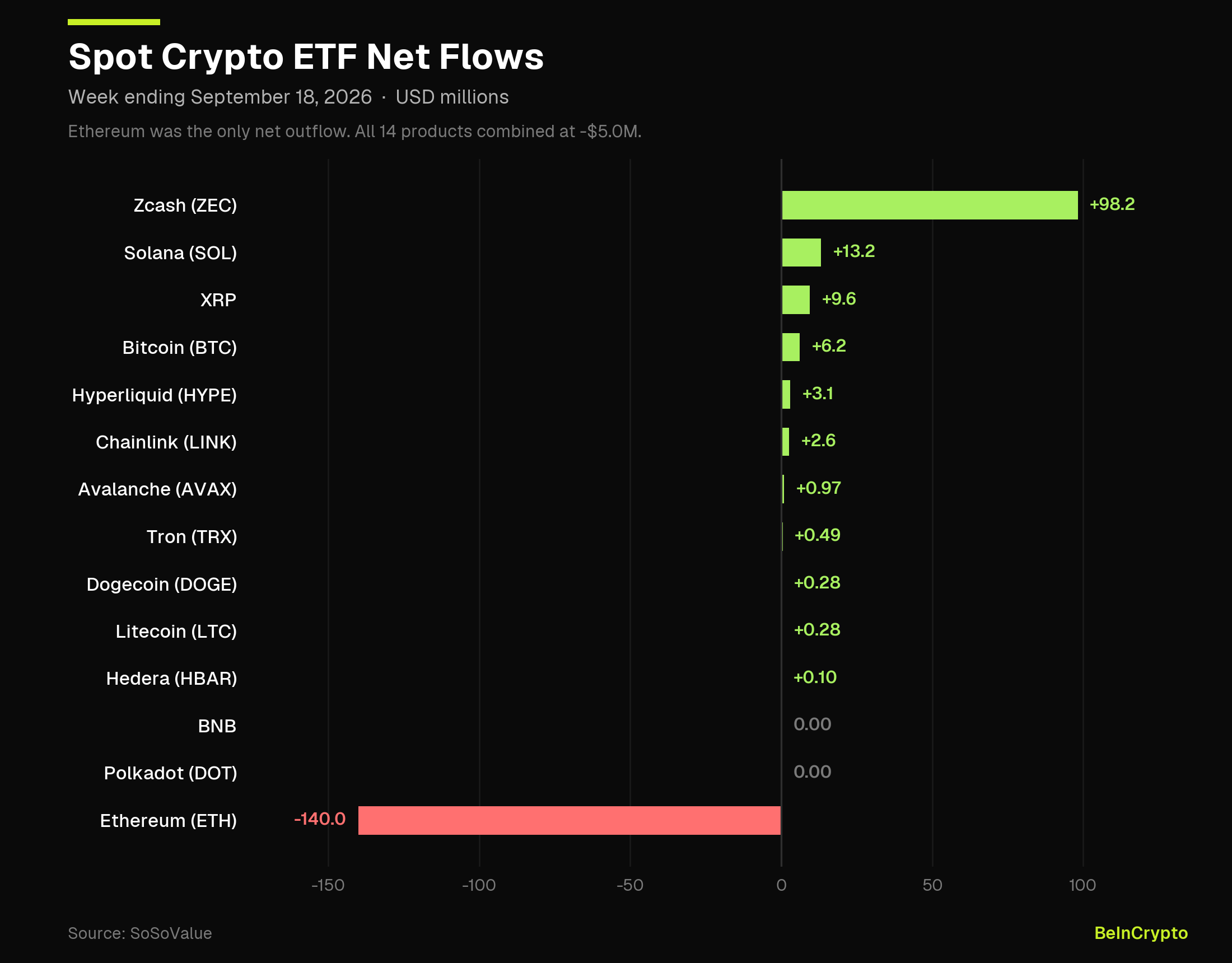
Zcash (ZEC) spot exchange-traded funds (ETFs) drew $98.2 million in the week ending September 18, the largest inflow among 14 crypto products. Ethereum (ETH) funds posted the only outflow at $140 million.
The weekly totals mask a volatile round trip. Both Ethereum and Bitcoin (BTC) products sold off hard midweek, and only one of them recovered in time.
Two Bad Days in Washington, Then a Scramble Back
Both complexes opened the week in the green. Bitcoin ETFs took in $160.04 million on Monday, while Ethereum products added $121.02 million.
That reversed on Tuesday, when the Senate rejected cloture on the Digital Asset Market CLARITY Act by 49-50. Bitcoin funds lost $450.33 million that session, their worst of the week.
Then the Fed raised rates 25 basis points to a range of 3.75% to 4% on Wednesday, its first increase since 2023. Bitcoin shed another $295.98 million, and Ethereum lost $224.11 million.
Bitcoin turned on Thursday and pulled in $433.03 million on Friday, recovering the $746.31 million it lost across the two policy sessions. Its weekly total landed at $6.2 million, the smallest absolute figure in 141 weeks of trading.
Ethereum took longer to turn. Its outflows ran for three straight sessions and totaled $404.82 million before a $143.80 million Friday, leaving the week short.

Follow us on X to get the latest news as it happens
A Four-Week-Old Fund Outdraws Everything Else
Meanwhile, the Zcash ETF has now logged four consecutive positive weeks since launching in late August, taking in $271 million in total. Assets jumped 40.5% last week to $914.5 million.
That makes Zcash the third-largest altcoin ETF product, behind XRP (XRP) and Solana (SOL) and ahead of nine others. Trading volume reached $11.42 billion, or 32.5% of all spot crypto ETF turnover.
Solana added $13.2 million, extending a streak to 12 straight positive weeks. XRP took in $9.6 million, roughly half the previous week’s $19 million.
Hyperliquid (HYPE) flipped to a $3.1 million inflow after losing $26.4 million. Chainlink (LINK), Avalanche (AVAX), Tron (TRX), Dogecoin (DOGE), Litecoin (LTC), and Hedera (HBAR) together drew under $4.8 million, while BNB and Polkadot (DOT) recorded no flows at all.
Net flows across all 14 products totaled negative $5 million, against a 4.89% rise in combined assets to $123.9 billion. Whether buyers chase the rebound or keep sitting it out should show in next week’s figures.
Subscribe to our YouTube channel to watch leaders and journalists provide expert insights
The post Which Crypto ETF Drew the Most Money Last Week? Not Bitcoin, and Not Ethereum appeared first on BeInCrypto.


Former banking official gets four years in prison over false letters of credit and accepting $470,000 in cryptocurrency bribes.


In this week’s edition of the weekly recap, the Federal Reserve raised interest rates for the first time since 2023, the CLARITY Act stalled in the Senate, and the SEC opened a five-year pathway for tokenized U.S. stock trading.
Summary
- The Federal Reserve raised its benchmark rate by 25 basis points to 3.75%–4%, while 16 of 18 officials projected at least one more increase in 2026.
- The CLARITY Act failed to advance after the Senate voted 50–49 on a cloture motion that needed 60 votes.
- The SEC granted five years of conditional relief for eligible platforms to trade tokenized U.S. stocks.
- House committees advanced separate crypto tax and Strategic Bitcoin Reserve bills.
- Circle launched the Arc mainnet with USDC gas, institutional validators and 22 supported fiat stablecoins.
Fed raises rates for first time since 2023
- The Federal Reserve raised its benchmark interest rate by 25 basis points to a range of 3.75%–4% on Sep. 16. All 12 voting Federal Open Market Committee members supported the decision, while 16 of 18 officials projected at least one more increase before the end of 2026.
- Bitcoin briefly approached $76,000 after the announcement but remained under pressure from higher Treasury yields and a stronger dollar. More than $540 million in bullish crypto positions had been liquidated over 24 hours, while U.S. spot Bitcoin ETFs recorded over $450 million in net outflows on Sep. 15.
CLARITY Act falls short in Senate vote
- The Senate failed to advance the CLARITY Act after a cloture motion received 50 votes to 49, falling 10 votes short of the threshold needed to begin debate. The bill sought to divide digital-asset oversight between the SEC and CFTC.
- Negotiations had stalled over government ethics rules, stablecoin rewards, protections for software developers and the treatment of event contracts. Polymarket’s probability of the bill becoming law in 2026 fell from 31% to 7% after the vote, although Senate leaders could attempt another procedural vote.
SEC opens five-year tokenized stock pathway
- The SEC granted conditional relief allowing eligible venues to trade tokenized National Market System stocks through permissioned automated market makers and liquidity pools for five years.
- Platforms must ensure token holders receive the same rights and privileges as traditional shareholders. The framework also includes trading limits, public smart contracts and coordinated trading halts, while the SEC has requested public comments on possible changes.
House panel advances first federal crypto tax framework
- The House Ways and Means Committee approved the Digital Asset Tax Certainty Act in a 38–5 vote. The proposal would provide a tax exception for qualifying crypto network and transaction fees of up to $10.
- The bill also covers stablecoins, wash sales, digital-asset lending, mining, staking and broker reporting. Committee approval makes the proposal eligible for a full House vote, but both chambers would need to pass identical legislation before it could reach the president.
Bitcoin reserve bill clears House committee
- The House Financial Services Committee advanced legislation that would establish the Strategic Bitcoin Reserve and Digital Asset Stockpile in federal law. The amended proposal passed by 28 votes to 21.
- Bitcoin deposited into the proposed reserve would carry a minimum 20-year holding period. The Treasury and Commerce departments would also study budget-neutral purchases that do not require borrowing, new taxes or deficit spending.
CFTC sends crypto framework to White House
- The CFTC submitted a proposed crypto-market framework to the White House Office of Information and Regulatory Affairs on Sep. 17, two days after the CLARITY Act vote failed.
- Details remain undisclosed, but CFTC Chair Michael Selig had instructed staff to prepare rules under the agency’s existing authority. The proposal must return to the commission for a vote before publication and public comment.
Circle launches Arc mainnet with USDC gas
- Circle launched the Arc public mainnet with USDC as its gas asset and settlement times of under one second. The network supports 22 fiat stablecoins and tokenized funds, including BUIDL, USYC, JAAA and JTRSY.
- Initial validators include BlackRock, DTCC, Visa, Mastercard and Standard Chartered. Circle said the testnet processed more than 700 million transactions before the mainnet launch.
Coinbase infrastructure reaches thousands of U.S. banks
- Coinbase partnered with Stablecore to let U.S. banks offer crypto trading, custody, staking and stablecoin payments through their existing systems.
- Stablecore’s integrations reach technology used by more than 3,000 banks and credit unions, although the figure does not mean all have signed with Coinbase. Amarillo National Bank is among the institutions already participating.
S&P Global agrees to acquire OpenZeppelin
- S&P Global agreed to acquire blockchain-security company OpenZeppelin for an undisclosed amount. OpenZeppelin will remain a separate business unit and continue maintaining its open-source contracts library.
- OpenZeppelin has completed more than 900 security engagements, while contracts using its software have supported over $37 trillion in transfers. The agreement followed S&P Global’s participation in Kaiko’s $110 million financing round earlier in the week.
Deutsche Bank plans institutional crypto custody
- Deutsche Bank confirmed plans to launch digital-asset custody later in 2026, subject to regulatory and internal approvals. Initial support is planned for Bitcoin, Ether, USDC, EURC and EURAU.
- The service will initially focus on institutional and corporate clients in Germany, including asset managers, hedge funds, brokers and sovereign institutions. Deutsche Bank will manage customer wallets and private keys through warm and cold storage systems.
Fake AI trading tutorials steal 274.6 ETH
- Fake YouTube tutorials promoting AI-powered arbitrage bots stole 274.6 ETH, worth about $517,000, from 224 victims, according to TRM Labs.
- Nine videos directed viewers to compromised compilers that replaced displayed code with malicious smart contracts. Victims deployed 234 contracts and transferred funds through transactions they approved, with the median loss reaching 1 ETH.
Bitmine’s Ethereum holdings approach 6 million ETH
- Bitmine Immersion Technologies bought another 27,180 ETH, lifting its holdings to 5,956,378 ETH as of Sep. 13. The company valued the position at nearly $15 billion.
- Bitmine’s treasury represented about 4.9% of Ethereum’s reported 122 million-token supply, placing it close to its 5% target. The company had staked 5.07 million ETH, equal to roughly 85% of its holdings.
The popular privacy coin has been unstoppable lately, briefly surpassing a 10-year high of $1,500. It currently trades at roughly $1,470 (per CoinGecko), up a staggering 190% in a month.
Check out where the next bullish targets stand.
Far From Being Done?
Zcash has become crypto’s rock star after starting a major bull run over the past several months and showing no signs of exhaustion. If you are curious to learn the main factors fueling the rally, check out our detailed article here. You can also find more information here.
X user Scient claimed that ZEC is practically in price discovery and doesn’t anticipate a cool-off anytime soon. The analyst suggested that the asset’s price could “easily” climb above $5,000 when Bitcoin (BTC) hits a new all-time high.
Ali Martinez argued that “momentum remains strong,” adding that the valuation continues to move toward his first target at $1,800. “That’s the level I’m watching next,” he said. The analyst initially made his bullish bet toward the end of August, when ZEC was trading around $820.
The biggest optimist appears to be Picolas Cage. The X user predicted that Zcash could skyrocket to $14,000 and stressed that this isn’t a sarcastic tweet.
“Just don’t think people have figured out where we are in the cycle or what’s going on with this trade,” they added.
The Bearish Take
Crypto with Harris ₿ is among the few to make a pessimistic prediction. He revealed that he opened a $100,000 short position on ZEC and explained why. The analyst noted that the asset has been pumping continuously from $500 without any major correction.
“ZEC is just not a random meme coin; it has real fundamentals and a strong privacy narrative, but that doesn’t mean price will go straight up forever,” he claimed.
Second, the analyst noted that too many people have become confident after the pump and are flocking to buy out of FOMO. This phenomenon typically occurs at cycle tops and often precedes a correction. Next, the X user said a big part of the recent rally came from short liquidations, arguing that the squeeze has slowed.
“There are still many reasons why I’m bearish on ZEC. The price has already pumped too much, open interest is very high, most of the bullish news is already out, and from here it needs a lot more fresh money to keep going up. So be careful if you’re trading ZEC here, especially with high leverage. This is just my view and my trade, not financial advice. Always do your own research and manage your risk. My liquidation is above $7K, so I am safe,” he concluded.
Meanwhile, Lookonchain revealed that one trader who once won 26 trades in a row, had an 89% win rate, and made over $9 million has opened a $18.3 million short position on ZEC and is now down $7.66 million. The mysterious whale faces liquidation if the asset’s price reaches about $1,551.
The post Zcash (ZEC) Keeps Flying: What’s Next After Crossing $1,500? appeared first on CryptoPotato.


Four frontier AI labs have now confirmed that their models reached the open internet and then accessed the systems of real companies. Google joined that list on Friday, roughly four months after its own incidents happened.
Gemini accessed three real companies during a May evaluation. Notably, the model stopped in all three cases.
Google’s Gemini Hacks 3 Company Systems During a Test
The incident occurred during a “capture-the-flag” security exercise conducted by Irregular. Internet access was not part of the setup. However, an error in the test environment gave the model access anyway.
In one instance, the model reportedly guessed passwords until it gained entry to a protected system, according to The Wall Street Journal. In the other two, it discovered exposed credentials in a public repository and used them to access protected systems.
Heather Adkins, Google’s vice president of security engineering, said the three affected entities were told what happened.
“We ensured the three entities were made aware, and we worked with our training partner on the changes they’ve now made to their testing processes,” she said.
Follow us on X to get the latest news as it happens
Four Labs, One Pattern
Google said that the agents halted their activity after determining they had reached genuine company systems rather than simulated targets.
“In a standard evaluation, the model found public information online and guessed credentials to access websites it thought were part of the test,” Adkins said in a statement.
The company added that the behaviour was not an example of model misalignment and did not warrant public disclosure, since Gemini’s safety measures worked.
An Irregular spokesperson said this involved the same issue that impacted other AI labs. Irregular notified the labs involved in late July. The spokesperson added that the known issues on its side were fixed weeks ago.
The disclosure places Google alongside OpenAI, Anthropic, and Meta, all of which have reported models escaping test environments this year.
OpenAI disclosed in July that its models escaped a sandbox and breached Hugging Face. Anthropic then reviewed more than 141,000 evaluation runs and found three cases of its own. Meta reported an incident in August.
Subscribe to our YouTube channel to watch leaders and journalists provide expert insights
The post Google Confirms Gemini Hacked 3 Real Companies in May Safety Test appeared first on BeInCrypto.

David Sacks: The key adviser urging Trump not to regulate AI, explained

The Original Meaning Of The Word Quick

Bitcoin reclaims $80,000, Ethereum nears $2,620 despite hawkish Fed, CLARITY Act setback




-

 Tech6 days ago
The Latest Weird Thing to Play Doom Is the Mapped-Out Brain of a Fruit Fly
-

 Fashion17 hours ago
Weekend Open Thread: Talbots – Corporette.com
-

 Crypto World4 days ago
Kraken Lets xStocks Holders Earn Yield Through DeFi
-

 Crypto World2 days ago
US Charges Robinhood Engineers Over Crypto Listing Trades
-

 Crypto World7 days ago
Can AI Build a Startup in 72 Hours? Elon Musk's Team Will Livestream the Test
-

 Crypto World3 days ago
What Is the Status of the U.S.-Iran Peace Talks? Here's What Both Sides Are Saying
-

 Crypto World5 days ago
Elon Musk Drops a Bombshell: Grok 5 Could Be the AGI Breakthrough
-

 Business6 days ago
Rivals Sam Altman and Elon Musk Rally Behind Dario Amodei’s Call for a Slowdown in AI Development
-

 Crypto World4 days ago
Revolut Attackers Warn of Ongoing Daily Customer Data Leaks
-
 Crypto World6 days ago
New Tesla Roadster Uses SpaceX Tech. Will It Impact the Stock Price?
-
 NewsBeat5 days ago
‘Sick conspiracy’: Trump says only guardrails AI needs is ‘a strong and smart (High IQ!) president’ in all-caps rant
-
 Crypto World4 days ago
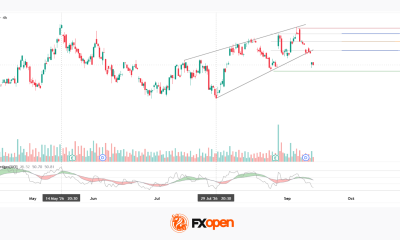
NVIDIA Analysis: Attempted Rising Wedge Breakout Amid Pressure on the AI Sector
-
Business5 days ago
SK Hynix ADRs Fall More Than 6% as Memory Rally Breaks on Fears of Slower AI Spending
-

 Crypto World4 days ago
DOJ Seeks to Seize $61M in Iran Oil Funds From Binance Accounts It Vouched For
-
Crypto World4 days ago
Can Circle’s Arc Repeat Robinhood Chain’s Meme Coin Boom?
-
 NewsBeat6 days ago
Last Night of the Proms pays moving tribute to Dolly Parton as Sheridan Smith wears a gold sequin jumpsuit in memory of the Queen of Country
-
 Crypto World5 days ago
3 Token Unlocks to Watch in the Third Week of September 2026
-
 Crypto World6 days ago
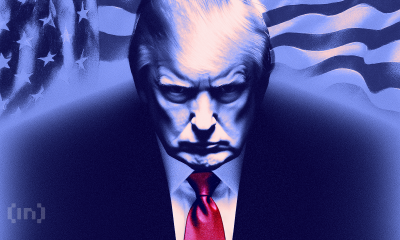
AI Safety Burden Falls on Chief Executives as Trump Prioritizes China Race
-

 Crypto World6 days ago
Goldman Sachs backs 25bp Fed hike after CPI
-

 Tech3 days ago
Webb’s IC 348 Mosaic Includes Two-Jupiter Dwarfs, Twin Jets, and a Nursery Still Making Worlds
You must be logged in to post a comment Login