
Crypto World
Crypto VC will prioritize quantum-ready infrastructure heading into 2027, Moon Pursuit founder says



Moon Pursuit Capital founder Utkarsh Ahuja has said crypto venture investors will prioritize quantum-ready infrastructure heading into 2027 as global VC investment reached $227.4 billion in the second quarter.
Summary
- Global VC investment reached $227.4 billion across 8,440 deals during Q2 2026.
- Ahuja expects post-quantum security and blockchain migration tools to attract more capital.
- Moon Pursuit co-led AmericanFortress’ $8 million seed round with SAVA and 0G Labs.
- NIST and major blockchain developers have already started preparing for quantum-resistant systems.
KPMG’s latest Venture Pulse report found that global venture funding recorded its second-highest quarterly total in Q2, although much of the capital went to large companies working in AI and other advanced technologies.
VC-backed companies raised $227.4 billion across 8,440 deals, down from the record $332.9 billion invested during Q1. OpenAI’s $122 billion round had lifted the first-quarter total, while Anthropic’s $65 billion financing provided the largest contribution in Q2.
US companies received $144.9 billion across 3,644 deals, accounting for nearly 64% of global investment. Other major US transactions included a $12 billion round for AI modeling company Project Prometheus and a $5 billion raise by defense technology company Anduril Industries.
Within the quantum-computing sector, investment slowed from the record pace recorded in 2025 but remained active, according to KPMG. Netherlands-based QuantWare raised $178 million, Germany’s eleQtron secured $66 million, and Quantinuum raised $1.6 billion through a Nasdaq listing that valued the company at $17.6 billion.
Crypto VC could fund quantum preparation before the threat arrives
Ahuja told crypto.news that investors will need to consider quantum risks well before a computer capable of breaking current blockchain security becomes available.
“I think quantum is going to force crypto investors to think much further ahead than they traditionally have,” Ahuja said.
No one can reliably predict when quantum hardware will be able to break the cryptography used to secure digital assets, according to Ahuja. However, he argued that the uncertain timetable does not remove the investment case because upgrading blockchains, wallets, and user infrastructure could take several years.
“If upgrading a blockchain, moving billions of dollars in assets, changing wallet infrastructure, and coordinating users across a decentralized network could take years, then quantum readiness becomes relevant well before the technology reaches that threshold.”
Ahuja expects the issue to send more venture funding toward post-quantum security, cryptographic migration, and infrastructure designed to accept future security upgrades. When assessing companies, he said Moon Pursuit will examine how easily their products can adapt when cryptographic requirements change.
Under that approach, resilience depends partly on whether a network or security provider can move users and assets to new systems without causing extensive disruption. Such migration work may carry particular weight for public blockchains, where developers cannot order every wallet owner, custodian, and validator to upgrade at the same time.
AmericanFortress gives Moon Pursuit a practical migration bet
Moon Pursuit co-led AmericanFortress’ $8 million seed round alongside SAVA Digital Asset Fund and 0G Labs. The company has developed a proposed security system for existing blockchain wallets and filed a patent covering quantum-resistant transaction signing.
Ahuja said the investment was based partly on the product’s planned compatibility with infrastructure already used by crypto networks.
“We were interested in the practicality of migration and the fact that the technology is designed to work with infrastructure that already exists,” he said.
AmericanFortress has proposed a system known as ZK-PoSP that would allow wallets to prove control of their original seed without exposing it. As crypto.news previously reported, the proposed quantum-safe wallet scheme would cover addresses on Bitcoin, Ethereum, and Solana without requiring holders to move their funds or rotate their keys.
The design remains a proposal and would require upgrades at the node level before a blockchain could enforce it. AmericanFortress’ technical paper also describes its post-quantum protection as conjectural rather than proven against a working quantum attack.
Ahuja said the apparent simplicity of the migration process could hide the complexity of the underlying work. Moon Pursuit considered the company’s intellectual property and patent development when assessing whether its technology could be easily copied, he added.
Instead of betting on a precise date for a major quantum breakthrough, Ahuja said venture firms should determine whether a company is solving a problem that already produces commercial demand. Security, cryptography, and infrastructure provide possible markets, but companies still need an adoption plan that does not depend entirely on rapid progress in quantum hardware, he said.
“Separating scientific progress from an investable business model is going to be increasingly important.”
Selective crypto funding favors products with existing demand
According to Galaxy Research, venture firms invested about $4 billion across 355 crypto and blockchain deals in Q1 2026. Funding fell 50% from the previous quarter, while the deal count declined 16%, mainly because the quarter had fewer large later-stage financings.
Trading, exchanges, investing, and lending companies collected approximately $2.6 billion, or close to three-fifths of the quarterly total. Infrastructure ranked second by deal count with 56 transactions, while privacy and security companies completed 22 deals.
Fundraising for crypto-focused venture firms remained difficult. Eight new funds raised about $1.1 billion during Q1, the lowest quarterly fund count since Q3 2020, according to Galaxy. The research firm said AI, spot crypto exchange-traded products, and digital asset treasury companies were also competing for institutional allocations.
US startups received 70.2% of all crypto VC capital and accounted for 43.5% of completed deals during the quarter. Galaxy also found that the median crypto investment exceeded $4.5 million, although it cautioned that available valuation data covered only 12% of the deals and leaned toward later-stage companies.
For Ahuja, investment categories once treated separately are starting to overlap as crypto companies use technology developed in AI, cybersecurity, and quantum research.
“We have spent years treating digital assets, AI, cybersecurity and quantum as fairly distinct investment categories, but some of the most interesting opportunities now sit between them,” he said.
Protocols and applications will continue to receive funding, according to Ahuja, although he expects more capital to reach the underlying systems required for institutions to use digital assets securely. Quantum protection fits within that category because companies can sell preparation and migration tools before quantum hardware reaches the level required to attack blockchains, he added.
US standards and blockchain projects have started preparing
The US National Institute of Standards and Technology finalized its first three post-quantum cryptography standards in August 2024. NIST encouraged system administrators to begin adopting the standards immediately rather than wait for a quantum computer capable of breaking current encryption.
NIST’s timetable calls for quantum-vulnerable algorithms to be deprecated by 2030 and removed from its standards by 2035, with high-risk systems expected to move earlier. The deadline applies to federal cryptographic standards rather than imposing a direct upgrade requirement on decentralized blockchain networks.
Institutional Bitcoin companies have also committed funding to the issue. In July, Strategy, BlackRock, Coinbase, and six other companies created a Bitcoin security consortium whose members pledged a combined $15 million over three years.
Anchorage Digital, ARK Invest, Block, Blockstream, Fidelity Digital Assets, and Galaxy joined the group. Members will choose which developers, researchers, and organizations receive their funding, while the consortium will not direct Bitcoin development or support a specific protocol change.
Ethereum developers have taken a separate route through network research and testing. Ethereum Foundation researcher Justin Drake said on Aug. 13 that Ethereum’s future layer-1 design will move away from the Poseidon hash function and use established functions such as SHA-2 or BLAKE2s.
The Ethereum roadmap change followed advances in proof systems that made traditional hash functions more practical for zero-knowledge technology. A production version of leanVM is scheduled for 2027, followed by planned protocol deployments in 2028.
At the custody level, BitGo and Silence Laboratories completed a post-quantum signing test in May using BitGo’s institutional platform and Silence Laboratories’ multi-party computation system. The simulation used ML-DSA, a digital signature algorithm included in NIST’s FIPS 204 standard, while retaining distributed key control, policy checks, and separate responsibilities across institutional teams.

Galaxy cited unresolved ethics, stablecoin yield and developer protection issues, along with a narrow Senate window when lawmakers return in September.


Africa Finance Corporation has raised 350 million Swiss francs or about $431 million, through its first digital bond, becoming the first African institution to issue such debt through a regulated exchange and central securities depository.
Summary
- The five-year digital bond carries a coupon rate of 1.4925%.
- Around 90% of investor demand came from Swiss accounts.
- Commerzbank and Deutsche Bank arranged the transaction.
- AFC will use the proceeds to support infrastructure financing across Africa.
AFC digital bond raises $431 million
Ledger Insights reported that Africa Finance Corporation issued the five-year bond through SIX, using its SDX digital platform for clearing and settlement. The transaction represents the first digital bond from an African institution to be processed through both a regulated exchange and a central securities depository.
Priced with a coupon of 1.4925%, the 350 million-franc bond is among the larger digital debt issues completed through the Swiss platform. UBS issued a 375 million-franc digital bond in 2022, according to Ledger Insights.
AFC separately described its offering as the largest Swiss franc-denominated digital bond from an international issuer. The company said it was also its fourth and largest bond issued in Swiss francs, following a 150 million-franc green bond completed in 2020.
Investor demand came mainly from Switzerland, with domestic accounts contributing about 90% of the orders and international investors providing the remaining 10%, according to AFC. Banks and other financial companies accounted for 57% of the order book, while asset managers represented 37% and hedge funds contributed 6%.
The bond was issued under AFC’s $5 billion Global Medium-Term Note Programme. Under the structure, the debt is represented as a tokenized security, while ownership details are kept on a regulated digital register using distributed ledger technology.
Trading and listing take place on the SIX Swiss Exchange, with the security deposited at SIX Digital Exchange. SIX SIS AG operates the clearing and settlement system used for the transaction.
Commerzbank AG served as the technical lead, while Deutsche Bank AG’s London branch participated through its Zurich branch. AFC said proceeds from the sale would cover its general funding needs and support its financing of infrastructure projects in Africa.
Digital format keeps the bond inside regulated markets
Unlike a crypto token issued through an open blockchain platform, AFC’s bond uses regulated market infrastructure for ownership records, trading, and settlement. Investors are buying a debt security issued by AFC, with the digital system changing how the bond is recorded and processed rather than the financial claim itself.
Banji Fehintola, an AFC executive board member and head of financial services, said the digital structure was “not an end in itself” but part of the company’s effort to diversify its sources of funding.
“The digital format of this bond is not an end in itself but a signal of our commitment to being at the frontier of innovation in the capital markets as we continue to diversify and strengthen AFC’s funding base to support Africa’s development.”
AFC President and CEO Samaila Zubairu said the deal also showed continued investor confidence in the institution’s credit profile and development strategy. According to the company, S&P Global rates AFC at A with a positive outlook, while Moody’s gives it an A3 rating with a stable outlook.
Before the digital sale, AFC returned to the international bond market in July with a $500 million, five-year senior unsecured Eurobond. The corporation said the digital issue secured funding at a level within the pricing of the earlier dollar benchmark.
Operating as a multilateral finance institution, AFC funds projects in power, transport, telecommunications, natural resources, and heavy industry. The organization was established in 2007 and now counts 48 African countries as members. It says it has invested $19 billion across the continent since its creation.
SIX combines digital and traditional settlement
AFC completed the issuance after Switzerland’s financial regulator approved a change to the structure of SIX’s digital asset operations. In May, the Swiss Financial Market Supervisory Authority allowed SIX Digital Exchange AG, its digital central securities depository, to merge into SIX SIS AG.
SIX said the consolidation placed its services for traditional and digital securities under one legal entity. FINMA also approved crypto custody through the combined central securities depository, allowing financial institutions to use the same regulated provider for conventional assets and certain digital assets.
The exchange operator launched SDX as a regulated market for securities issued and settled through distributed ledger technology. The platform has since hosted digital bonds from banks, public bodies and international institutions.
In November 2024, crypto.news covered Lugano’s third blockchain bond, a 120 million-franc issue listed on both SDX and the main SIX Swiss Exchange. Lugano had issued three such bonds worth a combined 320 million francs over two years.
The city’s third bond formed part of Project Helvetia, a Swiss National Bank pilot that tested settlement using wholesale central bank digital currency. Ledger Insights noted that AFC’s announcement did not identify wholesale central bank digital currency as part of its transaction.
AFC’s deal also ended a pause in new digital bond activity on SIX, where the previous issuance was completed by German development bank KfW in June 2025, according to Ledger Insights.
U.S. market follows a regulated tokenization path
American financial institutions are testing a comparable model in which blockchain records sit within existing securities infrastructure. The Depository Trust & Clearing Corporation planned to begin limited production transactions in July 2026, before a full tokenization service targeted for October.
As previously reported in May, DTCC formed a working group of more than 50 traditional finance and digital-asset companies. Participants include BlackRock, JPMorgan, Goldman Sachs, Morgan Stanley, Bank of America, Circle, Nasdaq and NYSE Group.
DTCC said the initial service could cover Russell 1000 stocks, major index-tracking exchange-traded funds, and U.S. Treasury securities held in its custody. Its subsidiary DTC received a three-year no-action letter from the Securities and Exchange Commission in December 2025 for the defined tokenization service.
For U.S. investors, the SEC’s position means representing a financial instrument on a blockchain does not remove it from securities rules. SEC Chair Paul Atkins said in April that a stock remains a stock whether it appears on paper, through a DTCC entry, or as a blockchain token.
Meanwhile, U.S. transfer agents asked the SEC in July to distinguish securities created with an issuer’s approval from third-party tokens that merely track an asset. The groups said regulated systems should preserve accurate ownership records, transfer controls, dividend rights, and investor protections.

The Russell 2000, an index tracking roughly 2,000 smaller publicly traded US companies that is generally viewed as one of Wall Street’s more risk-sensitive equity benchmarks, has returned to record territory at over 3,050 over the past few weeks.
According to popular analyst Crypto Rover, there’s a hidden connection between the index and the largest altcoin, which could lead to a major ETH rally.
ETH Rally Ahead?
As the market observer highlighted, the Russell 2000’s surge to a new all-time high follows previous similar gains charted in 2016 and 2020. After both instances, ETH went on a massive rally within 6-12 months.
Given the index’s risk-on significance, when it surges, it means that investors have become more comfortable moving away from mega-cap stocks and into smaller companies. This is often interpreted as evidence that risk appetite and liquidity conditions are improving.
Here’s where Crypto Rover outlined the connection with Ethereum as the Russell broke out during previous cycles before ETH eventually followed with significantly larger percentage gains. Analysts at Milk Road previously described the correlation between the two as almost “spooky,” suggesting that both tend to benefit when monetary policy turns easier, which hasn’t exactly been the case lately.
RUSSELL 2000 JUST HIT A NEW ALL-TIME HIGH.
The same setup played out in both 2016 and 2020.
Russell 2000 broke out first.
Ethereum followed months later with an explosive rally.
Historically, $ETH has lagged this move by around 6–12 months.
If the pattern repeats again,… pic.twitter.com/VWSgZ1lvJp
— Crypto Rover (@cryptorover) August 13, 2026
Ethereum also offers staking yield, while its broader ecosystem is heavily exposed to speculative activity, DeFi, tokenization, and other areas that expand during risk-on periods.
Although the relationship between the two appears superficial at first glance, Ash Crypto also recently spoke about it and predicted a similar surge as Crypto Rover.
Time to Buy ETH?
The altcoin jumped toward $2,000 in July, but it was halted on both attempts. It has since lost about $100, currently struggling below $1,900. Nevertheless, it is still up by over 20% since its local low at $1,520.
Other analysts are also optimistic about its future price movements, including Michaël van de Poppe, who commented recently that the perfect moment to buy an asset like ETH never comes, but the ideal time to accumulate it is right now:
“It’s always awkward to be positioning yourself into a position, as that’s the purpose of the markets. Previous breakouts of the market have resulted in generally big returns, as ETH is known for volatile movements. In that sense, last time a 60% breakout in less than a week took place. In 2023, the same happened,” he explained.
The post This TradFi Signal Preceded Explosive Ethereum Rallies: Is ETH Next? appeared first on CryptoPotato.


Robinhood Ventures Fund II has raised $225.5 million and opened at $22.50 on the New York Stock Exchange, 10% below its $25 initial public offering price.
Summary
- RVII raised $225.5 million after offering 8 million shares at $25 each.
- The fund opened at $22.50 on the NYSE, 10% below its IPO price.
- Its portfolio targets early- and growth-stage companies connected to Y Combinator.
- Retail investors can buy RVII shares without investing directly in its private holdings.
Reuters reported that Robinhood’s second publicly traded venture fund debuted on Thursday, giving individual investors access to early-stage companies usually available only to venture firms and wealthy investors.
The listing completed an offering that crypto.news previously covered after Robinhood Ventures Fund II priced 8 million shares at $25 each. The share sale raised $200 million, while Robinhood’s initial capital brought the fund’s total size to $225.5 million before sales charges and offering expenses.
RVII began trading on the NYSE at $22.50, placing its opening price $2.50 below the IPO level. The shares give U.S. investors an exchange-traded route into a managed collection of private businesses, although shareholders do not own those companies directly.
Robinhood venture fund targets younger startups
Robinhood designed RVII to invest in early- and growth-stage private companies, distinguishing it from Robinhood Ventures Fund I. The first fund, which was listed in March under the ticker RVI, mainly holds positions in more established businesses that have not yet gone public.
According to an August filing, RVII was prepared with holdings in about 80 private companies. Its strategy centers on businesses founded by current or former participants in Y Combinator, as well as other companies connected to the startup accelerator’s network.
Y Combinator has funded more than 5,000 companies since 2005, including over 100 businesses that reached valuations of at least $1 billion. Its past participants include U.S.-listed crypto exchange Coinbase, social media company Reddit, and OpenAI, the developer of ChatGPT.
The accelerator does not sponsor or endorse RVII, according to the fund’s regulatory disclosures. Robinhood has permission to use the Y Combinator name when describing the investment strategy, but the accelerator does not accept responsibility for the portfolio or its performance.
Rich Aberman, RVII’s portfolio manager and a former Y Combinator founder and visiting partner, described the fund as part of a new area of venture investing.
“Not only is this one of the more interesting things happening in venture at the moment, it’s like the frontier of that industry,” Aberman told Reuters.
Aberman said the structure could benefit “everyday Americans and retail investors” who have historically remained outside the wealth created by Silicon Valley startups.
Listed shares bring private-market risks
Structured as a business development company, RVII is a closed-end fund whose shares trade on the NYSE. Investors can buy and sell the listed shares through brokerage accounts, but they cannot redeem them directly with the fund before liquidation.
Market demand can therefore push the share price above or below the value of RVII’s underlying assets. Its $22.50 opening showed that such a gap can appear as soon as trading begins, even though IPO investors paid $25 for each share.
Early-stage companies also carry different risks from the later-stage businesses held by RVI. Young companies may lack steady revenue, require repeated funding rounds, or fail before reaching the public market. Private holdings can be difficult to value because they do not trade continuously on an exchange, leaving fund managers to rely on financing rounds, company information, and valuation methods disclosed in regulatory reports.
RVII charges a 2% annual management fee and a 20% incentive fee on realized capital gains. Its prospectus estimated total annual expenses at about 4.18%, though the actual cost can vary. Robinhood Ventures Fund I did not impose the same performance fee.
The fund’s registration documents describe the investment as speculative and warn that shareholders could lose a substantial portion of their money. Unlike direct investors in a startup, RVII shareholders also do not receive voting rights or direct claims against the companies held in the portfolio.
For U.S. retail buyers, RVII trades as a regulated, exchange-listed security rather than as a token representing a private company. The Securities and Exchange Commission declared its registration statement effective before the IPO, while the NYSE listing provides a public market for the fund shares.
Goldman Sachs served as lead bookrunner for the offering. Citigroup, JPMorgan, UBS Investment Bank, and Wells Fargo Securities acted as joint bookrunners, and the underwriting group received a 30-day option to buy another 1.2 million shares at the IPO price, less discounts and commissions.
If exercised in full, the option would add $30 million and increase the fund’s size to as much as $255.5 million before sales charges and expenses.
Robinhood expands retail private-market access
Robinhood’s first venture vehicle raised about $658.4 million when it listed in March. RVI initially fell roughly 16% during its first day of trading before later recovering, showing how the market price of a closed-end fund can move separately from its reported asset value.
The older fund has invested in companies including SpaceX, Stripe, Databricks, Canva, Ramp, Revolut and ElevenLabs. In April, it also bought OpenAI shares worth about $75 million, giving public-market investors indirect exposure to the private artificial intelligence company.
RVI’s holdings include businesses with links to digital assets. Stripe provides stablecoin and tokenization services, while Robinhood has separately expanded its own crypto operations, prediction markets, and tokenized-stock products.
Robinhood gained attention among individual investors through commission-free trading and has since added retirement accounts, advisory services, and a premium credit card. Its venture funds extend the same retail-focused model to private-company investments, where access has often depended on accreditation rules, high minimum commitments, or relationships with venture managers.
Companies have also remained private for longer while raising enough capital to reach multibillion-dollar valuations before an IPO. According to Reuters, investor interest in accessing businesses during that period has directed more money toward private-market products.
Robinhood Ventures is already preparing additional vehicles beyond RVI and RVII. Sarah Pinto, head of Robinhood Ventures and president of RVII, told Reuters that work had begun on funds three through six.
“We want to make sure that we’re not rushing into this and that we’re building funds where we can uniquely deliver performance,” Pinto said.
Gen Z traders on Binance have increased the ETF share of their equity trading volume to 25% in early August as their allocation to individual stocks has declined.
Summary
- ETFs accounted for 21.9% of Gen Z net equity inflows in July, up from 18.5% in June.
- Individual stocks received 74.2% of July inflows, compared with 77% one month earlier.
- Gen Z averaged fewer monthly trades than Millennials and Gen X across the products studied.
- Binance warned that its short direct-equities data window limits conclusions about lasting behavior.
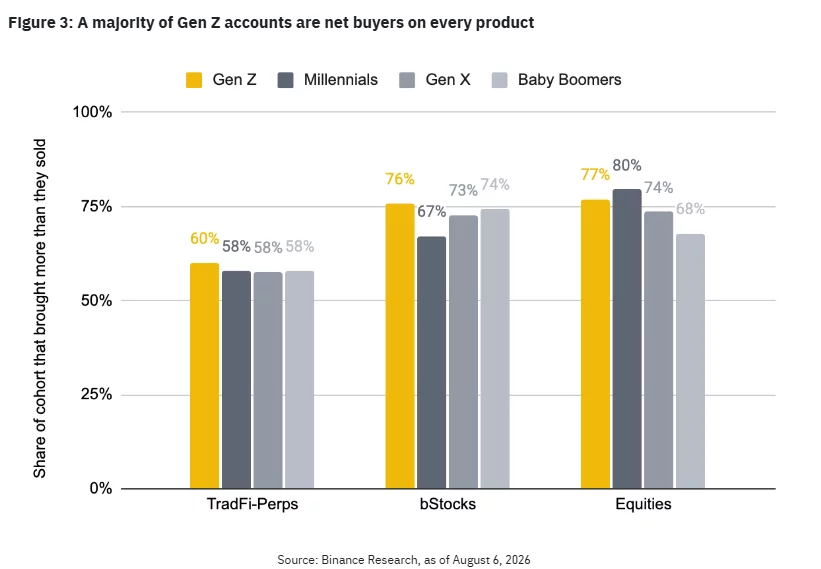
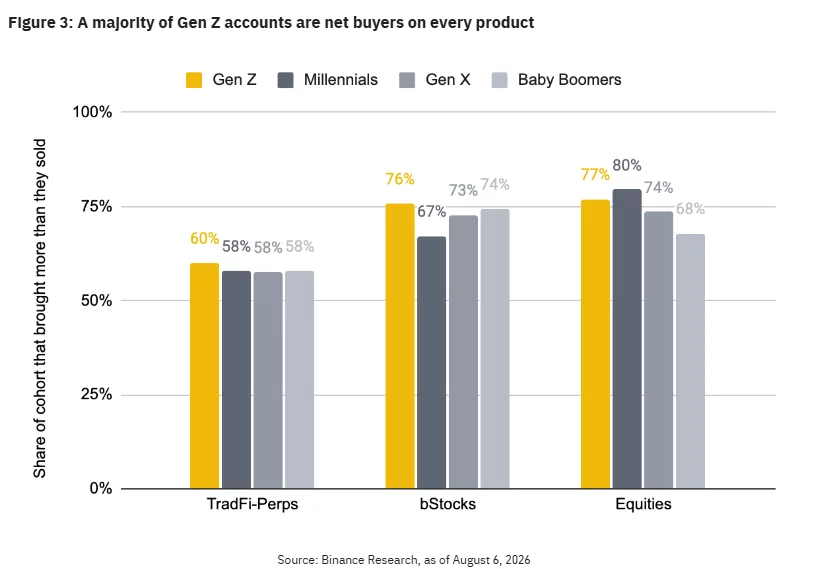
Binance Research found that exchange-traded funds are taking a larger share of Gen Z equity activity across the exchange’s direct-equity, tokenized-stock, and traditional finance perpetual products.
The research compared trading frequency, net capital flows, and leverage use among Gen Z, Millennials, Gen X, and Baby Boomers. While the youngest group increased its ETF allocation, the figures also showed that Gen Z generally traded less often than other working-age generations.
During July, ETFs received 21.9% of Gen Z’s net equity inflows, rising from 18.5% in June. Over the same period, the share directed toward individual stocks fell from 77% to 74.2%.
By early August, ETFs represented 25% of the cohort’s equity trading volume, adding another data point to the increase recorded in July. Binance did not say whether the August share would hold for the entire month.
Gen Z ETF activity rises as trading remains limited
Across traditional finance perpetuals, Gen Z users completed an average of 13 trades per month. Millennials averaged 17, while Gen X recorded 16.5.
Similar patterns appeared across the other equity products included in the study, with Binance finding that Gen Z traded less frequently than the two older working-age groups. The research compared account activity rather than relying only on survey responses about investment preferences.
Sell-order data also indicated that part of the cohort was holding positions instead of actively trading in and out of them. Among Gen Z direct-equity accounts, 22% had never submitted a sell order.
The corresponding share stood at 19% for Gen X and 9% for Baby Boomers. Millennials recorded the largest buy-only group; however, 30% of their direct-equity accounts showed no sell orders.
Within the Gen Z buy-only group, Broadcom, Tesla, and the Schwab U.S. Dividend Equity ETF ranked among the leading assets by cumulative purchases. The mix included two U.S.-listed technology companies and an ETF designed to track dividend-paying American stocks.
Binance did not present the buy-only activity as proof of a long-term investment strategy. An account may have avoided selling because it entered the market recently, particularly given the limited operating history of the exchange’s direct-equity product.
Binance data shows limited demand for leveraged ETFs
Leveraged and inverse ETFs attracted little activity from Gen Z users, even though such products can amplify gains or provide exposure to falling markets.
Binance reported that 88.2% of Gen Z traditional finance perpetual accounts had not traded either type of ETF. The inactive share was lower among Millennials at 84.5% and Gen X at 85.9%.
Unlike standard ETFs, leveraged products generally seek to deliver a multiple of an index’s daily move, while inverse funds seek gains when the tracked market falls. Their returns can differ from the index over longer periods because the products reset each day, according to investor guidance from the U.S. Securities and Exchange Commission.
The Binance figures therefore show that the youngest traders in its sample were not using leveraged or inverse funds as frequently as other working-age cohorts. However, the report did not establish whether risk concerns, product awareness, eligibility rules, or other factors caused the difference.
For U.S. investors, the distinction between conventional ETFs and blockchain-based equity products remains important. A traditional ETF registered in the United States trades through regulated securities markets, while a tokenized stock or derivative may only provide economic exposure to the referenced asset.
As crypto.news previously reported, the SEC has warned that third-party stock tokens can carry different rights from conventional shares. Depending on the product’s legal structure, buyers may not receive direct ownership, voting privileges, or the protections available to registered shareholders.
Access also depends on location. Some international tokenized-equity platforms restrict U.S. persons even when their products track stocks or ETFs listed in American markets.
Tokenized stocks bring U.S. equities onto crypto platforms
Binance’s findings arrive as crypto exchanges add more ways for eligible users to trade instruments tied to U.S. stocks and ETFs.
The exchange launched bStocks in June with tokenized versions of Nvidia, Tesla, Circle, Micron, and SanDisk. Binance has said the products are backed on a one-to-one basis by underlying U.S. securities and can be converted into direct stock positions without conversion fees.
During the first nine trading days of Binance’s equities business, daily volume averaged about $143 million, according to research figures cited in an earlier report on the equities product debut. Turnover passed $1 billion, daily active traders peaked at 30,700, and total value locked approached $400 million during the period.
The short operating history also limits the Gen Z study. Binance cautioned that its direct-equities product only reached meaningful scale in June, leaving too little data to determine whether the allocation and trading patterns represent lasting generational behavior.
Elsewhere in the sector, Crypto.com introduced tokenized derivatives tied to 1,500 U.S. stocks and ETFs for eligible users in the European Economic Area and other approved markets. The tokenized derivatives offering includes instruments linked to Apple, Nvidia, Tesla, SPDR Gold Shares, and iShares Silver Trust.
Crypto.com’s products provide synthetic price exposure rather than legal or beneficial ownership of the underlying securities. Eligible users may receive dividend-equivalent adjustments, while the assets supporting the products are held with Alpaca, a U.S.-regulated self-clearing broker-dealer.
Binance bStocks competes with xStocks for second place
Growing interest in equity products has coincided with rapid changes among tokenized-stock issuers. Binance’s bStocks briefly overtook Kraken-backed xStocks this week, less than two months after its launch.
Token Terminal data placed bStocks at $624 million in tokenized stock value on Thursday, ahead of xStocks at $579 million. Ondo Finance remained the largest issuer in the ranking.
By Saturday, their positions had reversed, with xStocks holding $603 million and bStocks falling to $535.1 million. The platforms accounted for about 22.3% and 19.8%, respectively, of the roughly $2.7 billion market tracked by Token Terminal.
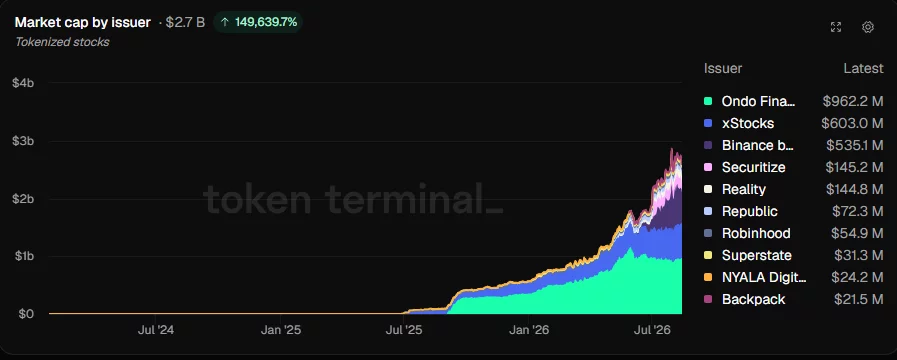
Ondo retained first place with $962.2 million. Earlier in August, bStocks had reached about $624 million, compared with roughly $579 million for xStocks and $927 million for Ondo.
Separate figures from RWA.xyz placed the distributed tokenized-stock value at $2.37 billion as of Saturday, an increase of about 5% over the preceding 30 days. Differences between that total and Token Terminal’s estimate can arise from the platforms, products, and valuation methods included by each data provider.
Tokenized equity adoption had already accelerated before Binance entered the issuer rankings. In July, data shared by DWF Labs showed that the number of holders across five major platforms had risen 92% in 30 days to 752,000, with Robinhood accounting for 328,000 holders and 44% of the measured total.
Robinhood held only $44 million in tokenized stocks in that comparison, while Ondo controlled $857 million and xStocks held $487 million. DWF Labs calculated an average Robinhood position of $134, compared with about $5,900 for Ondo and $1,900 for xStocks.
Bithumb has reported a 21.8 billion won, or about $15.7 million, net loss for the second quarter of 2026 as revenue fell 35.8% from a year earlier.
Summary
- Bithumb’s second-quarter revenue fell 35.8% to 86.3 billion won.
- The exchange swung from a 22 billion won profit to a 21.8 billion won loss.
- First-half revenue dropped 48.7%, while the net loss reached 108.7 billion won.
- Lower Korean crypto trading activity has reduced fee income across the domestic market.
According to Yonhap News Agency, Bithumb moved into the red during the three months through June after recording a 22 billion won net profit in the same quarter of 2025.
Bithumb’s quarterly loss has narrowed from Q1
Although the company’s latest result represented a year-on-year reversal, the second-quarter loss was smaller than the 86.9 billion won deficit reported during the first three months of 2026. The figures show Bithumb remained profitable at the operating level even as asset-related losses pulled its final result below zero.
Quarterly revenue reached 86.3 billion won, compared with about 134.4 billion won a year earlier. Operating profit fell 44% over the same period to 12.1 billion won, down from roughly 21.6 billion won.
Transaction commissions accounted for almost all of Bithumb’s operating revenue during the quarter. Local reports placed fee income at approximately 86.28 billion won, while revenue from other activities, including lending and market information services, amounted to only about 3.8 million won.
Heavy dependence on transaction fees leaves the exchange’s earnings closely tied to customer activity. When trading volume falls, fewer completed trades reduce the commissions collected by the platform, even if Bithumb retains a large share of South Korea’s crypto market.
At the same time, Bithumb attributed part of its net loss to changes in the value of its virtual asset holdings. Such valuation changes can cause net income to move differently from operating profit because the company must account for gains or losses on crypto assets held on its balance sheet.
First-half figures show a steeper revenue decline
Across the first six months of 2026, Bithumb recorded a net loss of 108.7 billion won, reversing a 55 billion won profit from the corresponding period last year.
First-half revenue fell 48.7% to 168.8 billion won, while operating profit declined 83.4% to 14.9 billion won. The company therefore remained profitable through its main exchange operations, but the amount earned from those activities dropped sharply as trading weakened.
The difference between the quarterly and half-year results also shows how heavily the first quarter weighed on the period. Subtracting the second-quarter figures from the six-month totals indicates that Bithumb generated about 82.5 billion won in first-quarter revenue and only 2.8 billion won in operating profit, alongside the previously disclosed 86.9 billion won net loss.
Lower trading across South Korea provides direct context for the revenue decline. A crypto.news report found that Upbit, Bithumb, Coinone, Korbit, and Gopax processed a combined $366.58 billion during the first half, down 54.6% from the same period in 2025.
During July 1–27, Bithumb handled approximately 4.71 trillion won in trades, according to NexBlock data cited in the report. Its share of trading among the five exchanges fell from 30.7% to 27.1%, while Upbit’s share increased from 62.3% to 67.4%.
The figures matter because Bithumb’s narrow revenue mix gives the exchange limited protection against a decline in spot-market activity. Fee income remains its main source of sales, leaving lower volume to pass quickly into quarterly revenue and operating earnings.
Weaker earnings arrive during Bithumb’s IPO work
Bithumb’s results have arrived while the company prepares for a public listing targeted for 2028. Its three-stage IPO roadmap calls for internal control improvements and preparation for Korean International Financial Reporting Standards during 2026.
Under the schedule disclosed in August, Bithumb expects to submit a preliminary listing application and complete the required audits in 2027. The company has also signed an advisory agreement with Samjong KPMG that runs through the end of that year, although it said the timetable could change with market conditions and the regulatory review.
Financial performance will form part of the information reviewed by prospective investors and listing authorities. Bithumb has said it plans to disclose its financial position, management matters, and crypto holdings more regularly as it prepares for the offering.
The company is also separating parts of its operations. Bithumb Asset has been spun off to define responsibilities between business units, while domestic and international securities firms, lawyers, and accounting firms are helping assess valuation and legal risks.
For U.S. investors, the main connection lies in Bithumb’s previous consideration of an overseas listing. Earlier reports linked the exchange with a possible Nasdaq offering, although its latest 2028 roadmap does not identify a final venue. Until Bithumb chooses a market and completes an offering, American investors do not have a U.S.-listed Bithumb stock through which to gain direct equity exposure.
Separately, South Korean brokerage Kiwoom Securities has held talks to acquire newly issued Bithumb shares. The proposed Kiwoom investment remained under negotiation in late June, with the two companies yet to agree on the investment size or ownership percentage.
Compliance costs remain part of Bithumb’s preparations
Alongside falling revenue, Bithumb has been addressing several regulatory and internal-control matters that could affect its listing work.
In June, South Korea’s Personal Information Protection Commission imposed a 210 million won penalty after finding that Bithumb transferred customer information overseas without meeting all consent and notice requirements. The regulator’s cross-border data ruling also required the exchange to revise its transfer procedures and explain them more clearly in its privacy policy.
An earlier anti-money laundering case produced a much larger 36.8 billion won fine and a six-month suspension covering new customer deposits and withdrawals to external wallets. In May, the Seoul Administrative Court paused the suspension while Bithumb’s legal challenge proceeds, allowing the exchange to continue operating without the restriction for the time being.
Regulators said the AML action involved about 6.65 million cases of inadequate user identity checks, as well as problems involving transaction monitoring and dealings with unregistered overseas virtual asset providers. Bithumb told local media that it would present its position during the remaining proceedings.
The exchange has said it will respond to changing market conditions by strengthening its internal operations and improving its services. Its disclosed IPO schedule requires the company to complete internal-control upgrades and K-IFRS conversion preparations during 2026 before audits, and a preliminary listing application is planned for 2027.


World Liberty Financial has received preliminary OCC approval to establish a national trust bank that would oversee more than $4 billion in USD1 stablecoin circulation.
Summary
- World Liberty Trust must meet the OCC’s conditions before it can begin operations.
- The proposed bank would issue USD1, manage its reserves, and serve institutional custody clients.
- WLTC must maintain at least $20 million in eligible capital before opening.
- WLFI rose after the decision but remains down more than 60% over the past year.
World Liberty Financial must meet OCC conditions
The Office of the Comptroller of the Currency said on Aug. 14 that it had granted preliminary conditional approval for World Liberty Trust Company, National Association, or WLTC, after reviewing the proposed bank’s application and commitments.
World Liberty Financial submitted the application through WLTC Holdings LLC in January. As crypto.news reported at the time, the proposed trust bank was designed to bring USD1 issuance, reserve management, and institutional custody under one federally supervised entity.
Preliminary approval allows World Liberty Financial to organize the bank but does not authorize it to open. According to the OCC’s 19-page approval decision, WLTC must complete its preopening requirements and receive final authorization before starting business.
Until then, the regulator can modify, suspend, or withdraw its approval if a new development raises concerns. WLTC must also notify the OCC about major changes to its business plan before making them.
The bank will need at least $20 million in eligible capital when it opens, while its organizers must submit an updated operating plan and receive OCC non-objection. Required appointments include a qualified internal audit manager, and the regulator must approve the bank’s proposed chief financial officer before the opening date.
WLTC would operate as a wholly owned subsidiary of Delaware-registered WLTC Holdings and maintain its main office in Bay Harbor Islands, Florida. The proposed institution must also apply for stock in a Federal Reserve Bank under federal law.
USD1 operations would move from BitGo to WLTC
Once fully authorized, World Liberty Trust plans to issue and redeem USD1 for institutional clients across the United States. The bank would also maintain the assets backing the dollar-pegged token and provide fiduciary custody services to USD1 users and other institutional customers.
BitGo Bank & Trust currently serves as the exclusive issuer and custodian for USD1. After opening, WLTC intends to acquire the stablecoin’s reserve assets and assume the liabilities connected to them, according to the OCC.
The regulator said the transfer may require additional approval under federal bank merger rules. Any acquisition of reserve assets from BitGo must therefore comply with the conditions set by the agency before the transaction can proceed.
Conversion services would form another part of WLTC’s planned operations. Institutional custody customers could submit approved stablecoins and receive USD1 in return, although the service would be limited to assets held in custody by the bank.
World Liberty Financial said USD1 has surpassed $4 billion in circulation. The company lists U.S. dollars held at financial institutions, U.S. government money market funds, and cash equivalents among the assets supporting the stablecoin.
USD1 is available on centralized platforms including Binance, Coinbase, Kraken, Crypto.com, OKX, and Bybit, as well as decentralized exchanges such as Uniswap and PancakeSwap. Reuters ranked it as the fourth-largest stablecoin by market capitalization following its rapid growth since its March 2025 launch.
World Liberty Trust President and Chairman Zach Witkoff said federal supervision would place the token’s main operations under one regulator.
“A national trust bank brings USD1 issuance, custody, and reserve management together under OCC supervision, examined on the same standards that have governed banks for generations.”
He added that the company welcomed “continuous scrutiny from federal regulators.”
Federal trust bank approval does not cover lending
Despite the bank designation, WLTC would not operate like a traditional commercial lender. National trust banks generally provide custody, fiduciary, settlement, and asset-servicing functions but cannot accept ordinary customer deposits or issue conventional loans.
A federal charter would let WLTC provide approved services nationwide under one primary regulator instead of applying for separate state licenses. The structure also places its operations under regular OCC examinations, along with federal anti-money laundering and sanctions requirements.
The company said customer assets would remain segregated and reserve management would operate independently. WLTC has selected Mack McCain as chief trust officer and Daniel Dietzel, a former chief financial officer at institutional prime broker Hidden Road, as its CFO.
A five-member board would oversee the proposed bank. Alongside Zach Witkoff, the board would include Scott Alper, Robert Witkoff, and independent directors Jeffrey Weiner and Erin Baskett. According to the company, Weiner previously led accounting firm Marcum, while Baskett serves on the Financial Industry Regulatory Authority’s Board of Governors.
World Liberty joins several digital asset companies that have entered the OCC charter process since December 2025. Ripple, Paxos, BitGo, and Fidelity Digital Assets have received conditional approvals, while Coinbase, Crypto.com, and Stripe-owned Bridge have also pursued national trust bank structures.
Circle moved one step further in July when it received final approval to establish its national trust bank. Circle first obtained conditional approval in December 2025 and then completed the OCC’s preopening requirements before receiving authorization.
The OCC reported that uninsured national trust banks under its supervision held $7.2 trillion in assets under administration as of March 31. Custody and safekeeping accounts represented $1.7 trillion, while fiduciary accounts accounted for the remaining $5.5 trillion.
Trump ties keep the charter under scrutiny
World Liberty Financial’s connection to U.S. President Donald Trump and his family has made the application a subject of congressional attention. Trump and members of the Witkoff family helped launch the company in 2024, while Trump later adopted the title of co-founder emeritus.
Sen. Elizabeth Warren asked OCC Comptroller Jonathan Gould in January to pause the charter review until Trump divested his financial interest in the company. Warren said approval could leave a presidential appointee regulating a business financially connected to the president.
Questions increased after reports that an Abu Dhabi-linked entity purchased a 49% interest in World Liberty Financial for $500 million shortly before Trump returned to office. In June, Senate Democrats questioned the potential national security implications of the transaction and its effect on the charter review.
The OCC said it received public comments concerning non-U.S. investors in World Liberty Financial. According to its decision, the foreign investors were not considered principal shareholders of the proposed bank, and several investors signed agreements promising not to control or influence its operations.
Eric Trump signed one of the agreements as president of a Trump family-linked investment vehicle. The regulator said Gould and agency staff followed their legal and ethical duties, while career employees handled the application review and nonpolitical examiners would supervise the bank.
Following the announcement, WLFI initially rose more than 2% to about $0.0597 before giving back part of the advance. TradingView data later placed the token near $0.0558, up about 8% over seven days but more than 65% below its level one year earlier.
XRP has shed more than 10% over the past week as its struggle near $1 continues. This downward pressure has pushed the crypto asset’s yearly losses to almost 70%.
Despite the negative sentiment, institutional participation appears to be intact, as several firms continue to use exchange-traded products to gain exposure to XRP.
Institutions Remain Unfazed
Morgan Stanley has disclosed its XRP exposure in the second quarter of 2026. The Wall Street giant holds positions through three XRP-linked exchange-traded funds: Franklin, REX-Osprey, and Bitwise ETF. Its largest position was in the Franklin fund, with 6,715 shares. The filing showed 255 shares of the REX-Osprey ETF and 67 shares of Bitwise’s.
The 13F filing also shows a larger position in Armada Acquisition Corp II, the SPAC partner of Ripple-backed Evernorth Holdings.
Several investment firms have had exposure to the token through exchange-traded products. For example, Wolverine Asset Management held 199,912 shares of the Bitwise XRP ETF. Gallacher Capital Management held 86,744 shares of Canary’s XRP ETF. Main Street Group had 5,261 shares of the same fund.
Meanwhile, Moisand Fitzgerald Tamayo held 964 shares of the Franklin XRP ETF. Additionally, National Bank of Canada revealed 3,848 shares of Bitwise’s XRP ETF.
Opportunity Amid Pressure
The picture looks less encouraging when it comes to XRP’s broader market activity. As reported by CryptoPotato, the Taker Buy/Sell Ratio is around 0.86, its lowest level since last May. The ratio has stayed below 1 for most of the recent period, which means that sellers have generally been more aggressive than buyers in the derivatives market.
There have been short-lived moves above 1, but buyers have yet to establish a clear change in momentum. A move back above that level could be a better sign for XRP, especially if it also starts seeing stronger volume and price action.
For now, however, derivatives traders appear to be leaning toward the sell side. Futures open interest also remains elevated and stands at 435.1 million units, above the 403.6 million 30-day average, with a +1.20σ Z-score, meaning “leverage is still stacked.” As such, the token is at risk of a liquidation cascade if it dumps further.
But the current weakness may also create a potential setup for a future recovery. ChartNerd highlighted $1.24 as an important level to reclaim. If the asset fails to do so, the analyst identified the $0.90-$0.70 range as a possible area where accumulation could take place.
ChartNerd also expects a retest of the 3-month 40 EMA to help XRP form a stronger base. Similar setups played out in 2023 and 2024, according to the analyst.
The post Morgan Stanley’s XRP Exposure Emerges as Price Struggles Near $1 appeared first on CryptoPotato.

The agency cancelled its August 14 Regulation Crypto meeting one day before commissioners were set to vote, citing an “unforeseen scheduling issue” that no one inside or outside the building predicted. With Congress already on recess and the CLARITY Act frozen until September, the double stall leaves every token project in America waiting for rules that neither branch of government can deliver right now.
Summary
- The SEC cancelled its August 14 open meeting to vote on Regulation Crypto, a roughly 400 page proposed rule that would have created three exemption pathways for token offerings, including a $75 million annual fundraising cap and a decentralization safe harbor.
- The cancellation notice appeared on August 13, one day after the White House Office of Information and Regulatory Affairs received the Reg Crypto NPRM under tracking number RIN 3235-AN38, meaning the rulemaking package was already in the federal pipeline when the vote was pulled.
- The Senate left Washington on August 8 without a floor vote on the CLARITY Act, pushing the next procedural motion to September 15 and sending Polymarket odds for passage in 2026 crashing from an 82% February peak to roughly 16%.
- Commissioner Hester Peirce, who led the SEC Crypto Task Force since January 2025, is leaving the agency in November 2026 to join Regent University School of Law, dropping the commission to two active members and creating untested quorum risks for any major rulemaking.
- The joint SEC and CFTC interpretive release from March 17, 2026, which sorted every crypto asset into one of five categories, remains the only binding regulatory framework in effect while both the legislative and administrative paths sit frozen.
The SEC was supposed to vote on the most ambitious crypto rulemaking in the agency’s 90 year history on a Friday morning in August, and then it did not. The cancellation notice landed on the SEC website at approximately 4:30 p.m. Eastern on Wednesday, August 13, offering a single explanation: “unforeseen scheduling issue.” No replacement date. No elaboration. No indication of whether the delay would last days or months. The timing turned a procedural pause into a structural problem, because the other path to regulatory clarity, the CLARITY Act winding through the Senate, had already frozen six days earlier when lawmakers left for a five week recess without bringing the bill to the floor. For the first time since the current administration took office promising to end regulation by enforcement, both tracks toward crypto rules are stalled simultaneously, and no one in Washington has offered a credible timeline for restarting either one.
What the SEC was about to vote on
The open meeting agenda contained a single item: whether to formally propose new rules creating a tailored offering regime for certain investment contracts involving crypto assets. The shorthand for the package is Regulation Crypto, and its ambition matched its length. The roughly 400 page proposal built three legal pathways for token projects seeking to raise capital without triggering the SEC’s full registration requirements.
The first pathway, the startup exemption, would have allowed early stage teams to raise up to $5 million over four years using whitepaper style disclosure instead of the audited financial statements required under traditional securities registration. The second, the fundraising exemption, borrowed its $75 million annual ceiling directly from Regulation A+ Tier 2, the JOBS Act framework that regulators and lawyers have understood since 2015, and added crypto specific requirements including semi-annual reporting and audited financials. The third and most consequential pathway was the investment contract safe harbor, which would have allowed tokens that achieved sufficient decentralization to exit securities classification entirely. Once an issuer could show that it had completed or permanently ceased the essential managerial efforts it promised at launch, the token would shed its securities wrapper and move outside the SEC’s jurisdiction.
A yes vote from the three member commission would not have made any of these pathways law. It would have opened a formal notice and comment period under the Administrative Procedure Act, inviting the public to weigh in on the proposed rules before the agency could finalize them. But even that procedural starting gun carried enormous weight, because it would have signaled that the SEC was committed to building a regulatory infrastructure for digital assets through rulemaking instead of the enforcement actions that defined the previous administration’s approach.
How the cancellation unfolded
The SEC posted the August 14 meeting on its website on August 11, a Monday. By Tuesday, the White House Office of Information and Regulatory Affairs had received the NPRM under RIN 3235-AN38, confirming that the rulemaking package had cleared the agency’s internal review and entered the federal regulatory pipeline. Chair Paul Atkins had spent the preceding weeks signaling that Regulation Crypto was his top priority. The machinery appeared to be working.
Then, on Wednesday afternoon, the SEC replaced the meeting notice with a cancellation. The stated reason, an unforeseen scheduling issue, carried no further detail. The agency did not withdraw the proposal from OIRA’s queue, did not issue a statement from the Chair, and did not announce a replacement date. Reginfo.gov still lists the Crypto Assets proposal as pending review, which multiple legal analysts have interpreted as evidence that the cancellation reflects a delay rather than an abandonment.
The abruptness is what distinguishes this from ordinary Washington scheduling friction. Open meetings are typically announced with enough lead time to signal seriousness, and cancellations at the 24 hour mark are rare enough that former SEC staffers interviewed by several outlets described the move as highly unusual. The gap between the official explanation and the scale of the rulemaking it interrupted has produced a secondary question that the agency has not answered: what, specifically, was unforeseen about the scheduling?
The commissioner question nobody will answer on the record
The SEC currently operates with three commissioners, all Republican: Chair Paul Atkins, Commissioner Mark Uyeda, and Commissioner Hester Peirce. That is a functioning quorum, but it is also the minimum, and the dynamics within a three person body are different from those within the five member commission the Securities Exchange Act of 1934 envisioned.
Peirce, widely known in digital asset circles as “Crypto Mom,” announced in June 2026 that she would leave the agency in November to join Regent University School of Law. Her departure will drop the commission to two active members, a configuration that has no modern precedent for conducting major rulemaking. An SEC rule adopted in 1995 permits the commission to conduct business with fewer than three commissioners, but administrative law scholars have questioned whether a rule finalized by a two member body could survive judicial challenge, particularly after the Supreme Court’s 2024 decision in Loper Bright Enterprises v. Raimondo raised the bar for agency deference.
The timing matters because Peirce’s exit creates a hard deadline: any rulemaking the SEC wants to finalize with a three vote margin must reach a final vote before November. If Regulation Crypto’s notice and comment period runs the standard 60 to 90 days, a vote that does not happen until late September or October would push the final rule into 2027 at the earliest, by which point the commission may have only two members. Two commissioners can still vote, but the APA vulnerability is real. Industry lawyers have already begun flagging the risk that a Reg Crypto final rule adopted by a two member commission could face procedural challenges that a three member vote would not.
None of the three commissioners have publicly addressed whether internal disagreement played a role in the cancellation. The official explanation points to scheduling. But observers have noted that Chair Atkins and Commissioner Uyeda have occasionally diverged on the pace and scope of crypto rulemaking throughout 2026, and that a three person commission offers no room to absorb a single dissent without killing a proposal entirely. Whether the “unforeseen scheduling issue” is a euphemism for a substantive disagreement or a genuine logistical conflict remains an open question that the agency has declined to clarify.
The CLARITY Act froze first
The SEC’s vote was always framed as a fallback. Chair Atkins said publicly that the agency was prepared to write the rules itself if Congress could not act, and the timing of Regulation Crypto’s development tracked directly with the CLARITY Act’s deterioration in the Senate.
The Digital Asset Market Clarity Act passed the House in July 2025 by a 294 to 134 vote with significant bipartisan support. It cleared the Senate Banking Committee in May 2026 by a 15 to 9 margin. Then it stalled. Disagreements over ethics provisions, DeFi protocol treatment, stablecoin yield language, and the government ethics provision that would have restricted certain officials from holding digital assets created a negotiating impasse that Senate leadership could not resolve before the August recess.
Senate Majority Leader John Thune confirmed that the chamber would delay voting on the legislation until after the recess, blaming Democrats for impeding progress. The next procedural vote, a motion to proceed rather than a final passage vote, is scheduled for September 15. But the Senate returns with only three working weeks before election cycle dynamics begin consuming legislative bandwidth, and the bill’s opponents have shown no sign of softening their positions on the outstanding disputes.
Polymarket captures the market’s verdict on those odds. The prediction market contract for the CLARITY Act being signed into law in 2026 peaked at 82% in February, when bipartisan momentum appeared genuine. It dropped to 43% in July after reports that the White House had brokered an ethics deal. It crashed to 16% when the Senate left town without acting. Each missed deadline, a White House floated July 4 signing ceremony, a late July practical window, and now the August recess, has eroded confidence that Congress can deliver comprehensive crypto legislation before gridlock takes permanent hold.
What the double stall means for projects on the ground
The practical consequence of both paths freezing simultaneously is that the only binding federal framework for crypto classification remains the joint SEC and CFTC interpretive release from March 17, 2026. That release sorted every crypto asset into one of five categories: digital commodities, digital collectibles, digital tools, stablecoins, and digital securities. It designated 16 major tokens including Bitcoin, Ethereum, Solana, and XRP as digital commodities under CFTC jurisdiction. It answered the decade old question of whether those specific assets are securities.
But it did not answer the question that Regulation Crypto was designed to address: how new tokens should be issued, what disclosure they require, and when they can exit securities classification. Projects planning token launches in the second half of 2026 now face a regulatory gap where neither the SEC nor Congress has provided usable rules. The startup exemption, the $75 million fundraising pathway, and the decentralization safe harbor all exist only in a draft that has not yet entered the comment period.
Industry groups have pointed to tangible effects. Dozens of crypto projects shut down or relocated outside the United States in 2026, citing regulatory uncertainty as a primary driver. Firms cannot plan custody arrangements, product roadmaps, or compliance architectures without knowing which agency holds jurisdiction over their specific token and what registration requirements apply. The March interpretive release clarified the commodity versus security question for 16 named tokens, but it explicitly did not address the hundreds of smaller assets and new launches that fall outside its scope.
The CFTC, meanwhile, has moved to fill part of the vacuum. The commodity regulator is preparing its inaugural digital asset regulatory session, and the White House convened crypto executives in early August in what multiple outlets described as a signal that the executive branch may be shifting emphasis from SEC securities law to CFTC commodities oversight. Whether that shift produces actionable rules faster than the SEC’s stalled process remains to be seen.
The cost of waiting is not evenly distributed. Well capitalized projects with existing legal teams can absorb months of uncertainty by operating under existing exemptions or structuring around Regulation D private placements. Smaller teams, the ones the startup exemption was specifically designed to help, face a harder calculation. A seed stage protocol that planned to launch under the $5 million whitepaper pathway now has no pathway at all, and every month of delay burns runway without producing the token sale revenue the team budgeted for. The irony is that the projects most vulnerable to regulatory delay are the same ones the SEC’s proposal was most clearly trying to protect. For founders in that position, the August 14 cancellation did not just postpone a rule. It postponed the only rule designed to meet them where they are.
The opposing case: this is a speed bump, not a collapse
The most credible version of the optimistic reading begins with the OIRA queue. The SEC did not withdraw the Reg Crypto NPRM from the White House review process. Reginfo.gov still lists RIN 3235-AN38 as pending, which means the rulemaking package remains intact and can be voted on whenever the commission reschedules. A delay is not a withdrawal, and the SEC has a documented institutional interest in completing the process before Peirce’s November departure narrows the commission.
Supporters of this view also note that the five category token taxonomy from March is already doing real work. The 16 token commodity designation triggered $500 million in Bitcoin ETF inflows during March alone, reversing four months of outflows. The framework is functioning. Regulation Crypto would extend it, not replace it, and the underlying policy direction, replacing enforcement with rulemaking, has not changed.
On the legislative side, the CLARITY Act is delayed but not dead. It cleared two committees with bipartisan votes. The September 15 procedural motion is a real vote, not a symbolic gesture, and Senate leadership has kept the bill on the calendar instead of shelving it. The ethics dispute that stalled negotiations is a solvable problem, not an ideological chasm, and the compromise that emerged in July, prohibiting interest on idle stablecoin balances while permitting activity based rewards, showed that the negotiating parties can find middle ground when political pressure is sufficient.
What would invalidate the thesis that both paths are structurally frozen? Three specific developments: the SEC announcing a replacement meeting date within the next two weeks, the Senate returning early from recess for a procedural vote, or the White House brokering a deal on the remaining CLARITY Act disputes before September 15. Any one of those would break the stall. If all three fail to materialize by late September, the regulatory freeze extends into 2027 and the two member commission scenario becomes the baseline.
Why this cancellation is different from every previous delay
Crypto regulation has been “about to happen” for years. What makes the August 14 cancellation qualitatively different is the convergence of three clocks that had never previously aligned against the industry simultaneously.
The first clock is the SEC’s shrinking commission. Peirce’s departure in November means every month of delay reduces the window for a three member vote. The second clock is the Senate calendar. Congress returns on September 9 with approximately three working weeks before the midterm campaign absorbs all legislative energy, and the CLARITY Act still needs to clear a cloture vote, a floor amendment process, and a conference committee reconciliation with the House version. The third clock is the market. Projects that delayed their launches waiting for Regulation Crypto or the CLARITY Act now face a choice between launching without a clear legal framework, continuing to wait with no guaranteed timeline, or leaving the United States entirely.
No previous delay triggered all three pressures at once. The SEC’s 2023 enforcement pause affected the agency’s posture but not Congress. The CLARITY Act’s July 4 deadline miss affected Congress but not the SEC’s independent rulemaking. The August 14 cancellation is the first event that froze both tracks while a commissioner departure was already counting down, creating a regulatory vacuum with no obvious exit before the end of the year.
A competitor publication would frame this as another episode in Washington’s endless inability to regulate crypto. The difference in this analysis is the specificity of the clocks. This is not a general story about dysfunction. It is a story about three independent timelines that converged on a single week in August and, for the first time, left no fallback path operational.
What to watch
SEC meeting reschedule announcement: If the agency posts a new open meeting date for Regulation Crypto within two weeks of the cancellation, the delay is administrative. If no date appears by September 1, the stall is structural and likely extends past Peirce’s November departure.
September 15 cloture vote on the CLARITY Act: This is the first procedural test when the Senate returns. A successful motion to proceed does not guarantee passage, but it signals that 60 senators are willing to engage with the bill. Failure here effectively kills the CLARITY Act for 2026.
OIRA status of RIN 3235-AN38: The Reginfo.gov listing is a leading indicator. If the SEC withdraws the NPRM from OIRA review, the rulemaking is dead. If it remains pending, the agency still intends to hold the vote.
CFTC digital asset session timing: The commodity regulator’s inaugural digital asset rulemaking session is an alternative signal. If the CFTC moves faster than the SEC to propose rules for digital commodities, the jurisdictional balance shifts further toward commodities oversight and away from the securities framework that Regulation Crypto represents.
Polymarket CLARITY Act contract: The prediction market has tracked every milestone and missed deadline with pricing precision. A sustained move above 25% would indicate that informed bettors see a viable path to passage. Continued decay below 15% would confirm the market’s assessment that 2026 legislation is effectively off the table.
This article was published on August 14, 2026, and reflects information available as of that date. It is intended for educational and informational purposes only and does not constitute investment advice, legal advice, or a recommendation to buy, sell, or hold any digital asset. Regulatory developments can change rapidly, and readers should consult qualified professionals before making decisions based on the information presented here.
What is Regulation Crypto and why does it matter?
Regulation Crypto is a proposed SEC rulemaking that would create three exemption pathways for token offerings: a startup exemption allowing raises up to $5 million, a fundraising exemption capped at $75 million per year, and a decentralization safe harbor that would let sufficiently decentralized tokens exit securities classification. It matters because it represents the SEC’s attempt to regulate crypto through formal rulemaking, moving beyond the enforcement actions that defined previous administrations.
Why did the SEC cancel the August 14 vote?
The SEC cited an “unforeseen scheduling issue” in its cancellation notice, posted on August 13. The agency provided no further detail and did not announce a replacement date. The proposal remains in the OIRA review queue under RIN 3235-AN38, indicating a delay rather than a withdrawal. The specific cause of the cancellation has not been publicly disclosed.
What is the CLARITY Act and where does it stand?
The Digital Asset Market Clarity Act is a congressional bill that would draw jurisdictional boundaries between the SEC and CFTC for digital assets. It passed the House in July 2025 by a 294 to 134 vote and cleared the Senate Banking Committee in May 2026. The Senate left for August recess without a floor vote, and the next procedural motion is scheduled for September 15.
How does Peirce’s departure affect the SEC’s crypto agenda?
Commissioner Hester Peirce, who led the SEC Crypto Task Force, is leaving the agency in November 2026 for a faculty position at Regent University School of Law. Her departure drops the commission from three active members to two, creating untested quorum dynamics for major rulemaking. Administrative law scholars have questioned whether rules finalized by a two member commission could survive judicial challenge.
What is the five category token taxonomy?
The SEC and CFTC jointly published a 68 page interpretive release on March 17, 2026, sorting every crypto asset into five categories: digital commodities, digital collectibles, digital tools, stablecoins, and digital securities. The release designated 16 major tokens, including Bitcoin, Ethereum, Solana, and XRP, as digital commodities under CFTC jurisdiction.
What happens to token projects that were waiting for Regulation Crypto?
Projects planning token launches in the second half of 2026 now face a regulatory gap. The startup exemption, the $75 million fundraising pathway, and the decentralization safe harbor all exist only in a draft that has not entered the comment period. Projects must choose between launching without clear legal guidance, continuing to wait with no guaranteed timeline, or relocating outside the United States.
Could the SEC still finalize Regulation Crypto in 2026?
Technically, yes, but the timeline is tight. If the SEC reschedules the vote by early September, a 60 to 90 day comment period would push the final rule into late 2026 or early 2027. Finalizing before Peirce’s November departure would require an unusually compressed timeline. If the vote does not happen until after her exit, the final rule would be adopted by a two member commission, raising potential legal vulnerabilities.
Is the regulatory freeze permanent?
No. The OIRA listing, the Senate calendar, and the CFTC’s independent rulemaking all represent potential paths to restarting the process. The freeze is a convergence of three independent timelines, not a permanent structural barrier. However, if neither the SEC nor Congress acts before November 2026, the regulatory gap could extend well into 2027. This is educational analysis, not investment advice.


Grayscale withdrew its Cardano, Polkadot, and Hedera ETF registrations in under four minutes on August 7, exactly two days before ADA cleared the SEC seasoning threshold. With Bitwise and Canary still in the race, the retreat says more about the economics of altcoin ETFs than about Cardano itself.
Summary
- Grayscale filed three Form RW withdrawals with the SEC on August 7, 2026, pulling its Cardano Trust ETF, Polkadot Trust ETF, and Hedera Trust ETF registrations in a span of 190 seconds, with no shares issued, sold, or distributed under any of the three.
– Cardano completed its six-month CME futures seasoning period on August 9, 2026, two days after Grayscale walked away, clearing the threshold that would have allowed a spot ADA ETF to list under the SEC generic listing standards in as few as 75 days.
– Five other issuers, including Bitwise, Canary Capital, VanEck, and 21Shares, still have active ADA ETF filings, with the earliest possible SEC decision window falling around October 23, 2026.
– Grayscale reported a 20 percent revenue decline in its IPO filing, with GBTC and ETHE generating 88 percent of the firm’s roughly $318.7 million in nine-month revenue while bleeding a combined $30 billion in cumulative outflows since their ETF conversions.
– ADA trades near $0.196 with a $6.55 billion market cap, DOT sits at $0.805, and HBAR has fallen to $0.068, all down more than 60 percent from their all-time highs and collectively representing a fraction of the institutional demand that drove Bitcoin and Ethereum ETF launches.
At 4:33 p.m. Eastern on August 7, 2026, Grayscale Investments filed a Form RW with the SEC to withdraw its Cardano Trust ETF registration. Ninety seconds later, the Hedera Trust ETF followed. Two minutes after that, the Polkadot Trust ETF joined them. Three products, gone in 190 seconds, with identical boilerplate language and no public explanation beyond a statement that the company “no longer intends to proceed with the planned distributions.”
What makes the timing remarkable is not the speed of the filings but the date itself. Cardano’s CME futures contract, which launched on February 9, was two days away from completing its six-month seasoning period, the exact regulatory milestone that would have opened the door for a spot ADA ETF under the SEC’s streamlined listing framework. Grayscale did not just exit the altcoin ETF race. It exited on the finish line.
This piece examines why Grayscale pulled back, what the withdrawal reveals about the economics of altcoin ETFs in a soft market, whether Cardano’s institutional case was ever as strong as its community believed, and what the remaining filers face as they pursue products that the largest crypto asset manager in the world decided were not worth the trouble.
Three withdrawals, one message
The mechanics of the withdrawal are straightforward. Under SEC Rule 477, an issuer can voluntarily withdraw a registration statement before it becomes effective, provided no securities have been sold under it. Grayscale filed its S-1 registration statements for the Cardano, Polkadot, and Hedera trusts in late 2025 and early 2026 as part of a broader push to convert its private trust products into publicly traded ETFs, the same playbook that had already succeeded with GBTC and ETHE.
All three Form RW filings contained identical language. None cited a specific reason for withdrawal. The SEC accepted them without comment. Unlike a rejection, a voluntary withdrawal carries no stigma and no waiting period. Grayscale could refile tomorrow if it chose to.
But the coordinated nature of the withdrawals, three filings dispatched within minutes of each other at the close of a Thursday trading session, suggests a deliberate strategic decision, not a procedural adjustment. This was not a pause. It was a retreat.
The crypto market noticed. ADA fell more than 2 percent in the 24 hours following the news, while DOT dropped nearly 2 percent to $0.805 and HBAR slipped 2.24 percent to $0.068. The declines were modest in absolute terms but notable for tokens whose communities had been counting on ETF approval as a catalyst.
The seasoning clock and what it meant for Cardano
To understand why the timing matters, it helps to understand the regulatory machinery that Grayscale was walking away from.
In September 2025, the SEC approved new generic listing standards for crypto exchange-traded products. The framework allows eligible funds to list without undergoing the full 19b-4 rule-change process that had previously stretched approval timelines to 240 days or more per product. Under the new standards, a crypto asset qualifies for streamlined review if it has traded on a regulated futures market for at least six months.
CME Group launched Cardano futures on February 9, 2026. The six-month clock expired on August 9. On that date, ADA became the newest cryptocurrency to meet the SEC’s eligibility threshold, joining Bitcoin, Ethereum, Solana, and XRP in the small club of assets with a clear path to a spot ETF.
Grayscale knew this. Every issuer in the space knew this. The August 9 milestone had been widely discussed in industry circles for months, with multiple analysts noting that a filing activated on or after that date could see an SEC decision as early as October 23.
Yet Grayscale chose to withdraw two days before the clock expired. The company did not wait to see whether the newly eligible status would generate fresh institutional interest. It did not pause the filing to reassess. It killed it. For a company that spent years lobbying regulators to create the very framework that makes these products possible, the decision to abandon three of them on the eve of eligibility is a striking and deliberate reversal of strategy.
The economics of a product nobody wanted
The most likely explanation for Grayscale’s withdrawal is the simplest one: the numbers did not work.
Launching an ETF is not free. Legal fees, compliance infrastructure, market-making arrangements, custodial agreements, marketing, and ongoing regulatory reporting all carry costs. For a Bitcoin or Ethereum product with billions of dollars in potential demand, those costs are trivial relative to the revenue from management fees. For an altcoin ETF tracking a $6.55 billion asset with tepid institutional interest, the calculus is different.
Consider the existing data points. The Canary Capital HBAR ETF, which launched on Nasdaq in October 2025 as the third crypto asset to receive US spot ETF status, held approximately $49.14 million in net assets as of July 2, 2026. Its market-price return was negative 37.32 percent for the year and negative 63.32 percent since inception. Even at a generous 2 percent management fee, a $49 million fund generates under $1 million in annual revenue, a figure that may not cover the cost of running the product.
The broader altcoin ETF landscape tells a similar story. While XRP ETFs have accumulated roughly $1.5 billion in cumulative inflows and Solana funds have gathered about $1.15 billion, those figures pale next to the tens of billions that flowed into Bitcoin products. Below the top tier, demand drops off sharply. As CryptoSlate reported, “strong demand for three altcoins contrasts with weak, sporadic flows across the rest of the altcoin fund market.”
Grayscale already has a way to offer ADA exposure. Its CoinDesk Crypto 5 ETF, trading under the ticker GDLC, tracks an index that includes Bitcoin, Ethereum, XRP, Solana, and Cardano. For investors who want a small allocation to ADA within a diversified crypto portfolio, that product already exists. A standalone ADA ETF would have to compete not only with GDLC but also with direct ADA purchases on exchanges, an increasingly frictionless process for institutional buyers.
Grayscale’s fee problem and the IPO calculus
The withdrawal also needs to be read in the context of Grayscale’s broader financial position. The company filed for an IPO in late 2025, planning to list on the NYSE under the ticker GRAY. The S-1 filing revealed a business under significant pressure.
GBTC, charging 1.5 percent annually, and ETHE, charging 2.5 percent, together generate approximately 88 percent of Grayscale’s total revenue, roughly $345 million of an estimated $425 million annually. But both products have been hemorrhaging assets. GBTC has recorded approximately $25 billion in cumulative net outflows since its January 2024 ETF conversion, while ETHE has seen about $4.8 billion leave since July 2024. Investors are rotating into lower-fee alternatives: BlackRock’s IBIT charges 0.12 percent, and Fidelity’s FBTC charges 0.25 percent.
Grayscale responded by launching Mini versions of both products at 0.15 percent, which have attracted $3.3 billion in combined inflows since 2024. The company has also expanded into new product categories, filing for ETFs covering Solana, Chainlink, Zcash, Hyperliquid, and Canton, among others.
But expansion costs money. Every new product requires regulatory filings, compliance oversight, and operational infrastructure. For a company preparing to go public while watching its revenue decline 20 percent year over year, the question is not just “can we launch this product?” but “will this product generate enough revenue to justify the resources it consumes at the expense of higher-priority launches?”
For ADA, DOT, and HBAR, the answer appears to have been no. Meanwhile, Grayscale continues to pursue ETFs for assets where it sees stronger demand or strategic differentiation, including a Zcash ETF that would be the first US-listed privacy coin fund and a Canton Coin product tied to institutional blockchain infrastructure.
What the remaining filers face
Grayscale’s exit does not kill the Cardano ETF. Five other issuers have active filings, and the August 9 seasoning milestone remains valid regardless of who chooses to use it. Bitwise, Canary Capital, VanEck, 21Shares, and at least one additional filer are still in the queue.
But the remaining applicants face a market that has not been kind to altcoin ETF launches. The Canary HBAR ETF’s experience is instructive. Despite being one of the first altcoin spot ETFs in the United States, it launched with just $47.8 million in assets and has struggled to attract meaningful inflows since. The lesson is that regulatory approval alone does not create demand. Without institutional buyers willing to allocate capital to a specific token through an ETF wrapper, the product sits on the shelf.
Cardano has some advantages that HBAR lacked at launch. Its market cap of $6.55 billion is substantially larger. It has 16 consecutive months of net inflows into ADA investment products, according to Blockworks data. Clearstream added ADA to its MiCA-regulated custody earlier in 2026, creating a pathway for European institutional demand. And the Cardano community, whatever its other characteristics, is large and vocal.
But “large and vocal” does not always translate to “willing to buy an ETF.” Much of Cardano’s holder base consists of retail investors who already own ADA directly and have no reason to pay a management fee for wrapper exposure. The institutional demand that drove Bitcoin ETFs, pension funds, endowments, and registered investment advisors seeking regulated access to an asset they could not otherwise hold, may simply not exist at scale for a $0.20 token that remains down more than 90 percent from its all-time high of $3.10.
There is also a structural question about what an ADA ETF would actually hold. Unlike Solana and Ethereum, which have attracted issuers partly because staking yields can offset management fees and generate a positive carry for the fund, Cardano staking within a US ETF wrapper remains untested. Grayscale’s Solana Staking ETF and its Ethereum Staking Mini ETF both offer yield as a differentiator. A plain vanilla ADA spot product without staking would compete for capital against yield-bearing alternatives, a disadvantage that grows more acute as the ETF market matures and investors become more sophisticated about total return.
The fee question compounds the problem. Morgan Stanley launched Ethereum and Solana ETFs at 0.14 percent, setting a new floor for the industry. Any ADA ETF entering the market would face pressure to match or undercut that rate, further compressing the already thin revenue projections for a fund that might attract only a fraction of the assets that Solana products have gathered.
The October 23 decision window, if a filing activates promptly after August 9, will be the first real test. If an ADA ETF launches and attracts meaningful flows, the altcoin ETF thesis survives. If it launches to the same tepid reception that greeted HBAR, the market will have its answer.
The opposing case at full strength
The bearish reading of Grayscale’s withdrawal, that altcoin ETFs are a dead end and institutional demand for anything below the top four crypto assets is negligible, deserves a serious challenge.
First, the timing may not be as significant as it appears. Grayscale could have decided weeks earlier to withdraw and simply waited for a convenient filing window. The proximity to August 9 may be coincidental rather than calculated.
Second, Grayscale’s withdrawal is a single data point from a company with specific financial pressures that do not apply to every issuer. Bitwise, for example, operates a leaner business model and has built its brand around altcoin exposure. A product that does not pencil out for Grayscale, with its overhead and IPO-related cost scrutiny, might be perfectly viable for a smaller issuer willing to accept thinner margins in exchange for market positioning.
Third, the altcoin ETF market is young. Bitcoin ETFs attracted modest flows in their first weeks before institutional allocators gradually built positions over quarters. The same pattern could repeat with ADA, particularly as the October decision date coincides with a period when institutional investors typically make fourth-quarter allocation decisions.
Fourth, Cardano’s fundamentals have continued to develop. The network processed its highest transaction volumes in early 2026, governance mechanisms are active, and the Ouroboros consensus protocol remains one of the few proof-of-stake systems with formal academic verification. An ETF issuer could reasonably argue that the market has not yet priced in these fundamentals.
Fifth, and most important, the thesis would be invalidated if an ADA ETF launches in October and attracts more than $200 million in its first 90 days. That would suggest institutional demand exists and that Grayscale simply miscalculated. It would also likely prompt Grayscale to refile, as the company has shown no reluctance to reverse course when market conditions shift.
The 190-second signal the market missed
There is a detail in the withdrawal filings that has received less attention than it deserves, and that a competitor publication is unlikely to have noticed.
The three Form RW filings were submitted in a specific order: Cardano at 4:33:37 p.m. ET, Hedera at 4:34:55 p.m., and Polkadot at 4:36:47 p.m. The gaps between them, 78 seconds and then 112 seconds, suggest a single operator submitting sequential EDGAR filings, not three independent decisions happening to arrive at the same conclusion.
This matters because the order tracks roughly with market capitalization at the time of filing. ADA, the largest of the three at $6.55 billion, went first. HBAR, at roughly $3.1 billion, went second. DOT, at approximately $1.5 billion, went last. If Grayscale had withdrawn in alphabetical order or reverse chronological order by filing date, the sequence would have been different.
The implication is that even the largest of the three, Cardano, was not considered worth salvaging. Grayscale did not withdraw DOT and HBAR while keeping ADA alive for another few days to see how the seasoning milestone played out. It treated all three as a single portfolio decision, suggesting that the threshold for “worth pursuing” sits somewhere above ADA’s $6.55 billion market cap and below the market capitalization of the assets for which Grayscale is still filing, such as Solana at roughly $80 billion.
That threshold has implications far beyond Cardano. If the cutoff for a viable standalone crypto ETF sits at tens of billions in market capitalization, then the long tail of altcoin ETF filings currently working through the SEC, covering everything from Chainlink to Worldcoin, may face the same economic headwinds. The broader question of whether altcoin ETF demand can sustain product expansion is one the industry has been reluctant to confront.
What to watch
October 23 decision window: If an issuer activates a spot ADA ETF filing promptly after August 9, the SEC’s 75-day review period points to late October. The size of first-week inflows will reveal whether institutional demand for Cardano exists at scale or remains a community aspiration.
Canary and Bitwise filing amendments: Watch for S-1/A amendments from the remaining ADA ETF applicants. Active amendments signal continued commitment. Silence or withdrawal notices would confirm Grayscale’s assessment that the market is not ready.
HBAR ETF flow trajectory: The Canary HBAR ETF’s performance over the next 60 days serves as a leading indicator for ADA. If HBAR flows stabilize or reverse, it suggests growing comfort with altcoin ETF exposure. Continued outflows would validate the bearish thesis.
Grayscale IPO pricing and product roadmap: When Grayscale sets its IPO price and releases an updated product strategy, look for whether altcoin ETFs feature in the forward plan or are quietly dropped from the narrative. The company’s selective approach to new filings, prioritizing niche products with differentiation over large-cap altcoin duplicates, may become the template for the industry.
ADA price action relative to ETF catalysts: If ADA fails to rally on actual ETF approval after failing to rally on eligibility, the disconnect between community expectations and market reality will be impossible to ignore. A sustained move above $0.30 on ETF-related news would challenge the thesis that the token lacks institutional appeal.
The information presented in this article is for educational and informational purposes only. It does not constitute financial, investment, legal, or tax advice. Cryptocurrency investments carry significant risk, including the potential loss of all invested capital. Readers should conduct their own research and consult qualified financial advisors before making any investment decisions. Crypto.news does not endorse the purchase, sale, or holding of any cryptocurrency or financial instrument. Past performance is not indicative of future results. Published August 14, 2026.
Is the ADA ETF still happening without Grayscale?
Yes. Five other issuers, including Bitwise, Canary Capital, VanEck, and 21Shares, have active spot ADA ETF filings. Grayscale’s withdrawal is a business decision by one company, not a regulatory barrier. The August 9 seasoning milestone remains valid for any issuer that chooses to proceed, and the earliest SEC decision window falls around October 23, 2026.
Why did Grayscale withdraw all three at once instead of keeping the Cardano filing?
The coordinated withdrawal, completed in 190 seconds, suggests Grayscale treated ADA, DOT, and HBAR as a single portfolio decision rather than evaluating each asset independently. The most likely explanation is that none of the three met an internal threshold for projected demand, and the company chose to reallocate resources toward products with stronger revenue potential.
What is the CME futures seasoning period and why does it matter?
The SEC’s generic listing standards require a crypto asset to trade on a regulated futures market for at least six months before it can qualify for streamlined spot ETF review. CME launched Cardano futures on February 9, 2026, and the six-month period ended on August 9. Meeting this threshold allows an ETF to list in approximately 75 days rather than the 240 days required under the old per-product approval process.
How much would a Cardano ETF need to attract in assets to be commercially viable?
Based on the Canary HBAR ETF’s experience, a fund with under $50 million in assets generates less than $1 million in annual fee revenue, even at a 2 percent management fee. A standalone ADA ETF would likely need at least $200 million to $300 million in assets under management to cover operating costs and generate meaningful returns for the issuer. By comparison, XRP ETFs have attracted roughly $1.5 billion and Solana funds about $1.15 billion.
Could Grayscale refile for a Cardano ETF later?
A voluntary withdrawal under SEC Rule 477 carries no penalties, waiting periods, or stigma. Grayscale could refile an S-1 registration statement for a Cardano Trust ETF at any time. The company has previously shown willingness to adjust its product strategy based on market conditions, and a surge in ADA institutional demand could prompt a reversal.
What does Grayscale’s withdrawal mean for DOT and HBAR prices?
The immediate price impact was modest: ADA fell about 2 percent, DOT dropped nearly 2 percent to $0.805, and HBAR slipped 2.24 percent to $0.068. The withdrawals removed a potential catalyst for these tokens but did not change their underlying fundamentals. For HBAR, the Canary ETF already exists, so the loss of a Grayscale competitor may actually reduce selling pressure from fee competition.
Are altcoin ETFs still worth pursuing for issuers?
The market is splitting into tiers. Bitcoin and Ethereum ETFs have attracted tens of billions. Solana and XRP funds have crossed the $1 billion mark. Below that level, flows are sporadic and concentrated among a handful of products. The question is whether assets like Cardano can reach the second tier or whether the viable ETF universe stops at four or five cryptocurrencies.
Should investors buy ADA ahead of a potential ETF approval?
Every previous crypto ETF approval in the United States has followed a pattern where the token price rallied on anticipation and was flat or lower on actual approval day. ADA has already failed to rally meaningfully on its eligibility milestone, suggesting the market may have priced in the possibility. Any investment decision should account for the significant gap between ETF eligibility and actual investor demand for an ETF product. This is educational analysis, not investment advice.

Israeli Brand Moroccanoil Pulls Out As Sponsor Of Eurovision Song Contest

Zharnel Hughes beaten to 200m gold by athlete under anti-doping investigation

Meta Patents AI Glasses to Use Facial Recognition to Identify People, Make Highlight Reels of Your Dinner Party


-

 Fashion15 hours ago
Weekend Open Thread: Ann Taylor
-

 News Videos7 days ago
Can Astrology Help Find Gold and Silver Trends? A Financial Astrology Guide
-

 Business6 days ago
Datadog: Best Of Breed For Multiple Reasons
-

 Business6 days ago
How to Start a Cleaning Business: A Step-by-Step Guide
-

 Business6 days ago
BDC Weekly Review: Private BDC Q2 Numbers Are Strong
-
 NewsBeat3 days ago
Communication cards help banking customers access services or report scams
-
 Business4 days ago
Oil Price Today (August 11): Crude oil rises to $88 after Trump’s compensation demand dents Hormuz opening. Here’s why
-

 Fashion6 days ago
Amazon Sundays: Closet Care Before Fall
-

 Politics7 days ago
Be quiet, Miriam! – spiked
-

 Business6 days ago
5 Things You Must Know About Jorge Messi, the Father and Longtime Agent Who Shaped Lionel Messi’s Career
-
 Crypto World4 days ago
Why Did Nvidia Stock Fall on Monday Despite a $500 Billion Wall Street AI Deal?
-

 Politics5 days ago
Ben-Gvir’s crocodile project halted but abuses at Ketziot Prison continue
-

 Business7 days ago
Mutual Fund Manager Scoops Up Beaten-Down Stocks
-

 Crypto World4 days ago
Revolut wins French banking licence, creates second EU banking hub
-
 Entertainment6 days ago
Will Ferrell’s New Netflix Series Just Became One of the Streamer’s Biggest Hits of 2026
-

 Crypto World7 days ago
A Deep Dive Into One Of The Most Significant Hacks In Recent Memory
-

 Crypto World7 days ago
Bitcoin ETFs draw $853.5M in five-day inflow streak
-

 Politics6 days ago
The Church of England’s ruinous reparations racket
-

 Politics5 days ago
Saudi Arabia used 86% of missile stockpile defending Iran attacks
-

 Politics7 days ago
Calls to permanently pedestrianise central Belfast following festival success
You must be logged in to post a comment Login