

Crypto World
CryptoQuant Flags Risk as Cboe Moves Toward Perpetual Futures


Crypto analytics firm CryptoQuant is urging MicroStrategy-linked holding company Strategy to slow down its Bitcoin accumulation, arguing that its dividend financing cushion has narrowed sharply. The warning arrives as investors increasingly scrutinize how Strategy’s cash flows, preferred-share obligations, and debt actions combine to fund new purchases.
Meanwhile, other crypto-industry developments underline how quickly market structure and traditional finance integration are moving—ranging from CBOE’s consideration of perpetual-style Bitcoin and Ether futures to new research efforts connecting stablecoins with cross-border FX settlement. Zcash mining company Fortitude is also preparing to reach public markets via a Nasdaq merger.
Key takeaways
- CryptoQuant says Strategy’s dividend coverage has fallen to about 14 months from roughly seven years, arguing the current pace of Bitcoin buying may be harder to sustain.
- Strategy’s dividend burden rose after large issuances of STRC preferred shares with an 11.5% yield, and CryptoQuant points to additional pressure from repurchasing 2029 senior notes.
- CBOE is reportedly exploring whether continuous Bitcoin and Ether futures could be converted into perpetual contracts—following broader regulatory momentum for perpetual futures.
- Chainlink is joining a banking working group to study stablecoin-based FX settlement between euro and won, using blockchain settlement concepts rather than launching a payment network.
- Fortitude Mining Holdings is pursuing a Nasdaq listing through an all-stock merger with HeartSciences, with the combined entity expected to trade under the Fortitude name.
CryptoQuant warns Strategy’s dividend coverage has tightened
In a thread posted earlier this week, CryptoQuant argued that Strategy’s aggressive Bitcoin buying has become increasingly difficult to sustain, urging the company to pause additional acquisitions and rebuild its cash reserves. The catalyst, according to CryptoQuant, is a steep deterioration in dividend coverage—down to roughly 14 months from about seven years.
CryptoQuant CEO Ki Young Ju said Strategy’s cash position has weakened as annual dividend obligations rose to approximately $1.2 billion following large issuances of STRC preferred shares carrying an 11.5% yield. CryptoQuant also notes that Strategy’s cash reserve rebounded to around $1.4 billion after recent MicroStrategy (MSTR) share sales, but that reserve remains down 38% year-to-date after the company repurchased $1.5 billion of its 2029 senior notes.
Beyond the cash trajectory, CryptoQuant highlighted a potential constraint in Strategy’s ability to fund itself through preferred-share issuance. It pointed out that STRC preferred shares recently traded as much as 17.5% below their $100 par value, which it said could limit the company’s capacity to raise fresh capital through additional preferred stock sales.
The core implication for investors is straightforward: even if Strategy is not facing an immediate liquidity crisis, the financing model supporting Bitcoin purchases is under a tighter margin. Dividend obligations tied to preferred equity can become a more immediate drag when reserves shrink and refinancing flexibility declines. Investors watching Strategy’s next purchases may therefore focus less on headline accumulation targets and more on whether cash buffers and dividend coverage stabilize.
CBOE weighs converting continuous futures into perpetual contracts
In a separate market-structure shift, the Chicago Board Options Exchange (CBOE) is reportedly considering a plan to convert its continuous Bitcoin and Ether futures into perpetual futures. The potential move was described in a Wall Street Journal report, and it would mark a notable evolution for a venue that already launched continuous contracts last December, with ten-year extensions.
Perpetual futures differ from traditional futures mainly because they do not have an expiration date. That structure allows traders to carry leveraged exposure indefinitely, which is one reason perpetual products have gained broad traction across derivatives venues over the years, including on crypto-native platforms.
The idea also fits with recent regulatory momentum in the United States. According to the reporting around the CFTC’s actions, the regulator approved crypto perpetual futures for Kalshi and outlined a framework that other registered exchanges could follow. If CBOE moves forward, it would be joining an expanding list of efforts to bring perpetual-style mechanics into more traditional exchange ecosystems.
For traders, the key variable is how perpetual contracts may change hedging and risk management compared with dated or continuous futures. For exchanges, it is a question of product demand, margin mechanics, and regulatory compatibility—especially as perpetual formats become more common in both centralized and decentralized derivatives markets.
Chainlink joins banks to test stablecoin FX settlement concepts
Chainlink has joined a cross-border banking initiative aimed at exploring whether regulated euro- and won-backed stablecoins can support real-time foreign exchange settlement. The project, known as Project Pangea, brings together European and South Korean institutions to evaluate blockchain-based settlement approaches, including atomic swap concepts.
Project Pangea is described as a working group rather than a launch of a live payment network. The participants include South Korean digital asset infrastructure company FairSquareLab, the Unified Korea Alliance (UniKA), Qivalis, and Chainlink. The collaboration is focused on wholesale financial market mechanics—where FX is one of the largest trading arenas globally—rather than on retail transfers.
The broader significance is that banks and market infrastructure groups are continuing to experiment with stablecoins and tokenized settlement rails to reduce friction in cross-border transactions. The initiative aligns with growing interest in how tokenized deposits and stablecoins could modernize settlement workflows, potentially lowering latency and improving composability across counterparties.
Still, Project Pangea is exploratory. What remains uncertain is whether the group’s findings translate into operational products, which jurisdictions and regulatory frameworks would govern any real-world deployments, and how atomic-swap settlement might be integrated into existing market infrastructure.
Zcash miner Fortitude targets Nasdaq via merger with HeartSciences
Fortitude Mining Holdings, a Zcash miner, is set to pursue a Nasdaq listing through an all-stock merger with medical technology company HeartSciences. The plan is designed to secure a Nasdaq presence without going through a traditional initial public offering, and HeartSciences shareholders are expected to retain a minority stake in the combined company.
After the transaction, the merged entity will operate under the Fortitude name and is expected to trade on Nasdaq under the ticker TUDE, pending regulatory approval. The merger announcement also appeared to move HeartSciences’ shares sharply higher, with reports noting gains as large as 91% on Tuesday.
The deal is particularly notable because it connects two businesses from different sectors—healthcare and crypto mining—under a single public-market wrapper. Prior to the merger, HeartSciences was reportedly unprofitable, posting a net loss of $8.77 million in fiscal 2025 despite continuing to advance its product roadmap.
For the crypto side, investors will likely look beyond the listing mechanics and ask how mining economics, funding plans, and market conditions will factor into the combined company’s strategy once it reaches public markets.
Next, market participants should watch whether Strategy’s dividend coverage stabilizes alongside any changes in Bitcoin purchase pacing, whether CBOE’s perpetual-futures consideration turns into a formal product filing, and how Project Pangea’s technical work progresses toward any regulated settlement trials.

The European Parliament’s Committee on Economic and Monetary Affairs (ECON) has formally pushed the European Commission to consider whether several fast-growing areas of the crypto market should fall under EU-wide rules. In an own-initiative resolution scheduled for a plenary vote, lawmakers ask the Commission to assess the regulatory perimeter for crypto lending and borrowing, staking, non-fungible tokens (NFTs) and decentralized finance (DeFi), while also encouraging broader tokenization across financial services.
The proposal, drafted by Belgian MEP Johan Van Overtveldt, will be submitted to the full Parliament for voting expected on July 7. If adopted, it would become the Parliament’s policy position—but it would not itself amend the existing Markets in Crypto-Assets Regulation (MiCA) or create new binding legal obligations.
Key takeaways
- ECON is urging the European Commission to evaluate whether lending/borrowing, staking, NFTs and DeFi should be regulated beyond MiCA’s current coverage.
- The draft strongly supports the development of euro-denominated stablecoins under MiCA to support payments and tokenized financial infrastructure.
- ECON wants consistent application of MiCA across EU member states, warning against national rule-making that could fragment the market.
- The resolution is set for a plenary vote around July 7 and would reflect Parliament’s stance without directly changing MiCA.
From MiCA scope to a wider policy checklist
MiCA already provides an EU framework for certain categories of crypto assets and sets licensing expectations for crypto-asset service providers. But ECON’s report signals that lawmakers are now looking past MiCA’s current boundaries. The resolution asks the Commission to assess regulatory needs for additional activity types, including staking and crypto lending and borrowing, as well as NFTs and DeFi.
The timing matters for investors and operators because the Commission is already in review mode. According to the report’s context, the European Commission launched a public consultation in May on whether MiCA should be expanded to cover DeFi, staking, lending, NFTs and tokenized financial assets, and whether the current ban on interest-bearing stablecoins should be revisited. ECON’s resolution effectively adds political weight to those questions, by asking the Commission to consider a broader regulatory scope rather than treating MiCA as a closed endpoint.
In addition, lawmakers stress the importance of a level playing field for firms operating across the EU. The draft encourages consistent MiCA implementation throughout member states, and warns against additional national requirements that could fragment regulation and force crypto businesses to navigate a patchwork of rules.
Stablecoins shift from suspicion to policy support
While the resolution opens the door to evaluating regulation for more crypto activity types, it also reflects an increasingly supportive stance toward euro-denominated stablecoins. ECON backs the development of regulated stablecoins under MiCA and ties that support to the bloc’s payments strategy and broader tokenization plans across financial services.
The report’s stablecoin emphasis also follows a notable change in tone from some senior crypto critics in recent weeks. The policy direction comes shortly after former Bank for International Settlements general manager Agustín Carstens softened his stance on stablecoins and highlighted a potential coexistence with fiat systems, according to earlier coverage referenced in the source material.
ECON’s stablecoin perspective is consistent with the idea that euro-backed tokens could complement existing financial rails. The resolution argues that euro-denominated stablecoins could complement tokenized commercial bank deposits and wholesale central bank digital currencies, while also enabling faster and cheaper cross-border payments. It further claims that wider use could strengthen EU financial markets’ competitiveness and support the euro’s international role.
Importantly for market participants, these points do not signal a standalone rule change by themselves. Instead, they serve as a political directive: policymakers appear increasingly willing to treat certain stablecoin use cases as strategically valuable—provided they operate within the EU’s regulatory framework.
Why this vote matters for the EU crypto market
The ECON report is an own-initiative resolution, meaning it is Parliament setting out recommendations for the Commission rather than directly legislating. Even so, a Parliament-backed position can influence how regulators prioritize consultations, drafting work, and the next round of policy decisions.
The filing process also underscores what is at stake. The text drafted by Van Overtveldt went through negotiations and amendments within ECON before receiving committee approval. An earlier draft, presented in February, focused more narrowly on MiCA’s existing framework, including stablecoin classifications and legal certainty for multi-issued stablecoins. Months later, the committee’s final version broadens the emphasis toward whether additional crypto sectors—particularly DeFi-like activity and token-driven financial primitives—should be pulled under a more explicit regulatory framework.
Meanwhile, MiCA’s implementation timetable is already moving. The transitional period for crypto asset service providers ends July 1, after which providers generally must hold authorization under the regulation to continue serving customers across the EU. For businesses watching for additional MiCA expansion, the July plenary vote on the resolution could be another step in shaping regulatory expectations—especially for models that don’t neatly fit within today’s MiCA categories.
A broader push for “digital money” coexistence
ECON’s approach aligns with a parallel strand of EU digital money policy. In the source context, the committee previously backed legislation for a digital euro, with lawmakers arguing that public and private forms of digital money should coexist rather than compete.
That political framing matters because it helps explain why stablecoins and tokenized deposits are treated as complementary tools instead of outright replacements. If the Parliament’s position is adopted and the Commission follows through during its MiCA review process, the next policy cycle could be defined less by whether crypto should exist, and more by how different digital money instruments should interact within an overarching EU framework.
Readers should watch the European Commission’s response to its May consultation and any follow-on legislative proposals once the July 7 plenary vote sets Parliament’s official stance. The key uncertainty is how the Commission will translate “assessment” questions—especially around DeFi, staking, lending/borrowing, and NFTs—into concrete regulatory boundaries without undermining the consistent MiCA implementation ECON says it wants across the EU.

A survey arranged by digital asset services provider CoinShares found that more than half of UK-based financial advisers reported the bulk of their clients’ crypto holdings were outside their oversight.
According to the results of a CoinShares survey released on Thursday, 52% of UK advisers in a group of 261 European wealth management professionals said that the majority of their clients’ digital assets exposure was essentially “invisible” to them. Among all the EU countries surveyed, including France, Germany, Italy and Switzerland, the number was 25%, with 61% of advisers saying that they worked in companies that explicitly restricted digital assets or provided no clear internal guidance.
“The capital has already been allocated,” said CoinShares co-founder and CEO Jean-Marie Mognetti. “The people entrusted with managing it simply cannot see it, and in most cases not because clients are unwilling to engage, but because firm policy prevents them from doing so. This is not a knowledge problem. It is not a demand problem. It is a firm-policy problem becoming a wrong-way risk.”
He added:
“[…] Visibility comes before advice. You cannot allocate, manage risk or earn trust over assets you cannot see.”

Source: CoinShares
The UK’s Financial Conduct Authority (FCA), the watchdog overseeing digital asset regulation, reported in December that about 8% of the country’s adults were invested in crypto. The group recently proposed allowing authorized investment funds to hold up to a 10% allocation of cryptocurrency exchange-traded notes.
Related: Bank of England eases stablecoin rules, introduces 40B pound issuance cap
Potential new leadership to shake up UK crypto policy?
UK Prime Minister Keir Starmer resigned as Labour leader on Monday amid pressure from many in his own party, opening the door to a recently elected member of parliament to take the reins.
In a recent by-election, former Mayor of Greater Manchester Andy Burnham won a seat as a member of parliament representing Makerfield, positioning him to be heavily favored by many in Labour to replace Starmer. While it’s unclear how Burnham may handle crypto policy on a national stage, as mayor, he supported the blockchain industry as a driver for economic development.
Magazine: AI is banking the unbanked in Africa… faster than crypto
The European Parliament’s economic affairs committee has urged the European Commission to assess whether crypto lending and borrowing, staking, non-fungible tokens (NFTs) and decentralized finance (DeFi) should be regulated.
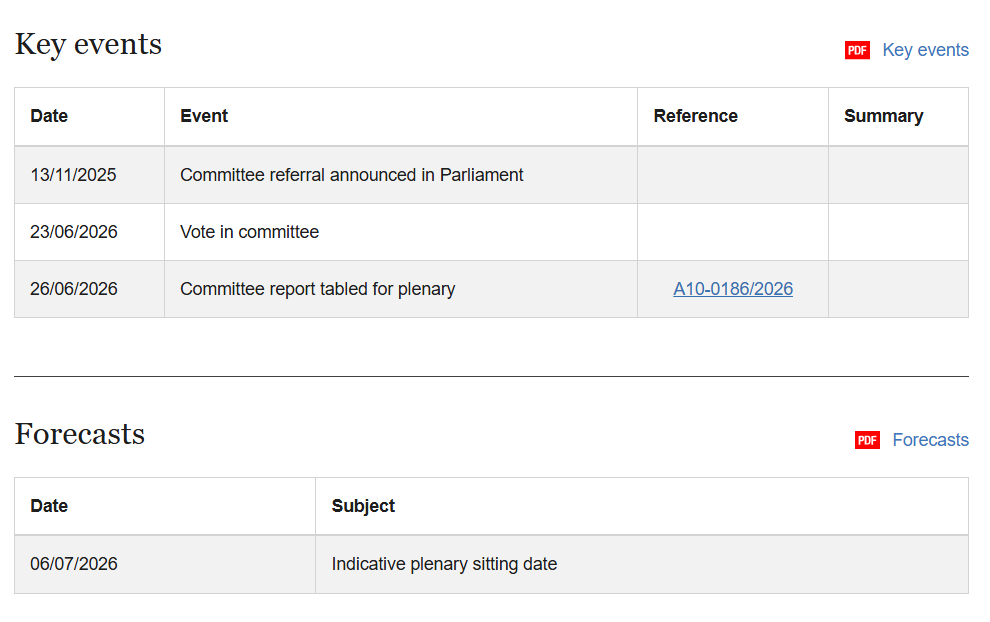
The recommendations were part of a report tabled Friday for plenary vote. It also called for promoting tokenization across financial services, encouraging euro-denominated stablecoins and assessing whether additional crypto activities should be regulated under the European Union’s Markets in Crypto-Assets Regulation (MiCA).
Drafted by Belgian Member of the European Parliament Johan Van Overtveldt, the report is an own-initiative resolution by the Committee on Economic and Monetary Affairs (ECON) that outlines recommendations for the Commission on digital asset regulation.
It will next go before the European Parliament for a vote, expected July 7. If adopted, the resolution would become Parliament’s official position on digital assets policy but would not amend MiCA or create new legal obligations.
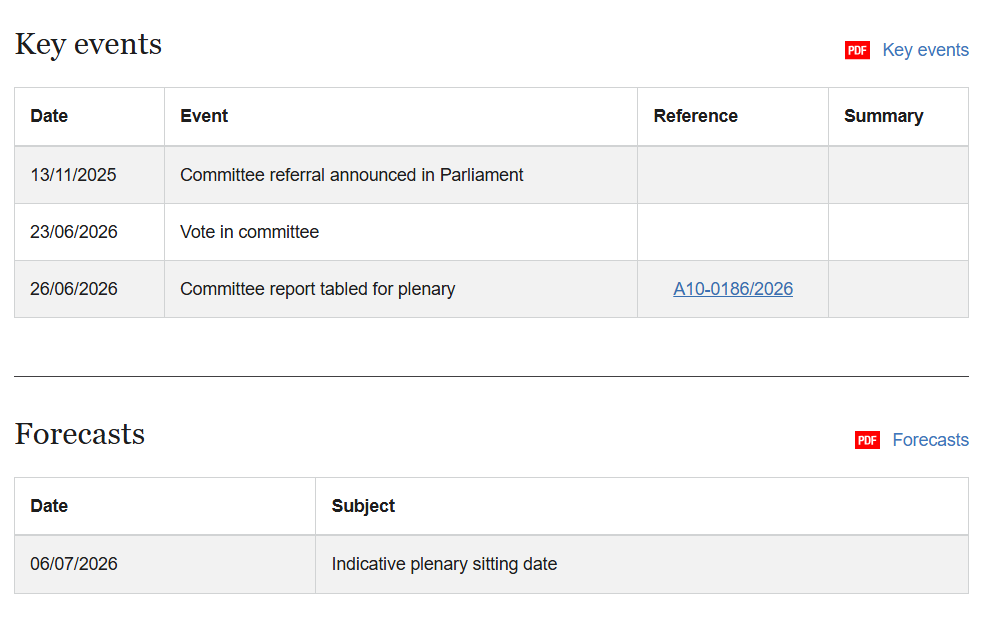
The legislative timeline shows the committee’s approval of the report and its referral for a plenary vote. Source: European Parliament
Related: European Parliament throws support behind digital euro
EU warms up to regulated stablecoins
The recommendations also reflect an evolving view of stablecoins among policymakers. Days after former Bank for International Settlements general manager and longtime crypto critic Agustín Carstens softened his stance on stablecoins, the report welcomed euro-denominated stablecoins under MiCA and encouraged their development to support the bloc’s payment sector.
In 2023, Van Overtveldt called for tighter restrictions on cryptocurrencies following the banking turmoil surrounding Silicon Valley Bank, Signature Bank and Silvergate Bank. The crisis was also closely tied to stablecoins, as USDC issuer Circle held roughly $3.3 billion of its reserves at Silicon Valley Bank when it collapsed, briefly causing USDC to lose its dollar peg.
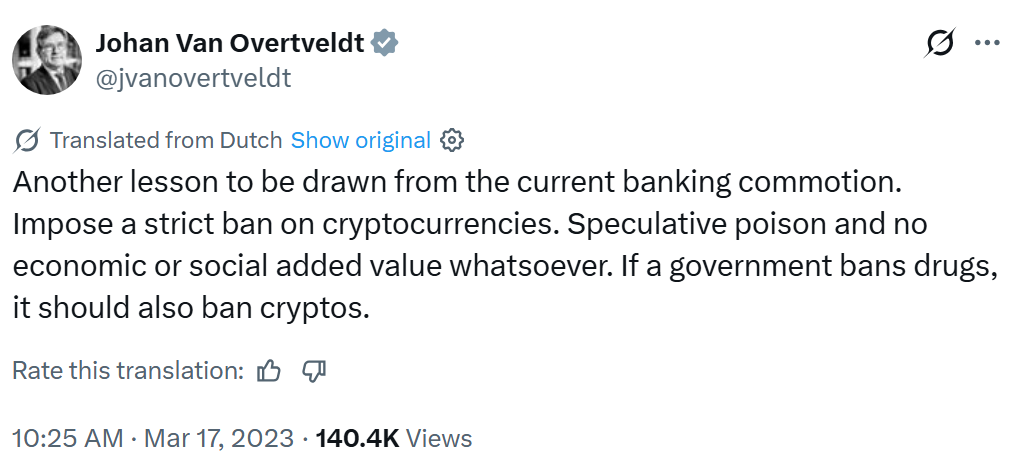
Van Overtveldt likened cryptocurrencies to drugs during the 2023 banking crisis. Source:Johan Van Overtveldt
The report argued that euro-denominated stablecoins could complement tokenized commercial bank deposits and wholesale central bank digital currencies while enabling faster and cheaper cross-border payments. It also said broader adoption could strengthen the competitiveness of EU financial markets and the international role of the euro.
The stance also aligns with ECON’s broader vision for Europe’s digital money ecosystem. On Tuesday, the committee backed legislation for a digital euro, with lawmakers arguing that public and private forms of digital money should coexist rather than compete.
Related: Poland president vetoes MiCA bill again as crypto companies look to license abroad
Lawmakers look beyond MiCA’s current scope
Van Overtveldt first presented a draft of the report in February before months of negotiations and amendments by ECON members. The earlier version largely focused on MiCA’s existing framework, including stablecoin classifications and legal certainty for multi-issued stablecoins.
The committee-approved report urged consistent application of MiCA across the EU to preserve a level playing field for crypto firms. It also warned member states against introducing national requirements beyond MiCA that could fragment the bloc’s digital asset industry.
The Commission is already reviewing MiCA. In May, the Commission launched a public consultation seeking feedback on whether the framework should be expanded to cover areas including DeFi, staking, lending, NFTs and tokenized financial assets, while also reopening debate over the regulation’s ban on interest-bearing stablecoins.
Meanwhile, MiCA’s transitional period ends July 1, after which crypto asset service providers generally must hold authorization under the regulation to continue operating across the EU.
Magazine: AI is banking the unbanked in Africa… faster than crypto
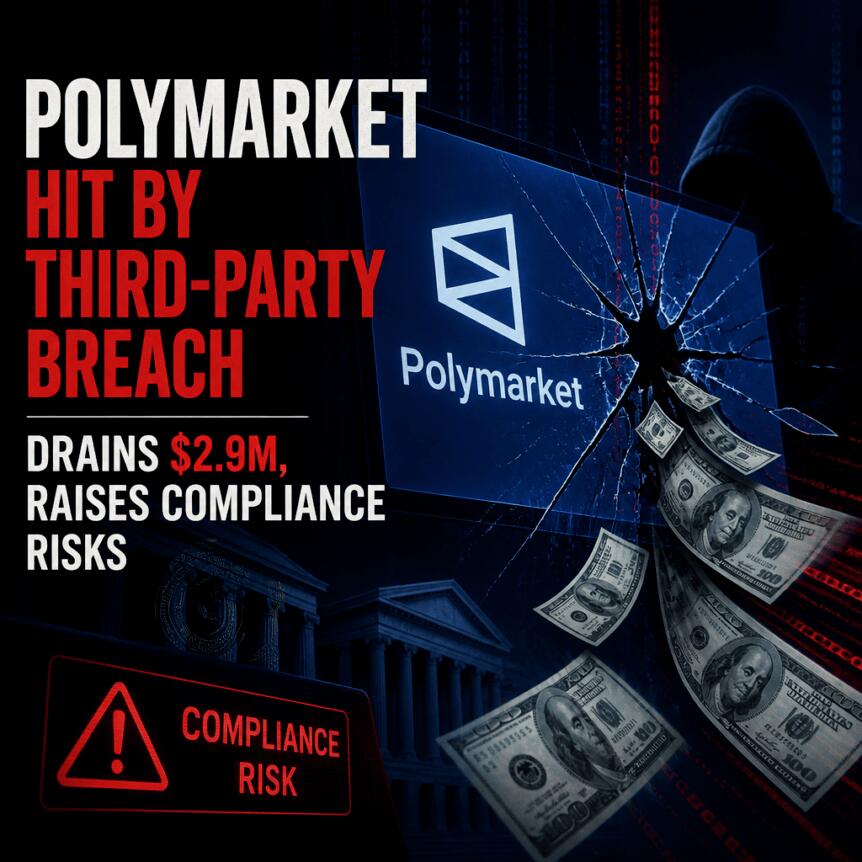
Polymarket says a third-party vendor compromise discovered on Thursday enabled attackers to inject malicious code into its website interface, leading to a phishing campaign that targeted multiple users. According to blockchain analyst Specter, the injected script was used to drain an estimated $2.94 million from at least 11 Polymarket wallets.
Polymarket stated that the incident has been contained and that the compromised dependency has been removed. The platform also said affected users will receive full refunds. Cointelegraph contacted Polymarket for comment but did not receive a response before publication.
Key takeaways
- Polymarket reported a third-party vendor compromise that allowed attackers to inject a malicious script into its frontend.
- Analyst Specter linked the malicious code to phishing activity, estimating losses of about $2.94 million across at least 11 user wallets.
- Polymarket said the issue has been contained, a dependency has been removed, and users will be fully refunded.
- Blockchain security reporting data indicates the incident fits within a high volume of crypto breaches in the quarter.
- Separately, DefiLlama data shows private key compromise remains the dominant cause of reported exploit losses over the last 30 days.
Frontend compromise and phishing-driven wallet losses
The Polymarket incident centers on a supply-chain style failure rather than a direct smart contract exploit. Specter said the malicious script appeared to enable a phishing attack that redirected or induced users into compromising credentials or authorizations, culminating in unauthorized asset movement from user wallets.
In practice, this type of front-end compromise can be especially damaging for institutions and compliance teams because it shifts the risk profile away from on-chain mechanics alone. Even where contracts are unchanged, malicious web-layer code can manipulate user behavior, compromise session-related security assumptions, or trick users into signing harmful transactions. For regulated entities that integrate with or route user access to crypto services, incidents like this highlight the need for tighter vendor governance and continuous integrity controls over externally served dependencies.
Polymarket’s response suggests the affected component was identified and removed after discovery. Its commitment to fully refund users also raises operational and policy considerations: while refunds may mitigate user harm, they do not automatically address whether the underlying controls—such as third-party software update processes, dependency monitoring, and incident response playbooks—were sufficient to prevent reoccurrence.
DefiLlama breach reporting underscores a pattern of recurring exploit methods
The Polymarket case arrives as crypto security incident reporting remains elevated. DefiLlama data places the event within a broader timeline: the third quarter’s second quarter-to-date statistics indicate the quarter had its most-hacked period by incident count, according to Cointelegraph’s reference to DefiLlama and its reporting on Q2.
DefiLlama also reports that June saw reported crypto exploit losses of $74.9 million across 29 incidents, exceeding May’s $60.5 million total but remaining well below April’s $644 million peak.
Among the largest June incidents were a $36 million Humanity Protocol exploit, a $4.7 million Secret Network bridge exploit, two separate Aztec exploits valued at $2.1 million each, and a $1.7 million bridge exploit tied to Taiko. While each exploit involves different technical pathways, they collectively reinforce a key compliance reality: incident frequency and magnitude continue to stress operational risk management across exchanges, wallets, and service providers with protocol-level exposure.
DefiLlama’s breakdown of losses over the past 30 days points to private key compromise as the most common leading vector, accounting for 43% of reported exploit losses. Fake proof exploits made up 10%, and reverse MEV honeypots accounted for 8%. For risk teams, these categories matter because they indicate whether controls should prioritize key management, signature/authorization integrity, or transaction routing safeguards for automated systems and integrators.
Private key history at Polymarket highlights multiple threat surfaces
About a month before the reported Polymarket frontend incident, the prediction market disclosed an additional exploit traced to a six-year-old private key used for internal top-up operations. Cointelegraph previously reported that Polymarket said contracts and user funds remained safe in that earlier case and that all permissions associated with the compromised key were revoked.
Taken together, the two events underscore that Polymarket—or any crypto service with on-chain and off-chain touchpoints—can face multiple, distinct threat surfaces: backend key management for operational processes, and web-delivered dependencies for user-facing interactions. For institutional stakeholders, the combination can complicate assurance: even when one control area is remediated (for example, permissions revoked after a key issue), a separate control plane—like third-party dependency integrity—can still introduce new risk.
Polymarket’s scale also implies higher stakes for incident governance. DefiLlama reports that the platform holds more than $450 million in total value locked, up from $112 million a year ago.
Regulatory and compliance implications for crypto firms and integrators
Although Polymarket operates in a market with evolving regulation, incidents of this nature feed directly into compliance expectations for crypto businesses. Under frameworks such as the EU’s Markets in Crypto-Assets regulation (MiCA), firms are expected to meet governance and operational resilience obligations, while AML/CFT requirements under applicable regimes typically extend to “know your customer” processes and the protection of user funds. Supply-chain compromise and phishing-driven theft also raise questions for regulated counterparties about how customer asset protection claims are substantiated in practice.
For exchanges, wallet providers, payment processors, and institutional service providers, vendor-linked incidents may trigger additional internal review under third-party risk management policies. Common areas include: the lifecycle management of dependencies, auditability of frontend build and deployment pipelines, incident detection and containment procedures, and the adequacy of refund or restitution policies. Even if the theft originates outside on-chain code, user harms can still translate into regulatory scrutiny about consumer protection, disclosures, and operational risk controls.
Cross-border differences in enforcement priorities can further complicate response. In the United States, where crypto enforcement actions have frequently addressed security, consumer protection, and alleged failures in compliance controls, and where federal agencies coordinate through legal processes and subpoenas, a frontend-driven phishing incident can still be framed as a failure to maintain reasonable safeguards. Separately, AML/KYC obligations do not prevent phishing, but they can affect how stolen funds are identified, how affected users are supported, and how suspicious activity is triaged.
For institutional compliance monitoring, the most actionable element is the incident pattern itself: third-party compromise leading to user deception, alongside persistent exploit vectors such as key compromise. These themes suggest that governance should cover both technical controls (key management, permissioning, transaction integrity) and administrative controls (vendor oversight, software supply-chain assurance, and documented response measures).
Closing perspective
Polymarket says the compromised dependency has been removed and that affected users will be refunded. The next phase will likely involve detailed post-incident validation of the compromised supply chain, verification of residual exposure across its frontend delivery stack, and continued alignment of technical controls with the compliance expectations institutions apply to customer protection and operational resilience. Security incident reporting will remain a key reference point for assessing whether this case reflects a broader systemic risk pattern or an isolated vendor failure.
Binance’s competitive advantages are facing a hard new test. Europe’s sweeping new crypto rulebook reopens an old question: how much of its dominance is due to scale, and how much to a regulatory gap.
The pressure is immediate. The European Union (EU) is forcing Binance out of the bloc under new Markets in Crypto-Assets (MiCA) rules. Days earlier, OKX chief executive Star Xu split its success into four parts, arguing each leans on those gaps.
Binance Has Four Competitive Advantages
Analysts and rivals credit Binance’s dominance to four pillars, a breakdown Xu recently detailed. Each is a real strength. Each also now faces a harder test.
Regulatory Arbitrage
Binance scaled quickly by operating across many markets, often ahead of local licensing requirements. That kept costs low. US prosecutors later found that it had never filed a suspicious activity report and let US users trade more than $898 million with sanctioned Iran.
It settled for $4.3 billion in 2023, the year founder Changpeng Zhao pleaded guilty and resigned.
Since then, it has chased licenses and, when pushed, left markets instead, exiting Canada, the Netherlands, and an earlier German application.
A Market-Leading Listings Engine
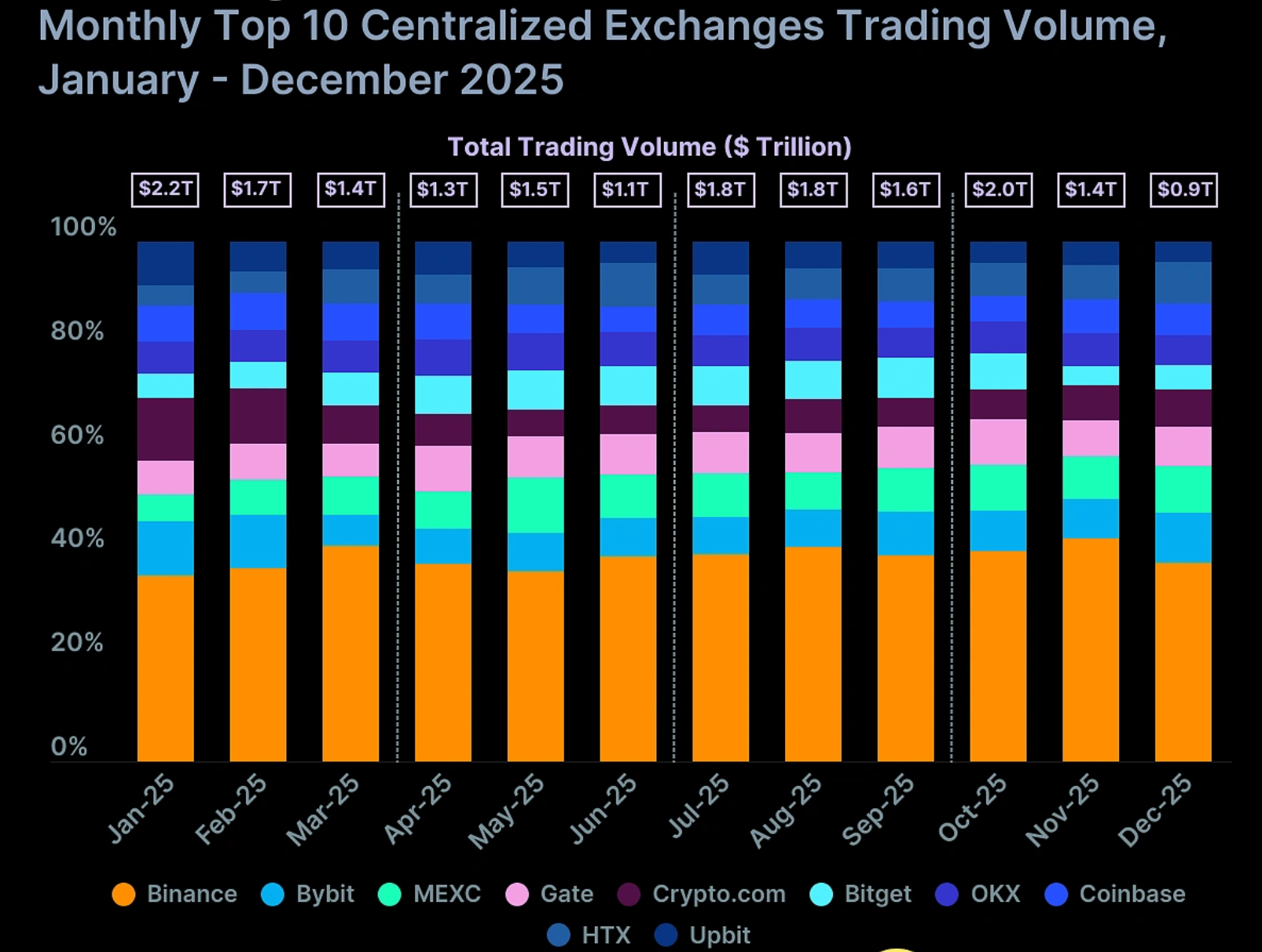
Binance turns attention into volume better than any rival. It took 39.2% of the top exchanges’ spot trading in 2025, almost five times the share of its nearest competitor, according to CoinGecko.

By its own count, it processed $34 trillion in total product volume across the year. Its Launchpad and constant listings keep traders chasing the next token, though critics warn the sharpest hype cycles leave retail holding the losses.
Unmatched Distribution
Binance counted more than 300 million registered users by the end of 2025, the company reported. A network of affiliates, volunteer Angels, and media partners stretches that reach further.
Supporters call it strong community building. Critics call it narrative management when bad news lands.
Heavy Compliance Investment
Binance’s compliance spending has topped $200 million a year, up from $158 million two years earlier, chief executive Richard Teng told Bloomberg. It fielded about 63,000 law enforcement requests in 2024, up from 58,000.
Yet US prosecutors still imposed a three-year independent monitor in 2023, and critics, Xu among them, say the controls long trailed the marketing.
“Let’s see how Binance plays the regulatory arbitrage game again…Regulators are ultimately evaluating outcomes, not organizational charts,” Xu said, with his own exchange competing directly with Binance.
Follow us on X to get the latest news as it happens
Why the Moat May Still Hold
Binance’s scale is hard to dispute. It pushed $7.3 trillion in spot trades in 2025, far ahead of the field. It also held the top rank through the upheaval that followed CZ’s exit and Teng’s arrival.
Binance says its proof-of-reserves system now backs about $163 billion in user assets.
That base reaches across Asia, the Middle East, and Latin America, well beyond Europe.
Even so, the EU squeeze is real. Binance is winding down EU services next week, and it withdrew its Greek bid days ago.
“Binance is not leaving Europe,” Gillian Lynch, its Head of Europe and UK, told Reuters.
Rivals are circling. Kraken cleared Ireland and Coinbase chose Luxembourg, ready to absorb users Binance sheds.
Analyst Paul Barron is less alarmed, calling the deadline a priced-in consolidation that mostly clears dormant platforms.
The open question is how much of Binance’s lead is scale and how much is a regulatory gap. Cleaner rules should start to answer it.
The post How MiCA is Testing Binance’s Four Competitive Advantages appeared first on BeInCrypto.


Dogecoin and Hyperliquid’s HYPE led the week’s losses across crypto, falling near 10%, as money kept flowing toward stocks tied to the artificial-intelligence boom and away from major tokens.
Dogecoin slid 9.6% over seven days to about $0.076 and HYPE lost 9.9%, the steepest falls among the majors. Ether dropped 8.4% to about $1,581 and XRP fell 7.8% to $1.06, while solana and tron held up better, roughly flat on the week at $72 and $0.32.
Bitcoin was the steadier major, down 5.3% to around $60,345 on Saturday after dipping to about $58,800 on Friday and recovering, per CoinDesk data.
“Bitcoin approached $58K at its lows late Thursday and early Friday, but in both cases, aggressive buying quickly pushed it back into the $60K range,” Alex Kuptsikevich, FxPro chief market analyst, told CoinDesk. “This pattern resembles margin position liquidations during downtrend spikes, followed by strong buying on pending orders during the recovery.”
“Given deteriorating sentiment among institutional investors and their ability to quickly divest from cryptocurrencies to stabilise their balance sheets, it is worth preparing for continued pressure and periodic sell-off spikes by leveraged traders,” he added.


Ripple CEO Brad Garlinghouse said he remains bullish on bitcoin but that Michael Saylor’s approach to funding bitcoin purchases has damaged the broader crypto market, in a CNBC interview on Friday, as the preferred stock at the center of Strategy’s model fell to a record low.
“Financial engineering does not drive long-term value,” Garlinghouse said, arguing that the lasting value of any digital asset comes from its usefulness. “Team Michael Saylor wasn’t focused on the right stuff and that has hurt the overall market.”
He separated that from his view on the asset itself, saying he is still bullish on bitcoin.
Garlinghouse’s target was the machine Strategy has used to accumulate bitcoin. For about a year, the company has issued preferred shares, a class of stock that pays a fixed dividend, to raise cash for more bitcoin.
Its STRC share carries an 11.5% annual dividend and is engineered to trade near $100. Garlinghouse pointed to STRC trading about 25% below that level as a “damning indictment” of the strategy.
Bitcoin’s price volatility around and just under $60,000 continued at the end of the business week, but the asset has managed to climb above this level as of Saturday morning.
Most larger-cap alts are slightly in the green, with XRP trading above $1.05 and ETH standing close to $1,600. SOL has risen the most from this cohort.
BTC Fights for $60K
The business week began on the right foot for the primary cryptocurrency as the asset rebounded from the weekend slump to $62,500 and tapped $65,500 on Monday. However, that was a short-lived attempt for a more profound recovery as the bears were quick to intervene and halt all the progress.
In the following hours, the asset fell to $62,000. It bounced to $63,000, but the next leg down was even more painful. Bitcoin broke below $60,000 for the second time this month and tapped $59,000. After another dead-cat bounce to almost $62,000, the asset plunged even harder on Thursday, dumping to $58,000 for the first time since late 2024.
The latest leg down was strongly related to the adverse price moves observed from Strategy’s MSTR, which also marked a multi-year low of under $80. Nevertheless, BTC has managed to recover some ground from the aforementioned low and now stands at just over $60,000 despite the new attacks in the Middle East.
Its market capitalization has risen to $1.210 trillion on CG, while its dominance over the alts remains under 56%.

SOL, AAVE Pump
Ethereum continues to climb gradually after the recent low of $1,510 and now trades close to $1,600 following a minor daily increase. XRP has reclaimed the $1.05 support after a 2% jump since yesterday. Solana’s SOL has gained the most from the larger-cap alts today and sits above $72.
Even more impressive gains come from AAVE, AVAX, and MORPHO. Aave’s token has risen by double digits and sits above $95, while AVAX is north of $6.6. MORPHO has neared $1.80 following a 7% jump.
In contrast, MemeCore continues to drop, losing another 20% of value and struggling below $0.70 as of now.
The total crypto market cap has recovered over $80 billion since the Thursday low and is up to $2.170 trillion.

The post Solana (SOL) Rebounds Above $70, Bitcoin (BTC) Fights for $60K: Weekend Watch appeared first on CryptoPotato.


Prediction-market operator Kalshi is in talks to raise fresh capital at a valuation of roughly $40 billion, according to the Financial Times, nearly double the price tag from a round that closed just seven weeks ago. The Financial Times first reported the talks, citing people familiar with the… Read the full story at The Defiant
Securitize has secured commitments expected to deliver about $400 million ahead of its planned New York Stock Exchange debut through a merger with Cantor Equity Partners II.
Summary
- Securitize expects to raise about $400 million ahead of its planned NYSE listing through a merger with Cantor Equity Partners II.
- Backed by BlackRock, Morgan Stanley, Coinbase, and Circle, the firm continues expanding its tokenization business with new institutional products.
- The market debut comes as Securitize grows its on-chain asset platform while defending itself in a patent dispute with tZERO.
According to Securitize, fewer than 30% of shareholders in Cantor Equity Partners II, the special purpose acquisition company taking the firm public, chose to redeem their shares following the final redemption results.
The company said it now expects to receive approximately $400 million in gross proceeds from the transaction, including related private investment in public equity (PIPE) financing, before transaction-related expenses.
The proposed listing comes as tokenization companies continue attracting institutional attention, with firms seeking to bring traditional financial assets onto blockchain networks. Securitize counts BlackRock, Morgan Stanley, Coinbase, and Circle among its backers and has become one of the largest providers of tokenization infrastructure for financial institutions.
The merger is expected to complete next week
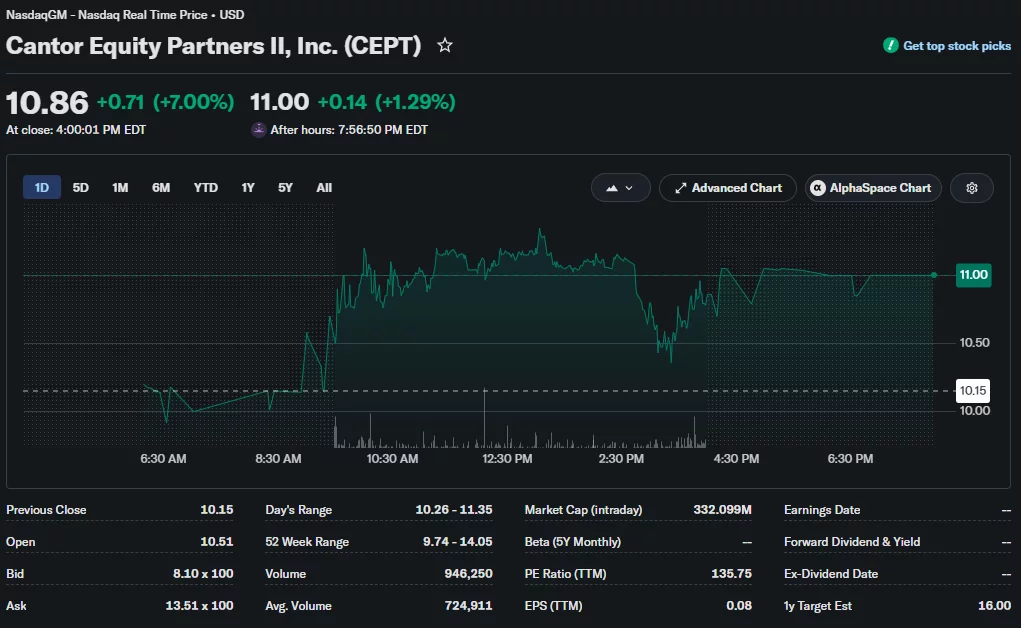
Market reaction has been positive ahead of the vote. Shares of Cantor Equity Partners II closed 7% higher at $10.86 on Friday before extending gains in after-hours trading to $11.
According to Securitize, shareholders are scheduled to vote on the merger on Monday. If approved and all remaining closing conditions are satisfied, the transaction is expected to close on July 1. The combined company is then expected to begin trading on the New York Stock Exchange under the ticker SECZ on July 2.
Commenting on the listing, Securitize co-founder and CEO Carlos Domingo said reaching the public markets represents an important step for the company after more than eight years of building tokenization infrastructure.
“Reaching the public markets is a significant milestone for Securitize and a reflection of the growing momentum behind tokenization.”
Domingo added that tokenized securities, once considered largely theoretical by major financial institutions, are now moving into mainstream finance as institutional adoption continues to grow.
The public debut also follows several months of expansion for the company. As previously reported by crypto.news, Securitize recently extended its Tokenized AAA CLO Fund (STAC) to the Solana blockchain. The company said Ethena Labs plans to allocate $250 million to the fund, which invests in U.S. dollar-denominated AAA-rated collateralized loan obligation tranches.
According to Securitize, the product is developed with BNY serving as custodian of the underlying assets and sub-adviser through BNY Investments.
Institutional tokenization business continues to expand
Alongside new investment products, Securitize has continued growing its role in tokenized capital markets. Earlier this year, the company partnered with the New York Stock Exchange to support the exchange’s planned tokenized securities platform.
Crypto.news previously reported that Securitize provides tokenization infrastructure for more than 650 funds and oversees more than $4 billion in tokenized assets. BlackRock has also deepened its relationship with the firm.
In May, crypto.news reported that the asset manager filed a second Securitize-powered tokenized fund with the U.S. Securities and Exchange Commission after its BUIDL fund expanded to roughly $2.3 billion in assets.
At the same time, Securitize is dealing with a legal dispute ahead of its market debut. As reported by crypto.news, the company recently asked the U.S. District Court for the District of Delaware to declare that its products do not infringe patents owned by tZERO after receiving a cease-and-desist letter. Securitize called the allegations “without merit,” while tZERO said its claims involve patents covering compliance systems, investor registry checks, and tokenized market infrastructure.
Separate industry forecasts also point to continued growth in tokenized finance. Earlier this month, Standard Chartered projected that tokenized assets used in decentralized finance could reach $2.7 trillion by the end of 2030, up from current levels.

‘I’m 98 but I still do my 40 press-ups every day’

Salesforce: Why The Bears Are Getting Ahead Of Themselves

EU Lawmakers Call for Review of DeFi, Staking and NFT Rules


-

 Entertainment6 days ago
Renter of Home in Anne Heche Crash Denies Settlement With Son
-
 Sports4 days ago
Two goals and an assist by sheer aura: Cristiano Ronaldo just entered the World Cup chat
-

 Tech5 days ago
Microsoft accidentally kills epic Outlook email threads
-

 Fashion15 hours ago
Weekend Open Thread: Staud – Corporette.com
-

 Business6 days ago
Soccer-U.S. defends Iran World Cup travel restrictions, says discussions ongoing
-

 Politics1 day ago
The House | Manchesterism won’t survive the painful trade-offs unless it gets citizens on board
-

 Politics1 day ago
Potential 2028er World Cup attendee leaderboard
-

 Business1 day ago
Asia stock markets slide as tech shares slump
-

 Tech2 days ago
A Look At A Gaggle Of Transputer Boards
-
Crypto World3 days ago
Bitcoin (BTC) Dips Below $62K, Ethereum (ETH) Plunges 6% Daily: Market Watch
-

 Crypto World3 days ago
Securitize Wraps Roubini's SEC-Registered ETF as Dubai VARA Digital Security
-
 Crypto World2 days ago
Dell (DELL) Shares Tumble Over 5% Following Analyst Downgrade to Hold
-
Business3 days ago
Entergy settles forward sale agreements, raises $672 million in cash proceeds
-
 Crypto World7 days ago
Can Charles Hoskinson Really Rescue Cardano?
-

 Sports12 hours ago
FIH Pro League: India defeat Pakistan 7-1, register biggest win of campaign | Other Sports News
-

 Crypto World4 hours ago
Kraken's xStocks Opens Bending Spoons IPO Registration to EEA Retail
-

 Crypto World16 hours ago
RTX holders must register wallets before token distribution begins
-
 Crypto World19 hours ago
Hyperliquid Named on Singapore MAS Investor Alert Register
-

 Crypto World7 days ago
Jake Chervinsky accuses CME of protecting derivatives monopoly
-

 Sports2 days ago
India vs Bangladesh LIVE Score, Women’s T20 World Cup: Bangladesh Opt To Bat; India Enter ‘Do-Or-Die’ Stage As Semi-Final Race Heats Up
You must be logged in to post a comment Login