
Crypto World
Crypto’s Core Business Is Maturing Toward Banking Models


This week’s most important crypto business developments all point in the same direction: more of the industry’s value is being routed through financial infrastructure rather than pure onchain speculation. BlackRock, for example, has introduced tokenized money market products aimed at stablecoin reserve use under the US GENIUS Act framework.
At the same time, tokenized real-world assets are proving their resilience in volatile markets, even if their decentralized finance (DeFi) adoption still looks modest. Elsewhere in the sector, Tether reported a sharp rise in profits tied to US Treasury income, while a public Bitcoin miner linked to the Trump family posted improved production and narrower quarterly losses.
Key takeaways
- BlackRock launched two tokenized money market products designed to help stablecoin issuers satisfy reserve requirements under the US GENIUS Act.
- RedStone data suggests tokenized gold performed relatively well during a sharp gold sell-off, but only a small fraction of tokenized gold supply is used as DeFi collateral.
- Tether reported $1.5 billion in second-quarter net operating profit, supported primarily by interest from US Treasury holdings and related arrangements.
- American Bitcoin reported record second-quarter production of 932 BTC, improving revenue and narrowing losses, though it remains unprofitable.
BlackRock moves to tokenize stablecoin reserves
BlackRock introduced two tokenized money market products intended to support stablecoin issuers with reserve requirements under the US GENIUS Act, expanding its involvement in tokenized financial infrastructure. According to earlier coverage by Cointelegraph, one product tokenizes exposure to BlackRock’s existing Treasury liquidity strategy on Ethereum, allowing approved investors to transfer ownership onchain while the underlying assets stay invested in cash and short-term US government securities.
The second product is described as a new institutional money market vehicle for digital asset markets. It is positioned as compatible with multiple blockchains and designed to automatically reinvest income—an approach that aligns with how reserve managers typically seek operational continuity rather than manual redemptions and reinvestment cycles.
For market participants, the practical significance goes beyond the novelty of tokenization. Stablecoins need credible, auditable reserves, and a product built around short-term government assets creates a clearer bridge between traditional compliance expectations and blockchain-based settlement. It also reinforces BlackRock’s growing footprint in tokenized Treasurys, where it already runs BUIDL, described as the industry’s largest tokenized Treasury fund.
This launch also reflects a broader institutional trend: Wall Street firms are increasingly entering tokenized markets not only as issuers, but as infrastructure providers for the assets that underwrite onchain finance. With GENIUS establishing a federal framework for payment stablecoins, the demand for reserve-grade solutions is likely to become more structured—potentially benefiting tokenization platforms that can translate “what reserves should be” into “how those reserves can be managed on-chain.”
Tokenized gold shows stress tolerance, but DeFi use is still limited
Tokenized bullion continues to draw attention, but its DeFi footprint remains small relative to its overall market. A report by RedStone, referenced in earlier Cointelegraph coverage, found that tokenized gold held up during periods of sharp price movement—specifically during gold’s sell-off.
RedStone’s analysis points to a key asymmetry in the sector: trading activity can surge while borrowing and lending adoption lag. While spot trading volume reportedly reached $90.7 billion in Q1 as gold futures rallied above $5,600 per troy ounce, RedStone estimated that only about $63 million of Tether Gold and PAX Gold is used as collateral on Aave v3 and Morpho. That figure is roughly 1.5% of their combined $4.2 billion market cap, indicating that most tokenized gold remains outside major onchain collateral pipelines.
The report also highlighted how collateral behaved during stress. On March 23, Aave processed what it described as its largest cluster of XAUT liquidations without disruption after gold dropped roughly 10% in a week—an event characterized by JPMorgan’s Greg Shearer as an “extremely brutal flush.” RedStone’s broader takeaway was that tokenized gold looked resilient, even as the findings underscored an infrastructure gap as tokenized real-world assets scale.
Since that period, gold futures have fallen more than 20% from January peaks, influenced by expectations of higher US interest rates. In that environment, the value proposition for tokenized gold is partly about reliability during volatility: the question for investors and DeFi builders now is whether liquidity and collateral usage can grow fast enough to match the expanding market for tokenized bullion itself.
Tether’s Treasury-linked earnings power another strong quarter
Tether reported a second-quarter performance that is closely tied to US Treasury income. According to its latest quarterly attestation, Tether generated $1.5 billion in net operating profit, driven primarily by interest earned on its US Treasury holdings and repurchase-related arrangements.
The attestation also points to reserve strength. As of June 30, Tether reported a reserve buffer of $4.11 billion, with assets exceeding liabilities by that margin. In parallel, even as the broader stablecoin market contracted, USDT circulating supply increased by $446 million to $184.6 billion. The result preserved Tether’s market share—DeFiLlama data cited in the earlier reporting placed USDT’s market value around $307 billion and suggested Tether still accounts for more than 60% of global stablecoin supply.
From an investor perspective, the most important implication is that stablecoin profitability continues to depend heavily on short-term interest rates. When Treasury bill yields and cash-equivalent returns are elevated, reserve-based income can become a major earnings driver, which is what appears to have happened in this quarter.
However, the same dynamic also raises a forward-looking risk: if rate expectations change or stablecoin demand slows further, Tether’s income could face pressure. This quarter’s stronger profit and reserve surplus therefore doesn’t eliminate near-term uncertainty for the stablecoin sector—it clarifies what factors are currently supporting earnings, and what could reverse them if macro conditions shift.
American Bitcoin improves production and reduces losses
Bitcoin mining remains highly sensitive to production economics and balance sheet decisions, and the latest quarterly results from American Bitcoin reflect that reality. In earlier Cointelegraph coverage, the company—linked to the Trump family and Nasdaq-listed—reported record second-quarter production of 932 BTC, improving mining revenue compared with the first quarter.
American Bitcoin reported mining revenue of $67 million in Q2, up from $62.1 million in Q1. The company also narrowed its net loss to $57.2 million, improving from an $81.8 million loss in the previous quarter. The production milestone matters because it is one of the few levers miners can control in the short term—hash rate and operational efficiency translate directly into how much Bitcoin is produced, even when market prices are volatile.
But the company’s financial picture is still constrained. American Bitcoin remains unprofitable, and it recently completed a 1-for-15 reverse stock split to maintain its Nasdaq listing after its share price fell below the exchange’s minimum bid requirement. Its balance sheet also includes pledged Bitcoin: the miner held roughly 8,002 BTC as of June 30 and had pledged about 3,090 BTC as collateral under equipment purchase agreements with Bitmain.
That pledge introduces additional sensitivity to Bitcoin price movements. Even when production improves, a decline in BTC could complicate collateral dynamics and funding conditions—an issue that investors should keep watching as the company attempts to stabilize its public-market footing.
Across these stories, a shared theme emerges: crypto businesses are increasingly evaluated on how they monetize financial assets—Treasury exposure, tokenized reserves, tokenized collateral, and operational production—rather than on token price narratives alone. The next watchpoints are straightforward: whether stablecoin-related tokenized reserve products expand beyond pilots, whether tokenized gold’s DeFi collateral usage grows beyond its current small share, and how earnings trajectories for issuers like Tether and miners like American Bitcoin respond if interest-rate and Bitcoin-price assumptions turn.


Twilio (TWLO) stock jumped Friday after the communications software maker reported second-quarter earnings and revenue that topped consensus estimates as a new voice-based artificial intelligence product gained traction. The company’s September quarter sales outlook came in above expectations. The San Francisco-based company reported earnings after the market close on Thursday. Twilio EPS rose 24% to $1.47 for the June quarter…
Copyright ©2026 Investor’s Business Daily, LLC. All rights reserved. 87990cbe856818d5eddac44c7b1cdeb8

Nvidia (NVDA) is set to report second-quarter earnings on Aug. 26 after the market close, and the options market is pricing in an 8.8% move in either direction. The tech heavyweight’s stock has a solid recent history of strong performance following earnings reports. Let’s look at selling a cash-secured put to take advantage of the high implied volatility around the…
Copyright ©2026 Investor’s Business Daily, LLC. All rights reserved. 87990cbe856818d5eddac44c7b1cdeb8

Recent initial public offering Loar (LOAR) is the IPO Stock Of The Week as it offers a new buy point and attempts support at a key level. The defense stock also sits on Investor’s Business Daily’s IPO Leaders screen. Loar manufactures components for military and aerospace platforms. It supplies such defense giants such as Boeing (BA), Airbus (EADSY) and Lockheed…
Copyright ©2026 Investor’s Business Daily, LLC. All rights reserved. 87990cbe856818d5eddac44c7b1cdeb8

XRPL has released version 3.3.0, which takes another step toward becoming infrastructure for institutional tokenization.
It introduces several proposed amendments focused on privacy, payments, and managing real-world assets (RWAs).
Confidential Transfers
Perhaps the most significant new feature is called Confidential Transfer. It’s designed to allow institutions to hide balances and transaction amounts for Multi-Purpose Tokens (MPTs) while keeping the accounts and the asset type involved visible. It uses cryptographic proofs to verify that transactions are valid without publicly revealing the underlying amounts.
According to the GitHub post and previous reports on the matter, this could address an important obstacle for financial institutions, which may want the transparency and settlement benefits of a public blockchain without exposing sensitive position sizes or transaction values.
Data from RWA.xyz shows that roughly $850 million out of the $1.38 billion in RWA distributed on the XRPL is from Ripple’s own stablecoin, RLUSD. This leaves approximately $530 million in other tokenized assets from other big names in the niche, such as Ondo, Archax, Societe Generale, and VERT Capital.
Other Proposals
Aside from Confidential Transfers, the other updates named in version 3.3.0 include Batch, Sponsor, and Permission Delegation. The first amendment would allow up to eight transactions to be grouped together, including an atomic mode in which either all transactions succeed or the entire batch fails. This is expected to benefit complex settlements, swaps, and institutional transactions.
Sponsor is designed to enable one account to cover another user’s transaction fees and reserve requirements. In other words, it could allow companies to onboard customers without requiring them to purchase XRP before interacting with an application.
The last one would enable account holders to grant another party pre-defined transaction permissions without surrendering full control of the wallet. It would align with Dynamic MPT and provide issuers with greater flexibility by allowing certain token characteristics to be modified after issuance.
It’s worth noting that these amendments are not live on the XRP Ledger Mainnet yet, as the governance process requires each to maintain support from at least 80% of trusted validators for two consecutive weeks before activation.
The post Major XRP Ledger Upgrade Targets Institutional Adoption But There’s a Catch appeared first on CryptoPotato.

Donald Trump has warned that China could gain control of the global crypto sector as the US delays major market rules. The president stressed that America must protect its leadership in digital assets while lawmakers struggle with the CLARITY Act. His remarks add pressure on Congress as negotiations continue over regulations, ethics rules, and illicit finance provisions.
Trump Links Crypto Leadership to US National Strategy
Trump has placed cryptocurrency among the technologies that could shape America’s economic position in coming years. He also compared the strategic importance of crypto with artificial intelligence and urged the US to maintain leadership. Meanwhile, his administration continues to promote digital assets as an important part of the American technology sector.
The president warned that China could strengthen its position if the US slows crypto development. He also pointed to growing competition among countries seeking greater influence over emerging digital technologies. Therefore, Trump argued that restrictive policies could weaken America’s position while other nations expand their crypto industries.
Trump has also defended his administration’s approach toward digital asset regulation and innovation. He argued that excessive restrictions could discourage new businesses and push technological activity toward foreign markets. However, lawmakers continue to debate how the US should balance innovation with stronger safeguards across the crypto sector.
Clarity Act Faces Continued Senate Delays
Trump’s comments arrive as the CLARITY Act remains stalled in the US Senate. The market structure bill seeks to establish clearer rules for digital assets and define responsibilities across federal regulators. However, lawmakers have yet to resolve several major disputes surrounding the legislation.
Senate negotiations have focused on ethics requirements, illicit finance measures, and other provisions within the bill. These disagreements have slowed progress and reduced the chances of an immediate floor vote. At the same time, lawmakers continue working on changes that could secure broader support for the legislation.
The delay creates another challenge for Trump’s broader crypto agenda and his push for American leadership. A prolonged legislative process could leave the industry without a comprehensive market structure framework. Meanwhile, competing jurisdictions could use regulatory clarity to attract crypto companies, capital, and blockchain development.
Trump Challenges Ethics Concerns Over Crypto
Trump has also criticized proposals that could restrict his participation in crypto-related businesses while serving as president. The ethics debate has become another issue within the wider negotiations surrounding the CLARITY Act. Lawmakers have considered measures designed to address potential conflicts involving public officials and digital asset interests.
The president has indicated that his businesses remain under his family’s management during his administration. He has also said that he does not discuss government matters with his children. Consequently, Trump maintains that the ethics provisions should not prevent the US from advancing its digital asset sector.
The debate now combines regulatory policy, national competition, and ethics concerns around crypto. Trump continues pushing for US leadership, while Senate lawmakers seek agreement on the CLARITY Act. As negotiations continue, the final legislation could shape how America regulates crypto and competes with China in digital technology.

Bitcoin Improvement Proposal (BIP) 110 has entered its mandatory-signaling window, but miners are signaling support at a fraction of the level needed to credibly move the network to a new consensus regime. According to a BIP-110 monitor, support was present in just 51 of the 2,016 blocks preceding block 961,632—about 2.53%—far below the 55% threshold required for early activation.
As of block 961,632, nodes enforcing BIP-110 started rejecting blocks that do not set version bit 4. Ordinary Bitcoin nodes, however, continued to accept both signaling and non-signaling blocks. A smaller “BIP-110 branch” appears to have emerged, but it quickly fell behind the chain that most miners are extending.
Key takeaways
- Miners signaled BIP-110 support at about 2.53% in the run-up to block 961,632, well under the 55% early-activation requirement.
- Starting at block 961,632, enforcement nodes reject blocks missing version bit 4, while non-enforcing nodes still accept them.
- A minority enforcing branch formed but has not gained sufficient momentum to become the dominant chain.
- BIP-110 aims to impose temporary limits on transaction/script and data sizes to curb non-monetary on-chain bloat, especially inscriptions.
Mandatory signaling begins, but the signal is weak
The core mechanics of BIP-110’s current phase hinge on miner signaling through version bit 4. During the defined mandatory-signaling window—blocks 961,632 through 963,647—nodes enforcing the proposal apply stricter rules: they reject blocks that do not carry the expected signal. The monitor data indicates that support during the prior 2,016-block period was too low for a sustained competitive chain to plausibly form.
Because the dominant chain is still being extended without broad signaling, the long-term viability of any rival branch depends on whether miners materially increase their participation. With limited support, a BIP-110 branch would at best advance slowly and could stall if miners continue extending blocks that enforcement nodes will not accept.
This is why the milestone matters beyond the immediate block height: it tests whether a contentious consensus change can move forward—or meaningfully alter behavior—without broad miner backing. That dynamic also raises the risk of an operational split: enforcing nodes could follow a chain that enforces BIP-110 rules, while the majority chain continues to follow the default rule set.
BIP-110’s proposed restrictions target on-chain data growth
BIP-110 was drafted by pseudonymous developer Dathon Ohm and is designed to introduce additional consensus restrictions intended to last roughly one year. The proposal focuses on constraining how much data different parts of a transaction can carry, including limits on output scripts and specific data-bearing elements.
In broad terms, it would:
- Limit most new output scripts to 34 bytes.
- Cap OP_RETURN outputs at 83 bytes.
- Restrict certain data pushes and witness elements to 256 bytes.
- Temporarily limit several Taproot-related features.
Importantly for users and wallet developers, outputs created before activation would be exempt from the new restrictions. Supporters of BIP-110 argue that these constraints would reduce incentives for inscriptions and other non-monetary data patterns that increase storage and bandwidth demands on node operators.
Criticism centers on network division and rule mismatches
Not everyone agrees that limiting data sizes is the right path. Critics—including Strategy Executive Chairman Michael Saylor and Blockstream CEO Adam Back—have argued that BIP-110 could divide Bitcoin and lead to situations where some nodes reject transactions that are permitted under the network’s existing rules. Earlier coverage from Cointelegraph highlighted their concerns in an article titled “Bitcoin leaders Michael Saylor and Adam Back rebuff BIP-110 proposal.”
The enforcement model during the signaling window heightens that concern. With enforcing nodes refusing non-signaling blocks, the network’s practical behavior can diverge even before a proposal’s restrictions fully take effect. This raises a key question for participants: whether the enforcement boundary will remain a technical footnote or become a persistent source of disagreement over block space usage.
Timing details and a discussed fallback
BIP-110’s deployment schedule defines several important points:
- Block 963,648 marks the beginning of its locked-in state.
- Block 965,664 is when the transaction restrictions would begin to take effect.
The version-bit mechanism is also a centerpiece of the proposal’s strategy. BIP-110 uses version bit 4 for miner signaling, with the mandatory-signaling window already underway. The current miner support level—about 2.53% in the monitor’s measured period—suggests that early activation is not likely to happen without a sharp change in miner behavior.
Separately, BIP-110 proponents have discussed contingencies. On Aug. 1, Bitcoin developer Chris Guida rebased preliminary code for a proof-of-work change originally written by Bitcoin Knots maintainer Luke Dashjr. Guida later described the code as a contingency if miners opposed BIP-110, though he did not set an activation date at the time.
While that fallback discussion does not change the current signaling reality, it underlines the central tension of the moment: supporters want a path to limit certain on-chain data behaviors, while opponents worry about the consequences of contentious rule enforcement in a system that relies on miner consensus and network-wide agreement.
Going forward, readers should watch whether miner signaling meaningfully climbs as the locked-in and effect windows approach. If signaling remains low, the conflict could stay confined to a small enforcing subset; if it rises, the schedule could accelerate a much broader—and more operationally significant—change in what blocks are accepted.

Driscoll acknowledged that he was inspired, in part, by Ukraine’s rapid response to diminished support from its allies, leading to a rapid expansion of missile and drone manufacturing startups.
“If you look at what Ukraine has done so incredibly well, it’s this innovation through necessity, and it’s innovation at the speed that is near or close to matching the commercial sector,” Driscoll said. “So what we, the Army, are trying to do is break down every single barrier that we have put up over the last 20 or 30 years.”
Major aerospace players such as Lockheed Martin and Boeing, as well as arms-makers like General Dynamics, have long been the country’s go-to for defense contracts. But Hegseth’s DoD has more recently strived to increase production by incentivizing smaller companies and startups to build cheap-yet-effective weapons.
For its G-BAM Challenge, the Pentagon said it is seeking long-range precision-strike systems that can be demonstrated within 60 to 90 days and scaled into production within 12 to 18 months. Its website stated that weapons must have a target cost of less than $250,000 apiece at scale.

Bitcoin Improvement Proposal 110 (BIP-110) has entered its mandatory-signaling phase, but miners have sent the required signal in only a small fraction of recent blocks—raising doubts about whether the contentious ruleset can gain enough support to sustain a rival chain.
According to a BIP-110 monitor, at block 961,632 on Saturday miners signaled support in just 51 of the preceding 2,016 blocks, equivalent to 2.53%. That falls well below the 55% threshold the mechanism expects for early activation. While nodes enforcing BIP-110 began rejecting blocks that did not set version bit 4, standard Bitcoin nodes continued accepting both signaling and non-signaling blocks—creating a potential split between enforcing and non-enforcing participants.
Key takeaways
- BIP-110 moved into a mandatory-signaling enforcement window at block 961,632, with enforcing nodes rejecting blocks lacking version bit 4.
- Miners signaled only 2.53% of the time in the preceding 2,016 blocks—far under the 55% level referenced for early activation.
- A BIP-110-compliant minority chain briefly emerged but quickly lagged behind the dominant chain.
- The proposal aims to temporarily restrict on-chain data to reduce storage and bandwidth pressure, but critics warn it could force rule-divergent behavior across the network.
Mandatory signaling begins, but miner participation stays low
The immediate consequence of BIP-110’s start is procedural and practical: once block 961,632 was reached, nodes enforcing the proposal began applying stricter block acceptance criteria. Specifically, they reject blocks that do not set version bit 4 in their block version field.
By contrast, ordinary Bitcoin nodes continued following the existing consensus rules, accepting blocks regardless of whether version bit 4 was set. That difference matters because it turns a signaling experiment into an enforcement stress test—one where participants can end up on different views of “valid” blocks depending on which rules they choose to enforce.
The BIP-110 monitor data also suggests the enforcement did not immediately attract sufficient miner support to sustain momentum. With only 51 signaling blocks out of 2,016 before the window began, proponents would need a significant change in miner behavior to avoid a situation where a BIP-110 branch advances slowly—or stops producing blocks—while the non-enforcing majority chain continues.
What BIP-110 is trying to change on-chain
Written by pseudonymous developer Dathon Ohm, BIP-110 proposes additional consensus restrictions that are intended to last for roughly one year. The proposal is designed to target the way Bitcoin scripts carry data, particularly where large payloads increase the workload for network participants.
In broad terms, BIP-110 would:
- Limit most new output scripts to 34 bytes.
- Cap OP_RETURN outputs at 83 bytes.
- Restrict certain data pushes and witness elements to 256 bytes.
- Temporarily limit several Taproot-related features.
The proposal also includes an exception for legacy outputs: unspent transaction outputs created before activation would not be affected. That detail is important because it reduces the risk of instantly “breaking” already-existing UTXOs, shifting the impact toward new transaction construction after the proposal takes effect.
Supporters have argued that these limits would discourage practices they view as non-monetary—such as inscriptions and other uses that can increase storage and bandwidth costs for node operators. The proposal’s framing is that congestion and resource pressure should be addressed at the consensus level, rather than relying on voluntary policy restrictions.
Why the current phase tests a contentious consensus change
Mandatory-signaling windows are designed to show whether miners are willing to align their blocks with a new ruleset. In this case, the numbers are stark: 2.53% signaling in the monitored window preceding block 961,632 implies that miners are not broadly coordinating around BIP-110.
The result is a practical dilemma for supporters: without a substantially higher share of miner participation, an enforcing chain may struggle to grow. The source notes that a minority branch did appear but quickly fell behind the dominant chain, underscoring how difficult it is to maintain a separate chain when the majority of block production does not follow the same rule signals.
This is also where the proposal’s broader network implications come into focus. If enforcing nodes reject transactions or blocks that non-enforcing nodes accept, a consensus disagreement can emerge—not necessarily as a permanent fork, but as a period in which participants experience different validity rules.
The milestone is therefore less about whether BIP-110 is “right” in principle and more about whether supporters can make a contentious consensus change real without broad miner backing. If that coordination fails, the episode may still be valuable as a signal of how powerfully miner alignment is required for soft-fork style proposals that rely on version-bit signaling and enforcement behavior.
Pushback from major voices and a possible fallback path
The proposal has faced strong criticism from prominent figures in the Bitcoin ecosystem. The article notes that Strategy Executive Chairman Michael Saylor and Blockstream CEO Adam Back argued that BIP-110 could divide Bitcoin and lead nodes to reject transactions that the network’s existing rules would otherwise permit. Earlier coverage on Cointelegraph also highlighted the ongoing dispute around spam and data-heavy usage of block space.
On the technical timeline, BIP-110’s deployment schedule uses version bit 4 and assigns block numbers to key states. The mandatory-signaling window runs from blocks 961,632 through 963,647, during which enforcing nodes reject blocks that do not include the signal. The specification then defines block 963,648 as the beginning of its “locked-in” state and block 965,664 as the point when its transaction restrictions take effect.
The source also points to discussions of a wider contingency. On Aug. 1, Bitcoin developer Chris Guida rebased preliminary code for a proof-of-work change originally written by Bitcoin Knots maintainer Luke Dashjr. Guida described the code as a contingency if miners opposed BIP-110, while stating that no activation date had been set. The details underscore that supporters and builders have considered alternatives if the signaling track does not achieve the needed coordination.
For now, however, the immediate reality is that the signaling signal is weak, and the cost of running enforcement rules without matching miner behavior is that compliant blocks may not keep pace with the chain produced by the majority.
Going forward, investors, traders, and node operators should watch how miner signaling evolves across subsequent windows, whether the enforcing chain continues to lag or disappears entirely, and whether developers continue to refine any contingency approaches if consensus support remains fragmented.


Bitcoin Improvement Proposal 110 entered its mandatory-signaling phase at block 961,632 on Saturday, with miners signaling support in just 51 of the preceding 2,016 blocks, or 2.53%, well below the 55% threshold required for early activation, according to the BIP-110 monitor.
Starting at block 961,632, nodes enforcing BIP-110 began rejecting blocks that did not set version bit 4, while ordinary Bitcoin nodes continued accepting both signaling and non-signaling blocks. A minority BIP-110 branch subsequently emerged, but quickly fell behind the dominant chain.
The low signaling rate makes a sustained rival chain unlikely without substantially greater miner participation. With relatively little mining support, a BIP-110 branch could advance slowly or stop producing blocks altogether.
The milestone tests whether supporters can advance a contentious consensus change without broad miner backing, potentially separating enforcing nodes from the dominant chain and escalating a dispute over how Bitcoin’s block space should be used.
BIP-110 seeks temporary limits on Bitcoin data
Written by pseudonymous developer Dathon Ohm, BIP-110 proposes additional consensus restrictions lasting roughly one year.
It would limit most new output scripts to 34 bytes, cap OP_RETURN outputs at 83 bytes, restrict certain data pushes and witness elements to 256 bytes, and temporarily limit several Taproot features. Unspent transaction outputs created before activation would be exempt.
Supporters said the restrictions would discourage inscriptions and other non-monetary data that increase storage and bandwidth costs for node operators.
The proposal’s critics, including Strategy Executive Chairman Michael Saylor and Blockstream CEO Adam Back, have argued that the proposal could divide Bitcoin and cause nodes to reject transactions permitted under the network’s existing rules.
Related: Bitcoin nodes running BIP-110 crosses 2% as spam wars heat up
The proposal uses version bit 4 for miner signaling. Its deployment schedule sets blocks 961,632 through 963,647 as a mandatory-signaling window, during which nodes enforcing BIP-110 reject blocks that do not carry the signal.
The specification defines block 963,648 as the beginning of its locked-in state and block 965,664 as the point when its transaction restrictions take effect.
BIP-110 proponents have also discussed a more extensive fallback. On Aug. 1, Bitcoin developer Chris Guida rebased preliminary code for a proof-of-work change originally written by Bitcoin Knots maintainer Luke Dashjr.
Guida described the code at the time as a contingency if miners opposed BIP-110, but said no activation date had been set.
Magazine: 10 weirdest things ever tokenized… including farts

Scammers impersonating financial regulators and licensed exchanges are targeting crypto holders who are still moving assets five weeks after the EU’s licensing deadline under the Markets in Crypto-Assets Regulation (MiCA).
This is according to several regulators, including France’s Autorité des Marchés Financiers (AMF), the Dutch Authority for the Financial Markets (AFM), and the European Securities and Markets Authority (ESMA), which described the pattern to the Financial Times.
Fraudsters contact customers of firms that failed to win authorization, present themselves as staff of a regulator or an exchange, then direct the customer to a website or account the criminals control. Regulators say they never cold-contact consumers with instructions to send funds to a particular account.
The transitional period under the Markets in Crypto-Assets Regulation (MiCA) closed on July 1. ESMA’s register listed 322 authorized crypto-asset service providers across 26 member states at its August 4 update, and every provider outside it lost the right to serve EU clients.
Regulators Told Users to Move
ESMA’s public statement of June 23 ordered unauthorized providers to “immediately stop onboarding new EU clients” and to limit services to “actions necessary to sell or transfer crypto-assets, reallocate assets, or close positions.” Custody may continue only for the period strictly necessary to complete an orderly exit.
That same statement told clients to check the register and, where their provider is unauthorized, to transfer holdings “to an authorized CASP, where one is identified, or to a self-hosted wallet.”
Regulators said that the overlap is what the fraudsters are exploiting, with large numbers of users being legitimately told to move funds in the same window.
Authorizations clustered ahead of the cut-off. Seventy-six firms entered the register in June, more than in any other month since the regime opened, with 31 added in July. OKX European CEO Erald Ghoos had predicted that 80% of crypto companies would not survive MiCA and would be pushed out of the bloc.
Impersonation Fraud Is Scaling
Chainalysis put the growth of impersonation scams at 1,400% year over year in 2025, with the average payment rising from $782 to $2,764. The firm valued total crypto scam and fraud losses for the year at near $17 billion.
CryptoPotato reported £2.1 million in Bitcoin taken from a cold wallet after a caller posed as a senior UK police officer and sent the victim to a site that captured the seed phrase, and the FBI has warned of a fake token carrying an “FBI message” subject line on Tron built to harvest wallet access.
ESMA said that national competent authorities are directly engaged with the firms concerned and may now take coordinated action against unauthorized providers, as the transitional period has ended.
The post Scammers Pose as EU Regulators to Target Crypto Users Displaced by MiCA Deadline appeared first on CryptoPotato.

Ransomware attacks spike as world distracted by AI

Free chance to see Two Lads archaeological dig this weekend

WALL STREET PRO JUST DROPPED A $10,000 XRP BOMB!? (SUPPLY SHOCK)


-

 Politics6 days ago
Zack Polanski: an incitement to murder Nigel Farage?
-

 Fashion2 days ago
Frugal Friday’s Workwear Report: Cap-Sleeve Pointelle Crewneck Sweater
-

 Crypto World7 days ago
Crypto PAC spending tops $2M in Michigan House race
-

 Business6 days ago
DTCR: Deleveraging And A Hedge Fund Collapse Point To A Possible AI Bottom
-

 Fashion1 day ago
Weekend Open Thread: Mattifying Sunscreen
-

 Tech7 days ago
ESET tracks rise in malicious AI skills and adaptable malware
-

 Crypto World6 days ago
XRP Ledger urges node upgrade after manifest flood
-

 Sports3 days ago
Jordan Coyle & Cordiamo take Laya Arena Stakes at RDS
-

 News Videos15 hours ago
Can Astrology Help Find Gold and Silver Trends? A Financial Astrology Guide
-
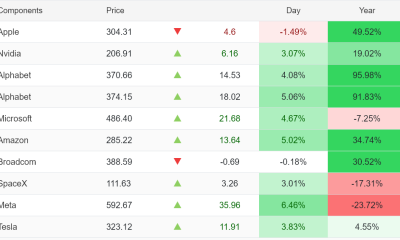
 Crypto World5 days ago
US Tech Stocks See Largest 5-Week Inflow in History: Can Nasdaq Break Its Downtrend?
-
 Business3 days ago
US stocks: Dow closes at record on Mideast optimism; SpaceX, AMD drag Nasdaq
-

 Tech7 days ago
Page Not Found | WIRED
-

 Politics3 days ago
Reform UK And Greens Sink To Lowest Favourability Ratings To Date
-

 Business4 days ago
Nvidia Stock Climbs 2.5% as Chip Sector Rally Builds Ahead of AMD Earnings, Nvidia’s Own Report Looms
-

 Crypto World4 days ago
Polymarket targets $20 billion valuation as competition heats up in prediction market sector
-

 NewsBeat7 days ago
Trump says he is cancelling strikes on Iran subject to ‘rapidly’ making deal
-

 Tech4 days ago
OpenAI, Anthropic AI agents targeted real people and systems in cyber tests
-

 Tech6 days ago
OpenAI teases Astra, its next major AI model, after it solves 10 long-standing math problems
-
 Entertainment7 days ago
7 Best Sci-Fi Series of 2026 (So Far), Ranked
-

 Business3 days ago
Supply chain issues impact Ingredion
You must be logged in to post a comment Login