

Crypto World
Crypto’s favorite $90 trillion trading product is coming to Wall Street, but big banks are taking it slow

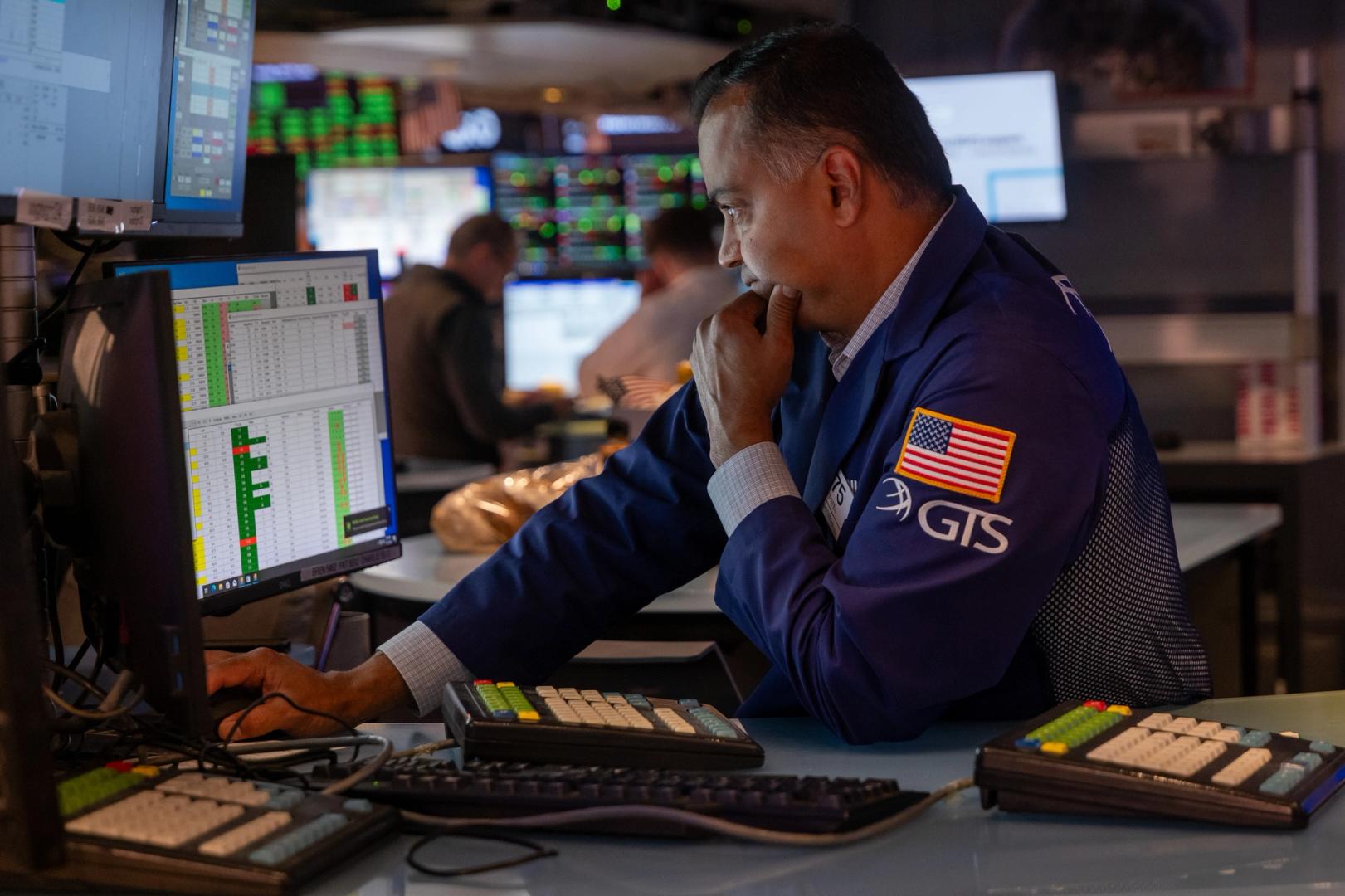
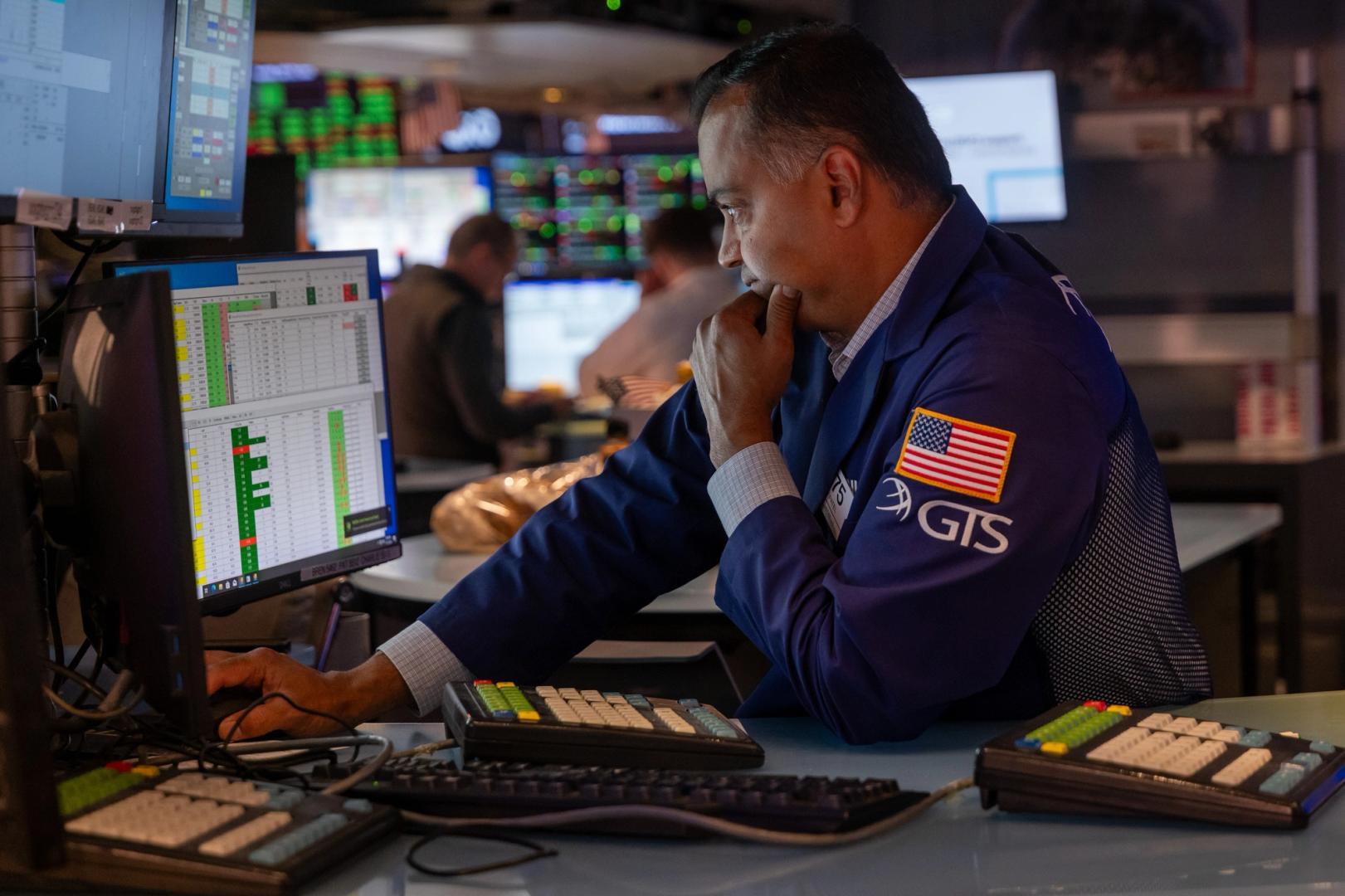
Perpetual futures have spent years as one of crypto’s most popular trading products, especially for investors outside the United States. Now that the contracts are entering regulated American markets, Wall Street is trying to decide whether they are a passing retail craze or a lasting threat to traditional futures.
The early numbers have been hard to ignore.
Kalshi’s perpetual futures topped $1 billion in trading volume within a week of launch in June, making them the company’s biggest product debut since prediction markets. The exchange has since sought regulatory approval to offer perpetual futures tied to gold and silver, a sign that the product may not stay confined to bitcoin (BTC) and other digital assets.
Perpetual futures, often called perps, resemble standard futures contracts but do not expire. Traders do not need to close or roll a position into a new contract each month or quarter. Instead, periodic funding payments help keep the contract’s price close to the underlying asset.
The product has become a core part of global crypto trading. Bank of America has estimated annual perpetual futures volume at about $90 trillion.
On May 29, the Commodity Futures Trading Commission (CFTC) cleared Kalshi to offer the contracts. Coinbase (COIN) also received approval to list regulated perpetual futures in the U.S.
Inside Wall Street, however, interest does not mean immediate adoption.
People familiar with discussions said perps are coming up more often, in part because U.S. regulators are allowing markets that once operated offshore to move onshore. Yet most large financial institutions are still studying the products rather than preparing major launches. The first movers are more likely to be proprietary trading firms, market makers and newer clearing firms.
Unlike large banks, prop shops trade their own capital. That gives them more freedom to test new venues, accept operational risk and withdraw if the economics stop working. Big banks face stricter capital rules, client obligations and reputational risk. For them, the profit available in a young market may not yet justify the cost of building compliance, clearing and risk systems around it.
That difference matters because the phrase “Wall Street” covers several groups moving at different speeds. Individual traders and smaller firms often arrive first. Market makers tend to follow once volume grows. Banks usually want years of data, clear regulatory treatment and stable infrastructure before committing large sums.
Still, the potential use cases extend beyond speculation. Perps could help traders manage weekend risk. Traditional futures markets close for part of the weekend, even though wars, elections and policy decisions do not. A trader holding options exposure on Friday may have to wait until Sunday night to hedge a sharp move.
A liquid 24-hour perpetual market could change that. Firms could adjust positions as events unfold, then use weekend prices to estimate where CME futures may reopen. Insiders said that could make perps useful as both a hedge and a source of price discovery.
“The demand has to be there, or the capital won’t be,” one industry insider said, arguing that firms won’t commit balance sheet until customer activity justifies it.
The problem is depth. A contract may trade around the clock, but that does not mean institutions can move large positions without shifting the market. Weekend liquidity remains thin, and collateral systems do not always move as quickly as the markets they support.
There is also a regulatory fight taking shape. One key question is whether some perpetual contracts should be treated as futures or swaps. That distinction affects margin rules, registration duties and who can provide liquidity. Industry insiders said those legal questions may become more important as exchanges push perps into commodities, equities and other traditional markets.
The debate is also becoming a competitive one. CME has challenged the CFTC’s treatment of Kalshi’s bitcoin perpetuals, arguing the contracts should be regulated differently. Similar disputes could emerge if exchanges seek to expand perpetuals into equities and other asset classes.
“A lot of this stuff… is more commercial than people are going to admit to out loud,” another industry insider said, suggesting some opposition reflects incumbent exchanges protecting existing businesses as much as concerns about market structure.
For now, Wall Street’s view is cautious rather than hostile. Trading firms see a product they understand, regulators see a market moving onshore and exchanges see a chance to capture new volume.
But the largest banks are unlikely to lead. They will wait for the rules, liquidity and infrastructure to catch up.



Crypto exchange Gate.io has been accused of withholding evidence and delaying a police investigation into the theft of a user’s $1.7 million worth of crypto.
Gate.io’s Chinese X account has denied the allegations put forward by user “Jheioff,” whose Gate account was drained on July 8.
Jheioff claims that, despite using phone verification, Google’s two-step authenticator, and email verification, they weren’t alerted to the attack.
They said, “My phone never received any SMS verification codes, and I’ve never provided video footage, handheld ID photos, or login screen recordings to anyone.”
Read more: Gate.io to compensate users for outage losses — but there’s a catch
Jheioff filed a criminal case on July 17 but subsequently accused Gate of “deflecting and delaying” and claims that, 10 days after filing the case, the exchange still hasn’t submitted video facial data or risk control information.
Gate, on the other hand, called Jheioff’s claims “unfounded accusations,” and instead says it has prioritised their case.
Jheioff says Gate is hindering crypto theft investigation
In an X post translated from Chinese, Jheioff said that once the case was filed, they asked the exchange for every document required by police.
They claim authorities then sent Gate the case filing decision, the IDs of two police officers, the judicial evidence request letter, and other related documents.
However, Gate allegedly wanted a PDF version from Jheioff. When sent a compressed PDF, they told Jheioff that they would need to re-upload as a proper PDF file while citing virus risks.
Jheioff claims the company then suggested could be submitting false documents, and that the police officers may be imposters. As such, it then said it would require a video confirming their identities.
“I made a special trip to the public security bureau to cooperate,” Jheioff says, “but Gate then claimed they could only do voice verification at that time and couldn’t do video.
Read more: Crypto exchanges too slow to react to RAVE collapse, ZachXBT
“Finally, they claimed that ‘the materials are incomplete’ and ‘some documents have expired,’ but failed to provide a single list specifying the missing materials, expired documents, correction standards, and processing deadlines.”
Jheioff added, “I’m baffled — you guys have so many issues. I asked in advance to clarify the details of the summons; why didn’t you mention any of this back then? Now you’re using these trivial details to stall and shirk responsibility — it really comes in handy.”
Gate claims Jheioff is the one delaying
Gate suggests that it’s actually Jheioff doing most of the delaying.
On the day of the incident, the company claims that Jheioff was “very slow,” and “consistently refused our assistance” when it came to filing a case and providing legal resources to help.
It said that after Jheioff informed it of the filing on July 17, it took another five days for it to receive an inquiry letter. It also claimed that the July 22 letter was missing documents, had expired credentials, couldn’t be verified, and lacked official contact information.
Then, on July 24, Gate says the given official contact phone number “was a personal line, the email was a personal account, and there were inconsistencies between the case description and the incident details,” and as such, it “immediately replied requesting a video call for verification and confirmation.”
“As of July 27, three days have passed, and we still have not received a specific schedule for the video verification,” Gate claims, adding that if Jheioff had cooperated, this step could’ve been resolved within a day.
As for the PDF, it says it clearly stated that it needed to be in the PDF format, and that Jheioff sent a document compression package instead.
Gate and Jheioff previously argued over the details of the hack, with Jheioff denying that all the logged security changes in the run-up to the draining were their doing.
Indeed, Gate maintained in its response to Jheioff today that the incident wasn’t the result of leaked data, which Jheioff suggests caused the drain.
Got a tip? Send us an email securely via Protos Leaks. For more informed news and investigations, follow us on X, Bluesky, and Google News, or subscribe to our YouTube channel.

Bitcoin is trading well below its historical valuation range, but a comparison between its realized value and its current market valuation shows signs of easing selling pressures.
Data from CryptoQuant shows BTC’s MVRV Z-Score sitting near 0.42, substantially below its long-term average of 1.7. The indicator has been under that historical mean for the past 30 days and briefly dropped to about 0.185 on June 30, its weakest reading this cycle.
Bitcoin Valuation Near Historic Lows, No Capitulation
Just a few days before the Fed’s interest rate decision, Bitcoin is changing hands around $65,000, extending weeks of consolidation between $64,000 and $66,000 after a 15% drop in price over the past three months, according to CoinGecko.
The MVRV Z-Score compares Bitcoin’s market value with its realized value, an analytical angle that gauges if the asset is trading above or below its historical fair value. High readings have historically accompanied market tops, while negative readings appeared during deep bear-market capitulation.
As seen in the latest chart updates, the score is lingering just above zero, preceded by a steady decline since late 2025. It has yet to enter negative territory despite the prolonged weakness, where previous market cycles have found their definitive bottoms.
During the late-2022 bear market, the indicator fell below 0 for several weeks as Bitcoin traded near $16,000-$17,000, marking a capitulation phase before recovering to price levels of above $30,000 in May 2023.
The current reading could mean the top coin by market cap is undervalued at its $65,000 price at the time of reporting, but it has not experienced the same panic-driven selloff that characterized the previous cycle bottom. Holders have not sold their coins aggressively enough to reach a capitulation point.
According to trader Axel Adler Jr.’s quicktake, a recovery in the Z-Score toward its historical average of 1.7 would spell improving valuation conditions. Conversely, a break below June’s low near 0.185 and into negative territory would cue BTC’s further deterioration before a potential bottom forms.
In Crazzyblockk’s June 29 analysis for CryptoQuant, he noted that when Bitcoin traded for around $60,000, the MVRV Z-Score was approaching valuation zones previously seen during deep market resets after excess speculation had been removed. Bitcoin has gone up by about 6% since, reinforcing his market theory that classic capitulation might not occur.
Market Profit Taking Replaces Loss Selling
Bitcoin’s seven-day realized profit and loss chart, showing the net amount investors have locked in the network, spent 23 of the last 30 days below zero. The coin had realized net losses of approximately $8.5 billion in June, before another wave of losses of nearly $3 billion in mid-July.
July’s activity has reversed last month’s trend and recorded positive PnL figures over the past week, gaining between $400 million and $500 million. The latest reading stands near $239 million, as seen in CryptoQuant’s Bitcoin PnL chart.
Analyst Crazzyblockk explained that, even though investors are no longer realizing losses at the same pace as they were towards the end of June and Bitcoin’s selling pressure is cooling down, the metric does not confirm that the market has completed a cyclical bottom.
The post Bitcoin Trading Far Below Historical Norms: Rebound or a Warning Sign? appeared first on CryptoPotato.
Crypto World
Bitcoin holds firm as Hormuz hostilities pause, Fed prepares interest-rate decision: Crypto Markets Today
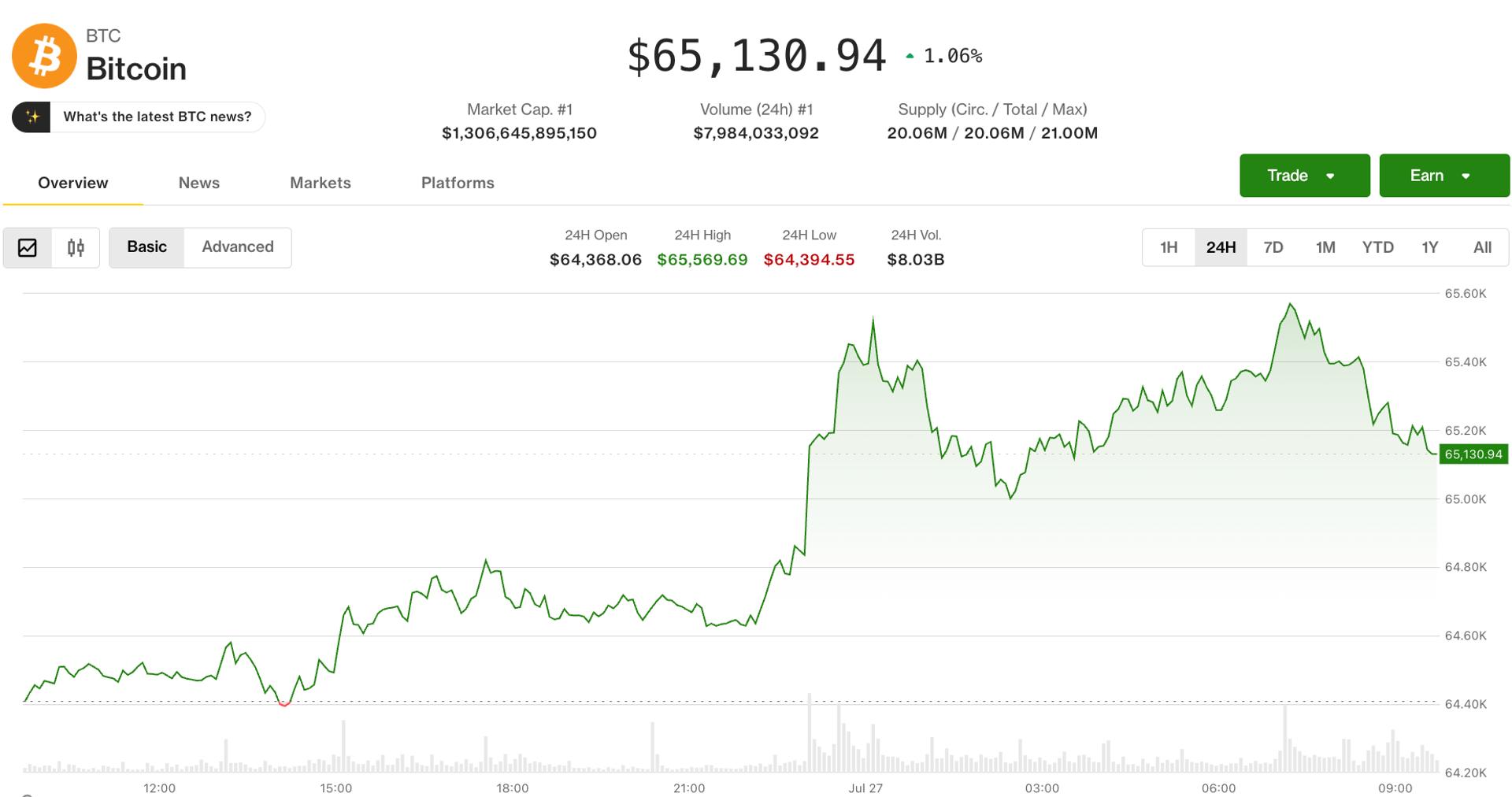
The crypto market opened the week on a positive note as a shift in the Middle East offered a modicum of relief to risk assets. The U.S. and Iran paused strikes over the Strait of Hormuz, sending Brent crude tumbling from above $100 to around $87 per barrel as mediators continued talks.
The move was felt across multiple asset classes. Nasdaq 100 and S&P 500 index futures are up 1.36% and 0.80%, respectively, while gold and silver are both higher as inflation fears unwind. The CoinDesk 20 Index (CD20) has gained 0.1% since midnight UTC, 1.6% over 24 hours.
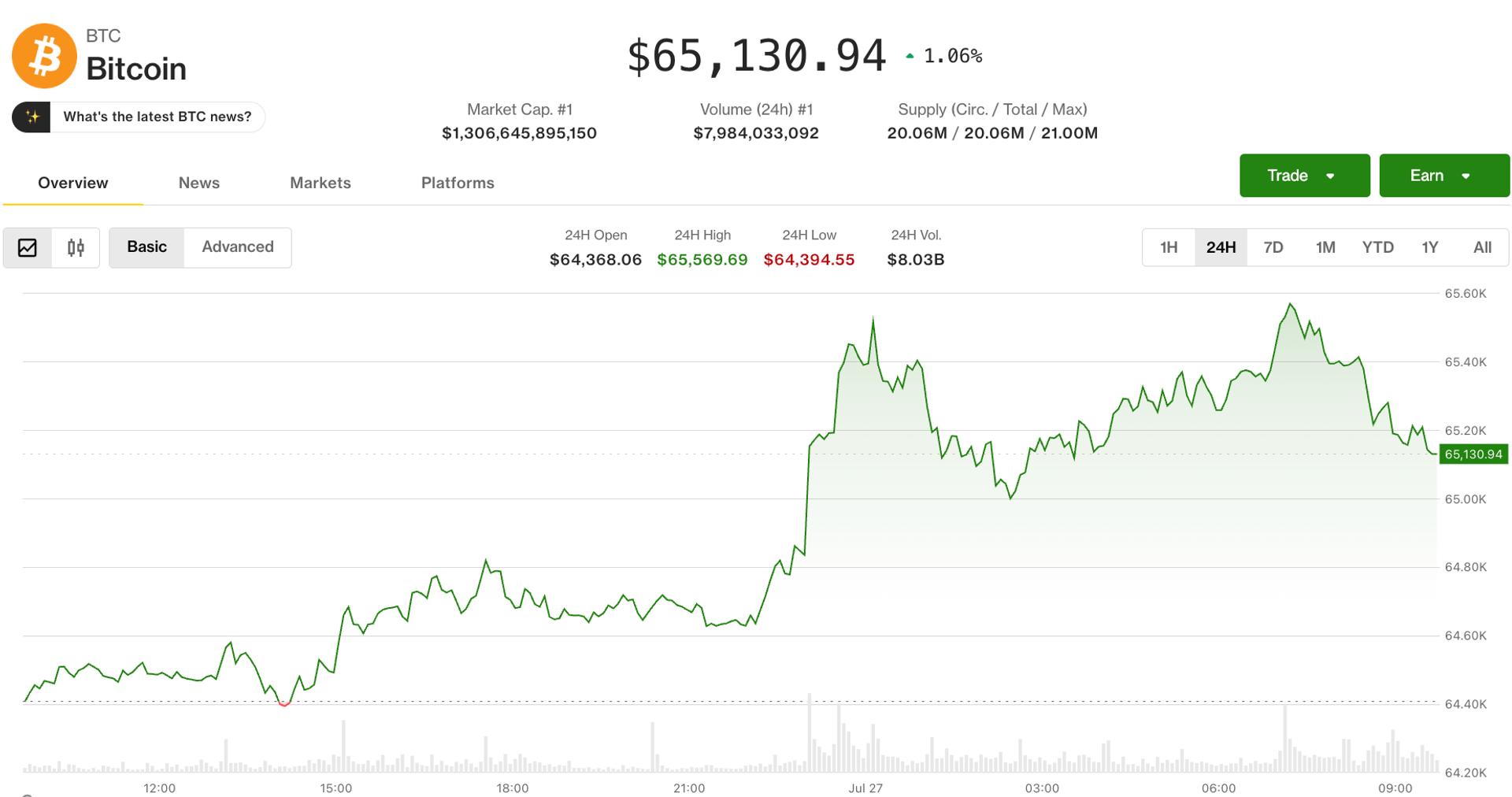
Bitcoin is lower since midnight at $65,200, though this follows a spike to $65,600 at the start of futures trading on Sunday. The little-changed reading masks an underlying improvement in sentiment.
Ether (ETH) outperformed bitcoin on Monday, rising 0.51% to $1,963 and approaching the psychologically significant $2,000 level for the first time since the beginning of June.
The Fed is meeting this week and faces a decision on whether to raise interest rates for the first time in three years, with inflation running at 4.1% on the back of the oil surge spurred by the Iran war.
While the market watched the token and the trade press counted the acquisitions, Ripple became the second-largest corporate political donor in America. The crypto industry now supplies more than a third of all corporate election money, its flagship super PAC holds a $193 million war chest, and the bill it was all built to pass is on the Senate floor this month. Here is the audit of the spend.
Summary
- Fairshake and its two affiliated super PACs entered the 2026 midterm cycle with roughly $193 million in cash, a figure disclosed ahead of the January Federal Election Commission deadline and larger than the entire crypto industry deployed across all of 2024.
- Ripple has contributed about $48 million this cycle, second only to Andreessen Horowitz among corporate donors by one accounting, alongside Coinbase at roughly $56 million, with a further $1 million sent directly to a single Senate candidate.
- Public Citizen’s tally puts total crypto election spending near $189 million, roughly 37% of all corporate money in the cycle, more than artificial intelligence, Big Tech, and online gambling combined.
- The structure is three PACs, not one: Fairshake for bipartisan candidate spending, Protect Progress for Democratic races, and Defend American Jobs for Republican ones, a design that lets the same money work both sides without appearing in the same place.
- The investment gets marked this month: the market-structure bill the spending exists to pass faces its decisive Senate window before the August recess, and roughly $110 million of the war chest remains unspent with the November midterms four months out.
Ripple spent about $4 billion buying companies over three years, and this publication audited that empire last week. The company also spent roughly $48 million buying something else, and almost nobody has audited that at all. The second purchase does not appear on any acquisition list, produces no revenue line, and cannot be valued by any multiple, but it is aimed at the same outcome as the first: a legal environment in which the assembled business is permitted to operate. Ripple is now, by one national tally, the second-largest corporate political donor in the United States this cycle, behind only Andreessen Horowitz and ahead of every bank, airline, pharmaceutical company, and defense contractor in the country. It sits alongside Coinbase inside Fairshake, the crypto industry’s flagship super PAC network, which entered the 2026 midterm cycle with roughly $193 million in cash, more than the entire industry deployed across the whole of the 2024 elections, and which has already spent more than $82 million with four months of campaign still to run. The industry as a whole now supplies more than a third of all corporate election money in America. This piece is the ledger: what was given, how the machine is built, what the last cycle’s version of it actually bought, where it demonstrably failed, and why the next few weeks are when the position gets marked.
The ledger, itemized
Start with the numbers, because their scale is the part most coverage understates.
Fairshake and its affiliates disclosed roughly $193 million on hand in January, ahead of the Federal Election Commission’s reporting deadline, a figure about 37% higher than its July 2025 disclosure. The second half of 2025 supplied the jump: Ripple contributed $25 million in a single commitment, Andreessen Horowitz added $24 million, and Coinbase had already put in $25 million earlier in the year, roughly $74 million from three companies in six months. Cycle-to-date totals run higher than those individual checks. Public Citizen’s accounting puts Coinbase at about $56 million and Ripple at about $48 million across the cycle’s channels, with a separate tally ranking Ripple second among all corporate donors nationally behind Andreessen Horowitz at $51.65 million. The figures differ because the counting differs, some tallies aggregate only Fairshake contributions while others include direct candidate giving and other committees, and any honest citation has to say which. What no accounting disputes is the order of magnitude: three crypto companies have put roughly $150 million into a single election cycle.
The industry total is the number that reframes everything. Public Citizen puts crypto’s 2026 election spending near $189 million, approximately 37% of all corporate political money in the cycle, against $517 million in total corporate spending that is itself up 12% from all of 2024. Artificial intelligence and Big Tech combined contributed about $60 million; online gambling about $45.6 million. One industry, younger than the iPhone, now outspends every other corporate sector in American politics, and roughly $56 million of crypto money went to MAGA Inc alongside the $82 million flowing through Fairshake.
Beyond the flagship network sits additional capacity: a newer vehicle called Fellowship PAC claimed a $100 million commitment for pro-crypto candidates, meaning the sector’s declared electoral firepower exceeds a quarter of a billion dollars before a single general-election ballot has been counted.
And then there is the retail-scale detail that shows the strategy has a second gear. Ripple sent $1 million directly to John Deaton, the pro-crypto attorney who lost Massachusetts’s 2024 Senate race to Elizabeth Warren by nearly twenty points and is running again in 2026 for the state’s other seat. Direct candidate contributions of that size are unusual, visible, and personal in a way super PAC money is not, which makes the Deaton line the clearest statement of intent in the entire ledger.
The machine: three PACs, one checkbook
The structure deserves explanation, because its design is the reason the money works harder than its size suggests.
Fairshake operates as three entities. Fairshake itself directs funds to candidates across both parties. Protect Progress spends in Democratic races. Defend American Jobs spends in Republican ones. The architecture solves a specific problem in American electoral finance: money that visibly funds both parties is politically awkward in primaries, where partisan credibility is the currency, so the network splits itself into partisan-facing vehicles that draw from the same donor base and coordinate the same strategy. A Democratic primary voter sees Protect Progress; a Republican primary voter sees Defend American Jobs; both are the same industry, and neither ad mentions cryptocurrency at all, because Fairshake’s signature tactic has always been to spend on issues unrelated to its own, funding advertisements about housing, healthcare, or a candidate’s record while the crypto position remains the invisible criterion.
The targeting is equally deliberate. Fairshake concentrates in primaries, where money moves outcomes furthest per dollar, and in a small number of races selected for signaling value. Protect Progress backed Adrian Boafo in a Maryland Democratic primary this cycle, and he won. That pattern, early money in low-turnout contests, is how a nine-figure war chest contests dozens of races without ever needing to win a national argument about digital assets.
The strategic effect is the one Fairshake’s own spokespeople describe most plainly: the network is standing infrastructure now, not a one-cycle experiment. The 2024 build converted heavy experimental spending into permanent capability, with money left over, $64 million carried into this cycle before a dollar of new fundraising. An industry that can credibly promise to spend against a legislator in the next primary does not need to spend in most of them, which is the quiet dividend of the whole enterprise and the reason the unspent balance matters as much as the deployed one.
What the money bought last time
The 2024 record is the only evidence base for what this spending achieves, and it points in one direction while carrying an important asterisk.
Fairshake and its affiliates raised approximately $93 million across the 2023-2024 build and spent more than $130 million on media buys supporting candidates they classified as pro-crypto and opposing those classified as anti-crypto. Two results defined the cycle’s reputation: Jamaal Bowman and Cori Bush, both incumbent House members regarded as industry critics, lost primaries in which Fairshake-funded advertising was widely credited as a decisive factor. Neither race was fought on crypto policy. Both outcomes were read across Capitol Hill as proof that the industry could end a career in a primary, and that reading, more than any individual seat, is what the money actually purchased. Legislative behavior since has been consistent with the lesson having landed: the House passed the market-structure bill 294 to 134, the stablecoin statute cleared with bipartisan support, and the number of members willing to be publicly identified as anti-crypto has thinned considerably.
The asterisk is Massachusetts. The industry’s most direct 2024 investment, backing John Deaton against Elizabeth Warren, its most prominent legislative opponent, failed by nearly twenty points, and it failed in the way that matters analytically: money could not make a general-electorate race about crypto when the electorate cared about something else. That result maps the strategy’s boundary precisely. Fairshake money is extremely effective in low-turnout primaries where a modest advertising advantage decides a small electorate, and largely ineffective in high-salience general elections where partisan identity dominates. Deaton is running again in 2026, with another $1 million from Ripple already committed, which will test whether the boundary moved or whether the industry is buying the same lesson twice.
The countervailing case, made properly
An audit owes the other side its strongest form, and there are two of them, pointing in opposite directions.
The critics’ case is structural rather than moral. Public Citizen’s objection is not that crypto participates in politics but that the concentration distorts: when a single industry supplies more than a third of all corporate election money, the ordinary pluralism that keeps any one sector from dominating a legislature stops functioning, and legislators facing a nine-figure adversary in their next primary make different choices than legislators facing ordinary lobbying. The insider-adjacent critique is sharper still. The industry is spending to shape the rules governing its own regulation, and the rules in question, market structure, agency jurisdiction, and enforcement authority, determine whether the same companies face securities liability. That is not corruption in any legal sense, and it is exactly the arrangement campaign-finance reformers have described as legalized capture for fifty years.
The industry’s case is that this is what every regulated sector does, and it is not a weak argument. Banking, pharmaceuticals, energy, and telecommunications have all spent decades funding candidates and shaping the statutes that govern them, and crypto arrived to a legal environment in which its participants faced enforcement actions predicated on rules nobody had written for them. Political spending, on this reading, is the industry’s only proportionate response to an existential regulatory posture, and its bipartisan structure, funding Democrats and Republicans by design, is evidence of issue-based rather than partisan intent. Both cases are true simultaneously: this is normal American interest-group politics, and it is happening at a scale and concentration that has few peers in the modern record.
The week the position gets marked
Which brings the ledger to the present, where several clocks converge at once.
The market-structure legislation that the entire apparatus exists to pass faces its decisive Senate window before the August recess, with the outcome resting on a small number of Democratic crossover votes and a negotiation whose remaining disputes this publication has covered in detail. Fairshake’s money did not buy those votes and cannot, super PAC spending is prospective leverage over future primaries, not a transaction over a pending bill, but it is unquestionably part of the environment in which those senators are calculating. If the bill passes, the industry’s electoral investment will be credited with having built the conditions for it, and the remaining balance rolls into November with a validated theory. If it fails, roughly $110 million of unspent capacity meets a midterm election in which the industry has both the resources and the stated motive to remove specific legislators from office, and the 2027 Congress becomes the target instead.
Either way, the more interesting question for Ripple specifically is the one the ledger poses and cannot answer: the company has now spent about $4 billion assembling an institutional financial business and about $48 million assembling the political conditions for it, and only one of those investments has a disclosed return. The empire, as this publication’s audit found, is designed to succeed with or without the token. The political spend is designed to make the empire legal. Neither line item is about XRP, which is perhaps the most honest summary available of where Ripple’s actual priorities sit, and the market that still prices the company through its token’s chart is, once again, reading the wrong ledger.
What to watch
The FEC filings after the Senate acts. Contribution and expenditure reports covering the coming weeks will show whether the industry accelerates into November or banks the balance. Sharp increases immediately after a legislative outcome, in either direction, would confirm the spending is tightly coupled to the bill rather than to a general political posture.
Deaton’s Massachusetts numbers. The rematch is the strategy’s clearest controlled experiment: the same candidate, the same state, a different seat, and a second round of industry money. A materially closer result would suggest the 2024 ceiling has lifted; a repeat would confirm that Fairshake money buys primaries and not general elections.
Which incumbents draw funded challengers. Watch whether the senators who blocked or slowed the market-structure bill face Fairshake-affiliated primary spending in their next cycles. That is the mechanism by which the 2024 lesson gets re-taught, and it is the most direct measure of whether the industry treats this vote as a scorecard.
The disclosure gap. Independent tallies of crypto political money differ by tens of millions depending on which vehicles are counted, and some contributions surface only in later filings. Any figure quoted before the FEC’s next full disclosure cycle, including the ones in this piece, is provisional, and the revisions are usually upward.
A closing observation about what this spending is not, because the distinction gets lost in the headline numbers. Campaign money is the smaller and more visible half of the industry’s influence apparatus; the larger half is conventional lobbying, trade associations, regulatory comment letters, personnel flowing between agencies and firms, and the technical assistance that shapes statutory language line by line long before any floor vote. Fairshake’s $193 million buys electoral leverage, which is a blunt instrument aimed at composition: who sits in the chamber. The quieter machinery aims at text: what the bill says once the chamber has been settled. Ripple’s participation in both is the reason the acquisition audit and this one belong on the same shelf, since a chartered bank application, a prime brokerage, and a stablecoin all depend on statutory definitions that are drafted in rooms no super PAC advertisement can reach. Judged only by the electoral ledger, the industry’s investment looks enormous and its returns ambiguous. Judged across both channels, the returns are already visible in the shape of the legislation itself, an asset taxonomy the industry helped define, a developer shield it asked for, a grandfather clause that resolves its most valuable assets’ status by statute. The $48 million is the part that files with the Federal Election Commission. It is not the part that writes the law, and the two should never be confused, least of all by anyone trying to estimate what the money actually bought.
Disclaimer: This article is for information and educational purposes only and does not constitute financial, investment, legal, or political advice. Campaign finance figures are drawn from third-party tallies and disclosures that vary by methodology and are revised as filings are published. Nothing here is a recommendation regarding any company, asset, candidate, or political position. Always do your own research. Information is accurate as of July 26, 2026.
Frequently Asked Questions
How much has Ripple spent on US politics this cycle?
Approximately $48 million across the 2026 cycle by Public Citizen’s accounting, including a $25 million contribution to the Fairshake network disclosed in late 2025, plus about $1 million given directly to Senate candidate John Deaton in Massachusetts. One national tally ranks Ripple second among all corporate political donors this cycle, behind Andreessen Horowitz at roughly $51.65 million.
What is Fairshake?
The cryptocurrency industry’s flagship super PAC network, structured as three affiliated entities: Fairshake, which spends across both parties; Protect Progress, focused on Democratic races; and Defend American Jobs, focused on Republican ones. The network entered the 2026 midterm cycle with roughly $193 million in cash, funded primarily by Coinbase, Ripple, and Andreessen Horowitz, and had spent more than $82 million by mid-year.
How does crypto’s spending compare to other industries?
It leads all of them. Public Citizen puts crypto election spending near $189 million, about 37% of all corporate political money in the 2026 cycle, against roughly $60 million from artificial intelligence and Big Tech combined and $45.6 million from online gambling. Total corporate election spending reached about $517 million, up 12% from the entire 2024 cycle.
Did this spending work in 2024?
In primaries, apparently yes. Fairshake and affiliates spent more than $130 million on media in 2024, and industry-funded advertising was widely credited with defeating incumbent House members Jamaal Bowman and Cori Bush in primaries, outcomes read across Congress as proof the sector could end a career. In general elections the record is worse: the industry’s backing of John Deaton against Elizabeth Warren failed by nearly twenty points.
Why do the ads rarely mention crypto?
Because Fairshake’s tactic is to spend on locally salient issues while the crypto position operates as the invisible selection criterion. Advertising in these races typically addresses housing, healthcare, or a candidate’s record, which is more persuasive to primary electorates than digital-asset policy and avoids making the industry itself the subject of the campaign.
Does this money buy votes on pending legislation?
Not directly, and the distinction matters legally and analytically. Super PAC spending is independent expenditure aimed at future elections, not payment for legislative action, and coordination with campaigns is prohibited. Its influence is prospective: legislators weigh the possibility of a well-funded primary challenge, which shapes the environment around votes without constituting a transaction over any particular one.
What is the criticism of this level of spending?
Public Citizen and similar groups argue the concentration distorts representation: when one industry supplies more than a third of corporate election money, the pluralism that prevents any single sector from dominating legislative outcomes weakens, particularly when the industry is funding the rules governing its own regulation. The industry’s response is that banking, pharmaceuticals, and energy have done the same for decades, and that political participation is a proportionate answer to enforcement-driven regulation.
What happens to the unspent money?
Roughly $110 million of the war chest remained unspent at mid-year with the November midterms approaching, and the industry has additional declared capacity, including a newer vehicle claiming a $100 million commitment. If the pending market-structure legislation passes, that balance rolls into November behind a validated strategy; if it fails, the same money meets an election in which the industry has stated its intent to change the composition of Congress. This is educational analysis, not investment or political advice.
Ethereum (ETH) whales keep adding to their holdings while the price trades near $1,963, up 4.3% in the last 24 hours. Three separate datasets now point to an accumulation two weeks after ETH broke its long-term descending trendline.
Glassnode data shows growing whale addresses, and US spot ETF flows have turned positive. However, one metric still refuses to confirm the recovery.
Ethereum Whales Grow Their Ranks at Yearly Lows
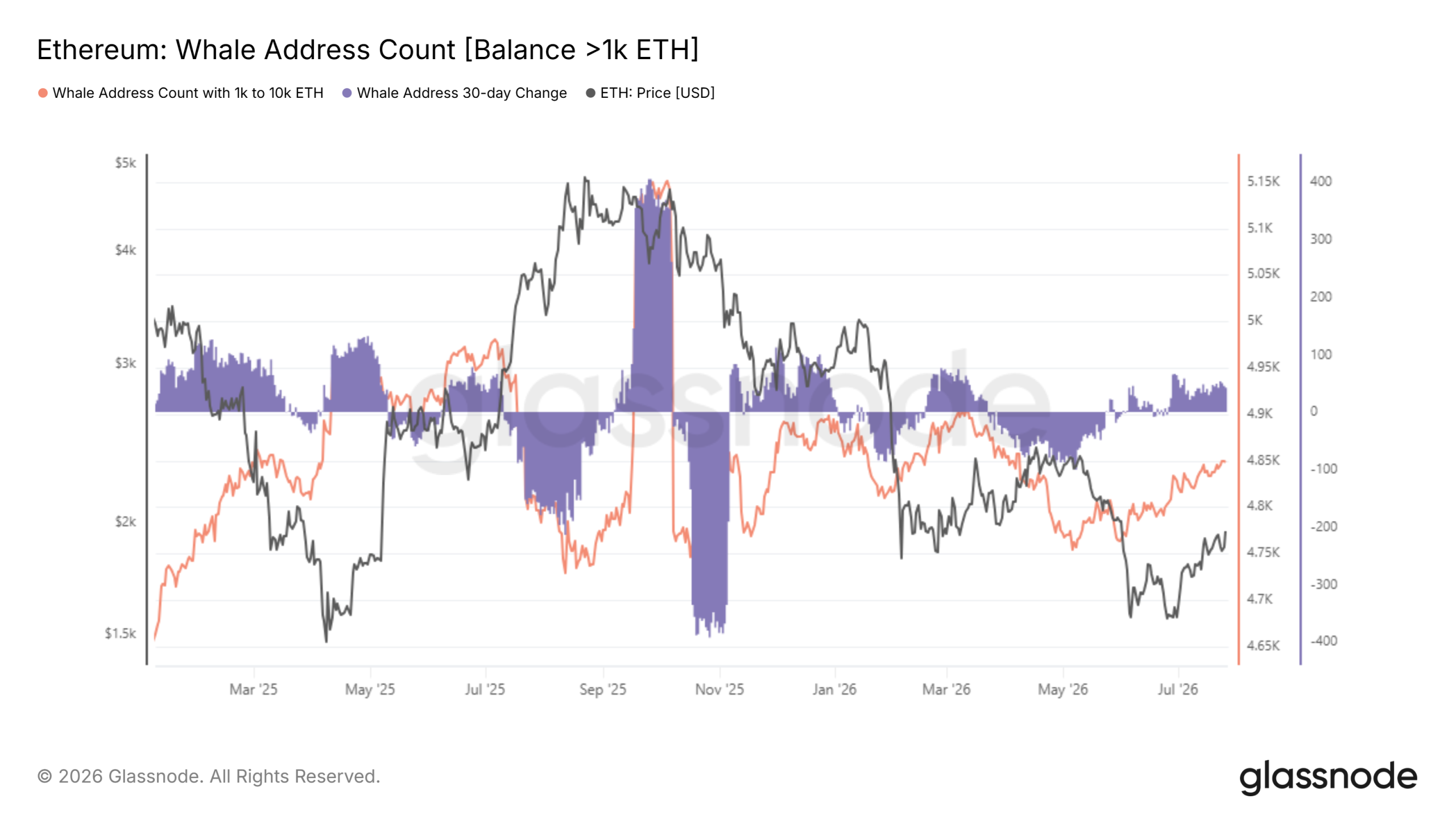
Glassnode’s whale address count tracks wallets holding between 1,000 and 10,000 ETH. The metric bottomed near 4,750 addresses in early June and has since climbed toward 4,850.
Meanwhile, the 30-day change has stayed positive through most of July. This suggests sustained accumulation rather than a short-lived spike.

The timing separates this move from October 2025. Back then, Ethereum whales spiked while ETH traded near its record high, and the rally reversed soon after. This time, large holders are buying close to yearly lows.
Fresh wallets also bought 50,000 ETH in mid-July as the ETH/BTC ratio jumped 6%. A flip of the 30-day change back below zero would weaken the signal.
ETF Inflows Return After 8 Weeks of Outflows
Institutional flows tell a similar story. US spot Ethereum ETF net flows flipped positive in July after roughly eight weeks dominated by outflows.
The funds have now recorded a third straight week of inflows, adding $103.9 million in the week ending July 24. Green bars have dominated the Glassnode flow chart throughout the month.

Still, the scale remains modest. Daily inflows sit in the tens of millions, far below the $600 million to $1 billion days of August 2025. Institutional demand is returning, not surging.
A return of sustained daily outflows would flip this signal back to bearish.
Active Addresses Remain the Missing Piece
Network activity complicates the bullish setup. The 14-day moving average of Ethereum active addresses sits near 400,000, according to Glassnode.
That reading stands far below the February 2026 spike near 800,000. It also trails the June local peak of roughly 460,000. In other words, accumulation is not yet backed by growing usage.

Crowd sentiment has also turned deeply bearish, although Santiment treats such readings as contrarian signals. The previous two pessimism extremes preceded ETH rebounds.
ETH Price Prediction as $2,000 Caps the Breakout
The daily chart shows why these signals matter now. A descending trendline from the August 2025 record high rejected the ETH price five times before the mid-July breakout, which came with futures open interest near $19.8 billion.
The price has held above the broken trendline for two weeks. It now presses into the resistance zone just below $2,000, a level with clear psychological weight.
A confirmed daily close above $2,000 could open the way toward the 0.618 Fibonacci retracement at $2,438. That target sits about 24% above the current price and overlaps the supply zone from May.

However, rejection remains possible. In that scenario, ETH could retest the 0.786 Fibonacci level at $1,754 and the broken trendline near $1,600. The green demand zone in that area has supported the price before.
Volume keeps declining during the recovery, which fits an accumulation phase but leaves the breakout unconfirmed. Either the whales, the ETFs, and the chart pull the price through $2,000, or ETH revisits the zone that launched this move.
The post Ethereum Whales Buy the Bottom as ETF Inflows Return: Is $2,438 Next? appeared first on BeInCrypto.


- fun’s BOOST buybacks helped offset selling from the latest token unlock.
- PUMP reclaimed $0.002 as daily trading volume topped $135 million.
- Bulls are watching the $0.00210-$0.00215 resistance zone.
Pump.fun price extended its recovery this week, climbing above the $0.002 mark as buying pressure continued to outweigh concerns over a major token unlock.
The token gained more than 14% over the past 24 hours, with trading volume rising to roughly $135 million, showing that market participation remained elevated during the rally.
Notably, the price hike comes after one of the largest vesting events for the project, a development that many traders expected would trigger heavy selling.
BOOST buybacks absorbed the token unlock pressure
A key catalyst behind the latest rally has been the BOOST mechanism, which creates ongoing buying pressure for PUMP through token buybacks.
The feature has become an important part of the project’s token economy and has attracted renewed attention as the token recovered from recent lows.
Introducing BOOST mode – the new standard launch mechanism for EVERY new pump fun coin
Over $100M in dead liquidity is lost every year when tokens migrate. Now, we’re reinjecting future liquidity into EVERY BONDED COIN.
Learn more 👇 pic.twitter.com/FJEE0rSXiB
— Pump.fun (@Pumpfun) July 21, 2026
But the recovery has been particularly notable because it followed a major vesting event.
Around 32.5 billion PUMP tokens allocated to investors and another 50 billion tokens allocated to the team became eligible for unlocking as part of the project’s vesting schedule.
Rather than leading to an immediate collapse in price, the market continued to absorb the additional supply.
The remaining unlocked allocations are scheduled to enter circulation gradually over the next 36 months instead of all at once.
That has shifted traders’ attention toward whether continued demand can keep pace with future releases rather than focusing solely on the initial unlock.
Technical indicators point to an improving trend
The improving price structure has also been reflected across several technical indicators.
PUMP has recovered above the Guppy Multiple Moving Average cluster, a sign that short-term momentum has strengthened.

At the same time, the Supertrend indicator has turned bullish as the token attempts to break above the upper boundary of a long-term descending channel that has capped price advances for months.

Another closely watched development is the behavior of derivatives markets.
Unlike rallies driven primarily by leverage, recent data showed that open interest declined while the token price continued to rise.
That combination suggests that spot market demand has played a larger role in supporting the recovery.
Trading activity has also accelerated significantly. Daily trading volume climbed above $135 million, while recent sessions recorded volume growth of more than 500% compared with earlier levels.
Higher participation has helped support the move as buyers pushed the token back above the psychological $0.002 level.
Market participants have also been watching the positioning of well-known Solana trader Ansem, who publicly disclosed a long position around the $0.001675 area.
The disclosure drew additional attention to PUMP during the early stages of its recovery and coincided with improving sentiment across the Solana memecoin sector.
Key PUMP price levels to watch
The next technical test lies around the $0.00210 to $0.00215 resistance zone, where previous rallies have struggled to maintain momentum.
A sustained move above that area would place the next upside targets between approximately $0.0025 and $0.0028.
On the downside, immediate support is seen between $0.00185 and $0.00190.
A deeper pullback could bring the $0.00170 area back into focus, while broader technical analysis identifies around $0.00130 as a level that would invalidate the current bullish structure.
Longer term, some market observers have pointed to $0.005 as a possible target if the current breakout develops into a sustained trend.
However, reaching that level would require continued buying pressure, further increases in trading activity, and the market’s ability to continue absorbing tokens released through the vesting schedule.


- Ethereum gained 24% in the past month, beating Bitcoin’s 8% rise.
- BitMine increased its holdings with a purchase of 9,946 ETH.
- Spot Ethereum ETF inflows continue to support ETH demand.
Ethereum has extended its recent rally, outperforming Bitcoin over the past month as institutional demand continues to strengthen.
The latest boost came after BitMine Immersion Technologies announced another large Ethereum purchase, adding more ETH to its treasury and bringing its total holdings to 5,787,414 ETH.
Ethereum gains strength against Bitcoin
Ethereum has continued to outperform Bitcoin over the past month, highlighting renewed investor interest in the second-largest cryptocurrency.
The ETH/BTC ratio recently climbed to 0.03, marking its highest level in around three months.

The hike reflects Ethereum’s stronger performance relative to Bitcoin rather than a decline in Bitcoin’s price.
During the past 30 days, Ethereum gained approximately 24%, compared with Bitcoin’s increase of around 8% over the same period.
Ethereum has also maintained positive momentum across shorter timeframes.
It rose about 4% over the past 24 hours and more than 5% over the last seven days, while extending its 14-day gain to roughly 10.5%.
Despite the recent rally, Ethereum remains well below its all-time high of $4,946.05, leaving it considerably below its previous peak even after the latest advance.
BitMine expands its Ethereum treasury
BitMine Immersion Technologies has strengthened its Ethereum strategy by purchasing another 9,946 ETH over the past week.
Following the acquisition, the company now holds 5,787,414 ETH worth approximately $11.2 billion based on current market prices.
The latest purchase reinforces BitMine’s position as the largest publicly known corporate holder of Ethereum.
The company has repeatedly stated that it intends to build one of the largest long-term Ethereum treasuries, and the latest transaction moves it closer to that objective.
A key part of BitMine’s strategy is staking its Ethereum holdings rather than leaving them idle.
Around 4.92 million ETH, representing roughly 85% of its total holdings, are currently staked.
This allows the company to generate staking rewards while maintaining its long-term investment in Ethereum.
Share buybacks add to investor confidence
BitMine’s latest Ethereum purchase was accompanied by continued share repurchases.
The company bought back 6.1 million shares during the latest week after repurchasing 5.5 million shares the previous week. Both transactions form part of its authorized $4 billion share buyback program.
3/
“Bitmine repurchased 6.1 million shares of common stock in the past week, an increase from the 5.5 million purchased the week prior. We increased our equity buyback as we view the rising ETH/BTC ratio, despite the falling odds of passage of the Clarity Act in 2026, as a sign… pic.twitter.com/LVOB46sIgL— Bitmine (NYSE-BMNR) $ETH (@BitMNR) July 27, 2026
Following the buyback update, BitMine’s stock, trading under the ticker BMNR, gained more than 5% following the announcement, reflecting a favorable market response to both the company’s expanding Ethereum holdings and its capital management strategy.
Tom Lee points to improving Ethereum momentum
BitMine Executive Chairman Tom Lee highlighted several indicators that continue to support Ethereum’s recent performance.
According to Lee, the ETH/BTC ratio reaching a three-month high signals improving strength for Ethereum relative to Bitcoin.
He also identified the $2,000 and $2,500 price levels as key resistance zones that traders are watching as the rally continues.
Lee further noted that Ethereum has significantly outperformed Bitcoin over the past month, reinforcing the company’s decision to focus its treasury strategy on ETH rather than other digital assets.
Institutional demand has also remained a major theme in Ethereum’s recent price action.
Continued inflows into spot Ethereum ETFs have provided additional buying pressure, while large treasury purchases from companies such as BitMine have strengthened demand from institutional investors.


Tokenized stock adoption nearly doubled over the past month as Robinhood attracted hundreds of thousands of retail holders, although Ondo continued to lead the sector by asset value.
Summary
- Tokenized equity holders increased 92% in 30 days, reaching 752,000 across five major platforms.
- Robinhood captured 328,000 holders and a 44% share, but held only $44 million in assets.
- Ondo led with $857 million, followed by xStocks at $487 million and Securitize at $245 million.
- US transfer-agent groups want the SEC to prioritize issuer-backed tokenized securities over unaffiliated products.
Tokenized stock holders rise 92% in one month
Tokenized equity platforms reached 752,000 holders after their combined count increased 92% within 30 days, according to data shared by DWF Labs.
Robinhood led the five platforms tracked by holder count after attracting 328,000 users since launching its latest stock-token product on July 1. That gave the brokerage a 44% share of the measured market.
However, Robinhood’s tokenized stocks represented only $44 million in total value. The difference between its holder count and asset value suggests its early growth has come largely from retail users holding small positions.
DWF Labs calculated Robinhood’s average position at just $134 per holder. By comparison, Securitize had 50 holders controlling $245 million, producing an average position of $4.9 million.
Figure showed a similar institutional tilt, with 186 holders and around $191 million in assets. Its average balance reached approximately $1.03 million.
The figures refer to platform holders and may include blockchain addresses rather than verified individual investors. They should therefore not automatically be treated as a count of unique people.
Robinhood attracts retail users but trails in value
Robinhood launched its public Layer 2 network and new stock tokens on July 1. The company made the products available through Robinhood Wallet in more than 120 countries, although access varies by jurisdiction.
Eligible users can trade the tokens around the clock and deploy them within decentralized finance applications, including lending pools and collateral markets.
Robinhood’s figures show how fractional access and wallet-based distribution can attract a broad retail audience. Its average position remains far below those recorded by the other four platforms in the DWF Labs comparison.
Activity on Robinhood Chain has also increased since the launch. Tokenized real-world assets on the network recently reached about $70 million, while total value locked rose to roughly $312 million.
That $70 million estimate covers a broader group of real-world assets and comes from a different measurement period, making it unsuitable for direct comparison with DWF Labs’ $44 million tokenized-stock figure.
Ondo and xStocks control more asset value
Ondo led the comparison with $857 million in tokenized equities and an average balance of about $5,900 per holder. Its platform offers more than 440 tokenized stocks and ETFs across Ethereum, BNB Chain and Solana.
Ondo’s international products provide economic exposure to underlying securities, including dividends after applicable withholding. However, its documentation states that the tokens are not themselves stocks or ETFs and do not give investors the right to receive the underlying assets.
xStocks ranked second by value with $487 million and an average position of $1,900. The platform currently supports 626 stocks and ETFs and reports more than $35 billion in total transaction volume.
Kraken parent Payward recently partnered with fintech infrastructure provider GTN to expand xStocks beyond US-listed securities. The companies plan to begin with Hong Kong equities before targeting the UK, Europe, South Korea and other markets, subject to local approvals.
GTN will provide execution, custody, ledgering and record-keeping infrastructure across more than 90 markets, while Payward will continue operating the tokenization layer.
US regulators face ownership-rights question
Access and ownership rights remain central issues for US investors. Ondo’s international stock tokens prohibit US persons from subscribing, acquiring or redeeming the products despite tracking securities listed in the United States.
The SEC has also warned that tokens created by third parties may carry different rights from conventional shares. Depending on their structure, holders may lack direct ownership, voting privileges, or the protections available to registered shareholders.
Continental Stock Transfer & Trust Company and the Securities Transfer Association recently urged the SEC to favor issuer-backed tokenized stocks and ETFs. The groups want tighter treatment of products issued by unaffiliated platforms without the underlying company’s approval.
Their proposal would create a clearer distinction between blockchain-based shares recognized by an issuer and tokens that provide only contractual or economic exposure. How the SEC handles that distinction could determine whether the rapid growth in tokenized-stock holders extends into the regulated US market.


Circle Internet Group has acquired more than 680 IBM patent families containing nearly 1,000 issued patents worldwide.
Summary
- Circle acquired nearly 1,000 IBM patents spanning blockchain, payments, banking, insurance, supply chains and cloud.
- Circle says the expanded portfolio supports USDC, Payments Network, Arc and its agentic finance tools.
- Financial terms remain undisclosed, while Circle and IBM plan to explore further commercial opportunities together.
The portfolio covers blockchain infrastructure, banking, payments, insurance, enterprise systems, supply-chain verification and secure cloud operations. Circle announced the transaction on July 27 but did not disclose its price or other financial terms.
In its official announcement, Circle said the deal made it the “leader in blockchain patent holdings in the United States.” That remains the company’s claim. Circle did not publish a full patent list, ranking method or independent comparison with other U.S. holders.
Patent portfolio broadens Circle’s infrastructure position
A patent family groups related filings that protect one invention across different countries. Therefore, 680 families and nearly 1,000 issued patents do not represent 1,000 separate technologies. The acquired rights still give Circle a larger intellectual-property base across several areas used in digital finance.
Circle did not identify which patents directly apply to stablecoin issuance, cross-border settlement or blockchain networks. It also did not explain whether IBM retained licences, regional rights or other permissions connected to the portfolio.
Circle general counsel Sarah Wilson said intellectual property was “critical” to the company’s mission and its effort to expand onchain infrastructure. The statement describes Circle’s intended use, but patents alone do not confirm that a product will gain users, pass regulatory checks or generate revenue.
Deal supports USDC, CPN and Arc strategy
Circle said the portfolio will support USDC, Circle Payments Network, Arc and its onchain products. CPN connects participating financial institutions so they can communicate and settle payments directly, while Circle provides the network’s technology layer.
Arc forms another part of that strategy. Circle designed the blockchain for stablecoin payments, foreign exchange, treasury activity and capital markets. As crypto.news previously reported, Arc uses stablecoins for transaction fees and targets faster settlement with features built for financial institutions.
Circle’s 2026 product roadmap places Arc, USDC, developer tools and CPN inside one platform. The company plans to use Arc as a coordination layer for payments, foreign exchange and capital flows. The IBM patents could help Circle protect parts of that stack or negotiate licences.
However, Circle has not said whether the acquisition will change any current product, reduce development costs or produce licensing income. It has also not announced legal action against other blockchain companies.
Agentic finance adds another use case
Circle also linked the patent purchase to its agentic finance tools. In May, the company launched Circle Agent Stack, a set of services for software agents that can hold funds, follow spending rules and pay for digital resources.
The stack includes agent wallets, a service marketplace, command-line tools and USDC nanopayments. Circle says the system can process transfers as small as $0.000001 through Circle Gateway. It also supports standards such as x402, allowing software to pay for data, computing or online services without manual checkout.
As crypto.news reported, Circle has tied Arc and USDC to AI-focused payment infrastructure. That coverage said Arc’s testnet had processed more than 244 million transactions by May, while Circle continued building wallets and payment tools for automated applications.
The IBM portfolio includes patents tied to secure cloud operations and enterprise infrastructure, which may overlap with systems used by autonomous financial software. Circle has not named the relevant patents or explained how they will fit into Agent Stack.
IBM deal adds protection as competition grows
Circle faces competition across stablecoins, payment networks and purpose-built blockchains. Banks, fintech companies and crypto firms are developing their own tokens, settlement systems and machine-payment products. As crypto.news reported in July, more than 140 companies backed Open USD, a model that shares stablecoin economics with network participants.
Circle can use patents defensively against infringement claims or in cross-licensing talks. It could also license the patents to other companies. The announcement did not commit to either approach or state whether Circle expects direct income.
IBM and Circle plan to explore further commercial opportunities after the transfer. Neither company described those possible projects. The statement also did not say whether IBM will use Circle products, join CPN or build on Arc.
The deal also shows Circle buying mature enterprise research instead of developing every technical component internally, although the company did not explain its integration schedule.
The acquisition gives Circle ownership of a broad set of issued patents as it expands beyond stablecoin issuance. The next details may come through product integrations, licensing agreements or company filings. Until then, the portfolio’s commercial value remains unreported.


Tesla has secured a UK Supreme Court victory that revives its legal challenge over the licensing terms for patents needed to launch 5G-enabled vehicles in Britain.
Summary
- Tesla can resume its FRAND licensing claim against InterDigital and patent platform Avanci.
- Avanci’s proposed licence reportedly cost $32 for each 5G-connected vehicle when proceedings began.
- Tesla continues to hold 11,509 Bitcoin despite recording a $112 million quarterly digital-asset loss.
- Dogecoin remains available for eligible Tesla Shop products, but not for vehicle purchases.
Tesla revives UK lawsuit over 5G patents
Britain’s Supreme Court ruled in Tesla’s favor on July 27, overturning earlier decisions that had blocked part of the automaker’s lawsuit against InterDigital and Avanci.
Tesla brought the case in London’s High Court in 2023 as it prepared to introduce 5G-enabled vehicles in the UK. The company wants an English court to determine the fair, reasonable and non-discriminatory, or FRAND, terms under which it can license standard-essential patents used in connected vehicles.
InterDigital owns some of the patents available through Avanci’s 5G licensing platform. Avanci combines intellectual property from multiple patent owners and offers licences primarily to vehicle manufacturers.
According to the UK Supreme Court’s case summary, the platform licence cost $32 per vehicle when Tesla filed its claim. Tesla argued that the rate was not FRAND.
The Supreme Court concluded that patent owners cannot avoid their FRAND commitments by placing their patents into a pool or licensing platform. The ruling allows Tesla’s claim to return to the High Court for further proceedings.
Why Tesla challenged Avanci’s licensing model
The High Court rejected Tesla’s request for a FRAND determination in 2024 after InterDigital and Avanci sought to have that part of the lawsuit dismissed. However, it allowed Tesla to continue separate claims challenging the validity of three InterDigital patents.
Tesla then appealed the FRAND decision. A majority of the Court of Appeal upheld the lower court’s ruling, prompting the electric vehicle maker to take the dispute to the Supreme Court.
Organizations including the Computer & Communications Industry Association and the Motion Picture Association intervened in support of the appeal.
The Supreme Court’s decision does not establish the final licence rate Tesla must pay. Instead, it revives the company’s attempt to have the English courts consider whether the platform’s licensing terms meet FRAND obligations.
“We respectfully disagree with today’s decision and continue to believe Tesla’s claims are without merit,” Avanci Vehicle President Laurie Fitzgerald said in a statement reported by Reuters.
Tesla stock erases early premarket gain
Tesla shares initially gained about 0.98% to $316.10 in premarket trading following the ruling, Yahoo Finance shows. However, that recovery did not hold after the opening bell.
TSLA was trading near $309.10 later on July 27, down about 1.2% from its previous close. The stock moved between an intraday low of $304.28 and a high of $317.
The patent ruling removes one procedural obstacle for Tesla, but the case could take more time to resolve after returning to the High Court. The final outcome may affect the terms under which Tesla uses 5G technology in vehicles sold in Britain.
For US investors, the dispute also matters because both Tesla and InterDigital are American companies. However, the ruling applies to proceedings in England and Wales and does not directly alter US patent law.
Tesla keeps Bitcoin as Dogecoin payments stay limited
Tesla’s crypto position remains separate from the UK patent dispute. As crypto.news reported last week, the company held its reserve of 11,509 BTC unchanged throughout the second quarter.
Tesla neither bought nor sold Bitcoin during the three months ended June 30, extending the holding pattern that followed its large BTC sale in 2022. Falling crypto prices generated a $112 million after-tax loss on the company’s digital assets during the quarter.
Bitcoin traded near $83,000 at the beginning of the period before falling as low as $58,000 in late June. The decline reduced the reported value of Tesla’s remaining crypto holdings without prompting the company to sell.
Beyond holding Bitcoin on its balance sheet, Tesla has also explored a wider role for cryptocurrency in its business. Tesla CEO Elon Musk suggested in 2024 that the automaker could eventually accept Dogecoin for vehicle purchases, although it has yet to introduce the payment option for its cars.
Tesla currently allows customers to use DOGE only for eligible merchandise sold through the Tesla Shop. Consequently, the UK ruling advances Tesla’s connected-car plans but does not change its current Bitcoin holdings or Dogecoin payment policy.

I’ve been stealing your crypto for 30 years #cybersecurity #finance #crypto

People in North East live 3 years less than London study shows

Gate.io denies withholding evidence in $1.7M theft case


-

 Fashion3 days ago
Weekend Open Thread: Brooks Brothers
-

 Crypto World6 days ago
Grayscale Files For Worldcoin ETF, WLD Registers Sharp Rise
-

 NewsBeat6 days ago
How a former Blue Peter presenter stunned America’s Got Talent judges
-

 Tech19 hours ago
Intel is reversing course and bringing hyper-threading back to its server chips
-

 Tech7 days ago
Sail Virtually Aboard The “Itanic” With IA-64 Emulator
-
 Tech7 days ago
Turtle Beach Command Series KB7 review: a nifty screen-equipped gaming keyboard
-
 Business6 days ago
New Jersey voter registration controversy explained: How 6,600 noncitizens got on the rolls, and what happens next
-
 Entertainment6 days ago
Johnny Depp’s R-Rated Gothic Cult Classic Gets New Release Ahead of Sydney Sweeney Remake
-

 Crypto World5 days ago
Ethics, other provisions in crypto Clarity Act to be further discussed
-

 Politics8 hours ago
Luke Littler dismantles Gerwyn Price to retain title in Blackpool
-
 NewsBeat7 days ago
Shanghai science forum photos show China’s AI and robotics advances in rivalry with US
-
 Sports23 hours ago
Commonwealth Games boxing: Jadumani Singh seals dominant 5-0 win over Pakistan’s Sumama Rehman to enter quarter-finals | Commonwealth Games News
-

 Sports4 days ago
2026 3M Open leaderboard: Scottie Scheffler finds putter in Round 1, sits three back
-

 News Videos4 days ago
The Peugeot Family: How 200 Years of an “Old Money” Dynasty Died in A Boardroom
-

 Politics1 day ago
Spain sweeps the board at 2026 World Cup with individual awards
-

 Fashion4 days ago
16 Dresses for the High Summer Event
-

 Crypto World7 days ago
Andrew Cuomo joins OKX board as crypto exchange expands in U.S.
-
 Entertainment3 days ago
A New Post-Apocalyptic Gundam Anime Series Blasts Into SDCC
-

 News Videos22 hours ago
BITCOIN JUST ENTERED THIS CRITICAL ZONE…
-

 Crypto World1 day ago
XRP Ledger adds $2.6B as RWA inflows rank second
You must be logged in to post a comment Login