

Crypto World
Curve Finance Claims PancakeSwap Copied Its Code


The Curve Finance team has accused PancakeSwap of integrating its StableSwap code into the newer PancakeSwap Infinity release without a proper license. The dispute centers on the StableSwap module, which underpins swaps involving stablecoins and tightly pegged assets, and its deployment within Infinity, the latest iteration of the PancakeSwap decentralized exchange. Curve’s public note on X framed licensing as a prerequisite for any continued use of the code, inviting PancakeSwap to engage in formal licensing or collaboration to reduce legal risk and safeguard users. The exchange has signaled it may reach out to Curve to discuss the matter, with Curve replying that “better to be friends and build together.”
Beyond licensing, Curve stressed that deploying stable-swap capabilities safely requires deep specialized know-how. The post pointed to historically high-risk episodes tied to swap-based systems, underscoring that even seemingly straightforward integrations can become attack surfaces if not designed with rigorous safeguards. The reference points include Saddle Finance’s 2022 hack and the 2025 Balancer incident, which saw a $116 million exploit tied to swap-based code. These examples are invoked to warn users and developers about the potential for losses when complex liquidity mechanisms interact with permissionless platforms.
Cointelegraph contacted both Curve and PancakeSwap for comment, but neither side had responded by publication time. The absence of formal statements on licensing terms leaves a broader conversation about DeFi security, intellectual-property rights, and cross-chain interoperability still unresolved. The episode also highlights how fast-moving feature sets—such as cross-chain swaps and programmable liquidity—can collide with the practical and legal complexities of code reuse in open ecosystems.
The timing aligns with PancakeSwap’s ongoing ecosystem expansion. In April 2025, Infinity launched on Arbitrum and BNB Chain, introducing one-click cross-chain swaps intended to streamline asset movement across networks. The upgrade also introduced “hooks” — smart contract plug-ins that let liquidity providers tailor pool parameters, including dynamic fee structures, customized rebates, and on-chain limit orders that execute when predefined conditions are met. PancakeSwap said the upgrade reduced pool-creation fees by as much as 99%, signaling an attempt to accelerate liquidity onboarding and experimentation across chains.
Further growth followed later in 2025, with Infinity extending to Base, an Ethereum layer-2 network. PancakeSwap reported that trading on Base could be up to 50% cheaper when Ether (CRYPTO: ETH) trades against ERC-20 tokens, underscoring the economic incentives behind cross-chain expansions and the continued push to lower trading costs for users who bridge assets across networks. The Base deployment exemplifies how DeFi aggregators are increasingly pursuing multi-chain footprints to improve liquidity depth and user experience, even as they navigate new regulatory and security considerations. ERC-20 remains the dominant token standard on Ethereum-based assets, including many that flow through L2 ecosystems and cross-chain adapters.
Taken together, the episode illustrates a core tension in DeFi: rapid feature innovation and cross-chain interoperability versus the need for rigorous license compliance and robust security controls. As Infinity’s architecture becomes more sophisticated—incorporating hooks, dynamic fees, rebates, and conditional orders—the potential attack surface grows, even as the market appetite for seamless, multi-chain swaps intensifies. The fact that Curve explicitly linked licensing discussions with user safety signals that governance and IP considerations may increasingly influence how DeFi projects collaborate and compete in the coming years.
For readers tracking the evolution of cross-chain DeFi, the exchange between Curve and PancakeSwap is a useful case study in how open-source finance negotiates the line between rapid innovation and formal protection of codebases. It also raises practical questions for developers and users: how are licenses enforced in permissionless environments, what constitutes a legally safe deployment of shared code, and how quickly can open collaboration be formalized when risk signals emerge?
PancakeSwap Infinity launches and goes cross-chain
PancakeSwap Infinity debuted on Arbitrum and BNB Chain in April 2025, following the project’s earlier adoption of one-click cross-chain swaps to facilitate asset movement across different blockchains. The Infinity upgrade introduced “hooks,” programmable plug-ins that let liquidity pools adapt to varying strategies, including dynamic fees, tailored rebates, and on-chain limit orders triggered by user-defined conditions. The intent was to give liquidity providers greater control and to optimize trading experiences across an expanding ecosystem of connected networks.
In addition to the feature set, the upgrade also reduced pool-creation costs by up to 99%, which PancakeSwap framed as a measure to encourage experimentation and liquidity provisioning across chains. The company stressed that Infinity was designed with flexibility in mind, enabling multiple liquidity approaches and enabling developers to customize pool behavior without sacrificing core usability.
Base, launched later in 2025, represented the project’s move onto another major Ethereum layer-2. On Base, PancakeSwap Infinity again marketed cost savings for traders, claiming that ether-based trades against ERC-20 tokens could be significantly cheaper. This expansion aligns with broader industry interest in scaling Ethereum-based assets and reducing friction for users who want to move assets between Layer 1 and Layer 2 ecosystems while maintaining efficient execution and competitive fees. The emphasis on Base reflects a broader trend of DeFi platforms extending their reach to Layer-2 networks in pursuit of higher throughput and lower costs for on-chain activity.
Throughout these developments, ERC-20 remains a central element in the cross-chain narrative, given its role as the primary token standard for assets minted on Ethereum and widely adopted across L2s and sidechains. The practical implications of this reality are clear: as more protocols enable cross-chain swaps and multi-network liquidity, the compatibility and security of ERC-20 contracts—along with the associated wallets and bridges—becomes an ever more critical factor for users and developers alike.
In this context, the licensing debate between Curve and PancakeSwap serves as a reminder that DeFi’s future depends not only on clever feature design but also on the governance, licensing, and security frameworks that enable collaboration across networks. The dynamics of cross-chain liquidity—and the legal and technical safeguards that protect it—will likely shape how other protocols approach similar integrations in the months ahead. The industry will be watching closely to see whether licensing discussions translate into formal agreements, and whether security practices evolve in step with the increasingly interconnected DeFi landscape.
Why it matters
What makes this dispute notable is its potential to influence the pace and direction of DeFi interoperability. Licensing friction, if not resolved, could slow down the adoption of shared code and cross-chain features, prompting projects to pursue bespoke solutions rather than open collaborations. Conversely, a constructive licensing outcome could establish a template for responsible code reuse, enabling faster deployment of complex liquidity primitives while maintaining safeguards for users.
Beyond licensing, the case spotlights the broader risk-management challenges in DeFi. As protocols push dynamic fee schemes, programmable pools, and cross-chain bridges, the importance of robust security practices and audited codebases becomes more pronounced. The references to Saddle Finance’s 2022 incident and Balancer’s 2025 exploit highlight the real costs of insufficient safeguards, reinforcing the view that risk assessment must accompany innovation. In short, the industry is weighing how to balance rapid iteration with disciplined, verifiable security and licensing processes that protect users and the broader ecosystem.
For builders, the episode reinforces the value of collaboration under clear, enforceable terms and the importance of pre-emptive security design when deploying reusable components. For investors and users, it underscores the ongoing need to assess not just the functionality of new features but also the licensing posture and risk controls that accompany them. As cross-chain ecosystems mature, the ability to navigate legal and technical risk will be as critical as the product features themselves.
What to watch next
- Public licensing negotiations between Curve and PancakeSwap: will a formal agreement or licensing framework emerge?
- Security reviews and audits of Infinity’s hooks and cross-chain components, including any new penetration testing results.
- Additional Infinity deployments on other networks and any changes to pool-creation economics or fee structures.
- Regulatory and governance developments that could influence how open-source DeFi code is shared and deployed across ecosystems.
Sources & verification
- Curve Finance X posts discussing licensing and collaboration for StableSwap features.
- Curve Finance X posts emphasizing the need for deep stableswap expertise for safe integration and safety considerations.
- PancakeSwap Infinity launch announcement and description of hooks and dynamic parameters.
- Cross-chain swap developments and the Base deployment, including cost-structure improvements.
- Historical references to Saddle Finance 2022 hack and Balancer’s $116 million exploit, cited as cautionary examples of swap-based code vulnerabilities.

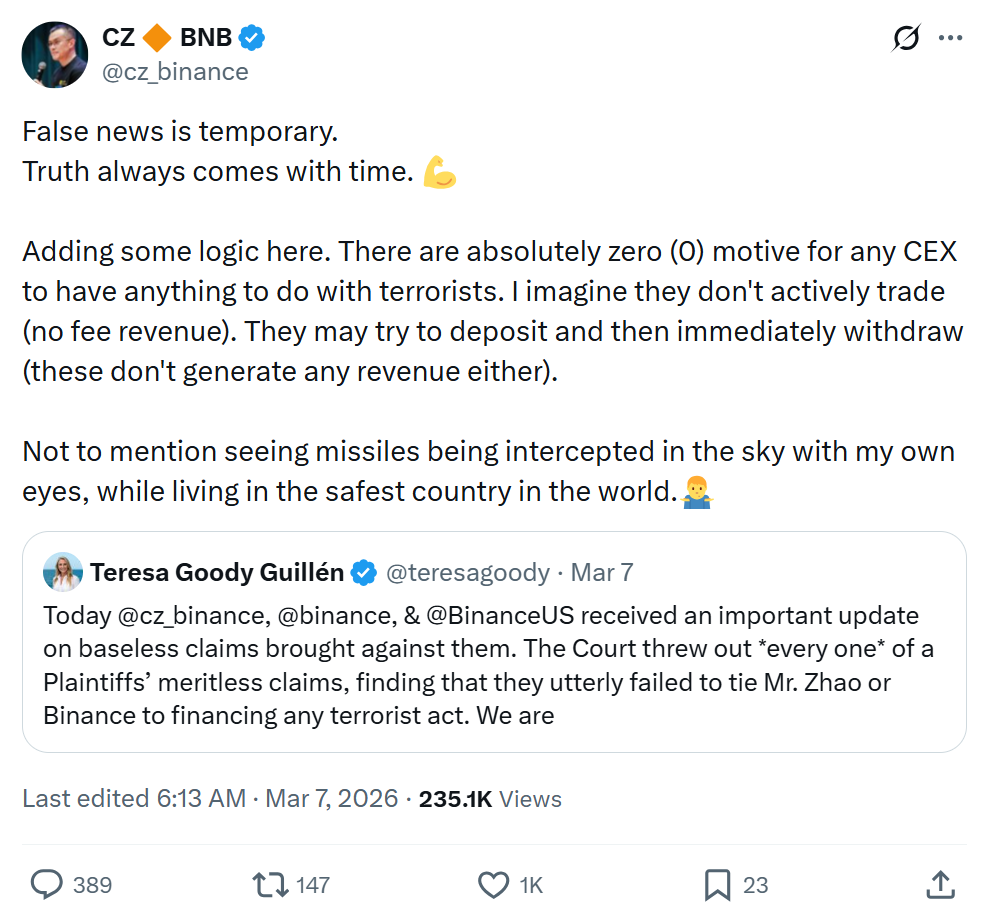
Former Binance CEO Changpeng “CZ” Zhao said centralized crypto exchanges have “zero motive” to assist terrorists after a US court dismissed a lawsuit accusing the exchange of facilitating terrorist financing.
In a post on X, Zhao argued that the economics of crypto trading make such activity illogical for exchanges. “There are absolutely zero (0) motive for any CEX to have anything to do with terrorists,” Zhao wrote, adding that such actors are unlikely to generate trading revenue and may only deposit funds briefly before withdrawing them.
The comments followed a ruling by the US District Court for the Southern District of New York that dismissed claims brought by hundreds of victims and relatives of victims of terrorist attacks. The lawsuit alleged that Binance, Zhao and Binance.US operator BAM Trading Services helped terrorist groups move funds through cryptocurrency transactions.

According to the court filing, the plaintiffs represented 535 individuals linked to victims of 64 attacks carried out between 2016 and 2024. The incidents were attributed to groups including Hezbollah, Hamas, ISIS, al-Qaeda and Palestinian Islamic Jihad.
Related: Binance slams US Senate probe over Iran as based on defamatory reports
Victims seek damages from Binance
The plaintiffs argued that the attackers or affiliated organizations benefited from transactions conducted on the Binance exchange. They sought damages under the US Anti-Terrorism Act and the Justice Against Sponsors of Terrorism Act, which allows victims to pursue claims against entities accused of assisting terrorist acts.
Judge Jeannette A. Vargas dismissed the case after finding that the complaint failed to establish a sufficient connection between Binance’s operations and the attacks themselves. While the filing described alleged compliance failures and illicit activity on the platform, the court said the plaintiffs did not plausibly link the exchange’s conduct to the specific attacks that caused their injuries.
The decision effectively ended the case at the pleading stage. The judge also said that “any amended complaint shall be due within 60 days.”
Related: Binance CEO accuses WSJ of defamation over Iran sanctions report
Binance denies Iran transaction claims
The recent win for Binance comes at a time when the exchange is under growing scrutiny over transactions tied to sanctioned entities. On Friday, the exchange pushed back against allegations raised by a group of 11 US senators, rejecting claims that it facilitated transactions tied to Iranian entities.
In a letter sent Friday to Senators Richard Blumenthal and Ron Johnson, Binance said the February inquiry relied on reports that were “demonstrably false” and lacked credible evidence. The scrutiny came after media reports alleged it processed more than $1 billion in crypto transactions linked to Iranian entities Hexa Whale and Blessed Trust and fired employees who raised concerns internally.
Magazine: Bitcoin may take 7 years to upgrade to post-quantum — BIP-360 co-author


Another analyst noted in the meantime that the Ethereum network activity has picked up the pace after a solid decline earlier this year.
Ethereum’s price has fought for $2,000 for a month now, but the bears have taken advantage once again after another 4% decline on a weekly scale. The macro charts are even more painful for the largest altcoin, which barely broke its 2021 all-time high in 2025, but now trades over 60% away from it.
According to a few analysts, though, the landscape around it could change soon due to the rising network activity and previous cycle moves. History has shown that ETH has posted incredible returns after it successfully defended a zone that it’s currently testing.
Can ETH Rocket by 4x Next?
Merlijn The Trader said in a Saturday post on X that “Ethereum is entering the zone that decided the last cycle.” Four years ago, it bottomed after sweeping the liquidity inside the $1.2K-$1.6K range. Technical tools like the RSI show that it’s approaching an oversold territory again, and Merlijn predicted that if it holds the $1.6K level, “buyers regain control.”
However, if it falls below the lower boundary of that range, “deeper liquidity becomes the target.” The last time this zone was tested and defended successfully, the analyst said ETH skyrocketed by 4x. A similar surge now would take it well beyond its all-time high of nearly $5,000.
In a subsequent post, Merlijn doubled down that ETH is at a “make-or-break level,” as the price has respected this rising trendline for years. It has neared the $2,000 level, and the next major move could be determined whether it will defend it or not.
ETHEREUM IS AT A MAKE-OR-BREAK LEVEL.
For years price has respected this rising trendline.
Each touch led to a major move.$ETH is testing it again near $2K.
Hold it: the bull structure stays intact.
Lose it: the macro trend breaks.Every previous touch resolved violently.… pic.twitter.com/eRauroDcrX
— Merlijn The Trader (@MerlijnTrader) March 7, 2026
Rising Network Activity
Meanwhile, fellow analyst CW noted that there’s a notable uptick in the network activity on Ethereum. The transactions peaked at over 2.5 million at the beginning of the year but quickly plunged to under 2 million. However, they have gone above that level as of the latest data.
You may also like:
Similar developments mean that investors and users are more inclined to use the network, which is generally a bullish sign for the underlying asset.
After a brief decline, $ETH network activity is increasing again.
Daily transactions are already well above last year levels. Despite the price decline, the network is becoming more active.
This indicates a bullish, not a bearish. pic.twitter.com/ZSICoVnbsO
— CW (@CW8900) March 7, 2026
Binance Free $600 (CryptoPotato Exclusive): Use this link to register a new account and receive $600 exclusive welcome offer on Binance (full details).
LIMITED OFFER for CryptoPotato readers at Bybit: Use this link to register and open a $500 FREE position on any coin!

TLDR:
- Yield-bearing stablecoins now combine Treasuries, lending markets, and AI compute revenue models across DeFi platforms.
- $sUSDS leads the sector with $5.3B TVL and roughly 4% APY from lending and real-world asset strategies.
- Maple’s $syrupUSDC generates about 4.7% APY through institutional lending to crypto-native borrowers.
- Gold-backed $pmUSD reportedly delivers the highest yields, ranging between 9% and 22% via Curve liquidity pools.
Yield-bearing stablecoins are gaining traction as decentralized finance platforms compete to offer on-chain income products.
Several tokens now promise steady returns backed by different asset structures. Some rely on U.S. Treasuries, while others draw yield from institutional lending or AI infrastructure.
The expanding category shows how stablecoin design continues to evolve across the crypto market.
Yield-Bearing Stablecoins Introduce New DeFi Yield Models
The DeFi ecosystem now features several yield-bearing stablecoins with distinct backing structures. Each product relies on a separate revenue engine to generate returns.
$sUSDS currently offers roughly 4% 30-day APY and holds about $5.3 billion in total value locked. The token relies on crypto collateral and real-world assets such as treasuries.
Protocol revenue from lending and real-world asset strategies funds the yield. The structure blends traditional finance exposure with on-chain lending activity.
$syrupUSDC provides around 4.7% 30-day APY and holds roughly $1.7 billion in locked capital. The yield comes from Maple’s institutional lending pools.
According to information shared on X by Edgy from The DeFi Edge, Maple deploys the capital to institutional borrowers. Interest payments generate the returns distributed to holders.
Another model appears with $USYC. The token holds short-duration Treasuries and fixed-income instruments that drive gradual value appreciation.
Recent yields hover near 3%, while total value locked stands close to $1.9 billion. The structure allows yield to accumulate through price drift instead of explicit distributions.
Different Collateral Strategies Drive Stablecoin Yield
Several newer tokens rely on alternative revenue streams beyond traditional lending. These structures attempt to capture emerging sectors within the crypto economy.
$USDai represents a synthetic dollar backed by Treasuries and AI compute lending infrastructure. Staking into $sUSDai exposes holders to those revenue flows.
Current yields approach 6.5%, while total value locked remains near $339 million. The token links stablecoin demand with AI compute financing markets.
$coreUSDC follows a vault strategy built around automated rebalancing. Deposited USDC moves between lending platforms including Euler and Morpho.
The system adjusts allocations across protocols to capture available lending yields. Current returns average about 6.3%, according to figures shared by The DeFi Edge.
Another model appears with $pmUSD, a stablecoin minted against tokenized gold collateral. Liquidity from the token primarily flows into Curve-based strategies.
Liquidity provider strategies reportedly produce yields ranging between 9% and 22%. These returns depend on liquidity incentives and market conditions within Curve pools.
The expanding list reflects growing experimentation across the stablecoin sector. Developers now test different combinations of real-world assets, DeFi lending, and infrastructure financing.


Crypto prices continued the strong downward trend today, March 8, as the war in Iran continued, pushing crude oil prices to $115 ahead of the upcoming US consumer inflation report.
Summary
- Crypto prices continued falling today, with Bitcoin moving to $96,000.
- Crude oil prices jumped to over $115 on Hyperliquid.
- The US will publish its inflation report on Wednesday this week.
Bitcoin (BTC) price dropped to $67,000 on Sunday from last week’s high of $74,000. An index tracking the top 20 cryptocurrencies dropped by 1.29% in the last 24 hours, while the Crypto Fear and Greed Index dropped to 18.
Crypto prices dropped amid signs that the war in Iran was not about to end, which pushed crude oil prices to the highest level since 2022. The West Texas Intermediate, which ended the week at $90, soared to $115. Brent, the global benchmark, is nearing the important resistance level at $120 on Hyperliquid.
Crude oil prices soared after more countries in the Middle East slashed their production because of the closure of the Strait of Hormuz by Iran. Kuwait and the United Arab Emirates announced that they would slash production as the war continues.
Soaring oil prices has a major impact on crypto prices because of its impact on inflation. Recent macro data from the United States showed that inflation has continued falling in the past few months. Therefore, this war will change the trajectory and push inflation higher in the coming months.
Soaring inflation rate will make it hard for the Federal Reserve to cut interest rates. Indeed, data on Polymarket shows that traders have scaled down their outlook for the Federal Reserve interest rate cuts for the year.
The war in Iran is also bearish for the crypto market because Bitcoin has proven to be an unreliable hedge against inflation and geopolitical risks.
Looking ahead, crypto prices will react to the upcoming US consumer inflation report on Wednesday. Economists polled by Reuters expect the upcoming numbers to show that the headline Consumer Price Index rose to 2.5% in February from the previous 2.4%.
Core inflation, which excludes the volatile food and energy prices, is expected to come in at 2.5. US inflation expectations have continued soaring this month as the war goes on.
Traders will focus on several cryptocurrencies this week. Pi Network price will be in focus ahead of the Pi Day event that happens on Saturday this week. Similarly, Polkadot will be in focus ahead of the tokenomics upgrade on March 12.
TLDR:
- Global liquidity shows about 90% correlation with Bitcoin and nearly 97% correlation with Nasdaq since 2012.
- U.S. total liquidity rebounded from lows three months ago, historically leading crypto market movements.
- Stablecoin supply surged roughly 50% last year as blockchain transaction volumes reached trillions globally.
- Weekly and daily DeMark indicators suggest crypto markets may approach a technical trend reversal soon.
The crypto market faces deep pessimism as prices struggle and traders warn of a prolonged downturn. However, macro signals tied to global liquidity suggest conditions may soon shift.
Several financial indicators now point to expanding liquidity across major economies. Those changes could reshape the outlook for Bitcoin and broader crypto markets in the coming weeks.
Global Liquidity Signals Point to Potential Crypto Market Reversal
Macro investor Raoul Pal outlined several liquidity indicators that historically track movements in Bitcoin and technology stocks. He shared the analysis through a detailed thread on X.
Pal stated that global liquidity shows a strong correlation with Bitcoin and the Nasdaq 100. According to his data, the relationship reached about 90 percent with Bitcoin since 2012.
Liquidity growth currently runs at nearly 10% annually. Pal noted that the trend continues without signs of slowing.
Financial conditions tracked by Global Macro Investor typically lead liquidity trends by six months. According to Pal, those conditions still show easing momentum.
U.S. total liquidity was temporarily disrupted earlier this year after government shutdown effects restricted flows. Pal explained that the measure usually leads crypto markets by about three months.
Data now shows U.S. liquidity rebounding from lows reached three months ago. That rebound may feed into crypto markets if historical relationships continue.
Pal also pointed to the business cycle as another major driver of risk assets. Accelerating economic activity often lifts earnings expectations and increases investor risk appetite.
Credit Expansion, Policy Moves and Stablecoins Add Liquidity
Additional liquidity sources may strengthen the trend. Pal highlighted the enhanced Supplementary Leverage Ratio as a key banking mechanism.
The rule allows banks to expand balance sheets while absorbing Treasury issuance. According to Pal, that process increases liquidity through credit creation.
Tax refund payments also contribute to liquidity flows. When refunds land in bank accounts, they raise spending capacity and potential credit demand.
Pal also cited policy actions in China. Authorities there continue expanding the country’s central bank balance sheet.
Rate cuts in the United States represent another factor. Lower borrowing costs often increase disposable income and encourage risk taking across financial markets.
Regulatory developments may also influence flows. Pal pointed to the proposed CLARITY Act as a potential framework for banks and asset managers entering crypto markets.
Stablecoin issuance has already accelerated sharply. Pal reported that supply grew roughly fifty percent last year as transaction volumes reached trillions of dollars.
He also noted that new artificial intelligence agents interacting with blockchain systems could expand the sector’s total addressable market.
Pal added that technical indicators currently show extreme oversold conditions in crypto markets. Weekly DeMark signals could form a market base within two weeks.
Daily DeMark indicators also approach potential reversal signals. According to Pal, weaker price action may complete those setups.
Oil prices remain the main macro risk factor. Prolonged increases could tighten financial conditions and slow liquidity expansion.
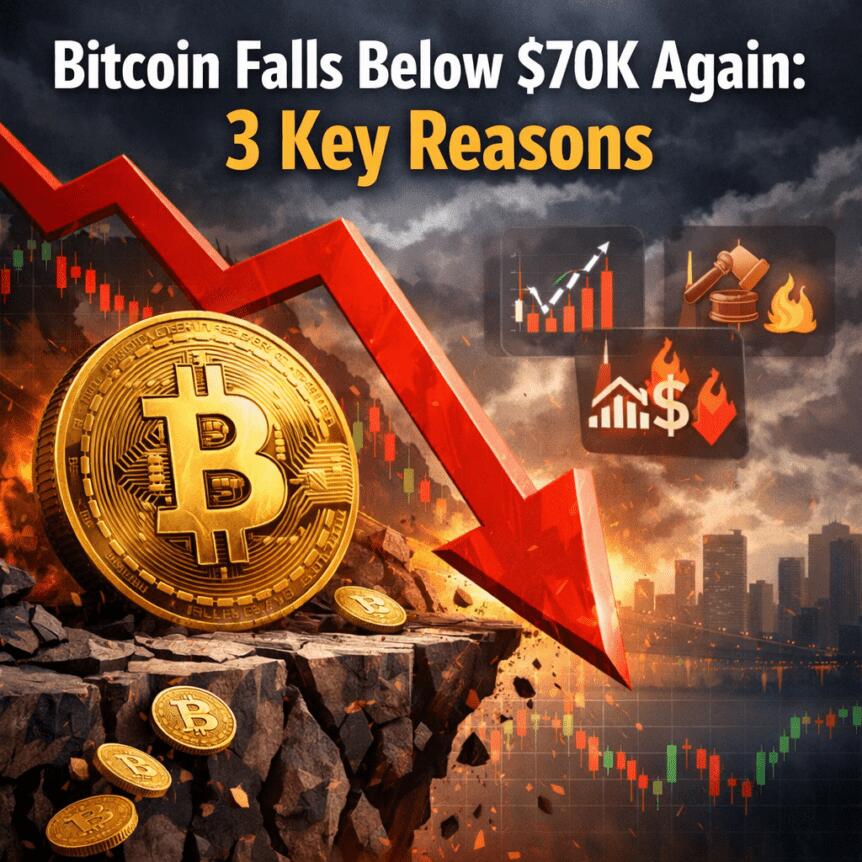
The flagship cryptocurrency has retreated from its recent momentum, slipping back into the month’s trading band beneath the $70,000 threshold after a roughly 5% decline over the past two days. Investors and traders are watching for how on-chain activity and derivatives signals align with price action, as data point to renewed selling pressure near the key level. Market participants also noted thinning spot volumes and shifting futures positioning, which together suggest a cautious stance ahead of the next price move. A four-hour view from a widely used charting platform captured the oscillation, underscoring a tussle between buyers aiming to reassert control and sellers eager to cap downside.
Key takeaways
- Short-term holders realized profits aggressively as the price rallied above $74,000, with more than 27,000 BTC moving to exchanges from short-term holder wallets in the last 24 hours.
- The profit-taking occurred predominantly from levels accumulated in the week prior, with the realized price sitting near $68,000 as selling activity intensified after the test of $70,000.
- Futures data showed a broad pattern of selling pressure, with the cumulative volume delta turning negative in both spot and perpetual markets. Specifically, spot delta reached a sizable negative read of about –$202.49 million, while perpetuals hovered around –$185.60 million.
- Coinbase-based liquidity signals showed demand cooling near critical inflection points; the Coinbase Premium Index briefly spiked above 0.08 during the rally to the $73,000–$74,000 range but faded as price retraced.
- Analysts pointed to a nearby fair value gap around $66,500 as a potential magnet for liquidity, suggesting a zone where price could pause and liquidity could rebalance if downside pressure persists.
- Market sentiment in late sessions reflected broader risk-off pressure across equities, with observers noting that Friday’s sessions often weighed on risk assets including the Nasdaq.
Tickers mentioned: $BTC
Sentiment: Neutral
Price impact: Negative. A renewed wave of selling near $70k and the negative CVD readings point to softer near-term momentum.
Trading idea (Not Financial Advice): Hold. The price remains in a narrow range around key support and resistance, with near-term liquidity considerations likely to dictate direction before a clearer breakout or breakdown.
Market context: The latest price action comes as on-chain and derivatives metrics underscore a cautious mood among market participants. The combination of profit-taking from short-term holders, negative delta signals, and weakening US spot demand paints a picture of a market still determining a sustainable path above or below the $70,000 threshold, even as macro factors and risk sentiment continue to influence flows.
Why it matters
The current dynamics highlight how on-chain behavior and derivatives data can diverge from simple price movement. When more than 27,000 BTC in profit moves to exchanges from short-term holders within 24 hours, it signals a cohort that is willing to crystallize gains rather than let profits ride into further upside. That pattern, coupled with a realized price near $68,000, suggests the market could experience episodic selling pressure as traders rebalance risk in a choppy environment.
From a technical standpoint, negative delta readings across spot and perpetual futures imply that sellers have the upper hand in immediate order-flow dynamics. The negative CVDs indicate that the market’s buy-side interest is being overwhelmed by sell-side activity, which tends to coincide with price softness and a willingness to test support zones rather than push decisively toward new highs. This cadence of selling pressures can also be reinforced by liquidity dynamics around key liquidity pockets, such as the fair value gap noted near $66,500, where liquidity-minded traders expect price to revisit to re-establish balanced order books.
On the demand side, the Coinbase Premium Index’s retreat from the intraday spike above 0.08—while fleeting—highlights how demand can evaporate quickly as price moves past critical levels. The erosion of the premium suggests that the surge of Coinbase-based buying that once accompanied the move toward $74,000 did not sustain, contributing to a softer near-term outlook. Analysts have connected these micro-movements to broader risk-off impulses that have been altering how US participants approach risk assets, including equities tied to the tech-heavy Nasdaq.
Looking ahead, observers are watching whether BTC can defend the $67,000–$68,000 zone as a near-term anchor or whether selling pressure intensifies to drive the price toward the lower bound of the current consolidation range. Titan of Crypto has highlighted a nearby fair value gap around $66,500 that could act as a magnet for liquidity should selling accelerate. Such a scenario would likely require a phase of cautious accumulation by larger holders before a renewed attempt at the $70,000 threshold. For now, the mood remains mixed: buyers are present, but the momentum needed to sustain a breakout above $70,000 remains uncertain. A related discussion online raises questions about whether the move to $74,000 was a bull trap, with traders diverging on the implications for a longer-term recovery.
Visual references to the market’s price action can be found in TradingView’s BTCUSDT chart, which has been used to illustrate the four-hour dynamics during this period. The broader context continues to unfold as market participants parse on-chain signals, futures data, and spot-market activity for clues about the next major step in BTC’s path.
Related: Bitcoin price drops to near $68K as US jobs weakness fails to rescue bulls
Note: This narrative summarizes market developments and does not constitute investment advice. Market conditions can change quickly, and readers should conduct their own research before making trading or investment decisions.
https://example.com/placeholder.js
What to watch next
- Monitor BTC around the $66,500–$68,000 zone for possible liquidity-driven rebalancing.
- Watch spot and futures delta for signs of a shift toward positive accumulation or further selling pressure.
- Track Coinbase Premium Index movements to gauge whether demand from US-based participants re-accumulates near the $70k–$74k region.
- Assess the influence of US macro data and risk-on/risk-off sentiment on a potential break above or below the current range.
Sources & verification
- CryptoQuant QuickTake on STH selling pressure and profit transfers (27,000 BTC moved to exchanges in 24 hours).
- IT Tech’s analysis of CVD movements in spot and perpetual futures (negative readings: spot around –$202.49 million, perpetual around –$185.60 million).
- Coinbase Premium Index data showing decay after a brief spike near $73,000–$74,000.
- Titan of Crypto’s analysis of a nearby fair value gap near $66,500 and liquidity considerations.
- Related coverage: “Was $74K a bull trap? Bitcoin traders diverge on 2022 crash repeating.”
- TradingView BTCUSDT four-hour reference chart for price action context.
- Cointelegraph coverage referencing Bitcoin price dynamics near $68K amid US jobs data.
Bitcoin price action and near-term outlook
Bitcoin (CRYPTO: BTC) moved to test the lower end of its immediate range after failing to sustain a push above the $70,000 mark, a level that has repeatedly acted as a psychological magnet for bulls. The day’s price action reflected a tug-of-war between demand from speculators looking to re-enter momentum trades and longer-term holders who remain more comfortable booking profits at elevated levels. The substantial transfer of profits from short-term holders to exchanges underscored a cautious stance among market participants who prefer crystallizing gains rather than chasing further upside in a market that has shown fragility in the face of macro and sector-wide risk signals.
The negative delta readings in both spot and perpetual futures markets emphasize the immediate pressure that price action is facing. With bid liquidity pulling back and on-chain activity signaling profit realization, even a modest dip can invite additional selling, particularly if market participants recalibrate risk exposure in response to incoming macro data or shifting regulatory narratives. Yet the presence of liquidity in place—evidenced by the level of bids near a crucial support zone—suggests that a flush to the downside may be met with renewed accumulation rather than a wholesale capitulation, should demand return to the scene.
As the market digests these signals, a potential rebound could emerge if buyers manage to defend the $67,000–$68,000 area and push back toward the $70,000–$72,000 zone. The interplay between short-term profit-taking behavior and longer-term conviction will likely shape the next wave of liquidity provision, setting the tone for the next phase of the market’s evolution. Traders and researchers will be watching not only price levels but also the behavior of major on-chain cohorts and the evolution of sentiment across futures and spot markets, waiting for a clear sign that the current pullback is a temporary pause or the beginning of a more meaningful correction.
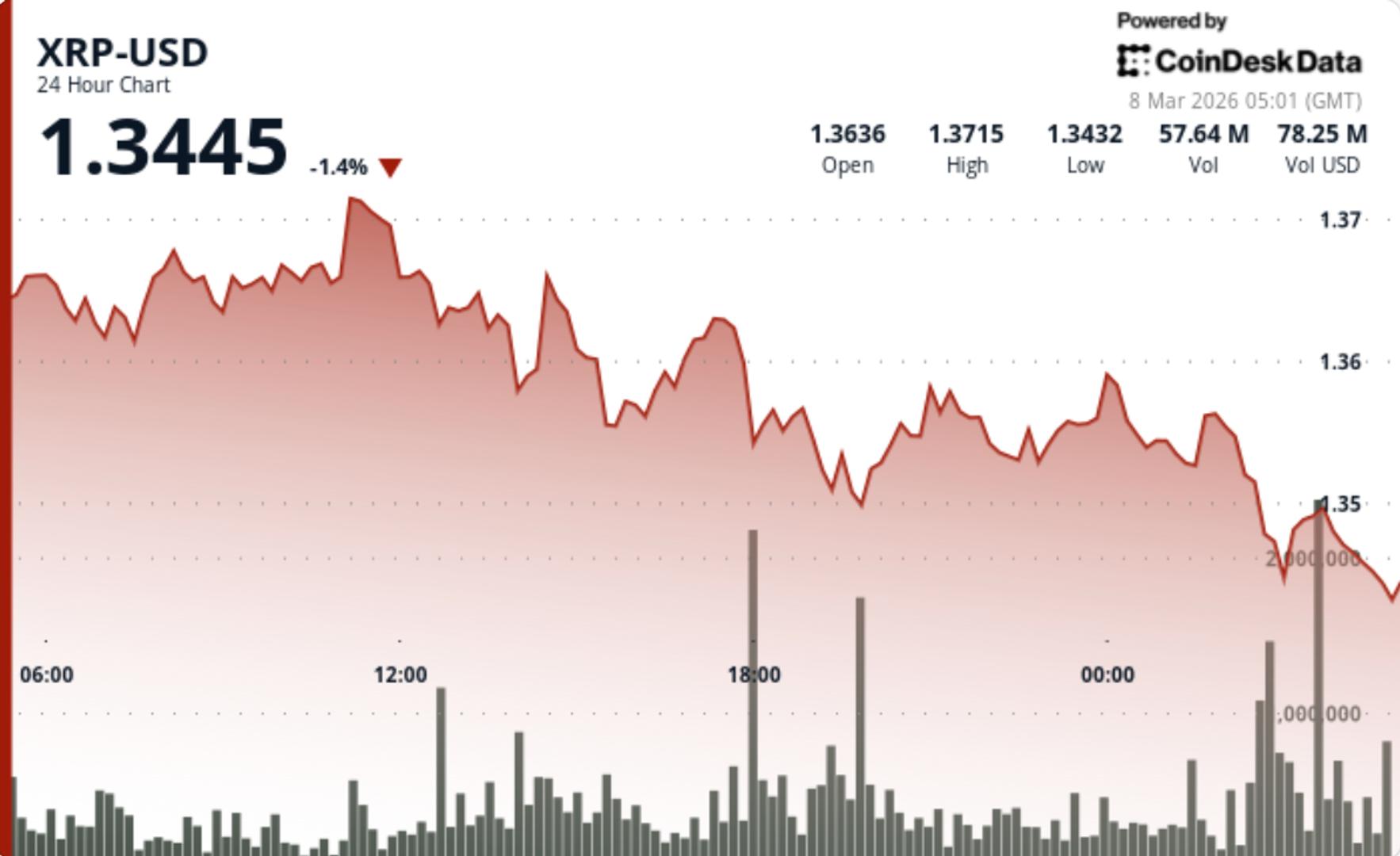

XRP edged lower after a technical breakdown earlier in the session, with buyers now attempting to stabilize price near the $1.35 support area.
News Background
- XRP has remained under pressure in recent sessions as the token trades within a broader corrective structure that has persisted since late February.
- Price action has largely been driven by technical positioning rather than new catalysts, with traders focusing on key support and resistance levels as the market consolidates.
- Institutional flows have been mixed during the period. XRP-linked investment products recorded moderate outflows earlier in the week while derivatives activity declined slightly, suggesting reduced speculative participation as the market digests recent volatility.
Price Action Summary
- XRP slipped from $1.3666 to $1.3554 over the 24-hour session
- The token traded within a relatively tight 1.9% range
- A sharp volume spike drove price briefly down to $1.3473
- Price later recovered toward $1.35–$1.36 as buyers stepped in
Technical Analysis
- The most notable move occurred when XRP briefly broke down toward $1.347 during a surge in trading volume, confirming selling pressure below the $1.36 area. That move reinforced $1.36–$1.37 as a short-term resistance zone after repeated rejection attempts.
- Despite the breakdown, buyers quickly defended the $1.35 region, triggering a modest rebound and forming a sequence of higher lows on shorter timeframes. This suggests dip demand remains active even as the broader trend remains weak.
- Price is now compressing between support near $1.35 and resistance around $1.36–$1.37, a tightening range that often precedes a directional move once liquidity builds.
What traders say is next?
- Market participants are focused on whether XRP can maintain support near $1.35.
- If the level holds, the token may continue consolidating before attempting another push toward $1.36–$1.37 resistance, where a breakout could reopen upside toward the $1.40 region.
- A decisive break below $1.35 would shift attention toward deeper support near $1.30–$1.32, signaling the corrective trend may extend further.

Washington, D.C. — Congressional scrutiny of crypto regulation intensified this week as Massachusetts Senator Elizabeth Warren sharpened her critique of the US Securities and Exchange Commission’s handling of a case against Justin Sun, the founder of Tron. Warren framed the settlement as a “free pass” for Sun after he poured an estimated $90 million into crypto ventures associated with former President Donald Trump and his family. The SEC had previously settled an unrelated matter with Sun for $10 million, a detail Warren highlighted to argue that regulatory actions should not appear to favor well-connected players in the industry. The debate arrives as lawmakers deliberate the market structure bill, widely known as the CLARITY Act, which seeks to clarify how digital assets are treated within the financial system and has become a battleground for critics of crypto policy. The White House has hosted three meetings between officials and representatives of the crypto and banking sectors in recent months, underscoring how regulatory dialogue remains a live process even as Congress debates specifics.
In parallel with Warren’s remarks, Sun’s involvement with Trump’s crypto ventures has kept the spotlight on enforcement and disclosure standards, while the SEC’s $10 million settlement related to Sun’s companies continues to echo in current discussions about accountability and transparency in crypto ventures. Warren’s commentary did not quote the CLARITY Act directly, but the legislation—seen as a cornerstone of administration and congressional thinking on market structure—has become a touchstone for how Congress intends to regulate tokenized assets, stablecoins, and new financial products built on distributed ledger technology.
A broader context shaping these debates is the ongoing push and pull around the market structure bill itself. The White House prioritizes clarity and a predictable framework for crypto entities, even as some lawmakers push back against faster approvals or blanket classifications that might restrict innovation. The CLARITY Act moved from the House to the Senate, earning attention for provisions involving tokenized equities, ethics, and stablecoin rewards. As the Senate contemplates the bill, it has been in the hands of committees with Warren serving as the ranking Democrat on the Banking Committee, a position that gives her influence over markup timelines and amendment opportunities.
Crucially, the dynamic surrounding the CLARITY Act is not happening in a vacuum. Several high-profile voices within the industry have raised concerns about how the legislation would be implemented. Coinbase CEO Brian Armstrong publicly asserted that the bill, in its current form, could not be supported “as written,” signaling that at least parts of the crypto exchange lobby consider the framework insufficiently precise or potentially burdensome for market participants seeking clear rules. Those tensions were echoed in Trump’s and Eric Trump’s recent social posts criticizing banks for their stance on crypto regulation, illustrating how political rhetoric intersects with policy development. To researchers and market watchers, the episode underscores a pattern: policy clarity often arrives only after intense, sometimes contentious, negotiations among lawmakers, the White House, and industry stakeholders.
For readers seeking a broader sense of what this means for investors and builders, the episode highlights the fragility of momentum on crypto legislation in the United States. The CLARITY Act’s path—strengthened by executive interest and congressional skepticism alike—depends on ongoing negotiation rather than a fixed timetable. The January postponement of a Senate Banking Committee markup, after concerns raised by industry participants, suggests that even with broad support in some corners, the final text must navigate a constellation of regulatory objectives, including consumer protections, market integrity, and financial stability. The debate is also shaped by political optics: how lawmakers balance the need for oversight with the ambition to preserve competitive innovation in a rapidly evolving sector.
Video discussions linked to the case have circulated online, providing public-facing elaborations on Sun’s regulatory history and the policy implications. For readers seeking deeper dives, see the linked discussions here: Video discussion: Sun case and crypto regulation and Video discussion: Market structure bill and banking concerns. These materials illustrate how experts frame the friction between enforcement actions and legislative action in an era of fast-moving digital asset innovation.
Crypto observers await markup for market structure bill
At the heart of the unfolding narrative is the market structure bill’s potential to redefine how crypto assets are categorized and regulated. The scope includes tokenized equities, ethics provisions, and how stablecoins may be rewarded or incentivized within the broader financial system. While the White House has hosted multiple meetings aimed at bridging industry perspectives with regulatory aims, it remains unclear whether those discussions have yielded concrete changes to the bill’s language as of the latest reporting.
Industry stakeholders, including banks and crypto firms, have argued that certain provisions—especially those touching on stablecoin rewards—could affect liquidity, consumer protections, and deposit dynamics. The tension is amplified by public disagreements among lawmakers about risk and innovation, and by calls from Trump and other figures for a robust stance that some see as necessary to curb perceived crypto abuses. Coinbase’s objections, echoed by other sector players, emphasize a desire for a careful calibration that reduces regulatory friction while preserving the capacity for new financial technologies to scale.
January’s postponement of a Senate markup added to the sense that timing and inclusivity are controlling factors in how the bill will ultimately be shaped. The Senate Banking Committee did not reschedule the markup by week’s end, delaying a formal discussion of securities law concerns before any potential floor vote. The absence of a firm timetable has left market participants in a wait-and-see posture as lawmakers balance enforcement precedent with forward-looking policy aims.
As the debate evolves, observers are watching how this interplay between enforcement history, political messaging, and legislative drafting will influence capital formation, exchange listings, and the pace of crypto innovation in the United States. The CLARITY Act’s fate could reverberate through token issuances, exchange governance, and the broader perception of regulatory certainty—an essential attribute for institutions considering long-term involvement in digital asset markets.
Why it matters
The Warren-Sun dispute highlights a central tension in US crypto policy: the perception that political connections may shape regulatory outcomes. If enforcement actions are seen as uneven or entangled with political favor, trust in the rule of law—and in the predictability of compliance costs—could erode. For industry participants, the episode underscores the importance of transparent governance and clear disclosure standards, particularly when investments intersect with public figures or political narratives.
From a policy perspective, the ongoing CLARITY Act conversation matters because it tests whether US regulatory architecture can accommodate rapid financial innovation without compromising investor protection or market integrity. The debate over tokenized assets and stablecoins speaks to fundamental questions about how digital instruments should be regulated, what constitutes a security, and how flows of liquidity affect financial stability. The White House’s engagement—through meetings with crypto and banking representatives—signals a willingness to shape policy through ongoing dialogue rather than unilateral decree, but it also preserves the risk that policy moves could lag behind technological progress.
For traders and builders, the practical implication is simple but consequential: policymakers are signaling that clarity, proportionality, and enforceable rules will eventually define the operating landscape. Even as the industry seeks to accelerate innovation, the potential for new reporting requirements, disclosure obligations, or capital-formation constraints remains a core consideration in strategic planning and risk assessment.
What to watch next
- Rescheduled markup: Monitor for a new date in the Senate Banking Committee to address securities law concerns tied to the market structure bill.
- Committee amendments: Expect potential amendments that sharpen definitions around tokenized assets and stablecoins.
- White House updates: Track any new White House statements or meetings thatCould influence the administration’s regulatory posture.
- Industry responses: Watch for statements from major exchanges and crypto advocacy groups that could signal coalition position changes on the bill.
Sources & verification
- Warren’s statement on the SEC dropping its case against Justin Sun: https://www.banking.senate.gov/newsroom/minority/warren-statement-on-the-sec-dropping-its-case-against-justin-sun
- Sun’s $10 million settlement in an unrelated SEC case: https://cointelegraph.com/news/justin-sun-sec-lawsuit-settles-10-million
- Clarity Act risks repeat of Europe’s mistakes, crypto lawyer warns (magazine): https://cointelegraph-magazine.com/clarity-act-micas-defi-mistake-lawyer-warns/
- Trump takes swipe banks over stalled crypto bill: https://cointelegraph.com/news/trump-takes-swipe-banks-over-stalled-crypto-bill
Market reaction and key details
The unfolding discourse around Warren’s critique, Sun’s investments, and the CLARITY Act highlights the complex, often competing priorities shaping US crypto policy. On one side, lawmakers seek precision and guardrails—especially around how assets are classified and how issuer and investor protections are enforced. On the other, industry participants argue for a framework that encourages innovation without stifling growth or creating excessive compliance burdens. The evolving narrative demonstrates how policy can influence market dynamics even when concrete legislative outcomes are still pending. The next steps—especially the rescheduling of committee markups and potential amendments—will be critical indicators of whether the United States can establish a stable, clarity-driven framework for the rapidly evolving digital asset ecosystem.
What it means for readers
Investors should watch how the policy dialogue translates into enforceable rules, especially around tokenized assets and stablecoins. For developers and exchanges, clarity will determine budgeting for compliance, listing standards, and product design. For lawmakers, the balance between safeguarding the financial system and enabling innovation will shape the long-term trajectory of crypto markets in the United States. The Sun case, Warren’s commentary, and the ongoing CLARITY Act discussions collectively illustrate that policy decisions in the coming months could have tangible implications for market liquidity, investor protections, and the competitive landscape for crypto firms.
TLDR:
- Bitcoin exchange reserves have steadily declined since late 2024, pointing to reduced short-term selling pressure in the market
- Spot Bitcoin ETF outflows began after BTC hit its ATH, directly reducing institutional demand and influencing overall price direction
- The pace of Bitcoin ETF outflows has slowed notably, suggesting institutional position adjustments may be nearing their completion point.
- XWIN Research warns that a return to rising ETF holdings would trigger a full reassessment of the current bearish base scenario.
Bitcoin ETF flows have emerged as a critical structural signal in the current market cycle. Following Bitcoin’s recent all-time high, XWIN Research Japan released Analysis Report No. 228.
The report examines how exchange reserves and ETF holdings interact as key market indicators. Together, these data points offer a clearer picture of institutional demand and overall Bitcoin supply dynamics currently.
Exchange Reserves Reflect a Broader Shift in Holding Behavior
CryptoQuant data shows that Bitcoin exchange reserves have gradually declined since late 2024. Fewer coins on exchanges generally mean less immediate selling pressure in the market.
This trend points to a broader shift toward long-term holding or self-custody transfers. As a result, the available supply for short-term trading appears to be contracting steadily.
Ki Young Ju, Founder of CryptoQuant, shared supporting chart data on this exchange reserve trend. He noted the ongoing decline in Bitcoin balances held across major exchange platforms.
A sustained drop in exchange reserves is often associated with reduced short-term sell-side activity. However, it can equally reflect growing confidence among long-term Bitcoin participants.
XWIN Research indicates the market is currently in a supply-demand rebalancing phase. The short-term bias remains somewhat bearish, though selling pressure shows early signs of easing.
This combination of declining reserves and cautious sentiment creates a layered market picture. Analysts and traders are watching both supply and demand metrics closely at this time.
Supply-side data alone, however, cannot confirm the direction of the next price move. The current period resembles a consolidation phase following the post-ATH correction.
Institutional behavior, particularly as seen through ETF activity, plays a central role here. Both sides of the equation must align before a clearer directional trend can emerge.
ETF Outflow Pace Slows, Stabilization Comes Into View
Bitcoin ETF flows turned negative after BTC reached its recent all-time high. Spot ETFs hold actual Bitcoin, so sustained outflows directly reduce available institutional demand.
The pace of these outflows has noticeably slowed in more recent data periods. This development may suggest that institutional position adjustments are approaching completion.
XWIN Research has previously noted that ETF flows act as a structural driver in Bitcoin cycles. The post-ATH outflows and the subsequent price correction broadly align with that earlier framework.
Ki Young Ju’s data, cited in the report, provides a visual representation of this pattern. Monitoring ETF holdings therefore remains essential for assessing near-term market conditions.
Recent observations show that ETF outflows have largely paused in the current period. This pause does not yet confirm that a new inflow cycle has begun.
However, it does reduce near-term selling pressure from the institutional side. XWIN Research states that a return to rising ETF holdings would require a full reassessment of its base scenario.
For now, Bitcoin ETF flows remain the clearest forward-looking indicator to watch. The market continues moving through a transitional period between correction and potential stabilization.
Until consistent institutional inflows return, caution remains the dominant market posture. Participants across the industry are closely watching upcoming ETF data for further directional cues.

Bitcoin (CRYPTO: BTC) and the broader crypto ecosystem are navigating a fresh wave of risk aversion as the Crypto Fear and Greed Index retreats to extreme fear territory. The gauge sits at 18, down from 20 on Friday, after a brief midweek uptick to 25 before sentiment cooled again amid escalating geopolitical frictions and macro uncertainty. The retreat underscores a phase of cautious trading, with liquidity tightening and volatility increasing as investors weigh a bear market that has stretched since late 2025. While BTC has faced a severe downdraft, the broader altcoin sector has suffered disproportionately, highlighting a liquidity squeeze that has yet to fully reverse.
Key takeaways
- The Crypto Fear and Greed Index is at 18, signaling “extreme fear,” after a transient bounce to 25 earlier in the week, reflecting a fragile risk appetite among market participants.
- Around 38% of altcoins are hovering near all-time low prices, with CryptoQuant data indicating roughly a 50% decline in overall trading volume alongside price erosion across the sector.
- BTC remains emblematic of the downturn, with the bear market taking hold since October 2025 and BTC’s price down more than half from its all-time high, while the altcoin market has erased hundreds of billions in value.
- Public interest in crypto sentiment has waned, evidenced by a surge in searches such as “Bitcoin going to zero” on Google Trends, signaling waning investor confidence amid macro and geopolitical headwinds.
- Liquidity and sentiment fragility persist as geopolitical tensions and macro uncertainties continue to weigh on risk assets, including digital currencies.
Tickers mentioned: $BTC
Sentiment: Bearish
Price impact: Negative. The combined effect of souring sentiment and liquidity strains has pressured Bitcoin and the broader altcoin market, contributing to continued price declines.
Trading idea (Not Financial Advice): Hold. Given the breadth of macro and geopolitical headwinds, traders may prefer patience until there are clearer signs of demand returning or a stabilization in liquidity conditions.
Market context: The sentiment drag sits against a backdrop of thinning liquidity and cautious risk-off behavior that has characterized crypto markets since late 2025. Geopolitical frictions and macro policy considerations—such as rate expectations and debt dynamics—have restrained appetite for risk assets, amplifying drawdowns in both BTC and altcoins.
Why it matters
The current mood matters because sentiment indicators often precede tangible shifts in trading behavior and liquidity. When the Fear and Greed Index registers extreme fear, it tends to reflect caution among retail and professional participants alike, potentially delaying bottoming processes and extending drawdowns if macro headlines intensify. The data suggests that buyers remain scarce even as some traders watch for any technical or fundamental catalyst that could rekindle demand.
Liquidity dynamics are particularly telling. CryptoQuant’s take—highlighting that altcoins are disproportionately affected and that overall trading volume has contracted by roughly half—points to a market where capital is increasingly concentrated in the largest assets and a few high-conviction bets. In a phase where liquidity governs price formation, thinner order books can exacerbate volatility and lead to sharper declines on adverse headlines. This pattern aligns with social sentiment metrics that show altcoin interest at multi-year lows, which secondaries often interpret as a sign of capital flight from riskier corners of the market.
Meanwhile, the public’s interest in crypto has cooled, as evidenced by Google Trends data showing a spike in searches for “Bitcoin going to zero.” Such behavior mirrors a broader risk-off environment: when the public narrative turns skeptical, both liquidity inflows and risk-taking capacity tend to retreat, making rallies harder to sustain without a clear macro or sector-specific catalyst. These trends underscore the importance of context when evaluating the market’s next moves—macro relief, regulatory clarity, or a shift in geopolitical dynamics could alter the balance between risk and reward for market participants.
What to watch next
- Monitor the Fear and Greed Index for a potential material shift away from extreme fear, signaling a thaw in risk appetite.
- Observe BTC price action and key support levels for possible technical breakouts or breakdowns, in concert with macro data releases and policy signals.
- Track altcoin liquidity and on-chain activity, paying attention to whether the nearly 50% drop in trading volume begins to reverse as risk sentiment improves.
- Keep an eye on geopolitical developments and macro indicators that influence rate expectations, liquidity, and global risk sentiment.
- Watch social and search trends for any renewed interest in Bitcoin or altcoins that could foreshadow a risk-on rally or a renewed round of capital inflows.
Sources & verification
- CoinMarketCap: Fear & Greed Index page (https://coinmarketcap.com/charts/fear-and-greed-index/)
- CryptoQuant data via public posts (e.g., liquidity and altcoin price/volume observations) including the cited post (https://x.com/cryptoquant_com/status/2028740883588243868/photo/1)
- Google Trends data on searches for “Bitcoin going to zero” (https://trends.google.com/explore?q=Bitcoin%20going%20to%20zero&date=today%205-y&geo=Worldwide)
- Cointelegraph coverage referenced in the original report, including market sentiment and price-action pieces (e.g., https://cointelegraph.com/explained/what-is-the-crypto-fear-and-greed-index, https://cointelegraph.com/news/bitcoin-drops-back-record-fear-levels-as-it-wipes-weekend-gains, https://cointelegraph.com/news/38-altcoins-near-all-time-lows)
Market mood and the liquidity squeeze: what the latest data show
The latest readings underline a market that remains structurally fragile. The Bear Market narrative—from the October 2025 decline that shaved more than half from Bitcoin’s price to the subsequent erosion in altcoin value—has left a lasting imprint on investor psychology. Even with occasional micro-recoveries, the aggregate appetite for risk has not yet returned to levels that would sustain a broad-based rally. As long as geopolitical tensions persist and macro conditions remain unsettled, liquidity will likely stay a key driver of price action for both Bitcoin and the altcoin universe.
The data also remind readers that sentiment indicators are not merely cyclical curiosities; they can act as early warning signals for shifts in capital allocation. If risk-on dynamics begin to re-enter markets—through improved macro clarity, favorable regulatory developments, or concrete ETF-related flows—the Fear and Greed Index could move away from the current extreme fear reading, potentially unlocking a new phase of demand. Until then, market participants should prepare for continued volatility, with a focus on risk controls, diversification, and a disciplined approach to liquidity management.

US Court Dismisses Binance, CZ Terrorism Financing Lawsuit

MS Dhoni arrives in Ahmedabad for T20 World Cup final, After attending semi-final in Mumbai | Cricket News

70s hi-fi legend Leak’s new streamer exudes vintage appeal


-

 Politics5 days ago
Alan Cumming Brands Baftas Ceremony A ‘Triggering S**tshow’
-
Business2 days ago
Form 8K Entergy Mississippi LLC For: 6 March
-

 Fashion2 days ago
Weekend Open Thread: Ann Taylor
-

 NewsBeat7 days ago
‘Significant’ damage to boarded-up Horden house after fire
-

 Tech3 days ago
Bitwarden adds support for passkey login on Windows 11
-

 Entertainment6 days ago
Baby Gear Guide: Strollers, Car Seats
-
 Sports3 days ago
499 runs and 34 sixes later, India beat England to enter T20 World Cup final | Cricket News
-
 NewsBeat7 days ago
Emirates confirms when flights will resume amid Dubai airport chaos
-

 NewsBeat6 days ago
Is it acceptable to comment on the appearance of strangers in public? Readers discuss
-

 Sports11 hours ago
Three share 2-shot lead entering final round in Hong Kong
-

 Tech7 days ago
Viral ad shows aged Musk, Altman, and Bezos using jobless humans to power AI
-

 Fashion7 days ago
On the Scene at the 57th Annual NAACP Image Awards: Teyana Taylor in Black Ashi Studio, Colman Domingo in Yellow Sergio Hudson, Chloe Bailey in Christian Siriano, and More!
-

 Video6 days ago
How to Build Finance Dashboards With AI in Minutes
-
 NewsBeat6 days ago
Ukraine-Russia war latest: Belgium releases video showing forces boarding Russian shadow fleet oil tanker
-

 Business4 days ago
Guthrie Disappearance Enters Fifth Week as Family Visits Memorial
-

 Sports2 hours ago
Braveheart Lakshya downs Lai in epic battle to enter All England Open final | Other Sports News
-
 Crypto World7 days ago
US Judge Lets Binance Unregistered Token Class Action Proceed
-

 Crypto World6 days ago
Why Nexo Is Reentering the US After the 2023 Crypto Lending Crackdown
-

 Tech5 days ago
Cynus Chess Robot: A Chess Board With A Robotic Arm
-

 NewsBeat3 days ago
Piccadilly Circus just unveiled ‘London’s newest tourist attraction’ and it only costs 80p to enter