
Crypto World
David Autor Is One of TIME's 100 Most Influential People in AI




Elon Musk says SpaceX could reach about $3.5 trillion in annual revenue by 2033. Morgan Stanley’s model does not get there until 2040.
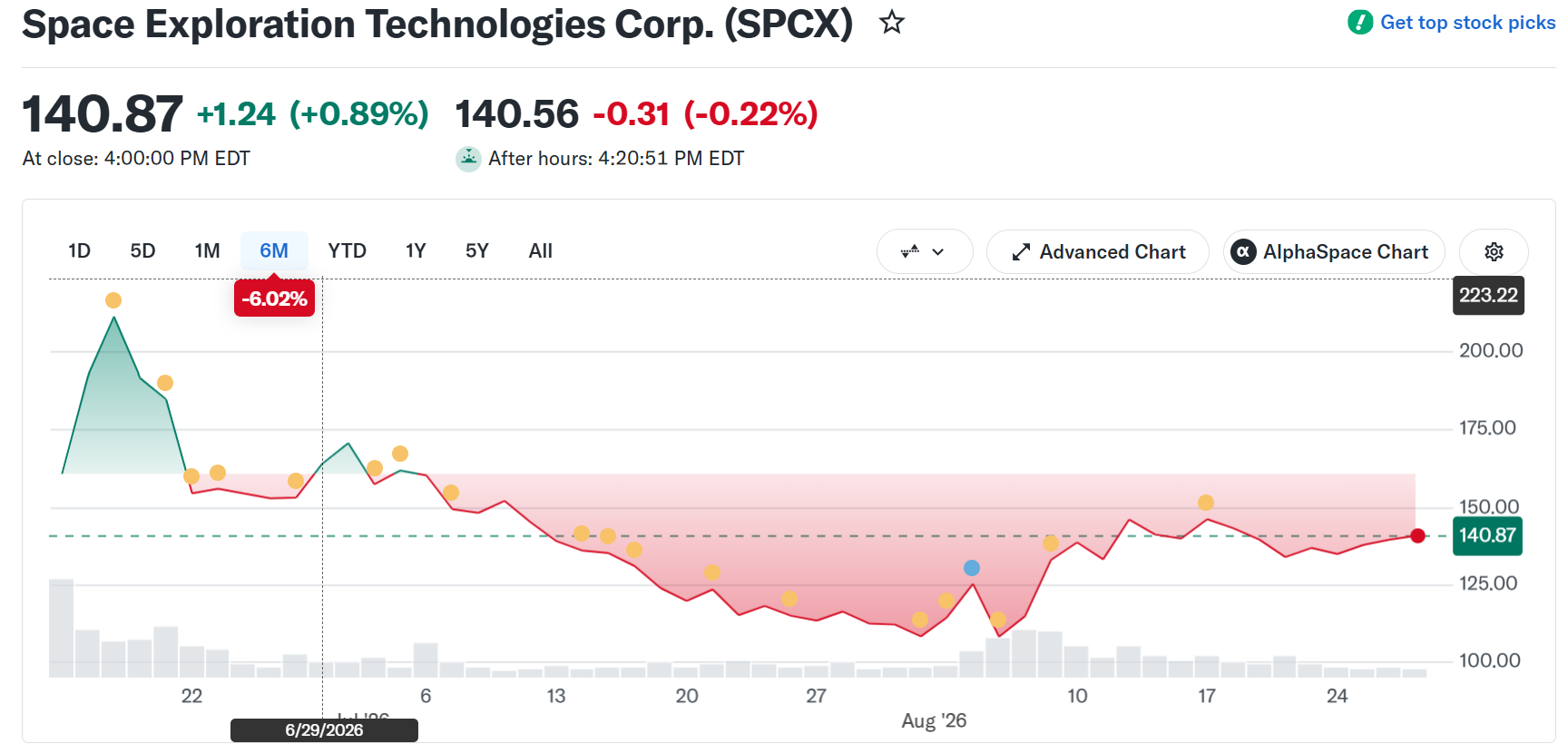
His estimate beats the bank by seven years and lands slightly higher. SpaceX stock trades near $141, about 38% below its June peak.

Where Musk’s SpaceX Revenue Forecast Splits From the Street
Morgan Stanley shared its SpaceX model with large investors days before the June listing. That model reached roughly $330 billion in 2030 and $3.4 trillion in 2040.
Elon Musk’s figure is larger and arrives sooner, while at the same time extending his earlier $1 trillion projection for 2030.
Follow us on X to get the latest news as it happens
Notably, SpaceX has never published a revenue target in any filing. The IPO prospectus carries no forward guidance. Neither does the second-quarter report. The number is Musk personally, not the company.

“My best guess for ~$3.5T revenue is roughly around 2033 fwiw [for what it’s worth],” Musk wrote.
Because trillions are hard to picture, let’s use a benchmark. Amazon is the world’s largest company by revenue and earned $716.9 billion in 2025. Musk’s target is nearly five times that. It is also 187 times the $18.67 billion SpaceX booked in 2025.
Clearing it means growing about 92% every year for eight straight years. Is that even possible?
Only Orbital AI Can Plausibly Produce Multi-Trillion Sales
Starlink pays the bills today, and subscribers doubled to 12 million last quarter. Even so, average revenue per user slipped to $66 from $85.
Launch is smaller than most people assume. Space revenue came in at $962 million for the quarter. The AI unit is the real bet. It grew 247% to $2.56 billion.
Follow the money and the priority is obvious, that of $18.4 billion in second-quarter capital spending, $15.8 billion went to AI.
The 2025 accounts show the same trade, where Starlink produced $4.42 billion in operating profit while the AI unit lost $6.36 billion.
SpaceX puts its addressable AI market at $26.5 trillion of a $28.5 trillion total. That estimate rests on internal assumptions and outside research, and the company says it may prove wrong.
Hardware is starting to follow the money, after SpaceX signed an orbital compute payload deal with Nvidia. It is also building a $100 billion Louisiana spaceport to lift flight rates.
The prospectus targets AI compute satellites in orbit as early as 2028.
SpaceX Stock Prices a Bull Case, Not Musk’s Fastest Case
SPCX last closed at $140.87, valuing SpaceX near $1.91 trillion. That sits about 38% under the $225.61 high set days after the debut.

Analysts are positive, but not this positive. Thirty-five firms average a $232.35 target, implying roughly 57% upside.

None of that approaches $3.5 trillion. JPMorgan’s $240 target leans on Grok and Cursor rather than rockets.
History argues for patience. Internal SpaceX documents once projected more than $30 billion in Starlink revenue by 2025.
Connectivity actually delivered $11.39 billion. That is close to a third of the plan.
The 2028 satellite date is the first milestone anyone can check. Third-quarter results will show whether record AI spending starts producing revenue.
Until it does, the stock prices a strong outcome rather than Musk’s fastest one.
The post Elon Musk and Morgan Stanley’s SpaceX Predictions Are 7 Years Apart appeared first on BeInCrypto.
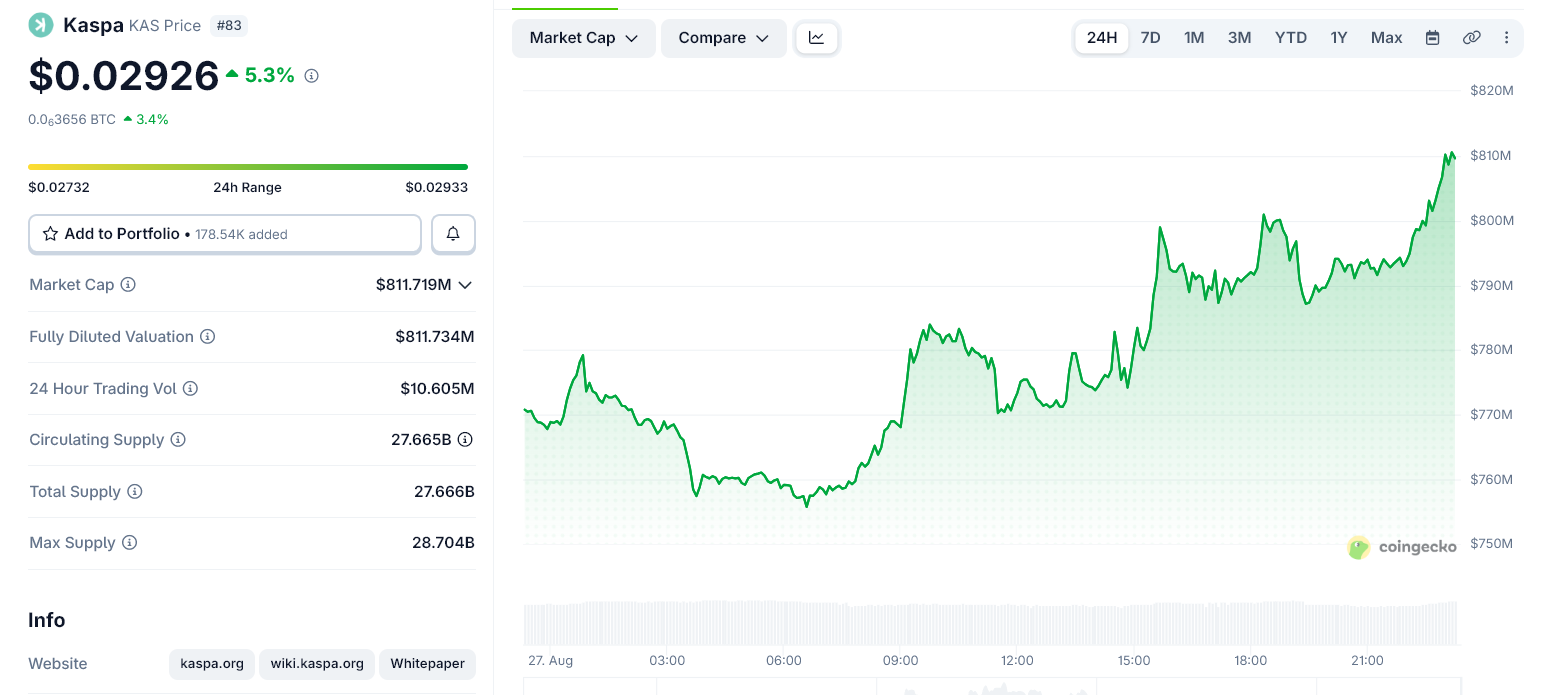
Kaspa climbed more than 5% in recent trading, with the token changing hands near $0.0286 as of late August 2026.
The move coincides with progress on KaChat 4.0, the latest version of the decentralized messaging and payments app built on the Kaspa network.

What KaChat 4.0 Actually Adds
KaChat is a native app that enables end-to-end encrypted peer-to-peer messaging, group chats, voice notes, and KAS payments, all of which are recorded as transactions on Kaspa’s high-throughput blockDAG.
Messages use encrypted payloads over protocols such as ciph_msg or kchat, ensuring that only intended recipients can decrypt the content.
Version 4.0, dubbed The Everywhere Update, expands accessibility with desktop and web support, improved tools for running personal nodes and indexers, Tangem wallet integration, and KaPosts, an on-chain social feature that allows likes, comments, follows, and reposts tied to KNS identities.
Additional changes include better notifications, child-mode privacy controls, and refined address management.
Follow us on X to get the latest news as it happens.
Official releases for Android and iOS are live, with availability on official stores advancing. Broader market factors and ongoing post-Toccata network activity have also influenced recent price action, though the timing of the KAS move has drawn attention from the community.
What This Development Means for Holders
For KAS holders, this rollout carries a few concrete implications. It demonstrates growing real-world utility beyond pure store-of-value or mining narratives, since each message or social interaction incurs a small transaction fee in KAS.
Kaspa’s fast confirmation times and low fees make frequent on-chain messaging practical in ways that remain difficult on many other networks.
Ecosystem expansion can also improve visibility and liquidity. A polished multi-platform app lowers barriers for new users who may acquire KAS simply to use KaChat, while existing holders gain practical tools for private communication and payments without relying on centralized intermediaries.
Features like KaPosts further position Kaspa as infrastructure for decentralized social activity.
Short-term price moves remain volatile, however, and are influenced by overall crypto sentiment, technical levels, and mining dynamics. Utility-driven demand tends to build gradually rather than produce immediate parabolic gains.
Subscribe to our YouTube channel to watch leaders and journalists provide expert insights.

Holders should also note that KaChat still relies on network infrastructure, namely nodes and indexers, and that the benefits of full decentralization increase only as more users run their own setups.
The post Kaspa Jumps 5% as KaChat 4.0 “Everywhere Update” Rolls Out appeared first on BeInCrypto.


The article has been updated with information provided by Bitfinex Securities.
Bitfinex Securities has completed a record $50 million tokenized capital raise for metals company Alkemya through a security backed by partnership interests tied to an independently valued $1.64 billion nickel asset base.
Summary
- Bitfinex Securities completed a record $50 million capital raise for Alkemya through its ALKN tokenized security.
- ALKN represents fractional interests in a Luxembourg partnership holding nickel wire independently valued at about $1.64 billion.
- Alkemya plans to use the proceeds to commercialize engineered nickel products for applications including semiconductors.
- Additional ALKN tokens will remain available to eligible investors until Oct. 15, while ALKN is already available for trading on Bitfinex Securities.
Bitfinex Securities and Alkemya said in an announcement on Thursday that the fundraising involved ALKN, a tokenized security representing limited partnership interests in Luxembourg-based Alkemya Metacore SCSp.
The partnership owns about 7 million meters of 99.99% pure nickel wire, according to the companies. Its nickel holdings have been independently valued at about $1.64 billion, according to the companies, while ALKN represents limited partnership interests tied to the asset.
For Bitfinex Securities, the $50 million total is the largest capital raise completed on its platform. The company said in the announcement that its previous record stood at $30 million and involved USTBL, a tokenized product linked to short-term U.S. Treasuries.
Bitfinex Securities sets a new $50 million fundraising record
Following the Alkemya transaction, Bitfinex Securities has now completed seven capital raises and listed 16 assets, according to figures provided by the platform.
ALKN is also Alkemya’s first tokenization project, an Alkemya spokesperson said in the announcement. Under the structure, eligible investors receive fractional interests in Alkemya Metacore SCSp in digital form, with the tokens designed to be transferable between eligible holders.
Proceeds from the offering will be used to support the commercialization of high-purity nickel products through Alkemya’s Singapore-based operating subsidiary, Green Transitional Metals Pte Ltd. Proceeds will be used to commercialize high-purity nickel products through its Singapore-based operating subsidiary, Green Transitional Metals Pte Ltd. Planned applications include semiconductors, electromagnetic interference shielding, aerospace and defense, power systems, green hydrogen, and rare and precious metals recovery.
Investors who did not participate in the completed $50 million raise will still have access to additional ALKN tokens. Bitfinex Securities plans to keep the offering open to eligible investors until Oct. 15 as Alkemya proceeds with another fundraising tranche.
Following the initial $50 million capital raise, ALKN tokens are available for trading on Bitfinex Securities for eligible investors. Additional ALKN tokens also remain available as part of the offering.
ALKN gives investors fractional interests in the nickel partnership
The ALKN structure places the legal investment interest in the Luxembourg partnership onchain while the underlying physical asset remains the nickel inventory held through Alkemya Metacore.
Each token represents an interest in the limited partnership instead of direct ownership of individual sections of nickel wire. Alkemya said the digital structure allows those partnership interests to be divided into fractional holdings and transferred electronically among eligible investors.
The transaction also comes as tokenized commodities have expanded beyond precious-metal products. In April, crypto.news reported that the value of tokenized commodities and equities had moved above $7 billion, with gold-backed products accounting for a large part of the market while tokenized oil, gas and agricultural assets were also gaining activity.
The same report cited Bitfinex research that put the tokenized commodity market at roughly $7 billion after an increase of nearly 600% since early 2025. Bitfinex said tokenized commodities were increasingly being used as onchain collateral across centralized platforms and decentralized finance protocols.
Earlier Bitfinex Securities offerings included Treasuries and debt
Before the Alkemya transaction, Bitfinex Securities had used its infrastructure for tokenized government debt exposure, corporate financing and other securities.
Crypto.news previously reported in November 2024 that the platform had launched a tokenized U.S. Treasury offering under El Salvador’s Digital Asset Law. Issued by NexBridge Digital Financial Solutions, USTBL represented shares in the iShares $ Treasury Bond 0-1yr UCITS ETF, which tracks U.S. government debt with maturities of less than one year.
The initial USTBL subscription period targeted a minimum raise of $30 million and accepted Tether’s USDT, with Bitcoin payments planned afterward. Bitfinex Securities said in the announcement in connection with the Alkemya deal that its previous fundraising record was the $30 million USTBL raise.
Earlier tokenized deals on the platform included corporate debt. In April 2024, Bitfinex Securities launched a tokenized debt offering designed to raise $6.25 million for construction of a Hampton by Hilton hotel near El Salvador International Airport. The HILSV security was issued on Liquid Network, a Bitcoin sidechain, and carried a five-year term with a 10% annual return.
Bitfinex Securities had also entered the tokenized bond market in 2023 with ALT2611, a 36-month security denominated in USDT and issued by a Luxembourg-based securitization fund managed by Mikro Kapital. The offering targeted $10 million and carried a 10% coupon, although early subscriptions fell below the original fundraising target.
Bitfinex has built regulated operations around tokenized assets
Bitfinex Securities operates regulated securities platforms in both El Salvador and the Astana International Financial Centre in Kazakhstan. The platform has also listed more than $500 million in tokenized assets, according to the company. In July, Bitfinex completed its Salvadoran license set covering spot trading, derivatives and regulated tokenized securities through separate operations.
In El Salvador, Bitfinex Securities received approval under the country’s Digital Assets Issuance Law before the group completed the rest of its local licensing structure. The National Commission of Digital Assets registry lists the securities entity under PSAD-0001 with an Oct. 24, 2023 registration date, and its permitted business includes issuance and trading infrastructure for tokenized financial products.
The platform’s tokenization work has also extended into distribution and infrastructure agreements. In November 2025, Tether’s Hadron tokenization platform, KraneShares and Bitfinex Securities announced a tokenized capital markets partnership under which Bitfinex Securities would provide regulated infrastructure and support access to secondary-market liquidity for tokenized products.
Additional ALKN tokens remain available to eligible investors through Oct. 15, while ALKN is already available for trading on Bitfinex Securities following the initial capital raise.

Ahead of the Fed’s September meeting, Stephen Miran, a former Federal Reserve governor, said a rate hike right now would be a mistake. He argued that recent inflation data are distorted, not genuinely elevated.
Speaking on CNBC’s Squawk Box, Miran said the Fed’s preferred gauge is the Personal Consumption Expenditures (PCE) index. He said it has broken from its usual link to the Consumer Price Index (CPI) by about a percentage point.
Portfolio Fees Distort the Inflation Picture
Miran said core CPI is running near 2.5%, a historically normal level. He said the usual 40-basis-point CPI-to-PCE gap would put core PCE near 2.1%.
Core PCE instead rose 0.2% in July. It held at 3.3% year over year, matching June’s pace. Miran called that inversion mostly measurement error.
He attributed nearly 70 basis points of the gap to two factors. Portfolio management fees rise mechanically as stock prices climb.
Software price increases, he said, wrongly count AI upgrades as inflation instead of quality gains.
Miran said the Bureau of Economic Analysis (BEA) plans to revise its methodology a little more than a month from now, a timeline that lines up with separate reports pointing to a late-September overhaul. He expects the change to pull core PCE lower.
The Federal Reserve Act gives the Fed two goals, maximum employment and stable prices, Miran said. He said raising rates to fight overstated inflation risks unnecessary job losses.
He said the Fed held rates in June and July as inflation data improved.
“There’s no reaction function that gives you both a hold in June and July and a hike in September.”
Stephen Miran, CNBC
Fed Independence and the Rate Hike Path Ahead
Miran discussed Fed Chair Kevin Warsh’s first Jackson Hole keynote, set for this week. He said the Fed should stick to its employment and price mandates rather than weigh in on fiscal policy.
The Treasury’s bond buyback plan adds purchases at the long end of the yield curve. Miran said more liquidity sharpens market signals rather than distorting them, pushing back on a criticism of the program that he said he has heard elsewhere.
Miran said policy set today should target inflation in late 2027. Rate changes take 12 to 18 months to reach the economy, he said.
He does not expect current distortions to persist that long.
The post Ahead of Fed Meeting, Former Governor Miran Says Rate Hike Would Be ‘Weird' appeared first on BeInCrypto.
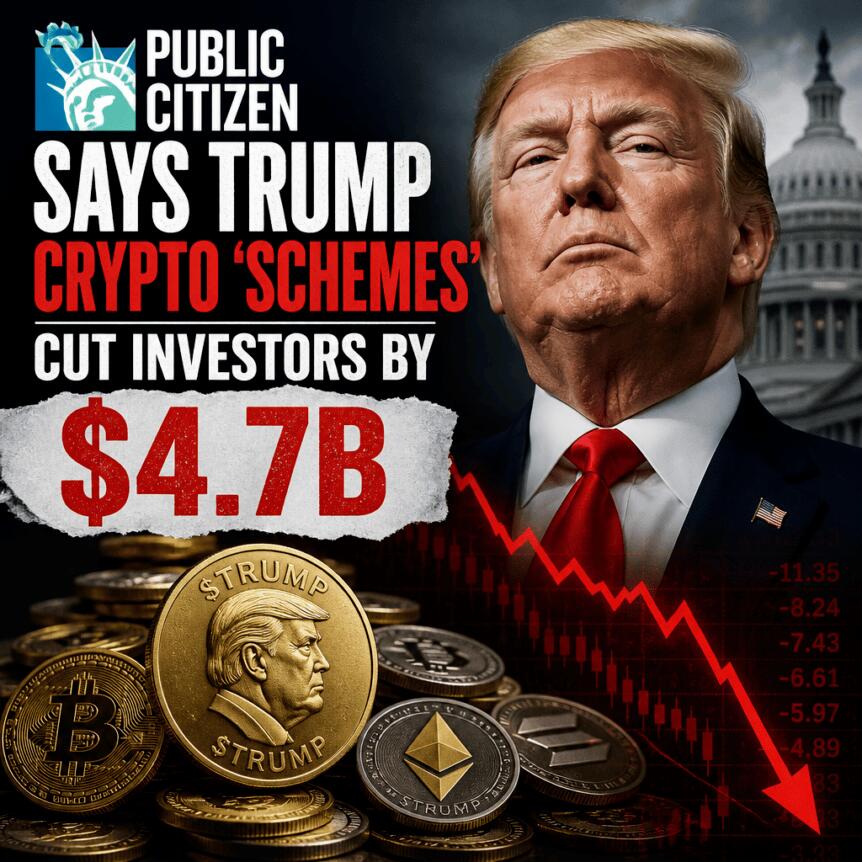
Public Citizen, a US consumer advocacy nonprofit, has alleged that investors tied to Donald Trump’s digital-asset activities since 2022 have been left “at least an estimated $4.7 billion underwater,” citing a mix of governance tokens, NFTs, and memecoin-related transactions.
The group’s assessment focuses on several Trump-linked crypto efforts, arguing that the scale of investor losses—particularly connected to the TRUMP memecoin—outweighs the reported earnings that flowed to Trump’s side through licensing, royalties, and sales tied to World Liberty Financial and other crypto ventures. White House officials did not immediately respond to Cointelegraph’s request for comment.
Key takeaways
- Public Citizen estimates Trump-related crypto ventures have left investors “at least” $4.7 billion in losses since 2022.
- About $3.2 billion of the estimated losses are attributed to investors in the TRUMP memecoin.
- Public Citizen says buyers of World Liberty Financial’s USD1 stablecoin “haven’t suffered major losses.”
- The nonprofit argues that a forthcoming US cryptocurrency market structure bill should include ethics requirements such as presidential and family divestment.
Public Citizen’s $4.7 billion underwater estimate
In a report shared with the public, Public Citizen says investors lost billions of dollars through multiple Trump family digital asset undertakings, including the World Liberty Financial governance token, NFT trading cards launched in 2022, and two other revenue-linked areas: the TRUMP memecoin and Trump Media’s digital asset treasury.
According to Public Citizen, the largest share of the losses came from TRUMP memecoin investors, estimated at $3.2 billion. The organization frames the memecoin outcome as a transfer of wealth rather than a simple wipeout—saying the losses amounted to “wealth transferred to a small group of early buyers rather than money that simply vanished.”
Public Citizen also highlights that, within its assessment, stablecoin holders appear to have experienced less severe outcomes. The group states that buyers of World Liberty Financial’s USD1 stablecoin have “haven’t suffered major losses,” an observation that matters because stablecoins are often marketed and structured with different risk expectations than volatile tokens.
How much Trump is reported to have earned
Public Citizen’s filing argues that while investors are estimated to have absorbed substantial losses, Trump also generated revenue from parts of the crypto ecosystem. The nonprofit says Trump earned $7.2 million from NFT licensing fees and royalties.
It further claims earnings tied to World Liberty include more than $600 million from World Liberty token sales and revenue from selling an equity stake, alongside $635 million in licensing fees for the memecoin and $197 million from capital contributions to World Liberty. The nonprofit also notes that these figures do not fully capture the value of Trump-held stakes in companies and ventures that remain under his control.
Some of the numbers referenced by Public Citizen were also said to be included in Trump’s 2025 disclosures, which Cointelegraph coverage previously noted as indicating $1.4 billion in earnings linked to crypto.
White House response and recurring conflict-of-interest questions
Cointelegraph reached out to the White House for comment regarding Public Citizen’s claims but did not receive an immediate response. The report references a White House spokesperson, Anna Kelly, who has repeatedly said that there are “no conflicts of interest” in connection with Trump’s crypto investments and related activity.
Public Citizen’s central contention is that investor outcomes and official policy should be considered together. The organization argues that it is not possible to cleanly separate the president’s policy choices from a personal portfolio that includes exposure to projects operating in the same market.
Ethics push as the CLARITY Act nears
Public Citizen’s report is also tied to a broader legislative fight over how US crypto markets should be structured. The group renewed calls for ethics provisions in the Digital Asset Market Clarity (CLARITY) Act, describing the proposal as incomplete without rules addressing potential conflicts involving the president and his family.
Specifically, Public Citizen argues that any bill shaping the industry should require a US president and their family to divest from projects in the sector, stating that “the president’s policy choices and personal portfolio cannot be separated.”
The nonprofit’s ethics stance comes as Trump has also been publicly active on crypto policy. Cointelegraph previously reported that Trump met with crypto company executives last week, urging a “fair version” of the CLARITY Act and saying it should pass once the Senate returns to session next month.
In terms of procedure, the bill is scheduled for a cloture vote on Sept. 15. If it advances, it would require at least 60 senators to vote in favor to move forward—an important threshold that determines whether the measure can proceed through the Senate agenda.
What to watch next
As the CLARITY Act approaches its cloture vote, the key question for market participants is whether ethics amendments—such as divestment requirements for the president and family—gain traction alongside the bill’s core regulatory changes, and how lawmakers reconcile the political push for industry “clarity” with ongoing conflict-of-interest concerns raised by Public Citizen.


Cointelegraph is committed to providing independent, high-quality journalism across the crypto, blockchain, AI, and fintech industries.
All news, reviews, and analyses are produced with full journalistic independence and integrity. For more details on our standards and processes, please read our Editorial Policy.

Mirae Asset—one of South Korea’s largest financial groups—wants to scale its crypto footprint into a major digital-asset business after taking control of the exchange formerly known as Korbit. According to The Korea Times, the group is aiming to build a 150 trillion won ($109 billion) digital asset platform centered on Digital X, the renamed exchange.
The reported roadmap is broad: Digital X would operate across cryptocurrencies, stablecoins, real-world assets (RWAs) and security token offerings, including plans to tokenize physical assets such as gold, silver and electricity. The strategy follows Mirae Asset Consulting’s acquisition of a controlling stake in Korbit earlier this year, positioning a traditional finance group as a direct operator of a domestic crypto exchange.
Key takeaways
- Mirae Asset plans a 150 trillion won ($109 billion) digital asset business built around Digital X, per The Korea Times.
- Digital X’s intended scope spans crypto trading, stablecoins, RWAs and security token offerings, including tokenization of physical assets like gold and silver.
- The expansion comes after Mirae Asset Consulting bought a 97.15% stake in Korbit in July and the exchange was rebranded as Digital X.
- Digital X started waiving trading fees for won-denominated assets on Monday, with the zero-fee period scheduled to run through Aug. 24, 2027.
- Despite Korbit’s long history (founded in 2013), it represented only 0.5% of South Korea’s crypto trading market in 2025, according to the Fair Trade Commission.
Mirae Asset’s digital-asset ambition and why it matters
The reported plan signals a continued shift in South Korea toward integrating digital assets into the broader financial-services ecosystem. For investors and market participants, the key point is not simply that a financial group owns an exchange—it’s the stated intention to move beyond spot trading into tokenization and regulated-style asset distribution.
By setting a large business target for “Mirae Asset 3.0,” Mirae Asset is effectively framing Digital X as a growth engine rather than a passive investment. According to The Korea Times, Mirae Asset founder and chairman Park Hyeon-joo discussed the direction at a Digital X employee event in Seoul on Wednesday, describing an initial goal of making Digital X a core pillar of “Mirae Asset 3.0.”
That positioning matters because tokenization initiatives—especially those involving real-world assets—depend on partnerships, custody and compliance frameworks, as well as market demand for new tokenized products. Whether Digital X can translate these ambitions into products that attract liquidity will likely determine how meaningful the exchange becomes within the domestic digital-asset value chain.
From Korbit to Digital X: control, rebrand, and market gap
Mirae Asset’s push is tied directly to its ownership of the exchange. The Korea Times reports that Mirae Asset Consulting completed a takeover of Korbit with a 97.15% stake in July, after accumulating a total cost of 141.4 billion won. The acquisition and subsequent rebrand are described as a notable first in South Korea: an affiliate of a financial group gaining control of a domestic crypto exchange.
Digital X began operating under the Korbit name’s successor brand after the control change. While Korbit has been active since 2013 and was described by The Korea Times as South Korea’s first cryptocurrency exchange, its scale has not matched its seniority. The Fair Trade Commission data cited by the same outlet indicated Korbit accounted for just 0.5% of South Korea’s crypto trading market in 2025.
In other words, the acquisition came with a built-in strategic challenge: Digital X will need to grow a relatively small footprint into a larger platform capable of supporting both trading activity and longer-horizon tokenization products.
Fee waivers and the push to win liquidity
One of the most immediate actions taken after the rebrand concerns trading costs. As of Monday, Digital X began waiving trading fees across all won-denominated assets, with the zero-fee initiative scheduled to run through Aug. 24, 2027. The exchange’s fee policy page lists the promotion and its coverage, including the won-denominated trading pairs the offer applies to (Digital X/Korbit fee information).
For traders, lower trading fees can improve effective returns—particularly for active users and market-makers who are sensitive to cost-per-trade. For the exchange, sustained fee reductions are often used to attract volume, increase order flow and improve overall liquidity, which can also help support new product launches.
However, fee waivers also shift business risk onto the platform: a longer period of reduced fees means revenue depends more heavily on alternative income streams (such as custody, token issuance-related services, or broader financial product distribution) that align with the company’s stated RWA and security token plans.
What’s planned beyond spot trading
According to The Korea Times, Digital X’s planned product direction includes crypto, stablecoins, RWAs and security token offerings—an expansion that aims to bring tokenized assets into a format that can be traded, held and potentially distributed like digital financial instruments.
The article’s examples of tokenization targets—physical assets such as gold, silver and electricity—highlight the core appeal of RWAs: the possibility of converting traditionally illiquid assets into blockchain-based representations that may be easier to transfer. At the same time, RWAs require robust governance around asset backing, redemption mechanics and compliance with securities-related rules where applicable.
While the plan is ambitious, the path from concept to live products typically depends on regulatory clarity, the ability to secure counterparties and the market’s appetite for new tokenized instruments. Readers should watch whether Digital X pairs its fee-driven liquidity push with concrete launches in stablecoins, RWAs and security token offerings, rather than limiting expansion to trading.
What to monitor next is how Digital X turns its ownership and fee incentives into sustained user growth and whether it can progress from a multi-category roadmap into specific tokenized asset products—particularly those tied to gold, silver and electricity—under South Korea’s evolving regulatory framework.
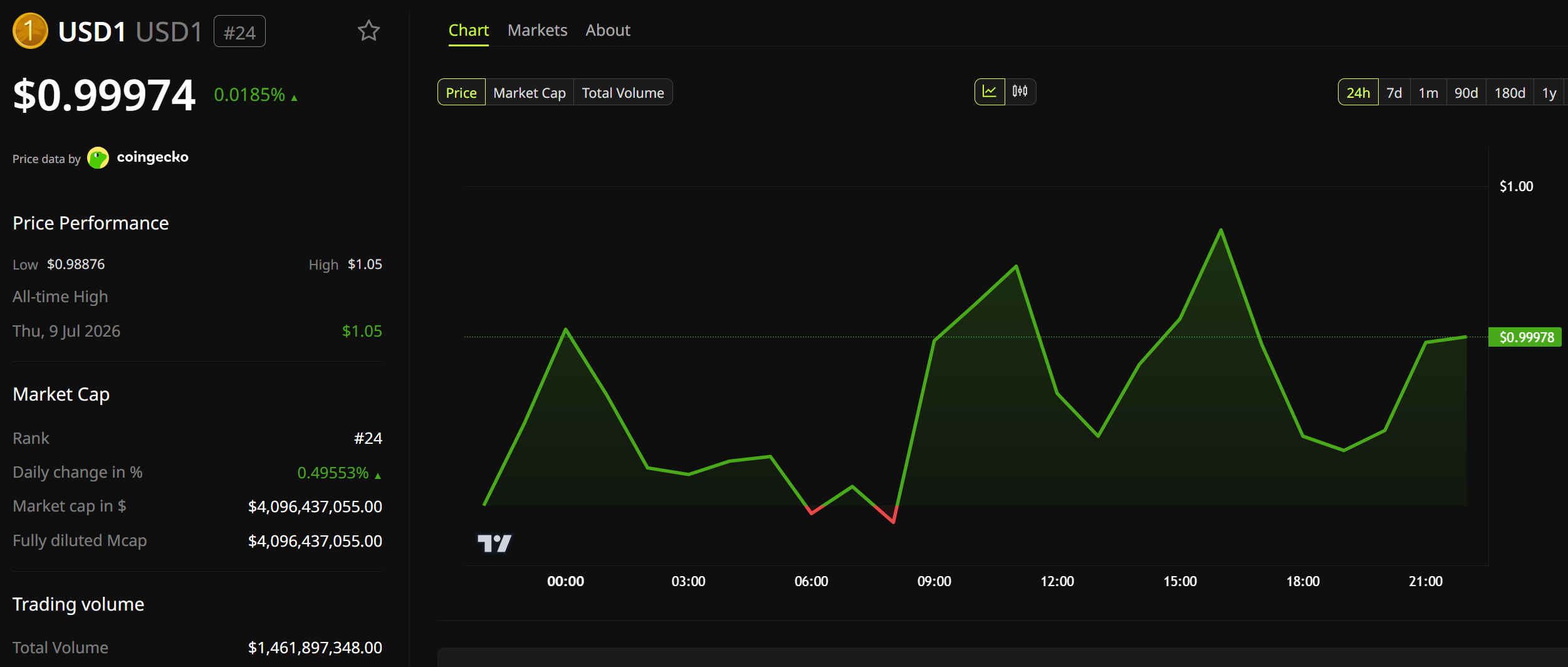
Eric Trump signed a promise not to interfere with his family’s new stablecoin bank. So did a manager for the Abu Dhabi entity that reportedly owns the largest piece of it.
Those promises are called passivity commitments, and regulators use them to stop big owners from steering a bank they are not supposed to run.
Who Actually Owns the Trump Stablecoin Bank
The Office of the Comptroller of the Currency (OCC) charters national banks. On August 14 it cleared World Liberty Trust Company to issue and redeem USD1.
The bank is owned by a Delaware company called WLTC Holdings. Its shareholder split copies World Liberty Financial, the Trump family crypto venture behind the coin.
An entity tied to Sheikh Tahnoon bin Zayed al Nahyan holds 49%, according to the Wall Street Journal. A Trump family entity holds 38%.
Neither figure appears in the OCC’s public decision. The regulator never lists a percentage. Both numbers rest on people familiar with the matter.
Tahnoon runs the United Arab Emirates’ national security service and is the brother of its president. In January 2025, investors associated with him invested $500 million in World Liberty. The deal closed four days before the inauguration.
A $20 Million Cushion Behind a $4 Billion Coin
The OCC set the bank’s floor at “a minimum of $20 million in tier 1 capital.” Half of that must sit in liquid assets.
USD1 is far bigger, with the coin holding its dollar peg at $0.9997. Its market value sits near $4.1 billion, ranking 24th among all crypto assets, BeInCrypto data shows.

That capital is not what backs the coin, as the reserves do that job. Still, there is clear concern, because the bank needs about $1 of its own capital for every $205 of USD1 outstanding.
The reserves are where the money is. Three-month Treasury bills yielded 3.79% on August 26, Treasury rates show. At that rate, $4.1 billion throws off roughly $155 million a year.
World Liberty has estimated $150 million, with the math saying that estimate is, if anything, cautious.
Today, BitGo issues the coin and keeps part of the interest. The new bank plans to take those reserves over. Every dollar of yield then stays in-house.
Meanwhile, one detail matters for holders. Stablecoins are not deposits, so USD1 carries no Federal Deposit Insurance Corporation (FDIC) coverage.
The Pledge That Replaced a Fight
The OCC collected passivity commitments from three entities:
- DT Marks SC LLC was signed by Eric F. Trump as president.
- StringZ Holding RSC was signed by Hamad Khlfan Ali Matar Alshamsi, a former director of Tahnoon’s artificial intelligence firm G42.
- AMGUS LLC was signed by co-founder Zachary Folkman.
Each promised no board seats and no influence over dividends, pricing, personnel, or operations. Any voting stake above 9.9% gets handed to management by proxy.
Then comes the line that defines the whole approval.
“Although such investors were not considered principal shareholders of the Bank, the OCC received passivity commitments from certain U.S. and non-U.S. investors in World Liberty Financial,” reads Office of the Comptroller of the Currency, Corporate Decision #1385.
So the OCC took pledges from investors it did not formally treat as principal owners. The Journal calls these only the second set demanded since Trump returned to office. That count comes from its own review, not a public tally.
Why Democrats Call This a Security Problem
Senator Elizabeth Warren has pressed Comptroller Jonathan Gould to delay the charter review until the president divests.
“any financial connection between Sheikh Tahnoon bin Zayed Al Nahyan and an applicant for a national bank charter, especially one owned by the President, should be immediately disqualifying given the national security concerns,” Elizabeth Warren, US Senator, in a letter to the OCC.
Washington was weighing UAE access to advanced American chips while G42 waited on supply. Senate Democrats have already demanded congressional hearings.
World Liberty says career OCC staff reviewed the application. The White House reportedly denies any conflict.
The bank cannot open yet. Rather, it has only 12 months to raise capital and 18 months from August 14 to start business.
A final exam still stands between the charter and the doors opening. The open question is whether that exam tests who owns the bank, or only the paperwork saying they will stay quiet.
The post The Foreign Owners Behind Trump’s $4 Billion Stablecoin Bank appeared first on BeInCrypto.
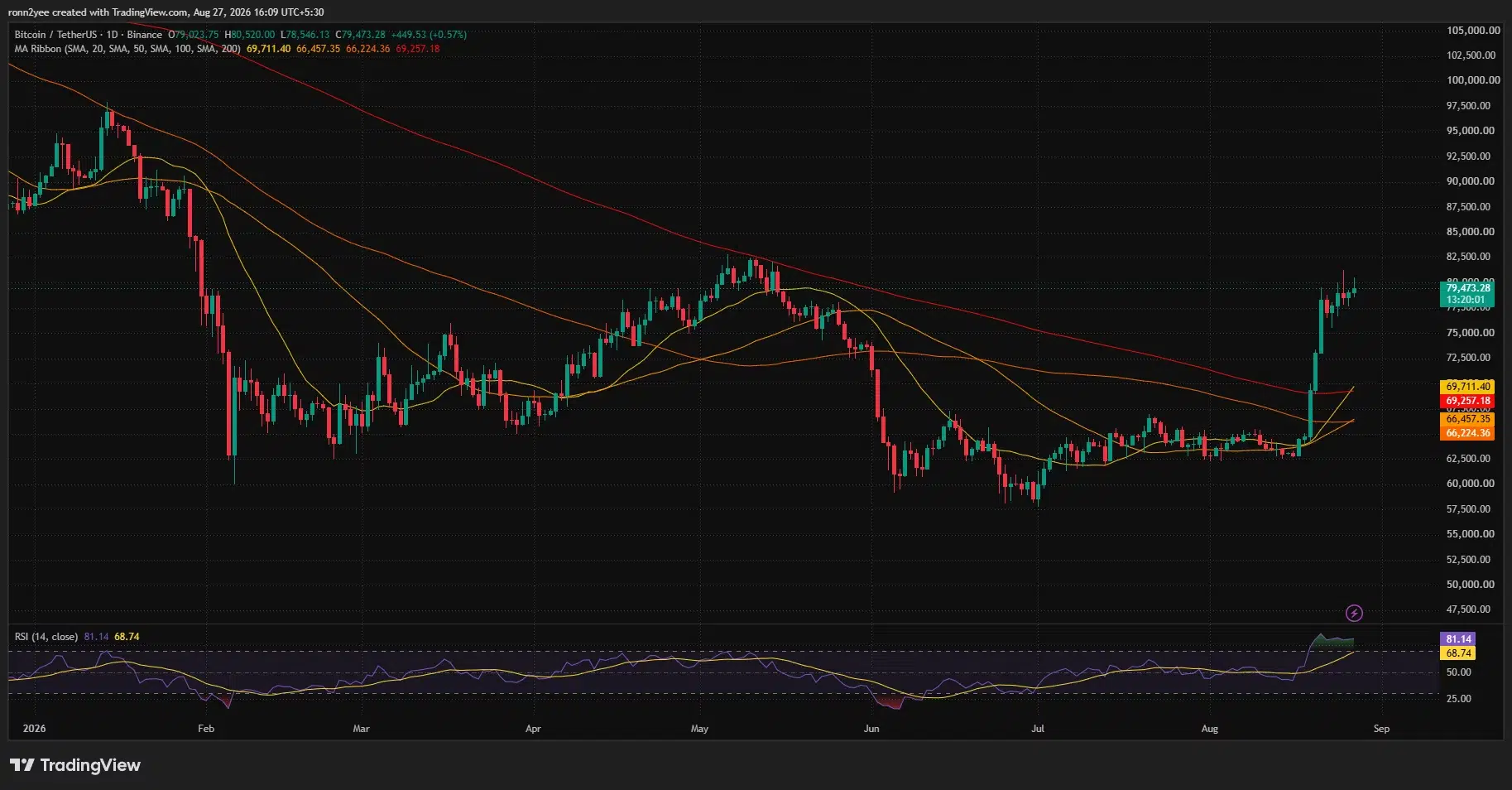
Bitcoin price held near $79,500 on Aug. 27 after a rapid breakout from the $63,000 area, with ETF demand and U.S. policy developments supporting the rally even as technical indicators warned that momentum may be stretched.
Summary
- Bitcoin price traded near $79,500 after gaining roughly 25% from its mid-August consolidation range.
- Daily RSI reached 81.14, placing BTC firmly in overbought territory.
- The 4-hour Supertrend remained bullish while MACD showed fading short-term momentum.
- Liquidation clusters near $81,000 and $77,500 could shape Bitcoin’s next move.
Bitcoin price holds above its breakout zone
According to data from crypto.news, Bitcoin (BTC) price was trading at approximately $79,473 at the time of writing. The price reached an intraday high of $80,520 after opening near $79,024.
BTC has gained roughly 25% since breaking out of a narrow range near $63,000 on Aug. 19. The advance took the asset above $80,000 before sellers blocked attempts to extend the rally through the $81,000–$82,000 region.
The daily chart shows Bitcoin trading above its four tracked simple moving averages. The 20-day SMA stood at $69,711, while the 200-day SMA was near $69,257. The 50-day and 100-day averages were positioned at $66,457 and $66,224, respectively.
Trading above all four averages supports the broader recovery, but the moving averages have not yet produced a confirmed bullish golden cross. The 20-day average remains only slightly above the 200-day line, leaving traders to watch whether the separation expands or reverses.
The daily relative strength index reached 81.14, well above the conventional overbought threshold of 70. Such a reading shows strong buying momentum but also raises the possibility of profit-taking after the steep advance.
Treasury buybacks and ETF inflows supported Bitcoin
Bitcoin’s breakout followed an Aug. 19 announcement from the U.S. Treasury that it would at least double the maximum size of long-end liquidity-support buybacks.
The department said operations involving nominal securities in the 10-to-20-year and 20-to-30-year sectors would increase from a maximum of $2 billion to at least $4 billion per operation. The larger operations will begin on Sept. 9 and continue through Nov. 4. The Treasury described the change as support for liquidity in longer-dated government debt markets.
The announcement improved market expectations around Treasury-market liquidity, although it did not represent an immediate injection of funds because the expanded operations have not yet started. Bitcoin’s reaction also coincided with renewed demand through U.S. investment products and improving expectations for crypto legislation.
U.S.-listed spot Bitcoin exchange-traded funds attracted approximately $1.92 billion in the week through Aug. 21, according to SoSoValue data. BlackRock’s IBIT accounted for about $1.33 billion of those inflows.
The ETF group recorded its strongest week since October 2025, but the funds remained roughly $2.91 billion in net outflows for 2026. The combination suggests institutional demand returned sharply during the breakout without fully reversing the weakness seen earlier in the year.
Political expectations also contributed to sentiment after President Donald Trump renewed calls for Congress to advance crypto market-structure legislation. The proposed CLARITY Act remains subject to congressional action, meaning its effect on sentiment does not amount to final regulatory certainty.
Bitcoin momentum cools on the 4-hour chart
The 4-hour chart shows that Bitcoin’s trend remains bullish despite weakening momentum.
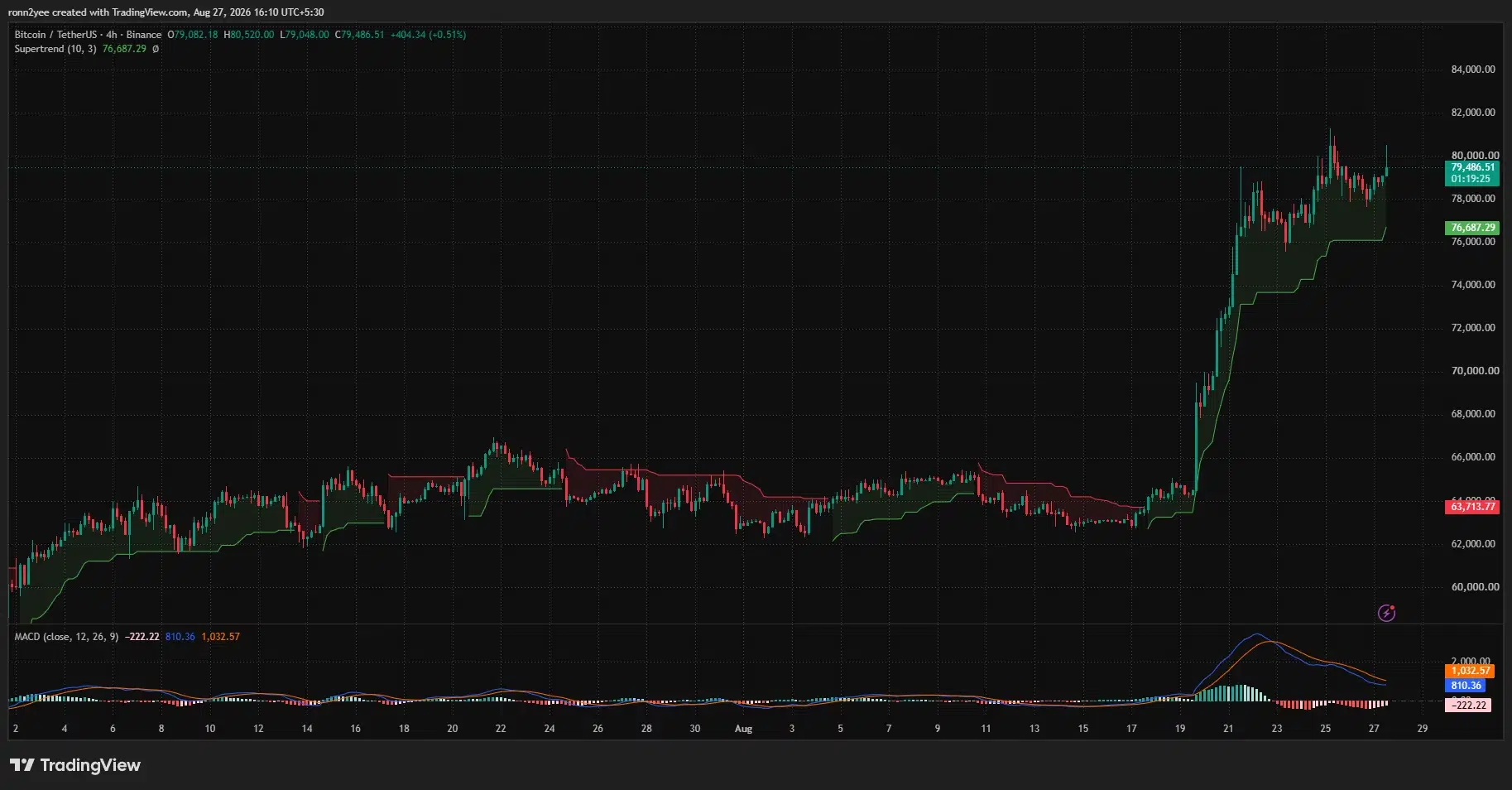
BTC was trading above the Supertrend indicator, which had moved up to $76,687. Holding above that level would preserve the sequence of higher lows established after the breakout.
The moving average convergence divergence indicator presented a more cautious picture. The MACD line stood near 810, below the signal line at approximately 1,033, while the histogram remained negative at minus 222.
The bearish MACD crossover suggests the rally has lost some short-term force since Bitcoin tested $81,000. However, the negative histogram bars were beginning to contract on the chart, indicating that downside momentum may also be easing.
Price action has formed a short consolidation between approximately $78,000 and $80,000. A close above $80,500 would allow buyers to challenge the recent high around $81,200, followed by the May peak near $82,800.
A weekly close above the 365-day moving average near $83,000 would provide a stronger long-term confirmation. Until then, Bitcoin remains below a resistance area that previously rejected price advances.
Liquidity concentrates around $81K and $77.5K
The one-week CoinGlass liquidation heatmap shows leveraged positions building on both sides of Bitcoin’s current price.
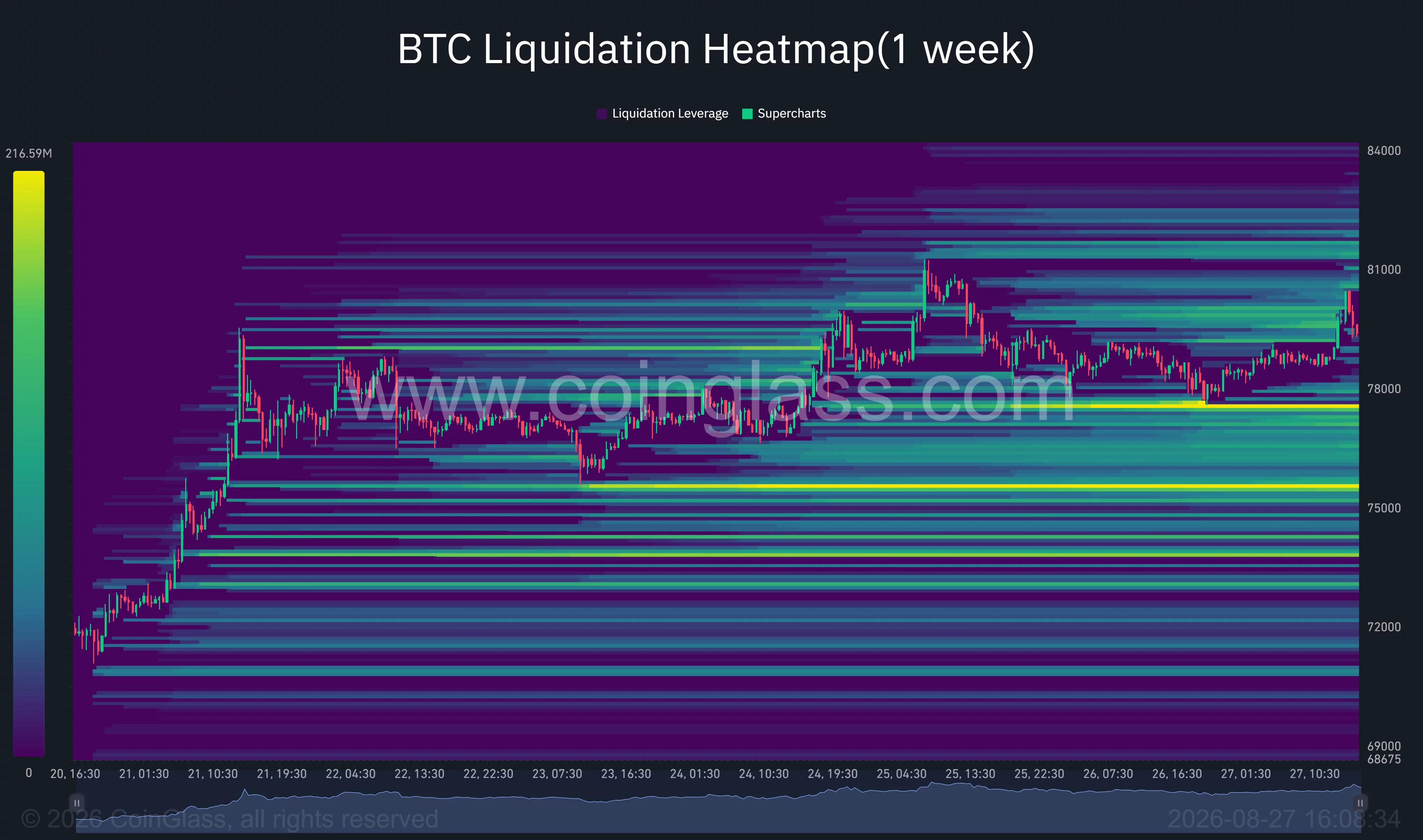
The nearest major concentration above the market sits around $80,000–$81,000. A clean break through that zone could force short sellers to close positions, potentially adding momentum toward liquidity near $81,500 and $84,000.
The strongest nearby downside cluster appears around $77,300–$77,700. Further liquidity is visible close to $75,500, making the two areas possible targets if Bitcoin loses its current range.
On-chain analyst Einstein BTC identified $75,900 as the newest short-term holder cost basis. According to the analyst, Bitcoin was trading only about 3.4% above that level, making it an important dividing line for the short-term structure.
The chart provides nearer support at $76,687 through the 4-hour Supertrend. A fall below that indicator would increase the probability of a move toward the $75,900 cost basis and the heatmap’s $75,500 liquidity cluster.
Another market commentator, Crypto with Haris, argued that repeated rejection below $82,000 could expose $74,000 and eventually $67,000. The forecast represents a bearish scenario rather than a confirmed outcome, with Bitcoin still holding above its immediate technical supports.
Bitcoin faces an overbought test near $80K
Bitcoin’s next move depends on whether buyers can absorb selling near $80,000 while defending the $77,500–$76,700 support area.
A daily close above $81,200 would weaken the immediate bearish case and open a path toward $82,800 and the 365-day average near $83,000. Liquidations above the market could accelerate such a move.
Failure to clear resistance, combined with an RSI above 80 and a bearish 4-hour MACD crossover, would leave Bitcoin vulnerable to a cooling period. The first test would sit near $77,500, followed by the Supertrend at $76,687 and the short-term holder cost basis around $75,900.
The larger trend remains constructive while BTC trades above its major daily moving averages. However, the overbought RSI and concentrated leverage on both sides of the market suggest the next breakout could produce another sharp move rather than a gradual change in direction.
Disclosure: This article does not represent investment advice. The content and materials featured on this page are for educational purposes only.
Bitcoin’s August rally has revived some of the mining sector’s most beaten-down stocks, reversing a trend that has favored miners pivoting toward artificial intelligence and high-performance computing and suggesting investors may once again be rewarding direct exposure to Bitcoin.
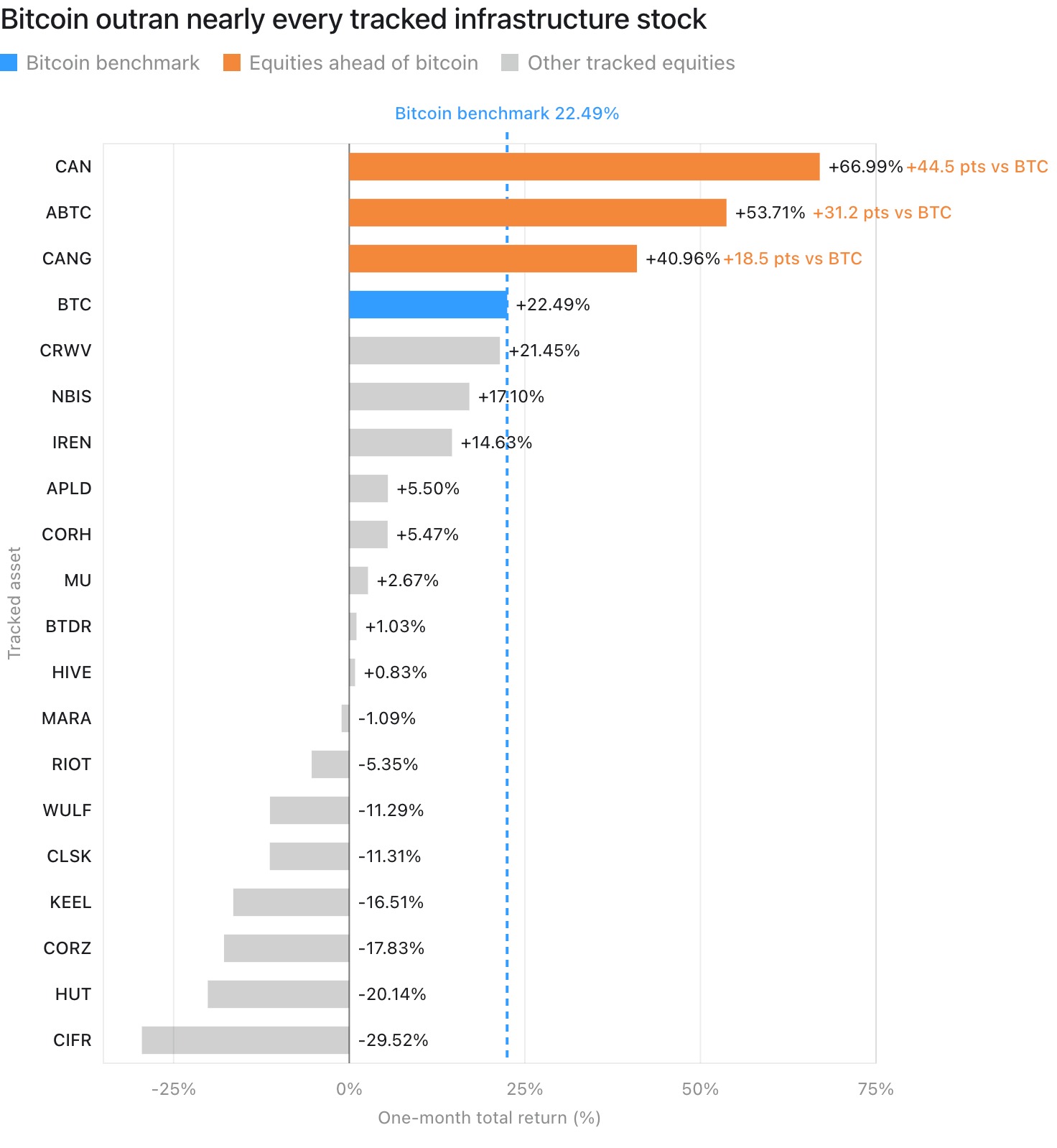
In its latest Miner Weekly newsletter, BlocksBridge Consulting reported that Bitcoin’s (BTC) roughly 23% rally over the past week outpaced most AI-linked infrastructure stocks.
Three beaten-down Bitcoin mining companies — Canaan, American Bitcoin and Cango — gained between 41% and 67%. By comparison, CoreWeave rose about 21%, Nebius gained 17% and IREN advanced 15%, while some miners with heavier exposure to AI and HPC were flat or declined.
Blocksbridge pointed to three catalysts behind Bitcoin’s rally. The first was the US Treasury Department’s Aug. 19 announcement that it would at least double the size of its liquidity-support buybacks for longer-dated Treasury securities.
The second was renewed regulatory optimism following a White House meeting with crypto executives, where US President Donald Trump urged Congress to pass a “fair version” of the CLARITY Act, a stalled crypto market structure bill.
The third was a sharp short squeeze following Bitcoin’s breakout, with more than $1.6 billion in crypto positions liquidated over 24 hours.
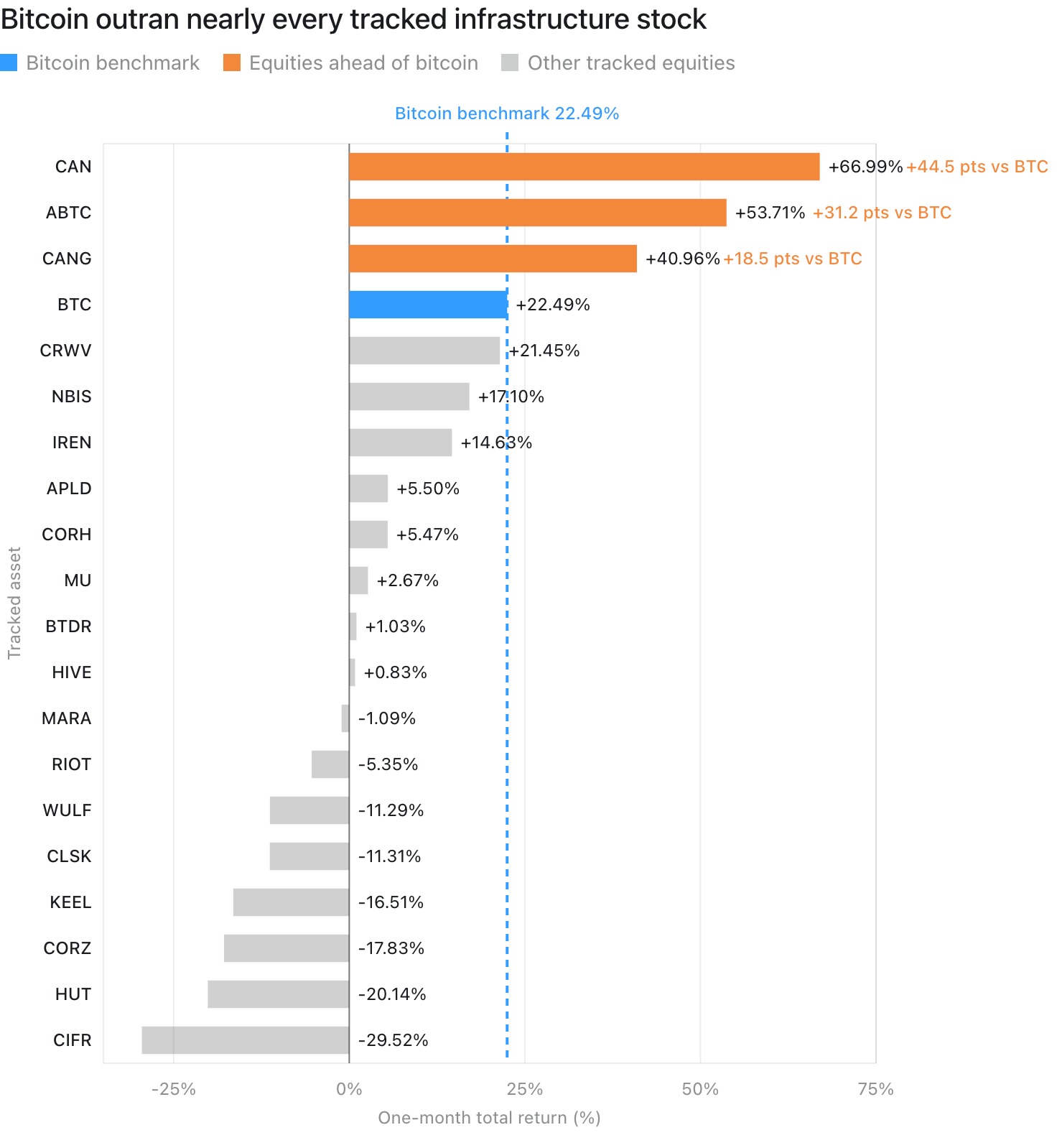
Bitcoin mining-focused stocks outperformed companies that pivoted toward AI and HPC. Source: Miner Weekly
Related: Strategy’s $66B Bitcoin machine hinges on capital markets, not BTC price: Report
BTC price still drives miners despite AI pivot
BlocksBridge’s findings echoed earlier Cointelegraph reporting that Bitcoin’s rally had lifted crypto-related stocks, including Bitcoin miners. The gains underscore how strongly Bitcoin’s price can still influence mining stocks, even as many miners have increasingly shifted their focus toward AI and HPC infrastructure in recent years.
Separate recent BlocksBridge analysis found that publicly traded Bitcoin miners have invested roughly $15 in AI data centers for every $1 in AI-related revenue generated. Nine public miners generated $341.2 million in AI and HPC revenue so far in 2026, compared with $5.11 billion in capital expenditures on the technology.
Related: Bitcoin breaks above 200-day moving average for first time since November

Aces starter NaLyssa Smith to miss remainder of season

Google AI Mode can now tell you when flights get cheaper and book your hotel

They’re Buying XRP & Bitcoin & Youre Missing The Big Picture This Is How You Enter The Wealthy Elite

Weekend Open Thread – Corporette.com

Weekend Open Thread: Brooks Brothers

London Mayor Sadiq Khan handed a peerage by Keir Starmer alongside 15 other Labour figures… just days before the PM leaves No10
They’re Buying XRP & Bitcoin & Youre Missing The Big Picture This Is How You Enter The Wealthy Elite

Euros vs hand press #satisfying #money #ASMR

Prices Keep Ripping Upward for Bitcoin Price Chart, XRP, and Altcoin Market as Confirmations Await
-

 Fashion6 days ago
Weekend Open Thread: Madewell – Corporette.com
-

 Crypto World2 days ago
SpaceX stock could rise 75% to $240, JPMorgan says
-

 Business6 days ago
Musk’s Tesla, SpaceX Confirm $16.8 Billion ‘Terafab’ Chip Plant as World’s Largest Building in Texas
-

 Crypto World6 days ago
anatomy of crypto’s biggest liquidation event since 2021
-

 Crypto World3 days ago
A $30 Billion AI Fund Implodes, Now the SEC Is Investigating Wall Street’s Role
-

 Politics6 days ago
6 months on, Irish renters crushed by effects of government housing bill
-

 Crypto World2 days ago
Did Trump Just Move SpaceX Stock With One Truth Social Post?
-

 Business5 days ago
Mystery AI Model ‘Ox Alpha’ Draws Developers With Free Access as Chinese Lab Origins Remain Debated
-
 NewsBeat6 days ago
The ‘Lucky Dip Gang’ causing carnage for clicks: After five thugs were killed speeding in the wrong direction on a motorway, GUY ADAMS investigates a sick new trend… and why police aren’t even allowed to pursue them
-
 Crypto World6 days ago
Nvidia Stock Suffers Longest Losing Streak Since 2022: Will Q2 Earnings End It?
-

 Business3 days ago
Moderna CEO warns China is pouring state money into mRNA technology
-

 Crypto World2 days ago
Warsh Jackson Hole keynote puts financial innovation first
-

 Business3 days ago
NVIDIA Stock Drops Nearly 2 Percent to $210 on Seventh Losing Day Ahead of Critical AI Earnings
-

 Tech6 days ago
Unitree’s New Superman Robot Claims to Outjump and Outrun Every Human, Usain Bolt Included
-

 Sports5 days ago
Deshaun Watson fires back at Browns fans after being booed: ‘It’s a disrespectful thing’
-
 Crypto World5 days ago
Google Gemini AI Predicts Ethereum Could Become the Trade Retail Misses in 2026
-

 Business7 days ago
UK firms in critical financial distress rise 9% to 53,756
-

 Tech6 days ago
Faster chip in a familiar form factor
-

 Business6 days ago
Will Tesla Stock Be Higher or Lower a Year From Now? Here’s What Wall Street Analysts Are Saying
-

 Business5 days ago
Tesla Recalls Nearly 3 Million Cars in China Over Hidden Door Handles Linked to Multiple Deaths Amid New Ban
You must be logged in to post a comment Login