
Crypto World
DeFi Protocols Launch Joint Escape Hatch for Aave ETH Lenders and Loopers



Fluid’s aWETH Redemption Protocol, launched with Lido, Ether.fi, 1inch, 0x and Kyber, has processed $136M out of Aave’s frozen WETH pool in 48 hours.
The same architectural openness that turned a forged cross-chain message at Kelp DAO’s bridge into hundreds of millions of bad debt at Aave has in 48 hours produced its own antidote: A coalition of DeFi protocols has launched an emergency exit route.
Fluid, a DeFi DEX and lending protocol, has joined with other DeFi protocols to build a way for ETH depositors and loopers on Aave to swap their positions out of WETH, either exiting the protocol altogether or switching to a different collateral type, at a time when direct withdrawals are unavailable after the $290 million Kelp DAO exploit.
The aWETH Redemption Protocol has processed 58,510 aWETH, or approximately $136 million, out of Aave’s frozen WETH pool in its first 48 hours, according to the live Dune dashboard Fluid is publishing.
The protocol was built in under 24 hours in response to Aave’s ETH utilization hitting 100% after the April 18 exploit of Kelp DAO’s rsETH bridge adapter.
How it works
The infrastructure allows Aave ETH lenders to swap aWETH into wstETH or weETH collateral in a single transaction, at a discount of roughly 2.21% for a 1,000 aWETH swap, per 1inch co-founder Sergej Kunz. Early exits via secondary markets had been clearing near 23% below par.
Two user scenarios are supported: For lenders, aWETH converts to wstETH and weETH collateral. Users can then withdraw their assets. For borrowers, collateral switches from ETH to wstETH or weETH collateral. Debt remains unchanged and users can exit a previously stuck position or remain on Aave with yield-bearing collateral.
Lenders hand aWETH into Fluid’s Lite ETH Vault in exchange for wstETH or weETH. The vault then uses the incoming aWETH to repay part of its own WETH debt at Aave, extinguishing a liability without requiring WETH to leave Aave’s pool. The netting works because Fluid is the single largest user of the Aave WETH market, carrying approximately $1.5 billion in ETH debt against its looped Lite Vault positions.
Because Fluid already owes the debt being retired, the protocol is not taking on new directional risk. It is exchanging one claim on LST collateral for another, with the exiting lender absorbing a modest haircut and the vault reducing its borrowed exposure in a market where supply is otherwise trapped.
Lido Finance, Ether.fi, 0x Protocol, 1inch, and KyberNetwork are leveraging the protocol. Lido and Ether.fi contribute LST liquidity, 1inch shipped the front-end, and 0x and Kyber are routing orders. Aave’s DAO-recommended withdrawal guidance now directs trapped WETH suppliers toward the Fluid route.
“ETH utilization on Aave hit 100% and lenders had no exit. Fluid built the infrastructure in hours — with significant capacity to support ETH lenders at scale,” Fluid Founder and CTO Samyak Jain said in an announcement.
Kelp DAO exploit context
On April 18, an attacker exploited Kelp DAO’s LayerZero-based rsETH bridge adapter and minted 116,500 rsETH, approximately $293 million, or 18% of circulating supply, without a corresponding amount locked on the Ethereum side. The attacker supplied the unbacked rsETH as collateral on Aave V3 and V4 and borrowed approximately $236 million in WETH before markets were frozen.
Aave’s WETH utilization reached 100% within hours as lenders attempted to withdraw ahead of the bad-debt recognition, breaking the lending invariant that allows passive withdrawals. Variable borrow rates spiked into triple digits and aWETH began trading at a discount on secondary markets.
Aave’s risk team, in its April 20 incident report, modeled bad debt at between $123.7 million and $230.1 million depending on how claims on the under-collateralized rsETH L2 adapter are allocated.
Kelp DAO and LayerZero have continued to dispute responsibility. Kelp’s April 19 statement argued that the 1-of-1 DVN configuration used on the bridge was LayerZero’s documented default in its quickstart guide and was re-confirmed as appropriate by the LayerZero team during Kelp’s L2 expansion. LayerZero has attributed the exploit to the North Korea-linked Lazarus Group’s TraderTraitor subgroup and said it will no longer allow new OFT deployments to ship with 1-of-1 DVN configurations.
The composability dimension
The architectural property that allowed the exploit to cascade across Aave, Compound, Fluid and other venues is what allowed the redemption protocol to be assembled in under a day. aWETH is a standardized receipt token, wstETH and weETH are standardized LSTs, Aave’s “repaywithAtokens” function is public and permissionless, and aggregators can source liquidity from any venue. The Fluid flow combines those primitives without a governance vote, a treasury drawdown, or a new counterparty relationship.
The protocol does not reduce Aave’s modeled bad debt, reverse the attacker’s borrowing, or affect the LayerZero-Kelp dispute. It provides an individual exit for lenders who would otherwise wait for a socialization outcome or accept a steeper market discount.
Fluid said capacity is significant and additional partners are being engaged.

Crypto World
Tom Lee Doubles Down on Crypto Winter Call as Bitmine Makes Biggest ETH Purchase of 2026
Bitmine Immersion Technologies (BMNR) acquired 101,627 Ethereum (ETH) tokens last week. This marked its largest weekly purchase of 2026.
The latest acquisition increased the company’s total ETH holdings to 4.976 million tokens. Its combined crypto and cash position reached $12.9 billion, according to the April 20 announcement.
Tom Lee Crypto Winter Call Comes Amid Bitmine’s Largest ETH Buy
The purchase was accompanied by a statement from Chairman Tom Lee arguing that the crypto downturn is closer to ending than most expect.
“While many believe the crypto winter may last through the Fall of 2026, our view remains that the crypto winter is much closer to ending,” he said.
Subscribe to our YouTube channel to watch leaders and journalists provide expert insights
Lee pegged his winter-ending call to historical market patterns. He explained that, since 2015, previous crypto bear markets have typically coincided with equity drawdowns of at least 20%.
The 2025 crypto decline aligned with a roughly 20% drop in the S&P 500. By contrast, the 2026 equity pullback has been relatively modest, at around 8%.
The divergence suggests the current crypto downturn lacks the macro backdrop that has historically sustained prolonged bear markets, implying a shorter duration and earlier recovery.
On-Chain and ETF Signals Align
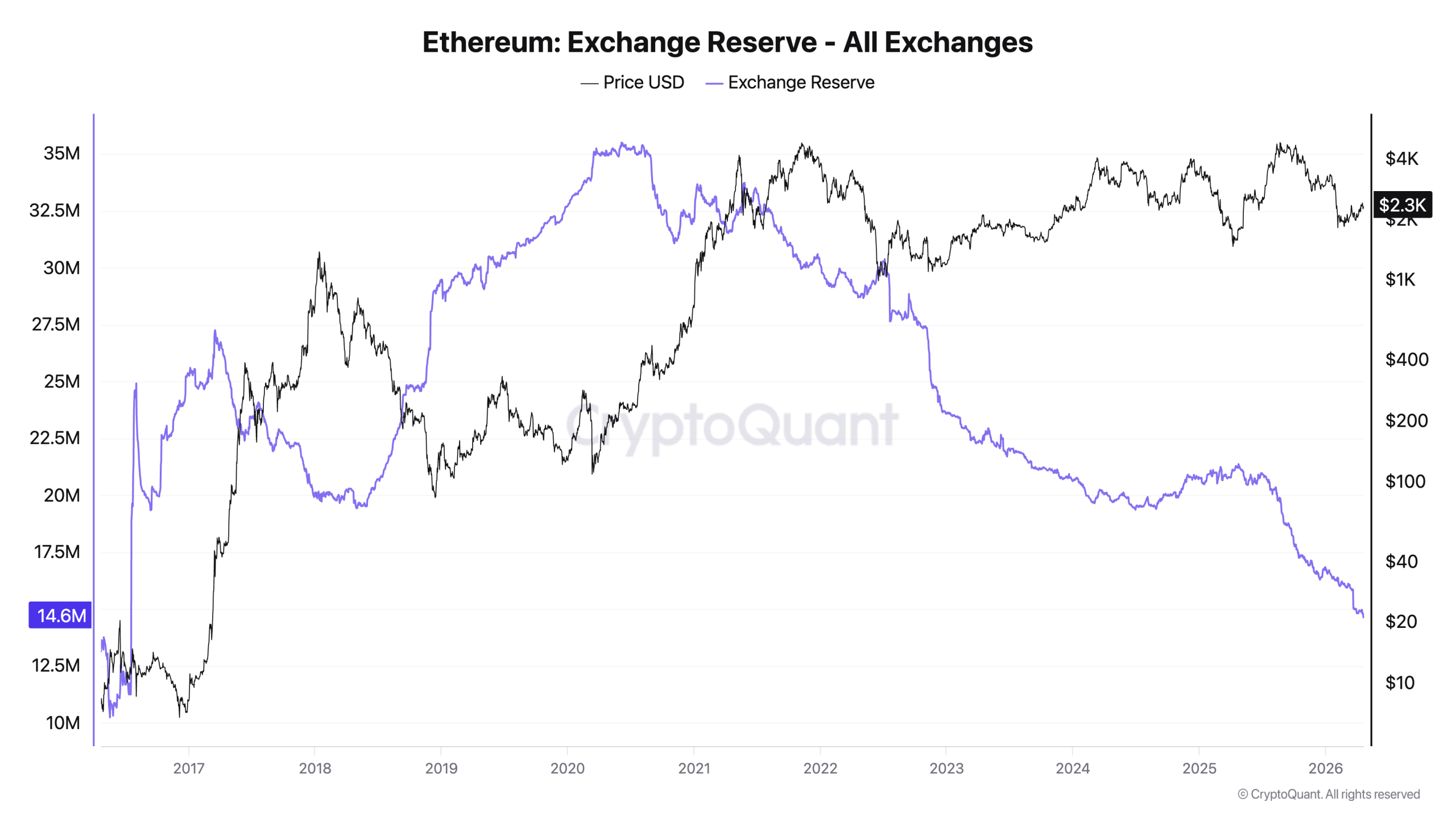
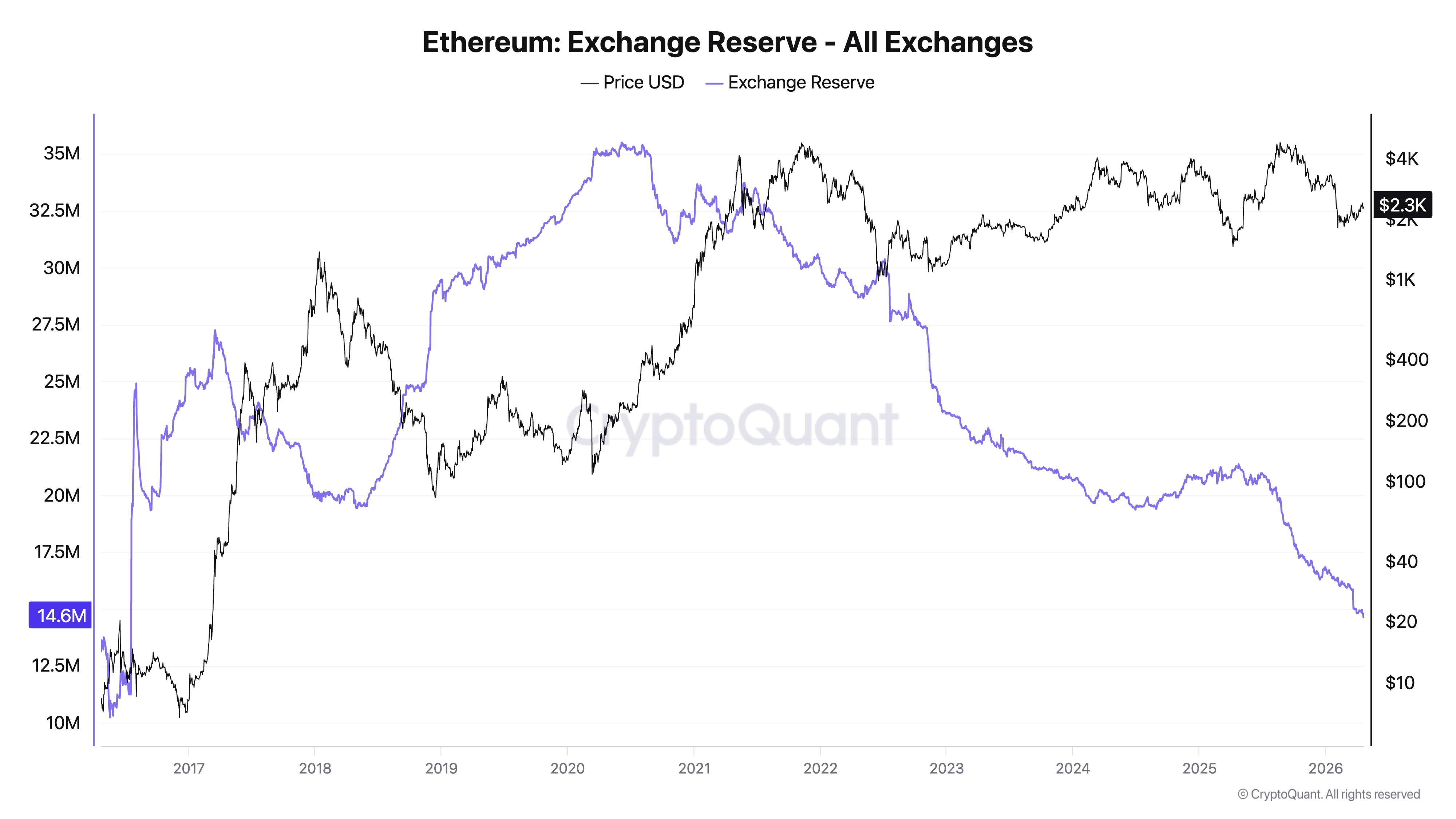
Meanwhile, on-chain signals and rebounding exchange-traded fund (ETF) flows also paint a bullish picture for Ethereum. Ethereum exchange reserves across all platforms fell to roughly 14.6 million ETH this week.
That marks the lowest level since 2016, per CryptoQuant. Falling exchange balances reduce sell-side liquidity available to traders.
Follow us on X to get the latest news as it happens
Spot Ethereum ETFs also posted their strongest weekly inflow since mid-January. The funds drew $275.83 million for the week ending April 17.
Adding to this view, one analyst highlighted that the count of Accumulating Addresses has edged past Stable Whales, 2,434 versus 2,410. This crossover suggests institutions are no longer sitting on the sidelines but are actively building positions.
“Whales do not just have capital ready; they are actively executing orders and moving assets to cold custody,” the post read.
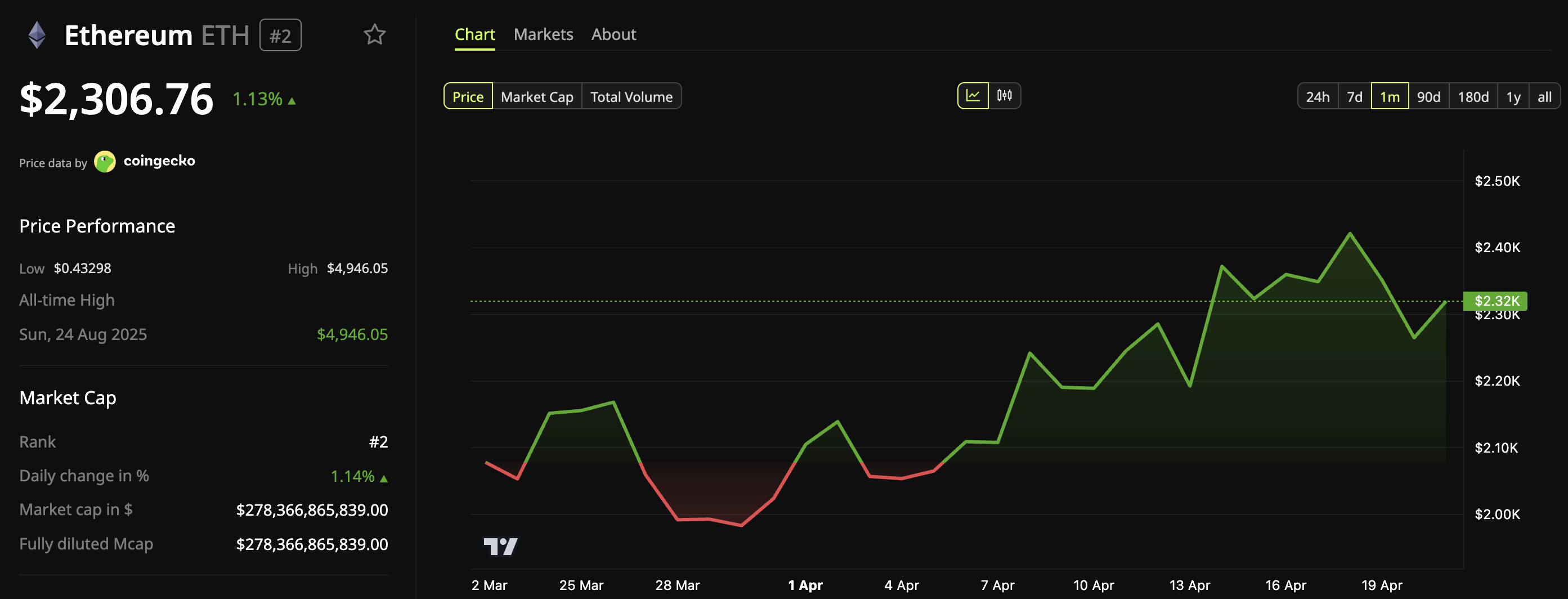
Despite these tailwinds, ETH still trades near $2,306, roughly 53% below its August 2025 all-time high.
Whether Bitmine’s pace and Lee’s framework hold up depends on sustained demand and broader market conditions.
The post Tom Lee Doubles Down on Crypto Winter Call as Bitmine Makes Biggest ETH Purchase of 2026 appeared first on BeInCrypto.
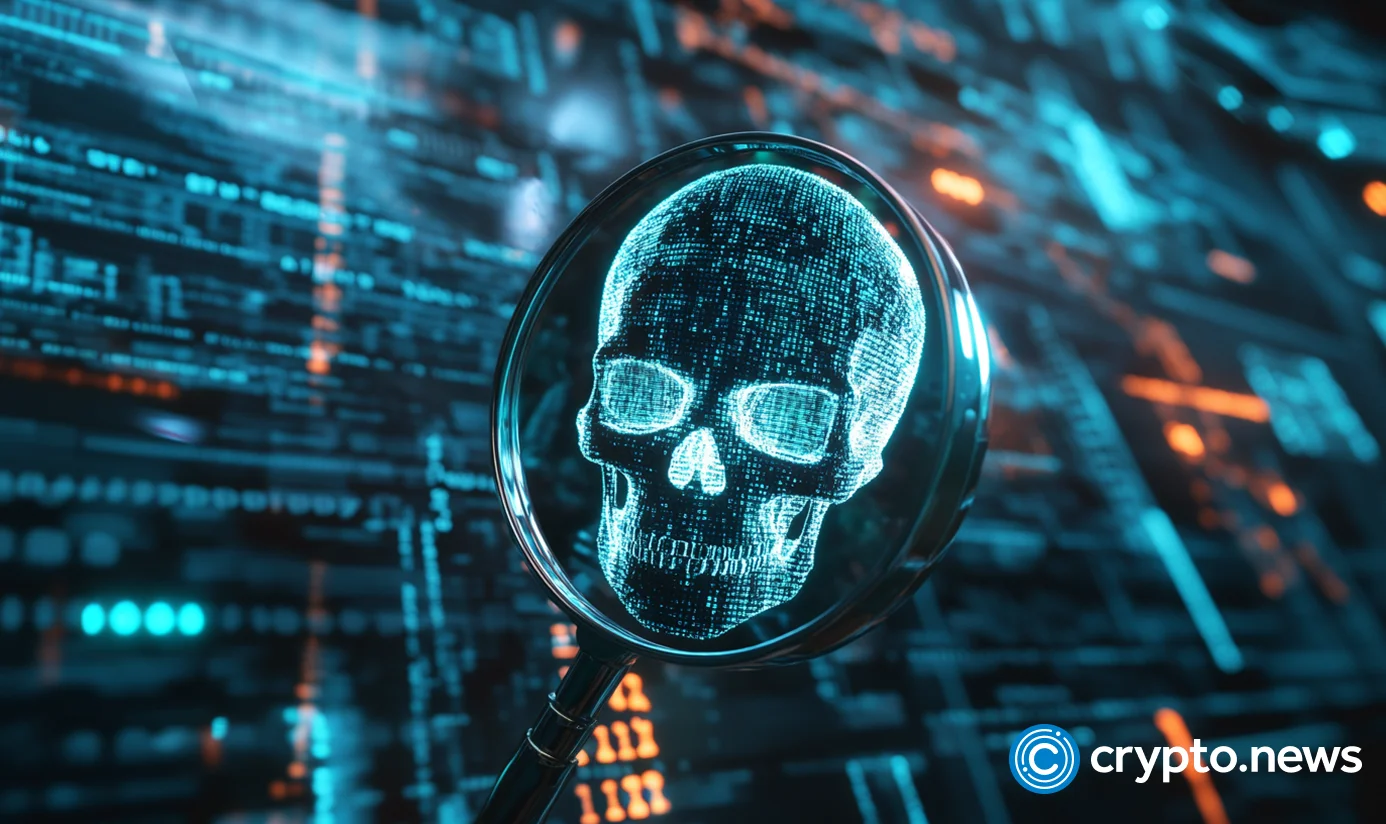
April has already seen over $600m stolen across DeFi, bridges and wallets, turning security from a protocol‑level concern into a full‑blown market risk premium.
Summary
- Crypto protocols have already lost more than $600m to hacks in April, led by $292m stolen from KelpDAO and $285m from Drift Protocol.
- Exploits now cut across smart contracts, infrastructure and social‑engineering attacks, including AI‑driven campaigns against wallets like Zerion.
- Between 11:00 and 13:00 UTC, mid‑cap DeFi names saw capitulation‑style selloffs as derivatives markets priced in a persistent “security risk premium.”
Fresh aggregate figures show that crypto protocols have already lost over $606m to hacks in the first 18 days of April, making it the worst month for exploits since February 2025 and pushing 2026’s year‑to‑date haul above $770m. According to data from DefiLlama at least 13 protocols have been compromised this month, with KelpDAO and Drift Protocol alone accounting for around 95% of April’s losses and roughly 75% of 2026’s total.
KelpDAO, an Ethereum liquid‑staking protocol, suffered an attack on April 18 that drained about 116,500 rsETH, valued at roughly $292m, after an attacker forged cross‑chain messages to trick a LayerZero EndpointV2 bridge contract into releasing reserves. Drift, Solana’s largest decentralized perpetuals exchange, was hit on April 1 in what regional media called a “sophisticated” exploit, losing about $285m in what is now the second‑largest security breach in Solana’s history after the $326m Wormhole hack in 2022.
The latest wave of hacks is not confined to smart‑contract bugs or restaking primitives. Incidents have hit routing and infrastructure layers such as Hyperbridge as well as front‑end and DevOps providers like Vercel, where attackers accessed internal systems and are allegedly shopping stolen data for $2m to fuel “global supply chain attacks.”
On the human side, wallet provider Zerion disclosed that it was targeted by North Korean hackers who used AI‑powered, long‑horizon social‑engineering campaigns to compromise hot‑wallet keys, stealing about $100,000 while leaving user funds and core infrastructure intact. The Security Alliance (SEAL) has identified at least 164 malicious domains tied to the DPRK‑linked group UNC1069, describing its playbook as defined by “patience, precision, and the deliberate weaponization of existing trust relationships.”
Industry data from earlier episodes, such as the $70m hot‑wallet exploit at Singapore‑based exchange Phemex in 2025, had already highlighted North Korea‑linked actors’ tendency to quickly convert stolen USDT and USDC into ETH to evade blacklists, a pattern authorities say continues in 2026.
Market structure reacted in real time as April’s hacks piled up. Between 11:00 and 13:00 UTC on key news days, order books in weaker mid‑cap DeFi names showed classic “capitulation” signatures: single‑session drawdowns of roughly 5–8%, thin bids and a visible rotation into protocols with cleaner security track records. Derivatives venues saw basket funding for DeFi tilt mildly negative while spot liquidity drained, the kind of configuration desks associate with a broad “security tax” on risk assets rather than isolated idiosyncratic shocks.
For traders, that has turned security into an explicit factor: fading leveraged DeFi beta on exploit headlines, staying long centralized venues and volatility‑monetizing infrastructure, and keeping dry powder for forced sellers once bad debt and write‑downs are fully recognized on‑chain.


Coinbase-backed artificial intelligence payments standard x402 has launched a marketplace for apps and services to boost the usefulness of AI agents.
Coinbase product lead Nick Prince said in a video posted on X on Monday that the idea behind the platform, called Agentic.market, was to “give humans and their agents access to thousands of services, with zero API keys required.”
Prince, in a separate post, said the market was a “storefront for discovering, comparing, and using x402 services” and offers access to a wide variety of apps and websites that AI agents can use, such as CoinGecko, Google Flights and the social media site X.
He added that hundreds of thousands of AI agents have transacted hundreds of millions in volume, but AI agent users have “relied on fragmented sources and word-of-mouth” to find compatible services.
The x402 protocol, launched by Coinbase in May 2025, allows AI agents to make internet payments using stablecoins and has seen growing support as many companies believe AI technology will become more involved in commerce.
Introducing Agentic(dot)Market, the homepage of the agent economy.
– Monitor agentic commerce trends
– Discover services for your agent to buy
– Sell your services to agentsThousands of services. Zero API keys. Powered by x402. https://t.co/dgrNV73MAJ pic.twitter.com/0QU9Bpb3kG
— nick.base.eth 🛡 (@Nick_Prince12) April 20, 2026
Prince said the marketplace has a web interface “for humans to browse and evaluate services” and a programming layer that allows AI agents access to the platform to “search, filter, and integrate new capabilities autonomously at runtime without a human in the loop.”
The platform provides an AI agent with “skills,” or code on how to use a service, along with a wallet that gives it the ability to “buy services and also sell services,” Prince added.
Related: Coinbase is testing AI agents that show up on Slack and email
The x402 protocol, named after the rarely used HTTP status code “402 Payment Required,” received support earlier this month from Google, Microsoft and Amazon Web Services, which backed the creation of the x402 Foundation to govern the protocol.
American Express, Mastercard, Visa, Cloudflare, Shopify, Stripe, Circle, Base, Polygon Labs, the Solana Foundation, Thirdweb and KakaoPay also expressed their “initial intent and support” of the foundation.
Coinbase CEO Brian Armstrong said at the time that “there will be more AI agents transacting online than humans very soon,” echoing Circle CEO Jeremy Allaire, who in January said that “literally billions of AI agents” will be transacting on blockchains in three to five years.
Magazine: AI agents will kill the web as we know it: Animoca’s Yat Siu

Die Welt der Kryptowährungen und Online-Casinos ist in Deutschland immer populärer. Viele Menschen suchen nach Möglichkeiten, um ihre Freizeit zu verbringen und vielleicht sogar Geld zu verdienen. Kryptokasinos bieten eine solche Möglichkeit, indem sie Spielautomaten, Tischspiele und andere Glücksspiele anbieten, die mit Kryptowährungen wie Bitcoin oder Ethereum gespielt werden können.
Die Auswahl an Kryptokasinos ist jedoch enorm und es kann schwierig sein, die richtigen zu finden. Deshalb haben wir uns die Aufgabe gestellt, die besten Kryptokasinos in Deutschland zu bewerten und Ihnen eine Auswahl der besten Angebote zu präsentieren. Wir haben uns auf die Suche gemacht nach Kryptokasinos mit Bonus, die anonym sind und die beste Auswahl an Spielen anbieten.
Wir haben uns auf die Suche gemacht nach Kryptokasinos, die in Deutschland lizenziert sind und eine gute Reputation haben. Wir haben auch die verschiedenen Angebote sorgfältig geprüft und bewertet, um sicherzustellen, dass Sie die beste Erfahrung haben. In diesem Artikel werden wir Ihnen die besten Kryptokasinos in Deutschland vorstellen und Ihnen zeigen, warum sie unsere Empfehlung sind.
Die Kryptokasinos, die wir empfehlen, bieten eine Vielzahl an Vorteilen, darunter die Möglichkeit, mit Kryptowährungen zu spielen, eine Vielzahl an Spielen und Tischspiele, eine gute Auswahl an Bonusangeboten und eine sichere und zuverlässige Plattform. Wir sind sicher, dass Sie die richtige Wahl treffen werden, wenn Sie unsere Empfehlungen befolgen.
Wir hoffen, dass Sie unseren Artikel finden, der Ihnen helfen wird, die richtigen Kryptokasinos in Deutschland zu finden. Wir sind sicher, dass Sie eine großartige Zeit haben werden, wenn Sie unsere Empfehlungen befolgen.
Die besten Kryptokasinos in Deutschland:
• [Name des Kryptokasinos 1]
• [Name des Kryptokasinos 2]
• [Name des Kryptokasinos 3]
Wir empfehlen Ihnen, unsere Empfehlungen sorgfältig zu prüfen und diejenigen zu wählen, die am besten zu Ihren Bedürfnissen passen.
Die besten Krypto-Casinos für deutsche Spieler
Wenn Sie sich für das Spielen in einem Krypto-Casino entschieden haben, gibt es einige wichtige Faktoren zu berücksichtigen. Einige der besten Krypto-Casinos für deutsche Spieler bieten eine Vielzahl an Spielen, eine sichere und zuverlässige Plattform und attraktive Bonusangebote. Hier sind einige der besten Krypto-Casinos für deutsche Spieler:
Die Top 5 Krypto-Casinos für deutsche Spieler
- BitStarz: BitStarz ist eines der bekanntesten und beliebtesten Krypto-Casinos für deutsche Spieler. Es bietet eine Vielzahl an Spielen, darunter auch einige der beliebtesten Slots und Tischspiele. BitStarz bietet auch einen attraktiven Willkommensbonus von 5 BTC.
- Cloudbet: Cloudbet ist ein weiteres beliebtes Krypto-Casino für deutsche Spieler. Es bietet eine Vielzahl an Spielen und einen attraktiven Bonus von 5 BTC für neue Spieler.
- 1xBit: 1xBit ist ein weiteres Krypto-Casino, das sich an deutsche Spieler richtet. Es bietet eine Vielzahl an Spielen und einen attraktiven Bonus von 1 BTC für neue Spieler.
- Binance Casino: Binance Casino ist ein Krypto-Casino, das sich an deutsche Spieler richtet. Es bietet eine Vielzahl an Spielen und einen attraktiven Bonus von 1000 EUR für neue Spieler.
- Stake: Stake ist ein weiteres Krypto-Casino, das sich an deutsche Spieler richtet. Es bietet eine Vielzahl an Spielen und einen attraktiven Bonus von 1000 EUR für neue Spieler.
Es gibt jedoch auch einige anonyme Krypto-Casinos, die sich an deutsche Spieler richtet. Diese Casinos bieten oft eine Vielzahl an Spielen und attraktive Bonusangebote. Einige der besten anonymen Krypto-Casinos für deutsche Spieler sind:
- Bitcoin Casino: Bitcoin Casino ist ein anonymes Krypto-Casino, das sich an deutsche Spieler richtet. Es bietet eine Vielzahl an Spielen und einen attraktiven Bonus von 1000 EUR für neue Spieler.
- Bitcoin Games: Bitcoin Games ist ein weiteres anonymes Krypto-Casino, das sich an deutsche Spieler richtet. Es bietet eine Vielzahl an Spielen und einen attraktiven Bonus von 1000 EUR für neue Spieler.
- Bitcoin Casino Club: Bitcoin Casino Club ist ein weiteres anonymes Krypto-Casino, das sich an deutsche Spieler richtet. Es bietet eine Vielzahl an Spielen und einen attraktiven Bonus von 1000 EUR für neue Spieler.
Es ist jedoch wichtig zu beachten, dass anonyme Krypto-Casinos oft keine Lizenz haben und deshalb nicht so sicher wie reguläre Krypto-Casinos sind. Es ist deshalb wichtig, sich vor dem Spielen in einem Krypto-Casino zu informieren und sicherzustellen, dass es eine gute Ruf und eine sichere Plattform bietet.
Die besten Krypto-Casinos für deutsche Spieler bieten oft eine Vielzahl an Spielen, attraktive Bonusangebote und eine sichere und zuverlässige Plattform. Es ist wichtig, sich vor dem Spielen in einem Krypto-Casino zu informieren und sicherzustellen, dass es eine gute Ruf und eine sichere Plattform bietet.
Krypto-Casino-Bewertungen: Was Sie beachten sollten
Wenn Sie sich für ein Krypto-Casino entscheiden, sollten Sie einige wichtige Aspekte beachten, um sicherzustellen, dass Sie sich bei einem seriösen und zuverlässigen Anbieter befinden.
Ein wichtiger Faktor ist die Lizenzierung. Ein seriöses Krypto-Casino sollte eine gültige Lizenz von einer anerkannten Regulierungsbehörde besitzen. In Deutschland ist dies beispielsweise die Malta Gaming Authority oder die Schleswig-Holsteinische Lotterie- und Glücksspielordnung.
Ein weiterer wichtiger Punkt ist die Sicherheit. Ein seriöses Krypto-Casino sollte ein sicheres und zuverlässiges Zahlungssystem haben, um sicherzustellen, dass Ihre Transaktionen sicher und reibungslos ablaufen. Es sollte auch ein robustes Sicherheitskonzept haben, um Ihre persönlichen Daten und Ihre Spielaktivitäten zu schützen.
Ein weiterer wichtiger Faktor ist die Auswahl der Spiele. Ein seriöses Krypto-Casino sollte eine breite Palette an Spielen anbieten, darunter auch klassische Casino-Spiele wie Roulette, Blackjack und Poker, aber auch innovative Spiele wie Bitcoin-Slots und Video-Poker.
Beste Krypto Casinos
Einige der besten Krypto Casinos sind:
BitStarz: Ein bekanntes und seriöses Krypto-Casino, das eine breite Palette an Spielen anbietet und eine hohe Sicherheit bietet.
BitcoinCasino: Ein weiteres seriöses Krypto-Casino, das eine breite Palette an Spielen anbietet und eine hohe Sicherheit bietet.
1xBit: Ein weiteres seriöses Krypto-Casino, das eine breite Palette an Spielen anbietet und eine hohe Sicherheit bietet.
Es gibt auch anonyme Krypto Casinos, die anonyme Spiele anbieten, aber es ist wichtig zu beachten, dass diese Casinos oft nicht lizenziert sind und deshalb nicht so sicher sind wie lizenzierte Casinos.
Wenn Sie sich für ein Krypto-Casino entscheiden, sollten Sie sich auch um die Bonusangebote kümmern. Einige Krypto Casinos bieten attraktive Bonusangebote an, wie zum Beispiel Willkommensbonus oder Freispiele, um neue Spieler zu gewinnen.
Es gibt auch Krypto Casinos, die speziell für die deutsche Marktkunden konzipiert sind, wie zum Beispiel Online Krypto Casino Deutschland, das eine breite Palette an Spielen anbietet und eine hohe Sicherheit bietet.
Insgesamt sollten Sie sich bei der Auswahl eines Krypto-Casinos um die oben genannten Aspekte kümmern, um sicherzustellen, dass Sie sich bei einem seriösen und zuverlässigen Anbieter befinden.
Die Vorteile von Krypto-Casinos für deutsche Spieler
Die Einführung von Krypto-Casinos in Deutschland hat zu einer Vielzahl von Vorteilen für deutsche Spieler geführt. Einige der wichtigsten Vorteile sind die Möglichkeit, anonym zu spielen, die Verfügbarkeit von verschiedenen Zahlungsmethoden und die Möglichkeit, auf eine breite Palette an Spielen zugreifen zu können.
Ein weiterer wichtiger Vorteil ist die Möglichkeit, auf eine breite Palette an Spielen zugreifen zu können. Krypto-Casinos bieten oft eine Vielzahl an verschiedenen Spielen, darunter auch einige, die in traditionellen Casinos nicht erhältlich sind. Dies bietet deutschen Spielern die Möglichkeit, neue Spiele zu entdecken und sich auf ihre Vorlieben einzustellen.
Beste Krypto-Casinos in Deutschland
Die Auswahl des besten Krypto-Casinos in Deutschland kann schwierig sein, da es viele gute Optionen gibt. Einige der besten Krypto-Casinos in Deutschland sind Binance Casino, BitStarz und 1xBit. Diese Casinos bieten eine Vielzahl an Spielen, eine sichere und zuverlässige Zahlungsmethode und eine breite Palette an Zahlungsmethoden an.
Ein weiterer wichtiger Faktor ist die Sicherheit. Krypto-Casinos müssen sicherstellen, dass die Daten ihrer Spieler sicher sind und dass die Transaktionen sicher und zuverlässig sind. Dies kann durch die Verwendung von SSL-Verschlüsselung und andere Sicherheitsmaßnahmen erreicht werden.
Es ist wichtig, dass deutsche Spieler sich vor dem Spiel informieren und recherchieren, um sicherzustellen, dass sie sich an einem vertrauenswürdigen Krypto-Casino beteiligen.
Insgesamt bieten Krypto-Casinos in Deutschland viele Vorteile für deutsche Spieler. Von der Möglichkeit, anonym zu spielen, über die Verfügbarkeit von verschiedenen Zahlungsmethoden bis hin zur Möglichkeit, auf eine breite Palette an Spielen zugreifen zu können, gibt es viele Gründe, warum deutsche Spieler Krypto-Casinos in Deutschland ausprobieren sollten.
Krypto-Casino-Bewertungen: Eine Auswahl der besten Anbieter
Wenn Sie sich für ein Online-Krypto-Casino entscheiden, ist es wichtig, dass Sie sich für den richtigen Anbieter entscheiden. In Deutschland gibt es viele Anbieter, die Ihnen die Möglichkeit bieten, Ihre Kryptowährungen zu setzen und zu gewinnen. Aber wie wählen Sie den richtigen Anbieter aus? In diesem Artikel werden wir Ihnen einige der besten Krypto-Casinos in Deutschland vorstellen.
Die besten Krypto-Casinos mit Bonus
Einige der besten Krypto-Casinos in Deutschland bieten Ihnen einen Bonus an, wenn Sie sich registrieren und Ihre erste Einzahlung tätigen. Einige der besten Anbieter sind:
Binance Casino: Binance ist eines der größten und bekanntesten Krypto-Casinos in Deutschland. Sie bieten Ihnen eine Vielzahl an Spielen, darunter auch einige der beliebtesten Kryptowährungen wie Bitcoin und Ethereum.
BitStarz: BitStarz ist ein weiteres ssangyong-presse.de beliebtes Krypto-Casino in Deutschland. Sie bieten Ihnen eine Vielzahl an Spielen und auch einige der besten Bonusangebote in der Branche.
Anonyme Krypto-Casinos
Wenn Sie sich für ein anonymes Krypto-Casino entscheiden, müssen Sie sich sicherstellen, dass Sie sich für einen Anbieter entscheiden, der Ihre Privatsphäre schützt. Einige der besten anonymen Krypto-Casinos in Deutschland sind:
Cloudbet: Cloudbet ist ein anonymes Krypto-Casino, das Ihnen die Möglichkeit bietet, Ihre Kryptowährungen zu setzen und zu gewinnen, ohne dass Ihre Privatsphäre gefährdet wird.
PrimeDice: PrimeDice ist ein weiteres anonymes Krypto-Casino, das Ihnen die Möglichkeit bietet, Ihre Kryptowährungen zu setzen und zu gewinnen, ohne dass Ihre Privatsphäre gefährdet wird.
Wenn Sie sich für ein Online-Krypto-Casino in Deutschland entscheiden, ist es wichtig, dass Sie sich für den richtigen Anbieter entscheiden. In diesem Artikel haben wir Ihnen einige der besten Krypto-Casinos in Deutschland vorgestellt, darunter auch einige der besten Anbieter mit Bonus und anonyme Krypto-Casinos. Wir hoffen, dass Sie bei Ihrer Entscheidung helfen können.


2026’s altcoin rotation is skipping meme narratives and flowing into XRP, BNB, Solana, TRON and Hyperliquid, as traders pay for throughput and real volume.
Summary
- Capital in early 2026 is rotating into payment tokens, exchange ecosystems, high‑throughput L1s and derivatives infrastructure, not long‑tail narrative coins.
- XRP, BNB, Solana and TRON continue to command deep liquidity, while derivatives venue Hyperliquid has pushed its HYPE token into the large‑cap ranks.
- Between 11:00 and 13:00 UTC, majors showed tighter spreads and shallower drawdowns than mid‑cap DeFi names, as traders paid a premium for volume and utility.
Altcoin flows in 2026 are starting to look less like a classic “altseason blow‑off” and more like a cold‑eyed rotation toward tokens that do real transactional work. Across derivatives desks and spot venues, liquidity is clustering around payment rails, centralized‑exchange ecosystems, high‑throughput base layers and perpetuals platforms, while complex DeFi experiments and bridge‑dependent tokens lag on both volume and depth.
Recent market structure data illustrates the split. Reports tracking intraday microstructure say that between 11:00 and 13:00 UTC, majors like Solana traded with “deeper spot books and narrower spreads” than mid‑cap DeFi names, and DEX volume remained disproportionately concentrated on Solana‑based venues even as the broader market leaned risk‑off. In the same window, liquidity in exchange tokens and derivatives‑linked assets such as BNB and Hyperliquid’s HYPE held up better on a relative basis, with lower slippage for size and smaller intraday drawdowns than DeFi L2s and LST/LRT plays exposed to bridge risk.
Commentary from market structure analysts frames the shift bluntly: “pay me for throughput and volume, not for clever staking abstractions.” That mantra is showing up in rankings as Hyperliquid’s HYPE token climbs into the large‑cap bracket, with one report noting that HYPE has “secured the 13th position among all cryptocurrencies by market capitalization” at a valuation of roughly $10 billion, trading around $41 with modest, well‑behaved daily swings.
At the same time, a crypto.news rundown of “4 top cryptos to buy” in the current bull phase highlighted Solana, Ethereum and BNB alongside newer infrastructure names, emphasizing that these networks combine high throughput with deep derivatives and spot markets. As of that report, Solana was trading around $146.81 with a market value above $81 billion, while BNB changed hands near $620.61 and XRP hovered around $1.42, underlining how much capital remains parked in established utility chains over experimental primitives.
For traders operating in the 11:00–13:00 UTC band, the logic has been straightforward: if they must be long, they prefer high‑utility L1s and CEX or derivatives tokens that monetize volume and volatility, while using complex DeFi and bridge‑dependent tokens as short collateral or avoiding them entirely. In a rotation regime shaped by security blow‑ups and macro uncertainty, altcoin exposure is increasingly being rationed to assets that clear one hard test—do they actually move size every day.
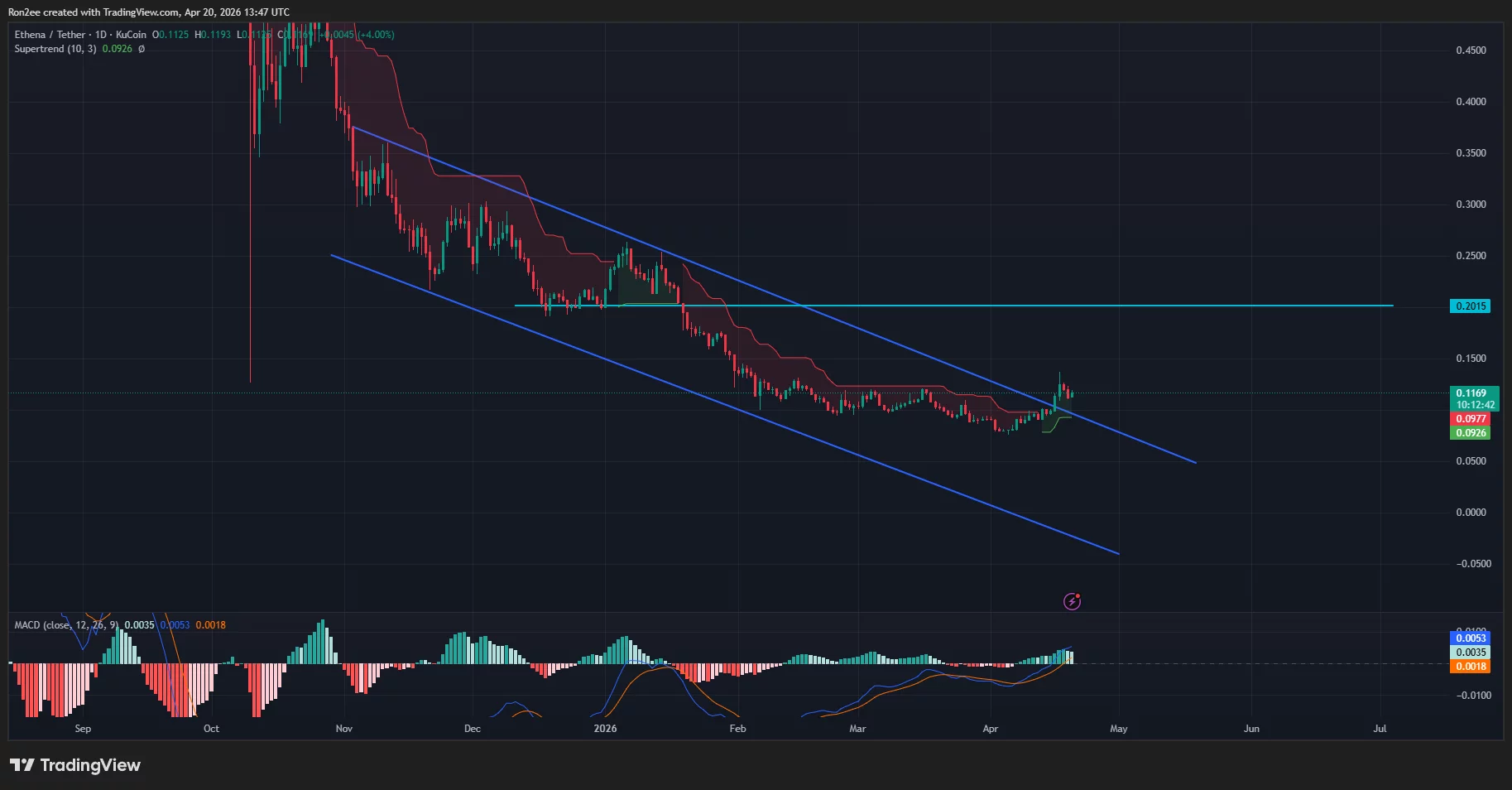
Ethena price soared over 45% in the past week to $0.134 on Saturday before paring off some of its gains amid a broader market drop.
Summary
- Ethena price climbed over 45% in the past week, reaching a 10-week high of $0.134 before pulling back to around $0.116 amid broader market weakness.
- Optimism is driven by a proposal to back USDe with tokenized gold, growing institutional adoption, and continued whale accumulation.
- A breakout from a long-term descending channel and bullish technical signals suggest potential upside toward the $0.20 level.
According to data from crypto.news, Ethena (ENA) price rallied to a 10-week high of $0.134 on Saturday before settling at $0.116 at the time of writing. The token’s market cap stood at $1.02 billion with a daily trading volume of $126 million.
Despite the recent pullback in Ethena price, it remains well-positioned for a potential rebound in the upcoming sessions, owing to three specific catalysts that have sparked fresh optimism among traders.
First, Ethena has recently introduced a proposal to back Ethena’s synthetic dollar, USDe, with tokenized gold assets like PAXG and XAUT. By diversifying its collateral reserve into gold-backed assets, the protocol would reduce reliance on crypto perpetual futures while improving the stability of yields generated by the reserve during market downturns.
The development turned USDe into a more diverse, real-world asset-linked product rather than a purely crypto native one and hence could attract investors looking for more resilient DeFi infrastructure to bet on.
Second, the token could gain from the increased institutional recognition it has received lately. On April 17, Singapore Gulf Bank announced the integration of USDe into its institutional settlement platform, offering fee-free stablecoin services on Solana.
At the same time, a potential partnership with Anchorage Digital and discussions around a “fee switch” to share protocol revenue with ENA stakers have also bolstered the long-term bullish narrative for the ecosystem.
Third, whales have been accumulating the token for the past month. Data from Lookonchain and Nansen showed that the top 100 ENA holders have reported increasing their ENA stashes by nearly 5% within the period. This accumulation suggests that large-scale investors are betting on a recovery despite the current market turbulence.
On the daily chart, Ethena price has been trading within a descending parallel channel since early November last year. It has recently broken out of the channel, which often signals a bullish reversal for the asset at play. This breakout suggests that the long-term downtrend may finally be coming to an end.
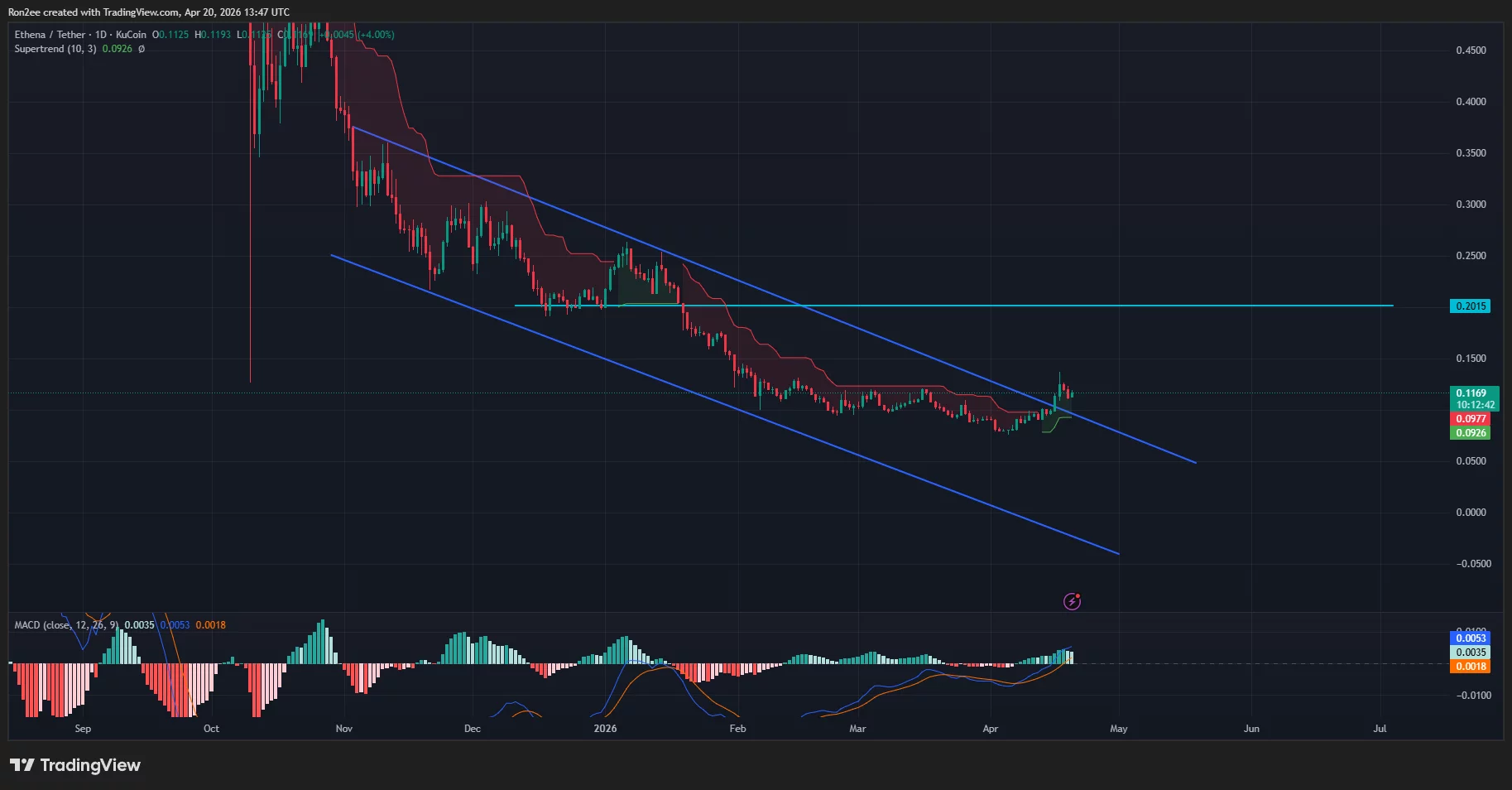
Technical indicators also seem to support this view. Notably, the SuperTrend indicator has flashed green for the first time since January, a sign that the market bias has shifted from bearish to bullish. Meanwhile, the MACD lines have pointed upwards and are trending toward the signal line, indicating growing buying pressure.
Hence, the path of least resistance for the token remains above, potentially leading to a reclamation of the December support at $0.20 as bulls regain control of the price action.
Disclosure: This article does not represent investment advice. The content and materials featured on this page are for educational purposes only.


Disclosure: This article does not represent investment advice. The content and materials featured on this page are for educational purposes only.
Passive income strategies in crypto shift from cloud mining to AI trading automation in 2026.
Summary
- Crypto passive income is shifting from cloud mining toward AI trading bots that automate market analysis and execution.
- Cloud mining limits like fixed contracts and price dependency are pushing investors toward more flexible AI trading systems.
- AriseAlpha ranks as a top beginner AI trading platform, offering fully automated, hands-free trading with built-in risk controls.
The way investors generate passive income in the crypto market is undergoing a noticeable shift.
In the past, cloud mining was one of the most accessible entry points. By purchasing hash power contracts, users could participate in mining cryptocurrencies like Bitcoin without managing hardware or technical infrastructure.
However, as the market has matured, several limitations of this model have become more apparent:
- Returns are highly dependent on crypto price fluctuations
- Fixed contract terms reduce flexibility
- Profit structures are often difficult to evaluate
As a result, many investors are now looking for more adaptable alternatives.
By 2026, AI crypto trading bots have emerged as a leading solution. Unlike mining, which relies on computational power, these systems analyze market data and automatically execute trading strategies — allowing users to engage with the market in a more dynamic way.
For beginners, this lowers the barrier to entry. For more experienced users, it improves execution efficiency. While automated trading reduces the need for constant monitoring, it still enables ongoing market participation.
This shift is why more users are exploring AI trading as a flexible approach to automated investing.
The following are 7 AI trading platforms worth considering in 2026, suitable for users at different experience levels.
For those who are starting from scratch, AriseAlpha is one of the easiest and most efficient platforms to begin with.
What makes it stand out is its fully automated approach. There’s no need to analyze charts or place trades manually — the system uses AI to handle everything.
Rating: 9.6 / 10
Key Features:
- Fully automated AI trading
- Real-time market analysis and execution
- No trading experience required
- 24/7 continuous operation
- Built-in risk management
Best For:
Beginners, passive income investors, and anyone looking for a hands-free trading experience
How to Get Started with AriseAlpha
Start in just a few simple steps:
1. Sign up (new users can receive a $12 real trading reward)
2. Deposit funds
3. Choose an AI-powered trading strategy
4. Activate the system and let it run automatically
Once activated, the AI system analyzes market data and executes trades on a user’s behalf. Users can monitor their performance anytime via mobile or desktop.
NiceHash allows users to buy and sell mining power, offering a flexible way to participate in Bitcoin mining.
Rating: 9.0 / 10
Highlights:
- No hardware required
- Flexible mining options
- Marketplace for hash power
Best for users exploring mining without upfront setup
Bitdeer provides structured mining plans with access to large-scale mining infrastructure.
Rating: 8.8 / 10
Best for long-term mining participation
3Commas offers a wide range of automated trading strategies and tools.
Rating: 8.7 / 10
Best for intermediate users who want more control
Cryptohopper supports automated trading and strategy customization.
Rating: 8.6 / 10
StormGain provides a simple way to try crypto mining with minimal effort.
Rating: 8.5 / 10
Pionex offers integrated bots for automated trading with an easy-to-use interface.
Rating: 8.5 / 10
1. Are AI trading bots suitable for beginners?
Yes. Some platforms, such as AriseAlpha, are designed specifically for beginners and support automated trading without complex setup.
2. Can AI trading bots really generate passive income?
They can help automate trading and reduce manual effort, but results depend on market conditions and are not guaranteed.
3. Which is better: AI trading or cloud mining?
They operate differently. Cloud mining relies on computational power, while AI trading relies on market analysis. AI trading is generally more flexible, but both involve risk.
4. Are free AI trading bots truly free?
Not entirely. Most platforms offer free trials, demo accounts, or limited-feature versions rather than fully free unlimited trading.
5. How much money do I need to start using AI trading bots?
Many platforms allow users to start with a small amount of capital, making them accessible for beginners.
6. Do AI trading bots require constant monitoring?
No frequent monitoring is required, but it is recommended to check performance periodically.
7. Are AI trading bots safe to use?
They can be safe when using reputable platforms, but proper risk management and capital control are still essential.
8. Can AI trading bots guarantee profits?
No. AI can improve execution efficiency, but it cannot predict the market or eliminate risk.
The shift from cloud mining to AI trading bots reflects a broader evolution in how people approach investing.
Compared to traditional models that rely on computational power, AI trading offers a more flexible and adaptive path to automated investing.
For most users, the key is not choosing the platform with the most features, but choosing one that:
can be easily started and consistently used over time
In this regard, automated platforms like AriseAlpha are increasingly becoming a practical starting point for beginners.
Disclosure: This content is provided by a third party. Neither crypto.news nor the author of this article endorses any product mentioned on this page. Users should conduct their own research before taking any action related to the company.

U.S. CLARITY Act faces a May delay as banks fight stablecoin yields, clashing with a White House report that says the lending impact is just 0.02%.
Summary
- U.S. CLARITY Act’s April committee review hangs in the balance as Senate Banking juggles Fed chair hearings and crypto legislation.
- Banking groups lobby hard against stablecoin yield, clashing with a White House report that pegs lending impact at just 0.02%.
- White House crypto adviser Patrick Witt publicly calls banks “greedy or ignorant” as pressure mounts to stop stalling the bill.
The U.S. CLARITY Act, a landmark effort to define stablecoin and broader crypto market structure, is at risk of being pushed from an expected April review into May as bank lobbying around stablecoin yield provisions intensifies on Capitol Hill.
According to newsletter outlet Crypto In America, the Senate Banking Committee has until Friday to decide whether to notice the bill for markup the week of April 27, but the calendar is already crowded by the confirmation hearing for Federal Reserve chair nominee Kevin Warsh.
In parallel, the North Carolina Bankers Association and other industry groups are urging members to call Senator Thom Tillis’s office and demand changes to the CLARITY Act’s proposed restrictions on yield-bearing stablecoins, reopening a compromise deal hammered out with crypto firms just weeks ago.
Banking trade bodies, including the American Bankers Association, have warned that allowing stablecoin rewards could drain up to $6.6 trillion in deposits from the banking system, arguing that yield-paying tokens would accelerate an exodus from traditional accounts.
That position sits uneasily with a recent report from the White House Council of Economic Advisers, which concluded that banning stablecoin yields would boost bank lending by only $2.1 billion, or roughly 0.02% of a $12 trillion loan book, while imposing a net welfare cost of about $800 million on consumers.
The CEA paper argued that a “yield prohibition would do very little to protect bank lending, while forgoing the consumer benefits of competitive returns on stablecoin holdings,” giving crypto and fintech advocates fresh ammunition against a blanket ban.
White House Crypto Council executive director Patrick Witt has taken that fight public, writing on X that banks are “further lobbying out of greed or ignorance” and urging lawmakers not to let the bill be “held hostage” by yield fears that the administration’s own data plays down.
Senator Tillis, a Republican from North Carolina and a key negotiator on the stablecoin language, has floated holding an in-person “crypto carnival” session with industry participants, a move he admits could extend the timeline but which he says is needed because “there are still issues to negotiate.”
Beyond yield, the CLARITY Act still has to navigate contentious provisions around DeFi, conflicts of interest and ethical rules for lawmakers trading tokens, and even if it clears the Senate Banking Committee in late April or May it must still be reconciled with a House version before landing on President Trump’s desk.
As highlighted in an earlier crypto.news story on how 2025 would make tokenized real-world assets mainstream, the fight over stablecoin yields is increasingly seen as a proxy for who captures trillions in future onchain savings flows, with banks, issuers and DeFi platforms all jockeying for control of the same digital dollar stack.


Oil price news Monday showed Brent crude jumped 4.3% to $94.18 and WTI rose 5.6% to $88.54, reversing Friday’s 9% collapse as Iran reimposed Strait of Hormuz restrictions over the weekend, the US Navy seized the Iranian cargo vessel Touska, and Kpler maritime data recorded zero tanker crossings of the strait on Sunday.
Summary
- Iran’s IRGC fired on two vessels attempting to transit Saturday before declaring the strait closed until the US lifts its naval blockade.
- The USS Spruance fired several rounds at the Touska after it ignored six hours of warnings, then US Marines boarded and took custody of the ship.
- Iran’s Foreign Ministry said Monday it has “no plans” for the Pakistan talks, leaving the ceasefire that expires Wednesday without a diplomatic path forward.
Oil price news opened the week with a sharp reversal of Friday’s optimism. Iran’s foreign minister had announced Friday that the Strait of Hormuz was completely open, sending Brent crude crashing 9%. By Saturday, Iran had reimposed restrictions, its gunboats were firing on tankers, and by Sunday the US had seized an Iranian-flagged cargo ship in the Gulf of Oman. The physical market confirmed the reversal: Kpler data recorded no oil tankers crossing the strait on Sunday.
The strait normally carries roughly 20% of the world’s oil and liquefied natural gas. ADNOC CEO Sultan Al Jaber put the cumulative supply loss at nearly 600 million barrels over approximately 50 days of the crisis, a figure that does not normalize quickly even under a genuine ceasefire.
“Markets are trading in a world where there is plenty of spin, statements, and speculation, but very little information of substance,” UBS Global Wealth Management chief economist Paul Donovan wrote in a Monday morning note. “Events over the weekend have reversed some of that optimism.”
Iran announced Saturday it was reimposing restrictions on the strait, accusing the US of failing to lift its naval blockade despite the April 8 ceasefire terms. IRGC gunboats fired on two India-flagged vessels attempting to transit. The UK Maritime Trade Operations Centre reported a tanker approached and fired upon with no prior radio warning.
The US Navy destroyer USS Spruance fired several rounds from its 5-inch gun at the Iranian-flagged cargo vessel Touska on Sunday after the ship ignored six hours of warnings to comply with the blockade. US Marines then rappelled from helicopters and took custody of the vessel. Trump announced the seizure on Truth Social, calling it a situation that “did not go well for them.”
Iran’s military called the seizure “maritime piracy” and warned retaliation would follow once the safety of the crew and their family members aboard was confirmed.
The Market’s Read and What Comes Next
The ceasefire expires Wednesday. Iran has declared it has no plans to attend a second round of Pakistan talks. The US delegation led by Vice President JD Vance is heading to Islamabad regardless. That asymmetry, Washington traveling for talks while Tehran publicly refuses to show up, defines the next 48 hours as the highest-risk window since the original ceasefire was struck.
Wholesale gasoline prices rose over 3% Monday and heating oil futures, a proxy for jet fuel, spiked 4%. S&P 500 futures fell 0.5% while Nasdaq futures dropped 0.6%, signaling that energy-driven inflation fears are once again bleeding into broader equity risk pricing.
For oil bitcoin dynamics, Monday’s Brent print at $94 returns crude to the level where oil inflation expectations begin to suppress Federal Reserve rate cut prospects and compress risk appetite simultaneously. Tracking prior week sessions shows that each Hormuz escalation has produced a progressively smaller BTC drawdown, suggesting institutional demand is absorbing the selling pressure even as the macro headwind persists.
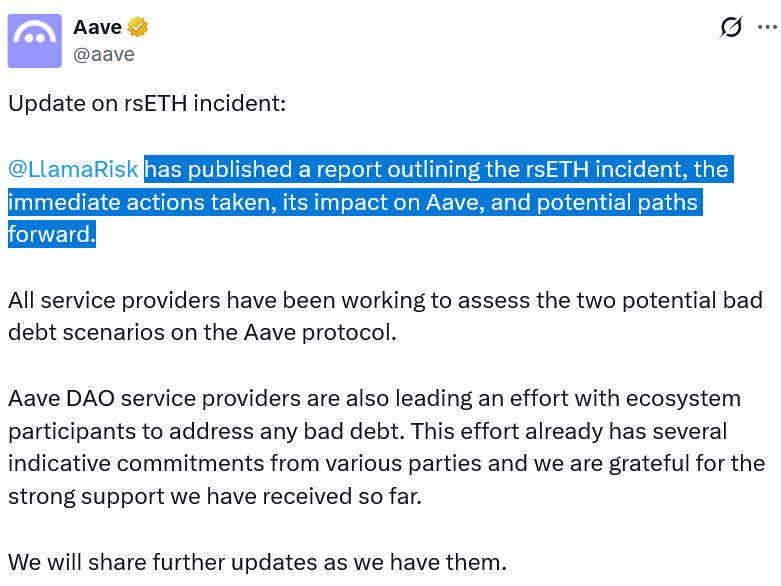
Decentralized lending platform Aave’s risk management provider has outlined two scenarios on how bad debt from the Kelp DAO exploit over the weekend could impact the ecosystem, depending on how the losses are allocated.
The incident began on Saturday when hackers stole 116,500 Kelp DAO Restaked ETH (rsETH) tokens worth $293 million from Kelp DAO’s LayerZero-powered bridge and used them as collateral on Aave V3 to borrow wrapped Ether (wETH).
On Monday, LlamaRisk modeled two possible scenarios for how this “bad debt” could materialize on Aave, noting that the final decision rests with Kelp DAO.
The incident highlights the contagion risk in DeFi, where a single bridge exploit can trigger liquidity crunches and mass withdrawals across interconnected protocols like Aave, which has seen nearly $10 billion in value leave the protocol since the Kelp DAO exploit took place.

Two scenarios and potential paths forward
The first scenario would see losses spread across all rsETH token holders on Ethereum mainnet and Ethereum layer 2s, resulting in roughly $123.7 million of bad debt on Aave while risking a 15% depeg in rsETH relative to Ether (ETH).
LlamaRisk said this first scenario would spread losses more thinly across all chains, while noting that wrapped Ether (wETH) would be “absorbing the bulk in absolute terms but barely noticing it relative to its reserve depth.”
Aave could also use its Umbrella security model to cover losses in wETH under the first scenario, noting that 18,922 Aave Wrapped ETH (aWETH) tokens worth nearly $43.7 million have entered the unstaking cooldown phase.
The second scenario would shift the entire shortfall to Ethereum layer 2 networks, such as Arbitrum and Mantle. However, the bad debt would be significantly higher at $230.1 million.
LlamaRisk also noted that Aave has around $181 million in its treasury that could be used to address a potential bad debt shortfall.

Related: Aave DAO backs V4 mainnet plan in near-unanimous vote
On Monday, Kelp DAO said it is still assessing the financial impact of the exploit and how to safely unpause the protocol, adding that it is working with Aave, LayerZero and other stakeholders on a path forward.
Kelp DAO sheds more light on the exploit
Kelp DAO also shared more details about the incident, saying that two nodes tied to the LayerZero bridge were compromised, while a third was hit with a distributed denial-of-service attack.
The attacker forged a seemingly valid transfer message that the system approved, allowing 116,500 rsETH to be minted on one of LayerZero’s bridges.
Kelp said it paused all relevant contracts on Ethereum and Ethereum layer 2s and blacklisted all wallets tied to the exploiter shortly after, preventing them from stealing another 40,000 rsETH worth $95 million.
Magazine: Are DeFi devs liable for the illegal activity of others on their platforms?
![Strategi 1% rule: Kenapa simpan RM50 lebih baik dari berangan RM10k [Kewangan]](https://wordupnews.com/wp-content/uploads/2026/02/1770720522_maxresdefault-80x80.jpg)
Strategi 1% rule: Kenapa simpan RM50 lebih baik dari berangan RM10k [Kewangan]

Hallmark faces backlash over ‘whitewashed’ new Mahjong movie
NSE IPO can unlock Rs 12,000 crore for PSU insurers, boost solvency



-

 NewsBeat7 days ago
Trump and Pope Leo: Behind their disagreement over Iran war
-

 Fashion3 days ago
Weekend Open Thread: Theodora Dress
-

 News Videos6 days ago
Secure crypto trading starts with an FIU-registered
-

 Sports4 days ago
NWFL Suspends Two Players Over Post-Match Clash in Ado-Ekiti
-

 Crypto World7 days ago
SEC Proposes Certain Crypto Interfaces Don’t Need to Register as Brokers
-

 Business2 days ago
Powerball Result April 18, 2026: No Jackpot Winner in Powerball Draw: $75 Million Rolls Over
-

 Crypto World3 days ago
Russia Pushes Bill to Criminalize Unregistered Crypto Services
-

 Politics8 hours ago
Gary Stevenson delivers timely reminder to register to vote as deadline TODAY
-

 Politics3 days ago
Palestine barred from entering Canada for FIFA Congress
-
 Business4 days ago
Creo Medical agree sale of its manufacturing operation
-

 Politics2 days ago
Zack Polanski demands ‘council homes not luxury flats for foreign investors’
-

 Crypto World3 days ago
Russia Introduces Bill To Criminalize Unregistered Crypto Services
-

 Tech2 days ago
Auto Enthusiast Scores Running Tesla Model 3 for Two Grand and Turns It Into Bare-Bones Go-Kart
-

 Tech5 days ago
‘Avatar: Aang, The Last Airbender’ Leaked Online. Some Fans Say Paramount Deserves the Fallout
-

 Tech6 days ago
Microsoft adds Windows protections for malicious Remote Desktop files
-

 Crypto World6 days ago
X Launches New Cashtag Feature for Stocks and Crypto: X
-

 Sports7 days ago
Younger Than Sachin Tendulkar: Vaibhav Sooryavanshi Set To Make Historic India Debut
-

 Entertainment6 days ago
Prince Carter Brings Fans Front Row and Backstage at Boys 4 Life Tour
-
 Entertainment6 days ago
Dave Portnoy Slams Dianna Russini: ‘Makes Zero Sense’
-

 Sports5 days ago
British climbers complete new route in Swiss Alps
You must be logged in to post a comment Login