

Crypto World
DeFi TVL Down by $45B in 2026 Despite More Resilient Market Structure

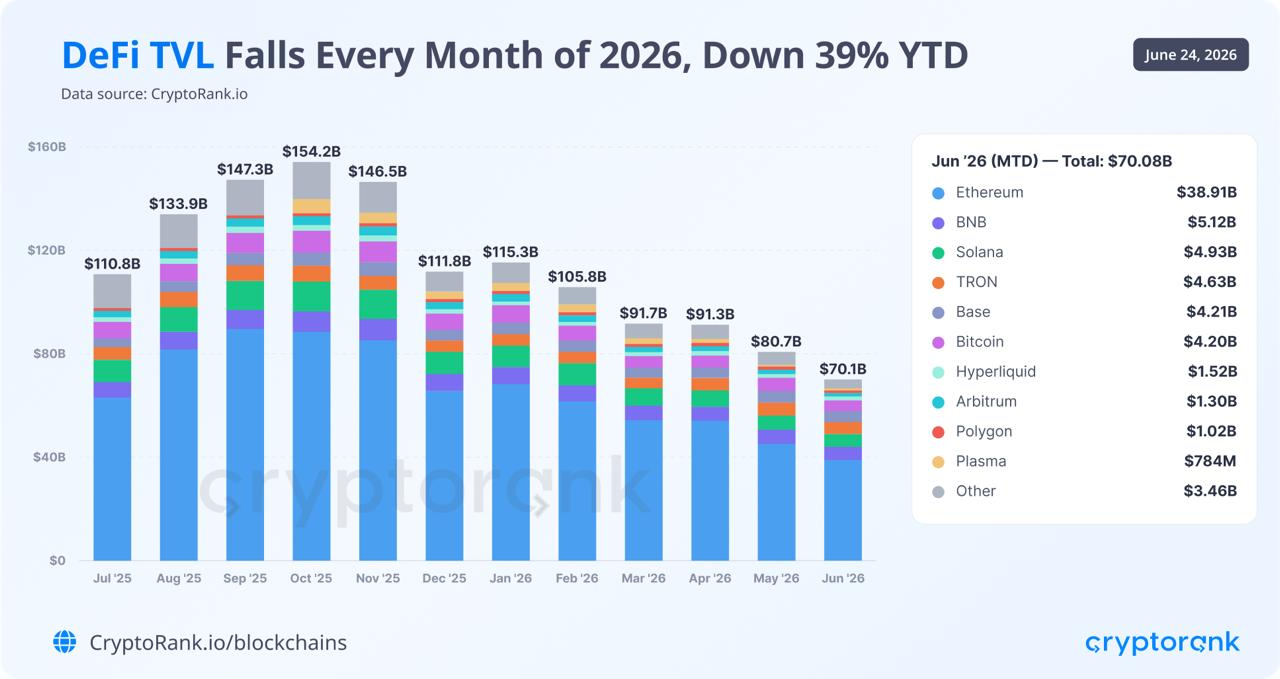
Total value locked (TVL) in decentralized finance (DeFi) has fallen by about 39% in 2026 so far, declining to just over $70 billion from roughly $115 billion in January.
A Wednesday report from crypto data aggregator CryptoRank attributed the decline to the broader market correction that followed the October 2025 crypto market peak.
After Bitcoin reached a record high above $122,000, a market-wide liquidation event on Oct. 10, 2025, erased more than $19 billion in leveraged positions and accelerated a deleveraging cycle across digital assets.
Despite the decline, CryptoRank noted that the current drawdown remains far smaller than during the 2021-2022 bear market, suggesting a more resilient DeFi market.
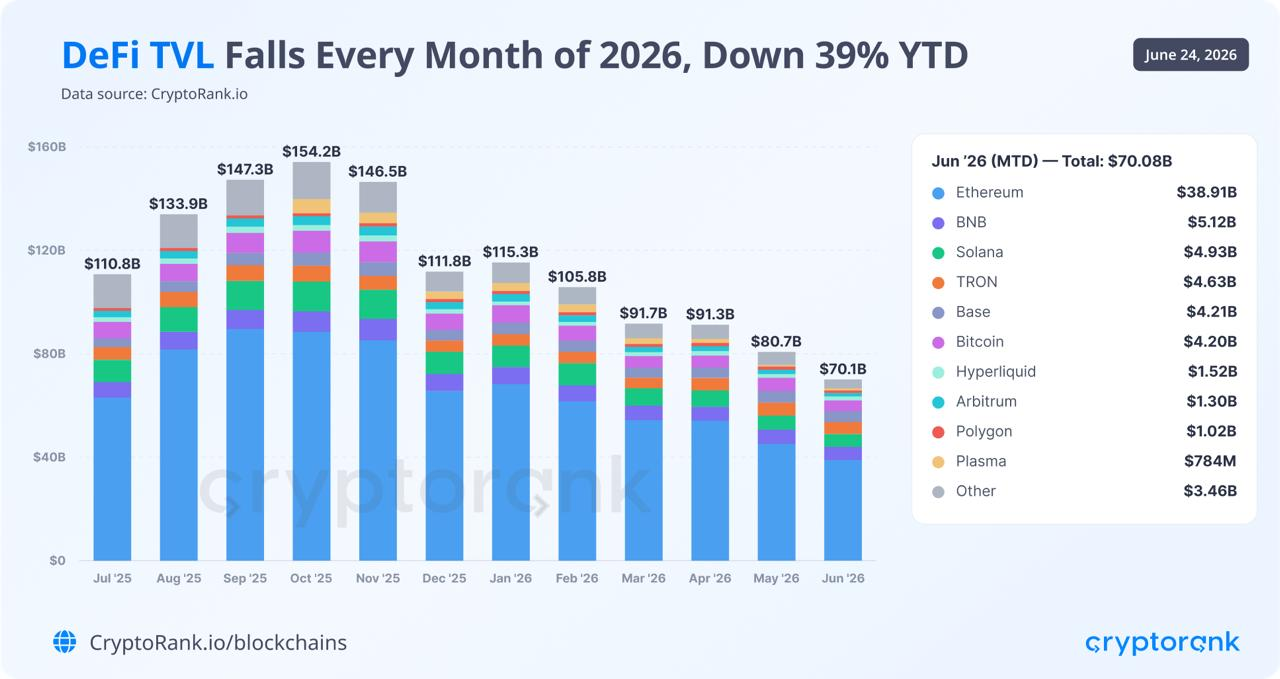
DeFi TVL, 1-year chart, monthly. Source: CryptoRank
Fallout from Kelp DAO exploit accelerated the DeFi TVL decline: analyst
CryptoRank said security incidents added another layer of pressure on DeFi in 2026, with 121 hacks and roughly $942 million in losses year-to-date. While exploits were not the primary driver of the decline, the data provider said their frequency likely weighed on user confidence and reinforced capital outflows from DeFi.
According to Nicolai Søndergaard, senior research analyst at crypto intelligence platform Nansen, the fallout from the $293 million Kelp DAO exploit on April 18 compressed into days what would otherwise have been weeks of DeFi outflows. Aave users withdrew about $15 billion in deposits in the four days following the exploit.
Related: CryptoQuant warns on Strategy’s dividend coverage as cash reserve falls 38%
The second quarter of 2026 became the most-hacked quarter on record by incident count, with 83 exploits targeting crypto protocols. However, the $755 million stolen during the quarter remained well below the $3.56 billion lost in the fourth quarter of 2020, the costliest quarter for crypto hacks on record.
The falling total value stolen is not due to more robust industry security but a sign that hackers are expanding their attack surface, according to Dmytro Matviiv, CEO of crowdsourced security and bug bounty platform HackenProof. He told Cointelegraph that the lower aggregate losses are “misread as progress,” but only the leading protocols have become harder to exploit, forcing attackers to expand their attack surface.
Alvin Kan, chief operating officer at Bitget Wallet, said that the cyber exploits are making users more cautious, but added that these may also result in capital leaving “weaker” DeFi protocols for those with “stronger venues and clearer yield models,” leading to more industry consolidation.
Magazine: Bitcoin, the ‘canary in the coal mine,’ XRP transaction demand falls 91.5%: Market Moves

Crypto World
Strategy Stock Falls Below $100 for First Time in Two Years as Analysts Pick Apart Its Bitcoin Bet

Shares of Strategy, the largest corporate holder of Bitcoin, fell below $100 on Wednesday for the first time since March 2024, leaving the company trading at a discount to the Bitcoin on its balance sheet and turning investor attention to which layer of its capital structure is still worth owning…. Read the full story at The Defiant

Cryptocurrency mining profitability remains under pressure across major proof-of-work networks, according to new data shared by Alphractal, which shows the sector is experiencing stagnation and reduced returns.
The analytics platform said that while miners continue to play an important role in maintaining network security and decentralization, the data suggests that profitability remains difficult across major proof-of-work networks.
Growing Pressure on Miners
Alphractal’s Mining Equilibrium Index compares miners’ average revenue per hash over 30 days against the 365-day average. Readings above 1.0 signal above-average profitability, while values below 0.5 point to stressed conditions for miners.
Among the four largest proof-of-work assets tracked by the index, Bitcoin posted the highest reading at 0.75, which makes it the strongest performer in terms of mining profitability.
Bitcoin Cash (BCH) followed at 0.66, which suggests relatively better conditions than the rest of the group. The OG meme coin, Dogecoin (DOGE), registered a score of 0.60, as mining profitability declined significantly over the years. Litecoin (LTC), on the other hand, recorded the lowest reading at 0.58, making it the weakest performer among the four assets.
However, Bitcoin’s position at the top of the list does not necessarily point to favorable conditions for miners. As recently reported by CryptoPotato, Bitcoin mining difficulty fell by more than 10%, in one of the largest downward adjustments of the year, and demonstrated that fewer miners are participating in the network. At the same time, the Bitcoin hash rate has continued to decline.
The figure briefly dropped below 790 EH/s this month from record levels above 1.2 ZH/s reached last year.
Alphractal also acknowledged that the current environment has made crypto mining increasingly dependent on access to capital, operational efficiency, and patience.
BTC Sales By Mining Companies
Several publicly listed Bitcoin miners have been selling their BTC holdings at the fastest pace since the previous crypto bear market. Back in April, The Energy Mag published a report that revealed that major mining companies such as MARA, CleanSpark, Riot, Cango, Core Scientific, and Bitdeer collectively sold more than 32,000 BTC during the first quarter of 2026.
The amount of Bitcoin sold surpassed the combined net sales recorded throughout all four quarters of 2025. The figure also set a new industry record as it exceeded the roughly 20,000 BTC liquidated by public miners during the second quarter of 2022, when the market was shaken by the collapse of the Terra-Luna ecosystem.
The post Mining Profits Dry Up Across Bitcoin, DOGE, LTC, and BCH appeared first on CryptoPotato.
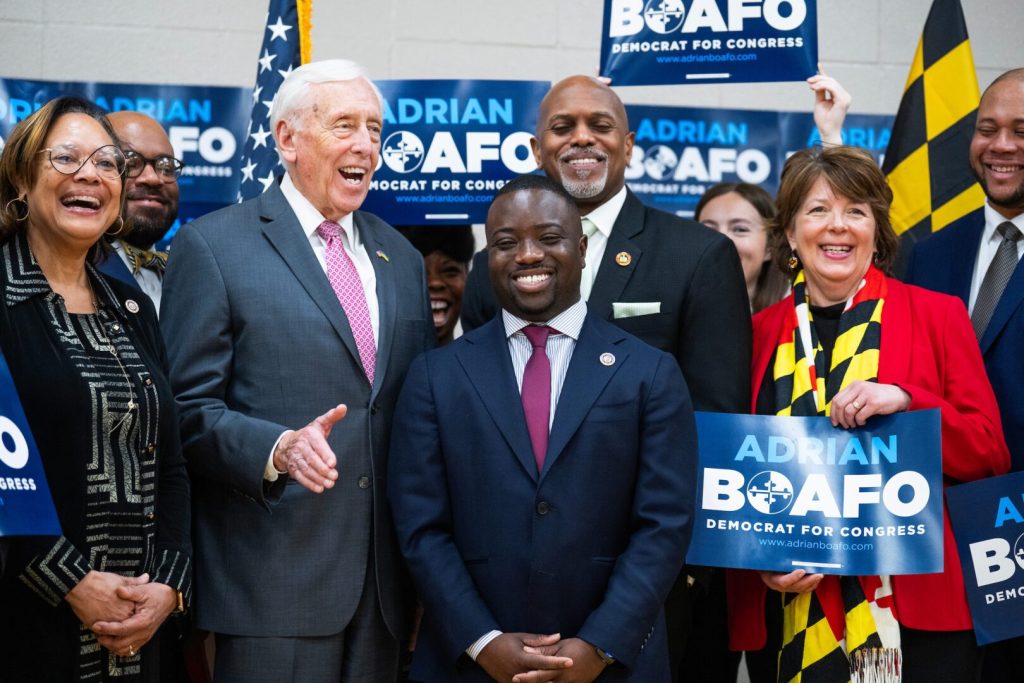
Protect Progress, the super PAC affiliated with crypto industry flagship Fairshake, spent $5.5 million backing Adrian Boafo in Maryland’s Democratic primary for the 5th Congressional District on June 23, a 24-candidate field for the seat vacated by retiring House Majority Leader Steny Hoyer.
Boafo won. Fairshake spokesperson Geoff Vetter put it plainly: “We went big, and we went early. We did our part to move Adrian Boafo from fifth place to the halls of Congress.”
That is not a boast. It is a data point. Boafo entered the race without top-tier name recognition in a district crowded with stronger-profile rivals, including former U.S. Capitol Police officer Harry Dunn, who carried Nancy Pelosi’s endorsement. The crypto PAC’s independent expenditure campaign changed the arithmetic of the race.
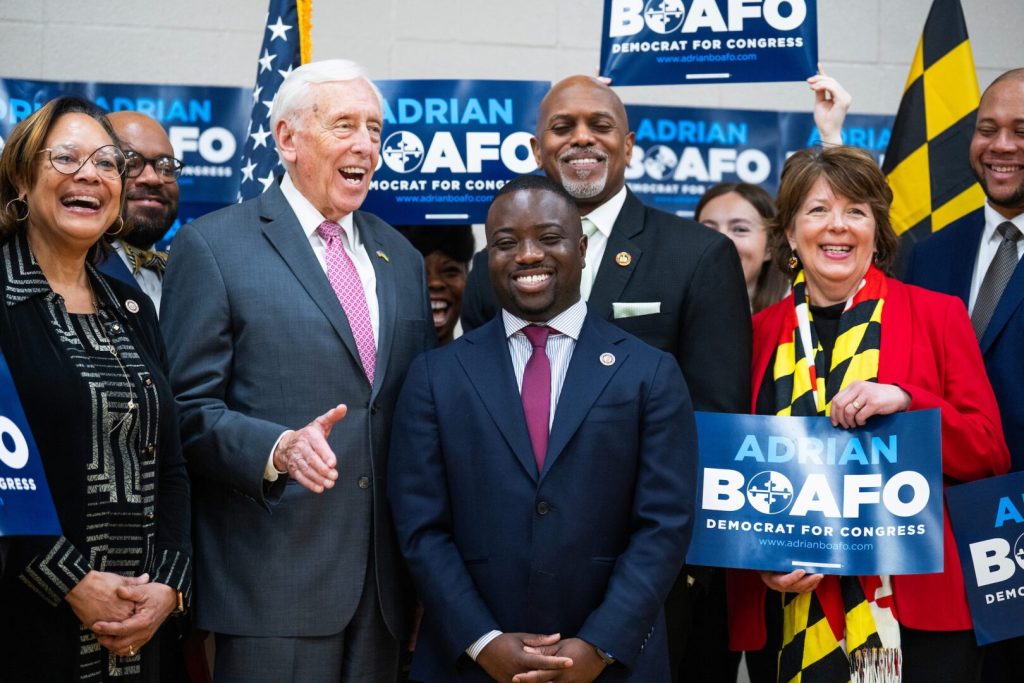
MD-05 is rated safely Democratic in the general election. Boafo’s primary win is effectively his congressional seat.The execution event, crypto-backed members voting as a bloc on market structure legislation, comes next.
The Maryland result is a single data point inside a larger, faster-moving pattern. Crypto legislation is stacking up in Congress, and the industry has been explicit about its strategy: build the vote count before the bills arrive on the floor, not after. Fairshake and allied crypto PACs have raised $188.9 million for the 2026 cycle، an aggressive early pace relative to the $359.4 million they deployed across the entire 2024 cycle. The Maryland win is proof of concept, not a one-off.
How $5.5M Buys a Congressional Nomination in a 24-Candidate Field
The structural logic of primary targeting is straightforward: low-turnout primaries in safe seats are the cheapest legislative votes the industry can buy. A $5.5 million independent expenditure in a crowded Democratic primary, where winning margins can be decided by a few thousand ballots, delivers substantially more ROI than the same sum deployed in a competitive general election.
Protect Progress is the Fairshake network’s affiliate vehicle for House races. The PAC began spending on Boafo well before the final push. Estimates from AdImpact and FEC data place early-cycle expenditures at $3.1 to $4.5 million by early June, including roughly $300,000 in a single week on TV and mail, before the final burst brought the total to $5.5 million.
This was a sustained intervention, not a last-minute rescue.
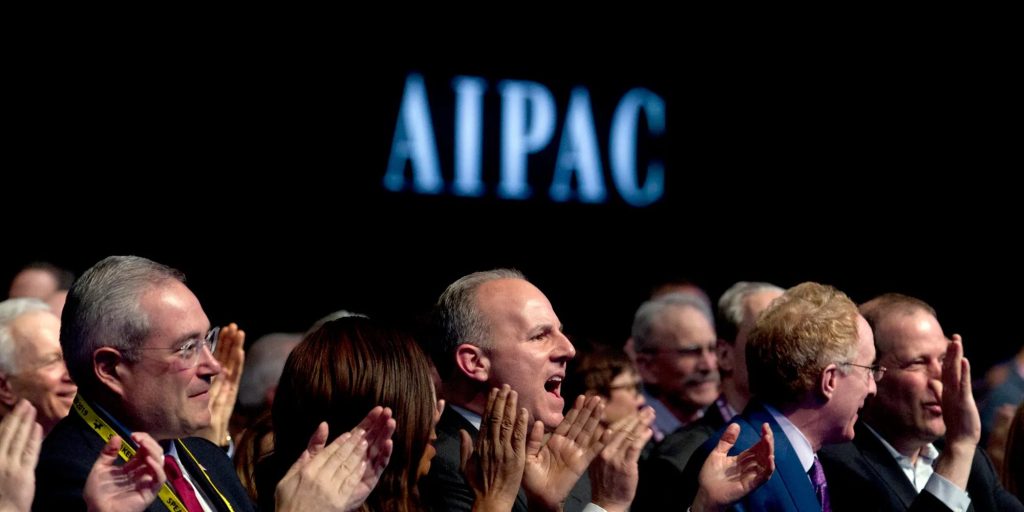
When AIPAC’s United Democracy Project is included, total outside support for Boafo reaches approximately $10-$11 million, accounting for more than 80% of all pro-Boafo advertising. The ads themselves did not mention crypto as an issue، they ran on endorsements from Governor Wes Moore, Senator Angela Alsobrooks, and Steny Hoyer.
The financial architecture and the campaign message were kept in separate lanes, which is legally required for independent expenditures and strategically useful for optics.
Maryland Senator Chris Van Hollen called the spending an “obscene amount of big special-interest money.” That framing will repeat in November and in the next cycle. It has not yet altered the outcome of a race where Fairshake was deployed at this scale.
Crypto PAC Have Raised $188.9M This Cycle: Maryland is the Latest Proof of Concept
The Maryland congressional election was not the only race on the board Tuesday. Fairshake simultaneously spent $1.3 million backing Representative Ritchie Torres in New York’s 15th district، described internally as one of the industry’s most reliable House allies، and $516,000 on incumbent Representative April McClain Delaney in Maryland.
All supported candidates won or were winning as counts concluded.
The week prior, Fairshake had committed $12 million to Barry Moore’s Alabama Senate bid, the largest single-race deployment in the PAC’s 2026 cycle to date. The pattern is bipartisan by design: Moore is a Republican; Boafo and Torres are Democrats. The crypto PAC’s selection criterion is a candidate’s regulatory posture, not party affiliation.
The Blockchain Leadership Fund, backed by Anchorage Digital and Chainlink, also aligned publicly with Boafo in MD-05, adding a second layer of industry coordination beyond Protect Progress.
Fairshake’s broader donor base، heavily funded by Coinbase and Andreessen Horowitz, which have each contributed tens of millions to crypto-aligned political vehicles، had approximately $126 million remaining on-hand at the end of May, with general election spending not yet begun. The industry is not running low on ammunition.
Prediction market platform Kalshi currently prices a Democratic House majority at 79% odds. If that holds in November, the crypto industry will have built campaign-finance relationships with a significant portion of the incoming majority caucus, relationships established at the primary stage, before general election loyalties had to be negotiated.
The post Fairshake’s $5.5M Maryland Bet Pays Off: Boafo Heads to Congress appeared first on Cryptonews.
Crypto World
Lummis Sets July as Senate Floor Deadline for Clarity Act, Tells Dimon to Read the Bill


Senator Cynthia Lummis announced Wednesday morning that the Digital Asset Market Clarity Act will reach the Senate floor in July, setting the first hard public commitment to a floor date from the bill's lead sponsor. Lummis made the announcement on Fox Business's "Mornings with Maria," saying the… Read the full story at The Defiant


Months of negotiations have brought the CLARITY Act to its final review stage, with Senator Cynthia Lummis confirming a July 4 release of the updated text ahead of a Senate push later in July.
Summary
- Senator Cynthia Lummis said the final CLARITY Act text will be released around July 4 for public review.
- Senate leaders are working to schedule floor consideration of the crypto market structure bill in July.
- Law enforcement groups and anti-trafficking advocates continue to oppose Section 604 over AML and oversight concerns.
According to Lummis, who spoke with Fox Business host Maria Bartiromo, Senate negotiators are preparing to publish the updated legislative text after months of discussions involving lawmakers, industry stakeholders, and banking representatives. She said the bill will be made available for one final round of feedback before lawmakers seek a Senate floor vote later in July.
Speaking during the interview, Lummis said negotiations on the legislation have been ongoing since last Labor Day and have required extensive work to address concerns raised throughout the drafting process. She stated that lawmakers spent thousands of hours examining issues tied to both the CLARITY Act and the recently debated GENIUS Act while also considering objections raised by parts of the banking industry.
Following the publication of the text, Lummis said Senate leadership is working to secure floor time next month. She added that discussions with Senate Majority Leader John Thune are focused on placing the legislation on the chamber’s July agenda.
Senate prepares next step for crypto market structure bill
The expected release comes as lawmakers continue refining a framework intended to establish regulatory boundaries for digital asset markets in the United States.
During the interview, Lummis pushed back against criticism from JPMorgan CEO Jamie Dimon, who had argued that the bill could allow crypto companies to offer rewards programs resembling interest-bearing banking products without being subject to the same safeguards as traditional financial institutions.
Responding to those concerns, Lummis said the criticism does not accurately reflect the legislation’s current language. She pointed to Section 301 of the bill, which she said was revised during negotiations to address issues raised by banks and regulators.
According to Lummis, the updated provisions ensure that rewards offered by crypto firms are not linked to account balances in a way that resembles interest payments. She also said the legislation includes additional anti-money laundering measures that were incorporated during the drafting process.
Her remarks come as lawmakers continue balancing demands from the crypto industry with concerns raised by traditional financial institutions over consumer protections and regulatory consistency.
Section 604 continues to attract opposition
While Senate negotiators move toward publication of the final text, several organizations have recently urged lawmakers to reconsider another part of the legislation.
As crypto.news previously reported, four law enforcement organizations sent a letter to Acting Attorney General Todd Blanche and White House digital assets adviser Patrick Witt, warning that Section 604 could create regulatory gaps and make investigations involving digital assets more difficult. The groups argued that the provision could weaken Know Your Customer and Anti-Money Laundering requirements compared with standards applied in traditional finance.
Section 604 incorporates the Blockchain Regulatory Certainty Act and would prevent certain non-custodial participants, including open-source developers, self-custody tool providers, software contributors, and some decentralized finance infrastructure operators, from automatically being classified as money transmitters.
Separately, the Alliance to End Human Trafficking urged Senate Republican Leader John Thune and Senate Democratic Leader Chuck Schumer to revisit the same provision. The organization said the proposed language could create ambiguities that complicate efforts to monitor financial activity linked to human trafficking, organized crime, child exploitation, sanctions evasion, and other illicit conduct.
Those objections add to the list of issues lawmakers are weighing as the CLARITY Act enters what Lummis described as its final public review phase before Senate consideration.


Ripple won a regulatory milestone in Japan this week — but it needed a rival blockchain to do it.
Earlier today, SBI VC Trade, a crypto arm of the $11 billion Japanese financial giant SBI Holdings, listed Ripple’s dollar-pegged stablecoin for trading, heralding it as the country’s first “Type 4 electronic payment instrument” under Japan’s revised Payment Services Act.
However, the only Ripple USD (RLUSD) tokens that SBI traders in Japan can deposit or withdraw are on the Ethereum blockchain.
The irony is rich. Ethereum is the primary competitor of the XRP Ledger (XRPL), the blockchain that Ripple incubated.
The Japanese approval of RLUSD as its first Type 4 instrument is unambiguous. The supported chain is Ethereum, and RLUSD on any other chain will not be accepted for deposit, including XRPL-based RLUSD.
Additional blockchains could earn approval in the future, although regulators have not specified any particular timeline for review.
Type 4 electronic payment method
Japan’s 2023 amendments to its Payment Services Act created a dedicated regulatory bucket for fiat-pegged stablecoins.
These “electronic payment instruments” separated digital money-type tokens from ordinary crypto assets like ether or XRP, which aren’t pegged in value to any fiat currency.
Pursuant to Article 2 of the act, Type 1 instruments include currency-denominated value usable for payment to and tradable with unspecified persons, Type 2 covers value instantly exchangeable with Type 1, and Type 3 covers instruments with specific trust beneficiary rights.
Type 4 is a residual, catch-all slot for property value designated, by cabinet office ordinance, as otherwise equivalent in value to the first three categories.
It’s the bucket regulators can reach for when an instrument doesn’t fit cleanly anywhere else.
That residual quality explains the awkward legal footnote in SBI VC Trade’s own announcement. The RLUSD token is not a trust beneficiary right under US law, the company noted, yet SBI workers were able to help it gain Type 4 classification for Japanese purposes anyway after establishing its financial equivalencies to the USD to the satisfaction of regulators.
The Type 4 label is as much a classification as a regulatory admission that Ethereum has some superiority over the XRPL.
RLUSD didn’t slot neatly into the three main categories, but thanks to the help of Ethereum, it was able to gain a catch-all designation.
It’s issued by Standard Custody & Trust Company, a New York-chartered Ripple subsidiary, and is backed by dollar deposits and short-term Treasuries subject to monthly, third-party attestations.
It’s the second dollar stablecoin on the SBI VCTRADE platform, which has handled Circle’s USDC since March 2025. USDC is a Type 3 instrument in Japan.
An XRP milestone using Ethereum
Still, XRP influencers framed the event as a win. RLUSD started trending on X.
The president of SBI VC Trade billed the listing as a milestone and credited Ripple Labs for the momentous occasion.
Jack McDonald, Ripple’s senior vice president for stablecoins, praised Japan’s regulatory clarity and applauded RLUSD’s ability to link Japanese institutions with global liquidity.
Neither executive dwelt on which blockchain was actually linking up the liquidity.
“They launched this one on ETHEREUM,” one account posted in reply to celebratory coverage.
A separate post highlighted the fine print on the approval. RLUSD is live “on Ethereum ONLY” as a Japanese Type 4 electronic payment instrument and capped at roughly $6,200 per transaction, a ceiling that matches the 1 million yen per-transaction limit set in SBI VC Trade’s own announcement.
Most of RLUSD already lives on Ethereum
The Japanese listing isn’t an anomaly. Indeed, despite being a Ripple project, the majority of RLUSD tokens have historically existed outside of the XRPL.
As Protos reported on June 15, around $879 million of the token in circulation was parked on Ethereum, ahead of roughly $760 million on the XRP Ledger.
Read more: Ripple dumps XRP to pump RLUSD — still 0.2% the size of USDT
Ethereum’s dominance had been wider earlier in the cycle, with Ethereum holding close to 88% of RLUSD supply as recently as October 2025.
Coin listing sites like CoinMarketCap reinforce the preeminence of Ethereum-based RLUSD, listing RLUSD’s primary blockchain as Ethereum and pointing to the token’s ERC-20 contract address as its primary smart contract, rather than any XRP Ledger issuance.
Dwarfing the size of XRPL, Ethereum gave RLUSD deeper liquidity, mature DeFi venues like Aave and Curve, and a far larger base of dollar-stablecoin holders.
For a Japanese exchange wiring up a new asset, Ethereum-based RLUSD was the quickest path to approval and trade listings.
Got a tip? Send us an email securely via Protos Leaks. For more informed news and investigations, follow us on X, Bluesky, and Google News, or subscribe to our YouTube channel.
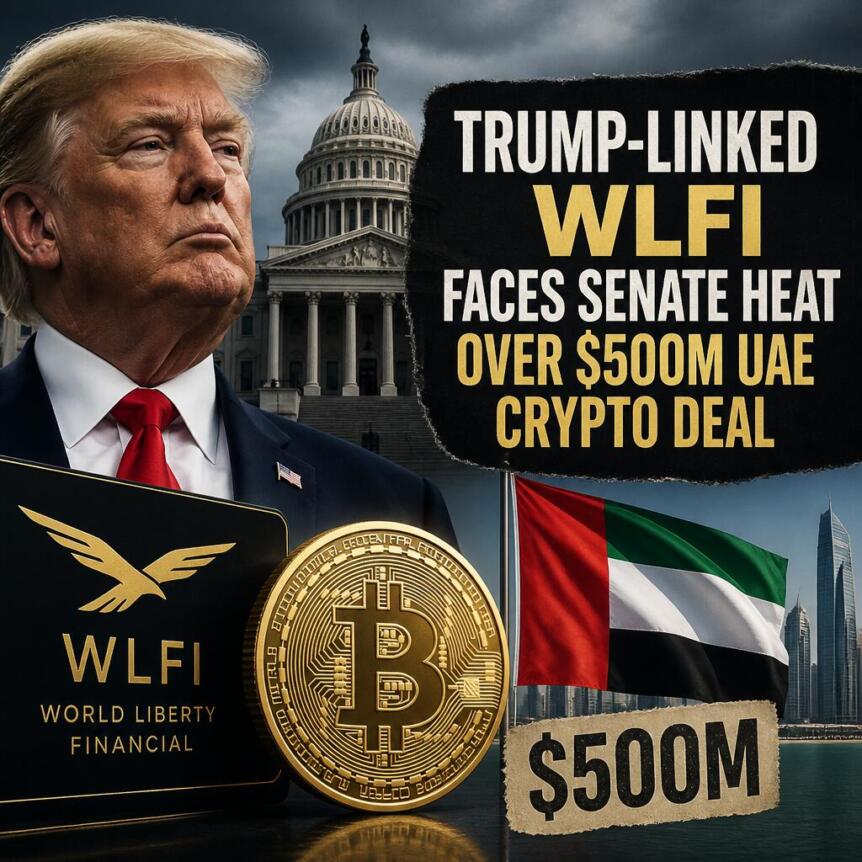
Congressional scrutiny has intensified around World Liberty Financial (WLFI) after Senate Democrats raised concerns about a major foreign-linked investment. The lawmakers are seeking additional information about a reported transaction involving entities connected to the United Arab Emirates. Meanwhile, the issue has emerged alongside ongoing debates over digital asset legislation in Washington.
Senate Democrats Seek Review of WLFI UAE Investment
Five Democratic senators have urged Republican committee leaders to examine a reported investment involving WLFI. The lawmakers requested a congressional hearing and highlighted potential conflicts linked to foreign interests. As a result, the issue has drawn fresh attention to the company’s ownership structure.
According to the senators, the investment agreement was completed shortly before Donald Trump returned to office. They stated that a UAE-linked partner received a 49% stake in WLFI through the arrangement. Additionally, the lawmakers reported that foreign buyers paid $218 million to entities connected to Trump and envoy Steve Witkoff.
The senators identified Sheikh Tahnoon bin Zayed Al Nahyan as the lead investor in the transaction. They argued that the reported ownership structure raises questions about foreign influence. Consequently, they requested sworn statements from administration officials and others connected to the deal.
The lawmakers also pointed to policy developments that occurred after Trump took office. They noted that the UAE received more than $1.4 billion in arms approvals since January 2025. Furthermore, exports of advanced artificial intelligence chips exceeded $1 billion during the same period.
Democrats want authorities to clarify what officials knew about the reported payments and timing. Therefore, they are seeking records and testimony from relevant parties. The request forms part of a broader effort to examine potential conflicts involving public officials.
The inquiry adds another layer of political pressure on WLFI and its associated projects. At the same time, lawmakers continue to debate how digital asset businesses should operate. As discussions continue, congressional committees may face increased pressure to address the concerns.
Clarity Act Debate Adds New Dimension to Dispute
The controversy has surfaced while Congress continues work on the CLARITY Act. The legislation aims to establish a clearer regulatory framework for digital assets. Therefore, lawmakers remain engaged in negotiations over several key provisions.
Senate Democrats have proposed ethics measures tied to the legislation. The proposal would restrict federal officials from creating, promoting, or sponsoring crypto assets. Consequently, the amendment could affect projects associated with current government officials.
The proposed restrictions could impact crypto ventures linked to Trump. Lawmakers specifically referenced World Liberty Financial and the TRUMP meme coin. As a result, the debate has expanded beyond market regulation and into ethics oversight.
White House crypto adviser Patrick Witt has become involved in discussions surrounding the bill. Reports indicate that he is working to address concerns related to the ethics provisions. Meanwhile, lawmakers continue to negotiate the final structure of the legislation.
Supporters of the ethics proposal argue that stronger safeguards would reduce potential conflicts. However, opponents maintain that broad restrictions could affect participation in emerging technologies. Therefore, the issue remains a key point of disagreement in Congress.
The dispute highlights the growing intersection between digital assets and national politics. At the same time, regulators and lawmakers continue shaping future crypto policy. As congressional discussions move forward, both the WLFI inquiry and the CLARITY Act debate are expected to remain prominent topics.


Cboe, one of the largest U.S. derivatives exchanges, said it is entering the prediction-market arena and is reviving binary options on the S&P 500 index after abandoning them more than a decade ago, a move that brings it into competition with platforms such as Kalshi and the crypto-native Polymarket.
A binary option is a yes-or-no bet that pays a fixed amount if an outcome occurs, in this case whether the benchmark U.S. equity index crosses a specific level. That is close to what Polymarket and Kalshi already offer, though their offerings go beyond stock market forecasts to cover political and sporting outcomes as well as other topics.
The introduction follows Cboe’s success with same-day S&P 500 options, contracts that expire within hours and now make up about 30% of U.S. options volume, calling attention to the demand for fast, outcome-based trades.
“Investors increasingly seek products that allow them to express a specific view on future events and market outcomes,” said Milan Galik, CEO of Interactive Brokers, which is carrying the binary contracts, in a statement.
The contracts will also become available on Charles Schwab later this year.
Second time round
Cboe has tried this market before. It first listed binary options on the S&P 500 and the Cboe Volatility Index in 2008, but they failed to draw interest and were pulled, with the last such contract expiring in 2017.


YZi rejected suggestions that the settlement amounts to a takeover, a person close to the settlement told CoinDesk in an interview, describing it instead as a governance reset intended to unlock shareholder value. The firm also stressed that Binance founder Changpeng “CZ” Zhao was not involved in the initiative.
The investment firm was rebranded from the venture arm of crypto exchange Binance in 2024. Following Zhao’s release from prison that year, he took a more active role in venture project. YZI Labs is often referred to as Zhao’s family office – the name for an investment vehicle that manages a family’s wealth. YZi, however, says its structure is different, as it does not involve itself in estate planning, tax structuring and other similar functions.
YZi’s goal is to reposition CEA as a leading BNB treasury vehicle, comparable to Strategy’s (MSTR) role in bitcoin markets. The firm argues that CEA’s shares trade at a significant discount to the value of its underlying BNB holdings, a gap it believes can be narrowed through governance reforms and a clearer operating strategy.
The move comes as digital asset treasury companies enter what some investors describe as a second phase of development. While early treasury firms focused primarily on accumulating crypto assets, newer models are increasingly looking to generate revenue from ecosystem participation and infrastructure businesses tied to those holdings.


Arredondo argues that the industry has spent years building separate blockchain networks, stablecoins and digital money projects, but has spent less time ensuring those systems can work together.
“We need to move the market from everyone doing their own very cool things to actually thinking about standard-setting across the piece.”
The issue has become more important as governments, banks and private companies increasingly experiment with tokenized deposits, stablecoins and central bank digital currencies (CBDCs).
Arredondo pointed to the European Union (EU) as an example of a jurisdiction seeking to accommodate multiple forms of digital money simultaneously.
The EU’s approach allows stablecoins, tokenized bank deposits and central bank money to coexist under the same broad framework, she said.
Wall Street’s crypto role
The growing role of banks, asset managers and large financial institutions in crypto has divided the industry. Some early crypto supporters argue the sector is moving away from its original goals of decentralization and disintermediation.
Arredondo sees it differently. “The early crypto vision raised fundamental economic questions and brought them to the mainstream,” she said.
For Arredondo, the rise of institutional crypto does not mean the industry’s early ideas failed.
Instead, she sees it as evidence that ideas first developed inside the crypto sphere are increasingly being adopted by mainstream finance. “It shouldn’t be disappointing that we are maintaining the pillars that have long anchored trust in money.”
Strategy Stock Falls Below $100 for First Time in Two Years as Analysts Pick Apart Its Bitcoin Bet

Canada’s Diallo reaches quarterfinals at Eastbourne with win over Etcheverry

ASUS ROG Zephyrus Duo With RTX 5090 Now Available in India


-

 Fashion5 days ago
Weekend Open Thread: Miami – Corporette.com
-

 Entertainment4 days ago
Renter of Home in Anne Heche Crash Denies Settlement With Son
-

 Tech2 days ago
Microsoft accidentally kills epic Outlook email threads
-
 Sports24 hours ago
Two goals and an assist by sheer aura: Cristiano Ronaldo just entered the World Cup chat
-

 Business4 days ago
Soccer-U.S. defends Iran World Cup travel restrictions, says discussions ongoing
-
Crypto World15 hours ago
Bitcoin (BTC) Dips Below $62K, Ethereum (ETH) Plunges 6% Daily: Market Watch
-

 Politics6 days ago
BBC Reporter Discusses Cross Party Criticism Of Trumps Iran Deal
-

 Crypto World12 hours ago
Securitize Wraps Roubini's SEC-Registered ETF as Dubai VARA Digital Security
-
Business18 hours ago
Entergy settles forward sale agreements, raises $672 million in cash proceeds
-
 Business5 days ago
Wall Street Week Ahead: Investors see Micron earnings as pulse check of AI rally momentum
-

 Politics4 days ago
Andy Burnham and the meaning of Makerfield
-

 Tech6 days ago
AWS enters the context layer race with a graph that learns from agents, not manual curation
-
 Crypto World4 days ago
Can Charles Hoskinson Really Rescue Cardano?
-

 NewsBeat5 days ago
Keir Starmer Allies Question His Chances For No 10
-

 Crypto World5 days ago
HIVE shares jump as $220M AI deal speeds Bitcoin mining pivot
-

 Crypto World4 days ago
Jake Chervinsky accuses CME of protecting derivatives monopoly
-
 Tech3 days ago
Signal’s Meredith Whittaker says AI chatbots ‘are not your friends’ and calls Copilot agents a backdoor
-

 Entertainment5 days ago
Jose Alvarado Wants Taylor Swift at More Knicks Games
-

 Tech2 days ago
Nearly 7,000 fake Amazon domains registered ahead of Prime Day 2026, researchers warn
-

 Business6 days ago
Brexit cost 6% of UK economy, Bank of England company data suggests
You must be logged in to post a comment Login